

- Market Size (2026)
- USD 2.5 Bn
- Forecast (2036)
- USD 6.0 Bn
- CAGR (2026 to 2036)
- 9.1%
How big is DNases Ligases RNA Polymerases Market in 2026?
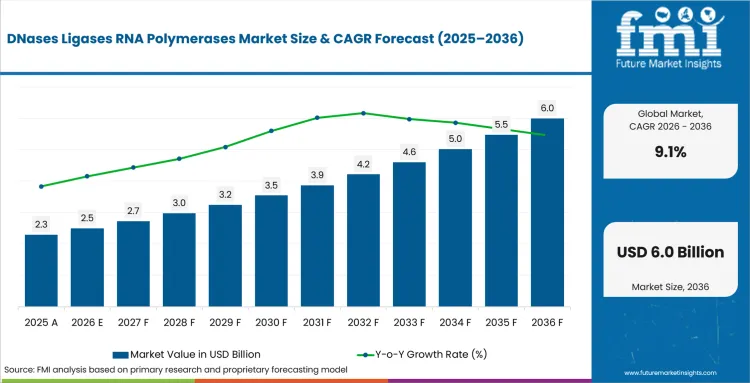
USD 2.5 billion in 2026 and USD 6.0 billion by 2036 at a 9.1% CAGR.
Demand for DNases ligases RNA polymerases is projected to expand at 9.1% CAGR between 2026 and 2036, increasing valuation from USD 2.5 billion in 2026 to USD 6.0 billion by 2036. Molecular diagnostics laboratories use these enzymes during nucleic-acid cleanup and joining alongside amplification and transcript preparation across validated tests. In March 2026, Dyadic and Fermbox Bio commercially launched animal-origin-free recombinant DNase I with an RNase-free specification. The product supports sample preparation and residual-DNA removal without exposing sensitive RNA workflows to unwanted RNase activity. The launch provides direct commercial evidence that defined purity and source controls can widen adoption across sensitive RNA workflows. Repeat revenue depends on consistent activity across every released lot and each qualified laboratory method used in production.
Biopharmaceutical manufacturers evaluate polymerases through transcript yield and double-stranded RNA formation alongside downstream purification workload across mRNA raw materials programs. In March 2025, Primrose Bio launched Prima RNApols ExTend for long-template mRNA manufacturing and reported higher yield with lower double-stranded RNA formation than traditional T7 polymerase. The product shows how an engineered enzyme can reduce purification pressure and reagent use during difficult transcription runs. United States developers often qualify enzymes through decentralized pharmaceutical and diagnostic networks, whereas Japanese programs use coordinated vaccine-manufacturing initiatives. Genomics research laboratories apply a different qualification test that prioritizes broad template compatibility over GMP release requirements. Commercial planning therefore requires separate support models for regulated production and exploratory research programs with different validation thresholds.
Key Takeaways of DNases Ligases RNA Polymerases Market
- Demand is supported by molecular diagnostics and RNA manufacturing workflows that require defined activity alongside controlled nuclease contamination.
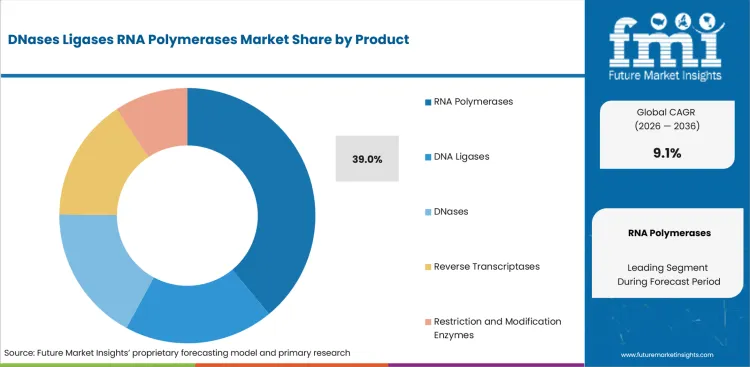
- RNA polymerases are expected to represent 39.0% of product demand in 2026 owing to repeated transcription requirements across research and therapeutic workflows.
- Molecular diagnostics are projected to account for 36.0% of application revenue in 2026 supported by repeat assay use and regulated validation requirements.
- Pharmaceutical and biotechnology companies are estimated to capture 43.0% of end-user spending in 2026 due to recurring development and manufacturing demand.
- Lot variation and storage sensitivity raise qualification costs that delay switching between established enzyme formulations and validated laboratory methods.
- Competition includes Thermo Fisher Scientific; Merck KGaA; New England Biolabs; Takara Bio; Promega; QIAGEN; Agilent Technologies; and F. Hoffmann-La Roche.
Analyst Perspective
“DNases and ligases alongside RNA polymerases create value at different reaction steps, but every order depends on consistent performance inside the complete laboratory method. Diagnostic laboratories focus on contamination control and lot comparability, whereas mRNA manufacturers track transcript yield and double-stranded RNA formation. Companies that connect application data with dependable change notification can protect repeat demand across validated workflows.”
- Anurag Sharma, Principal Analyst, Future Market Insights
How is the DNases Ligases RNA Polymerases market segmented?
The DNases Ligases RNA Polymerases industry is segmented by Product, Application, End User, Distribution Channel, Enzyme Source, and Region.
The market is segmented by product, application, end user, distribution channel, enzyme source, and region for commercial analysis. Product analysis covers RNA polymerases, DNA ligases, DNases, reverse transcriptases, and restriction or modification enzymes used across nucleic-acid workflows. Application categories include molecular diagnostics, genomic research, biopharmaceutical manufacturing, synthetic biology, and forensic or clinical research across regulated and exploratory settings. End-user and distribution analysis separates pharmaceutical companies, research institutes, diagnostic laboratories, direct sales, distributors, e-commerce platforms, and institutional contracts. Enzyme source categories cover recombinant, native, engineered, research-grade, and clinical-grade materials with different purity and documentation requirements. Regional analysis compares validation standards, laboratory infrastructure, manufacturing capacity, and technical support across the molecular biology reagents market.
What supports RNA polymerases within the product category?
RNA polymerases create transcript material from defined DNA templates across research and regulated biopharmaceutical workflows. In March 2025, Takara Bio announced GMP-grade PrimeCap T7 RNA Polymerase for mRNA vaccine and therapeutic manufacturing. The engineered enzyme combines high RNA yield with reduced double-stranded RNA generation and improved capping efficiency. The launch performance controls connect polymerase selection with transcript integrity and downstream purification across regulated mRNA programs. Synthetic biology projects require comparable repeatability across sequence-dependent templates and controlled reaction designs during iterative assembly workflows.
- By product, RNA polymerases are estimated to hold 39.0% in 2026 owing to repeated transcription demand across research and mRNA manufacturing. Their position depends on predictable transcript yield with controlled double-stranded RNA formation across defined templates. Development teams also require release records that support comparability during scale-up and manufacturing transfer across regulated programs.
- mRNA developers adopt RNA polymerases through template-specific studies that compare transcript yield and impurity formation across intended sequences. A formulation gains repeat demand once it performs consistently across the qualified template and purification method. Sequence length and reaction conditions can change the result, making technical support valuable during process development and manufacturing transfer.
Why do molecular diagnostics account for the largest application share?
Molecular diagnostic workflows combine polymerases and reverse transcriptases with ligases across assay preparation and amplification. In June 2025, QIAGEN and GENCURIX announced a partnership to develop oncology IVD assays on the QIAcuity digital PCR platform. The partnership connects amplification chemistry with regulated assay development and defined laboratory validation across intended oncology workflows. Activity control becomes commercially useful through RT-PCR kits and digital systems that preserve analytical sensitivity across intended instruments and sample types.
- Based on application, molecular diagnostics is projected to account for 36.0% in 2026 due to recurring enzyme use across validated nucleic-acid tests. Assay developers require lot comparability and defined contamination limits across every approved sample type and instrument. The segment retains its position through repeat reagent consumption after a test enters routine clinical use.
- Clinical laboratories adopt enzyme formulations through assay-specific validation across approved instruments and every intended specimen type. Reliable activity protects analytical sensitivity and reduces repeated troubleshooting during routine testing across multiple production lots. Diagnostic manufacturers require formal change notification owing to additional verification triggered by altered enzyme lots across released kits and laboratory-developed testing programs.
How do pharmaceutical and biotechnology companies shape end-user demand?
Pharmaceutical and biotechnology companies use modifying enzymes during discovery and regulated manufacturing alongside commercial supply preparation. In March 2025, c-LEcta launched GMP-grade DENARASE High Salt for clinical and commercial biopharmaceutical production. The nuclease maintains activity under elevated salt conditions that can limit standard DNA-removal enzymes during purification. That capability lets process teams address residual DNA within demanding purification steps while retaining controlled manufacturing documentation. Precision medicine genomics programs create a separate requirement for dependable reverse transcription during biomarker development.
- The pharmaceutical and biotechnology companies segment is set to lead the end user category with 43.0% share in 2026 due to repeated enzyme use across discovery and regulated manufacturing. Spending covers analytical development and process qualification alongside commercial supply for several internal manufacturing stages. Demand remains concentrated in programs that require controlled materials and repeat documentation across several development stages.
- Biopharmaceutical teams adopt new formulations through comparability studies that connect reaction performance with process risk. A validated change can improve yield or purity without disrupting later manufacturing steps across the complete process. Commercial adoption slows whenever documentation does not explain source changes and impurity controls alongside release methods across development batches and technology-transfer sites.
What keeps direct sales ahead within the distribution channel category?
Direct sales give enzyme manufacturers a practical route for custom formulations and quality agreements alongside technical troubleshooting across regulated programs. In September 2025, Promega and Watchmaker Genomics formed a partnership around an engineered reverse transcriptase. Promega stated that the agreement would support catalog and customized solutions for clinical and pharmaceutical molecular analysis. The development explains why direct relationships support tailored performance and documented supply terms across regulated programs. Distributors remain useful for routine orders, but complex programs require closer application and quality coordination.
- In 2026, direct sales is expected to lead the distribution channel category with 47.0% share due to technical qualification and negotiated supply terms. Direct account teams can coordinate release documents with formulation support across custom concentrations and regulated applications. The route also gives large programs a clearer process for change notification and continuity planning.
- Large laboratories adopt direct agreements for bulk supply and formal change notification across validated methods. The arrangement supports scheduled deliveries and direct access to application specialists during troubleshooting or process transfer. Smaller accounts remain better suited to distributors owing to low order volumes that cannot support identical documentation and technical coverage across every location.
Why do recombinant enzymes remain central to enzyme source demand?
Recombinant production gives manufacturers greater control over expression systems and impurity specifications than variable native extraction routes. In April 2025, Worthington Biochemical launched NUCxyme DNA/RNA Nuclease as a recombinant and animal-free bioprocessing enzyme. The company uses yeast expression to minimize contaminating nucleases and proteases while removing animal-derived material risks. Comparable controls support recombinant DNA applications that require repeatable enzyme activity across research and commercial settings.
- The enzyme source category is forecast to be led by recombinant enzymes at 51.0% share in 2026 due to controlled expression and scalable purification. Recombinant production gives manufacturers clearer control over source materials and defined impurity limits across validated workflows. The segment also supports animal-origin-free supply for programs that require documented quality controls and consistent manufacturing records.
- Laboratories adopt recombinant enzymes through qualification packages that identify the expression system and release method for each formulation. Engineered production supports custom activity specifications and scalable supply across research or manufacturing programs with defined quality requirements. Storage and shipping controls remain necessary to prevent performance deterioration across varied distribution points and customer operating sites.
What are the drivers, restraints, and opportunities in the DNases Ligases RNA Polymerases Market?
RNA diagnostics and therapeutic manufacturing expand enzyme use while qualification burden and storage sensitivity limit commercial conversion.
- Driver: RNA programs require repeated transcription and ligation alongside amplification and template-removal steps across development and production workflows.
- Restraint: Variable activity across process conditions can force laboratories to repeat costly qualification and impurity-control work.
- Opportunity: GMP-compatible formulations can support premium contracts across regulated RNA and genomic production workflows with defined process conditions.
Expansion of mRNA vaccine development creates direct demand for template-preparation and transcription enzymes alongside DNA-removal products. In May 2026, the Japan Agency for Medical Research and Development selected four projects focused on improving mRNA vaccine template-DNA production. The projects cover synthetic DNA and large-scale PCR alongside cell-free linear DNA processes for controlled template production. Each route requires controlled polymerase or nuclease performance before the prepared template enters an in-vitro transcription reaction. Enzyme manufacturers can convert this activity through biopharma contract manufacturing agreements that include application data and dependable scale-up supply.
Changes in polymerase performance across salt concentrations and impurity profiles create a material restraint for manufacturing process transfer. In November 2025, a Nucleic Acids Research study reported that an engineered T7 polymerase reduced double-stranded RNA three- to four-fold and remained active at sodium chloride concentrations up to 150 mM. The result confirms that enzymes with the same general function are not automatically interchangeable across manufacturing conditions. Every formulation change requires testing across the intended template and buffer alongside the purification method.
Automation-ready enzyme workflows create an opportunity for premium contracts that combine reagents with implementation support. In February 2026, New England Biolabs reported verified RNA and DNA library-preparation collaborations with five laboratory automation providers. The partners developed transferable methods and validated scripts for multiple automated laboratory workstation platforms used in production. Enzyme companies can use the same approach across enzymatic DNA synthesis and related applications that require stable timing across repeated runs. Premium pricing becomes defensible through verified performance across the laboratory’s equipment and complete sample range.
Which country CAGRs are profiled in the DNases Ligases RNA Polymerases Market?
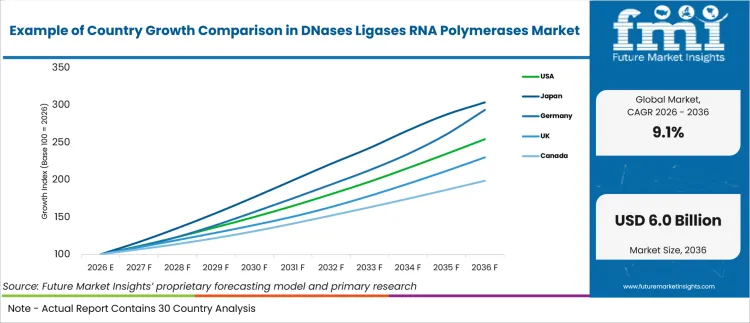
| Country | CAGR |
|---|---|
| Japan | 11.8% |
| Germany | 11.4% |
| Australia | 10.9% |
| USA | 9.8% |
| UK | 8.7% |
| Canada | 7.1% |
| South Korea | 6.4% |
How do country-level CAGRs compare in the DNases Ligases RNA Polymerases Market?
The comparison shows a gradual progression across national growth rates rather than several separate commercial tiers. Japan and Germany remain closely aligned through advanced life-science infrastructure and demanding qualification requirements in both countries. Australia and the United States follow through different routes, with local mRNA capacity supporting Australia and regulated molecular testing supporting the United States. A wider break appears between the United Kingdom and Canada as manufacturing concentration and regional service economics begin to affect conversion. South Korea closes the range through a tightly regulated genetic-testing route and concentrated biotechnology clusters. The 5.4-point spread therefore reflects different commercialization paths rather than a simple ranking of scientific capability.
- Japan combines coordinated vaccine research with domestic enzyme development, creating demand for documented template preparation and high-purity transcription inputs. Long qualification cycles reward companies that maintain Japanese technical support and provide local-language documentation for validated laboratory workflows.
- Germany’s reimbursed genome-sequencing pilot gives university hospitals a defined clinical route for qualified amplification and library-preparation reagents. Data-governance requirements narrow commercial access to companies that can support controlled workflows and documented handling across participating centers.
- Australia’s end-to-end mRNA manufacturing capacity creates a direct use case for transcription and template-removal enzymes. Long delivery distances increase the commercial value of local inventory and responsive technical service across widely separated laboratory clusters.
- The United States combines broad laboratory capacity with several regulated molecular-testing pathways across decentralized health and research systems. Assay-specific approvals create recurring reagent use, although decentralized purchasing slows consistent account conversion across major institutional networks.
- The United Kingdom is building clinical-grade RNA translation capacity through a publicly funded biofoundry serving early development programs. Centralized programs support manufacturing scale-up, but specialized expertise remains concentrated within a limited number of research and production clusters.
- Canada’s domestic mRNA facility strengthens the local route for qualified transcription inputs and controlled residual-DNA removal. Provincial purchasing differences increase service costs for laboratories located outside major biomanufacturing centers in Quebec and Ontario.
- South Korea’s defined genetic-testing rules create a clear route for selected molecular assays across dense biotechnology clusters. Local-language documentation and technical partnerships remain necessary for commercial access across regulated clinical testing networks.
Similar growth rates do not guarantee similar revenue outcomes across countries with different qualification rules and service networks. Companies should compare account-level validation costs with local technical coverage before assigning country investment across the complete forecast portfolio. The full report provides country-level CAGR analysis across North America, Latin America, Europe, East Asia, South Asia, Oceania and the Middle East and Africa.
Country-wise Analysis
- Japan combines coordinated vaccine research with strict expectations for local documentation and application support across enzyme-intensive workflows. Adoption of DNases and ligases alongside RNA polymerases in Japan is estimated to expand at 11.8% CAGR through 2036, supported by domestic high-purity mRNA programs. In March 2026, AMED’s interim evaluation included a project to build a Japanese high-purity mRNA production platform based on PureCap technology. The program creates demand for controlled template preparation and transcription inputs alongside impurity-removal enzymes during process development. Domestic technical teams support qualification through Japanese protocols and provide rapid interpretation of application-specific performance records. Long validation cycles remain a material friction for companies without local-language documentation and rapid troubleshooting.
- Germany operates a reimbursed genome-sequencing pilot that connects university hospitals with defined clinical and data infrastructure. Statutory health insurers cover participating care through a national contract that establishes a controlled route for eligible patients. Demand for DNases and ligases alongside RNA polymerases in Germany is forecast to rise at 11.4% CAGR over the forecast period, reinforced by clinical sequencing activity. The Federal Ministry of Health reports that the model began in July 2024 and has enrolled patients across participating centers. Qualified enzymes support library preparation and amplification within controlled clinical methods across participating university hospitals. Data-security rules and limited routine reimbursement outside the pilot remain material barriers to wider commercial conversion.
- Australian laboratories depend on reliable cold-chain delivery across widely separated research and manufacturing centers throughout the country. Sales of DNases and ligases alongside RNA polymerases in Australia are forecast to expand at 10.9% CAGR by 2036, enabled by local mRNA capacity. Victoria’s industry department reports that Moderna’s Melbourne facility received a full TGA GMP licence in August 2025 and is completing final approvals. The end-to-end site creates direct demand for qualified transcription and template-removal inputs across controlled production. Major-city distributors improve stock access and temperature management for laboratories located far from international manufacturing centers. Long service distances and remaining approval steps can delay support for programs outside established biotechnology hubs.
- United States laboratories combine broad research capacity with regulated companion-diagnostic pathways and decentralized institutional purchasing systems. In July 2025, Thermo Fisher Scientific received FDA approval for an NGS assay used with ZEGFROVY and for tumor profiling. The USA market for DNases and ligases alongside RNA polymerases is projected to record 9.8% CAGR during the assessment period, shaped by regulated molecular testing. The approved workflow automates sample preparation through reporting and creates recurring demand for compatible enzymes and library-preparation reagents. Extensive national distribution supports laboratory access across major diagnostic and biopharmaceutical clusters throughout the United States. Assay-specific validation and separate institutional budgets create uneven commercial conversion across laboratories and health systems nationwide.
- United Kingdom demand is shaped by central research funding and a translational network for advanced RNA therapies. The United Kingdom’s outlook for DNases and ligases alongside RNA polymerases is anticipated to advance at 8.7% CAGR over the assessment period, underpinned by clinical-grade RNA infrastructure. In August 2025, the government announced a new RNA Biofoundry in Darlington to support advanced therapy development. The facility is intended to manufacture RNA materials at the quality and scale needed for early clinical trials. Central funding provides a direct route for qualified transcription inputs and controlled impurity-removal enzymes within early manufacturing programs. Specialized staff remain concentrated within major clusters, which limits technical coverage for laboratories outside those centers.
- Canada combines established biomanufacturing clusters with regional laboratory networks that span long service distances and several purchasing systems. In September 2025, the federal government reported the first made-in-Canada Moderna mRNA vaccine doses from the Laval facility. In Canada the demand for DNases and ligases alongside RNA polymerases is predicted to advance at 7.1% CAGR through 2036, sustained by domestic mRNA manufacturing. The operating site creates a direct route for qualified transcription and template-removal inputs across controlled production. Local warehousing improves delivery reliability for laboratories that operate far from international enzyme manufacturing centers. Provincial purchasing differences and dispersed technical support increase account costs outside the main Quebec and Ontario biotechnology clusters.
- South Korea has dense biotechnology clusters and defined rules for embryo and fetal genetic testing across concentrated laboratory networks. The South Korean market is estimated to post 6.4% CAGR over the forecast period, influenced by regulated diagnostics and automation investment. In April 2025, the Ministry of Health and Welfare added eight diseases to the eligible testing list and brought the total to 230 conditions. The defined route supports qualified amplification and preparation reagents within approved clinical testing workflows across eligible conditions. Korean-language documentation and local integrator relationships provide practical access to regulated laboratories and concentrated biotechnology centers. Restricted eligibility limits wider demand outside approved clinical indications and prevents immediate expansion into broader screening programs.
Who are the notable companies in the DNases Ligases RNA Polymerases Market?
Thermo Fisher Scientific Inc., Merck KGaA, New England Biolabs, Inc., Takara Bio Inc., Promega Corporation, QIAGEN N.V., Agilent Technologies Inc., and F. Hoffmann-La Roche Ltd. are notable companies in this market.
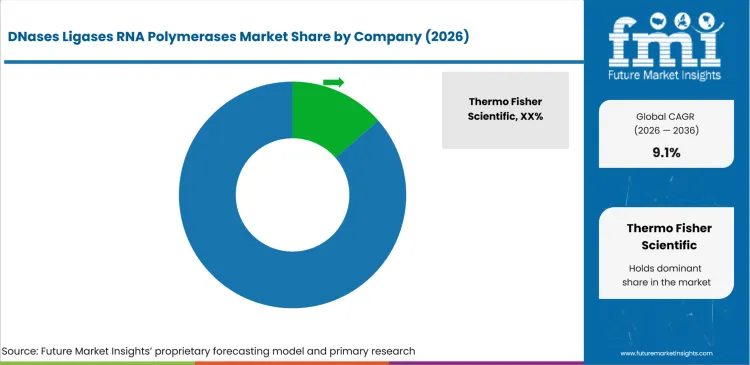
The competitive field combines broad life-science groups with specialists that control selected enzyme workflows and protein expression capabilities. Roche CustomBiotech currently lists T7 RNA polymerase alongside customizable and lyo-ready enzyme formats for diagnostic and biopharmaceutical workflows. Thermo Fisher Scientific and Merck compete through manufacturing documentation and global account coverage for regulated biopharmaceutical programs. New England Biolabs and Promega emphasize molecular biology depth with application support for research and translational laboratories. QIAGEN connects enzyme supply with OEM diagnostic programs, whereas Takara Bio and Agilent support research or sequencing workflows. Commercial advantage depends on qualification evidence and reliable change management across validated applications and manufacturing stages.
- Thermo Fisher Scientific and Merck KGaA alongside Roche address regulated RNA manufacturing through documented polymerase and nuclease materials. Their commercial position depends on controlled production and responsive change-management support across regulated global customer accounts.
- New England Biolabs and Promega alongside Takara Bio compete through enzyme specialization and application knowledge across research workflows. Their specialized portfolios support laboratories that need documented reaction optimization before wider production and supply commitments.
- QIAGEN and Agilent Technologies connect enzymes with diagnostic or sequencing workflows that require integrated validation across regulated laboratory methods. Their growth route depends on converting platform relationships into recurring reagent contracts and custom-supply agreements.
Competitive Benchmarking: DNases Ligases RNA Polymerases Market
| Company | Enzyme Portfolio Breadth | Diagnostic Workflow Support | Custom or GMP Supply | Geographic Reach |
|---|---|---|---|---|
| Thermo Fisher Scientific Inc. | High | High | High | Global |
| Merck KGaA | High | Medium | High | Global |
| New England Biolabs, Inc. | High | Medium | High | Global |
| Takara Bio Inc. | High | Medium | High | Global |
| Promega Corporation | High | High | High | Global |
| QIAGEN N.V. | High | High | High | Global |
| Agilent Technologies Inc. | Medium | Low | Medium | Global |
| F. Hoffmann-La Roche Ltd. | High | High | High | Global |
Key Developments in the DNases Ligases RNA Polymerases Market
- In July 2025, New England Biolabs launched the NEBNext Low-bias Small RNA Library Prep Kit. The workflow reduces biased representation of small RNA species during sequencing preparation across complex research samples. The development increases the importance of ligation chemistry and reaction design across complex RNA samples. Laboratories gain a new qualification point for comparing representation and yield across intended sample classes.
- In August 2025, Thermo Fisher Scientific received FDA approval for the Oncomine Dx Target Test as a companion diagnostic. The test identifies HER2 mutations for patients considered for HERNEXEOS treatment in non-small cell lung cancer. The approval expands regulated molecular testing that depends on reliable nucleic-acid preparation and amplification across approved clinical workflows. Reagent compatibility must remain documented across approved instruments and specimen types during routine laboratory operation.
- In October 2025, Cocoon Bioscience launched a recombinant T4 DNA ligase for cloning and sequencing workflows. The company introduced standard and high-concentration formats produced through its CrisBio expression platform for varied ligation conditions. The launch expands European access to a key DNA-joining enzyme across cloning and sequencing research applications. Commercial uptake depends on documented purity and consistent performance across difficult ligation conditions and low-volume reaction formats.
- In November 2025, Primrose Bio launched Prima RNApols ExTend Cap AU for self-amplifying mRNA manufacturing. The engineered polymerase improves capping efficiency while reducing double-stranded RNA formation and key reagent use during production. The launch broadens enzyme options for long-template RNA programs that require higher yield and cleaner transcripts. Development teams must confirm the reported gains across their templates and downstream purification methods before manufacturing scale-up.
Key Players in the DNases Ligases RNA Polymerases Market
Broad Enzyme and Bioprocess Providers
- Thermo Fisher Scientific Inc.
- Merck KGaA
- F. Hoffmann-La Roche Ltd.
Specialist Molecular Biology Providers
- New England Biolabs, Inc.
- Promega Corporation
- Takara Bio Inc.
Diagnostic and Sequencing Workflow Providers
- QIAGEN N.V.
- Agilent Technologies Inc.
DNases Ligases RNA Polymerases Market - Report Scope
| Coverage field | Report scope |
|---|---|
| Market breakdown | Product, Application, End User, Distribution Channel, Enzyme Source, and Region. |
| Market Definition | Commercial DNases, ligases, RNA polymerases, reverse transcriptases, and related modifying enzyme formulations supplied for research, diagnostic, and biopharmaceutical workflows. |
| Regions Covered | North America, Latin America, Western Europe, Eastern Europe, East Asia, South Asia and Pacific, and Middle East and Africa. |
| Countries Covered | Japan, Germany, Australia, United States, United Kingdom, Canada, and South Korea. |
| Key Companies Profiled | Thermo Fisher Scientific Inc., Merck KGaA, New England Biolabs, Inc., Takara Bio Inc., Promega Corporation, QIAGEN N.V., Agilent Technologies Inc., and F. Hoffmann-La Roche Ltd. |
| Forecast Period | 2026 to 2036. |
| Approach | Hybrid bottom-up and top-down market sizing supported by primary interviews and official desk research. |
DNases Ligases RNA Polymerases Market - Research Methodology
| Method | Approach |
|---|---|
| Primary Research | FMI analysts gathered input from manufacturers, service providers, technology developers, distributors, end users, procurement teams, and subject-matter experts. Interviews examined purchasing decisions, product or service evaluation, adoption barriers, approval requirements, pricing considerations, and expectations for technical or commercial support. Respondents were also asked what evidence is required before a trial, pilot, or initial order develops into regular purchasing. |
| Desk Research | Desk research covered government statistics, regulatory publications, trade data, industry associations, technical literature, standards, company filings, product information, and official corporate announcements. Sources were reviewed for relevance, publication date, geographic coverage, and consistency with the defined market scope. Claims relating to performance, applications, approvals, capacity, investment, and commercial activity were retained only when supported by credible public evidence. |
| Market Sizing and Forecasting | The market model combined the baseline value with historical performance, segment structure, pricing and volume indicators, adoption levels, company participation, and country-level demand conditions. Forecast assumptions considered economic activity, investment trends, regulatory developments, technology adoption, purchasing cycles, supply availability, and barriers to wider market use. Segment and regional estimates were reconciled before the final market total was calculated. |
| Data Validation | Estimates were checked against multiple independent indicators, including public data, company activity, trade patterns, industry developments, and findings from primary interviews. Validation also tested whether products, services, applications, and company revenues fell within the defined market boundaries. Adjacent categories, unsupported claims, overlapping revenues, and activities without direct market relevance were excluded to reduce double counting and maintain consistency across segments and countries. |
DNases Ligases RNA Polymerases Market by Segments
DNases Ligases RNA Polymerases Market segmented by Product:
- RNA Polymerases
- T7 RNA Polymerase
- SP6 RNA Polymerase
- DNA Ligases
- T4 DNA Ligase
- Taq DNA Ligase
- DNases
- DNase I
- Recombinant DNase
- Reverse Transcriptases
- MMLV Reverse Transcriptase
- AMV Reverse Transcriptase
- Restriction and Modification Enzymes
- Restriction Endonucleases
- Methyltransferases
DNases Ligases RNA Polymerases Market segmented by Application:
- Molecular Diagnostics
- PCR and RT-PCR
- Nucleic Acid Extraction
- Genomic Research
- DNA Sequencing
- Gene Expression Analysis
- Biopharmaceutical Manufacturing
- mRNA Therapeutics
- Vaccine Production
- Synthetic Biology
- Gene Assembly
- DNA Cloning
- Forensic and Clinical Research
- Forensic DNA Analysis
- Clinical Laboratory Research
DNases Ligases RNA Polymerases Market segmented by End User:
- Pharmaceutical and Biotechnology Companies
- Biopharmaceutical Companies
- Gene Therapy Developers
- Academic and Research Institutes
- Universities
- Government Research Laboratories
- Clinical Diagnostic Laboratories
- Hospital Laboratories
- Reference Laboratories
- Contract Research Organizations
- Preclinical CROs
- Clinical CROs
- Forensic Laboratories
- Government Forensic Laboratories
- Private Forensic Laboratories
DNases Ligases RNA Polymerases Market segmented by Distribution Channel:
- Direct Sales
- Key Account Sales
- Enterprise Supply Agreements
- Laboratory Distributors
- National Laboratory Distributors
- Global Scientific Distributors
- E-Commerce Platforms
- Manufacturer Online Stores
- B2B Scientific Marketplaces
- Life Science Dealers
- Regional Dealers
- Authorized Resellers
- Procurement Contracts
- Government Procurement
- Institutional Procurement
DNases Ligases RNA Polymerases Market segmented by Enzyme Source:
- Recombinant Enzymes
- Bacterial Expression Systems
- Yeast Expression Systems
- Native Enzymes
- Microbial Derived Enzymes
- Animal Tissue Derived Enzymes
- Engineered Enzymes
- High Fidelity Enzymes
- Thermostable Enzymes
- Research Grade Enzymes
- Standard Research Grade
- High Purity Research Grade
- Clinical Grade Enzymes
- GMP Grade Enzymes
- Diagnostic Grade Enzymes
DNases Ligases RNA Polymerases Market by Region:
- North America
- United States
- Canada
- Latin America
- Brazil
- Mexico
- Argentina
- Chile
- Western Europe
- Germany
- France
- United Kingdom
- Italy
- Spain
- Benelux
- Nordics
- Eastern Europe
- Poland
- Czech Republic
- Romania
- Hungary
- East Asia
- China
- Japan
- South Korea
- South Asia and Pacific
- India
- ASEAN
- Australia and New Zealand
- Middle East and Africa
- GCC Countries
- South Africa
- Türkiye
- Israel
Research Sources and Bibliography
- Sanjeev, A., Summers, C. R., Politi, J., Beuning, P. J., & Cheng, C. J. (2025, November 20). Nucleic Acids Research, 53(21), gkaf1124.
- c-LEcta GmbH. (2025, March 25).
- Cocoon Bioscience. (2025, October 27).
- Department of Jobs, Skills, Industry and Regions, Victoria. (2026).
- Dyadic Applied BioSolutions. (2026, March 4).
- Federal Ministry of Health. (2026, March 2).
- Government of Canada. (2025, September 19).
- Japan Agency for Medical Research and Development. (2026, May 8).
- Japan Agency for Medical Research and Development. (2026, March 19).
- Ministry of Health and Welfare, Republic of Korea. (2025, April 30).
- New England Biolabs, Inc. (2025, July 22).
- New England Biolabs, Inc. (2026, February 6).
- Primrose Bio, Inc. (2025, March 26).
- Primrose Bio, Inc. (2025, November 10).
- Promega Corporation. (2025, September 9).
- QIAGEN N.V. (2025, June 18).
- Thermo Fisher Scientific Inc. (2025, July 3).
- Thermo Fisher Scientific Inc. (2025, August 11).
- Worthington Biochemical Corporation. (2025, April 4).
This bibliography is provided for reader reference and is not exhaustive. The full report contains the complete reference list and detailed citations
This Report Answers
- How large is the DNases Ligases RNA Polymerases market in 2026 and 2036?
- Which workflows create recurring demand for DNases, ligases, RNA polymerases, and reverse transcriptases?
- Why do RNA Polymerases account for the largest Product share in 2026?
- How do Molecular Diagnostics influence enzyme qualification and repeat purchasing?
- Why do Pharmaceutical and Biotechnology Companies represent the largest End User share?
- How do country growth rates differ across Japan, Germany, Australia, the USA, the UK, Canada, and South Korea?
- Which companies provide broad enzyme portfolios or specialized workflow support?
- What limits supplier switching across validated diagnostic and manufacturing processes?
- How do GMP-compatible and custom formulations create premium contract opportunities?
Frequently Asked Questions
How big is the DNases Ligases RNA Polymerases Market in 2026?
The DNases ligases RNA polymerases market is valued at USD 2.5 billion in 2026 and is forecast to reach USD 6.0 billion by 2036. Demand is supported by molecular diagnostics, genomic research, and biopharmaceutical manufacturing workflows that require consistent enzyme activity and controlled purity across nucleic-acid processing.
What is the CAGR of the DNases Ligases RNA Polymerases Market from 2026 to 2036?
The DNases ligases RNA polymerases market grows at a CAGR of 9.1% between 2026 and 2036, supported by recurring enzyme requirements across RNA manufacturing, molecular diagnostics, genomic research, and regulated biopharmaceutical workflows where consistent performance and documented quality are important.
Which product type leads the DNases Ligases RNA Polymerases Market?
RNA polymerases account for 39.0% of the DNases ligases RNA polymerases market by product type in 2026, supported by repeated transcription requirements across research and mRNA manufacturing workflows that require predictable transcript yield and controlled double-stranded RNA formation.
How much will the DNases Ligases RNA Polymerases Market add between 2026 and 2036?
The DNases ligases RNA polymerases market is set to add USD 3.5 billion between 2026 and 2036, growing from USD 2.5 billion to USD 6.0 billion as enzyme demand expands across molecular diagnostics, RNA manufacturing, genomic research, and biopharmaceutical production workflows worldwide.
Who are the leading companies in the DNases Ligases RNA Polymerases Market?
Five companies lead the DNases ligases RNA polymerases market, including Thermo Fisher Scientific, Merck KGaA, New England Biolabs, Takara Bio, and Promega, competing through broad enzyme portfolios, specialized molecular biology solutions, diagnostic workflow support, customized formulations, and controlled supply for research and biopharmaceutical applications.
Preview the report firsthand - request a free sample
Get SampleGet the brochure for pricing and purchase details.
Get PDFTable of Content
- Key Takeaways
- Market Size and CAGR
- Top Growth Driver
- Fastest Growing Segment
- Leading Region
- Key Companies
- Emerging Opportunities
- Executive Summary
- Global Market Outlook
- Demand-side Trends
- Supply-side Trends
- Technology Roadmap Analysis
- Analysis and Recommendations
- Analyst Perspective (What is happening? Why now? What should investors know?)
- Key Questions Answered
- How large is the market?
- What is the CAGR?
- What are key trends?
- Which region dominates?
- Who are the leaders?
- Market Overview
- Market Coverage / Taxonomy
- Market Definition / Scope / Limitations
- Research Methodology
- Chapter Orientation
- Analytical Lens and Working Hypotheses
- Market Structure, Signals, and Trend Drivers
- Benchmarking and Cross-market Comparability
- Market Sizing, Forecasting, and Opportunity Mapping
- Research Design and Evidence Framework
- Desk Research Programme (Secondary Evidence)
- Expert Input and Fieldwork (Primary Evidence)
- Tooling, Models, and Reference Databases
- Data Engineering and Model Build
- Quality Assurance and Audit Trail
- Market Background
- Market Dynamics (Drivers, Restraints, Opportunity, Trends)
- Scenario Forecast (Optimistic, Likely, Conservative)
- Impact Analysis
- AI Impact
- Sustainability Impact
- Regulatory Impact
- Technology Impact
- Consumer / Buyer Analysis
- Purchase Drivers
- Adoption Barriers
- Buyer Journey
- Opportunity Map Analysis
- Product Life Cycle Analysis
- Supply Chain Analysis
- Investment Feasibility Matrix
- Value Chain Analysis
- PESTLE and Porter's Analysis
- Regulatory Landscape
- Regional Parent Market Outlook
- Production and Consumption Statistics
- Import and Export Statistics
- Global Market Analysis and Forecast, 2021 to 2036
- Historical Market Size Value (USD Billion) Analysis, 2021 to 2025
- Current and Future Market Size Value (USD Billion) Projections, 2026 to 2036
- Y-o-Y Growth Trend Analysis
- Absolute $ Opportunity Analysis
- Global Market Pricing Analysis, 2021 to 2036
- Global Market Analysis and Forecast, By Product, 2021 to 2036
- Introduction / Key Findings
- Historical Market Size Value (USD Billion) Analysis By Product, 2021 to 2025
- Current and Future Market Size Value (USD Billion) Analysis and Forecast By Product, 2026 to 2036
- RNA Polymerases
- T7 RNA Polymerase
- SP6 RNA Polymerase
- DNA Ligases
- T4 DNA Ligase
- Taq DNA Ligase
- DNases
- DNase I
- Recombinant DNase
- Reverse Transcriptases
- MMLV Reverse Transcriptase
- AMV Reverse Transcriptase
- Restriction and Modification Enzymes
- Restriction Endonucleases
- Methyltransferases
- RNA Polymerases
- Y-o-Y Growth Trend Analysis By Product, 2021 to 2025
- Absolute $ Opportunity Analysis By Product, 2026 to 2036
- Global Market Analysis and Forecast, By Application, 2021 to 2036
- Introduction / Key Findings
- Historical Market Size Value (USD Billion) Analysis By Application, 2021 to 2025
- Current and Future Market Size Value (USD Billion) Analysis and Forecast By Application, 2026 to 2036
- Molecular Diagnostics
- PCR and RT-PCR
- Nucleic Acid Extraction
- Genomic Research
- DNA Sequencing
- Gene Expression Analysis
- Biopharmaceutical Manufacturing
- mRNA Therapeutics
- Vaccine Production
- Synthetic Biology
- Gene Assembly
- DNA Cloning
- Forensic and Clinical Research
- Forensic DNA Analysis
- Clinical Laboratory Research
- Molecular Diagnostics
- Y-o-Y Growth Trend Analysis By Application, 2021 to 2025
- Absolute $ Opportunity Analysis By Application, 2026 to 2036
- Global Market Analysis and Forecast, By End User, 2021 to 2036
- Introduction / Key Findings
- Historical Market Size Value (USD Billion) Analysis By End User, 2021 to 2025
- Current and Future Market Size Value (USD Billion) Analysis and Forecast By End User, 2026 to 2036
- Pharmaceutical and Biotechnology Companies
- Biopharmaceutical Companies
- Gene Therapy Developers
- Academic and Research Institutes
- Universities
- Government Research Laboratories
- Clinical Diagnostic Laboratories
- Hospital Laboratories
- Reference Laboratories
- Contract Research Organizations
- Preclinical CROs
- Clinical CROs
- Forensic Laboratories
- Government Forensic Laboratories
- Private Forensic Laboratories
- Pharmaceutical and Biotechnology Companies
- Y-o-Y Growth Trend Analysis By End User, 2021 to 2025
- Absolute $ Opportunity Analysis By End User, 2026 to 2036
- Global Market Analysis and Forecast, By Distribution Channel, 2021 to 2036
- Introduction / Key Findings
- Historical Market Size Value (USD Billion) Analysis By Distribution Channel, 2021 to 2025
- Current and Future Market Size Value (USD Billion) Analysis and Forecast By Distribution Channel, 2026 to 2036
- Direct Sales
- Key Account Sales
- Enterprise Supply Agreements
- Laboratory Distributors
- National Laboratory Distributors
- Global Scientific Distributors
- E-Commerce Platforms
- Manufacturer Online Stores
- B2B Scientific Marketplaces
- Life Science Dealers
- Regional Dealers
- Authorized Resellers
- Procurement Contracts
- Government Procurement
- Institutional Procurement
- Direct Sales
- Y-o-Y Growth Trend Analysis By Distribution Channel, 2021 to 2025
- Absolute $ Opportunity Analysis By Distribution Channel, 2026 to 2036
- Global Market Analysis and Forecast, By Enzyme Source, 2021 to 2036
- Introduction / Key Findings
- Historical Market Size Value (USD Billion) Analysis By Enzyme Source, 2021 to 2025
- Current and Future Market Size Value (USD Billion) Analysis and Forecast By Enzyme Source, 2026 to 2036
- Recombinant Enzymes
- Bacterial Expression Systems
- Yeast Expression Systems
- Native Enzymes
- Microbial Derived Enzymes
- Animal Tissue Derived Enzymes
- Engineered Enzymes
- High Fidelity Enzymes
- Thermostable Enzymes
- Research Grade Enzymes
- Standard Research Grade
- High Purity Research Grade
- Clinical Grade Enzymes
- GMP Grade Enzymes
- Diagnostic Grade Enzymes
- Recombinant Enzymes
- Y-o-Y Growth Trend Analysis By Enzyme Source, 2021 to 2025
- Absolute $ Opportunity Analysis By Enzyme Source, 2026 to 2036
- Global Market Analysis and Forecast, By Region, 2021 to 2036
- Introduction
- Historical Market Size Value (USD Billion) Analysis By Region, 2021 to 2025
- Current Market Size Value (USD Billion) Analysis and Forecast By Region, 2026 to 2036
- North America
- Latin America
- Western Europe
- Eastern Europe
- East Asia
- South Asia and Pacific
- Middle East & Africa
- Market Attractiveness Analysis By Region
- North America Market Analysis and Forecast, By Country, 2021 to 2036
- Historical Market Size Value (USD Billion) Trend Analysis By Market Taxonomy, 2021 to 2025
- Market Size Value (USD Billion) Forecast By Market Taxonomy, 2026 to 2036
- By Country
- USA
- Canada
- By Product
- By Application
- By End User
- By Distribution Channel
- By Enzyme Source
- By Country
- Market Attractiveness Analysis
- By Country
- By Product
- By Application
- By End User
- By Distribution Channel
- By Enzyme Source
- Key Takeaways
- Latin America Market Analysis and Forecast, By Country
- Historical Market Size Value (USD Billion) Trend Analysis By Market Taxonomy, 2021 to 2025
- Market Size Value (USD Billion) Forecast By Market Taxonomy, 2026 to 2036
- By Country
- Brazil
- Mexico
- Chile
- Rest of Latin America
- By Product
- By Application
- By End User
- By Distribution Channel
- By Enzyme Source
- By Country
- Market Attractiveness Analysis
- By Country
- By Product
- By Application
- By End User
- By Distribution Channel
- By Enzyme Source
- Key Takeaways
- Western Europe Market Analysis and Forecast, By Country
- Historical Market Size Value (USD Billion) Trend Analysis By Market Taxonomy, 2021 to 2025
- Market Size Value (USD Billion) Forecast By Market Taxonomy, 2026 to 2036
- By Country
- Germany
- UK
- Italy
- Spain
- France
- Nordic
- BENELUX
- Rest of Western Europe
- By Product
- By Application
- By End User
- By Distribution Channel
- By Enzyme Source
- By Country
- Market Attractiveness Analysis
- By Country
- By Product
- By Application
- By End User
- By Distribution Channel
- By Enzyme Source
- Key Takeaways
- Eastern Europe Market Analysis and Forecast, By Country
- Historical Market Size Value (USD Billion) Trend Analysis By Market Taxonomy, 2021 to 2025
- Market Size Value (USD Billion) Forecast By Market Taxonomy, 2026 to 2036
- By Country
- Russia
- Poland
- Hungary
- Balkan & Baltic
- Rest of Eastern Europe
- By Product
- By Application
- By End User
- By Distribution Channel
- By Enzyme Source
- By Country
- Market Attractiveness Analysis
- By Country
- By Product
- By Application
- By End User
- By Distribution Channel
- By Enzyme Source
- Key Takeaways
- East Asia Market Analysis and Forecast, By Country
- Historical Market Size Value (USD Billion) Trend Analysis By Market Taxonomy, 2021 to 2025
- Market Size Value (USD Billion) Forecast By Market Taxonomy, 2026 to 2036
- By Country
- China
- Japan
- South Korea
- By Product
- By Application
- By End User
- By Distribution Channel
- By Enzyme Source
- By Country
- Market Attractiveness Analysis
- By Country
- By Product
- By Application
- By End User
- By Distribution Channel
- By Enzyme Source
- Key Takeaways
- South Asia and Pacific Market Analysis and Forecast, By Country
- Historical Market Size Value (USD Billion) Trend Analysis By Market Taxonomy, 2021 to 2025
- Market Size Value (USD Billion) Forecast By Market Taxonomy, 2026 to 2036
- By Country
- India
- ASEAN
- Australia & New Zealand
- Rest of South Asia and Pacific
- By Product
- By Application
- By End User
- By Distribution Channel
- By Enzyme Source
- By Country
- Market Attractiveness Analysis
- By Country
- By Product
- By Application
- By End User
- By Distribution Channel
- By Enzyme Source
- Key Takeaways
- Middle East & Africa Market Analysis and Forecast, By Country
- Historical Market Size Value (USD Billion) Trend Analysis By Market Taxonomy, 2021 to 2025
- Market Size Value (USD Billion) Forecast By Market Taxonomy, 2026 to 2036
- By Country
- Kingdom of Saudi Arabia
- Other GCC Countries
- Türkiye
- South Africa
- Other African Union
- Rest of Middle East & Africa
- By Product
- By Application
- By End User
- By Distribution Channel
- By Enzyme Source
- By Country
- Market Attractiveness Analysis
- By Country
- By Product
- By Application
- By End User
- By Distribution Channel
- By Enzyme Source
- Key Takeaways
- Key Countries Market Analysis
- USA
- Pricing Analysis
- Market Share Analysis, 2025
- By Product
- By Application
- By End User
- By Distribution Channel
- By Enzyme Source
- Canada
- Pricing Analysis
- Market Share Analysis, 2025
- By Product
- By Application
- By End User
- By Distribution Channel
- By Enzyme Source
- Mexico
- Pricing Analysis
- Market Share Analysis, 2025
- By Product
- By Application
- By End User
- By Distribution Channel
- By Enzyme Source
- Brazil
- Pricing Analysis
- Market Share Analysis, 2025
- By Product
- By Application
- By End User
- By Distribution Channel
- By Enzyme Source
- Chile
- Pricing Analysis
- Market Share Analysis, 2025
- By Product
- By Application
- By End User
- By Distribution Channel
- By Enzyme Source
- Germany
- Pricing Analysis
- Market Share Analysis, 2025
- By Product
- By Application
- By End User
- By Distribution Channel
- By Enzyme Source
- UK
- Pricing Analysis
- Market Share Analysis, 2025
- By Product
- By Application
- By End User
- By Distribution Channel
- By Enzyme Source
- Italy
- Pricing Analysis
- Market Share Analysis, 2025
- By Product
- By Application
- By End User
- By Distribution Channel
- By Enzyme Source
- Spain
- Pricing Analysis
- Market Share Analysis, 2025
- By Product
- By Application
- By End User
- By Distribution Channel
- By Enzyme Source
- France
- Pricing Analysis
- Market Share Analysis, 2025
- By Product
- By Application
- By End User
- By Distribution Channel
- By Enzyme Source
- India
- Pricing Analysis
- Market Share Analysis, 2025
- By Product
- By Application
- By End User
- By Distribution Channel
- By Enzyme Source
- ASEAN
- Pricing Analysis
- Market Share Analysis, 2025
- By Product
- By Application
- By End User
- By Distribution Channel
- By Enzyme Source
- Australia & New Zealand
- Pricing Analysis
- Market Share Analysis, 2025
- By Product
- By Application
- By End User
- By Distribution Channel
- By Enzyme Source
- China
- Pricing Analysis
- Market Share Analysis, 2025
- By Product
- By Application
- By End User
- By Distribution Channel
- By Enzyme Source
- Japan
- Pricing Analysis
- Market Share Analysis, 2025
- By Product
- By Application
- By End User
- By Distribution Channel
- By Enzyme Source
- South Korea
- Pricing Analysis
- Market Share Analysis, 2025
- By Product
- By Application
- By End User
- By Distribution Channel
- By Enzyme Source
- Russia
- Pricing Analysis
- Market Share Analysis, 2025
- By Product
- By Application
- By End User
- By Distribution Channel
- By Enzyme Source
- Poland
- Pricing Analysis
- Market Share Analysis, 2025
- By Product
- By Application
- By End User
- By Distribution Channel
- By Enzyme Source
- Hungary
- Pricing Analysis
- Market Share Analysis, 2025
- By Product
- By Application
- By End User
- By Distribution Channel
- By Enzyme Source
- Kingdom of Saudi Arabia
- Pricing Analysis
- Market Share Analysis, 2025
- By Product
- By Application
- By End User
- By Distribution Channel
- By Enzyme Source
- Türkiye
- Pricing Analysis
- Market Share Analysis, 2025
- By Product
- By Application
- By End User
- By Distribution Channel
- By Enzyme Source
- South Africa
- Pricing Analysis
- Market Share Analysis, 2025
- By Product
- By Application
- By End User
- By Distribution Channel
- By Enzyme Source
- USA
- Market Structure Analysis
- Competition Dashboard
- Competition Benchmarking
- Market Share Analysis of Top Players
- By Regional
- By Product
- By Application
- By End User
- By Distribution Channel
- By Enzyme Source
- Emerging Startups
- Innovation Benchmarking
- Competition Analysis
- Competition Deep Dive
- Thermo Fisher Scientific
- Overview
- Product Portfolio
- Profitability by Market Segments
- Sales Footprint
- Strategy Overview
- Marketing Strategy
- Product Strategy
- Channel Strategy
- Merck KGaA
- New England Biolabs
- Takara Bio
- Promega Corporation
- QIAGEN
- Agilent Technologies
- F. Hoffmann-La Roche
- Danaher Corporation
- Bio-Rad Laboratories
- Thermo Fisher Scientific
- Case Studies
- Success Stories
- Recent Developments
- Competition Deep Dive
- Assumptions & Acronyms Used


