

- Market Size (2026)
- USD 131.1 Mn
- Forecast (2036)
- USD 316.1 Mn
- CAGR (2026 to 2036)
- 9.2%
How big is the donut frying systems market in 2026?
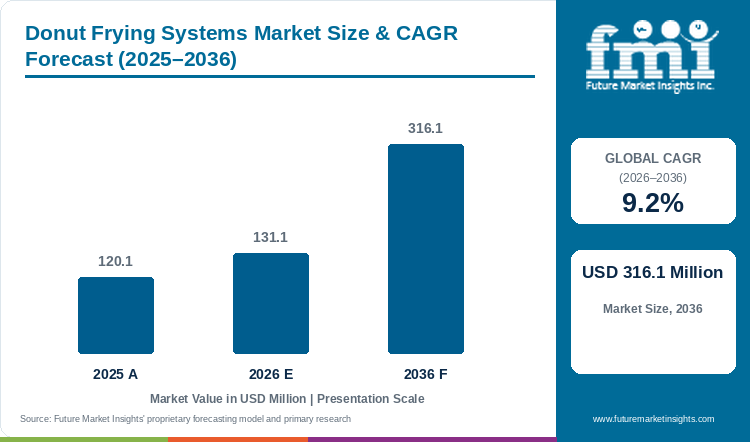
The market was valued at USD 120.1 million in 2025 and is expected to reach USD 131.1 million in 2026. It is projected to reach USD 316.1 million by 2036 at a CAGR of 9.2% from 2026 to 2036.
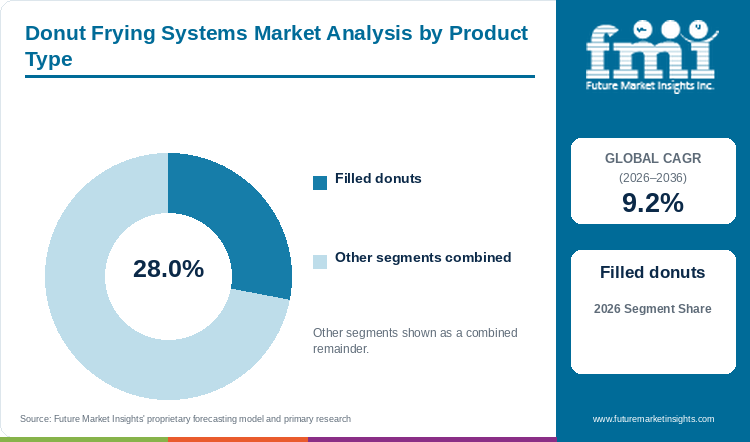
The donut frying systems market was valued at USD 120.1 million in 2025, is anticipated to reach USD 131.1 million in 2026, and is forecast to grow to USD 316.1 million by 2036 at a 9.2% CAGR from 2026 to 2036. Filled donuts account for 28.0% of the Product Type category in 2026. Equipment rated 500-2,000 kg/hr leads Capacity at 42.0%, while Semi-automatic systems hold 42.0% of Automation Level. The central procurement issue is not merely fryer throughput: buyers must match temperature stability and oil management to upstream dough formation and downstream finishing. The forecast reflects investment in controllable frying time, oil filtration and production-line synchronization rather than the retail value of donuts. In September 2025, Moline Machinery presented an integrated mid-capacity donut configuration combining forming equipment with a thermal-fluid fryer and continuous filtration.[1] For commercial bakers, such designs shift a fryer purchase from a standalone kettle decision toward an evaluated production-cell investment.
Key Market Trends & Insights
- By Product Type: Filled donuts lead Product Type with a 28.0% share in 2026; product integrity and downstream filling requirements place value on controlled frying.
- By Capacity: 500-2,000 kg/hr leads Capacity with a 42.0% share in 2026; it offers an intermediate scale between retail kettles and major continuous factories.
- By Automation Level: Semi-automatic leads Automation Level with a 42.0% share in 2026; it allows controlled frying without requiring full robotic handling.
Regional Highlights
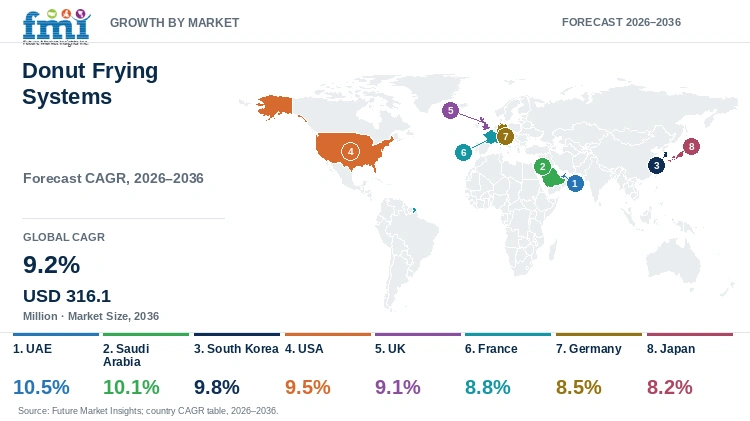
- With a projected 10.5% CAGR over 2026 to 2036, the UAE leads the donut frying system country outlook, where oil management and stable cooking conditions shape purchasing decisions.
- Saudi Arabia follows at 10.1% and South Korea at 9.8%; Japan's 8.2% forecast is the slowest of the eight, though it still implies continued equipment demand.
Market Size & Forecast
Table 1: Donut Frying Systems Market Size and Forecast (USD million), 2025 to 2036
| Market size and forecast | Value |
|---|---|
| 2025 Value (actual) | USD 120.1 million |
| Estimated market size in 2026 | USD 131.1 million |
| Projected market size by 2036 | USD 316.1 million |
| CAGR (2026-2036) | 9.2% |
Operating needs differ by production scale and location. French official statistics recorded 48,351 bakery-pastry outlets in 2024.[23] This underlines the relevance of compact and serviceable installations without proving donut fryer sales. In Japan, a July 2024 agriculture ministry guideline addressed hygienic deployment of robots in food factories, reinforcing the need to validate cleanability before automation.[30] Purchases ultimately depend on consistent product yield, available ventilation and the ability to qualify a machine on a buyer’s actual recipes.
The market is segmented by Product Type, Capacity, Automation Level, End User, Sales Channel and Region, with an outlook from 2026 to 2036.
Profiled companies are AMF Bakery Systems, Buhler Group, Baker Perkins, Rademaker, FRITSCH Group, Rheon Automatic Machinery, Mecatherm, Middleby, Reading Bakery Systems, Kaak Group.
Table 2: Supporting Industry Indicators for the Donut Frying Systems Market
| Indicator | Data point | Why it matters | Source |
|---|---|---|---|
| Integrated donut frying | In September 2025, Moline Machinery presented a next-generation automated mid-capacity donut system at the International Baking Industry Exposition.[1] The exhibit paired a compact stamper and self-cleaning proofer with a thermal-fluid LIBRA fryer and continuous oil filtration.[1] | The reported configuration directly illustrates fryer integration and sanitation design. Moline is a specialist fryer reference and is not included among the companies profiled above. | [1] |
| Upstream bakery equipment | In August 2025, Middleby acquired Oka-Spezialmaschinenfabrik of Germany.[15] Middleby described Oka as a developer of bakery extrusion, molding, depositing and cutting equipment. | The acquisition broadens upstream process scope and could simplify future line-design discussions. Its announcement did not identify a new donut-frying machine, and the acquired revenue should not be treated as revenue from donut-fryer hardware. | [15] |
| Pilot bakery qualification | In June 2025, AMF Bakery Systems and Puratos opened a pilot bakery in New Jersey for commercial bakers to test equipment and formulations in an integrated environment.[18] | The initiative provides a route to validate production processes before capital deployment. The announcement does not specify a donut-frying line, so its relevance is the wider qualification model for commercial bakery equipment rather than a verified fryer launch. | [18] |
Demand Intensity Analysis
Demand is driven by replacement and expansion of frying equipment that can stabilize heat exposure while limiting oil sediment and unscheduled cleaning.
Installation cost extends beyond the equipment invoice to extraction, energy service, operator training, sanitation access and recipe validation.
The increase from USD 131.1 million in 2026 to USD 316.1 million in 2036 represents USD 185.0 million in additional market revenue over the forecast period.
Table 3: Demand Intensity Metrics for the Donut Frying Systems Market, 2026 to 2036
| Demand intensity metric | Value | Basis |
|---|---|---|
| Donut Frying Systems Market value CAGR | 9.2% | Global market value growth, 2026 to 2036 |
| Filled donuts share in 2026 | 28.0% | Product Type classification |
| 500-2,000 kg/hr share in 2026 | 42.0% | Capacity classification |
| Semi-automatic share in 2026 | 42.0% | Automation Level classification |
| Added revenue through 2036 | USD 185.0 million | Increase in market revenue from 2026 to 2036 |
Analyst Perspective
A buyer’s decision turns on demonstrated oil-temperature recovery and saleable donut consistency over a full shift, not a nominal catalog capacity. Suppliers unable to document the frying stage should be assessed only for the production steps they actually provide.
- Nandini Roy Choudhury, Principal Consultant, FMI
How is the donut frying systems market segmented?
The market is segmented by Product Type, Capacity, Automation Level, End User and Sales Channel.
Product Type comprises Filled donuts, Glazed rings, Cake donuts and Premium & specialty. Capacity covers 500-2,000 kg/hr, Below 500 kg/hr and Above 2,000 kg/hr. Automation Level includes Semi-automatic, Manual and Fully automatic / robotic. End User distinguishes Industrial bakeries, In-store & retail bakeries, Artisan bakeries and Foodservice / QSR central kitchens. Sales Channel separates Direct OEM sales, Dealers & distributors and Aftermarket & refurbished.
Why do filled donuts shape fryer specifications within Product Type?
Filled donuts place tighter limits on handling damage and internal doneness because the fried shell must accommodate either subsequent injection or a filled forming route. Operators need repeatable dwell time without oil saturation that could weaken the product. Glazed rings favor steady conveyor geometry and uniform color. Cake donuts can require different deposition and turning arrangements. Premium & specialty products increase changeover needs, but these differences do not establish the underlying share without market-specific measurement.
- Filled donuts represent 28.0% of Product Type in 2026; this leadership makes handling consistency and downstream filling compatibility commercially relevant.
- In September 2025, the Moline exhibit paired a donut former with a thermal-fluid fryer and oil filtration, illustrating the value of keeping shaping and frying interfaces aligned.
What sustains the 500-2,000 kg/hr capacity bracket?
The 500-2,000 kg/hr band addresses processors needing more predictable hourly output than countertop operations while avoiding the site demands of very large continuous lines. Equipment selection depends on how dough mass relates to finished-piece mass, frying residence time and equipment utilization. Vendor brochures often quote pieces per hour rather than kilograms, so buyers must normalize throughput on a common product basis. The Below 500 kg/hr bracket suits smaller production points; Above 2,000 kg/hr entails more demanding line balancing.
- 500-2,000 kg/hr accounts for 42.0% of Capacity in 2026; mid-scale installations can phase capital spending alongside expanding distribution.
- In September 2025, Moline highlighted a mid-capacity automated donut configuration; the description supports intermediate-scale product availability, not an independent kilogram-per-hour estimate.[1]
How does semi-automatic operation balance output with flexibility?
Semi-automatic equipment combines mechanized frying functions with operator-directed loading, unloading or product adjustments. It can preserve temperature controls without committing a bakery to robotic end-to-end handling. Manual systems keep initial capital requirements lower but depend more heavily on employee technique. Fully automatic / robotic systems offer repeatability at scale yet need continuous demand and compatible upstream equipment. The investment threshold is the labor saved after accounting for training and maintenance rather than automation as an end in itself.
- Semi-automatic represents 42.0% of Automation Level in 2026; controlled heating with selective mechanization suits varied recipe runs.
- At Bakery China in May 2024, AMF Bakery Systems presented a compact make-up system for the transition from manual to semi-automatic baking workflows; this is adjacent equipment evidence, not a donut fryer launch.
Why are industrial bakeries the principal End User?
Industrial bakeries treat a fryer as one component in a synchronized flow of make-up, proofing, hot-oil processing and finishing. A failure in that sequence can idle other capital-intensive assets and create waste across an entire shift. Consequently, larger sites tend to emphasize oil-filtration access and process data alongside nominal speed. In-store and artisan bakeries prioritize installation footprint and batch versatility. Foodservice / QSR central kitchens require repeatable specifications across delivery destinations but may operate under different production schedules.
- Industrial bakeries hold 41.0% of End User in 2026; line uptime and yield control are especially valuable when production is centralized.
- In June 2025, AMF Bakery Systems opened a commercial-baking pilot facility with Puratos to support equipment and recipe testing; no donut fryer installation was specified.[18]
Why do direct OEM relationships dominate the Sales Channel?
Direct OEM procurement gives the plant owner one point of contact for fryer sizing, oil-handling design, acceptance testing and integration with proofers or conveyors. The channel becomes more important when equipment is customized around product pitch and local utility conditions. Dealers and distributors remain relevant where customers value regional servicing and smaller configurations. Aftermarket & refurbished transactions provide another access route for price-sensitive buyers, although the market boundary applies only to identifiable donut-fryer system equipment and not general consumables.
- Direct OEM sales account for 54.0% of Sales Channel in 2026; configuration and commissioning accountability support factory-to-manufacturer contracting.
- In September 2025, coverage of Moline’s integrated donut system described forming, proofing, frying and filtration as a linked equipment offer, illustrating the OEM integration proposition.
What are the drivers, restraints and opportunities in the donut frying systems market?
Demand is supported by tighter control of production quality, while utility and sanitation requirements constrain installations, and modular oil-managed systems offer a route to phased expansion.
- Driver: Consistent fry quality and lower cleaning interruption encourage replacement of manually managed kettles.
- Restraint: Ventilation, thermal utilities and line-validation costs can delay capital approval.
- Opportunity: Modular fryers with configurable oil filtration can serve processors scaling beyond manual batches.
Bakery operators purchase new frying equipment when variable color and oil loading begin to limit the amount of saleable output. Continuous filtration and sediment removal reduce the need to interrupt a production shift for cleaning. Moline’s 2025 mid-capacity system and its published LIBRA configurations show how heat source and oil management are being combined in equipment offerings. The commercial driver is narrower than general demand for bakery products: it is the savings a fryer can demonstrate through fewer rejected donuts, consistent timing and controllable maintenance.
A fryer that fits the plant budget may still fail installation review if exhaust handling, hot-oil protection or electrical supply is inadequate. Belshaw’s equipment specifications distinguish industrial gas and electric configurations and describe temperature controls. This makes the buyer’s technical audit materially different from a simple rated-capacity comparison. Operators also need recipes tested on the proposed machine to establish color, texture and oil pickup. These factors lengthen approval cycles; they do not imply a loss of underlying need for efficient frying equipment.
A commercially actionable opening lies between a single-store kettle and a fully integrated high-volume line. Belshaw documents a small electric fryer with a 24-donut load, while Moline describes long continuous systems with filtration and sediment-sweep options. The intervening space rewards a configurable design that buyers can expand with conveyors and more reliable oil control. Dealers can contribute local servicing, but an OEM or integrator must document actual fryer responsibility before a central bakery commits to a standardized production architecture.
Which country CAGRs are profiled in the donut frying systems market?
The following country-level compound annual growth rates cover 2026 to 2036.
Table 4: Country growth outlook for the Donut Frying Systems Market
| Country | CAGR |
|---|---|
| UAE | 10.5% |
| Saudi Arabia | 10.1% |
| South Korea | 9.8% |
| USA | 9.5% |
| UK | 9.1% |
| France | 8.8% |
| Germany | 8.5% |
| Japan | 8.2% |
How do country-level CAGRs compare in the donut frying systems market?
The country outlook ranges from 8.2% in Japan to 10.5% in the UAE, a spread of 2.3 percentage points. The UAE and Saudi Arabia form the highest forecast band, while South Korea and the USA follow. The European rates cluster around the global forecast and Japan is the lowest among the profiled growth rates. These comparisons describe rates of change; they do not establish the relative revenue size of each national market.
- UAE: Food-industry cluster policy creates a potential investment setting; projects still depend on local service and importing economics.
- Saudi Arabia: Food-factory inspection and HACCP obligations favor designs with documented sanitation and process controls.
- South Korea: Extensive franchise-sector reporting highlights the relevance of recipe uniformity and multi-site procurement discipline.
- USA: Established industrial donut-equipment offers enable side-by-side comparison of heating modes and oil filtration.
- UK: Food-manufacturing infrastructure supports both centralized production and smaller bespoke bakery installations.
- France: A large bakery-pastry outlet network increases the importance of compact equipment and accessible maintenance.
- Germany: Ongoing bakery consolidation sharpens scrutiny of labor use and total operating cost.
- Japan: Hygiene-oriented robotics guidance strengthens the case for documented cleanability before mechanization.
Country profiles are directional explanations of operating and procurement conditions. The growth rates should not be interpreted as measured fryer installations or national revenue shares.
Country-wise Analysis
UAE
The UAE holds a 10.5% CAGR from 2026 to 2036. In October 2024, the Emirates News Agency reported that the UAE Future Food Forum discussed the national food-cluster strategy and investment in the food industry. That policy direction offers context for procurement but is not evidence of a specific donut-fryer order. Central kitchens evaluating new frying capacity must secure installation engineering and dependable parts access for imported systems. Compact configurations may suit smaller outlets, while consolidated operators need filtration and repeatable run settings. For manufacturers entering this market, the practical differentiator is documented commissioning support rather than a nominal output claim.
Saudi Arabia
Food-factory compliance is a distinct consideration in Saudi Arabia. The market is forecast to grow at 10.1% CAGR from 2026 to 2036. In July 2024, the Saudi Food and Drug Authority reported inspections of food factories and distribution facilities that examined effective HACCP systems and traceability. Donut-fryer procurement therefore involves more than heating capacity: operators need cleanable oil circuits, documented control points and staff training suited to their production operation. Equipment that creates lengthy disassembly work may raise sanitation costs. Regional engineering coverage and spare-part access can become decisive when a production site is far from its OEM.
South Korea
In South Korea, the 2026 to 2036 CAGR is 9.8%. The Korea Fair Trade Commission published franchise-business statistics in April 2025, documenting the scale and structure of chains across consumer services. The release did not quantify donut equipment. It does, however, provide context for buyers who must reproduce product specifications at multiple outlets or central kitchens. Their engineering priorities include consistent frying recipes and verification across batches, not simply the maximum quantity processed. A modular fryer with monitored settings could appeal where seasonal menu changes are frequent. Validation across different filled and ring products remains a necessary purchasing step.
USA
The USA profile carries a 9.5% CAGR from 2026 to 2036. The country has well-documented industrial donut-fryer options across electric, gas and thermal-fluid heating architectures. In September 2025, Moline showed an automated mid-capacity donut line and a longer electric fryer at an industry exhibition.[1] That equipment evidence makes the procurement trade-off tangible: manufacturers can compare oil filtration, production footprint and commissioning requirements across configurations. Retail locations may prefer smaller installed kettles, whereas centralized factories prioritize continuous operation and reduced sediment shutdowns. Replacement demand depends on demonstrable recipe yield and lower whole-life servicing costs, not a supplier’s promotional throughput figure.
UK
A 9.1% CAGR from 2026 to 2036 is forecast for the UK. The Office for National Statistics published its 2024 manufacturers’ sales-by-product bulletin in July 2025, providing a formal reference point for domestic food-production activity without isolating donut frying equipment. In this environment, small bakeries and industrial operations have different purchase approval routes. Plant buyers will ask whether new fryer capacity is compatible with ventilation and available energy supply. They must also determine how downtime for cleaning affects existing shifts. Service response and spare parts can outweigh a lower quoted equipment price when the line operates on tight fulfillment schedules.
France
France is assigned an 8.8% CAGR over 2026 to 2036. Insee recorded 48,351 bakery-pastry outlets in metropolitan France for 2024 and published the estimate in July 2025. That is retail infrastructure evidence, not a count of donut-fryer users. It suggests a fragmented set of possible small-equipment buyers alongside centralized producers. A shop with limited floor space will weigh safe oil handling and extraction against higher automation. An industrial customer will instead prioritize batch consistency and system integration. Suppliers serving France need to demonstrate whether equipment is suitable for the intended end user rather than treating all bakery establishments as interchangeable demand.
Germany
Germany’s market CAGR is 8.5% from 2026 to 2036. The German Bakers Association reported in May 2024 that bakery businesses had declined to 9,242 in 2023. The decline reflects continued concentration. A January 2025 update also described improvement in new apprenticeship agreements while acknowledging staffing difficulties. For fryer investment, consolidation makes labor productivity and cleaning time important when smaller operations feed larger production networks. Suppliers able to clarify hourly output under actual recipe conditions may meet purchasing requirements more effectively. Local engineering and compatibility with plant safety systems remain important because a fryer influences the economics of the full production line.
Japan
Japan is forecast at an 8.2% CAGR from 2026 to 2036, the lowest rate among the profiled countries. The Ministry of Agriculture, Forestry and Fisheries issued hygiene-management guidance on introducing robots into food-manufacturing workplaces in July 2024. This policy context supports a buyer focus on safe mechanization but does not prove a donut-fryer rollout. A bakery considering automation must assess exposed hot-oil areas and cleaning access as carefully as operator labor. In smaller facilities, space-constrained manual processes may remain economical. Where a central plant has enough recurring throughput, hygienic machine interfaces and dependable maintenance could justify higher levels of controlled handling.
Who are the notable companies in the donut frying systems market?
AMF Bakery Systems, Buhler Group, Baker Perkins, Rademaker, FRITSCH Group, Rheon Automatic Machinery, Mecatherm, Middleby, Reading Bakery Systems, Kaak Group are the notable companies profiled in this market.
The profiled companies enter bakery procurement discussions from different points in the processing chain. Rademaker documents a donut dough-forming line, while a Rheon channel partner identifies equipment for shaping filled-ring products. Kaak Group discusses yeast-raised donuts as a mixer application; FRITSCH Group offers dough-cutting technology. AMF Bakery Systems, Mecatherm and Middleby provide broader industrial bakery line or process expertise. Buhler Group, Baker Perkins and Reading Bakery Systems concentrate on bakery ingredients processing or adjacent snack equipment. The distinction matters: a documented dough line or extruder does not establish that its manufacturer supplies the hot-oil frying kettle. First-party fryer specifications from specialist vendors provide the more direct comparison for this stage. The cited product material does not establish dedicated donut-fryer hardware for these ten profiled companies.
- Donut dough formation and bakery make-up specialists: Rademaker, Rheon Automatic Machinery, FRITSCH Group, Kaak Group; documented forming, dough preparation or cutting interfaces; fryer manufacture requires separate verification.
- Industrial bakery line and process integration platforms: AMF Bakery Systems, Mecatherm, Middleby; engineering for multi-stage bakery lines and commercial-scale operations, without a documented donut-fryer claim.
- Ingredient, extrusion and adjacent baked-snack equipment: Buhler Group, Baker Perkins, Reading Bakery Systems; upstream processing or substitute snack formats; fryer responsibility requires separate supplier confirmation.
Competitive Benchmarking: Donut Frying Systems Market
Table 5: Company capabilities for the Donut Frying Systems Market
| Company | Donut Forming | Line Integration | Donut Fryer | Geographic Reach |
|---|---|---|---|---|
| AMF Bakery Systems | Unscored | High | Unscored | United States and international bakery operations |
| Buhler Group | Unscored | High | Unscored | Switzerland and global food-processing markets |
| Baker Perkins | Unscored | Medium | Unscored | United Kingdom and international processing markets |
| Rademaker | High | Medium | Unscored | Netherlands; international donut-line customers |
| FRITSCH Group | Unscored | Medium | Unscored | Germany and international bakery machinery markets |
| Rheon Automatic Machinery | Medium | Medium | Unscored | Japan; distributor evidence in international markets |
| Mecatherm | Unscored | High | Unscored | France and international industrial bakeries |
| Middleby | Unscored | High | Unscored | United States, Europe and international markets |
| Reading Bakery Systems | Unscored | Medium | Unscored | United States and international snack markets |
| Kaak Group | Medium | High | Unscored | Netherlands and international bakeries |
Scoring basis: Donut Forming rates High for a dedicated documented donut make-up line and Medium for a named donut-capable mixing or forming application. Line Integration rates High for documented broad bakery production-line coordination and Medium for a narrower subsystem or interface. Donut Fryer would rate High for explicit supplied donut oil-frying hardware and Medium for clearly documented partial fryer-stage responsibility. Low indicates a documented limitation; public information that does not establish a capability is left Unscored. Ratings do not measure market share or product performance under a common test protocol.
Key Developments in the Donut Frying Systems Market
In September 2025, Moline Machinery presented a next-generation automated mid-capacity donut system at the International Baking Industry Exposition.[1] The exhibit paired a compact stamper and self-cleaning proofer with a thermal-fluid LIBRA fryer and continuous oil filtration.[1] The reported configuration directly illustrates fryer integration and sanitation design. Moline is a specialist fryer reference and is not included among the companies profiled above.
In August 2025, Middleby acquired Oka-Spezialmaschinenfabrik of Germany.[15] Middleby described Oka as a developer of bakery extrusion, molding, depositing and cutting equipment. The acquisition broadens upstream process scope and could simplify future line-design discussions. Its announcement did not identify a new donut-frying machine, and the acquired revenue should not be treated as revenue from donut-fryer hardware.
In June 2025, AMF Bakery Systems and Puratos opened a pilot bakery in New Jersey for commercial bakers to test equipment and formulations in an integrated environment.[18] The initiative provides a route to validate production processes before capital deployment. The announcement does not specify a donut-frying line, so its relevance is the wider qualification model for commercial bakery equipment rather than a verified fryer launch.
Key Players in the Donut Frying Systems Market
Donut dough formation and bakery make-up specialists
- Rademaker
- Rheon Automatic Machinery
- FRITSCH Group
- Kaak Group
Industrial bakery line and process integration platforms
- AMF Bakery Systems
- Mecatherm
- Middleby
Ingredient, extrusion and adjacent baked-snack equipment
- Buhler Group
- Baker Perkins
- Reading Bakery Systems
Donut Frying Systems Market - Report Scope
Table 6: Report scope for the Donut Frying Systems Market
| Coverage field | Report scope |
|---|---|
| Market breakdown | Product Type, Capacity, Automation Level, End User, Sales Channel |
| Quantitative Units | USD million |
| Market Definition | Revenue from new and eligible aftermarket or refurbished donut-frying system equipment sold within the defined segments. Include only the identifiable fryer-system component of bundled lines. Exclude finished donut sales, separate baking and forming machines, non-donut fryers and general services or consumables. |
| Regions Covered | North America, Latin America, Western Europe, Eastern Europe, East Asia, South Asia and Pacific, Middle East and Africa |
| Countries Covered | UAE, Saudi Arabia, South Korea, USA, UK, France, Germany, Japan |
| Key Companies Profiled | AMF Bakery Systems, Buhler Group, Baker Perkins, Rademaker, FRITSCH Group, Rheon Automatic Machinery, Mecatherm, Middleby, Reading Bakery Systems, Kaak Group |
| Forecast Period | 2026 to 2036 |
| Approach | Primary and secondary research with market triangulation. |
Donut Frying Systems Market - Research Methodology
Table 7: Research approach for the Donut Frying Systems Market
| Method | Approach |
|---|---|
| Primary Research | FMI analysts gathered input from manufacturers, service providers, technology developers, distributors, end users, procurement teams and subject-matter experts. Interviews examined purchasing decisions, product or service evaluation, adoption barriers, approval requirements, pricing considerations and expectations for technical or commercial support. Respondents were also asked what evidence is required before a trial, pilot, or initial order develops into regular purchasing. |
| Desk Research | Desk research covered government statistics, regulatory publications, trade data, industry associations, technical literature, standards, company filings, product information and official corporate announcements. Sources were reviewed for relevance, publication date, geographic coverage and consistency with the defined market scope. Claims relating to performance, applications, approvals, capacity, investment and commercial activity were retained only when supported by credible public evidence. |
| Market Sizing and Forecasting | The market model combined the baseline value with historical performance, segment structure, pricing and volume indicators, adoption levels, company participation and country-level demand conditions. Forecast assumptions considered economic activity, investment trends, regulatory developments, technology adoption, purchasing cycles, supply availability and barriers to wider market use. Segment and regional estimates were reconciled before the final market total was calculated. |
| Data Validation | Estimates were checked against multiple independent indicators, including public data, company activity, trade patterns, industry developments and findings from primary interviews. Validation also tested whether products, services, applications and company revenues fell within the defined market boundaries. Adjacent categories, unsupported claims, overlapping revenues and activities without direct market relevance were excluded to reduce double counting and maintain consistency across segments and countries. |
Donut Frying Systems Market by Segments
Product Type
- Filled donuts
- Glazed rings
- Cake donuts
- Premium & specialty
Capacity
- 500-2,000 kg/hr
- Below 500 kg/hr
- Above 2,000 kg/hr
Automation Level
- Semi-automatic
- Manual
- Fully automatic / robotic
End User
- Industrial bakeries
- In-store & retail bakeries
- Artisan bakeries
- Foodservice / QSR central kitchens
Sales Channel
- Direct OEM sales
- Dealers & distributors
- Aftermarket & refurbished
Donut Frying Systems Market by Region
- North America
- United States
- Canada
- Latin America
- Brazil
- Mexico
- Argentina
- Chile
- Western Europe
- Germany
- France
- United Kingdom
- Italy
- Spain
- Benelux
- Nordics
- Eastern Europe
- Poland
- Czech Republic
- Romania
- Hungary
- East Asia
- China
- Japan
- South Korea
- South Asia and Pacific
- India
- ASEAN
- Australia and New Zealand
- Middle East and Africa
- GCC Countries
- South Africa
- Türkiye
- Israel
Research Sources and Bibliography
- [1] Keith Moore / Bcaking Business (2025, September 15). Moline rolls out new donut equipment.
- [2] Moline Machinery (n.d.). Industrial Donut Equipment.
- [3] Belshaw (n.d.). Century Industrial Donut Fryer C16-24, C18-24.
- [4] Belshaw (n.d.). 618L Donut Fryer (Electric).
- [5] Rademaker (n.d.). Radini Donut Line.
- [6] MSL Teknoloji (n.d.). Rheon-Filled Ring Donut Forming Device for KN550.
- [7] Kaak Group (n.d.). MDD High Speed Mixer.
- [8] FRITSCH Group (n.d.). VARIOCUT S/M 700.
- [9] Buhler Group (n.d.). Baked Goods Production and Ingredient Handling.
- [10] Baker Perkins (n.d.). High Output Food Extruders.
- [11] Mecatherm (n.d.). Our Production Lines.
- [12] Middleby (n.d.). Food Processing.
- [13] Reading Bakery Systems (n.d.). Fried Potato Ring Systems Manufacturing Equipment.
- [14] Reading Bakery Systems (n.d.). Locations.
- [15] Middleby (2025, August 13). Middleby Acquires Oka-Spezialmaschinenfabrik GmbH & Co. KG.
- [16] Middleby (2025, February 25). Middleby Announces Intent to Separate Food Processing Business.
- [17] Middleby (2024, November 26). Middleby Acquires Gorreri Food Processing Technology.
- [18] AMF Bakery Systems (2025, June 9). AMF and Puratos Launch Joint Pilot Bakery Facility.
- [19] AMF Bakery Systems (n.d.). Innovation for Growth Award.
- [20] Mecatherm (2025, May 18). MECATHERM Facilitates Production Line Operations with MyMecatherm Digital Platform.
- [21] Mecatherm (2025, April 16). iba 2025: MECATHERM and ABI Present Bakery and Sweet Goods Solutions.
- [22] Reading Bakery Systems (n.d.). RBS Virtual Snack Seminar: Dynabites Seasoned Pretzels and Baked Potato Sticks.
- [23] Insee (2025, July 10). Équipements et services à la population en 2024: France métropolitaine.
- [24] Zentralverband des Deutschen Bäckerhandwerks (2024, May 4). Mehr Bäckermeister und stabile Neugründungen.
- [25] Zentralverband des Deutschen Bäckerhandwerks (2025, January 9). Positive Bilanz im Bäckerhandwerk: Ausbildungsberufe deutlich beliebter.
- [26] Emirates News Agency (2024, October 4). Future Food Forum Lays Roadmap for Food Cluster Strategy.
- [27] Saudi Food and Drug Authority (2024, July 22). SFDA Detects Over 1,800 Violations.
- [28] Korea Fair Trade Commission / Korea Policy Briefing (2025, April 9). 2024 Franchise Business Status Statistics Announcement.
- [29] Office for National Statistics (2025, July 22). UK Manufacturers’ Sales by Product: 2024.
- [30] Ministry of Agriculture, Forestry and Fisheries, Japan (2024, July 24). Hygiene Management Guideline for Introducing Robots at Food Manufacturing Sites.
This Report Answers
- How large is the donut frying systems market in 2026 and what value is projected for 2036?
- Which fryer-process and production pressures support equipment purchases?
- Why do Filled donuts lead the Product Type classification?
- What keeps 500-2,000 kg/hr at the center of the Capacity mix?
- How do the growth rates of the UAE, Saudi Arabia, South Korea, USA, UK, France, Germany and Japan compare?
- Which profiled companies offer relevant forming, line integration or adjacent bakery equipment?
- What installation and supplier-qualification hurdles delay fryer purchases?
- Which heating, filtration, sanitation and servicing criteria should equipment buyers test?
Frequently Asked Questions
How big is the donut frying systems market in 2026, and what is forecast for 2036?
The market is estimated at USD 131.1 million in 2026 and forecast to reach USD 316.1 million in 2036. These values represent defined frying-system equipment revenue rather than finished donut sales.
What is the donut frying systems market CAGR from 2026 to 2036?
The forecast CAGR is 9.2% from 2026 to 2036. Adoption depends on proving fryer utilization and oil-management benefits within the buyer’s operating constraints.
Which Product Type segment leads the donut frying systems market?
Filled donuts lead Product Type with 28.0% in 2026. Controlled heating and product handling help protect shell consistency for filling and finishing.
Which Capacity segment is the largest in the donut frying systems market?
The 500-2,000 kg/hr category accounts for 42.0% in 2026. This size class can support the move from batch production to more repeatable industrial throughput.
Which profiled countries show the fastest growth?
The UAE has the highest profiled CAGR at 10.5%, followed by Saudi Arabia at 10.1% from 2026 to 2036. These are growth rates and do not indicate which country has the greatest equipment-market revenue.
Which companies are active in or adjacent to the donut frying systems market?
The profiled companies are AMF Bakery Systems, Buhler Group, Baker Perkins, Rademaker, FRITSCH Group, Rheon Automatic Machinery, Mecatherm, Middleby, Reading Bakery Systems, Kaak Group. Their documented roles range from donut dough preparation to industrial bakery and snack systems; direct donut fryer manufacture was not verified for every name.
Preview the report firsthand - request a free sample
Get SampleGet the brochure for pricing and purchase details.
Get PDFTable of Content
- Key Takeaways
- Market Size and CAGR
- Top Growth Driver
- Fastest Growing Segment
- Leading Region
- Key Companies
- Emerging Opportunities
- Executive Summary
- Global Market Outlook
- Demand-side Trends
- Supply-side Trends
- Technology Roadmap Analysis
- Analysis and Recommendations
- Analyst Perspective (What is happening? Why now? What should investors know?)
- Key Questions Answered
- How large is the market?
- What is the CAGR?
- What are key trends?
- Which region dominates?
- Who are the leaders?
- Market Overview
- Market Coverage / Taxonomy
- Market Definition / Scope / Limitations
- Research Methodology
- Chapter Orientation
- Analytical Lens and Working Hypotheses
- Market Structure, Signals, and Trend Drivers
- Benchmarking and Cross-market Comparability
- Market Sizing, Forecasting, and Opportunity Mapping
- Research Design and Evidence Framework
- Desk Research Programme (Secondary Evidence)
- Expert Input and Fieldwork (Primary Evidence)
- Tooling, Models, and Reference Databases
- Data Engineering and Model Build
- Quality Assurance and Audit Trail
- Market Background
- Market Dynamics (Drivers, Restraints, Opportunity, Trends)
- Scenario Forecast (Optimistic, Likely, Conservative)
- Impact Analysis
- AI Impact
- Sustainability Impact
- Regulatory Impact
- Technology Impact
- Consumer / Buyer Analysis
- Purchase Drivers
- Adoption Barriers
- Buyer Journey
- Opportunity Map Analysis
- Product Life Cycle Analysis
- Supply Chain Analysis
- Investment Feasibility Matrix
- Value Chain Analysis
- PESTLE and Porter's Analysis
- Regulatory Landscape
- Regional Parent Market Outlook
- Production and Consumption Statistics
- Import and Export Statistics
- Global Market Analysis and Forecast, 2021 to 2036
- Historical Market Size Value (USD Million) Analysis, 2021 to 2025
- Current and Future Market Size Value (USD Million) Projections, 2026 to 2036
- Y-o-Y Growth Trend Analysis
- Absolute $ Opportunity Analysis
- Global Market Pricing Analysis, 2021 to 2036
- Global Market Analysis and Forecast, By Product Type, 2021 to 2036
- Introduction / Key Findings
- Historical Market Size Value (USD Million) Analysis By Product Type, 2021 to 2025
- Current and Future Market Size Value (USD Million) Analysis and Forecast By Product Type, 2026 to 2036
- Filled donuts
- Glazed rings
- Cake donuts
- Premium & specialty
- Y-o-Y Growth Trend Analysis By Product Type, 2021 to 2025
- Absolute $ Opportunity Analysis By Product Type, 2026 to 2036
- Global Market Analysis and Forecast, By Capacity, 2021 to 2036
- Introduction / Key Findings
- Historical Market Size Value (USD Million) Analysis By Capacity, 2021 to 2025
- Current and Future Market Size Value (USD Million) Analysis and Forecast By Capacity, 2026 to 2036
- 500-2,000 kg/hr
- Below 500 kg/hr
- Above 2,000 kg/hr
- Y-o-Y Growth Trend Analysis By Capacity, 2021 to 2025
- Absolute $ Opportunity Analysis By Capacity, 2026 to 2036
- Global Market Analysis and Forecast, By Automation Level, 2021 to 2036
- Introduction / Key Findings
- Historical Market Size Value (USD Million) Analysis By Automation Level, 2021 to 2025
- Current and Future Market Size Value (USD Million) Analysis and Forecast By Automation Level, 2026 to 2036
- Semi-automatic
- Manual
- Fully automatic / robotic
- Y-o-Y Growth Trend Analysis By Automation Level, 2021 to 2025
- Absolute $ Opportunity Analysis By Automation Level, 2026 to 2036
- Global Market Analysis and Forecast, By End User, 2021 to 2036
- Introduction / Key Findings
- Historical Market Size Value (USD Million) Analysis By End User, 2021 to 2025
- Current and Future Market Size Value (USD Million) Analysis and Forecast By End User, 2026 to 2036
- Industrial bakeries
- In-store & retail bakeries
- Artisan bakeries
- Foodservice / QSR central kitchens
- Y-o-Y Growth Trend Analysis By End User, 2021 to 2025
- Absolute $ Opportunity Analysis By End User, 2026 to 2036
- Global Market Analysis and Forecast, By Sales Channel, 2021 to 2036
- Introduction / Key Findings
- Historical Market Size Value (USD Million) Analysis By Sales Channel, 2021 to 2025
- Current and Future Market Size Value (USD Million) Analysis and Forecast By Sales Channel, 2026 to 2036
- Direct OEM sales
- Dealers & distributors
- Aftermarket & refurbished
- Y-o-Y Growth Trend Analysis By Sales Channel, 2021 to 2025
- Absolute $ Opportunity Analysis By Sales Channel, 2026 to 2036
- Global Market Analysis and Forecast, By Region, 2021 to 2036
- Introduction
- Historical Market Size Value (USD Million) Analysis By Region, 2021 to 2025
- Current Market Size Value (USD Million) Analysis and Forecast By Region, 2026 to 2036
- North America
- Latin America
- Western Europe
- Eastern Europe
- East Asia
- South Asia and Pacific
- Middle East and Africa
- Market Attractiveness Analysis By Region
- North America Market Analysis and Forecast, By Country, 2021 to 2036
- Historical Market Size Value (USD Million) Trend Analysis By Market Taxonomy, 2021 to 2025
- Market Size Value (USD Million) Forecast By Market Taxonomy, 2026 to 2036
- By Country
- United States
- Canada
- By Product Type
- By Capacity
- By Automation Level
- By End User
- By Sales Channel
- By Country
- Market Attractiveness Analysis
- By Country
- By Product Type
- By Capacity
- By Automation Level
- By End User
- By Sales Channel
- Key Takeaways
- Latin America Market Analysis and Forecast, By Country
- Historical Market Size Value (USD Million) Trend Analysis By Market Taxonomy, 2021 to 2025
- Market Size Value (USD Million) Forecast By Market Taxonomy, 2026 to 2036
- By Country
- Brazil
- Mexico
- Argentina
- Chile
- By Product Type
- By Capacity
- By Automation Level
- By End User
- By Sales Channel
- By Country
- Market Attractiveness Analysis
- By Country
- By Product Type
- By Capacity
- By Automation Level
- By End User
- By Sales Channel
- Key Takeaways
- Western Europe Market Analysis and Forecast, By Country
- Historical Market Size Value (USD Million) Trend Analysis By Market Taxonomy, 2021 to 2025
- Market Size Value (USD Million) Forecast By Market Taxonomy, 2026 to 2036
- By Country
- Germany
- France
- United Kingdom
- Italy
- Spain
- Benelux
- Nordics
- By Product Type
- By Capacity
- By Automation Level
- By End User
- By Sales Channel
- By Country
- Market Attractiveness Analysis
- By Country
- By Product Type
- By Capacity
- By Automation Level
- By End User
- By Sales Channel
- Key Takeaways
- Eastern Europe Market Analysis and Forecast, By Country
- Historical Market Size Value (USD Million) Trend Analysis By Market Taxonomy, 2021 to 2025
- Market Size Value (USD Million) Forecast By Market Taxonomy, 2026 to 2036
- By Country
- Poland
- Czech Republic
- Romania
- Hungary
- By Product Type
- By Capacity
- By Automation Level
- By End User
- By Sales Channel
- By Country
- Market Attractiveness Analysis
- By Country
- By Product Type
- By Capacity
- By Automation Level
- By End User
- By Sales Channel
- Key Takeaways
- East Asia Market Analysis and Forecast, By Country
- Historical Market Size Value (USD Million) Trend Analysis By Market Taxonomy, 2021 to 2025
- Market Size Value (USD Million) Forecast By Market Taxonomy, 2026 to 2036
- By Country
- China
- Japan
- South Korea
- By Product Type
- By Capacity
- By Automation Level
- By End User
- By Sales Channel
- By Country
- Market Attractiveness Analysis
- By Country
- By Product Type
- By Capacity
- By Automation Level
- By End User
- By Sales Channel
- Key Takeaways
- South Asia and Pacific Market Analysis and Forecast, By Country
- Historical Market Size Value (USD Million) Trend Analysis By Market Taxonomy, 2021 to 2025
- Market Size Value (USD Million) Forecast By Market Taxonomy, 2026 to 2036
- By Country
- India
- ASEAN
- Australia and New Zealand
- By Product Type
- By Capacity
- By Automation Level
- By End User
- By Sales Channel
- By Country
- Market Attractiveness Analysis
- By Country
- By Product Type
- By Capacity
- By Automation Level
- By End User
- By Sales Channel
- Key Takeaways
- Middle East and Africa Market Analysis and Forecast, By Country
- Historical Market Size Value (USD Million) Trend Analysis By Market Taxonomy, 2021 to 2025
- Market Size Value (USD Million) Forecast By Market Taxonomy, 2026 to 2036
- By Country
- GCC Countries
- South Africa
- Türkiye
- Israel
- By Product Type
- By Capacity
- By Automation Level
- By End User
- By Sales Channel
- By Country
- Market Attractiveness Analysis
- By Country
- By Product Type
- By Capacity
- By Automation Level
- By End User
- By Sales Channel
- Key Takeaways
- Key Countries Market Analysis
- United States
- Pricing Analysis
- Market Share Analysis, 2025
- By Product Type
- By Capacity
- By Automation Level
- By End User
- By Sales Channel
- Canada
- Pricing Analysis
- Market Share Analysis, 2025
- By Product Type
- By Capacity
- By Automation Level
- By End User
- By Sales Channel
- Mexico
- Pricing Analysis
- Market Share Analysis, 2025
- By Product Type
- By Capacity
- By Automation Level
- By End User
- By Sales Channel
- Brazil
- Pricing Analysis
- Market Share Analysis, 2025
- By Product Type
- By Capacity
- By Automation Level
- By End User
- By Sales Channel
- Chile
- Pricing Analysis
- Market Share Analysis, 2025
- By Product Type
- By Capacity
- By Automation Level
- By End User
- By Sales Channel
- Germany
- Pricing Analysis
- Market Share Analysis, 2025
- By Product Type
- By Capacity
- By Automation Level
- By End User
- By Sales Channel
- United Kingdom
- Pricing Analysis
- Market Share Analysis, 2025
- By Product Type
- By Capacity
- By Automation Level
- By End User
- By Sales Channel
- Italy
- Pricing Analysis
- Market Share Analysis, 2025
- By Product Type
- By Capacity
- By Automation Level
- By End User
- By Sales Channel
- Spain
- Pricing Analysis
- Market Share Analysis, 2025
- By Product Type
- By Capacity
- By Automation Level
- By End User
- By Sales Channel
- France
- Pricing Analysis
- Market Share Analysis, 2025
- By Product Type
- By Capacity
- By Automation Level
- By End User
- By Sales Channel
- India
- Pricing Analysis
- Market Share Analysis, 2025
- By Product Type
- By Capacity
- By Automation Level
- By End User
- By Sales Channel
- ASEAN
- Pricing Analysis
- Market Share Analysis, 2025
- By Product Type
- By Capacity
- By Automation Level
- By End User
- By Sales Channel
- Australia and New Zealand
- Pricing Analysis
- Market Share Analysis, 2025
- By Product Type
- By Capacity
- By Automation Level
- By End User
- By Sales Channel
- China
- Pricing Analysis
- Market Share Analysis, 2025
- By Product Type
- By Capacity
- By Automation Level
- By End User
- By Sales Channel
- Japan
- Pricing Analysis
- Market Share Analysis, 2025
- By Product Type
- By Capacity
- By Automation Level
- By End User
- By Sales Channel
- South Korea
- Pricing Analysis
- Market Share Analysis, 2025
- By Product Type
- By Capacity
- By Automation Level
- By End User
- By Sales Channel
- Poland
- Pricing Analysis
- Market Share Analysis, 2025
- By Product Type
- By Capacity
- By Automation Level
- By End User
- By Sales Channel
- Hungary
- Pricing Analysis
- Market Share Analysis, 2025
- By Product Type
- By Capacity
- By Automation Level
- By End User
- By Sales Channel
- Türkiye
- Pricing Analysis
- Market Share Analysis, 2025
- By Product Type
- By Capacity
- By Automation Level
- By End User
- By Sales Channel
- South Africa
- Pricing Analysis
- Market Share Analysis, 2025
- By Product Type
- By Capacity
- By Automation Level
- By End User
- By Sales Channel
- UAE
- Pricing Analysis
- Market Share Analysis, 2025
- By Product Type
- By Capacity
- By Automation Level
- By End User
- By Sales Channel
- Saudi Arabia
- Pricing Analysis
- Market Share Analysis, 2025
- By Product Type
- By Capacity
- By Automation Level
- By End User
- By Sales Channel
- United States
- Market Structure Analysis
- Competition Dashboard
- Competition Benchmarking
- Market Share Analysis of Top Players
- By Regional
- By Product Type
- By Capacity
- By Automation Level
- By End User
- By Sales Channel
- Emerging Startups
- Innovation Benchmarking
- Competition Analysis
- Competition Deep Dive
- AMF Bakery Systems
- Overview
- Product Portfolio
- Profitability by Market Segments
- Sales Footprint
- Strategy Overview
- Marketing Strategy
- Product Strategy
- Channel Strategy
- Buhler Group
- Baker Perkins
- Rademaker
- FRITSCH Group
- Rheon Automatic Machinery
- Mecatherm
- Middleby
- Reading Bakery Systems
- Kaak Group
- AMF Bakery Systems
- Case Studies
- Success Stories
- Recent Developments
- Competition Deep Dive
- Assumptions & Acronyms Used


