

- Market Size (2026)
- USD 1.3 Bn
- Forecast (2036)
- USD 2.0 Bn
- CAGR (2026 to 2036)
- 4.8%
How big is Drill Stem Testing Tools Market in 2026?
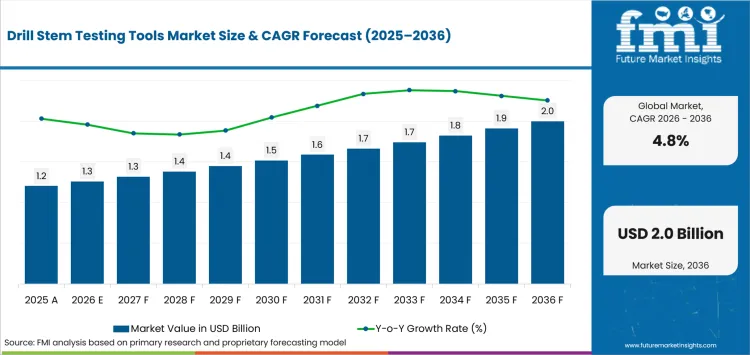
USD 1.3 billion in 2026 and USD 2.0 billion by 2036 at a 4.8% CAGR.
Demand for drill stem testing tools is projected to expand at 4.8% CAGR between 2026 and 2036, increasing valuation from USD 1.3 billion to USD 2.0 billion. Full-flow tests earn rig time only where pressure behavior or produced fluids can change a completion decision. In January 2025 Halliburton won a three-year Petrobras offshore drilling contract that included formation testing for exploration and development wells. The award places reservoir evidence inside the well-construction program and makes test reliability a purchasing condition before permanent completion work begins.
Norway's mature offshore system makes qualified test-string availability more local than in project-selective markets such as Japan. The Norwegian Offshore Directorate recorded 2.219 million barrels per day of oil, NGL and condensate in January 2026. That production base supports nearby maintenance and recertification capacity for tools mobilized to offshore rigs. Smaller appraisal programs carry the opposite economics because rental mobilization absorbs more of each test budget. The forecast therefore converts through service density as much as through well count.
Key Takeaways
- Exploration and appraisal spending sustains demand where a flowing test can change the reservoir model before permanent completion decisions are fixed.
- By tool type, tester valves are estimated to hold 23.0% in 2026 owing to predictable flow and shut-in control.
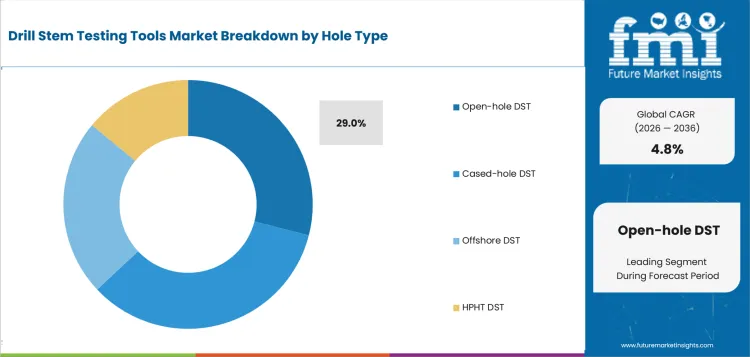
- In 2026 open-hole DST is expected to lead hole type with 29.0% share because appraisal wells need temporary isolation before completion design.
- Reservoir evaluation is projected to hold 30.0% by operation in 2026 due to its direct role in development decisions.
- Rig time and test-string qualification restrain adoption where wireline formation testing answers the commercial question without a full flowing test.
- Some of the key players in this market include Halliburton, SLB, Baker Hughes, NOV, Weatherford, Expro, Nabors, Interwell, NESR, and TAM International.
Analyst Perspective
"DST earns rig time only if the string can isolate the interval and return flow evidence that changes a well decision. The practical advantage lies in qualified tools that mobilize quickly and recover usable pressure data without forcing a repeat run."
- Nikhil Kaitwade, Principal Consultant, Future Market Insights
How is the drill stem testing tools market segmented?
The drill stem testing tools market is segmented by tool type, hole type, operation, well type, and sales channel.
Tool type covers tester valves, packer assemblies, circulating valves, pressure recorders, sampler tools and downhole gauges. Hole type includes open-hole DST, cased-hole DST, offshore DST and HPHT DST. Operation covers reservoir evaluation, formation pressure testing, fluid sampling, flow testing and well deliverability testing. Well type covers exploration, appraisal, offshore, deepwater and HPHT wells. Sales channels include oilfield service companies, tool rental providers, direct tool OEMs and regional service shops.
Why does open-hole DST lead the hole type category?
Open-hole DST runs before permanent oilwell completion tools establish the final isolation architecture. The uncased interval gives packer sealing greater weight. Retrievability also affects whether crews can finish appraisal without complicating later completion work. Open-hole uncertainty increases the cost of a failed seal.
- In 2026 open-hole DST is expected to lead hole type with 29.0% share because appraisal wells need temporary isolation before completion design.
- JAPEX began exploratory drilling offshore Hidaka in March 2026 and planned production tests if gas indications were found. The staged program keeps temporary isolation flexible until the appraisal result justifies a permanent design.
What makes tester valves central to the tool type category?
Tester valves alternate reservoir flow with shut-in periods so pressure buildup can be interpreted without pulling the string. Adjacent drilling tools use the same control principle whenever a downhole state must change after reaching depth.
- By tool type, tester valves are estimated to hold 23.0% in 2026 owing to controlled flow cycles that depend on predictable opening and closure.
- In February 2026 Expro disclosed that CaTS ATX transmitted downhole data and controlled a valve remotely during DST in Indonesia. Field crews can confirm valve response before starting the next pressure sequence. That check reduces the chance of repeating a manipulation step.
How does reservoir evaluation lead the operation category?
Reservoir evaluation uses temporary flow to answer permeability and pressure-support questions before development capital is fixed. In cased-hole tests perforating guns may provide zone access before the flow sequence begins. The test has commercial value only if recovered pressure and fluid data narrow the development choice.
- Reservoir evaluation is projected to hold 30.0% by operation in 2026 due to its direct role in deciding whether a reservoir proceeds to completion.
- Expro won a June 2025 Northern Endurance Partnership contract covering integrated well testing and DST for two carbon-storage appraisal wells. Downhole data acquisition tied test execution directly to reservoir qualification before injection planning.
Why do exploration wells lead the well type category?
Exploration wells carry the widest uncertainty about whether discovered rock can flow at rates that justify another capital step. Directional drilling services often place the borehole before DST tests deliverability. A negative result can stop appraisal before a permanent completion is ordered.
- Exploration wells are set to lead well type with 31.0% share in 2026 due to the value of flowing data before development commitment.
- The Norwegian Offshore Directorate stated in January 2026 that 2025 was the second-best exploration year in a decade on the Norwegian shelf. That activity keeps fit-for-purpose test strings close to active offshore drilling schedules.
What supports oilfield service companies in the sales channel category?
DST is commonly purchased as an executed test instead of a collection of individual tools. Oil and gas field services companies coordinate packer setting with valve sequencing under one field procedure. Their crews also manage pressure recording and contingencies during high-cost rig operations.
- By sales channel, oilfield service companies are forecast to represent 48.0% in 2026 driven by demand for qualified tools plus field execution.
- Expro secured a two-year UAE contract in June 2026 for surface well testing plus flowback services on unconventional wells. The award shows why operators purchase testing as executed field work with equipment and operational support.
What are the drivers, restraints and opportunities in the Drill Stem Testing Tools Market?
Offshore appraisal sustains direct reservoir testing while rig-time and qualification costs limit full-flow programs. Faster downhole confirmation can reduce repeated manipulation during qualified test sequences.
- Driver: Offshore exploration keeps DST relevant where pressure and deliverability evidence can alter the development concept before major completion capital is committed.
- Restraint: Full-flow testing consumes rig time and requires qualified temporary isolation hardware so alternative formation-testing routes compete for narrower reservoir questions.
- Opportunity: Faster downhole confirmation can reduce repeated manipulation if control tools integrate cleanly with pressure-qualified DST strings.
New offshore fields keep a testable well pool active because appraisal results shape completion and facility choices. The USA Energy Information Administration expected 13 Gulf of America fields to start production during 2025 and 2026. Those projects sustain deepwater evaluation work where a flowing test can justify its rig-time cost through direct deliverability evidence.
Wireline formation testing competes with DST whenever the immediate question does not require sustained formation flow. Halliburton launched Xaminer Deep Testing in May 2026 to extend producibility and boundary insight earlier in the well life cycle. Full-flow DST therefore needs a decision advantage large enough to offset temporary isolation and recertification work.
Test time has more value if crews spend it collecting reservoir evidence instead of confirming tool state. NOV introduced a smart-wired circulating sub in April 2026 with real-time circulation control and independent operation of multiple subs. Similar control interfaces can shorten test sequencing once pressure integrity and service compatibility are qualified for the DST string.
Which country CAGRs are profiled in the Drill Stem Testing Tools Market?
| Country | CAGR |
|---|---|
| Norway | 5.6% |
| UAE | 5.3% |
| KSA | 5.2% |
| Brazil | 5.0% |
| USA | 4.4% |
| Canada | 4.3% |
| Japan | 3.3% |
How do country-level CAGRs compare in the Drill Stem Testing Tools Market?
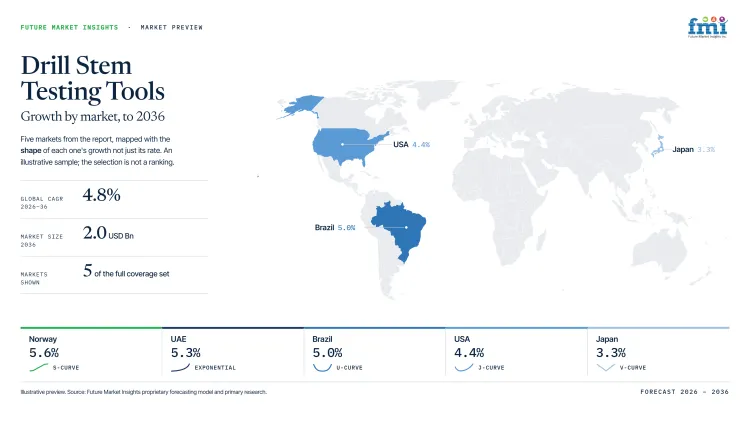
Norway, UAE and KSA form the upper band above 5.0%. Brazil sits at the transition point. USA and Canada follow while Japan records the slowest approved CAGR.
- Norway rewards rapid offshore recertification.
- UAE programs link testing with flowback.
- KSA gas expansion enlarges service baseload.
- Brazil penalizes repeat offshore runs.
- USA offers deeper rental choice.
- Canada's winter access shapes scheduling.
- Japan raises dedicated-inventory thresholds.
Similar CAGRs therefore require different service models. The full report provides country-level CAGR analysis across North America, Latin America, Western Europe, Eastern Europe, East Asia, South Asia and Pacific, and Middle East and Africa.
Country-wise Analysis
- North Sea appraisal campaigns compress tool preparation into narrow offshore windows because rig schedules leave little tolerance for failed barrier tests. The Norway drill stem testing tools sector is projected to record 5.6% CAGR during the assessment period, owing to active licence turnover and a mature service base. In January 2026 the Norwegian Offshore Directorate offered 57 production licences to 19 companies and placed 31 licences in the North Sea. Local inventory shortens replacement lead times after a test tool fails qualification during offshore preparation. Harsh pressure and weather conditions still raise the proof required before mobilization. Companies holding qualified North Sea strings can protect turnaround time without relaxing pressure-integrity criteria.
- USA DST selection differs sharply between shale programs and Gulf offshore wells because the cost of sustained formation flow changes by rig type. Coiled tubing services and wireline fleets deepen local execution options. EIA data published in March 2026 show crude output reached a record 13.6 million barrels per day during 2025 despite fewer active rigs and wells. Demand for drill stem testing tools in USA is forecast to rise at 4.4% CAGR over the forecast period, tied to selective use where full-flow evidence changes completion design. Wireline formation testing still wins narrower pressure questions. Growth therefore does not imply broader DST use on every well.
- Japan runs upstream appraisal through discrete projects rather than continuous basin activity so test packages are assembled for specific drilling windows. Domestic crews can support advanced evaluation work but offshore mobilization carries a higher threshold if only a few wells need testing. METI stated in February 2026 that Japan's independent oil and gas development ratio reached 42.1% in FY2024. Japan is estimated to post 3.3% CAGR over the forecast period, given continued upstream development and a limited domestic drilling cadence. Project concentration keeps specialized DST demand uneven as national upstream capability improves. Local project timing controls whether dedicated test hardware stays in-country between campaigns.
- Brazilian pre-salt wells place temporary isolation beside ram BOP systems inside deepwater programs with high pressure exposure and long offshore logistics. ANP reported in March 2026 that pre-salt production represented 79.9% of national oil and gas output in January from 177 producing wells. Drill stem testing tool sales in Brazil are forecast to expand at 5.0% CAGR by 2036, propelled by technically demanding appraisal and development work. Local offshore service bases support complex testing but deepwater pressure envelopes tighten qualification requirements for packers and tester valves. Further pre-salt appraisal will favor companies that keep qualified spares near campaign ports before well schedules tighten.
- UAE unconventional wells move from hydraulic fracturing services into stable test conditions where pressure-control handoffs must be qualified. Adoption of drill stem testing tools in UAE is estimated to expand at 5.3% CAGR through 2036, helped by unconventional gas appraisal. Abu Dhabi Media Office stated in June 2025 that the emirate had produced unconventional gas for the first time. Established energy-service capacity supports local crews and critical spares. High-pressure interfaces still require careful qualification between downhole strings and surface testing equipment. Regional providers compete more effectively if they prove interface integrity before the rig reaches the test interval.
- Saudi gas programs use BOP pressure test units and other pressure-control routines that must keep qualification records consistent between field teams. Aramco announced in February 2026 that Jafurah had started production and still targets roughly 80% sales-gas capacity growth by 2030 versus 2021. Local repair capacity keeps pressure-control hardware available between campaigns and reduces avoidable remobilization delays. In KSA drill stem testing tool demand is predicted to advance at 5.2% CAGR through 2036, attributable to sustained unconventional development. Operators will favor service groups that document the same barrier and pressure-test basis at each mobilization while maintaining spare availability.
- Western Canada has a deep well-service base but gas economics determine which reservoir questions justify a full flowing test. The Canada Energy Regulator recorded average natural gas production near 19.0 Bcf/d in 2025 and a monthly record of 20.0 Bcf/d in November. Canada's drill stem testing tools outlook is anticipated to advance at 4.3% CAGR over the assessment period, because sustained drilling keeps evaluation work active. Inflow control devices and other completion work keep technical service capacity near active western fields. Low-price periods still shift selected reservoir questions toward lower-cost formation-testing routes. DST utilization improves if operators tie each flowing test to a defined completion or deliverability decision.
Who are the notable companies in the Drill Stem Testing Tools Market?
Halliburton, SLB, Baker Hughes, NOV, Weatherford, Expro, Nabors, Interwell, NESR, and TAM International are notable companies serving this market.
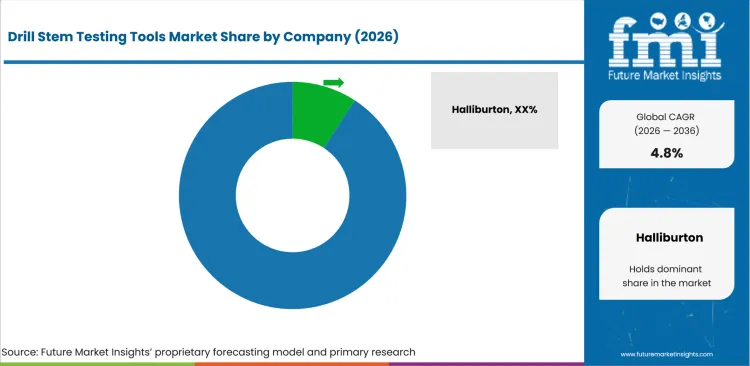
Competition splits between integrated testing groups and specialists in isolation or drilling control plus regional well-testing execution. Entry depends on pressure-qualified hardware and service readiness at the rig. Corporate scale alone does not show whether a provider can mobilize a compatible string within the drilling schedule.
- Halliburton and SLB provide broad reservoir-evaluation or well-testing workflows. Baker Hughes, Weatherford and Expro also combine field execution with integrated testing.
- NOV and Nabors contribute drilling control plus downhole data systems that can interface with testing workflows.
- Interwell and TAM International focus on isolation hardware while NESR provides regional well-testing and drilling-evaluation service depth.
Competitive Benchmarking: Drill Stem Testing Tools Market
| Company | Testing and Evaluation Evidence | Isolation and Flow-Control Evidence | Real-Time Data and Control Evidence | Geographic Reach |
|---|---|---|---|---|
| Halliburton | High | High | High | Global |
| SLB | High | Medium | High | Global |
| Baker Hughes | High | Medium | High | Global |
| NOV | Low | Low | High | Global |
| Weatherford | High | Medium | High | Global |
| Expro | High | Medium | High | Global |
| Nabors | Low | Low | High | Americas, Middle East and international drilling markets |
| Interwell | Low | High | High | Europe, Middle East, Asia Pacific and Americas |
| NESR | Medium | Low | Medium | Middle East, North Africa and selected Asia Pacific markets |
| TAM International | Low | High | Low | North America, Europe, Middle East, Latin America, Asia Pacific and Africa |
Scoring basis: High requires multiple current official records showing direct capability for the criterion. Medium marks one direct record or several narrower records. Low identifies a documented adjacent role or a single limited function. Geographic reach records supported operating regions and is not scored.
Key Developments in the Drill Stem Testing Tools Market
- In July 2026, Baker Hughes signed ONGC agreements covering up to 46 wireline units and seven drill stem testing kits for Indian onshore and offshore fields. Local maintenance sites in Taloja and Duliajan make the award relevant to repeat mobilization as well as hardware supply.
- In October 2025, Weatherford disclosed an integrated La Luna operation in Colombia that tested four zones and explicitly included drill stem testing. The result tied DST execution to perforation plus completion decisions in the country's first stratigraphic well.
- In April 2025, SLB disclosed an Australian offshore service contract for exploration and appraisal that included drillstem testing within a broader drilling scope. The contract places DST beside wireline and tubing-conveyed perforating under one service program.
Key Players in the Drill Stem Testing Tools Market
Integrated Reservoir Testing and Field Execution
- Halliburton
- SLB
- Baker Hughes
- Weatherford
- Expro
Drilling, Data and Regional Testing Platforms
- NOV
- Nabors
- NESR
Isolation and Downhole Tool Specialists
- Interwell
- TAM International
Drill Stem Testing Tools Market - Report Scope
| Coverage field | Report scope |
|---|---|
| Market breakdown | By tool type, hole type, operation, well type, sales channel and region. |
| Quantitative Units | USD billion. |
| Market Definition | Commercial drill stem testing tools and executed testing services used to isolate formations, control temporary flow, record pressure and recover representative reservoir evidence. |
| Regions Covered | North America, Latin America, Western Europe, Eastern Europe, East Asia, South Asia and Pacific, and Middle East and Africa. |
| Countries Covered | Norway, USA, Japan, Brazil, UAE, KSA, Canada, and 20+ countries included in the full report. |
| Key Companies Profiled | Halliburton, SLB, Baker Hughes, NOV, Weatherford, Expro, Nabors, Interwell, NESR, and TAM International. |
| Forecast Period | 2026 to 2036. |
| Approach | Primary and secondary research with market triangulation. |
Drill Stem Testing Tools Market - Research Methodology
| Method | Approach |
|---|---|
| Primary Research | FMI analysts gathered input from manufacturers, service providers, technology developers, distributors, end users, procurement teams, and subject-matter experts. Interviews examined purchasing decisions, product or service evaluation, adoption barriers, approval requirements, pricing considerations, and expectations for technical or commercial support. Respondents were also asked what evidence is required before a trial, pilot, or initial order develops into regular purchasing. |
| Desk Research | Desk research covered government statistics, regulatory publications, trade data, industry associations, technical literature, standards, company filings, product information, and official corporate announcements. Sources were reviewed for relevance, publication date, geographic coverage, and consistency with the defined market scope. Claims relating to performance, applications, approvals, capacity, investment, and commercial activity were retained only when supported by credible public evidence. |
| Market Sizing and Forecasting | The market model combined the baseline value with historical performance, segment structure, pricing and volume indicators, adoption levels, company participation, and country-level demand conditions. Forecast assumptions considered economic activity, investment trends, regulatory developments, technology adoption, purchasing cycles, supply availability, and barriers to wider market use. Segment and regional estimates were reconciled before the final market total was calculated. |
| Data Validation | Estimates were checked against multiple independent indicators, including public data, company activity, trade patterns, industry developments, and findings from primary interviews. Validation also tested whether products, services, applications, and company revenues fell within the defined market boundaries. Adjacent categories, unsupported claims, overlapping revenues, and activities without direct market relevance were excluded to reduce double counting and maintain consistency across segments and countries. |
Drill Stem Testing Tools Market by Segments
Drill Stem Testing Tools Market segmented by Tool Type:
- Tester valves
- Packer assemblies
- Circulating valves
- Pressure recorders
- Sampler tools
- Downhole gauges
Drill Stem Testing Tools Market segmented by Hole Type:
- Open-hole DST
- Cased-hole DST
- Offshore DST
- HPHT DST
Drill Stem Testing Tools Market segmented by Operation:
- Reservoir evaluation
- Formation pressure testing
- Fluid sampling
- Flow testing
- Well deliverability testing
Drill Stem Testing Tools Market segmented by Well Type:
- Exploration wells
- Appraisal wells
- Offshore wells
- Deepwater wells
- HPHT wells
Drill Stem Testing Tools Market segmented by Sales Channel:
- Oilfield service companies
- Tool rental providers
- Direct tool OEM
- Regional service shops
Drill Stem Testing Tools Market by Region:
- North America
- United States
- Canada
- Latin America
- Brazil
- Mexico
- Argentina
- Chile
- Western Europe
- Germany
- France
- United Kingdom
- Italy
- Spain
- Benelux
- Nordics
- Eastern Europe
- Poland
- Czech Republic
- Romania
- Hungary
- East Asia
- China
- Japan
- South Korea
- South Asia and Pacific
- India
- ASEAN
- Australia and New Zealand
- Middle East and Africa
- GCC Countries
- South Africa
- Türkiye
- Israel
Research Sources and Bibliography
- Halliburton. (2025, January 30). Halliburton secures major offshore drilling contract with Petrobras.
- Norwegian Offshore Directorate. (2026, February 20). Production figures January 2026.
- Expro. (2026, February 19). Expro Group Holdings N.V. Announces Fourth Quarter 2025 Results and Full-Year 2026 Guidance.
- JAPEX. (2026, March 25). Commence of Exploratory Drilling Survey in the Offshore Hidaka Area of Hokkaido.
- Expro. (2025, June 19). Expro Wins Well Test Contract for Major UK CCS Project.
- Norwegian Offshore Directorate. (2026, January 8). Best exploration year in several years.
- Expro. (2026, June 11). Expro Secures Two-Year Contract for Unconventional Well Testing in the UAE.
- USA Energy Information Administration. (2025, June 6). Gulf of America oil and natural gas production expected to remain stable through 2026.
- Halliburton. (2026, May 18). Halliburton launches Xaminer Deep Testing logging service.
- NOV. (2026, April 27). NOV Reports First Quarter 2026 Earnings.
- Norwegian Offshore Directorate. (2026, January 13). 19 companies offered ownership interests.
- USA Energy Information Administration. (2026, March 31). USA crude oil production rose in 2025, setting new record.
- Ministry of Economy, Trade and Industry. (2026, February 17). FY2024 Independent Development Ratio of Oil and Natural Gas in Japan Released.
- Agência Nacional do Petróleo, Gás Natural e Biocombustíveis. (2026, March 2). ANP divulga dados consolidados da produção de petróleo e gás em janeiro de 2026.
- Abu Dhabi Media Office. (2025, June 10). Khaled bin Mohamed bin Zayed chairs meeting of Executive Committee of ADNOC Board of Directors.
- Aramco. (2026, February 26). Aramco's gas strategy builds momentum with major progress towards growth target.
- Canada Energy Regulator. (2026, May 20). Market Snapshot: Canada's natural gas production kept climbing in 2025.
- Baker Hughes. (2026, July 6). Baker Hughes, India's ONGC Sign Agreements to Deploy Advanced Wireline Solutions Across Onshore, Offshore Fields.
- Weatherford. (2025, October 21). Weatherford Announces Third Quarter 2025 Results.
- SLB. (2025, April 25). SLB Announces First-Quarter 2025 Results.
- Expro. (2026, July 23). Expro Completes Enhanced Drilling Acquisition, Adding Transformational Managed Pressure Drilling Capability.
- Baker Hughes. (2026, September 2). Baker Hughes Collaborates with OGDC to Optimize Existing Well Production, Supporting Energy Continuity in Pakistan.
- Halliburton. (2025, September 9). Halliburton launches SmartWell® Turing® electro-hydraulic control system for improved reservoir management.
- NOV. (2026, August 21). NOV and Well ID Deliver Breakthrough in Borehole Imaging While Drilling.
- National Energy Services Reunited Corp. (2026, August 5). NESR Secures $300 Million in Multiple Services & Technology Contracts in Kuwait.
- Interwell. (2025, October). Triple Barrier With On-Demand Pressure Readout Enabling Dry Workover on Live Gas Cavern.
- Halliburton. (2026, April 15). Halliburton launches Volta™ all-electric control system to advance intelligent completions.
- SLB. (2026, February 12). SLB Awarded Multiple Offshore Drilling Contracts by Mubadala Energy for Tangkulo Deepwater Development in Indonesia.
- Baker Hughes. (2025, January 13). Baker Hughes Launches SureCONNECT™ FE, Next Generation Downhole Intelligent Wet-Mate System.
- NOV. (2026, July 28). NOV Reports Second Quarter 2026 Earnings.
- Weatherford. (2025, October 21). Weatherford International 3Q 2025 Earnings Presentation.
- Expro. (2026, July 28). Expro Announces Second Quarter 2026 Results.
- Nabors. (2025, February 25). Nabors Wins Big at the 2025 Oil & Gas Middle East Awards.
- Interwell. (2025, July). Requalifying 15-Year-Old Suspension Plugs for Final Well Abandonment.
- National Energy Services Reunited Corp. (2025, April 29). NESR Awarded $200 Million in New Slickline Contracts Across Multiple Countries.
- USA Patent and Trademark Office. (2025, November 4). Patentee Index.
This bibliography is provided for reader reference and is not exhaustive. The full report contains the complete reference list and detailed citations.
This Report Answers
- How large is the drill stem testing tools market in 2026 and 2036?
- Why does direct reservoir evidence keep DST relevant in appraisal?
- Why do tester valves hold 23.0% share in 2026?
- How does open-hole DST affect temporary isolation before completion design?
- Why does reservoir evaluation hold 30.0% share in 2026?
- How do the seven profiled country CAGRs compare?
- Which companies provide testing, isolation or drilling-control functions?
- How do rig time and alternative formation tests affect DST selection?
Frequently Asked Questions
How big is the drill stem testing tools market in 2026?
The drill stem testing tools market is valued at USD 1.3 billion in 2026 and is projected to reach USD 2.0 billion by 2036. Spending follows exploration and appraisal programs that require direct pressure and deliverability evidence.
What is the CAGR of the drill stem testing tools market from 2026 to 2036?
The drill stem testing tools market is projected to grow at a CAGR of 4.8% between 2026 and 2036. Expansion follows technically demanding wells where full-flow reservoir evidence can change completion or development decisions.
Which tool type leads the drill stem testing tools market?
The tester valves segment is expected to hold 23.0% of the drill stem testing tools market in 2026, attributable to controlled flow and shut-in cycling. Predictable valve actuation protects the pressure-transient sequence during each test.
Which hole type holds a leading share in the drill stem testing tools market?
The open-hole DST segment is expected to hold 29.0% of the drill stem testing tools market in 2026, supported by temporary isolation before final completion design. Packer reliability carries more weight because appraisal occurs before permanent well architecture is fixed.
Which countries are projected to record the highest growth in the drill stem testing tools market?
Norway is projected to grow at 5.6% CAGR, followed by UAE at 5.3% and KSA at 5.2% through 2036. Their higher rates align with offshore or unconventional programs that maintain intensive testing-service needs.
Which companies are active in the drill stem testing tools market?
Key companies operating in the drill stem testing tools market include Halliburton, SLB, Baker Hughes, NOV, Weatherford, Expro, Nabors, Interwell, NESR, and TAM International. Their positions span integrated testing, isolation, drilling control and regional field execution.
Preview the report firsthand - request a free sample
Get SampleGet the brochure for pricing and purchase details.
Get PDFTable of Content
- Key Takeaways
- Market Size and CAGR
- Top Growth Driver
- Fastest Growing Segment
- Leading Region
- Key Companies
- Emerging Opportunities
- Executive Summary
- Global Market Outlook
- Demand-side Trends
- Supply-side Trends
- Technology Roadmap Analysis
- Analysis and Recommendations
- Analyst Perspective (What is happening? Why now? What should investors know?)
- Key Questions Answered
- How large is the market?
- What is the CAGR?
- What are key trends?
- Which region dominates?
- Who are the leaders?
- Market Overview
- Market Coverage / Taxonomy
- Market Definition / Scope / Limitations
- Research Methodology
- Chapter Orientation
- Analytical Lens and Working Hypotheses
- Market Structure, Signals, and Trend Drivers
- Benchmarking and Cross-market Comparability
- Market Sizing, Forecasting, and Opportunity Mapping
- Research Design and Evidence Framework
- Desk Research Programme (Secondary Evidence)
- Expert Input and Fieldwork (Primary Evidence)
- Tooling, Models, and Reference Databases
- Data Engineering and Model Build
- Quality Assurance and Audit Trail
- Market Background
- Market Dynamics (Drivers, Restraints, Opportunity, Trends)
- Scenario Forecast (Optimistic, Likely, Conservative)
- Impact Analysis
- AI Impact
- Sustainability Impact
- Regulatory Impact
- Technology Impact
- Consumer / Buyer Analysis
- Purchase Drivers
- Adoption Barriers
- Buyer Journey
- Opportunity Map Analysis
- Product Life Cycle Analysis
- Supply Chain Analysis
- Investment Feasibility Matrix
- Value Chain Analysis
- PESTLE and Porter's Analysis
- Regulatory Landscape
- Regional Parent Market Outlook
- Production and Consumption Statistics
- Import and Export Statistics
- Global Market Analysis and Forecast, 2021 to 2036
- Historical Market Size Value (USD Billion) Analysis, 2021 to 2025
- Current and Future Market Size Value (USD Billion) Projections, 2026 to 2036
- Y-o-Y Growth Trend Analysis
- Absolute $ Opportunity Analysis
- Global Market Pricing Analysis, 2021 to 2036
- Global Market Analysis and Forecast, By Tool Type, 2021 to 2036
- Introduction / Key Findings
- Historical Market Size Value (USD Billion) Analysis By Tool Type, 2021 to 2025
- Current and Future Market Size Value (USD Billion) Analysis and Forecast By Tool Type, 2026 to 2036
- Tester valves
- Packer assemblies
- Circulating valves
- Pressure recorders
- Sampler tools
- Downhole gauges
- Tester valves
- Y-o-Y Growth Trend Analysis By Tool Type, 2021 to 2025
- Absolute $ Opportunity Analysis By Tool Type, 2026 to 2036
- Global Market Analysis and Forecast, By Hole Type, 2021 to 2036
- Introduction / Key Findings
- Historical Market Size Value (USD Billion) Analysis By Hole Type, 2021 to 2025
- Current and Future Market Size Value (USD Billion) Analysis and Forecast By Hole Type, 2026 to 2036
- Open-hole DST
- Cased-hole DST
- Offshore DST
- HPHT DST
- Open-hole DST
- Y-o-Y Growth Trend Analysis By Hole Type, 2021 to 2025
- Absolute $ Opportunity Analysis By Hole Type, 2026 to 2036
- Global Market Analysis and Forecast, By Operation, 2021 to 2036
- Introduction / Key Findings
- Historical Market Size Value (USD Billion) Analysis By Operation, 2021 to 2025
- Current and Future Market Size Value (USD Billion) Analysis and Forecast By Operation, 2026 to 2036
- Reservoir evaluation
- Formation pressure testing
- Fluid sampling
- Flow testing
- Well deliverability testing
- Reservoir evaluation
- Y-o-Y Growth Trend Analysis By Operation, 2021 to 2025
- Absolute $ Opportunity Analysis By Operation, 2026 to 2036
- Global Market Analysis and Forecast, By Well Type, 2021 to 2036
- Introduction / Key Findings
- Historical Market Size Value (USD Billion) Analysis By Well Type, 2021 to 2025
- Current and Future Market Size Value (USD Billion) Analysis and Forecast By Well Type, 2026 to 2036
- Exploration wells
- Appraisal wells
- Offshore wells
- Deepwater wells
- HPHT wells
- Exploration wells
- Y-o-Y Growth Trend Analysis By Well Type, 2021 to 2025
- Absolute $ Opportunity Analysis By Well Type, 2026 to 2036
- Global Market Analysis and Forecast, By Sales Channel, 2021 to 2036
- Introduction / Key Findings
- Historical Market Size Value (USD Billion) Analysis By Sales Channel, 2021 to 2025
- Current and Future Market Size Value (USD Billion) Analysis and Forecast By Sales Channel, 2026 to 2036
- Oilfield service companies
- Tool rental providers
- Direct tool OEM
- Regional service shops
- Oilfield service companies
- Y-o-Y Growth Trend Analysis By Sales Channel, 2021 to 2025
- Absolute $ Opportunity Analysis By Sales Channel, 2026 to 2036
- Global Market Analysis and Forecast, By Region, 2021 to 2036
- Introduction
- Historical Market Size Value (USD Billion) Analysis By Region, 2021 to 2025
- Current Market Size Value (USD Billion) Analysis and Forecast By Region, 2026 to 2036
- North America
- Latin America
- Western Europe
- Eastern Europe
- East Asia
- South Asia and Pacific
- Middle East & Africa
- Market Attractiveness Analysis By Region
- North America Market Analysis and Forecast, By Country, 2021 to 2036
- Historical Market Size Value (USD Billion) Trend Analysis By Market Taxonomy, 2021 to 2025
- Market Size Value (USD Billion) Forecast By Market Taxonomy, 2026 to 2036
- By Country
- USA
- Canada
- By Tool Type
- By Hole Type
- By Operation
- By Well Type
- By Sales Channel
- By Country
- Market Attractiveness Analysis
- By Country
- By Tool Type
- By Hole Type
- By Operation
- By Well Type
- By Sales Channel
- Key Takeaways
- Latin America Market Analysis and Forecast, By Country
- Historical Market Size Value (USD Billion) Trend Analysis By Market Taxonomy, 2021 to 2025
- Market Size Value (USD Billion) Forecast By Market Taxonomy, 2026 to 2036
- By Country
- Brazil
- Mexico
- Chile
- Rest of Latin America
- By Tool Type
- By Hole Type
- By Operation
- By Well Type
- By Sales Channel
- By Country
- Market Attractiveness Analysis
- By Country
- By Tool Type
- By Hole Type
- By Operation
- By Well Type
- By Sales Channel
- Key Takeaways
- Western Europe Market Analysis and Forecast, By Country
- Historical Market Size Value (USD Billion) Trend Analysis By Market Taxonomy, 2021 to 2025
- Market Size Value (USD Billion) Forecast By Market Taxonomy, 2026 to 2036
- By Country
- Germany
- UK
- Italy
- Spain
- France
- Nordic
- BENELUX
- Rest of Western Europe
- By Tool Type
- By Hole Type
- By Operation
- By Well Type
- By Sales Channel
- By Country
- Market Attractiveness Analysis
- By Country
- By Tool Type
- By Hole Type
- By Operation
- By Well Type
- By Sales Channel
- Key Takeaways
- Eastern Europe Market Analysis and Forecast, By Country
- Historical Market Size Value (USD Billion) Trend Analysis By Market Taxonomy, 2021 to 2025
- Market Size Value (USD Billion) Forecast By Market Taxonomy, 2026 to 2036
- By Country
- Russia
- Poland
- Hungary
- Balkan & Baltic
- Rest of Eastern Europe
- By Tool Type
- By Hole Type
- By Operation
- By Well Type
- By Sales Channel
- By Country
- Market Attractiveness Analysis
- By Country
- By Tool Type
- By Hole Type
- By Operation
- By Well Type
- By Sales Channel
- Key Takeaways
- East Asia Market Analysis and Forecast, By Country
- Historical Market Size Value (USD Billion) Trend Analysis By Market Taxonomy, 2021 to 2025
- Market Size Value (USD Billion) Forecast By Market Taxonomy, 2026 to 2036
- By Country
- China
- Japan
- South Korea
- By Tool Type
- By Hole Type
- By Operation
- By Well Type
- By Sales Channel
- By Country
- Market Attractiveness Analysis
- By Country
- By Tool Type
- By Hole Type
- By Operation
- By Well Type
- By Sales Channel
- Key Takeaways
- South Asia and Pacific Market Analysis and Forecast, By Country
- Historical Market Size Value (USD Billion) Trend Analysis By Market Taxonomy, 2021 to 2025
- Market Size Value (USD Billion) Forecast By Market Taxonomy, 2026 to 2036
- By Country
- India
- ASEAN
- Australia & New Zealand
- Rest of South Asia and Pacific
- By Tool Type
- By Hole Type
- By Operation
- By Well Type
- By Sales Channel
- By Country
- Market Attractiveness Analysis
- By Country
- By Tool Type
- By Hole Type
- By Operation
- By Well Type
- By Sales Channel
- Key Takeaways
- Middle East & Africa Market Analysis and Forecast, By Country
- Historical Market Size Value (USD Billion) Trend Analysis By Market Taxonomy, 2021 to 2025
- Market Size Value (USD Billion) Forecast By Market Taxonomy, 2026 to 2036
- By Country
- Kingdom of Saudi Arabia
- Other GCC Countries
- Türkiye
- South Africa
- Other African Union
- Rest of Middle East & Africa
- By Tool Type
- By Hole Type
- By Operation
- By Well Type
- By Sales Channel
- By Country
- Market Attractiveness Analysis
- By Country
- By Tool Type
- By Hole Type
- By Operation
- By Well Type
- By Sales Channel
- Key Takeaways
- Key Countries Market Analysis
- USA
- Pricing Analysis
- Market Share Analysis, 2025
- By Tool Type
- By Hole Type
- By Operation
- By Well Type
- By Sales Channel
- Canada
- Pricing Analysis
- Market Share Analysis, 2025
- By Tool Type
- By Hole Type
- By Operation
- By Well Type
- By Sales Channel
- Mexico
- Pricing Analysis
- Market Share Analysis, 2025
- By Tool Type
- By Hole Type
- By Operation
- By Well Type
- By Sales Channel
- Brazil
- Pricing Analysis
- Market Share Analysis, 2025
- By Tool Type
- By Hole Type
- By Operation
- By Well Type
- By Sales Channel
- Chile
- Pricing Analysis
- Market Share Analysis, 2025
- By Tool Type
- By Hole Type
- By Operation
- By Well Type
- By Sales Channel
- Germany
- Pricing Analysis
- Market Share Analysis, 2025
- By Tool Type
- By Hole Type
- By Operation
- By Well Type
- By Sales Channel
- UK
- Pricing Analysis
- Market Share Analysis, 2025
- By Tool Type
- By Hole Type
- By Operation
- By Well Type
- By Sales Channel
- Italy
- Pricing Analysis
- Market Share Analysis, 2025
- By Tool Type
- By Hole Type
- By Operation
- By Well Type
- By Sales Channel
- Spain
- Pricing Analysis
- Market Share Analysis, 2025
- By Tool Type
- By Hole Type
- By Operation
- By Well Type
- By Sales Channel
- France
- Pricing Analysis
- Market Share Analysis, 2025
- By Tool Type
- By Hole Type
- By Operation
- By Well Type
- By Sales Channel
- India
- Pricing Analysis
- Market Share Analysis, 2025
- By Tool Type
- By Hole Type
- By Operation
- By Well Type
- By Sales Channel
- ASEAN
- Pricing Analysis
- Market Share Analysis, 2025
- By Tool Type
- By Hole Type
- By Operation
- By Well Type
- By Sales Channel
- Australia & New Zealand
- Pricing Analysis
- Market Share Analysis, 2025
- By Tool Type
- By Hole Type
- By Operation
- By Well Type
- By Sales Channel
- China
- Pricing Analysis
- Market Share Analysis, 2025
- By Tool Type
- By Hole Type
- By Operation
- By Well Type
- By Sales Channel
- Japan
- Pricing Analysis
- Market Share Analysis, 2025
- By Tool Type
- By Hole Type
- By Operation
- By Well Type
- By Sales Channel
- South Korea
- Pricing Analysis
- Market Share Analysis, 2025
- By Tool Type
- By Hole Type
- By Operation
- By Well Type
- By Sales Channel
- Russia
- Pricing Analysis
- Market Share Analysis, 2025
- By Tool Type
- By Hole Type
- By Operation
- By Well Type
- By Sales Channel
- Poland
- Pricing Analysis
- Market Share Analysis, 2025
- By Tool Type
- By Hole Type
- By Operation
- By Well Type
- By Sales Channel
- Hungary
- Pricing Analysis
- Market Share Analysis, 2025
- By Tool Type
- By Hole Type
- By Operation
- By Well Type
- By Sales Channel
- Kingdom of Saudi Arabia
- Pricing Analysis
- Market Share Analysis, 2025
- By Tool Type
- By Hole Type
- By Operation
- By Well Type
- By Sales Channel
- Türkiye
- Pricing Analysis
- Market Share Analysis, 2025
- By Tool Type
- By Hole Type
- By Operation
- By Well Type
- By Sales Channel
- South Africa
- Pricing Analysis
- Market Share Analysis, 2025
- By Tool Type
- By Hole Type
- By Operation
- By Well Type
- By Sales Channel
- USA
- Market Structure Analysis
- Competition Dashboard
- Competition Benchmarking
- Market Share Analysis of Top Players
- By Regional
- By Tool Type
- By Hole Type
- By Operation
- By Well Type
- By Sales Channel
- Emerging Startups
- Innovation Benchmarking
- Competition Analysis
- Competition Deep Dive
- Halliburton
- Overview
- Product Portfolio
- Profitability by Market Segments
- Sales Footprint
- Strategy Overview
- Marketing Strategy
- Product Strategy
- Channel Strategy
- SLB
- Baker Hughes
- NOV
- Weatherford
- Expro
- Nabors
- Interwell
- Probe
- TAM International
- Halliburton
- Case Studies
- Success Stories
- Recent Developments
- Competition Deep Dive
- Assumptions & Acronyms Used


