

- Market Size (2026)
- USD 182.8 Mn
- Forecast (2036)
- USD 514.4 Mn
- CAGR (2026 to 2036)
- 10.9%
How Big is the Edible Ink Market in 2026?
The edible ink market is estimated at USD 182.8 million in 2026.
The global edible ink market was valued at USD 164.8 million in 2025 and is estimated to reach USD 182.8 million in 2026. The market is projected to reach USD 514.4 million by 2036, expanding at a compound annual growth rate (CAGR) of 10.9% between 2026 and 2036. Standard grade accounted for the largest share of the Product Type breakdown, contributing 40.0% of total revenue in 2026. The colour base of edible inks is changing quickly in the US. In July 2025, the US Food and Drug Administration (FDA) approved gardenia (genipin) blue, the fourth colour from natural sources it had approved for food use in two months, and stated that about 40.0% of the food industry had committed to a voluntary phase-out of petroleum-based synthetic dyes[8]. The FDA aims to eliminate six remaining synthetic dyes from the food supply by the end of 2026[7], while FD&C Red No. 3 must be removed from foods by January 15, 2027[2]. Colour suppliers are growing as a result. Sensient Technologies reported a 20.6% increase in second-quarter 2026 Color Group revenue to USD 216.1 million[5]. For printers, a replacement colour must also reproduce established images, as Hakim and colleagues' 2024 review identifies resolution and colour-range constraints in edible printing on cakes, cookies and bread[1].
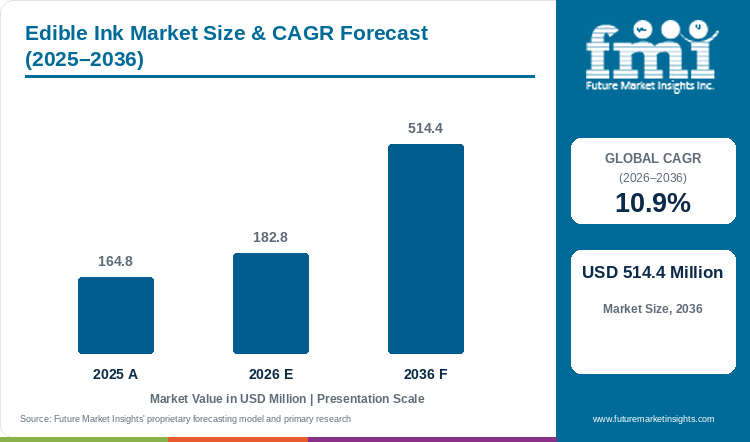
Table 1: Edible Ink Market Size and Forecast (USD million), 2025 to 2036
| Market size and forecast | Value |
|---|---|
| 2025 market size | USD 164.8 million |
| Estimated market size in 2026 | USD 182.8 million |
| Projected market size by 2036 | USD 514.4 million |
| CAGR (2026-2036) | 10.9% |
| Added revenue, 2026 to 2036 | USD 331.6 million |
Key Market Trends & Insights
- By Product Type: The Standard grade segment accounted for the largest share of the Product Type breakdown in 2026, representing 40.0% of total market revenue.
- By Form: Powder / dry products held the leading market position with a share of 45.0% in 2026.
- By Application: Bread & rolls remained the largest application segment, accounting for 34.0% of the market in 2026, with crust, shape and surface texture affecting the readability of a printed mark.
Regional Highlights
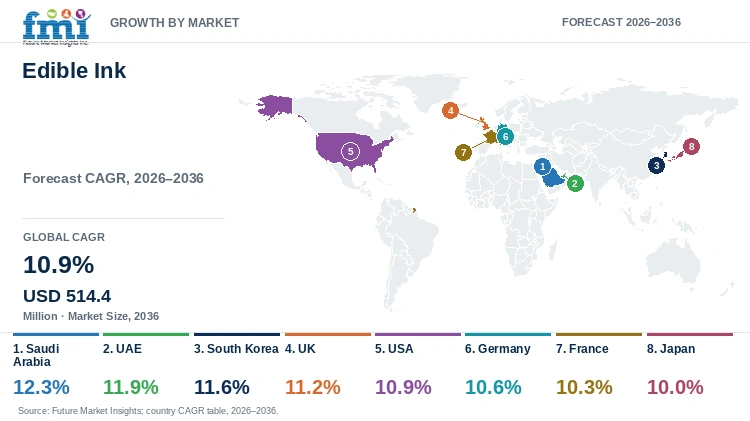
- Fastest-growing country: Saudi Arabia is expected to record the highest growth rate among the eight profiled countries, with a projected CAGR of 12.3% between 2026 and 2036.
- Growth across other countries: The UAE is projected to expand at a CAGR of 11.9%, followed by South Korea at 11.6% and the UK at 11.2%. Japan is expected to register comparatively slower growth, with a CAGR of 10.0% during the forecast period.
Natural colour approvals are widening the palette available to ink formulators. In May 2025, the FDA approved Galdieria extract blue and calcium phosphate and expanded the uses of butterfly pea flower extract[6], and in July 2025 it approved gardenia (genipin) blue for uses including hard and soft candy[8]. Hakim and colleagues' April 2024 review identifies edible-printing applications on cakes, cookies and bread, alongside formulation and resolution constraints[1]. The receiving surface affects how clearly a design appears, so ink and edible sheet or film substrates form a combined application decision.
The regulatory timetable is tight. The FDA's April 2025 plan targets the removal of FD&C Green No. 3, Red No. 40, Yellow No. 5, Yellow No. 6, Blue No. 1 and Blue No. 2 by the end of 2026, together with the revocation of Citrus Red No. 2 and Orange B[7]. In July 2025, the FDA also wrote to manufacturers encouraging them to phase out Red No. 3 sooner than the January 15, 2027 deadline[8]. Replacing a pigment can change the appearance of an established design and the way the ink behaves in the selected printing system, so the transition involves existing artwork, substrates and printing conditions as well as composition approval.
Colour suppliers are expanding to meet reformulation demand. Sensient Technologies reported second-quarter 2026 revenue of USD 462.1 million, up 11.6%, with its Color Group growing by 20.6%, and its spending on property, plant and equipment rose to USD 67.5 million in the first half of 2026 from USD 38.0 million a year earlier[5]. On February 5, 2026, the FDA reiterated identity and purity requirements for colours exempt from certification, while EU additive rules link authorisation to the intended food uses and conditions[3][4]. Clear identification of the formulation and any changes gives recurring print programmes a consistent reference when a cartridge, refill or colour source is replaced.
Table 2: Supporting Industry Indicators for the Edible Ink Market, 2024 to 2026, with a 2027 Food Reformulation Deadline
| Indicator | Data point | Why it matters | Source |
|---|---|---|---|
| Industry commitments | About 40.0% of the food industry had committed to a voluntary phase-out of petroleum-based dyes by July 2025. | Customers increasingly require inks based on natural colours. | [8] |
| Synthetic dye phase-out | FDA aims to eliminate six remaining synthetic dyes from the food supply by the end of 2026. | Inks using these dyes need reformulation. | [7] |
| US colour replacement | The January 2025 Red No. 3 action sets January 15, 2027 for affected food reformulation. | Replacement inks require assessment on established designs. | [2] |
| Natural blue approval | FDA approved gardenia (genipin) blue in July 2025, its fourth natural-source colour in two months. | More approved blues widen the printable palette. | [8] |
| May 2025 approvals | FDA approved Galdieria extract blue and calcium phosphate and expanded butterfly pea flower extract uses. | New colours give formulators more options. | [6] |
| Colour supplier results | Sensient's Color Group revenue rose by 20.6% to USD 216.1 million in Q2 2026. | Strong demand reflects food colour reformulation. | [5] |
| Colour supplier investment | Sensient's spending on property, plant and equipment reached USD 67.5 million in H1 2026, against USD 38.0 million in H1 2025. | Investment supports supply of reformulated colours. | [5] |
| Printing performance | A 2024 review covers edible inks for cakes, cookies and bread and identifies resolution and palette constraints. | Ink and surface jointly determine image detail. | [1] |
| Ingredient specifications | FDA reiterated identity and purity requirements for certification-exempt colours in February 2026. | Formulation records remain necessary when a colour source changes. | [3] |
| EU permitted uses | EU additive rules specify authorised food uses and conditions. | Eligibility precedes comparison of printed output. | [4] |
Demand Intensity Analysis
A comparison of colour supplier growth with market growth gives a measure of the pace of reformulation. FMI estimates that the edible ink market grew by approximately 10.9% between 2025 and 2026, while Sensient's Color Group revenue rose by 20.6% in the second quarter of 2026, almost twice as fast[5]. The difference reflects reformulation across the wider food industry, of which edible printing forms a small part.
Industry commitments provide another reference point. With about 40.0% of the food industry committed to a voluntary phase-out by July 2025[8], the majority of manufacturers had yet to commit at that stage. As more bakery and confectionery brands commit, edible ink suppliers will need natural-colour versions of their standard palettes, and Standard grade, valued at USD 73.1 million in 2026, carries most of this reformulation work.
The timing of regulation adds urgency. The end-2026 target for the six synthetic dyes is about two months away, and the Red No. 3 deadline follows on January 15, 2027[2][7]. Industrial customers need replacement inks qualified on their existing printers and substrates within this period, which favours suppliers with documented compatibility information.
Segment values show where demand is concentrated. Direct to industrial bakeries accounted for USD 96.9 million by Sales Channel in 2026, while Powder / dry represented USD 82.3 million in the Form classification and Bread & rolls USD 62.2 million by Application. FMI projects USD 331.6 million in added market revenue from 2026 to 2036, with the market reaching approximately 2.8 times its 2026 value.
Table 3: Demand Intensity Metrics for the Edible Ink Market, 2025 to 2036
| Demand intensity metric | Value | Basis |
|---|---|---|
| FMI market growth, 2025 to 2026 | Approximately +10.9% | USD 164.8 million to USD 182.8 million. |
| Sensient Color Group revenue growth, Q2 2026 | +20.6% | USD 216.1 million. |
| Food industry committed to dye phase-out, July 2025 | About 40.0% | FDA estimate. |
| Natural-source colours approved by FDA, May to July 2025 | Four | Including gardenia (genipin) blue. |
| Synthetic dyes targeted for elimination | Six | FDA target of the end of 2026. |
| Red No. 3 food reformulation deadline | January 15, 2027 | FDA revocation of January 2025. |
| Standard grade revenue, 2026 | USD 73.1 million | 40.0% of edible ink revenue. |
| Direct to industrial bakeries revenue, 2026 | USD 96.9 million | 53.0% of edible ink revenue. |
| Added revenue, 2026 to 2036 | USD 331.6 million | FMI edible ink market forecast. |
| Market expansion multiple | Approximately 2.8 times | Projected 2036 market value relative to 2026. |
Analyst Perspective
"The FDA has approved four natural colours in two months and the synthetic dye deadline is close, so ink suppliers that can match established designs with natural colours, on the customer's own printer, will win the replacement business."
- Nandini Roy Choudhury, Principal Analyst at Future Market Insights
How is the edible ink market segmented?
The edible ink market is segmented by product type, form, application, claim and sales channel. Product Type identifies the formulation grade and Form its delivered condition or concentrate preparation. Application specifies the bakery item receiving the image, Claim affects the ingredient palette, and Sales Channel describes how compatible material and technical support are obtained.
Why does Standard grade lead the Product Type category?
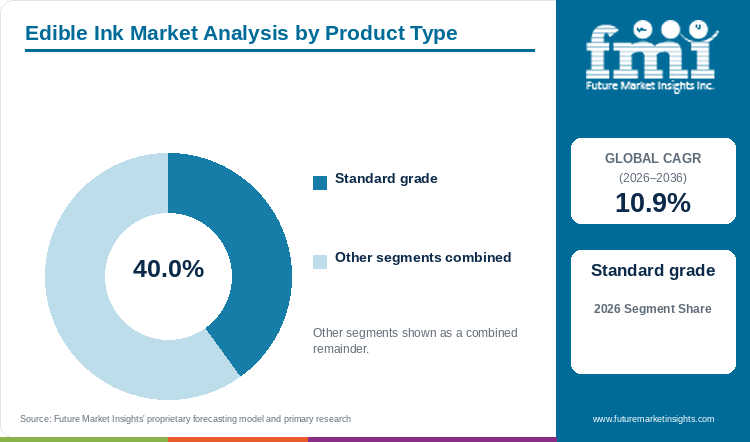
Standard grade represents 40.0% of Product Type revenue in 2026.
Standard grade inks generated approximately USD 73.1 million in 2026, as recurring print jobs need a visual reference that subsequent deliveries can reproduce. The reference should be made on the actual food or edible sheet using the selected printing system, so that colour and image clarity are comparable between batches. With synthetic dyes being phased out[7], many standard palettes will be reformulated, and the new versions must maintain the approved image through ordinary production conditions. The cost assessment can then include discarded output and cleaning time alongside the ink consumed.
- Standard grade represents 40.0% of Product Type revenue in 2026.
- The approved image needs a defined surface and printing setup to remain a useful reference.
How does Powder / dry retain the leading Form position?
Powder / dry holds 45.0% of Form revenue in 2026.
Powder / dry concentrates accounted for approximately USD 82.3 million in 2026 and require preparation compatible with the intended application system. Mixing consistency, flow and the stability of the prepared batch are relevant before the material is assessed for print quality, and Hakim and colleagues discuss the formulation components and printing constraints that make this compatibility work important[1]. Storage advantages of the dry ingredient have to be weighed against the work required to prepare and clean the complete system.
- Powder / dry holds 45.0% of Form revenue in 2026.
- Mixing and prepared-batch stability are assessed before a concentrate is judged as a printing ink.
What supports Bread & rolls in the Application category?
Bread & rolls account for 34.0% of Application revenue in 2026.
Printing on bread and rolls generated approximately USD 62.2 million in 2026. The colour and texture of a bread crust influence how well a printed mark can be read, and the shape of representative formats determines whether a graphic remains legible. Bread is among the food surfaces identified in Hakim and colleagues' edible-printing review[1]. A trial can define the required handling interval between baking and packing and the proportion of output meeting the visual reference.
- Bread & rolls account for 34.0% of Application revenue in 2026.
- A bread trial needs representative crust color, texture and shape.
Why does Conventional lead the Claim category?
Conventional represents 53.0% of Claim revenue in 2026.
Conventional formulations held 53.0% of Claim revenue in 2026, although their palette is changing. EU additive rules specify authorised conditions, while US action on Red No. 3 and the planned phase-out of six further synthetic dyes affect inks containing those colours[2][4][7]. The new natural colours approved by the FDA in 2025[6][8] give formulators options, but the eligible palette still has to reproduce the design at an acceptable quality, as the same design may look different even when the replacement serves a similar colouring function.
- Conventional represents 53.0% of Claim revenue in 2026.
- A revised color component can change the image as well as the ingredient declaration.
What drives Direct to industrial bakeries in Sales Channel?
Direct to industrial bakeries contributes 53.0% of Sales Channel revenue in 2026.
Direct supply to industrial bakeries accounted for approximately USD 96.9 million in 2026, bringing the formulation into the bakery's printing setup. The intended image, surface and operating schedule can be specified before a proposed ink is tested, and direct communication gives changes in ink or substrate a route back into that assessment. This relationship is especially useful during the current reformulation period, when replacement inks need to be qualified quickly against existing designs.
- Direct to industrial bakeries contributes 53.0% of Sales Channel revenue in 2026.
- Qualification should include the actual run conditions and the interval before handling.
What are the drivers, restraints and opportunities in the edible ink market?
Customization becomes valuable when the printed result is repeatable, but color reformulation can change a previously approved image, making better ink and substrate matching important for usable output.
Customization becomes valuable when the printed result is repeatable
Changing the artwork gives one bakery base several visual identities without extensive manual decoration. Short design runs and recurring branded products can use that flexibility, but the printing step has to remain predictable as images change. The connection with bakery equipment is central because the printer and its operating sequence constrain the formulation. New approved colours, including four natural-source colours approved by the FDA between May and July 2025[8], widen the range of designs that can be printed with natural palettes.
Color reformulation can change a previously approved image
Replacing a colour component can change an ink's behaviour as well as its declaration. Six synthetic dyes are targeted for elimination by the end of 2026 and affected foods must remove Red No. 3 by January 15, 2027[2][7], so an established print programme may need several colours replaced in a short period. Each replacement needs assessment on the same printer and substrate as the approved ink, and requests involving alternative food colors raise a similar application question. The work required to preserve a familiar design can therefore constrain adoption.
Better ink and substrate matching can improve usable output
Image definition, colour density and drying develop together on the receiving surface, and considering them separately can miss why an ink works on one edible substrate and not another. The 2024 review of edible inks identifies formulation and resolution challenges that make this matching work relevant[1]. Colour suppliers are adding capacity, with Sensient's capital spending up sharply in the first half of 2026[5], and the FDA's February 2026 reminder confirms that exempt colours must still satisfy identity and purity specifications[3]. Combining precise ingredient records with application knowledge improves printed output from a defined setup.
Which country CAGRs are profiled in the edible ink market?
Table 4: Country growth outlook for the edible ink market
| Country | CAGR |
|---|---|
| Saudi Arabia | 12.3% |
| UAE | 11.9% |
| South Korea | 11.6% |
| UK | 11.2% |
| USA | 10.9% |
| Germany | 10.6% |
| France | 10.3% |
| Japan | 10.0% |
Saudi Arabia
- Saudi Arabia is the fastest-growing market among the profiled countries, with a projected CAGR of 12.3% from 2026 to 2036. Fine detail sets the resolution requirement for recurring bakery print designs in Saudi Arabia, and clarity at the actual image size determines production suitability more directly than an enlarged demonstration. A complete run should include pauses, restarts and the interval between printing and packing, since these conditions expose variation that a single sample can conceal.
UAE
- The UAE is forecast to grow at a CAGR of 11.9% from 2026 to 2036. Varied artwork in UAE bakery printing requires an ink system capable of reproducing several visual briefs within a defined operating method, with the chosen substrate and an agreed colour reference providing continuity. Handling before delivery or display also belongs in the assessment, and once a combination is established, customisation becomes a repeatable preparation step.
South Korea
- With a projected CAGR of 11.6% from 2026 to 2036, South Korea ranks third among the profiled countries. Compact South Korean bakery formats make actual-size image definition central to ink qualification, as small printed features can expose resolution limits. Testing the intended edible sheet or food surface shows whether colour spreads or the image becomes unclear after handling, so the ink and substrate are qualified together.
UK
- The UK market is projected to grow at a CAGR of 11.2% from 2026 to 2036. For UK decorating businesses with varied order sizes, pauses between jobs can be as relevant as continuous printing, so storage, start-up and cleaning instructions need to be considered alongside image quality. Cartridge or refill choice also needs to reflect actual consumption, and comparing acceptable output across these conditions shows whether discarded sheets or products alter the cost of the selected format.
USA
- The USA market is forecast to grow at a CAGR of 10.9% from 2026 to 2036, with reformulation the main near-term task. Six synthetic dyes are targeted for elimination by the end of 2026, and Red No. 3 must be removed from foods by January 15, 2027[2][7]. The FDA has approved new natural colours, including gardenia (genipin) blue in July 2025[8], and about 40.0% of the food industry had committed to a voluntary phase-out by that month[8]. Existing designs and substrates provide the appropriate test of each replacement, while identity and purity requirements remain relevant[3].
Germany
- Germany is projected to grow at a CAGR of 10.6% from 2026 to 2036. For German customers, the intended food use and additive authorisation need to be connected before an edible ink is selected for the EU market[4]. Eligible formulations can then be compared on the same surface under the same operating conditions, and advance communication of formulation changes helps maintain the selected specification without repeated adjustments.
France
- France is projected to grow at a CAGR of 10.3% from 2026 to 2036. Placement on a pastry can change how a small printed motif or message is perceived, so French applications need to be assessed after the decorative element is assembled and held under normal conditions. The ingredient review also includes EU additive authorisation[4], and the decoration must remain manageable at the pace and batch size used in production.
Japan
- Japan is expected to register the slowest growth among the profiled countries, with a forecast CAGR of 10.0% from 2026 to 2036. Wrapping provides the final handling condition against which printed marks are assessed on individually presented Japanese bakery products, where a small design can be prominent in the package. Trials should use representative finished items and assess the required detail after handling rather than on the freshly printed surface.
Who are the notable companies in the edible ink market?
Kopykake; Icing Images; InkEdibles; Primera Technology; DecoPac
Kopykake, Icing Images, InkEdibles, Primera Technology and DecoPac offer identifiable edible ink products for specified printing workflows, with differences in cartridge format, system compatibility and the use of edible sheets compared with direct printing onto food. Upstream, colour suppliers such as Sensient, whose Color Group revenue reached USD 216.1 million in the second quarter of 2026[5], provide the colours that ink producers need as palettes are reformulated.
The final image reflects food color formulation, but ink choice also includes replenishment, cleaning and the amount of usable output. Comparing the complete setup gives a clearer view of suitability for recurring bakery work than comparing colour or cartridge price in isolation.
Competitive Benchmarking: Edible Ink Market
Table 5: Company capabilities in the edible ink market
| Company | Product capability | Application emphasis |
|---|---|---|
| Kopykake | Edible inks for cake imaging | Printing on edible frosting sheets |
| Icing Images | Edible ink cartridges and refill bottles | Edible image printing |
| InkEdibles | Edible ink cartridges | Food-grade printing systems |
| Primera Technology | Eddie edible ink cartridges | Direct printing on cookies and other foods |
| DecoPac | PhotoCake edible inks | Cake image production |
Key Developments in the Edible Ink Market
- In January 2025, the FDA revoked the food authorisation of FD&C Red No. 3, setting January 15, 2027 as the reformulation deadline for foods[2].
- In April 2025, the FDA announced plans to eliminate six remaining synthetic dyes from the food supply by the end of 2026[7].
- In May 2025, the FDA approved Galdieria extract blue and calcium phosphate and expanded the uses of butterfly pea flower extract[6].
- In July 2025, the FDA approved gardenia (genipin) blue and encouraged manufacturers to phase out Red No. 3 before the 2027 deadline[8].
- In July 2026, Sensient Technologies reported a 20.6% increase in second-quarter Color Group revenue[5].
- In February 2026, the FDA reaffirmed identity and purity requirements for colours exempt from certification[3].
Key Players in the Edible Ink Market
- Kopykake
- Icing Images
- InkEdibles
- Primera Technology
- DecoPac
Edible Ink Market - Report Scope
Table 6: Report scope for the edible ink market
| Coverage field | Report scope |
|---|---|
| Market breakdown | Product Type; Form; Application; Claim; Sales Channel |
| Quantitative Units | USD Million |
| Market Definition | Revenue from edible printing and surface-marking ink formulations sold for applications within the stated bakery segmentation. Powder / dry and other forms are counted only where sold as qualifying ink systems or ink-making concentrates. Excludes finished bakery product sales, conventional nonprinting glazes or fillings, printers and unrelated packaging inks. |
| Regions Covered | North America; Latin America; Western Europe; Eastern Europe; East Asia; South Asia and Pacific; Middle East and Africa |
| Countries Covered | Saudi Arabia; UAE; South Korea; UK; USA; Germany; France; Japan |
| Key Companies Profiled | Kopykake; Icing Images; InkEdibles; Primera Technology; DecoPac |
| Forecast Period | 2026 to 2036 |
| Approach | Market assessment supported by official technical and regulatory publications, company product information and country operating conditions. |
Edible Ink Market - Research Methodology
Table 7: Research approach for the edible ink market
| Method | Approach |
|---|---|
| Market definition | The assessment covers edible printing and surface-marking ink formulations, including qualifying ink concentrates, within the stated bakery applications. |
| Desk research | Government and regulatory publications, technical literature and official product information establish the application and supply context. |
| Commercial assessment | The commercial review considers ink and printer compatibility, color reproduction, substrate response, preparation, cleaning and acceptable printed output. |
| Comparability | Market values, segment allocations and country growth rates use consistent units and the stated 2026 to 2036 forecast period. Company comparisons describe product roles and purchasing relevance. |
Edible Ink Market by Segments
Product Type
- Standard grade
- Premium / specialty grade
- Organic certified
- Clean label grade
Form
- Powder / dry
- Liquid
- Paste / semi-solid
- Granules / pieces
Application
- Bread & rolls
- Cakes & muffins
- Biscuits & cookies
- Viennoiserie & pastry
- Other bakery & snacks
Claim
- Conventional
- Clean label
- Organic
- Non-GMO / identity preserved
Sales Channel
- Direct to industrial bakeries
- Ingredient distributors
- Foodservice & artisan supply
- Online B2B
Edible Ink Market by Region
- North America
- United States
- Canada
- Latin America
- Brazil
- Mexico
- Argentina
- Chile
- Western Europe
- Germany
- France
- United Kingdom
- Italy
- Spain
- Benelux
- Nordics
- Eastern Europe
- Poland
- Czech Republic
- Romania
- Hungary
- East Asia
- China
- Japan
- South Korea
- South Asia and Pacific
- India
- ASEAN
- Australia and New Zealand
- Middle East and Africa
- GCC Countries
- South Africa
- Türkiye
- Israel
Research Sources and Bibliography
- [1] Hakim, L., Deshmukh, R. K., Lee, Y. S., and Gaikwad, K. K. (2024, April 9). Edible ink for food printing and packaging applications: a review.
- [2] U.S. Food and Drug Administration. (2025, January 15). FD&C Red No. 3.
- [3] U.S. Food and Drug Administration. (2026, February 5). FDA reminds manufacturers of color additives exempt from certification to comply with identity and purity requirements.
- [4] European Commission. (n.d.). EU rules on food additives.
- [5] Sensient Technologies Corporation. (2026, July 24). Second quarter 2026 results (Form 8-K, Exhibit 99.1).
- [6] U.S. Food and Drug Administration. (2025, May 9). FDA approves three food colors from natural sources.
- [7] U.S. Food and Drug Administration. (2025, April 22). HHS, FDA to phase out petroleum-based synthetic dyes in nation's food supply.
- [8] U.S. Food and Drug Administration. (2025, July 14). FDA approves gardenia (genipin) blue color additive while encouraging faster phase-out of FD&C Red No. 3.
Future Market Insights. (2026). Edible Ink Market: Global Industry Analysis and Opportunity Assessment 2036.
This Report Answers
- How large is the edible ink market in 2026 and what value is expected by 2036?
- Which industry pressures support demand for printing and marking on baked goods?
- Why does Standard grade lead edible ink by Product Type?
- What accounts for the leading position of Powder / dry within Form?
- How do the forecast growth rates of the eight profiled countries differ?
- Which suppliers offer edible inks for bakery printing systems?
Frequently Asked Questions
How big is the edible ink market in 2026, and what is forecast for 2036?
The market is valued at USD 182.8 million in 2026 and is expected to reach USD 514.4 million by 2036.
What is the forecast CAGR for the edible ink market from 2026 to 2036?
The market is forecast to grow at a CAGR of 10.9% from 2026 to 2036.
Which Product Type segment leads the edible ink market in 2026?
Standard grade leads with a 40.0% share in 2026.
Which Form segment has the highest share in the edible ink market?
Powder / dry accounts for 45.0% in 2026.
Which profiled countries have the fastest growth rates?
Saudi Arabia leads at 12.3%, followed by the UAE at 11.9% and South Korea at 11.6% from 2026 to 2036.
Which companies participate in the edible ink market?
The report profiles Kopykake, Icing Images, InkEdibles, Primera Technology and DecoPac, each of which offers edible ink products for a specified printing workflow.
Preview the report firsthand - request a free sample
Get SampleGet the brochure for pricing and purchase details.
Get PDFTable of Content
- Key Takeaways
- Market Size and CAGR
- Top Growth Driver
- Fastest Growing Segment
- Leading Region
- Key Companies
- Emerging Opportunities
- Executive Summary
- Global Market Outlook
- Demand-side Trends
- Supply-side Trends
- Technology Roadmap Analysis
- Analysis and Recommendations
- Analyst Perspective (What is happening? Why now? What should investors know?)
- Key Questions Answered
- How large is the market?
- What is the CAGR?
- What are key trends?
- Which region dominates?
- Who are the leaders?
- Market Overview
- Market Coverage / Taxonomy
- Market Definition / Scope / Limitations
- Research Methodology
- Chapter Orientation
- Analytical Lens and Working Hypotheses
- Market Structure, Signals, and Trend Drivers
- Benchmarking and Cross-market Comparability
- Market Sizing, Forecasting, and Opportunity Mapping
- Research Design and Evidence Framework
- Desk Research Programme (Secondary Evidence)
- Expert Input and Fieldwork (Primary Evidence)
- Tooling, Models, and Reference Databases
- Data Engineering and Model Build
- Quality Assurance and Audit Trail
- Market Background
- Market Dynamics (Drivers, Restraints, Opportunity, Trends)
- Scenario Forecast (Optimistic, Likely, Conservative)
- Impact Analysis
- AI Impact
- Sustainability Impact
- Regulatory Impact
- Technology Impact
- Consumer / Buyer Analysis
- Purchase Drivers
- Adoption Barriers
- Buyer Journey
- Opportunity Map Analysis
- Product Life Cycle Analysis
- Supply Chain Analysis
- Investment Feasibility Matrix
- Value Chain Analysis
- PESTLE and Porter's Analysis
- Regulatory Landscape
- Regional Parent Market Outlook
- Production and Consumption Statistics
- Import and Export Statistics
- Global Market Analysis and Forecast, 2021 to 2036
- Historical Market Size Value (USD Million) Analysis, 2021 to 2025
- Current and Future Market Size Value (USD Million) Projections, 2026 to 2036
- Y-o-Y Growth Trend Analysis
- Absolute $ Opportunity Analysis
- Global Market Pricing Analysis, 2021 to 2036
- Global Market Analysis and Forecast, By Product Type, 2021 to 2036
- Introduction / Key Findings
- Historical Market Size Value (USD Million) Analysis By Product Type, 2021 to 2025
- Current and Future Market Size Value (USD Million) Analysis and Forecast By Product Type, 2026 to 2036
- Standard grade
- Premium / specialty grade
- Organic certified
- Clean label grade
- Y-o-Y Growth Trend Analysis By Product Type, 2021 to 2025
- Absolute $ Opportunity Analysis By Product Type, 2026 to 2036
- Global Market Analysis and Forecast, By Form, 2021 to 2036
- Introduction / Key Findings
- Historical Market Size Value (USD Million) Analysis By Form, 2021 to 2025
- Current and Future Market Size Value (USD Million) Analysis and Forecast By Form, 2026 to 2036
- Powder / dry
- Liquid
- Paste / semi-solid
- Granules / pieces
- Y-o-Y Growth Trend Analysis By Form, 2021 to 2025
- Absolute $ Opportunity Analysis By Form, 2026 to 2036
- Global Market Analysis and Forecast, By Application, 2021 to 2036
- Introduction / Key Findings
- Historical Market Size Value (USD Million) Analysis By Application, 2021 to 2025
- Current and Future Market Size Value (USD Million) Analysis and Forecast By Application, 2026 to 2036
- Bread & rolls
- Cakes & muffins
- Biscuits & cookies
- Viennoiserie & pastry
- Other bakery & snacks
- Y-o-Y Growth Trend Analysis By Application, 2021 to 2025
- Absolute $ Opportunity Analysis By Application, 2026 to 2036
- Global Market Analysis and Forecast, By Claim, 2021 to 2036
- Introduction / Key Findings
- Historical Market Size Value (USD Million) Analysis By Claim, 2021 to 2025
- Current and Future Market Size Value (USD Million) Analysis and Forecast By Claim, 2026 to 2036
- Conventional
- Clean label
- Organic
- Non-GMO / identity preserved
- Y-o-Y Growth Trend Analysis By Claim, 2021 to 2025
- Absolute $ Opportunity Analysis By Claim, 2026 to 2036
- Global Market Analysis and Forecast, By Sales Channel, 2021 to 2036
- Introduction / Key Findings
- Historical Market Size Value (USD Million) Analysis By Sales Channel, 2021 to 2025
- Current and Future Market Size Value (USD Million) Analysis and Forecast By Sales Channel, 2026 to 2036
- Direct to industrial bakeries
- Ingredient distributors
- Foodservice & artisan supply
- Online B2B
- Y-o-Y Growth Trend Analysis By Sales Channel, 2021 to 2025
- Absolute $ Opportunity Analysis By Sales Channel, 2026 to 2036
- Global Market Analysis and Forecast, By Region, 2021 to 2036
- Introduction
- Historical Market Size Value (USD Million) Analysis By Region, 2021 to 2025
- Current Market Size Value (USD Million) Analysis and Forecast By Region, 2026 to 2036
- North America
- Latin America
- Western Europe
- Eastern Europe
- East Asia
- South Asia and Pacific
- Middle East and Africa
- Market Attractiveness Analysis By Region
- North America Market Analysis and Forecast, By Country, 2021 to 2036
- Historical Market Size Value (USD Million) Trend Analysis By Market Taxonomy, 2021 to 2025
- Market Size Value (USD Million) Forecast By Market Taxonomy, 2026 to 2036
- By Country
- United States
- Canada
- By Product Type
- By Form
- By Application
- By Claim
- By Sales Channel
- By Country
- Market Attractiveness Analysis
- By Country
- By Product Type
- By Form
- By Application
- By Claim
- By Sales Channel
- Key Takeaways
- Latin America Market Analysis and Forecast, By Country
- Historical Market Size Value (USD Million) Trend Analysis By Market Taxonomy, 2021 to 2025
- Market Size Value (USD Million) Forecast By Market Taxonomy, 2026 to 2036
- By Country
- Brazil
- Mexico
- Argentina
- Chile
- By Product Type
- By Form
- By Application
- By Claim
- By Sales Channel
- By Country
- Market Attractiveness Analysis
- By Country
- By Product Type
- By Form
- By Application
- By Claim
- By Sales Channel
- Key Takeaways
- Western Europe Market Analysis and Forecast, By Country
- Historical Market Size Value (USD Million) Trend Analysis By Market Taxonomy, 2021 to 2025
- Market Size Value (USD Million) Forecast By Market Taxonomy, 2026 to 2036
- By Country
- Germany
- France
- United Kingdom
- Italy
- Spain
- Benelux
- Nordics
- By Product Type
- By Form
- By Application
- By Claim
- By Sales Channel
- By Country
- Market Attractiveness Analysis
- By Country
- By Product Type
- By Form
- By Application
- By Claim
- By Sales Channel
- Key Takeaways
- Eastern Europe Market Analysis and Forecast, By Country
- Historical Market Size Value (USD Million) Trend Analysis By Market Taxonomy, 2021 to 2025
- Market Size Value (USD Million) Forecast By Market Taxonomy, 2026 to 2036
- By Country
- Poland
- Czech Republic
- Romania
- Hungary
- By Product Type
- By Form
- By Application
- By Claim
- By Sales Channel
- By Country
- Market Attractiveness Analysis
- By Country
- By Product Type
- By Form
- By Application
- By Claim
- By Sales Channel
- Key Takeaways
- East Asia Market Analysis and Forecast, By Country
- Historical Market Size Value (USD Million) Trend Analysis By Market Taxonomy, 2021 to 2025
- Market Size Value (USD Million) Forecast By Market Taxonomy, 2026 to 2036
- By Country
- China
- Japan
- South Korea
- By Product Type
- By Form
- By Application
- By Claim
- By Sales Channel
- By Country
- Market Attractiveness Analysis
- By Country
- By Product Type
- By Form
- By Application
- By Claim
- By Sales Channel
- Key Takeaways
- South Asia and Pacific Market Analysis and Forecast, By Country
- Historical Market Size Value (USD Million) Trend Analysis By Market Taxonomy, 2021 to 2025
- Market Size Value (USD Million) Forecast By Market Taxonomy, 2026 to 2036
- By Country
- India
- ASEAN
- Australia and New Zealand
- By Product Type
- By Form
- By Application
- By Claim
- By Sales Channel
- By Country
- Market Attractiveness Analysis
- By Country
- By Product Type
- By Form
- By Application
- By Claim
- By Sales Channel
- Key Takeaways
- Middle East and Africa Market Analysis and Forecast, By Country
- Historical Market Size Value (USD Million) Trend Analysis By Market Taxonomy, 2021 to 2025
- Market Size Value (USD Million) Forecast By Market Taxonomy, 2026 to 2036
- By Country
- GCC Countries
- South Africa
- Türkiye
- Israel
- By Product Type
- By Form
- By Application
- By Claim
- By Sales Channel
- By Country
- Market Attractiveness Analysis
- By Country
- By Product Type
- By Form
- By Application
- By Claim
- By Sales Channel
- Key Takeaways
- Key Countries Market Analysis
- United States
- Pricing Analysis
- Market Share Analysis, 2025
- By Product Type
- By Form
- By Application
- By Claim
- By Sales Channel
- Canada
- Pricing Analysis
- Market Share Analysis, 2025
- By Product Type
- By Form
- By Application
- By Claim
- By Sales Channel
- Mexico
- Pricing Analysis
- Market Share Analysis, 2025
- By Product Type
- By Form
- By Application
- By Claim
- By Sales Channel
- Brazil
- Pricing Analysis
- Market Share Analysis, 2025
- By Product Type
- By Form
- By Application
- By Claim
- By Sales Channel
- Chile
- Pricing Analysis
- Market Share Analysis, 2025
- By Product Type
- By Form
- By Application
- By Claim
- By Sales Channel
- Germany
- Pricing Analysis
- Market Share Analysis, 2025
- By Product Type
- By Form
- By Application
- By Claim
- By Sales Channel
- United Kingdom
- Pricing Analysis
- Market Share Analysis, 2025
- By Product Type
- By Form
- By Application
- By Claim
- By Sales Channel
- Italy
- Pricing Analysis
- Market Share Analysis, 2025
- By Product Type
- By Form
- By Application
- By Claim
- By Sales Channel
- Spain
- Pricing Analysis
- Market Share Analysis, 2025
- By Product Type
- By Form
- By Application
- By Claim
- By Sales Channel
- France
- Pricing Analysis
- Market Share Analysis, 2025
- By Product Type
- By Form
- By Application
- By Claim
- By Sales Channel
- India
- Pricing Analysis
- Market Share Analysis, 2025
- By Product Type
- By Form
- By Application
- By Claim
- By Sales Channel
- ASEAN
- Pricing Analysis
- Market Share Analysis, 2025
- By Product Type
- By Form
- By Application
- By Claim
- By Sales Channel
- Australia and New Zealand
- Pricing Analysis
- Market Share Analysis, 2025
- By Product Type
- By Form
- By Application
- By Claim
- By Sales Channel
- China
- Pricing Analysis
- Market Share Analysis, 2025
- By Product Type
- By Form
- By Application
- By Claim
- By Sales Channel
- Japan
- Pricing Analysis
- Market Share Analysis, 2025
- By Product Type
- By Form
- By Application
- By Claim
- By Sales Channel
- South Korea
- Pricing Analysis
- Market Share Analysis, 2025
- By Product Type
- By Form
- By Application
- By Claim
- By Sales Channel
- Poland
- Pricing Analysis
- Market Share Analysis, 2025
- By Product Type
- By Form
- By Application
- By Claim
- By Sales Channel
- Hungary
- Pricing Analysis
- Market Share Analysis, 2025
- By Product Type
- By Form
- By Application
- By Claim
- By Sales Channel
- Türkiye
- Pricing Analysis
- Market Share Analysis, 2025
- By Product Type
- By Form
- By Application
- By Claim
- By Sales Channel
- South Africa
- Pricing Analysis
- Market Share Analysis, 2025
- By Product Type
- By Form
- By Application
- By Claim
- By Sales Channel
- Saudi Arabia
- Pricing Analysis
- Market Share Analysis, 2025
- By Product Type
- By Form
- By Application
- By Claim
- By Sales Channel
- UAE
- Pricing Analysis
- Market Share Analysis, 2025
- By Product Type
- By Form
- By Application
- By Claim
- By Sales Channel
- United States
- Market Structure Analysis
- Competition Dashboard
- Competition Benchmarking
- Market Share Analysis of Top Players
- By Regional
- By Product Type
- By Form
- By Application
- By Claim
- By Sales Channel
- Emerging Startups
- Innovation Benchmarking
- Competition Analysis
- Competition Deep Dive
- Kopykake
- Overview
- Product Portfolio
- Profitability by Market Segments
- Sales Footprint
- Strategy Overview
- Marketing Strategy
- Product Strategy
- Channel Strategy
- Icing Images
- InkEdibles
- Primera Technology
- DecoPac
- Kopykake
- Case Studies
- Success Stories
- Recent Developments
- Competition Deep Dive
- Assumptions & Acronyms Used


