

- Industry Size (2026)
- USD 1.70 Bn
- Forecast (2036)
- USD 3.20 Bn
- CAGR (2026 to 2036)
- 6.50%
EMC Electromagnetic Compatibility Test Laboratory Market Size, Market Forecast and Outlook By FMI
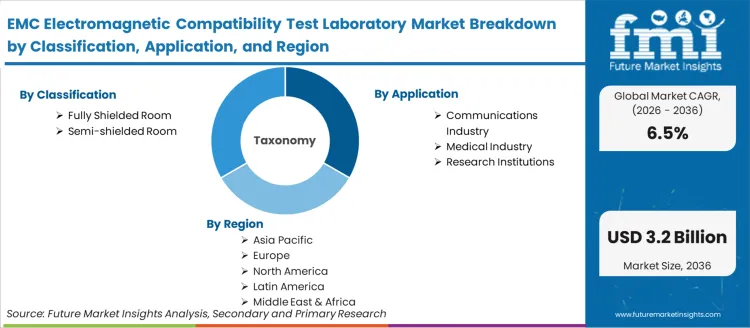
The EMC electromagnetic compatibility test laboratory market was valued at USD 1.60 billion in 2025, projected to reach USD 1.70 billion in 2026, and is forecast to expand to USD 3.20 billion by 2036 at a 6.50% CAGR. Tightening electromagnetic compatibility regulatory requirements for consumer electronics, automotive electronics, medical devices, and 5G telecommunications equipment are driving investment in accredited EMC test laboratory infrastructure. Product manufacturers are establishing in-house pre-compliance EMC testing capabilities to reduce development cycle time, while accredited third-party laboratories expand capacity to serve growing certification testing volumes driven by product launch velocity and regulatory scope expansion.
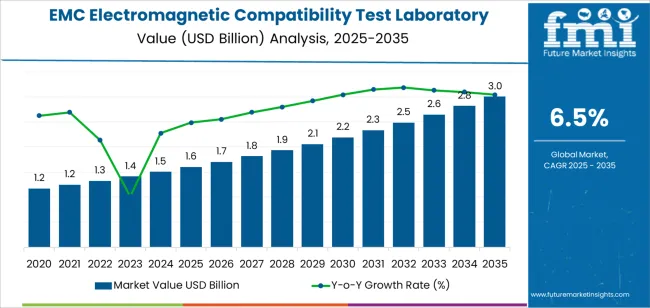
The absolute dollar opportunity of approximately USD 1.50 billion over the forecast period reflects the compounding effect of regulatory scope expansion and product electronic complexity on EMC testing demand. Automotive EMC testing for electric vehicle power electronics and ADAS sensor systems is generating the fastest-growing per-test revenue category as vehicle electrification mandates produce new electromagnetic interference challenges. Over-the-air testing capabilities for 5G mmWave and Wi-Fi 7 devices are requiring laboratory upgrades with anechoic chamber configurations that command per-facility investment values exceeding conventional conducted emissions test installations.
Summary of EMC Electromagnetic Compatibility Test Laboratory Market
- EMC Electromagnetic Compatibility Test Laboratory Market Definition
- EMC test laboratories are shielded testing facilities with anechoic chambers and measurement instrumentation for evaluating electronic product compliance with electromagnetic emissions and immunity standards across communications, medical, automotive, and consumer electronics sectors.
- Demand Drivers in the Market
- Expanding EMC regulatory scope covering 5G telecommunications equipment, electric vehicle power electronics, and medical device wireless connectivity is generating new certification testing categories that drive laboratory capacity investment.
- Product manufacturers establishing in-house pre-compliance EMC testing reduce development cycle time, creating a parallel investment channel alongside third-party accredited laboratory capacity expansion.
- Automotive EMC testing for EV power electronics and ADAS sensor systems generates the fastest-growing per-test revenue as vehicle electrification produces new electromagnetic interference compliance requirements.
- Key Segments Analyzed in the FMI Report
- Fully Shielded Room by Classification: 30.0% share in 2026, as fully shielded anechoic chambers deliver the measurement accuracy and ambient noise floor performance required for accredited radiated emissions and immunity testing.
- Communications Industry by Application: 35.0% share in 2026, reflecting the high testing volume generated by 5G equipment, Wi-Fi devices, and IoT modules that each require EMC certification before market placement.
- China: 8.8% compound growth driven by CCC certification expansion and electronics manufacturer pre-compliance facility investment across major manufacturing clusters.
- Analyst Opinion at FMI
- The EMC test laboratory market benefits from a structural demand multiplier where each new wireless technology standard and each regulatory scope expansion creates testing requirements that apply across the entire product portfolio of every affected manufacturer. Laboratories that invest in over-the-air testing capabilities for 5G mmWave and automotive radar frequencies capture the premium per-test pricing tier. The critical capacity risk centers on measurement instrumentation lead times, as spectrum analyser and EMI receiver delivery schedules extend during periods when multiple laboratories simultaneously upgrade capabilities for new regulatory requirements.
- Strategic Implications / Executive Takeaways
- EMC laboratory operators must invest in over-the-air testing capabilities for 5G mmWave and automotive radar frequencies to capture the premium per-test pricing tier generated by vehicle electrification and wireless technology expansion.
- Electronics manufacturers must establish in-house pre-compliance testing facilities to reduce development iteration cycles and optimize designs before committing to accredited third-party certification testing.
- Shielded room manufacturers must expand production capacity to serve simultaneous laboratory construction programmes driven by synchronized regulatory scope expansion timelines across multiple national markets.
EMC Electromagnetic Compatibility Test Laboratory Market Key Takeaways
| Metric | Details |
|---|---|
| Industry Size (2026) | USD 1.70 Billion |
| Industry Value (2036) | USD 3.20 Billion |
| CAGR (2026-2036) | 6.50% |
Source: Future Market Insights, 2026
China sets the pace at an 8.8% CAGR, driven by CCC certification programme expansion and domestic electronics manufacturer pre-compliance testing facility investment. India follows at 8.1% as BIS compulsory registration scheme expansion and electronics manufacturing growth generate EMC testing demand. Germany registers 7.5% growth supported by automotive EMC testing requirements and TUV/DEKRA laboratory network expansion. Brazil advances at 6.8% with INMETRO certification requirements and electronics industry testing demand. USA tracks at 6.2% driven by FCC equipment authorization testing and automotive EMC compliance volumes. UK maintains 5.5% anchored by UKCA marking EMC testing requirements. Japan registers 4.9% supported by VCCI compliance and automotive electronics testing.
EMC Electromagnetic Compatibility Test Laboratory Market Definition
EMC electromagnetic compatibility test laboratories are specialized testing facilities equipped with shielded rooms, anechoic chambers, and precision measurement instrumentation designed to evaluate electronic and electrical products for compliance with electromagnetic emissions and immunity standards. These laboratories perform radiated emissions, conducted emissions, radiated immunity, conducted immunity, and electrostatic discharge testing across fully shielded and semi-shielded room configurations for pre-compliance development testing and accredited certification testing.
EMC Electromagnetic Compatibility Test Laboratory Market Inclusions
Market scope includes fully shielded anechoic chamber installations, semi-shielded room configurations, EMC measurement instrumentation suites, shielded room construction and fit-out services, and laboratory accreditation consulting. Coverage spans communications equipment, medical device, automotive electronics, consumer electronics, and industrial equipment EMC testing applications.
EMC Electromagnetic Compatibility Test Laboratory Market Exclusions
Standalone EMC measurement instruments sold without laboratory installation, electromagnetic field survey equipment, and EMC consulting services without laboratory testing facility investment are excluded. Safety testing laboratories without EMC-specific shielding infrastructure fall outside analytical parameters.
EMC Electromagnetic Compatibility Test Laboratory Market Research Methodology
- Primary Research: Analysts engaged with EMC laboratory facility directors, electronics manufacturer test engineering managers, and shielded room construction contractors to map the investment triggers for EMC laboratory establishment and capacity expansion.
- Desk Research: Data collection phases aggregated national EMC regulatory scope expansion timelines, accredited laboratory establishment statistics, and electronics product certification volume data from national accreditation bodies.
- Market-Sizing and Forecasting: Baseline values derive from a bottom-up aggregation of EMC laboratory construction and equipment investment values combined with per-test revenue from accredited testing services, applying region-specific regulatory expansion and electronics manufacturing growth curves.
- Data Validation and Update Cycle: Projections are tested against publicly reported testing and certification segment revenues from leading EMC test laboratory operators and shielded room manufacturers.
Why Is the EMC Electromagnetic Compatibility Test Laboratory Market Expanding Across Global Technology and Manufacturing Sectors?
The EMC electromagnetic compatibility test laboratory market is expanding as electronic device manufacturers face stringent regulatory requirements governing emission and immunity performance. Compliance with standards such as CISPR, IEC, and FCC mandates thorough testing to ensure devices operate without interfering with other electronic systems. Laboratories offering full-spectrum EMC testing services covering conducted, radiated, and electrostatic discharge evaluations play a crucial role in product certification across consumer electronics, automotive, aerospace, and telecommunications industries. The rapid proliferation of wireless devices and electric vehicles intensifies testing demand as systems grow more electronically dense and cross-interference risks increase.
Growth is further supported by the global shift toward pre-compliance and R&D-level testing, enabling manufacturers to identify design vulnerabilities early in development cycles. Test facilities invest in advanced shielded chambers, broadband antennas, and automated measurement systems to improve accuracy and reduce turnaround times. Regional expansion of accredited laboratories in Asia-Pacific, Europe, and North America aligns with local production growth and regulatory harmonization. High setup costs and the need for skilled electromagnetic engineers remain barriers to market entry, leading many manufacturers to outsource compliance testing. Continuous advancements in radiofrequency environments, 5G infrastructure, and electric mobility maintain strong long-term demand for specialized EMC testing services worldwide.
How Is the EMC Electromagnetic Compatibility Test Laboratory Market Segmented by Classification, Application, and Region?
The EMC electromagnetic compatibility test laboratory market is segmented by classification, application, and region. By classification, the market is divided into fully shielded rooms and semi-shielded rooms. Based on application, it is categorized into the communications industry, medical industry, and research institutions. Regionally, the market is segmented into North America, Europe, East Asia, South Asia, Latin America, and the Middle East & Africa. These segments define testing environment types, end-use applications, and regional patterns of compliance and certification infrastructure development.
By Classification, Which Segment Leads the EMC Electromagnetic Compatibility Test Laboratory Market?
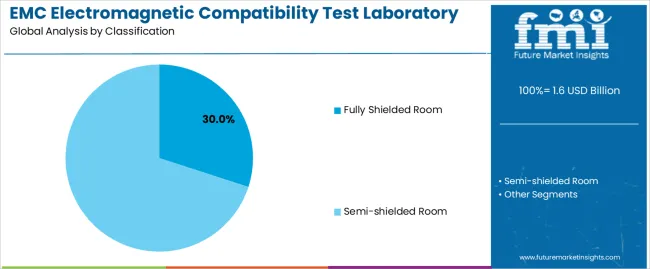
The fully shielded room segment accounts for approximately 30.0% of the global EMC electromagnetic compatibility test laboratory market in 2026, representing the leading classification category. This dominance reflects the extensive use of fully shielded environments in certification testing requiring complete electromagnetic isolation and low ambient interference levels. Fully shielded rooms are designed with multi-layer conductive materials and waveguide components that ensure precise measurement of emission and immunity characteristics for electronic and communication equipment.
The segment’s leadership is reinforced by increasing regulatory emphasis on compliance with international EMC standards such as IEC, CISPR, and FCC. Manufacturers and certification bodies rely on fully shielded rooms to validate product conformity in pre-compliance and final testing stages. Adoption is particularly strong in laboratories serving high-frequency communication, automotive electronics, and defense-related testing applications. Continuous improvements in shielding effectiveness, modular room design, and absorber materials enhance measurement precision and operational flexibility. Fully shielded rooms remain the industry benchmark for electromagnetic testing reliability and are integral to maintaining global certification standards in both public and private testing facilities.
By Application, Which Segment Dominates Market Demand?
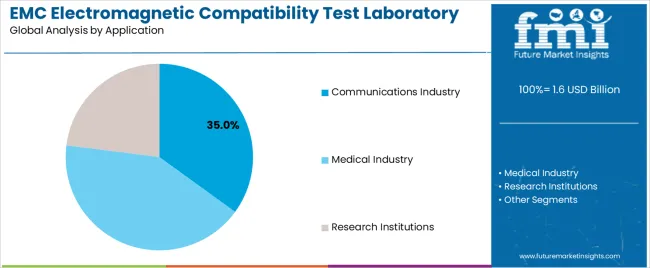
The communications industry segment represents about 35.0% of the total EMC electromagnetic compatibility test laboratory market in 2026, making it the largest application category. This leadership is supported by the growing volume of communication devices and systems requiring electromagnetic emission and immunity testing before market release. Wireless technologies, including mobile communication, satellite transmission, and radar systems, necessitate controlled testing environments to ensure compliance with regional and international electromagnetic standards.
Demand is reinforced by the rapid expansion of 5G infrastructure, radio frequency components, and IoT-enabled devices, which increase the complexity of electromagnetic interaction testing. The segment benefits from continuous laboratory investments in advanced testing equipment capable of evaluating broadband emissions, antenna performance, and electronic susceptibility under standardized conditions. Laboratories serving communication manufacturers in East Asia and North America account for a substantial share of market activity due to concentrated production and certification operations. The communications industry continues to dominate market demand as regulatory frameworks evolve alongside technological innovation, requiring reliable and repeatable EMC testing for electronic communication systems and integrated circuit assemblies worldwide.
What are the Key Trends, Drivers, and Restraints in the EMC Electromagnetic Compatibility Test Laboratory Market?
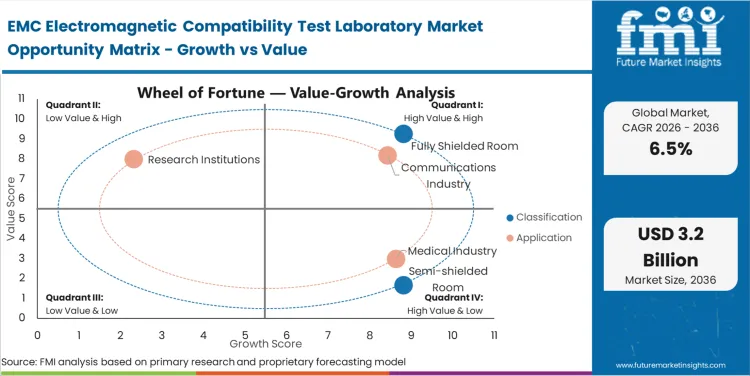
The EMC electromagnetic compatibility test laboratory market is expanding as electronic devices proliferate across industries and regulatory compliance becomes increasingly stringent. Enterprises and manufacturers require certified facilities to validate that their products do not emit or suffer unacceptable electromagnetic interference. Growth is propelled by sectors such as automotive, telecommunications and medical devices that rely on EMC testing for global market access. Constraints persist in the form of high capital expenditure for lab upgrades and skilled personnel shortages. Laboratory operators and service providers respond with advanced test chambers, digital monitoring and location diversification to capture broader demand.
How are regulatory and technology shifts driving demand for EMC testing laboratories?
The rise of 5G networks, electric vehicles and Internet of Things (IoT) devices has elevated the complexity of electromagnetic environments, pushing manufacturers to secure EMC compliance early in their development cycle. Lab buyers and test-service purchasers value a USP of rapid-turn-around accredited testing including pre-compliance and full-compliance services that enables quicker time-to-market and reduces redesign risk. As such, investment in high-frequency chambers and multi-standard test capabilities is becoming a differentiator for laboratories aiming to serve diverse, global clients.
What major challenges are limiting expansion of EMC test laboratory services?
Growth is curtailed by the substantial cost of establishing and maintaining EMC laboratories, including shielded chambers, precision instrumentation and certification accreditation. Smaller manufacturers may defer testing or opt for limited in-house capabilities. An additional barrier is the shortage of trained technicians and engineers who can interpret complex EMC results and navigate evolving standards. For laboratories targeting mid-market OEMs, a USP lies in offering flexible pricing and modular test packages that lower entry cost and broaden accessibility for smaller firms competing in regulated markets.
What operational and competitive trends are shaping the future of EMC test laboratories?
Laboratories increasingly adopt digital technologies such as real-time monitoring, remote access and automated test sequence management to improve efficiency and throughput. Modular test-lab setups and on-site portable test systems also support emerging markets where local infrastructure is limited. A USP for lab operators serving global industries is the ability to deliver multi-geography test coverage with consistent quality and rapid service via digital client portals.
What is the Analysis of the EMC Electromagnetic Compatibility Test Laboratory Market by Key Country?
.webp "Top Country Growth Comparison Emc Electromagnetic Compatibility Test Laboratory Market Cagr (2026 2036)")
| Country | CAGR (%) |
|---|---|
| China | 8.8% |
| India | 8.1% |
| Germany | 7.5% |
| Brazil | 6.8% |
| USA | 6.2% |
| UK | 5.5% |
| Japan | 4.9% |
Source: FMI analysis based on primary research and proprietary forecasting model
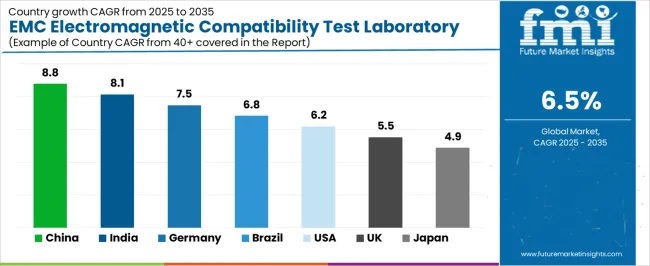
The EMC Electromagnetic Compatibility Test Laboratory Market is expanding rapidly worldwide, with China leading at an 8.8% CAGR through 2036, driven by accelerated electronics manufacturing, strict compliance standards, and growing R&D infrastructure. India follows at 8.1%, supported by rising domestic electronics production, government-backed quality assurance initiatives, and increasing export testing requirements. Germany grows at 7.5%, reflecting leadership in automotive and industrial testing technologies. Brazil records 6.8%, fueled by expansion in telecommunications and consumer electronics certification. The USA, at 6.2%, continues to innovate in test automation and high-frequency EMC applications, while the UK (5.5%) and Japan (4.9%) emphasize precision measurement, laboratory modernization, and international standard alignment to strengthen compliance testing capabilities.
The report covers an in-depth analysis of 40+ countries top-performing countries are highlighted below.
How Is Infrastructure Modernization Accelerating Market Growth in China?
China is experiencing strong growth in the EMC test laboratory market, projected to expand at a CAGR of 8.8% through 2036. Rapid industrial automation and electronic manufacturing expansion are driving the need for compliance testing facilities. The government’s investment in advanced laboratory infrastructure supports certification for automotive, telecom, and aerospace applications. Domestic firms are enhancing testing capacity with shielded chambers, broadband antennas, and advanced signal analysis equipment. International accreditation and export-oriented testing services further enhance China’s competitiveness in global compliance markets.
- Expanding electronic manufacturing sustains testing demand.
- Infrastructure investment supports accredited laboratory growth.
- Adoption of advanced test systems improves result accuracy.
- International certification drives export competitiveness.
Why Is Rising Electronics Production Strengthening Market Potential in India?
India is witnessing rapid development in the EMC test laboratory market, growing at a CAGR of 8.1%, driven by expansion in electronics manufacturing and government-led standardization programs. The country’s push toward domestic production under “Make in India” is creating strong demand for certification and compliance facilities. Laboratories are upgrading to handle complex testing for IoT, defense, and automotive electronics. Partnerships between public research institutions and private labs are accelerating capacity enhancement and technological capability across major industrial regions.
- Growth in electronics production drives laboratory expansion.
- Public private collaboration supports test system modernization.
- Make in India initiatives reinforce local compliance testing.
- Rising demand from IoT and automotive sectors sustains growth.
How Does Engineering Precision Sustain Market Competitiveness in Germany?
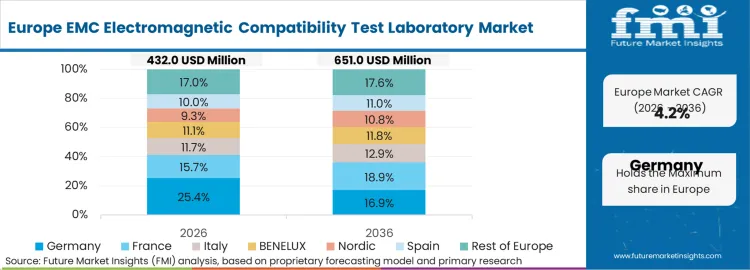
Across Germany, the EMC test laboratory market is advancing at a CAGR of 7.5%, supported by engineering precision, strict regulatory frameworks, and a highly developed industrial ecosystem. Laboratories focus on meeting European CE and automotive EMC standards while expanding capabilities in RF shielding and emission testing. The country’s strong automotive, aerospace, and industrial electronics sectors maintain continuous demand for high-accuracy testing. Integration of automation and digital control systems ensures consistency and repeatability in complex test environments.
- Stringent EU regulations sustain continuous laboratory utilization.
- Integration of automation enhances data accuracy and reliability.
- Expansion in automotive testing supports high-value projects.
- Research collaboration promotes advanced EMC methodologies.
Why Is Standardization Expansion Encouraging Market Development in Brazil?
Brazil is observing consistent growth in the EMC test laboratory market, forecast to increase at a CAGR of 6.8% through 2036. Expansion in telecommunications, automotive, and consumer electronics sectors continues to support laboratory investment. National standardization programs are encouraging domestic testing rather than international outsourcing. Local firms are adopting high-frequency analyzers and modular shielded chambers to improve performance. Strategic collaboration with accredited international laboratories ensures compliance with ISO and IEC standards, enhancing reliability and global alignment.
- Growth in telecom and electronics sectors sustains testing activity.
- National certification programs reduce dependence on foreign labs.
- Equipment modernization improves testing precision and scope.
- International collaborations strengthen technical accreditation.
How Do Regulatory Requirements Support Market Expansion in the United States?
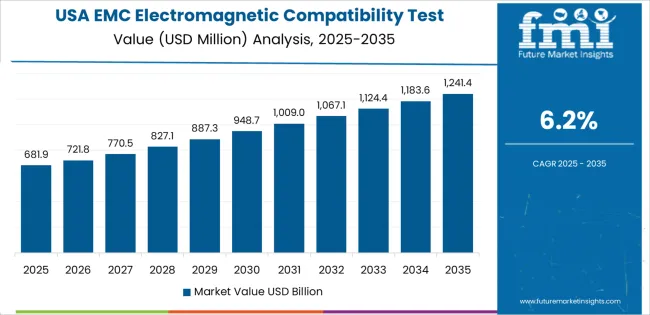
In the United States, the EMC test laboratory market is expanding at a CAGR of 6.2%, supported by regulatory requirements from the FCC and Department of Defense for product certification. Demand for testing spans medical devices, aerospace systems, and electronic consumer goods. Laboratories are investing in multi-chamber facilities and advanced simulation tools to meet increasing complexity. Growth in electric vehicles and defense electronics continues to reinforce demand for electromagnetic compatibility testing and validation across high-performance sectors.
- Regulatory mandates ensure continuous testing demand.
- EV and defense sectors expand EMC testing scope.
- Investment in multi-chamber facilities increases testing throughput.
- Simulation technologies improve efficiency and result consistency.
Why Is Technological Advancement Sustaining Market Activity in the United Kingdom?
Across the United Kingdom, the EMC test laboratory market is advancing at a CAGR of 5.5%, supported by technological progress and harmonization with international standards. Laboratories are upgrading test systems to meet automotive, telecom, and medical device certification requirements. Expansion of private compliance centers complements the activities of established research laboratories. The country’s participation in global regulatory frameworks enables continuous alignment with European and international EMC standards, maintaining reliability and technical credibility.
- Upgrades in test systems improve precision and speed.
- Harmonization with EU and global standards sustains alignment.
- Private sector participation increases testing capacity.
- Demand from medical and telecom sectors drives utilization.
How Does Innovation in Precision Testing Maintain Market Stability in Japan?
Japan is growing steadily in the EMC test laboratory market, projected to expand at a CAGR of 4.9% through 2036. Continuous innovation in precision testing and electronic design validation sustains market consistency. Domestic laboratories emphasize low-noise chamber environments, broadband antenna arrays, and high-speed digital analysis tools. Demand from automotive electronics, robotics, and advanced manufacturing applications supports long-term laboratory utilization. Regulatory stability and international accreditation maintain Japan’s global standing in electromagnetic compatibility testing services.
- Precision testing innovations enhance laboratory performance.
- Growth in robotics and automotive sectors sustains demand.
- Stable regulations maintain consistent testing frameworks.
- Global accreditation reinforces international competitiveness.
How Competitive Is the Global EMC Electromagnetic Compatibility Test Laboratory Market and What Defines Its Strategic Landscape?
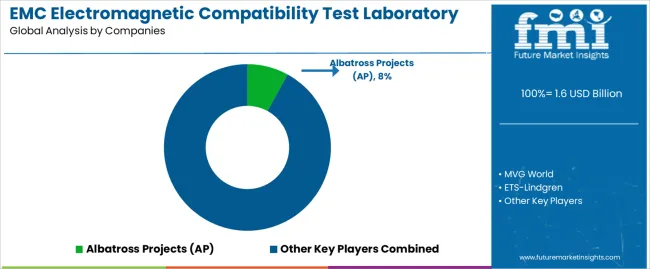
The global EMC electromagnetic compatibility test laboratory market exhibits moderate consolidation, shaped by established shielding system manufacturers and specialized test solution providers. Albatross Projects (AP) maintains a leading position through turnkey EMC laboratory design, integration of shielded rooms, and compliance testing infrastructure. MVG World and ETS-Lindgren follow closely, providing comprehensive EMC testing solutions that combine chambers, antennas, and measurement systems for automotive, aerospace, and electronics industries. Magnetic Shields and SOLIANI EMC specialize in precision-engineered enclosures and modular shielding materials to support consistent test accuracy. NTD and Faraday Pty Ltd contribute expertise in test chamber installation and field measurement systems. EMshield GmbH and National Shielding strengthen regional markets through localized service networks and customized test environments.
Europe EMC Products and Holland Shielding Systems provide standardized and bespoke shielding solutions for research laboratories and industrial applications, emphasizing structural precision and RF attenuation performance. Equipto Electronics and Pepro focus on portable shielding and equipment housing for on-site EMC evaluation. VARAY LABORIX and RA Mayes Company deliver custom test room fabrication and field certification services. DCR, HBTE Tech, and LISUN enhance competitiveness through advanced EMC instrumentation, automated test systems, and calibration support. Competition in this market centers on electromagnetic isolation efficiency, compliance with CISPR and IEC standards, and scalability of laboratory infrastructure. Strategic differentiation depends on precision engineering, installation reliability, and integration of hybrid testing technologies supporting 5G, automotive electronics, and aerospace certification programs.
Key Players in the Market
- Albatross Projects (AP)
- MVG World
- ETS-Lindgren
- Magnetic Shields
- SOLIANI EMC
- MVG
- NTD
- Faraday Pty Ltd
- EMshield GmbH
- National Shielding
- Europe EMC Products
- Holland Shielding Systems
- Equipto Electronics
- Pepro
- VARAY LABORIX
- RA Mayes Company
- DCR
- HBTE Tech
- LISUN
Scope of the Report
| Metric | Value |
|---|---|
| Quantitative Units | USD 1.70 Billion to USD 3.20 Billion, at a CAGR of 6.50% |
| Market Definition | EMC test laboratories are shielded testing facilities with anechoic chambers and measurement instrumentation for evaluating electronic product compliance with electromagnetic emissions and immunity standards across communications, medical, automotive, and consumer electronics sectors. |
| Segmentation | Classification: Fully Shielded Room and Semi-shielded Room; Application: Communications Industry, Medical Industry, and Research Institutions |
| Regions Covered | North America, Latin America, Europe, East Asia, South Asia, Oceania, Middle East & Africa |
| Countries Covered | China, India, Germany, Brazil, USA, UK, Japan, and 40 plus countries |
| Key Companies Profiled | Albatross Projects (AP), MVG World, ETS-Lindgren, Magnetic Shields, SOLIANI EMC, NTD, Faraday Pty Ltd, EMshield GmbH, National Shielding, Europe EMC Products |
| Forecast Period | 2026 to 2036 |
| Approach | Forecasting models apply a bottom-up methodology starting with installed base metrics and projecting conversion rates to technology adoption. |
Shielded Room Market by Segments
Classification:
- Fully Shielded Room
- Semi-shielded Room
Application:
- Communications Industry
- Medical Industry
- Research Institutions
Region:
East Asia
- China
- Japan
- South Korea
- Taiwan
- Rest of East Asia
Europe
- Germany
- UK
- France
- Italy
- Spain
- Switzerland
- Nordic
- BENELUX
- Rest of Europe
North America
- USA
- Canada
- Mexico
South Asia
- India
- Pakistan
- Bangladesh
- Rest of South Asia
Latin America
- Brazil
- Argentina
- Chile
- Rest of Latin America
Middle East & Africa
- Kingdom of Saudi Arabia
- Other GCC Countries
- Turkey
- South Africa
- Other African Union
- Rest of Middle East & Africa
Eastern Europe
- Russia
- Poland
- Czech Republic
Rest of Eastern Europe
Bibliography
- 1. International Electrotechnical Commission. (2024). CISPR 32: Electromagnetic Compatibility of Multimedia Equipment Emissions Requirements. IEC.
- 2. Federal Communications Commission. (2024). Equipment Authorization Procedures: EMC Testing Requirements Update. FCC.
- 3. Certification and Accreditation Administration of China. (2024). CCC Certification: EMC Test Laboratory Accreditation Standards. CNCA.
- 4. Bureau of Indian Standards. (2024). Compulsory Registration Scheme: EMC Testing Requirements for Electronics. BIS.
- 5. European Committee for Electrotechnical Standardization. (2024). EN 55032/EN 55035: EMC Standards for Information Technology Equipment. CENELEC.
- 6. International Laboratory Accreditation Cooperation. (2024). EMC Testing Laboratory Accreditation: Mutual Recognition Arrangement Update. ILAC.
- This bibliography is provided for reader reference. The full FMI report contains the complete reference list with primary research documentation.
This bibliography is provided for reader reference and is not exhaustive. The full report contains the complete reference list and detailed citations.
Frequently Asked Questions
How large is the demand for EMC Test Laboratories in the global market in 2026?
Demand is estimated to be valued at USD 1.70 billion in 2026.
What will be the market size by 2036?
Market size is projected to reach USD 3.20 billion by 2036.
What is the expected CAGR between 2026 and 2036?
Demand is expected to grow at a CAGR of 6.50% between 2026 and 2036.
Which Classification is poised to lead in 2026?
Fully Shielded Room accounts for 30.0% share delivering the measurement accuracy required for accredited radiated testing.
How is Communications Industry positioned in 2026?
Communications Industry represents 35.0% share driven by 5G, Wi-Fi, and IoT device certification testing volumes.
What is driving demand in China?
CCC certification expansion and electronics manufacturer pre-compliance facility investment fuel the fastest growth at 8.8% CAGR through 2036.
What is included in the scope of this report?
The market covers shielded anechoic chambers, semi-shielded rooms, measurement suites, construction services, and accreditation consulting for communications, medical, automotive, and consumer electronics testing.
What is excluded from the scope of this report?
Standalone EMC instruments, field survey equipment, EMC consulting without lab facility, and safety labs without EMC shielding are excluded.
Preview the report firsthand - request a free sample
Get SampleGet the brochure for pricing and purchase details.
Get PDFTable of Content
- Executive Summary
- Global Market Outlook
- Demand-side Trends
- Supply-side Trends
- Technology Roadmap Analysis
- Analysis and Recommendations
- Market Overview
- Market Coverage / Taxonomy
- Market Definition / Scope / Limitations
- Research Methodology
- Chapter Orientation
- Analytical Lens and Working Hypotheses
- Market Structure, Signals, and Trend Drivers
- Benchmarking and Cross-market Comparability
- Market Sizing, Forecasting, and Opportunity Mapping
- Research Design and Evidence Framework
- Desk Research Programme (Secondary Evidence)
- Company Annual and Sustainability Reports
- Peer-reviewed Journals and Academic Literature
- Corporate Websites, Product Literature, and Technical Notes
- Earnings Decks and Investor Briefings
- Statutory Filings and Regulatory Disclosures
- Technical White Papers and Standards Notes
- Trade Journals, Industry Magazines, and Analyst Briefs
- Conference Proceedings, Webinars, and Seminar Materials
- Government Statistics Portals and Public Data Releases
- Press Releases and Reputable Media Coverage
- Specialist Newsletters and Curated Briefings
- Sector Databases and Reference Repositories
- FMI Internal Proprietary Databases and Historical Market Datasets
- Subscription Datasets and Paid Sources
- Social Channels, Communities, and Digital Listening Inputs
- Additional Desk Sources
- Expert Input and Fieldwork (Primary Evidence)
- Primary Modes
- Qualitative Interviews and Expert Elicitation
- Quantitative Surveys and Structured Data Capture
- Blended Approach
- Why Primary Evidence is Used
- Field Techniques
- Interviews
- Surveys
- Focus Groups
- Observational and In-context Research
- Social and Community Interactions
- Stakeholder Universe Engaged
- C-suite Leaders
- Board Members
- Presidents and Vice Presidents
- R&D and Innovation Heads
- Technical Specialists
- Domain Subject-matter Experts
- Scientists
- Physicians and Other Healthcare Professionals
- Governance, Ethics, and Data Stewardship
- Research Ethics
- Data Integrity and Handling
- Primary Modes
- Tooling, Models, and Reference Databases
- Desk Research Programme (Secondary Evidence)
- Data Engineering and Model Build
- Data Acquisition and Ingestion
- Cleaning, Normalisation, and Verification
- Synthesis, Triangulation, and Analysis
- Quality Assurance and Audit Trail
- Market Background
- Market Dynamics
- Drivers
- Restraints
- Opportunity
- Trends
- Scenario Forecast
- Demand in Optimistic Scenario
- Demand in Likely Scenario
- Demand in Conservative Scenario
- Opportunity Map Analysis
- Product Life Cycle Analysis
- Supply Chain Analysis
- Investment Feasibility Matrix
- Value Chain Analysis
- PESTLE and Porter’s Analysis
- Regulatory Landscape
- Regional Parent Market Outlook
- Production and Consumption Statistics
- Import and Export Statistics
- Market Dynamics
- Global Market Analysis 2021 to 2025 and Forecast, 2026 to 2036
- Historical Market Size Value (USD Million) Analysis, 2021 to 2025
- Current and Future Market Size Value (USD Million) Projections, 2026 to 2036
- Y-o-Y Growth Trend Analysis
- Absolute $ Opportunity Analysis
- Global Market Pricing Analysis 2021 to 2025 and Forecast 2026 to 2036
- Global Market Analysis 2021 to 2025 and Forecast 2026 to 2036, By Classification
- Introduction / Key Findings
- Historical Market Size Value (USD Million) Analysis By Classification , 2021 to 2025
- Current and Future Market Size Value (USD Million) Analysis and Forecast By Classification , 2026 to 2036
- Fully Shielded Room
- Semi-shielded Room
- Fully Shielded Room
- Y-o-Y Growth Trend Analysis By Classification , 2021 to 2025
- Absolute $ Opportunity Analysis By Classification , 2026 to 2036
- Global Market Analysis 2021 to 2025 and Forecast 2026 to 2036, By Application
- Introduction / Key Findings
- Historical Market Size Value (USD Million) Analysis By Application, 2021 to 2025
- Current and Future Market Size Value (USD Million) Analysis and Forecast By Application, 2026 to 2036
- Communications Industry
- Medical Industry
- Research Institutions
- Communications Industry
- Y-o-Y Growth Trend Analysis By Application, 2021 to 2025
- Absolute $ Opportunity Analysis By Application, 2026 to 2036
- Global Market Analysis 2021 to 2025 and Forecast 2026 to 2036, By Region
- Introduction
- Historical Market Size Value (USD Million) Analysis By Region, 2021 to 2025
- Current Market Size Value (USD Million) Analysis and Forecast By Region, 2026 to 2036
- North America
- Latin America
- Western Europe
- Eastern Europe
- East Asia
- South Asia and Pacific
- Middle East & Africa
- Market Attractiveness Analysis By Region
- North America Market Analysis 2021 to 2025 and Forecast 2026 to 2036, By Country
- Historical Market Size Value (USD Million) Trend Analysis By Market Taxonomy, 2021 to 2025
- Market Size Value (USD Million) Forecast By Market Taxonomy, 2026 to 2036
- By Country
- USA
- Canada
- Mexico
- By Classification
- By Application
- By Country
- Market Attractiveness Analysis
- By Country
- By Classification
- By Application
- Key Takeaways
- Latin America Market Analysis 2021 to 2025 and Forecast 2026 to 2036, By Country
- Historical Market Size Value (USD Million) Trend Analysis By Market Taxonomy, 2021 to 2025
- Market Size Value (USD Million) Forecast By Market Taxonomy, 2026 to 2036
- By Country
- Brazil
- Chile
- Rest of Latin America
- By Classification
- By Application
- By Country
- Market Attractiveness Analysis
- By Country
- By Classification
- By Application
- Key Takeaways
- Western Europe Market Analysis 2021 to 2025 and Forecast 2026 to 2036, By Country
- Historical Market Size Value (USD Million) Trend Analysis By Market Taxonomy, 2021 to 2025
- Market Size Value (USD Million) Forecast By Market Taxonomy, 2026 to 2036
- By Country
- Germany
- UK
- Italy
- Spain
- France
- Nordic
- BENELUX
- Rest of Western Europe
- By Classification
- By Application
- By Country
- Market Attractiveness Analysis
- By Country
- By Classification
- By Application
- Key Takeaways
- Eastern Europe Market Analysis 2021 to 2025 and Forecast 2026 to 2036, By Country
- Historical Market Size Value (USD Million) Trend Analysis By Market Taxonomy, 2021 to 2025
- Market Size Value (USD Million) Forecast By Market Taxonomy, 2026 to 2036
- By Country
- Russia
- Poland
- Hungary
- Balkan & Baltic
- Rest of Eastern Europe
- By Classification
- By Application
- By Country
- Market Attractiveness Analysis
- By Country
- By Classification
- By Application
- Key Takeaways
- East Asia Market Analysis 2021 to 2025 and Forecast 2026 to 2036, By Country
- Historical Market Size Value (USD Million) Trend Analysis By Market Taxonomy, 2021 to 2025
- Market Size Value (USD Million) Forecast By Market Taxonomy, 2026 to 2036
- By Country
- China
- Japan
- South Korea
- By Classification
- By Application
- By Country
- Market Attractiveness Analysis
- By Country
- By Classification
- By Application
- Key Takeaways
- South Asia and Pacific Market Analysis 2021 to 2025 and Forecast 2026 to 2036, By Country
- Historical Market Size Value (USD Million) Trend Analysis By Market Taxonomy, 2021 to 2025
- Market Size Value (USD Million) Forecast By Market Taxonomy, 2026 to 2036
- By Country
- India
- ASEAN
- Australia & New Zealand
- Rest of South Asia and Pacific
- By Classification
- By Application
- By Country
- Market Attractiveness Analysis
- By Country
- By Classification
- By Application
- Key Takeaways
- Middle East & Africa Market Analysis 2021 to 2025 and Forecast 2026 to 2036, By Country
- Historical Market Size Value (USD Million) Trend Analysis By Market Taxonomy, 2021 to 2025
- Market Size Value (USD Million) Forecast By Market Taxonomy, 2026 to 2036
- By Country
- Kingdom of Saudi Arabia
- Other GCC Countries
- Turkiye
- South Africa
- Other African Union
- Rest of Middle East & Africa
- By Classification
- By Application
- By Country
- Market Attractiveness Analysis
- By Country
- By Classification
- By Application
- Key Takeaways
- Key Countries Market Analysis
- USA
- Pricing Analysis
- Market Share Analysis, 2025
- By Classification
- By Application
- Canada
- Pricing Analysis
- Market Share Analysis, 2025
- By Classification
- By Application
- Mexico
- Pricing Analysis
- Market Share Analysis, 2025
- By Classification
- By Application
- Brazil
- Pricing Analysis
- Market Share Analysis, 2025
- By Classification
- By Application
- Chile
- Pricing Analysis
- Market Share Analysis, 2025
- By Classification
- By Application
- Germany
- Pricing Analysis
- Market Share Analysis, 2025
- By Classification
- By Application
- UK
- Pricing Analysis
- Market Share Analysis, 2025
- By Classification
- By Application
- Italy
- Pricing Analysis
- Market Share Analysis, 2025
- By Classification
- By Application
- Spain
- Pricing Analysis
- Market Share Analysis, 2025
- By Classification
- By Application
- France
- Pricing Analysis
- Market Share Analysis, 2025
- By Classification
- By Application
- India
- Pricing Analysis
- Market Share Analysis, 2025
- By Classification
- By Application
- ASEAN
- Pricing Analysis
- Market Share Analysis, 2025
- By Classification
- By Application
- Australia & New Zealand
- Pricing Analysis
- Market Share Analysis, 2025
- By Classification
- By Application
- China
- Pricing Analysis
- Market Share Analysis, 2025
- By Classification
- By Application
- Japan
- Pricing Analysis
- Market Share Analysis, 2025
- By Classification
- By Application
- South Korea
- Pricing Analysis
- Market Share Analysis, 2025
- By Classification
- By Application
- Russia
- Pricing Analysis
- Market Share Analysis, 2025
- By Classification
- By Application
- Poland
- Pricing Analysis
- Market Share Analysis, 2025
- By Classification
- By Application
- Hungary
- Pricing Analysis
- Market Share Analysis, 2025
- By Classification
- By Application
- Kingdom of Saudi Arabia
- Pricing Analysis
- Market Share Analysis, 2025
- By Classification
- By Application
- Turkiye
- Pricing Analysis
- Market Share Analysis, 2025
- By Classification
- By Application
- South Africa
- Pricing Analysis
- Market Share Analysis, 2025
- By Classification
- By Application
- USA
- Market Structure Analysis
- Competition Dashboard
- Competition Benchmarking
- Market Share Analysis of Top Players
- By Regional
- By Classification
- By Application
- Competition Analysis
- Competition Deep Dive
- Albatross Projects (AP)
- Overview
- Product Portfolio
- Profitability by Market Segments (Product/Age /Sales Channel/Region)
- Sales Footprint
- Strategy Overview
- Marketing Strategy
- Product Strategy
- Channel Strategy
- MVG World
- ETS-Lindgren
- Magnetic Shields
- SOLIANI EMC
- MVG
- NTD
- Faraday Pty Ltd
- EMshield GmbH
- National Shielding
- Europe EMC Products
- Albatross Projects (AP)
- Competition Deep Dive
- Assumptions & Acronyms Used


