

- Market Size (2026)
- USD 640.6 Mn
- Forecast (2036)
- USD 1136.4 Mn
- CAGR (2026 to 2036)
- 5.9%
How big is the EMS markers market size?
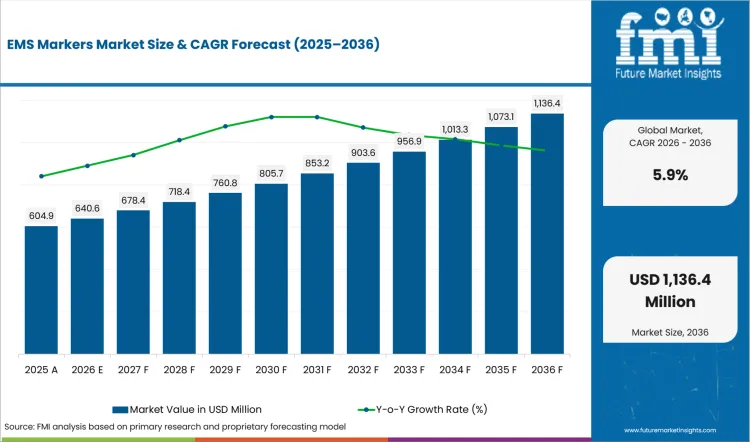
USD 640.6 million in 2026 and USD 1,136.4 million by 2036 at a 5.9% CAGR.
Demand for EMS markers is projected to expand at 5.9% CAGR between 2026 and 2036, increasing valuation from USD 640.6 million in 2026 to USD 1,136.4 million by 2036. Managing underground networks requires qualifying marker systems around buried asset identity alongside surface-readable verification across fiber and sewer work. Rising focus on infrastructure safety directly boosts need for accurate location tools. Common Ground Alliance reported on August 2025 noting its CGA Index rose from 94.0 in 2023 to 96.7 in 2024 as buried utility damage prevention needed stronger field records. Increased tracking demands expand deployment expectations for electromagnetic markers globally.
Operations in India and China prefer marker programs connected with fiber route identity and municipal coordination records. The United Kingdom and Germany organizations review locator compatibility alongside field documentation before completing repeat purchases. Adapting to regional preferences remains important since excavation alerts now move closer to asset records and route verification. India Department of Telecommunications reported on December 2025 stating Call Before u Dig monthly enquiries increased from 1,211 in November 2024 to 11,258 in October 2025. Such an enquiry growth confirms a global transition toward stricter field documentation and precise mapping verification.
| Metric | Value |
|---|---|
| 2025 Market Size | USD 604.9 million |
| 2026 Market Size | USD 640.6 million |
| 2036 Market Size | USD 1,136.4 million |
| Forecast CAGR (2026-2036) | 5.9% |
| Sales Channel Focus | Utility Distributors (48.0% share in 2026) |
| Application Focus | Underground Asset Marking (39.0% share in 2026) |
| Marker Type Focus | Ball Markers (36.0% share in 2026) |
Summary of the EMS Markers Market
| Market Signal | Commercial Impact |
|---|---|
| Demand and Growth Drivers | Purchasing for EMS markers is estimated to rise as utility owners connect buried asset records with locator-readable field checks. Account decisions are expected to reflect marker readability and locator compatibility across repeat excavation programs.
|
| Product and Segment View | Segment demand is led by utility distributors and underground asset marking programs needing marker availability before ground closure. Specification work is expected to focus on marker types suited to future locator reads and clear utility identity.
|
| Geography and Growth Outlook | Country demand is likely to improve across markets investing in telecom routes and damage prevention discipline. Supplier gains are projected to reflect fiber buildout and distributor access.
|
| Competitive Landscape | Competition is likely to focus on marker readability and locator system compatibility. Account wins are expected to favor suppliers with field evidence and utility-code coverage.
|
| Analyst Perspective | EMS markers are developing into a specification-led utility marking group linked to excavation discipline and asset record quality. Supplier progress is projected to improve through marker evidence and field support aligned with utility owner needs.
|
Source: Future Market Insights analysis, 2026.
How is the EMS markers market segmented?
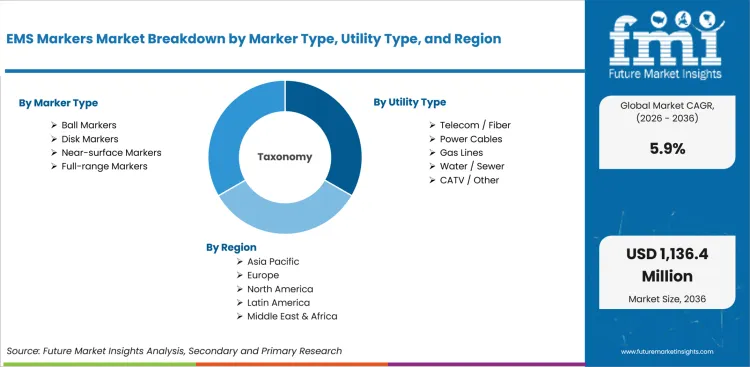
The EMS markers market is segmented by sales channel, application, marker type, utility type, frequency code, and region.
The EMS markers industry is segmented by sales channel, application, marker type, utility type, frequency code, and region. Sales channel coverage includes utility distributors, direct OEM, and contractor supply. Application coverage includes underground asset marking, cable route identification, joint or splice location, and repair and maintenance. Marker type coverage includes ball markers, disk markers, near-surface markers, and full-range markers. Utility type coverage includes telecom or fiber, K, gas lines, water or sewer, and CATV or other utilities. Frequency code coverage includes telephone, power, gas, water, wastewater, and general purpose. Regional coverage includes North America, Latin America, Western Europe, Eastern Europe, East Asia, South Asia and Pacific, and Middle East and Africa.
How do utility distributors support sales channel demand?
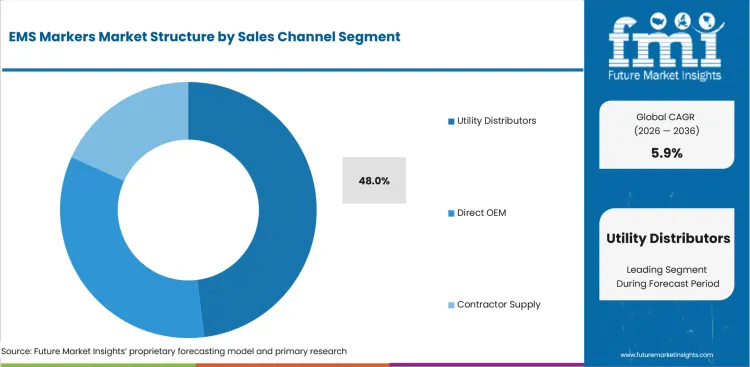
Common Ground Alliance reported on August 2025 announcing 74% of excavation or construction-sourced damage reports came through 811 centers in 2024, reinforcing channel demand around pre-excavation coordination and utility field supplies. Utility distributors are anticipated to support EMS marker as contractors need correct marker types before ground closure. Field teams prefer distributor access once utility color code and frequency-code selection affect jobsite timing.
- Utility distributors are projected to account for 48.0% share in 2026, aided by stock availability and recurring utility contractor purchases. Buyers prefer distributor channels once marker type and locator compatibility affect field readiness.
- Direct OEM and contractor supply channels are expected to retain service value. Utility distributors gain preference once crews need common marker formats available before assets are buried.
Why does underground asset marking influence application demand?
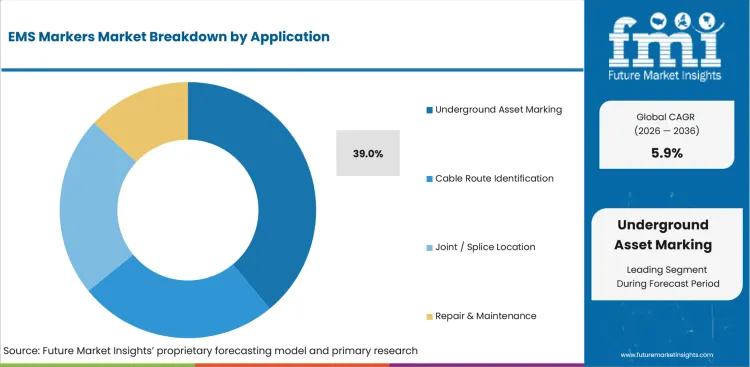
Underground asset marking is expected to guide EMS marker use as buried points need recoverable identity after pavement or construction changes. Utility teams are likely to compare marker placement records and locator read reliability before wider account use. Common Ground Alliance reported on August 2025 stating top 10 root causes accounted for nearly 85% of damages in 2024, supporting marker use as asset records and field verification enter damage prevention work.
- In 2026, underground asset marking is forecast to hold 39.0% share in 2026 due to buried utility identity needs and repeat maintenance checks. Accounts seek marker programs backed by placement records and utility type coding.
- Cable route identification and repair and maintenance serve different field needs. Underground asset marking gains selection preference once crews need a recoverable point after surface references disappear.
How do ball markers guide marker type demand?
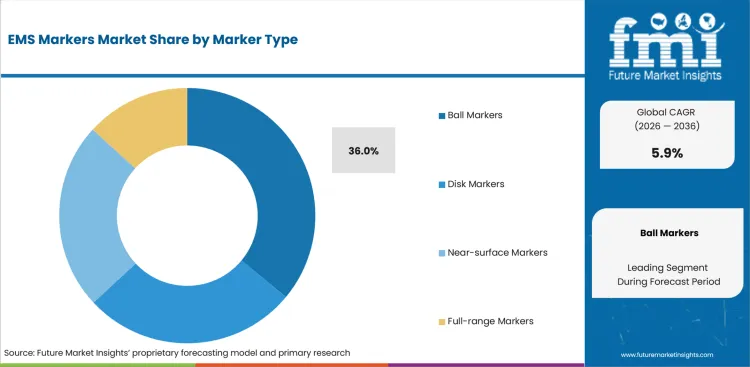
Ball markers are estimated to influence EMS marker selection as flexible placement suits valves and splice areas. Equipment teams assess detection range and field readability before choosing a marker family for repeat work. Radiodetection reported in its May 2025 MRX brochure showing ball marker maximum depth at 1.5 m or 4.9 ft, helping crews compare marker suitability for surface reads.
- By guide marker type, ball markers are estimated to capture 36.0% share in 2026 owing to placement flexibility and familiar utility workflows. Suppliers gain account approval once ball marker programs support easy burial and later identification.
- Disk markers and full-range markers support different depth and surface conditions. Ball markers gain attention once crews need simple placement near asset changes and utility access points.
Why does Telecom or Fiber shape utility type demand?
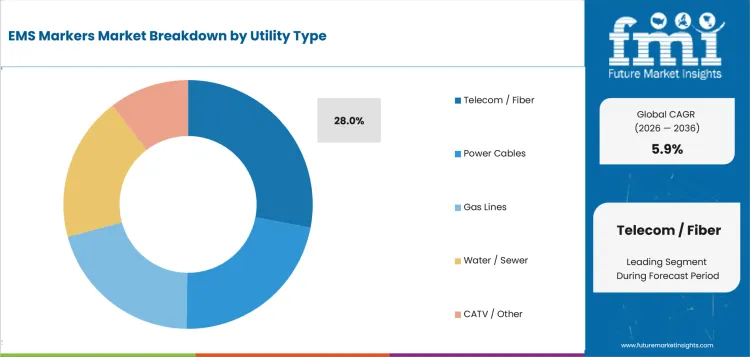
Telecom or Fiber utility type demand is anticipated to increase as fiber routes require identification around splice points and buried route changes. Crews are expected to need marker programs suited to dense rights-of-way and overlapping utility corridors. Ofcom reported on May 2026 noting full fibre availability reached 24.9 million United Kingdom residential premises by January 2026, indicating fiber buildout continues to raise route identity and utility locating needs.
- Telecom or fiber is anticipated to garner 28.0% share of utility type in 2026, guided by buried fiber expansion and splice-point verification needs. Buyers prefer markers helping crews confirm telecom assets without repeated ground opening.
- Power cables and CATV or other utilities retain field marking demand. Telecom or Fiber gains preference once fiber expansion raises demand for accurate underground asset records.
How does Telephone frequency code support marker selection?
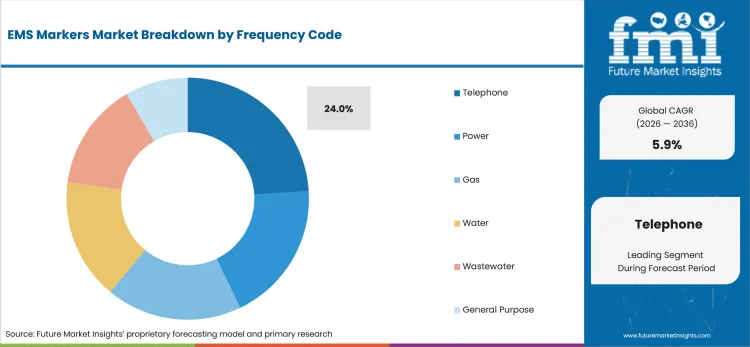
Telephone frequency code is projected to support marker selection as telecom and fiber assets need coded reads separate from wastewater and general-purpose markers. Locator teams are likely to prefer codes reducing confusion in congested utility corridors. Radiodetection reported in its May 2025 MRX brochure listing Telephone or Telecoms marker frequency at 101.4 kHz, confirming coded utility separation for field marker reads.
- Based on marker selection, telephone is likely to secure 24.0% share in 2026 since it is influenced by telecom and fiber asset density. Field crews prefer telephone-coded markers once several buried utilities share the same work zone.
- Power and general-purpose frequency codes serve separate utility identification needs. Telephone gains account attention once telecom routes require distinct locator signals before maintenance work.
What are the drivers, restraints, and opportunities in the EMS markers market?
Near-term purchases are shaped by utility asset identification and service-led adoption paths outlined below.
- Driver: Utility owners are expected to add EMS markers to connect buried asset identity with locator-readable field checks.
- Restraint: Adoption is anticipated to slow if marker placement discipline and frequency-code records stay inconsistent.
- Opportunity: Telecom or Fiber expansion and public excavation coordination are likely to raise demand for marker families suited to future asset reads.
Underground utility projects increasingly require accurate locating tools before any digging takes place. Common Ground Alliance reported on August 2025 stating 196,977 unique reported damages were recorded in 2024. High rates of accidental strikes motivate utility companies to improve route identification and enforce stricter excavation safety rules.
Widespread use of electronic markers slows down whenever poor locator response times and missing records disrupt field schedules. Common Ground Alliance reported on August 2025 citing incomplete responses left excavators unable to begin work as scheduled an average 38% of the time across 8 centers. Incomplete utility locating data clearly weakens daily excavation planning and delays project timelines.
Expanding internet connectivity creates new underground utility lines stretching far beyond dense city corridors. OECD reported on October 2025 stating fibre reached 47% of total fixed broadband subscriptions across OECD members by the end of 2024. Rapid broadband growth generates a continuous need for reliable field identification tools around newly built infrastructure.
What country CAGRs are profiled in the EMS markers market?
.webp "Top Country Growth Comparison Ems Markers Market Cagr (2026 2036)")
| Country | CAGR |
|---|---|
| India | 7.7% |
| China | 6.9% |
| Australia | 5.6% |
| United Kingdom | 5.3% |
| United States | 5.0% |
| Germany | 4.6% |
| Japan | 4.3% |
Source: Future Market Insights, 2026.
How do country-level CAGRs compare in the EMS markers market?
Country demand in EMS markers is expected to be guided by excavation rules and distributor access. India and China are likely to connect demand with utility additions and telecom route management. Australia and United Kingdom accounts are projected to connect adoption with fiber upgrade programs and developed utility networks. The United States and Japan are anticipated to connect demand with maintenance discipline and advanced locator use.
- India EMS markers sector is projected to grow at 7.7% CAGR between 2026 and 2036, reflected by telecom expansion and route-identification needs across public infrastructure work. India Department of Telecommunications reported on December 2025 stating BharatNet had laid 694,711 km of optical fibre cable by October 2025, promoting demand for buried route identity and field-readable marker placement.
- China utility owners are expected to review EMS markers around dense telecom assets and city utility additions. Sales in China are forecast to expand at 6.9% CAGR from 2026 to 2036, aided by urban network depth and field verification requirements. State Council reported on February 2026 noting China had 1.125 billion internet users by the end of 2025, influencing marker demand around telecom access points and underground network maintenance.
- Australia buyers are projected to favor marker systems suited to wide-area utility maintenance and fiber upgrade work. NBN Co reported in its 2025 half-year report having made almost 2.6 million premises ready for offer to upgrade to FTTP services as of December 2024, highlighting marker review around route additions and access-point records. EMS markers industry in Australia is expected to grow at 5.6% CAGR through 2036, helped by network renewal and contractor supply needs.
- The market in United Kingdom is anticipated to connect with asset records and locator compatibility across developed public works areas. Demand in the United Kingdom is projected to rise at 5.3% CAGR during the assessment period, backed by fiber route expansion and stricter field documentation. Ofcom reported on May 2026 announcing full fibre reached 24.9 million residential premises by January 2026, strengthening demand for marker systems used around telecom route identification.
- United States accounts are likely to review EMS markers through damage prevention and telecom route maintenance programs. OECD reported on October 2025 stating United States maintained 200 mobile broadband subscriptions per 100 inhabitants in 2024, impacting field activity around dense connectivity networks and route verification. EMS markers market in the United States is forecast to expand at 5.0% CAGR during the study period, aided by utility locating discipline and distributor-led field supply.
- Germany EMS markers industry is expected to grow at 4.6% CAGR during the forecast period, shaped by utility maintenance discipline and fiber network documentation. Bundesnetzagentur reported on June 2026 claiming for active fibre connections having increased from 5.3 million at the end of 2024 to 6.4 million by the end of 2025, influencing demand for marker programs linked with access points and future maintenance reads.
- Japan utilities are projected to favor marker systems supporting dense telecom access and precise field verification. OECD reported on October 2025 noting Japan having maintained 210 mobile broadband subscriptions per 100 inhabitants in 2024, indicating a dense connectivity base requiring careful buried asset maintenance. EMS markers sector in Japan is anticipated to expand at 4.3% CAGR through 2036, led by compact urban networks and advanced utility locating practice.
Who are the notable companies in the EMS markers market?
3M, Radiodetection, Tempo Communications, Schonstedt, Berntsen International, C.Scope, Vivax-Metrotech, Pro-Line Safety, Leica Geosystems, and SubSurface Instruments are expected to shape demand.
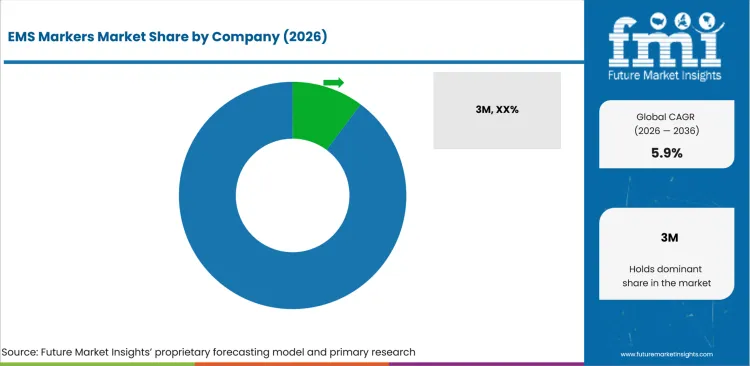
Competition in EMS markers is anticipated to center on marker readability and locator compatibility. Account teams are likely to compare suppliers based on utility-code coverage and ability to support repeat field programs after initial approval. 3M, Radiodetection and Vivax-Metrotech are expected to receive review attention due to marker and locator system knowledge. Schonstedt and SubSurface Instruments are projected to compete due to locating tools and channel support. Berntsen International and Leica Geosystems are estimated to support account demand led by survey and field identification knowledge.
- 3M and Vivax-Metrotech are expected to gain account attention based on marker and locator system depth. Tempo Communications is likely to contributes through utility-code coverage promoting programs needing gas and wastewater identification.
- Schonstedt and SubSurface Instruments are anticipated to compete led by locating equipment familiarity and service support. Their role as projected to improve contractors reviewing equipment usability and training needs before marker adoption.
- Berntsen International and Leica Geosystems are forecast to promote demand depending on field marking accessories and infrastructure measurement knowledge. Field documentation support is expected to help accounts compare asset identity records and mapping needs.
- Specialist and regional suppliers are estimated to gain review strength depending on contractor supply access and field response. Supplier access is likely to improve as buried utility owners seek marker availability across recurring work sites.
Competitive Benchmarking: EMS Markers Market
| Company | Portfolio Depth | Marker Format Match | Application Support | Service Reach |
|---|---|---|---|---|
| 3M | High | High | High | Global |
| Radiodetection | High | High | High | Global |
| Tempo Communications | High | High | High | Global |
| Vivax-Metrotech | Medium | High | High | Global |
| Schonstedt | Medium | Medium | High | Global |
| C.Scope | Medium | Medium | High | Regional/Global |
| Berntsen International | Medium | Medium | Medium | Regional/Global |
| Pro-Line Safety | Medium | Medium | Medium | Regional |
| Leica Geosystems | Medium | Medium | Medium | Global |
| SubSurface Instruments | Medium | Medium | Medium | Regional/Global |
Source: Future Market Insights competitive analysis, 2026.
Key Developments in the EMS Markers Market
- In May 2025, Radiodetection launched its MRX RF Marker Ball Locator range. Radiodetection announced on May 2025 noting MRX and MRX SG integrate marker ball detection and utility locating in one device, improving equipment review for crews needing marker reads and utility path detection together.
- In May 2025, Radiodetection issued RF Marker mode guidance for the MRX SG marker locator. Radiodetection support stated on May 2025 noting RF markers identify buried utilities through specific frequency and color, strengthening field guidance for utility-code marker selection.
- In April 2026, Tempo Communications introduced the EML250-ID RFID Marker Locator and OmniMarker-ID markers. Tempo Communications stated on April 2026 claiming EML250-ID reads OmniMarker-ID markers from up to 5 feet away across all 9 industry-standard frequencies, supporting buried asset data recording across utility marker programs.
Key Players in the EMS Markers Market
Marker and locator system suppliers
- 3M
- Radiodetection
- Tempo Communications
- Vivax-Metrotech
Locating instrument specialists
- Schonstedt
- C.Scope
- SubSurface Instruments
Survey and field identification suppliers
- Berntsen International
- Pro-Line Safety
- Leica Geosystems
EMS Markers Market - Report Scope
| Coverage field | Report scope |
|---|---|
| Market breakdown | EMS Markers Market breakdown by sales channel, application, marker type, utility type, frequency code, and region |
| Market Definition | EMS markers are electronic marker systems used to tag buried utility assets and support locator-readable identification across telecom, power, gas, water, sewer, CATV, and general utility work. |
| Regions Covered | North America, Latin America, Western Europe, Eastern Europe, East Asia, South Asia and Pacific, and Middle East and Africa |
| Countries Covered | United States, China, Germany, Japan, India, United Kingdom, Australia, Canada, Brazil, Mexico, France, Italy, Spain, ASEAN, New Zealand, GCC countries, South Africa, and Türkiye |
| Key Companies Profiled | 3M, Radiodetection, Tempo Communications, Schonstedt, Berntsen International, C.Scope, Vivax-Metrotech, Pro-Line Safety, Leica Geosystems, and SubSurface Instruments |
| Forecast Period | 2026 to 2036 |
| Approach | Hybrid bottom-up and top-down methodology using segment share, country CAGR, buried utility density, fiber route additions, damage prevention signals, marker type mix, locator compatibility, and channel exposure |
Source: Future Market Insights analysis, 2026.
EMS Markers Market - Research Methodology
| Method | Approach |
|---|---|
| Primary Research | Primary interviews covered utility owners, telecom contractors, excavation teams, utility distributors, locator equipment suppliers, and infrastructure maintenance managers. Discussions focused on marker type, frequency code, placement records, locator compatibility, stock availability, training needs, and repeat-order readiness. |
| Desk Research | Desk research reviewed official damage prevention datasets, telecom infrastructure updates, company product pages, locator documentation, utility marking references, and public broadband rollout information. |
| Market Sizing and Forecasting | Market sizing used a hybrid model across segment mix, country CAGR, buried asset exposure, fiber route expansion, repair cycles, distributor participation, and supplier coverage across EMS markers. |
| Data Validation | Data validation compares interview findings from utility locator technicians, telecom contractors, municipal engineers, and specialized distributors against regional infrastructure programs and channel availability. Analysts test country-level growth against segment shares, country CAGRs, company alignment, and official source signals to avoid unsupported claims and unrelated utility equipment leakage. The forecast is then triangulated across new utility line extensions, highway construction projects, and regular line maintenance cycles that influence repeat EMS marker demand. |
Source: Future Market Insights analysis, 2026.
EMS Markers Market by Segments
EMS Markers Market segmented by Sales Channel:
- Utility Distributors
- Direct OEM
- Contractor Supply
EMS Markers Market segmented by Application:
- Underground Asset Marking
- Cable Route Identification
- Joint or Splice Location
- Repair and Maintenance
EMS Markers Market segmented by Marker Type:
- Ball Markers
- Disk Markers
- Near-surface Markers
- Full-range Markers
EMS Markers Market segmented by Utility Type:
- Telecom or Fiber
- Power Cables
- Gas Lines
- Water or Sewer
- CATV or Other
EMS Markers Market segmented by Frequency Code:
- Telephone
- Power
- Gas
- Water
- Wastewater
- General Purpose
EMS Markers Market by Region:
- North America
- United States
- Canada
- Latin America
- Brazil
- Mexico
- Argentina
- Western Europe
- Germany
- United Kingdom
- France
- Italy
- Spain
- Eastern Europe
- Poland
- Romania
- Czech Republic
- East Asia
- China
- Japan
- South Korea
- Taiwan
- South Asia and Pacific
- India
- Thailand
- Indonesia
- Australia
- New Zealand
- Middle East and Africa
- GCC countries
- South Africa
- Türkiye
Research Sources and Bibliography
- Bundesnetzagentur. (2026, June 5). Telecoms Annual Report 2025.
- Common Ground Alliance. (2025, August 28). 2024 DIRT Report: Spotlight on 2024 Data.
- Common Ground Alliance. (2025, August 28). 2024 DIRT Report: Root Cause Analysis: Utility Work Dominates.
- India Department of Telecommunications. (2025, December 19). Year End Review 2025 for Department of Telecommunications.
- NBN Co. (2025). Half-Year Report 2025.
- OECD. (2025, October 30). Broadband statistics.
- Ofcom. (2026, May 13). Connected Nations update: Spring 2026.
- Radiodetection. (2025, May 1). Radiodetection announces new RF Marker Ball Locator range.
- Radiodetection. (2025, May 7). RF Marker mode.
- Radiodetection. (2025, May). Locate and map buried utilities with integrated RF marker detection.
- State Council of the People’s Republic of China. (2026, February 5). China’s internet user base hits 1.125 billion as AI adoption surges.
- Tempo Communications. (2026, April 23). Tempo Communications introduces the EML250-ID RFID Marker Locator and OmniMarker-ID markers for intelligent underground asset management.
This bibliography is provided for reader reference and is not exhaustive. The full report contains the complete reference list and detailed citations.
This Report Answers
- What segments shape demand across sales channel, application, marker type, utility type, and frequency code?
- How do utility buyers evaluate EMS markers before replacing approved marker families?
- How do country CAGRs differ across profiled markets?
- What companies compete through marker readability and locator compatibility?
- How does FMI validate forecasts using a hybrid bottom-up and top-down approach?
- What factors do account teams address before larger account expansion?
- How do frequency-code records and placement evidence affect supplier selection?
- What limits return on investment for account teams adding EMS markers to field programs?
- How do locator files and field response records influence account approval?
- What supplier capabilities improve long-term account confidence?
Frequently Asked Questions
What is supporting demand in the EMS markers market?
Demand is likely to be supported by utility owners needing marker systems identifying buried assets before excavation and maintenance work. Accounts are expected to prefer suppliers combining marker families with locator compatibility and placement guidance.
Who are the notable companies in the EMS markers market?
Notable companies are anticipated to include 3M, Radiodetection, Tempo Communications, Schonstedt, Berntsen International, C.Scope, Vivax-Metrotech, Pro-Line Safety, Leica Geosystems, and SubSurface Instruments. Competition is likely to be based on marker readability and field service coverage.
What is a restraint in the EMS markers market?
Placement discipline acts as a practical restraint for EMS markers since crews need correct frequency code selection and records before future locating work. Accounts slow adoption if markers lack clear utility coding or field instructions needed for repeat verification.
Why do executives need to track the EMS markers market?
Executives are expected to track EMS markers as buried utility identification affects excavation risk and maintenance efficiency. Factors such as locator compatibility and distributor access shape buyer reviews.
What business problem does the EMS markers market address?
Market demand addresses utility programs needing recoverable identity points for buried assets after ground closure. Utility owners and contractors need marker formats helping crews confirm asset type before maintenance or excavation work.
What do account teams evaluate before selecting suppliers?
Account teams are likely to evaluate marker readability and frequency-code coverage before supplier approval. Locator compatibility and field support are expected to guide final supplier review.
What limits return on investment for purchasing teams?
Return on investment weakens if marker placement records or locator reads are not proven before field adoption. Wrong code selection and missed asset records reduce expected efficiency gains.
How do suppliers build long-term account confidence?
Suppliers build account confidence by providing consistent marker quality and utility-specific identification evidence. Field training and responsive support are expected to influence repeat-order trust.
Preview the report firsthand - request a free sample
Get SampleGet the brochure for pricing and purchase details.
Get PDFTable of Content
- Key Takeaways
- Market Size and CAGR
- Top Growth Driver
- Fastest Growing Segment
- Leading Region
- Key Companies
- Emerging Opportunities
- Executive Summary
- Global Market Outlook
- Demand-side Trends
- Supply-side Trends
- Technology Roadmap Analysis
- Analysis and Recommendations
- Analyst Perspective (What is happening? Why now? What should investors know?)
- Key Questions Answered
- How large is the market?
- What is the CAGR?
- What are key trends?
- Which region dominates?
- Who are the leaders?
- Market Overview
- Market Coverage / Taxonomy
- Market Definition / Scope / Limitations
- Research Methodology
- Chapter Orientation
- Analytical Lens and Working Hypotheses
- Market Structure, Signals, and Trend Drivers
- Benchmarking and Cross-market Comparability
- Market Sizing, Forecasting, and Opportunity Mapping
- Research Design and Evidence Framework
- Desk Research Programme (Secondary Evidence)
- Expert Input and Fieldwork (Primary Evidence)
- Tooling, Models, and Reference Databases
- Data Engineering and Model Build
- Quality Assurance and Audit Trail
- Market Background
- Market Dynamics (Drivers, Restraints, Opportunity, Trends)
- Scenario Forecast (Optimistic, Likely, Conservative)
- Impact Analysis
- AI Impact
- Sustainability Impact
- Regulatory Impact
- Technology Impact
- Consumer / Buyer Analysis
- Purchase Drivers
- Adoption Barriers
- Buyer Journey
- Opportunity Map Analysis
- Product Life Cycle Analysis
- Supply Chain Analysis
- Investment Feasibility Matrix
- Value Chain Analysis
- PESTLE and Porter's Analysis
- Regulatory Landscape
- Regional Parent Market Outlook
- Production and Consumption Statistics
- Import and Export Statistics
- Global Market Analysis and Forecast, 2021 to 2036
- Historical Market Size Value (USD Million) & Volume (Unit) Analysis, 2021 to 2025
- Current and Future Market Size Value (USD Million) & Volume (Unit) Projections, 2026 to 2036
- Y-o-Y Growth Trend Analysis
- Absolute $ Opportunity Analysis
- Global Market Pricing Analysis, 2021 to 2036
- Global Market Analysis and Forecast, By Marker Type, 2021 to 2036
- Introduction / Key Findings
- Historical Market Size Value (USD Million) & Volume (Unit) Analysis By Marker Type, 2021 to 2025
- Current and Future Market Size Value (USD Million) & Volume (Unit) Analysis and Forecast By Marker Type, 2026 to 2036
- Ball Markers
- Disk Markers
- Near-surface Markers
- Full-range Markers
- Ball Markers
- Y-o-Y Growth Trend Analysis By Marker Type, 2021 to 2025
- Absolute $ Opportunity Analysis By Marker Type, 2026 to 2036
- Global Market Analysis and Forecast, By Utility Type, 2021 to 2036
- Introduction / Key Findings
- Historical Market Size Value (USD Million) & Volume (Unit) Analysis By Utility Type, 2021 to 2025
- Current and Future Market Size Value (USD Million) & Volume (Unit) Analysis and Forecast By Utility Type, 2026 to 2036
- Telecom / Fiber
- Power Cables
- Gas Lines
- Water / Sewer
- CATV / Other
- Telecom / Fiber
- Y-o-Y Growth Trend Analysis By Utility Type, 2021 to 2025
- Absolute $ Opportunity Analysis By Utility Type, 2026 to 2036
- Global Market Analysis and Forecast, By Frequency Code, 2021 to 2036
- Introduction / Key Findings
- Historical Market Size Value (USD Million) & Volume (Unit) Analysis By Frequency Code, 2021 to 2025
- Current and Future Market Size Value (USD Million) & Volume (Unit) Analysis and Forecast By Frequency Code, 2026 to 2036
- Telephone
- Power
- Gas
- Water
- Wastewater
- General Purpose
- Telephone
- Y-o-Y Growth Trend Analysis By Frequency Code, 2021 to 2025
- Absolute $ Opportunity Analysis By Frequency Code, 2026 to 2036
- Global Market Analysis and Forecast, By Application, 2021 to 2036
- Introduction / Key Findings
- Historical Market Size Value (USD Million) & Volume (Unit) Analysis By Application, 2021 to 2025
- Current and Future Market Size Value (USD Million) & Volume (Unit) Analysis and Forecast By Application, 2026 to 2036
- Underground Asset Marking
- Cable Route Identification
- Joint / Splice Location
- Repair & Maintenance
- Underground Asset Marking
- Y-o-Y Growth Trend Analysis By Application, 2021 to 2025
- Absolute $ Opportunity Analysis By Application, 2026 to 2036
- Global Market Analysis and Forecast, By Sales Channel, 2021 to 2036
- Introduction / Key Findings
- Historical Market Size Value (USD Million) & Volume (Unit) Analysis By Sales Channel, 2021 to 2025
- Current and Future Market Size Value (USD Million) & Volume (Unit) Analysis and Forecast By Sales Channel, 2026 to 2036
- Utility Distributors
- Direct OEM
- Contractor Supply
- Utility Distributors
- Y-o-Y Growth Trend Analysis By Sales Channel, 2021 to 2025
- Absolute $ Opportunity Analysis By Sales Channel, 2026 to 2036
- Global Market Analysis and Forecast, By Region, 2021 to 2036
- Introduction
- Historical Market Size Value (USD Million) & Volume (Unit) Analysis By Region, 2021 to 2025
- Current Market Size Value (USD Million) & Volume (Unit) Analysis and Forecast By Region, 2026 to 2036
- North America
- Latin America
- Western Europe
- Eastern Europe
- East Asia
- South Asia and Pacific
- Middle East & Africa
- Market Attractiveness Analysis By Region
- North America Market Analysis and Forecast, By Country, 2021 to 2036
- Historical Market Size Value (USD Million) & Volume (Unit) Trend Analysis By Market Taxonomy, 2021 to 2025
- Market Size Value (USD Million) & Volume (Unit) Forecast By Market Taxonomy, 2026 to 2036
- By Country
- USA
- Canada
- By Marker Type
- By Utility Type
- By Frequency Code
- By Application
- By Sales Channel
- By Country
- Market Attractiveness Analysis
- By Country
- By Marker Type
- By Utility Type
- By Frequency Code
- By Application
- By Sales Channel
- Key Takeaways
- Latin America Market Analysis and Forecast, By Country
- Historical Market Size Value (USD Million) & Volume (Unit) Trend Analysis By Market Taxonomy, 2021 to 2025
- Market Size Value (USD Million) & Volume (Unit) Forecast By Market Taxonomy, 2026 to 2036
- By Country
- Brazil
- Mexico
- Chile
- Rest of Latin America
- By Marker Type
- By Utility Type
- By Frequency Code
- By Application
- By Sales Channel
- By Country
- Market Attractiveness Analysis
- By Country
- By Marker Type
- By Utility Type
- By Frequency Code
- By Application
- By Sales Channel
- Key Takeaways
- Western Europe Market Analysis and Forecast, By Country
- Historical Market Size Value (USD Million) & Volume (Unit) Trend Analysis By Market Taxonomy, 2021 to 2025
- Market Size Value (USD Million) & Volume (Unit) Forecast By Market Taxonomy, 2026 to 2036
- By Country
- Germany
- UK
- Italy
- Spain
- France
- Nordic
- BENELUX
- Rest of Western Europe
- By Marker Type
- By Utility Type
- By Frequency Code
- By Application
- By Sales Channel
- By Country
- Market Attractiveness Analysis
- By Country
- By Marker Type
- By Utility Type
- By Frequency Code
- By Application
- By Sales Channel
- Key Takeaways
- Eastern Europe Market Analysis and Forecast, By Country
- Historical Market Size Value (USD Million) & Volume (Unit) Trend Analysis By Market Taxonomy, 2021 to 2025
- Market Size Value (USD Million) & Volume (Unit) Forecast By Market Taxonomy, 2026 to 2036
- By Country
- Russia
- Poland
- Hungary
- Balkan & Baltic
- Rest of Eastern Europe
- By Marker Type
- By Utility Type
- By Frequency Code
- By Application
- By Sales Channel
- By Country
- Market Attractiveness Analysis
- By Country
- By Marker Type
- By Utility Type
- By Frequency Code
- By Application
- By Sales Channel
- Key Takeaways
- East Asia Market Analysis and Forecast, By Country
- Historical Market Size Value (USD Million) & Volume (Unit) Trend Analysis By Market Taxonomy, 2021 to 2025
- Market Size Value (USD Million) & Volume (Unit) Forecast By Market Taxonomy, 2026 to 2036
- By Country
- China
- Japan
- South Korea
- By Marker Type
- By Utility Type
- By Frequency Code
- By Application
- By Sales Channel
- By Country
- Market Attractiveness Analysis
- By Country
- By Marker Type
- By Utility Type
- By Frequency Code
- By Application
- By Sales Channel
- Key Takeaways
- South Asia and Pacific Market Analysis and Forecast, By Country
- Historical Market Size Value (USD Million) & Volume (Unit) Trend Analysis By Market Taxonomy, 2021 to 2025
- Market Size Value (USD Million) & Volume (Unit) Forecast By Market Taxonomy, 2026 to 2036
- By Country
- India
- ASEAN
- Australia & New Zealand
- Rest of South Asia and Pacific
- By Marker Type
- By Utility Type
- By Frequency Code
- By Application
- By Sales Channel
- By Country
- Market Attractiveness Analysis
- By Country
- By Marker Type
- By Utility Type
- By Frequency Code
- By Application
- By Sales Channel
- Key Takeaways
- Middle East & Africa Market Analysis and Forecast, By Country
- Historical Market Size Value (USD Million) & Volume (Unit) Trend Analysis By Market Taxonomy, 2021 to 2025
- Market Size Value (USD Million) & Volume (Unit) Forecast By Market Taxonomy, 2026 to 2036
- By Country
- Kingdom of Saudi Arabia
- Other GCC Countries
- Türkiye
- South Africa
- Other African Union
- Rest of Middle East & Africa
- By Marker Type
- By Utility Type
- By Frequency Code
- By Application
- By Sales Channel
- By Country
- Market Attractiveness Analysis
- By Country
- By Marker Type
- By Utility Type
- By Frequency Code
- By Application
- By Sales Channel
- Key Takeaways
- Key Countries Market Analysis
- USA
- Pricing Analysis
- Market Share Analysis, 2025
- By Marker Type
- By Utility Type
- By Frequency Code
- By Application
- By Sales Channel
- Canada
- Pricing Analysis
- Market Share Analysis, 2025
- By Marker Type
- By Utility Type
- By Frequency Code
- By Application
- By Sales Channel
- Mexico
- Pricing Analysis
- Market Share Analysis, 2025
- By Marker Type
- By Utility Type
- By Frequency Code
- By Application
- By Sales Channel
- Brazil
- Pricing Analysis
- Market Share Analysis, 2025
- By Marker Type
- By Utility Type
- By Frequency Code
- By Application
- By Sales Channel
- Chile
- Pricing Analysis
- Market Share Analysis, 2025
- By Marker Type
- By Utility Type
- By Frequency Code
- By Application
- By Sales Channel
- Germany
- Pricing Analysis
- Market Share Analysis, 2025
- By Marker Type
- By Utility Type
- By Frequency Code
- By Application
- By Sales Channel
- UK
- Pricing Analysis
- Market Share Analysis, 2025
- By Marker Type
- By Utility Type
- By Frequency Code
- By Application
- By Sales Channel
- Italy
- Pricing Analysis
- Market Share Analysis, 2025
- By Marker Type
- By Utility Type
- By Frequency Code
- By Application
- By Sales Channel
- Spain
- Pricing Analysis
- Market Share Analysis, 2025
- By Marker Type
- By Utility Type
- By Frequency Code
- By Application
- By Sales Channel
- France
- Pricing Analysis
- Market Share Analysis, 2025
- By Marker Type
- By Utility Type
- By Frequency Code
- By Application
- By Sales Channel
- India
- Pricing Analysis
- Market Share Analysis, 2025
- By Marker Type
- By Utility Type
- By Frequency Code
- By Application
- By Sales Channel
- ASEAN
- Pricing Analysis
- Market Share Analysis, 2025
- By Marker Type
- By Utility Type
- By Frequency Code
- By Application
- By Sales Channel
- Australia & New Zealand
- Pricing Analysis
- Market Share Analysis, 2025
- By Marker Type
- By Utility Type
- By Frequency Code
- By Application
- By Sales Channel
- China
- Pricing Analysis
- Market Share Analysis, 2025
- By Marker Type
- By Utility Type
- By Frequency Code
- By Application
- By Sales Channel
- Japan
- Pricing Analysis
- Market Share Analysis, 2025
- By Marker Type
- By Utility Type
- By Frequency Code
- By Application
- By Sales Channel
- South Korea
- Pricing Analysis
- Market Share Analysis, 2025
- By Marker Type
- By Utility Type
- By Frequency Code
- By Application
- By Sales Channel
- Russia
- Pricing Analysis
- Market Share Analysis, 2025
- By Marker Type
- By Utility Type
- By Frequency Code
- By Application
- By Sales Channel
- Poland
- Pricing Analysis
- Market Share Analysis, 2025
- By Marker Type
- By Utility Type
- By Frequency Code
- By Application
- By Sales Channel
- Hungary
- Pricing Analysis
- Market Share Analysis, 2025
- By Marker Type
- By Utility Type
- By Frequency Code
- By Application
- By Sales Channel
- Kingdom of Saudi Arabia
- Pricing Analysis
- Market Share Analysis, 2025
- By Marker Type
- By Utility Type
- By Frequency Code
- By Application
- By Sales Channel
- Türkiye
- Pricing Analysis
- Market Share Analysis, 2025
- By Marker Type
- By Utility Type
- By Frequency Code
- By Application
- By Sales Channel
- South Africa
- Pricing Analysis
- Market Share Analysis, 2025
- By Marker Type
- By Utility Type
- By Frequency Code
- By Application
- By Sales Channel
- USA
- Market Structure Analysis
- Competition Dashboard
- Competition Benchmarking
- Market Share Analysis of Top Players
- By Regional
- By Marker Type
- By Utility Type
- By Frequency Code
- By Application
- By Sales Channel
- Emerging Startups
- Innovation Benchmarking
- Competition Analysis
- Competition Deep Dive
- 3M
- Overview
- Product Portfolio
- Profitability by Market Segments
- Sales Footprint
- Strategy Overview
- Marketing Strategy
- Product Strategy
- Channel Strategy
- Radiodetection
- Tempo Communications
- Schonstedt
- Berntsen International
- C.Scope
- Vivax-Metrotech
- Pro-Line Safety
- Leica Geosystems
- SubSurface Instruments
- 3M
- Case Studies
- Success Stories
- Recent Developments
- Competition Deep Dive
- Assumptions & Acronyms Used


