

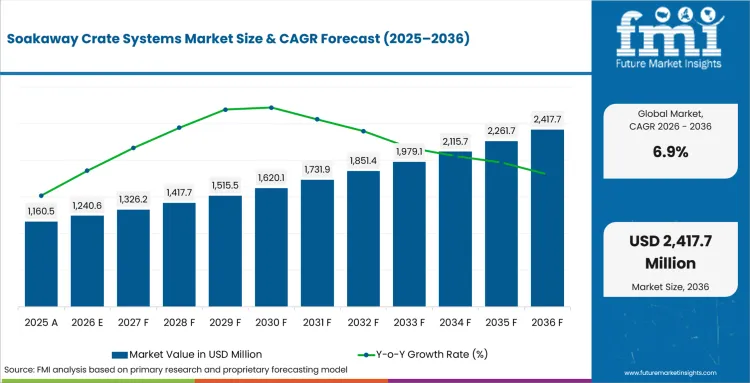
- Market Size (2026)
- USD 1240.6 Mn
- Forecast (2036)
- USD 2417.7 Mn
- CAGR (2026 to 2036)
- 6.9%
How big is Soakaway Crate Systems Market in 2026?
USD 1240.6 million in 2026 and USD 2417.7 million by 2036 at a 6.9% CAGR.
Demand in the soakaway crate systems market is anticipated to push valuation from USD 1240.6 million in 2026 to USD 2417.7 million by 2036, expanding at a 6.9% CAGR over the forecast period. Buried modular storage preserves developable surface space across sites that cannot accommodate open detention basins.
Drainage engineers need a clear measure of runoff exposure to size underground storage for constrained developments. The Environment Agency reported around 4.6 million English properties in areas at risk of surface-water flooding in January 2025. That exposure increases the need for verified soils and maintainable inspection routes across underground rainwater modules installed beneath constrained sites. Permeable concrete pavers can reduce surface inflow as buried crates manage the remaining design volume.
Key Takeaways of Soakaway Crate Systems Market
- Urban drainage teams increasingly specify modular underground storage on constrained sites that cannot accommodate large surface basins.
- Modular plastic crates are projected to represent 34.0% share in 2026 owing to adaptable geometry and efficient site handling.
- Light vehicle areas are estimated to account for 42.0% share in 2026 due to frequent parking and access-road applications.
- Commercial building systems are forecast to capture 43.0% share in 2026 driven by limited footprints and documented maintenance requirements.
- Low permeability and shallow groundwater remain material restraints as either condition can invalidate a proposed infiltration design.
- Polypipe, Wavin, GRAF and ACO compete alongside Geoplast, Brett Martin, Hydro International and SDS Limited.
Analyst Perspective
"The commercial test for a soakaway crate system is whether one buried layout satisfies soil conditions and preserves a practical cleaning route. Developers that resolve traffic loading with sediment control during design reduce late changes and protect usable storage capacity after handover."
- Nikhil Kaitwade, Principal Consultant, Future Market Insights
How is the Soakaway Crate Systems Market segmented?
The soakaway crate systems industry is segmented by crate type, load rating, storage volume, application, end use, sales channel and region.
The market is segmented by crate type, load rating, storage volume, application, end use, sales channel and region. Crate type includes modular plastic, traffic-rated, inspectable, geotextile-wrapped and recycled-plastic systems across pedestrian, light vehicle and heavy vehicle load classes. Storage volume spans residential, commercial and infrastructure systems across infiltration, attenuation, SuDS, parking drainage and industrial drainage applications. End uses cover residential, commercial, municipal, industrial and civil projects through distributors, manufacturers, installers and project-specifier supply routes.
Why do modular plastic crates lead demand within the crate type category?
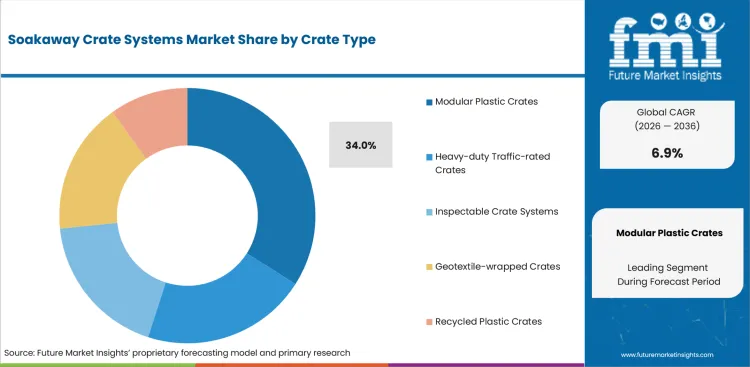
Modular plastic crates combine high void space with stackable units alongside geocell systems that fit irregular excavation boundaries beneath parking or landscaped areas.
- Modular plastic crates are projected to hold 34.0% share in 2026 owing to adaptable tank geometry across constrained sites.
- Civil contractors are expected to favor modular plastic crates over alternatives, supported by product ranges that preserve one drainage concept across landscaped and trafficked zones. Documented load transitions reduce redesign work as engineering teams finalize cover depth and excavation limits.
Why are light vehicle areas central to the load rating category?
Light vehicle areas combine repeated wheel loading with parking-bay runoff and require verified cover depth across completed pavement assemblies for structural approval.
- Based on load rating, light vehicle areas are projected to account for 42.0% in 2026 due to frequent parking and access-road applications.
- Light vehicle configurations are drawing demand from commercial developers, reinforced by maintenance routes that preserve camera access beneath completed paving and private roads. Slot drainage systems collect surface runoff and protect planned jetting routes across the same finished areas without excavation.
How do commercial building systems support the storage volume category?
Commercial developments with large roof areas require substantial stormwater storage without surrendering parking or landscaped space to open basins. Stormwater lift stations support sites that lack an unrestricted gravity discharge route from buried modular tanks.
- By storage volume, commercial building systems are estimated to hold 43.0% in 2026 owing to high runoff volumes and constrained development footprints.
- Purchase activity for commercial building systems is anticipated to rise, driven by maintenance plans that preserve inspection routes beneath finished paving. Inspectable channels support camera surveys and high-pressure cleaning without disrupting occupied parking or pedestrian areas.
What supports stormwater infiltration within the application category?
Stormwater infiltration returns captured runoff to suitable ground and reduces volumes entering downstream sewers across commercial developments. Site feasibility depends on permeability testing and groundwater separation across the proposed tank footprint during design.
- The application category is forecast to be led by stormwater infiltration at 32.0% share in 2026 due to source-control planning requirements.
- Demand for stormwater infiltration is expected to grow among drainage designers, supported by geosynthetic drainage materials that limit sediment transfer toward protected infiltration surfaces. Soil stabilization materials reinforce verified bearing zones without replacing the permeability evidence required for safe infiltration.
What are the drivers, restraints and opportunities in the Soakaway Crate Systems Market?
Driver: Drainage standards require verified storage and infiltration across runoff routes. Restraint: Unsuitable soils and shallow groundwater can require lined attenuation or controlled discharge. Opportunity: Inspectable layouts can preserve capacity through planned maintenance.
- Driver: Drainage standards link storage capacity with infiltration testing and documented maintenance across completed developments.
- Restraint: Low permeability and shallow groundwater can invalidate a soakaway design or require controlled discharge.
- Opportunity: Accessible layouts support stormwater cleaning services that remove sediment and preserve usable storage capacity.
Drainage standards require development teams to test infiltration before relying on buried storage as the final runoff route. A complete design therefore links soil evidence with an approved overflow or controlled-discharge path for unsuitable ground.
Ground conditions can invalidate a preferred crate layout even after engineers calculate the required storage volume for the site. Low permeability or shallow groundwater can shift the project toward lined attenuation and a restricted outlet.
Usable capacity depends on inspection access and upstream sediment control throughout the operating life of each buried tank. Water level monitoring can identify declining storage early and help maintenance crews schedule cleaning before blocked channels disrupt drainage.
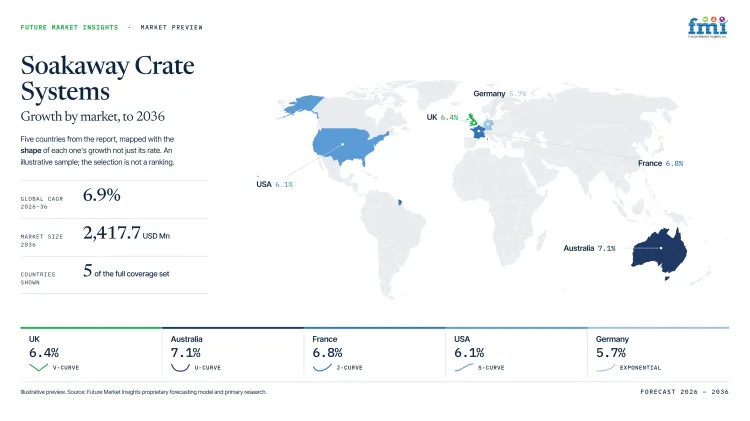
Which country CAGRs are profiled in the Soakaway Crate Systems Market?
| Country | CAGR |
|---|---|
| Australia | 7.1% |
| France | 6.8% |
| United Kingdom | 6.4% |
| United States | 6.1% |
| Germany | 5.7% |
How do country-level CAGRs compare in the Soakaway Crate Systems Market?
The country forecasts remain closely grouped across the soakaway crate systems market, with only 1.4 percentage points separating Australia and Germany. Australia and France form an upper group, reflecting strong emphasis on sustainable stormwater management and drainage infrastructure upgrades. The United Kingdom follows within a narrow range and benefits from increasing adoption of SuDS (Sustainable Drainage Systems) in residential and commercial developments. The United States remains closely aligned with the UK, while Germany creates a lower position without a significant break in the overall comparison.
- Australia benefits from continued investment in stormwater control systems and growing use of underground water infiltration solutions in urban developments.
- France supports demand through increasing focus on sustainable drainage infrastructure and compliance with water management regulations.
- The United Kingdom reflects steady adoption of soakaway crate systems as developers incorporate SuDS-based drainage solutions into new projects.
- The United States maintains market growth through demand for effective runoff management across residential, commercial and municipal applications.
- Germany continues to support the market through established drainage engineering practices and emphasis on efficient rainwater infiltration systems.
Comparable CAGRs may still reflect different market conditions because stormwater regulations, land development patterns, soil conditions and infrastructure investment priorities vary across countries. The full report provides country-level CAGR analysis across North America, Latin America, Europe, East Asia, South Asia, Oceania and the Middle East and Africa.
Country-wise Analysis
- Australian commercial and residential projects route stormwater work through licensed plumbing practitioners who align soil testing with council drainage requirements and coordinate installation with local civil contractors across constrained urban developments. The Building and Plumbing Commission stated in June 2026 that regulated work beginning October 20, 2025 must follow AS/NZS 3500.3:2025 across Victoria for buried stormwater installations under the state compliance framework. In Australia, soakaway crate system demand is predicted to advance at 7.1% CAGR through 2036, supported by established civil distribution that also serves sponge city systems despite variable permeability and seasonal groundwater that can require lined attenuation.
- French municipalities use stormwater zoning during local planning to set runoff limits and treatment duties across dense redevelopment sites with restricted surface space and limited discharge capacity in older drainage networks. France’s soakaway crate systems outlook is anticipated to advance at 6.8% CAGR over the assessment period, shaped by design-led tenders and established drainage consultancies serving commercial projects across multiple regions. Cerema’s November 2025 guidance places source control inside local zoning and gives engineering teams a clearer specification route despite variable soils and municipal prescriptions that can require separate evidence covering excavation depth and maintenance access during municipal approval.
- English planning authorities require source-control systems for commercial developments that manage runoff at source across brownfield sites with restricted surface space, legacy utilities and constrained excavation routes. The July 2025 standards for England require infiltration assessment on suitable ground and adequate groundwater separation, giving drainage designers a common approval route during local review of larger commercial and infrastructure projects across England. Adoption of soakaway crate systems in the United Kingdom is estimated to expand at 6.4% CAGR through 2036, driven by mature drainage distribution despite contamination and unclear maintenance ownership that can require pretreatment or lined attenuation during local review.
- United States commercial and municipal projects operate through state and local stormwater permits that vary in infiltration testing and groundwater protection requirements for buried storage systems and controlled discharge routes. Soakaway crate system sales in the United States are forecast to expand at 6.1% CAGR by 2036, supported by national distribution and established engineering contractors serving dense redevelopment and parking projects across major metropolitan areas. California’s State Water Resources Control Board outlined a risk-based infiltration framework in March 2025 that considers soils and groundwater uses alongside expected pollutants and pretreatment design as local permit differences complicate underground project approval.
- German civil engineering practices require infiltration systems to match soil permeability and groundwater protection requirements as local authorities review buried storage for dense urban redevelopment sites and protected aquifer areas with limited excavation space. DWA’s January 2025 Versickerungs-Expert update automated overflow verification and produced authority-ready output for common infiltration systems, improving calculation consistency across public submissions and local approval records used by engineers and drainage authorities. By 2036, Germany is projected to grow at 5.7% CAGR, supported by technical distributors and rigorous engineering practices although variable soils and protected groundwater can require pretreatment or longer hydrogeological documentation during local project review.
Who are the notable companies in the Soakaway Crate Systems Market?
Polypipe, Wavin, GRAF and ACO are profiled alongside Geoplast, Brett Martin, Hydro International and SDS Limited.
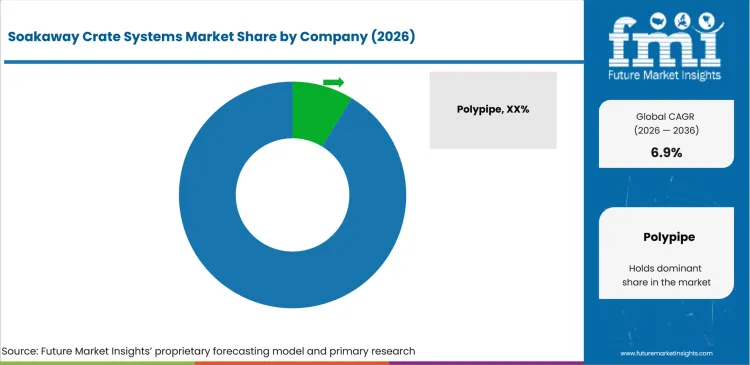
The competitive field combines multinational drainage groups with regional geocellular specialists that compete on load certification and inspection access. New entrants can address local projects through engineering support, although unfamiliar systems face lengthy qualification without clear structural documentation or practical cleaning routes.
- Polypipe and Wavin span landscaped and heavy-traffic applications through modular ranges with inspection options and design support.
- GRAF and ACO compete through inspectable systems that support camera surveys and scheduled cleaning across buried tanks.
- Geoplast and Brett Martin serve defined load profiles as Hydro International and SDS Limited emphasize configurable storage and specialist design support.
Competitive Benchmarking: Soakaway Crate Systems Market
| Company | Load Application Range | Inspection and Cleaning Access | Infiltration and Attenuation Fit | Geographic Reach |
|---|---|---|---|---|
| Polypipe | High | High | High | Global and multi-region |
| Wavin | High | High | High | Global and multi-region |
| GRAF | High | High | High | Europe and international |
| ACO | High | High | High | Global and multi-region |
| Geoplast | High | Medium | High | Global export markets |
| Brett Martin | Medium | Low | High | United Kingdom and export markets |
| Hydro International | High | High | High | Global and multi-region |
| SDS Limited | High | Medium | High | United Kingdom and selected international projects |
Scoring basis: Load range is High for light and heavy traffic, Medium for one class and Low for untrafficked sites. Access is High for inspection routes, Medium for selected channels and Low for restricted entry. Hydraulic fit is High for both routes, Medium for one route and Low for narrow applications.
Key Developments in the Soakaway Crate Systems Market
- In August 2025, Wavin Ireland expanded its AquaCell range with AquaCell NG to reduce site storage and installation time across attenuation or infiltration projects.
- In August 2025, Hydro International added MX and HX blocks to Stormbloc Optimum for medium and very heavy loading across buried storage systems.
- In May 2025, ACO documented StormBrixx HD modules supporting runoff attenuation and tree-pit storage at the Rushden Lakes retail development.
Soakaway Crate Systems Market - Report Scope
| Coverage field | Report scope |
|---|---|
| Market breakdown | By crate type, load rating, storage volume, application, end use, sales channel and region. |
| Quantitative Units | Revenue in USD million and CAGR in %. |
| Market Definition | The market covers modular underground crate systems sold for stormwater infiltration and attenuation across residential, commercial, industrial and infrastructure applications. |
| Regions Covered | North America, Latin America, Western Europe, Eastern Europe, East Asia, South Asia and Pacific, and Middle East and Africa. |
| Countries Covered | Australia, France, United Kingdom, United States, Germany and more than twenty-five additional countries in the full report. |
| Key Companies Profiled | Polypipe, Wavin, GRAF, ACO, Geoplast, Brett Martin, Hydro International and SDS Limited. |
| Forecast Period | 2026 to 2036. |
| Approach | Primary and secondary research with market triangulation. |
Soakaway Crate Systems Market - Research Methodology
| Method | Approach |
|---|---|
| Primary Research | FMI analysts gathered input from manufacturers, service providers, technology developers, distributors, end users, procurement teams, and subject-matter experts. Interviews examined purchasing decisions, product or service evaluation, adoption barriers, approval requirements, pricing considerations, and expectations for technical or commercial support. Respondents were also asked what evidence is required before a trial, pilot, or initial order develops into regular purchasing. |
| Desk Research | Desk research covered government statistics, regulatory publications, trade data, industry associations, technical literature, standards, company filings, product information, and official corporate announcements. Sources were reviewed for relevance, publication date, geographic coverage, and consistency with the defined market scope. Claims relating to performance, applications, approvals, capacity, investment, and commercial activity were retained only when supported by credible public evidence. |
| Market Sizing and Forecasting | The market model combined the baseline value with historical performance, segment structure, pricing and volume indicators, adoption levels, company participation, and country-level demand conditions. Forecast assumptions considered economic activity, investment trends, regulatory developments, technology adoption, purchasing cycles, supply availability, and barriers to wider market use. Segment and regional estimates were reconciled before the final market total was calculated. |
| Data Validation | Estimates were checked against multiple independent indicators, including public data, company activity, trade patterns, industry developments, and findings from primary interviews. Validation also tested whether products, services, applications, and company revenues fell within the defined market boundaries. Adjacent categories, unsupported claims, overlapping revenues, and activities without direct market relevance were excluded to reduce double counting and maintain consistency across segments and countries. |
Soakaway Crate Systems Market by Segments
Soakaway Crate Systems Market segmented by Crate Type:
- Modular Plastic Crates
- Heavy-duty Traffic-rated Crates
- Inspectable Crate Systems
- Geotextile-wrapped Crates
- Recycled Plastic Crates
Soakaway Crate Systems Market segmented by Load Rating:
- Light Vehicle Areas
- Pedestrian / Landscaped Areas
- Heavy Vehicle / Road Areas
Soakaway Crate Systems Market segmented by Storage Volume:
- Commercial Building Systems
- Small Residential Systems
- Large Infrastructure Systems
Soakaway Crate Systems Market segmented by Application:
- Stormwater Infiltration
- Rainwater Attenuation
- SuDS Projects
- Parking / Road Drainage
- Industrial Site Drainage
Soakaway Crate Systems Market segmented by End Use:
- Commercial Construction
- Residential Developers
- Municipal / Infrastructure
- Industrial Facilities
- Civil Contractors
Soakaway Crate Systems Market segmented by Sales Channel:
- Drainage Product Distributors
- Direct Manufacturer
- Civil Contractors / Installers
- Project / Specifier Supply
Soakaway Crate Systems Market by Region:
- North America
- United States
- Canada
- Latin America
- Brazil
- Mexico
- Argentina
- Chile
- Western Europe
- Germany
- France
- United Kingdom
- Italy
- Spain
- Benelux
- Nordics
- Eastern Europe
- Poland
- Czech Republic
- Romania
- Hungary
- East Asia
- China
- Japan
- South Korea
- South Asia and Pacific
- India
- ASEAN
- Australia and New Zealand
- Middle East and Africa
- GCC Countries
- South Africa
- Türkiye
- Israel
Research Sources and Bibliography
- Environment Agency. (2025, January 22). National assessment of flood and coastal erosion risk in England 2024.
- Department for Environment, Food & Rural Affairs. (2025, July 30). National standards for sustainable drainage systems (SuDS).
- California State Water Resources Control Board. (2025, March 28). Urban stormwater infiltration policy.
- Building and Plumbing Commission. (2026, June 30). Updated plumbing and drainage standards - Part 3: Stormwater drainage.
- Deutsche Vereinigung für Wasserwirtschaft, Abwasser und Abfall. (2025, January). Versickerungs-Expert - Software zum DWA-A 138-1 (Oktober 2024) - Version 6.
- Cerema. (2025, November 6). LES EDITIONS / Zonage pluvial : pour une gestion intégrée de l'eau.
- Wavin Ireland. (2025, August 19). Wavin's AquaCell NG System delivers cost and environmental efficiencies on site in the face of climate change.
- Hydro International. (2025, August 7). Hydro International adds strength options to its Stormbloc® Optimum range of below ground storage.
- ACO. (2025, May). Beavers, Biodiversity, and Sustainable Drainage at Rushden Lake.
- Polypipe Middle East. (n.d.). Storm Water Management.
- Wavin. (n.d.). AquaCell Next Gen (NG) - System Features.
- GRAF. (n.d.). EcoBloc Inspect flex.
- ACO. (n.d.). ACO StormBrixx Range.
- Geoplast. (n.d.). Drening Faq.
- Brett Martin. (n.d.). StormCrate55 FAQs.
- Hydro International. (n.d.). The new Stormbloc Optimum inspection chamber.
- SDS Infrastructure. (n.d.). GEOlight Stormwater Storage and Drainage Tanks.
This Report Answers
- How large is the soakaway crate systems market in 2026 and 2036?
- Which operating conditions support demand for soakaway crate systems?
- Which crate type is estimated to hold the largest share in 2026?
- How does load rating influence soakaway crate system selection?
- Which storage-volume category is expected to account for the largest share?
- How do country growth rates differ across the profiled soakaway crate markets?
- Which companies serve the soakaway crate systems market?
- What limits soakaway crate system adoption across unsuitable development sites?
- How should project teams compare infiltration and attenuation configurations?
Frequently Asked Questions
How big is the Soakaway Crate Systems Market in 2026?
The soakaway crate systems market is valued at USD 1240.6 million in 2026 and is forecast to reach USD 2417.7 million by 2036. Growth is supported by buried modular storage that preserves developable surface space across constrained sites unable to accommodate open detention basins.
What is the CAGR of the Soakaway Crate Systems Market from 2026 to 2036?
The soakaway crate systems market grows at a CAGR of 6.9% between 2026 and 2036, supported by drainage standards that link storage capacity with infiltration testing and documented maintenance across completed residential, commercial and infrastructure developments.
Which crate type leads the Soakaway Crate Systems Market?
Modular plastic crates account for 34.0% of the soakaway crate systems market by crate type in 2026, driven by adaptable tank geometry and stackable units that fit irregular excavation boundaries across constrained sites.
How much will the Soakaway Crate Systems Market add between 2026 and 2036?
The soakaway crate systems market is set to add USD 1177.1 million between 2026 and 2036, growing from USD 1240.6 million to USD 2417.7 million as inspectable buried storage layouts extend across residential, commercial and municipal drainage projects worldwide.
Who are the leading companies in the Soakaway Crate Systems Market?
Eight companies lead the soakaway crate systems market consistently, including Polypipe, Wavin, GRAF, ACO, Geoplast, Brett Martin, Hydro International and SDS Limited, competing through load application range, inspection and cleaning access, and infiltration and attenuation fit worldwide.
Preview the report firsthand - request a free sample
Get SampleGet the brochure for pricing and purchase details.
Get PDFTable of Content
- Key Takeaways
- Market Size and CAGR
- Top Growth Driver
- Fastest Growing Segment
- Leading Region
- Key Companies
- Emerging Opportunities
- Executive Summary
- Global Market Outlook
- Demand-side Trends
- Supply-side Trends
- Technology Roadmap Analysis
- Analysis and Recommendations
- Analyst Perspective (What is happening? Why now? What should investors know?)
- Key Questions Answered
- How large is the market?
- What is the CAGR?
- What are key trends?
- Which region dominates?
- Who are the leaders?
- Market Overview
- Market Coverage / Taxonomy
- Market Definition / Scope / Limitations
- Research Methodology
- Chapter Orientation
- Analytical Lens and Working Hypotheses
- Market Structure, Signals, and Trend Drivers
- Benchmarking and Cross-market Comparability
- Market Sizing, Forecasting, and Opportunity Mapping
- Research Design and Evidence Framework
- Desk Research Programme (Secondary Evidence)
- Expert Input and Fieldwork (Primary Evidence)
- Tooling, Models, and Reference Databases
- Data Engineering and Model Build
- Quality Assurance and Audit Trail
- Market Background
- Market Dynamics (Drivers, Restraints, Opportunity, Trends)
- Scenario Forecast (Optimistic, Likely, Conservative)
- Impact Analysis
- AI Impact
- Sustainability Impact
- Regulatory Impact
- Technology Impact
- Consumer / Buyer Analysis
- Purchase Drivers
- Adoption Barriers
- Buyer Journey
- Opportunity Map Analysis
- Product Life Cycle Analysis
- Supply Chain Analysis
- Investment Feasibility Matrix
- Value Chain Analysis
- PESTLE and Porter's Analysis
- Regulatory Landscape
- Regional Parent Market Outlook
- Production and Consumption Statistics
- Import and Export Statistics
- Global Market Analysis and Forecast, 2021 to 2036
- Historical Market Size Value (USD Million) Analysis, 2021 to 2025
- Current and Future Market Size Value (USD Million) Projections, 2026 to 2036
- Y-o-Y Growth Trend Analysis
- Absolute $ Opportunity Analysis
- Global Market Pricing Analysis, 2021 to 2036
- Global Market Analysis and Forecast, By Crate Type, 2021 to 2036
- Introduction / Key Findings
- Historical Market Size Value (USD Million) Analysis By Crate Type, 2021 to 2025
- Current and Future Market Size Value (USD Million) Analysis and Forecast By Crate Type, 2026 to 2036
- Modular Plastic Crates
- Heavy-duty Traffic-rated Crates
- Inspectable Crate Systems
- Geotextile-wrapped Crates
- Recycled Plastic Crates
- Modular Plastic Crates
- Y-o-Y Growth Trend Analysis By Crate Type, 2021 to 2025
- Absolute $ Opportunity Analysis By Crate Type, 2026 to 2036
- Global Market Analysis and Forecast, By Load Rating, 2021 to 2036
- Introduction / Key Findings
- Historical Market Size Value (USD Million) Analysis By Load Rating, 2021 to 2025
- Current and Future Market Size Value (USD Million) Analysis and Forecast By Load Rating, 2026 to 2036
- Light Vehicle Areas
- Pedestrian / Landscaped Areas
- Heavy Vehicle / Road Areas
- Light Vehicle Areas
- Y-o-Y Growth Trend Analysis By Load Rating, 2021 to 2025
- Absolute $ Opportunity Analysis By Load Rating, 2026 to 2036
- Global Market Analysis and Forecast, By Storage Volume, 2021 to 2036
- Introduction / Key Findings
- Historical Market Size Value (USD Million) Analysis By Storage Volume, 2021 to 2025
- Current and Future Market Size Value (USD Million) Analysis and Forecast By Storage Volume, 2026 to 2036
- Commercial Building Systems
- Small Residential Systems
- Large Infrastructure Systems
- Commercial Building Systems
- Y-o-Y Growth Trend Analysis By Storage Volume, 2021 to 2025
- Absolute $ Opportunity Analysis By Storage Volume, 2026 to 2036
- Global Market Analysis and Forecast, By Application, 2021 to 2036
- Introduction / Key Findings
- Historical Market Size Value (USD Million) Analysis By Application, 2021 to 2025
- Current and Future Market Size Value (USD Million) Analysis and Forecast By Application, 2026 to 2036
- Stormwater Infiltration
- Rainwater Attenuation
- SuDS Projects
- Parking / Road Drainage
- Industrial Site Drainage
- Stormwater Infiltration
- Y-o-Y Growth Trend Analysis By Application, 2021 to 2025
- Absolute $ Opportunity Analysis By Application, 2026 to 2036
- Global Market Analysis and Forecast, By End Use, 2021 to 2036
- Introduction / Key Findings
- Historical Market Size Value (USD Million) Analysis By End Use, 2021 to 2025
- Current and Future Market Size Value (USD Million) Analysis and Forecast By End Use, 2026 to 2036
- Commercial Construction
- Residential Developers
- Municipal / Infrastructure
- Industrial Facilities
- Civil Contractors
- Commercial Construction
- Y-o-Y Growth Trend Analysis By End Use, 2021 to 2025
- Absolute $ Opportunity Analysis By End Use, 2026 to 2036
- Global Market Analysis and Forecast, By Sales Channel
- Introduction / Key Findings
- Historical Market Size Value (USD Million) Analysis By Sales Channel, 2021 to 2025
- Current and Future Market Size Value (USD Million) Analysis and Forecast By Sales Channel, 2026 to 2036
- Drainage Product Distributors
- Direct Manufacturer
- Civil Contractors / Installers
- Project / Specifier Supply
- Drainage Product Distributors
- Y-o-Y Growth Trend Analysis By Sales Channel, 2021 to 2025
- Absolute $ Opportunity Analysis By Sales Channel, 2026 to 2036
- Global Market Analysis and Forecast, By Region, 2021 to 2036
- Introduction
- Historical Market Size Value (USD Million) Analysis By Region, 2021 to 2025
- Current Market Size Value (USD Million) Analysis and Forecast By Region, 2026 to 2036
- North America
- Latin America
- Western Europe
- Eastern Europe
- East Asia
- South Asia and Pacific
- Middle East & Africa
- Market Attractiveness Analysis By Region
- North America Market Analysis and Forecast, By Country, 2021 to 2036
- Historical Market Size Value (USD Million) Trend Analysis By Market Taxonomy, 2021 to 2025
- Market Size Value (USD Million) Forecast By Market Taxonomy, 2026 to 2036
- By Country
- USA
- Canada
- By Crate Type
- By Load Rating
- By Storage Volume
- By Application
- By End Use
- By Sales Channel
- By Country
- Market Attractiveness Analysis
- By Country
- By Crate Type
- By Load Rating
- By Storage Volume
- By Application
- By End Use
- By Sales Channel
- Key Takeaways
- Latin America Market Analysis and Forecast, By Country
- Historical Market Size Value (USD Million) Trend Analysis By Market Taxonomy, 2021 to 2025
- Market Size Value (USD Million) Forecast By Market Taxonomy, 2026 to 2036
- By Country
- Brazil
- Mexico
- Chile
- Rest of Latin America
- By Crate Type
- By Load Rating
- By Storage Volume
- By Application
- By End Use
- By Sales Channel
- By Country
- Market Attractiveness Analysis
- By Country
- By Crate Type
- By Load Rating
- By Storage Volume
- By Application
- By End Use
- By Sales Channel
- Key Takeaways
- Western Europe Market Analysis and Forecast, By Country
- Historical Market Size Value (USD Million) Trend Analysis By Market Taxonomy, 2021 to 2025
- Market Size Value (USD Million) Forecast By Market Taxonomy, 2026 to 2036
- By Country
- Germany
- UK
- Italy
- Spain
- France
- Nordic
- BENELUX
- Rest of Western Europe
- By Crate Type
- By Load Rating
- By Storage Volume
- By Application
- By End Use
- By Sales Channel
- By Country
- Market Attractiveness Analysis
- By Country
- By Crate Type
- By Load Rating
- By Storage Volume
- By Application
- By End Use
- By Sales Channel
- Key Takeaways
- Eastern Europe Market Analysis and Forecast, By Country
- Historical Market Size Value (USD Million) Trend Analysis By Market Taxonomy, 2021 to 2025
- Market Size Value (USD Million) Forecast By Market Taxonomy, 2026 to 2036
- By Country
- Russia
- Poland
- Hungary
- Balkan & Baltic
- Rest of Eastern Europe
- By Crate Type
- By Load Rating
- By Storage Volume
- By Application
- By End Use
- By Sales Channel
- By Country
- Market Attractiveness Analysis
- By Country
- By Crate Type
- By Load Rating
- By Storage Volume
- By Application
- By End Use
- By Sales Channel
- Key Takeaways
- East Asia Market Analysis and Forecast, By Country
- Historical Market Size Value (USD Million) Trend Analysis By Market Taxonomy, 2021 to 2025
- Market Size Value (USD Million) Forecast By Market Taxonomy, 2026 to 2036
- By Country
- China
- Japan
- South Korea
- By Crate Type
- By Load Rating
- By Storage Volume
- By Application
- By End Use
- By Sales Channel
- By Country
- Market Attractiveness Analysis
- By Country
- By Crate Type
- By Load Rating
- By Storage Volume
- By Application
- By End Use
- By Sales Channel
- Key Takeaways
- South Asia and Pacific Market Analysis and Forecast, By Country
- Historical Market Size Value (USD Million) Trend Analysis By Market Taxonomy, 2021 to 2025
- Market Size Value (USD Million) Forecast By Market Taxonomy, 2026 to 2036
- By Country
- India
- ASEAN
- Australia & New Zealand
- Rest of South Asia and Pacific
- By Crate Type
- By Load Rating
- By Storage Volume
- By Application
- By End Use
- By Sales Channel
- By Country
- Market Attractiveness Analysis
- By Country
- By Crate Type
- By Load Rating
- By Storage Volume
- By Application
- By End Use
- By Sales Channel
- Key Takeaways
- Middle East & Africa Market Analysis and Forecast, By Country
- Historical Market Size Value (USD Million) Trend Analysis By Market Taxonomy, 2021 to 2025
- Market Size Value (USD Million) Forecast By Market Taxonomy, 2026 to 2036
- By Country
- Kingdom of Saudi Arabia
- Other GCC Countries
- Türkiye
- South Africa
- Other African Union
- Rest of Middle East & Africa
- By Crate Type
- By Load Rating
- By Storage Volume
- By Application
- By End Use
- By Sales Channel
- By Country
- Market Attractiveness Analysis
- By Country
- By Crate Type
- By Load Rating
- By Storage Volume
- By Application
- By End Use
- By Sales Channel
- Key Takeaways
- Key Countries Market Analysis
- USA
- Pricing Analysis
- Market Share Analysis, 2025
- By Crate Type
- By Load Rating
- By Storage Volume
- By Application
- By End Use
- By Sales Channel
- Canada
- Pricing Analysis
- Market Share Analysis, 2025
- By Crate Type
- By Load Rating
- By Storage Volume
- By Application
- By End Use
- By Sales Channel
- Mexico
- Pricing Analysis
- Market Share Analysis, 2025
- By Crate Type
- By Load Rating
- By Storage Volume
- By Application
- By End Use
- By Sales Channel
- Brazil
- Pricing Analysis
- Market Share Analysis, 2025
- By Crate Type
- By Load Rating
- By Storage Volume
- By Application
- By End Use
- By Sales Channel
- Chile
- Pricing Analysis
- Market Share Analysis, 2025
- By Crate Type
- By Load Rating
- By Storage Volume
- By Application
- By End Use
- By Sales Channel
- Germany
- Pricing Analysis
- Market Share Analysis, 2025
- By Crate Type
- By Load Rating
- By Storage Volume
- By Application
- By End Use
- By Sales Channel
- UK
- Pricing Analysis
- Market Share Analysis, 2025
- By Crate Type
- By Load Rating
- By Storage Volume
- By Application
- By End Use
- By Sales Channel
- Italy
- Pricing Analysis
- Market Share Analysis, 2025
- By Crate Type
- By Load Rating
- By Storage Volume
- By Application
- By End Use
- By Sales Channel
- Spain
- Pricing Analysis
- Market Share Analysis, 2025
- By Crate Type
- By Load Rating
- By Storage Volume
- By Application
- By End Use
- By Sales Channel
- France
- Pricing Analysis
- Market Share Analysis, 2025
- By Crate Type
- By Load Rating
- By Storage Volume
- By Application
- By End Use
- By Sales Channel
- India
- Pricing Analysis
- Market Share Analysis, 2025
- By Crate Type
- By Load Rating
- By Storage Volume
- By Application
- By End Use
- By Sales Channel
- ASEAN
- Pricing Analysis
- Market Share Analysis, 2025
- By Crate Type
- By Load Rating
- By Storage Volume
- By Application
- By End Use
- By Sales Channel
- Australia & New Zealand
- Pricing Analysis
- Market Share Analysis, 2025
- By Crate Type
- By Load Rating
- By Storage Volume
- By Application
- By End Use
- By Sales Channel
- China
- Pricing Analysis
- Market Share Analysis, 2025
- By Crate Type
- By Load Rating
- By Storage Volume
- By Application
- By End Use
- By Sales Channel
- Japan
- Pricing Analysis
- Market Share Analysis, 2025
- By Crate Type
- By Load Rating
- By Storage Volume
- By Application
- By End Use
- By Sales Channel
- South Korea
- Pricing Analysis
- Market Share Analysis, 2025
- By Crate Type
- By Load Rating
- By Storage Volume
- By Application
- By End Use
- By Sales Channel
- Russia
- Pricing Analysis
- Market Share Analysis, 2025
- By Crate Type
- By Load Rating
- By Storage Volume
- By Application
- By End Use
- By Sales Channel
- Poland
- Pricing Analysis
- Market Share Analysis, 2025
- By Crate Type
- By Load Rating
- By Storage Volume
- By Application
- By End Use
- By Sales Channel
- Hungary
- Pricing Analysis
- Market Share Analysis, 2025
- By Crate Type
- By Load Rating
- By Storage Volume
- By Application
- By End Use
- By Sales Channel
- Kingdom of Saudi Arabia
- Pricing Analysis
- Market Share Analysis, 2025
- By Crate Type
- By Load Rating
- By Storage Volume
- By Application
- By End Use
- By Sales Channel
- Türkiye
- Pricing Analysis
- Market Share Analysis, 2025
- By Crate Type
- By Load Rating
- By Storage Volume
- By Application
- By End Use
- By Sales Channel
- South Africa
- Pricing Analysis
- Market Share Analysis, 2025
- By Crate Type
- By Load Rating
- By Storage Volume
- By Application
- By End Use
- By Sales Channel
- USA
- Market Structure Analysis
- Competition Dashboard
- Competition Benchmarking
- Market Share Analysis of Top Players
- By Regional
- By Crate Type
- By Load Rating
- By Storage Volume
- By Application
- By End Use
- By Sales Channel
- Emerging Startups
- Innovation Benchmarking
- Competition Analysis
- Competition Deep Dive
- Polypipe
- Overview
- Product Portfolio
- Profitability by Market Segments
- Sales Footprint
- Strategy Overview
- Marketing Strategy
- Product Strategy
- Channel Strategy
- Wavin
- Graf
- ACO
- Marley Plumbing & Drainage
- Geoplast
- Brett Martin
- Hydro International
- Advanced Drainage Systems
- SDS Limited
- Polypipe
- Case Studies
- Success Stories
- Recent Developments
- Competition Deep Dive
- Assumptions & Acronyms Used


