

- Market Size (2026)
- USD 4662.4 Mn
- Forecast (2036)
- USD 2460.6 Mn
- CAGR (2026 to 2036)
- 6.6%
How big is the Stormwater Lift Station Market in 2026?
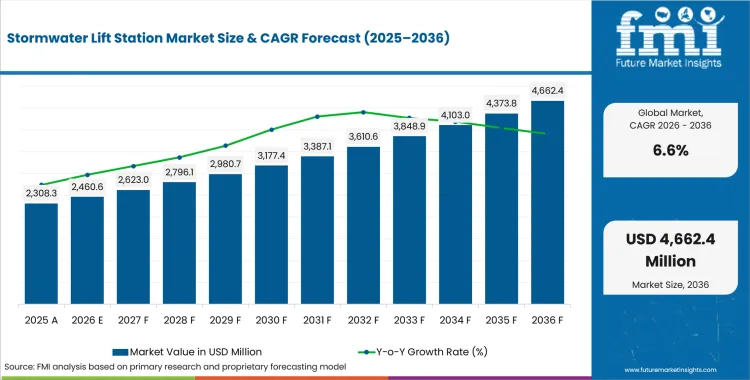
USD 2,460.6 million in 2026 and USD 4,662.4 million by 2036 at a 6.6% CAGR.
Sales in the stormwater lift station market are projected to grow at 6.6% CAGR through 2036, driving valuation to USD 4,662.4 million by 2036 from USD 2,460.6 million in 2026. Flood-risk planning is moving from reactive cleanup toward equipment accountability in underground drainage assets. EPA’s May 2026 CWNS page listed USD 115.3 billion of stormwater management needs. The figure places lift stations inside broader water treatment spending decisions. Municipal engineers use those needs to justify stations that move runoff from low points into permitted discharge networks.
India and China are anticipated to form the buildout tier as urban drainage corridors and renewal works create new station demand. The United States, Germany and the United Kingdom are projected to expand through replacement-led procurement where wet-well records and controls continuity shape awards. Municipal utilities are expected to purchase stormwater lift stations to keep roads and dense catchments operable during heavy rainfall. EPC contractors are likely to use packaged stations to reduce interface risk between civil works and pump controls
Municipal utilities and transport authorities are expected to purchase stormwater lift stations to keep roads and dense catchments operable during heavy rainfall. EPC contractors use packaged stations to reduce interface risk between civil works and pump controls during public drainage projects. Station value is supported by factory-tested pumps and panel documentation that reduce approval uncertainty in industrial pump planning programs. Engineering teams judge vendors on duty-point proof and response ownership before shifting pilot projects into approved procurement lists.
| Metric | Value |
|---|---|
| 2025 Market Size | USD 2,308.3 million |
| 2026 Market Size | USD 2,460.6 million |
| 2036 Market Size | USD 4,662.4 million |
| Forecast CAGR (2026-2036) | 6.6% |
| Pump Capacity Focus | <500 GPM |
| <500 GPM Share (2026) | 46.0% |
| Sales Channel Focus | Direct OEM |
| Direct OEM Share (2026) | 44.5% |
| End Use Focus | Municipal Utilities |
| Municipal Utilities Share (2026) | 39.1% |
Summary of the Stormwater Lift Station Market
| Market Signal | Commercial Impact |
|---|---|
| Demand and Growth Drivers | Municipal drainage accountability is expected to push spending toward stormwater lift stations. Documentation and service ownership are projected to set the pace for project approval.
|
| Product and Segment View | Low-capacity stations and direct OEM routes are expected to lead their parent categories in 2026. Municipal utilities are forecast to remain the main end-use screen.
|
| Geography and Growth Outlook | India and China are projected to form the build-out tier due to urban drainage work and public works scale. The United States and Europe are expected to expand under replacement-led procurement cycles.
|
| Competitive Landscape | Competition is moderately concentrated around pump engineering depth and municipal service coverage. Procurement screens are expected to center on station reliability and field response ownership.
|
| Analyst Perspective | Stormwater lift stations are purchased to reduce flood-service risk, but their value is proven after installation. Municipal teams should focus on duty-point fit, controls continuity and service response before standardizing station vendors.
|
Source: FMI's proprietary forecasting model and primary research
How is the stormwater lift station market segmented?
The stormwater lift station industry is segmented by station type, pump capacity, application, end use, sales channel and region.
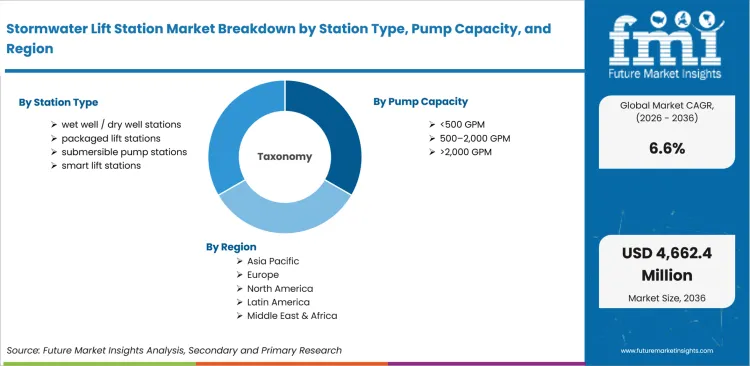
The stormwater lift station market is segmented by station type, pump capacity, application, end use, sales channel and region. By station type, the market covers packaged lift stations, wet well / dry well stations, submersible pump stations and smart lift stations. By pump capacity, it covers <500 GPM, 500-2,000 GPM and >2,000 GPM. By application, it covers urban stormwater, highway drainage, industrial site drainage and flood control. By end use, it covers municipal utilities, commercial developments, industrial facilities and transport infrastructure. By sales channel, it covers EPC / civil contractors, direct OEM and municipal procurement. Regional coverage includes North America, Latin America, Europe, East Asia, South Asia and Pacific and Middle East and Africa beside adjacent water pump portfolios coverage.
How does <500 GPM shape demand within the pump capacity category?
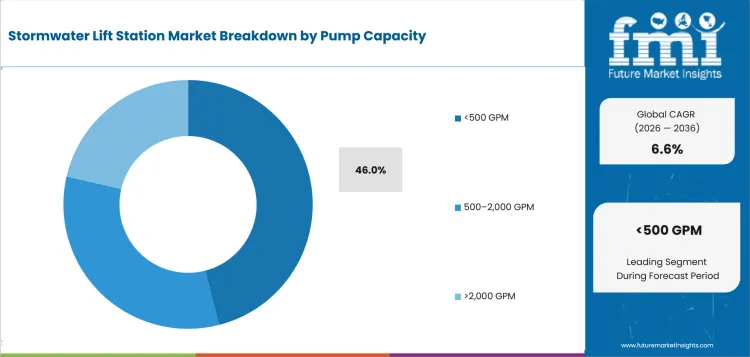
Small catchments and retrofit basins make capacity selection a practical station-design decision. EPA’s May 2026 CWNS page reported 17,544 publicly owned treatment works in the national survey. The count shows how many public treatment and conveyance systems require site-specific flow handling. Municipal engineers favor smaller stations for inlet depth and pump cycling constraints in tight neighborhoods. Contractors also prefer equipment that arrives matched to approved duty points before excavation teams mobilize.
- <500 GPM is projected to lead pump capacity with 46.0% share in 2026 due to localized basin drainage and lower civil-work exposure. EPA’s May 2026 CWNS page reported USD 151.1 billion for conveyance system repair and new conveyance systems, which raises attention on distributed municipal transfer assets.
- <500 GPM demand is expected to grow among municipal utilities owing to retrofit pit limits and smaller drainage basins. Contractors comparing dewatering pump programs use similar capacity discipline before they approve lift stations for low-point roadway drains.
What supports direct OEM purchasing within the sales channel category?
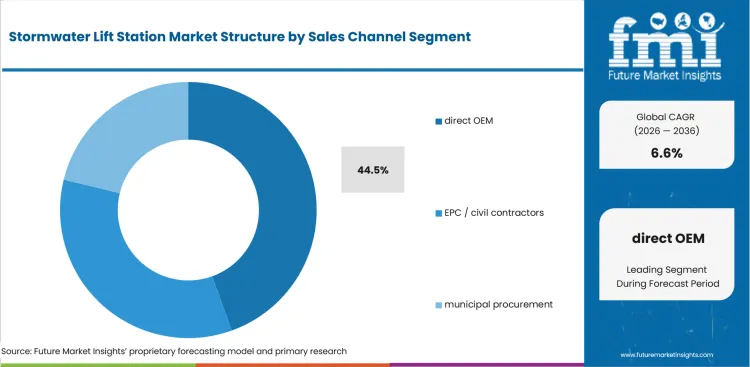
Warranty responsibility and control-panel matching make the sales route part of the technical decision. Grundfos notes that prefabricated pumping stations collect and pump drainage water, rainwater or wastewater using configured pumps and cabinets. Direct OEM purchase reduces ambiguity around pump curves and enclosure design during public infrastructure tenders. Municipal procurement teams therefore use the route when project risk exceeds the benefit of fragmented sourcing.
- Direct OEM is estimated to hold 44.5% share in 2026 owing to factory accountability and clearer documentation transfer. Ofwat allowed £11.3 billion of expenditure to improve storm overflows, which increases scrutiny on equipment packages tied to measurable overflow reduction work.
- Direct OEM activity is anticipated to rise driven by municipal preference for one accountable station package. Engineering teams comparing centrifugal pump specifications still require project-specific controls and warranty proof before wider account use.
How do municipal utilities evaluate stations within the end use category?
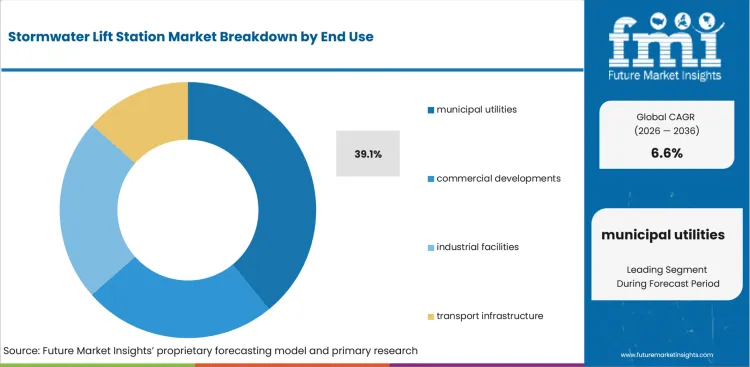
Municipal utilities carry direct responsibility for flood calls and pump-station maintenance across public drainage networks. EPA’s September 2025 Green Infrastructure Strategic Agenda 2035 connects federal support to durable outcomes and clean water regulatory programs. The end-use decision therefore combines hydraulic fit with response time and service access across recurring utility maintenance routines. Utility engineers judge stations on redundancy and maintenance records before standardization across catchment-level equipment programs.
- Municipal utilities are forecast to capture 39.1% share in 2026 attributable to public drainage responsibility and recurring service exposure. EPA’s May 2026 CWNS page reported total clean water needs of USD 630.1 billion, which keeps lift-station renewal inside long-cycle capital planning.
- Municipal utility adoption is expected to rise in flood-prone service districts supported by asset renewal and complaint-response pressure. Utility teams reviewing water treatment chemical projects also apply documentation discipline to station projects serving water-quality goals.
What makes wet well / dry well stations central to station type planning?
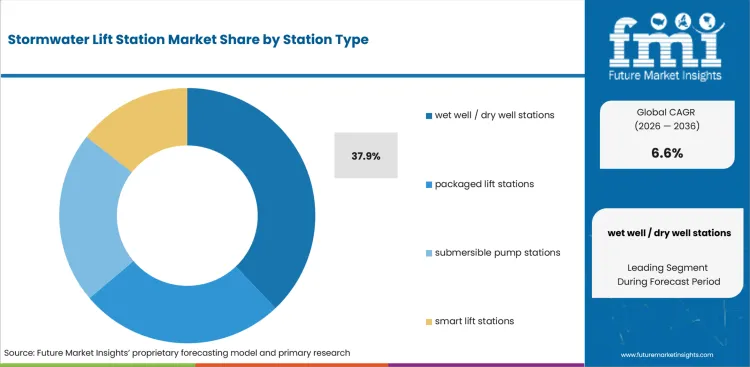
Wet well / dry well stations address sites where pump access and electrical separation affect maintenance safety. Xylem life-cycle guidance for wastewater pumping systems notes that stormwater pumping stations often run limited annual hours, which shifts evaluation toward readiness and maintenance labor. Utilities select the configuration for safer service access during inspection and wet-weather callouts involving electrical equipment. Higher design complexity still requires engineering review before approval in municipal drawings and service plans.
- Wet well / dry well stations are set to lead station type with 37.9% share in 2026 driven by maintenance access and electrical separation needs. Xylem’s 2025 life-cycle guidance described stormwater pumping station operating-cost categories, which ties configuration choice to labor and readiness planning.
- Operations teams are expected to favor wet well / dry well stations due to safer service separation and clearer inspection routines. Demand also receives support from utilities that need station access during wet-weather events without exposing technicians to avoidable electrical risk.
How is urban stormwater positioned within the application category?
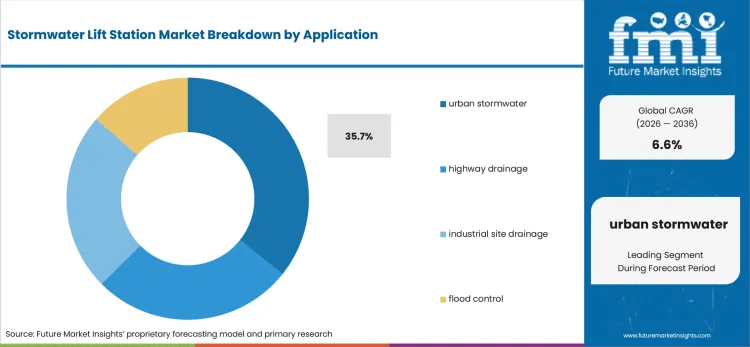
Street flooding and inlet surcharge make urban stormwater the clearest application for lift stations. EPA’s September 2025 green infrastructure page links runoff control to infiltration and conveyance capacity in developed areas. Urban drainage teams use lift stations after gravity conveyance loses headroom at low points. Station approval therefore depends on reliable pumps and controls that protect road corridors during high-rainfall events.
- Urban stormwater is likely to represent 35.7% share in 2026 supported by dense pavement coverage and recurring low-point flooding. Environment Agency and Defra reported a 35% fall in storm overflow spill numbers in March 2026, which still kept drainage performance inside public scrutiny.
- Purchase activity for urban stormwater stations is forecast to rise reinforced by street-flooding exposure and public complaint pressure. City engineers connect lift station upgrades with water treatment system upgrades where runoff control and drainage reliability share budget scrutiny.
What are the drivers, restraints, and opportunities in the stormwater lift station market?
Near-term purchases are being shaped by flood-resilience requirements, municipal budget review and retrofit channel access outlined below.
- Driver: Urban flood exposure is expected to push municipalities toward lift stations that protect low-point roads and drainage basins.
- Restraint: Capital review cycles are projected to slow projects that lack design proof and clear service responsibility.
- Opportunity: Retrofit programs are anticipated to open access for vendors offering packaged stations and documented startup support.
Municipal drainage departments are expected to increase station review in districts facing local flooding and emergency callouts. China’s State Council reported 100 more cities targeted for flood drainage risk work in March 2024. Urban renewal pressure supports packaged lift stations that help engineers move water from low points into larger conveyance systems. Procurement teams therefore put pump redundancy and service access into early design checks before tender packages are released.
Project approval is anticipated to slow where capital budgets separate civil works from pump packages. Ofwat’s February 2025 PR24 expenditure allowance document challenged company spending proposals when evidence was insufficient. Stormwater lift station vendors face similar review due to pump-package cost and long-term service work. Budget scrutiny keeps lifecycle files close to tender approval during capital review and framework procurement.
Retrofit access is projected to convert budget scrutiny into a practical growth route for packaged station vendors. KSB’s July 2025 pumping-station design guidance emphasized planning around inflow conditions and operational reliability. The guidance supports vendors that document startup needs before installation work begins on retrofit sites. Vendors that pair packaged units with self-priming pump applications gain more routes into retrofit projects requiring clearer startup responsibility.
Which country CAGRs are profiled in the stormwater lift station market?
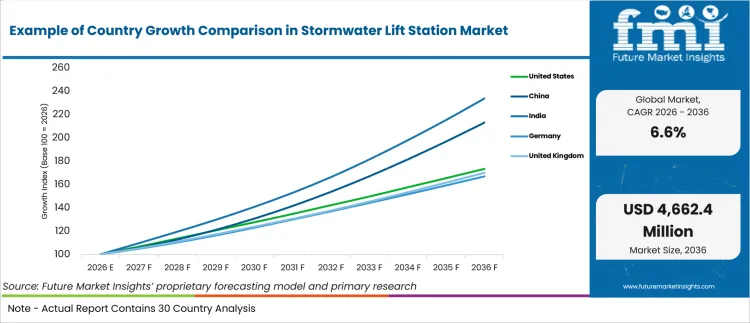
| Country | CAGR |
|---|---|
| United States | 5.65% |
| China | 7.85% |
| India | 8.85% |
| Germany | 5.25% |
| United Kingdom | 5.45% |
| Japan | 5.05% |
| South Korea | 6.45% |
Source: FMI's proprietary forecasting model and primary research
How do country-level CAGRs compare in the stormwater lift station market?
Country outlook differs by drainage build-out stage and renewal discipline across the profiled markets. India is projected at 8.85% CAGR and China is forecast at 7.85% CAGR due to wider urban infrastructure programs. South Korea is anticipated at 6.45% CAGR and Rest of World is estimated at 6.85% CAGR owing to climate-response works. The United States is projected at 5.65% CAGR and the United Kingdom is forecast at 5.45% CAGR due to replacement-led utility spending. Germany is anticipated at 5.25% CAGR and Japan is estimated at 5.05% CAGR under service-heavy procurement cycles.
- The United States stormwater lift station sector is projected to grow at 5.65% CAGR through 2036, driven by municipal overflow correction and aging conveyance assets. EPA’s May 2026 CWNS page reported USD 36.5 billion in combined sewer overflow correction needs. The figure supports replacement demand for stations that move runoff from low-grade assets into permitted networks. Local stormwater utilities still face budget approval and ratepayer scrutiny before larger pump packages advance. Vendors with hydraulic proof and municipal service coverage are expected to receive closer consideration in lifecycle-based accounts.
- China’s stormwater lift station outlook is forecast to advance at 7.85% CAGR over the forecast period, supported by urban renewal and flood-drainage capacity work. The State Council reported renovation plans for over 100,000 km of urban pipelines in May 2025. Pipeline renewal raises the need for matched pumping assets in corridors lacking reliable gravity drainage. Municipal design institutes and EPC contractors shape adoption due to control over project drawings and package qualification. Pump vendors with local assembly and fast delivery are expected to gain attention in city renewal tenders.
- India is estimated to post 8.85% CAGR over the assessment period, attributable to stormwater drainage works inside broader urban infrastructure missions. The Press Information Bureau reported projects worth about ₹2.79 lakh crore sanctioned under AMRUT and AMRUT 2.0 between 2015 and 2026. The program includes stormwater drainage, which gives lift stations a defined public-works route in flood-prone cities. Urban local bodies still need low-maintenance packages and contractor support before monsoon-cycle procurement decisions accelerate. Vendors offering simple controls and serviceable pumps are expected to receive closer consideration before monsoon-cycle procurement.
- Germany’s stormwater lift station sector is anticipated to record 5.25% CAGR through 2036, shaped by public sewer connection depth and rainwater inflow into treatment systems. BMUKN’s February 2026 wastewater page reported around 3 billion cubic metres of rainwater runoff entering treatment plants each year. Rainwater inflow supports pump upgrades in connected systems that need reliable transfer capacity during peak-flow events. Stadtwerke operators and engineering consultants remain cautious due to strict documentation and maintenance routines. Vendors with efficient motors and service plans are expected to receive closer review in municipal accounts.
- The United Kingdom market is projected to expand at 5.45% CAGR during the assessment period, driven by storm overflow regulation and water-company asset programs. Environment Agency and Defra data showed 291,492 spill events in March 2026 reporting for England. The count keeps sewer overflow and drainage capacity visible in investment plans even after a drier year reduced event totals. Water companies and framework contractors shape station demand through AMP-linked procurement routes and monitored asset programs. Suppliers with monitored controls and documented startup support are expected to receive closer consideration in overflow and drainage packages.
- Japan’s stormwater lift station demand is predicted to advance at 5.05% CAGR through 2036, reinforced by urban flood control and integrated water administration. MLIT’s November 2025 AWaP Annual Report stated Japan Sewage Works Agency recently constructed about 70% of Japan’s sewage treatment plants. The construction role highlights local-government reliance on pooled engineering expertise for wastewater assets and related pump stations. Local governments still weigh resilience spending against maintenance labor before selecting compact station designs. Vendors with compact layouts and reliable service access are expected to gain review in dense urban projects.
- South Korea’s stormwater lift station market is forecast to rise at 6.45% CAGR by 2036, supported by sewage maintenance areas and urban flood prevention works. The Ministry of Environment planned KRW 313.8 billion for sewage infrastructure expansion in January 2025. The plan includes pumping stations and storage facilities, which directly supports lift station procurement in flood-prone urban zones. Seoul and provincial governments also emphasize inlet cleaning and river monitoring before monsoon exposure. Vendors with controls support and field startup records are expected to gain attention in public works accounts.
Who are the notable companies in the stormwater lift station market?
Xylem, Grundfos, Sulzer, KSB, Wilo, Tsurumi Pump, Ebara, Zoeller, Pentair and Gorman-Rupp are the notable companies shaping this market.
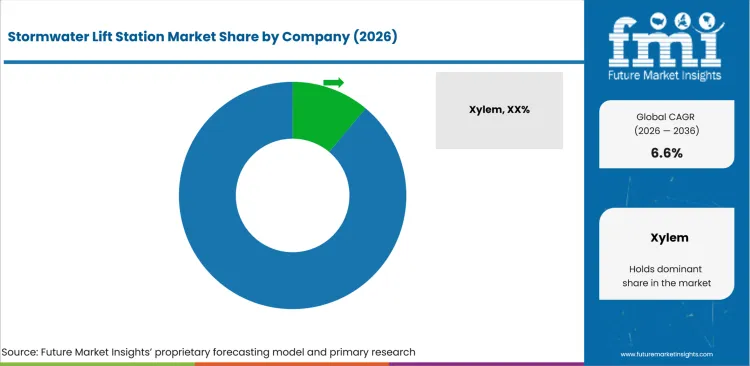
The competitive base is moderately concentrated among global pump manufacturers and regional drainage specialists. Large manufacturers hold advantages in hydraulic testing and service network depth across municipal accounts. Regional pump firms compete in contractor-led projects that need quick supply and simpler station packages. Competition centers on duty-point fit and warranty ownership during startup documentation review. Municipal engineers also compare industrial water treatment programs to judge whether vendors understand public works qualification beyond hardware supply.
- Hydraulic design depth separates vendors serving specification-heavy municipal accounts before station drawings reach tender review. Xylem and Grundfos compete through wastewater and stormwater pump portfolios that help engineers match duty points and service access. Municipal utilities use these records to reduce rework before stations move from design approval into field installation.
- Service continuity shapes decisions in replacement programs that face emergency callouts during heavy rainfall periods. Sulzer and KSB compete on wastewater pump service experience, repair capability and station troubleshooting. Facility managers value that support after blocked pumps or failed controls threaten road access and site drainage.
- Contractor-led drainage packages need equipment availability and clear installation responsibility during fast-moving public works tenders. Wilo, Tsurumi Pump and Ebara compete in these settings due to pump breadth and project support in dewatering and wastewater handling. EPC contractors use those capabilities to reduce interface disputes during station startup and warranty handover.
- Specialized drainage and sump portfolios keep Zoeller, Pentair and Gorman-Rupp visible in narrower applications. These companies fit accounts that need packaged sump systems and self-priming designs for commercial drainage sites. Vendors combining clear drawings and fast parts support are positioned for repeat orders in contractor-led projects.
Competitive Benchmarking: Stormwater Lift Station Market
| Company | Station Portfolio Fit | Controls and Documentation | Contractor Access | Service Reach |
|---|---|---|---|---|
| Xylem | High | Strong | High | Global |
| Grundfos | High | Strong | High | Global |
| Sulzer | Strong | Strong | Medium | Global |
| KSB | Strong | Strong | Medium | Global |
| Wilo | Strong | Medium | High | Global |
| Tsurumi Pump | High | Medium | Strong | Global |
| Ebara | High | Medium | Strong | Global |
| Zoeller | Medium | Strong | Regional | Regional |
| Pentair | Medium | Strong | Medium | Global |
| Gorman-Rupp | Strong | Medium | Strong | Regional |
Source: Future Market Insights competitive analysis, 2026. Ratings reflect relative portfolio relevance and workflow fit across municipal station projects. Service capability and geographic reach shape the remaining comparison across replacement and retrofit accounts.
Key Developments in the Stormwater Lift Station Market
- In December 2025, Xylem published a customer resilience update highlighting the Silvertown Tunnel flood-prevention system in London. The project incorporates six pumping stations designed to collect stormwater and return it to the River Thames, supporting flood-risk management for critical transport infrastructure. This development underscores the growing importance of integrated stormwater handling solutions in large-scale urban infrastructure projects.
- In March 2026, Grundfos reported the launch of its SE/SL Range 48 and 52 wastewater pumps along with the Grundfos Connect Sewer Insights platform in its India annual report summary. The solutions were positioned to support wastewater management, network visibility, and operating optimization across utility systems.
- In November 2025, Sulzer announced a binding agreement to acquire Dansk Overpumpning A/S in Denmark. The company specializes in engineered wastewater pumping solutions and rental services for municipal and industrial customers. This development signals continued consolidation within the wastewater pumping sector and a growing emphasis on comprehensive service capabilities.
- In December 2025, Wilo USA introduced the Wilo-Rexa PRO-S wastewater grinder pump for municipal and commercial applications. The product features FM approval and radial macerator technology designed for pressure drainage systems operating in clog-prone wastewater environments.
Key Players in the Stormwater Lift Station Market
Pump and water infrastructure suppliers
- Xylem
- Grundfos
- Sulzer
- KSB
Municipal drainage pump suppliers
- Wilo
- Tsurumi Pump
- Ebara
- Zoeller
Station and dewatering specialists
- Pentair
- Gorman-Rupp
Stormwater Lift Station Market - Report Scope
| Coverage field | Report scope |
|---|---|
| Market breakdown | Stormwater Lift Station Market Breakdown By Station Type, Pump Capacity, Application, End Use, Sales Channel and Region |
| Market Definition | Stormwater lift stations are pumped drainage systems that collect stormwater from low-elevation catchments and transfer it to gravity sewers, outfalls or storage assets for municipal and site operators. |
| Regions Covered | North America, Latin America, Europe, East Asia, South Asia and Pacific, Middle East and Africa |
| Countries Covered | United States, China, India, Germany, United Kingdom, Japan, South Korea and 30+ countries |
| Key Companies Profiled | Xylem, Grundfos, Sulzer, KSB, Wilo, Tsurumi Pump, Ebara, Zoeller, Pentair and Gorman-Rupp |
| Forecast Period | 2026 to 2036 |
| Approach | Hybrid bottom-up and top-down methodology using installed municipal drainage assets, station capacity bands, utility procurement routes and vendor service depth |
Source: Future Market Insights - analysis driven by proprietary forecasting models and primary research
Stormwater Lift Station Market - Research Methodology
| Method | Approach |
|---|---|
| Primary Research | Primary interviews covered municipal drainage engineers, EPC project managers and pump station service leads across utility and transport accounts. Facility managers and system integrators were reviewed to test station approval steps and service gaps. Discussions focused on duty-point proof and panel documentation across retrofit barriers and operating needs specific to stormwater lift station projects. |
| Desk Research | Desk research reviewed government stormwater investment needs and national urban renewal references beside official flood-response programs and company pump portfolios. Official company sources were checked against station applications, wastewater pump capabilities and service support claims. Product relevance was verified against drainage transfer and pump capacity beside control documentation and municipal qualification needs. |
| Market Sizing and Forecasting | Market sizing used a hybrid bottom-up and top-down model across municipal drainage assets and station replacement exposure. Pump capacity mix, end-use procurement and country-level infrastructure programs were used to test demand direction. Forecast assumptions were adjusted for retrofit intensity, direct OEM access and documentation standards identified in this market. |
| Data Validation | Data validation compared forecasts against official stormwater needs, urban pipeline renewal programs and public water infrastructure spending references. Company portfolios were reviewed to avoid counting adjacent industrial pumps without stormwater or wastewater lift relevance. Country estimates were checked against local procurement routes and service availability before final calibration. |
Source: Future Market Insights (FMI) analysis based on proprietary forecasting model and primary research
Stormwater Lift Station Market by Segments
Stormwater Lift Station Market segmented by Station Type:
- Packaged Lift Stations
- Wet Well / Dry Well Stations
- Submersible Pump Stations
- Smart Lift Stations
Stormwater Lift Station Market segmented by Pump Capacity:
- <500 GPM
- 500-2,000 GPM
- >2,000 GPM
Stormwater Lift Station Market segmented by Application:
- Urban Stormwater
- Highway Drainage
- Industrial Site Drainage
- Flood Control
Stormwater Lift Station Market segmented by End Use:
- Municipal Utilities
- Commercial Developments
- Industrial Facilities
- Transport Infrastructure
Stormwater Lift Station Market segmented by Sales Channel:
- EPC / Civil Contractors
- Direct OEM
- Municipal Procurement
Stormwater Lift Station Market by Region:
- North America
- United States
- Canada
- Latin America
- Brazil
- Mexico
- Europe
- Germany
- United Kingdom
- France
- Italy
- Spain
- East Asia
- China
- Japan
- South Korea
- South Asia and Pacific
- India
- Australia
- ASEAN countries
- Middle East and Africa
- GCC countries
- South Africa
Research Sources and Bibliography
- USA Environmental Protection Agency. (2026, May). Clean Watersheds Needs Survey. USA Environmental Protection Agency.
- USA Environmental Protection Agency. (2025, September). About Green Infrastructure. USA Environmental Protection Agency.
- USA Environmental Protection Agency. (2024, May). New EPA Survey Highlights Wastewater Infrastructure Needs to Protect Waterbodies. USA Environmental Protection Agency.
- The State Council of the People’s Republic of China. (2024, March). China to steadily advance urban renewal projects: minister. State Council.
- The State Council of the People’s Republic of China. (2025, January). China accelerates urban renewal efforts to create livable cities. State Council.
- The State Council of the People’s Republic of China. (2025, May). China doubles down on urban upgrades to boost high-quality development. State Council.
- Press Information Bureau. (2026, June). Infrastructure at the Core of India’s Development. Government of India.
- Press Information Bureau. (2025, June). 10 Years of AMRUT. Government of India.
- Environment Agency and Department for Environment, Food & Rural Affairs. (2026, March). Fewer and shorter storm overflow spills in 2025, new monitoring data shows. GOV.UK.
- Ofwat. (2025, February). PR24 final determinations: Expenditure allowances. Ofwat.
- Federal Ministry for the Environment, Nature Conservation, Nuclear Safety and Consumer Protection. (2026, February). Waste water. BMUKN.
- Ministry of Land, Infrastructure, Transport and Tourism. (2025, July). FY 2024 Study of International Cooperation in the Water Sector. MLIT.
- Ministry of Land, Infrastructure, Transport and Tourism. (2025, September). Fiscal Year 2024 Trends Concerning Land. MLIT.
- JICA Ogata Research Institute. (2025, January). Flood Protection Investments in Indonesia, Japan, and the Special Capital Region of Jakarta. JICA Ogata Research Institute.
- Ministry of Environment. (2025, January). Fully Committed to Establishing a System for Water Disaster Preparedness in 2025. Government of the Republic of Korea.
- Ministry of Environment. (2025, July). Press Release. Government of the Republic of Korea.
- Xylem. (2025, December). How Xylem customers advanced water reuse, resilience and water security in 2025. Xylem.
- Grundfos. (2026, March). Annual report summary - India. Grundfos.
- Sulzer. (2025, November). Sulzer supports growth strategy with acquisition in Denmark. Sulzer.
- Wilo USA. (2025, December). New Wilo-Rexa PRO-S Advanced Wastewater Grinder Pump. Wilo USA.
- KSB. (2025, July). Pumping stations design guidelines - dos and dont’s. KSB.
- Zoeller Pump Company. (2026, March). The Design of Municipal Sewage Pumping Stations. Zoeller Pump Company.
- Ministry of Land, Infrastructure, Transport and Tourism. (2025, November). The AWaP Annual Report 2025. MLIT.
This bibliography is provided for reader reference and uses primary government, standards-body, official trade body, and company sources.
This Report Answers
- What are the estimated stormwater lift station market values in 2026 and 2036?
- What CAGR is forecast for the stormwater lift station market from 2026 to 2036?
- Which station categories and channel routes shape demand across parent segments?
- Which flood-risk, replacement and documentation pressures support station purchase activity?
- How do country CAGRs differ across the United States and other profiled markets?
- Which companies compete across station portfolio fit and service reach?
- How does FMI validate forecasts using a hybrid bottom-up and top-down methodology?
- What should municipal engineers and EPC contractors address before broader account expansion?
- How do claims review, controls documentation and regulatory spending programs affect vendor selection?
Frequently Asked Questions
What is driving growth in the Stormwater Lift Station Market?
Growth is being driven by municipal drainage accountability and flood-response obligations. Utilities and transport authorities need stations that keep roads, underpasses and dense catchments operable.
Who are the key players in the Stormwater Lift Station Market?
Key players include Xylem and Grundfos; Sulzer and KSB; Wilo and Tsurumi Pump; Ebara and Zoeller. Competition centers on pump engineering depth, controls documentation and municipal service coverage.
What is a significant restraint in the Stormwater Lift Station Market?
A significant restraint is maintenance ambiguity after installation. Buyers face risk when sizing, startup ownership and service responsibility are not clearly documented.
Why should executives track the Stormwater Lift Station Market?
Executives should track this category due to its direct effect on flood resilience and utility service continuity. Station choice also influences lifecycle cost, warranty exposure and public works delivery risk.
What business problem does the Stormwater Lift Station Market address?
The market addresses runoff transfer in areas that gravity drainage does not serve reliably. Lift stations help utilities reduce low-point flooding and protect roads, tunnels and commercial sites.
What should procurement leaders evaluate before selecting suppliers?
Procurement leaders should evaluate duty-point proof and control-panel documentation before selecting station vendors. Service access and warranty ownership should be reviewed before wider station standardization.
What limits return on investment for buyers?
Return on investment is likely to be limited by poor sizing, weak startup ownership and unclear maintenance responsibility. Municipal teams reduce exposure by setting acceptance tests before installation.
How do suppliers build long-term account confidence?
Pump vendors build confidence by providing hydraulic calculations, control files and service records tied to local operating conditions. Repeat orders are expected to follow cleaner handover and verified field response.
Preview the report firsthand - request a free sample
Get SampleGet the brochure for pricing and purchase details.
Get PDFTable of Content
- Key Takeaways
- Market Size and CAGR
- Top Growth Driver
- Fastest Growing Segment
- Leading Region
- Key Companies
- Emerging Opportunities
- Executive Summary
- Global Market Outlook
- Demand-side Trends
- Supply-side Trends
- Technology Roadmap Analysis
- Analysis and Recommendations
- Analyst Perspective (What is happening? Why now? What should investors know?)
- Key Questions Answered
- How large is the market?
- What is the CAGR?
- What are key trends?
- Which region dominates?
- Who are the leaders?
- Market Overview
- Market Coverage / Taxonomy
- Market Definition / Scope / Limitations
- Research Methodology
- Chapter Orientation
- Analytical Lens and Working Hypotheses
- Market Structure, Signals, and Trend Drivers
- Benchmarking and Cross-market Comparability
- Market Sizing, Forecasting, and Opportunity Mapping
- Research Design and Evidence Framework
- Desk Research Programme (Secondary Evidence)
- Expert Input and Fieldwork (Primary Evidence)
- Tooling, Models, and Reference Databases
- Data Engineering and Model Build
- Quality Assurance and Audit Trail
- Market Background
- Market Dynamics (Drivers, Restraints, Opportunity, Trends)
- Scenario Forecast (Optimistic, Likely, Conservative)
- Impact Analysis
- AI Impact
- Sustainability Impact
- Regulatory Impact
- Technology Impact
- Consumer / Buyer Analysis
- Purchase Drivers
- Adoption Barriers
- Buyer Journey
- Opportunity Map Analysis
- Product Life Cycle Analysis
- Supply Chain Analysis
- Investment Feasibility Matrix
- Value Chain Analysis
- PESTLE and Porter's Analysis
- Regulatory Landscape
- Regional Parent Market Outlook
- Production and Consumption Statistics
- Import and Export Statistics
- Global Market Analysis and Forecast, 2021 to 2036
- Historical Market Size Value (USD Mn) Analysis, 2021 to 2025
- Current and Future Market Size Value (USD Mn) Projections, 2026 to 2036
- Y-o-Y Growth Trend Analysis
- Absolute $ Opportunity Analysis
- Global Market Pricing Analysis, 2021 to 2036
- Global Market Analysis and Forecast, By Station Type, 2021 to 2036
- Introduction / Key Findings
- Historical Market Size Value (USD Mn) Analysis By Station Type, 2021 to 2025
- Current and Future Market Size Value (USD Mn) Analysis and Forecast By Station Type, 2026 to 2036
- wet well / dry well stations
- packaged lift stations
- submersible pump stations
- smart lift stations
- wet well / dry well stations
- Y-o-Y Growth Trend Analysis By Station Type, 2021 to 2025
- Absolute $ Opportunity Analysis By Station Type, 2026 to 2036
- Global Market Analysis and Forecast, By Pump Capacity, 2021 to 2036
- Introduction / Key Findings
- Historical Market Size Value (USD Mn) Analysis By Pump Capacity, 2021 to 2025
- Current and Future Market Size Value (USD Mn) Analysis and Forecast By Pump Capacity, 2026 to 2036
- <500 GPM
- 500-2,000 GPM
- >2,000 GPM
- <500 GPM
- Y-o-Y Growth Trend Analysis By Pump Capacity, 2021 to 2025
- Absolute $ Opportunity Analysis By Pump Capacity, 2026 to 2036
- Global Market Analysis and Forecast, By Application, 2021 to 2036
- Introduction / Key Findings
- Historical Market Size Value (USD Mn) Analysis By Application, 2021 to 2025
- Current and Future Market Size Value (USD Mn) Analysis and Forecast By Application, 2026 to 2036
- urban stormwater
- highway drainage
- industrial site drainage
- flood control
- urban stormwater
- Y-o-Y Growth Trend Analysis By Application, 2021 to 2025
- Absolute $ Opportunity Analysis By Application, 2026 to 2036
- Global Market Analysis and Forecast, By End Use, 2021 to 2036
- Introduction / Key Findings
- Historical Market Size Value (USD Mn) Analysis By End Use, 2021 to 2025
- Current and Future Market Size Value (USD Mn) Analysis and Forecast By End Use, 2026 to 2036
- municipal utilities
- commercial developments
- industrial facilities
- transport infrastructure
- municipal utilities
- Y-o-Y Growth Trend Analysis By End Use, 2021 to 2025
- Absolute $ Opportunity Analysis By End Use, 2026 to 2036
- Global Market Analysis and Forecast, By Sales Channel, 2021 to 2036
- Introduction / Key Findings
- Historical Market Size Value (USD Mn) Analysis By Sales Channel, 2021 to 2025
- Current and Future Market Size Value (USD Mn) Analysis and Forecast By Sales Channel, 2026 to 2036
- direct OEM
- EPC / civil contractors
- municipal procurement
- direct OEM
- Y-o-Y Growth Trend Analysis By Sales Channel, 2021 to 2025
- Absolute $ Opportunity Analysis By Sales Channel, 2026 to 2036
- Global Market Analysis and Forecast, By Region, 2021 to 2036
- Introduction
- Historical Market Size Value (USD Mn) Analysis By Region, 2021 to 2025
- Current Market Size Value (USD Mn) Analysis and Forecast By Region, 2026 to 2036
- North America
- Latin America
- Western Europe
- Eastern Europe
- East Asia
- South Asia and Pacific
- Middle East & Africa
- Market Attractiveness Analysis By Region
- North America Market Analysis and Forecast, By Country, 2021 to 2036
- Historical Market Size Value (USD Mn) Trend Analysis By Market Taxonomy, 2021 to 2025
- Market Size Value (USD Mn) Forecast By Market Taxonomy, 2026 to 2036
- By Country
- USA
- Canada
- By Station Type
- By Pump Capacity
- By Application
- By End Use
- By Sales Channel
- By Country
- Market Attractiveness Analysis
- By Country
- By Station Type
- By Pump Capacity
- By Application
- By End Use
- By Sales Channel
- Key Takeaways
- Latin America Market Analysis and Forecast, By Country
- Historical Market Size Value (USD Mn) Trend Analysis By Market Taxonomy, 2021 to 2025
- Market Size Value (USD Mn) Forecast By Market Taxonomy, 2026 to 2036
- By Country
- Brazil
- Mexico
- Chile
- Rest of Latin America
- By Station Type
- By Pump Capacity
- By Application
- By End Use
- By Sales Channel
- By Country
- Market Attractiveness Analysis
- By Country
- By Station Type
- By Pump Capacity
- By Application
- By End Use
- By Sales Channel
- Key Takeaways
- Western Europe Market Analysis and Forecast, By Country
- Historical Market Size Value (USD Mn) Trend Analysis By Market Taxonomy, 2021 to 2025
- Market Size Value (USD Mn) Forecast By Market Taxonomy, 2026 to 2036
- By Country
- Germany
- UK
- Italy
- Spain
- France
- Nordic
- BENELUX
- Rest of Western Europe
- By Station Type
- By Pump Capacity
- By Application
- By End Use
- By Sales Channel
- By Country
- Market Attractiveness Analysis
- By Country
- By Station Type
- By Pump Capacity
- By Application
- By End Use
- By Sales Channel
- Key Takeaways
- Eastern Europe Market Analysis and Forecast, By Country
- Historical Market Size Value (USD Mn) Trend Analysis By Market Taxonomy, 2021 to 2025
- Market Size Value (USD Mn) Forecast By Market Taxonomy, 2026 to 2036
- By Country
- Russia
- Poland
- Hungary
- Balkan & Baltic
- Rest of Eastern Europe
- By Station Type
- By Pump Capacity
- By Application
- By End Use
- By Sales Channel
- By Country
- Market Attractiveness Analysis
- By Country
- By Station Type
- By Pump Capacity
- By Application
- By End Use
- By Sales Channel
- Key Takeaways
- East Asia Market Analysis and Forecast, By Country
- Historical Market Size Value (USD Mn) Trend Analysis By Market Taxonomy, 2021 to 2025
- Market Size Value (USD Mn) Forecast By Market Taxonomy, 2026 to 2036
- By Country
- China
- Japan
- South Korea
- By Station Type
- By Pump Capacity
- By Application
- By End Use
- By Sales Channel
- By Country
- Market Attractiveness Analysis
- By Country
- By Station Type
- By Pump Capacity
- By Application
- By End Use
- By Sales Channel
- Key Takeaways
- South Asia and Pacific Market Analysis and Forecast, By Country
- Historical Market Size Value (USD Mn) Trend Analysis By Market Taxonomy, 2021 to 2025
- Market Size Value (USD Mn) Forecast By Market Taxonomy, 2026 to 2036
- By Country
- India
- ASEAN
- Australia & New Zealand
- Rest of South Asia and Pacific
- By Station Type
- By Pump Capacity
- By Application
- By End Use
- By Sales Channel
- By Country
- Market Attractiveness Analysis
- By Country
- By Station Type
- By Pump Capacity
- By Application
- By End Use
- By Sales Channel
- Key Takeaways
- Middle East & Africa Market Analysis and Forecast, By Country
- Historical Market Size Value (USD Mn) Trend Analysis By Market Taxonomy, 2021 to 2025
- Market Size Value (USD Mn) Forecast By Market Taxonomy, 2026 to 2036
- By Country
- Kingdom of Saudi Arabia
- Other GCC Countries
- Türkiye
- South Africa
- Other African Union
- Rest of Middle East & Africa
- By Station Type
- By Pump Capacity
- By Application
- By End Use
- By Sales Channel
- By Country
- Market Attractiveness Analysis
- By Country
- By Station Type
- By Pump Capacity
- By Application
- By End Use
- By Sales Channel
- Key Takeaways
- Key Countries Market Analysis
- USA
- Pricing Analysis
- Market Share Analysis, 2025
- By Station Type
- By Pump Capacity
- By Application
- By End Use
- By Sales Channel
- Canada
- Pricing Analysis
- Market Share Analysis, 2025
- By Station Type
- By Pump Capacity
- By Application
- By End Use
- By Sales Channel
- Mexico
- Pricing Analysis
- Market Share Analysis, 2025
- By Station Type
- By Pump Capacity
- By Application
- By End Use
- By Sales Channel
- Brazil
- Pricing Analysis
- Market Share Analysis, 2025
- By Station Type
- By Pump Capacity
- By Application
- By End Use
- By Sales Channel
- Chile
- Pricing Analysis
- Market Share Analysis, 2025
- By Station Type
- By Pump Capacity
- By Application
- By End Use
- By Sales Channel
- Germany
- Pricing Analysis
- Market Share Analysis, 2025
- By Station Type
- By Pump Capacity
- By Application
- By End Use
- By Sales Channel
- UK
- Pricing Analysis
- Market Share Analysis, 2025
- By Station Type
- By Pump Capacity
- By Application
- By End Use
- By Sales Channel
- Italy
- Pricing Analysis
- Market Share Analysis, 2025
- By Station Type
- By Pump Capacity
- By Application
- By End Use
- By Sales Channel
- Spain
- Pricing Analysis
- Market Share Analysis, 2025
- By Station Type
- By Pump Capacity
- By Application
- By End Use
- By Sales Channel
- France
- Pricing Analysis
- Market Share Analysis, 2025
- By Station Type
- By Pump Capacity
- By Application
- By End Use
- By Sales Channel
- India
- Pricing Analysis
- Market Share Analysis, 2025
- By Station Type
- By Pump Capacity
- By Application
- By End Use
- By Sales Channel
- ASEAN
- Pricing Analysis
- Market Share Analysis, 2025
- By Station Type
- By Pump Capacity
- By Application
- By End Use
- By Sales Channel
- Australia & New Zealand
- Pricing Analysis
- Market Share Analysis, 2025
- By Station Type
- By Pump Capacity
- By Application
- By End Use
- By Sales Channel
- China
- Pricing Analysis
- Market Share Analysis, 2025
- By Station Type
- By Pump Capacity
- By Application
- By End Use
- By Sales Channel
- Japan
- Pricing Analysis
- Market Share Analysis, 2025
- By Station Type
- By Pump Capacity
- By Application
- By End Use
- By Sales Channel
- South Korea
- Pricing Analysis
- Market Share Analysis, 2025
- By Station Type
- By Pump Capacity
- By Application
- By End Use
- By Sales Channel
- Russia
- Pricing Analysis
- Market Share Analysis, 2025
- By Station Type
- By Pump Capacity
- By Application
- By End Use
- By Sales Channel
- Poland
- Pricing Analysis
- Market Share Analysis, 2025
- By Station Type
- By Pump Capacity
- By Application
- By End Use
- By Sales Channel
- Hungary
- Pricing Analysis
- Market Share Analysis, 2025
- By Station Type
- By Pump Capacity
- By Application
- By End Use
- By Sales Channel
- Kingdom of Saudi Arabia
- Pricing Analysis
- Market Share Analysis, 2025
- By Station Type
- By Pump Capacity
- By Application
- By End Use
- By Sales Channel
- Türkiye
- Pricing Analysis
- Market Share Analysis, 2025
- By Station Type
- By Pump Capacity
- By Application
- By End Use
- By Sales Channel
- South Africa
- Pricing Analysis
- Market Share Analysis, 2025
- By Station Type
- By Pump Capacity
- By Application
- By End Use
- By Sales Channel
- USA
- Market Structure Analysis
- Competition Dashboard
- Competition Benchmarking
- Market Share Analysis of Top Players
- By Regional
- By Station Type
- By Pump Capacity
- By Application
- By End Use
- By Sales Channel
- Emerging Startups
- Innovation Benchmarking
- Competition Analysis
- Competition Deep Dive
- Xylem
- Overview
- Product Portfolio
- Profitability by Market Segments
- Sales Footprint
- Strategy Overview
- Marketing Strategy
- Product Strategy
- Channel Strategy
- Grundfos
- Sulzer
- KSB
- Wilo
- Tsurumi Pump
- Ebara
- Zoeller
- Pentair
- Gorman-Rupp
- Xylem
- Case Studies
- Success Stories
- Recent Developments
- Competition Deep Dive
- Assumptions & Acronyms Used


