

- Industry Size (2026)
- USD 883.0 Mn
- Forecast (2036)
- USD 3050.7 Mn
- CAGR (2026 to 2036)
- 13.20%
IV Bag and Tubing Recycling Market Forecast and Outlook 2026 to 2036
The global IV bag and tubing recycling market is expected to grow from USD 883.0 million in 2026 to USD 3,050.7 million by 2036, reflecting a CAGR of 13.2% over the forecast period. IV bags and tubing form one of the most consistent, high-volume plastic waste streams in hospitals, making them a practical starting point for scalable recycling programs. Commercial relevance is driven less by sustainability positioning and more by measurable cost avoidance, audit readiness, and waste-handling efficiency. Buyer intent centers on solutions that integrate smoothly into clinical workflows, limit staff burden, and deliver verifiable diversion outcomes.
Economic sensitivity varies by region, with large hospital networks better positioned to commit to long-term programs than smaller facilities. Between 2026 and 2036, value creation will depend on program scalability, logistics reliability, and the ability of recyclers to demonstrate consistent recovery performance across multi-site healthcare systems rather than pilot-level success.
Quick Stats for IV Bag and Tubing Recycling Market
- IV Bag and Tubing Recycling Market Value (2026): USD 883.0 Million
- IV Bag and Tubing Recycling Market Forecast Value (2036): USD 3,050.7 Million
- IV Bag and Tubing Recycling Market Forecast CAGR (2026-2036): 13.20%
- Leading Product Type in IV Bag and Tubing Recycling Market: PVC Recycling Systems (44% share)
- Key Growth Regions in IV Bag and Tubing Recycling Market: North America, Europe, Asia Pacific, Latin America, Middle East & Africa
- Top Key Players in IV Bag and Tubing Recycling Market: Stryker Sustainability, Daniels Health, BD EcoSolutions, Stericycle, Veolia
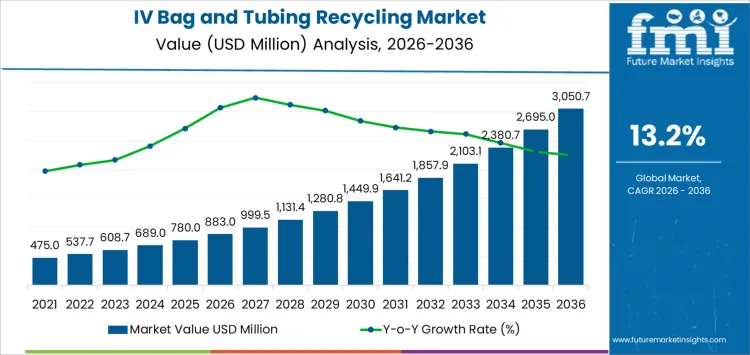
IV Bag and Tubing Recycling Market Key Takeaways
| Metric | Value |
|---|---|
| IV Bag and Tubing Recycling Market Value (2026) | USD 883.0 Million |
| IV Bag and Tubing Recycling Market Forecast Value (2036) | USD 3,050.7 Million |
| IV Bag and Tubing Recycling Market Forecast CAGR (2026-2036) | 13.20% |
How are Hospital Waste Segregation, Compliance Pressure, and Material Recovery Economics Driving the IV Bag and Tubing Recycling Market?
The IV bag and tubing recycling market is gaining traction as healthcare providers seek practical ways to reduce regulated medical waste volumes without compromising safety. IV consumables primarily PVC-based bags and tubing represent a large, high-frequency waste stream in hospitals. Adoption friction remains tied to contamination control, regulatory variability, and the need for dependable downstream processing partners. By separating non-infectious IV waste from biohazardous disposal, facilities can significantly lower disposal costs while improving recycling rates. This is shifting demand toward turnkey recycling programs that combine on-site segregation protocols with downstream processing assurance.
Adoption is being shaped by operational simplicity and compliance confidence. Hospitals favor solutions that integrate seamlessly into existing clinical workflows, minimize staff retraining, and provide clear guidance on what qualifies for recycling. Technologies such as closed-loop collection systems, automated shredding, and traceability-enabled logistics are reducing contamination risk and improving audit readiness. Recycling providers that can document chain-of-custody, material decontamination, and end-use outcomes are gaining preference with large hospital networks and group purchasing organizations.
Scale-up economics and downstream demand are further accelerating market growth. Recycled PVC from IV bags and tubing is increasingly being reprocessed into durable goods and non-clinical applications, improving the business case for collection programs. As healthcare systems set waste-reduction targets and regulators tighten reporting requirements, multi-site rollout becomes a priority. For recyclers and solution providers, competitive advantage increasingly depends on program scalability, regulatory alignment, and the ability to deliver measurable cost savings positioning IV bag and tubing recycling as a high-growth, operations-led segment within healthcare waste management.
How is the IV Bag and Tubing Recycling Market Structured by Product and Application?
The IV bag and tubing recycling market is segmented by product and application, reflecting how material composition and waste stream control shape recycling system adoption in healthcare environments. By product, PVC recycling systems represent the leading segment, as PVC remains the most widely used material in IV bags and medical tubing. Other products include non-PVC material recycling solutions and collection and processing services that support mixed medical waste handling. By application, hospital waste management forms the primary demand area, while pharma manufacturing waste and other healthcare waste streams contribute to broader system utilization.
Why Do PVC Recycling Systems Lead Product Adoption In The IV Bag And Tubing Recycling Market?

PVC recycling systems account for 44% share of the IV bag and tubing recycling market because PVC-based IV bags and tubing dominate clinical use due to flexibility, durability, and cost efficiency. Hospitals generate large volumes of post-use PVC medical disposables that can be segregated and processed through dedicated recycling systems. These systems are designed to handle medical-grade PVC with controlled contamination management. Centralized processing improves material recovery and operational efficiency. For equipment providers, PVC recycling systems offer standardized designs and repeat installations across healthcare networks. These material prevalence and processing advantages explain why PVC recycling systems remain the leading product category.
Why Does Hospital Waste Management Dominate Application Demand In The IV Bag And Tubing Recycling Market?
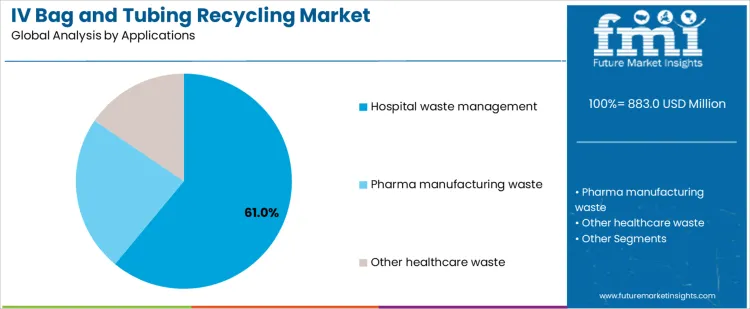
Hospital waste management holds 61% share of the IV bag and tubing recycling market because hospitals generate continuous, high-volume streams of IV bags and tubing during routine patient care. Inpatient wards, intensive care units, and surgical departments rely heavily on single-use IV systems. Centralized hospital waste programs enable segregation, collection, and processing at scale. Regulatory oversight and internal waste reduction targets encourage adoption of dedicated recycling solutions. High bed turnover rates sustain consistent waste generation. For recycling service providers and system suppliers, hospitals offer long-term contracts and predictable volumes, explaining why hospital waste management remains the dominant application segment.
What are the Key Dynamics of the IV Bag and Tubing Recycling Market?
The IV bag and tubing recycling market is driven by increasing volumes of single-use medical plastics generated by hospitals, surgical centers, and outpatient facilities. Intravenous (IV) bags and tubing sets predominantly comprised of PVC, PE, and other polymer components constitute a significant portion of regulated medical waste. For recycling solution providers, developing systems that safely decontaminate, sort, and reclaim these materials into feedstocks suitable for reprocessing is central to commercialization. Healthcare organizations prioritize solutions that balance regulatory compliance, infection control, cost-effectiveness, and transparent waste diversion data when evaluating recycling partnerships.
How Are Processing Technologies And Operational Practices Shaping This Market?
Processing technologies and operational practices are shaping the IV bag and tubing recycling market by improving safety, throughput, and material recovery rates. Advanced decontamination systems including steam sterilization, chemical neutralization, and low-temperature plasma treatment support safe handling of biohazardous streams prior to recycling. Automated sorting and identification technologies (near-infrared, AI-assisted vision systems) enhance separation of multi-polymer assemblies, enabling recovery of PVC, PE, and other thermoplastics with reduced manual labor. Integration of compact shredders and wash lines improves processing efficiency, while partnerships with third-party waste managers and in-facility segregation programs strengthen supply consistency. For solution providers, offering turnkey systems that align with hospital infection control protocols increases adoption potential.
Why Do Safety, Regulatory, And Quality Challenges Restrain Market Growth?
Safety, regulatory, and quality challenges restrain growth in the IV bag and tubing recycling market due to the biohazardous nature of medical waste and stringent healthcare compliance requirements. Handling contaminated plastics requires validated decontamination processes that satisfy infection control standards, adding cost and complexity relative to recycling non-clinical plastics. Regulatory frameworks for medical waste recycling vary across regions, and some jurisdictions have strict disposal mandates that limit reuse options, requiring careful navigation by recyclers. Ensuring consistent output quality especially for reprocessed PCR resins demands tight control of feedstock composition and processing parameters. These factors elevate barriers to entry and require demonstrable quality performance before healthcare providers are willing to commit.
What is the Country-Level Overview for the IV Bag and Tubing Recycling Market?
The IV bag and tubing recycling market is expanding as healthcare systems seek structured solutions to manage high volumes of single-use medical plastic waste generated in hospitals, clinics, and diagnostic centers. IV bags and tubing, primarily made from PVC and polyolefin materials, represent a significant waste stream due to their widespread use in infusion therapies and fluid management. Growth varies by country based on hospital waste segregation practices, availability of recycling infrastructure, regulatory pressure, and participation from healthcare providers and recyclers. Mature markets emphasize compliant collection systems, material purity, and traceable recycling pathways, while faster-growing regions focus on building basic recovery capacity and scaling hospital participation.
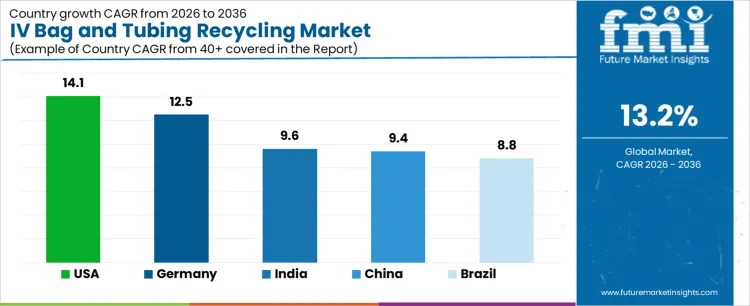
| Country | CAGR (%) |
|---|---|
| United States | 14.1 |
| Germany | 12.5 |
| India | 9.6 |
| China | 9.4 |
| Brazil | 8.8 |
How Is The United States Scaling Structured IV Bag And Tubing Recycling Programs?
The IV bag and tubing recycling market in the United States is expanding at a CAGR of 14.1% during 2026-2036, driven by the large volume of single-use medical plastics generated across hospitals and outpatient care facilities. Adoption is led by major hospital networks implementing segregated collection programs for non-hazardous IV plastics. Buyers prioritize regulatory compliance, traceability, and the ability to integrate recycling workflows without disrupting clinical operations. Collection systems are often centralized at hospital group or regional levels, enabling efficient aggregation and processing. Procurement decisions favor recycling partners with strong logistics capability, experience handling regulated medical waste, and proven material recovery outcomes. Market value is driven by scale, standardized hospital participation, and long-term service contracts rather than one-off recycling initiatives. The USA represents a program-driven market where success depends on operational reliability, compliance expertise, and the ability to manage high waste volumes across distributed healthcare facilities.
Why Is Germany Advancing High-Control IV Plastic Recycling Models?
Germany’s IV bag and tubing recycling market is growing at a CAGR of 12.5% during 2026-2036, shaped by structured hospital waste management systems and strict regulatory oversight. Adoption focuses on controlled segregation of IV plastics to ensure material purity and safe downstream processing. Hospitals emphasize standardized protocols, staff training, and documentation throughout the collection process. Recycling initiatives are typically integrated into broader medical waste handling frameworks rather than standalone programs. Procurement decisions involve hospital administrators, compliance teams, and waste management authorities, resulting in longer evaluation cycles. Market value is driven by consistent participation from large healthcare institutions and reliable processing outcomes. Germany represents a precision-oriented market where growth is steady and determined by governance strength, process discipline, and alignment with regulatory requirements rather than rapid expansion.
What Is Driving India’s Rapid Growth in IV Bag and Tubing Recycling?
India’s IV bag and tubing recycling market is projected to grow at a CAGR of 9.6% during 2026-2036, supported by rising healthcare utilization and expanding hospital infrastructure. Adoption is largely greenfield-led, with recycling systems introduced alongside new waste management initiatives. Buyers emphasize affordability, scalability, and ease of implementation across diverse hospital environments. Segregation practices are improving, enabling increased recovery of non-infectious IV plastics. Procurement cycles are relatively short, allowing fast onboarding of recycling partners. Market value is driven by high patient volumes, growing awareness of medical plastic recovery, and the ability to process mixed material streams efficiently. India represents a scale-emerging market where success depends on cost-effective logistics, local processing capacity, and close collaboration with healthcare providers.
Why Is China Expanding IV Bag And Tubing Recycling Capacity?
China’s IV bag and tubing recycling market is growing at a CAGR of 9.4% during 2026-2036, driven by large hospital systems and increasing attention to medical waste volume management. Adoption is concentrated in urban hospitals and regional healthcare clusters where waste aggregation is feasible. Buyers prioritize throughput efficiency, regulatory compliance, and reliable processing capacity. Recycling systems are often linked to centralized waste handling facilities serving multiple hospitals. Procurement decisions favor providers with strong local presence, scalable infrastructure, and regulatory familiarity. Market value is driven by volume recovery and integration into existing waste processing networks. China represents a capacity-driven market where competitive advantage depends on processing scale, logistical coordination, and the ability to manage high daily waste flows reliably.
How Is Brazil Developing Practical IV Plastic Recycling Pathways?
Brazil’s IV bag and tubing recycling market is expanding at a CAGR of 8.8% during the forecast period, shaped by gradual improvements in healthcare waste segregation and recycling access. Adoption is strongest in large private hospitals and urban medical centers. Buyers focus on cost control, operational simplicity, and dependable collection services. Recycling initiatives are often supported through partnerships between hospitals, waste service providers, and regional recyclers. Procurement decisions favor flexible solutions that can operate within constrained infrastructure environments. Market value is driven by incremental expansion of hospital participation and improved recovery of medical plastics. Brazil represents a pragmatic growth market where success depends on affordability, distributor reach, and consistent service delivery rather than complex system integration.
How are Service Providers Structuring Competition in IV Bag and Tubing Recycling?
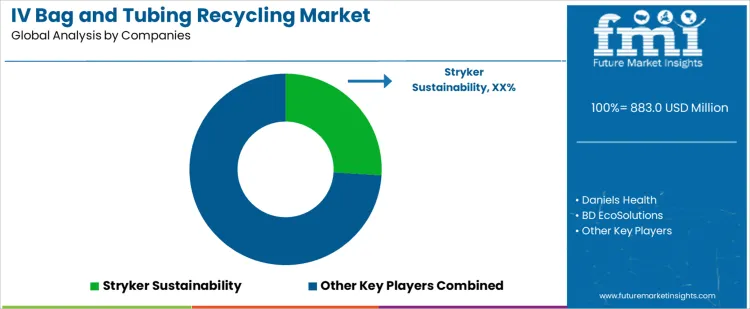
Competition in the IV bag and tubing recycling market is shaped by end-to-end recovery capability, documented diversion performance, and compliance with healthcare waste regulations that matter to hospitals, group purchasing organizations, and sustainability teams. Stryker Sustainability Solutions positions its programs around closed-loop recovery of IV bags and tubing, with service materials emphasizing infection-control protocols, automated segregation, and auditable diversion metrics that support hospital reporting requirements. Program design focuses on simplifying point-of-use collection while maximizing polymer recovery.
Operational integration and clinical workflow alignment define another competitive axis. Daniels Health competes through engineered containment and collection systems designed to reduce contamination risks and improve capture rates of recyclable IV plastics. BD EcoSolutions aligns recycling with established sharps and plastics handling workflows, with documentation highlighting standardized processes and consistent downstream material quality.
Scale and infrastructure depth strengthen positioning among large waste managers. Stericycle emphasizes compliance assurance, chain-of-custody tracking, and verified diversion outcomes across multi-facility healthcare networks. Veolia differentiates through integrated clinical waste logistics and advanced mechanical recycling, with materials underscoring sorting accuracy and the quality of recovered resins suitable for reprocessing.
Others in the market include regional recyclers and niche medical plastics specialists offering tailored programs and localized collection networks. Across providers, competitive advantage is established through brochure-verified recovery performance, regulatory compliance, and seamless integration with hospital operations rather than pricing alone.
Key Players in IV Bag and Tubing Recycling Market
- Stryker Sustainability
- Daniels Health
- BD EcoSolutions
- Stericycle
- Veolia
- Others
Scope of Report
| Attribute | Description |
|---|---|
| Quantitative Unit | USD Million |
| Products | PVC Recycling Systems, Non-PVC Material Recycling, Collection & Processing Services |
| Applications | Hospital Waste Management, Pharma Manufacturing Waste, Other Healthcare Waste |
| Countries Covered | China, Japan, South Korea, India, Australia & New Zealand, ASEAN, Rest of Asia Pacific, Germany, United Kingdom, France, Italy, Spain, Nordic, BENELUX, Rest of Europe, United States, Canada, Mexico, Brazil, Chile, Rest of Latin America, Kingdom of Saudi Arabia, Other GCC Countries, Turkey, South Africa, Other African Union, Rest of Middle East & Africa |
| Regions Covered | Asia Pacific, Europe, North America, Latin America, Middle East & Africa |
| Key Companies Profiled | Stryker Sustainability, Daniels Health, BD EcoSolutions, Stericycle, Veolia, Others |
| Additional Attributes | Dollar sales by product type and application are evaluated across regulated healthcare waste recycling workflows. The report includes country-level demand assessment, growth projections for 2026-2036, analysis of PVC recovery efficiency and contamination control, evaluation of compliance with medical waste regulations, competitive benchmarking of service providers, and assessment of sustainability-driven adoption across hospitals and pharmaceutical manufacturing facilities. |
IV Bag and Tubing Recycling Market by Key Segments
Products
- PVC recycling systems
- Non-PVC material recycling
- Collection & processing services
Applications
- Hospital waste management
- Pharma manufacturing waste
- Other healthcare waste
Region
- Asia Pacific
- China
- Japan
- South Korea
- India
- Australia & New Zealand
- ASEAN
- Rest of Asia Pacific
- Europe
- Germany
- United Kingdom
- France
- Italy
- Spain
- Nordic
- BENELUX
- Rest of Europe
- North America
- United States
- Canada
- Mexico
- Latin America
- Brazil
- Chile
- Rest of Latin America
- Middle East & Africa
- Kingdom of Saudi Arabia
- Other GCC Countries
- Turkey
- South Africa
- Other African Union
- Rest of Middle East & Africa
Bibiliography
- World Health Organization. (2024). Safe management of wastes from health-care activities (2nd ed.). World Health Organization.
- Klein, R., & Thiel, C. (2024). Circular economy strategies for plastic waste reduction in healthcare systems. Journal of Cleaner Production, 418, 139883.
- Organisation for Economic Co-operation and Development. (2024). Circular economy policies for plastics in health and life sciences sectors. OECD Publishing.
- United Nations Environment Programme. (2024). Healthcare plastics and sustainable waste management systems. United Nations Environment Programme.
- European Commission. (2024). Circular economy approaches for medical devices and healthcare materials. European Commission.
Frequently Asked Questions
How big is the iv bag and tubing recycling market in 2026?
The global iv bag and tubing recycling market is estimated to be valued at USD 883.0 million in 2026.
What will be the size of iv bag and tubing recycling market in 2036?
The market size for the iv bag and tubing recycling market is projected to reach USD 3,050.7 million by 2036.
How much will be the iv bag and tubing recycling market growth between 2026 and 2036?
The iv bag and tubing recycling market is expected to grow at a 13.2% CAGR between 2026 and 2036.
What are the key product types in the iv bag and tubing recycling market?
The key product types in iv bag and tubing recycling market are pvc recycling systems, non-pvc material recycling and collection & processing services.
Which applications segment to contribute significant share in the iv bag and tubing recycling market in 2026?
In terms of applications, hospital waste management segment to command 61.0% share in the iv bag and tubing recycling market in 2026.
Preview the report firsthand - request a free sample
Get SampleGet the brochure for pricing and purchase details.
Get PDFTable of Content
- Executive Summary
- Global Market Outlook
- Demand-side Trends
- Supply-side Trends
- Technology Roadmap Analysis
- Analysis and Recommendations
- Market Overview
- Market Coverage / Taxonomy
- Market Definition / Scope / Limitations
- Market Background
- Market Dynamics
- Drivers
- Restraints
- Opportunity
- Trends
- Scenario Forecast
- Demand in Optimistic Scenario
- Demand in Likely Scenario
- Demand in Conservative Scenario
- Opportunity Map Analysis
- Product Life Cycle Analysis
- Supply Chain Analysis
- Investment Feasibility Matrix
- Value Chain Analysis
- PESTLE and Porter’s Analysis
- Regulatory Landscape
- Regional Parent Market Outlook
- Production and Consumption Statistics
- Import and Export Statistics
- Market Dynamics
- Global Market Analysis 2021 to 2025 and Forecast, 2026 to 2036
- Historical Market Size Value (USD Million) Analysis, 2021 to 2025
- Current and Future Market Size Value (USD Million) Projections, 2026 to 2036
- Y-o-Y Growth Trend Analysis
- Absolute $ Opportunity Analysis
- Global Market Pricing Analysis 2021 to 2025 and Forecast 2026 to 2036
- Global Market Analysis 2021 to 2025 and Forecast 2026 to 2036, By Products
- Introduction / Key Findings
- Historical Market Size Value (USD Million) Analysis By Products , 2021 to 2025
- Current and Future Market Size Value (USD Million) Analysis and Forecast By Products , 2026 to 2036
- PVC recycling systems
- Non-PVC material recycling
- Collection & processing services
- PVC recycling systems
- Y-o-Y Growth Trend Analysis By Products , 2021 to 2025
- Absolute $ Opportunity Analysis By Products , 2026 to 2036
- Global Market Analysis 2021 to 2025 and Forecast 2026 to 2036, By Applications
- Introduction / Key Findings
- Historical Market Size Value (USD Million) Analysis By Applications, 2021 to 2025
- Current and Future Market Size Value (USD Million) Analysis and Forecast By Applications, 2026 to 2036
- Hospital waste management
- Pharma manufacturing waste
- Other healthcare waste
- Hospital waste management
- Y-o-Y Growth Trend Analysis By Applications, 2021 to 2025
- Absolute $ Opportunity Analysis By Applications, 2026 to 2036
- Global Market Analysis 2021 to 2025 and Forecast 2026 to 2036, By Region
- Introduction
- Historical Market Size Value (USD Million) Analysis By Region, 2021 to 2025
- Current Market Size Value (USD Million) Analysis and Forecast By Region, 2026 to 2036
- North America
- Latin America
- Western Europe
- Eastern Europe
- East Asia
- South Asia and Pacific
- Middle East & Africa
- Market Attractiveness Analysis By Region
- North America Market Analysis 2021 to 2025 and Forecast 2026 to 2036, By Country
- Historical Market Size Value (USD Million) Trend Analysis By Market Taxonomy, 2021 to 2025
- Market Size Value (USD Million) Forecast By Market Taxonomy, 2026 to 2036
- By Country
- USA
- Canada
- Mexico
- By Products
- By Applications
- By Country
- Market Attractiveness Analysis
- By Country
- By Products
- By Applications
- Key Takeaways
- Latin America Market Analysis 2021 to 2025 and Forecast 2026 to 2036, By Country
- Historical Market Size Value (USD Million) Trend Analysis By Market Taxonomy, 2021 to 2025
- Market Size Value (USD Million) Forecast By Market Taxonomy, 2026 to 2036
- By Country
- Brazil
- Chile
- Rest of Latin America
- By Products
- By Applications
- By Country
- Market Attractiveness Analysis
- By Country
- By Products
- By Applications
- Key Takeaways
- Western Europe Market Analysis 2021 to 2025 and Forecast 2026 to 2036, By Country
- Historical Market Size Value (USD Million) Trend Analysis By Market Taxonomy, 2021 to 2025
- Market Size Value (USD Million) Forecast By Market Taxonomy, 2026 to 2036
- By Country
- Germany
- UK
- Italy
- Spain
- France
- Nordic
- BENELUX
- Rest of Western Europe
- By Products
- By Applications
- By Country
- Market Attractiveness Analysis
- By Country
- By Products
- By Applications
- Key Takeaways
- Eastern Europe Market Analysis 2021 to 2025 and Forecast 2026 to 2036, By Country
- Historical Market Size Value (USD Million) Trend Analysis By Market Taxonomy, 2021 to 2025
- Market Size Value (USD Million) Forecast By Market Taxonomy, 2026 to 2036
- By Country
- Russia
- Poland
- Hungary
- Balkan & Baltic
- Rest of Eastern Europe
- By Products
- By Applications
- By Country
- Market Attractiveness Analysis
- By Country
- By Products
- By Applications
- Key Takeaways
- East Asia Market Analysis 2021 to 2025 and Forecast 2026 to 2036, By Country
- Historical Market Size Value (USD Million) Trend Analysis By Market Taxonomy, 2021 to 2025
- Market Size Value (USD Million) Forecast By Market Taxonomy, 2026 to 2036
- By Country
- China
- Japan
- South Korea
- By Products
- By Applications
- By Country
- Market Attractiveness Analysis
- By Country
- By Products
- By Applications
- Key Takeaways
- South Asia and Pacific Market Analysis 2021 to 2025 and Forecast 2026 to 2036, By Country
- Historical Market Size Value (USD Million) Trend Analysis By Market Taxonomy, 2021 to 2025
- Market Size Value (USD Million) Forecast By Market Taxonomy, 2026 to 2036
- By Country
- India
- ASEAN
- Australia & New Zealand
- Rest of South Asia and Pacific
- By Products
- By Applications
- By Country
- Market Attractiveness Analysis
- By Country
- By Products
- By Applications
- Key Takeaways
- Middle East & Africa Market Analysis 2021 to 2025 and Forecast 2026 to 2036, By Country
- Historical Market Size Value (USD Million) Trend Analysis By Market Taxonomy, 2021 to 2025
- Market Size Value (USD Million) Forecast By Market Taxonomy, 2026 to 2036
- By Country
- Kingdom of Saudi Arabia
- Other GCC Countries
- Turkiye
- South Africa
- Other African Union
- Rest of Middle East & Africa
- By Products
- By Applications
- By Country
- Market Attractiveness Analysis
- By Country
- By Products
- By Applications
- Key Takeaways
- Key Countries Market Analysis
- USA
- Pricing Analysis
- Market Share Analysis, 2025
- By Products
- By Applications
- Canada
- Pricing Analysis
- Market Share Analysis, 2025
- By Products
- By Applications
- Mexico
- Pricing Analysis
- Market Share Analysis, 2025
- By Products
- By Applications
- Brazil
- Pricing Analysis
- Market Share Analysis, 2025
- By Products
- By Applications
- Chile
- Pricing Analysis
- Market Share Analysis, 2025
- By Products
- By Applications
- Germany
- Pricing Analysis
- Market Share Analysis, 2025
- By Products
- By Applications
- UK
- Pricing Analysis
- Market Share Analysis, 2025
- By Products
- By Applications
- Italy
- Pricing Analysis
- Market Share Analysis, 2025
- By Products
- By Applications
- Spain
- Pricing Analysis
- Market Share Analysis, 2025
- By Products
- By Applications
- France
- Pricing Analysis
- Market Share Analysis, 2025
- By Products
- By Applications
- India
- Pricing Analysis
- Market Share Analysis, 2025
- By Products
- By Applications
- ASEAN
- Pricing Analysis
- Market Share Analysis, 2025
- By Products
- By Applications
- Australia & New Zealand
- Pricing Analysis
- Market Share Analysis, 2025
- By Products
- By Applications
- China
- Pricing Analysis
- Market Share Analysis, 2025
- By Products
- By Applications
- Japan
- Pricing Analysis
- Market Share Analysis, 2025
- By Products
- By Applications
- South Korea
- Pricing Analysis
- Market Share Analysis, 2025
- By Products
- By Applications
- Russia
- Pricing Analysis
- Market Share Analysis, 2025
- By Products
- By Applications
- Poland
- Pricing Analysis
- Market Share Analysis, 2025
- By Products
- By Applications
- Hungary
- Pricing Analysis
- Market Share Analysis, 2025
- By Products
- By Applications
- Kingdom of Saudi Arabia
- Pricing Analysis
- Market Share Analysis, 2025
- By Products
- By Applications
- Turkiye
- Pricing Analysis
- Market Share Analysis, 2025
- By Products
- By Applications
- South Africa
- Pricing Analysis
- Market Share Analysis, 2025
- By Products
- By Applications
- USA
- Market Structure Analysis
- Competition Dashboard
- Competition Benchmarking
- Market Share Analysis of Top Players
- By Regional
- By Products
- By Applications
- Competition Analysis
- Competition Deep Dive
- Stryker Sustainability
- Overview
- Product Portfolio
- Profitability by Market Segments (Product/Age /Sales Channel/Region)
- Sales Footprint
- Strategy Overview
- Marketing Strategy
- Product Strategy
- Channel Strategy
- Daniels Health
- BD EcoSolutions
- Stericycle
- Veolia
- Others
- Stryker Sustainability
- Competition Deep Dive
- Assumptions & Acronyms Used
- Research Methodology


