

- Market Size (2026)
- USD 640.6 Mn
- Forecast (2036)
- USD 1063.5 Mn
- CAGR (2026 to 2036)
- 5.2%
How big is the End Grain Flooring Market in 2026?
USD 640.6 million in 2026 and USD 1,063.5 million by 2036 at a 5.2% CAGR.
Demand for end grain flooring is projected to expand at 5.2% CAGR between 2026 and 2036, increasing valuation from USD 640.6 million in 2026 to USD 1,063.5 million by 2036. Heritage interiors and heavy-traffic renovation projects are making flooring specification more disciplined. USA Census Bureau reported June 2026 that private residential construction spending reached USD 909.9 billion in April 2026. The spending base keeps contractor attention on durable surfaces and documented flooring installation quality.
India and China are estimated to favor direct manufacturer access and price discipline as hospitality, residential and commercial fit-out projects widen demand. United States buyers are expected to prioritize installer accountability, moisture-control records and finish consistency before approving custom wood floors. Suppliers are projected to gain where they reduce inspection risk and preserve design intent after handover.
Flooring contractors and architectural specifiers are expected to source end grain floors for projects requiring durability proof before approval. Direct manufacturer routes help these teams match species, dimensions and finish choices to installation conditions. The product creates value by turning a custom wood surface into a documented system for building material procurement and site handover. Municipal facilities and hospitality operators often need a surface that absorbs wear without pushing maintenance teams into early replacement plans.
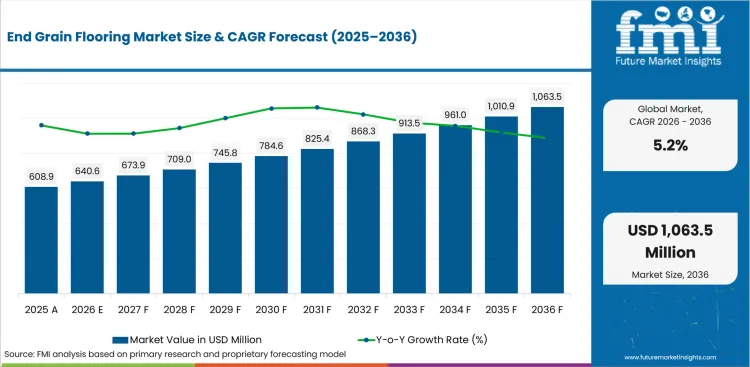
Summary of the End Grain Flooring Market
| Market Signal | Commercial Impact |
|---|---|
| Demand and Growth Drivers | Specification-led renovation is expected to push spending toward end grain flooring in heritage and premium interior projects. Documentation needs are projected to make contractors test moisture control before repeat orders.
|
| Product and Segment View | Direct manufacturer, oak and blocks are expected to lead their parent categories in 2026. Residential interiors and unfinished products are forecast to keep the specification case visible.
|
| Geography and Growth Outlook | India and China are projected to form the higher-growth tier due to formal housing activity and faster channel conversion. The United States and Europe are expected to grow under stricter installer review.
|
| Competitive Landscape | Competition is moderately fragmented around specialty flooring makers and design-led hardwood suppliers. Selection criteria are expected to center on installation proof and project support.
|
| Analyst Perspective | End grain flooring is a specialty surface that must be sold as an installation system rather than a decorative material. The commercial test is whether supplier guidance protects moisture behavior, finish consistency and site handover.
|
How is the End Grain Flooring Market segmented?
The end grain flooring industry is segmented by wood type, format, application, finish, sales channel and region.
The end grain flooring market is segmented by wood type, format, application, finish, sales channel and region. By wood type, the market covers oak, maple, pine or softwood and reclaimed or specialty wood. By format, it covers blocks, tiles, panels and custom patterns. By application, it covers residential interiors, commercial interiors, hospitality or retail and historic restoration. By finish, it covers unfinished, prefinished, oil or wax finished and sealed industrial finish. By sales channel, it covers flooring dealers, direct manufacturers and contractors or designers. Regional coverage includes North America, Latin America, Europe, East Asia, South Asia and Pacific and Middle East and Africa, aligned to adjacent wood coatings demand.
How do project teams evaluate direct manufacturer routes within sales channels?
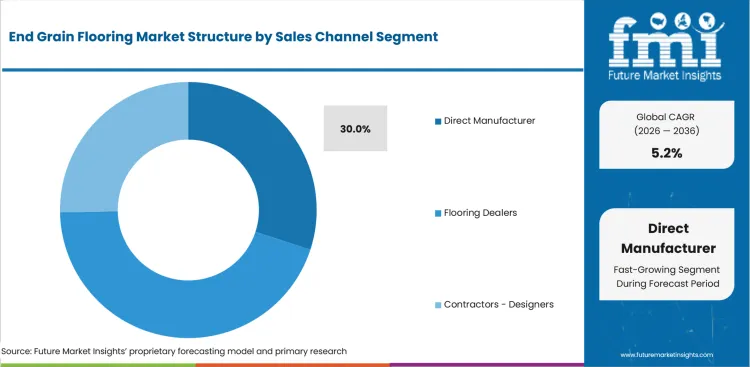
End grain flooring specifications often need direct answers on acclimation, layout and repair support before contractors accept site responsibility. The direct technical support more visible for architects who need a supplier to explain format behavior before installation schedules are fixed.
- By sales channel, direct manufacturer is projected to account for 30.0% share in 2026 due to tighter control over samples and project files. Kaswell Flooring Systems described engineered end grain planks in July 2025, which supports direct supplier involvement in specification reviews before orders move into project schedules.
- Direct manufacturer routes are witnessing demand from contractors owing to the need for single-point answers on layout and warranty support. Project teams comparing hard surface flooring demand also use direct routes to reduce delay between design approval and field correction.
What supports demand for oak within the wood type category?
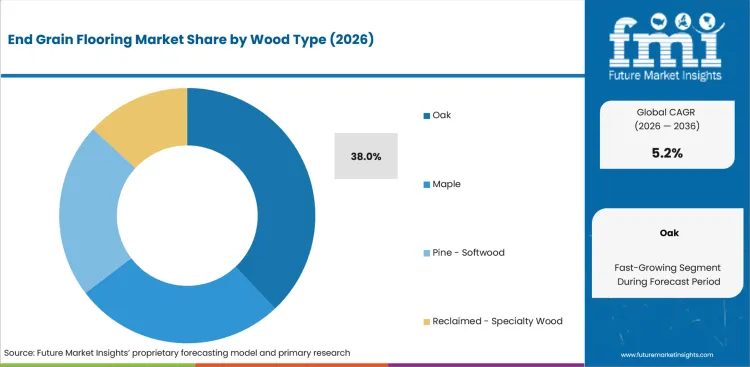
Oak remains a practical specification choice due to contractor familiarity with its appearance range and finishing behavior. Czar Floors states that its wide plank products use Appalachian white oak and red oak among other hardwoods. The species fits custom parquet and end grain projects that need recognizable material language before a design team accepts a specialty floor.
- Oak is estimated to hold 38.0% share of wood type demand in 2026 owing to specification familiarity and easier finish matching.
- Demand for oak is expected to grow among specifiers attributable to its established color range and familiar staining response. Architects reviewing green building materials often need species documentation before natural wood surfaces enter public or hospitality interiors.
How is the blocks format positioned within format demand?
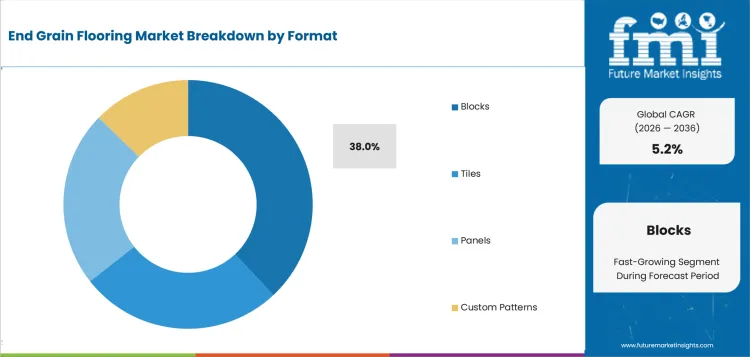
Blocks are central to the product identity due to exposed growth rings across many small pieces. The block format links product appearance to wear behavior and makes layout planning central to installer training.
- By format, blocks are forecast to represent 38.0% share in 2026 driven by the visual texture created by exposed growth rings. Kaswell Flooring Systems describes end grain blocks as cross-cut pieces with growth rings exposed, which connects the format to the category’s distinctive surface behavior.
- Flooring contractors are increasingly purchasing blocks led by their ability to support custom patterns and targeted replacement work. The format also helps manufacturers sell project-specific layouts without forcing every customer into long plank design language.
What drives residential interiors within the application category?
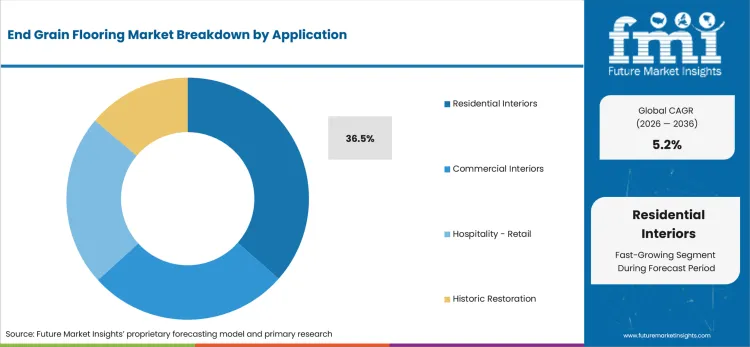
Residential interior demand is tied to renovation decisions involving homeowners and designers seeking visible material character. NAHB reported a Remodeling Market Index reading of 64 in the fourth quarter of 2025. The reading supports the idea that remodeling work remains a channel for premium surface decisions after new housing demand weakens.
- Residential interiors are likely to capture 36.5% share of application demand in 2026 attributable to renovation-led specification work.
- Purchase activity for residential interiors is anticipated to rise driven by homeowners seeking visible wood character in kitchens and living spaces. Designers still need product samples and finish guidance before recommending end grain floors in occupied-home renovation work.
How does unfinished product shape decisions within the finish category?
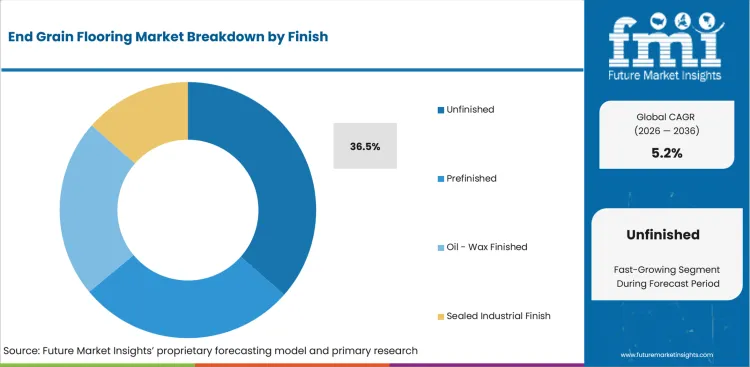
Unfinished end grain flooring gives installers control over staining and sealing after site conditions are known. Czar Floors installation guidance places job site inspection, storage and handling before final finishing steps. The sequence gives contractors a reason to keep unfinished products in specifications affected by subfloor condition and late visual matching.
- The finish category is forecast to be led by unfinished products at 36.5% share in 2026 due to site-level color control.
- Sales of unfinished products are forecast to gain traction in restoration and custom interiors reinforced by final-site finish flexibility. Contractors use the format to align stain decisions with adjacent millwork and existing wood floors during late-stage approval.
What are the drivers, restraints, and opportunities in the End Grain Flooring Market?
Near-term purchases are being shaped by specification-led renovation, moisture-control burden and direct manufacturer support outlined below.
- Driver: Specification-led renovation is expected to push project teams toward end grain flooring that supports visible wood character and longer service life.
- Restraint: Moisture control and skilled installation needs are anticipated to slow adoption in projects lacking clear installer responsibility.
- Opportunity: Engineered panels and direct support are projected to open account access for designers needing faster layout approval.
Architectural specifiers are expected to raise interest in end grain flooring for projects requiring heritage texture and wear-resistance proof. Havwoods published March 2026 guidance explaining that end grain pieces are cut perpendicular to growth rings. The explanation helps design teams connect appearance to surface behavior before moving from concept boards into sample approval and tender documentation.
Installer qualification is likely to slow purchases in projects lacking early humidity control and subfloor preparation responsibility. Czar Floors lists job site inspection and storage handling in its parquet installation guidance. Flooring contractors need clearer site ownership before they accept end grain products that depend on block stability and finish sequencing.
Channel expansion is projected to convert installation friction into a service route for manufacturers and specialist dealers. Havwoods welcomed Castle Bespoke Flooring to its North American business in February 2025. The acquisition points to wider showroom and service access for wood flooring, which supports construction chemical specification decisions around adhesives and floor preparation.
Which country CAGRs are profiled in the End Grain Flooring Market?
.webp "Top Country Growth Comparison End Grain Flooring Market Cagr (2026 2036)")
| Country | CAGR |
|---|---|
| United States | 4.0% |
| China | 6.4% |
| India | 7.4% |
| Germany | 3.4% |
| United Kingdom | 3.8% |
| Japan | 3.2% |
| South Korea | 4.6% |
Source: FMI's proprietary forecasting model and primary research
How do country-level CAGRs compare in the End Grain Flooring Market?
Country growth is expected to separate by renovation depth and local service access. India is projected at 7.4% CAGR and China is forecast at 6.4% CAGR due to faster fit-out conversion. South Korea is predicted at 4.6% CAGR due to compact supply chains. The United States is estimated at 4.0% CAGR. The United Kingdom is set at 3.8% CAGR. Germany is projected at 3.4% CAGR and Japan is forecast at 3.2% CAGR due to stricter qualification cycles.
- United States demand is projected to grow at 4.0% CAGR by 2036 driven by renovation spending that supports premium wood surfaces. The USA Census Bureau reported residential construction spending of USD 909.9 billion in April 2026. The spending base keeps flooring contractors focused on products that reduce replacement and repair exposure in occupied buildings. Local dealers still face tight installer capacity and moisture-control responsibility during custom block installation. Suppliers with clear acclimation files and dealer training are expected to receive stronger consideration in specification-led accounts.
- China end grain flooring demand is forecast to rise at 6.4% CAGR over the forecast period, supported by selective fit-out spending despite property weakness. National Bureau of Statistics of China reported residential floor space newly started at 258.81 million square meters from January to July 2025. The figure shows a narrower new-build pipeline, which shifts wood flooring attention toward premium renovation and commercial interiors. Local distributors must manage price pressure and species availability under uneven real estate activity. Direct importers with consistent delivery are expected to gain account access in active showroom conversion programs.
- Adoption of end grain flooring in India is estimated to expand at 7.4% CAGR through 2036, owing to formal housing programs and premium urban interiors. Press Information Bureau reported PMAY-U 2.0 approvals above 16.13 lakh houses in June 2026. Formal housing activity supports broader interior material awareness despite end grain floors remaining premium products. Local contractors also need price discipline due to frequent comparisons between wood blocks and tile or laminate alternatives. Suppliers with local samples and installation partners are expected to receive stronger consideration in urban design accounts.
- Germany is estimated to post 3.4% CAGR over the forecast period, shaped by qualification-heavy construction review and slower residential completions. German Federal Statistical Office recorded 238,063 dwellings permitted in 2025. The permit base gives flooring suppliers a limited but structured pipeline for specification-led interior work. German architects also place weight on documented material behavior before approving specialty wood surfaces. Suppliers with European technical files and stable oak sourcing are expected to receive stronger consideration in projects requiring documented finish control.
- The United Kingdom sector is projected to record 3.8% CAGR during the assessment period, strengthened by repair and maintenance activity. Office for National Statistics estimated construction output growth of 1.6% in the three months to April 2026. Repair-led work supports end grain flooring interest in hospitality and residential upgrades for projects avoiding full rebuilds. Dealers also need dependable import lead times and skilled installers for custom blocks. Specialist distributors with sample libraries are expected to draw attention from designers in London and regional refurbishment corridors.
- Japan end grain flooring demand is predicted to advance at 3.2% CAGR through 2036 influenced by quality screening and slower housing starts. Canada Wood Japan reported total wooden housing of 433,655 units in 2025 based on MLIT data. The wood-housing base keeps natural material knowledge inside the construction ecosystem even as total starts decline. Local specifiers also demand stable dimensions and careful finish guidance before accepting a specialty surface. Suppliers with precise installation documentation are expected to receive stronger consideration in restoration and boutique commercial accounts.
- End grain flooring sales in South Korea are forecast to expand at 4.6% CAGR by 2036, led by compact project cycles and design-led interiors. FRED data based on OECD statistics showed residential permit growth at -5.23 % in 2025. The contraction raises the value of renovation and premium fit-out channels for specialty wood flooring suppliers. Local studios need quick sample feedback due to rapid design decisions in Seoul-area projects. Suppliers with responsive technical support are expected to receive stronger consideration in accounts that require fast correction during installation.
Who are the notable companies in the End Grain Flooring Market?
Kaswell Flooring Systems, Czar Floors, Oshkosh Designs, Havwoods, Old Wood, Everitt & Schilling, and Appalachian Hardwood are the notable companies shaping this market.
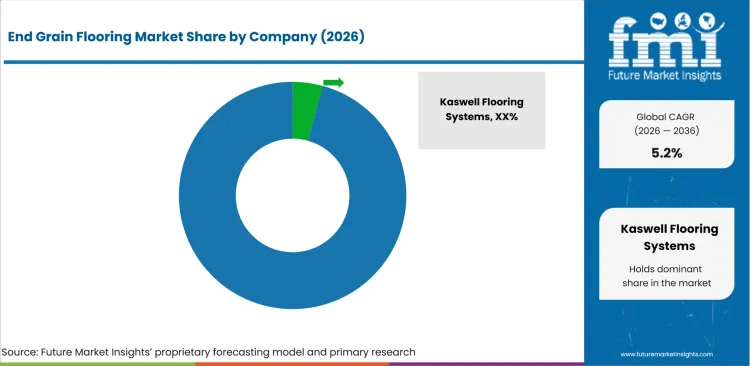
The market is moderately fragmented due to specialty wood-block suppliers competing beside broader hardwood flooring companies. Concentration is controlled by project references, installation support and direct access to architects. Established multinational and regional suppliers hold channel reach and showroom access. Smaller specialists compete by offering end grain blocks and custom patterns that align with narrow design briefs. Competition centers on species range and technical files beside acoustic flooring assemblies that influence commercial interiors. Sourcing teams screen supplier depth before moving from sample approval to recurring project use.
- Project capability separates specialist end grain suppliers from general hardwood flooring firms. Kaswell Flooring Systems and Old Wood compete on dedicated end grain products that help architects defend the surface choice. Their practical advantage is the ability to explain block construction and installation behavior before contractors price the job.
- Design-led sourcing favors companies that give architects custom patterns and clear visual options. Czar Floors and Oshkosh Designs compete in projects that combine parquet, borders and medallions with end grain flooring decisions. These companies serve residential and hospitality projects in which layout choice shapes the purchasing argument.
- Channel access carries more weight in commercial interiors that require samples and faster stakeholder review. Havwoods has broader showroom and commercial content depth, supported by its 2025 Castle Bespoke Flooring integration. The group is relevant for designers who want wood flooring advice connected to construction technology adoption and project coordination.
- Regional hardwood and association-linked suppliers support accounts that prioritize wood sourcing and local knowledge. Everitt & Schilling and Appalachian Hardwood are most useful in accounts needing species familiarity and supply continuity. Suppliers that combine specialty wood knowledge with installation support are expected to receive better repeat-order consideration.
Competitive Benchmarking: End Grain Flooring Market
| Company | End Grain Fit | Design Customization | Specification Support | Service Reach |
|---|---|---|---|---|
| Kaswell Flooring Systems | High | Strong | High | Global |
| Czar Floors | Strong | Strong | Medium | Global |
| Oshkosh Designs | Strong | Strong | Medium | Regional |
| Havwoods | Medium | Strong | High | Global |
| Old Wood | High | Medium | Strong | Regional |
| Everitt & Schilling | Medium | Medium | Medium | Regional |
| Appalachian Hardwood | Medium | Medium | Strong | Regional |
Source: Future Market Insights competitive analysis, 2026. Ratings reflect relative portfolio relevance and workflow fit. Service capability and geographic reach shape the remaining comparison.
Key Developments in the End Grain Flooring Market
- In February 2025, Havwoods announced that Castle Bespoke Flooring had joined the global Havwoods family, adding an Oregon-based custom flooring business to its North American operations. This development signals a growing focus on localized service capabilities for wood flooring projects.
- In July 2024, Old Wood reported that its Douglas Fir flooring had been selected for The Webster Collection project in Santa Fe. The project highlighted the use of a wire-brushed finish within a gallery-style environment, showcasing the aesthetic appeal of specialty wood flooring in design-focused settings.
Key Players in the End Grain Flooring Market
End-grain and wood-block specialists
- Kaswell Flooring Systems
- Old Wood
Custom parquet and design-flooring suppliers
- Czar Floors
- Oshkosh Designs
Commercial hardwood flooring suppliers
- Havwoods
- Everitt & Schilling
Wood-industry and regional support groups
- Appalachian Hardwood
End Grain Flooring Market - Report Scope
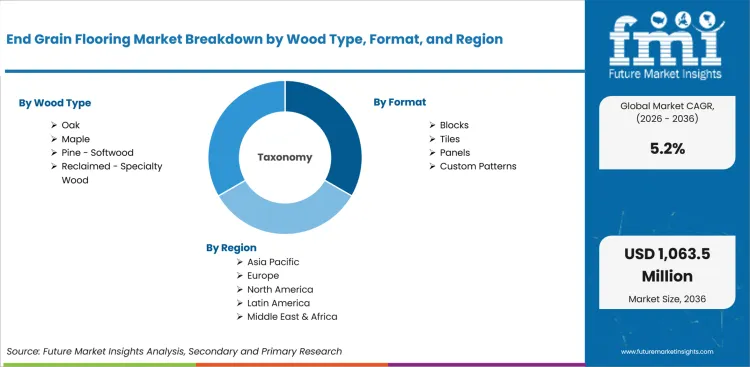
| Coverage field | Report scope |
|---|---|
| Market breakdown | End Grain Flooring Market Breakdown By Wood Type, Format, Application, Finish, Sales Channel, and Region |
| Market Definition | End grain flooring consists of wood blocks, tiles or panels cut across the grain and used by contractors, architects and designers for durable decorative floor surfaces. |
| Regions Covered | North America, Latin America, Europe, East Asia, South Asia and Pacific, and Middle East and Africa |
| Countries Covered | United States, China, India, Germany, United Kingdom, Japan, South Korea, and 30+ countries |
| Key Companies Profiled | Kaswell Flooring Systems, Czar Floors, Oshkosh Designs, Havwoods, Old Wood, Everitt & Schilling, and Appalachian Hardwood |
| Forecast Period | 2026 to 2036 |
| Approach | Hybrid bottom-up and top-down methodology using project specification rates, wood type demand, format mix and channel adoption. Country-level renovation indicators and supplier portfolio depth were used for cross-checking. |
Source: Future Market Insights - analysis driven by proprietary forecasting models and primary research
End Grain Flooring Market - Research Methodology
| Method | Approach |
|---|---|
| Primary Research | FMI analysts gathered input from manufacturers, service providers, technology developers, distributors, end users, sourcing teams, and subject-matter experts. Interviews examined purchasing decisions, product or service evaluation, adoption barriers, approval requirements, pricing considerations, and expectations for technical or commercial support. Respondents were also asked what evidence is required before a trial, pilot, or initial order develops into regular purchasing. |
| Desk Research | Desk research covered government statistics, regulatory publications, trade data, industry associations, technical literature, standards, company filings, product information, and official corporate announcements. Sources were reviewed for relevance, publication date, geographic coverage, and consistency with the defined market scope. Claims relating to performance, applications, approvals, capacity, investment, and commercial activity were retained only when supported by credible public evidence. |
| Market Sizing and Forecasting | The market model combined the baseline value with historical performance, segment structure, pricing and volume indicators, adoption levels, company participation, and country-level demand conditions. Forecast assumptions considered economic activity, investment trends, regulatory developments, technology adoption, purchasing cycles, supply availability, and barriers to wider market use. Segment and regional estimates were reconciled before the final market total was calculated. |
| Data Validation | Estimates were checked against multiple independent indicators, including public data, company activity, trade patterns, industry developments, and findings from primary interviews. Validation also tested whether products, services, applications, and company revenues fell within the defined market boundaries. Adjacent categories, unsupported claims, overlapping revenues, and activities without direct market relevance were excluded to reduce double counting and maintain consistency across segments and countries. |
End Grain Flooring Market by Segments
End Grain Flooring Market segmented by Wood Type:
- Oak
- Maple
- Pine / Softwood
- Reclaimed / Specialty Wood
End Grain Flooring Market segmented by Format:
- Blocks
- Tiles
- Panels
- Custom Patterns
End Grain Flooring Market segmented by Application:
- Residential Interiors
- Commercial Interiors
- Hospitality / Retail
- Historic Restoration
End Grain Flooring Market segmented by Finish:
- Unfinished
- Prefinished
- Oil / Wax Finished
- Sealed Industrial Finish
End Grain Flooring Market segmented by Sales Channel:
- Flooring Dealers
- Direct Manufacturer
- Contractors / Designers
End Grain Flooring Market by Region:
- North America
- United States
- Canada
- Latin America
- Brazil
- Mexico
- Rest of Latin America
- Europe
- Germany
- United Kingdom
- France
- Italy
- Spain
- Rest of Europe
- East Asia
- China
- Japan
- South Korea
- South Asia and Pacific
- India
- Australia and New Zealand
- ASEAN
- Rest of South Asia and Pacific
- Middle East and Africa
- GCC
- South Africa
- Rest of Middle East and Africa
Research Sources and Bibliography
- USA Census Bureau. (2026, June). Monthly Construction Spending, April 2026. USA Census Bureau.
- National Bureau of Statistics of China. (2025, August). Investment in Real Estate Development from January to July 2025. National Bureau of Statistics of China.
- Press Information Bureau. (2026, June). 7th CSMC meeting under PMAY-Urban 2.0 chaired by Secretary, MoHUA. Ministry of Housing and Urban Affairs.
- German Federal Statistical Office. (2026, February). Building permits for building construction in Germany. Statistisches Bundesamt.
- Office for National Statistics. (2026, June). Construction output in Great Britain: April 2026. Office for National Statistics.
- Canada Wood Japan. (2026, March). 2025 Japan Construction Starts Report Year End Summary. Canada Wood Group.
- Federal Reserve Bank of St. Louis. (2026, April). Orders: Construction: Permits Issued: Dwellings and Residential Buildings for Korea. FRED.
- Food and Agriculture Organization of the United Nations. (2025, December). Global forest products trade and production show signs of recovery in 2024. FAO.
- National Association of Home Builders. (2026, January). Remodeling Market Sentiment Strengthens in Fourth Quarter of 2025. NAHB.
- Kaswell Flooring Systems. (2025, July). ENGINEERED END GRAIN FOR FLOORS, WALLS, CEILINGS, AND FURNITURE! Kaswell Flooring Systems.
- Havwoods. (2025, February). Celebrating 50 Years: Havwoods Welcomes Castle Bespoke Flooring to the Family. Havwoods.
- Havwoods. (2026, March). What Is End Grain Wood Flooring and Why Is It Making a Comeback? Havwoods.
- Old Wood LLC. (2024, July). The Webster Collection. A dedication to quality and artistry. Old Wood LLC.
- Czar Floors. (2026, June). How to Install Parquet Floors. Czar Floors.
- Oshkosh Designs. (2025, March). Top Tips: How to Clean Wood Parquet Flooring Effectively. Oshkosh Designs.
This bibliography is provided for reader reference and uses primary government, standards-body, official trade body, and company sources.
This Report Answers
- What value is estimated for the end grain flooring market in 2026 and forecast by 2036?
- What CAGR is expected for the end grain flooring market from 2026 to 2036?
- Which segments shape demand across wood type, format, application, finish and sales channel categories?
- Which specification pressures support adoption or purchase activity across project teams?
- How do country CAGRs differ across the profiled markets and regional groups?
- Which companies compete across end grain fit, design customization and specification support?
- How does FMI validate forecasts using hybrid bottom-up and top-down market sizing?
- What should architects and contractors address before broader account expansion or sourcing commitment?
- How do installation claims, documentation and project responsibility affect supplier selection?
Frequently Asked Questions
What is driving growth in the End Grain Flooring Market?
Growth is being driven by specification-led renovation in heritage, hospitality and premium interior projects. Buyers seek durable wood surfaces with visible character and documented installation support.
Who are the key players in the End Grain Flooring Market?
Key players include Kaswell Flooring Systems, Czar Floors, Oshkosh Designs, Havwoods, Old Wood and Everitt & Schilling. Competition centers on project support and specialty wood sourcing.
What is a significant restraint in the End Grain Flooring Market?
A significant restraint is moisture-control burden and skilled installation need. Projects may delay adoption when installer responsibility and site preparation are unclear.
Why should executives track the End Grain Flooring Market?
Executives should track the category due to its link between premium wood surfaces and specification control. The market shows how direct support and installation proof influence repeat purchasing.
What business problem does the End Grain Flooring Market address?
The market addresses the need for durable decorative flooring in projects that cannot accept generic surface choices. End grain blocks help specifiers defend texture, wear behavior and replacement logic during project review.
What should procurement leaders evaluate before selecting suppliers?
Procurement leaders should evaluate species control and sample availability. Moisture guidance and installer support should be checked before repeat sourcing. Direct manufacturer response should be checked before moving custom floors into repeat account schedules.
What limits return on investment for project teams?
Return on investment is likely to weaken in projects lacking installer moisture-control responsibility or clear finishing guidance. Price pressure also delays adoption during project comparisons between end grain floors and cheaper surface alternatives.
How do suppliers build long-term account confidence?
Suppliers build account confidence by providing installation files, finish guidance and practical project references. Contractors respond better to support that continues after sample approval and before turnover.
Preview the report firsthand - request a free sample
Get SampleGet the brochure for pricing and purchase details.
Get PDFTable of Content
- Key Takeaways
- Market Size and CAGR
- Top Growth Driver
- Fastest Growing Segment
- Leading Region
- Key Companies
- Emerging Opportunities
- Executive Summary
- Global Market Outlook
- Demand-side Trends
- Supply-side Trends
- Technology Roadmap Analysis
- Analysis and Recommendations
- Analyst Perspective (What is happening? Why now? What should investors know?)
- Key Questions Answered
- How large is the market?
- What is the CAGR?
- What are key trends?
- Which region dominates?
- Who are the leaders?
- Market Overview
- Market Coverage / Taxonomy
- Market Definition / Scope / Limitations
- Research Methodology
- Chapter Orientation
- Analytical Lens and Working Hypotheses
- Market Structure, Signals, and Trend Drivers
- Benchmarking and Cross-market Comparability
- Market Sizing, Forecasting, and Opportunity Mapping
- Research Design and Evidence Framework
- Desk Research Programme (Secondary Evidence)
- Expert Input and Fieldwork (Primary Evidence)
- Tooling, Models, and Reference Databases
- Data Engineering and Model Build
- Quality Assurance and Audit Trail
- Market Background
- Market Dynamics (Drivers, Restraints, Opportunity, Trends)
- Scenario Forecast (Optimistic, Likely, Conservative)
- Impact Analysis
- AI Impact
- Sustainability Impact
- Regulatory Impact
- Technology Impact
- Consumer / Buyer Analysis
- Purchase Drivers
- Adoption Barriers
- Buyer Journey
- Opportunity Map Analysis
- Product Life Cycle Analysis
- Supply Chain Analysis
- Investment Feasibility Matrix
- Value Chain Analysis
- PESTLE and Porter's Analysis
- Regulatory Landscape
- Regional Parent Market Outlook
- Production and Consumption Statistics
- Import and Export Statistics
- Global Market Analysis and Forecast, 2021 to 2036
- Historical Market Size Value (USD Million) & Volume (Unit) Analysis, 2021 to 2025
- Current and Future Market Size Value (USD Million) & Volume (Unit) Projections, 2026 to 2036
- Y-o-Y Growth Trend Analysis
- Absolute $ Opportunity Analysis
- Global Market Pricing Analysis, 2021 to 2036
- Global Market Analysis and Forecast, By Wood Type, 2021 to 2036
- Introduction / Key Findings
- Historical Market Size Value (USD Million) & Volume (Unit) Analysis By Wood Type, 2021 to 2025
- Current and Future Market Size Value (USD Million) & Volume (Unit) Analysis and Forecast By Wood Type, 2026 to 2036
- Oak
- Maple
- Pine - Softwood
- Reclaimed - Specialty Wood
- Oak
- Y-o-Y Growth Trend Analysis By Wood Type, 2021 to 2025
- Absolute $ Opportunity Analysis By Wood Type, 2026 to 2036
- Global Market Analysis and Forecast, By Format, 2021 to 2036
- Introduction / Key Findings
- Historical Market Size Value (USD Million) & Volume (Unit) Analysis By Format, 2021 to 2025
- Current and Future Market Size Value (USD Million) & Volume (Unit) Analysis and Forecast By Format, 2026 to 2036
- Blocks
- Tiles
- Panels
- Custom Patterns
- Blocks
- Y-o-Y Growth Trend Analysis By Format, 2021 to 2025
- Absolute $ Opportunity Analysis By Format, 2026 to 2036
- Global Market Analysis and Forecast, By Application, 2021 to 2036
- Introduction / Key Findings
- Historical Market Size Value (USD Million) & Volume (Unit) Analysis By Application, 2021 to 2025
- Current and Future Market Size Value (USD Million) & Volume (Unit) Analysis and Forecast By Application, 2026 to 2036
- Residential Interiors
- Commercial Interiors
- Hospitality - Retail
- Historic Restoration
- Residential Interiors
- Y-o-Y Growth Trend Analysis By Application, 2021 to 2025
- Absolute $ Opportunity Analysis By Application, 2026 to 2036
- Global Market Analysis and Forecast, By Finish, 2021 to 2036
- Introduction / Key Findings
- Historical Market Size Value (USD Million) & Volume (Unit) Analysis By Finish, 2021 to 2025
- Current and Future Market Size Value (USD Million) & Volume (Unit) Analysis and Forecast By Finish, 2026 to 2036
- Unfinished
- Prefinished
- Oil - Wax Finished
- Sealed Industrial Finish
- Unfinished
- Y-o-Y Growth Trend Analysis By Finish, 2021 to 2025
- Absolute $ Opportunity Analysis By Finish, 2026 to 2036
- Global Market Analysis and Forecast, By Sales Channel, 2021 to 2036
- Introduction / Key Findings
- Historical Market Size Value (USD Million) & Volume (Unit) Analysis By Sales Channel, 2021 to 2025
- Current and Future Market Size Value (USD Million) & Volume (Unit) Analysis and Forecast By Sales Channel, 2026 to 2036
- Direct Manufacturer
- Flooring Dealers
- Contractors - Designers
- Direct Manufacturer
- Y-o-Y Growth Trend Analysis By Sales Channel, 2021 to 2025
- Absolute $ Opportunity Analysis By Sales Channel, 2026 to 2036
- Global Market Analysis and Forecast, By Region, 2021 to 2036
- Introduction
- Historical Market Size Value (USD Million) & Volume (Unit) Analysis By Region, 2021 to 2025
- Current Market Size Value (USD Million) & Volume (Unit) Analysis and Forecast By Region, 2026 to 2036
- North America
- Latin America
- Western Europe
- Eastern Europe
- East Asia
- South Asia and Pacific
- Middle East & Africa
- Market Attractiveness Analysis By Region
- North America Market Analysis and Forecast, By Country, 2021 to 2036
- Historical Market Size Value (USD Million) & Volume (Unit) Trend Analysis By Market Taxonomy, 2021 to 2025
- Market Size Value (USD Million) & Volume (Unit) Forecast By Market Taxonomy, 2026 to 2036
- By Country
- USA
- Canada
- Mexico
- By Wood Type
- By Format
- By Application
- By Finish
- By Sales Channel
- By Country
- Market Attractiveness Analysis
- By Country
- By Wood Type
- By Format
- By Application
- By Finish
- By Sales Channel
- Key Takeaways
- Latin America Market Analysis and Forecast, By Country
- Historical Market Size Value (USD Million) & Volume (Unit) Trend Analysis By Market Taxonomy, 2021 to 2025
- Market Size Value (USD Million) & Volume (Unit) Forecast By Market Taxonomy, 2026 to 2036
- By Country
- Brazil
- Chile
- Rest of Latin America
- By Wood Type
- By Format
- By Application
- By Finish
- By Sales Channel
- By Country
- Market Attractiveness Analysis
- By Country
- By Wood Type
- By Format
- By Application
- By Finish
- By Sales Channel
- Key Takeaways
- Western Europe Market Analysis and Forecast, By Country
- Historical Market Size Value (USD Million) & Volume (Unit) Trend Analysis By Market Taxonomy, 2021 to 2025
- Market Size Value (USD Million) & Volume (Unit) Forecast By Market Taxonomy, 2026 to 2036
- By Country
- Germany
- UK
- Italy
- Spain
- France
- Nordic
- BENELUX
- Rest of Western Europe
- By Wood Type
- By Format
- By Application
- By Finish
- By Sales Channel
- By Country
- Market Attractiveness Analysis
- By Country
- By Wood Type
- By Format
- By Application
- By Finish
- By Sales Channel
- Key Takeaways
- Eastern Europe Market Analysis and Forecast, By Country
- Historical Market Size Value (USD Million) & Volume (Unit) Trend Analysis By Market Taxonomy, 2021 to 2025
- Market Size Value (USD Million) & Volume (Unit) Forecast By Market Taxonomy, 2026 to 2036
- By Country
- Russia
- Poland
- Hungary
- Balkan & Baltic
- Rest of Eastern Europe
- By Wood Type
- By Format
- By Application
- By Finish
- By Sales Channel
- By Country
- Market Attractiveness Analysis
- By Country
- By Wood Type
- By Format
- By Application
- By Finish
- By Sales Channel
- Key Takeaways
- East Asia Market Analysis and Forecast, By Country
- Historical Market Size Value (USD Million) & Volume (Unit) Trend Analysis By Market Taxonomy, 2021 to 2025
- Market Size Value (USD Million) & Volume (Unit) Forecast By Market Taxonomy, 2026 to 2036
- By Country
- China
- Japan
- South Korea
- By Wood Type
- By Format
- By Application
- By Finish
- By Sales Channel
- By Country
- Market Attractiveness Analysis
- By Country
- By Wood Type
- By Format
- By Application
- By Finish
- By Sales Channel
- Key Takeaways
- South Asia and Pacific Market Analysis and Forecast, By Country
- Historical Market Size Value (USD Million) & Volume (Unit) Trend Analysis By Market Taxonomy, 2021 to 2025
- Market Size Value (USD Million) & Volume (Unit) Forecast By Market Taxonomy, 2026 to 2036
- By Country
- India
- ASEAN
- Australia & New Zealand
- Rest of South Asia and Pacific
- By Wood Type
- By Format
- By Application
- By Finish
- By Sales Channel
- By Country
- Market Attractiveness Analysis
- By Country
- By Wood Type
- By Format
- By Application
- By Finish
- By Sales Channel
- Key Takeaways
- Middle East & Africa Market Analysis and Forecast, By Country
- Historical Market Size Value (USD Million) & Volume (Unit) Trend Analysis By Market Taxonomy, 2021 to 2025
- Market Size Value (USD Million) & Volume (Unit) Forecast By Market Taxonomy, 2026 to 2036
- By Country
- Kingdom of Saudi Arabia
- Other GCC Countries
- Türkiye
- South Africa
- Other African Union
- Rest of Middle East & Africa
- By Wood Type
- By Format
- By Application
- By Finish
- By Sales Channel
- By Country
- Market Attractiveness Analysis
- By Country
- By Wood Type
- By Format
- By Application
- By Finish
- By Sales Channel
- Key Takeaways
- Key Countries Market Analysis
- USA
- Pricing Analysis
- Market Share Analysis, 2025
- By Wood Type
- By Format
- By Application
- By Finish
- By Sales Channel
- Canada
- Pricing Analysis
- Market Share Analysis, 2025
- By Wood Type
- By Format
- By Application
- By Finish
- By Sales Channel
- Mexico
- Pricing Analysis
- Market Share Analysis, 2025
- By Wood Type
- By Format
- By Application
- By Finish
- By Sales Channel
- Brazil
- Pricing Analysis
- Market Share Analysis, 2025
- By Wood Type
- By Format
- By Application
- By Finish
- By Sales Channel
- Chile
- Pricing Analysis
- Market Share Analysis, 2025
- By Wood Type
- By Format
- By Application
- By Finish
- By Sales Channel
- Germany
- Pricing Analysis
- Market Share Analysis, 2025
- By Wood Type
- By Format
- By Application
- By Finish
- By Sales Channel
- UK
- Pricing Analysis
- Market Share Analysis, 2025
- By Wood Type
- By Format
- By Application
- By Finish
- By Sales Channel
- Italy
- Pricing Analysis
- Market Share Analysis, 2025
- By Wood Type
- By Format
- By Application
- By Finish
- By Sales Channel
- Spain
- Pricing Analysis
- Market Share Analysis, 2025
- By Wood Type
- By Format
- By Application
- By Finish
- By Sales Channel
- France
- Pricing Analysis
- Market Share Analysis, 2025
- By Wood Type
- By Format
- By Application
- By Finish
- By Sales Channel
- India
- Pricing Analysis
- Market Share Analysis, 2025
- By Wood Type
- By Format
- By Application
- By Finish
- By Sales Channel
- ASEAN
- Pricing Analysis
- Market Share Analysis, 2025
- By Wood Type
- By Format
- By Application
- By Finish
- By Sales Channel
- Australia & New Zealand
- Pricing Analysis
- Market Share Analysis, 2025
- By Wood Type
- By Format
- By Application
- By Finish
- By Sales Channel
- China
- Pricing Analysis
- Market Share Analysis, 2025
- By Wood Type
- By Format
- By Application
- By Finish
- By Sales Channel
- Japan
- Pricing Analysis
- Market Share Analysis, 2025
- By Wood Type
- By Format
- By Application
- By Finish
- By Sales Channel
- South Korea
- Pricing Analysis
- Market Share Analysis, 2025
- By Wood Type
- By Format
- By Application
- By Finish
- By Sales Channel
- Russia
- Pricing Analysis
- Market Share Analysis, 2025
- By Wood Type
- By Format
- By Application
- By Finish
- By Sales Channel
- Poland
- Pricing Analysis
- Market Share Analysis, 2025
- By Wood Type
- By Format
- By Application
- By Finish
- By Sales Channel
- Hungary
- Pricing Analysis
- Market Share Analysis, 2025
- By Wood Type
- By Format
- By Application
- By Finish
- By Sales Channel
- Kingdom of Saudi Arabia
- Pricing Analysis
- Market Share Analysis, 2025
- By Wood Type
- By Format
- By Application
- By Finish
- By Sales Channel
- Türkiye
- Pricing Analysis
- Market Share Analysis, 2025
- By Wood Type
- By Format
- By Application
- By Finish
- By Sales Channel
- South Africa
- Pricing Analysis
- Market Share Analysis, 2025
- By Wood Type
- By Format
- By Application
- By Finish
- By Sales Channel
- USA
- Market Structure Analysis
- Competition Dashboard
- Competition Benchmarking
- Market Share Analysis of Top Players
- By Regional
- By Wood Type
- By Format
- By Application
- By Finish
- By Sales Channel
- Emerging Startups
- Innovation Benchmarking
- Competition Analysis
- Competition Deep Dive
- Kaswell Flooring Systems
- Overview
- Product Portfolio
- Profitability by Market Segments (Product/Region/Sales Channel)
- Sales Footprint
- Strategy Overview
- Marketing Strategy
- Product Strategy
- Channel Strategy
- Czar Floors
- Oshkosh Designs
- Havwoods
- Old Wood
- Everitt & Schilling
- and Appalachian Hardwood
- Kaswell Flooring Systems
- Case Studies
- Success Stories
- Recent Developments
- Competition Deep Dive
- Assumptions & Acronyms Used


