

- Industry Size (2026)
- USD 0.5935 Bn
- Forecast (2036)
- USD 1.47 Bn
- CAGR (2026 to 2036)
- 9.5%
Ergodynamic Strap Systems Market Size, Market Forecast and Outlook By FMI
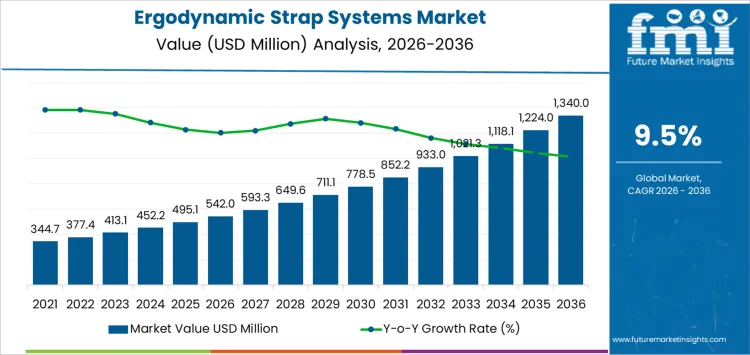
The ergodynamic strap systems market was valued at USD 0.542 billion in 2025, projected to reach USD 0.5935 billion in 2026, and is forecast to expand to USD 1.47 billion by 2036 at a 9.5% CAGR. Occupational Health Regulation Enforcement mandates and advancing operational specifications are reshaping procurement priorities across global end-use sectors. What were once discretionary performance investments are becoming non-negotiable compliance and operational baseline requirements across primary buyer segments.
Summary of Ergodynamic Strap Systems Market
- Market Snapshot
- The ergodynamic strap systems market is valued at USD 0.542 billion in 2025 and is projected to reach USD 1.47 billion by 2036.
- The industry is expected to grow at a 9.5% CAGR from 2026 to 2036, creating an incremental opportunity of USD 0.88 billion.
- The market operates as a specification-driven, compliance-sensitive category where regulatory alignment, performance verification, and supply chain qualification define competitive positioning.
- Demand and Growth Drivers
- Occupational Health Regulation Enforcement is generating sustained procurement demand as end-use operators require verified performance against established compliance and operational standards.
- E-commerce Fulfilment Centre Expansion is expanding the addressable volume base as infrastructure investment and sector growth programs accelerate adoption in high-growth markets.
- Regulatory and institutional procurement specification evolution is shifting buyer criteria toward qualified, certified product and service providers.
- Among key countries, India at 11.5%, China at 10.8%, USA at 8.5% lead growth, while Germany at 7.5%, Brazil at 7.2%, Japan at 4.5% reflect mature market replacement demand patterns.
- Product and Segment View
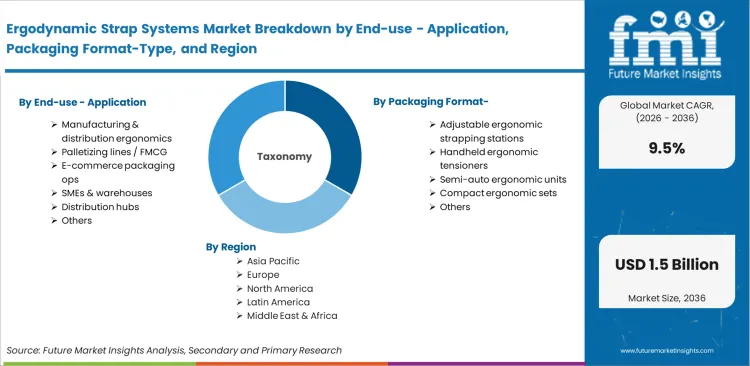
- The market encompasses Manufacturing & distribution ergonomics, Palletizing lines / FMCG, E-commerce packaging ops and related configurations serving diverse technical and institutional procurement requirements.
- Manufacturing & distribution ergonomics is poised to lead by End-use / Application with 40% share in 2026, supported by established adoption patterns and concentrated procurement volumes in primary end-use channels.
- Adjustable ergonomic strapping stations is estimated to command the leading position by Packaging Format / Type with 50% share in 2026, anchored by the largest institutional procurement segment with the most concentrated recurring demand volumes.
- The scope covers Manufacturing & distribution ergonomics, Palletizing lines / FMCG, E-commerce packaging ops, SMEs & warehouses and related configurations, while excluding unrelated product categories and non-core technical formats.
- Geography and Competitive Outlook
- India and China are the fastest-growing markets, driven by regulatory program expansion, infrastructure investment, and new institutional procurement demand.
- Europe and North America represent high-value mature demand bases sustained by replacement procurement, performance upgrade cycles, and compliance-driven investment.
- Competition is shaped by product qualification status, regulatory certification depth, and technical service infrastructure serving buyer specification and validation requirements.
- Key companies active in this market include Mosca, Signode, Local OEMs, UFlex (partners), Tsubaki.
Ergodynamic Strap Systems Market Key Takeaways
| Metric | Details |
|---|---|
| Industry Size (2026) | USD 0.5935 billion |
| Industry Value (2036) | USD 1.47 billion |
| CAGR (2026-2036) | 9.5% |
| Source | Future Market Insights, 2026 |
The absolute dollar increment from 2026 to 2036 reaches USD 0.88 billion, the highest CAGR in this batch at 9.5%, reflecting the early-stage market development dynamic where penetration of ergodynamic tool alternatives into the installed base of conventional strapping equipment is only beginning across the large warehousing and distribution footprint in Asia Pacific. E-commerce fulfilment centre proliferation in India and China is generating large-scale strapping operation volumes where ergonomic tool specification is becoming a standard element of facility fit-out rather than a post-commissioning upgrade, accelerating adoption among new-build facilities that represent a disproportionate share of global strapping equipment procurement.
Regional growth patterns diverge across the forecast period. India advances at a 11.5% CAGR, China advances at a 10.8% CAGR, USA advances at a 8.5% CAGR, driven by industrial investment, regulatory program expansion, and institutional procurement growth. Germany tracks at 7.5%, Brazil tracks at 7.2%, Japan tracks at 4.5%, reflecting established market infrastructure and replacement cycle dynamics. The full country CAGR breakdown spans: India at 11.5%, China at 10.8%, USA at 8.5%, Germany at 7.5%, Brazil at 7.2%, Japan at 4.5%.
Ergodynamic Strap Systems Market Definition
Ergodynamic strap systems are purpose-engineered packaging and securing tool platforms designed to reduce operator musculoskeletal strain during repetitive strapping operations in warehousing, distribution, manufacturing, and e-commerce fulfilment environments. These systems incorporate tension-assist mechanisms, motorised feed and auto-feed technologies, quick-adjust ratchet configurations, and ergonomically profiled grip surfaces that reduce the wrist torque, shoulder load, and grip force required to achieve specified strap tension across polypropylene, recycled polypropylene, and lightweight composite strap materials. The integration of ergonomic design principles into strapping station and handheld tensioner formats addresses occupational health compliance requirements and productivity improvement objectives simultaneously, making ergodynamic strap systems a convergent workplace safety and operational efficiency investment rather than a pure packaging consumable.
Ergodynamic Strap Systems Market Inclusions
The report covers global and regional market sizing for ergodynamic strap systems segmented by end-use application, packaging format and type, strap material, and tension-assist technology configuration. Forecast data spans 2026 to 2036 encompassing adjustable strapping stations, handheld ergonomic tensioners, semi-automatic units, and compact sets across manufacturing, FMCG, e-commerce, warehouse, and distribution hub applications.
Ergodynamic Strap Systems Market Exclusions
The scope excludes conventional non-ergonomic strapping tools and tensioners that do not incorporate musculoskeletal load reduction design features, fully automated strapping machines that eliminate operator physical interaction with the strapping process, and strap consumable materials marketed independently without associated ergodynamic tooling systems. General material handling ergonomic equipment not specific to strapping operations falls outside the analytical boundary.
Ergodynamic Strap Systems Market Research Methodology
- Primary Research: FMI analysts conducted structured interviews with procurement decision-makers, product managers, clinical specialists, and technical leads across the ergodynamic strap systems value chain to capture first-hand market intelligence on pricing dynamics, procurement cycles, and demand factors not available through public data sources.
- Desk Research: Secondary data collection aggregated regulatory filings, government procurement records, trade association publications, peer-reviewed research, and verified company disclosures including annual reports, earnings call transcripts, and official press releases from institutional sources.
- Market-Sizing and Forecasting: Market values are derived through a hybrid bottom-up and top-down methodology combining supply-side production and shipment data with demand-side consumption analysis. Regional forecasts apply segment-specific growth rate inputs validated against macroeconomic and sector activity benchmarks sourced from multilateral organisations and government statistical agencies.
- Data Validation and Update Cycle: All primary findings are cross-validated against secondary sources and quantitative benchmarks. Model projections are stress-tested through scenario analysis incorporating regulatory, macroeconomic, and supply chain risk variables. Outputs are reviewed on a defined cycle aligned with material market developments.
How Is Demand Evolving for Ergodynamic Strap Systems Across Industrial Applications?
Initial demand for ergodynamic strap systems developed as employers addressed rising injury claims linked to repetitive lifting, load restraint, and manual fastening tasks. Conventional straps placed uneven stress on shoulders, wrists, and lower backs, particularly in high frequency warehouse and transport operations. Early adoption focused on distribution centres, manufacturing plants, and construction sites where injury related downtime affected output and insurance costs. Historical growth reflected greater attention to workplace ergonomics, formal risk assessments, and compliance with occupational health guidelines. Procurement decisions prioritised durability, adjustability, and ease of use rather than system integration. Uptake progressed gradually, shaped by budget constraints and the need to retrofit improved straps into established handling routines.
Future demand for ergodynamic strap systems is expected to follow operational restructuring rather than injury response alone. Labour shortages and rising productivity expectations are pushing firms to redesign manual workflows to reduce physical effort per task. Strap systems are increasingly evaluated for their role in throughput consistency, task standardisation, and worker retention. Product development focuses on adaptive tension control, modular components, and compatibility with semi-automated handling equipment. Compared with earlier growth driven by injury reduction, future expansion reflects workforce optimisation and cost control. Adoption is likely to broaden among mid-sized operators as performance metrics replace reactive safety spending as the primary purchasing driver.
What Factors Are Affecting the Demand for Ergodynamic Strap Systems Market in Terms of End Use Application and Packaging Format and Type?
Demand for ergodynamic strap systems is structured by end use application and packaging format and type across material handling and packaging environments. Manufacturing and distribution ergonomics account for about 40% of total demand, reflecting emphasis on worker safety and repetitive task reduction. Palletizing lines within FMCG operations contribute around 30% due to high throughput strapping requirements. E commerce packaging operations, SMEs, warehouses, and distribution hubs represent additional application areas with varying scale and automation levels. Packaging format and type influence how ergonomic systems are deployed, adjusted, and integrated. Adjustable stations, handheld tensioners, semi-automated units, and compact sets address different operational constraints. These segments explain demand formation based on labor intensity, injury risk, and workflow design rather than discretionary equipment upgrades.
What Drives Demand by End Use Application in the Ergodynamic Strap Systems Market?
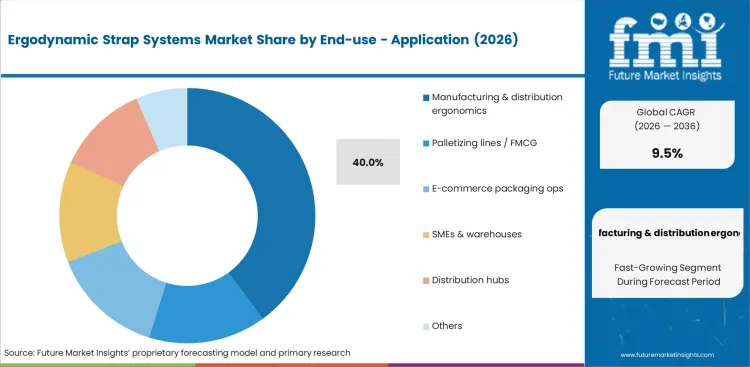
Manufacturing and distribution ergonomics lead demand due to continuous manual strapping and lifting activities. These environments prioritize reducing strain injuries and maintaining consistent productivity across shifts. Palletizing lines in FMCG operations adopt ergonomic strap systems to manage repetitive motions under high volume conditions. E commerce packaging operations require flexible solutions to handle variable parcel sizes and rapid order cycles. SMEs and warehouses focus on ergonomic improvements that do not require full automation investment. Distribution hubs emphasize throughput stability and worker endurance. Adoption intensity correlates with labor exposure and regulatory oversight related to workplace safety. End use demand concentrates where physical strain directly affects operational continuity, absenteeism, and compliance across packaging and logistics functions.
Application driven demand remains steady because ergonomic risks persist regardless of production cycles. Manufacturing facilities embed ergonomic strapping into standard operating procedures. FMCG palletizing lines rely on consistent strapping speed and reduced fatigue. E commerce facilities value adaptability due to fluctuating order profiles. Smaller warehouses adopt compact solutions aligned with space and budget constraints. Distribution hubs apply systems selectively in high intensity zones. These usage patterns limit short term volatility. End use segmentation highlights structural dependence on human operated strapping tasks. Demand therefore aligns with workforce exposure and handling frequency rather than technology novelty. This structure sustains recurring investment in ergonomic systems across diverse handling environments.
How Does Packaging Format and Type Shape Demand for Ergodynamic Strap Systems Market?
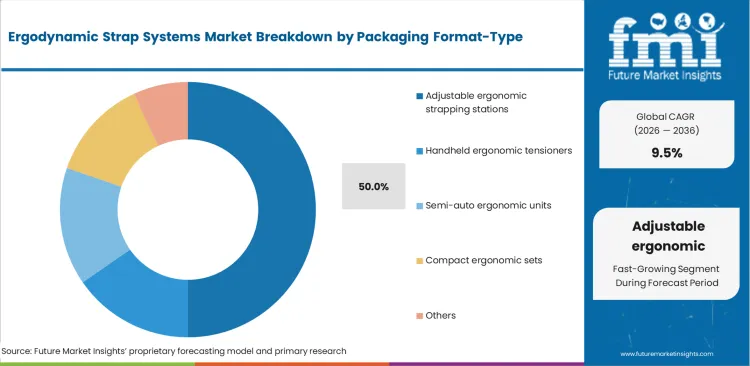
Adjustable ergonomic strapping stations account for about 50% of total demand, making them the leading packaging format. Their adoption reflects suitability for fixed workstations and high repetition tasks. Handheld ergonomic tensioners represent about 30% of demand, supporting mobile and low volume operations. Semi-automated ergonomic units are used where partial automation balances cost and productivity. Compact ergonomic sets serve SMEs and constrained warehouse environments. Other formats address specialized or transitional needs. Packaging format selection depends on task frequency, workspace layout, and operator rotation. Demand follows practical deployment considerations rather than advanced mechanical complexity across manufacturing, warehousing, and distribution settings.
Adjustable stations maintain leadership due to stability and customization for operator height and load type. Handheld tensioners remain relevant for flexibility and minimal installation requirements. Semi-automated units reduce manual effort without full line integration. Compact sets provide entry level ergonomic improvements. Format choice reflects existing workflow and capital tolerance. Organizations avoid formats requiring major layout changes or extended downtime. This constrains rapid shifts in adoption. Packaging format and type therefore stabilize demand by aligning with established strapping practices. These constraints explain why proven ergonomic formats dominate demand rather than experimental or highly automated alternatives.
How Are Ergodynamic Strap Systems Being Applied Across Packaging and Material Handling Operations?
Use appears in environments where repetitive strapping tasks impact worker safety and operational efficiency. Warehouses adopt ergodynamic strap systems to reduce strain during pallet bundling and shipping preparation. Logistics operators apply them on high volume packing lines to maintain consistent tension while minimizing fatigue. Manufacturing plants use ergonomic designs to improve speed and accuracy in strapping irregularly shaped products. These applications reflect operational needs focused on injury reduction, process consistency, and worker comfort rather than purely material containment.
What Operational Conditions Encourage Adoption of Ergodynamic Strap Systems?
Selection aligns with facilities prioritizing repetitive motion efficiency and workforce safety. Operators value tools that distribute load evenly to prevent strain during continuous use. Packaging teams adopt systems compatible with existing automated or semi-automated strapping lines to maintain throughput. Safety managers integrate ergonomic features to comply with occupational health regulations. Training requirements are minimized due to intuitive handle design and tension feedback. These conditions arise from operational efficiency, workforce protection, and compliance requirements in high frequency strapping environments.
Which Practical Considerations Shape Limits on Wider Use of Ergodynamic Strap Systems?
Equipment cost and compatibility influence adoption across facilities with varying budgets. Existing strapping machines may require modification to accommodate new ergonomically designed units. Staff familiarity with conventional systems may reduce initial uptake. Maintenance requirements for tension control mechanisms add operational complexity. Limited availability of specific strap widths or materials can restrict application. These factors result in selective deployment where worker safety, throughput improvement, and regulatory alignment justify incremental investment and process adjustment.
What is the Demand for Ergodynamic Strap Systems by Country?
.webp "Top Country Growth Comparison Ergodynamic Strap Systems Market Cagr (2026 2036)")
| Country | CAGR (%) |
|---|---|
| Germany | 7.5% |
| USA | 8.5% |
| China | 10.8% |
| India | 11.5% |
| Brazil | 7.2% |
| Japan | 4.5% |
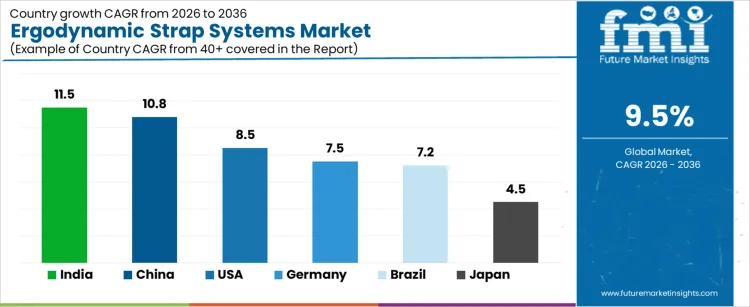
The demand for ergodynamic strap systems varies across countries, driven by industrial automation, packaging ergonomics, and labor safety requirements. India leads with an 11.5% CAGR, supported by rapid growth in manufacturing, logistics, and high adoption of ergonomic packaging solutions. China follows at 10.8%, driven by large scale production, automation in packaging lines, and efficiency optimization. The USA grows at 8.5%, reflecting adoption across industrial operations, transport, and warehouse logistics. Germany records 7.5%, shaped by structured industrial standards and labor safety initiatives. Brazil posts 7.2%, supported by expanding manufacturing and logistics sectors, while Japan grows at 4.5%, reflecting mature operations and steady demand for ergonomic strap systems.
How Is Advanced Packaging Ergonomics Driving Growth in Germany?
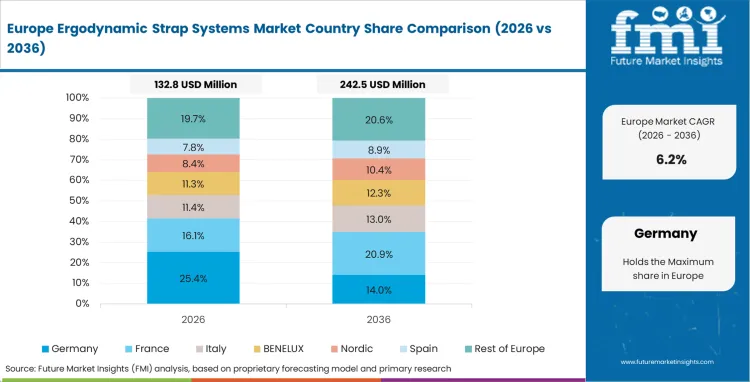
In Germany, revenue from the Ergodynamic Strap Systems Market is expanding at a CAGR of 7.50% through 2036, driven by adoption of ergonomically designed strap systems to improve handling efficiency, worker safety, and load stability in logistics and industrial packaging. Manufacturers are integrating ergodynamic straps for beverage, consumer goods, and bulk product shipments. Demand is concentrated in industrial, food, and retail distribution channels. Domestic suppliers are providing straps with reinforced materials and optimized tension for consistent performance. Structured supply chains and safety compliance practices are sustaining predictable procurement across packaging operations nationwide.
- Beverage, consumer goods, and bulk product manufacturers adopt ergodynamic strap systems for improved handling efficiency
- Reinforced strap designs support load stability and worker safety
- Domestic suppliers provide optimized tension and durable materials
- Compliance with industrial safety standards sustains predictable procurement
How Is Packaging Efficiency Driving Demand in the United States?
The United States is experiencing growth in the Ergodynamic Strap Systems Market at a CAGR of 8.50% through 2036, supported by the need for ergonomic and efficient packaging solutions across logistics and industrial sectors. Manufacturers are integrating ergodynamic straps for beverage, food, and personal care product shipments to reduce handling fatigue and prevent damage. Demand is concentrated in high-volume packaging operations and retail distribution centers. Domestic suppliers are supplying reinforced and adjustable strap systems compatible with automated strapping equipment. Stable shipment volumes and recurring packaging operations are sustaining consistent procurement nationwide.
- Beverage, food, and personal care brands adopt ergodynamic strap systems to reduce handling fatigue
- Reinforced and adjustable straps improve load stability and operational efficiency
- Domestic suppliers provide solutions compatible with automated strapping equipment
- Recurring packaging operations sustain predictable procurement volumes
How Is Logistics and Manufacturing Expansion Accelerating Adoption in China?
In China, revenue from the Ergodynamic Strap Systems Market is growing at a CAGR of 10.80% through 2036, driven by the rapid expansion of logistics networks and high-volume packaging operations. Manufacturers are adopting ergodynamic strap systems for beverage, consumer electronics, and industrial goods shipments to improve handling safety and reduce strain on workers. Demand is strong across industrial, e-commerce, and retail distribution channels. Domestic suppliers are scaling production of reinforced straps and optimized ergonomic designs. High throughput operations and structured procurement practices are sustaining rapid adoption nationwide.
- Expansion of logistics and industrial packaging drives demand for ergodynamic strap systems
- Beverage, electronics, and industrial shipments are primary applications
- Domestic suppliers scale production of reinforced and ergonomically optimized straps
- High throughput operations sustain consistent procurement
How Is Organized Manufacturing Supporting Growth in India?
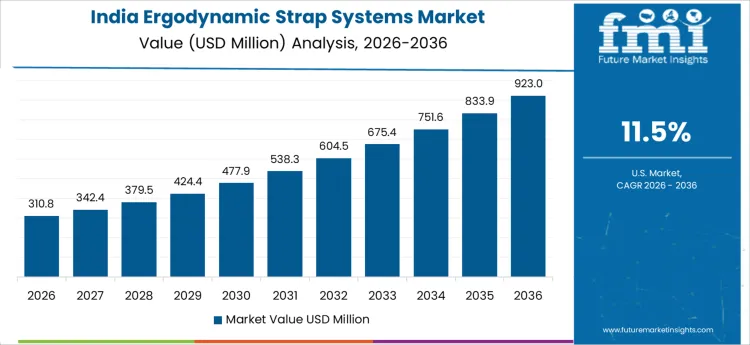
India is witnessing strong expansion in the Ergodynamic Strap Systems Market at a CAGR of 11.50% through 2036, supported by growth in organized manufacturing and logistics operations. Manufacturers are integrating ergodynamic strap systems for beverages, packaged foods, and consumer goods to improve handling efficiency and worker safety. Demand is rising across urban retail distribution, industrial logistics, and e-commerce channels. Domestic suppliers are providing cost-aligned, reinforced strap systems suited for high-volume operations. Expanding industrial output and structured logistics are sustaining robust procurement nationwide.
- Organized manufacturing increases demand for ergodynamic strap systems
- Beverage, packaged food, and consumer goods shipments drive high-volume usage
- Domestic suppliers provide cost-aligned reinforced strap solutions
- Industrial and logistics expansion sustains predictable procurement
How Are Consumer Goods Shipments Supporting Adoption in Brazil?
Brazil is seeing steady growth in the Ergodynamic Strap Systems Market at a CAGR of 7.20% through 2036, supported by rising distribution of consumer goods and packaged products. Manufacturers are using ergodynamic strap systems to ensure handling safety, reduce worker fatigue, and maintain load stability during transit. Demand is concentrated in organized retail and regional distribution hubs. Domestic suppliers are expanding production of reinforced and ergonomically designed strap systems. Growth in retail networks and consumer goods shipments is sustaining recurring procurement nationwide.
- Consumer goods and packaged product shipments drive adoption of ergodynamic strap systems
- Ergonomic and reinforced strap designs improve worker safety and load stability
- Domestic suppliers expand production capacity for high-volume packaging
- Retail and distribution growth sustains recurring procurement
How Does Mature Packaging Demand Influence Stability in Japan?
Japan is maintaining measured growth in the Ergodynamic Strap Systems Market at a CAGR of 4.50% through 2036, supported by mature industrial and retail packaging markets and selective adoption of ergonomic solutions. Brands apply ergodynamic strap systems for beverages, packaged foods, and industrial shipments. Demand remains focused on strap durability, tension control, and ease of handling. Domestic suppliers emphasize precise strap design and consistent material quality. Stable consumption patterns and replacement-driven purchasing are sustaining predictable procurement across established packaging operations nationwide.
- Mature industrial and retail markets favor selective adoption of ergodynamic strap systems
- Beverage, packaged foods, and industrial shipments anchor baseline demand
- Domestic suppliers ensure precise strap design and consistent material quality
- Replacement-driven purchasing sustains procurement continuity
Which Companies Are Shaping Competition in the Ergodynamic Strap Systems Market Across Industrial Packaging and Material Handling Environments?
Competition in the Ergodynamic Strap Systems Market is anchored by established strapping system manufacturers that emphasize operator safety, mechanical efficiency, and repeatable load control. Mosca and Signode play a central role through ergonomically designed strapping machines and systems tailored for high throughput industrial settings. Their offerings focus on reducing manual strain, improving tension consistency, and integrating with automated or semi-automated packaging lines. These companies benefit from long term relationships with manufacturing, logistics, and warehousing customers where workplace safety standards influence equipment selection. Product differentiation is driven by system reliability, ease of operator interaction, and compatibility with existing end of line equipment rather than feature density or digital add ons.
Local OEMs contribute materially to competitive dynamics by addressing regional operating conditions and customer specific requirements. In Asia and parts of Europe, manufacturers such as Tsubaki support ergodynamic strap applications through mechanical components and motion control solutions integrated into packaging systems. UFlex participates through partnerships, supplying strapping materials and collaborating with equipment providers rather than manufacturing full systems independently. Regional OEMs often compete on customization, service responsiveness, and pricing flexibility, particularly for medium scale users. Competitive positioning across the market reflects practical considerations such as maintenance simplicity, operator training time, and adaptability to diverse load formats. Entry barriers are shaped by mechanical design expertise, safety compliance, and customer validation cycles rather than capital intensity.
Key Players in the Ergodynamic Strap Systems Market
- Mosca
- Signode
- Local OEMs
- UFlex (partners)
- Tsubaki
Scope of the Report
| Metric | Value |
|---|---|
| Quantitative Units | USD 0.5935 billion to USD 1.47 billion, at a CAGR of 9.5% |
| Market Definition | Ergodynamic strap systems are purpose-engineered packaging and securing tool platforms designed to reduce operator musculoskeletal strain during repetitive strapping operations in warehousing, distribution, manufacturing... |
| End-use / Application Segmentation | Manufacturing & distribution ergonomics, Palletizing lines / FMCG, E-commerce packaging ops, SMEs & warehouses, Distribution hubs, Others |
| Packaging Format / Type Segmentation | Adjustable ergonomic strapping stations, Handheld ergonomic tensioners, Semi-auto ergonomic units, Compact ergonomic sets, Others |
| Material Segmentation | Lightweight composite straps, PP / rPP straps, Recycled poly straps, Others |
| Technology Segmentation | Tension-assist + auto-feed mechanisms, Motorized feed & quick-tension, Quick-adjust ratchet systems, Assistive tension levers, Others |
| Regions Covered | North America, Latin America, Europe, East Asia, South Asia, Oceania, Middle East & Africa |
| Countries Covered | India, China, USA, Germany, Brazil, Japan, and 40 plus countries |
| Key Companies Profiled | Mosca, Signode, Local OEMs, UFlex (partners), Tsubaki |
| Forecast Period | 2026 to 2036 |
| Approach | Hybrid bottom-up and top-down forecasting model validated against primary research and public institutional data sources |
Ergodynamic Strap Systems Market Segmentation
End-use / Application:
- Manufacturing & distribution ergonomics
- Palletizing lines / FMCG
- E-commerce packaging ops
- SMEs & warehouses
- Distribution hubs
- Others
Packaging Format / Type:
- Adjustable ergonomic strapping stations
- Handheld ergonomic tensioners
- Semi-auto ergonomic units
- Compact ergonomic sets
- Others
Material:
- Lightweight composite straps
- PP / rPP straps
- Recycled poly straps
- Others
Technology:
- Tension-assist + auto-feed mechanisms
- Motorized feed & quick-tension
- Quick-adjust ratchet systems
- Assistive tension levers
- Others
Region
- Asia Pacific
- China
- Japan
- South Korea
- India
- Australia & New Zealand
- ASEAN
- Rest of Asia Pacific
- Europe
- Germany
- United Kingdom
- France
- Italy
- Spain
- Nordic
- BENELUX
- Rest of Europe
- North America
- United States
- Canada
- Mexico
- Latin America
- Brazil
- Chile
- Rest of Latin America
- Middle East & Africa
- Kingdom of Saudi Arabia
- Other GCC Countries
- Turkey
- South Africa
- Other African Union
- Rest of Middle East & Africa
Bibliography
- 1. World Health Organization. (2025). World Health Statistics 2025. WHO Press.
- 2. Organisation for Economic Co-operation and Development. (2025). OECD Economic Outlook 2025. OECD Publishing.
- 3. World Bank Group. (2025). World Development Indicators 2025. World Bank Open Data.
- 4. International Energy Agency. (2025). Energy Technology Perspectives 2025. IEA Publications.
- 5. United Nations Industrial Development Organization. (2025). Industrial Development Report 2025. UNIDO.
- 6. European Commission. (2025). European Industrial Strategy Progress Report 2025. European Commission.
- 7. International Atomic Energy Agency. (2025). Nuclear Technology Review 2025. IAEA.
This bibliography is provided for reader reference. The full Future Market Insights report contains the complete reference list with primary research documentation.
Frequently Asked Questions
How large is the demand for Ergodynamic Strap Systems in the global market in 2026?
Demand for ergodynamic strap systems in the global market is estimated to be valued at USD 0.5935 billion in 2026.
What will the market size of Ergodynamic Strap Systems be by 2036?
The ergodynamic strap systems market is projected to reach USD 1.47 billion by 2036, reflecting sustained demand growth across primary end-use segments throughout the forecast period.
What is the expected CAGR for the Ergodynamic Strap Systems market between 2026 and 2036?
The ergodynamic strap systems market is expected to grow at a CAGR of 9.5% between 2026 and 2036, creating an incremental opportunity of USD 0.88 billion.
Which End-use / Application segment leads global sales in 2026?
Manufacturing & distribution ergonomics accounts for 40% share in 2026, supported by established adoption patterns and concentrated institutional procurement demand.
Which Packaging Format / Type leads in the Ergodynamic Strap Systems market?
Adjustable ergonomic strapping stations holds 50% share by packaging format / type in 2026, reflecting its position as the primary procurement driver with the most concentrated recurring demand volumes.
Which country records the fastest growth in the Ergodynamic Strap Systems market?
India records the highest CAGR at 11.5% through 2036, driven by occupational health regulation enforcement and expanding institutional procurement activity.
What does FMI forecast for the Ergodynamic Strap Systems market through 2036?
As per FMI analysis, the ergodynamic strap systems market is forecast to grow from USD 0.5935 billion in 2026 to USD 1.47 billion by 2036, driven by occupational health regulation enforcement and e-commerce fulfilment centre expansion.
Preview the report firsthand - request a free sample
Get SampleGet the brochure for pricing and purchase details.
Get PDFTable of Content
- Executive Summary
- Global Market Outlook
- Demand-side Trends
- Supply-side Trends
- Technology Roadmap Analysis
- Analysis and Recommendations
- Market Overview
- Market Coverage / Taxonomy
- Market Definition / Scope / Limitations
- Research Methodology
- Chapter Orientation
- Analytical Lens and Working Hypotheses
- Market Structure, Signals, and Trend Drivers
- Benchmarking and Cross-market Comparability
- Market Sizing, Forecasting, and Opportunity Mapping
- Research Design and Evidence Framework
- Desk Research Programme (Secondary Evidence)
- Company Annual and Sustainability Reports
- Peer-reviewed Journals and Academic Literature
- Corporate Websites, Product Literature, and Technical Notes
- Earnings Decks and Investor Briefings
- Statutory Filings and Regulatory Disclosures
- Technical White Papers and Standards Notes
- Trade Journals, Industry Magazines, and Analyst Briefs
- Conference Proceedings, Webinars, and Seminar Materials
- Government Statistics Portals and Public Data Releases
- Press Releases and Reputable Media Coverage
- Specialist Newsletters and Curated Briefings
- Sector Databases and Reference Repositories
- FMI Internal Proprietary Databases and Historical Market Datasets
- Subscription Datasets and Paid Sources
- Social Channels, Communities, and Digital Listening Inputs
- Additional Desk Sources
- Expert Input and Fieldwork (Primary Evidence)
- Primary Modes
- Qualitative Interviews and Expert Elicitation
- Quantitative Surveys and Structured Data Capture
- Blended Approach
- Why Primary Evidence is Used
- Field Techniques
- Interviews
- Surveys
- Focus Groups
- Observational and In-context Research
- Social and Community Interactions
- Stakeholder Universe Engaged
- C-suite Leaders
- Board Members
- Presidents and Vice Presidents
- R&D and Innovation Heads
- Technical Specialists
- Domain Subject-matter Experts
- Scientists
- Physicians and Other Healthcare Professionals
- Governance, Ethics, and Data Stewardship
- Research Ethics
- Data Integrity and Handling
- Primary Modes
- Tooling, Models, and Reference Databases
- Desk Research Programme (Secondary Evidence)
- Data Engineering and Model Build
- Data Acquisition and Ingestion
- Cleaning, Normalisation, and Verification
- Synthesis, Triangulation, and Analysis
- Quality Assurance and Audit Trail
- Market Background
- Market Dynamics
- Drivers
- Restraints
- Opportunity
- Trends
- Scenario Forecast
- Demand in Optimistic Scenario
- Demand in Likely Scenario
- Demand in Conservative Scenario
- Opportunity Map Analysis
- Product Life Cycle Analysis
- Supply Chain Analysis
- Investment Feasibility Matrix
- Value Chain Analysis
- PESTLE and Porter’s Analysis
- Regulatory Landscape
- Regional Parent Market Outlook
- Production and Consumption Statistics
- Import and Export Statistics
- Market Dynamics
- Global Market Analysis 2021 to 2025 and Forecast, 2026 to 2036
- Historical Market Size Value (USD Million) Analysis, 2021 to 2025
- Current and Future Market Size Value (USD Million) Projections, 2026 to 2036
- Y-o-Y Growth Trend Analysis
- Absolute $ Opportunity Analysis
- Global Market Pricing Analysis 2021 to 2025 and Forecast 2026 to 2036
- Global Market Analysis 2021 to 2025 and Forecast 2026 to 2036, By End-use / Application
- Introduction / Key Findings
- Historical Market Size Value (USD Million) Analysis By End-use / Application , 2021 to 2025
- Current and Future Market Size Value (USD Million) Analysis and Forecast By End-use / Application , 2026 to 2036
- Manufacturing & distribution ergonomics
- Palletizing lines / FMCG
- E-commerce packaging ops
- SMEs & warehouses
- Distribution hubs
- Others
- Manufacturing & distribution ergonomics
- Y-o-Y Growth Trend Analysis By End-use / Application , 2021 to 2025
- Absolute $ Opportunity Analysis By End-use / Application , 2026 to 2036
- Global Market Analysis 2021 to 2025 and Forecast 2026 to 2036, By Packaging Format / Type
- Introduction / Key Findings
- Historical Market Size Value (USD Million) Analysis By Packaging Format / Type, 2021 to 2025
- Current and Future Market Size Value (USD Million) Analysis and Forecast By Packaging Format / Type, 2026 to 2036
- Adjustable ergonomic strapping stations
- Handheld ergonomic tensioners
- Semi-auto ergonomic units
- Compact ergonomic sets
- Others
- Adjustable ergonomic strapping stations
- Y-o-Y Growth Trend Analysis By Packaging Format / Type, 2021 to 2025
- Absolute $ Opportunity Analysis By Packaging Format / Type, 2026 to 2036
- Global Market Analysis 2021 to 2025 and Forecast 2026 to 2036, By Material
- Introduction / Key Findings
- Historical Market Size Value (USD Million) Analysis By Material, 2021 to 2025
- Current and Future Market Size Value (USD Million) Analysis and Forecast By Material, 2026 to 2036
- Lightweight composite straps
- PP / rPP straps
- Recycled poly straps
- Others
- Lightweight composite straps
- Y-o-Y Growth Trend Analysis By Material, 2021 to 2025
- Absolute $ Opportunity Analysis By Material, 2026 to 2036
- Global Market Analysis 2021 to 2025 and Forecast 2026 to 2036, By Technology
- Introduction / Key Findings
- Historical Market Size Value (USD Million) Analysis By Technology, 2021 to 2025
- Current and Future Market Size Value (USD Million) Analysis and Forecast By Technology, 2026 to 2036
- Tension-assist + auto-feed mechanisms
- Motorized feed & quick-tension
- Quick-adjust ratchet systems
- Assistive tension levers
- Others
- Tension-assist + auto-feed mechanisms
- Y-o-Y Growth Trend Analysis By Technology, 2021 to 2025
- Absolute $ Opportunity Analysis By Technology, 2026 to 2036
- Global Market Analysis 2021 to 2025 and Forecast 2026 to 2036, By Region
- Introduction
- Historical Market Size Value (USD Million) Analysis By Region, 2021 to 2025
- Current Market Size Value (USD Million) Analysis and Forecast By Region, 2026 to 2036
- North America
- Latin America
- Western Europe
- Eastern Europe
- East Asia
- South Asia and Pacific
- Middle East & Africa
- Market Attractiveness Analysis By Region
- North America Market Analysis 2021 to 2025 and Forecast 2026 to 2036, By Country
- Historical Market Size Value (USD Million) Trend Analysis By Market Taxonomy, 2021 to 2025
- Market Size Value (USD Million) Forecast By Market Taxonomy, 2026 to 2036
- By Country
- USA
- Canada
- Mexico
- By End-use / Application
- By Packaging Format / Type
- By Material
- By Technology
- By Country
- Market Attractiveness Analysis
- By Country
- By End-use / Application
- By Packaging Format / Type
- By Material
- By Technology
- Key Takeaways
- Latin America Market Analysis 2021 to 2025 and Forecast 2026 to 2036, By Country
- Historical Market Size Value (USD Million) Trend Analysis By Market Taxonomy, 2021 to 2025
- Market Size Value (USD Million) Forecast By Market Taxonomy, 2026 to 2036
- By Country
- Brazil
- Chile
- Rest of Latin America
- By End-use / Application
- By Packaging Format / Type
- By Material
- By Technology
- By Country
- Market Attractiveness Analysis
- By Country
- By End-use / Application
- By Packaging Format / Type
- By Material
- By Technology
- Key Takeaways
- Western Europe Market Analysis 2021 to 2025 and Forecast 2026 to 2036, By Country
- Historical Market Size Value (USD Million) Trend Analysis By Market Taxonomy, 2021 to 2025
- Market Size Value (USD Million) Forecast By Market Taxonomy, 2026 to 2036
- By Country
- Germany
- UK
- Italy
- Spain
- France
- Nordic
- BENELUX
- Rest of Western Europe
- By End-use / Application
- By Packaging Format / Type
- By Material
- By Technology
- By Country
- Market Attractiveness Analysis
- By Country
- By End-use / Application
- By Packaging Format / Type
- By Material
- By Technology
- Key Takeaways
- Eastern Europe Market Analysis 2021 to 2025 and Forecast 2026 to 2036, By Country
- Historical Market Size Value (USD Million) Trend Analysis By Market Taxonomy, 2021 to 2025
- Market Size Value (USD Million) Forecast By Market Taxonomy, 2026 to 2036
- By Country
- Russia
- Poland
- Hungary
- Balkan & Baltic
- Rest of Eastern Europe
- By End-use / Application
- By Packaging Format / Type
- By Material
- By Technology
- By Country
- Market Attractiveness Analysis
- By Country
- By End-use / Application
- By Packaging Format / Type
- By Material
- By Technology
- Key Takeaways
- East Asia Market Analysis 2021 to 2025 and Forecast 2026 to 2036, By Country
- Historical Market Size Value (USD Million) Trend Analysis By Market Taxonomy, 2021 to 2025
- Market Size Value (USD Million) Forecast By Market Taxonomy, 2026 to 2036
- By Country
- China
- Japan
- South Korea
- By End-use / Application
- By Packaging Format / Type
- By Material
- By Technology
- By Country
- Market Attractiveness Analysis
- By Country
- By End-use / Application
- By Packaging Format / Type
- By Material
- By Technology
- Key Takeaways
- South Asia and Pacific Market Analysis 2021 to 2025 and Forecast 2026 to 2036, By Country
- Historical Market Size Value (USD Million) Trend Analysis By Market Taxonomy, 2021 to 2025
- Market Size Value (USD Million) Forecast By Market Taxonomy, 2026 to 2036
- By Country
- India
- ASEAN
- Australia & New Zealand
- Rest of South Asia and Pacific
- By End-use / Application
- By Packaging Format / Type
- By Material
- By Technology
- By Country
- Market Attractiveness Analysis
- By Country
- By End-use / Application
- By Packaging Format / Type
- By Material
- By Technology
- Key Takeaways
- Middle East & Africa Market Analysis 2021 to 2025 and Forecast 2026 to 2036, By Country
- Historical Market Size Value (USD Million) Trend Analysis By Market Taxonomy, 2021 to 2025
- Market Size Value (USD Million) Forecast By Market Taxonomy, 2026 to 2036
- By Country
- Kingdom of Saudi Arabia
- Other GCC Countries
- Turkiye
- South Africa
- Other African Union
- Rest of Middle East & Africa
- By End-use / Application
- By Packaging Format / Type
- By Material
- By Technology
- By Country
- Market Attractiveness Analysis
- By Country
- By End-use / Application
- By Packaging Format / Type
- By Material
- By Technology
- Key Takeaways
- Key Countries Market Analysis
- USA
- Pricing Analysis
- Market Share Analysis, 2025
- By End-use / Application
- By Packaging Format / Type
- By Material
- By Technology
- Canada
- Pricing Analysis
- Market Share Analysis, 2025
- By End-use / Application
- By Packaging Format / Type
- By Material
- By Technology
- Mexico
- Pricing Analysis
- Market Share Analysis, 2025
- By End-use / Application
- By Packaging Format / Type
- By Material
- By Technology
- Brazil
- Pricing Analysis
- Market Share Analysis, 2025
- By End-use / Application
- By Packaging Format / Type
- By Material
- By Technology
- Chile
- Pricing Analysis
- Market Share Analysis, 2025
- By End-use / Application
- By Packaging Format / Type
- By Material
- By Technology
- Germany
- Pricing Analysis
- Market Share Analysis, 2025
- By End-use / Application
- By Packaging Format / Type
- By Material
- By Technology
- UK
- Pricing Analysis
- Market Share Analysis, 2025
- By End-use / Application
- By Packaging Format / Type
- By Material
- By Technology
- Italy
- Pricing Analysis
- Market Share Analysis, 2025
- By End-use / Application
- By Packaging Format / Type
- By Material
- By Technology
- Spain
- Pricing Analysis
- Market Share Analysis, 2025
- By End-use / Application
- By Packaging Format / Type
- By Material
- By Technology
- France
- Pricing Analysis
- Market Share Analysis, 2025
- By End-use / Application
- By Packaging Format / Type
- By Material
- By Technology
- India
- Pricing Analysis
- Market Share Analysis, 2025
- By End-use / Application
- By Packaging Format / Type
- By Material
- By Technology
- ASEAN
- Pricing Analysis
- Market Share Analysis, 2025
- By End-use / Application
- By Packaging Format / Type
- By Material
- By Technology
- Australia & New Zealand
- Pricing Analysis
- Market Share Analysis, 2025
- By End-use / Application
- By Packaging Format / Type
- By Material
- By Technology
- China
- Pricing Analysis
- Market Share Analysis, 2025
- By End-use / Application
- By Packaging Format / Type
- By Material
- By Technology
- Japan
- Pricing Analysis
- Market Share Analysis, 2025
- By End-use / Application
- By Packaging Format / Type
- By Material
- By Technology
- South Korea
- Pricing Analysis
- Market Share Analysis, 2025
- By End-use / Application
- By Packaging Format / Type
- By Material
- By Technology
- Russia
- Pricing Analysis
- Market Share Analysis, 2025
- By End-use / Application
- By Packaging Format / Type
- By Material
- By Technology
- Poland
- Pricing Analysis
- Market Share Analysis, 2025
- By End-use / Application
- By Packaging Format / Type
- By Material
- By Technology
- Hungary
- Pricing Analysis
- Market Share Analysis, 2025
- By End-use / Application
- By Packaging Format / Type
- By Material
- By Technology
- Kingdom of Saudi Arabia
- Pricing Analysis
- Market Share Analysis, 2025
- By End-use / Application
- By Packaging Format / Type
- By Material
- By Technology
- Turkiye
- Pricing Analysis
- Market Share Analysis, 2025
- By End-use / Application
- By Packaging Format / Type
- By Material
- By Technology
- South Africa
- Pricing Analysis
- Market Share Analysis, 2025
- By End-use / Application
- By Packaging Format / Type
- By Material
- By Technology
- USA
- Market Structure Analysis
- Competition Dashboard
- Competition Benchmarking
- Market Share Analysis of Top Players
- By Regional
- By End-use / Application
- By Packaging Format / Type
- By Material
- By Technology
- Competition Analysis
- Competition Deep Dive
- Mosca
- Overview
- Product Portfolio
- Profitability by Market Segments (Product/Age /Sales Channel/Region)
- Sales Footprint
- Strategy Overview
- Marketing Strategy
- Product Strategy
- Channel Strategy
- Signode
- Local OEMs
- UFlex (partners)
- Tsubaki
- Mosca
- Competition Deep Dive
- Assumptions & Acronyms Used


