

- Industry Size (2026)
- USD 313.0 Mn
- Forecast (2036)
- USD 1127.0 Mn
- CAGR (2026 to 2036)
- 13.7%
Smart Strap-Tension Monitor Market Forecast and Outlook 2026 to 2036
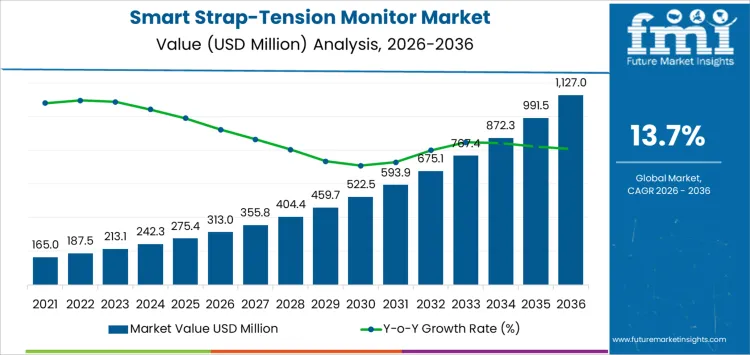
The smart strap-tension monitor market is valued at USD 313 million in 2026 and is projected to reach USD 1,127 million by 2036, reflecting a CAGR of 13.7%. Between 2026 and 2031, the market shows strong acceleration, with annual absolute additions increasing from roughly USD 46 million to USD 86 million. Early growth is driven by logistics and pallet safety applications, where strap-mounted tension sensors with IoT-enabled monitoring and real-time alerts ensure secure load handling. Adoption is supported by industrial pilots, increasing regulatory focus on transport safety, and integration of telemetry-enabled monitoring systems into existing supply chains.
From 2031 to 2036, expansion remains robust, with market value rising from approximately USD 661 million to USD 1,127 million. Absolute annual gains continue to grow, reflecting broader adoption across industrial supply chains, e-commerce logistics, and cold-chain pharmaceutical operations. Growth during this period is fueled by standardized sensor designs, improved production scalability, and cloud-enabled monitoring systems that allow repeat deployment and remote management. Relative acceleration moderates as the market matures, signaling a transition from early adoption-led growth to volume-driven expansion with sustained structural demand across multiple global logistics and supply chain segments.
Quick Stats of the Smart Strap-Tension Monitor Market:
- Smart Strap-Tension Monitor Market Value (2026): USD 313.0 million
- Smart Strap-Tension Monitor Market Forecast Value (2036): USD 1,127.0 million
- Smart Strap-Tension Monitor Market Forecast CAGR (2026 to 2036): 13.7%
- Leading Packaging Format: Strap-mounted Tension Sensors (60%)
- Key Growth Regions: India, China, USA, Brazil, Germany, Japan
- Top Players: Mosca / Signode (IoT partners), Cyklop
What is the Growth Forecast for the Smart Strap-Tension Monitor Market through 2036?
From 2026 to 2031, the smart strap-tension monitor market grows from USD 313 million to approximately USD 586 million, representing the early growth curve characterized by selective adoption in industrial, logistics, and high-precision packaging applications. Growth during this phase is driven by demand for accurate load monitoring, safety assurance, and process optimization in packaging lines. Uptake is concentrated among early adopters seeking operational efficiency and risk reduction, with annual value additions increasing steadily as sensor reliability, data integration, and system compatibility improve, enabling incremental scaling across pilot deployments.
Between 2031 and 2036, the market expands from roughly USD 586 million to USD 1,127 million, illustrating the late growth curve, where scale adoption drives value creation. Growth accelerates as smart strap-tension monitors become embedded in broader supply chains, automated logistics networks, and mass production operations. Annual value additions widen significantly as adoption spreads across multiple product lines, repeat procurement increases, and integration into real-time monitoring and predictive maintenance systems becomes standard. Earlier growth relied on niche deployment and validation, while later expansion is driven by portfolio-wide scaling, structural adoption, and consistent global usage.
Smart Strap Tension Monitor Market Key Takeaways
| Metric | Value |
|---|---|
| Sales Value (2026) | USD 313 million |
| Forecast Value (2036) | USD 1,127 million |
| Forecast CAGR (2026 to 2036) | 13.7% |
What Is Shaping the Demand Trajectory for Smart Strap Tension Monitors?
Early demand for smart strap tension monitors emerged from recurring load stability failures across freight transport, warehousing, and industrial handling operations. Manual tension checks depended heavily on operator experience, creating variation in restraint quality and documentation gaps. Logistics firms and industrial operators adopted early monitoring devices to introduce measurable tension verification during cargo securing. Historical growth aligned with stricter enforcement of load safety standards, rising freight volumes, and higher insurance scrutiny following transit damage incidents. Adoption concentrated in heavy industry, cross border logistics, and regulated transport corridors where compliance records mattered. Cost sensitivity and limited system integration restricted broader uptake, positioning early demand as risk control driven rather than efficiency focused.
Future demand for smart strap tension monitors is expected to expand through operational integration rather than isolated safety correction. Logistics networks increasingly rely on automated compliance tracking, remote monitoring, and data driven risk management. Smart tension monitors are being incorporated into connected transport systems, enabling real time alerts, audit trails, and preventive intervention. Growth will be supported by declining sensor costs, standardized digital interfaces, and rising accountability across supply chains. Unlike earlier demand shaped by accident prevention, future adoption reflects productivity management, liability reduction, and system wide visibility. Expansion into light commercial transport and last mile delivery reflects this structural shift toward continuous load condition monitoring.
What Factors Are Affecting the Demand for Smart Strap Tension Monitor Market in Terms of End Use Application and Packaging Format and Type?
Demand for smart strap tension monitors is shaped by end use application and packaging format and type across logistics and industrial transport systems. Logistics and pallet safety applications account for about 50% of total demand, reflecting the need to prevent load shifting and damage during transit. Industrial supply chains, e commerce logistics, and cold chain pharmaceutical transport represent additional application areas with different monitoring requirements. Packaging format and type determine how tension sensors are deployed, calibrated, and reused. Strap mounted sensors, inline modules, retrofittable monitors, and portable testers support varied operational settings. Together, these segments explain demand based on cargo risk exposure, handling frequency, and monitoring responsibility rather than uniform adoption across transport activities.
What Drives Demand by End Use Application in the Smart Strap Tension Monitor Market?
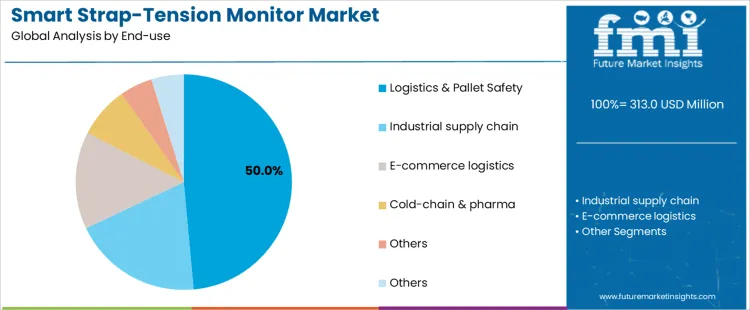
Logistics and pallet safety applications lead demand due to high exposure to load instability during road, rail, and warehouse handling. These environments require continuous monitoring to reduce cargo damage and safety incidents. Industrial supply chains adopt tension monitors to maintain consistency across repeated shipments of standardized goods. E commerce logistics rely on monitoring where parcels experience frequent handling and variable stacking conditions. Cold chain and pharmaceutical transport applies tension monitoring to protect sensitive shipments from movement during controlled temperature distribution. Adoption intensity varies with shipment value and liability exposure. End use demand is therefore concentrated where load failure risks translate into direct financial loss or safety concerns across distribution networks.
Application driven demand remains steady due to recurring transport cycles and standardized load securing practices. Logistics operators integrate monitoring into routine palletization processes rather than episodic inspections. Industrial users favor solutions that align with existing strapping systems. E commerce adoption increases where shipment density and handling frequency rise. Cold chain usage reflects compliance and product protection priorities. These patterns limit volatility in demand levels. End use segmentation highlights operational dependence on consistent load tension rather than discretionary technology uptake. As a result, demand aligns closely with transport intensity and cargo risk profiles embedded within supply chain design across sectors.
How Does Packaging Format and Type Influence Adoption in the Smart Strap Tension Monitor Market?
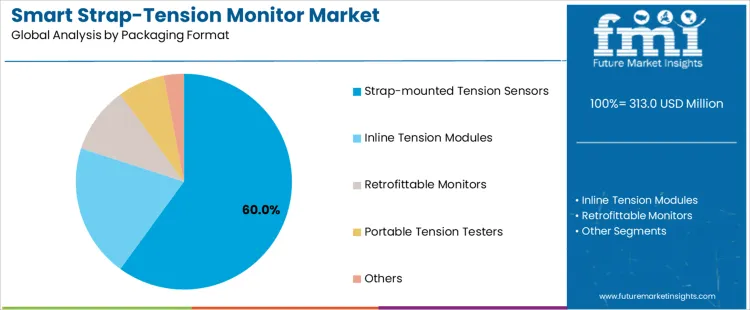
Strap mounted tension sensors account for about 60% of total demand, making them the leading packaging format. Their dominance reflects direct integration with load securing straps and real time monitoring capability. Inline tension modules are used within automated or fixed strapping systems in industrial settings. Retrofittable monitors support adoption where existing straps and equipment are already deployed. Portable tension testers are applied in inspection focused environments such as cold chain and pharmaceutical transport. Other formats address niche or transitional requirements. Packaging format selection depends on ease of installation, reuse potential, and compatibility with current strapping practices rather than sensor sophistication alone.
Strap mounted sensors maintain leadership due to minimal workflow disruption and broad applicability. Inline modules are favored where strapping operations are centralized and standardized. Retrofittable formats reduce replacement costs and support gradual adoption. Portable testers serve verification and compliance checks rather than continuous monitoring. Format choice reflects operational structure and monitoring frequency. Organizations avoid formats requiring major process changes or retraining. This constrains rapid shifts in adoption patterns. Packaging format and type therefore stabilize demand by aligning with existing load securing infrastructure. These constraints explain why simple, integrated formats retain higher penetration across logistics and industrial transport environments.
How Smart Strap Tension Monitors Are Applied, Selected, and Deployed Across Modern Logistics Workflows
How Are Smart Strap Tension Monitors Being Applied Across Packaging and Logistics Operations? Use appears in environments where strap tension impacts load stability, safety, and product integrity during transport. Logistics operators equip pallets and crates with monitors to ensure strapping meets required force specifications before shipping. Manufacturing plants use devices to verify tension on bundled goods during packaging line operations. Warehouses adopt monitors for incoming inspection to prevent damage from overtight or loose straps. These applications reflect operational and quality assurance priorities rather than decorative or promotional purposes, with adoption driven by real-time monitoring and compliance enforcement.
What Operational Conditions Support Adoption of Smart Strap Tension Monitors?
Selection aligns with environments requiring consistent tension verification across high volume loads. Operators favor devices that provide digital readouts and wireless alerts for deviations. Packaging teams integrate monitors into automated strapping systems to reduce manual checks. Safety managers rely on data logging to comply with transport regulations and internal standards. Industrial engineers value monitors compatible with varied strap materials and widths. These conditions arise from the need for process control, safety assurance, and operational efficiency in structured packaging and logistics workflows.
Which Practical Considerations Limit Wider Use of Smart Strap Tension Monitors?
Cost per unit and device maintenance affect adoption in low-margin operations. Calibration requirements vary by strap type and environmental conditions. Integration with existing strapping machines may require technical adjustments. Staff training is necessary to interpret readings and respond to alerts. Wireless connectivity or data management infrastructure may be limited in some facilities. These factors lead to selective deployment where monitoring accuracy, regulatory compliance, and load integrity outweigh additional investment and operational complexity.
What is the Demand for Smart Strap Tension Monitors by Country?
| Country | CAGR (%) |
|---|---|
| USA | 9.0% |
| Germany | 7.2% |
| China | 10.5% |
| India | 11.8% |
| Brazil | 7.0% |
| Japan | 4.5% |
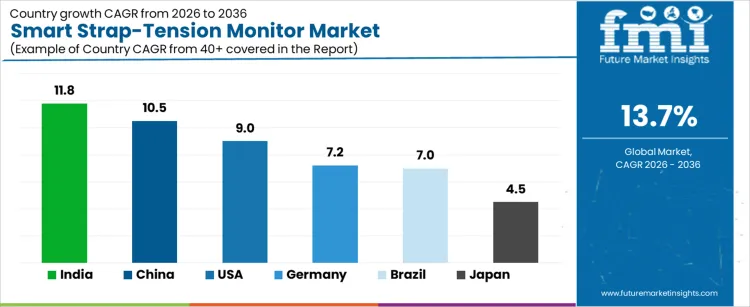
The demand for smart strap tension monitors differs across countries, driven by industrial automation, packaging efficiency, and safety monitoring requirements. India leads with an 11.8% CAGR, supported by growth in manufacturing, logistics, and quality assurance adoption. China follows at 10.5%, driven by large scale packaging operations and increasing automation in production lines. The USA grows at 9.0%, reflecting adoption in industrial packaging, warehouse operations, and transport logistics. Brazil records 7.0%, shaped by expanding manufacturing and logistics sectors. Germany posts 7.2%, supported by established industrial standards, while Japan grows at 4.5%, reflecting mature operations and steady demand for monitoring solutions.
How Is Intelligent Packaging Monitoring Driving Growth in the United States?
In the United States, revenue from the Smart Strap-Tension Monitor Market is expanding at a CAGR of 9.00% through 2035, driven by adoption of smart monitoring systems to ensure strap tension consistency in logistics, industrial packaging, and shipment of consumer goods. Manufacturers are integrating smart strap-tension monitors to reduce packaging damage, improve handling safety, and maintain product integrity. Demand is concentrated in beverage, electronics, and bulk packaged goods distributed through retail and e-commerce channels. Domestic monitor suppliers are providing sensor-enabled solutions compatible with existing strapping equipment. High-volume shipments and recurring packaging operations are sustaining predictable procurement across packaging users nationwide.
- Beverage, electronics, and bulk goods producers are adopting smart strap-tension monitors to maintain packaging integrity
- Sensor-enabled solutions improve handling safety and reduce product damage
- Domestic suppliers provide monitors compatible with existing strapping equipment
- Recurring high-volume shipments sustain predictable procurement volumes
How Do Industrial and Safety Standards Shape Demand in Germany?
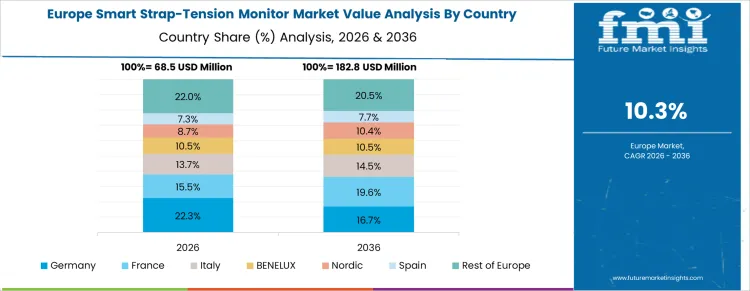
Germany continues to record steady growth in the Smart Strap-Tension Monitor Market at a CAGR of 7.20% through 2035, supported by industrial safety regulations and quality standards. Manufacturers are using smart strap-tension monitors to maintain proper packaging tension for perishable goods, electronics, and industrial components. Demand remains focused on regulated sectors requiring traceable tension monitoring. Technical expertise ensures reliable sensor integration and accurate readings. Stable production volumes and compliance-driven procurement practices are sustaining measured adoption across domestic packaging operations nationwide.
- Industrial safety and quality standards support adoption of smart strap-tension monitors
- Perishable goods, electronics, and industrial components anchor demand
- Technical integration ensures reliable monitoring and accurate readings
- Compliance-driven procurement sustains steady adoption levels
How Is Logistics and Packaging Expansion Accelerating Adoption in China?
In China, revenue from the Smart Strap-Tension Monitor Market is growing at a CAGR of 10.50% through 2035, driven by expansion of logistics networks and high-volume packaging operations. Manufacturers are adopting smart strap-tension monitors for beverage, consumer electronics, and bulk goods shipments to prevent packaging failure. Demand is strong across industrial, e-commerce, and retail distribution channels. Domestic suppliers are scaling sensor-enabled monitor production for integration with automated strapping systems. High throughput operations and structured procurement practices are sustaining rapid adoption nationwide.
- Expansion of logistics and packaging networks drives smart strap-tension monitor adoption
- Beverage, electronics, and bulk shipments are primary applications
- Domestic suppliers scale sensor-enabled solutions for automated strapping systems
- High throughput operations sustain consistent procurement
How Is Organized Manufacturing Supporting Growth in India?
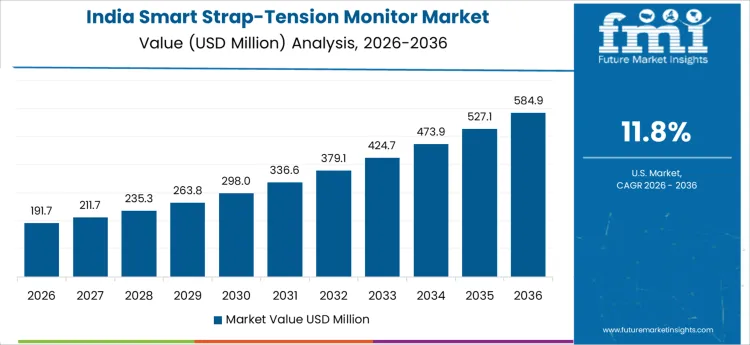
India is witnessing strong expansion in the Smart Strap-Tension Monitor Market at a CAGR of 11.80% through 2035, supported by growth in organized manufacturing and retail distribution. Producers are integrating smart strap-tension monitors for beverages, packaged foods, and industrial goods to ensure safe transport and consistent packaging performance. Demand is rising across urban distribution centers, industrial logistics, and e-commerce channels. Domestic suppliers are providing cost-aligned sensor-enabled monitoring solutions suited for high-volume operations. Expanding industrial output and structured logistics are sustaining robust procurement nationwide.
- Organized manufacturing increases demand for smart strap-tension monitoring systems
- Beverage, packaged food, and industrial goods drive high-volume usage
- Domestic suppliers provide cost-aligned sensor-enabled monitoring solutions
- Industrial and logistics expansion sustains predictable procurement
How Are Consumer Goods Shipments Supporting Adoption in Brazil?
Brazil is seeing steady growth in the Smart Strap-Tension Monitor Market at a CAGR of 7.00% through 2035, supported by rising shipments of perishable and packaged goods. Manufacturers are using smart strap-tension monitors to maintain tension uniformity and prevent damage during transport. Demand is concentrated in beverage, food, and consumer goods distribution networks. Imports supply some advanced sensor components, while domestic suppliers expand integration capacity. Growth in retail and logistics operations is sustaining recurring procurement across packaging operations nationwide.
- Beverage, food, and consumer goods shipments drive adoption of smart strap-tension monitors
- Sensor integration improves packaging reliability and reduces damage
- Domestic suppliers expand integration capacity for sensor-enabled monitoring
- Retail and logistics growth sustains recurring procurement volumes
How Does Mature Packaging Demand Influence Stability in Japan?
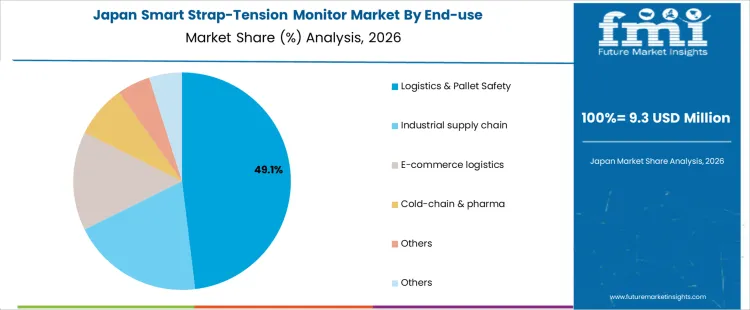
Japan is maintaining measured growth in the Smart Strap-Tension Monitor Market at a CAGR of 4.50% through 2035, supported by mature industrial and retail packaging demand. Brands apply smart strap-tension monitors selectively for beverages, packaged foods, and electronics shipments. Demand remains focused on monitoring accuracy, durability, and operational reliability. Domestic suppliers emphasize precision sensor integration and long-term performance. Stable consumption patterns and replacement-driven purchasing are sustaining predictable procurement across established packaging operations nationwide.
- Mature industrial and retail markets favor selective adoption of smart strap-tension monitors
- Beverage, food, and electronics shipments anchor baseline demand
- Domestic suppliers ensure precision sensor integration and reliability
- Replacement-driven purchasing sustains procurement continuity
Which companies are shaping competition in the Smart Strap Tension Monitor Market for industrial packaging and logistics control?
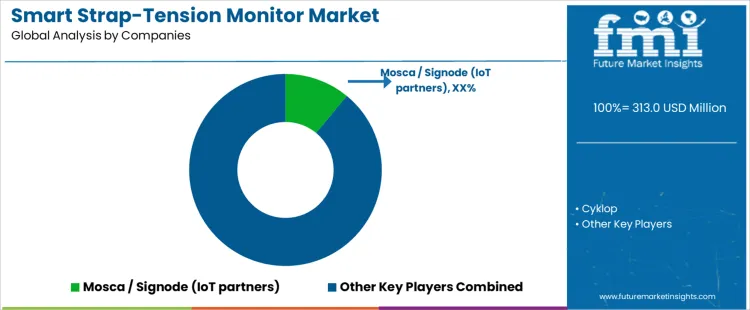
Competition in the Smart Strap Tension Monitor Market is led by packaging system manufacturers extending their portfolios into monitored load security. Mosca and Signode influence this space through strap tension monitoring solutions developed in collaboration with IoT hardware and software partners. Their strength lies in deep integration with strapping machines, palletizing systems, and warehouse automation environments used in manufacturing and distribution centers. These companies benefit from long standing relationships with industrial customers seeking consistent load integrity during transport and storage. Product positioning emphasizes compatibility with existing strapping equipment, data capture reliability, and ease of deployment within closed loop logistics operations. Adoption is driven by damage reduction goals, compliance tracking, and process control rather than standalone sensor demand.
Cyklop plays a distinct role as a specialist in strapping and end of line packaging systems, with a growing focus on monitored tension control for industrial and logistics users. The company targets customers seeking modular upgrades rather than full system replacement, particularly in medium scale manufacturing and regional distribution hubs. Competitive differentiation across the market centers on sensor durability, calibration stability under variable loads, and integration with warehouse management or quality control systems. Smaller technology partners and sensor developers support this ecosystem through embedded electronics and connectivity modules. Barriers to entry are defined by mechanical integration requirements, customer trust in load safety performance, and qualification cycles within industrial packaging environments rather than software complexity alone.
Key Players in the Smart Strap Tension Monitor Market
- Mosca / Signode (IoT partners)
- Cyklop
Scope of the Report
| Items | Values |
|---|---|
| Quantitative Units (2026) | USD million |
| End-use / Application | Logistics & Pallet Safety, Industrial supply chain, E-commerce logistics, Cold-chain & pharma, Others |
| Packaging Format / Type | Strap-mounted Tension Sensors, Inline Tension Modules, Retrofittable Monitors, Portable Tension Testers, Others |
| Material | Steel/Poly strap compatible, High-strength Polypropylene, Composite Straps, Others |
| Technology | IoT Tension Monitoring + Alerts, Wireless Telemetry, Sensor+Cloud, Others |
| Region | Asia Pacific (China, Japan, South Korea, India, Australia & New Zealand, ASEAN, Rest of Asia Pacific), Europe (Germany, United Kingdom, France, Italy, Spain, Nordic, BENELUX, Rest of Europe), North America (United States, Canada, Mexico), Latin America (Brazil, Chile, Rest of Latin America), Middle East & Africa (KSA, Other GCC Countries, Turkey, South Africa, Other African Union, Rest of Middle East & Africa) |
| Key Companies Profiled | Mosca / Signode (IoT partners), Cyklop |
| Additional Attributes | Dollar by sales (2026, 2036), CAGR (2026 to 2036), adoption by end-use and sensor type, packaging format penetration, material compatibility, IoT integration, telemetry performance, regional deployment, regulatory alignment, operational efficiency, load monitoring accuracy, repeat procurement, cloud-enabled monitoring adoption |
Smart Strap Tension Monitor Market Segmentation
End-use / Application:
- Logistics & Pallet Safety
- Industrial supply chain
- E-commerce logistics
- Cold-chain & pharma
- Others
Packaging Format / Type:
- Strap-mounted Tension Sensors
- Inline Tension Modules
- Retrofittable Monitors
- Portable Tension Testers
- Others
Material:
- Steel/Poly strap compatible
- High-strength Polypropylene
- Composite Straps
- Others
Technology:
- IoT Tension Monitoring + Alerts
- Wireless Telemetry
- Sensor+Cloud
- Others
Region
- Asia Pacific
- China
- Japan
- South Korea
- India
- Australia & New Zealand
- ASEAN
- Rest of Asia Pacific
- Europe
- Germany
- United Kingdom
- France
- Italy
- Spain
- Nordic
- BENELUX
- Rest of Europe
- North America
- United States
- Canada
- Mexico
- Latin America
- Brazil
- Chile
- Rest of Latin America
- Middle East & Africa
- Kingdom of Saudi Arabia
- Other GCC Countries
- Turkey
- South Africa
- Other African Union
- Rest of Middle East & Africa
Frequently Asked Questions
How big is the smart strap-tension monitor market in 2026?
The global smart strap-tension monitor market is estimated to be valued at USD 313.0 million in 2026.
What will be the size of smart strap-tension monitor market in 2036?
The market size for the smart strap-tension monitor market is projected to reach USD 1,127.0 million by 2036.
How much will be the smart strap-tension monitor market growth between 2026 and 2036?
The smart strap-tension monitor market is expected to grow at a 13.7% CAGR between 2026 and 2036.
What are the key product types in the smart strap-tension monitor market?
The key product types in smart strap-tension monitor market are logistics & pallet safety, industrial supply chain, e-commerce logistics, cold-chain & pharma, others and others.
Which packaging format segment to contribute significant share in the smart strap-tension monitor market in 2026?
In terms of packaging format, strap-mounted tension sensors segment to command 60.0% share in the smart strap-tension monitor market in 2026.
Preview the report firsthand - request a free sample
Get SampleGet the brochure for pricing and purchase details.
Get PDFTable of Content
- Executive Summary
- Global Market Outlook
- Demand-side Trends
- Supply-side Trends
- Technology Roadmap Analysis
- Analysis and Recommendations
- Market Overview
- Market Coverage / Taxonomy
- Market Definition / Scope / Limitations
- Market Background
- Market Dynamics
- Drivers
- Restraints
- Opportunity
- Trends
- Scenario Forecast
- Demand in Optimistic Scenario
- Demand in Likely Scenario
- Demand in Conservative Scenario
- Opportunity Map Analysis
- Product Life Cycle Analysis
- Supply Chain Analysis
- Investment Feasibility Matrix
- Value Chain Analysis
- PESTLE and Porter’s Analysis
- Regulatory Landscape
- Regional Parent Market Outlook
- Production and Consumption Statistics
- Import and Export Statistics
- Market Dynamics
- Global Market Analysis 2021 to 2025 and Forecast, 2026 to 2036
- Historical Market Size Value (USD Million) Analysis, 2021 to 2025
- Current and Future Market Size Value (USD Million) Projections, 2026 to 2036
- Y-o-Y Growth Trend Analysis
- Absolute $ Opportunity Analysis
- Global Market Pricing Analysis 2021 to 2025 and Forecast 2026 to 2036
- Global Market Analysis 2021 to 2025 and Forecast 2026 to 2036, By End-use
- Introduction / Key Findings
- Historical Market Size Value (USD Million) Analysis By End-use , 2021 to 2025
- Current and Future Market Size Value (USD Million) Analysis and Forecast By End-use , 2026 to 2036
- Logistics & Pallet Safety
- Industrial supply chain
- E-commerce logistics
- Cold-chain & pharma
- Others
- Others
- Y-o-Y Growth Trend Analysis By End-use , 2021 to 2025
- Absolute $ Opportunity Analysis By End-use , 2026 to 2036
- Global Market Analysis 2021 to 2025 and Forecast 2026 to 2036, By Packaging Format
- Introduction / Key Findings
- Historical Market Size Value (USD Million) Analysis By Packaging Format, 2021 to 2025
- Current and Future Market Size Value (USD Million) Analysis and Forecast By Packaging Format, 2026 to 2036
- Strap-mounted Tension Sensors
- Inline Tension Modules
- Retrofittable Monitors
- Portable Tension Testers
- Others
- Y-o-Y Growth Trend Analysis By Packaging Format, 2021 to 2025
- Absolute $ Opportunity Analysis By Packaging Format, 2026 to 2036
- Global Market Analysis 2021 to 2025 and Forecast 2026 to 2036, By Material
- Introduction / Key Findings
- Historical Market Size Value (USD Million) Analysis By Material, 2021 to 2025
- Current and Future Market Size Value (USD Million) Analysis and Forecast By Material, 2026 to 2036
- Steel/Poly strap compatible
- High-strength Polypropylene
- Composite Straps
- Others
- Others
- Y-o-Y Growth Trend Analysis By Material, 2021 to 2025
- Absolute $ Opportunity Analysis By Material, 2026 to 2036
- Global Market Analysis 2021 to 2025 and Forecast 2026 to 2036, By Technology
- Introduction / Key Findings
- Historical Market Size Value (USD Million) Analysis By Technology, 2021 to 2025
- Current and Future Market Size Value (USD Million) Analysis and Forecast By Technology, 2026 to 2036
- IoT Tension Monitoring + Alerts
- Wireless Telemetry
- Sensor+Cloud
- Others
- Others
- Y-o-Y Growth Trend Analysis By Technology, 2021 to 2025
- Absolute $ Opportunity Analysis By Technology, 2026 to 2036
- Global Market Analysis 2021 to 2025 and Forecast 2026 to 2036, By Region
- Introduction
- Historical Market Size Value (USD Million) Analysis By Region, 2021 to 2025
- Current Market Size Value (USD Million) Analysis and Forecast By Region, 2026 to 2036
- North America
- Latin America
- Western Europe
- Eastern Europe
- East Asia
- South Asia and Pacific
- Middle East & Africa
- Market Attractiveness Analysis By Region
- North America Market Analysis 2021 to 2025 and Forecast 2026 to 2036, By Country
- Historical Market Size Value (USD Million) Trend Analysis By Market Taxonomy, 2021 to 2025
- Market Size Value (USD Million) Forecast By Market Taxonomy, 2026 to 2036
- By Country
- USA
- Canada
- Mexico
- By End-use
- By Packaging Format
- By Material
- By Technology
- By Country
- Market Attractiveness Analysis
- By Country
- By End-use
- By Packaging Format
- By Material
- By Technology
- Key Takeaways
- Latin America Market Analysis 2021 to 2025 and Forecast 2026 to 2036, By Country
- Historical Market Size Value (USD Million) Trend Analysis By Market Taxonomy, 2021 to 2025
- Market Size Value (USD Million) Forecast By Market Taxonomy, 2026 to 2036
- By Country
- Brazil
- Chile
- Rest of Latin America
- By End-use
- By Packaging Format
- By Material
- By Technology
- By Country
- Market Attractiveness Analysis
- By Country
- By End-use
- By Packaging Format
- By Material
- By Technology
- Key Takeaways
- Western Europe Market Analysis 2021 to 2025 and Forecast 2026 to 2036, By Country
- Historical Market Size Value (USD Million) Trend Analysis By Market Taxonomy, 2021 to 2025
- Market Size Value (USD Million) Forecast By Market Taxonomy, 2026 to 2036
- By Country
- Germany
- UK
- Italy
- Spain
- France
- Nordic
- BENELUX
- Rest of Western Europe
- By End-use
- By Packaging Format
- By Material
- By Technology
- By Country
- Market Attractiveness Analysis
- By Country
- By End-use
- By Packaging Format
- By Material
- By Technology
- Key Takeaways
- Eastern Europe Market Analysis 2021 to 2025 and Forecast 2026 to 2036, By Country
- Historical Market Size Value (USD Million) Trend Analysis By Market Taxonomy, 2021 to 2025
- Market Size Value (USD Million) Forecast By Market Taxonomy, 2026 to 2036
- By Country
- Russia
- Poland
- Hungary
- Balkan & Baltic
- Rest of Eastern Europe
- By End-use
- By Packaging Format
- By Material
- By Technology
- By Country
- Market Attractiveness Analysis
- By Country
- By End-use
- By Packaging Format
- By Material
- By Technology
- Key Takeaways
- East Asia Market Analysis 2021 to 2025 and Forecast 2026 to 2036, By Country
- Historical Market Size Value (USD Million) Trend Analysis By Market Taxonomy, 2021 to 2025
- Market Size Value (USD Million) Forecast By Market Taxonomy, 2026 to 2036
- By Country
- China
- Japan
- South Korea
- By End-use
- By Packaging Format
- By Material
- By Technology
- By Country
- Market Attractiveness Analysis
- By Country
- By End-use
- By Packaging Format
- By Material
- By Technology
- Key Takeaways
- South Asia and Pacific Market Analysis 2021 to 2025 and Forecast 2026 to 2036, By Country
- Historical Market Size Value (USD Million) Trend Analysis By Market Taxonomy, 2021 to 2025
- Market Size Value (USD Million) Forecast By Market Taxonomy, 2026 to 2036
- By Country
- India
- ASEAN
- Australia & New Zealand
- Rest of South Asia and Pacific
- By End-use
- By Packaging Format
- By Material
- By Technology
- By Country
- Market Attractiveness Analysis
- By Country
- By End-use
- By Packaging Format
- By Material
- By Technology
- Key Takeaways
- Middle East & Africa Market Analysis 2021 to 2025 and Forecast 2026 to 2036, By Country
- Historical Market Size Value (USD Million) Trend Analysis By Market Taxonomy, 2021 to 2025
- Market Size Value (USD Million) Forecast By Market Taxonomy, 2026 to 2036
- By Country
- Kingdom of Saudi Arabia
- Other GCC Countries
- Turkiye
- South Africa
- Other African Union
- Rest of Middle East & Africa
- By End-use
- By Packaging Format
- By Material
- By Technology
- By Country
- Market Attractiveness Analysis
- By Country
- By End-use
- By Packaging Format
- By Material
- By Technology
- Key Takeaways
- Key Countries Market Analysis
- USA
- Pricing Analysis
- Market Share Analysis, 2025
- By End-use
- By Packaging Format
- By Material
- By Technology
- Canada
- Pricing Analysis
- Market Share Analysis, 2025
- By End-use
- By Packaging Format
- By Material
- By Technology
- Mexico
- Pricing Analysis
- Market Share Analysis, 2025
- By End-use
- By Packaging Format
- By Material
- By Technology
- Brazil
- Pricing Analysis
- Market Share Analysis, 2025
- By End-use
- By Packaging Format
- By Material
- By Technology
- Chile
- Pricing Analysis
- Market Share Analysis, 2025
- By End-use
- By Packaging Format
- By Material
- By Technology
- Germany
- Pricing Analysis
- Market Share Analysis, 2025
- By End-use
- By Packaging Format
- By Material
- By Technology
- UK
- Pricing Analysis
- Market Share Analysis, 2025
- By End-use
- By Packaging Format
- By Material
- By Technology
- Italy
- Pricing Analysis
- Market Share Analysis, 2025
- By End-use
- By Packaging Format
- By Material
- By Technology
- Spain
- Pricing Analysis
- Market Share Analysis, 2025
- By End-use
- By Packaging Format
- By Material
- By Technology
- France
- Pricing Analysis
- Market Share Analysis, 2025
- By End-use
- By Packaging Format
- By Material
- By Technology
- India
- Pricing Analysis
- Market Share Analysis, 2025
- By End-use
- By Packaging Format
- By Material
- By Technology
- ASEAN
- Pricing Analysis
- Market Share Analysis, 2025
- By End-use
- By Packaging Format
- By Material
- By Technology
- Australia & New Zealand
- Pricing Analysis
- Market Share Analysis, 2025
- By End-use
- By Packaging Format
- By Material
- By Technology
- China
- Pricing Analysis
- Market Share Analysis, 2025
- By End-use
- By Packaging Format
- By Material
- By Technology
- Japan
- Pricing Analysis
- Market Share Analysis, 2025
- By End-use
- By Packaging Format
- By Material
- By Technology
- South Korea
- Pricing Analysis
- Market Share Analysis, 2025
- By End-use
- By Packaging Format
- By Material
- By Technology
- Russia
- Pricing Analysis
- Market Share Analysis, 2025
- By End-use
- By Packaging Format
- By Material
- By Technology
- Poland
- Pricing Analysis
- Market Share Analysis, 2025
- By End-use
- By Packaging Format
- By Material
- By Technology
- Hungary
- Pricing Analysis
- Market Share Analysis, 2025
- By End-use
- By Packaging Format
- By Material
- By Technology
- Kingdom of Saudi Arabia
- Pricing Analysis
- Market Share Analysis, 2025
- By End-use
- By Packaging Format
- By Material
- By Technology
- Turkiye
- Pricing Analysis
- Market Share Analysis, 2025
- By End-use
- By Packaging Format
- By Material
- By Technology
- South Africa
- Pricing Analysis
- Market Share Analysis, 2025
- By End-use
- By Packaging Format
- By Material
- By Technology
- USA
- Market Structure Analysis
- Competition Dashboard
- Competition Benchmarking
- Market Share Analysis of Top Players
- By Regional
- By End-use
- By Packaging Format
- By Material
- By Technology
- Competition Analysis
- Competition Deep Dive
- Mosca / Signode (IoT partners)
- Overview
- Product Portfolio
- Profitability by Market Segments (Product/Age /Sales Channel/Region)
- Sales Footprint
- Strategy Overview
- Marketing Strategy
- Product Strategy
- Channel Strategy
- Cyklop
- Mosca / Signode (IoT partners)
- Competition Deep Dive
- Assumptions & Acronyms Used
- Research Methodology


