- Market Size (2026)
- USD 29.8 Bn
- Forecast (2036)
- USD 59.7 Bn
- CAGR (2026 to 2036)
- 7.2%
How Big Is the Esoteric Testing Market in 2026?
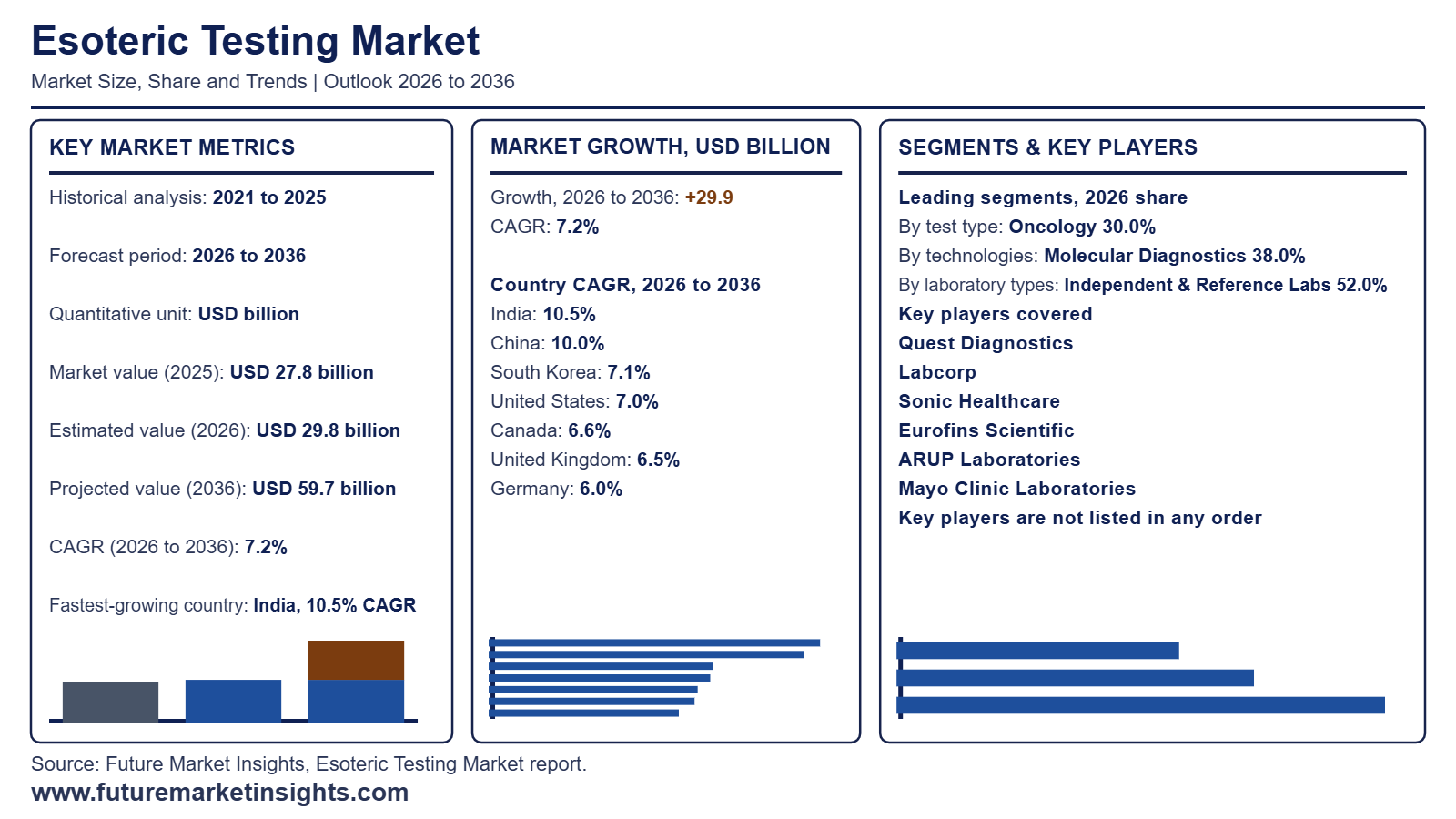
The global esoteric testing market is valued at USD 29.8 billion in 2026, up from USD 27.8 billion in 2025, and is projected by Future Market Insights (FMI) to reach USD 59.7 billion by 2036, expanding at a 7.2% CAGR from 2026 to 2036 and generating USD 29.9 billion in incremental revenue over the 10-year forecast period.
| Market Metric | Valuation / Share / Forecast Benchmark |
|---|---|
| 2025 Market Size (Historical) | USD 27.8 billion |
| 2026 Market Size (Estimated) | USD 29.8 billion |
| 2036 Market Size (Projected) | USD 59.7 billion |
| Compound Annual Growth Rate (2026 to 2036) | 7.2% CAGR |
| Incremental Dollar Opportunity (2026 to 2036) | USD 29.9 billion |
| Dominant Test Type (2026 to 2036 Share) | Oncology (30.0% in 2026, 32.9% by 2036) | Genetic fastest at 8.8% CAGR |
| Leading & Fastest-Growing Technologies | Molecular Diagnostics (38.0% share in 2026; fastest at 9.0% CAGR) |
| Leading & Fastest-Growing Laboratory Types | Independent & Reference Labs (52.0% share in 2026; fastest at 7.8% CAGR) |
| Largest Country Markets (2026 Global Share) | United States (41.5%), China (8.0%), Germany (7.0%) |
| Fastest-Growing Country Markets (2026 to 2036) | India (10.5% CAGR), China (10.0% CAGR), South Korea (7.1% CAGR) |
| Leading Tier-1 Companies | Quest Diagnostics, Labcorp, Sonic Healthcare, Eurofins Scientific, ARUP Laboratories, Mayo Clinic Laboratories |
Source: Future Market Insights analysis of the esoteric testing market, 2026.
Executive Market Overview
Demand for esoteric testing is rising mainly through higher test volumes. Doctors are ordering more specialised tests for cancer, inherited disease and brain disorders that local labs cannot run. As a result, large reference laboratories are handling more work at lower prices per test. For example, Quest Diagnostics reported in October 2026 that organic requisition volume rose 14.4% in the third quarter. Revenue per requisition, however, fell 4.2% over the same period. Automation is offsetting these lower prices, which is keeping margins steady. Independent and reference laboratories are taking about 52% of revenue in 2026. The market as a whole is growing at about 7.2% a year, a pace expected to hold through 2036.
Revenue growth in the esoteric testing market is concentrated in molecular cancer testing and new blood tests for brain disease. Targeted cancer drugs need a matching test before treatment starts. Oncology is therefore taking about 30% of revenue in 2026 and is growing at about 8.2% a year. Neurology testing is also gaining. For instance, Quest and Labcorp both added an FDA-cleared blood test for Alzheimer's disease in 2026. As a result, neurology is growing at around 7.5% a year. Molecular methods such as sequencing and PCR are growing fastest by technology, at about 9.0% a year.
Analyst Perspective
"Test volumes at large reference labs are rising faster than revenue. Prices per test are falling, while doctors order more specialised work. Blood tests for Alzheimer's disease and companion tests for cancer drugs will be the largest new sources of volume. Hospitals will keep handing outreach testing to national labs, which will concentrate the market further."
- Anurag Sharma, Principal Consultant, Future Market Insights (FMI)
Major Market Trends and Insights
- Doctors Are Ordering More Blood-Based Tests: Demand for blood-based tests is rising as doctors move away from costly scans and tissue biopsies. For example, Quest and Labcorp began offering an FDA-cleared blood test for Alzheimer's disease in 2026. Primary care doctors can order this test without referring patients to specialists. As a result, test volumes for brain disease are growing outside large hospitals.
- Hospitals Are Outsourcing Specialised Testing: Sales of specialised tests are shifting from hospital labs to large reference labs. Hospitals are selling outreach labs to cut costs and gain wider test menus. For instance, Quest agreed in 2026 to buy outreach lab assets from a Northeastern US health system. Labcorp, in turn, signed deals for assets from BioReference Health. This is moving test volume to fewer, larger labs.
- Labs Are Adding Companion Tests and Automation: Adoption of companion tests is rising as more cancer drugs need a gene test before treatment. Labs are therefore seeking FDA approvals for these tests. For example, Labcorp received approval in 2026 for a tissue test used in advanced melanoma. Labs are also automating sequencing and mass spectrometry lines. As a result, labs are handling higher volumes while prices per test fall.
What Are the Main Drivers, Restraints, and Opportunities?
Key drivers in the esoteric testing market are ageing populations, targeted cancer drugs and new blood tests for brain disease. Price pressure and payment rule changes restrain growth, while molecular oncology and Asian markets offer the largest new revenue.
Driver: Ageing Populations and Precision Medicine
Demand for complex tests rises with age, since older people develop more cancers, inherited conditions and brain disorders. Routine labs cannot run many of these tests. Doctors are also using genetic tests to choose drugs and doses for each patient. For example, Quest said in October 2026 that care needs of an ageing population helped its growth. Hospitals are also outsourcing specialised work to save costs. As a result, independent and reference laboratories are set to add about USD 17.2 billion of revenue by 2036.
Restraint: Price Pressure and Payment Rules
Payers are cutting prices for many lab tests and asking for proof that a test changes treatment. For example, Quest expects changes under the Protecting Access to Medicare Act to cut its 2027 revenue by about 1%. New tests also need clinical evidence before insurers agree to cover these tests, which slows use of some genetic panels. Shortages of trained laboratory scientists are also raising costs in many countries.
Opportunity: Molecular Oncology, Neurology and Asia
Molecular diagnostics offers the largest investment opportunities in the esoteric testing market. This technology is growing at about 9.0% a year and is set to add around USD 15.5 billion by 2036. Oncology tests, in turn, are set to add about USD 10.7 billion, the largest gain by test type. Genetic and inherited disease testing, meanwhile, is growing at about 8.8% a year as insurers cover more panels. India, at about 10.5% a year, is the fastest-growing profiled country, followed by China at about 10.0%.
How Is the Esoteric Testing Market Segmented?
The esoteric testing market is segmented into test type, technology, laboratory type and region, with values shown in USD billion.
| Segmentation Axis | Sub-Segments Covered | 2026 Leading Segment & Share | Main Growth Benchmark (2026 to 2036) |
|---|---|---|---|
| Test Type | Oncology, Genetic & Inherited Disease, Infectious Disease, Endocrinology, Neurology, Others | Oncology (30.0% revenue share) | Genetic (8.8% CAGR) vs. Infectious Disease (5.0% CAGR) |
| Technology | Molecular Diagnostics, Immunoassay, Mass Spectrometry, Flow Cytometry, Others | Molecular Diagnostics (38.0% revenue share) | Molecular (9.0% CAGR) vs. Immunoassay (5.2% CAGR) |
| Laboratory Type | Independent & Reference Laboratories, Hospital Laboratories, Academic & Specialty Laboratories | Independent & Reference Labs (52.0% revenue share) | Independent Labs lead growth at a 7.8% CAGR vs. Hospital Labs at 6.4% |
| Region | North America, Europe, East Asia, South Asia & Pacific, Latin America, Middle East & Africa | North America (45.0% revenue share) | South Asia & Pacific leads regional growth at a 9.5% CAGR; India leads national growth at a 10.5% CAGR |
Source: Future Market Insights analysis of the esoteric testing market, 2026.
Why Does the Oncology Segment Lead by Test Type?
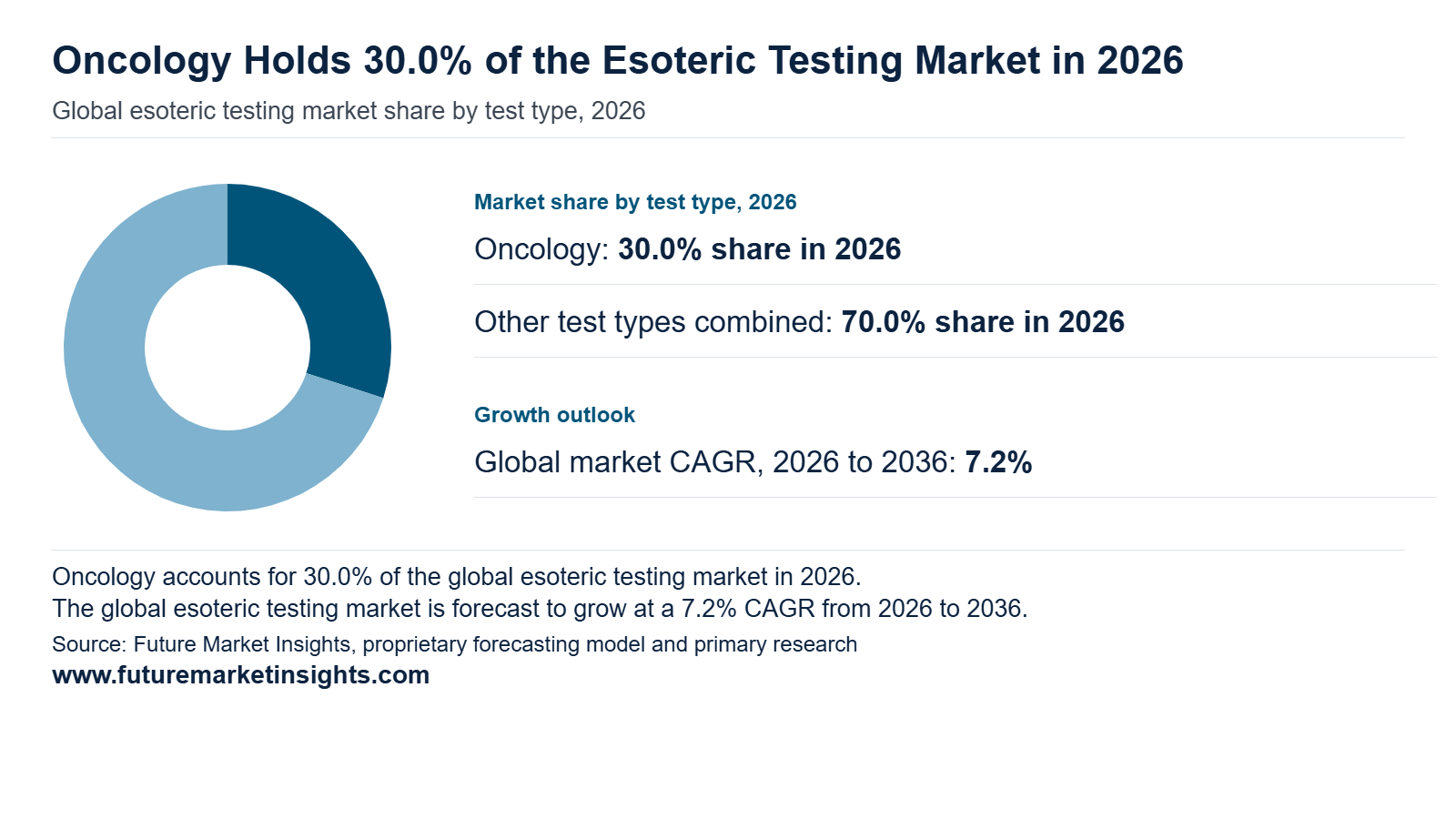
Sales of oncology tests lead the market, since cancer care depends on tests for tumour genes, blood markers and residual disease. As a result, oncology holds about 30% of revenue in 2026, worth USD 8.9 billion. This segment is growing at about 8.2% a year. Genetic and inherited disease testing, however, is growing fastest at close to 8.8%, with about 18% of revenue. Insurers are covering more gene panels, which supports this growth. Infectious disease testing (14%) is rising more slowly at around 5.0%, and endocrinology (10%) at about 5.5%. Neurology, at about 8%, is growing at around 7.5% as Alzheimer's blood tests spread. Other tests, such as autoimmune and toxicology, hold the remaining 20% and are growing at close to 6.1%.
Why Does the Molecular Diagnostics Segment Lead by Technology?
Sequencing and PCR can read many genes from one sample and detect very small amounts of tumour DNA. Molecular diagnostics is therefore the largest technology, with about 38% of revenue in 2026, worth USD 11.3 billion. It is also growing fastest at about 9.0% a year and is set to reach nearly 45% of revenue by 2036. Immunoassays, however, are losing share. These tests hold about 24% and are growing at around 5.2%, as many routine immunoassays move to local labs. Mass spectrometry, at about 16%, is growing at close to 7.4%, led by vitamin, hormone and drug tests. Flow cytometry holds about 8% and other methods about 14%.
Why Does the Independent Laboratory Segment Lead by Laboratory Type?
Hospitals and doctors send many specialised samples to independent and reference laboratories, which run large volumes at lower cost per test. As a result, these labs hold about 52% of revenue in 2026, worth USD 15.5 billion. Hospitals are also outsourcing more testing to cut costs. This segment is therefore growing fastest by lab type, at about 7.8% a year. Hospital laboratories, at about 34%, are growing more slowly at close to 6.4%. Academic and specialty laboratories hold about 14% and are growing at around 7.0%. Research links and rare disease testing support this group.
Esoteric Testing Market by Region and Country (2026 to 2036)
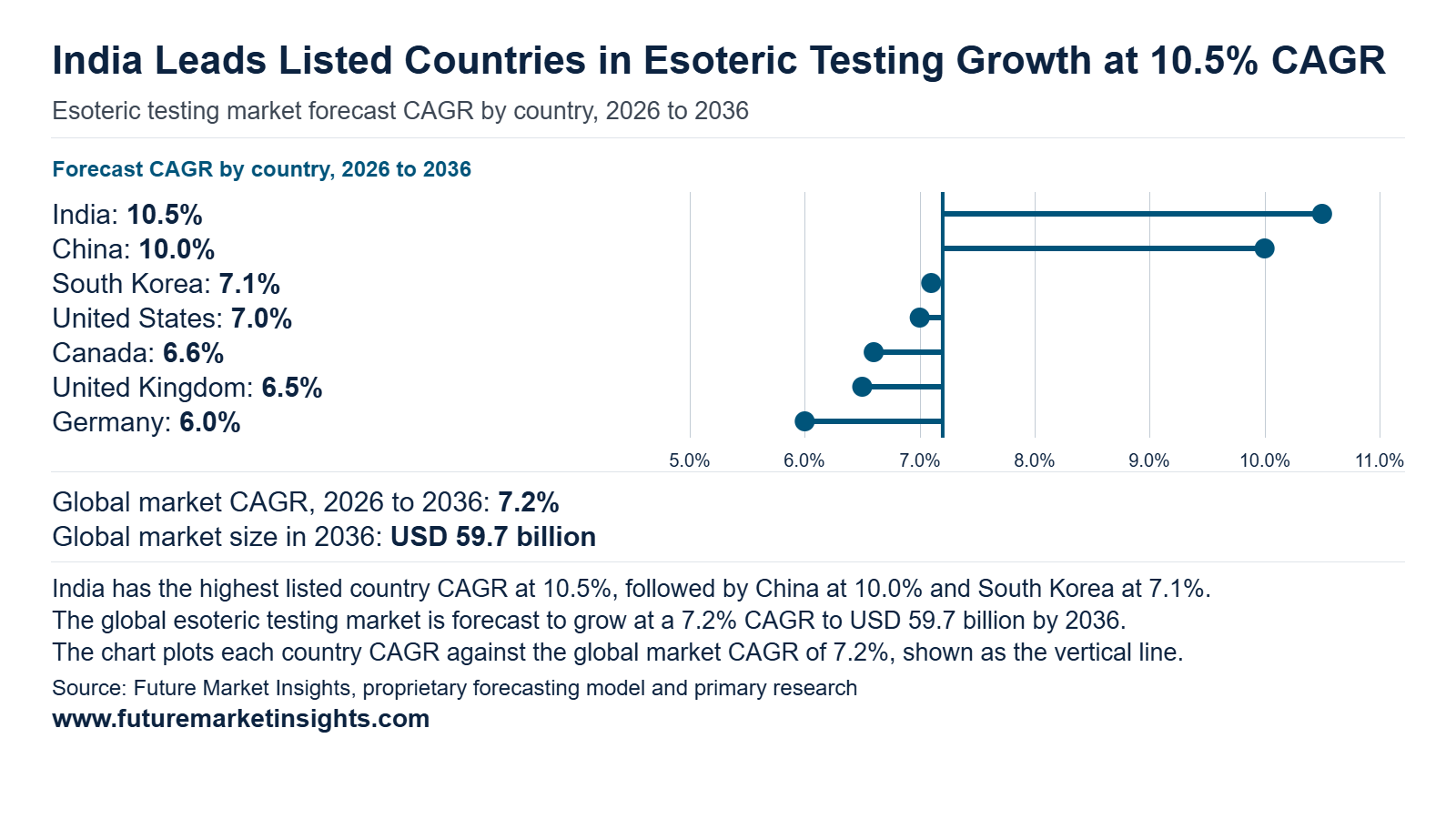
The largest reference laboratory networks in the world are keeping North America ahead in esoteric testing. North America is likely to remain the highest market, with about 45% of global revenue in 2026. The region is growing at about 7.0% a year. Europe holds about 25% and is growing at close to 6.0%, since public health systems control test prices. East Asia, at about 16%, is growing at around 8.6%, led by China. In contrast, South Asia and Pacific is the fastest-growing region at about 9.5% a year, led by India. The Middle East and Africa is growing at around 7.5% and Latin America at about 7.0%. The ten profiled countries make up around 81.5% of global revenue.
| Country | 2026 Revenue | 2036 Revenue | 10-Year Addition | 2026 to 2036 CAGR | Global Share (2026 → 2036) |
|---|---|---|---|---|---|
| United States | USD 12.37 billion | USD 24.33 billion | +USD 11.96 billion | 7.0% | 41.5% → 40.7% |
| China | USD 2.38 billion | USD 6.18 billion | +USD 3.80 billion | 10.0% | 8.0% → 10.4% |
| Germany | USD 2.09 billion | USD 3.74 billion | +USD 1.65 billion | 6.0% | 7.0% → 6.3% |
| Japan | USD 1.49 billion | USD 2.62 billion | +USD 1.13 billion | 5.8% | 5.0% → 4.4% |
| United Kingdom | USD 1.49 billion | USD 2.80 billion | +USD 1.31 billion | 6.5% | 5.0% → 4.7% |
| France | USD 1.34 billion | USD 2.36 billion | +USD 1.02 billion | 5.8% | 4.5% → 3.9% |
| Canada | USD 0.89 billion | USD 1.69 billion | +USD 0.80 billion | 6.6% | 3.0% → 2.8% |
| Italy | USD 0.89 billion | USD 1.53 billion | +USD 0.63 billion | 5.5% | 3.0% → 2.6% |
| India | USD 0.75 billion | USD 2.02 billion | +USD 1.28 billion | 10.5% | 2.5% → 3.4% |
| South Korea | USD 0.60 billion | USD 1.18 billion | +USD 0.59 billion | 7.1% | 2.0% → 2.0% |
Source: Future Market Insights analysis of the esoteric testing market, 2026.
United States
Large reference laboratories and wide use of targeted cancer drugs are projected to keep the US the largest esoteric testing market. In 2026, the market in the US is valued at USD 12.4 billion. Through 2036, it is likely to grow to USD 24.3 billion at a CAGR of 7.0%. Key trends to look for include rising test volumes at large labs. For example, Quest Diagnostics reported a 10.0% rise in third-quarter 2026 revenue to USD 3.10 billion. Labcorp, in turn, reported revenue of USD 3.81 billion, up 6.9%, and launched tests for melanoma and Alzheimer's disease. Hospitals are also selling outreach labs to these groups, which moves more specialised tests to reference labs. Medicare payment changes, however, are set to reduce prices for some tests from 2027. Patients are also ordering more genetic and wellness tests directly through online services.
China
Independent lab chains are taking more specialised tests from smaller hospitals in China. KingMed Diagnostics and Dian Diagnostics, for example, run national networks that serve hospitals across the country. Cancer is the leading cause of death, so demand for tumour gene tests is rising. More targeted drugs are also being added to the national insurance list. Volume-based buying and price controls, however, limit revenue per test. Local sequencing makers such as MGI Tech are lowering costs, which makes gene tests affordable in smaller cities. Valued at USD 2.4 billion in 2026, the market is expected to reach USD 6.2 billion by 2036. This growth, at a CAGR of 10.0%, is the second fastest among the profiled countries. Insurance cover for gene tests still varies widely between provinces, which slows growth in poorer regions.
Germany
Statutory health insurers in Germany set fees for each test, which keeps prices under control. As a result, growth in the German market is steady rather than fast. The market, worth USD 2.1 billion in 2026, is projected to reach USD 3.7 billion by 2036 at a CAGR of 6.0%. Private laboratory groups such as Synlab, Limbach and Amedes run specialised tests for hospitals and doctors nationwide. Genetic testing for cancer and inherited diseases is also growing as insurers cover more tests. Hospitals are also adding sequencing for tumour boards. For example, the national genome sequencing programme, started in 2024, funds whole genome tests for selected cancer and rare disease patients. Smaller labs, however, are struggling with fee pressure, which is leading to more mergers.
Japan
One of the oldest populations in the world gives Japan high demand for cancer and chronic disease tests. National insurance has covered comprehensive cancer gene panel testing since 2019. Rules on when patients can receive these panels, however, limit volumes. The government also sets test fees every two years, which keeps prices low. Many large hospitals also run specialised tests in-house instead of sending samples out. Large commercial labs such as BML, SRL and LSI Medience serve clinics and smaller hospitals. In 2026, the market in Japan is valued at USD 1.5 billion. Through 2036, it is likely to grow to USD 2.6 billion at a CAGR of 5.8%. Demand for cancer gene panels is still rising as more hospitals gain approval to offer these tests.
United Kingdom
Long NHS waiting lists are pushing more specialised testing to private labs in the United Kingdom. NHS genomic laboratory hubs provide whole genome sequencing for some cancers and for rare diseases in children. Private health insurance and direct-to-patient testing also add demand, mainly in London and the South East of England. Pathology staff shortages, however, remain a challenge across many NHS trusts. As a result, the NHS is investing in digital pathology and automated lab networks to handle rising volumes. The market in the UK stands at USD 1.5 billion in 2026 and is set to reach USD 2.8 billion by 2036. This represents a CAGR of 6.5%. In turn, patients are paying privately for faster access to some specialised tests.
France
Repeated fee cuts for routine tests are pushing French laboratories toward specialised work. The national health insurer, Assurance Maladie, sets test prices for the whole country. As a result, groups such as Cerba HealthCare, Biogroup and Eurofins are building specialised testing capacity. Private lab groups are also buying smaller labs to gain volume. National plans, meanwhile, support genomic medicine through regional sequencing platforms in Paris and Lyon. These platforms run whole genome tests for cancer and rare disease patients. Valued at USD 1.3 billion in 2026, the market in France is expected to reach USD 2.4 billion by 2036. Growth is set at a CAGR of 5.8%, among the slower rates in the profiled group. Demand for prenatal and inherited disease tests is also rising in large cities.
Canada
Limited local capacity sends many specialised tests from Canada to US reference labs in Utah, Minnesota and California. Provinces are therefore building local genetic testing capacity to reduce this reliance. LifeLabs, part of Quest Diagnostics since 2024, and Dynacare run community and specialised testing in several provinces. Provinces are also adding funding for cancer gene tests linked to new drug approvals. Private insurers also pay for some genetic tests that provinces do not cover. Long distances, however, make sample transport costly for rural areas. In 2026, the Canadian market is valued at USD 0.89 billion. Through 2036, it is likely to grow to USD 1.69 billion at a CAGR of 6.6%. Hospitals in smaller provinces, in turn, still depend on labs in larger provinces.
Italy
Regional health authorities in Italy buy lab services through tenders, which keeps prices low. As a result, Italy is the slowest-growing profiled country, at a CAGR of 5.5%. The market, at USD 0.89 billion in 2026, is projected to reach USD 1.53 billion by 2036. Private groups such as Synlab Italia and Lifebrain are buying smaller labs to build volume. Genetic testing for inherited cancers is also growing as regions fund more tests. Lab capacity, however, is stronger in the north than in the south. Many specialised samples therefore travel to labs in Milan, Rome and Bologna. An ageing population also supports demand for cancer and chronic disease tests. Patients in the south often travel north for complex care, which adds to this flow.
India
Most Indian patients pay for specialised tests out of pocket, which keeps volumes low. Government insurance schemes, however, are adding cover for some cancer tests. As a result, India is the fastest-growing esoteric testing market among the profiled countries. In 2026, the market in India is valued at USD 0.75 billion. By 2036, it is projected to reach USD 2.0 billion, growing at a CAGR of 10.5%. National chains such as Dr. Lal PathLabs, Metropolis Healthcare and Agilus Diagnostics run reference labs in large cities. These chains collect samples from smaller towns. Low local sequencing costs, meanwhile, are making genetic tests more affordable. Private hospital chains are also adding cancer gene testing to oncology centres. Demand is rising fastest in large cities, where private hospitals and insured patients are concentrated.
South Korea
National insurance in South Korea covers next-generation sequencing for several cancers under conditional approval. The list of covered cancers is growing each year, which is lifting gene panel volumes. Large hospitals in Seoul run sequencing for cancer patients. Commercial labs such as GC Labs and Seegene Medical Foundation, in turn, serve smaller clinics. Hospital labs, however, keep much specialised work in-house. The government also supports precision medicine through national genome projects. Local diagnostics makers such as Seegene also export tests worldwide. Worth USD 0.60 billion in 2026, the market in South Korea is set to reach USD 1.18 billion by 2036. Growth is at a CAGR of 7.1%, the third fastest among the profiled countries. Demand for cancer gene panels is rising as more patients qualify for covered testing.
Competitive Environment and Notable Companies
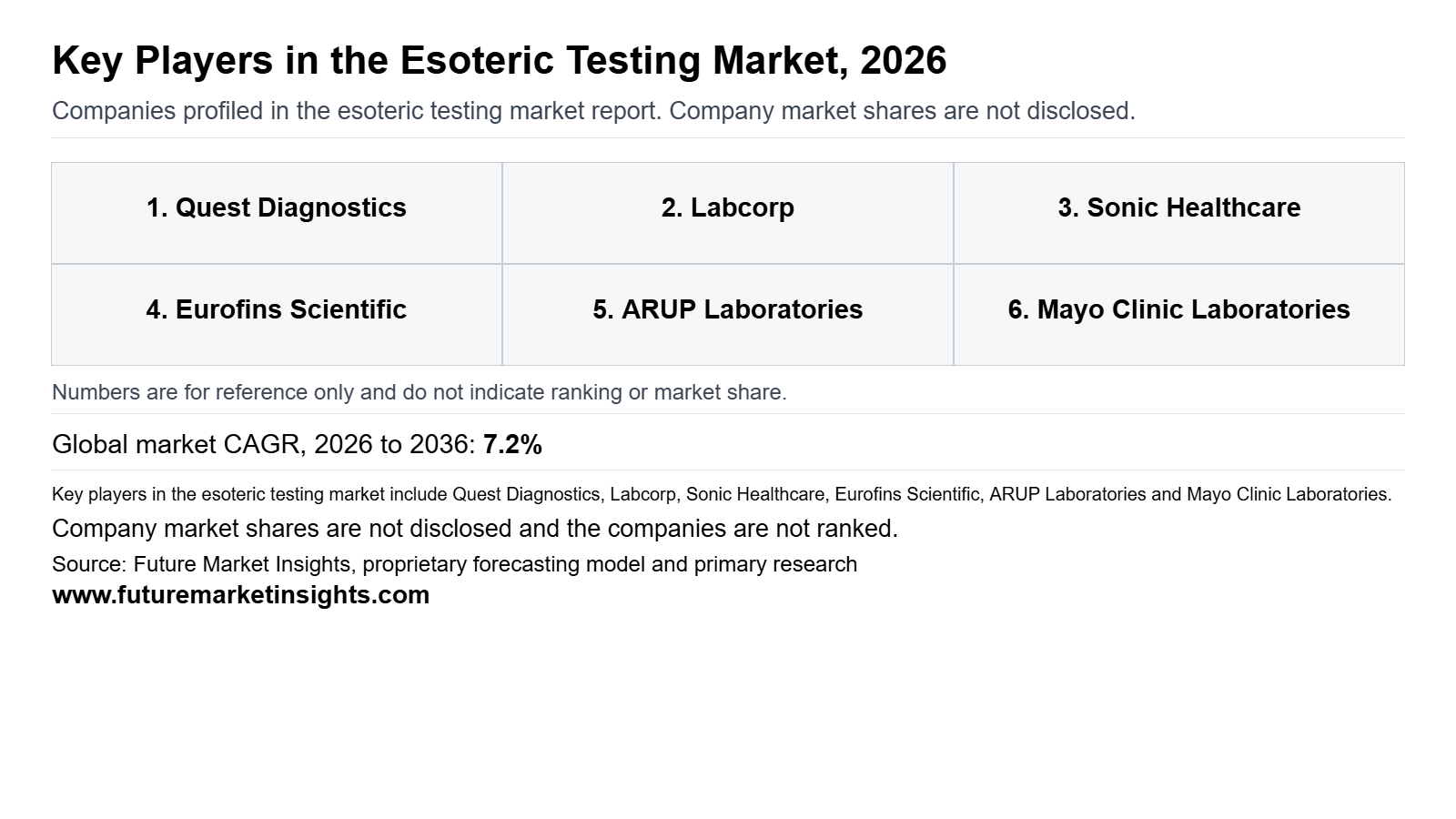
The esoteric testing market is led by large reference laboratories, with specialist firms strong in genetic and cancer tests. Notable companies include Quest Diagnostics, Labcorp, Sonic Healthcare, Eurofins Scientific, ARUP Laboratories and Mayo Clinic Laboratories. OPKO Health (BioReference), Myriad Genetics, Natera and NeoGenomics are also active, mainly in genetic, prenatal and cancer testing. Since hospitals are outsourcing specialised work, large labs are buying hospital outreach businesses. As a result, test volume is moving to fewer, larger labs with automated sequencing lines. Competition is therefore shifting toward test menu breadth, FDA approvals and hospital partnerships.
How Are Companies Positioned in the Esoteric Testing Market?
Large reference labs are adding volume through acquisitions and new tests. For example, Quest Diagnostics reported 10.0% revenue growth in October 2026 and raised its full-year guidance. Quest also agreed to buy outreach lab assets from a Northeastern US health system. Labcorp, in turn, reported 6.9% revenue growth and signed further acquisition agreements, including assets from BioReference Health. Both firms also added FDA-cleared Alzheimer's blood tests in 2026.
How Do Hospitals and Doctors Choose a Reference Lab?
Hospitals and doctors compare reference labs first on test menu and accuracy. Turnaround time comes next, since many cancer tests guide urgent treatment decisions. Insurance coverage and price then decide the final choice. Hospitals also look for labs with data links to hospital systems. Hospitals also favour labs able to take over outreach testing and staff.
Which Capabilities Distinguish Laboratory Offers?
Broad menus of genetic and cancer tests are the main point of difference between labs. FDA-approved companion tests add steady volume, since treatment guidelines name these tests. Automated sequencing and mass spectrometry lines, meanwhile, lower cost per test. National courier networks, in turn, let labs collect samples quickly from distant hospitals.
How Does Geographic Reach Affect Competition?
Sample collection from many regions gives large labs a cost advantage. Central labs run high volumes on automated lines, which lowers cost per test. As a result, national networks such as Quest and Labcorp in the US, and KingMed in China, keep growing. Local labs, however, compete where samples must be tested quickly. National rules in some countries also favour domestic providers, which limits foreign entry.
| Verified Company Evidence (2026) | Commercial Effect | Buyer Action |
|---|---|---|
| 22 October 2026: Quest Diagnostics reported Q3 revenue of USD 3.10 billion, up 10.0%, with organic requisition volume up 14.4% and revenue per requisition down 4.2%; it added the pTau217 Alzheimer's blood test to its AD-Detect range (Quest Diagnostics, October 2026). | Shows volume-led growth with falling prices per test. | Negotiate volume-based pricing for specialised test menus. |
| 28 October 2026: Labcorp reported Q3 revenue of USD 3.81 billion, up 6.9%, received FDA approval for a melanoma companion diagnostic and launched the pTau217 blood test (Labcorp, October 2026). | Adds companion and neurology tests to reference lab menus. | Check that test menus cover new targeted cancer drugs. |
| October 2026: Quest expects payment changes under PAMA to reduce its 2027 revenue by about 1% (Quartr, October 2026). | Signals further price pressure in the United States. | Plan budgets for lower Medicare test prices from 2027. |
Source: Verified corporate disclosures and Future Market Insights analysis, 2026.
| Company | Core Positioning | Verified Activity & Source Attribution |
|---|---|---|
| Quest Diagnostics | Largest US reference laboratory | Q3 2026 revenue up 10.0%; outreach lab acquisition agreed (Quest Diagnostics, October 2026). |
| Labcorp | Global laboratory and specialty testing group | Q3 2026 revenue up 6.9%; new melanoma companion diagnostic (Labcorp, October 2026). |
| Eurofins Scientific | Specialty clinical and genomic testing in Europe and the US | Company information. |
| NeoGenomics | Cancer testing laboratory | Company information. |
Source: Verified corporate disclosures and Future Market Insights analysis, 2026.
Esoteric Testing Market Report Scope and Research Methodology
Specialised test volumes by country form the base of FMI's estimate. These volumes are taken from lab company reports, health system data and payer statistics. Volumes are multiplied by average reimbursed prices for each test type to give revenue by country. Country totals are then added to give regional and global values. Forecasts are built on disease rates, ageing, drug approvals that need companion tests and payment rules. Lab capacity and insurance cover for new tests are also tracked, since these limit volume growth. Acquisitions of outreach labs, such as those by Quest and Labcorp in 2026, are included, since these move volume between lab types. As a final step, FMI checks the results against the reported revenue of listed laboratory companies. Any country where figures do not match is adjusted.
| Coverage Field | Report Scope |
|---|---|
| Market definition | Complex, low-volume laboratory tests that need specialised equipment and staff and are not run by most local labs. |
| Test types | Oncology, genetic and inherited disease, infectious disease, endocrinology, neurology, and others. |
| Technologies | Molecular diagnostics, immunoassay, mass spectrometry, flow cytometry, and others. |
| Laboratory types | Independent and reference laboratories, hospital laboratories, and academic and specialty laboratories. |
| Sample types | Blood, tissue, urine, spinal fluid and other samples. |
| Customer types | Hospitals, doctors, clinics and drug makers. |
| Revenue basis | Fees paid by payers and patients for specialised tests. |
| Exclusions | Routine clinical chemistry and blood counts, home test kits and research-only testing. |
| Quantitative units | USD billion for value. |
| Volume basis | Number of specialised tests performed, used to check value estimates. |
| Value basis | Reimbursed test revenue recognised in the country where the test is ordered. |
| Regions covered | North America, Europe, East Asia, South Asia & Pacific, Latin America, and Middle East & Africa. |
| National coverage | United States, China, Germany, Japan, United Kingdom, France, Canada, Italy, India, South Korea. |
| Companies covered | Quest Diagnostics, Labcorp, Sonic Healthcare, Eurofins Scientific, ARUP Laboratories, Mayo Clinic Laboratories, OPKO Health, Myriad Genetics, Natera and NeoGenomics. |
Source: Future Market Insights analysis of the esoteric testing market, 2026.
Research Sources and Bibliography
- Quest Diagnostics Incorporated. (2026, October 22). Quest Diagnostics reports third quarter 2026 financial results; raises revenue and EPS guidance for full year 2026 (Form 8-K, Exhibit 99.1).
- Quartr. (2026, October). Quest Diagnostics (DGX) Q3 2026 earnings summary.
- Labcorp Holdings Inc. (2026, October 28). Labcorp reports strong 2026 third quarter results; raises full year 2026 guidance.
- Quartr. (2026, October 30). Labcorp (LH) Q3 2026 earnings summary.
- MarketBeat. (2026, October 28). Labcorp Q3 earnings call highlights.
Table of Content
- Key Takeaways
- Market Size and CAGR
- Top Growth Driver
- Fastest Growing Segment
- Leading Region
- Key Companies
- Emerging Opportunities
- Executive Summary
- Global Market Outlook
- Demand-side Trends
- Supply-side Trends
- Technology Roadmap Analysis
- Analysis and Recommendations
- Analyst Perspective (What is happening? Why now? What should investors know?)
- Key Questions Answered
- How large is the market?
- What is the CAGR?
- What are key trends?
- Which region dominates?
- Who are the leaders?
Read More...
- Market Overview
- Market Coverage / Taxonomy
- Market Definition / Scope / Limitations
- Research Methodology
- Chapter Orientation
- Analytical Lens and Working Hypotheses
- Market Structure, Signals, and Trend Drivers
- Benchmarking and Cross-market Comparability
- Market Sizing, Forecasting, and Opportunity Mapping
- Research Design and Evidence Framework
- Desk Research Programme (Secondary Evidence)
- Expert Input and Fieldwork (Primary Evidence)
- Tooling, Models, and Reference Databases
- Data Engineering and Model Build
- Quality Assurance and Audit Trail
- Market Background
- Market Dynamics (Drivers, Restraints, Opportunity, Trends)
- Scenario Forecast (Optimistic, Likely, Conservative)
- Impact Analysis
- AI Impact
- Sustainability Impact
- Regulatory Impact
- Technology Impact
- Consumer / Buyer Analysis
- Purchase Drivers
- Adoption Barriers
- Buyer Journey
- Opportunity Map Analysis
- Product Life Cycle Analysis
- Supply Chain Analysis
- Investment Feasibility Matrix
- Value Chain Analysis
- PESTLE and Porter's Analysis
- Regulatory Landscape
- Regional Parent Market Outlook
- Production and Consumption Statistics
- Import and Export Statistics
- Global Esoteric Testing Market Analysis and Forecast, 2021 to 2036
- Historical Market Size Value (USD Billion) Analysis, 2021 to 2025
- Current and Future Market Size Value (USD Billion) Projections, 2026 to 2036
- Y-o-Y Growth Trend Analysis
- Absolute $ Opportunity Analysis
- Global Esoteric Testing Market Pricing Analysis, 2021 to 2036
- Global Esoteric Testing Market Analysis and Forecast, By Test Type, 2021 to 2036
- Introduction / Key Findings
- Historical Market Size Value (USD Billion) Analysis By Test Type, 2021 to 2025
- Current and Future Market Size Value (USD Billion) Analysis and Forecast By Test Type, 2026 to 2036
- Oncology
- Genetic & Inherited Disease
- Infectious Disease
- Endocrinology
- Neurology
- Others
- Y-o-Y Growth Trend Analysis By Test Type, 2021 to 2025
- Absolute $ Opportunity Analysis By Test Type, 2026 to 2036
- Global Esoteric Testing Market Analysis and Forecast, By Technology, 2021 to 2036
- Introduction / Key Findings
- Historical Market Size Value (USD Billion) Analysis By Technology, 2021 to 2025
- Current and Future Market Size Value (USD Billion) Analysis and Forecast By Technology, 2026 to 2036
- Molecular Diagnostics
- Immunoassay
- Mass Spectrometry
- Flow Cytometry
- Others
- Y-o-Y Growth Trend Analysis By Technology, 2021 to 2025
- Absolute $ Opportunity Analysis By Technology, 2026 to 2036
- Global Esoteric Testing Market Analysis and Forecast, By Laboratory Type, 2021 to 2036
- Introduction / Key Findings
- Historical Market Size Value (USD Billion) Analysis By Laboratory Type, 2021 to 2025
- Current and Future Market Size Value (USD Billion) Analysis and Forecast By Laboratory Type, 2026 to 2036
- Independent & Reference Laboratories
- Hospital Laboratories
- Academic & Specialty Laboratories
- Y-o-Y Growth Trend Analysis By Laboratory Type, 2021 to 2025
- Absolute $ Opportunity Analysis By Laboratory Type, 2026 to 2036
- Global Esoteric Testing Market Analysis and Forecast, By Region, 2021 to 2036
- Introduction
- Historical Market Size Value (USD Billion) Analysis By Region, 2021 to 2025
- Current Market Size Value (USD Billion) Analysis and Forecast By Region, 2026 to 2036
- North America
- Europe
- East Asia
- South Asia & Pacific
- Latin America
- Middle East & Africa
- Market Attractiveness Analysis By Region
- North America Esoteric Testing Market Analysis and Forecast, By Country, 2021 to 2036
- Historical Market Size Value (USD Billion) Trend Analysis By Market Taxonomy, 2021 to 2025
- Market Size Value (USD Billion) Forecast By Market Taxonomy, 2026 to 2036
- By Country
- United States
- Canada
- Rest of North America
- By Test Type
- By Technology
- By Laboratory Type
- By Country
- Market Attractiveness Analysis
- By Country
- By Test Type
- By Technology
- By Laboratory Type
- Key Takeaways
- Europe Esoteric Testing Market Analysis and Forecast, By Country, 2021 to 2036
- Historical Market Size Value (USD Billion) Trend Analysis By Market Taxonomy, 2021 to 2025
- Market Size Value (USD Billion) Forecast By Market Taxonomy, 2026 to 2036
- By Country
- Germany
- United Kingdom
- France
- Italy
- Rest of Europe
- By Test Type
- By Technology
- By Laboratory Type
- By Country
- Market Attractiveness Analysis
- By Country
- By Test Type
- By Technology
- By Laboratory Type
- Key Takeaways
- East Asia Esoteric Testing Market Analysis and Forecast, By Country, 2021 to 2036
- Historical Market Size Value (USD Billion) Trend Analysis By Market Taxonomy, 2021 to 2025
- Market Size Value (USD Billion) Forecast By Market Taxonomy, 2026 to 2036
- By Country
- China
- Japan
- South Korea
- Rest of East Asia
- By Test Type
- By Technology
- By Laboratory Type
- By Country
- Market Attractiveness Analysis
- By Country
- By Test Type
- By Technology
- By Laboratory Type
- Key Takeaways
- South Asia & Pacific Esoteric Testing Market Analysis and Forecast, By Country, 2021 to 2036
- Historical Market Size Value (USD Billion) Trend Analysis By Market Taxonomy, 2021 to 2025
- Market Size Value (USD Billion) Forecast By Market Taxonomy, 2026 to 2036
- By Country
- India
- Rest of South Asia & Pacific
- By Test Type
- By Technology
- By Laboratory Type
- By Country
- Market Attractiveness Analysis
- By Country
- By Test Type
- By Technology
- By Laboratory Type
- Key Takeaways
- Latin America Esoteric Testing Market Analysis and Forecast, By Country, 2021 to 2036
- Historical Market Size Value (USD Billion) Trend Analysis By Market Taxonomy, 2021 to 2025
- Market Size Value (USD Billion) Forecast By Market Taxonomy, 2026 to 2036
- By Country
- Rest of Latin America
- By Test Type
- By Technology
- By Laboratory Type
- By Country
- Market Attractiveness Analysis
- By Country
- By Test Type
- By Technology
- By Laboratory Type
- Key Takeaways
- Middle East & Africa Esoteric Testing Market Analysis and Forecast, By Country, 2021 to 2036
- Historical Market Size Value (USD Billion) Trend Analysis By Market Taxonomy, 2021 to 2025
- Market Size Value (USD Billion) Forecast By Market Taxonomy, 2026 to 2036
- By Country
- Rest of Middle East & Africa
- By Test Type
- By Technology
- By Laboratory Type
- By Country
- Market Attractiveness Analysis
- By Country
- By Test Type
- By Technology
- By Laboratory Type
- Key Takeaways
- Key Countries Market Analysis
- United States
- Pricing Analysis
- Market Share Analysis, 2025
- By Test Type
- By Technology
- By Laboratory Type
- China
- Pricing Analysis
- Market Share Analysis, 2025
- By Test Type
- By Technology
- By Laboratory Type
- Germany
- Pricing Analysis
- Market Share Analysis, 2025
- By Test Type
- By Technology
- By Laboratory Type
- Japan
- Pricing Analysis
- Market Share Analysis, 2025
- By Test Type
- By Technology
- By Laboratory Type
- United Kingdom
- Pricing Analysis
- Market Share Analysis, 2025
- By Test Type
- By Technology
- By Laboratory Type
- France
- Pricing Analysis
- Market Share Analysis, 2025
- By Test Type
- By Technology
- By Laboratory Type
- Canada
- Pricing Analysis
- Market Share Analysis, 2025
- By Test Type
- By Technology
- By Laboratory Type
- Italy
- Pricing Analysis
- Market Share Analysis, 2025
- By Test Type
- By Technology
- By Laboratory Type
- India
- Pricing Analysis
- Market Share Analysis, 2025
- By Test Type
- By Technology
- By Laboratory Type
- South Korea
- Pricing Analysis
- Market Share Analysis, 2025
- By Test Type
- By Technology
- By Laboratory Type
- United States
- Market Structure Analysis
- Competition Dashboard
- Competition Benchmarking
- Market Share Analysis of Top Players
- By Regional
- By Test Type
- By Technology
- By Laboratory Type
- Emerging Startups
- Innovation Benchmarking
- Competition Analysis
- Competition Deep Dive
- Quest Diagnostics
- Overview
- Product Portfolio
- Profitability by Market Segments
- Sales Footprint
- Strategy Overview
- Marketing Strategy
- Product Strategy
- Channel Strategy
- Labcorp
- Sonic Healthcare
- Eurofins Scientific
- ARUP Laboratories
- Mayo Clinic Laboratories
- OPKO Health
- Myriad Genetics
- Natera
- NeoGenomics
- Quest Diagnostics
- Case Studies
- Success Stories
- Recent Developments
- Competition Deep Dive
- Assumptions & Acronyms Used
List of Tables
- Table 1: Global Esoteric Testing Market Value (USD Billion) Forecast by Region, 2021 to 2036
- Table 2: Global Esoteric Testing Market Value (USD Billion) Forecast by Test Type, 2021 to 2036
- Table 3: Global Esoteric Testing Market Value (USD Billion) Forecast by Technology, 2021 to 2036
- Table 4: Global Esoteric Testing Market Value (USD Billion) Forecast by Laboratory Type, 2021 to 2036
- Table 5: North America Esoteric Testing Market Value (USD Billion) Forecast by Country, 2021 to 2036
- Table 6: North America Esoteric Testing Market Value (USD Billion) Forecast by Test Type, 2021 to 2036
- Table 7: North America Esoteric Testing Market Value (USD Billion) Forecast by Technology, 2021 to 2036
- Table 8: North America Esoteric Testing Market Value (USD Billion) Forecast by Laboratory Type, 2021 to 2036
- Table 9: Europe Esoteric Testing Market Value (USD Billion) Forecast by Country, 2021 to 2036
- Table 10: Europe Esoteric Testing Market Value (USD Billion) Forecast by Test Type, 2021 to 2036
- Table 11: Europe Esoteric Testing Market Value (USD Billion) Forecast by Technology, 2021 to 2036
- Table 12: Europe Esoteric Testing Market Value (USD Billion) Forecast by Laboratory Type, 2021 to 2036
- Table 13: East Asia Esoteric Testing Market Value (USD Billion) Forecast by Country, 2021 to 2036
- Table 14: East Asia Esoteric Testing Market Value (USD Billion) Forecast by Test Type, 2021 to 2036
- Table 15: East Asia Esoteric Testing Market Value (USD Billion) Forecast by Technology, 2021 to 2036
- Table 16: East Asia Esoteric Testing Market Value (USD Billion) Forecast by Laboratory Type, 2021 to 2036
- Table 17: South Asia & Pacific Esoteric Testing Market Value (USD Billion) Forecast by Country, 2021 to 2036
- Table 18: South Asia & Pacific Esoteric Testing Market Value (USD Billion) Forecast by Test Type, 2021 to 2036
- Table 19: South Asia & Pacific Esoteric Testing Market Value (USD Billion) Forecast by Technology, 2021 to 2036
- Table 20: South Asia & Pacific Esoteric Testing Market Value (USD Billion) Forecast by Laboratory Type, 2021 to 2036
- Table 21: Latin America Esoteric Testing Market Value (USD Billion) Forecast by Country, 2021 to 2036
- Table 22: Latin America Esoteric Testing Market Value (USD Billion) Forecast by Test Type, 2021 to 2036
- Table 23: Latin America Esoteric Testing Market Value (USD Billion) Forecast by Technology, 2021 to 2036
- Table 24: Latin America Esoteric Testing Market Value (USD Billion) Forecast by Laboratory Type, 2021 to 2036
- Table 25: Middle East & Africa Esoteric Testing Market Value (USD Billion) Forecast by Country, 2021 to 2036
- Table 26: Middle East & Africa Esoteric Testing Market Value (USD Billion) Forecast by Test Type, 2021 to 2036
- Table 27: Middle East & Africa Esoteric Testing Market Value (USD Billion) Forecast by Technology, 2021 to 2036
- Table 28: Middle East & Africa Esoteric Testing Market Value (USD Billion) Forecast by Laboratory Type, 2021 to 2036
List of Figures
- Figure 1: Global Esoteric Testing Market Pricing Analysis
- Figure 2: Global Esoteric Testing Market Value (USD Billion) Forecast 2021-2036
- Figure 3: Global Esoteric Testing Market Value Share and BPS Analysis by Test Type, 2026 and 2036
- Figure 4: Global Esoteric Testing Market Y-o-Y Growth Comparison by Test Type, 2026-2036
- Figure 5: Global Esoteric Testing Market Attractiveness Analysis by Test Type
- Figure 6: Global Esoteric Testing Market Value Share and BPS Analysis by Technology, 2026 and 2036
- Figure 7: Global Esoteric Testing Market Y-o-Y Growth Comparison by Technology, 2026-2036
- Figure 8: Global Esoteric Testing Market Attractiveness Analysis by Technology
- Figure 9: Global Esoteric Testing Market Value Share and BPS Analysis by Laboratory Type, 2026 and 2036
- Figure 10: Global Esoteric Testing Market Y-o-Y Growth Comparison by Laboratory Type, 2026-2036
- Figure 11: Global Esoteric Testing Market Attractiveness Analysis by Laboratory Type
- Figure 12: Global Esoteric Testing Market Value (USD Billion) Share and BPS Analysis by Region, 2026 and 2036
- Figure 13: Global Esoteric Testing Market Y-o-Y Growth Comparison by Region, 2026-2036
- Figure 14: Global Esoteric Testing Market Attractiveness Analysis by Region
- Figure 15: North America Esoteric Testing Market Incremental Dollar Opportunity, 2026-2036
- Figure 16: Europe Esoteric Testing Market Incremental Dollar Opportunity, 2026-2036
- Figure 17: East Asia Esoteric Testing Market Incremental Dollar Opportunity, 2026-2036
- Figure 18: South Asia & Pacific Esoteric Testing Market Incremental Dollar Opportunity, 2026-2036
- Figure 19: Latin America Esoteric Testing Market Incremental Dollar Opportunity, 2026-2036
- Figure 20: Middle East & Africa Esoteric Testing Market Incremental Dollar Opportunity, 2026-2036
- Figure 21: North America Esoteric Testing Market Value Share and BPS Analysis by Country, 2026 and 2036
- Figure 22: North America Esoteric Testing Market Value Share and BPS Analysis by Test Type, 2026 and 2036
- Figure 23: North America Esoteric Testing Market Y-o-Y Growth Comparison by Test Type, 2026-2036
- Figure 24: North America Esoteric Testing Market Attractiveness Analysis by Test Type
- Figure 25: North America Esoteric Testing Market Value Share and BPS Analysis by Technology, 2026 and 2036
- Figure 26: North America Esoteric Testing Market Y-o-Y Growth Comparison by Technology, 2026-2036
- Figure 27: North America Esoteric Testing Market Attractiveness Analysis by Technology
- Figure 28: North America Esoteric Testing Market Value Share and BPS Analysis by Laboratory Type, 2026 and 2036
- Figure 29: North America Esoteric Testing Market Y-o-Y Growth Comparison by Laboratory Type, 2026-2036
- Figure 30: North America Esoteric Testing Market Attractiveness Analysis by Laboratory Type
- Figure 31: Europe Esoteric Testing Market Value Share and BPS Analysis by Country, 2026 and 2036
- Figure 32: Europe Esoteric Testing Market Value Share and BPS Analysis by Test Type, 2026 and 2036
- Figure 33: Europe Esoteric Testing Market Y-o-Y Growth Comparison by Test Type, 2026-2036
- Figure 34: Europe Esoteric Testing Market Attractiveness Analysis by Test Type
- Figure 35: Europe Esoteric Testing Market Value Share and BPS Analysis by Technology, 2026 and 2036
- Figure 36: Europe Esoteric Testing Market Y-o-Y Growth Comparison by Technology, 2026-2036
- Figure 37: Europe Esoteric Testing Market Attractiveness Analysis by Technology
- Figure 38: Europe Esoteric Testing Market Value Share and BPS Analysis by Laboratory Type, 2026 and 2036
- Figure 39: Europe Esoteric Testing Market Y-o-Y Growth Comparison by Laboratory Type, 2026-2036
- Figure 40: Europe Esoteric Testing Market Attractiveness Analysis by Laboratory Type
- Figure 41: East Asia Esoteric Testing Market Value Share and BPS Analysis by Country, 2026 and 2036
- Figure 42: East Asia Esoteric Testing Market Value Share and BPS Analysis by Test Type, 2026 and 2036
- Figure 43: East Asia Esoteric Testing Market Y-o-Y Growth Comparison by Test Type, 2026-2036
- Figure 44: East Asia Esoteric Testing Market Attractiveness Analysis by Test Type
- Figure 45: East Asia Esoteric Testing Market Value Share and BPS Analysis by Technology, 2026 and 2036
- Figure 46: East Asia Esoteric Testing Market Y-o-Y Growth Comparison by Technology, 2026-2036
- Figure 47: East Asia Esoteric Testing Market Attractiveness Analysis by Technology
- Figure 48: East Asia Esoteric Testing Market Value Share and BPS Analysis by Laboratory Type, 2026 and 2036
- Figure 49: East Asia Esoteric Testing Market Y-o-Y Growth Comparison by Laboratory Type, 2026-2036
- Figure 50: East Asia Esoteric Testing Market Attractiveness Analysis by Laboratory Type
- Figure 51: South Asia & Pacific Esoteric Testing Market Value Share and BPS Analysis by Country, 2026 and 2036
- Figure 52: South Asia & Pacific Esoteric Testing Market Value Share and BPS Analysis by Test Type, 2026 and 2036
- Figure 53: South Asia & Pacific Esoteric Testing Market Y-o-Y Growth Comparison by Test Type, 2026-2036
- Figure 54: South Asia & Pacific Esoteric Testing Market Attractiveness Analysis by Test Type
- Figure 55: South Asia & Pacific Esoteric Testing Market Value Share and BPS Analysis by Technology, 2026 and 2036
- Figure 56: South Asia & Pacific Esoteric Testing Market Y-o-Y Growth Comparison by Technology, 2026-2036
- Figure 57: South Asia & Pacific Esoteric Testing Market Attractiveness Analysis by Technology
- Figure 58: South Asia & Pacific Esoteric Testing Market Value Share and BPS Analysis by Laboratory Type, 2026 and 2036
- Figure 59: South Asia & Pacific Esoteric Testing Market Y-o-Y Growth Comparison by Laboratory Type, 2026-2036
- Figure 60: South Asia & Pacific Esoteric Testing Market Attractiveness Analysis by Laboratory Type
- Figure 61: Latin America Esoteric Testing Market Value Share and BPS Analysis by Country, 2026 and 2036
- Figure 62: Latin America Esoteric Testing Market Value Share and BPS Analysis by Test Type, 2026 and 2036
- Figure 63: Latin America Esoteric Testing Market Y-o-Y Growth Comparison by Test Type, 2026-2036
- Figure 64: Latin America Esoteric Testing Market Attractiveness Analysis by Test Type
- Figure 65: Latin America Esoteric Testing Market Value Share and BPS Analysis by Technology, 2026 and 2036
- Figure 66: Latin America Esoteric Testing Market Y-o-Y Growth Comparison by Technology, 2026-2036
- Figure 67: Latin America Esoteric Testing Market Attractiveness Analysis by Technology
- Figure 68: Latin America Esoteric Testing Market Value Share and BPS Analysis by Laboratory Type, 2026 and 2036
- Figure 69: Latin America Esoteric Testing Market Y-o-Y Growth Comparison by Laboratory Type, 2026-2036
- Figure 70: Latin America Esoteric Testing Market Attractiveness Analysis by Laboratory Type
- Figure 71: Middle East & Africa Esoteric Testing Market Value Share and BPS Analysis by Country, 2026 and 2036
- Figure 72: Middle East & Africa Esoteric Testing Market Value Share and BPS Analysis by Test Type, 2026 and 2036
- Figure 73: Middle East & Africa Esoteric Testing Market Y-o-Y Growth Comparison by Test Type, 2026-2036
- Figure 74: Middle East & Africa Esoteric Testing Market Attractiveness Analysis by Test Type
- Figure 75: Middle East & Africa Esoteric Testing Market Value Share and BPS Analysis by Technology, 2026 and 2036
- Figure 76: Middle East & Africa Esoteric Testing Market Y-o-Y Growth Comparison by Technology, 2026-2036
- Figure 77: Middle East & Africa Esoteric Testing Market Attractiveness Analysis by Technology
- Figure 78: Middle East & Africa Esoteric Testing Market Value Share and BPS Analysis by Laboratory Type, 2026 and 2036
- Figure 79: Middle East & Africa Esoteric Testing Market Y-o-Y Growth Comparison by Laboratory Type, 2026-2036
- Figure 80: Middle East & Africa Esoteric Testing Market Attractiveness Analysis by Laboratory Type
- Figure 81: Global Esoteric Testing Market - Tier Structure Analysis
- Figure 82: Global Esoteric Testing Market - Company Share Analysis
Frequently Asked Questions
How big is the esoteric testing market in 2026?
Future Market Insights estimates the global esoteric testing market at USD 29.8 billion in 2026, up from USD 27.8 billion in 2025. Higher test volumes at reference labs are driving this growth.
How fast is the esoteric testing market expected to grow through 2036?
FMI projects a 7.2% CAGR from 2026 to 2036, taking the market to USD 59.7 billion by 2036. This adds USD 29.9 billion in revenue, led by molecular cancer and brain disease tests.
Which test type leads the esoteric testing market?
Oncology leads with 30.0% of 2026 revenue, since targeted cancer drugs need matching tests. Genetic and inherited disease testing is growing fastest, at about 8.8% a year, as insurers cover more gene panels.
Which technology leads the esoteric testing market?
Molecular diagnostics holds 38.0% of 2026 revenue and is growing fastest, at about 9.0% a year. Sequencing and PCR can read many genes from one sample, which supports cancer and inherited disease testing.
Which laboratory type leads the esoteric testing market?
Independent and reference laboratories account for 52.0% of 2026 revenue. These labs are also growing fastest, at about 7.8% a year from 2026 to 2036, as hospitals outsource specialised testing.
Which country is the largest esoteric testing market?
The United States is the largest market, with 41.5% of global revenue in 2026, worth USD 12.4 billion. China follows at 8.0% (USD 2.4 billion) and Germany at 7.0% (USD 2.1 billion).
Which countries are expected to grow fastest in the esoteric testing market?
India is projected to grow fastest, at a 10.5% CAGR from 2026 to 2036, as insurance cover for cancer tests widens. China follows at 10.0% and South Korea at 7.1%.
What drives demand for esoteric testing?
Ageing populations and targeted cancer drugs that need companion tests are the main drivers. New blood tests for Alzheimer's disease and hospital outsourcing of specialised testing are also adding volume.
Preview the report firsthand - request a free sample
Get SampleGet the brochure for pricing and purchase details.
Get PDF