

- Industry Size (2026)
- USD 410.99 Mn
- Forecast (2036)
- USD 614.24 Mn
- CAGR (2026 to 2036)
- 4.1%
Etidronic Acid Market Size, Market Forecast and Outlook By FMI
The etidronic acid market was valued at USD 394.8 million in 2025, projected to reach USD 410.99 million in 2026, and is forecast to expand to USD 614.24 million by 2036 at a 4.1% CAGR. Etidronic acid, also known as 1-hydroxyethylidene-1,1-diphosphonic acid (HEDP), is a chelating and scale-inhibiting agent used in water treatment, detergent formulation, textile processing, and metal surface treatment. Stricter industrial effluent discharge limits and cooling water management mandates are sustaining consumption across chemical manufacturing sectors.
Summary of Etidronic Acid Market
- By 2036, the market is projected to be worth USD 614.24 million.
- A 4.1% compound annual growth rate is anticipated between 2026 and 2036.
- Market size in 2025 was estimated at USD 394.8 million.
- An absolute dollar opportunity of USD 203.25 million is anticipated between 2026 and 2036.
- Pharmaceutical Industry leads by end-user with 38.6% share in 2026. Chemicals leads by application with 24.8% share.
- Demand is anchored by industrial water treatment mandates requiring threshold scale inhibitors for boiler and cooling tower circuits.
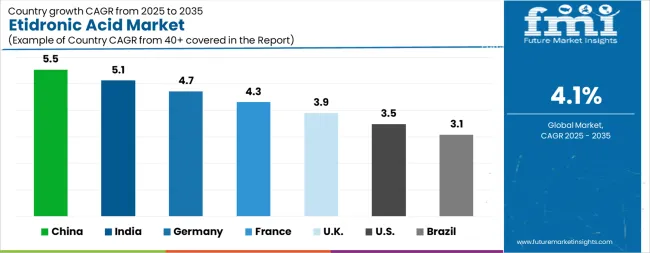
- Among tracked countries, China leads at 5.5% CAGR, followed by India at 5.1%, Germany at 4.7%, France at 4.3%, the UK at 3.9%, the USA at 3.5%, and Brazil at 3.1%.
FMI is of the opinion that the incremental opportunity between 2026 and 2036 is USD 203.25 million. Water treatment applications remain the anchor consumption segment, with etidronic acid deployed as a threshold scale inhibitor in boiler and cooling tower circuits. Detergent formulators use it as a peroxide stabilizer in oxygen-bleach laundry products, a function that gains relevance as chlorine-based bleach faces tighter environmental scrutiny. Pharmaceutical-grade etidronic acid, used as a bone resorption inhibitor in osteoporosis treatment, represents a smaller but higher-value consumption channel. Production is concentrated in China, where phosphonate manufacturing capacity services both domestic and export demand.
Country-level CAGR distribution reflects industrial water treatment intensity and chemical manufacturing base size. China leads at 5.5% CAGR, supported by its dominant phosphonate production capacity and expanding industrial cooling water treatment infrastructure. India follows at 5.1%, driven by thermal power plant water chemistry management requirements. Germany advances at 4.7%, linked to its detergent manufacturing base and EU Biocidal Products Regulation compliance. France tracks at 4.3%, the United Kingdom at 3.9%, the United States at 3.5% anchored by industrial boiler water treatment spending, and Brazil at 3.1% tied to textile processing chemical demand.
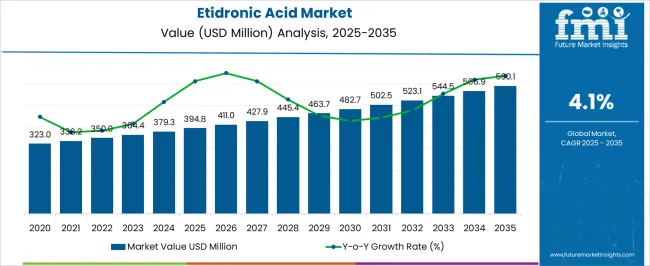
Etidronic Acid Market Key Takeaways
| Metric | Details |
|---|---|
| Industry Size (2026) | USD 410.99 million |
| Industry Value (2036) | USD 614.24 million |
| CAGR (2026 to 2036) | 4.1% |
Source: Future Market Insights, 2026
Etidronic Acid Market Definition
Etidronic acid (HEDP) is an organophosphonate compound that functions as a chelating agent, scale inhibitor, and peroxide stabilizer across industrial water treatment, detergent manufacturing, textile processing, and pharmaceutical formulations. It prevents calcium and magnesium scale deposition in boiler and cooling systems and stabilizes hydrogen peroxide in oxygen-bleach detergent products. Industrial buyers source etidronic acid as a concentrated liquid solution or solid powder.
Etidronic Acid Market Inclusions
Market scope covers global and regional revenue for etidronic acid sold as an industrial chemical and pharmaceutical ingredient, segmented by application, end-user, and region. The forecast period is 2026 to 2036, with analysis of production capacity, pricing trends, and end-use consumption patterns.
Etidronic Acid Market Exclusions
The scope excludes other organophosphonate compounds such as ATMP and PBTCA unless sold in blends with etidronic acid. Finished pharmaceutical dosage forms containing etidronic acid as an active ingredient are outside the market boundary.
Etidronic Acid Market Research Methodology
- Primary Research: Analysts engaged with water treatment chemical procurement managers, detergent formulation engineers, and phosphonate production directors to map purchasing decision triggers.
- Desk Research: Data collection aggregated effluent discharge regulation databases, detergent industry association publications, and pharmaceutical excipient monographs from official pharmacopoeias.
- Market-Sizing and Forecasting: Baseline values derive from bottom-up aggregation of phosphonate trade volumes and water treatment chemical spending records, applying region-specific industrial growth curves.
- Data Validation and Update Cycle: Projections are tested against publicly reported production volumes from leading Chinese phosphonate manufacturers and cross-referenced with water treatment association data.
Why is the Etidronic Acid Market Growing?
The Etidronic Acid market is witnessing steady growth, driven by its widespread use in industrial and pharmaceutical applications. Rising demand for corrosion inhibitors, water treatment chemicals, and specialty chemicals is supporting market expansion. In the pharmaceutical sector, Etidronic Acid is increasingly utilized for its chelating properties, particularly in formulations aimed at preventing mineral deposition and improving drug stability.
Advancements in production technologies and process optimization have improved product purity and cost efficiency, enabling broader adoption across diverse applications. Regulatory focus on environmental compliance and sustainable chemical usage is further influencing market dynamics. The growing pharmaceutical industry, particularly in emerging economies, is creating additional demand for high-quality Etidronic Acid as a critical input.
Research and development initiatives aimed at novel applications, including industrial cleaning, detergents, and metal surface treatment, are also contributing to market growth As organizations prioritize efficiency, sustainability, and product performance, the Etidronic Acid market is expected to sustain growth, supported by technological innovations and expanding industrial and pharmaceutical applications.
Segmental Analysis
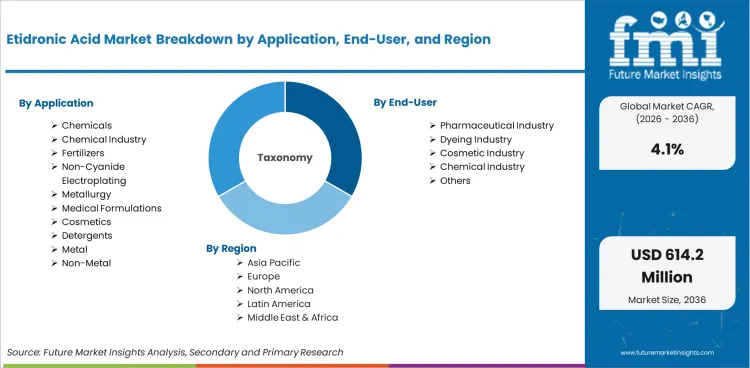
The etidronic acid market is segmented by application, end-user, and geographic regions. By application, etidronic acid market is divided into Chemicals, Chemical Industry, Fertilizers, Non-Cyanide Electroplating, Metallurgy, Medical Formulations, Cosmetics, Detergents, Metal, Non-Metal, and Water Treatment. In terms of end-user, etidronic acid market is classified into Pharmaceutical Industry, Dyeing Industry, Cosmetic Industry, Chemical Industry, and Others. Regionally, the etidronic acid industry is classified into North America, Latin America, Western Europe, Eastern Europe, Balkan & Baltic Countries, Russia & Belarus, Central Asia, East Asia, South Asia & Pacific, and the Middle East & Africa.
Insights into the Chemicals Application Segment
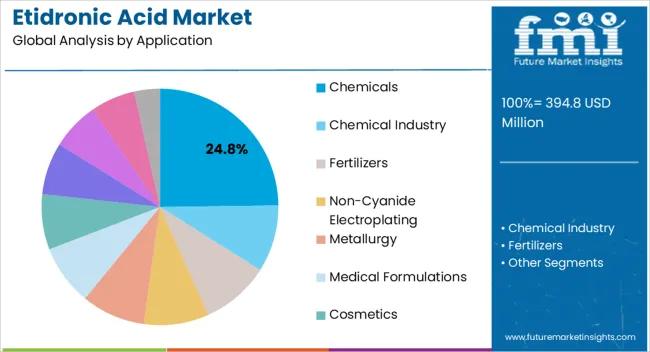
The chemicals application segment is projected to hold 24.8% of the Etidronic Acid market revenue in 2026, establishing it as a leading application. Growth in this segment is driven by the extensive use of Etidronic Acid in water treatment formulations, corrosion inhibitors, detergents, and specialty chemicals, which are critical in industrial processes. Its ability to chelate metal ions and prevent scale formation enhances efficiency and prolongs equipment life, making it a preferred choice in chemical manufacturing.
The product’s compatibility with various industrial processes and its effectiveness in diverse chemical formulations further reinforce adoption. Manufacturers are increasingly integrating Etidronic Acid into chemical blends for cleaning, stabilization, and metal treatment applications to improve operational performance.
The scalability and reliability of supply, coupled with process optimization, have strengthened its market position As industrial activities expand globally and the focus on water and chemical efficiency increases, the chemicals application segment is expected to maintain a leading position in the Etidronic Acid market.
Insights into the Pharmaceutical Industry End-User Segment
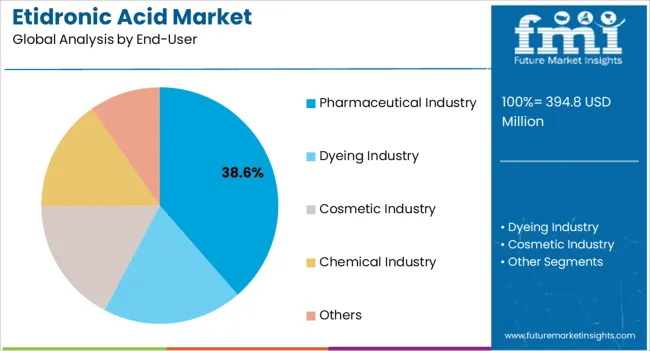
The pharmaceutical industry segment is anticipated to account for 38.6% of the market revenue in 2026, making it the leading end-user. Growth is being driven by the increasing utilization of Etidronic Acid in pharmaceutical formulations as a chelating agent to prevent metal ion contamination and improve product stability. The compound is widely employed in oral and injectable medications, as well as in topical formulations, due to its ability to enhance drug safety and efficacy.
Research advancements and stringent quality standards in drug manufacturing are further increasing reliance on high-purity Etidronic Acid. Pharmaceutical companies are leveraging the compound for improved shelf life, reduced degradation, and enhanced therapeutic performance.
Additionally, regulatory compliance regarding impurities and product consistency reinforces its adoption in the sector As pharmaceutical production continues to expand globally, particularly in emerging markets with rising healthcare demand, the pharmaceutical industry segment is expected to remain the primary driver of revenue growth in the Etidronic Acid market.
Market Overview
Etidronic Acid Market Overview
Etidronic acid is a bisphosphonate helps in calcium metabolism. The global etidronic acid is expected to have substantially high growth rate, attributed to growing pharmaceutical and chemical industry across the globe.
North America accounts for significantly high revenue share in the global etidronic acid market, attributed to robust marketing and research in the region.
Analysis of Etidronic Acid Market By Key Countries
.webp "Top Country Growth Comparison Etidronic Acid Market Cagr (2026 2036)")
| Country | CAGR |
|---|---|
| China | 5.5% |
| India | 5.1% |
| Germany | 4.7% |
| France | 4.3% |
| UK | 3.9% |
| USA | 3.5% |
| Brazil | 3.1% |
Source: FMI analysis based on primary research and proprietary forecasting model
Country-wise Analysis
The Etidronic Acid Market is expected to register a CAGR of 4.1% during the forecast period, exhibiting varied country level momentum. China leads with the highest CAGR of 5.5%, followed by India at 5.1%. Developed markets such as Germany, France, and the UK continue to expand steadily, while the USA is likely to grow at consistent rates. Brazil posts the lowest CAGR at 3.1%, yet still underscores a broadly positive trajectory for the global Etidronic Acid Market. In 2024, Germany held a dominant revenue in the Western Europe market and is expected to grow with a CAGR of 4.7%. The USA Etidronic Acid Market is estimated to be valued at USD 148.9 million in 2026 and is anticipated to reach a valuation of USD 209.7 million by 2036. Sales are projected to rise at a CAGR of 3.5% over the forecast period between 2026 and 2036. While Japan and South Korea markets are estimated to be valued at USD 19.8 million and USD 12.6 million respectively in 2026.
Key Players in the Etidronic Acid Market
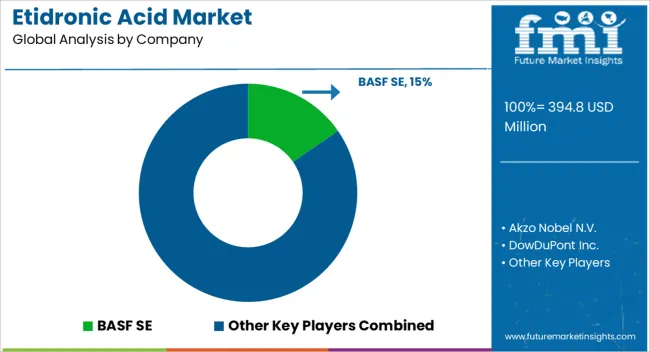
- BASF SE
- Akzo Nobel N.V.
- DowDuPont Inc.
- Shandong Taihe Water Treatment Technologies Co., Ltd.
- Zschimmer & Schwarz, Inc.
- Hubei Hengshuo Chemical Co., Ltd.
- Hebei Jinhong Chemicals Co., Ltd.
- Shandong Xintai Water Treatment Technology Co., Ltd.
- Changzhou Kewei Fine Chemical Co., Ltd.
- Jiangxi Jinhong Chemical Co., Ltd.
- Shandong IRO Water Treatment Co., Ltd.
- Jiangsu Jianghai Chemical Group Co., Ltd.
- Zaozhuang Kerui Chemicals Co., Ltd.
Scope of the Report
| Metric | Value |
|---|---|
| Quantitative Units | USD 410.99 million to USD 614.24 million, at a CAGR of 4.1% |
| Market Definition | Etidronic acid (HEDP) is an organophosphonate compound that functions as a chelating agent, scale inhibitor, and peroxide stabilizer across industrial water treatment, detergent manufacturing, textile processing, and pharmaceutical formulations. It prevents calcium and magnesium scale deposition in boiler and cooling systems and stabilizes hydrogen peroxide in oxygen-bleach detergent products. Industrial buyers source etidronic acid as a concentrated liquid solution or solid powder. |
| Segmentation | Application: Chemicals, Chemical Industry, Fertilizers, Non-Cyanide Electroplating, Metallurgy, Medical Formulations, Cosmetics, Detergents, Metal, Non-Metal, Water Treatment; End-User: Pharmaceutical Industry, Dyeing Industry, Cosmetic Industry, Chemical Industry, Others |
| Regions Covered | North America, Latin America, Europe, East Asia, South Asia, Oceania, Middle East & Africa |
| Countries Covered | China, India, Germany, France, UK, USA, Brazil, and 40 plus countries |
| Key Companies Profiled | BASF SE, Akzo Nobel N.V., DowDuPont Inc., Shandong Taihe Water Treatment Technologies Co., Ltd., Zschimmer & Schwarz, Inc., Hubei Hengshuo Chemical Co., Ltd., Hebei Jinhong Chemicals Co., Ltd., Shandong Xintai Water Treatment Technology Co., Ltd., Changzhou Kewei Fine Chemical Co., Ltd., Jiangxi Jinhong Chemical Co., Ltd., Shandong IRO Water Treatment Co., Ltd., Jiangsu Jianghai Chemical Group Co., Ltd., Zaozhuang Kerui Chemicals Co., Ltd. |
| Forecast Period | 2026 to 2036 |
| Approach | Forecasting models apply a bottom-up methodology starting with trade volume benchmarks and cross-validating projections against manufacturer revenue disclosures. |
Etidronic Acid Market by Segments
Application:
- Chemicals
- Chemical Industry
- Fertilizers
- Non-Cyanide Electroplating
- Metallurgy
- Medical Formulations
- Cosmetics
- Detergents
- Metal
- Non-Metal
- Water Treatment
End-User:
- Pharmaceutical Industry
- Dyeing Industry
- Cosmetic Industry
- Chemical Industry
- Others
Region:
- North America
- USA
- Canada
- Mexico
- Latin America
- Brazil
- Chile
- Rest of Latin America
- Western Europe
- Germany
- UK
- Italy
- Spain
- France
- Nordic
- BENELUX
- Rest of Western Europe
- Eastern Europe
- Russia
- Poland
- Hungary
- Balkan & Baltic
- Rest of Eastern Europe
- East Asia
- China
- Japan
- South Korea
- South Asia and Pacific
- India
- ASEAN
- Australia & New Zealand
- Rest of South Asia and Pacific
- Middle East & Africa
- Kingdom of Saudi Arabia
- Other GCC Countries
- Turkiye
- South Africa
- Other African Union
- Rest of Middle East & Africa
Bibliography
- 1. European Chemicals Agency. (2025). Biocidal Products Regulation: Active Substance Evaluation, HEDP. ECHA.
- 2. United States Environmental Protection Agency. (2024). National Pollutant Discharge Elimination System: Industrial Effluent Guidelines. EPA.
- 3. Central Pollution Control Board, India. (2025). Standards for Thermal Power Plant Effluent Discharge. CPCB.
- 4. World Health Organization. (2024). Model List of Essential Medicines: Bisphosphonates. WHO.
- 5. International Organization for Standardization. (2024). ISO 6107: Water Quality Vocabulary. ISO.
- 6. Organisation for Economic Co-operation and Development. (2024). Emission Scenario Documents for Chemicals Used in Water Treatment. OECD.
This bibliography is provided for reader reference. The full Future Market Insights report contains the complete reference list with primary research documentation.
Frequently Asked Questions
How large is the demand for Etidronic Acid in the global market in 2026?
Demand for Etidronic Acid in the global market is estimated to be valued at USD 410.99 million in 2026.
What will be the market size of Etidronic Acid in the global market by 2036?
Market size for Etidronic Acid is projected to reach USD 614.24 million by 2036.
What is the expected demand growth for Etidronic Acid in the global market between 2026 and 2036?
Demand for Etidronic Acid is expected to grow at a CAGR of 4.1% between 2026 and 2036.
Which End-User segment leads global consumption by 2026?
Pharmaceutical Industry accounts for 38.6% share in 2026, driven by etidronic acid use as a bone resorption inhibitor in osteoporosis treatment formulations.
What is driving demand in China?
Dominant phosphonate production capacity combined with expanding industrial cooling water treatment infrastructure across manufacturing zones sustains consumption growth.
What is the India growth outlook in this report?
India is projected to grow at a CAGR of 5.1% during 2026 to 2036.
What does market forecast mean on this page?
The market forecast represents a model-based projection built on defined industry consumption assumptions and supply chain benchmarks for strategic planning purposes.
How does FMI build and validate the Etidronic Acid forecast?
Forecasting models apply a bottom-up methodology starting with global trade volume metrics and cross-validate projections against manufacturer financial disclosures and trade body statistical releases.
Preview the report firsthand - request a free sample
Get SampleGet the brochure for pricing and purchase details.
Get PDFTable of Content
- Executive Summary
- Global Market Outlook
- Demand-side Trends
- Supply-side Trends
- Technology Roadmap Analysis
- Analysis and Recommendations
- Market Overview
- Market Coverage / Taxonomy
- Market Definition / Scope / Limitations
- Research Methodology
- Chapter Orientation
- Analytical Lens and Working Hypotheses
- Market Structure, Signals, and Trend Drivers
- Benchmarking and Cross-market Comparability
- Market Sizing, Forecasting, and Opportunity Mapping
- Research Design and Evidence Framework
- Desk Research Programme (Secondary Evidence)
- Company Annual and Sustainability Reports
- Peer-reviewed Journals and Academic Literature
- Corporate Websites, Product Literature, and Technical Notes
- Earnings Decks and Investor Briefings
- Statutory Filings and Regulatory Disclosures
- Technical White Papers and Standards Notes
- Trade Journals, Industry Magazines, and Analyst Briefs
- Conference Proceedings, Webinars, and Seminar Materials
- Government Statistics Portals and Public Data Releases
- Press Releases and Reputable Media Coverage
- Specialist Newsletters and Curated Briefings
- Sector Databases and Reference Repositories
- FMI Internal Proprietary Databases and Historical Market Datasets
- Subscription Datasets and Paid Sources
- Social Channels, Communities, and Digital Listening Inputs
- Additional Desk Sources
- Expert Input and Fieldwork (Primary Evidence)
- Primary Modes
- Qualitative Interviews and Expert Elicitation
- Quantitative Surveys and Structured Data Capture
- Blended Approach
- Why Primary Evidence is Used
- Field Techniques
- Interviews
- Surveys
- Focus Groups
- Observational and In-context Research
- Social and Community Interactions
- Stakeholder Universe Engaged
- C-suite Leaders
- Board Members
- Presidents and Vice Presidents
- R&D and Innovation Heads
- Technical Specialists
- Domain Subject-matter Experts
- Scientists
- Physicians and Other Healthcare Professionals
- Governance, Ethics, and Data Stewardship
- Research Ethics
- Data Integrity and Handling
- Primary Modes
- Tooling, Models, and Reference Databases
- Desk Research Programme (Secondary Evidence)
- Data Engineering and Model Build
- Data Acquisition and Ingestion
- Cleaning, Normalisation, and Verification
- Synthesis, Triangulation, and Analysis
- Quality Assurance and Audit Trail
- Market Background
- Market Dynamics
- Drivers
- Restraints
- Opportunity
- Trends
- Scenario Forecast
- Demand in Optimistic Scenario
- Demand in Likely Scenario
- Demand in Conservative Scenario
- Opportunity Map Analysis
- Product Life Cycle Analysis
- Supply Chain Analysis
- Investment Feasibility Matrix
- Value Chain Analysis
- PESTLE and Porter’s Analysis
- Regulatory Landscape
- Regional Parent Market Outlook
- Production and Consumption Statistics
- Import and Export Statistics
- Market Dynamics
- Global Market Analysis 2021 to 2025 and Forecast, 2026 to 2036
- Historical Market Size Value (USD Million) Analysis, 2021 to 2025
- Current and Future Market Size Value (USD Million) Projections, 2026 to 2036
- Y-o-Y Growth Trend Analysis
- Absolute $ Opportunity Analysis
- Global Market Pricing Analysis 2021 to 2025 and Forecast 2026 to 2036
- Global Market Analysis 2021 to 2025 and Forecast 2026 to 2036, By Application
- Introduction / Key Findings
- Historical Market Size Value (USD Million) Analysis By Application , 2021 to 2025
- Current and Future Market Size Value (USD Million) Analysis and Forecast By Application , 2026 to 2036
- Chemicals
- Chemical Industry
- Fertilizers
- Non-Cyanide Electroplating
- Metallurgy
- Medical Formulations
- Cosmetics
- Detergents
- Metal
- Non-Metal
- Water Treatment
- Chemicals
- Y-o-Y Growth Trend Analysis By Application , 2021 to 2025
- Absolute $ Opportunity Analysis By Application , 2026 to 2036
- Global Market Analysis 2021 to 2025 and Forecast 2026 to 2036, By End-User
- Introduction / Key Findings
- Historical Market Size Value (USD Million) Analysis By End-User, 2021 to 2025
- Current and Future Market Size Value (USD Million) Analysis and Forecast By End-User, 2026 to 2036
- Pharmaceutical Industry
- Dyeing Industry
- Cosmetic Industry
- Chemical Industry
- Others
- Pharmaceutical Industry
- Y-o-Y Growth Trend Analysis By End-User, 2021 to 2025
- Absolute $ Opportunity Analysis By End-User, 2026 to 2036
- Global Market Analysis 2021 to 2025 and Forecast 2026 to 2036, By Region
- Introduction
- Historical Market Size Value (USD Million) Analysis By Region, 2021 to 2025
- Current Market Size Value (USD Million) Analysis and Forecast By Region, 2026 to 2036
- North America
- Latin America
- Western Europe
- Eastern Europe
- East Asia
- South Asia and Pacific
- Middle East & Africa
- Market Attractiveness Analysis By Region
- North America Market Analysis 2021 to 2025 and Forecast 2026 to 2036, By Country
- Historical Market Size Value (USD Million) Trend Analysis By Market Taxonomy, 2021 to 2025
- Market Size Value (USD Million) Forecast By Market Taxonomy, 2026 to 2036
- By Country
- USA
- Canada
- Mexico
- By Application
- By End-User
- By Country
- Market Attractiveness Analysis
- By Country
- By Application
- By End-User
- Key Takeaways
- Latin America Market Analysis 2021 to 2025 and Forecast 2026 to 2036, By Country
- Historical Market Size Value (USD Million) Trend Analysis By Market Taxonomy, 2021 to 2025
- Market Size Value (USD Million) Forecast By Market Taxonomy, 2026 to 2036
- By Country
- Brazil
- Chile
- Rest of Latin America
- By Application
- By End-User
- By Country
- Market Attractiveness Analysis
- By Country
- By Application
- By End-User
- Key Takeaways
- Western Europe Market Analysis 2021 to 2025 and Forecast 2026 to 2036, By Country
- Historical Market Size Value (USD Million) Trend Analysis By Market Taxonomy, 2021 to 2025
- Market Size Value (USD Million) Forecast By Market Taxonomy, 2026 to 2036
- By Country
- Germany
- UK
- Italy
- Spain
- France
- Nordic
- BENELUX
- Rest of Western Europe
- By Application
- By End-User
- By Country
- Market Attractiveness Analysis
- By Country
- By Application
- By End-User
- Key Takeaways
- Eastern Europe Market Analysis 2021 to 2025 and Forecast 2026 to 2036, By Country
- Historical Market Size Value (USD Million) Trend Analysis By Market Taxonomy, 2021 to 2025
- Market Size Value (USD Million) Forecast By Market Taxonomy, 2026 to 2036
- By Country
- Russia
- Poland
- Hungary
- Balkan & Baltic
- Rest of Eastern Europe
- By Application
- By End-User
- By Country
- Market Attractiveness Analysis
- By Country
- By Application
- By End-User
- Key Takeaways
- East Asia Market Analysis 2021 to 2025 and Forecast 2026 to 2036, By Country
- Historical Market Size Value (USD Million) Trend Analysis By Market Taxonomy, 2021 to 2025
- Market Size Value (USD Million) Forecast By Market Taxonomy, 2026 to 2036
- By Country
- China
- Japan
- South Korea
- By Application
- By End-User
- By Country
- Market Attractiveness Analysis
- By Country
- By Application
- By End-User
- Key Takeaways
- South Asia and Pacific Market Analysis 2021 to 2025 and Forecast 2026 to 2036, By Country
- Historical Market Size Value (USD Million) Trend Analysis By Market Taxonomy, 2021 to 2025
- Market Size Value (USD Million) Forecast By Market Taxonomy, 2026 to 2036
- By Country
- India
- ASEAN
- Australia & New Zealand
- Rest of South Asia and Pacific
- By Application
- By End-User
- By Country
- Market Attractiveness Analysis
- By Country
- By Application
- By End-User
- Key Takeaways
- Middle East & Africa Market Analysis 2021 to 2025 and Forecast 2026 to 2036, By Country
- Historical Market Size Value (USD Million) Trend Analysis By Market Taxonomy, 2021 to 2025
- Market Size Value (USD Million) Forecast By Market Taxonomy, 2026 to 2036
- By Country
- Kingdom of Saudi Arabia
- Other GCC Countries
- Turkiye
- South Africa
- Other African Union
- Rest of Middle East & Africa
- By Application
- By End-User
- By Country
- Market Attractiveness Analysis
- By Country
- By Application
- By End-User
- Key Takeaways
- Key Countries Market Analysis
- USA
- Pricing Analysis
- Market Share Analysis, 2025
- By Application
- By End-User
- Canada
- Pricing Analysis
- Market Share Analysis, 2025
- By Application
- By End-User
- Mexico
- Pricing Analysis
- Market Share Analysis, 2025
- By Application
- By End-User
- Brazil
- Pricing Analysis
- Market Share Analysis, 2025
- By Application
- By End-User
- Chile
- Pricing Analysis
- Market Share Analysis, 2025
- By Application
- By End-User
- Germany
- Pricing Analysis
- Market Share Analysis, 2025
- By Application
- By End-User
- UK
- Pricing Analysis
- Market Share Analysis, 2025
- By Application
- By End-User
- Italy
- Pricing Analysis
- Market Share Analysis, 2025
- By Application
- By End-User
- Spain
- Pricing Analysis
- Market Share Analysis, 2025
- By Application
- By End-User
- France
- Pricing Analysis
- Market Share Analysis, 2025
- By Application
- By End-User
- India
- Pricing Analysis
- Market Share Analysis, 2025
- By Application
- By End-User
- ASEAN
- Pricing Analysis
- Market Share Analysis, 2025
- By Application
- By End-User
- Australia & New Zealand
- Pricing Analysis
- Market Share Analysis, 2025
- By Application
- By End-User
- China
- Pricing Analysis
- Market Share Analysis, 2025
- By Application
- By End-User
- Japan
- Pricing Analysis
- Market Share Analysis, 2025
- By Application
- By End-User
- South Korea
- Pricing Analysis
- Market Share Analysis, 2025
- By Application
- By End-User
- Russia
- Pricing Analysis
- Market Share Analysis, 2025
- By Application
- By End-User
- Poland
- Pricing Analysis
- Market Share Analysis, 2025
- By Application
- By End-User
- Hungary
- Pricing Analysis
- Market Share Analysis, 2025
- By Application
- By End-User
- Kingdom of Saudi Arabia
- Pricing Analysis
- Market Share Analysis, 2025
- By Application
- By End-User
- Turkiye
- Pricing Analysis
- Market Share Analysis, 2025
- By Application
- By End-User
- South Africa
- Pricing Analysis
- Market Share Analysis, 2025
- By Application
- By End-User
- USA
- Market Structure Analysis
- Competition Dashboard
- Competition Benchmarking
- Market Share Analysis of Top Players
- By Regional
- By Application
- By End-User
- Competition Analysis
- Competition Deep Dive
- BASF SE
- Overview
- Product Portfolio
- Profitability by Market Segments (Product/Age /Sales Channel/Region)
- Sales Footprint
- Strategy Overview
- Marketing Strategy
- Product Strategy
- Channel Strategy
- Akzo Nobel N.V.
- DowDuPont Inc.
- Shandong Taihe Water Treatment Technologies Co., Ltd.
- Zschimmer & Schwarz, Inc.
- Hubei Hengshuo Chemical Co., Ltd.
- Hebei Jinhong Chemicals Co., Ltd.
- Shandong Xintai Water Treatment Technology Co., Ltd.
- Changzhou Kewei Fine Chemical Co., Ltd.
- Jiangxi Jinhong Chemical Co., Ltd.
- Shandong IRO Water Treatment Co., Ltd.
- Jiangsu Jianghai Chemical Group Co., Ltd.
- Zaozhuang Kerui Chemicals Co., Ltd.
- BASF SE
- Competition Deep Dive
- Assumptions & Acronyms Used


