

- Market Size (2026)
- USD 1.6 Bn
- Forecast (2036)
- USD 2.8 Bn
- CAGR (2026 to 2036)
- 5.8%
How big is Extracorporeal Shock Wave Lithotripsy Market in 2026?
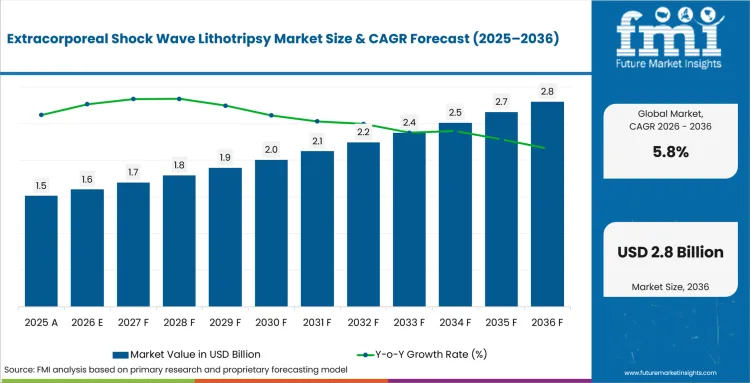
USD 1.6 billion in 2026 and USD 2.8 billion by 2036 at a 5.8% CAGR.
Extracorporeal shock wave lithotripsy demand is projected to expand at 5.8% CAGR between 2026 and 2036, rising from USD 1.6 billion in 2026 to USD 2.8 billion by 2036. Modern lithotripsy devices combine focused shock-wave generation with imaging and patient positioning for non-invasive fragmentation of suitable urinary stones. In March 2025, a comparative study followed 112 patients with renal stones measuring 10 to 20 millimeters. Flexible ureteroscopy produced stronger four-week clearance, while three-month stone-free outcomes were statistically similar between both treatment groups. The finding keeps shock-wave treatment relevant for selected patients but requires clear counselling about early clearance and possible retreatment. Hospital investment therefore depends on dependable clinical results and technical support across the complete treatment pathway.
Treatment economics differ between high-volume referral centers and smaller hospitals that share equipment through regional service arrangements. In January 2026, France's Assurance Maladie explained that computed tomography can define stone location and urinary obstruction during renal-colic assessment. The same guidance notes that recovered fragments can undergo composition analysis to guide preventive treatment and recurrence review. Stone analysis software can organize those laboratory findings without turning diagnostic evidence into a claim of equipment demand. Dedicated rooms suit programs with stable case volume and in-house imaging support across planned treatment lists. Mobile services extend access across smaller hospitals but require clear responsibility for calibration and imaging checks at each receiving site. The investment case remains strongest across networks that can sustain predictable volume among clinically suitable patients.
Key Takeaways of Extracorporeal Shock Wave Lithotripsy Market
- Recurring urinary-stone treatment supports demand across patients whose stone profile and anatomy remain suitable for non-invasive fragmentation.
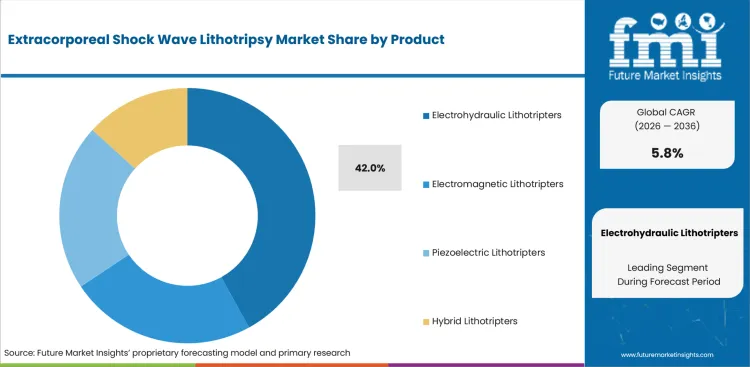
- Electrohydraulic lithotripters are expected to represent 42.0% share in 2026 due to established service knowledge and configurable treatment platforms.
- Kidney stones are projected to account for 58.0% share in 2026 owing to recurring presentations and broad clinical familiarity.
- Hospitals are anticipated to capture 49.0% by end-user in 2026 driven by centralized imaging and coordinated specialist treatment programs.
- Dense stones and unfavorable anatomy can reduce fragmentation success while established ureteroscopy capacity limits utilization across smaller ESWL programs.
- Dornier MedTech and STORZ MEDICAL AG compete beside Richard Wolf GmbH through targeting accuracy and dependable technical support across established hospital treatment programs.
Analyst Perspective
“ESWL earns capital priority in urology programs that can identify suitable stones and sustain enough annual procedures for dependable service. Accurate localization and disciplined acoustic coupling protect treatment quality across repeated sessions without relying on non-invasive positioning alone. Hospitals should compare stone-free outcomes and retreatment needs beside technical response across the complete operating year.”
- Anurag Sharma, Principal Analyst, Future Market Insights.
How is the Extracorporeal Shock Wave Lithotripsy Market segmented?
The extracorporeal shock wave lithotripsy market is segmented by Product, Application, End User, Technology, Mobility, and Region.
The market is segmented by product, application, end user, technology, mobility, and region to reflect distinct clinical and purchasing decisions. Product separates electrohydraulic, electromagnetic, piezoelectric, and hybrid generators according to shock-wave production and maintenance requirements. Application distinguishes kidney, ureteral, bladder, pancreatic, and salivary stone pathways that require different treatment planning. End user compares hospitals, specialty urology clinics, ambulatory surgical centers, and diagnostic or research centers with different support capabilities. Technology covers fluoroscopy, ultrasound, and dual-imaging guidance used for localization and treatment monitoring across suitable patients. Mobility and regional analysis compare fixed or shared access beside regulatory conditions and technical service coverage. Together these dimensions show how medical device technologies enter different clinical pathways and capital plans.
Why do electrohydraulic lithotripters lead the product category?
Electrohydraulic lithotripters generate focused shock waves through a spark-gap source supported by established maintenance practices. The 2026 European Association of Urology guideline warns that trapped air within poor acoustic coupling can divert energy from the intended path. Clinical teams therefore need repeatable preparation and documented therapy-head contact across every scheduled treatment session. Experienced engineering departments can manage replaceable spark-gap components without rebuilding the complete prepared treatment room.
- The product category is forecast to be led by electrohydraulic lithotripters at 42.0% share in 2026 due to established spark-gap service knowledge. Replaceable generator components let hospitals plan recurring maintenance without changing the complete clinical treatment sequence. Configurable platforms also fit several room layouts and existing imaging assets across mature urology programs.
- Hospital adoption depends on coupling checks that transfer usable energy without trapped air between the therapy head and patient. Clinical teams need documented preparation steps that remain consistent across operators and repeated treatment sessions. Service organizations strengthen adoption through component availability and calibration support that protect fragmentation quality across the installed system lifetime.
How do kidney stones shape demand within the application category?
Kidney stones create the broadest ESWL workflow through wide variation in renal location and measured density. In June 2025, STORZ MEDICAL summarized outcomes from 208 patients treated with the MODULITH SLK inline for renal stones below 15 millimeters. Stronger results were associated with smaller stones and lower Hounsfield values across the reviewed patient group. Kidney stone extraction balloons remain relevant for endoscopic fragment management after incomplete shock-wave clearance in selected patients.
- Kidney stones are projected to hold 58.0% share in 2026 owing to the broad pool of suitable renal-stone cases. Smaller radiopaque stones can support non-invasive treatment without immediate endoscopic access or conventional surgical preparation. The segment position weakens for dense burdens and lower-pole anatomy that increase retreatment risk or delay complete clearance.
- Urology teams adopt ESWL for kidney stones that offer a practical route to clearance without a conventional incision. Computed tomography separates suitable cases through density and skin-to-stone measurements during initial clinical treatment planning. Hospitals protect utilization by routing difficult stones toward ureteroscopy or percutaneous removal instead of repeating low-probability shock-wave sessions.
Why do hospitals hold the largest end-user share?
Hospitals combine diagnostic imaging with urology specialists and anesthesia support inside one coordinated urinary-stone pathway. In February 2025, STORZ MEDICAL summarized a matched analysis that compared wide and narrow shock-wave focus during urolithiasis treatment. The evidence shows why hospitals need consistent protocols and complete treatment records across different device settings. Formal review of medical devices also favors facilities with biomedical engineering support for installation and preventive maintenance.
- By end user, hospitals are forecast to represent 49.0% in 2026 driven by centralized imaging and coordinated specialist support. Larger sites can spread equipment expense across emergency referrals and planned treatment lists serving several patient pathways. Hospital governance also supports defined selection rules and service accountability across complex renal and ureteral stone cases.
- Hospital adoption advances through dependable uptime across every component within the lithotripter installation and imaging chain. Biomedical engineering teams coordinate generator maintenance with imaging calibration and patient-table checks ahead of planned sessions. Smaller hospitals often prefer mobile access since dedicated room utilization cannot reliably support a permanent capital commitment across the annual schedule.
What supports fluoroscopy-guided systems within the technology category?
Fluoroscopy gives operators continuous visual confirmation for radiopaque stones during positioning and focused energy delivery. In July 2025, STORZ MEDICAL reported that in-line targeting and shock-wave path alignment supported fragmentation efficiency in recent MODULITH SLK inline studies. Visible localization lets operators correct patient movement and prevent focused energy from missing the intended stone position. Fluoroscopy equipment also supports hospitals that already maintain trained imaging teams and established radiation-control routines.
- Fluoroscopy-guided systems are set to lead the technology category with 46.0% share in 2026 due to operator familiarity with radiopaque stone localization. Integrated imaging can shorten alignment work and preserve a consistent visual record during treatment delivery. The segment maintains its position through established training and predictable targeting control across scheduled hospital procedures.
- Clinical teams adopt fluoroscopy guidance for stones that remain visible during repeated positioning and energy delivery. Radiation management requires disciplined imaging settings and avoidance of unnecessary exposure throughout every planned treatment procedure. Dual-modality configurations add ultrasound for selected cases and let operators change imaging emphasis without abandoning the established patient position. The additional option supports mixed case lists that include stones with different visibility characteristics during treatment.
What supports fixed systems within the mobility category?
Fixed systems anchor dedicated rooms that combine patient support with imaging and generator controls across scheduled stone procedures. In April 2025, SonoMotion completed enrollment in the SOUND Break Wave pivotal clinical trial for an ultrasound-guided system. The milestone advanced another localization approach toward regulatory review and increased validation pressure on permanent platforms. Patient positioning systems remain central to fixed-room consistency since every treatment session depends on repeatable alignment.
- Fixed systems are likely to capture 61.0% share in 2026 attributable to stable room alignment and predictable procedure preparation. Dedicated installations can support recurring schedules while preserving space for imaging controls and patient-positioning equipment. Their share depends on trained operator groups and maintenance routines that justify a dedicated permanent treatment suite.
- Hospitals adopt fixed systems at annual volumes that support dedicated space and a consistent clinical team. Permanent installations reduce transport and reconnection work across consecutive procedures inside the same prepared treatment room. Mobile services remain attractive for smaller centers but require clear responsibility for transport damage and imaging compatibility across different receiving locations.
What are the drivers, restraints, and opportunities in the Extracorporeal Shock Wave Lithotripsy Market?
Recurring urinary-stone treatment supports demand, difficult stones and competing ureteroscopy limit utilization, and integrated imaging with shared mobile access creates the clearest expansion route.
- Driver: Recurrent urinary stones create repeat treatment demand across patients whose anatomy and stone profile suit non-invasive fragmentation.
- Restraint: Dense stones and difficult anatomy increase retreatment risk and strengthen the case for direct endoscopic removal.
- Opportunity: Integrated imaging and shared mobile capacity can improve targeting consistency and equipment utilization across regional clinical networks.
Recurring urinary stones create a durable treatment pool across established urology pathways in several healthcare systems.A 2026 review published in the Annals of Internal Medicine reported a 25% five-year recurrence risk after a first adult kidney stone and a 50% risk among adults with previous stones. Recurrent cases support continuing treatment capacity without proving that every patient requires ESWL for clearance. Revenue conversion depends on stone characteristics and dependable imaging access during each individual treatment decision. Referral centers gain the clearest advantage by matching suitable cases with available equipment and scheduled specialist support.
Difficult stone profiles create the principal commercial restraint across dedicated ESWL programs and lower expected equipment utilization. A July 2025 meta-analysis covering 146,845 patients found higher stone-free rates and lower retreatment with ureteroscopy than shock-wave lithotripsy. Hospitals can therefore favor endoscopy for complex cases despite the non-invasive benefit offered by ESWL. Lower utilization extends financial payback across centers that must divide capital between several urology treatment routes. Programs need disciplined case selection so repeated low-probability sessions do not consume scarce room and specialist capacity.
Integrated platforms create a practical opportunity to improve targeting and distribute treatment capacity across several clinical sites. The FDA's current consensus-standards record covers the pressure-pulse generator and patient support alongside interactions with imaging or monitoring devices. Manufacturers can align MedTech investment with modular service packages that protect operating consistency across scheduled sessions. Shared mobile routes can raise equipment utilization across hospitals lacking enough clinically suitable cases for separate fixed installations. Clear responsibility for calibration and transport remains necessary across every participating regional clinical treatment site.
Which country CAGRs are profiled in the Extracorporeal Shock Wave Lithotripsy Market?
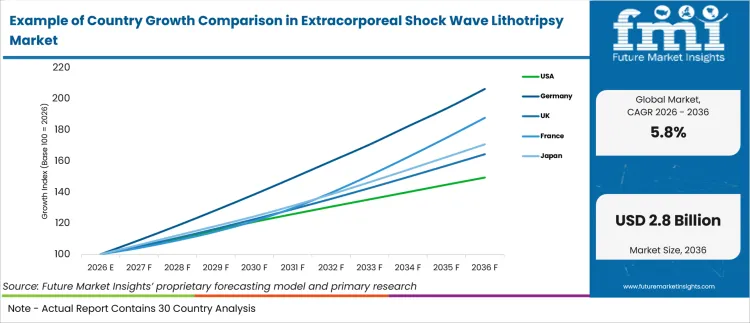
| Country | CAGR |
|---|---|
| Germany | 7.5% |
| France | 6.5% |
| Japan | 5.5% |
| UK | 5.1% |
| Italy | 4.8% |
| Canada | 4.5% |
| USA | 4.1% |
How do country-level CAGRs compare in the Extracorporeal Shock Wave Lithotripsy Market?
The country forecasts show a structured progression across the extracorporeal shock wave lithotripsy (ESWL) market, with growth gradually moderating from Germany to the USA rather than separating into distinct tiers. Germany and France form an upper group where demand is supported by established urology care networks and continued use of non-invasive stone management procedures. Japan and the UK occupy a middle position with relatively limited separation between their forecasts, reflecting steady utilization of ESWL alongside other treatment approaches for urinary stone disease. Italy, Canada and the USA create a lower band where growth remains positive but is more closely linked to equipment replacement, procedural optimization and patient selection trends. This pattern reflects differences in treatment protocols, healthcare investment and the balance between lithotripsy and alternative stone removal techniques across major healthcare markets.
- Germany benefits from a strong urology infrastructure and long-standing adoption of non-invasive stone treatment technologies, supporting continued demand for ESWL systems and related services.
- France remains closely aligned with Germany as healthcare providers continue to utilize lithotripsy as an important treatment option for appropriately selected kidney and urinary stone cases.
- Japan supports steady market development through high utilization of advanced medical technologies and sustained demand for minimally invasive treatment approaches.
- The UK reflects ongoing demand for ESWL procedures within hospital-based urology services, where treatment decisions are increasingly guided by patient outcomes and resource efficiency considerations.
- Italy continues to generate demand through established urological care pathways and continued investment in technologies that reduce procedural complexity and recovery times.
- Canada's outlook is influenced by growing emphasis on efficient management of urinary stone disease and optimization of treatment access across healthcare facilities.
- The USA maintains a more measured growth trajectory as providers balance ESWL utilization with alternative interventions such as ureteroscopy and other minimally invasive stone treatment procedures.
Similar CAGRs do not necessarily translate into identical market conditions. Differences in reimbursement policies, treatment preferences, healthcare infrastructure and clinical guidelines can significantly influence how ESWL technologies are adopted and utilized. As a result, manufacturers and service providers may encounter distinct commercialization and procurement environments despite broadly comparable growth trends. The full report provides country-level CAGR analysis across North America, Latin America, Europe, East Asia, South Asia, Oceania and the Middle East and Africa.
Country-wise Analysis
- Germany records inpatient urinary-stone procedures through national codes that distinguish extracorporeal treatment by stone location. Extracorporeal shock wave lithotripsy sales in Germany are forecast to expand at 7.5% CAGR by 2036, supported by coded hospital pathways and concentrated referral capacity. BfArM's 2025 OPS classification assigns code 8-110 to extracorporeal treatment of urinary stones by anatomical location. Destatis published inpatient procedure data in September 2025 through the same four-digit coding framework used by German hospitals. The coding route supports utilization review across referral centers that maintain dedicated imaging and clinical engineering teams. Capital committees remain cautious about long service commitments and reliable replacement-part access across the complete equipment lifetime. Manufacturers should prioritize regional centers that show repeatable procedure volume and documented local maintenance capacity.
- France supports extracorporeal lithotripsy through hospital networks that can deliver selected procedures within an ambulatory treatment pathway. France's extracorporeal shock wave lithotripsy outlook is anticipated to advance at 6.5% CAGR over the assessment period, shaped by established day-surgery pathways. Assurance Maladie stated in January 2026 that extracorporeal lithotripsy belongs among procedures suitable for same-day surgery. Selected facilities can require prior medical approval if the patient needs full hospitalization rather than ambulatory treatment. The ambulatory route favors centers with predictable scheduling and dependable discharge coordination across suitable stone cases. Regional access differences and public budgets can delay replacement of older lithotripters outside established referral hubs. Service organizations need broad response coverage so maintenance problems do not interrupt planned capacity at smaller hospitals.
- Japan uses formal facility filing requirements for hospitals delivering extracorporeal kidney and ureter stone fragmentation. Japan is estimated to post 5.5% CAGR over the forecast period, aided by a defined reimbursement filing route for urinary-stone procedures. The Kanto-Shinetsu Regional Bureau listed the procedure as filing item 77 under the June 2026 reimbursement revision. The pathway gives hospitals a defined reimbursement route but requires documented compliance with facility conditions. Local distributors need Japanese-language documentation and qualified service coverage across regional hospital groups and clinics. Metropolitan centers can support specialist maintenance more easily than smaller facilities facing longer technician travel times. Commercial entry therefore depends on reimbursement readiness and a service network that can sustain equipment uptime.
- Great Britain applies strengthened post-market surveillance duties to medical devices supplied across public and private hospitals. By 2036, the UK extracorporeal shock wave lithotripsy market is projected to grow at 5.1% CAGR through clearer lifecycle responsibilities. MHRA guidance updated in September 2025 applies the requirements to devices placed on the market from June 16, 2025. The rules assign clearer incident reporting and lifecycle monitoring duties across manufacturers and authorized service organizations. Public hospital budgets remain a material friction for fleet replacement and additional fixed treatment capacity. Manufacturers need tender plans that connect service response with post-market evidence across the validated equipment lifetime. Mobile arrangements can widen regional access but complicate training ownership across several separate treatment locations.
- Italy tracks large medical equipment across public and private healthcare facilities through a national information system. Italy's extracorporeal shock wave lithotripsy sector is projected to record 4.8% CAGR during the assessment period, supported by national equipment visibility. The Ministry of Health updated its equipment-data guidance in January 2025 and retains extracorporeal lithotripsy as a named category. The database gives regional planners visibility into active installations and likely replacement requirements across public facilities. Hospitals compare ESWL with other endoscopic treatment routes across limited annual capital budgets for urology. Regional funding differences create uneven purchasing schedules and distributor service needs across the public system.
- Canada requires a medical device licence before Class II through Class IV systems can be imported or sold generally. Adoption of extracorporeal shock wave lithotripsy in Canada is estimated to expand at 4.5% CAGR through 2036, reinforced by federal licensing requirements. Health Canada published revised licence-application guidance in November 2025 with an effective date of February 2, 2026. The pathway creates a searchable authorization record and lets technical evaluation progress into hospital purchasing discussions. Wide distances between treatment centers increase service costs and replacement-part lead times outside major cities. Manufacturers need regional technicians and clear transport responsibilities to support fixed or mobile access across provinces. The commercial case improves across hospital networks that can aggregate referrals around dependable service routes.
- The United States regulates urological extracorporeal shock-wave lithotripters through a defined Class II device pathway. Extracorporeal shock wave lithotripsy demand in the USA is predicted to advance at 4.1% CAGR through 2036, linked to established urology networks. FDA classification records place these systems under product code LNS and regulation 876.5990 within the gastroenterology and urology panel. The route supports market entry through substantial equivalence to a legally marketed predicate device for commercial sale. Hospitals compare ESWL with established endoscopic choices across urology departments and ambulatory clinical treatment settings. Payer economics and low procedure volume can weaken utilization even among patients who remain clinically suitable. Manufacturers need measurable treatment volume and responsive service coverage to support expansion beyond major urology centers.
Who are the notable companies in the Extracorporeal Shock Wave Lithotripsy Market?
Dornier MedTech, STORZ MEDICAL AG, Richard Wolf GmbH, WIKKON, SonoMotion, Inc., DirexGroup, Medispec Ltd., and MTS Medical AG are the notable companies shaping this market.
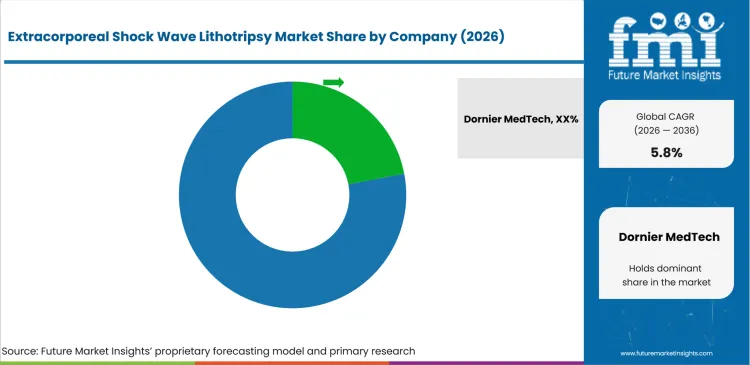
Competition combines established lithotripter manufacturers with newer ultrasound devices adapted for non-invasive fragmentation across hospital treatment settings. Dornier MedTech and STORZ MEDICAL AG provide integrated systems with verified imaging choices across established commercial regions. Richard Wolf GmbH and DirexGroup compete through modular localization and specialized room configurations for hospitals. WIKKON, a subsidiary of Advanced MedTech Holdings (which also owns Dornier MedTech), and SonoMotion use recent United States clearances to broaden regulated technology choice in hospitals. Medispec and MTS Medical serve specialist facilities through focused shock-wave platforms and distinct service models. Hospital capital plans compare ESWL with other urology treatment devices across the same annual investment cycle.
- Dornier MedTech and STORZ MEDICAL AG address hospitals seeking integrated imaging with established technical support across several regions. Dornier offers fixed and transportable configurations that suit different room layouts and planned annual treatment volumes. STORZ MEDICAL maintains dedicated SWL platforms with documented service locations across several major healthcare markets.
- Richard Wolf GmbH and DirexGroup compete through systems that combine shock-wave generation with documented localization options. Richard Wolf provides simultaneous X-ray and ultrasound guidance through its PiezoLith platform for selected urinary stones. DirexGroup offers electromagnetic generation with compatible imaging arrangements for different prepared hospital clinical room configurations.
- Medispec and MTS Medical AG serve specialist facilities seeking compact or configurable shock-wave systems today. Medispec distributes electromagnetic platforms across several regions, while MTS Medical offers FDA-cleared lithogold systems for renal and ureteral calculi. The lithogold platform is not commercially available in the European Union despite its United States clearance.
Competitive Benchmarking: Extracorporeal Shock Wave Lithotripsy Market
| Company | Integrated Stone Localization | Lithotripter Modularity | Clinical or Regulatory Evidence | Geographic Reach |
|---|---|---|---|---|
| Dornier MedTech | High | High | Medium | Global |
| STORZ MEDICAL AG | High | High | High | Global |
| Richard Wolf GmbH | High | High | Medium | Multi-country |
| WIKKON | Medium | Medium | High | Multi-country |
| SonoMotion, Inc. | Medium | Medium | High | United States |
| DirexGroup | High | Medium | Medium | Multi-country |
| Medispec Ltd. | High | High | Medium | Global distributor network |
| MTS Medical AG | High | Medium | High | United States and selected markets |
Key Developments in the Extracorporeal Shock Wave Lithotripsy Market
- In June 2025, WIKKON received United States FDA 510(k) clearance for the U200 extracorporeal shock wave lithotripter. The official announcement described integrated ultrasound localization that removes the need for X-ray imaging during treatment setup and delivery. The clearance adds another regulated imaging configuration for hospital stone-treatment programs across the United States.
- In May 2026, SonoMotion received FDA clearance for next-generation Break Wave therapy probes with a 31% smaller footprint and lighter handling. The update creates a more compact ultrasound-guided fragmentation configuration for selected kidney stones in hospitals. Hospitals gain another option for facilities with limited treatment space or different room design requirements.
- In December 2025, STORZ MEDICAL published treatment insights drawn from more than 2,000 SWL procedures involving larger or unusually shaped urinary stones. The article described structured protocols for stones measuring at least one centimeter and stressed careful case selection. The evidence broadens clinical discussion around complex cases without removing retreatment risk or the need for endoscopic alternatives.
- In January 2026, SonoMotion received United States FDA 510(k) clearance for the Break Wave lithotripsy device under the regulated urological extracorporeal category. The decision introduced an ultrasound-guided fragmentation platform for selected kidney stones in adult treatment pathways. Hospitals gained another non-invasive technology option that can broaden treatment choice across clinically suitable patient cases.
Key Players in the Extracorporeal Shock Wave Lithotripsy Market
Integrated Lithotripter Manufacturers
- Dornier MedTech
- STORZ MEDICAL AG
- Richard Wolf GmbH
Specialist Shock-Wave System Providers
- WIKKON
- DirexGroup
- Medispec Ltd.
Emerging and Focused Technology Developers
- SonoMotion, Inc.
- MTS Medical AG
Extracorporeal Shock Wave Lithotripsy Market - Report Scope
| Coverage field | Report scope |
|---|---|
| Market breakdown | Product, Application, End User, Technology, Mobility, and Region. |
| Market Definition | Systems and related support used to fragment urinary stones through externally generated focused shock waves without a conventional incision. |
| Regions Covered | North America, Latin America, Western Europe, Eastern Europe, East Asia, South Asia and Pacific, and Middle East and Africa. |
| Countries Covered | Germany, France, Japan, United Kingdom, Italy, Canada, and United States, with additional regional coverage across more than 30 countries. |
| Key Companies Profiled | Dornier MedTech, STORZ MEDICAL AG, Richard Wolf GmbH, WIKKON, SonoMotion, Inc., DirexGroup, Medispec Ltd., and MTS Medical AG. |
| Forecast Period | 2026 to 2036. |
| Approach | Hybrid bottom-up and top-down market sizing supported by primary market inputs and authoritative desk research. |
Extracorporeal Shock Wave Lithotripsy Market - Research Methodology
| Method | Approach |
|---|---|
| Primary Research | FMI analysts gathered input from manufacturers, service providers, technology developers, distributors, end users, procurement teams, and subject-matter experts. Interviews examined purchasing decisions, product or service evaluation, adoption barriers, approval requirements, pricing considerations, and expectations for technical or commercial support. Respondents were also asked what evidence is required before a trial, pilot, or initial order develops into regular purchasing. |
| Desk Research | Desk research covered government statistics, regulatory publications, trade data, industry associations, technical literature, standards, company filings, product information, and official corporate announcements. Sources were reviewed for relevance, publication date, geographic coverage, and consistency with the defined market scope. Claims relating to performance, applications, approvals, capacity, investment, and commercial activity were retained only when supported by credible public evidence. |
| Market Sizing and Forecasting | The market model combined the baseline value with historical performance, segment structure, pricing and volume indicators, adoption levels, company participation, and country-level demand conditions. Forecast assumptions considered economic activity, investment trends, regulatory developments, technology adoption, purchasing cycles, supply availability, and barriers to wider market use. Segment and regional estimates were reconciled before the final market total was calculated. |
| Data Validation | Estimates were checked against multiple independent indicators, including public data, company activity, trade patterns, industry developments, and findings from primary interviews. Validation also tested whether products, services, applications, and company revenues fell within the defined market boundaries. Adjacent categories, unsupported claims, overlapping revenues, and activities without direct market relevance were excluded to reduce double counting and maintain consistency across segments and countries. |
Extracorporeal Shock Wave Lithotripsy Market by Segments
Extracorporeal Shock Wave Lithotripsy Market segmented by Product:
- Electrohydraulic Lithotripters
- Third-generation Systems
- Integrated Imaging Systems
- High-energy Shock Wave Systems
- Electromagnetic Lithotripters
- Fixed Electromagnetic Systems
- Mobile Electromagnetic Systems
- Digital Lithotripters
- Piezoelectric Lithotripters
- High-precision Systems
- Low-noise Systems
- Compact Lithotripters
- Hybrid Lithotripters
- Multimodal Lithotripsy Systems
- AI-assisted Systems
- Image-guided Platforms
Extracorporeal Shock Wave Lithotripsy Market segmented by Application:
- Kidney Stones
- Renal Pelvis Stones
- Lower Pole Stones
- Multiple Renal Stones
- Ureteral Stones
- Upper Ureter Stones
- Mid Ureter Stones
- Lower Ureter Stones
- Bladder Stones
- Single Bladder Stones
- Multiple Bladder Stones
- Recurrent Stones
- Pancreatic & Salivary Stones
- Pancreatic Duct Stones
- Salivary Gland Stones
- Biliary Stone Applications
Extracorporeal Shock Wave Lithotripsy Market segmented by End User:
- Hospitals
- Public Hospitals
- Private Hospitals
- Tertiary Care Hospitals
- Specialty Urology Clinics
- Urology Centers
- Kidney Stone Clinics
- Ambulatory Urology Centers
- Ambulatory Surgical Centers
- Day Surgery Centers
- Minimally Invasive Surgery Centers
- Outpatient Centers
- Diagnostic & Research Centers
- University Hospitals
- Clinical Research Institutes
- Diagnostic Imaging Centers
Extracorporeal Shock Wave Lithotripsy Market segmented by Technology:
- Fluoroscopy-guided Systems
- Digital Fluoroscopy
- Real-time Imaging
- High-resolution Imaging
- Ultrasound-guided Systems
- 2D Ultrasound Guidance
- 3D Ultrasound Guidance
- Doppler-assisted Guidance
- Dual-imaging Systems
- Fluoroscopy + Ultrasound
- AI-assisted Imaging
- Image Fusion Systems
Extracorporeal Shock Wave Lithotripsy Market segmented by Mobility:
- Fixed Systems
- Hospital-installed Systems
- High-capacity Systems
- Multi-room Systems
- Mobile Systems
- Wheeled Lithotripters
- Compact Mobile Units
- Portable ESWL Systems
- Hybrid Systems
- Modular Platforms
- Shared-use Systems
- Mobile Imaging Integration
Extracorporeal Shock Wave Lithotripsy Market by Region:
- North America
- United States
- Canada
- Latin America
- Brazil
- Mexico
- Argentina
- Chile
- Western Europe
- Germany
- France
- United Kingdom
- Italy
- Spain
- Benelux
- Nordics
- Eastern Europe
- Poland
- Czech Republic
- Romania
- Hungary
- East Asia
- China
- Japan
- South Korea
- South Asia and Pacific
- India
- ASEAN
- Australia and New Zealand
- Middle East and Africa
- GCC Countries
- South Africa
- Türkiye
- Israel
Research Sources and Bibliography
- European Association of Urology. (2026). EAU guidelines on urolithiasis.
- Nedbal, C., Geraghty, R., Tramanzoli, P., Sessa, D., Gauhar, V., Galosi, A. B., Gregori, A., & Somani, B. K. (2025, July 8). Cost and effectiveness of flexible ureteroscopy versus shockwave lithotripsy for urolithiasis: A systematic review and meta-analysis by the European Association of Urology Endourology Section.
- STORZ MEDICAL AG. (2025, June 6). Erdoğan E. et al., 2025: Impact of advanced lithotripter technology on SWL success: insights from Modulith SLK inline outcomes.
- STORZ MEDICAL AG. (2025, July 31). Evidence-based, non-invasive stone therapy (SWL) with high success rates - MODULITH® SLK »inline«.
- STORZ MEDICAL AG. (2025, December 29). SWL for large urinary stones: Clinical insights into non-invasive treatment.
- USA Food and Drug Administration. (2026, May 25). Recognized consensus standards: Medical devices [IEC 60601-2-36].
- SonoMotion, Inc. (2026, May 14). SonoMotion announces FDA 510(k) clearance for the next generation Break Wave device featuring therapy probes with 31% smaller footprint, lighter weight and easier handling.
- Assurance Maladie. (2026, January 15). Colique néphrétique (calcul rénal ou urinaire).
- Assurance Maladie. (2026, January 13). Hospitalisation : les types de séjour et les démarches à effectuer.
- Federal Institute for Drugs and Medical Devices. (2025). OPS Version 2025.
- Federal Statistical Office of Germany. (2025, September 30). Statistischer Bericht - Fallpauschalenbezogene Krankenhausstatistik (DRG-Statistik) - Operationen und Prozeduren der vollstationären Patientinnen und Patienten in Krankenhäusern (4-Steller) - 2024.
- Kanto-Shinetsu Regional Bureau of Health and Welfare. (2026, June).
- Medicines and Healthcare products Regulatory Agency. (2025, September 5). Introduction and scope.
- Italian Ministry of Health. (2025, January 2). Consultazione dei dati sulle apparecchiature sanitarie.
- Health Canada. (2025, November 21). Guidance on managing applications for medical device licences: Overview.
- Erdoğan, E., Kanberoğlu, A. F., Aşık, A., Sarıca, G., & Sarıca, K. (2025, March 7). Outcomes of 10-20 mm renal stones: Shock wave lithotripsy versus flexible ureteroscopy.
- USA Food and Drug Administration. (2025, June 18). 510(k) premarket notification [K242922, U200].
- WIKKON. (2025, June 30). WIKKON® receives FDA clearance forU200 extracorporeal shock wave lithotripter.
- USA Food and Drug Administration. (2026, January 12). 510(k) premarket notification [K252913, Break Wave].
- SonoMotion, Inc. (2026, January 21). SonoMotion announces FDA 510(k) clearance of its Break Wave™ lithotripsy device for the non-invasive and anesthesia-free treatment of kidney stones.
- STORZ MEDICAL AG. (n.d.). MODULITH SLK inline - Flexible lithotripsy device with integrated patient table.
- DirexGroup. (n.d.). Duet Magna - Advancing shockwave lithotripsy.
- STORZ MEDICAL AG. (2025, February 3). Anna J Sharp et al., 2024: Matched pair analysis of wide versus narrow focus during shockwave lithotripsy for urolithiasis.
- SonoMotion, Inc. (2025, April 23). SonoMotion completed enrollment in the SOUND Break Wave™ pivotal clinical trial.
- Asher, G. N., Viprakasit, D. P., Aymes, S. E., Lusk, J. B., Ross, S., Baker, C., Rains, C., Wright, S. T., & Kahwati, L. C. (2026, January). Recurrent nephrolithiasis in adults and children: Comparative effectiveness of preventive medical strategies. Agency for Healthcare Research and Quality.
- USA Food and Drug Administration. (2006, November 2). 510(k) premarket notification [K062081, LithoGold].
This bibliography is provided for reader reference and is not exhaustive. The full report contains the complete reference list and detailed citations
This Report Answers
- How large is the extracorporeal shock wave lithotripsy market in 2026 and 2036?
- Which clinical conditions support investment in extracorporeal shock wave lithotripsy systems?
- Why do electrohydraulic lithotripters account for the largest product share in 2026?
- How do kidney stones influence application demand across treatment settings?
- Why do hospitals represent the largest end-user share in 2026?
- How do country growth rates differ across Germany, France, Japan, the UK, Italy, Canada, and the USA?
- Which companies provide integrated or specialized extracorporeal lithotripter systems?
- What limits equipment utilization across low-volume treatment sites?
- How can integrated imaging and mobile configurations improve treatment delivery?
Frequently Asked Questions
How big is the Extracorporeal Shock Wave Lithotripsy Market in 2026?
The extracorporeal shock wave lithotripsy market is valued at USD 1.6 billion in 2026 and is forecast to reach USD 2.8 billion by 2036. Growth is supported by recurring urinary-stone presentations creating repeat treatment demand across patients whose stone profile and anatomy remain suitable for non-invasive fragmentation within established urology programs.
What is the CAGR of the Extracorporeal Shock Wave Lithotripsy Market from 2026 to 2036?
The extracorporeal shock wave lithotripsy market grows at a CAGR of 5.8% between 2026 and 2036, supported by hospitals investing in integrated lithotripter systems once those platforms demonstrate dependable stone localization, consistent acoustic coupling, and reliable technical service coverage across planned annual treatment schedules.
Which product leads the Extracorporeal Shock Wave Lithotripsy Market?
Electrohydraulic lithotripters account for 42.0% of the extracorporeal shock wave lithotripsy market by product in 2026, driven by established spark-gap service knowledge and replaceable generator components that allow hospitals to plan recurring maintenance without changing the complete clinical treatment sequence across mature urology programs.
How much will the Extracorporeal Shock Wave Lithotripsy Market add between 2026 and 2036?
The extracorporeal shock wave lithotripsy market is set to add USD 1.2 billion between 2026 and 2036, growing from USD 1.6 billion to USD 2.8 billion as integrated dual-modality imaging platforms, ultrasound-guided fragmentation systems, and shared mobile lithotripter services enter funded hospital urology purchasing pathways across a widening base of kidney and ureteral stone treatment programs.
Who are the leading companies in the Extracorporeal Shock Wave Lithotripsy Market?
Five companies lead the extracorporeal shock wave lithotripsy market, including Dornier MedTech, STORZ MEDICAL AG, Richard Wolf GmbH, WIKKON, and SonoMotion, competing through integrated stone localization platforms, dual-modality imaging guidance, ultrasound-guided fragmentation, modular room configurations, and documented clinical evidence across global hospital urology programs.
Preview the report firsthand - request a free sample
Get SampleGet the brochure for pricing and purchase details.
Get PDFTable of Content
- Key Takeaways
- Market Size and CAGR
- Top Growth Driver
- Fastest Growing Segment
- Leading Region
- Key Companies
- Emerging Opportunities
- Executive Summary
- Global Market Outlook
- Demand-side Trends
- Supply-side Trends
- Technology Roadmap Analysis
- Analysis and Recommendations
- Analyst Perspective (What is happening? Why now? What should investors know?)
- Key Questions Answered
- How large is the market?
- What is the CAGR?
- What are key trends?
- Which region dominates?
- Who are the leaders?
- Market Overview
- Market Coverage / Taxonomy
- Market Definition / Scope / Limitations
- Research Methodology
- Chapter Orientation
- Analytical Lens and Working Hypotheses
- Market Structure, Signals, and Trend Drivers
- Benchmarking and Cross-market Comparability
- Market Sizing, Forecasting, and Opportunity Mapping
- Research Design and Evidence Framework
- Desk Research Programme (Secondary Evidence)
- Expert Input and Fieldwork (Primary Evidence)
- Tooling, Models, and Reference Databases
- Data Engineering and Model Build
- Quality Assurance and Audit Trail
- Market Background
- Market Dynamics (Drivers, Restraints, Opportunity, Trends)
- Scenario Forecast (Optimistic, Likely, Conservative)
- Impact Analysis
- AI Impact
- Sustainability Impact
- Regulatory Impact
- Technology Impact
- Consumer / Buyer Analysis
- Purchase Drivers
- Adoption Barriers
- Buyer Journey
- Opportunity Map Analysis
- Product Life Cycle Analysis
- Supply Chain Analysis
- Investment Feasibility Matrix
- Value Chain Analysis
- PESTLE and Porter's Analysis
- Regulatory Landscape
- Regional Parent Market Outlook
- Production and Consumption Statistics
- Import and Export Statistics
- Global Market Analysis and Forecast, 2021 to 2036
- Historical Market Size Value (USD Billion) Analysis, 2021 to 2025
- Current and Future Market Size Value (USD Billion) Projections, 2026 to 2036
- Y-o-Y Growth Trend Analysis
- Absolute $ Opportunity Analysis
- Global Market Pricing Analysis, 2021 to 2036
- Global Market Analysis and Forecast, By Product, 2021 to 2036
- Introduction / Key Findings
- Historical Market Size Value (USD Billion) Analysis By Product, 2021 to 2025
- Current and Future Market Size Value (USD Billion) Analysis and Forecast By Product, 2026 to 2036
- Electrohydraulic Lithotripters
- Third-generation Systems
- Integrated Imaging Systems
- High-energy Shock Wave Systems
- Electromagnetic Lithotripters
- Fixed Electromagnetic Systems
- Mobile Electromagnetic Systems
- Digital Lithotripters
- Piezoelectric Lithotripters
- High-precision Systems
- Low-noise Systems
- Compact Lithotripters
- Hybrid Lithotripters
- Multimodal Lithotripsy Systems
- AI-assisted Systems
- Image-guided Platforms
- Electrohydraulic Lithotripters
- Y-o-Y Growth Trend Analysis By Product, 2021 to 2025
- Absolute $ Opportunity Analysis By Product, 2026 to 2036
- Global Market Analysis and Forecast, By Application, 2021 to 2036
- Introduction / Key Findings
- Historical Market Size Value (USD Billion) Analysis By Application, 2021 to 2025
- Current and Future Market Size Value (USD Billion) Analysis and Forecast By Application, 2026 to 2036
- Kidney Stones
- Renal Pelvis Stones
- Lower Pole Stones
- Multiple Renal Stones
- Ureteral Stones
- Upper Ureter Stones
- Mid Ureter Stones
- Lower Ureter Stones
- Bladder Stones
- Single Bladder Stones
- Multiple Bladder Stones
- Recurrent Stones
- Pancreatic & Salivary Stones
- Pancreatic Duct Stones
- Salivary Gland Stones
- Biliary Stone Applications
- Kidney Stones
- Y-o-Y Growth Trend Analysis By Application, 2021 to 2025
- Absolute $ Opportunity Analysis By Application, 2026 to 2036
- Global Market Analysis and Forecast, By End User, 2021 to 2036
- Introduction / Key Findings
- Historical Market Size Value (USD Billion) Analysis By End User, 2021 to 2025
- Current and Future Market Size Value (USD Billion) Analysis and Forecast By End User, 2026 to 2036
- Hospitals
- Public Hospitals
- Private Hospitals
- Tertiary Care Hospitals
- Specialty Urology Clinics
- Urology Centers
- Kidney Stone Clinics
- Ambulatory Urology Centers
- Ambulatory Surgical Centers
- Day Surgery Centers
- Minimally Invasive Surgery Centers
- Outpatient Centers
- Diagnostic & Research Centers
- University Hospitals
- Clinical Research Institutes
- Diagnostic Imaging Centers
- Hospitals
- Y-o-Y Growth Trend Analysis By End User, 2021 to 2025
- Absolute $ Opportunity Analysis By End User, 2026 to 2036
- Global Market Analysis and Forecast, By Technology, 2021 to 2036
- Introduction / Key Findings
- Historical Market Size Value (USD Billion) Analysis By Technology, 2021 to 2025
- Current and Future Market Size Value (USD Billion) Analysis and Forecast By Technology, 2026 to 2036
- Fluoroscopy-guided Systems
- Digital Fluoroscopy
- Real-time Imaging
- High-resolution Imaging
- Ultrasound-guided Systems
- 2D Ultrasound Guidance
- 3D Ultrasound Guidance
- Doppler-assisted Guidance
- Dual-imaging Systems
- Fluoroscopy + Ultrasound
- AI-assisted Imaging
- Image Fusion Systems
- Fluoroscopy-guided Systems
- Y-o-Y Growth Trend Analysis By Technology, 2021 to 2025
- Absolute $ Opportunity Analysis By Technology, 2026 to 2036
- Global Market Analysis and Forecast, By Mobility, 2021 to 2036
- Introduction / Key Findings
- Historical Market Size Value (USD Billion) Analysis By Mobility, 2021 to 2025
- Current and Future Market Size Value (USD Billion) Analysis and Forecast By Mobility, 2026 to 2036
- Fixed Systems
- Hospital-installed Systems
- High-capacity Systems
- Multi-room Systems
- Mobile Systems
- Wheeled Lithotripters
- Compact Mobile Units
- Portable ESWL Systems
- Hybrid Systems
- Modular Platforms
- Shared-use Systems
- Mobile Imaging Integration
- Fixed Systems
- Y-o-Y Growth Trend Analysis By Mobility, 2021 to 2025
- Absolute $ Opportunity Analysis By Mobility, 2026 to 2036
- Global Market Analysis and Forecast, By Region, 2021 to 2036
- Introduction
- Historical Market Size Value (USD Billion) Analysis By Region, 2021 to 2025
- Current Market Size Value (USD Billion) Analysis and Forecast By Region, 2026 to 2036
- North America
- Latin America
- Western Europe
- Eastern Europe
- East Asia
- South Asia and Pacific
- Middle East & Africa
- Market Attractiveness Analysis By Region
- North America Market Analysis and Forecast, By Country, 2021 to 2036
- Historical Market Size Value (USD Billion) Trend Analysis By Market Taxonomy, 2021 to 2025
- Market Size Value (USD Billion) Forecast By Market Taxonomy, 2026 to 2036
- By Country
- USA
- Canada
- By Product
- By Application
- By End User
- By Technology
- By Mobility
- By Country
- Market Attractiveness Analysis
- By Country
- By Product
- By Application
- By End User
- By Technology
- By Mobility
- Key Takeaways
- Latin America Market Analysis and Forecast, By Country
- Historical Market Size Value (USD Billion) Trend Analysis By Market Taxonomy, 2021 to 2025
- Market Size Value (USD Billion) Forecast By Market Taxonomy, 2026 to 2036
- By Country
- Brazil
- Mexico
- Chile
- Rest of Latin America
- By Product
- By Application
- By End User
- By Technology
- By Mobility
- By Country
- Market Attractiveness Analysis
- By Country
- By Product
- By Application
- By End User
- By Technology
- By Mobility
- Key Takeaways
- Western Europe Market Analysis and Forecast, By Country
- Historical Market Size Value (USD Billion) Trend Analysis By Market Taxonomy, 2021 to 2025
- Market Size Value (USD Billion) Forecast By Market Taxonomy, 2026 to 2036
- By Country
- Germany
- UK
- Italy
- Spain
- France
- Nordic
- BENELUX
- Rest of Western Europe
- By Product
- By Application
- By End User
- By Technology
- By Mobility
- By Country
- Market Attractiveness Analysis
- By Country
- By Product
- By Application
- By End User
- By Technology
- By Mobility
- Key Takeaways
- Eastern Europe Market Analysis and Forecast, By Country
- Historical Market Size Value (USD Billion) Trend Analysis By Market Taxonomy, 2021 to 2025
- Market Size Value (USD Billion) Forecast By Market Taxonomy, 2026 to 2036
- By Country
- Russia
- Poland
- Hungary
- Balkan & Baltic
- Rest of Eastern Europe
- By Product
- By Application
- By End User
- By Technology
- By Mobility
- By Country
- Market Attractiveness Analysis
- By Country
- By Product
- By Application
- By End User
- By Technology
- By Mobility
- Key Takeaways
- East Asia Market Analysis and Forecast, By Country
- Historical Market Size Value (USD Billion) Trend Analysis By Market Taxonomy, 2021 to 2025
- Market Size Value (USD Billion) Forecast By Market Taxonomy, 2026 to 2036
- By Country
- China
- Japan
- South Korea
- By Product
- By Application
- By End User
- By Technology
- By Mobility
- By Country
- Market Attractiveness Analysis
- By Country
- By Product
- By Application
- By End User
- By Technology
- By Mobility
- Key Takeaways
- South Asia and Pacific Market Analysis and Forecast, By Country
- Historical Market Size Value (USD Billion) Trend Analysis By Market Taxonomy, 2021 to 2025
- Market Size Value (USD Billion) Forecast By Market Taxonomy, 2026 to 2036
- By Country
- India
- ASEAN
- Australia & New Zealand
- Rest of South Asia and Pacific
- By Product
- By Application
- By End User
- By Technology
- By Mobility
- By Country
- Market Attractiveness Analysis
- By Country
- By Product
- By Application
- By End User
- By Technology
- By Mobility
- Key Takeaways
- Middle East & Africa Market Analysis and Forecast, By Country
- Historical Market Size Value (USD Billion) Trend Analysis By Market Taxonomy, 2021 to 2025
- Market Size Value (USD Billion) Forecast By Market Taxonomy, 2026 to 2036
- By Country
- Kingdom of Saudi Arabia
- Other GCC Countries
- Türkiye
- South Africa
- Other African Union
- Rest of Middle East & Africa
- By Product
- By Application
- By End User
- By Technology
- By Mobility
- By Country
- Market Attractiveness Analysis
- By Country
- By Product
- By Application
- By End User
- By Technology
- By Mobility
- Key Takeaways
- Key Countries Market Analysis
- USA
- Pricing Analysis
- Market Share Analysis, 2025
- By Product
- By Application
- By End User
- By Technology
- By Mobility
- Canada
- Pricing Analysis
- Market Share Analysis, 2025
- By Product
- By Application
- By End User
- By Technology
- By Mobility
- Mexico
- Pricing Analysis
- Market Share Analysis, 2025
- By Product
- By Application
- By End User
- By Technology
- By Mobility
- Brazil
- Pricing Analysis
- Market Share Analysis, 2025
- By Product
- By Application
- By End User
- By Technology
- By Mobility
- Chile
- Pricing Analysis
- Market Share Analysis, 2025
- By Product
- By Application
- By End User
- By Technology
- By Mobility
- Germany
- Pricing Analysis
- Market Share Analysis, 2025
- By Product
- By Application
- By End User
- By Technology
- By Mobility
- UK
- Pricing Analysis
- Market Share Analysis, 2025
- By Product
- By Application
- By End User
- By Technology
- By Mobility
- Italy
- Pricing Analysis
- Market Share Analysis, 2025
- By Product
- By Application
- By End User
- By Technology
- By Mobility
- Spain
- Pricing Analysis
- Market Share Analysis, 2025
- By Product
- By Application
- By End User
- By Technology
- By Mobility
- France
- Pricing Analysis
- Market Share Analysis, 2025
- By Product
- By Application
- By End User
- By Technology
- By Mobility
- India
- Pricing Analysis
- Market Share Analysis, 2025
- By Product
- By Application
- By End User
- By Technology
- By Mobility
- ASEAN
- Pricing Analysis
- Market Share Analysis, 2025
- By Product
- By Application
- By End User
- By Technology
- By Mobility
- Australia & New Zealand
- Pricing Analysis
- Market Share Analysis, 2025
- By Product
- By Application
- By End User
- By Technology
- By Mobility
- China
- Pricing Analysis
- Market Share Analysis, 2025
- By Product
- By Application
- By End User
- By Technology
- By Mobility
- Japan
- Pricing Analysis
- Market Share Analysis, 2025
- By Product
- By Application
- By End User
- By Technology
- By Mobility
- South Korea
- Pricing Analysis
- Market Share Analysis, 2025
- By Product
- By Application
- By End User
- By Technology
- By Mobility
- Russia
- Pricing Analysis
- Market Share Analysis, 2025
- By Product
- By Application
- By End User
- By Technology
- By Mobility
- Poland
- Pricing Analysis
- Market Share Analysis, 2025
- By Product
- By Application
- By End User
- By Technology
- By Mobility
- Hungary
- Pricing Analysis
- Market Share Analysis, 2025
- By Product
- By Application
- By End User
- By Technology
- By Mobility
- Kingdom of Saudi Arabia
- Pricing Analysis
- Market Share Analysis, 2025
- By Product
- By Application
- By End User
- By Technology
- By Mobility
- Türkiye
- Pricing Analysis
- Market Share Analysis, 2025
- By Product
- By Application
- By End User
- By Technology
- By Mobility
- South Africa
- Pricing Analysis
- Market Share Analysis, 2025
- By Product
- By Application
- By End User
- By Technology
- By Mobility
- USA
- Market Structure Analysis
- Competition Dashboard
- Competition Benchmarking
- Market Share Analysis of Top Players
- By Regional
- By Product
- By Application
- By End User
- By Technology
- By Mobility
- Emerging Startups
- Innovation Benchmarking
- Competition Analysis
- Competition Deep Dive
- Dornier MedTech
- Overview
- Product Portfolio
- Profitability by Market Segments
- Sales Footprint
- Strategy Overview
- Marketing Strategy
- Product Strategy
- Channel Strategy
- Olympus Corporation
- Richard Wolf GmbH
- DirexGroup
- EDAP TMS
- Siemens Healthineers
- STORZ Medical AG
- Boston Scientific Corporation
- Allengers Medical Systems
- Medispec Ltd.
- Dornier MedTech
- Case Studies
- Success Stories
- Recent Developments
- Competition Deep Dive
- Assumptions & Acronyms Used


