

- Market Size (2026)
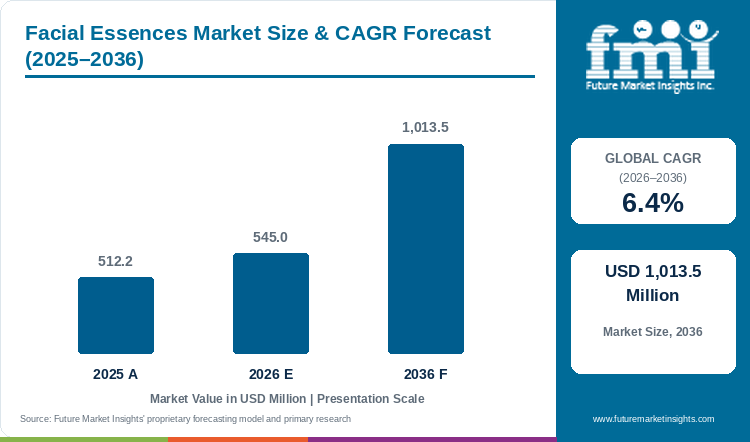
- USD 545.0 Mn
- Forecast (2036)
- USD 1013.5 Mn
- CAGR (2026 to 2036)
- 6.4%
How big is the Facial Essences Market in 2026?
The Facial Essences Market is valued at USD 545.0 Million in 2026, compared with USD 512.2 Million in 2025.
FMI values the facial essences market at USD 545.0 Million in 2026 and forecasts it to reach USD 1,013.5 Million by 2036 at a 6.4% CAGR. The market is growing in mature as well as emerging markets. For instance, Germany gives a useful view of where face-care spending is moving. Skin and face care sales increased 11.1% in 2025, whereas rugstores still held 53% of beauty sales. [2] The market in Japan is growing on account of factors that are different than those in Europe. Cosmetic shipments increased 1.2% in 2025 to JPY 1.39 trillion (USD 8.8 billion), in which skin cosmetics represented 45.2% of shipment value and serums became the largest individual skincare item at JPY 121.9 billion (USD 770.2 million). [8] This is important for facial essences because the category is entering a market where consumers already spend heavily on treatment layers. The opportunity is large but so is substitution pressure from serum.
South Korea remains important because it is both a domestic skincare market and a global product-development base. Cosmetics exports reached USD 11.4 billion in 2025 and increased 11.8% from the previous year. The USA was the largest export market at USD 2.2 billion. [9] For essence suppliers this means Korean product trends can move into overseas channels quickly once a format gains acceptance. The same cross-border pattern is visible in the K-Beauty Product Market. The market in France has its own idiosyncrasies. Makeup and facial-care products generated about EUR 11 billion (USD 12.3 billion) of French cosmetics exports in 2025 and represented 49% of total cosmetics exports. [3] However, this category was down 2.1% for the year. The market is large but competition is already strong. New essence launches will need to take spend from established face-care products during the forecast period, as per FMI analysis.
Key Takeaways
- Core / classic lines are projected to hold 41.0% of Product Type demand in 2026.
- Conventional products are expected to account for 56.0% of Nature demand.
- Cream & balm is projected to hold 35.0% of Format demand in 2026. Richer essence textures are gaining use in dry-skin and barrier-care routines.
- Mass is expected to account for 35.0% of Price Positioning demand in 2026. Many buyers still see essence as an extra step in skincare. A lower price makes it easier to try the product without changing the rest of the routine.
- E-commerce & DTC is projected to account for 26.0% of Sales Channel demand in 2026. The channel is important because many facial essence brands reach buyers outside their home markets through online retail before they gain wide store distribution.
- UAE is expected to record brisk CAGR at 7.7% through 2036. Whereas Saudi Arabia follows at 7.3%. The Gulf markets are growing faster from a smaller base, while South Korea already has strong familiarity with essence-led skincare routines
Analyst Perspective
“Over the next few years, facial essences will move beyond thin hydration products. Milky essences and barrier-support formulas are likely to gain more demand while resurfacing essences will open a more treatment-led part of the market. South Korea and Japan will continue to influence product development while faster-growing Gulf markets offer room for wider adoption.”
- Rahul Pandita, Principal Consultant, Future Market Insights
How is the facial essences market segmented?
The market is segmented by Product Type, Nature, Format, Price Positioning, Sales Channel, and Region.
By Product Type, the market includes Core / classic lines, Targeted treatment lines, Sensitive & gentle lines, Premium & clinical lines, and Kits & sets. Nature covers Conventional, Vegan & cruelty-free, Natural & organic, Dermocosmetic / clinical, and Fragrance-free & sensitive products. Format includes Cream & balm, Liquid & serum, Stick & solid, Spray & mist, Sheet & patch, and Powder. Price Positioning is divided into Mass, Masstige, Premium, and Professional. Sales Channel covers E-commerce & DTC, Specialty beauty retail, Pharmacies & drugstores, Supermarkets & hypermarkets, and Salons & spas.
Why do Core / classic lines lead demand within the Product Type category?
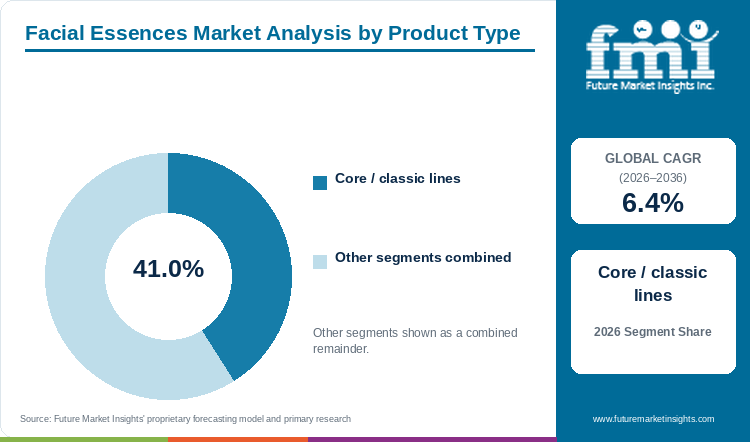
Core / classic lines are projected to account for 41.0% of Product Type demand in 2026.
Core / classic lines are likely to remain the largest segment because facial essence is still an additional step in the skincare routine. Buyers who already use an essence are more likely to continue with a familiar hydration or first-treatment product than replace it with a more specialized formula. Targeted treatment lines are also likely to grow as resurfacing and repair become more common. However, these products also compete with serums and exfoliants that already perform similar jobs. The same spending overlap is visible in the Facial Serum Market. Core lines should therefore retain the largest share even as treatment-led products gain some demand.
- Core / classic lines are projected to account for 41.0% of Product Type demand in 2026.
- Targeted treatment lines are expected to gain demand as resurfacing and repair become more common within the essence category.
Why does Cream & balm lead demand within the Format category?
Cream & balm is projected to account for 35.0% of Format demand in 2026.
Cream & balm is gaining share as facial essences move beyond thin treatment waters. Richer formats are being used for dry skin and barrier care. The Cosmetic Ceramide Blends Market is relevant here because ceramides are widely used in barrier-focused facial skincare. They also reduce the need to add another light layer before moisturizer. Liquid essences are likely to remain important in Japan and South Korea where the format is already familiar. Creamy and milky products are likely to grow faster in markets where barrier care is becoming a larger part of the skincare routine. Their main challenge for brands is keeping the texture light enough for use before serum or moisturizer.
- Cream & balm is projected to account for 35.0% of Format demand in 2026.
- Creamy and milky essences are gaining demand in dry-skin and barrier-care routines.
Why does Mass lead demand within the Price Positioning category?
Mass is projected to account for 35.0% of Price Positioning demand in 2026.
Mass products are projected to lead their leading market share owing to the fact that facial essence is still a new step for many buyers outside East Asia. A lower price gives consumers a chance to try the category without spending as much as they would on a premium serum or treatment product. This gives facial essence a practical place inside the wider Cosmetics Market. Premium essences will remain important among buyers who already follow layered skincare routines. They can also support higher prices through treatment ingredients or prestige branding. Mass should still hold the larger share because category expansion depends on bringing new users into the routine.
- Mass is projected to account for 35.0% of Price Positioning demand in 2026.
- Premium demand is stronger among buyers who already use several treatment steps.
Why does E-commerce & DTC lead demand within the Sales Channel category?
E-commerce & DTC is projected to account for 26.0% of Sales Channel demand in 2026.
E-commerce has become important as many facial essence brands reach buyers outside their home markets before they gain wide store distribution. This is especially relevant for Korean and Japanese skincare brands. Online retail gives these products access to buyers who may not find the same assortment in local stores. These channels also work well for repeat purchase.
- E-commerce & DTC is projected to account for 26.0% of Sales Channel demand in 2026.
- Specialty beauty retail remains important where buyers want to test texture before purchase.
What are the drivers, restraints, and opportunities in the Facial Essences Market?
Demand is growing as facial essences gain a clearer place in skincare routines. Overlap with toner and serum remains the main restraint. Milky and treatment-led formats are opening new areas of demand.
- Driver: More consumers are using an essence as the first treatment step after cleansing.
- Restraint: Demand weakens when the buyer cannot see enough difference between an essence and a toner or serum.
- Opportunity: Barrier-care and resurfacing products can bring facial essences into more skincare routines.
Facial essences are likely to gain demand as more buyers add one more step between cleansing and serum or moisturizer. Hydration will remain the main reason for use while barrier care is likely to become more important over the forecast period. German skin and face care sales rose 11.1% in 2025. [2] This shows that consumers are still willing to spend more on facial care even in a mature market.
The main challenge is that essence can be removed from the routine very easily. A watery essence may look similar to toner while a treatment essence may look similar to serum. If buyers do not see enough difference they may stop using the product after trial. This is why repeat purchase will depend more on a clear benefit than on first-time interest.
The next opportunity will come from products that move beyond basic hydration. Milky essences are likely to gain demand in barrier-care routines while resurfacing essences can attract buyers looking for a stronger treatment step. These formats can help the category reach new users without depending only on traditional watery essences.
Which country CAGRs are profiled in the Facial Essences Market?
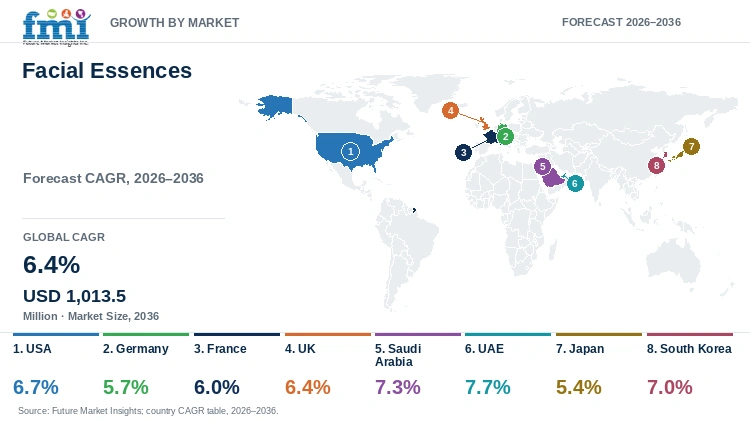
| Country | CAGR |
|---|---|
| USA | 6.7% |
| Germany | 5.7% |
| France | 6.0% |
| UK | 6.4% |
| Saudi Arabia | 7.3% |
| UAE | 7.7% |
| Japan | 5.4% |
| South Korea | 7.0% |
Country-wise Analysis
- USA: The USA is expected to grow at a 6.7% CAGR through 2036. More than 1.29 million cosmetic products were listed with the FDA by June 2026. [1] South Korea also exported USD 2.2 billion of cosmetics to the USA in 2025. [9] Facial essences therefore enter a very crowded skincare market. Growth will depend on whether the product can earn a separate place beside toner and serum rather than simply add another hydration claim.
- Germany: Germany is projected to grow at a 5.7% CAGR through 2036. Skin and face care sales increased 11.1% in 2025. Drugstores accounted for 53% of beauty purchases while online beauty sales grew 22.5%. [2] Facial essences therefore need to work at drugstore price points as well as online. Mass and masstige products should have more room than very expensive products that depend only on prestige retail.
- France: France is likely to expand at a 6.0% CAGR through 2036. Makeup and facial care generated about EUR 11 billion of French cosmetics exports in 2025 and represented 49% of total cosmetics exports. However this category declined 2.1% during the year. [3] Facial essence brands are therefore entering a large but mature market. New launches will need to take spend from serums and other face-care products rather than depend only on growth in the overall category.
- UK: The UK is expected to grow at a 6.4% CAGR through 2036. More than 861,000 cosmetic products had been notified through the UK system by May 2026. [4] This shows how crowded the market already is. Facial essences can still gain buyers through specialty beauty and online retail but overseas brands also need a UK Responsible Person before sale. Market entry therefore requires both product differentiation and local compliance.
- Saudi Arabia: Saudi Arabia is forecast to grow at a 7.3% CAGR through 2036. Electronic payments accounted for 85% of retail payments in 2025 and the country handled about 14.6 billion electronic transactions. [5] This supports online beauty buying and repeat purchases. Facial essence brands still need to complete local cosmetic notification before wider distribution. [6] The market therefore offers faster digital growth but also requires proper local registration.
- UAE: UAE is expected to record the fastest profiled CAGR at 7.7% through 2036. Dubai handles more than 90% of UAE imports and monitors over 500,000 imported consumer products. Nearly 13,000 establishments are involved in cosmetics and consumer-product trade in the city. [7] Facial essences can therefore reach buyers through many retail and online routes. The main challenge is standing out in a market where new imported beauty products enter quickly.
- Japan: Japan is forecast to grow at a 5.4% CAGR through 2036. Skin cosmetics represented 45.2% of total cosmetics shipment value in 2025. Serums alone reached JPY 121.9 billion and became the largest individual skincare item. [8] Facial essences therefore compete inside an already mature treatment routine. Growth will come mainly from products that offer a clear reason to be used before serum rather than from teaching consumers a new skincare step.
- South Korea: South Korea is expected to grow at a 7.0% CAGR through 2036. Cosmetics exports reached USD 11.4 billion in 2025 and increased 11.8% from the previous year. The USA was the largest export market at USD 2.2 billion. [9] South Korea is therefore important not only for domestic demand but also for product development that can move into overseas markets. Facial essence brands need regular product updates because consumers already know the category and compare new textures or treatment claims quickly.
Who are the notable companies in the Facial Essences Market?
Notable companies in the Facial Essences Market include Coty, Shiseido, L'Oreal, Amorepacific, Unilever, Procter & Gamble, e.l.f. Beauty, Estee Lauder Companies, Beiersdorf and Kao Corporation.
Shiseido and Amorepacific have a strong position in Asia where facial essences are already familiar to buyers. Procter & Gamble owns SK-II, one of the best-known essence brands. On the other hand, Kao has long experience in treatment lotions. These companies are selling into markets where the product step is already understood.
L'Oreal and Estee Lauder Companies are stronger in premium treatment skincare, whereas Beiersdorf and Coty have large face-care businesses but less direct exposure to facial essences. For these companies the opportunity is to introduce an essence only when it offers something different from an existing serum or lotion. e.l.f. Beauty became more important in this market after buying rhode in 2025. [12] rhode sells Glazing Milk as a creamy ceramide facial essence. Unilever owns Tatcha, which has an essence as part of its skincare routine.
- Asian skincare: Shiseido and Amorepacific have established essence ranges. Procter & Gamble owns SK-II and Kao has experience in treatment lotions.
- Premium skincare: L'Oreal and Estee Lauder Companies have large treatment-skincare businesses. Beiersdorf and Coty are stronger in broader face care.
- Newer positions in essence: e.l.f. Beauty owns rhode. Unilever owns Tatcha.
Competitive Benchmarking: Facial Essences Market
| Company | Essence Category Depth | Treatment & Barrier Positioning | Omnichannel Activation | Geographic Reach |
|---|---|---|---|---|
| Coty | Medium | High | High | North America and Europe with Asia-Pacific and travel retail |
| Shiseido | High | High | High | Japan and Asia with North America and Europe |
| L'Oreal | Medium | High | High | Global prestige and specialty beauty reach |
| Amorepacific | High | High | High | South Korea and East Asia with North America and Europe |
| Unilever | Medium | Medium | High | North America and Europe with Asia-Pacific |
| Procter & Gamble | High | High | High | Asia and North America with Europe and travel retail |
| e.l.f. Beauty | Medium | High | High | North America and UK with selected international markets |
| Estee Lauder Companies | High | High | High | Global prestige retail and online |
| Beiersdorf | Medium | High | High | Europe and North America with Asia and Middle East |
| Kao Corporation | Medium | High | High | Japan and East Asia with selected global prestige channels |
Scoring basis: Essence Category Depth looks at current facial essence and treatment-lotion products. Treatment & Barrier Positioning looks at targeted skincare claims and formula depth. Omnichannel Activation looks at digital and physical beauty distribution. High means broad documented capability while Medium means a narrower role.
Key Developments in the Facial Essences Market
- In August 2025 Amorepacific launched AP BEAUTY Resurfacing & Repair Essence in South Korea. The first-step liquid essence combines exfoliation with repair positioning and moves the category closer to treatment-led skincare. [11]
- In August 2025 e.l.f. Beauty completed its acquisition of rhode. The deal brought Glazing Milk into the group and gave e.l.f. Beauty a direct position in creamy facial essences. [12]
- During 2025 Beiersdorf launched La Prairie Pure Gold Revitalizing Essence. Beiersdorf reported that this launch helped partly offset weaker La Prairie sales during the year. [13]
Key Players in the Facial Essences Market
Ritual-Led Asian Skincare Platforms
- Shiseido
- Amorepacific
- Procter & Gamble
- Kao Corporation
Global Prestige Treatment Portfolios
- L'Oreal
- Estee Lauder Companies
- Beiersdorf
- Coty
Focused Digital and Prestige Challengers
- e.l.f. Beauty
- Unilever
Report Scope and Methodology
| Coverage field | Report scope |
|---|---|
| Market breakdown | Product Type; Nature; Format; Price Positioning; Sales Channel; Region |
| Quantitative Units | USD Million |
| Market Definition | Revenue includes products sold as facial essences or essence lotions within the stated segmentation. Toners and serums are excluded unless the product is explicitly marketed as an essence. |
| Regions Covered | North America; Latin America; Western Europe; Eastern Europe; East Asia; South Asia and Pacific; Middle East and Africa |
| Countries Covered | USA; Germany; France; UK; Saudi Arabia; UAE; Japan; South Korea; and additional countries in the full report |
| Key Companies Profiled | Coty; Shiseido; L'Oreal; Amorepacific; Unilever; Procter & Gamble; e.l.f. Beauty; Estee Lauder Companies; Beiersdorf; Kao Corporation |
| Forecast Period | 2026 to 2036 |
| Approach | Primary and desk research with market triangulation |
Research Methodology
| Method | Approach |
|---|---|
| Primary Research | FMI gathers input from brand owners and manufacturers. Retailers and distributors also provide views on pricing and repeat purchase. |
| Desk Research | Research uses regulator guidance and industry statistics. Company filings and official product information are also reviewed. |
| Market Sizing and Forecasting | Market values are reviewed against segment structure and country conditions. Product availability and channel presence are also considered. |
| Data Validation | Company roles and product definitions are checked against current first-party information. Adjacent toners and serums are kept outside the market unless they are sold as essences. |
Facial Essences Market by Segments
Facial Essences Market Segmented by Product Type
- Core / classic lines
- Targeted treatment lines
- Sensitive & gentle lines
- Premium & clinical lines
- Kits & sets
Facial Essences Market Segmented by Nature
- Conventional
- Vegan & cruelty-free
- Natural & organic
- Dermocosmetic / clinical
- Fragrance-free & sensitive
Facial Essences Market Segmented by Format
- Cream & balm
- Liquid & serum
- Stick & solid
- Spray & mist
- Sheet & patch
- Powder
Facial Essences Market Segmented by Price Positioning
- Mass
- Masstige
- Premium
- Professional
Facial Essences Market Segmented by Sales Channel
- E-commerce & DTC
- Specialty beauty retail
- Pharmacies & drugstores
- Supermarkets & hypermarkets
- Salons & spas
Facial Essences Market by Region
- North America
- United States
- Canada
- Latin America
- Brazil
- Mexico
- Argentina
- Chile
- Western Europe
- Germany
- France
- United Kingdom
- Italy
- Spain
- Benelux
- Nordics
- Eastern Europe
- Poland
- Czech Republic
- Romania
- Hungary
- East Asia
- China
- Japan
- South Korea
- South Asia and Pacific
- India
- ASEAN
- Australia and New Zealand
- Middle East and Africa
- GCC Countries
- South Africa
- Türkiye
- Israel
Research Sources and Bibliography
- [1] U.S. Food and Drug Administration (2026). Registration & Listing of Cosmetic Product Facilities and Products. Cosmetic registration data
- [2] IKW - The German Cosmetic, Toiletry, Perfumery and Detergent Association (2025, December 3). Market Data: Renewed Growth for the Beauty and Home Care Industry. German beauty market data
- [3] FEBEA - Fédération des Entreprises de la Beauté (2026, February 6). Coup de frein sur les exportations de cosmétiques français en 2025. French cosmetics export data
- [4] UK Office for Product Safety and Standards (2026, July 17). New data on UK cosmetic product safety notifications. UK cosmetics notification data
- [5] Saudi Central Bank (SAMA) (2026). E-Payments Account for 85% of Total Retail Payments in 2025.
- [6] Saudi Food and Drug Authority (2026, April 28). List of Notification of Marketing for Cosmetic Products.
- [7] Dubai Municipality (2025, October 27). Product safety at Beautyworld Middle East 2025.
- [8] Japan Cosmetic Industry Association (2025, October 27). Cosmetic Shipments.
- [9] Ministry of Food and Drug Safety, Republic of Korea (2026, January 9). 2025 K-Beauty exports hit a record USD 11.4 billion.
- [10] European Commission (2013, July 10). Commission Regulation (EU) No 655/2013 on common criteria for cosmetic claims.
- [11] Amorepacific (2025, August 1). AP BEAUTY launches Resurfacing & Repair Essence.
- [12] e.l.f. Beauty, Inc. (2025, August 6). Current Report on Form 8-K reporting completion of the rhode acquisition.
- [13] Beiersdorf (2026). Annual Report 2025.
- [14] Kao Corporation (2025, August 7). est The Lotion EX and The Emulsion EX launch announcement.
This bibliography is provided for reader reference. The full report contains the complete reference list and supporting research.
This Report Answers
- What is the Facial Essences Market size in 2026 and what value is forecast for 2036?
- Why do Core / classic lines hold the leading Product Type share?
- Why does Conventional remain the largest Nature segment?
- Why does Cream & balm lead the Format category?
- What is limiting wider facial essence adoption?
- Which countries have the fastest growth outlook through 2036?
- Which companies have the strongest facial essence or treatment-lotion positions?
- What should beauty category teams watch as essences move closer to serums and treatment lotions?
Frequently Asked Questions
How large is the Facial Essences Market in 2026?
FMI values the market at USD 545.0 Million in 2026. Sales are forecast to reach USD 1,013.5 Million by 2036.
What is the market CAGR from 2026 to 2036?
The Facial Essences Market is forecast to grow at a 6.4% CAGR from 2026 to 2036.
Which Product Type leads the Facial Essences Market?
Core / classic lines lead Product Type with a 41.0% share in 2026. Their position is supported by established routines and repeat purchase.
Which Nature segment holds the largest share?
Conventional leads Nature with a 56.0% share in 2026. Buyers still choose many essences on texture and routine benefit rather than on a vegan or natural label.
Which country has the fastest profiled growth rate?
UAE has the fastest profiled CAGR at 7.7% through 2036. Saudi Arabia follows at 7.3% and South Korea at 7.0%.
What is the main restraint in the Facial Essences Market?
The main restraint is overlap with toner and serum. If buyers cannot see a separate job for the essence step repeat purchase becomes harder.
Preview the report firsthand - request a free sample
Get SampleGet the brochure for pricing and purchase details.
Get PDFTable of Content
- Key Takeaways
- Market Size and CAGR
- Top Growth Driver
- Fastest Growing Segment
- Leading Region
- Key Companies
- Emerging Opportunities
- Executive Summary
- Global Market Outlook
- Demand-side Trends
- Supply-side Trends
- Technology Roadmap Analysis
- Analysis and Recommendations
- Analyst Perspective (What is happening? Why now? What should investors know?)
- Key Questions Answered
- How large is the market?
- What is the CAGR?
- What are key trends?
- Which region dominates?
- Who are the leaders?
- Market Overview
- Market Coverage / Taxonomy
- Market Definition / Scope / Limitations
- Research Methodology
- Chapter Orientation
- Analytical Lens and Working Hypotheses
- Market Structure, Signals, and Trend Drivers
- Benchmarking and Cross-market Comparability
- Market Sizing, Forecasting, and Opportunity Mapping
- Research Design and Evidence Framework
- Desk Research Programme (Secondary Evidence)
- Expert Input and Fieldwork (Primary Evidence)
- Tooling, Models, and Reference Databases
- Data Engineering and Model Build
- Quality Assurance and Audit Trail
- Market Background
- Market Dynamics (Drivers, Restraints, Opportunity, Trends)
- Scenario Forecast (Optimistic, Likely, Conservative)
- Impact Analysis
- AI Impact
- Sustainability Impact
- Regulatory Impact
- Technology Impact
- Consumer / Buyer Analysis
- Purchase Drivers
- Adoption Barriers
- Buyer Journey
- Opportunity Map Analysis
- Product Life Cycle Analysis
- Supply Chain Analysis
- Investment Feasibility Matrix
- Value Chain Analysis
- PESTLE and Porter's Analysis
- Regulatory Landscape
- Regional Parent Market Outlook
- Production and Consumption Statistics
- Import and Export Statistics
- Global Market Analysis and Forecast, 2021 to 2036
- Historical Market Size Value (USD Million) Analysis, 2021 to 2025
- Current and Future Market Size Value (USD Million) Projections, 2026 to 2036
- Y-o-Y Growth Trend Analysis
- Absolute $ Opportunity Analysis
- Global Market Pricing Analysis, 2021 to 2036
- Global Market Analysis and Forecast, By Product Type, 2021 to 2036
- Introduction / Key Findings
- Historical Market Size Value (USD Million) Analysis By Product Type, 2021 to 2025
- Current and Future Market Size Value (USD Million) Analysis and Forecast By Product Type, 2026 to 2036
- Core / classic lines
- Targeted treatment lines
- Sensitive & gentle lines
- Premium & clinical lines
- Kits & sets
- Y-o-Y Growth Trend Analysis By Product Type, 2021 to 2025
- Absolute $ Opportunity Analysis By Product Type, 2026 to 2036
- Global Market Analysis and Forecast, By Nature, 2021 to 2036
- Introduction / Key Findings
- Historical Market Size Value (USD Million) Analysis By Nature, 2021 to 2025
- Current and Future Market Size Value (USD Million) Analysis and Forecast By Nature, 2026 to 2036
- Conventional
- Vegan & cruelty-free
- Natural & organic
- Dermocosmetic / clinical
- Fragrance-free & sensitive
- Y-o-Y Growth Trend Analysis By Nature, 2021 to 2025
- Absolute $ Opportunity Analysis By Nature, 2026 to 2036
- Global Market Analysis and Forecast, By Format, 2021 to 2036
- Introduction / Key Findings
- Historical Market Size Value (USD Million) Analysis By Format, 2021 to 2025
- Current and Future Market Size Value (USD Million) Analysis and Forecast By Format, 2026 to 2036
- Cream & balm
- Liquid & serum
- Stick & solid
- Spray & mist
- Sheet & patch
- Powder
- Y-o-Y Growth Trend Analysis By Format, 2021 to 2025
- Absolute $ Opportunity Analysis By Format, 2026 to 2036
- Global Market Analysis and Forecast, By Price Positioning, 2021 to 2036
- Introduction / Key Findings
- Historical Market Size Value (USD Million) Analysis By Price Positioning, 2021 to 2025
- Current and Future Market Size Value (USD Million) Analysis and Forecast By Price Positioning, 2026 to 2036
- Mass
- Masstige
- Premium
- Professional
- Y-o-Y Growth Trend Analysis By Price Positioning, 2021 to 2025
- Absolute $ Opportunity Analysis By Price Positioning, 2026 to 2036
- Global Market Analysis and Forecast, By Sales Channel, 2021 to 2036
- Introduction / Key Findings
- Historical Market Size Value (USD Million) Analysis By Sales Channel, 2021 to 2025
- Current and Future Market Size Value (USD Million) Analysis and Forecast By Sales Channel, 2026 to 2036
- E-commerce & DTC
- Specialty beauty retail
- Pharmacies & drugstores
- Supermarkets & hypermarkets
- Salons & spas
- Y-o-Y Growth Trend Analysis By Sales Channel, 2021 to 2025
- Absolute $ Opportunity Analysis By Sales Channel, 2026 to 2036
- Global Market Analysis and Forecast, By Region, 2021 to 2036
- Introduction
- Historical Market Size Value (USD Million) Analysis By Region, 2021 to 2025
- Current Market Size Value (USD Million) Analysis and Forecast By Region, 2026 to 2036
- North America
- Latin America
- Western Europe
- Eastern Europe
- East Asia
- South Asia and Pacific
- Middle East and Africa
- Market Attractiveness Analysis By Region
- North America Market Analysis and Forecast, By Country, 2021 to 2036
- Historical Market Size Value (USD Million) Trend Analysis By Market Taxonomy, 2021 to 2025
- Market Size Value (USD Million) Forecast By Market Taxonomy, 2026 to 2036
- By Country
- United States
- Canada
- By Product Type
- By Nature
- By Format
- By Price Positioning
- By Sales Channel
- By Country
- Market Attractiveness Analysis
- By Country
- By Product Type
- By Nature
- By Format
- By Price Positioning
- By Sales Channel
- Key Takeaways
- Latin America Market Analysis and Forecast, By Country
- Historical Market Size Value (USD Million) Trend Analysis By Market Taxonomy, 2021 to 2025
- Market Size Value (USD Million) Forecast By Market Taxonomy, 2026 to 2036
- By Country
- Brazil
- Mexico
- Argentina
- Chile
- By Product Type
- By Nature
- By Format
- By Price Positioning
- By Sales Channel
- By Country
- Market Attractiveness Analysis
- By Country
- By Product Type
- By Nature
- By Format
- By Price Positioning
- By Sales Channel
- Key Takeaways
- Western Europe Market Analysis and Forecast, By Country
- Historical Market Size Value (USD Million) Trend Analysis By Market Taxonomy, 2021 to 2025
- Market Size Value (USD Million) Forecast By Market Taxonomy, 2026 to 2036
- By Country
- Germany
- France
- United Kingdom
- Italy
- Spain
- Benelux
- Nordics
- By Product Type
- By Nature
- By Format
- By Price Positioning
- By Sales Channel
- By Country
- Market Attractiveness Analysis
- By Country
- By Product Type
- By Nature
- By Format
- By Price Positioning
- By Sales Channel
- Key Takeaways
- Eastern Europe Market Analysis and Forecast, By Country
- Historical Market Size Value (USD Million) Trend Analysis By Market Taxonomy, 2021 to 2025
- Market Size Value (USD Million) Forecast By Market Taxonomy, 2026 to 2036
- By Country
- Poland
- Czech Republic
- Romania
- Hungary
- By Product Type
- By Nature
- By Format
- By Price Positioning
- By Sales Channel
- By Country
- Market Attractiveness Analysis
- By Country
- By Product Type
- By Nature
- By Format
- By Price Positioning
- By Sales Channel
- Key Takeaways
- East Asia Market Analysis and Forecast, By Country
- Historical Market Size Value (USD Million) Trend Analysis By Market Taxonomy, 2021 to 2025
- Market Size Value (USD Million) Forecast By Market Taxonomy, 2026 to 2036
- By Country
- China
- Japan
- South Korea
- By Product Type
- By Nature
- By Format
- By Price Positioning
- By Sales Channel
- By Country
- Market Attractiveness Analysis
- By Country
- By Product Type
- By Nature
- By Format
- By Price Positioning
- By Sales Channel
- Key Takeaways
- South Asia and Pacific Market Analysis and Forecast, By Country
- Historical Market Size Value (USD Million) Trend Analysis By Market Taxonomy, 2021 to 2025
- Market Size Value (USD Million) Forecast By Market Taxonomy, 2026 to 2036
- By Country
- India
- ASEAN
- Australia and New Zealand
- By Product Type
- By Nature
- By Format
- By Price Positioning
- By Sales Channel
- By Country
- Market Attractiveness Analysis
- By Country
- By Product Type
- By Nature
- By Format
- By Price Positioning
- By Sales Channel
- Key Takeaways
- Middle East and Africa Market Analysis and Forecast, By Country
- Historical Market Size Value (USD Million) Trend Analysis By Market Taxonomy, 2021 to 2025
- Market Size Value (USD Million) Forecast By Market Taxonomy, 2026 to 2036
- By Country
- GCC Countries
- South Africa
- Türkiye
- Israel
- By Product Type
- By Nature
- By Format
- By Price Positioning
- By Sales Channel
- By Country
- Market Attractiveness Analysis
- By Country
- By Product Type
- By Nature
- By Format
- By Price Positioning
- By Sales Channel
- Key Takeaways
- Key Countries Market Analysis
- United States
- Pricing Analysis
- Market Share Analysis, 2025
- By Product Type
- By Nature
- By Format
- By Price Positioning
- By Sales Channel
- Canada
- Pricing Analysis
- Market Share Analysis, 2025
- By Product Type
- By Nature
- By Format
- By Price Positioning
- By Sales Channel
- Mexico
- Pricing Analysis
- Market Share Analysis, 2025
- By Product Type
- By Nature
- By Format
- By Price Positioning
- By Sales Channel
- Brazil
- Pricing Analysis
- Market Share Analysis, 2025
- By Product Type
- By Nature
- By Format
- By Price Positioning
- By Sales Channel
- Chile
- Pricing Analysis
- Market Share Analysis, 2025
- By Product Type
- By Nature
- By Format
- By Price Positioning
- By Sales Channel
- Germany
- Pricing Analysis
- Market Share Analysis, 2025
- By Product Type
- By Nature
- By Format
- By Price Positioning
- By Sales Channel
- United Kingdom
- Pricing Analysis
- Market Share Analysis, 2025
- By Product Type
- By Nature
- By Format
- By Price Positioning
- By Sales Channel
- Italy
- Pricing Analysis
- Market Share Analysis, 2025
- By Product Type
- By Nature
- By Format
- By Price Positioning
- By Sales Channel
- Spain
- Pricing Analysis
- Market Share Analysis, 2025
- By Product Type
- By Nature
- By Format
- By Price Positioning
- By Sales Channel
- France
- Pricing Analysis
- Market Share Analysis, 2025
- By Product Type
- By Nature
- By Format
- By Price Positioning
- By Sales Channel
- India
- Pricing Analysis
- Market Share Analysis, 2025
- By Product Type
- By Nature
- By Format
- By Price Positioning
- By Sales Channel
- ASEAN
- Pricing Analysis
- Market Share Analysis, 2025
- By Product Type
- By Nature
- By Format
- By Price Positioning
- By Sales Channel
- Australia and New Zealand
- Pricing Analysis
- Market Share Analysis, 2025
- By Product Type
- By Nature
- By Format
- By Price Positioning
- By Sales Channel
- China
- Pricing Analysis
- Market Share Analysis, 2025
- By Product Type
- By Nature
- By Format
- By Price Positioning
- By Sales Channel
- Japan
- Pricing Analysis
- Market Share Analysis, 2025
- By Product Type
- By Nature
- By Format
- By Price Positioning
- By Sales Channel
- South Korea
- Pricing Analysis
- Market Share Analysis, 2025
- By Product Type
- By Nature
- By Format
- By Price Positioning
- By Sales Channel
- Poland
- Pricing Analysis
- Market Share Analysis, 2025
- By Product Type
- By Nature
- By Format
- By Price Positioning
- By Sales Channel
- Hungary
- Pricing Analysis
- Market Share Analysis, 2025
- By Product Type
- By Nature
- By Format
- By Price Positioning
- By Sales Channel
- Türkiye
- Pricing Analysis
- Market Share Analysis, 2025
- By Product Type
- By Nature
- By Format
- By Price Positioning
- By Sales Channel
- South Africa
- Pricing Analysis
- Market Share Analysis, 2025
- By Product Type
- By Nature
- By Format
- By Price Positioning
- By Sales Channel
- Saudi Arabia
- Pricing Analysis
- Market Share Analysis, 2025
- By Product Type
- By Nature
- By Format
- By Price Positioning
- By Sales Channel
- UAE
- Pricing Analysis
- Market Share Analysis, 2025
- By Product Type
- By Nature
- By Format
- By Price Positioning
- By Sales Channel
- United States
- Market Structure Analysis
- Competition Dashboard
- Competition Benchmarking
- Market Share Analysis of Top Players
- By Regional
- By Product Type
- By Nature
- By Format
- By Price Positioning
- By Sales Channel
- Emerging Startups
- Innovation Benchmarking
- Competition Analysis
- Competition Deep Dive
- Coty
- Overview
- Product Portfolio
- Profitability by Market Segments
- Sales Footprint
- Strategy Overview
- Marketing Strategy
- Product Strategy
- Channel Strategy
- Shiseido
- L'Oreal
- Amorepacific
- Unilever
- Procter & Gamble
- e.l.f. Beauty
- Estee Lauder Companies
- Beiersdorf
- Kao Corporation
- Coty
- Case Studies
- Success Stories
- Recent Developments
- Competition Deep Dive
- Assumptions & Acronyms Used


