

- Market Size (2026)
- USD 472.2 Mn
- Forecast (2036)
- USD 791.4 Mn
- CAGR (2026 to 2036)
- 5.3%
How big is Facial Self-Tanning Drops Market in 2026?
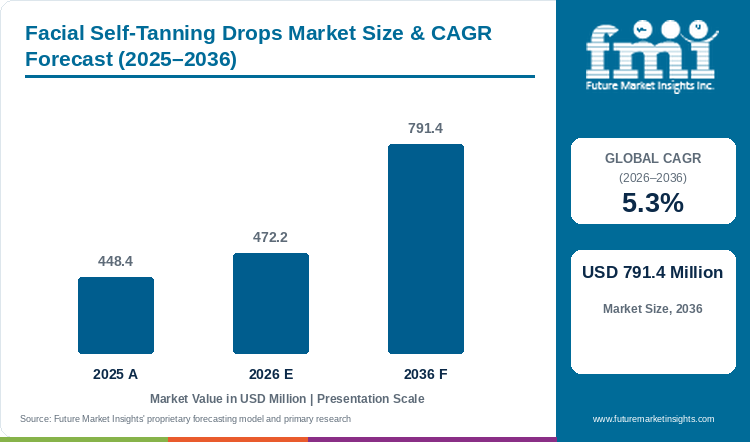
Demand for facial self-tanning drops is projected to expand at 5.3% CAGR between 2026 and 2036. Industry value grows from USD 448.4 million in 2025 to USD 472.2 million in 2026 and is projected to reach USD 791.4 million by 2036.
Facial self-tanning drops are DHA-based cosmetic color products that let consumers develop a tanned appearance without ultraviolet exposure, mixed into an existing moisturizer or serum rather than applied as a standalone body product. Demand for facial self-tanning drops is projected to expand at 5.3% CAGR between 2026 and 2036. The industry value is estimated to increase from USD 448.4 million in 2025 to USD 472.2 million in 2026 and further reach USD 791.4 million by 2036. The U.S. Food and Drug Administration explains that dihydroxyacetone darkens the skin by reacting with amino acids at the surface rather than by increasing melanin, and the same guidance restricts DHA to external application away from the eye area, lips and mucous membranes [1]. That non-UV mechanism keeps the category commercially relevant wherever sun-safety messaging is strong, but a facial formula still has to earn trust on dose control and predictable color before it earns a place in a daily routine. The category also sits within the wider beauty & personal care market, where facial products compete for space in established skincare routines.
Country conditions determine how that proposition reaches the shelf. UK demand builds on a self-tanning culture already embedded in British beauty retail, which gives facial-specific extensions an existing audience to convert, and the market is projected to grow at 6.6% CAGR through 2036, the fastest of the five profiled countries. USA follows at 6.3% CAGR, where L'Oreal Paris already sells a dedicated Sublime Bronze Self-Tanning Facial Drops line formulated to mix with moisturizer, showing that facial-specific formats have cleared mainstream American retail. Compliance work still varies by market, but both reward suppliers that turn documentation into clear, face-specific use instructions rather than treat it as a back-office cost.
Key Takeaways
- UV-free cosmetic color is gaining relevance as facial self-tanners become easier to integrate into daily skincare, which is expected to support the facial self-tanning drops market growth.
- Based on product type, mousses & foams is projected to account for 32.0% in 2026 owing to recognizable application behavior and fast-spreading textures that lower switching friction for consumers new to facial self-tan.
- By nature, conventional is estimated to hold 50.0% in 2026 due to a long DHA formulation history that supports both mass and prestige price points.
- In 2026, liquid & serum is expected to lead format with 28.0% share owing to controlled dosing that fits directly into an existing moisturizer routine.
- Facial dosing errors and the absence of inherent sun protection raise the cost of a poor first result, which may slow conversion from trial to repeat purchase.
- Profiled companies include Unilever, Procter & Gamble, Beiersdorf, Shiseido, Estee Lauder Companies, e.l.f. Beauty, Amorepacific, Coty, L'Oreal, and Kao Corporation.
Analyst Perspective
“Self-tan earns a place in the skincare routine only when it behaves like dependable facial care rather than an occasional body-tanning extension. In my experience, controlled development, sensitive-skin design and explicit sun-protection separation are what turn a first trial into a repeat purchase.”
- Rahul Pandita, Principal Consultant, Future Market Insights.
How is the facial self-tanning drops market segmented?
Facial self-tanning drops market is segmented by five primary commercial axes and region: product type, nature, format, price positioning, and sales channel. Mousses & foams is projected at 32.0%, conventional at 50.0%, and liquid & serum at 28.0% in 2026.
- By product type: Mousses & Foams, Drops & Serums, Lotions & Gradual, and Mists & Sprays.
- By nature: Conventional, Vegan & Cruelty-Free, Natural & Organic, Dermocosmetic / Clinical, and Fragrance-Free & Sensitive.
- By format: Liquid & Serum, Cream & Balm, Stick & Solid, Spray & Mist, Sheet & Patch, and Powder.
- By price positioning: Mass, Masstige, Premium, and Professional.
- By sales channel: Specialty Beauty Retail, E-commerce & DTC, Pharmacies & Drugstores, Supermarkets & Hypermarkets, and Salons & Spas.
- By region: North America, Latin America, Western Europe, Eastern Europe, East Asia, South Asia and Pacific, and Middle East and Africa.
What makes Mousses & Foams central to the Product Type category?
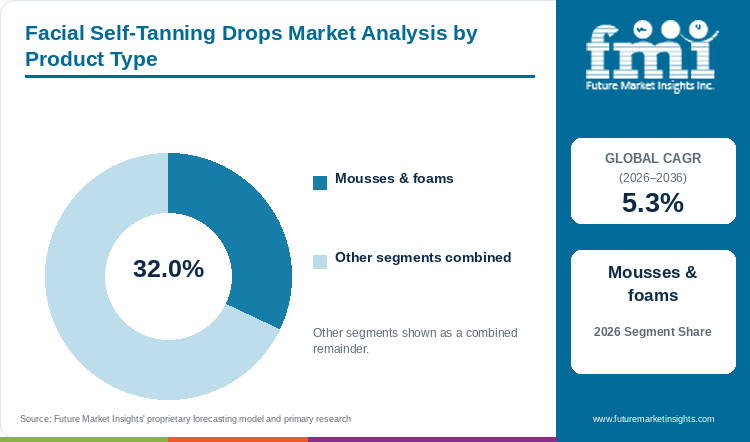
Based on product type, mousses & foams is projected to account for 32.0% in 2026, driven by recognizable application behavior.
Mousses and foams carry an advantage that is behavioral rather than technical: their airy texture spreads quickly across larger skin areas and gives consumers a clear application step, which lowers uncertainty for anyone entering self-tanning from body products. That familiarity becomes a bridge into facial routines, since brands can extend a known tanning architecture into face-specific creams, serums or complementary drops without asking shoppers to relearn the preparation and development cycle. Kao Corporation's August 2023 statement that Bondi Sands specializes in self-tanning alongside suncare and skincare illustrates the scale this familiarity can support; the acquisition added a dedicated tanning brand architecture spanning multiple application formats rather than a single product line.
- Mousses & foams hold 32.0% of product type demand in 2026 because recognizable application behavior and fast-spreading textures keep the format central to how consumers first learn self-tanning.
- That familiarity gives brands room to cross-sell more precise facial formats later, without asking the consumer to start from zero.
Why does Conventional lead the Nature category?
By nature, conventional is estimated to hold 50.0% in 2026, owing to a long DHA formulation history and broad price coverage.
Conventional formulations hold the widest commercial base because DHA chemistry carries a long regulatory and formulation history, letting brands pair it with familiar humectants and emulsion systems rather than build the purchase around a narrower ethical or botanical claim. For facial products specifically, that maturity matters because the core job is predictable color development with manageable irritation and clear instructions. The European Commission's Scientific Committee on Consumer Safety concluded in March 2020 that self-tanning lotion and face cream containing up to 10% DHA were safe under the assessed use conditions [2], giving formulators a stable regulatory baseline to build mass and prestige products alike without changing the underlying tanning mechanism.
- Conventional holds 50.0% of nature demand in 2026 because established DHA practice supports broad product and price coverage that vegan or clinical positioning has not yet matched.
- Natural, vegan and dermocosmetic alternatives still expand the category, but they compete for a smaller share built around narrower consumer priorities. They also sit within the wider natural cosmetics market, where ingredient positioning carries more weight in the purchase decision.
How does Liquid & Serum define the Format category?
In 2026, liquid & serum is expected to lead format with 28.0% share, supported by controlled dosing and routine compatibility.
Liquid and serum formats fit the logic of facial skincare rather than body tanning: they dispense in small amounts, mix with moisturizer, and layer into a routine without the heavier feel of a cream or body lotion, which lets consumers adjust color intensity through dose rather than through switching products. L'Oreal Paris USA's May 2021 introduction of Sublime Bronze Self-Tanning Facial Drops described exactly this logic, a clear facial serum mixed with moisturizer to adjust the depth of the result. The precision addresses the category's main failure point directly, since facial users can control the amount applied to face and neck instead of risking an unexpectedly deep or uneven result.
- Liquid & serum holds 28.0% of format demand in 2026 because controlled dosing and compatibility with existing skincare routines reduce the risk that keeps new users from trying the category.
- The same dropper format also gives brands room to add humectants or blemish-oriented ingredients, pushing the product closer to a serum than a conventional tanning lotion. The formulation work draws on the same emollients, humectants and skin-conditioning systems used across the personal care ingredient market.
What supports Mass within Price Positioning?
By price positioning, mass holds 39.0% share in 2026, enabled by low experimentation cost for a product users must learn to apply.
Mass positioning lowers the experimentation cost for a product that can produce a visibly poor result when used incorrectly, since facial users typically need several applications to learn the right dose, preparation and development time. Accessible pricing supports that learning curve and sustains replenishment once the product settles into a recurring skincare routine. L'Oreal Paris USA's own May 2021 introduction positioned its facial drops as an easy option for under USD 20, illustrating how a facial self-tanner can enter a mass-price trial set rather than ask for a prestige-level commitment on a first purchase. Premium and professional offers can still justify higher prices through formulation depth or in-store consultation, but mass retains the advantage of broad familiarity and lower trial risk.
- Mass holds 39.0% of price positioning demand in 2026 because accessible trial economics support the experimentation a new user needs before repeat purchase.
- The commercial task at this price point is narrower than at premium: preserve clear instructions and credible skin feel without raising the shelf price.
What drives Specialty Beauty Retail in the Sales Channel category?
Specialty beauty retail is forecast to lead sales channel with 26.0% share in 2026, supported by assisted discovery and comparison.
Specialty beauty retail suits a product that benefits from explanation before purchase, since consumers may compare undertone and development time, weigh fragrance or skin sensitivity, or simply need to know whether a formula should be mixed with moisturizer before they commit. A specialist environment reduces that uncertainty through staff advice and placement alongside skincare or sun care, and it gives brands a setting to explain why a genuine self-tanner differs from a wash-off bronzing drop. Bondi Sands' May 2024 statement that its Technocolor Self Tanning Face Serum would launch exclusively at Ulta for the U.S. market shows how specialty retail education can carry a new facial format through its first months, before e-commerce takes over the more efficient job of replenishment.
- Specialty beauty retail holds 26.0% of sales channel demand in 2026 because assisted discovery and comparison reduce the application risk that weighs most heavily on a first facial purchase.
- Once shade and routine fit are established, the same consumer can move to e-commerce for faster, lower-friction replenishment.
What are the drivers, restraints and opportunities in the facial self-tanning drops market?
Demand is supported by interest in UV-free cosmetic color, while application and compliance friction limit conversion, and skincare-integrated personalization creates the clearest product opportunity.
- Driver: UV-avoidance awareness and routine-based customization encourage consumers to substitute cosmetic self-tan for deliberate tanning.
- Restraint: Facial dosing errors, restricted exposure areas, and the absence of inherent sun protection raise the cost of a poor user experience.
- Opportunity: Sensitive-skin and blemish-aware formulas, paired with fragrance-free design and undertone-specific options, can widen facial use beyond traditional self-tan consumers.
UV-Avoidance Behavior Sustains a Non-UV Substitute
The strongest driver is a practical substitution effect: consumers can obtain visible color without using a tanning bed or deliberately seeking UV exposure. Australia shows why that logic stays commercially relevant. Cancer Council Australia marked the tenth anniversary of the commercial solarium ban in January 2025 and reported that more than 2 million Australians had still tried to tan in the prior year [4]. Self-tanners do not remove the need for sun protection, but they give beauty brands a non-UV route to the same cosmetic outcome. That places facial self-tan alongside the wider suncare products market in the consumer's sun-exposure routine, even though the products serve different functions. Facial drops strengthen that proposition by letting users build color gradually inside a familiar skincare routine instead of committing to a one-step body-tan process.
Facial Dosing and SPF Separation Raise the Execution Bar
The restraint sits at application and compliance. FDA guidance states that DHA is permitted for external application but not approved for the eye area, lips or mucous membranes, and it stresses that most self-tanners do not provide sun protection [1]. That creates a narrow operating window for facial products: consumers need precise instructions, controlled dispensing and clear SPF separation. In the UK, July 2025 product-safety guidance also requires a safety assessment and notification before a cosmetic is sold in Great Britain [3]. None of this removes demand, but it raises the execution standard for brands entering or scaling the category.
Skincare-Integrated Personalization Opens the Next Growth Lane
The clearest opportunity is to treat facial self-tanning as a skin-condition and complexion problem rather than a generic tanning extension. Bondi Sands' Technocolor face range illustrates the direction, with four tone-oriented formulas built around a Blemish Control Complex that positions the serum around facial skin needs as well as tanning. That logic can extend through fragrance-free design, acne-compatible testing, better undertone matching and more explicit dosing guidance, all of which reduce first-use risk. Brands with strong specialty retail education or DTC content are best placed to explain both the skincare benefit and the tanning trade-offs before first use.
Which country CAGRs are profiled in the facial self-tanning drops market?
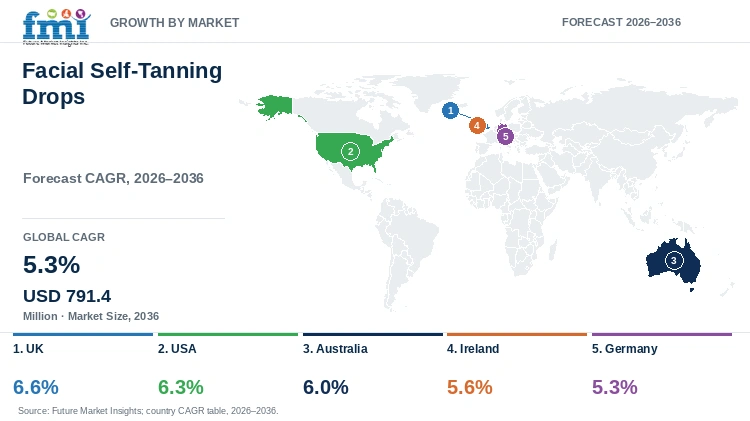
| Country | CAGR |
|---|---|
| UK | 6.6% |
| USA | 6.3% |
| Australia | 6.0% |
| Ireland | 5.6% |
| Germany | 5.3% |
Country-wise Analysis
- UK: UK suppliers operate inside a defined Great Britain cosmetics regime that requires a safety assessment and notification before a tanning product reaches the shelf. Demand for facial self-tanning drops in the UK is forecast to rise at 6.6% CAGR from 2026 to 2036, the fastest of the five profiled markets. In July 2025, the Office for Product Safety and Standards confirmed that tanning products are cosmetics and that new formulas must be assessed before sale [3], which makes documentary compliance and clear labeling the main friction rather than consumer appetite. Suppliers that pair face-specific instructions with reliable safety files are best placed to convert existing category familiarity into repeat purchase.
- USA: USA suppliers sell into a broad retail environment while managing FDA rules around DHA exposure. Demand for facial self-tanning drops in the USA is forecast to increase at 6.3% CAGR from 2026 to 2036. FDA guidance limits DHA to external application and excludes the eye area, lips and mucous membranes [1]. Suppliers therefore need face-specific instructions that make dose control and application boundaries clear across retail and digital channels.
- Australia: Australia combines established self-tanning familiarity with highly visible sun-safety messaging. Demand for facial self-tanning drops in Australia is forecast to grow at 6.0% CAGR from 2026 to 2036. In January 2025, Cancer Council Australia marked ten years since the commercial solarium ban and reiterated the risks of UV tanning [4], a reminder that cosmetic tanning sits alongside sun protection rather than replacing it. Suppliers should pair easy facial application with explicit SPF separation and lean on local self-tan familiarity to support sell-through.
- Ireland: Ireland combines EU cosmetic obligations with strong public-health messaging against artificial UV tanning. Sales of facial self-tanning drops in Ireland are forecast to expand at 5.6% CAGR from 2026 to 2036. The commercial case rests on giving consumers a non-UV cosmetic option while keeping sun protection separate from the tanning claim. Suppliers should emphasize controlled dosing and clear SPF guidance through channels equipped to explain the difference between cosmetic color and UV protection.
- Germany: Germany operates inside the EU cosmetics framework, where product safety and notification are central to market access. Sales of facial self-tanning drops in Germany are forecast to rise at 5.3% CAGR from 2026 to 2036. The higher documentation burden favors brands with established formulation and compliance processes. Suppliers should keep facial-use instructions conservative and avoid claims that move the product beyond its cosmetic role.
Who are the notable companies in the facial self-tanning drops market?
Unilever, Procter & Gamble, Beiersdorf, Shiseido, Estee Lauder Companies, e.l.f. Beauty, Amorepacific, Coty, L'Oreal, and Kao Corporation are the notable companies profiled in this market.
Competition separates most clearly along two lines: direct self-tan depth and the ability to carry consumer education across channels. L'Oreal, Kao Corporation, Coty and Unilever compete through self-tanning activity that reaches facial use or the wider format universe. Estee Lauder Companies, Procter & Gamble, Beiersdorf and Shiseido sit in a more diversified group where a broader skincare or beauty portfolio matters more than any single self-tan listing. e.l.f. Beauty and Amorepacific sit closer to complexion and skincare adjacencies and compete for the same consumer attention.
- Direct self-tan portfolios: L'Oreal, Kao Corporation, Coty, and Unilever compete through tanning formats with direct face-use relevance and established consumer instructions.
- Diversified skincare and beauty platforms: Estee Lauder Companies, Procter & Gamble, Beiersdorf, and Shiseido bring broader beauty or skincare architectures; current market-specific self-tan depth varies across the group.
- Complexion and skincare adjacencies: e.l.f. Beauty and Amorepacific sit closer to substitute routines, where tinted glow, serum textures or skincare positioning shape consumer expectations for facial tanning products.
Competitive Benchmarking: Facial Self-Tanning Drops Market
| Company | Facial Self-Tan Offer | Dose / Shade Customization | Self-Tan Portfolio Breadth | Geographic Reach |
|---|---|---|---|---|
| Unilever | High | Medium | High | Dove self-tan range in the UK includes face creams, lotions, and mousses |
| Procter & Gamble | Low | Low | Low | Broad personal-care and skincare reach |
| Beiersdorf | Low | Low | Low | Global skincare reach through NIVEA and related brands |
| Shiseido | Low | Low | Low | Global prestige skincare reach |
| Estee Lauder Companies | High | Medium | Medium | Clinique facial and body self-tan listings in the Middle East |
| e.l.f. Beauty | Low | Low | Low | Broad beauty retail reach |
| Amorepacific | Low | Low | Low | Asia-led and international skincare reach |
| Coty | High | High | Medium | Lancaster facial self-tan activity in European beauty retail |
| L'Oreal | High | High | High | Direct facial self-tan activity in the USA |
| Kao Corporation | High | High | High | U.S. facial self-tan offer; Bondi Sands has major markets in Australia, UK, and USA |
Scoring basis: Facial Self-Tan Offer measures the strength of a face-specific self-tanning product or face-use proposition. Dose / Shade Customization measures whether the offer lets consumers control development through drops, gradual build or defined shade choices. Self-Tan Portfolio Breadth reflects coverage across multiple self-tanning formats or face-and-body use. High indicates broad capability, Medium indicates narrower capability and Low indicates limited direct presence in that criterion.
Key Developments in the Facial Self-Tanning Drops Market
- In May 2024, Coty's Lancaster introduced Self Tan Sun-Kissed Face Drops alongside a body self-tan product. The facial formula was designed to mix with daily moisturizer, with users adjusting the result by changing the number of drops, extending a prestige sun-care brand into customizable facial tanning.
- In May 2024, Kao Corporation's Bondi Sands introduced Technocolor Self Tanning Face Serum for the U.S. market, launching exclusively at Ulta. Current product materials describe tone-oriented formulas and a Blemish Control Complex, moving facial self-tanning toward undertone matching and skin-condition support while using specialty retail as an education channel.
Key Players in the Facial Self-Tanning Drops Market
Direct Self-Tanning Portfolios
- L'Oreal
- Kao Corporation
- Coty
- Unilever
Diversified Skincare and Beauty Platforms
- Estee Lauder Companies
- Procter & Gamble
- Beiersdorf
- Shiseido
Complexion and Skincare Adjacencies
- e.l.f. Beauty
- Amorepacific
Facial Self-Tanning Drops Market - Report Scope
| Coverage field | Report scope |
|---|---|
| Market breakdown | Product Type, Nature, Format, Price Positioning, and Sales Channel |
| Quantitative Units | USD Million |
| Market Definition | Revenue covers topical facial self-tanning products and directly comparable face-use self-tan formats represented by the stated segmentation universe. It excludes temporary wash-off bronzers, sunscreen-only products, tanning pills, UV tanning services, salon service fees, and other adjacent or substitute revenue. |
| Regions Covered | North America; Latin America; Western Europe; Eastern Europe; East Asia; South Asia and Pacific; Middle East and Africa |
| Countries Covered | UK, Ireland, USA, Australia, Germany, and more than twenty-five additional countries in the full report |
| Key Companies Profiled | Unilever; Procter & Gamble; Beiersdorf; Shiseido; Estee Lauder Companies; e.l.f. Beauty; Amorepacific; Coty; L'Oreal; Kao Corporation |
| Forecast Period | 2026 to 2036 |
| Approach | Hybrid bottom-up and top-down sizing that reconciles product-level demand indicators, pricing, channel activity, and country-level adoption conditions within the defined revenue boundary. |
Facial Self-Tanning Drops Market - Research Methodology
| Method | Approach |
|---|---|
| Primary Research | FMI's primary-research framework covers product manufacturers, brand or category teams, distributors, beauty retailers, e-commerce operators, and relevant subject-matter specialists. Discussion themes include pricing and format choice, channel behavior, application friction, and repeat-purchase conditions. |
| Desk Research | Public regulatory guidance, scientific safety opinions, company filings and product materials, public-health publications, and dated company announcements are reviewed for evidence that fits the defined market boundary. Adjacent beauty categories are used only when they explain substitution, buying behavior, or product architecture. |
| Market Sizing and Forecasting | The sizing process combines bottom-up product and channel signals with top-down category checks. Forecast assumptions consider pricing, self-tan format adoption, skincare integration, specialty and digital channel development, country regulation, and the persistence of non-UV cosmetic tanning demand. |
| Data Validation | Evidence is cross-checked across independent and first-party sources where possible. The process excludes temporary wash-off bronzers, sunscreen-only products, UV tanning equipment and services, unsupported claims, and duplicate revenue that would otherwise overstate the defined market. |
Facial Self-Tanning Drops Market by Segments
Facial Self-Tanning Drops Market segmented by Product Type:
- Mousses & foams
- Drops & serums
- Lotions & gradual
- Mists & sprays
Facial Self-Tanning Drops Market segmented by Nature:
- Conventional
- Vegan & cruelty-free
- Natural & organic
- Dermocosmetic / clinical
- Fragrance-free & sensitive
Facial Self-Tanning Drops Market segmented by Format:
- Liquid & serum
- Cream & balm
- Stick & solid
- Spray & mist
- Sheet & patch
- Powder
Facial Self-Tanning Drops Market segmented by Price Positioning:
- Mass
- Masstige
- Premium
- Professional
Facial Self-Tanning Drops Market segmented by Sales Channel:
- Specialty beauty retail
- E-commerce & DTC
- Pharmacies & drugstores
- Supermarkets & hypermarkets
- Salons & spas
Facial Self-Tanning Drops Market by Region:
- North America
- United States
- Canada
- Latin America
- Brazil
- Mexico
- Argentina
- Chile
- Western Europe
- Germany
- France
- United Kingdom
- Italy
- Spain
- Benelux
- Nordics
- Eastern Europe
- Poland
- Czech Republic
- Romania
- Hungary
- East Asia
- China
- Japan
- South Korea
- South Asia and Pacific
- India
- ASEAN
- Australia and New Zealand
- Middle East and Africa
- GCC Countries
- South Africa
- Türkiye
- Israel
Research Sources and Bibliography
- [1] U.S. Food and Drug Administration. (n.d.). Sunless Tanners & Bronzers. https://www.fda.gov/cosmetics/cosmetic-products/sunless-tanners-bronzers
- [2] Scientific Committee on Consumer Safety. (2020, March 4). Dihydroxyacetone - DHA (1,3-Dihydroxy-2-propanone) CAS No. 96-26-4. https://health.ec.europa.eu/publications/dihydroxyacetone-dha-13-dihydroxy-2-propanone-cas-no-96-26-4_en
- [3] Office for Product Safety and Standards. (2025, July 10). Consumer products: cosmetics. https://www.gov.uk/guidance/consumer-products-cosmetics
- [4] Cancer Council Australia. (2025, January 6). 10-year anniversary of sunbed ban a stark reminder that no tan is worth dying for. https://www.cancer.org.au/about-us/news-and-media/media-releases/10-year-anniversary-of-sunbed-ban-a-stark-reminder-that-no-tan-is-worth-dying-for
This bibliography is provided for reader reference and is not exhaustive. The full report contains the complete reference list and detailed citations.
This Report Answers
- What is the size of the Facial Self-Tanning Drops Market in 2026 and what value is forecast for 2036?
- Which consumer and public-health pressures support demand for UV-free facial self-tanning products?
- Why do Mousses & foams hold the leading position within Product Type?
- How does Conventional positioning influence the breadth of available facial self-tan formulations?
- Why does Liquid & serum lead the Format category for facial self-tanning?
- How do the 2026 to 2036 growth rates differ across UK, Ireland, USA, Australia, and Germany?
- Which profiled companies have direct self-tan activity and which are positioned through adjacent beauty platforms?
- Which application, safety, and compliance frictions can slow adoption of facial self-tanning products?
- What should beauty brand and retail decision-makers evaluate before adding or expanding a facial self-tanning assortment?
Frequently Asked Questions
What is driving growth in the Facial Self-Tanning Drops Market?
Growth is driven by demand for cosmetic facial color without deliberate UV exposure and by formats that fit established skincare routines. Adjustable drops and serums lower the commitment barrier because users can build intensity gradually instead of applying a fixed-depth tan in one step.
Who are the key players in the Facial Self-Tanning Drops Market?
The profiled companies are Unilever, Procter & Gamble, Beiersdorf, Shiseido, Estee Lauder Companies, e.l.f. Beauty, Amorepacific, Coty, L'Oreal, and Kao Corporation. Their roles differ between direct self-tanning portfolios and broader skincare or complexion platforms, which shapes how directly each company competes for facial self-tan demand.
What notable restraint affects the Facial Self-Tanning Drops Market?
The main restraint is the cost of application error on visible facial skin, combined with strict use instructions around DHA exposure. Brands must also make clear that self-tanning color does not replace sunscreen, which adds another education step at purchase and use.
Why should executives track the Facial Self-Tanning Drops Market?
The category links self-tan with skincare and complexion routines while sun-safety behavior shapes demand across established beauty channels. Executives should track whether facial-specific formats produce repeat purchase rather than one-time trial, because routine adoption determines durable revenue.
What business problem does the Facial Self-Tanning Drops Market address?
Facial self-tanning products give consumers a way to create developing cosmetic color without relying on sun exposure or a UV tanning service. The best offers also reduce mismatch between face and body by letting users control dose, undertone, and development through a skincare-style format.
What should beauty brand and retail decision-makers evaluate in the Facial Self-Tanning Drops Market?
Decision-makers should evaluate facial safety instructions and shade control before comparing development predictability, skin feel, or fragrance. They should then test whether specialty or pharmacy channels can support first-use success, while mass and DTC channels need equally clear education at scale.
What limits return on investment in the Facial Self-Tanning Drops Market?
Return on investment is limited when acquisition spending drives trial but application error or poor shade match prevents repeat purchase, since irritation can create the same outcome. Additional costs come from safety assessment and notification, packaging and retailer margin, and education content and inventory complexity across multiple tones or formats.
What supports long-term commercial confidence in the Facial Self-Tanning Drops Market?
Long-term confidence is supported by an established DHA tanning mechanism and continuing interest in UV-free cosmetic color, while product development increasingly resembles facial skincare. Confidence is strongest when innovation solves failure points such as streaking and sensitivity, since undertone mismatch and unclear dosing remain additional problems worth solving.
Preview the report firsthand - request a free sample
Get SampleGet the brochure for pricing and purchase details.
Get PDFTable of Content
- Key Takeaways
- Market Size and CAGR
- Top Growth Driver
- Fastest Growing Segment
- Leading Region
- Key Companies
- Emerging Opportunities
- Executive Summary
- Global Market Outlook
- Demand-side Trends
- Supply-side Trends
- Technology Roadmap Analysis
- Analysis and Recommendations
- Analyst Perspective (What is happening? Why now? What should investors know?)
- Key Questions Answered
- How large is the market?
- What is the CAGR?
- What are key trends?
- Which region dominates?
- Who are the leaders?
- Market Overview
- Market Coverage / Taxonomy
- Market Definition / Scope / Limitations
- Research Methodology
- Chapter Orientation
- Analytical Lens and Working Hypotheses
- Market Structure, Signals, and Trend Drivers
- Benchmarking and Cross-market Comparability
- Market Sizing, Forecasting, and Opportunity Mapping
- Research Design and Evidence Framework
- Desk Research Programme (Secondary Evidence)
- Expert Input and Fieldwork (Primary Evidence)
- Tooling, Models, and Reference Databases
- Data Engineering and Model Build
- Quality Assurance and Audit Trail
- Market Background
- Market Dynamics (Drivers, Restraints, Opportunity, Trends)
- Scenario Forecast (Optimistic, Likely, Conservative)
- Impact Analysis
- AI Impact
- Sustainability Impact
- Regulatory Impact
- Technology Impact
- Consumer / Buyer Analysis
- Purchase Drivers
- Adoption Barriers
- Buyer Journey
- Opportunity Map Analysis
- Product Life Cycle Analysis
- Supply Chain Analysis
- Investment Feasibility Matrix
- Value Chain Analysis
- PESTLE and Porter's Analysis
- Regulatory Landscape
- Regional Parent Market Outlook
- Production and Consumption Statistics
- Import and Export Statistics
- Global Market Analysis and Forecast, 2021 to 2036
- Historical Market Size Value (USD Million) Analysis, 2021 to 2025
- Current and Future Market Size Value (USD Million) Projections, 2026 to 2036
- Y-o-Y Growth Trend Analysis
- Absolute $ Opportunity Analysis
- Global Market Pricing Analysis, 2021 to 2036
- Global Market Analysis and Forecast, By Product Type, 2021 to 2036
- Introduction / Key Findings
- Historical Market Size Value (USD Million) Analysis By Product Type, 2021 to 2025
- Current and Future Market Size Value (USD Million) Analysis and Forecast By Product Type, 2026 to 2036
- Mousses & foams
- Drops & serums
- Lotions & gradual
- Mists & sprays
- Y-o-Y Growth Trend Analysis By Product Type, 2021 to 2025
- Absolute $ Opportunity Analysis By Product Type, 2026 to 2036
- Global Market Analysis and Forecast, By Nature, 2021 to 2036
- Introduction / Key Findings
- Historical Market Size Value (USD Million) Analysis By Nature, 2021 to 2025
- Current and Future Market Size Value (USD Million) Analysis and Forecast By Nature, 2026 to 2036
- Conventional
- Vegan & cruelty-free
- Natural & organic
- Dermocosmetic / clinical
- Fragrance-free & sensitive
- Y-o-Y Growth Trend Analysis By Nature, 2021 to 2025
- Absolute $ Opportunity Analysis By Nature, 2026 to 2036
- Global Market Analysis and Forecast, By Format, 2021 to 2036
- Introduction / Key Findings
- Historical Market Size Value (USD Million) Analysis By Format, 2021 to 2025
- Current and Future Market Size Value (USD Million) Analysis and Forecast By Format, 2026 to 2036
- Liquid & serum
- Cream & balm
- Stick & solid
- Spray & mist
- Sheet & patch
- Powder
- Y-o-Y Growth Trend Analysis By Format, 2021 to 2025
- Absolute $ Opportunity Analysis By Format, 2026 to 2036
- Global Market Analysis and Forecast, By Price Positioning, 2021 to 2036
- Introduction / Key Findings
- Historical Market Size Value (USD Million) Analysis By Price Positioning, 2021 to 2025
- Current and Future Market Size Value (USD Million) Analysis and Forecast By Price Positioning, 2026 to 2036
- Mass
- Masstige
- Premium
- Professional
- Y-o-Y Growth Trend Analysis By Price Positioning, 2021 to 2025
- Absolute $ Opportunity Analysis By Price Positioning, 2026 to 2036
- Global Market Analysis and Forecast, By Sales Channel, 2021 to 2036
- Introduction / Key Findings
- Historical Market Size Value (USD Million) Analysis By Sales Channel, 2021 to 2025
- Current and Future Market Size Value (USD Million) Analysis and Forecast By Sales Channel, 2026 to 2036
- Specialty beauty retail
- E-commerce & DTC
- Pharmacies & drugstores
- Supermarkets & hypermarkets
- Salons & spas
- Y-o-Y Growth Trend Analysis By Sales Channel, 2021 to 2025
- Absolute $ Opportunity Analysis By Sales Channel, 2026 to 2036
- Global Market Analysis and Forecast, By Region, 2021 to 2036
- Introduction
- Historical Market Size Value (USD Million) Analysis By Region, 2021 to 2025
- Current Market Size Value (USD Million) Analysis and Forecast By Region, 2026 to 2036
- North America
- Latin America
- Western Europe
- Eastern Europe
- East Asia
- South Asia and Pacific
- Middle East and Africa
- Market Attractiveness Analysis By Region
- North America Market Analysis and Forecast, By Country, 2021 to 2036
- Historical Market Size Value (USD Million) Trend Analysis By Market Taxonomy, 2021 to 2025
- Market Size Value (USD Million) Forecast By Market Taxonomy, 2026 to 2036
- By Country
- United States
- Canada
- By Product Type
- By Nature
- By Format
- By Price Positioning
- By Sales Channel
- By Country
- Market Attractiveness Analysis
- By Country
- By Product Type
- By Nature
- By Format
- By Price Positioning
- By Sales Channel
- Key Takeaways
- Latin America Market Analysis and Forecast, By Country
- Historical Market Size Value (USD Million) Trend Analysis By Market Taxonomy, 2021 to 2025
- Market Size Value (USD Million) Forecast By Market Taxonomy, 2026 to 2036
- By Country
- Brazil
- Mexico
- Argentina
- Chile
- By Product Type
- By Nature
- By Format
- By Price Positioning
- By Sales Channel
- By Country
- Market Attractiveness Analysis
- By Country
- By Product Type
- By Nature
- By Format
- By Price Positioning
- By Sales Channel
- Key Takeaways
- Western Europe Market Analysis and Forecast, By Country
- Historical Market Size Value (USD Million) Trend Analysis By Market Taxonomy, 2021 to 2025
- Market Size Value (USD Million) Forecast By Market Taxonomy, 2026 to 2036
- By Country
- Germany
- France
- United Kingdom
- Italy
- Spain
- Benelux
- Nordics
- By Product Type
- By Nature
- By Format
- By Price Positioning
- By Sales Channel
- By Country
- Market Attractiveness Analysis
- By Country
- By Product Type
- By Nature
- By Format
- By Price Positioning
- By Sales Channel
- Key Takeaways
- Eastern Europe Market Analysis and Forecast, By Country
- Historical Market Size Value (USD Million) Trend Analysis By Market Taxonomy, 2021 to 2025
- Market Size Value (USD Million) Forecast By Market Taxonomy, 2026 to 2036
- By Country
- Poland
- Czech Republic
- Romania
- Hungary
- By Product Type
- By Nature
- By Format
- By Price Positioning
- By Sales Channel
- By Country
- Market Attractiveness Analysis
- By Country
- By Product Type
- By Nature
- By Format
- By Price Positioning
- By Sales Channel
- Key Takeaways
- East Asia Market Analysis and Forecast, By Country
- Historical Market Size Value (USD Million) Trend Analysis By Market Taxonomy, 2021 to 2025
- Market Size Value (USD Million) Forecast By Market Taxonomy, 2026 to 2036
- By Country
- China
- Japan
- South Korea
- By Product Type
- By Nature
- By Format
- By Price Positioning
- By Sales Channel
- By Country
- Market Attractiveness Analysis
- By Country
- By Product Type
- By Nature
- By Format
- By Price Positioning
- By Sales Channel
- Key Takeaways
- South Asia and Pacific Market Analysis and Forecast, By Country
- Historical Market Size Value (USD Million) Trend Analysis By Market Taxonomy, 2021 to 2025
- Market Size Value (USD Million) Forecast By Market Taxonomy, 2026 to 2036
- By Country
- India
- ASEAN
- Australia and New Zealand
- By Product Type
- By Nature
- By Format
- By Price Positioning
- By Sales Channel
- By Country
- Market Attractiveness Analysis
- By Country
- By Product Type
- By Nature
- By Format
- By Price Positioning
- By Sales Channel
- Key Takeaways
- Middle East and Africa Market Analysis and Forecast, By Country
- Historical Market Size Value (USD Million) Trend Analysis By Market Taxonomy, 2021 to 2025
- Market Size Value (USD Million) Forecast By Market Taxonomy, 2026 to 2036
- By Country
- GCC Countries
- South Africa
- Türkiye
- Israel
- By Product Type
- By Nature
- By Format
- By Price Positioning
- By Sales Channel
- By Country
- Market Attractiveness Analysis
- By Country
- By Product Type
- By Nature
- By Format
- By Price Positioning
- By Sales Channel
- Key Takeaways
- Key Countries Market Analysis
- United States
- Pricing Analysis
- Market Share Analysis, 2025
- By Product Type
- By Nature
- By Format
- By Price Positioning
- By Sales Channel
- Canada
- Pricing Analysis
- Market Share Analysis, 2025
- By Product Type
- By Nature
- By Format
- By Price Positioning
- By Sales Channel
- Mexico
- Pricing Analysis
- Market Share Analysis, 2025
- By Product Type
- By Nature
- By Format
- By Price Positioning
- By Sales Channel
- Brazil
- Pricing Analysis
- Market Share Analysis, 2025
- By Product Type
- By Nature
- By Format
- By Price Positioning
- By Sales Channel
- Chile
- Pricing Analysis
- Market Share Analysis, 2025
- By Product Type
- By Nature
- By Format
- By Price Positioning
- By Sales Channel
- Germany
- Pricing Analysis
- Market Share Analysis, 2025
- By Product Type
- By Nature
- By Format
- By Price Positioning
- By Sales Channel
- United Kingdom
- Pricing Analysis
- Market Share Analysis, 2025
- By Product Type
- By Nature
- By Format
- By Price Positioning
- By Sales Channel
- Italy
- Pricing Analysis
- Market Share Analysis, 2025
- By Product Type
- By Nature
- By Format
- By Price Positioning
- By Sales Channel
- Spain
- Pricing Analysis
- Market Share Analysis, 2025
- By Product Type
- By Nature
- By Format
- By Price Positioning
- By Sales Channel
- France
- Pricing Analysis
- Market Share Analysis, 2025
- By Product Type
- By Nature
- By Format
- By Price Positioning
- By Sales Channel
- India
- Pricing Analysis
- Market Share Analysis, 2025
- By Product Type
- By Nature
- By Format
- By Price Positioning
- By Sales Channel
- ASEAN
- Pricing Analysis
- Market Share Analysis, 2025
- By Product Type
- By Nature
- By Format
- By Price Positioning
- By Sales Channel
- Australia and New Zealand
- Pricing Analysis
- Market Share Analysis, 2025
- By Product Type
- By Nature
- By Format
- By Price Positioning
- By Sales Channel
- China
- Pricing Analysis
- Market Share Analysis, 2025
- By Product Type
- By Nature
- By Format
- By Price Positioning
- By Sales Channel
- Japan
- Pricing Analysis
- Market Share Analysis, 2025
- By Product Type
- By Nature
- By Format
- By Price Positioning
- By Sales Channel
- South Korea
- Pricing Analysis
- Market Share Analysis, 2025
- By Product Type
- By Nature
- By Format
- By Price Positioning
- By Sales Channel
- Poland
- Pricing Analysis
- Market Share Analysis, 2025
- By Product Type
- By Nature
- By Format
- By Price Positioning
- By Sales Channel
- Hungary
- Pricing Analysis
- Market Share Analysis, 2025
- By Product Type
- By Nature
- By Format
- By Price Positioning
- By Sales Channel
- Türkiye
- Pricing Analysis
- Market Share Analysis, 2025
- By Product Type
- By Nature
- By Format
- By Price Positioning
- By Sales Channel
- South Africa
- Pricing Analysis
- Market Share Analysis, 2025
- By Product Type
- By Nature
- By Format
- By Price Positioning
- By Sales Channel
- Australia
- Pricing Analysis
- Market Share Analysis, 2025
- By Product Type
- By Nature
- By Format
- By Price Positioning
- By Sales Channel
- Ireland
- Pricing Analysis
- Market Share Analysis, 2025
- By Product Type
- By Nature
- By Format
- By Price Positioning
- By Sales Channel
- United States
- Market Structure Analysis
- Competition Dashboard
- Competition Benchmarking
- Market Share Analysis of Top Players
- By Regional
- By Product Type
- By Nature
- By Format
- By Price Positioning
- By Sales Channel
- Emerging Startups
- Innovation Benchmarking
- Competition Analysis
- Competition Deep Dive
- Unilever
- Overview
- Product Portfolio
- Profitability by Market Segments
- Sales Footprint
- Strategy Overview
- Marketing Strategy
- Product Strategy
- Channel Strategy
- Procter & Gamble
- Beiersdorf
- Shiseido
- Estee Lauder Companies
- e.l.f. Beauty
- Amorepacific
- Coty
- L'Oreal
- Kao Corporation
- Unilever
- Case Studies
- Success Stories
- Recent Developments
- Competition Deep Dive
- Assumptions & Acronyms Used


