

- Market Size (2026)
- USD 4.39 Bn
- Forecast (2036)
- USD 7.72 Bn
- CAGR (2026 to 2036)
- 5.8%
Functional Dental Pet Treats Market Size, Market Forecast and Outlook By FMI
USD 4.39 billion in 2026 and USD 7.72 billion by 2036 at a 5.8% CAGR.
The functional dental pet treats industry value is forecast to increase from USD 4.15 billion in 2025 to USD 7.72 billion by 2036 at 5.8% CAGR as pet owners use edible dental chews, sticks, biscuits, and bites for daily oral-care support. Dental chews are projected to represent 54.0% share in 2026 because chew texture gives products a clearer plaque and tartar control role. Dogs are expected to hold 83.0% share in 2026 since canine chewing behavior supports daily dental treat use more strongly than cat formats.
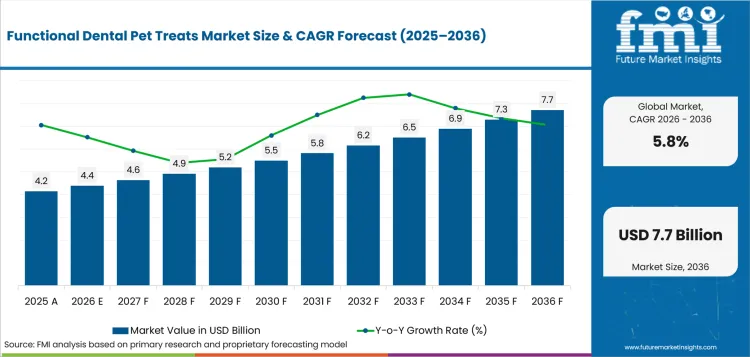
Functional Dental Pet Treats Market Overview: Size and Forecast
- 2026 Market Size: USD 4.39 billion
- 2036 Market Size: USD 7.72 billion
- Forecast CAGR: 5.8% from 2026 to 2036
- Leading Product Type: Dental Chews
- Dental Chews Share in 2026: 54.0%
- Leading Pet Type: Dogs
- Dogs Share in 2026: 83.0%
- Fastest-growing Country: India
- India CAGR: 8.6% by 2036
Summary of the Functional Dental Pet Treats Market
- Demand and Growth Drivers
- Rising pet ownership and higher preventive pet healthcare spending are driving demand for dental treats that help reduce plaque and tartar buildup.
- Functional pet nutrition adoption is encouraging consumers to choose dental treats that combine oral-care support with daily snacking convenience.
- Retail and e-commerce sales are expanding as pet owners seek veterinarian-recommended oral-care solutions for dogs and cats.
- Premium pet care trends are supporting demand for natural and multifunctional dental treats across major markets.
- Product and Segment View
- Dental chews are projected to lead Product Type with 54.0% share in 2026 as chew texture supports mechanical tooth contact.
- Dogs are expected to lead Pet Type with 83.0% share in 2026 since canine products carry larger pack sizes.
- Plaque control is anticipated to lead Function with 48.0% share in 2026 given its role in daily oral hygiene.
- Plant-based formats are projected to lead Ingredient Base with 38.0% share in 2026 as digestibility and texture claims converge.
- Geography and Competitive Outlook
- The United States is projected to record 5.1% CAGR through 2036 as a high-spend pet care system supports premium dental treats.
- The United Kingdom is expected to expand at 5.6% CAGR through 2036 as specialty retailers and online channels educate owners.
- Germany is forecast at 5.2% CAGR through 2036 as premium pet food supply supports quality claims.
- Mars Petcare, Nestlé Purina, Hill’s Pet Nutrition, Virbac, ADM, United Petfood, and VAFO Group shape the benchmark set.
- Analyst Opinion
- Nandini Roy Choudhury, Principal Consultant at FMI, says, “Functional dental pet treats should be treated as a daily-use compliance category rather than a snack category. Owners buy them when brushing feels difficult and the product gives a visible breath or tartar benefit. Suppliers that combine accepted dental claims, breed-size formats, and clear feeding rules should defend price better than brands selling flavor alone.”
Edible dog dental chews are becoming a preferred daily-use format because owners need easier home care between veterinary cleanings. The American Veterinary Medical Association reported in February 2026 that periodontal disease affects nearly 80% of dogs and 70% of cats by age three. The Veterinary Oral Health Council separates edible chew treats from dental diets, water additives, toothbrushes, and wipes. That structure gives buyers a clearer way to compare claims before choosing daily-use treats.
Which factors support expansion in the functional dental pet treats market?
Daily oral-care use, claim-backed dental chews, and wider pet specialty access support market value across retail and veterinary channels.
- Market value is supported by edible dental chews, sticks, biscuits, and bites that owners use as daily oral-care treats rather than occasional snacks.
- Supplier pricing reflects chew texture, breed-size design, dental claim support, ingredient base, and pack count before flavor variety affects repeat purchase.
- Revenue improves when owners convert brushing difficulty into daily chew routines between veterinary cleanings.
- Retail trust rises when products show clear plaque, tartar, breath, or gum-support claims with feeding directions and breed-size guidance.
- Veterinary and pet specialty channels support premium pricing when dental treats are positioned as home-care support rather than basic pet snacks.
Why is the functional dental pet treats market growing?
Daily chewing is turning oral care into a repeatable home-care routine for pet owners who struggle with brushing.
- Daily chewing is expected to turn oral care into a habit as owners struggle to brush pets consistently.
- Veterinary advice is expected to support home care between cleanings because periodontal disease is common in dogs and cats.
- Retail shelves are expected to support premium pricing when dental claims are easy to compare against basic treats.
- Breed-size formats are expected to improve fit because small dogs need different hardness and shape than large dogs.
- Functional ingredients are expected to raise repeat purchase when dental treats overlap with digestion, breath, or calming claims.
Daily-use Convenience and Proof-led Shelf Selection
Dental treat demand is shifting from occasional treat purchase into routine at-home oral care because brushing is difficult for many owners to maintain. In April 2026, APPA reported that 95 million USA households owned pets and total USA pet industry expenditures reached USD 158.0 billion in 2025. That spending base matters because oral-care chews sit inside daily treat behavior rather than clinic-only dental care. Mars’ May 2025 Greenies Canine Dental Check adds a useful company signal because the smartphone-photo tool helps owners monitor dog dental concerns while keeping Greenies tied to preventive care. Suppliers that pair daily-use instructions with size guidance and visible dental proof can improve repeat purchase because owners need a low-friction product that fits feeding routines.
Verified Oral-care Claims and Format-led Retail Buying
Retail growth is becoming proof-led because shoppers first compare formats and then check whether the product has credible oral-care backing. VOHC says it reviews submitted data against clinical requirements and awards the Seal of Acceptance for plaque, calculus or both when products meet the standard. Its accepted-product list separates edible chew treats from diets, rawhide chews, water additives, gels, sprays, toothpastes, toothbrushes and wipes.
How is the functional dental pet treats market segmented?
The functional dental pet treats industry is segmented by product type, pet type, function, ingredient base, sales channel, and region.
- Dental chews are expected to lead Product Type with 54.0% share in 2026 through longer chewing time and stronger claim visibility.
- Dogs are projected to account for 83.0% of Pet Type demand in 2026 as pack sizes and daily usage favor canine owners.
- Plaque control is anticipated to capture 48.0% of Function demand in 2026 given that it is the main mechanical cleaning claim.
- Plant-based formats are expected to represent 38.0% of Ingredient Base demand in 2026 with digestibility and meat-free positioning.
- Pet specialty stores are projected to direct 35.0% of Sales Channel value in 2026 since advice-led purchases support first trials.
Segmentation follows the way owners buy dental treats in stores and online. The first filter is pet type, then texture, then oral-care claim. Ingredient choice then affects chew safety and digestive tolerance. Channel choice changes the purchase message because veterinary clinics emphasize evidence. That structure explains why dental chews and dog formats capture most 2026 value within the wider pet food market.
Why do dental chews lead the functional dental pet treats market?
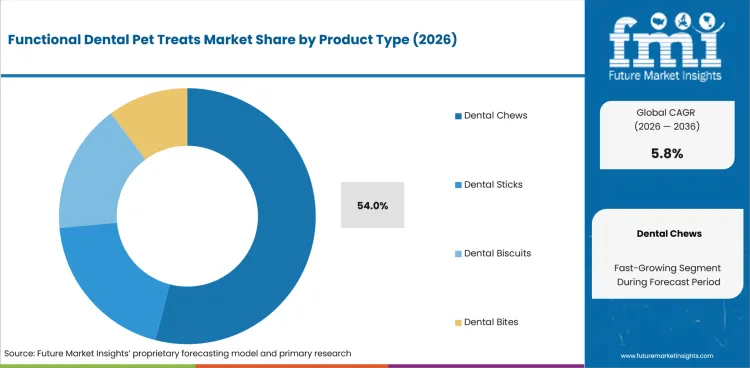
- Dental chews are projected to hold 54.0% product share in 2026 as their shape and firmness extend tooth contact during routine chewing.
- Buyer comparison in this segment centers on accepted claims, breed size, and chew hardness.
- Retailers often separate pet oral-care products from basic snacks, giving claim-backed chews stronger shelf identity.
Which pet type leads the functional dental pet treats market?
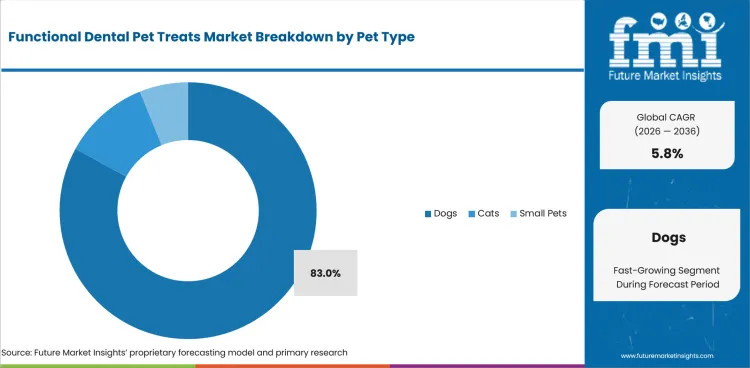
- Dogs are expected to represent 83.0% pet-type share in 2026 since canine chewing behavior makes daily dental formats easier to sell.
- Small-breed dental treats need tighter texture control because small dogs face earlier tartar risk and owners compare choking safety closely.
Which function leads the functional dental pet treats market?
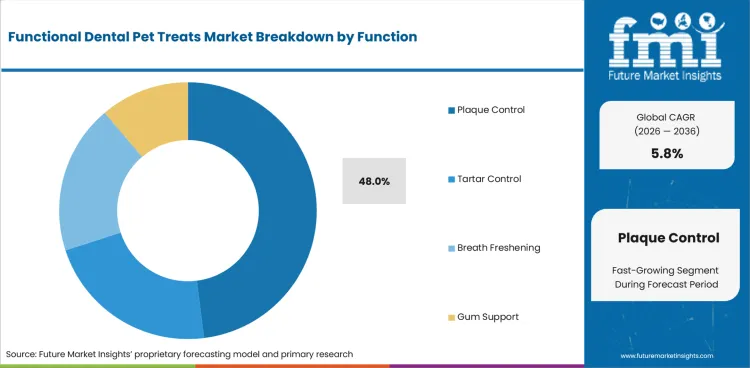
- Plaque control is anticipated to account for 48.0% functional share in 2026 as it is tied to the first stage of oral hygiene.
- Products targeting plaque need evidence language that buyers understand.
- Accepted claims hold an advantage over broad fresh-breath wording because they are easier for retailers and owners to compare.
Which ingredient base leads the functional dental pet treats market?
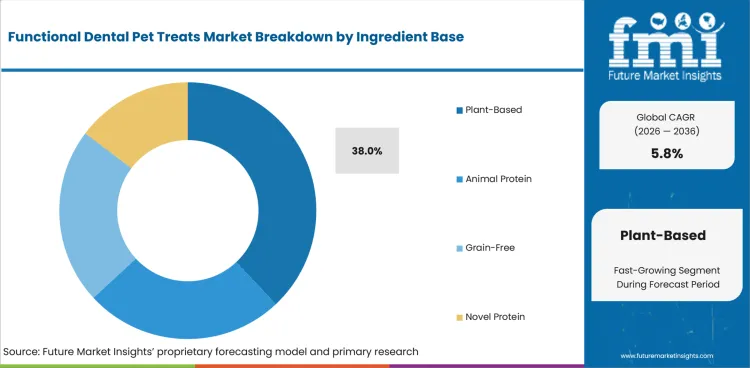
- Plant-based formats are projected to capture 38.0% ingredient share in 2026 as starch structure supports shape and repeat chewing.
- Virbac’s Veggiedent FR3SH uses a plant-based Z-shape and includes a prebiotic for digestive support.
- This shows how dental texture and gut positioning overlap in functional pet treats.
Which sales channel leads the functional dental pet treats market?
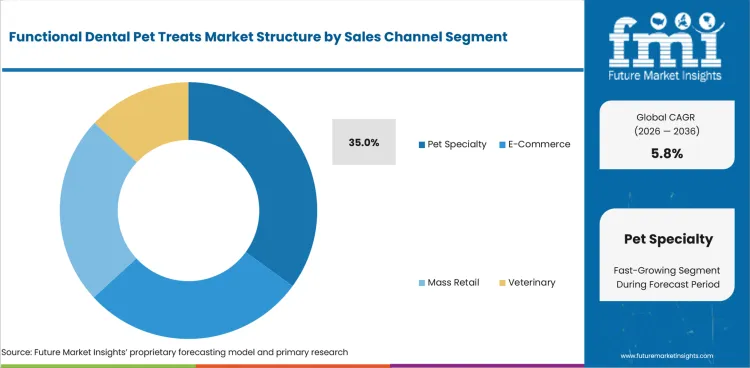
- Pet specialty stores are estimated to hold 35.0% channel share in 2026 because staff advice reduces confusion across oral-care formats.
- Online channels gain when owners search by breed size, claim, and pack count.
- Ratings and product education remain central to repeat orders.
What are the drivers, restraints, and opportunities in the functional dental pet treats market?
Dental compliance and accepted claim visibility support growth, while price sensitivity and chew safety concerns can slow repeat purchase.
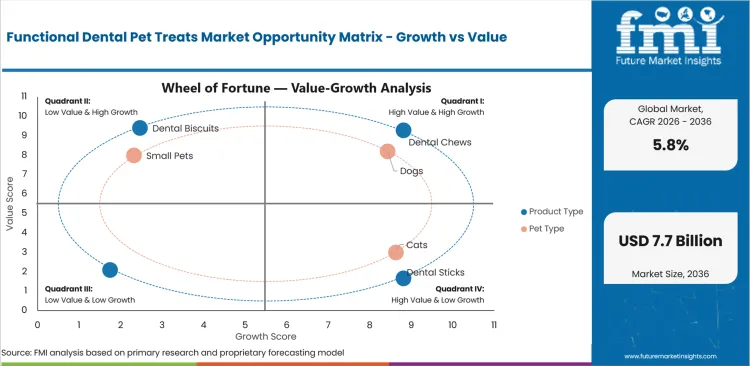
- Driver: Dental compliance is expected to drive demand as edible treats reduce the effort needed for home oral-care routines.
- Driver: Accepted claim visibility is expected to create premium pricing where buyers trust proof over flavor claims.
- Driver: Breed-size design is expected to open margin space because small dogs and large dogs need different chew structures.
- Restraint: Price sensitivity is expected to restrain growth when mass retail shoppers compare dental treats with basic biscuits.
- Opportunity: Multi-function chews are expected to create opportunity as oral care blends with digestion, breath, and calming support.
Chew-Time Cleaning Mechanism
Dental treat growth depends on contact time inside the mouth. A chew must resist crumbling quickly so the tooth surface receives enough friction. Nestlé says Dentalife uses a chewy porous texture and is scientifically tested to reduce tartar build-up. That kind of texture claim matters because owners cannot assess plaque reduction at the shelf.
Functional Dental Pet Treats Market Demand Outlook
Demand outlook is moving toward edible oral-care formats that can prove claim quality before retail expansion. The American Pet Products Association reported in March 2026 that USA pet industry spending reached USD 158.0 billion in 2025 and is projected at USD 165.0 billion in 2026. That spend base gives dental chews room to grow when owners compare wellness treats with basic snacks.
Mars launched Greenies Canine Dental Check in May 2025 to help USA owners assess tartar and gum irritation from a smartphone image. The tool shows how dental treat brands are linking home observation with repeat-use products. Suppliers with evidence-backed claims and clear feeding instructions are better placed to defend premium packs.
Consumer Segmentation and Purchase Behavior Analysis
Dog owners form the main switching pool for functional dental treats because canine chewing behavior supports daily-use formats. APPA reported that 95.0 million USA households owned at least one pet in 2025. Product design should therefore focus on treat size, chew time, pack count, and safety guidance that make daily compliance easier. Cat dental treats remain a smaller but visible opportunity. Owners need products that overcome weaker chewing habits and more selective taste behavior. Brands that use smaller formats, softer textures, and clearer feeding rules can reduce friction in this segment.
Which countries are growing fastest in the functional dental pet treats market?
India 8.6% CAGR, China 7.4% CAGR, South Korea 6.8% CAGR, United Kingdom 5.6% CAGR, Germany 5.2% CAGR, United States 5.1% CAGR, France 4.9% CAGR, and Japan 3.9% CAGR through 2036.
.webp "Top Country Growth Comparison Functional Dental Pet Treats Market Cagr (2026 2036)")
| Country | CAGR |
|---|---|
| India | 8.6% |
| China | 7.4% |
| South Korea | 6.8% |
| United Kingdom | 5.6% |
| Germany | 5.2% |
| United States | 5.1% |
| France | 4.9% |
| Japan | 3.9% |
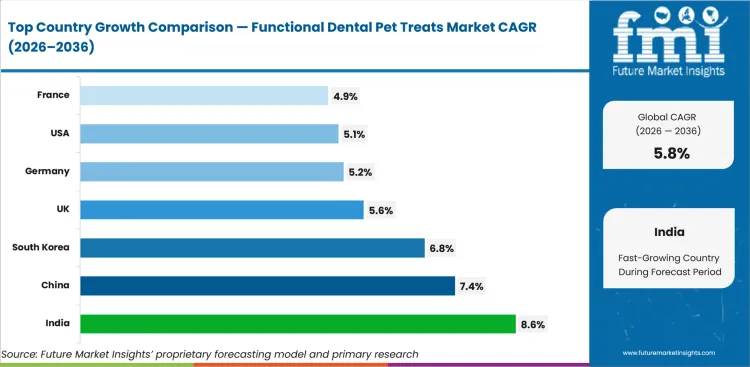
Source: Future Market Insights, 2026.
How do country-level CAGRs compare in the functional dental pet treats market?
India leads country growth while Japan records the most cautious expansion outlook among profiled markets.
- India is forecast to record 8.6% CAGR by 2036 as dog ownership and e-commerce discovery expand from metros into tier-one cities.
- China is expected to expand at 7.4% CAGR through 2036 due to premium pet food spending and fast online trial.
- South Korea is projected to grow at 6.8% CAGR through 2036 as pet ownership visibility and online pet retail improve.
- The United Kingdom is estimated to rise at 5.6% CAGR by 2036 with specialty retail education supporting treat trials.
- Germany is forecast to advance at 5.2% CAGR through 2036 as premium nutrition standards support proof-led claims.
- The United States is expected to post 5.1% CAGR through 2036 as high pet spending supports daily oral-care purchases.
- France is projected to rise at 4.9% CAGR by 2036 as established pet food retail supports premium dental formats.
- Japan is forecast to grow at 3.9% CAGR through 2036 as an aging pet base and smaller dog population moderate volume gains.
How fast is the functional dental pet treats market growing in the United States?
A 5.1% CAGR through 2036 reflects high pet-product spending and regular use of premium dental chews across dog-owning households.
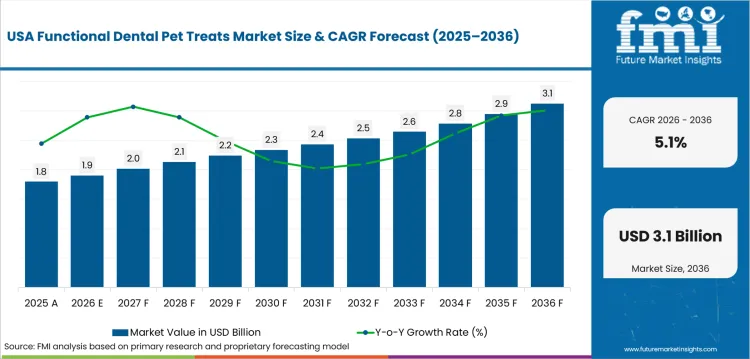
Country Market Snapshot Table
| Parameter | Value |
|---|---|
| Market Size in 2025 (Value) | USD 1,010.0 million |
| Market Size in 2026 (Value) | USD 1,061.5 million |
| Market Forecast in 2036 (Value) | USD 1,744.7 million |
| CAGR (2026 to 2036) | 5.1% |
| Years Considered | 2021 to 2036 |
| Base Year | 2025 |
| Forecast Period | 2026 to 2036 |
| Units Considered | Value (USD million) |
| Leading Sub-Region | California, Texas, Florida, New York, and Midwest pet retail corridors |
United States Functional Dental Pet Treats Market Outlook
United States demand is influenced by high pet ownership and a large specialty retail base. Owners are familiar with dental chews as a home-care bridge between veterinary visits.
Brand owners are expected to compete through accepted claims and breed-size packs. Digital guidance and subscription programs should help larger brands retain repeat buyers.
Key Growth Drivers
- USDA FAS reported USA dog and cat food exports of USD 2.44 billion in 2025, supporting manufacturing scale for functional dental treats.
- BLS recorded pets and pet products at 0.605% of CPI-U relative importance in May 2026, showing pet supplies remain a tracked household spending category.
- Pet specialty chains are expected to use dental claim education to separate oral-care chews from basic biscuits.
- Breed-size packs are expected to support repeat use because small and large dogs need different chew structures.
Key Restraints
- FRED placed the USA pet food and treats CPI at 193.229 in May 2026, keeping pack-price comparison active for premium treats.
- Hardness and swallowing concerns are expected to reduce trial among small-breed owners.
- Cat dental treat conversion remains weaker because chewing behavior is less routine than canine chewing.
What makes the United States unique
The United States is unique due to high pet spending and strong retail coverage for evidence-backed dental chews.
Key Companies
- Mars Petcare
- Nestlé Purina PetCare
- Hill’s Pet Nutrition
- Ark Naturals
- Blue Buffalo
- Bocce’s Bakery
- Wellness Pet Company
Sales & Marketing Channels
- Pet specialty stores
- Veterinary clinics
- Mass retail chains
- Warehouse clubs
- E-commerce marketplaces
- Subscription platforms
Country Segment Breakdown Table
| Segment | Sub-Segments |
|---|---|
| By Product Type | Dental Chews · Dental Sticks · Dental Biscuits · Dental Bites |
| By Pet Type | Dogs · Cats · Small Pets |
| By Function | Plaque Control · Tartar Control · Breath Freshening · Gum Support |
| By Ingredient Base | Plant-Based · Animal Protein · Grain-Free · Novel Protein |
| By Sales Channel | Pet Specialty · E-Commerce · Mass Retail · Veterinary |
| Key Sub-Regions Covered, Urban Retail Clusters | California · Texas · Florida · New York · Illinois · Pennsylvania |
Frequently Asked Questions
How fast is United States functional dental pet treats market growing?
Sales in United States are projected to grow at 5.1% CAGR from 2026 to 2036, guided by country-specific pet ownership and retail behavior.
Who leads United States functional dental pet treats market?
Mars Petcare, Nestlé Purina PetCare, and Hill’s Pet Nutrition compete through local supply, channel reach, and dental treat positioning.
How fast is the functional dental pet treats market growing in the United Kingdom?
A 5.6% CAGR through 2036 reflects specialty retail education and strong dog ownership across urban and suburban homes.
Country Market Snapshot Table
| Parameter | Value |
|---|---|
| Market Size in 2025 (Value) | USD 300.0 million |
| Market Size in 2026 (Value) | USD 316.8 million |
| Market Forecast in 2036 (Value) | USD 546.6 million |
| CAGR (2026 to 2036) | 5.6% |
| Years Considered | 2021 to 2036 |
| Base Year | 2025 |
| Forecast Period | 2026 to 2036 |
| Units Considered | Value (USD million) |
| Leading Sub-Region | Greater London, Midlands, South East, and northern specialty retail clusters |
United Kingdom Functional Dental Pet Treats Market Outlook
United Kingdom demand is shaped by high pet ownership and advice-led specialty retail. Dental treats benefit when owners compare chews with brushing aids and premium snacks.
Retailers are expected to support oral-care claims that are easy to explain online and in stores. Dog dental chews should remain the strongest commercial format.
Key Growth Drivers
- Defra’s 2025 animal welfare strategy reported around 10.6 million pet dogs in 2024, giving dental chew suppliers a wide canine base.
- ONS added pet grooming to the 2026 CPI basket among 27 new items, showing pet care is now more visible in household services.
- Specialty chains are expected to educate owners on chew size and breath claims before first purchase.
- Online repeat ordering is expected to support monthly dental treat packs for small and medium dogs.
Key Restraints
- The CMA received over 56,000 responses in its veterinary services review in March 2026, showing high owner sensitivity to pet-care costs.
- Private-label dental treats are expected to pressure branded price gaps in supermarket and online channels.
- Cat dental treat conversion is expected to remain slower because chew-based oral care fits dogs more naturally.
What makes the United Kingdom unique
The United Kingdom is unique due to specialty retail advice and broad owner interest in premium pet snacks.
Key Companies
- Pets at Home Group
- Lily’s Kitchen
- Burns Pet Nutrition
- Forthglade
- The Innocent Hound
- Pooch & Mutt
- Wagg Foods
Sales & Marketing Channels
- Pet specialty stores
- Veterinary clinics
- Grocery chains
- Online pet stores
- Subscription platforms
- Independent pet shops
Country Segment Breakdown Table
| Segment | Sub-Segments |
|---|---|
| By Product Type | Dental Chews · Dental Sticks · Dental Biscuits · Dental Bites |
| By Pet Type | Dogs · Cats · Small Pets |
| By Function | Plaque Control · Tartar Control · Breath Freshening · Gum Support |
| By Ingredient Base | Plant-Based · Animal Protein · Grain-Free · Novel Protein |
| By Sales Channel | Pet Specialty · E-Commerce · Mass Retail · Veterinary |
| Key Sub-Regions Covered, Urban Retail Clusters | Greater London · South East England · Midlands · North West England · Scotland · Wales |
Frequently Asked Questions
How fast is United Kingdom functional dental pet treats market growing?
Sales in United Kingdom are projected to grow at 5.6% CAGR from 2026 to 2036, guided by country-specific pet ownership and retail behavior.
Who leads United Kingdom functional dental pet treats market?
Pets at Home Group, Lily’s Kitchen, and Burns Pet Nutrition compete through local supply, channel reach, and dental treat positioning.
How fast is the functional dental pet treats market growing in Germany?
A 5.2% CAGR through 2036 reflects premium pet food culture and careful comparison of product claims.
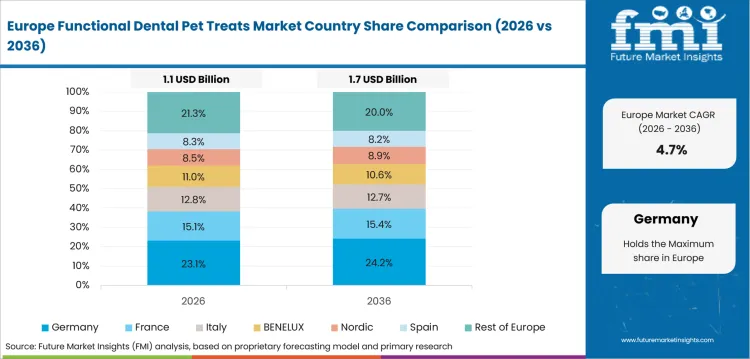
Country Market Snapshot Table
| Parameter | Value |
|---|---|
| Market Size in 2025 (Value) | USD 260.0 million |
| Market Size in 2026 (Value) | USD 273.5 million |
| Market Forecast in 2036 (Value) | USD 454.2 million |
| CAGR (2026 to 2036) | 5.2% |
| Years Considered | 2021 to 2036 |
| Base Year | 2025 |
| Forecast Period | 2026 to 2036 |
| Units Considered | Value (USD million) |
| Leading Sub-Region | North Rhine-Westphalia, Bavaria, Berlin, Hamburg, and southern retail corridors |
Germany Functional Dental Pet Treats Market Outlook
Germany demand is influenced by premium pet nutrition and owner caution around ingredients. Dental chews need clear texture and digestibility language.
Retail growth is expected to come through specialty stores and online platforms that can explain oral-care benefits. Local brands should benefit when they combine quality claims with price discipline.
Key Growth Drivers
- Government of Canada trade data placed Germany’s pet food imports at Can$4.5 billion in 2025, showing deep retail supply capacity.
- FEDIAF recorded 10.5 million dogs in Germany in its 2025 facts report, giving dental chew brands a broad canine base.
- Specialty retailers are expected to give premium dental chews space when claims and feeding instructions are clear.
- Breed-size and digestibility claims are expected to support repeat buying among small-dog owners.
Key Restraints
- Destatis reported wholesale selling prices were 1.2% higher in February 2026 than a year earlier, keeping input-cost pressure visible.
- Owners are expected to scrutinize ingredient lists before accepting premium dental chew prices.
- Private-label expansion is expected to pressure branded products without accepted dental evidence.
What makes Germany unique
Germany is unique due to disciplined nutrition claims and a strong premium pet food retail base.
Key Companies
- Fressnapf Tiernahrungs GmbH
- animonda petcare gmbh
- bosch Tiernahrung GmbH & Co. KG
- Josera petfood GmbH & Co. KG
- Dr. Clauder GmbH & Co. KG
- Happy Dog
- Trixie Heimtierbedarf GmbH & Co. KG
Sales & Marketing Channels
- Pet specialty stores
- Veterinary clinics
- Drugstores
- Online marketplaces
- Grocery chains
- Independent pet shops
Country Segment Breakdown Table
| Segment | Sub-Segments |
|---|---|
| By Product Type | Dental Chews · Dental Sticks · Dental Biscuits · Dental Bites |
| By Pet Type | Dogs · Cats · Small Pets |
| By Function | Plaque Control · Tartar Control · Breath Freshening · Gum Support |
| By Ingredient Base | Plant-Based · Animal Protein · Grain-Free · Novel Protein |
| By Sales Channel | Pet Specialty · E-Commerce · Mass Retail · Veterinary |
| Key Sub-Regions Covered, Urban Retail Clusters | North Rhine-Westphalia · Bavaria · Baden-Württemberg · Berlin · Hamburg · Hesse |
Frequently Asked Questions
How fast is Germany functional dental pet treats market growing?
Sales in Germany are projected to grow at 5.2% CAGR from 2026 to 2036, guided by country-specific pet ownership and retail behavior.
Who leads Germany functional dental pet treats market?
Fressnapf Tiernahrungs GmbH, animonda petcare gmbh, and bosch Tiernahrung GmbH & Co. KG compete through local supply, channel reach, and dental treat positioning.
How fast is the functional dental pet treats market growing in France?
A 4.9% CAGR through 2036 reflects established pet food retail and gradual movement toward daily oral-care treats.
Country Market Snapshot Table
| Parameter | Value |
|---|---|
| Market Size in 2025 (Value) | USD 225.0 million |
| Market Size in 2026 (Value) | USD 236.0 million |
| Market Forecast in 2036 (Value) | USD 380.6 million |
| CAGR (2026 to 2036) | 4.9% |
| Years Considered | 2021 to 2036 |
| Base Year | 2025 |
| Forecast Period | 2026 to 2036 |
| Units Considered | Value (USD million) |
| Leading Sub-Region | Île-de-France, Auvergne-Rhône-Alpes, Provence-Alpes-Côte d’Azur, and western pet retail clusters |
France Functional Dental Pet Treats Market Outlook
France demand is shaped by established dog ownership and premium pet food retail. Dental treats gain space when product claims are easier to understand than general wellness language.
Veterinary and specialty channels are expected to remain important for first purchase. Repeat demand should depend on chew safety and palatability.
Key Growth Drivers
- FEDIAF recorded 7.6 million dogs in France in its 2025 facts report, giving daily dental treats a sizable canine base.
- Government of Canada trade data placed France’s pet food imports at Can$1.77 billion in 2025, supporting broad retail supply.
- Veterinary clinics are expected to reinforce oral-care routines during wellness visits and dental consultations.
- Product-origin messaging is expected to help premium chews compete with standard biscuits.
Key Restraints
- FEDIAF recorded 14.9 million cats in France in its 2025 facts report, making cat-specific dental treat education necessary before wider scale.
- Some owners are expected to compare dental chews with lower-cost biscuits before paying for functional claims.
- Texture concerns are expected to slow repeat use when treats appear too hard for small dogs.
What makes France unique
France is unique due to large cat ownership and steady premiumization in pet food retail.
Key Companies
- Virbac
- Ultra Premium Direct
- Zolux
- Francodex Santé Animale
- Héry Laboratories
- Agrobiothers
- La Normandise
Sales & Marketing Channels
- Pet specialty stores
- Veterinary clinics
- E-commerce platforms
- Grocery chains
- Garden centers
- Independent pet shops
Country Segment Breakdown Table
| Segment | Sub-Segments |
|---|---|
| By Product Type | Dental Chews · Dental Sticks · Dental Biscuits · Dental Bites |
| By Pet Type | Dogs · Cats · Small Pets |
| By Function | Plaque Control · Tartar Control · Breath Freshening · Gum Support |
| By Ingredient Base | Plant-Based · Animal Protein · Grain-Free · Novel Protein |
| By Sales Channel | Pet Specialty · E-Commerce · Mass Retail · Veterinary |
| Key Sub-Regions Covered, Urban Retail Clusters | Île-de-France · Auvergne-Rhône-Alpes · Provence-Alpes-Côte d’Azur · Nouvelle-Aquitaine · Occitanie · Hauts-de-France |
Frequently Asked Questions
How fast is France functional dental pet treats market growing?
Sales in France are projected to grow at 4.9% CAGR from 2026 to 2036, guided by country-specific pet ownership and retail behavior.
Who leads France functional dental pet treats market?
Virbac, Ultra Premium Direct, and Zolux compete through local supply, channel reach, and dental treat positioning.
How fast is the functional dental pet treats market growing in Japan?
A 3.9% CAGR through 2036 reflects premium per-pet spending but slower volume growth in a smaller dog base.
Country Market Snapshot Table
| Parameter | Value |
|---|---|
| Market Size in 2025 (Value) | USD 175.0 million |
| Market Size in 2026 (Value) | USD 181.8 million |
| Market Forecast in 2036 (Value) | USD 266.5 million |
| CAGR (2026 to 2036) | 3.9% |
| Years Considered | 2021 to 2036 |
| Base Year | 2025 |
| Forecast Period | 2026 to 2036 |
| Units Considered | Value (USD million) |
| Leading Sub-Region | Tokyo, Osaka, Aichi, Kanagawa, and Kansai retail corridors |
Japan Functional Dental Pet Treats Market Outlook
Japan demand is shaped by small households and older pets. Premium treat preferences also influence product design.
Retailers are expected to focus on compact formats and clear feeding instructions. Brands that address aging dogs and cautious owners should gain repeat demand.
Key Growth Drivers
- Agriculture and Agri-Food Canada reported that Japan’s pet population reached 55.8 million in 2023, supporting a broad companion-animal care base.
- A MAFF-published veterinary report found commercial dry food was the main diet for about 80% of dogs and cats, supporting packaged pet-care routines.
- Small-format packaging is expected to support purchases in urban homes with limited storage space.
- Specialty pet shops are expected to explain texture and portion size to owners of older pets.
Key Restraints
- Government of Canada forecast Japan’s dog population at 6.2 million by 2028, keeping dog-led dental chew growth volume-limited.
- Aging dogs are expected to need softer dental formats that may reduce mechanical cleaning intensity.
- High product expectations are expected to increase formulation costs for premium dental treat brands.
What makes Japan unique
Japan is unique due to aging pets and compact homes. Demand for smaller premium treat formats adds another distinction.
Key Companies
- Unicharm Corporation
- DoggyMan H.A. Co., Ltd.
- Inaba Petfood Co., Ltd.
- Petline Corporation
- Marukan Co., Ltd.
- IRIS Ohyama Inc.
- Yamahisa Pet Care
Sales & Marketing Channels
- Pet specialty stores
- Veterinary clinics
- Convenience retail
- E-commerce platforms
- Home centers
- Department-store pet sections
Country Segment Breakdown Table
| Segment | Sub-Segments |
|---|---|
| By Product Type | Dental Chews · Dental Sticks · Dental Biscuits · Dental Bites |
| By Pet Type | Dogs · Cats · Small Pets |
| By Function | Plaque Control · Tartar Control · Breath Freshening · Gum Support |
| By Ingredient Base | Plant-Based · Animal Protein · Grain-Free · Novel Protein |
| By Sales Channel | Pet Specialty · E-Commerce · Mass Retail · Veterinary |
| Key Sub-Regions Covered, Urban Retail Clusters | Tokyo · Osaka · Aichi · Kanagawa · Hyogo · Fukuoka |
Frequently Asked Questions
How fast is Japan functional dental pet treats market growing?
Sales in Japan are projected to grow at 3.9% CAGR from 2026 to 2036, guided by country-specific pet ownership and retail behavior.
Who leads Japan functional dental pet treats market?
Unicharm Corporation, DoggyMan H.A. Co., Ltd., and Inaba Petfood Co., Ltd. compete through local supply, channel reach, and dental treat positioning.
How fast is the functional dental pet treats market growing in China?
A 7.4% CAGR through 2036 reflects premium pet food spending and fast online discovery across urban owners.
Country Market Snapshot Table
| Parameter | Value |
|---|---|
| Market Size in 2025 (Value) | USD 340.0 million |
| Market Size in 2026 (Value) | USD 365.2 million |
| Market Forecast in 2036 (Value) | USD 746.7 million |
| CAGR (2026 to 2036) | 7.4% |
| Years Considered | 2021 to 2036 |
| Base Year | 2025 |
| Forecast Period | 2026 to 2036 |
| Units Considered | Value (USD million) |
| Leading Sub-Region | Shanghai, Beijing, Guangdong, Zhejiang, and Chengdu retail clusters |
China Functional Dental Pet Treats Market Outlook
China demand is shaped by rapid premiumization and platform-led product discovery. Dental treats gain attention when brands explain breath and plaque benefits.
Local and international suppliers are expected to compete through pack design and price tiering. Online reviews add another filter when shoppers compare many products quickly.
Key Growth Drivers
- USDA FAS reported that China’s pet industry reached USD 43.4 billion in 2025, giving premium dental treats a larger spending base.
- Government of Canada reported China had 86.5 million cat-owning households in 2025, supporting companion-animal care demand beyond dog products.
- Douyin, Tmall and JD.com are expected to speed discovery for breath and plaque claims.
- Local brands are expected to adjust package design and price tiers quickly for city-level demand.
Key Restraints
- Government of Canada reported China’s dog and cat food imports declined at a 4.9% CAGR from 2021 to 2025, increasing reliance on domestic supply.
- Online price comparison is expected to pressure imported premium dental chew brands without clear claim proof.
- Regulatory review of pet food claims is expected to limit vague oral-care language on packs.
What makes China unique
China is unique due to fast online discovery and premium pet food spending across large urban clusters.
Key Companies
- Yantai China Pet Foods Co., Ltd.
- Gambol Pet Group
- Shanghai Bridge Petcare Co., Ltd.
- Huaxing Pet Food
- Navarch Petcare
- Myfoodie Pet Food
- CrazyDog Pet Food
Sales & Marketing Channels
- E-commerce marketplaces
- Livestream commerce
- Pet specialty stores
- Veterinary clinics
- Supermarkets
- Community pet shops
Country Segment Breakdown Table
| Segment | Sub-Segments |
|---|---|
| By Product Type | Dental Chews · Dental Sticks · Dental Biscuits · Dental Bites |
| By Pet Type | Dogs · Cats · Small Pets |
| By Function | Plaque Control · Tartar Control · Breath Freshening · Gum Support |
| By Ingredient Base | Plant-Based · Animal Protein · Grain-Free · Novel Protein |
| By Sales Channel | Pet Specialty · E-Commerce · Mass Retail · Veterinary |
| Key Sub-Regions Covered, Urban Retail Clusters | Shanghai · Beijing · Guangdong · Zhejiang · Jiangsu · Sichuan |
Frequently Asked Questions
How fast is China functional dental pet treats market growing?
Sales in China are projected to grow at 7.4% CAGR from 2026 to 2036, guided by country-specific pet ownership and retail behavior.
Who leads China functional dental pet treats market?
Yantai China Pet Foods Co., Ltd., Gambol Pet Group, and Shanghai Bridge Petcare Co., Ltd. compete through local supply, channel reach, and dental treat positioning.
How fast is the functional dental pet treats market growing in South Korea?
A 6.8% CAGR through 2036 reflects high urban pet ownership and strong online channel influence.
Country Market Snapshot Table
| Parameter | Value |
|---|---|
| Market Size in 2025 (Value) | USD 190.0 million |
| Market Size in 2026 (Value) | USD 202.9 million |
| Market Forecast in 2036 (Value) | USD 392.0 million |
| CAGR (2026 to 2036) | 6.8% |
| Years Considered | 2021 to 2036 |
| Base Year | 2025 |
| Forecast Period | 2026 to 2036 |
| Units Considered | Value (USD million) |
| Leading Sub-Region | Seoul, Gyeonggi, Busan, Daegu, and Daejeon retail clusters |
South Korea Functional Dental Pet Treats Market Outlook
South Korea demand is shaped by urban pet parenting and high reliance on online reviews. Dental chews gain traction when they combine breath benefits with safe texture claims.
Retailers are expected to favor compact packs and premium formats that suit apartments and small dogs. Imported and local brands must prove value against grooming and wellness spend.
Key Growth Drivers
- MAFRA survey coverage reported that 29.2% of South Korean households raised pets in 2025, widening the addressable owner base.
- Agriculture and Agri-Food Canada reported South Korea’s dog-owning households reached 2.7 million in 2023, supporting canine oral-care demand.
- E-commerce reviews are expected to influence trust and reorder behavior for dental chews.
- Pet registration and welfare attention are expected to reinforce responsible-care habits among owners.
Key Restraints
- USDA FAS reported in February 2026 that South Korea extended a grace period for new pet food import health requirements, keeping import compliance under review.
- High grooming and wellness spending is expected to compete with discretionary dental treat purchases.
- Small-dog ownership is expected to increase scrutiny on chew hardness and choking warnings.
What makes South Korea unique
South Korea is unique due to online channel influence and high owner attention to visible pet wellness outcomes.
Key Companies
- Harim Pet Food
- Daehan Feed Co., Ltd.
- Ourhome Pet Food
- Bowwow Korea
- ANF Korea
- Pulmuone Pet Food
- CJ Feed & Care
Sales & Marketing Channels
- E-commerce marketplaces
- Pet specialty stores
- Veterinary clinics
- Hypermarkets
- Subscription platforms
- Grooming-linked retail
Country Segment Breakdown Table
| Segment | Sub-Segments |
|---|---|
| By Product Type | Dental Chews · Dental Sticks · Dental Biscuits · Dental Bites |
| By Pet Type | Dogs · Cats · Small Pets |
| By Function | Plaque Control · Tartar Control · Breath Freshening · Gum Support |
| By Ingredient Base | Plant-Based · Animal Protein · Grain-Free · Novel Protein |
| By Sales Channel | Pet Specialty · E-Commerce · Mass Retail · Veterinary |
| Key Sub-Regions Covered, Urban Retail Clusters | Seoul · Gyeonggi · Busan · Daegu · Daejeon · Incheon |
Frequently Asked Questions
How fast is South Korea functional dental pet treats market growing?
Sales in South Korea are projected to grow at 6.8% CAGR from 2026 to 2036, guided by country-specific pet ownership and retail behavior.
Who leads South Korea functional dental pet treats market?
Harim Pet Food, Daehan Feed Co., Ltd., and Ourhome Pet Food compete through local supply, channel reach, and dental treat positioning.
How fast is the functional dental pet treats market growing in India?
An 8.6% CAGR through 2036 reflects metro pet retail expansion and fast growth in dog-focused premium treats.
Country Market Snapshot Table
| Parameter | Value |
|---|---|
| Market Size in 2025 (Value) | USD 105.0 million |
| Market Size in 2026 (Value) | USD 114.0 million |
| Market Forecast in 2036 (Value) | USD 259.5 million |
| CAGR (2026 to 2036) | 8.6% |
| Years Considered | 2021 to 2036 |
| Base Year | 2025 |
| Forecast Period | 2026 to 2036 |
| Units Considered | Value (USD million) |
| Leading Sub-Region | Delhi NCR, Mumbai, Bengaluru, Hyderabad, Pune, and Chennai retail clusters |
India Functional Dental Pet Treats Market Outlook
India demand is shaped by dog ownership and online discovery. Rising premium pet food sales in metros add support.
The category remains early compared with developed pet care markets. Suppliers that price smaller packs well should improve first-time purchase among new pet parents.
Key Growth Drivers
- Agriculture and Agri-Food Canada reported that dogs accounted for 85.0% of India’s pet population in 2025, supporting dog-led dental chew demand.
- The same official report placed India’s pet food retail sales at USD 769.7 million in 2025, showing a larger base for premium functional treats.
- Metro retail and online channels are expected to increase trial of daily dental chews among new pet parents.
- Veterinary clinics are expected to improve owner understanding of plaque and tartar home care.
Key Restraints
- Agriculture and Agri-Food Canada reported that India imported Can$192.9 million of pet food in 2025, exposing premium treats to landed-cost pressure.
- Price sensitivity is expected to slow repeat buying when dental chews compete with standard biscuits.
- Lower awareness of preventive dental routines is expected to limit adoption outside larger cities.
What makes India unique
India is unique due to fast dog ownership expansion and a shift from basic treats toward function-backed pet snacks.
Key Companies
- Heads Up For Tails
- Drools Pet Food
- Wiggles India
- Captain Zack
- Basil Petcare
- Dogsee Chew
- Supertails
Sales & Marketing Channels
- E-commerce platforms
- Pet specialty stores
- Veterinary clinics
- Modern retail
- Quick-commerce platforms
- Independent pet shops
Country Segment Breakdown Table
| Segment | Sub-Segments |
|---|---|
| By Product Type | Dental Chews · Dental Sticks · Dental Biscuits · Dental Bites |
| By Pet Type | Dogs · Cats · Small Pets |
| By Function | Plaque Control · Tartar Control · Breath Freshening · Gum Support |
| By Ingredient Base | Plant-Based · Animal Protein · Grain-Free · Novel Protein |
| By Sales Channel | Pet Specialty · E-Commerce · Mass Retail · Veterinary |
| Key Sub-Regions Covered, Urban Retail Clusters | Delhi NCR · Mumbai · Bengaluru · Hyderabad · Pune · Chennai |
Frequently Asked Questions
How fast is India functional dental pet treats market growing?
Sales in India are projected to grow at 8.6% CAGR from 2026 to 2036, guided by country-specific pet ownership and retail behavior.
Who leads India functional dental pet treats market?
Heads Up For Tails, Drools Pet Food, and Wiggles India compete through local supply, channel reach, and dental treat positioning.
Who are the leading companies in the functional dental pet treats market?
Mars Petcare, Nestlé Purina PetCare, Hill’s Pet Nutrition, Virbac, ADM, United Petfood, and VAFO Group are key companies in the functional dental pet treats market.
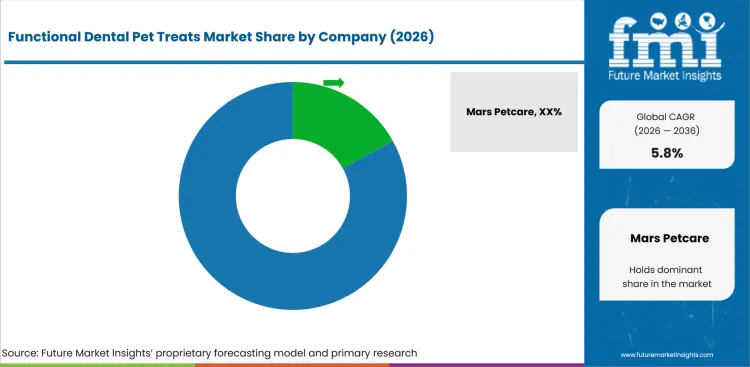
- Multinational pet care companies hold an advantage through accepted dental claims and broad retail access.
- Veterinary health brands gain stronger credibility where clinics guide oral-care product choice.
- Private-label suppliers compete through breed-size coverage, texture systems, and channel-ready packaging.
- Regional premium treat producers gain relevance through local flavors, smaller packs, and value-led online formats.
The functional dental pet treats market is led by multinational pet care companies, veterinary health brands, private-label suppliers, and regional premium treat producers. Competition is based on dental proof, chew texture, breed-size coverage, digestibility claims, and channel education.
Companies such as Mars Petcare and Nestlé Purina hold the strongest branded positions because Greenies and Dentalife combine clear oral-care claims with broad retail reach. Virbac and Hill’s Pet Nutrition remain important where veterinary credibility shapes owner trust. Regional suppliers are better placed when they target local flavors, smaller packs, and value-led online formats.
How do top functional dental pet treats companies compare?
Mars Petcare and Hill’s Pet Nutrition score strongest on veterinary channel fit, while Nestlé Purina retains global reach through retail scale and product familiarity.
| Company | Dental Claim Depth | Breed-Size Coverage | Veterinary Channel Fit | Geographic Reach |
|---|---|---|---|---|
| Mars Petcare | High | High | High | Global |
| Nestlé Purina | High | High | Moderate | Global |
| Hill’s Pet Nutrition | High | Moderate | High | Global |
| Virbac | High | Moderate | High | Global |
| ADM | Moderate | Moderate | Moderate | Global B2B |
| United Petfood | Moderate | High | Moderate | Europe and global private label |
| VAFO Group | Moderate | Moderate | Moderate | Europe |
Source: Future Market Insights competitive analysis, 2026.
Key Developments in Functional Dental Pet Treats Market
- In May 2025, Mars launched GREENIES Canine Dental Check in the United States to help owners assess tartar and gum irritation from a smartphone image. The tool links home dental observation with product-led oral care.
- In March 2026, Nestlé Purina opened a CHF 370 million wet pet food factory in Vargeão, Brazil. The site strengthens Purina’s capacity for cats and dogs across one of the world’s largest pet populations.
- In April 2026, VAFO Group’s Prima Pet and Enifer started test batches of dry pet food with PEKILO mycoprotein at the Nokia factory in Finland. The work shows how alternative proteins are entering pet food and treat formulation pipelines.
Who are the key players in the functional dental pet treats market?
Key global companies leading the functional dental pet treats market include:
Global Pet Care Groups
- Mars Petcare
- Nestlé Purina PetCare
- Hill’s Pet Nutrition
Veterinary and Oral-Care Specialists
- Virbac
- Ark Naturals
- Wellness Pet Company
B2B, Private Label, and Regional Suppliers
- ADM
- United Petfood
- VAFO Group
- Blue Buffalo
- Bocce’s Bakery
Functional Dental Pet Treats Market - Report Scope
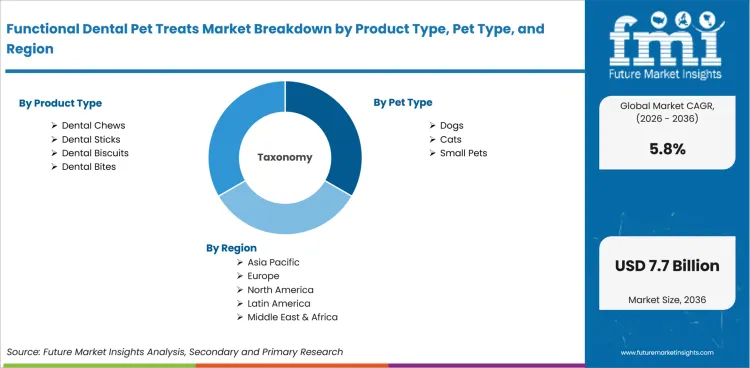
| Attribute | Details |
|---|---|
| Market Name | Functional Dental Pet Treats Market |
| Forecast Period | 2026 to 2036 |
| Base Year | 2025 |
| Historical Period | 2021 to 2025 |
| Market Size in 2026 | USD 4.39 billion |
| Market Forecast in 2036 | USD 7.72 billion |
| Forecast CAGR | 5.8% |
| Segments Covered | Product Type, Pet Type, Function, Ingredient Base, Sales Channel, and Region |
| Regions Covered | North America, Latin America, Europe, East Asia, South Asia and Pacific, and Middle East and Africa |
Source: Future Market Insights, 2026.
Functional Dental Pet Treats Market - Scope & Definition
| Attribute | Detail |
|---|---|
| Market Definition | Edible treats designed to support companion-animal oral hygiene through chewing action, plaque control, tartar control, breath freshening, or gum-support positioning |
| Functions Covered | Plaque control, tartar control, breath freshening, gum support, daily oral-care compliance, and texture-led tooth contact |
| Applications Covered | Dental chews, dental sticks, dental biscuits, and dental bites used by dogs, cats, and small pets |
| End-Use Industries | Pet treats, pet food, veterinary retail, pet specialty retail, e-commerce, and functional pet nutrition |
| Grades Covered | Plant-based, animal-protein, grain-free, novel-protein, breed-size, and life-stage dental treat formats |
| Inclusions | Commercially traded edible dental treats sold through pet specialty, e-commerce, mass retail, and veterinary channels across all global regions |
| Exclusions | Veterinary dental services, dental diets positioned as complete food, non-edible chew toys, toothbrushes, toothpaste, oral gels, sprays, water additives, and human oral-care products |
Functional Dental Pet Treats Market - Research Methodology
| Method | Description |
|---|---|
| Primary Research | FMI analyst interviews with pet treat manufacturers, pet specialty retailers, veterinary channel participants, ingredient suppliers, and private-label manufacturers across key markets |
| Desk Research | Review of pet ownership data, pet food trade data, veterinary dental references, VOHC accepted-product lists, company product evidence, and official country pet food reports |
| Market Sizing & Forecasting | Bottom-up product-boundary approach using dog and cat populations, dental-treat penetration, average pack pricing, purchase frequency, channel mix, and country-level retail access |
| Data Validation | Cross-verification using company portfolios, accepted dental claims, distributor checks, regional pet food sales, USA pet expenditure data, and adjacent pet snacks growth rates |
Key Segments
Functional Dental Pet Treats Market Segmented by Product Type
- Dental Chews
- Dental Sticks
- Dental Biscuits
- Dental Bites
Functional Dental Pet Treats Market Segmented by Pet Type
- Dogs
- Cats
- Small Pets
Functional Dental Pet Treats Market Segmented by Function
- Plaque Control
- Tartar Control
- Breath Freshening
- Gum Support
Functional Dental Pet Treats Market Segmented by Ingredient Base
- Plant-Based
- Animal Protein
- Grain-Free
- Novel Protein
Functional Dental Pet Treats Market Segmented by Sales Channel
- Pet Specialty
- E-Commerce
- Mass Retail
- Veterinary
Functional Dental Pet Treats Market by Region
- North America
- Latin America
- Europe
- East Asia
- South Asia and Pacific
- Middle East and Africa
Research Sources and Bibliography
- Agriculture and Agri-Food Canada. (2026, May 13). Sector trend analysis: Pet food trends in India. Government of Canada.
- Agriculture and Agri-Food Canada. (2026, April 1). Sector trend analysis: Pet food trends in Australia. Government of Canada.
- Agriculture and Agri-Food Canada. (2025). Sector trend analysis: Pet food in Japan. Government of Canada.
- American Pet Products Association. (2026, March 26). USA pet industry reaches USD 158 billion in 2025, poised for continued growth in 2026.
- American Veterinary Medical Association. (2026, February 4). AVMA: Doggie breath could be a sign of serious disease.
- Bureau of Labor Statistics. (2026, June 11). Consumer Price Index, May 2026. USA Department of Labor.
- Competition and Markets Authority. (2026, March 24). Veterinary services for household pets: Final decision report. GOV.UK.
- Department for Environment, Food & Rural Affairs. (2025, December). Animal welfare strategy for England. GOV.UK.
- Destatis. (2026, March 13). Wholesale prices in February 2026: +1.2% on February 2025. Federal Statistical Office of Germany.
- FEDIAF. (2025, June). Facts and figures 2025.
- Federal Reserve Bank of St. Louis. (2026, June 10). Consumer Price Index for All Urban Consumers: Pet food and treats in USA city average.
- Mars Incorporated. (2025, May 6). Mars puts pet health in pet parents’ hands with new AI-powered tools.
- Ministry of Agriculture, Forestry and Fisheries. (2025). Japan veterinary antimicrobial resistance monitoring report 2021.
- Nestlé. (2026, March 4). Nestlé Purina opens a CHF 370 million pet food factory in Brazil.
- Office for National Statistics. (2026, March 16). Consumer price inflation basket of goods and services: 2026.
- USA Census Bureau. (2025, May 29). New product statistics from 2022 Economic Census now available.
- USA Department of Agriculture Foreign Agricultural Service. (2026, April 14). China: Pet food market update 2026.
- USA Department of Agriculture Foreign Agricultural Service. (2026). Dog and cat food.
- USA Department of Agriculture Foreign Agricultural Service. (2026, February 2). South Korea: ROK extends grace period for new pet food import health requirements.
- USA International Trade Administration. (2026, June 8). Germany pet industry. USA Department of Commerce.
- VAFO Group. (2026, April 23). Prima Pet first in Finland to develop dry pet food with PEKILO mycoprotein.
- Veterinary Oral Health Council. (2025, November). Accepted products.
- Virbac. (2026). C.E.T. Veggiedent FR3SH dental chews for dogs.
This Report Answers
- The report estimates functional dental pet treats market value from 2026 to 2036.
- The report explains which product type, pet type, function, ingredient base, and channel lead demand.
- The report compares country growth across the United States, United Kingdom, Germany, France, Japan, China, South Korea, and India.
- The report identifies competitive benchmarks based on dental claim depth, breed-size coverage, veterinary fit, and geographic reach.
- The report assesses oral-care claim proof, chew texture, breed-size suitability, and pet specialty channel influence.
- The report evaluates how veterinary guidance, e-commerce education, and accepted-product lists shape buying behavior.
Frequently Asked Questions
How big is the functional dental pet treats market in 2026?
The market is valued at USD 4.39 billion in 2026 and is forecast to reach USD 7.72 billion by 2036.
What is the CAGR for the functional dental pet treats market?
The market is projected to grow at 5.8% CAGR from 2026 to 2036.
Which product type leads the market?
Dental chews lead Product Type with 54.0% share in 2026 because chew texture supports mechanical tooth contact.
Which pet type leads the market?
Dogs lead Pet Type with 83.0% share in 2026 since canine chewing behavior supports daily dental treat use.
Which country is expected to grow fastest?
India is expected to grow at fastest at 8.6% CAGR through 2036 due to metro pet retail expansion and dog-led premium treat demand.
Preview the report firsthand - request a free sample
Get SampleGet the brochure for pricing and purchase details.
Get PDFTable of Content
- Executive Summary
- Global Market Outlook
- Demand to side Trends
- Supply to side Trends
- Technology Roadmap Analysis
- Analysis and Recommendations
- Market Overview
- Market Coverage / Taxonomy
- Market Definition / Scope / Limitations
- Research Methodology
- Chapter Orientation
- Analytical Lens and Working Hypotheses
- Market Structure, Signals, and Trend Drivers
- Benchmarking and Cross-market Comparability
- Market Sizing, Forecasting, and Opportunity Mapping
- Research Design and Evidence Framework
- Desk Research Programme (Secondary Evidence)
- Company Annual and Sustainability Reports
- Peer-reviewed Journals and Academic Literature
- Corporate Websites, Product Literature, and Technical Notes
- Earnings Decks and Investor Briefings
- Statutory Filings and Regulatory Disclosures
- Technical White Papers and Standards Notes
- Trade Journals, Industry Magazines, and Analyst Briefs
- Conference Proceedings, Webinars, and Seminar Materials
- Government Statistics Portals and Public Data Releases
- Press Releases and Reputable Media Coverage
- Specialist Newsletters and Curated Briefings
- Sector Databases and Reference Repositories
- FMI Internal Proprietary Databases and Historical Market Datasets
- Subscription Datasets and Paid Sources
- Social Channels, Communities, and Digital Listening Inputs
- Additional Desk Sources
- Expert Input and Fieldwork (Primary Evidence)
- Primary Modes
- Qualitative Interviews and Expert Elicitation
- Quantitative Surveys and Structured Data Capture
- Blended Approach
- Why Primary Evidence is Used
- Field Techniques
- Interviews
- Surveys
- Focus Groups
- Observational and In-context Research
- Social and Community Interactions
- Stakeholder Universe Engaged
- C-suite Leaders
- Board Members
- Presidents and Vice Presidents
- R&D and Innovation Heads
- Technical Specialists
- Domain Subject-matter Experts
- Scientists
- Physicians and Other Healthcare Professionals
- Governance, Ethics, and Data Stewardship
- Research Ethics
- Data Integrity and Handling
- Primary Modes
- Tooling, Models, and Reference Databases
- Desk Research Programme (Secondary Evidence)
- Data Engineering and Model Build
- Data Acquisition and Ingestion
- Cleaning, Normalisation, and Verification
- Synthesis, Triangulation, and Analysis
- Quality Assurance and Audit Trail
- Market Background
- Market Dynamics
- Drivers
- Restraints
- Opportunity
- Trends
- Scenario Forecast
- Demand in Optimistic Scenario
- Demand in Likely Scenario
- Demand in Conservative Scenario
- Opportunity Map Analysis
- Product Life Cycle Analysis
- Supply Chain Analysis
- Investment Feasibility Matrix
- Value Chain Analysis
- PESTLE and Porter’s Analysis
- Regulatory Landscape
- Regional Parent Market Outlook
- Production and Consumption Statistics
- Import and Export Statistics
- Market Dynamics
- Global Market Analysis 2021 to 2025 and Forecast, 2026 to 2036
- Historical Market Size Value (USD Million) Analysis, 2021 to 2025
- Current and Future Market Size Value (USD Million) Projections, 2026 to 2036
- Y to o to Y Growth Trend Analysis
- Absolute $ Opportunity Analysis
- Global Market Pricing Analysis 2021 to 2025 and Forecast 2026 to 2036
- Global Market Analysis 2021 to 2025 and Forecast 2026 to 2036, By Form
- Introduction / Key Findings
- Historical Market Size Value (USD Million) Analysis By Form , 2021 to 2025
- Current and Future Market Size Value (USD Million) Analysis and Forecast By Form , 2026 to 2036
- Pieces
- Powder
- Whole
- Granules
- Pieces
- Y to o to Y Growth Trend Analysis By Form , 2021 to 2025
- Absolute $ Opportunity Analysis By Form , 2026 to 2036
- Global Market Analysis 2021 to 2025 and Forecast 2026 to 2036, By Nature
- Introduction / Key Findings
- Historical Market Size Value (USD Million) Analysis By Nature, 2021 to 2025
- Current and Future Market Size Value (USD Million) Analysis and Forecast By Nature, 2026 to 2036
- Conventional
- Organic
- Conventional
- Y to o to Y Growth Trend Analysis By Nature, 2021 to 2025
- Absolute $ Opportunity Analysis By Nature, 2026 to 2036
- Global Market Analysis 2021 to 2025 and Forecast 2026 to 2036, By Application
- Introduction / Key Findings
- Historical Market Size Value (USD Million) Analysis By Application, 2021 to 2025
- Current and Future Market Size Value (USD Million) Analysis and Forecast By Application, 2026 to 2036
- Bakery
- Breakfast Cereals
- Snacks
- Dairy
- Beverages
- Supplements
- Bakery
- Y to o to Y Growth Trend Analysis By Application, 2021 to 2025
- Absolute $ Opportunity Analysis By Application, 2026 to 2036
- Global Market Analysis 2021 to 2025 and Forecast 2026 to 2036, By Buyer Type
- Introduction / Key Findings
- Historical Market Size Value (USD Million) Analysis By Buyer Type, 2021 to 2025
- Current and Future Market Size Value (USD Million) Analysis and Forecast By Buyer Type, 2026 to 2036
- Food Manufacturers
- Ingredient Distributors
- Retail Brands
- Foodservice
- Food Manufacturers
- Y to o to Y Growth Trend Analysis By Buyer Type, 2021 to 2025
- Absolute $ Opportunity Analysis By Buyer Type, 2026 to 2036
- Global Market Analysis 2021 to 2025 and Forecast 2026 to 2036, By Sales Channel
- Introduction / Key Findings
- Historical Market Size Value (USD Million) Analysis By Sales Channel, 2021 to 2025
- Current and Future Market Size Value (USD Million) Analysis and Forecast By Sales Channel, 2026 to 2036
- Direct B2B
- Distributors
- Online Retail
- Specialty Retail
- Direct B2B
- Y to o to Y Growth Trend Analysis By Sales Channel, 2021 to 2025
- Absolute $ Opportunity Analysis By Sales Channel, 2026 to 2036
- Global Market Analysis 2021 to 2025 and Forecast 2026 to 2036, By Region
- Introduction
- Historical Market Size Value (USD Million) Analysis By Region, 2021 to 2025
- Current Market Size Value (USD Million) Analysis and Forecast By Region, 2026 to 2036
- North America
- Latin America
- Western Europe
- Eastern Europe
- East Asia
- South Asia and Pacific
- Middle East & Africa
- Market Attractiveness Analysis By Region
- North America Market Analysis 2021 to 2025 and Forecast 2026 to 2036, By Country
- Historical Market Size Value (USD Million) Trend Analysis By Market Taxonomy, 2021 to 2025
- Market Size Value (USD Million) Forecast By Market Taxonomy, 2026 to 2036
- By Country
- USA
- Canada
- Mexico
- By Form
- By Nature
- By Application
- By Buyer Type
- By Sales Channel
- By Country
- Market Attractiveness Analysis
- By Country
- By Form
- By Nature
- By Application
- By Buyer Type
- By Sales Channel
- Key Takeaways
- Latin America Market Analysis 2021 to 2025 and Forecast 2026 to 2036, By Country
- Historical Market Size Value (USD Million) Trend Analysis By Market Taxonomy, 2021 to 2025
- Market Size Value (USD Million) Forecast By Market Taxonomy, 2026 to 2036
- By Country
- Brazil
- Chile
- Rest of Latin America
- By Form
- By Nature
- By Application
- By Buyer Type
- By Sales Channel
- By Country
- Market Attractiveness Analysis
- By Country
- By Form
- By Nature
- By Application
- By Buyer Type
- By Sales Channel
- Key Takeaways
- Western Europe Market Analysis 2021 to 2025 and Forecast 2026 to 2036, By Country
- Historical Market Size Value (USD Million) Trend Analysis By Market Taxonomy, 2021 to 2025
- Market Size Value (USD Million) Forecast By Market Taxonomy, 2026 to 2036
- By Country
- Germany
- UK
- Italy
- Spain
- France
- Nordic
- BENELUX
- Rest of Western Europe
- By Form
- By Nature
- By Application
- By Buyer Type
- By Sales Channel
- By Country
- Market Attractiveness Analysis
- By Country
- By Form
- By Nature
- By Application
- By Buyer Type
- By Sales Channel
- Key Takeaways
- Eastern Europe Market Analysis 2021 to 2025 and Forecast 2026 to 2036, By Country
- Historical Market Size Value (USD Million) Trend Analysis By Market Taxonomy, 2021 to 2025
- Market Size Value (USD Million) Forecast By Market Taxonomy, 2026 to 2036
- By Country
- Russia
- Poland
- Hungary
- Balkan & Baltic
- Rest of Eastern Europe
- By Form
- By Nature
- By Application
- By Buyer Type
- By Sales Channel
- By Country
- Market Attractiveness Analysis
- By Country
- By Form
- By Nature
- By Application
- By Buyer Type
- By Sales Channel
- Key Takeaways
- East Asia Market Analysis 2021 to 2025 and Forecast 2026 to 2036, By Country
- Historical Market Size Value (USD Million) Trend Analysis By Market Taxonomy, 2021 to 2025
- Market Size Value (USD Million) Forecast By Market Taxonomy, 2026 to 2036
- By Country
- China
- Japan
- South Korea
- By Form
- By Nature
- By Application
- By Buyer Type
- By Sales Channel
- By Country
- Market Attractiveness Analysis
- By Country
- By Form
- By Nature
- By Application
- By Buyer Type
- By Sales Channel
- Key Takeaways
- South Asia and Pacific Market Analysis 2021 to 2025 and Forecast 2026 to 2036, By Country
- Historical Market Size Value (USD Million) Trend Analysis By Market Taxonomy, 2021 to 2025
- Market Size Value (USD Million) Forecast By Market Taxonomy, 2026 to 2036
- By Country
- India
- ASEAN
- Australia & New Zealand
- Rest of South Asia and Pacific
- By Form
- By Nature
- By Application
- By Buyer Type
- By Sales Channel
- By Country
- Market Attractiveness Analysis
- By Country
- By Form
- By Nature
- By Application
- By Buyer Type
- By Sales Channel
- Key Takeaways
- Middle East & Africa Market Analysis 2021 to 2025 and Forecast 2026 to 2036, By Country
- Historical Market Size Value (USD Million) Trend Analysis By Market Taxonomy, 2021 to 2025
- Market Size Value (USD Million) Forecast By Market Taxonomy, 2026 to 2036
- By Country
- Kingdom of Saudi Arabia
- Other GCC Countries
- Turkiye
- South Africa
- Other African Union
- Rest of Middle East & Africa
- By Form
- By Nature
- By Application
- By Buyer Type
- By Sales Channel
- By Country
- Market Attractiveness Analysis
- By Country
- By Form
- By Nature
- By Application
- By Buyer Type
- By Sales Channel
- Key Takeaways
- Key Countries Market Analysis
- USA
- Pricing Analysis
- Market Share Analysis, 2025
- By Form
- By Nature
- By Application
- By Buyer Type
- By Sales Channel
- Canada
- Pricing Analysis
- Market Share Analysis, 2025
- By Form
- By Nature
- By Application
- By Buyer Type
- By Sales Channel
- Mexico
- Pricing Analysis
- Market Share Analysis, 2025
- By Form
- By Nature
- By Application
- By Buyer Type
- By Sales Channel
- Brazil
- Pricing Analysis
- Market Share Analysis, 2025
- By Form
- By Nature
- By Application
- By Buyer Type
- By Sales Channel
- Chile
- Pricing Analysis
- Market Share Analysis, 2025
- By Form
- By Nature
- By Application
- By Buyer Type
- By Sales Channel
- Germany
- Pricing Analysis
- Market Share Analysis, 2025
- By Form
- By Nature
- By Application
- By Buyer Type
- By Sales Channel
- UK
- Pricing Analysis
- Market Share Analysis, 2025
- By Form
- By Nature
- By Application
- By Buyer Type
- By Sales Channel
- Italy
- Pricing Analysis
- Market Share Analysis, 2025
- By Form
- By Nature
- By Application
- By Buyer Type
- By Sales Channel
- Spain
- Pricing Analysis
- Market Share Analysis, 2025
- By Form
- By Nature
- By Application
- By Buyer Type
- By Sales Channel
- France
- Pricing Analysis
- Market Share Analysis, 2025
- By Form
- By Nature
- By Application
- By Buyer Type
- By Sales Channel
- India
- Pricing Analysis
- Market Share Analysis, 2025
- By Form
- By Nature
- By Application
- By Buyer Type
- By Sales Channel
- ASEAN
- Pricing Analysis
- Market Share Analysis, 2025
- By Form
- By Nature
- By Application
- By Buyer Type
- By Sales Channel
- Australia & New Zealand
- Pricing Analysis
- Market Share Analysis, 2025
- By Form
- By Nature
- By Application
- By Buyer Type
- By Sales Channel
- China
- Pricing Analysis
- Market Share Analysis, 2025
- By Form
- By Nature
- By Application
- By Buyer Type
- By Sales Channel
- Japan
- Pricing Analysis
- Market Share Analysis, 2025
- By Form
- By Nature
- By Application
- By Buyer Type
- By Sales Channel
- South Korea
- Pricing Analysis
- Market Share Analysis, 2025
- By Form
- By Nature
- By Application
- By Buyer Type
- By Sales Channel
- Russia
- Pricing Analysis
- Market Share Analysis, 2025
- By Form
- By Nature
- By Application
- By Buyer Type
- By Sales Channel
- Poland
- Pricing Analysis
- Market Share Analysis, 2025
- By Form
- By Nature
- By Application
- By Buyer Type
- By Sales Channel
- Hungary
- Pricing Analysis
- Market Share Analysis, 2025
- By Form
- By Nature
- By Application
- By Buyer Type
- By Sales Channel
- Kingdom of Saudi Arabia
- Pricing Analysis
- Market Share Analysis, 2025
- By Form
- By Nature
- By Application
- By Buyer Type
- By Sales Channel
- Turkiye
- Pricing Analysis
- Market Share Analysis, 2025
- By Form
- By Nature
- By Application
- By Buyer Type
- By Sales Channel
- South Africa
- Pricing Analysis
- Market Share Analysis, 2025
- By Form
- By Nature
- By Application
- By Buyer Type
- By Sales Channel
- USA
- Market Structure Analysis
- Competition Dashboard
- Competition Benchmarking
- Market Share Analysis of Top Players
- By Regional
- By Form
- By Nature
- By Application
- By Buyer Type
- By Sales Channel
- Competition Analysis
- Competition Deep Dive
- Chaucer Foods
- Overview
- Product Portfolio
- Profitability by Market Segments (Product/Age /Sales Channel/Region)
- Sales Footprint
- Strategy Overview
- Marketing Strategy
- Product Strategy
- Channel Strategy
- Van Drunen Farms
- Mercer Foods
- European Freeze Dry
- Döhler
- OFD Foods
- LYOFOOD
- Paradise Fruits
- Sow Good
- Nim’s Fruit Crisps
- Chaucer Foods
- Competition Deep Dive
- Assumptions & Acronyms Used


