

- Market Size (2026)
- USD 2.9 Bn
- Forecast (2036)
- USD 6.5 Bn
- CAGR (2026 to 2036)
- 8.2%
How big is Functional Frozen Meals Market in 2026?
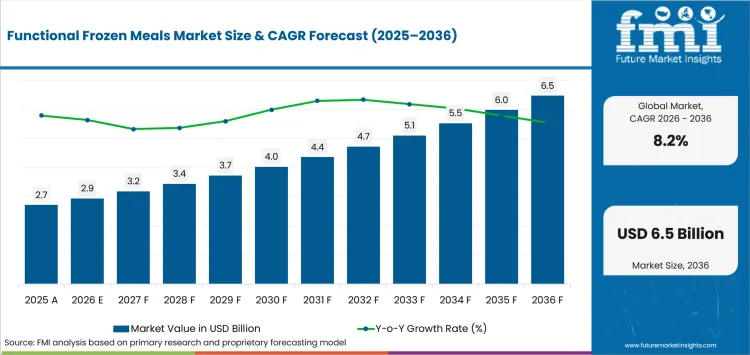
USD 2.9 billion in 2026 and USD 6.5 billion by 2036 at an 8.2% CAGR.
Demand for functional frozen meals is projected to expand at 8.2% CAGR between 2026 and 2036, increasing valuation from USD 2.9 billion in 2026 to USD 6.5 billion by 2036. Growth rests on prepared meals that make protein, sodium, portion size or other nutrition cues easy to understand while keeping preparation simple enough for ordinary weekday use.
Nutrition policy is making those cues more consequential. The USA Food and Drug Administration updated the voluntary “healthy” nutrient content claim in December 2024, while the 2025-2030 Dietary Guidelines for Americans place greater emphasis on nutrient-dense foods and protein. These changes do not guarantee demand for a frozen meal, but they raise the value of formulations that can support a credible nutrition proposition without losing familiarity at the point of purchase.
Key Takeaways of Functional Frozen Meals Market
- Functional frozen meals gain relevance when nutrition is visible at the same moment consumers evaluate convenience, price and preparation time.
- Frozen bowls are projected at 25.3% of Product Type in 2026 because a single-portion format supports clear meal construction and microwave preparation.
- High-protein meals are estimated at 30.1% of Function Claim demand in 2026 as protein is measurable on-pack and fits several eating occasions.
- Poultry is forecast at 31.4% of Protein Base in 2026 due to recipe familiarity and practical protein density across single-serve meals.
- Claim substantiation, sodium limits, price pressure and eating quality can slow repeat purchase when the functional promise is stronger than the product experience.
- Conagra Brands, Inc. (Healthy Choice), Nestlé, Daily Harvest, Kevin’s Natural Foods, Amy’s Kitchen, Mosaic Foods, Saffron Road, Sweet Earth Foods, The Kraft Heinz Company and Tattooed Chef are active across frozen nutrition, plant-forward meals or protein-oriented convenience.
Analyst Perspective
“Functional frozen meals have to solve a practical dinner decision before they solve a wellness aspiration. Brands should make the nutrition cue easy to verify, then protect taste, portion satisfaction and freezer economics so the product earns repeat purchase rather than one-time trial.”
- Nandini Roy Choudhury, Principal Consultant, Future Market Insights
How is the Functional Frozen Meals Market segmented?
The functional frozen meals market is segmented by Product Type, Function Claim, Protein Base, Packaging, Sales Channel and Region.
Product Type separates bowls, entrees, breakfasts, sides and desserts. Function Claim covers high-protein, gut health, immunity support, plant-based nutrition and low-sodium propositions. Protein Base identifies the main protein architecture, while Packaging captures the relationship between portioning, heating and shelf presentation. Sales Channel distinguishes grocery retail, online routes and specialist outlets. The surrounding frozen ready meals category provides a useful reference for how prepared frozen formats compete on convenience while functional meals add a more explicit nutrition job.
Why do frozen bowls hold a major position in the product type category?
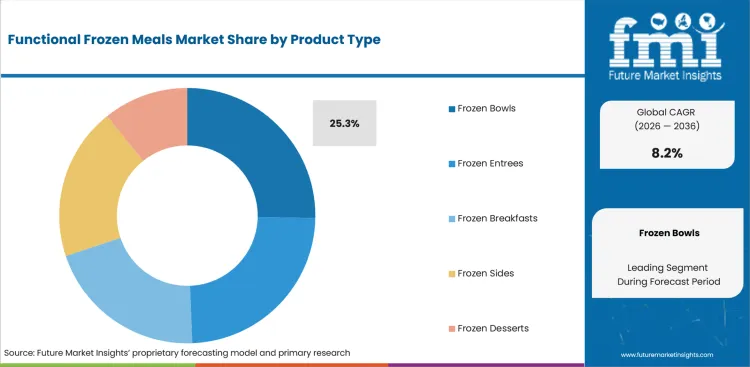
Frozen bowls compress a complete meal into one portion while giving brands enough recipe flexibility to combine a protein base with vegetables, grains or pasta. The format makes portion size visible and supports fast heating, two qualities that help a nutrition claim connect with an actual meal occasion. Nestlé’s Vital Pursuit line shows the architecture: the company introduced 14 frozen meals nationally in September 2024, including several bowl formats, with products offering at least 20 grams of protein.
- Frozen Bowls are projected to account for 25.3% of Product Type in 2026 because portion control, quick preparation and recipe flexibility fit a broad range of functional meal concepts.
- Conagra Brands introduced more than 50 frozen products in June 2025, including single-serve meals and plant-based options, showing that innovation continues to move through established freezer formats.
Why does high-protein lead the function claim category?
High-protein positioning is comparatively easy for shoppers to assess because grams of protein are visible on the Nutrition Facts panel and can be reinforced through permitted front-of-pack language. The proposition can serve satiety, active lifestyles and weight-management occasions without forcing the product into one cuisine. The broader plant-based protein market also shows how protein sourcing is becoming a formulation decision across conventional and plant-forward foods, widening the ingredient routes available to frozen-meal developers.
- High-Protein is estimated at 30.1% of Function Claim in 2026 because the benefit is measurable, widely understood and compatible with several meal occasions.
- Conagra Brands said its “On Track” badge would appear on 26 selected Healthy Choice items from January 2025, identifying products that were high in protein, low calorie and a good source of fiber.
How does poultry anchor the protein base category?
Poultry gives developers a familiar protein base that works across sauces, grains, pasta and vegetable-heavy recipes. It can support a substantial protein contribution without requiring consumers to adopt an unfamiliar flavor profile. Formulators still have to balance sodium, saturated fat, ingredient cost and texture after reheating. Saffron Road’s 2025 frozen entree renovation increased chicken or lamb content while also changing oils and packaging, showing that protein density is often redesigned alongside the rest of the meal rather than as a stand-alone claim.
- Poultry is forecast to account for 31.4% of Protein Base in 2026 because it combines familiar taste with recipe flexibility and practical protein density for single-serve meals.
- Saffron Road announced in August 2025 that its renovated chicken and lamb entrees would contain materially more meat while retaining frozen convenience and globally inspired recipes.
What supports trays in the packaging category?
Trays remain useful where a meal needs stable portion geometry, predictable heating and enough surface area for required nutrition information. They also work for recipes with distinct protein, sauce and side components. Material choice is changing within the format. Saffron Road said in August 2025 that it would begin moving frozen entrees toward plant-based and sustainably sourced compostable fiber trays, showing how packaging can be redesigned without abandoning the tray workflow.
- Trays are estimated at 32.7% of Packaging in 2026 because they support portion stability, microwave preparation and entree-style meal construction.
- Packaging decisions increasingly have to satisfy heating performance and label visibility while meeting retailer expectations around material use.
What drives supermarkets & hypermarkets in the sales channel category?
Supermarkets and hypermarkets combine freezer infrastructure with the assortment breadth needed for routine meal comparison. Functional products benefit because shoppers can assess price, portion and nutrition cues beside conventional frozen meals during the same trip. This channel logic overlaps with the wider ready-to-eat food market, where distribution access and simple preparation remain central to repeat purchase. Saffron Road’s Crossroads launch in February 2026 was designed for a nationwide retail rollout, reinforcing the importance of mainstream freezer placement for new nutrition-led meal concepts.
- Supermarkets & Hypermarkets are projected at 29.3% of Sales Channel in 2026 because broad freezer access places functional meals inside the main weekly food-shopping decision.
- Online and direct-to-consumer channels remain useful for narrower dietary propositions, but physical grocery distribution gives new products immediate comparison against established frozen meals.
What are the drivers, restraints and opportunities in the Functional Frozen Meals Market?
Measurable nutrition supports demand while claim and formulation requirements can slow commercialization, and portion-aligned protein meals create room for new frozen formats.
- Driver: Consumers are seeking quick meals that make protein and other nutrition attributes visible at the point of purchase.
- Restraint: Brands must support claim language and nutrient thresholds without weakening taste, value or reheating quality.
- Opportunity: Portion-aligned meals with protein and fiber can serve weight-management occasions without positioning ordinary food as medical treatment.
Convenience is becoming more valuable when it carries a nutrition signal that is easy to verify. The 2025-2030 USA dietary guidance emphasizes whole, nutrient-dense foods and gives protein a prominent role. That does not favor every prepared product. It puts more pressure on frozen-meal brands to show why a packaged dinner fits the intended eating pattern. Products that communicate protein, portion and ingredient quality without asking the consumer to decode a complicated claim can earn more planned meal occasions.
The restraint emerges when a marketing promise has to survive regulatory scrutiny and food formulation at the same time. FDA rules for the voluntary “healthy” claim use food-group requirements and limits for saturated fat, sodium and added sugars. European Union rules also require nutrition and health claims to meet defined conditions, with EFSA evaluating scientific substantiation for health claims. Japan and South Korea maintain their own labeling frameworks. A concept can therefore look attractive in product development but become harder to scale if claim language changes from one market to another or reformulation undermines flavor.
Weight-management demand creates a product-development opening for smaller, protein-dense meal occasions. Nestlé introduced Vital Pursuit for GLP-1 users and other consumers focused on weight management, while Conagra used a badge to identify selected Healthy Choice products with defined protein, calorie and fiber attributes. The opportunity extends beyond medication users because portion alignment and protein density can serve ordinary meal planning. Developers can also borrow formulation cues from plant-based meals when consumers want a functional proposition built around vegetables, legumes or alternative proteins.
Which country CAGRs are covered in the Functional Frozen Meals Market?
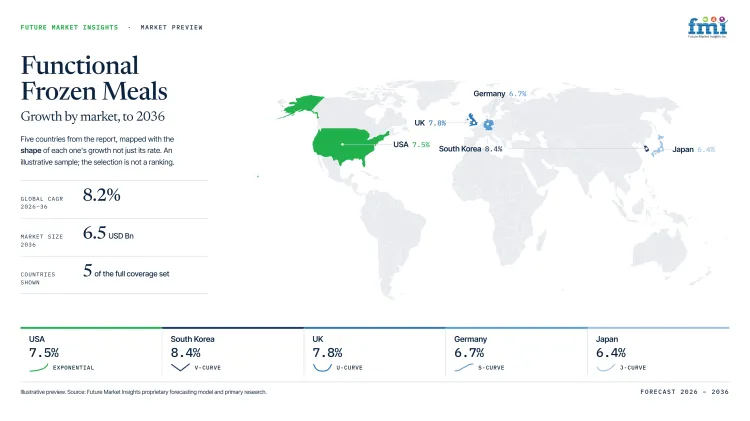
| Country | CAGR |
|---|---|
| South Korea | 8.4% |
| UK | 7.8% |
| USA | 7.5% |
| Germany | 6.7% |
| Japan | 6.4% |
How do country-level CAGRs compare in the Functional Frozen Meals Market?
The five selected country CAGRs span 2.0 percentage points from South Korea at 8.4% to Japan at 6.4% during 2026 to 2036. The spacing reflects different rates of category expansion rather than the absolute revenue available in each country. Retail access, labeling rules, household meal habits and the maturity of nutrition-positioned frozen products can make two similar growth rates commercially very different.
- South Korea sits above the other selected markets as expanded nutrition labeling makes pack-level clarity more consequential for processed foods.
- The UK and USA are separated by 0.3 percentage points, so retailer access and claim architecture can matter more than the small difference in forecast pace.
- Germany remains a meaningful route for products that pair convenience with credible nutrition communication, especially when plant-forward positioning is supported by balanced formulation.
- Japan has the lowest rate within this selected set, yet precise claim language and localized meal formats can still support commercially attractive niches.
Country growth should therefore be read together with route-to-market conditions rather than used as a stand-alone ranking. A supplier can face a lower CAGR and still have a stronger commercial opening because the retailer fit, claim structure or freezer economics are better. Related frozen food demand also differs by product mix and channel maturity across regions, which changes the context in which functional meals are introduced.
Country-wise Analysis
- South Korean functional frozen meal demand is set to expand at 8.4% CAGR through 2036 as nutrition information becomes more standardized across processed-food categories. The Ministry of Food and Drug Safety published 2026 nutrition-labeling changes in February 2025, increasing the importance of clear pack communication. Suppliers need protein, sodium, sugar and serving information that can be compared quickly while still matching local flavor expectations and freezer-shopping habits.
- Demand in the UK is anticipated to grow at 7.8% CAGR through 2036. Advertising restrictions for less healthy food and drink took effect across the UK on January 5, 2026, which makes nutrient composition relevant to promotion as well as product formulation. Suppliers need meals that can support compliant communication while competing on taste, price and preparation convenience in established grocery channels.
- The USA is set to expand at 7.5% CAGR from 2026 to 2036. The FDA’s updated “healthy” claim and the 2025-2030 Dietary Guidelines make nutrition architecture more visible in prepared-food development, while Healthy Choice and Vital Pursuit show how protein and portion cues are entering mainstream frozen portfolios. The commercial test remains repeat purchase at ordinary grocery price points.
- Germany is likely to grow at 6.7% CAGR through 2036. The German Federal Institute for Risk Assessment has highlighted the need for stronger evidence on plant-based dietary patterns through the COPLANT study, a useful reminder that plant-forward positioning is not a substitute for balanced nutrition. Product developers should localize ingredient and nutrient communication instead of relying on a broad wellness message.
- Japan is expected to advance at 6.4% CAGR through 2036. The Consumer Affairs Agency’s framework for Foods with Function Claims keeps evidence and notification discipline central when brands move beyond ordinary nutrition language. Frozen-meal suppliers should treat claim wording as an early product-design decision, then adapt portion size, flavor and preparation format to local meal occasions.
Who are the notable companies in the Functional Frozen Meals Market?
Conagra Brands, Inc. (Healthy Choice), Nestlé, Daily Harvest, Kevin’s Natural Foods, Amy’s Kitchen, Mosaic Foods, Saffron Road, Sweet Earth Foods, The Kraft Heinz Company and Tattooed Chef are notable companies serving functional frozen meal demand.
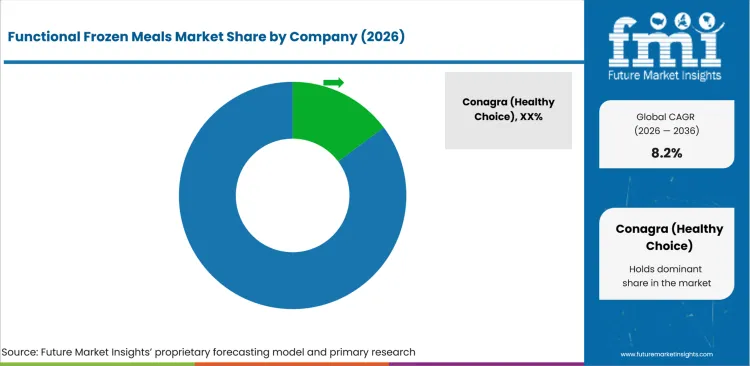
Competition spans established frozen-meal portfolios and specialists built around plant-forward, protein-focused or dietary-specific propositions. Conagra Brands, Nestlé and The Kraft Heinz Company bring broad freezer access and familiar prepared-meal formats. Daily Harvest and Mosaic Foods use direct delivery and plant-forward menus, while Amy’s Kitchen and Sweet Earth Foods serve consumers seeking dietary filters or plant-based options. Kevin’s Natural Foods and Saffron Road make protein and ingredient cues central to the product proposition. Tattooed Chef is active again under Planted Ventures with frozen bowls and other plant-rich formats, so its current role is better understood through the relaunched brand rather than its former public-company structure.
- Conagra Brands, Nestlé and The Kraft Heinz Company compete through established retail distribution and multiple frozen meal formats.
- Daily Harvest, Amy’s Kitchen, Mosaic Foods, Sweet Earth Foods and Tattooed Chef compete through plant-forward recipes, dietary positioning or alternative meal architectures.
- Kevin’s Natural Foods and Saffron Road use protein, ingredient standards and ready-in-minutes convenience to differentiate frozen meals.
Competitive Benchmarking: Functional Frozen Meals Market
| Company | Functional Nutrition Positioning | Frozen Format Depth | Commercial Access | Geographic Reach |
|---|---|---|---|---|
| Conagra Brands, Inc. (Healthy Choice) | High | High | High | United States and Canada |
| Nestlé | High | High | High | United States with wider international food operations |
| Daily Harvest | High | Medium | Medium | United States, primarily direct delivery |
| Kevin’s Natural Foods | High | Medium | High | United States retail and online |
| Amy’s Kitchen | High | High | High | United States retail with selected international distribution |
| Mosaic Foods | High | Medium | Medium | United States, direct delivery |
| Saffron Road | High | Medium | High | United States retail |
| Sweet Earth Foods | High | Medium | Medium | United States retail |
| The Kraft Heinz Company | Medium | High | High | North American retail |
| Tattooed Chef | Medium | High | Medium | United States retail under Planted Ventures |
Key Developments in the Functional Frozen Meals Market
- In February 2026, Saffron Road launched Crossroads, a frozen entree line delivering at least 24 grams of protein per serving, seed-oil-free certification and a nationwide retail rollout beginning in March.
- In June 2025, Conagra Brands introduced more than 50 frozen products spanning single-serve meals, multi-serve meals, vegetable sides and plant-based options, extending innovation across established freezer categories.
- In May 2025, Daily Harvest announced that it was joining the Chobani family while stating that its products, website and customer experience would remain in place, changing the ownership structure behind a plant-forward frozen delivery platform.
Key Players in the Functional Frozen Meals Market
Scaled Retail Nutrition Platforms
- Conagra Brands, Inc. (Healthy Choice)
- Nestlé
- The Kraft Heinz Company
Plant-Forward and Dietary-Specific Specialists
- Daily Harvest
- Amy’s Kitchen
- Mosaic Foods
- Sweet Earth Foods
- Tattooed Chef
Protein-Focused Frozen Meal Brands
- Kevin’s Natural Foods
- Saffron Road
Functional Frozen Meals Market - Report Scope
| Coverage field | Report scope |
|---|---|
| Market breakdown | By Product Type, Function Claim, Protein Base, Packaging, Sales Channel and Region. |
| Quantitative Units | Revenue in USD billion and CAGR in %. |
| Market Definition | Packaged frozen meals positioned around defined functional nutrition claims or measurable nutrition benefits and sold within the listed product, protein, packaging and channel universe. Refrigerated meals, shelf-stable meals, raw frozen ingredients, supplements, meal kits and restaurant meals are outside the market boundary. |
| Regions Covered | North America, Latin America, Western Europe, Eastern Europe, East Asia, South Asia and Pacific, and Middle East and Africa. |
| Countries Covered | USA, UK, Germany, Japan, South Korea, and additional countries included in the full report. |
| Key Companies | Conagra Brands, Inc. (Healthy Choice), Nestlé, Daily Harvest, Kevin’s Natural Foods, Amy’s Kitchen, Mosaic Foods, Saffron Road, Sweet Earth Foods, The Kraft Heinz Company and Tattooed Chef. |
| Forecast Period | 2026 to 2036. |
| Approach | Primary and secondary research with market triangulation. |
Functional Frozen Meals Market - Research Methodology
| Method | Approach |
|---|---|
| Primary Research | FMI analysts gathered input from food manufacturers, retailers, distributors, product developers, nutrition specialists, procurement teams and category-management professionals. Interviews examined purchase criteria, pricing, frozen formats, claim architecture, channel access, formulation friction and repeat-purchase conditions. |
| Desk Research | Desk research covered food-labeling rules, government nutrition guidance, public company filings, technical literature, industry associations, product information and official corporate announcements. Sources were reviewed for relevance, publication date, geographic coverage and consistency with the defined market boundary. |
| Market Sizing and Forecasting | The market model combined baseline value with segment structure, pricing and volume indicators, adoption levels, company participation and country demand conditions. Forecast assumptions considered retail access, nutrition trends, regulatory developments, product innovation and barriers to wider household use. |
| Data Validation | Estimates were checked against independent indicators, company activity, public evidence and findings from primary interviews. Adjacent categories, unsupported claims, overlapping revenue and products outside the defined functional frozen meal boundary were excluded. |
Functional Frozen Meals Market by Segments
Functional Frozen Meals Market segmented by Product Type:
- Frozen Bowls
- Frozen Entrees
- Frozen Breakfasts
- Frozen Sides
- Frozen Desserts
Functional Frozen Meals Market segmented by Function Claim:
- High-Protein
- Gut Health
- Immunity Support
- Plant-Based Nutrition
- Low-Sodium
Functional Frozen Meals Market segmented by Protein Base:
- Poultry
- Plant Protein
- Seafood
- Beef
- Egg & Dairy
Functional Frozen Meals Market segmented by Packaging:
- Trays
- Bowls
- Pouches
- Skillet Bags
- Others
Functional Frozen Meals Market segmented by Sales Channel:
- Supermarkets & Hypermarkets
- Online / DTC
- Convenience Stores
- Specialty & Health Stores
- Others
Functional Frozen Meals Market by Region:
- North America
- United States
- Canada
- Latin America
- Brazil
- Mexico
- Argentina
- Chile
- Rest of Latin America
- Western Europe
- Germany
- France
- United Kingdom
- Italy
- Spain
- Benelux
- Nordics
- Rest of Western Europe
- Eastern Europe
- Poland
- Czech Republic
- Romania
- Hungary
- Rest of Eastern Europe
- East Asia
- China
- Japan
- South Korea
- South Asia and Pacific
- India
- ASEAN
- Australia and New Zealand
- Rest of South Asia and Pacific
- Middle East and Africa
- GCC Countries
- South Africa
- Türkiye
- Israel
- Other African Union Countries
- Rest of Middle East and Africa
Research Sources and Bibliography
- USA Food and Drug Administration. (2024, December 19). FDA Updates “Healthy” Claim, Providing a Refreshed Tool for Consumers.
- USA Department of Agriculture. (2026, January 7). Dietary Guidelines for Americans, 2025-2030: policy release and nutrition priorities.
- Department of Health and Social Care, UK. (2025, June 4). Restricting advertising of less healthy food or drink on TV and online: products in scope.
- European Commission. Nutrition and Health Claims under Regulation (EC) No 1924/2006.
- European Food Safety Authority. Health claims: scientific substantiation and assessment framework.
- Health Canada. Front-of-package nutrition symbol requirements for prepackaged foods.
- Canadian Food Inspection Agency. (2025, November 17). January 1, 2026 deadline for front-of-package nutrition labelling.
- German Federal Institute for Risk Assessment. (2024, April 9). How do vegan and vegetarian diets affect health? COPLANT study launch.
- Consumer Affairs Agency, Japan. (2024, August 30). Manual for notifications related to Foods with Function Claims.
- Ministry of Food and Drug Safety, South Korea. (2025, February 28). Major changes to the 2026 nutrition labeling system.
- Fitch, A. et al. (2025). Application of nutrition interventions with GLP-1 based therapies. Publicly accessible through the USA National Library of Medicine.
- Conagra Brands, Inc. (2024, December 12). Conagra Brands Introduces Badges on Select Healthy Choice Products.
- Conagra Brands, Inc. (2025, June 11). Conagra Brands Introduces More Than 50 New Frozen Foods.
- Nestlé USA. (2024, September 18). Vital Pursuit Hits Shelves Nationwide.
- Daily Harvest. (2025, May). Exciting News from the Daily Harvest Family.
- Saffron Road. (2025, August 14). Saffron Road Reinvents the Frozen Aisle with Protein-Packed, Seed Oil-Free Entrees.
- Saffron Road. (2026, February 27). Saffron Road Ignites the Frozen Aisle with Crossroads.
- Kevin’s Natural Foods. (Accessed 2026, August). Frozen Bowls and product information.
- Amy’s Kitchen. (Accessed 2026, August). Frozen meals and dietary product information.
- Mosaic Foods. (Accessed 2026, August). Frozen meal delivery and plant-forward meal information.
- Tattooed Chef. (Accessed 2026, August). Current frozen bowls, pizzas and plant-rich product portfolio.
This bibliography is provided for reader reference and is not exhaustive. The full report contains the complete reference list and detailed citations.
This Report Answers
- How large is the Functional Frozen Meals Market in 2026 and 2036?
- Which nutrition and convenience conditions support recurring demand for functional frozen meals?
- How do frozen bowls fit the Product Type structure?
- Why is high-protein positioning commercially relevant across frozen meal occasions?
- How does poultry function within the Protein Base category?
- What packaging and retail conditions shape freezer-aisle adoption?
- How do country growth rates affect market-entry timing and claim strategy?
- Which companies serve scaled retail, plant-forward and protein-focused frozen meal demand?
Frequently Asked Questions
How big is the Functional Frozen Meals Market in 2026?
USD 2.9 billion represents the functional frozen meals market value in 2026. Demand is supported by consumers who want convenient meals with visible nutrition cues, while taste, portion satisfaction and price still determine whether first-time trial becomes routine freezer purchase.
What is the CAGR of the Functional Frozen Meals Market from 2026 to 2036?
An 8.2% CAGR is projected for the functional frozen meals market between 2026 and 2036. Growth is tied to nutrition-led product development, mainstream freezer access and clearer claim architecture across protein, plant-forward and portion-oriented meals.
Which Product Type segment is projected to account for 25.3% in 2026?
Frozen Bowls are projected to account for 25.3% of Product Type demand in 2026. The format combines single-portion convenience with enough recipe flexibility to support protein, vegetables and grains or pasta in one reheatable meal.
How much will the Functional Frozen Meals Market add between 2026 and 2036?
About USD 3.5 billion is expected to be added between 2026 and 2036. The increase depends on sustained household acceptance, broad freezer access and products that convert a clear nutrition proposition into repeat purchase.
Which companies are active in the Functional Frozen Meals Market?
Companies active across the category include Conagra Brands, Inc. through Healthy Choice, Nestlé, Daily Harvest, Kevin’s Natural Foods, Amy’s Kitchen, Mosaic Foods, Saffron Road, Sweet Earth Foods, The Kraft Heinz Company and Tattooed Chef. Their roles differ by retail reach, nutrition proposition and meal format.
Preview the report firsthand - request a free sample
Get SampleGet the brochure for pricing and purchase details.
Get PDFTable of Content
- Key Takeaways
- Market Size and CAGR
- Top Growth Driver
- Fastest Growing Segment
- Leading Region
- Key Companies
- Emerging Opportunities
- Executive Summary
- Global Market Outlook
- Demand-side Trends
- Supply-side Trends
- Technology Roadmap Analysis
- Analysis and Recommendations
- Analyst Perspective (What is happening? Why now? What should investors know?)
- Key Questions Answered
- How large is the market?
- What is the CAGR?
- What are key trends?
- Which region dominates?
- Who are the leaders?
- Market Overview
- Market Coverage / Taxonomy
- Market Definition / Scope / Limitations
- Research Methodology
- Chapter Orientation
- Analytical Lens and Working Hypotheses
- Market Structure, Signals, and Trend Drivers
- Benchmarking and Cross-market Comparability
- Market Sizing, Forecasting, and Opportunity Mapping
- Research Design and Evidence Framework
- Desk Research Programme (Secondary Evidence)
- Expert Input and Fieldwork (Primary Evidence)
- Tooling, Models, and Reference Databases
- Data Engineering and Model Build
- Quality Assurance and Audit Trail
- Market Background
- Market Dynamics (Drivers, Restraints, Opportunity, Trends)
- Scenario Forecast (Optimistic, Likely, Conservative)
- Impact Analysis
- AI Impact
- Sustainability Impact
- Regulatory Impact
- Technology Impact
- Consumer / Buyer Analysis
- Purchase Drivers
- Adoption Barriers
- Buyer Journey
- Opportunity Map Analysis
- Product Life Cycle Analysis
- Supply Chain Analysis
- Investment Feasibility Matrix
- Value Chain Analysis
- PESTLE and Porter's Analysis
- Regulatory Landscape
- Regional Parent Market Outlook
- Production and Consumption Statistics
- Import and Export Statistics
- Global Market Analysis and Forecast, 2021 to 2036
- Historical Market Size Value (USD Billion) Analysis, 2021 to 2025
- Current and Future Market Size Value (USD Billion) Projections, 2026 to 2036
- Y-o-Y Growth Trend Analysis
- Absolute $ Opportunity Analysis
- Global Market Pricing Analysis, 2021 to 2036
- Global Market Analysis and Forecast, By Product Type, 2021 to 2036
- Introduction / Key Findings
- Historical Market Size Value (USD Billion) Analysis By Product Type, 2021 to 2025
- Current and Future Market Size Value (USD Billion) Analysis and Forecast By Product Type, 2026 to 2036
- Frozen Bowls
- Frozen Entrees
- Frozen Breakfasts
- Frozen Sides
- Frozen Desserts
- Frozen Bowls
- Y-o-Y Growth Trend Analysis By Product Type, 2021 to 2025
- Absolute $ Opportunity Analysis By Product Type, 2026 to 2036
- Global Market Analysis and Forecast, By Function Claim, 2021 to 2036
- Introduction / Key Findings
- Historical Market Size Value (USD Billion) Analysis By Function Claim, 2021 to 2025
- Current and Future Market Size Value (USD Billion) Analysis and Forecast By Function Claim, 2026 to 2036
- High-Protein
- Gut Health
- Immunity Support
- Plant-Based Nutrition
- Low-Sodium
- High-Protein
- Y-o-Y Growth Trend Analysis By Function Claim, 2021 to 2025
- Absolute $ Opportunity Analysis By Function Claim, 2026 to 2036
- Global Market Analysis and Forecast, By Protein Base, 2021 to 2036
- Introduction / Key Findings
- Historical Market Size Value (USD Billion) Analysis By Protein Base, 2021 to 2025
- Current and Future Market Size Value (USD Billion) Analysis and Forecast By Protein Base, 2026 to 2036
- Poultry
- Plant Protein
- Seafood
- Beef
- Egg & Dairy
- Poultry
- Y-o-Y Growth Trend Analysis By Protein Base, 2021 to 2025
- Absolute $ Opportunity Analysis By Protein Base, 2026 to 2036
- Global Market Analysis and Forecast, By Packaging, 2021 to 2036
- Introduction / Key Findings
- Historical Market Size Value (USD Billion) Analysis By Packaging, 2021 to 2025
- Current and Future Market Size Value (USD Billion) Analysis and Forecast By Packaging, 2026 to 2036
- Trays
- Bowls
- Pouches
- Skillet Bags
- Others
- Trays
- Y-o-Y Growth Trend Analysis By Packaging, 2021 to 2025
- Absolute $ Opportunity Analysis By Packaging, 2026 to 2036
- Global Market Analysis and Forecast, By Sales Channel, 2021 to 2036
- Introduction / Key Findings
- Historical Market Size Value (USD Billion) Analysis By Sales Channel, 2021 to 2025
- Current and Future Market Size Value (USD Billion) Analysis and Forecast By Sales Channel, 2026 to 2036
- Supermarkets & Hypermarkets
- Online / DTC
- Convenience Stores
- Specialty & Health Stores
- Others
- Supermarkets & Hypermarkets
- Y-o-Y Growth Trend Analysis By Sales Channel, 2021 to 2025
- Absolute $ Opportunity Analysis By Sales Channel, 2026 to 2036
- Global Market Analysis and Forecast, By Region, 2021 to 2036
- Introduction
- Historical Market Size Value (USD Billion) Analysis By Region, 2021 to 2025
- Current Market Size Value (USD Billion) Analysis and Forecast By Region, 2026 to 2036
- North America
- Latin America
- Western Europe
- Eastern Europe
- East Asia
- South Asia and Pacific
- Middle East & Africa
- Market Attractiveness Analysis By Region
- North America Market Analysis and Forecast, By Country, 2021 to 2036
- Historical Market Size Value (USD Billion) Trend Analysis By Market Taxonomy, 2021 to 2025
- Market Size Value (USD Billion) Forecast By Market Taxonomy, 2026 to 2036
- By Country
- USA
- Canada
- By Product Type
- By Function Claim
- By Protein Base
- By Packaging
- By Sales Channel
- By Country
- Market Attractiveness Analysis
- By Country
- By Product Type
- By Function Claim
- By Protein Base
- By Packaging
- By Sales Channel
- Key Takeaways
- Latin America Market Analysis and Forecast, By Country
- Historical Market Size Value (USD Billion) Trend Analysis By Market Taxonomy, 2021 to 2025
- Market Size Value (USD Billion) Forecast By Market Taxonomy, 2026 to 2036
- By Country
- Brazil
- Mexico
- Chile
- Rest of Latin America
- By Product Type
- By Function Claim
- By Protein Base
- By Packaging
- By Sales Channel
- By Country
- Market Attractiveness Analysis
- By Country
- By Product Type
- By Function Claim
- By Protein Base
- By Packaging
- By Sales Channel
- Key Takeaways
- Western Europe Market Analysis and Forecast, By Country
- Historical Market Size Value (USD Billion) Trend Analysis By Market Taxonomy, 2021 to 2025
- Market Size Value (USD Billion) Forecast By Market Taxonomy, 2026 to 2036
- By Country
- Germany
- UK
- Italy
- Spain
- France
- Nordic
- BENELUX
- Rest of Western Europe
- By Product Type
- By Function Claim
- By Protein Base
- By Packaging
- By Sales Channel
- By Country
- Market Attractiveness Analysis
- By Country
- By Product Type
- By Function Claim
- By Protein Base
- By Packaging
- By Sales Channel
- Key Takeaways
- Eastern Europe Market Analysis and Forecast, By Country
- Historical Market Size Value (USD Billion) Trend Analysis By Market Taxonomy, 2021 to 2025
- Market Size Value (USD Billion) Forecast By Market Taxonomy, 2026 to 2036
- By Country
- Russia
- Poland
- Hungary
- Balkan & Baltic
- Rest of Eastern Europe
- By Product Type
- By Function Claim
- By Protein Base
- By Packaging
- By Sales Channel
- By Country
- Market Attractiveness Analysis
- By Country
- By Product Type
- By Function Claim
- By Protein Base
- By Packaging
- By Sales Channel
- Key Takeaways
- East Asia Market Analysis and Forecast, By Country
- Historical Market Size Value (USD Billion) Trend Analysis By Market Taxonomy, 2021 to 2025
- Market Size Value (USD Billion) Forecast By Market Taxonomy, 2026 to 2036
- By Country
- China
- Japan
- South Korea
- By Product Type
- By Function Claim
- By Protein Base
- By Packaging
- By Sales Channel
- By Country
- Market Attractiveness Analysis
- By Country
- By Product Type
- By Function Claim
- By Protein Base
- By Packaging
- By Sales Channel
- Key Takeaways
- South Asia and Pacific Market Analysis and Forecast, By Country
- Historical Market Size Value (USD Billion) Trend Analysis By Market Taxonomy, 2021 to 2025
- Market Size Value (USD Billion) Forecast By Market Taxonomy, 2026 to 2036
- By Country
- India
- ASEAN
- Australia & New Zealand
- Rest of South Asia and Pacific
- By Product Type
- By Function Claim
- By Protein Base
- By Packaging
- By Sales Channel
- By Country
- Market Attractiveness Analysis
- By Country
- By Product Type
- By Function Claim
- By Protein Base
- By Packaging
- By Sales Channel
- Key Takeaways
- Middle East & Africa Market Analysis and Forecast, By Country
- Historical Market Size Value (USD Billion) Trend Analysis By Market Taxonomy, 2021 to 2025
- Market Size Value (USD Billion) Forecast By Market Taxonomy, 2026 to 2036
- By Country
- Kingdom of Saudi Arabia
- Other GCC Countries
- Türkiye
- South Africa
- Other African Union
- Rest of Middle East & Africa
- By Product Type
- By Function Claim
- By Protein Base
- By Packaging
- By Sales Channel
- By Country
- Market Attractiveness Analysis
- By Country
- By Product Type
- By Function Claim
- By Protein Base
- By Packaging
- By Sales Channel
- Key Takeaways
- Key Countries Market Analysis
- USA
- Pricing Analysis
- Market Share Analysis, 2025
- By Product Type
- By Function Claim
- By Protein Base
- By Packaging
- By Sales Channel
- Canada
- Pricing Analysis
- Market Share Analysis, 2025
- By Product Type
- By Function Claim
- By Protein Base
- By Packaging
- By Sales Channel
- Mexico
- Pricing Analysis
- Market Share Analysis, 2025
- By Product Type
- By Function Claim
- By Protein Base
- By Packaging
- By Sales Channel
- Brazil
- Pricing Analysis
- Market Share Analysis, 2025
- By Product Type
- By Function Claim
- By Protein Base
- By Packaging
- By Sales Channel
- Chile
- Pricing Analysis
- Market Share Analysis, 2025
- By Product Type
- By Function Claim
- By Protein Base
- By Packaging
- By Sales Channel
- Germany
- Pricing Analysis
- Market Share Analysis, 2025
- By Product Type
- By Function Claim
- By Protein Base
- By Packaging
- By Sales Channel
- UK
- Pricing Analysis
- Market Share Analysis, 2025
- By Product Type
- By Function Claim
- By Protein Base
- By Packaging
- By Sales Channel
- Italy
- Pricing Analysis
- Market Share Analysis, 2025
- By Product Type
- By Function Claim
- By Protein Base
- By Packaging
- By Sales Channel
- Spain
- Pricing Analysis
- Market Share Analysis, 2025
- By Product Type
- By Function Claim
- By Protein Base
- By Packaging
- By Sales Channel
- France
- Pricing Analysis
- Market Share Analysis, 2025
- By Product Type
- By Function Claim
- By Protein Base
- By Packaging
- By Sales Channel
- India
- Pricing Analysis
- Market Share Analysis, 2025
- By Product Type
- By Function Claim
- By Protein Base
- By Packaging
- By Sales Channel
- ASEAN
- Pricing Analysis
- Market Share Analysis, 2025
- By Product Type
- By Function Claim
- By Protein Base
- By Packaging
- By Sales Channel
- Australia & New Zealand
- Pricing Analysis
- Market Share Analysis, 2025
- By Product Type
- By Function Claim
- By Protein Base
- By Packaging
- By Sales Channel
- China
- Pricing Analysis
- Market Share Analysis, 2025
- By Product Type
- By Function Claim
- By Protein Base
- By Packaging
- By Sales Channel
- Japan
- Pricing Analysis
- Market Share Analysis, 2025
- By Product Type
- By Function Claim
- By Protein Base
- By Packaging
- By Sales Channel
- South Korea
- Pricing Analysis
- Market Share Analysis, 2025
- By Product Type
- By Function Claim
- By Protein Base
- By Packaging
- By Sales Channel
- Russia
- Pricing Analysis
- Market Share Analysis, 2025
- By Product Type
- By Function Claim
- By Protein Base
- By Packaging
- By Sales Channel
- Poland
- Pricing Analysis
- Market Share Analysis, 2025
- By Product Type
- By Function Claim
- By Protein Base
- By Packaging
- By Sales Channel
- Hungary
- Pricing Analysis
- Market Share Analysis, 2025
- By Product Type
- By Function Claim
- By Protein Base
- By Packaging
- By Sales Channel
- Kingdom of Saudi Arabia
- Pricing Analysis
- Market Share Analysis, 2025
- By Product Type
- By Function Claim
- By Protein Base
- By Packaging
- By Sales Channel
- Türkiye
- Pricing Analysis
- Market Share Analysis, 2025
- By Product Type
- By Function Claim
- By Protein Base
- By Packaging
- By Sales Channel
- South Africa
- Pricing Analysis
- Market Share Analysis, 2025
- By Product Type
- By Function Claim
- By Protein Base
- By Packaging
- By Sales Channel
- USA
- Market Structure Analysis
- Competition Dashboard
- Competition Benchmarking
- Market Share Analysis of Top Players
- By Regional
- By Product Type
- By Function Claim
- By Protein Base
- By Packaging
- By Sales Channel
- Emerging Startups
- Innovation Benchmarking
- Competition Analysis
- Competition Deep Dive
- Conagra (Healthy Choice)
- Overview
- Product Portfolio
- Profitability by Market Segments
- Sales Footprint
- Strategy Overview
- Marketing Strategy
- Product Strategy
- Channel Strategy
- Nestle
- Daily Harvest
- Kevin's Natural Foods
- Amy's Kitchen
- Mosaic Foods
- Saffron Road
- Sweet Earth (Nestle)
- Kraft Heinz
- Tattooed Chef
- Conagra (Healthy Choice)
- Case Studies
- Success Stories
- Recent Developments
- Competition Deep Dive
- Assumptions & Acronyms Used


