

- Market Size (2026)
- USD 202.0 Mn
- Forecast (2036)
- USD 401.1 Mn
- CAGR (2026 to 2036)
- 7.1%
How big is the glass bottle fill-level vision inspection market in 2026?
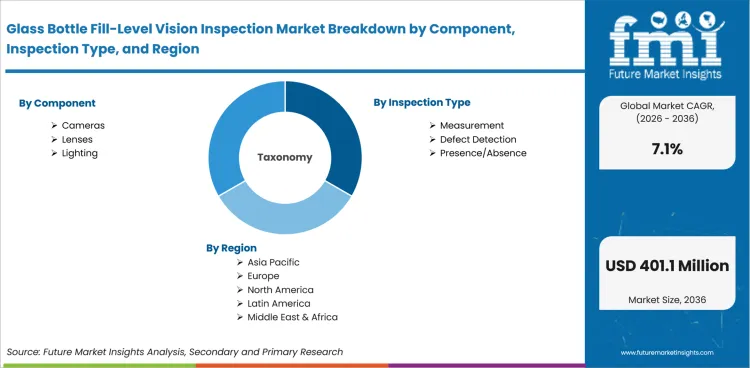
USD 202.0 million in 2026 and USD 401.1 million by 2036 at a 7.1% CAGR.
The glass bottle fill-level vision inspection industry value is forecast to grow from USD 188.6 million in 2025 to USD 401.1 million by 2036 at 7.1% CAGR. Cameras are forecast to represent 31.4% share in 2026 because stable image capture is required before software can separate true liquid level from foam and glass reflections. Measurement is expected to hold 46.2% share in 2026 as underfill and overfill checks remain the main buying trigger.B
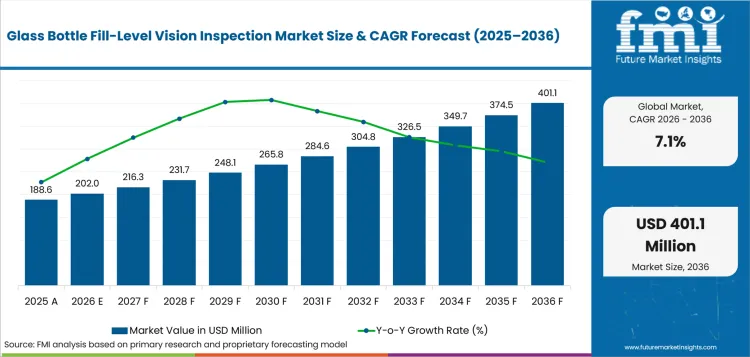
Glass Bottle Fill-Level Vision Inspection Market Overview: Size and Forecast
- 2025 Market Size: USD 188.6 million
- 2026 Market Size: USD 202.0 million
- 2036 Market Size: USD 401.1 million
- Forecast CAGR: 7.1% from 2026 to 2036
- Leading Component: Cameras
- Cameras Share in 2026: 31.4%
- Leading Inspection Type: Measurement
- Measurement Share in 2026: 46.2%
- Leading Deployment: Inline
- Inline Share in 2026: 78.0%
- Fastest-growing Country: India
- India CAGR: 8.3% by 2036
Summary of the Glass Bottle Fill-Level Vision Inspection Market
- Demand and Growth Drivers
- Fill accuracy programs support the 7.1% CAGR because overfill waste and underfill claims both affect bottler margins.
- Measurement is expected to represent 46.2% of inspection demand in 2026 with fill-height tolerance as the core buying trigger.
- Food and beverage applications are forecast to account for 67.5% of end-use demand in 2026 through beer and premium drinks.
- Product and Segment View
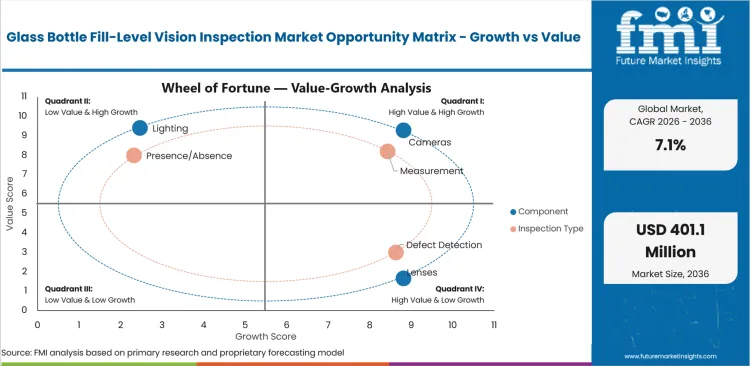
- Cameras are projected to lead the component segment with 31.4% share in 2026 because glass glare needs stable imaging.
- Measurement is forecast to lead the inspection type segment with 46.2% share in 2026 as fill height remains the main control point.
- Inline systems are estimated to lead deployment with 78.0% share in 2026 because reject decisions must happen before cartons.
- Geography and Competitive Outlook
- India is projected to record 8.3% CAGR by 2036 as beverage capacity and food processing projects support inspection upgrades.
- China is expected to expand at 8.0% CAGR by 2036 through beverage output scale and local automation supply.
- Cognex and KEYENCE compete with Krones, Antares Vision Group and HEUFT on inspection accuracy and line service.
- Analyst Opinion
- Nikhil Kaitwade, Principal Consultant at Future Market Insights for the industrial domain, observes that “Glass bottle fill-level inspection is moving from a reject checkpoint to a filling-performance control tool. Buyers should judge systems by false reject rate and recipe stability rather than camera price alone.”
everage filling is the main pressure point as plants shift fill checks from manual sampling toward inline rejection and batch records. Cognex launched the In-Sight L38 3D vision system in April 2024 for AI-enabled inspection and measurement. Krones introduced AI-based fill level control for Dynafill in April 2024. These developments show that suppliers are linking fill-level inspection with process control rather than late-stage rejection alone.
The glass bottle fill-level vision inspection market is expected to expand as beverage, pharmaceutical and packaging plants use vision systems to control fill height on reflective glass containers. Buyers are prioritizing false-reject control, recipe handling and service support over camera price alone.
Which factors support expansion in the glass bottle fill-level vision inspection market?
Inline inspection revenue is supported by camera packages and lighting. Software, reject controls and service programs keep lines stable across bottle formats.
- Market value is supported by complete inspection stations rather than cameras sold alone.
- Supplier pricing reflects lighting design, foam compensation and software recipe control before service revenue adds value.
- Revenue improves as bottlers convert manual sampling into inline checks on high-volume filling lines.
- Retail trust rises when plants can document which bottles were rejected and why the reject happened.
Why is the glass bottle fill-level vision inspection market growing?
Beverage plants need inline fill-height control as overfill wastes product and underfill creates retailer claims. Glass packaging increases inspection difficulty because reflections, tint and embossing can distort camera readings. The analysis links naturally with glass container demand because fill-level inspection demand follows filled glass container throughput.
Beverage packaging investments support inline quality inspection across filling and capping operations. Glass bottle and container production is linked with fill-level inspection demand in premium drinks. Foam compensation is becoming a buying filter as beer and sparkling drink lines need reliable liquid-level detection. Krones launched AI-based fill-level control for Dynafill in April 2024. Antares Vision Group introduced EB-EYE inspection upgrades in August 2025 for higher-resolution quality control on beverage packaging lines.
How is the glass bottle fill-level vision inspection market segmented?
The industry is segmented by component and inspection type. It is also segmented by deployment, end-use industry and region.
- Cameras are projected to secure 31.4% share in 2026 because stable imaging is required before software can detect true liquid height.
- Measurement is expected to hold 46.2% share in 2026 since fill-height tolerance remains the main control point.
- Inline deployment is forecast to represent 78.0% share in 2026 because reject timing must match conveyor speed.
- Food and beverage is anticipated to account for 67.5% share in 2026 through beer and premium water lines.
- Europe is estimated to hold 30.8% share in 2026 because equipment suppliers and beverage plants are closely clustered.
Why do cameras dominate the glass bottle fill-level vision inspection market?
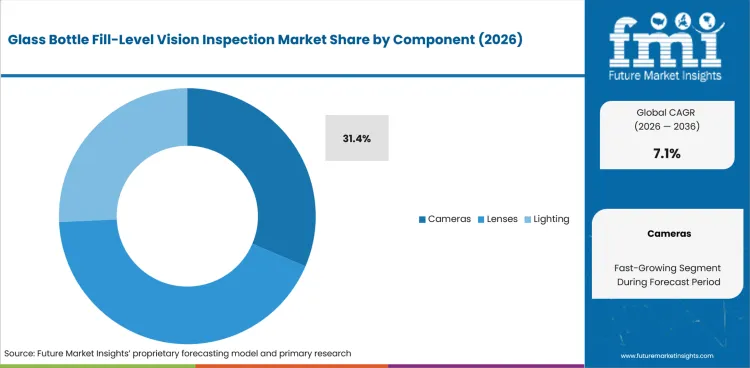
- Cameras are projected to account for 31.4% share in 2026 due to the need to stabilize images across amber, green and clear glass.
- Lighting and lens fit gain value because glass shoulders can reflect light into the inspected fill band.
Which inspection type leads the glass bottle fill-level vision inspection market?
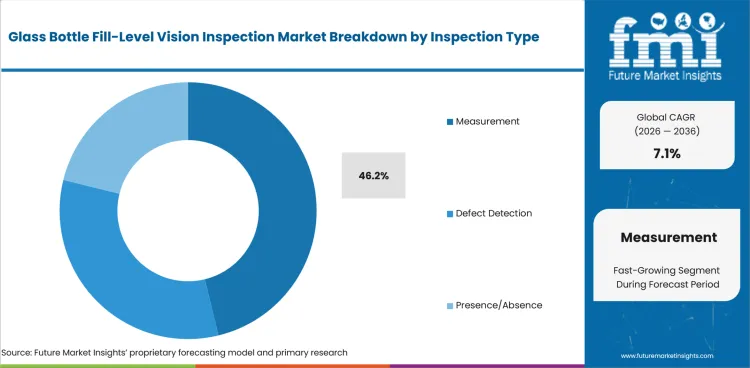
- Measurement is expected to account for 46.2% share in 2026 through fill-height tolerance checks on bottles moving at line speed.
- OCR and presence checks gain added use when bottlers bundle lot code, cap and label inspection into one station.
Which deployment type leads the glass bottle fill-level vision inspection market?
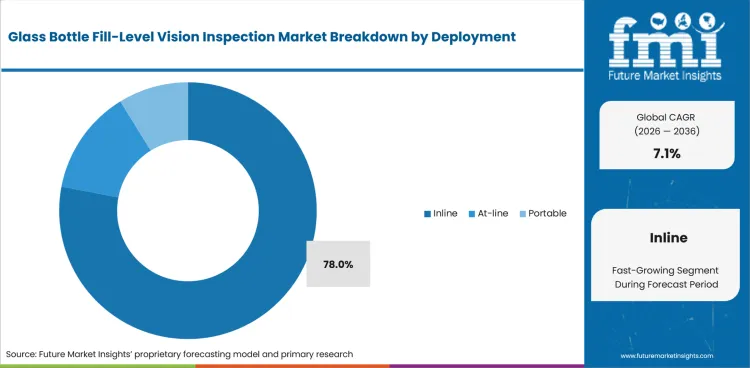
- Inline systems are projected to represent 78.0% share in 2026 because bottlers need rejection before cartons and secondary packaging.
- At-line and portable systems remain useful for trials, audits and lower-speed packaging rooms.
Which end-use industry leads the glass bottle fill-level vision inspection market?
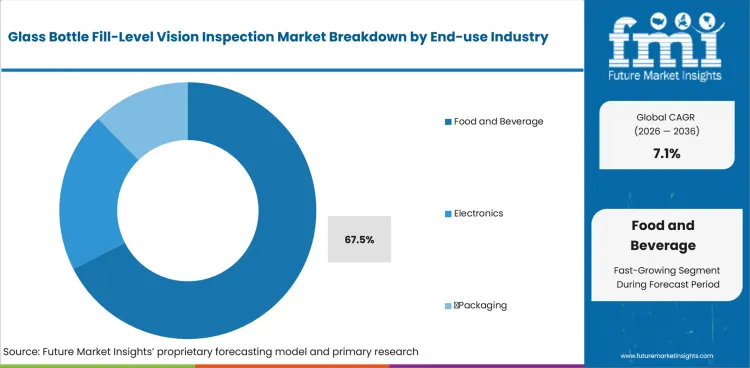
- Food and beverage is forecast to account for 67.5% share in 2026 due to beer and premium drink lines.
- Pharmaceutical use gains value where filled glass containers need clean documentation and controlled rejection.
Which region leads the glass bottle fill-level vision inspection market?
- Europe is expected to hold 30.8% share in 2026 because beverage filling, glass packaging and inspection equipment supply are clustered.
- East Asia records faster upgrades where beverage output and factory automation spending support newer filling lines.
What are the drivers, restraints and opportunities in the glass bottle fill-level vision inspection market?
Fill giveaway control and batch records support growth while glass glare and setup risk limit faster replacement cycles.
- Driver: Overfill reduction supports inspection investment because product giveaway converts directly into avoidable loss on high-volume lines.
- Driver: Foam-sensitive beverages create demand for high-frequency and software-assisted inspection packages.
- Restraint: Glass glare raises false reject risk when lighting design fails during bottle format changes.
- Opportunity: Filler-integrated inspection can reduce finished goods waste by correcting fill performance earlier.
- Opportunity: Software recipe libraries can support faster changeovers across premium bottle shapes and liquid colors.
Glass Bottle Fill-Level Vision Inspection Market Demand Outlook
Demand is moving toward stations that combine liquid-level measurement with reject control and batch evidence. Plants increasingly need proof that every bottle was checked before secondary packaging hides the individual container.
Consumer Segmentation and Purchase Behavior Analysis
Beverage plants, pharmaceutical fillers and packaging converters form the main buyer base for glass bottle fill-level vision inspection. High-speed beverage plants usually start with inline systems because late rejection raises waste after cartons and labels are applied.
Voice of Customer and Decision-driver Analysis
Purchase decisions are shaped by false reject rate and recipe handling. Local service support and filler compatibility also influence awards on high-speed lines.
Which countries are growing fastest in the glass bottle fill-level vision inspection market?
India leads with 8.3% CAGR through 2036. China follows at 8.0% CAGR and South Korea records 7.4% CAGR. Germany reaches 6.9% CAGR while the United States records 6.8% CAGR. France reaches 6.7% CAGR and Japan reaches 6.5% CAGR. The United Kingdom records 6.4% CAGR through 2036.
.webp "Top Country Growth Comparison Glass Bottle Fill Level Vision Inspection Market Cagr (2026 2036)")
| Country | CAGR |
| United States | 6.8% |
| United Kingdom | 6.4% |
| Germany | 6.9% |
| France | 6.7% |
| Japan | 6.5% |
| China | 8.0% |
| South Korea | 7.4% |
| India | 8.3% |
Source: Future Market Insights, 2026.
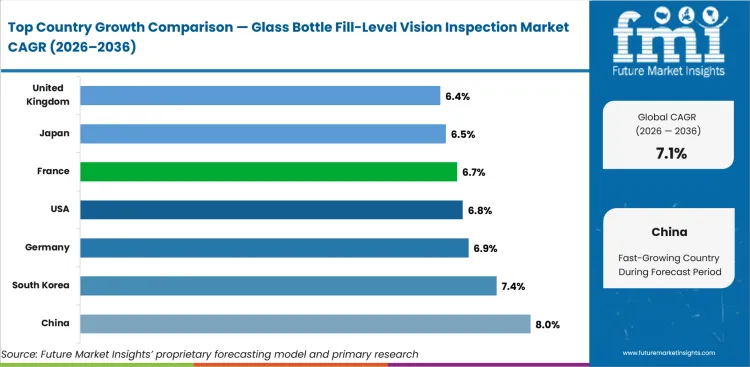
How do country-level CAGRs compare in the glass bottle fill-level vision inspection market?
India leads country growth while the United Kingdom records the most cautious expansion outlook among profiled markets.
- United States is anticipated to witness a 6.8% CAGR by 2036, driven by expanding beverage production infrastructure and increasing adoption of automated inspection technologies.
- United Kingdom is projected to grow at a 6.4% CAGR through 2036, supported by stringent quality control requirements in glass bottle manufacturing and filling operations.
- Germany is expected to register a 6.9% CAGR by 2036, fueled by strong beverage processing capacity and a high level of factory automation adoption.
- France is forecast to achieve a 6.7% CAGR through 2036, aided by modernization initiatives across beverage bottling lines and manufacturing facilities.
- Japan is anticipated to expand at a 6.5% CAGR by 2036, owing to continued emphasis on product quality assurance and precision inspection in glass bottling applications.
- China is expected to record an 8.0% CAGR through 2036, supported by rapid growth in beverage production and increasing investments in automated quality inspection systems.
- South Korea is projected to grow at a 7.4% CAGR by 2036, driven by developments in beverage packaging operations and readily available technical service capabilities.
How fast is the glass bottle fill-level vision inspection market growing in the United States?
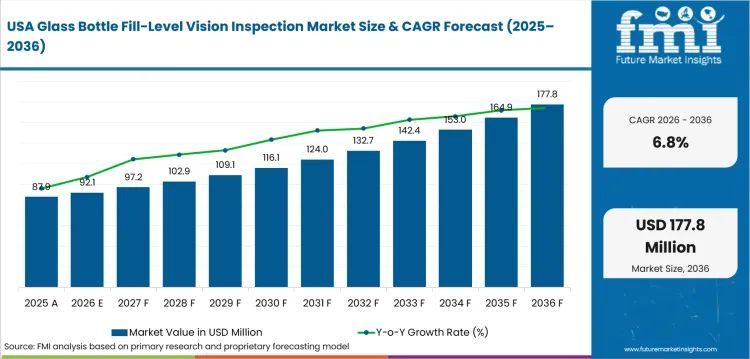
A 6.8% CAGR through 2036 reflects beverage line automation and multi-format glass bottle inspection demand.
Country Market Snapshot Table
| Parameter | Value |
| Market Size in 2025 (Value) | USD 33.3 million |
| Market Size in 2026 (Value) | USD 35.6 million |
| Market Forecast in 2036 (Value) | USD 68.7 million |
| CAGR (2026 to 2036) | 6.8% |
| Years Considered | 2021 to 2036 |
| Base Year | 2025 |
| Forecast Period | 2026 to 2036 |
| Units Considered | Value (USD million) |
| Leading Sub-Region | Midwest and coastal beverage bottling corridors |
United States Glass Bottle Fill-Level Vision Inspection Market Outlook
- United States demand is shaped by beverage filling density and the shift from manual checks toward inline inspection. Plants are expected to favor systems that combine camera stability with simple recipe control.
- Supplier selection is expected to depend on proof against foam, glass glare and false rejects during real production trials. Local service coverage is expected to matter because commissioning quality decides whether inspection runs at rated speed.
Key Growth Drivers
- Food and beverage plants support inspection upgrades because NIST ranked food, beverage and tobacco as the second largest USA manufacturing subsector in October 2024.
- High line utilization supports inline reject control because the Census Bureau reported 77.7% full production capacity use in Q2 2025.
- National brewers and spirits bottlers need repeatable inspection recipes across amber glass, clear glass and embossed containers.
- Domestic vision suppliers shorten trials for plants that need proof on foam bands and neck reflections before wider rollout.
Key Restraints
- Capex approval remains cautious because the Federal Reserve reported manufacturing utilization at 75.7% in May 2026.
- Multi-site validation cycles can delay awards when every filler block needs reject timing and recipe testing.
- Legacy checkweighers can slow camera upgrades where plants already trust weight-based underfill control.
What makes United States unique
The United States is unique due to high automation expectations and strict giveaway control across multi-format glass bottle lines.
Key Companies
- Cognex Corporation
- FILTEC
- Mettler-Toledo Product Inspection
- Krones Inc.
- HEUFT USA
- SICK Inc.
- Teledyne DALSA
Sales & Marketing Channels
- Direct OEM sales
- System integrators
- Beverage equipment distributors
- Filler retrofit partners
- Plant maintenance programs
Country Segment Breakdown Table
| Segment | Sub-Segments |
| By Component | Cameras · Lenses · Lighting · Frame Grabbers · Vision Software · Services |
| By Inspection Type | Defect Detection · Measurement · OCR/OCV · Presence/Absence · Guidance |
| By Deployment | Inline · At-line · Robotic Cell · Portable |
| By End-use Industry | Electronics · Automotive · Packaging · Pharmaceuticals · Food & Beverage · Metals |
| By Region | North America · Latin America · Europe · East Asia · South Asia and Pacific · Middle East and Africa |
| Key Sub-Regions Covered, Manufacturing and automation corridors | California · Texas · Pennsylvania · Illinois · Wisconsin · New York |
Frequently Asked Questions
How fast is United States glass bottle fill-level vision inspection market growing?
United States is forecast to expand at 6.8% through 2036 based on beverage line automation and inspection demand.
Who leads United States glass bottle fill-level vision inspection market?
Cognex Corporation and FILTEC compete with Mettler-Toledo Product Inspection and Krones Inc. through inspection systems and line integration.
What is driving adoption in United States glass bottle fill-level vision inspection market?
Beverage line automation and false-reject control are moving buyers toward validated inline fill-level inspection.
How is the glass bottle fill-level vision inspection market performing in the United Kingdom?
A 6.4% CAGR through 2036 reflects premium beverage bottling and compact inspection demand.
Country Market Snapshot Table
| Parameter | Value |
| Market Size in 2025 (Value) | USD 8.1 million |
| Market Size in 2026 (Value) | USD 8.6 million |
| Market Forecast in 2036 (Value) | USD 16.0 million |
| CAGR (2026 to 2036) | 6.4% |
| Years Considered | 2021 to 2036 |
| Base Year | 2025 |
| Forecast Period | 2026 to 2036 |
| Units Considered | Value (USD million) |
| Leading Sub-Region | England distillery and contract packing corridors |
United Kingdom Glass Bottle Fill-Level Vision Inspection Market Outlook
- United Kingdom demand is shaped by spirits, wine and contract bottling lines that require compact inspection stations. Buyers are expected to prioritize fill accuracy where premium glass packs carry higher retail risk.
- Contract packers need systems that can move between bottle heights and label positions without repeated commissioning delays. Local service support should influence awards when shutdown windows are narrow.
Key Growth Drivers
- Glass packaging fees support waste control because DEFRA set the 2025 to 2026 EPR rate for glass at GBP 192 per tonne.
- Wine bottling creates inspection demand because the Food Standards Agency reported 124,377 hectolitres of UK wine production in 2025.
- Distillers require fill checks that protect premium bottle presentation during small-batch and seasonal packaging runs.
- Contract packers need flexible recipes because clients switch bottle height, closure style and label placement frequently.
Key Restraints
- Investment timing can slow because HMRC reported alcohol duty receipts of GBP 12,435 million for fiscal 2025 to 2026.
- Small bottlers can delay inline vision when manual sampling still meets internal release procedures.
- Imported machine lead times can limit faster replacement of older inspection heads in regional plants.
What makes United Kingdom unique
The United Kingdom is unique due to premium spirits and contract packing demand for compact inspection cells with frequent changeovers.
Key Companies
- Krones UK
- SICK UK
- Cognex UK
- Mettler-Toledo UK
- Antares Vision Group UK
- BW Integrated Systems UK
Sales & Marketing Channels
- OEM sales teams
- Contract packer channels
- Distillery engineering partners
- Packaging machinery distributors
- Service-led retrofit routes
Country Segment Breakdown Table
| Segment | Sub-Segments |
| By Component | Cameras · Lenses · Lighting · Frame Grabbers · Vision Software · Services |
| By Inspection Type | Defect Detection · Measurement · OCR/OCV · Presence/Absence · Guidance |
| By Deployment | Inline · At-line · Robotic Cell · Portable |
| By End-use Industry | Electronics · Automotive · Packaging · Pharmaceuticals · Food & Beverage · Metals |
| By Region | North America · Latin America · Europe · East Asia · South Asia and Pacific · Middle East and Africa |
| Key Sub-Regions Covered, Manufacturing and automation corridors | England · Scotland · Wales · Northern Ireland · London and South East · Midlands |
Frequently Asked Questions
How fast is United Kingdom glass bottle fill-level vision inspection market growing?
United Kingdom is forecast to expand at 6.4% through 2036 based on beverage line automation and inspection demand.
Who leads United Kingdom glass bottle fill-level vision inspection market?
Krones UK and SICK UK compete with Cognex UK and Mettler-Toledo UK through packaging line access and inspection service coverage.
What is driving adoption in United Kingdom glass bottle fill-level vision inspection market?
Premium beverage bottling and contract packing are moving buyers toward compact inline inspection with rapid format changes.
How fast is the glass bottle fill-level vision inspection market growing in Germany?
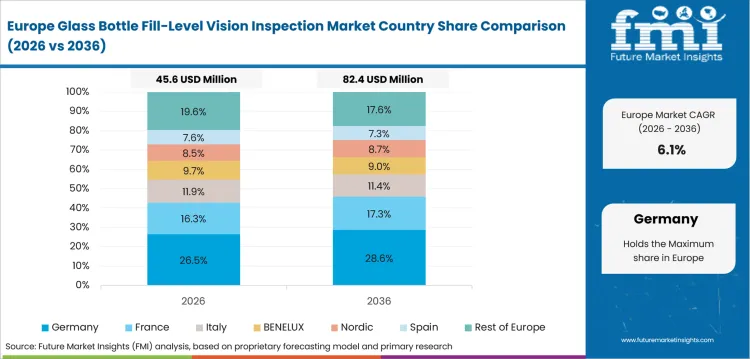
A 6.9% CAGR through 2036 reflects beer bottling scale and domestic inspection equipment strength.
Country Market Snapshot Table
| Parameter | Value |
| Market Size in 2025 (Value) | USD 16.0 million |
| Market Size in 2026 (Value) | USD 17.1 million |
| Market Forecast in 2036 (Value) | USD 33.3 million |
| CAGR (2026 to 2036) | 6.9% |
| Years Considered | 2021 to 2036 |
| Base Year | 2025 |
| Forecast Period | 2026 to 2036 |
| Units Considered | Value (USD million) |
| Leading Sub-Region | Bavaria and North Rhine-Westphalia beverage equipment corridors |
Germany Glass Bottle Fill-Level Vision Inspection Market Outlook
- Germany demand is shaped by beer filling scale and domestic equipment supply. Refillable glass bottle pools make inspection harder because scuffed bottles and embossing can disturb simple thresholds.
- Beverage plants are expected to test camera, high-frequency and infrared routes before purchase. Suppliers with nearby service teams should gain from shorter trial cycles and faster fault correction.
Key Growth Drivers
- Beer bottling scale supports inspection replacement because Destatis reported roughly 7.8 billion litres of beer sold in Germany in 2025.
- Packaging recovery rules support line discipline because UBA and ZSVR reported more than 5.5 million tonnes of household packaging recovered in 2023.
- Local equipment clusters allow breweries to test cameras, lighting and reject controls with nearby supplier support.
- Refillable glass systems need stable level checks because bottle scuffing and embossing can disturb simple vision thresholds.
Key Restraints
- Cost approval can tighten because ifo reported German manufacturing capacity utilization at 83.6% in January 2026.
- Beer volume pressure can delay discretionary replacements where plants stretch existing inspection equipment.
- Dense supplier choice can lengthen trials because buyers compare high-frequency, infrared and camera routes before purchase.
What makes Germany unique
Germany is unique due to large beer bottling volume and domestic specialists that support difficult refillable glass lines.
Key Companies
- Krones AG
- HEUFT Systemtechnik GmbH
- SICK AG
- Basler AG
- Mettler-Toledo Garvens
- KHS GmbH
- Balluff GmbH
Sales & Marketing Channels
- OEM direct sales
- Brewery engineering contractors
- Line retrofit specialists
- Regional service networks
- Packaging machinery fairs
Country Segment Breakdown Table
| Segment | Sub-Segments |
| By Component | Cameras · Lenses · Lighting · Frame Grabbers · Vision Software · Services |
| By Inspection Type | Defect Detection · Measurement · OCR/OCV · Presence/Absence · Guidance |
| By Deployment | Inline · At-line · Robotic Cell · Portable |
| By End-use Industry | Electronics · Automotive · Packaging · Pharmaceuticals · Food & Beverage · Metals |
| By Region | North America · Latin America · Europe · East Asia · South Asia and Pacific · Middle East and Africa |
| Key Sub-Regions Covered, Manufacturing and automation corridors | Bavaria · North Rhine-Westphalia · Baden-Wuerttemberg · Lower Saxony · Hesse · Saxony |
Frequently Asked Questions
How fast is Germany glass bottle fill-level vision inspection market growing?
Germany is forecast to expand at 6.9% through 2036 based on beverage line automation and inspection demand.
Who leads Germany glass bottle fill-level vision inspection market?
Krones AG and HEUFT Systemtechnik compete with SICK AG and KHS GmbH through beverage equipment access and local service depth.
What is driving adoption in Germany glass bottle fill-level vision inspection market?
Beer filling volume and refillable glass complexity are moving buyers toward inspection systems proven on worn bottles.
What is the glass bottle fill-level vision inspection market outlook in France?
A 6.7% CAGR through 2036 reflects wine and spirits bottling demand across premium glass formats.
Country Market Snapshot Table
| Parameter | Value |
| Market Size in 2025 (Value) | USD 11.2 million |
| Market Size in 2026 (Value) | USD 12.0 million |
| Market Forecast in 2036 (Value) | USD 23.0 million |
| CAGR (2026 to 2036) | 6.7% |
| Years Considered | 2021 to 2036 |
| Base Year | 2025 |
| Forecast Period | 2026 to 2036 |
| Units Considered | Value (USD million) |
| Leading Sub-Region | Champagne, Cognac and Bordeaux bottling corridors |
France Glass Bottle Fill-Level Vision Inspection Market Outlook
- France demand is shaped by wine, spirits and premium beverage bottling. Fill-level control matters because underfill or overfill can affect retail acceptance and brand presentation.
- Seasonal production patterns are expected to keep at-line checks relevant for smaller wineries. Larger bottlers should favor inline systems that handle decorative bottle shapes and high-value closures.
Key Growth Drivers
- Wine scale supports inspection because Agreste identified France as a global wine producer in its 2025 statistical book.
- Faster line use supports upgrades because INSEE reported industrial capacity utilization at 81% in April 2026.
- Premium wine and spirits brands need non-contact inspection that avoids marking decorative glass and high-value closures.
- Export-focused bottlers need stronger records when fill height affects retail acceptance and brand presentation.
Key Restraints
- Wine output pressure can delay spending because OIV reported France produced 36.1 mhl in 2025.
- Small wineries may prefer at-line checks when full inline systems exceed seasonal production needs.
- Decorative bottle shapes can raise false reject risk when shoulders, punts and embossing alter lighting response.
What makes France unique
France is unique due to wine and spirits bottlers that need inspection without slowing seasonal packaging windows.
Key Companies
- Antares Vision Group France
- SICK France
- Krones France
- Cognex France
- Mettler-Toledo France
- HEUFT France
Sales & Marketing Channels
- Winery equipment dealers
- Spirits packaging integrators
- OEM direct sales
- Regional service partners
- Glass packaging specialists
Country Segment Breakdown Table
| Segment | Sub-Segments |
| By Component | Cameras · Lenses · Lighting · Frame Grabbers · Vision Software · Services |
| By Inspection Type | Defect Detection · Measurement · OCR/OCV · Presence/Absence · Guidance |
| By Deployment | Inline · At-line · Robotic Cell · Portable |
| By End-use Industry | Electronics · Automotive · Packaging · Pharmaceuticals · Food & Beverage · Metals |
| By Region | North America · Latin America · Europe · East Asia · South Asia and Pacific · Middle East and Africa |
| Key Sub-Regions Covered, Manufacturing and automation corridors | Champagne · Cognac · Bordeaux · Burgundy · Occitanie · Provence |
Frequently Asked Questions
How fast is France glass bottle fill-level vision inspection market growing?
France is forecast to expand at 6.7% through 2036 based on beverage line automation and inspection demand.
Who leads France glass bottle fill-level vision inspection market?
Antares Vision Group France and SICK France compete with Krones France and Cognex France through winery and spirits packaging channels.
What is driving adoption in France glass bottle fill-level vision inspection market?
Wine and spirits bottling are moving buyers toward non-contact inspection that protects premium glass presentation.
What is the glass bottle fill-level vision inspection market forecast for Japan?
A 6.5% CAGR through 2036 reflects compact beverage lines and strict quality validation habits.
Country Market Snapshot Table
| Parameter | Value |
| Market Size in 2025 (Value) | USD 10.5 million |
| Market Size in 2026 (Value) | USD 11.2 million |
| Market Forecast in 2036 (Value) | USD 21.0 million |
| CAGR (2026 to 2036) | 6.5% |
| Years Considered | 2021 to 2036 |
| Base Year | 2025 |
| Forecast Period | 2026 to 2036 |
| Units Considered | Value (USD million) |
| Leading Sub-Region | Kanto, Kansai and Chubu production corridors |
Japan Glass Bottle Fill-Level Vision Inspection Market Outlook
- Japan demand is shaped by compact filling lines and strict production quality habits. Buyers are expected to value low false-reject operation because plants often run small bottle formats and tight spaces around fillers.
- Local machine vision strength supports integration with beverage and pharmaceutical packaging lines. Validation can remain lengthy because operators test across many bottle and liquid combinations before rollout.
Key Growth Drivers
- Processed beverage lines support inspection demand because USDA FAS reported Japan food processing value reached USD 174 billion in 2024.
- Export policy supports packaged food quality because MAFF set a 5 trillion yen food export target for 2030 in 2025 materials.
- Labor pressure supports automation because food plants need inspection steps that reduce manual sampling on high-speed lines.
- Local vision suppliers help buyers tune cameras for clear glass, tea colors and small bottle formats.
Key Restraints
- Spending scrutiny can rise because USDA FAS reported Japan food processing value contracted 3% in 2025.
- Older beverage plants may defer full inline systems when space around fillers is limited.
- Strict validation habits can extend trials because operators test reject accuracy across many bottle and liquid combinations.
What makes Japan unique
Japan is unique due to local machine vision capability and compact beverage lines that require low-false-reject inspection.
Key Companies
- OMRON Kirin Techno-System
- KEYENCE Corporation
- Cognex Japan
- SICK Japan
- Krones Japan
- Mettler-Toledo Japan
Sales & Marketing Channels
- Direct equipment sales
- Beverage plant engineering routes
- OEM integrator networks
- Distributor service teams
- Factory automation channels
Country Segment Breakdown Table
| Segment | Sub-Segments |
| By Component | Cameras · Lenses · Lighting · Frame Grabbers · Vision Software · Services |
| By Inspection Type | Defect Detection · Measurement · OCR/OCV · Presence/Absence · Guidance |
| By Deployment | Inline · At-line · Robotic Cell · Portable |
| By End-use Industry | Electronics · Automotive · Packaging · Pharmaceuticals · Food & Beverage · Metals |
| By Region | North America · Latin America · Europe · East Asia · South Asia and Pacific · Middle East and Africa |
| Key Sub-Regions Covered, Manufacturing and automation corridors | Kanto · Kansai · Chubu · Kyushu · Tohoku · Hokkaido |
Frequently Asked Questions
How fast is Japan glass bottle fill-level vision inspection market growing?
Japan is forecast to expand at 6.5% through 2036 based on beverage line automation and inspection demand.
Who leads Japan glass bottle fill-level vision inspection market?
OMRON Kirin Techno-System and KEYENCE Corporation compete with Cognex Japan and SICK Japan through local vision and automation channels.
What is driving adoption in Japan glass bottle fill-level vision inspection market?
Compact production lines and strict quality habits are moving buyers toward validated low-false-reject inspection systems.
How is the glass bottle fill-level vision inspection market performing in China?
An 8.0% CAGR through 2036 reflects beverage output scale and local factory automation supply.
Country Market Snapshot Table
| Parameter | Value |
| Market Size in 2025 (Value) | USD 26.3 million |
| Market Size in 2026 (Value) | USD 28.4 million |
| Market Forecast in 2036 (Value) | USD 61.3 million |
| CAGR (2026 to 2036) | 8.0% |
| Years Considered | 2021 to 2036 |
| Base Year | 2025 |
| Forecast Period | 2026 to 2036 |
| Units Considered | Value (USD million) |
| Leading Sub-Region | East China and South China beverage clusters |
China Glass Bottle Fill-Level Vision Inspection Market Outlook
- China demand is shaped by large beverage capacity and broad factory automation supply. Large bottlers need inline systems that handle regional recipes and different glass colors.
- Price-sensitive plants are expected to compare local and global suppliers closely. Domestic integrators should gain where buyers need lower-cost inspection with nearby service support.
Key Growth Drivers
- Beverage output supports inspection demand because NBS reported liquor, beverages and refined tea manufacturing rose 3.4% in June 2025.
- Food import scale supports premium line upgrades because USDA FAS reported China imported USD 207.4 billion of food and agricultural products in 2025.
- Large bottlers need inline systems that handle different glass colors and many regional product recipes.
- Local automation integrators expand access for plants that need lower-cost inspection with nearby service support.
Key Restraints
- Overcapacity limits some projects because NBS reported food manufacturing utilization at 68.5% in Q4 2025.
- Price pressure can push buyers toward basic cameras that lack stable foam compensation.
- Regional specification gaps can delay standardization when plants use different reject gates and conveyor layouts.
What makes China unique
China is unique due to beverage capacity, local automation supply and price-sensitive upgrades in large filling plants.
Key Companies
- KEYENCE China
- Cognex China
- SICK China
- Krones China
- Antares Vision Group China
- Hikrobot
- Dahua Technology
Sales & Marketing Channels
- OEM direct routes
- Local system integrators
- Factory automation distributors
- Beverage line builders
- E-commerce plant procurement
Country Segment Breakdown Table
| Segment | Sub-Segments |
| By Component | Cameras · Lenses · Lighting · Frame Grabbers · Vision Software · Services |
| By Inspection Type | Defect Detection · Measurement · OCR/OCV · Presence/Absence · Guidance |
| By Deployment | Inline · At-line · Robotic Cell · Portable |
| By End-use Industry | Electronics · Automotive · Packaging · Pharmaceuticals · Food & Beverage · Metals |
| By Region | North America · Latin America · Europe · East Asia · South Asia and Pacific · Middle East and Africa |
| Key Sub-Regions Covered, Manufacturing and automation corridors | Shanghai · Guangdong · Zhejiang · Jiangsu · Shandong · Sichuan |
Frequently Asked Questions
How fast is China glass bottle fill-level vision inspection market growing?
China is forecast to expand at 8.0% through 2036 based on beverage line automation and inspection demand.
Who leads China glass bottle fill-level vision inspection market?
KEYENCE China and Cognex China compete with SICK China, Krones China and Hikrobot through global and local automation channels.
What is driving adoption in China glass bottle fill-level vision inspection market?
Beverage output scale and domestic automation supply are moving buyers toward inline inspection with local support.
How fast is the glass bottle fill-level vision inspection market growing in South Korea?
A 7.4% CAGR through 2036 reflects compact high-speed beverage lines and flexible recipe needs.
Country Market Snapshot Table
| Parameter | Value |
| Market Size in 2025 (Value) | USD 6.0 million |
| Market Size in 2026 (Value) | USD 6.4 million |
| Market Forecast in 2036 (Value) | USD 13.1 million |
| CAGR (2026 to 2036) | 7.4% |
| Years Considered | 2021 to 2036 |
| Base Year | 2025 |
| Forecast Period | 2026 to 2036 |
| Units Considered | Value (USD million) |
| Leading Sub-Region | Seoul Capital Area and Busan logistics belt |
South Korea Glass Bottle Fill-Level Vision Inspection Market Outlook
- South Korea demand is shaped by beer, soju and premium beverage producers that need reliable inspection on compact lines. Buyers are expected to value flexible recipes for clear glass and decorated bottles.
- Local electronics and automation capability supports camera integration. Supplier qualification can still take time when buyers need Korean language software support and rapid spare parts access.
Key Growth Drivers
- Beer packaging supports inspection upgrades because USDA FAS reported domestic beer accounts for over 80% of South Korea total beer market.
- Food industry scale supports packaging demand because Korea.net reported 504,657 Korean food industry businesses in 2024.
- Convenience retail packaging cycles encourage bottlers to add fast checks before secondary packaging.
- Local electronics and automation know-how supports faster camera integration on beverage and pharmaceutical lines.
Key Restraints
- Output volatility can delay orders because Korean data showed manufacturing capacity utilization at 73.8% in April 2025.
- Domestic beer competition can reduce margin headroom for smaller brewery inspection investments.
- Supplier qualification can take longer when buyers require Korean language software support and rapid spare parts access.
What makes South Korea unique
South Korea is unique due to compact high-speed beverage plants and flexible inspection recipes for domestic and imported formats.
Key Companies
- OMRON Korea
- KEYENCE Korea
- Cognex Korea
- SICK Korea
- Krones Korea
- Mettler-Toledo Korea
Sales & Marketing Channels
- Factory automation distributors
- Brewery engineering contractors
- OEM direct sales
- Convenience-linked beverage suppliers
- Line service partners
Country Segment Breakdown Table
| Segment | Sub-Segments |
| By Component | Cameras · Lenses · Lighting · Frame Grabbers · Vision Software · Services |
| By Inspection Type | Defect Detection · Measurement · OCR/OCV · Presence/Absence · Guidance |
| By Deployment | Inline · At-line · Robotic Cell · Portable |
| By End-use Industry | Electronics · Automotive · Packaging · Pharmaceuticals · Food & Beverage · Metals |
| By Region | North America · Latin America · Europe · East Asia · South Asia and Pacific · Middle East and Africa |
| Key Sub-Regions Covered, Manufacturing and automation corridors | Seoul Capital Area · Busan · Daegu · Daejeon · Gwangju · Ulsan |
Frequently Asked Questions
How fast is South Korea glass bottle fill-level vision inspection market growing?
South Korea is forecast to expand at 7.4% through 2036 based on beverage line automation and inspection demand.
Who leads South Korea glass bottle fill-level vision inspection market?
OMRON Korea and KEYENCE Korea compete with Cognex Korea and SICK Korea through automation distribution and local service routes.
What is driving adoption in South Korea glass bottle fill-level vision inspection market?
Beer packaging and compact beverage lines are moving buyers toward inspection recipes that handle frequent format changes.
What is driving glass bottle fill-level vision inspection growth in India?
An 8.3% CAGR through 2036 reflects beverage capacity additions and food processing investment.
Country Market Snapshot Table
| Parameter | Value |
| Market Size in 2025 (Value) | USD 7.2 million |
| Market Size in 2026 (Value) | USD 7.8 million |
| Market Forecast in 2036 (Value) | USD 17.3 million |
| CAGR (2026 to 2036) | 8.3% |
| Years Considered | 2021 to 2036 |
| Base Year | 2025 |
| Forecast Period | 2026 to 2036 |
| Units Considered | Value (USD million) |
| Leading Sub-Region | Maharashtra, Karnataka and NCR beverage clusters |
India Glass Bottle Fill-Level Vision Inspection Market Outlook
- India demand is shaped by packaged beverage capacity and food processing projects. Bottlers are expected to use inline inspection to prevent underfill claims before cartons or shrink packs hide bottle-level defects.
- Regional service coverage is expected to influence adoption outside large industrial clusters. Plants often need retrofit paths that add inspection without replacing full filling lines.
Key Growth Drivers
- Beverage capacity supports inspection demand because MoFPI estimated India alcoholic beverages at USD 39.30 billion in 2024.
- Food processing policy supports automation because PIB reported 274 approved PLISFPI project locations by February 2026.
- Packaged beverage lines need inline fill checks before cartons and shrink packs hide bottle-level defects.
- Automation distributors expand buyer access in industrial corridors where new filling lines need local commissioning support.
Key Restraints
- Project timing can shift because RBI-linked data showed manufacturing capacity utilization at 75.6% in December 2025.
- Price sensitivity can delay premium vision systems when plants compare cameras against checkweighers.
- Regional service coverage can limit adoption outside major beverage and industrial clusters.
What makes India unique
India is unique due to packaged beverage capacity expansion and food processing projects that support the fastest selected-country outlook.
Key Companies
- SICK India
- Cognex India
- KEYENCE India
- Krones India
- Antares Vision Group India
- Omron Automation India
- Mettler-Toledo India
Sales & Marketing Channels
- OEM direct sales
- Food processing project consultants
- Beverage line installers
- Industrial automation distributors
- Regional service engineers
Country Segment Breakdown Table
| Segment | Sub-Segments |
| By Component | Cameras · Lenses · Lighting · Frame Grabbers · Vision Software · Services |
| By Inspection Type | Defect Detection · Measurement · OCR/OCV · Presence/Absence · Guidance |
| By Deployment | Inline · At-line · Robotic Cell · Portable |
| By End-use Industry | Electronics · Automotive · Packaging · Pharmaceuticals · Food & Beverage · Metals |
| By Region | North America · Latin America · Europe · East Asia · South Asia and Pacific · Middle East and Africa |
| Key Sub-Regions Covered, Manufacturing and automation corridors | Maharashtra · Karnataka · Delhi NCR · Gujarat · Tamil Nadu · Telangana |
Frequently Asked Questions
How fast is India glass bottle fill-level vision inspection market growing?
India is forecast to expand at 8.3% through 2036 based on beverage line automation and inspection demand.
Who leads India glass bottle fill-level vision inspection market?
SICK India and Cognex India compete with KEYENCE India and Krones India through automation channels and retrofit service routes.
What is driving adoption in India glass bottle fill-level vision inspection market?
Beverage capacity additions and food processing investment are moving buyers toward inline fill-level inspection.
Who are the leading companies in the glass bottle fill-level vision inspection market?
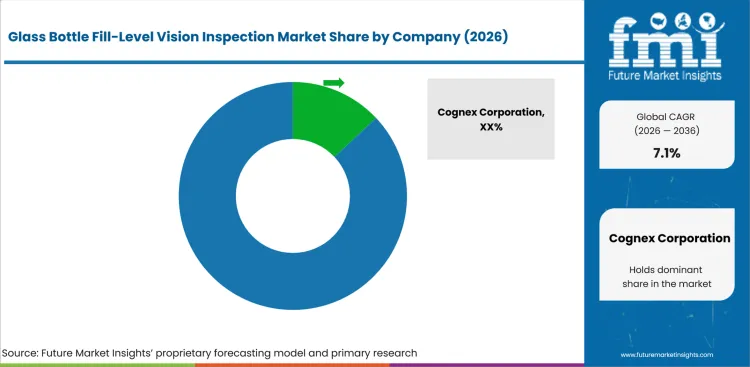
Cognex and KEYENCE are listed with Krones, Antares Vision Group and HEUFT.
- Machine vision suppliers hold an advantage through camera platforms and inspection software depth.
- Beverage line OEMs gain traction when inspection can be connected directly with filling and reject control.
- Specialist inspection suppliers compete through foam compensation and container-level quality checks.
- Local service networks support repeat orders where commissioning quality determines line-speed performance.
Pharmaceutical glass packaging supports higher documentation needs for filled container inspection. Vision guided robots are relevant where inspection moves into robotic cells and automated handling. The competitive field includes machine vision suppliers and beverage line OEMs. Inspection specialists and automation integrators compete on false reject control and service speed.
Suppliers best positioned for share gains are those that combine stable imaging with practical line commissioning. Krones and HEUFT benefit from beverage line access. Cognex and KEYENCE gain from camera platforms. SICK and OMRON gain from automation reach.
How do top glass bottle fill-level vision inspection companies compare?
| Company | Relevance to Market Title | Inspection Portfolio | Line Integration | Service Reach | Geographic Footprint |
| Cognex | Very High | Very Strong | Strong | Very Strong | Global |
| KEYENCE | Very High | Very Strong | Strong | Very Strong | Global |
| Krones | Very High | Strong | Very Strong | Very Strong | Global |
| Antares Vision Group | Very High | Very Strong | Strong | Strong | Global |
| HEUFT Systemtechnik | Very High | Very Strong | Very Strong | Strong | Europe and Americas |
| FILTEC | High | Very Strong | Strong | Strong | North America and Global |
| OMRON | High | Strong | Strong | Very Strong | Global |
Source: Future Market Insights competitive analysis, 2026.
Who are the key players in the glass bottle fill-level vision inspection market?
Cognex and KEYENCE are listed with Krones, Antares Vision Group and HEUFT among other suppliers.
Key global companies leading the glass bottle fill-level vision inspection market include:
- Cognex Corporation
- KEYENCE Corporation
- Krones AG
- Antares Vision Group
- HEUFT Systemtechnik GmbH
- FILTEC
- OMRON Corporation
- SICK AG
- Mettler-Toledo Product Inspection
- Teledyne DALSA
Key Developments in Glass Bottle Fill-Level Vision Inspection Market
- In April 2024, Cognex launched the In-Sight L38 3D vision system for AI-enabled inspection and measurement applications.
- In April 2024, Krones introduced AI-based fill level control for Dynafill to improve filling quality and resource use.
- In August 2025, Antares Vision Group introduced EB-EYE with AV-MultiView to improve inspection resolution and defect detection.
Key Players in the Glass Bottle Fill-Level Vision Inspection Market
Machine Vision and Automation Suppliers
- Cognex Corporation
- KEYENCE Corporation
- OMRON Corporation
- SICK AG
- Teledyne DALSA
Beverage Line and Inspection Specialists
- Krones AG
- HEUFT Systemtechnik GmbH
- FILTEC
- Antares Vision Group
Product Inspection and Integration Companies
- Mettler-Toledo Product Inspection
- KHS GmbH
- BW Integrated Systems
- Hikrobot
- Dahua Technology
Glass Bottle Fill-Level Vision Inspection Market - Scope & Definition
| Attribute | Detail |
| Market Definition | Vision-based systems used to check whether filled glass bottles meet target fill height or volume ranges on production and packaging lines. |
| Functions Covered | Fill-height measurement, underfill detection, overfill detection, foam compensation, reject control, batch evidence capture, and inspection recipe management. |
| Applications Covered | Inline inspection, at-line checks, robotic cell inspection, portable verification, filler feedback, and packaging quality control. |
| End-Use Industries | Food and beverage, pharmaceuticals, packaging, electronics, automotive, and metals where filled glass containers or related inspection workflows are used. |
| Grades Covered | Camera-based, high-frequency-assisted, infrared-assisted, X-ray-assisted, gamma-assisted, and software-led inspection configurations. |
| Inclusions | Cameras, lenses, lighting, frame grabbers, vision software, reject controls and services used for glass bottle fill-level inspection across selected regions. |
| Exclusions | Standalone checkweighers, manual laboratory volume checks, empty glass inspection sold alone, label inspection sold alone, and general plant automation software not tied to fill-level inspection. |
Glass Bottle Fill-Level Vision Inspection Market - Research Methodology
| Method | Description |
| Primary Research | FMI analyst interviews with beverage filling line owners, packaging machine builders, system integrators, component suppliers and inspection service providers across key markets. |
| Desk Research | Review of official manufacturing sources, packaging rules, machine vision releases, product documentation, and company evidence related to fill-level inspection. |
| Market Sizing & Forecasting | Bottom-up installed-line approach using inspection station pricing, component mix, country automation readiness, end-use line density and glass bottle packaging exposure. |
| Data Validation | Cross-verification using machine vision adoption signals, beverage packaging activity, company product claims, country manufacturing indicators and expert validation. |
Glass Bottle Fill-Level Vision Inspection Market - Report Scope
| Parameter | Details |
| Forecast period | 2026 to 2036 |
| Historical period | 2021 to 2025 |
| Quantitative unit | Revenue in USD million |
| By component | Cameras, lenses, lighting, frame grabbers, vision software, services |
| By inspection type | Defect detection, measurement, OCR/OCV, presence/absence, guidance |
| By deployment | Inline, at-line, robotic cell, portable |
| By end-use industry | Electronics, automotive, packaging, pharmaceuticals, food and beverage, metals |
| Regions covered | North America, Latin America, Europe, East Asia, South Asia and Pacific, Middle East and Africa |
| Countries covered | United States, United Kingdom, Germany, France, Japan, China, South Korea, India |
| Key companies profiled | Cognex, KEYENCE, Krones, Antares Vision Group, HEUFT, FILTEC, OMRON, SICK |
| Approach | Bottom-up installed-line approach using inspection station revenue, component mix, country automation readiness, and glass bottle filling density |
Source: Future Market Insights, 2026.
Glass Bottle Fill-Level Vision Inspection Market Breakdown by Component, Inspection Type, Deployment, End-use Industry and Region
Glass Bottle Fill-Level Vision Inspection Market Segmented by Component
- Cameras
- Lenses
- Lighting
- Frame Grabbers
- Vision Software
- Services
Glass Bottle Fill-Level Vision Inspection Market Segmented by Inspection Type
- Defect Detection
- Measurement
- OCR/OCV
- Presence/Absence
- Guidance
Glass Bottle Fill-Level Vision Inspection Market Segmented by Deployment
- Inline
- At-line
- Robotic Cell
- Portable
Glass Bottle Fill-Level Vision Inspection Market Segmented by End-use Industry
- Electronics
- Automotive
- Packaging
- Pharmaceuticals
- Food & Beverage
- Metals
Glass Bottle Fill-Level Vision Inspection Market by Region
- North America
- Latin America
- Europe
- East Asia
- South Asia and Pacific
- Middle East and Africa
Research Sources and Bibliography
- Agreste. (2025, October). Statistical book 2025. French Ministry of Agriculture and Food Sovereignty.
- Antares Vision Group. (2025, August). EB-EYE sees defects in closures and containers.
- Board of Governors of the Federal Reserve System. (2026, June 15). Industrial production and capacity utilization - G.17.
- Cognex Corporation. (2024, April 16). Cognex launches In-Sight L38 3D vision system.
- Department for Environment, Food & Rural Affairs. (2025, June 30). Extended producer responsibility for packaging: 2025 base fees.
- Destatis. (2026, February 2). Beer sales down in 2025.
- Federal Statistical Office. (2026, June). Producer prices in May 2026: +2.2% on May 2025.
- Food Standards Agency. (2026, March 24). UK wine production soars in 2025.
- Government of India Press Information Bureau. (2026, April 21). Strengthening India food processing ecosystem.
- HM Revenue and Customs. (2026, May). Alcohol Bulletin commentary.
- ifo Institute. (2026, January). Capacity utilization in German industry.
- INSEE. (2026, April 23). Quarterly business survey in industry.
- Korea.net. (2025, July 31). The result of the survey on the Korean food industry.
- Krones AG. (2024, April). Filling at a new level.
- Ministry of Food Processing Industries. (2025, September). Sector profile: Beverages.
- Ministry of Agriculture Forestry and Fisheries of Japan. (2025, March). Basic plan for food and agriculture in rural areas.
- National Bureau of Statistics of China. (2025, July 28). Industrial production operation in June 2025.
- National Bureau of Statistics of China. (2026, January 20). Industrial capacity utilization rate in the fourth quarter of 2025.
- National Institute of Standards and Technology. (2024, October). Annual report on the USA manufacturing economy: 2024.
- Office for National Statistics Korea. (2025, April). Monthly industrial statistics.
- OIV. (2026, May). State of the world vine and wine sector in 2025.
- Reserve Bank of India. (2026, January). Order books, inventories and capacity utilisation survey.
- USA Census Bureau. (2025, September). Quarterly plant capacity utilization survey.
- USA Department of Agriculture Foreign Agricultural Service. (2025, April 1). Japan: Food processing ingredients annual.
- USA Department of Agriculture Foreign Agricultural Service. (2025, September 25). Korea beer market brief.
- USA Department of Agriculture Foreign Agricultural Service. (2026, April 1). China: Food processing ingredients annual.
- USA Department of Agriculture Foreign Agricultural Service. (2026, April 1). Japan: Food processing ingredients annual.
- Umweltbundesamt. (2025, January 21). Packaging recycling only works with correct waste separation.
This Report Answers
- Market size estimates for 2026 and forecasts through 2036 for the glass bottle fill-level vision inspection market.
- Insights across more than 30 regional and country-level markets.
- Analysis of demand drivers and inspection requirements across line automation and purchasing behavior.
- Evaluation of component demand across cameras and lighting as well as software and services.
- Assessment of deployment routes including inline and at-line inspection as well as robotic cell and portable systems.
- Identification of opportunities across beverage and pharmaceutical applications as well as packaging and industrial uses.
- Evaluation of competitive dynamics among machine vision suppliers, inspection specialists and beverage line OEMs.
- Country-level growth analysis covering the United States and United Kingdom. The analysis also covers Germany and France. It also covers Japan and China. South Korea and India are also covered.
- Assessment of product development, filler integration and inspection software direction.
- Delivery of market data, forecasts and supporting analysis in PDF and Excel formats.
Frequently Asked Questions
What is the growth prospect for glass bottle fill-level vision inspection?
Demand for glass bottle fill-level vision inspection is expected to rise as bottlers shift from manual sampling to inline reject control.
Which companies are expected to shape the market?
Cognex and KEYENCE are expected to shape competition through camera platforms. Krones, Antares Vision Group and HEUFT are expected to shape line integration.
Why are beverage plants investing in fill-level vision inspection?
Beverage plants are investing to reduce overfill waste, prevent underfill claims and document bottle-level quality checks.
Why is inline deployment important in this market?
Inline deployment supports immediate rejection before secondary packaging hides the individual bottle and raises investigation cost.
Which component leads demand?
Cameras lead component demand because stable image capture is required before software can measure the true liquid line.
Which inspection type leads demand?
Measurement leads inspection demand because fill-height tolerance is the central quality-control need on glass bottle lines.
How does foam affect glass bottle inspection?
Foam can hide the true liquid line, so suppliers need compensation tools that separate foam band behavior from actual fill level.
Why is service support important?
Service support is important because lighting design, camera tuning and reject timing determine whether inspection works at rated line speed.
Which country grows fastest?
India grows fastest among profiled countries due to packaged beverage capacity and food processing investment.
Preview the report firsthand - request a free sample
Get SampleGet the brochure for pricing and purchase details.
Get PDFTable of Content
- Executive Summary
- Global Market Outlook
- Demand-side Trends
- Supply-side Trends
- Technology Roadmap Analysis
- Analysis and Recommendations
- Market Overview
- Market Coverage / Taxonomy
- Market Definition / Scope / Limitations
- Research Methodology
- Research Design
- Primary Research
- Desk Research
- Market Sizing and Forecasting
- Data Validation
- Global Market Analysis 2021 to 2025 and Forecast, 2026 to 2036
- Historical Market Size Value (USD Million) Analysis, 2021 to 2025
- Current and Future Market Size Value (USD Million) Projections, 2026 to 2036
- Y-o-Y Growth Trend Analysis
- Absolute $ Opportunity Analysis
- Global Market Pricing Analysis 2021 to 2025 and Forecast 2026 to 2036
- Global Market Analysis 2021 to 2025 and Forecast 2026 to 2036, By Component
- Introduction / Key Findings
- Historical Market Size Value (USD Million) Analysis By Component, 2021 to 2025
- Current and Future Market Size Value (USD Million) Analysis By Component, 2026 to 2036
- Global Market Analysis 2021 to 2025 and Forecast 2026 to 2036, By Inspection Type
- Introduction / Key Findings
- Historical Market Size Value (USD Million) Analysis By Inspection Type, 2021 to 2025
- Current and Future Market Size Value (USD Million) Analysis By Inspection Type, 2026 to 2036
- Global Market Analysis 2021 to 2025 and Forecast 2026 to 2036, By Deployment
- Introduction / Key Findings
- Historical Market Size Value (USD Million) Analysis By Deployment, 2021 to 2025
- Current and Future Market Size Value (USD Million) Analysis By Deployment, 2026 to 2036
- Global Market Analysis 2021 to 2025 and Forecast 2026 to 2036, By End-use Industry
- Introduction / Key Findings
- Historical Market Size Value (USD Million) Analysis By End-use Industry, 2021 to 2025
- Current and Future Market Size Value (USD Million) Analysis By End-use Industry, 2026 to 2036
- Global Market Analysis 2021 to 2025 and Forecast 2026 to 2036, By Region
- Introduction / Key Findings
- Historical Market Size Value (USD Million) Analysis By Region, 2021 to 2025
- Current and Future Market Size Value (USD Million) Analysis By Region, 2026 to 2036
- North America Market Analysis 2021 to 2025 and Forecast 2026 to 2036
- Pricing Analysis
- Market Share Analysis, 2025
- By Country
- By Component
- By Inspection Type
- By Deployment
- By End-use Industry
- Country-level Analysis
- United States
- Canada
- Latin America Market Analysis 2021 to 2025 and Forecast 2026 to 2036
- Pricing Analysis
- Market Share Analysis, 2025
- By Country
- By Component
- By Inspection Type
- By Deployment
- By End-use Industry
- Country-level Analysis
- Brazil
- Mexico
- Rest of Latin America
- Western Europe Market Analysis 2021 to 2025 and Forecast 2026 to 2036
- Pricing Analysis
- Market Share Analysis, 2025
- By Country
- By Component
- By Inspection Type
- By Deployment
- By End-use Industry
- Country-level Analysis
- Germany
- France
- United Kingdom
- Italy
- Spain
- BENELUX
- Nordics
- Rest of Western Europe
- Eastern Europe Market Analysis 2021 to 2025 and Forecast 2026 to 2036
- Pricing Analysis
- Market Share Analysis, 2025
- By Country
- By Component
- By Inspection Type
- By Deployment
- By End-use Industry
- Country-level Analysis
- Russia
- Poland
- Rest of Eastern Europe
- East Asia Market Analysis 2021 to 2025 and Forecast 2026 to 2036
- Pricing Analysis
- Market Share Analysis, 2025
- By Country
- By Component
- By Inspection Type
- By Deployment
- By End-use Industry
- Country-level Analysis
- China
- Japan
- South Korea
- South Asia and Pacific Market Analysis 2021 to 2025 and Forecast 2026 to 2036
- Pricing Analysis
- Market Share Analysis, 2025
- By Country
- By Component
- By Inspection Type
- By Deployment
- By End-use Industry
- Country-level Analysis
- India
- ASEAN
- Australia & New Zealand
- Rest of South Asia and Pacific
- Middle East & Africa Market Analysis 2021 to 2025 and Forecast 2026 to 2036
- Pricing Analysis
- Market Share Analysis, 2025
- By Country
- By Component
- By Inspection Type
- By Deployment
- By End-use Industry
- Country-level Analysis
- GCC Countries
- South Africa
- Turkey
- Rest of Middle East & Africa
- Market Structure Analysis
- Competition Dashboard
- Competition Benchmarking
- Market Share Analysis of Top Players
- By Region
- By Component
- By Inspection Type
- By Deployment
- By End-use Industry
- Emerging Startups
- Innovation Benchmarking
- Competition Analysis
- Competition Deep Dive
- Company Profiles
- Case Studies
- Success Stories
- Recent Developments
- Assumptions & Acronyms Used
- List of Tables: Glass Bottle Fill-Level Vision Inspection Market
- List of Figures: Glass Bottle Fill-Level Vision Inspection Market


