

- Industry Size (2026)
- USD 185.5 Mn
- Forecast (2036)
- USD 1412.0 Mn
- CAGR (2026 to 2036)
- 22.5%
Prussian Blue Cathode Precursors Market Size, Market Forecast and Outlook By FMI
The Prussian blue cathode precursors market crossed a valuation of USD 151.4 million in 2025. Industry is estimated to be USD 185.5 million in 2026 at a CAGR of 22.5% during the forecast. Demand outlook carries the market size to USD 1,412.0 million as grid storage developers mandate low-cost material frameworks for utility-scale battery deployments.
The transition from lab-scale synthesis to metric-ton commercial production forces specialty chemical formulators to fundamentally re-engineer their precipitation vessels. Raw material procurement leads designing next-generation cell chemistries now reject precursor batches exhibiting high interstitial water content. Facilities unable to control crystallization kinetics during the synthesis phase face unavoidable structural collapse during battery cycling. This strict purity requirement permanently disqualifies generic industrial chemical suppliers from the advanced battery materials supply chain.
Summary of Prussian Blue Cathode Precursors Market
- Prussian Blue Cathode Precursors Market Definition:
- The sector represents the production of battery-grade hexacyanoferrate coordination polymers featuring controlled defect structures. These materials form the essential electrochemical foundation for emerging alkali-ion energy storage systems.
- Demand Drivers in the Market:
- The volatile pricing dynamics of lithium carbonate compel stationary storage developers to aggressively commercialize alternative battery chemistries utilizing earth-abundant elements.
- Grid network operators deploying multi-megawatt balancing stations mandate ultra-low capital expenditure thresholds that only iron-based active materials can physically achieve.
- Raw material processing facilities face intense pressure to eliminate crystal water defects that historically degraded the cycle life of open-framework cathode structures.
- Key Segments Analyzed in the FMI Report:
- Iron-based PBAs: 55.0% share in 2026, as cell manufacturing architects prioritize the lowest possible elemental cost for utility-scale battery formats.
- Sodium-ion Batteries: 88.0% share in 2026, driven by aggressive gigafactory production targets seeking immediate lithium substitution in light-duty transit applications.
- China: 32.0% compound growth, anchored by extensive domestic chemical processing infrastructure and coordinated national mandates for alternative battery technology deployment.
- Analyst Opinion at FMI:
- Nikhil Kaitwade, Principal Consultant for Chemicals and Materials, opines, "In my analysis, I have observed that the true bottleneck in sodium-ion commercialization is not the cell assembly process, but the reliable bulk synthesis of defect-free hexacyanoferrate frameworks. Chemical formulators attempting to scale hydrothermal synthesis methods face unavoidable interstitial water retention that triggers severe capacity fade during early cycle life. Precursor manufacturing leads who continue utilizing standard precipitation techniques will find themselves unable to meet the stringent structural integrity thresholds required for next-generation grid storage qualification."
- Strategic Implications / Executive Takeaways:
- Specialty chemical formulators must invest heavily in advanced chelating and continuous crystallization technologies to eliminate lattice water defects during bulk synthesis.
- Gigafactory procurement directors should secure long-term offtake agreements with precursor suppliers demonstrating proven metric-ton batch consistency.
- Battery recycling integrators must develop specialized hydrometallurgical recovery pathways specific to cyanide-containing coordination polymers to ensure closed-loop compliance.
- Methodology:
- Primary Research: FMI conducted detailed technical interviews with principal materials scientists, supply chain strategists, and battery engineering directors across 15 countries to validate precursor adoption timelines.
- Desk Research: Analysts aggregated public patent registries, environmental permitting applications for chemical synthesis sites, and national energy storage grant programs.
- Market-Sizing and Forecasting: The model applies a bottom-up methodology starting with global installed base targets for sodium-ion manufacturing and projecting the required metric tonnage of active material.
- Data Validation and Update Cycle: Segment forecasts undergo cross-validation against quarterly financial disclosures from leading advanced battery material conglomerates.
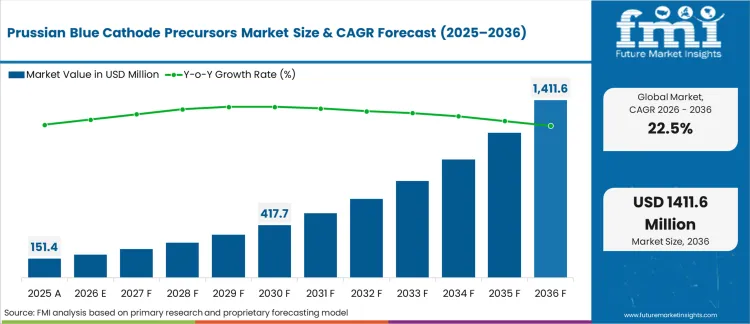
The true inflection point occurs when interstitial water management techniques achieve defect-free crystallization at continuous production scales. Specialty chemical producers must validate their proprietary drying and chelating methods before automotive qualification windows close in late 2028. Mastering this kinetic control allows cell manufacturers to achieve the theoretical specific capacity limits of sodium-ion architectures.
As regional cell manufacturing hubs secure local raw material supply lines, China sets the pace with a 32.0% compound expansion rate anchored by aggressive state-backed sodium-ion commercialization mandates. India advances at a 28.5% trajectory as grid storage integrators leverage abundant domestic iron and sodium resources. The USA registers a 20.5% growth rate supported by critical mineral independence policies. Germany expands at 19.0% while Japan tracks at 18.5%, both driven by stationary storage localization strategies. South Korea grows at 16.0% and the UK follows at 15.5%. This geographic dispersion reflects distinct national strategies to bypass lithium supply chain vulnerabilities.
Prussian Blue Cathode Precursors Market Key Takeaways
| Metric | Details |
|---|---|
| Industry Size (2026) | USD 185.5 million |
| Industry Value (2036) | USD 1,412.0 million |
| CAGR (2026-2036) | 22.5% |
Source: Future Market Insights (FMI) analysis, based on proprietary forecasting model and primary research
Prussian Blue Cathode Precursors Market Definition
Prussian blue cathode precursors encompass the specialized transition metal hexacyanoferrate compounds utilized as the foundational active material in non-aqueous battery architectures. These highly porous coordination polymers provide the three-dimensional open framework required for the reversible insertion and extraction of large alkali metal ions.
Prussian Blue Cathode Precursors Market Inclusions
The market scope incorporates all battery-grade iron, manganese, and mixed-metal hexacyanoferrate powders engineered specifically for electrochemical energy storage. Transition metal salts, complexing agents, and proprietary chelating compounds utilized during the dedicated synthesis of these cathode materials fall within the defined boundaries. Specialized chemical intermediaries destined for both sodium-ion batteries and emerging potassium-ion batteries variants are fully integrated into the valuation model.
Prussian Blue Cathode Precursors Market Exclusions
Standard industrial-grade Prussian blue pigments utilized in inks, coatings, and cosmetic formulations are explicitly omitted from the valuation. Generic commodity iron and cyanide salts not specifically processed for battery intercalation are excluded. Precursor materials destined for lithium-ion architectures, such as nickel-manganese-cobalt sulfates, fall entirely outside the defined analytical parameters.
Prussian Blue Cathode Precursors Market Research Methodology
- Primary Research: Analysts engaged with battery materials scientists, gigafactory procurement directors, and specialty chemical formulation leads to map the qualification gates for new precursor compounds.
- Desk Research: The data collection phase aggregated compliance roadmaps from the Battery European Partnership Association, patent filings for co-precipitation techniques, and materials science journal publications.
- Market-Sizing and Forecasting: The baseline value derives from a bottom-up aggregation of specialized hexacyanoferrate shipment volumes, applying region-specific commercialization curves to project future adoption velocity.
- Data Validation and Update Cycle: Projections are rigorously tested against publicly reported production capacity expansion announcements from leading sodium-ion cell developers.
Segmental Analysis
Prussian Blue Cathode Precursors Market Analysis by Precursor Type
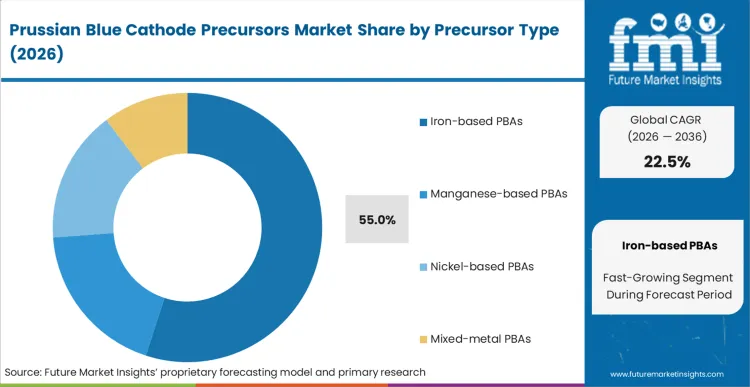
With material cost serving as the primary competitive vector against established lithium technologies, procurement specification leads aggressively favor the most abundant transition metals. Iron-based PBAs capture a dominant 55.0% share in 2026, reflecting their absolute necessity for driving utility-scale storage costs below critical viability thresholds. FMI analysts opine that relying on iron and manganese entirely eliminates the volatile pricing exposure associated with cobalt and nickel supply chains. Formulators optimizing these iron-rich frameworks must rigorously control the precipitation environment to prevent unwanted phase transitions. Mastering this specific synthetic challenge guarantees continuous battery precursors supply without geopolitical disruption risk. Cell manufacturing architects specifying these compounds secure long-term price stability for their massive stationary energy storage deployments.
- Cost optimization: Utilizing widely available iron feedstocks drastically reduces the bulk material expense per kilowatt-hour of energy capacity.
- Toxicity reduction: Eliminating heavy metals inherently simplifies the environmental permitting process for new precursor synthesis facilities.
- Supply resilience: Domestically sourced iron compounds shield regional gigafactories from international trade restrictions affecting specialized battery minerals.
Prussian Blue Cathode Precursors Market Analysis by Battery Type
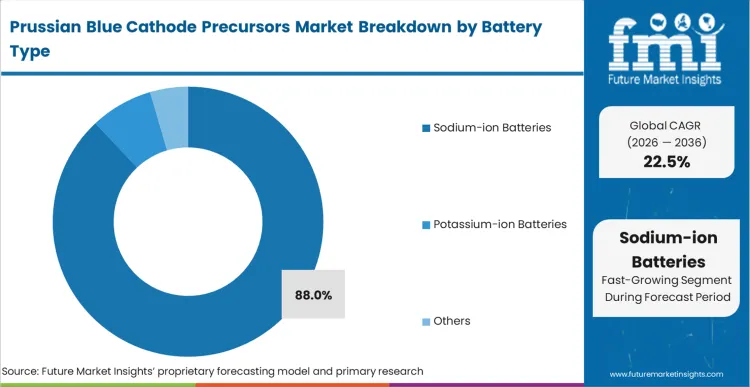
The urgent commercial push to displace lithium in low-energy-density applications heavily dictates current precursor consumption volumes. Sodium-ion Batteries represent an overwhelming 88.0% share in 2026, as extensive capital flows direct massive manufacturing capacity toward this specific electrochemical architecture. The fundamental ionic radius compatibility between sodium ions and the hexacyanoferrate lattice structural voids drives this deep integration. Based on FMI's assessment, optimizing the precursor chemistry specifically for sodium intercalation allows engineers to achieve exceptional low-temperature performance metrics. Potassium-ion architectures remain in developmental phases, capturing nominal volume. Battery engineering directors standardizing on energy storage systems compatible precursors capture the immediate commercial volume generated by the emerging light-duty electric vehicle sector.
- Format compatibility: The rigid open framework physically accommodates the larger sodium ion without experiencing severe volumetric expansion during cycling.
- Thermal stability: Hexacyanoferrate structures inherently resist the dangerous thermal runaway events associated with highly reactive lithium chemistries.
- Rate capability: The wide three-dimensional diffusion channels facilitate rapid sodium ion transport during high-power charging sequences.
Prussian Blue Cathode Precursors Market Analysis by Synthesis Method
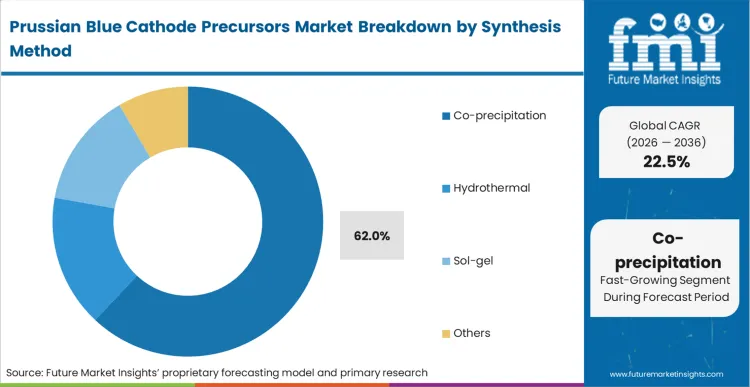
Translating complex laboratory chemical reactions into viable industrial-scale production requires highly controllable and continuous processing techniques. Co-precipitation emerges as the dominant application area, expected to represent 62.0% of total market share in 2026. This method allows chemical engineers to tightly regulate precursor particle size and morphology by precisely managing pH and temperature within the reaction vessel. FMI's analysis indicates that abandoning batch hydrothermal processes in favor of continuous co-precipitation drastically reduces the embedded energy cost per kilogram of active material. Quality assurance directors evaluating precursor batches demand the strict morphological uniformity that only advanced co-precipitation reactors can consistently provide. Specialty chemical formulation leads optimizing continuous precipitation parameters successfully eliminate the interstitial water defects that plague alternative synthesis routes.
- Morphology control: Precise manipulation of reagent feed rates allows operators to engineer exact particle shapes optimized for electrode coating.
- Throughput velocity: Continuous flow reactors generate significantly higher daily metric tonnage compared to constrained batch synthesis techniques.
- Defect minimization: Utilizing specific chelating agents during the precipitation phase prevents the inclusion of detrimental crystal water within the lattice.
Prussian Blue Cathode Precursors Market Analysis by Application
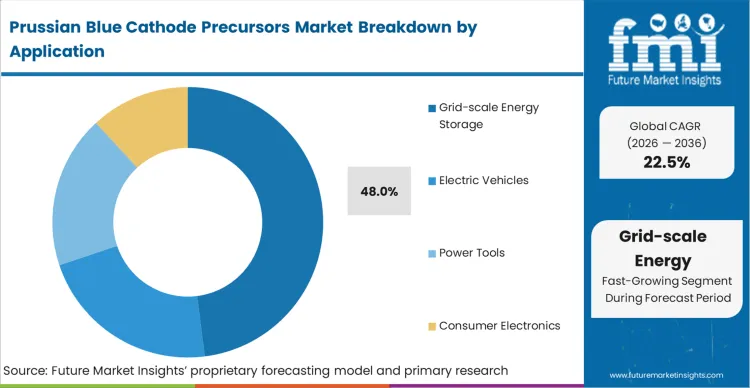
The fundamental energy density limitations of sodium-ion architectures naturally direct these specialized cathodes toward applications where weight remains a secondary concern. Grid-scale Energy Storage accounts for a leading 48.0% segment share in 2026. Utility network planners deploying massive balancing stations prioritize absolute system cost and safety over gravimetric energy density. Integrating highly stable iron-based cathodes guarantees long-duration cycling capability for renewable energy storage assets without the inherent fire risks of traditional chemistries. In FMI's view, targeting the utility storage sector provides precursor manufacturers with massive, predictable volume offtake agreements. Capital project directors constructing massive grid-scale battery storage parks mandate these low-cost chemistries to achieve aggressive levelized cost of storage targets.
- Lifespan extension: The zero-strain insertion mechanism of the open framework ensures thousands of stable charge cycles for stationary battery parks.
- Safety profile: Utilizing non-flammable cathode materials significantly reduces the physical footprint required for thermal isolation in grid installations.
- Capital efficiency: Low active material costs directly accelerate the financial payback period for utility-scale solar and wind integration projects.
Prussian Blue Cathode Precursors Market Drivers, Restraints, and Opportunities
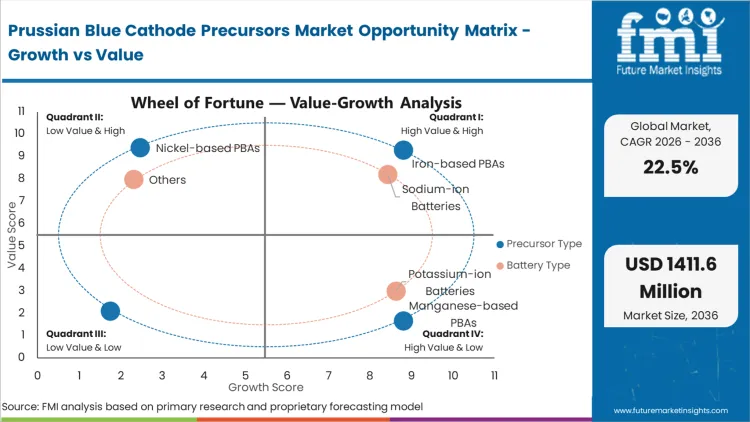
The extreme price volatility of critical battery minerals forces cell manufacturing architects to aggressively commercialize alternative chemistries built entirely on earth-abundant elements. Supply chain directors facing unpredictable lithium carbonate costs must deploy sodium-ion platforms to stabilize their raw material procurement budgets. Transitioning to iron and manganese-based hexacyanoferrates isolates battery production economics from geopolitical supply constraints and mining bottlenecks. Facilities that fail to qualify these low-cost active materials risk severe margin compression and total exclusion from the highly price-sensitive stationary energy storage sector.
The inherent tendency of hexacyanoferrate frameworks to trap coordinated water molecules during synthesis creates a massive operational friction for chemical formulators. Battery materials scientists mapping degradation pathways identify this interstitial water as the primary catalyst for severe capacity fade and transition metal dissolution during cycling. Implementing advanced vacuum drying and specialized chelating environments mitigates this issue but significantly increases the capital complexity of the manufacturing line. This specialized processing requirement limits the number of chemical facilities capable of producing battery-grade material at scale.
Opportunities in the Prussian Blue Cathode Precursors Market
- Continuous Reactor Implementation: Specialty chemical formulation leads transitioning from batch synthesis to continuous flow reactors drastically reduce the manufacturing cost per kilogram. This volume scaling captures massive early-stage contracts from Tier-1 sodium-ion gigafactories.
- Defect-Free Chelating Agents: Materials science innovators developing proprietary organic complexing agents effectively block water molecule integration during the precipitation phase. Battery engineering directors aggressively seek out these specialized formulations to guarantee extended cell cycle life.
- Localized Supply Chains: Chemical infrastructure developers establishing synthesis capacity near emerging gigafactory hubs secure lucrative domestic sourcing contracts. This proximity eliminates complex international logistics and shields electric vehicle battery developers from cross-border trade tariffs.
Regional Analysis
Based on the regional analysis, the Prussian blue cathode precursors market is segmented into Asia Pacific, North America, and Europe across 40 plus countries.
.webp "Top Country Growth Comparison Prussian Blue Cathode Precursors Market Cagr (2026 2036)")
| Country | CAGR (2026 to 2036) |
|---|---|
| China | 32.0% |
| India | 28.5% |
| USA | 20.5% |
| Germany | 19.0% |
| Japan | 18.5% |
| South Korea | 16.0% |
| UK | 15.5% |
Source: Future Market Insights (FMI) analysis, based on proprietary forecasting model and primary research
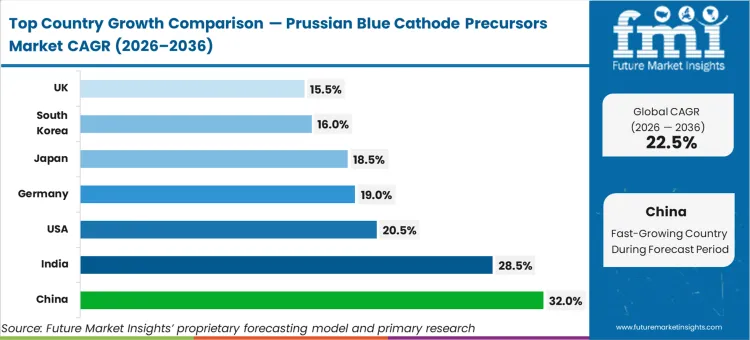
Asia Pacific Prussian Blue Cathode Precursors Market Analysis
Massive state-backed capitalization of alternative battery architectures transforms the Asia Pacific region into the epicenter for high-volume precursor synthesis. Government policymakers aggressively push sodium-ion commercialization to break total reliance on imported lithium feedstocks for grid storage applications. FMI's research confirms that domestic chemical giants are rapidly retrofitting legacy pigment manufacturing lines to produce advanced battery-grade hexacyanoferrates.
- China: China's electric vehicle manufacturing sector deploys vast capital resources to commercialize low-cost sodium-ion battery packs for micro mobility applications. The national directive to dominate next-generation energy storage drives unprecedented investment in continuous precipitation infrastructure capable of metric-ton output. Massive gigafactory deployments already validate the commercial viability of these zero-lithium architectures. This aggressive state backing anchors China's 32.0% compound expansion to 2036. Cell manufacturing architects securing domestic precursor supply lines rapidly undercut global competitors on absolute battery cost.
- India: Localized grid storage mandates in India heavily incentivize the adoption of battery chemistries utilizing indigenous raw materials. Battery materials scientists must optimize synthesis parameters to utilize the region's abundant iron resources effectively. The rapid deployment of commercial-scale sodium-ion pilot plants highlights the shift away from expensive imported lithium cells. India advances at a 28.5% compound rate as national infrastructure developers localize the active material supply chain. Procurement specification leads targeting rural electrification projects demand these ultra-low-cost energy storage solutions.
- Japan: Japan's advanced specialty chemical sector leverages decades of materials science expertise to engineer highly stable, defect-free coordination polymers. Formulators target the precise elimination of interstitial water to guarantee the exceptional cycle life required by strict domestic utility standards. Specialized pilot lines producing ultra-pure hexacyanoferrates demonstrate Japan's focus on premium, long-duration storage performance. Japan's precursor demand is rising at a CAGR of 18.5% as stationary storage localization strategies take effect. Quality assurance directors mandate absolute structural perfection before qualifying new precursor batches for critical infrastructure integration.
- South Korea: South Korean cell manufacturers rapidly diversify their portfolio beyond premium nickel chemistries to capture the emerging low-cost stationary storage tier. Materials engineers require specialized high-tap-density precursors to maximize the volumetric efficiency of these bulk energy systems. Aggressive corporate investments into alternative cathode research validate the strategic shift toward diverse material ecosystems. This strategic diversification drives a 16.0% CAGR for the market in South Korea. Supply chain strategists failing to secure viable sodium-ion material streams risk losing massive utility-scale contracts to regional competitors.
FMI's report includes comprehensive coverage of the broader Asia Pacific landscape. Emerging manufacturing hubs across the ASEAN bloc actively position themselves as secondary processing centers for bulk transition metal salts, aiming to capture downstream synthesis value.
North America Prussian Blue Cathode Precursors Market Analysis
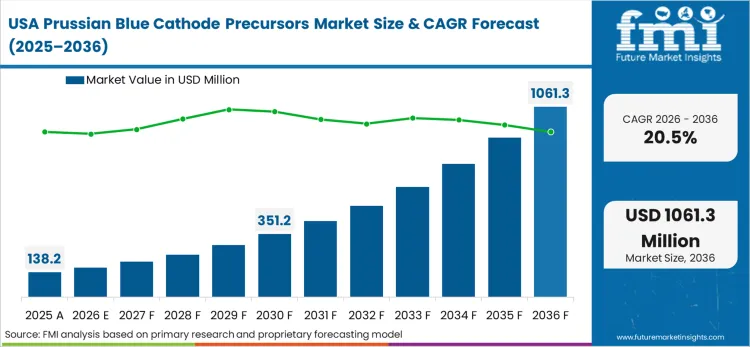
Federal critical mineral strategies across North America actively penalize cell architectures reliant on vulnerable international supply chains. Department of Energy funding vehicles aggressively subsidize the domestic production of earth-abundant battery materials to secure national grid infrastructure. As per FMI's projection, this legislative framework permanently shifts capital allocation toward iron and sodium-based energy storage ecosystems.
- USA: The United States battery manufacturing sector utilizes robust federal localization grants to rapidly construct domestic precursor synthesis facilities. Chemical engineering leads must design continuous processing lines capable of meeting stringent environmental permitting regulations while scaling output. The heavy federal capitalization of pilot-scale sodium-ion manufacturing sites confirms the strategic pivot toward lithium-free architectures. The USA registers a 20.5% annual expansion rate as federal supply chain localization initiatives mandate domestic sourcing. Capital project directors constructing massive utility battery parks specify these localized, secure chemistries to qualify for critical infrastructure tax incentives.
FMI's report includes extensive evaluation of the North American battery materials sector. Canadian mineral processing sectors actively explore the conversion of domestic transition metal tailings into viable feedstocks for advanced hexacyanoferrate synthesis.
Europe Prussian Blue Cathode Precursors Market Analysis
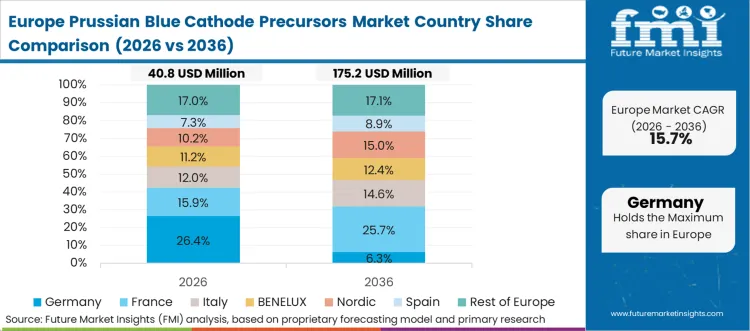
Stringent environmental directives governing battery recycling and raw material sourcing force European cell developers to pioneer highly sustainable active materials. The European Battery Directive penalizes highly toxic chemistries, accelerating the shift toward benign iron and manganese coordination polymers. Based on FMI's assessment, local chemical formulators leverage their deep expertise in complex synthesis to engineer premium precursor grades.
- Germany: Germany's powerful specialty chemical sector rapidly scales hydrothermal synthesis capabilities to supply the emerging regional sodium-ion gigafactories. Process engineers must solve complex kinetic challenges to achieve the exact particle morphology required by advanced automotive coating lines. The transition of several pilot lines into full commercial production validates the technical maturity of the European sodium-ion ecosystem. This technological mastery sustains a 19.0% compound rate for the market in Germany. Gigafactory procurement directors securing these ultra-pure regional precursors completely isolate their production lines from Asian supply chain bottlenecks.
- UK: The United Kingdom's grid modernization programs require massive deployments of low-cost energy storage to balance volatile offshore wind generation. Utility network planners deploy pilot sodium-ion installations to validate the exceptional cycle life of Prussian blue analogues in high-frequency balancing operations. Government-backed battery industrialization centers actively fund the scale-up of novel continuous co-precipitation reactor designs. The UK's 15.5% annual growth rate reflects targeted investments in specialized grid storage chemistries. Grid storage engineers standardizing on these robust cathode materials drastically lower the capital expenditure required for national renewable energy integration.
FMI's report includes thorough investigation of the European advanced materials framework. Nordic countries heavily prioritize the integration of localized, green-energy-powered chemical synthesis to achieve true zero-carbon battery precursor manufacturing.
Competitive Aligners for Market Players
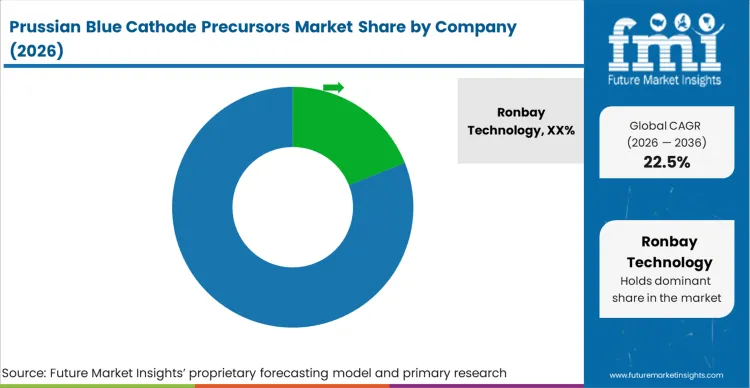
The competitive structure of the Prussian Blue cathode precursors market is increasingly shaped by crystal purity, vacancy control, moisture management, and the ability to scale precursor synthesis without compromising electrochemical consistency. Buyers no longer assess suppliers only on headline cathode performance. They increasingly compare producers on batch reproducibility, sodium-ion compatibility, precursor cost control, and readiness for commercial cell qualification. This shift is raising the technical threshold across the industry and placing pressure on suppliers that cannot stabilize Prussian Blue or Prussian White production at meaningful commercial scale.
Industry participants have already begun aligning around specialized sodium-ion cathode development and scale-up. Ronbay Technology, Malion New Materials, Altris AB, GEM Co., Ltd., and BASF SE each reflect different strategic routes into this market, ranging from dedicated sodium-ion material development to broader battery materials and industrial chemistry capabilities. Their positioning shows that the market is moving beyond laboratory validation and toward structured supply chain formation. As a result, precursor suppliers are increasingly expected to support not only material innovation, but also manufacturing reliability, customer qualification, and long-term scalability across emerging sodium-ion battery programs.
Vendors that combine precursor engineering, scale-up discipline, and supply chain integration gain a significant strategic advantage. The core competitive battleground now lies in controlling structural defects, water content, and batch consistency across larger production runs so that battery manufacturers can qualify the material with lower technical risk. This dynamic favors players that can connect proprietary chemistry development with repeatable industrial output and stronger downstream relationships. As commercialization accelerates, suppliers that fail to demonstrate stable precursor quality, manufacturable cost structures, and clear sodium-ion alignment risk losing position during early customer qualification cycles.
Key Players in Prussian Blue Cathode Precursors Market
- Ronbay Technology
- Malion New Materials
- Altris AB
- Lily Group Co., Ltd.
- GEM Co., Ltd.
- BASF SE
Scope of the Report
| Metric | Value |
|---|---|
| Quantitative Units | USD 185.5 million to USD 1,412.0 million, at a CAGR of 22.5% |
| Market Definition | The sector encompasses the production of specialized battery-grade hexacyanoferrate coordination polymers featuring controlled defect structures for alkali-ion energy storage architectures. |
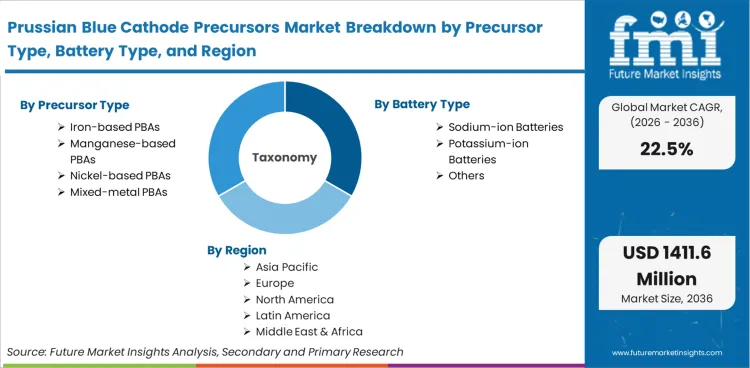
| Precursor Type Segmentation | Iron-based PBAs, Manganese-based PBAs, Nickel-based PBAs, Mixed-metal PBAs |
| Battery Type Segmentation | Sodium-ion Batteries, Potassium-ion Batteries, Others |
| Synthesis Method Segmentation | Co-precipitation, Hydrothermal, Sol-gel, Others |
| Application Segmentation | Grid-scale Energy Storage, Electric Vehicles, Power Tools, Consumer Electronics |
| Regions Covered | North America, Latin America, Europe, East Asia, South Asia, Oceania, Middle East & Africa |
| Countries Covered | China, India, USA, Germany, Japan, South Korea, UK, and 40 plus countries |
| Key Companies Profiled | Ronbay Technology, Malion New Materials, Altris AB, Lily Group Co., Ltd., GEM Co., Ltd., BASF SE |
| Forecast Period | 2026 to 2036 |
| Approach | The baseline value derives from a bottom-up aggregation of specialized hexacyanoferrate shipment volumes. Projections undergo cross-validation against publicly reported production capacity expansion announcements from leading sodium-ion cell developers. |
Source: Future Market Insights (FMI) analysis, based on proprietary forecasting model and primary research
Prussian Blue Cathode Precursors Market Analysis by Segments
Precursor Type:
- Iron-based PBAs
- Manganese-based PBAs
- Nickel-based PBAs
- Mixed-metal PBAs
Battery Type:
- Sodium-ion Batteries
- Potassium-ion Batteries
- Others
Synthesis Method:
- Co-precipitation
- Hydrothermal
- Sol-gel
- Others
Application:
- Grid-scale Energy Storage
- Electric Vehicles
- Power Tools
- Consumer Electronics
Region:
- North America
- United States
- Canada
- Mexico
- Latin America
- Brazil
- Argentina
- Rest of Latin America
- Europe
- Germany
- United Kingdom
- France
- Italy
- Spain
- Rest of Europe
- East Asia
- China
- Japan
- South Korea
- South Asia
- India
- ASEAN
- Rest of South Asia
- Oceania
- Australia
- New Zealand
- Middle East & Africa
- GCC
- South Africa
- Rest of Middle East & Africa
Bibliography
- International Energy Agency. (2026, February 5). Sodium-ion battery installed and announced manufacturing capacity by chemistry and region, 2025 and 2030.
- International Renewable Energy Agency. (2025, November). Sodium-ion batteries: A technology brief.
- USA Department of Energy, Advanced Materials and Manufacturing Technologies Office. (2024, December 19). Funding selections: Platform technologies for transformative battery manufacturing.
- USA Department of Energy, Vehicle Technologies Office. (2024, December 20). Funding selections: Fiscal Year 2024 Vehicle Technologies Office Research & Development Funding Program.
- Komenda, A., & Piątek, J. (2025). Prussian blue analogues in sodium-ion batteries: comparison with lithium technologies, recent advances, and prospects. Renewable and Sustainable Energy Reviews, 217, 115677.
- Liu, J., Wang, X., Wu, Y., Lu, Y.-C., & Kang, Y.-M. (2024). Vacancies-regulated Prussian blue analogues through precipitation conversion for cathodes in sodium-ion batteries with energy densities over 500 Wh/kg. Angewandte Chemie International Edition, 63, e202400214.
This bibliography is provided for reader reference. The full FMI report contains the complete reference list with primary research documentation.
This Report Addresses
- Market sizing and quantitative forecast metrics detailing the commercial expansion of Prussian Blue cathode precursors across emerging alkali-ion battery supply chains through 2036.
- Segmentation analysis mapping adoption patterns across precursor types, battery chemistries, synthesis methods, and application sectors shaping active material qualification decisions.
- Regional deployment intelligence comparing aggressive sodium-ion precursor scale-up in Asia Pacific with localization-driven supply chain development across North America and Europe.
- Regulatory and policy assessment analyzing how critical mineral independence strategies, battery localization programs, and sustainability mandates are accelerating demand for defect-controlled hexacyanoferrate materials.
- Competitive posture evaluation tracking how precursor suppliers differentiate through crystal purity, interstitial water control, batch reproducibility, and scalable continuous synthesis capabilities.
- Manufacturing strategic guidance defining the precipitation control, drying, chelation, and defect-management requirements needed to support metric-ton commercial precursor production.
- Supply chain vulnerability analysis identifying the crystallization, moisture retention, raw material localization, and qualification bottlenecks that can delay sodium-ion commercialization timelines.
- Custom data delivery formats encompassing interactive dashboards, raw Excel datasets, and comprehensive PDF narrative reports.
Frequently Asked Questions
How large is the demand for Prussian Blue Cathode Precursors in the global market in 2026?
Demand for Prussian Blue Cathode Precursors in the global market is estimated to be valued at USD 185.5 million in 2026.
What will be the market size of Prussian Blue Cathode Precursors in the global market by 2036?
Market size for Prussian Blue Cathode Precursors is projected to reach USD 1,412.0 million by 2036.
What is the expected demand growth for Prussian Blue Cathode Precursors in the global market between 2026 and 2036?
Demand for Prussian Blue Cathode Precursors is expected to grow at a CAGR of 22.5% between 2026 and 2036.
Which Precursor Type is poised to lead global sales by 2026?
Iron-based PBAs account for 55.0% in 2026 as cell manufacturing architects prioritize the lowest possible elemental cost for utility-scale battery formats.
How significant is the role of Sodium-ion Batteries in driving Prussian Blue Cathode Precursors adoption in 2026?
Sodium-ion Batteries represent 88.0% of segment share as the hexacyanoferrate lattice structure provides the open framework required for sodium-ion insertion and extraction.
What is driving demand in China?
China's electric vehicle and grid storage sectors are deploying large-scale sodium-ion commercialization programs, forcing rapid expansion of metric-ton precursor synthesis infrastructure.
What compliance standards or regulations are referenced for Germany?
Germany’s market is shaped by strict European sustainability and battery localization frameworks that require highly controlled and defect-free precursor production.
What is the China growth outlook in this report?
China is projected to grow at a CAGR of 32.0% during 2026 to 2036.
Why is North America described as a priority region in this report?
North America is prioritized because federal critical mineral independence policies and grid infrastructure programs are accelerating domestic precursor synthesis capacity.
What type of demand dominates in North America?
Demand heavily focuses on localized production of earth-abundant cathode materials that reduce dependence on vulnerable lithium and imported specialty mineral supply chains.
What is India’s growth outlook in this report?
India is projected to expand at a CAGR of 28.5% during 2026 to 2036.
Does the report cover USA in its regional analysis?
Yes, USA is included within North America under the regional scope of analysis.
What are the sources referred to for analyzing USA?
Federal critical mineral localization grants, Department of Energy funding mechanisms, and domestic grid storage development programs form the analytical basis.
What is the main demand theme linked to USA in its region coverage?
Domestic precursor capacity buildout tied to sodium-ion manufacturing and localized grid storage deployment forms the main demand theme in the United States.
Does the report cover Germany in its regional analysis?
Yes, Germany is included within Europe under the regional coverage framework.
What is the main Germany related demand theme in its region coverage?
Germany’s demand is driven by specialty chemical scale-up and sodium-ion gigafactory qualification requiring defect-free and highly stable precursor materials.
Which product formats or configurations are strategically important for Asia Pacific supply chains?
Continuous co-precipitation systems, iron-rich hexacyanoferrate powders, and localized bulk precursor synthesis facilities are strategically important for Asia Pacific supply chains.
What is Prussian Blue Cathode Precursors and what is it mainly used for?
Prussian Blue Cathode Precursors are specialized transition metal hexacyanoferrate compounds mainly used as active cathode materials in sodium-ion and other alkali-ion battery systems.
What does Prussian Blue Cathode Precursors mean in this report?
The scope encompasses battery-grade iron, manganese, nickel, and mixed-metal hexacyanoferrate compounds engineered specifically for electrochemical energy storage applications.
What is included in the scope of this Prussian Blue Cathode Precursors report?
The market covers battery-grade precursor powders, transition metal salts, complexing agents, proprietary chelating compounds, and specialized intermediates utilized in sodium-ion and emerging potassium-ion battery synthesis.
What is excluded from the scope of this report?
Standard industrial-grade Prussian blue pigments used in inks, coatings, and cosmetics, generic iron and cyanide salts, and precursor materials meant for lithium-ion chemistries are explicitly excluded.
What does market forecast mean on this page?
The market forecast represents a model-based projection built on precursor shipment volumes, sodium-ion commercialization curves, and regional manufacturing scale-up assumptions for strategic planning purposes.
How does FMI build and validate the Prussian Blue Cathode Precursors forecast?
The model applies a bottom-up methodology starting with specialized hexacyanoferrate shipment volumes and sodium-ion manufacturing targets, then cross-validates projections against production capacity expansion announcements and financial disclosures from advanced battery material developers.
What does zero reliance on speculative third-party market research mean here?
Primary interviews, patent registries, environmental permitting applications, national energy storage grant programs, and verified company disclosures are used instead of unverified syndicated estimates.
Preview the report firsthand - request a free sample
Get SampleGet the brochure for pricing and purchase details.
Get PDFTable of Content
- Executive Summary
- Global Market Outlook
- Demand-side Trends
- Supply-side Trends
- Technology Roadmap Analysis
- Analysis and Recommendations
- Market Overview
- Market Coverage / Taxonomy
- Market Definition / Scope / Limitations
- Research Methodology
- Chapter Orientation
- Analytical Lens and Working Hypotheses
- Market Structure, Signals, and Trend Drivers
- Benchmarking and Cross-market Comparability
- Market Sizing, Forecasting, and Opportunity Mapping
- Research Design and Evidence Framework
- Desk Research Programme (Secondary Evidence)
- Company Annual and Sustainability Reports
- Peer-reviewed Journals and Academic Literature
- Corporate Websites, Product Literature, and Technical Notes
- Earnings Decks and Investor Briefings
- Statutory Filings and Regulatory Disclosures
- Technical White Papers and Standards Notes
- Trade Journals, Industry Magazines, and Analyst Briefs
- Conference Proceedings, Webinars, and Seminar Materials
- Government Statistics Portals and Public Data Releases
- Press Releases and Reputable Media Coverage
- Specialist Newsletters and Curated Briefings
- Sector Databases and Reference Repositories
- FMI Internal Proprietary Databases and Historical Market Datasets
- Subscription Datasets and Paid Sources
- Social Channels, Communities, and Digital Listening Inputs
- Additional Desk Sources
- Expert Input and Fieldwork (Primary Evidence)
- Primary Modes
- Qualitative Interviews and Expert Elicitation
- Quantitative Surveys and Structured Data Capture
- Blended Approach
- Why Primary Evidence is Used
- Field Techniques
- Interviews
- Surveys
- Focus Groups
- Observational and In-context Research
- Social and Community Interactions
- Stakeholder Universe Engaged
- C-suite Leaders
- Board Members
- Presidents and Vice Presidents
- R&D and Innovation Heads
- Technical Specialists
- Domain Subject-matter Experts
- Scientists
- Physicians and Other Healthcare Professionals
- Governance, Ethics, and Data Stewardship
- Research Ethics
- Data Integrity and Handling
- Primary Modes
- Tooling, Models, and Reference Databases
- Desk Research Programme (Secondary Evidence)
- Data Engineering and Model Build
- Data Acquisition and Ingestion
- Cleaning, Normalisation, and Verification
- Synthesis, Triangulation, and Analysis
- Quality Assurance and Audit Trail
- Market Background
- Market Dynamics
- Drivers
- Restraints
- Opportunity
- Trends
- Scenario Forecast
- Demand in Optimistic Scenario
- Demand in Likely Scenario
- Demand in Conservative Scenario
- Opportunity Map Analysis
- Product Life Cycle Analysis
- Supply Chain Analysis
- Investment Feasibility Matrix
- Value Chain Analysis
- PESTLE and Porter’s Analysis
- Regulatory Landscape
- Regional Parent Market Outlook
- Production and Consumption Statistics
- Import and Export Statistics
- Market Dynamics
- Global Market Analysis 2021 to 2025 and Forecast, 2026 to 2036
- Historical Market Size Value (USD Million) Analysis, 2021 to 2025
- Current and Future Market Size Value (USD Million) Projections, 2026 to 2036
- Y-o-Y Growth Trend Analysis
- Absolute $ Opportunity Analysis
- Global Market Pricing Analysis 2021 to 2025 and Forecast 2026 to 2036
- Global Market Analysis 2021 to 2025 and Forecast 2026 to 2036, By Precursor Type
- Introduction / Key Findings
- Historical Market Size Value (USD Million) Analysis By Precursor Type , 2021 to 2025
- Current and Future Market Size Value (USD Million) Analysis and Forecast By Precursor Type , 2026 to 2036
- Iron-based PBAs
- Manganese-based PBAs
- Nickel-based PBAs
- Mixed-metal PBAs
- Iron-based PBAs
- Y-o-Y Growth Trend Analysis By Precursor Type , 2021 to 2025
- Absolute $ Opportunity Analysis By Precursor Type , 2026 to 2036
- Global Market Analysis 2021 to 2025 and Forecast 2026 to 2036, By Battery Type
- Introduction / Key Findings
- Historical Market Size Value (USD Million) Analysis By Battery Type, 2021 to 2025
- Current and Future Market Size Value (USD Million) Analysis and Forecast By Battery Type, 2026 to 2036
- Sodium-ion Batteries
- Potassium-ion Batteries
- Others
- Sodium-ion Batteries
- Y-o-Y Growth Trend Analysis By Battery Type, 2021 to 2025
- Absolute $ Opportunity Analysis By Battery Type, 2026 to 2036
- Global Market Analysis 2021 to 2025 and Forecast 2026 to 2036, By Synthesis Method
- Introduction / Key Findings
- Historical Market Size Value (USD Million) Analysis By Synthesis Method, 2021 to 2025
- Current and Future Market Size Value (USD Million) Analysis and Forecast By Synthesis Method, 2026 to 2036
- Co-precipitation
- Hydrothermal
- Sol-gel
- Others
- Co-precipitation
- Y-o-Y Growth Trend Analysis By Synthesis Method, 2021 to 2025
- Absolute $ Opportunity Analysis By Synthesis Method, 2026 to 2036
- Global Market Analysis 2021 to 2025 and Forecast 2026 to 2036, By Application
- Introduction / Key Findings
- Historical Market Size Value (USD Million) Analysis By Application, 2021 to 2025
- Current and Future Market Size Value (USD Million) Analysis and Forecast By Application, 2026 to 2036
- Grid-scale Energy Storage
- Electric Vehicles
- Power Tools
- Consumer Electronics
- Grid-scale Energy Storage
- Y-o-Y Growth Trend Analysis By Application, 2021 to 2025
- Absolute $ Opportunity Analysis By Application, 2026 to 2036
- Global Market Analysis 2021 to 2025 and Forecast 2026 to 2036, By Region
- Introduction
- Historical Market Size Value (USD Million) Analysis By Region, 2021 to 2025
- Current Market Size Value (USD Million) Analysis and Forecast By Region, 2026 to 2036
- North America
- Latin America
- Western Europe
- Eastern Europe
- East Asia
- South Asia and Pacific
- Middle East & Africa
- Market Attractiveness Analysis By Region
- North America Market Analysis 2021 to 2025 and Forecast 2026 to 2036, By Country
- Historical Market Size Value (USD Million) Trend Analysis By Market Taxonomy, 2021 to 2025
- Market Size Value (USD Million) Forecast By Market Taxonomy, 2026 to 2036
- By Country
- USA
- Canada
- Mexico
- By Precursor Type
- By Battery Type
- By Synthesis Method
- By Application
- By Country
- Market Attractiveness Analysis
- By Country
- By Precursor Type
- By Battery Type
- By Synthesis Method
- By Application
- Key Takeaways
- Latin America Market Analysis 2021 to 2025 and Forecast 2026 to 2036, By Country
- Historical Market Size Value (USD Million) Trend Analysis By Market Taxonomy, 2021 to 2025
- Market Size Value (USD Million) Forecast By Market Taxonomy, 2026 to 2036
- By Country
- Brazil
- Chile
- Rest of Latin America
- By Precursor Type
- By Battery Type
- By Synthesis Method
- By Application
- By Country
- Market Attractiveness Analysis
- By Country
- By Precursor Type
- By Battery Type
- By Synthesis Method
- By Application
- Key Takeaways
- Western Europe Market Analysis 2021 to 2025 and Forecast 2026 to 2036, By Country
- Historical Market Size Value (USD Million) Trend Analysis By Market Taxonomy, 2021 to 2025
- Market Size Value (USD Million) Forecast By Market Taxonomy, 2026 to 2036
- By Country
- Germany
- UK
- Italy
- Spain
- France
- Nordic
- BENELUX
- Rest of Western Europe
- By Precursor Type
- By Battery Type
- By Synthesis Method
- By Application
- By Country
- Market Attractiveness Analysis
- By Country
- By Precursor Type
- By Battery Type
- By Synthesis Method
- By Application
- Key Takeaways
- Eastern Europe Market Analysis 2021 to 2025 and Forecast 2026 to 2036, By Country
- Historical Market Size Value (USD Million) Trend Analysis By Market Taxonomy, 2021 to 2025
- Market Size Value (USD Million) Forecast By Market Taxonomy, 2026 to 2036
- By Country
- Russia
- Poland
- Hungary
- Balkan & Baltic
- Rest of Eastern Europe
- By Precursor Type
- By Battery Type
- By Synthesis Method
- By Application
- By Country
- Market Attractiveness Analysis
- By Country
- By Precursor Type
- By Battery Type
- By Synthesis Method
- By Application
- Key Takeaways
- East Asia Market Analysis 2021 to 2025 and Forecast 2026 to 2036, By Country
- Historical Market Size Value (USD Million) Trend Analysis By Market Taxonomy, 2021 to 2025
- Market Size Value (USD Million) Forecast By Market Taxonomy, 2026 to 2036
- By Country
- China
- Japan
- South Korea
- By Precursor Type
- By Battery Type
- By Synthesis Method
- By Application
- By Country
- Market Attractiveness Analysis
- By Country
- By Precursor Type
- By Battery Type
- By Synthesis Method
- By Application
- Key Takeaways
- South Asia and Pacific Market Analysis 2021 to 2025 and Forecast 2026 to 2036, By Country
- Historical Market Size Value (USD Million) Trend Analysis By Market Taxonomy, 2021 to 2025
- Market Size Value (USD Million) Forecast By Market Taxonomy, 2026 to 2036
- By Country
- India
- ASEAN
- Australia & New Zealand
- Rest of South Asia and Pacific
- By Precursor Type
- By Battery Type
- By Synthesis Method
- By Application
- By Country
- Market Attractiveness Analysis
- By Country
- By Precursor Type
- By Battery Type
- By Synthesis Method
- By Application
- Key Takeaways
- Middle East & Africa Market Analysis 2021 to 2025 and Forecast 2026 to 2036, By Country
- Historical Market Size Value (USD Million) Trend Analysis By Market Taxonomy, 2021 to 2025
- Market Size Value (USD Million) Forecast By Market Taxonomy, 2026 to 2036
- By Country
- Kingdom of Saudi Arabia
- Other GCC Countries
- Turkiye
- South Africa
- Other African Union
- Rest of Middle East & Africa
- By Precursor Type
- By Battery Type
- By Synthesis Method
- By Application
- By Country
- Market Attractiveness Analysis
- By Country
- By Precursor Type
- By Battery Type
- By Synthesis Method
- By Application
- Key Takeaways
- Key Countries Market Analysis
- USA
- Pricing Analysis
- Market Share Analysis, 2025
- By Precursor Type
- By Battery Type
- By Synthesis Method
- By Application
- Canada
- Pricing Analysis
- Market Share Analysis, 2025
- By Precursor Type
- By Battery Type
- By Synthesis Method
- By Application
- Mexico
- Pricing Analysis
- Market Share Analysis, 2025
- By Precursor Type
- By Battery Type
- By Synthesis Method
- By Application
- Brazil
- Pricing Analysis
- Market Share Analysis, 2025
- By Precursor Type
- By Battery Type
- By Synthesis Method
- By Application
- Chile
- Pricing Analysis
- Market Share Analysis, 2025
- By Precursor Type
- By Battery Type
- By Synthesis Method
- By Application
- Germany
- Pricing Analysis
- Market Share Analysis, 2025
- By Precursor Type
- By Battery Type
- By Synthesis Method
- By Application
- UK
- Pricing Analysis
- Market Share Analysis, 2025
- By Precursor Type
- By Battery Type
- By Synthesis Method
- By Application
- Italy
- Pricing Analysis
- Market Share Analysis, 2025
- By Precursor Type
- By Battery Type
- By Synthesis Method
- By Application
- Spain
- Pricing Analysis
- Market Share Analysis, 2025
- By Precursor Type
- By Battery Type
- By Synthesis Method
- By Application
- France
- Pricing Analysis
- Market Share Analysis, 2025
- By Precursor Type
- By Battery Type
- By Synthesis Method
- By Application
- India
- Pricing Analysis
- Market Share Analysis, 2025
- By Precursor Type
- By Battery Type
- By Synthesis Method
- By Application
- ASEAN
- Pricing Analysis
- Market Share Analysis, 2025
- By Precursor Type
- By Battery Type
- By Synthesis Method
- By Application
- Australia & New Zealand
- Pricing Analysis
- Market Share Analysis, 2025
- By Precursor Type
- By Battery Type
- By Synthesis Method
- By Application
- China
- Pricing Analysis
- Market Share Analysis, 2025
- By Precursor Type
- By Battery Type
- By Synthesis Method
- By Application
- Japan
- Pricing Analysis
- Market Share Analysis, 2025
- By Precursor Type
- By Battery Type
- By Synthesis Method
- By Application
- South Korea
- Pricing Analysis
- Market Share Analysis, 2025
- By Precursor Type
- By Battery Type
- By Synthesis Method
- By Application
- Russia
- Pricing Analysis
- Market Share Analysis, 2025
- By Precursor Type
- By Battery Type
- By Synthesis Method
- By Application
- Poland
- Pricing Analysis
- Market Share Analysis, 2025
- By Precursor Type
- By Battery Type
- By Synthesis Method
- By Application
- Hungary
- Pricing Analysis
- Market Share Analysis, 2025
- By Precursor Type
- By Battery Type
- By Synthesis Method
- By Application
- Kingdom of Saudi Arabia
- Pricing Analysis
- Market Share Analysis, 2025
- By Precursor Type
- By Battery Type
- By Synthesis Method
- By Application
- Turkiye
- Pricing Analysis
- Market Share Analysis, 2025
- By Precursor Type
- By Battery Type
- By Synthesis Method
- By Application
- South Africa
- Pricing Analysis
- Market Share Analysis, 2025
- By Precursor Type
- By Battery Type
- By Synthesis Method
- By Application
- USA
- Market Structure Analysis
- Competition Dashboard
- Competition Benchmarking
- Market Share Analysis of Top Players
- By Regional
- By Precursor Type
- By Battery Type
- By Synthesis Method
- By Application
- Competition Analysis
- Competition Deep Dive
- Ronbay Technology
- Overview
- Product Portfolio
- Profitability by Market Segments (Product/Age /Sales Channel/Region)
- Sales Footprint
- Strategy Overview
- Marketing Strategy
- Product Strategy
- Channel Strategy
- Malion New Materials
- Altris AB
- Lily Group Co., Ltd.
- GEM Co., Ltd.
- BASF SE
- Ronbay Technology
- Competition Deep Dive
- Assumptions & Acronyms Used


