

- Industry Size (2026)
- USD 42.8 Bn
- Forecast (2036)
- USD 58.2 Bn
- CAGR (2026 to 2036)
- 3.1%
Lead Acid Battery Market Forecast and Outlook By FMI
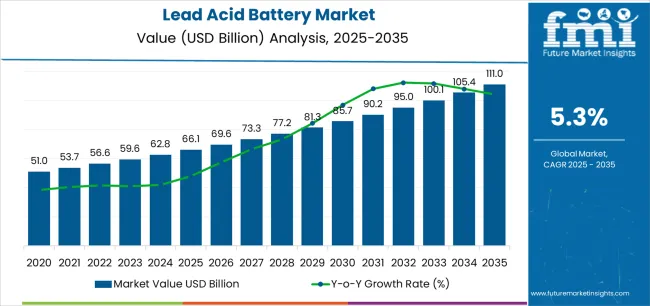
Lead acid battery market value is expected to expand from USD 42.8 billion in 2026 to USD 58.2 billion by 2036. Demand is anticipated to register a 3.1% CAGR during the forecast period as automotive replacement cycles and industrial backup power needs continue. Flooded cell batteries are likely to lead with a 45.0% product type share in 2026. Automotive applications are projected to account for 65.0% share of the application segment in 2026.
Summary of the Lead Acid Battery Market
- Demand and Growth Drivers
- Automotive replacement cycles are expected to create steady demand for starting and ignition batteries across mature vehicle fleets.
- Industrial backup power needs are likely to lift VRLA and AGM battery use in telecom sites.
- Cost-sensitive buyers are anticipated to favor lead acid batteries for proven serviceability and established recycling value.
- Product and Segment View
- Flooded cell batteries are expected to lead the product type segment through standard SLI use.
- VRLA and AGM batteries are likely to gain preference in backup power sites requiring sealed operation.
- Automotive applications are anticipated to keep the largest share as conventional vehicles require 12-volt battery systems.
- Geography and Competitive Outlook
- India is expected to post the fastest country-level CAGR through 2036 as vehicle output and telecom rollout expand.
- China is likely to keep the largest value base through its vehicle parc and backup power installations.
- Manufacturers with recycling integration are anticipated to defend margins across lead sourcing and battery recovery cycles.
- Analyst Opinion
- Nikhil Kaitwade, serves as Principal Consultant for Automotive and Process Automation at FMI and suggests the following view.
- “Lead acid battery demand is expected to stay resilient as buyers balance cost pressure with proven performance across automotive and backup power use. Manufacturers with automated production and strong recycling systems are likely to protect margins as lead recovery rules grow stricter across key regions.”
- Lead Acid Battery Market Value Analysis
- Lead acid battery demand is moving from simple vehicle replacement toward broader backup power and circular production planning.
- Adoption is likely to rise as automotive fleets age and service centers replace standard starting batteries.
- Stationary power use is expected to expand through telecom sites and data centers requiring short-duration backup.
- Spending is anticipated to favor suppliers with recycling capacity and regional production near major battery buyers.
- Price discipline is expected to improve as automated assembly lowers unit cost across mature battery formats.
Key Takeaways, Market Size, and Forecast
- Global lead acid battery market value is expected to reach USD 42.8 billion in 2026.
- By 2036, global lead acid battery market value is projected to reach USD 58.2 billion.
- From 2026 to 2036, the market is anticipated to expand at a 3.1% CAGR worldwide.
- Flooded cell batteries are likely to account for 45.0% share of the product type segment in 2026.
- Automotive applications are expected to hold 65.0% share of the application segment in 2026 globally.
- India is projected to record the fastest country-level expansion at 4.1% CAGR through 2036 globally.
Lead Acid Battery Market Key Takeaways
| Metric | Value (USD Billion) |
|---|---|
| Market Size (2026) | USD 42.8 Billion |
| Forecast Value (2036) | USD 58.2 Billion |
| CAGR 2026 to 2036 | 3.1% |
Source: Future Market Insights (FMI) analysis, based on proprietary forecasting model and primary research
What Factors Are Propelling Adoption of Lead Acid Battery Market?
Primary adoption drivers center on cost advantages and proven reliability in established applications. FMI opines that automotive manufacturers continue specifying lead acid batteries for starting, lighting, and ignition systems due to cold-weather performance characteristics and manufacturing cost structures that remain 60-70% lower than lithium alternatives.
Legislative drivers include the European Battery Directive amendments implemented in September 2025, mandating extended producer responsibility for battery lifecycle management. These regulations favor lead acid technology due to established recycling infrastructure that already processes 98% of used lead acid batteries in developed markets. The United States Environmental Protection Agency updated battery handling guidelines in November 2025, streamlining collection procedures for automotive service centers.
Technology adoption drivers focus on enhanced manufacturing processes rather than fundamental chemistry changes. Advanced grid casting techniques introduced by major manufacturers in 2025 improved cycle life by 15-20% while maintaining cost advantages. Energy storage systems market growth in renewable applications has created new demand segments where lead acid batteries serve as cost-effective solutions for short-duration storage requirements.
Industrial applications drive sustained demand through backup power system requirements in telecommunications infrastructure. The International Monetary Fund projects global growth at 3.3% for 2026 and 3.2% for 2027, supporting industrial equipment investment that relies on reliable power backup solutions.
How Is the Lead Acid Battery Market Segmented?
The lead acid battery market is segmented by product type, construction type, application, end use, and region to reflect the diverse operating environments in which these batteries are deployed. By product type, the market includes starting, lighting and ignition batteries, deep cycle batteries, valve regulated lead acid batteries, flooded cell batteries, and absorbed glass mat batteries that serve automotive and stationary requirements. By construction type, the market is divided into flooded and valve regulated configurations, each aligned with specific maintenance and performance needs. By application, demand spans automotive, industrial equipment, telecommunications backup, renewable energy storage, and uninterruptible power supply systems. By end use, adoption is led by passenger vehicles and commercial fleets, followed by telecom infrastructure, data centers, utilities, and material handling operations.
FMI analysis suggests that while new chemistries are gaining visibility, the structural core of the market remains anchored in automotive replacement cycles and industrial backup reliability. This segmentation highlights a dual-track market where vehicle starting systems provide scale and recurring demand, while stationary and telecom applications provide stability and long-term infrastructure depth.
Why Does Automotive Segment Hold a Dominant Share?
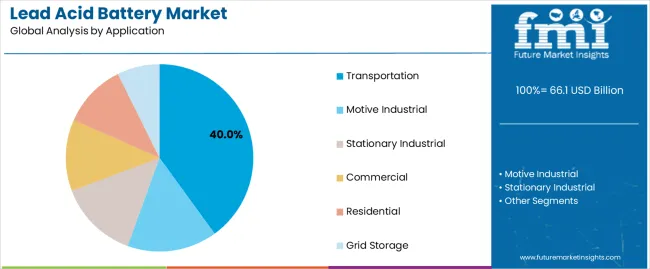
The automotive segment commands approximately 65% market share due to universal starting battery requirements across conventional vehicle production. In February 2026, Ford Motor Company reported maintaining lead acid specifications for 12-volt systems across its entire conventional vehicle lineup, representing over 2.1 million units annually. General Motors announced in January 2026 that lead acid batteries remain standard equipment for starting applications in hybrid vehicle architectures, supporting dual-battery system designs.
Why Do Industrial Applications Generate Consistent Demand?
Industrial applications account for 22% market share through telecommunications backup power and uninterruptible power supply installations. Verizon Communications disclosed in December 2025 that network infrastructure expansion required 180,000 additional backup battery units, predominantly lead acid technology. Amazon Web Services confirmed in March 2026 that data center backup systems utilize lead acid batteries for short-duration power bridging applications.
Why Is Stationary Storage Segment Experiencing Growth?
Stationary storage represents 13% market share with accelerating growth in renewable energy integration projects. The renewable energy market expansion drives demand for cost-effective grid stabilization solutions where lead acid batteries provide economic advantages for specific duty cycles and duration requirements.
What Trends Are Shaping Industry Evolution?
Consumer psychology shifts toward total cost ownership evaluation rather than initial purchase price comparisons have benefited lead acid battery adoption in commercial applications. Fleet operators increasingly recognize lifecycle cost advantages when factoring in recycling value recovery and established service infrastructure availability.
Material innovation focuses on lead alloy composition optimization and separator technology improvements that extend operational life without fundamental chemistry changes. Johnson Controls announced in January 2026 the introduction of enhanced calcium-lead alloys that improve deep-cycle performance for industrial applications. In February 2026, East Penn Manufacturing reported that new separator materials increased battery life by 18% in stationary applications.
Digital transformation in the energy storage sector has introduced smart battery monitoring systems that utilize IoT to optimize charging profiles and accurately predict replacement timing. In late 2025, industry leaders like Clarios and EnerSys expanded their IoT-enabled platforms, such as the Smart AGM and Wi-iQ systems.
Supply chain evolution emphasizes regional production and recycling integration to reduce transportation costs and environmental impact. The battery recycling market benefits from lead acid technology's mature recovery processes that extract 99% of lead content for reuse in new battery production.
How Will Lead Acid Battery Market Expansion Unfold Across Key Global Regions?
Regional expansion patterns reflect automotive production concentration and industrial infrastructure development priorities. China maintains growth at 2.8% CAGR, the United States projects 3.2% CAGR, India demonstrates 4.1% CAGR, Germany shows 2.9% CAGR, and Brazil anticipates 3.7% CAGR through 2036.
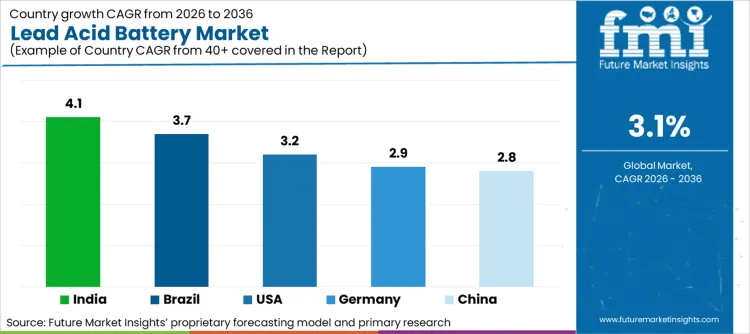
| Country | CAGR (through 2036) |
|---|---|
| China | 2.8% |
| United States | 3.2% |
| India | 4.1% |
| Germany | 2.9% |
| Brazil | 3.7% |
Lead Acid Battery Market Regional CAGR (2026 to 2036) / Source: FMI analysis
How Is China Driving 2.8% Growth in Lead Acid Battery Market?
China's lead acid battery market expansion reflects automotive production stability and industrial power infrastructure requirements. In January 2026, CAAM reported that China's vehicle production hit a record 34.5 million units in 2025. With a domestic fleet exceeding 300 million, replacement demand for SLI batteries remains massive. Simultaneously, State Grid announced a record annual investment of 800 billion yuan through 2030. While newer chemistries are growing, lead-acid technology remains the cornerstone for grid backup due to its superior safety and cost-efficiency in large-scale stationary applications. Manufacturing consolidation continues as leading producers optimize production efficiency through advanced automation systems.
In December 2025, Tianneng Battery Group reached a major milestone in its global expansion with the commencement of operations at its Vietnam Factory Phase II in Hoang Mai. This facility enhances the group's manufacturing support for the Asia-Pacific market, focusing on high-performance power batteries and UPS energy storage. Simultaneously, the continued densification of China's 5G network, which reached 4.8 million base stations by early 2026, is driving sustained demand for resilient backup power. Industry forecasts indicate the global telecom tower power system market will expand at a CAGR of 9.53% through 2031, fueled by the need for advanced battery storage to ensure 5G network uptime. Environmental regulations implemented in November 2025 mandate 95% lead recovery rates from used batteries, strengthening the circular economy approach that benefits established lead acid recycling networks.
How is the United States Driving 3.2% Growth in the lead acid battery market?
United States market growth stems from automotive aftermarket demand and renewable energy storage integration projects. In early 2026, MEMA and S&P Global reported the average USA vehicle age reached a record 12.9 years, driving massive replacement battery demand for 289 million vehicles in operation. Conversely, Tesla reaffirmed its commitment to lithium-ion technology in January 2026, launching USA-made solar panels for its LFP-based Powerwall 3, further displacing lead-acid solutions in the residential grid-tie market. Industrial applications expand through data center construction and telecommunications infrastructure upgrades across rural markets. American Tower Corporation disclosed in December 2025 that network densification projects require 95,000 additional backup battery installations over 24 months. Manufacturing reshoring initiatives support domestic production capacity expansion. East Penn Manufacturing continues to modernise its Pennsylvania facilities, building on 2025 efforts to expand its Deka product lines. Simultaneously, the Inflation Reduction Act provides a 30% Investment Tax Credit for energy storage through 2032. This incentive includes lead-acid systems exceeding 3kWh, making them a cost-effective choice for industrial backup power and applications meeting utility-standard 4-hour discharge benchmarks.
How Is India Driving 4.1% Growth in Lead Acid Battery Market?
India's accelerated growth reflects automotive sector expansion and rural electrification programs requiring reliable energy storage solutions. In January 2026, SIAM reported that India's total vehicle production for the calendar year 2025 reached a record 33.19 million units, driven by a 5% growth in passenger vehicles. Simultaneously, Bharti Airtel continued its aggressive 5G network expansion in early 2026, leveraging lithium-ion and solar-hybrid backup solutions to enhance grid resilience and meet green energy targets. Supporting this technological shift, Exide Industries advanced its lithium-ion manufacturing capabilities, with its Gujarat-based facility focusing on battery packs and modules to cater to the growing demand for EV and stationary energy storage solutions. Rural electrification initiatives drive industrial applications as distributed power systems require cost-effective backup solutions. Power Grid Corporation is modernizing its backup systems by integrating advanced VRLA and Lithium-ion battery technologies. These upgrades are part of a broader strategy to support India's growing renewable energy capacity, which reached a transformation milestone of over 540,000 MVA in February 2026. Government initiatives promoting energy storage under the National Solar Mission include lead acid solutions for applications requiring proven reliability and established maintenance infrastructure.
How is Germany Driving 2.9% Growth in the lead acid battery market?
Germany’s market development is centered on industrial applications and renewable energy integration supporting its Energiewende strategy. In early 2026, Volkswagen Group confirmed that despite aggressive electrification, its conventional and hybrid vehicle production continues to utilize lead-acid specifications for 12V starting systems across more than 9 million annual units globally. Similarly, Deutsche Telekom reported in February 2026 that its 5G network densification requires a significant expansion of backup power, with VRLA (Valve Regulated Lead Acid) remainng a core technology for its reliability in 5G infrastructure. Manufacturing optimization in Germany now emphasizes circular economy principles mandated by the EU Battery Regulation. Clarios (formerly Johnson Controls Power Solutions) reported in late 2025 that its German facilities achieved a 99% lead recovery rate, maintaining a closed-loop system where nearly all lead-acid battery components are recycled into new products. Furthermore, renewable energy storage is expanding as wind and solar projects require short-duration backup; in early 2026, utility leader E.ON highlighted the role of distributed lead-acid systems in grid stabilization projects. Industrial demand also continues to grow through data center expansion, where lead-acid technology is prioritized for its proven reliability in mission-critical, high-stakes environments.
How Is Brazil Driving 3.7% Growth in Lead Acid Battery Market?
Brazil's market expansion reflects automotive production recovery and telecommunications infrastructure development across urban and rural markets. In January 2026, ANFAVEA reported that Brazil's 2025 production hit 2.33 million vehicles, driving massive battery demand for a national fleet exceeding 61 million units. Simultaneously, Telefónica Brasil is expanding its 5G network, primarily utilizing lead-acid technology for backup power due to its cost-efficiency, thermal stability in tropical climates, and Brazil’s highly developed recycling ecosystem. Mining industry applications drive industrial segment growth as remote operations require reliable power backup solutions. Vale confirmed in December 2025 that equipment electrification projects include 15,000 backup battery units for critical mining operations. Manufacturing capacity expansion supports regional market development through local production initiatives. Government infrastructure programs supporting rural connectivity and industrial development create sustained demand for proven energy storage technologies that offer established maintenance networks and cost-effective total ownership economics in challenging operating environments.
What Strategic Moves Are Defining the Competitive Landscape?
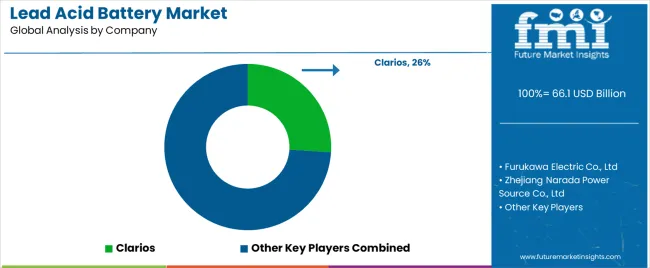
Competitive dynamics emphasize manufacturing efficiency optimization and recycling integration rather than fundamental technology shifts. Leading manufacturers focus on cost reduction through automation while maintaining product reliability standards that established lead acid technology's market position across automotive and industrial applications.
Manufacturing strategies prioritize regional production capabilities and supply chain integration that reduces transportation costs while improving delivery responsiveness. Companies invest in advanced grid casting systems and automated assembly processes that enhance production efficiency without requiring substantial capital equipment replacement compared to alternative battery technologies.
Somik Lall, Senior Adviser to the World Bank Group Chief Economist, and Director of the 2024 World Development Report, noted: 'The prospect for these middle-income countries is not promising. Over the last 30 years, only 34 middle-income economies have been able to transition from middle-income to high-income. The rest are stuck in a middle-income trap.' This economic reality supports continued demand for cost-effective energy storage solutions in developing markets where lead acid batteries maintain significant advantages.
Recent Developments:
- In January 2026, Clarios (formerly Johnson Controls Power Solutions) completed a major expansion of its Toledo, Ohio facility. This investment focused on automated production lines for Absorbent Glass Mat (AGM) batteries to meet the surging demand for 12V auxiliary power in electric and start-stop vehicles across North America.
- In February 2026, Exide Technologies will finalize the integration of its newest European recycling centers, creating a fully closed-loop "circular economy" operation. This allows the company to recover up to 99% of lead from spent batteries at its facilities in Spain and Germany, directly feeding its manufacturing lines for new industrial and automotive units.
- In December 2025, Crown Battery completed its multimillion-dollar expansion at its Fremont, Ohio headquarters. This development specifically targeted the high-growth deep-cycle and renewable energy segments, increasing production capacity for heavy-duty lead-acid batteries used in floor care, material handling, and off-grid solar storage.
Key Players in Lead Acid Battery Market
- Johnson Controls International
- Exide Technologies
- East Penn Manufacturing
- Clarios
- GS Yuasa Corporation
- Enersys
- Crown Battery Corporation
- Trojan Battery Company
- C&D Technologies
- Fiamm Energy Technology
- Leoch International Technology
- Banner Batteries
What Is the Market Definition?
Lead acid battery market includes rechargeable electrochemical energy storage devices that utilize lead dioxide positive electrodes, metallic lead negative electrodes, and sulfuric acid electrolyte solutions to store and deliver electrical energy across automotive, industrial, and stationary applications.
Market inclusions incorporate starting, lighting, and ignition batteries for conventional vehicles, deep-cycle batteries for industrial equipment, valve-regulated lead acid batteries for backup power systems, flooded cell batteries for stationary applications, and absorbed glass mat batteries for specialized requirements. The scope includes original equipment manufacturer supplies and aftermarket replacement products across all capacity ranges and voltage configurations.
Market exclusions eliminate lithium-ion batteries, nickel-metal hydride batteries, solid-state battery technologies, and other alternative electrochemical storage systems. The analysis excludes battery components sold separately, battery chargers and testing equipment, and recycling services not directly integrated with battery production operations.
Scope of Report
| Items | Values |
|---|---|
| Quantitative Units | USD 42.8 Billion (2026) |
| Product Type | Starting, Lighting, Ignition (SLI) Batteries; Deep Cycle Batteries; Valve Regulated Lead Acid (VRLA) Batteries; Flooded Cell Batteries; Absorbent Glass Mat (AGM) Batteries |
| Application Type | Automotive; Industrial Equipment; Telecommunications Backup Power; Renewable Energy Storage; Uninterruptible Power Supply (UPS); Data Centers |
| Construction Type | Flooded Lead Acid; Valve Regulated Lead Acid (VRLA); Gel Batteries; AGM Batteries |
| End Use | Passenger Vehicles; Commercial Vehicles; Two and Three Wheelers; Telecom Infrastructure; Data Centers; Utilities and Grid Storage; Mining and Material Handling |
| Distribution Channel | OEM Supply; Aftermarket Replacement; Industrial System Integrators |
| Regions Covered | North America; Latin America; Western Europe; Eastern Europe; East Asia; South Asia Pacific; Middle East and Africa |
| Countries Covered | United States; Canada; Mexico; Brazil; Germany; United Kingdom; France; Italy; Spain; China; Japan; South Korea; India; ASEAN; Kingdom of Saudi Arabia; United Arab Emirates; South Africa; Other GCC; Other African Union |
| Key Companies Profiled | Johnson Controls International; Clarios; Exide Technologies; East Penn Manufacturing; GS Yuasa Corporation; EnerSys; Crown Battery Corporation; Trojan Battery Company; C&D Technologies; FIAMM Energy Technology; Leoch International Technology; Banner Batteries |
| Additional Attributes | Revenue analysis by product type and application; evaluation of EU Battery Regulation 2023/1542 compliance impact; assessment of automotive replacement cycles and fleet age influence; analysis of recycling integration and circular economy economics; competitive positioning based on regional manufacturing footprint, recycling recovery rates, and cost optimization capability |
Lead Acid Battery Market Categorized by Segments
By Product Type:
- Starting, Lighting, Ignition (SLI) Batteries
- Deep Cycle Batteries
- Valve Regulated Lead Acid (VRLA) Batteries
- Flooded Cell Batteries
By Application Type:
- Automotive
- Industrial
- Telecommunications
- Renewable Energy Storage
- Uninterruptible Power Supply
By Region:
- North America
- Europe
- Asia Pacific
- Latin America
- Middle East and Africa
Bibliography
- International Monetary Fund. (2026, January). World Economic Outlook Update. International Monetary Fund.
- European Parliament and Council. (2023). Regulation (EU) 2023/1542 concerning batteries and waste batteries, amending Directive 2008/98/EC and Regulation (EU) 2019/1020. Official Journal of the European Union.
- International Lead Association (ILA). (2025). Global lead and battery market report 2024-2025: Production, consumption, and recycling statistics. London, UK.
Frequently Asked Questions
How large is the demand for Lead Acid Battery in the global market in 2026?
Demand for Lead Acid Battery in the global market is estimated to be valued at USD 69.6 billion in 2026.
What will be the market size of Lead Acid Battery in the global market by 2036?
Market size for Lead Acid Battery is projected to reach USD 116.7 billion by 2036.
What is the expected demand growth for Lead Acid Battery in the global market between 2026 and 2036?
Demand for Lead Acid Battery in the global market is expected to grow at a CAGR of 5.3% between 2026 and 2036.
Which Product Type is poised to lead global sales by 2026?
Flooded Batteries are expected to lead with approximately 45% market share in 2026 due to their cost-effectiveness in standard SLI applications.
How significant is the role of Transportation Application in driving Lead Acid Battery adoption in 2026?
Transportation represents a critical segment, projected to hold a substantial 40% share of the total market in 2026 as vehicle replacement cycles drive volume.
What is driving demand in India?
Growth is driven by a 9.1% recovery in two-wheeler sales and government investments in commercial fleet modernization like the PM e-Bus Sewa scheme.
What compliance standards or regulations are referenced for India?
The PM e-Bus Sewa and FAME schemes are referenced as key regulatory benchmarks driving commercial adoption.
What is the India growth outlook in this report?
India is projected to grow at a CAGR of 7.2% during 2026 to 2036.
Why is North America described as a priority region in this report?
North America is prioritized due to its mature circular economy and high vehicle ownership rates that drive consistent aftermarket value.
What type of demand dominates in North America?
Replacement demand supported by a 99% recycling rate dominates regional consumption.
What is China growth outlook in this report?
China is projected to expand at a CAGR of 6.2% during 2026 to 2036.
Does the report cover Japan in its regional analysis?
Yes, Japan is included within Asia Pacific under the regional scope of analysis.
What are the sources referred to for analyzing Japan?
Official statistics from the US International Trade Administration and Japanese automotive data are cited as primary reference sources.
What is the main demand theme linked to Japan in its region coverage?
Demand is associated with the sustained popularity of hybrid vehicles requiring 12V auxiliary support.
Does the report cover Germany in its regional analysis?
Yes, Germany is included within Europe under the regional coverage framework.
What is the main Germany related demand theme in its region coverage?
Export-driven automotive production and stable domestic replacement needs are emphasized.
Which product formats or configurations are strategically important for Asia Pacific supply chains?
Flooded batteries remain strategically important due to their lower cost, while AGM is growing in premium vehicle segments.
What is Lead Acid Battery and what is it mainly used for?
A Lead Acid Battery is a rechargeable energy storage device used primarily for starting, lighting, and ignition in vehicles and standby power in industry.
What does Lead Acid Battery mean in this report?
Lead Acid Battery refers to the global trade and industrial consumption of flooded, AGM, and Gel battery technologies.
What is included in the scope of this Lead Acid Battery report?
Scope covers lead-based batteries by type, applications in transportation and industry, and sales through OEM and aftermarket channels.
What is excluded from the scope of this report?
Lithium-ion, nickel-based batteries, and non-rechargeable primary cells are excluded unless part of a hybrid lead-acid system.
What does market forecast mean on this page?
Market forecast represents a model based projection built on defined assumptions for strategic planning purposes.
How does FMI build and validate the Lead Acid Battery forecast?
Forecast is developed using bottom-up modeling validated through vehicle registration data, production benchmarks, and primary industry interviews.
What does zero reliance on speculative third party market research mean here?
Primary interviews and verifiable public datasets from bodies like SIAM and EPA are used instead of unverified syndicated market estimates.
Preview the report firsthand - request a free sample
Get SampleGet the brochure for pricing and purchase details.
Get PDFTable of Content
- Executive Summary
- Global Market Outlook
- Demand-side Trends
- Supply-side Trends
- Technology Roadmap Analysis
- Analysis and Recommendations
- Market Overview
- Market Coverage / Taxonomy
- Market Definition / Scope / Limitations
- Research Methodology
- Chapter Orientation
- Analytical Lens and Working Hypotheses
- Market Structure, Signals, and Trend Drivers
- Benchmarking and Cross-market Comparability
- Market Sizing, Forecasting, and Opportunity Mapping
- Research Design and Evidence Framework
- Desk Research Programme (Secondary Evidence)
- Company Annual and Sustainability Reports
- Peer-reviewed Journals and Academic Literature
- Corporate Websites, Product Literature, and Technical Notes
- Earnings Decks and Investor Briefings
- Statutory Filings and Regulatory Disclosures
- Technical White Papers and Standards Notes
- Trade Journals, Industry Magazines, and Analyst Briefs
- Conference Proceedings, Webinars, and Seminar Materials
- Government Statistics Portals and Public Data Releases
- Press Releases and Reputable Media Coverage
- Specialist Newsletters and Curated Briefings
- Sector Databases and Reference Repositories
- FMI Internal Proprietary Databases and Historical Market Datasets
- Subscription Datasets and Paid Sources
- Social Channels, Communities, and Digital Listening Inputs
- Additional Desk Sources
- Expert Input and Fieldwork (Primary Evidence)
- Primary Modes
- Qualitative Interviews and Expert Elicitation
- Quantitative Surveys and Structured Data Capture
- Blended Approach
- Why Primary Evidence is Used
- Field Techniques
- Interviews
- Surveys
- Focus Groups
- Observational and In-context Research
- Social and Community Interactions
- Stakeholder Universe Engaged
- C-suite Leaders
- Board Members
- Presidents and Vice Presidents
- R&D and Innovation Heads
- Technical Specialists
- Domain Subject-matter Experts
- Scientists
- Physicians and Other Healthcare Professionals
- Governance, Ethics, and Data Stewardship
- Research Ethics
- Data Integrity and Handling
- Primary Modes
- Tooling, Models, and Reference Databases
- Desk Research Programme (Secondary Evidence)
- Data Engineering and Model Build
- Data Acquisition and Ingestion
- Cleaning, Normalisation, and Verification
- Synthesis, Triangulation, and Analysis
- Quality Assurance and Audit Trail
- Market Background
- Market Dynamics
- Drivers
- Restraints
- Opportunity
- Trends
- Scenario Forecast
- Demand in Optimistic Scenario
- Demand in Likely Scenario
- Demand in Conservative Scenario
- Opportunity Map Analysis
- Product Life Cycle Analysis
- Supply Chain Analysis
- Investment Feasibility Matrix
- Value Chain Analysis
- PESTLE and Porter’s Analysis
- Regulatory Landscape
- Regional Parent Market Outlook
- Production and Consumption Statistics
- Import and Export Statistics
- Market Dynamics
- Global Market Analysis 2021 to 2025 and Forecast, 2026 to 2036
- Historical Market Size Value (USD billion) Analysis, 2021 to 2025
- Current and Future Market Size Value (USD billion) Projections, 2026 to 2036
- Y-o-Y Growth Trend Analysis
- Absolute $ Opportunity Analysis
- Global Market Pricing Analysis 2021 to 2025 and Forecast 2026 to 2036
- Global Market Analysis 2021 to 2025 and Forecast 2026 to 2036, By Application
- Introduction / Key Findings
- Historical Market Size Value (USD billion) Analysis By Application , 2021 to 2025
- Current and Future Market Size Value (USD billion) Analysis and Forecast By Application , 2026 to 2036
- Automotive
- Industrial
- Telecommunications
- Renewable Energy Storage
- Automotive
- Y-o-Y Growth Trend Analysis By Application , 2021 to 2025
- Absolute $ Opportunity Analysis By Application , 2026 to 2036
- Global Market Analysis 2021 to 2025 and Forecast 2026 to 2036, By Region
- Introduction
- Historical Market Size Value (USD billion) Analysis By Region, 2021 to 2025
- Current Market Size Value (USD billion) Analysis and Forecast By Region, 2026 to 2036
- North America
- Latin America
- Western Europe
- Eastern Europe
- East Asia
- South Asia and Pacific
- Middle East & Africa
- Market Attractiveness Analysis By Region
- North America Market Analysis 2021 to 2025 and Forecast 2026 to 2036, By Country
- Historical Market Size Value (USD billion) Trend Analysis By Market Taxonomy, 2021 to 2025
- Market Size Value (USD billion) Forecast By Market Taxonomy, 2026 to 2036
- By Country
- USA
- Canada
- Mexico
- By Application
- By Country
- Market Attractiveness Analysis
- By Country
- By Application
- Key Takeaways
- Latin America Market Analysis 2021 to 2025 and Forecast 2026 to 2036, By Country
- Historical Market Size Value (USD billion) Trend Analysis By Market Taxonomy, 2021 to 2025
- Market Size Value (USD billion) Forecast By Market Taxonomy, 2026 to 2036
- By Country
- Brazil
- Chile
- Rest of Latin America
- By Application
- By Country
- Market Attractiveness Analysis
- By Country
- By Application
- Key Takeaways
- Western Europe Market Analysis 2021 to 2025 and Forecast 2026 to 2036, By Country
- Historical Market Size Value (USD billion) Trend Analysis By Market Taxonomy, 2021 to 2025
- Market Size Value (USD billion) Forecast By Market Taxonomy, 2026 to 2036
- By Country
- Germany
- UK
- Italy
- Spain
- France
- Nordic
- BENELUX
- Rest of Western Europe
- By Application
- By Country
- Market Attractiveness Analysis
- By Country
- By Application
- Key Takeaways
- Eastern Europe Market Analysis 2021 to 2025 and Forecast 2026 to 2036, By Country
- Historical Market Size Value (USD billion) Trend Analysis By Market Taxonomy, 2021 to 2025
- Market Size Value (USD billion) Forecast By Market Taxonomy, 2026 to 2036
- By Country
- Russia
- Poland
- Hungary
- Balkan & Baltic
- Rest of Eastern Europe
- By Application
- By Country
- Market Attractiveness Analysis
- By Country
- By Application
- Key Takeaways
- East Asia Market Analysis 2021 to 2025 and Forecast 2026 to 2036, By Country
- Historical Market Size Value (USD billion) Trend Analysis By Market Taxonomy, 2021 to 2025
- Market Size Value (USD billion) Forecast By Market Taxonomy, 2026 to 2036
- By Country
- China
- Japan
- South Korea
- By Application
- By Country
- Market Attractiveness Analysis
- By Country
- By Application
- Key Takeaways
- South Asia and Pacific Market Analysis 2021 to 2025 and Forecast 2026 to 2036, By Country
- Historical Market Size Value (USD billion) Trend Analysis By Market Taxonomy, 2021 to 2025
- Market Size Value (USD billion) Forecast By Market Taxonomy, 2026 to 2036
- By Country
- India
- ASEAN
- Australia & New Zealand
- Rest of South Asia and Pacific
- By Application
- By Country
- Market Attractiveness Analysis
- By Country
- By Application
- Key Takeaways
- Middle East & Africa Market Analysis 2021 to 2025 and Forecast 2026 to 2036, By Country
- Historical Market Size Value (USD billion) Trend Analysis By Market Taxonomy, 2021 to 2025
- Market Size Value (USD billion) Forecast By Market Taxonomy, 2026 to 2036
- By Country
- Kingdom of Saudi Arabia
- Other GCC Countries
- Turkiye
- South Africa
- Other African Union
- Rest of Middle East & Africa
- By Application
- By Country
- Market Attractiveness Analysis
- By Country
- By Application
- Key Takeaways
- Key Countries Market Analysis
- USA
- Pricing Analysis
- Market Share Analysis, 2025
- By Application
- Canada
- Pricing Analysis
- Market Share Analysis, 2025
- By Application
- Mexico
- Pricing Analysis
- Market Share Analysis, 2025
- By Application
- Brazil
- Pricing Analysis
- Market Share Analysis, 2025
- By Application
- Chile
- Pricing Analysis
- Market Share Analysis, 2025
- By Application
- Germany
- Pricing Analysis
- Market Share Analysis, 2025
- By Application
- UK
- Pricing Analysis
- Market Share Analysis, 2025
- By Application
- Italy
- Pricing Analysis
- Market Share Analysis, 2025
- By Application
- Spain
- Pricing Analysis
- Market Share Analysis, 2025
- By Application
- France
- Pricing Analysis
- Market Share Analysis, 2025
- By Application
- India
- Pricing Analysis
- Market Share Analysis, 2025
- By Application
- ASEAN
- Pricing Analysis
- Market Share Analysis, 2025
- By Application
- Australia & New Zealand
- Pricing Analysis
- Market Share Analysis, 2025
- By Application
- China
- Pricing Analysis
- Market Share Analysis, 2025
- By Application
- Japan
- Pricing Analysis
- Market Share Analysis, 2025
- By Application
- South Korea
- Pricing Analysis
- Market Share Analysis, 2025
- By Application
- Russia
- Pricing Analysis
- Market Share Analysis, 2025
- By Application
- Poland
- Pricing Analysis
- Market Share Analysis, 2025
- By Application
- Hungary
- Pricing Analysis
- Market Share Analysis, 2025
- By Application
- Kingdom of Saudi Arabia
- Pricing Analysis
- Market Share Analysis, 2025
- By Application
- Turkiye
- Pricing Analysis
- Market Share Analysis, 2025
- By Application
- South Africa
- Pricing Analysis
- Market Share Analysis, 2025
- By Application
- USA
- Market Structure Analysis
- Competition Dashboard
- Competition Benchmarking
- Market Share Analysis of Top Players
- By Regional
- By Application
- Competition Analysis
- Competition Deep Dive
- Johnson Controls International
- Overview
- Product Portfolio
- Profitability by Market Segments (Product/Age /Sales Channel/Region)
- Sales Footprint
- Strategy Overview
- Marketing Strategy
- Product Strategy
- Channel Strategy
- Exide Technologies
- East Penn Manufacturing
- Clarios
- Johnson Controls International
- Competition Deep Dive
- Assumptions & Acronyms Used


