

- Market Size (2026)
- USD 188.3 Mn
- Forecast (2036)
- USD 410.3 Mn
- CAGR (2026 to 2036)
- 8.1%
How big is Golden Syrup & Treacle Market in 2026?
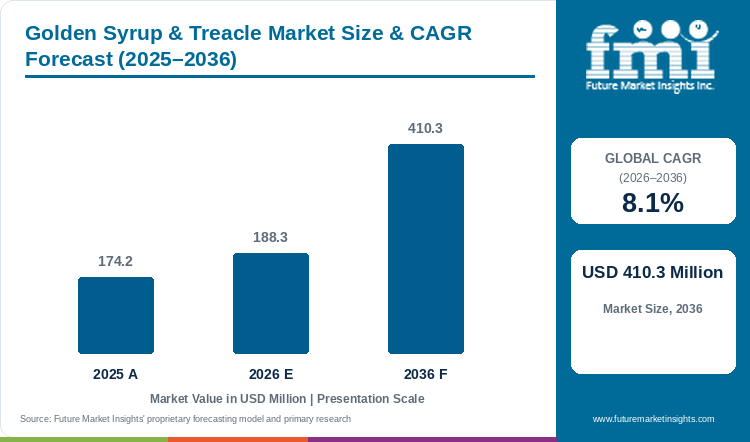
The golden syrup & treacle market demonstrated steady progress from USD 174.2 million in 2025 to USD 188.3 million in 2026, building toward a targeted valuation of USD 410.3 million by 2036 at a CAGR of 8.1%. Standard Syrup leads type with a 40.0% share in 2026, Powder / Dry commands 38.0% in form, and Bread & Rolls account for 37.0% of application.
In April 2025, Ragus published updated industrial baking specifications confirming pure cane black treacle can replace synthetic Class III caramel colorings without any change to tunnel-oven schedules, moving an old biscuit ingredient into the clean-label lane [1]. The global golden syrup & treacle market was valued at USD 174.2 million in 2025 and is estimated to reach USD 188.3 million in 2026. The market is projected to reach USD 410.3 million by 2036, expanding at a compound annual growth rate (CAGR) of 8.1% between 2026 and 2036. Standard syrup is projected to capture 40.0% of 2026 demand, as classic 80-degree Brix amber syrup and culinary black treacle match established biscuit and flapjack humectancy targets reformulation teams cannot hit with novel fibers [2]. Demand growth runs ahead of the invert sugar market at 4.6% CAGR because cane syrups carry both the functional humectant job and the ingredient-list heritage that invert sugar sells anonymously [3]. The supplier base is consolidating around that position, with Tate & Lyle reporting GBP 1,736 million revenue following its CP Kelco combination in June 2026 [19] and Sudzucker detailing EUR 2,216 million in Special Products for industrial baking customers [20]. Biscuit makers facing added-sugar caps buy the syrup that holds flapjack moisture without a synthetic coloring, and refiners holding cane supply under those caps set the price through 2036.
Key Market Trends & Insights
- By type: Standard Syrup is projected to capture 40.0% in 2026 because classic 80° Brix amber golden syrup and culinary black treacle match established biscuit and bread specifications.
- By form: Powder / Dry formats are estimated to command 38.0% in 2026 as cake-mix and bread-improver plants adopt co-dried treacle and golden syrup powders at higher unit value per kilogram.
- By application: Bread & Rolls are expected to concentrate 37.0% in 2026 because 1.5% to 4.0% black treacle additions impart natural mahogany crumb color and mask whole-wheat bran bitterness.
- By claim: Conventional grades are forecast to generate 54.0% in 2026 owing to staple pan-bread and ginger-biscuit contracts that prioritize ICUMSA color consistency and bulk tanker pricing.
- By sales channel: Direct to Industrial Bakeries is anticipated to account for 55.0% in 2026 through heated 25-ton road tanker deliveries and custom IBC or Bag-in-Box refinery contracts.
Regional Highlights
- Top national expansion: The UAE is projected to lead evaluated national markets at a 9.4% CAGR through 2036 as more than 570 local food processors and hotel pastry commissaries expand Commonwealth and international bakery lines.
- Broader country progression: Saudi Arabia is expected to expand at a 9.1% CAGR ahead of South Korea at 8.8% and the USA at 8.5%, while Japan is forecast to advance at a 7.2% CAGR.
Market Size & Forecast
Table 1: Market Size and Forecast for the Golden Syrup & Treacle Market (USD million and CAGR percentage), 2025 to 2036
| Metric | Value |
|---|---|
| 2025 Market Size | USD 174.2 million |
| Estimated Market Size in 2026 | USD 188.3 million |
| Projected Market Size by 2036 | USD 410.3 million |
| CAGR, 2026 to 2036 | 8.1% |
| Added Revenue, 2026 to 2036 | USD 222.0 million |
Industrial bread and morning-goods manufacturers face growing pressure to cut total declared sugars while preserving the soft crumb elasticity and caramel aroma traditionally provided by refiners' syrup. Simply lowering liquid golden syrup inclusion causes dough dehydration, reduced loaf specific volume, and pale crust appearance. In March 2025, cereal chemistry research published in the Journal of the Science of Food and Agriculture demonstrated that combining oligosaccharides and sodium carboxymethyl cellulose with D-allulose in sugar-reduced bread restores loaf specific volume and crumb softness while moderating Maillard crust browning [2]. so specialty refiners are formulating blended golden syrups with liquid sugar so automated plant bakeries meet retail sugar caps without sacrificing shelf life.
Refinery-Throughput and Bakery-Dosage Sizing
Table 2: Refinery-Throughput and Bakery-Dosage Sizing for the Golden Syrup & Treacle Market (USD million and operational ranges), 2025 to 2036
| Metric | 2025 | 2026 | 2036 |
|---|---|---|---|
| Market size (USD million) | 174.2 | 188.3 | 410.3 |
| Commercial bakery golden syrup & treacle volume (thousand MT) | 97.0 to 99.0 | 101.5 to 103.5 | 180.0 to 185.0 |
| Finished bakery & snack tonnage dosed (million MT) | 2.4 to 2.8 | 2.5 to 2.9 | 4.4 to 5.1 |
| Average blended liquid & co-dried unit price (USD/kg) | 1.7 to 1.8 | 1.8 to 1.9 | 2.2 to 2.3 |
Operational note: Volume and unit-price ranges reconcile 80° Brix bulk liquid golden syrup, culinary black treacle, and higher-value co-dried treacle/invert premix powders across commercial bread and biscuit lines.
Cane and beet refineries control partial acid or invertase-enzyme hydrolysis to keep golden syrup at a balanced glucose-fructose-sucrose ratio that resists crystallization in ambient storage tanks. Industrial biscuit and dark-bread bakers pair these standardized syrups with molasses to achieve repeatable water-activity depression across multi-week retail distribution.
Per Capita & Industrial Bakery Tanker Sizing
Table 3: Per Capita and Bakery Plant Spending Indicators for the Golden Syrup & Treacle Market (USD), 2025 to 2036
| Metric | 2025 | 2026 | 2036 |
|---|---|---|---|
| Global population base (million) | 8,200.0 | 8,300.0 | 9,000.0 |
| Spend per 1,000 people (USD) | 21.2 | 22.7 | 45.6 |
| Annual spend per bulk-contracted bakery plant (USD) | 18,500 to 22,000 | 19,800 to 23,500 | 36,000 to 42,500 |
| Direct industrial bakery tanker & IBC share (%) | 53.5% to 55.5% | 54.0% to 56.0% | 56.5% to 59.0% |
Table 4: Refinery & Bakery Procurement Indicators for the Golden Syrup & Treacle Market (USD and percentages), 2026
| Metric | Value | Institutional Reference Basis |
|---|---|---|
| Market size, 2026 | USD 188.3 million | 2026 global commercial bakery baseline |
| Direct to industrial bakeries revenue, 2026 | USD 103.6 million | 55.0% leading sales channel allocation |
| Standard Syrup type revenue, 2026 | USD 75.3 million | 40.0% leading type allocation |
| Powder / Dry form revenue, 2026 | USD 71.6 million | 38.0% leading form allocation |
Bulk syrup handling in winter climates requires balancing heated tanker logistics against the convenience of free-flowing co-dried molasses and golden-syrup powders. Plant engineers benchmark co-dried treacle against cane molasses and brown sugar to optimize dry-silo metering and eliminate unheated tote residue losses.
Analyst Perspective
"Industrial bakeries specify golden syrup and black treacle not simply as caloric sweeteners, but as multifunctional humectants and clean-label caramel colorants. Refiners and ingredient blenders that deliver co-dried free-flowing powders and rare-sugar-blended liquid syrups will capture high-margin reformulation contracts across global baking markets."
- Nandini Roy Choudhury, Principal Analyst at Future Market Insights
How is the golden syrup & treacle market segmented?
The golden syrup & treacle market is segmented by type, form, application, claim, and sales channel. Standard Syrup leads type at 40.0% in 2026, while Powder / Dry captures 38.0% of form and Bread & Rolls hold 37.0% of application.
By type: Standard Syrup, High-DE / Specialty, Organic, and Blended Systems.
By form: Powder / Dry, Liquid, Paste / Semi-Solid, and Granules / Pieces.
By application: Bread & Rolls, Cakes & Muffins, Biscuits & Cookies, Viennoiserie & Pastry, and Other Bakery & Snacks.
By claim: Conventional, Clean Label, Organic, and Non-GMO / Identity Preserved.
By sales channel: Direct to Industrial Bakeries, Ingredient Distributors, Foodservice & Artisan Supply, and Online B2B.
Why is Standard Syrup central to the Type category?
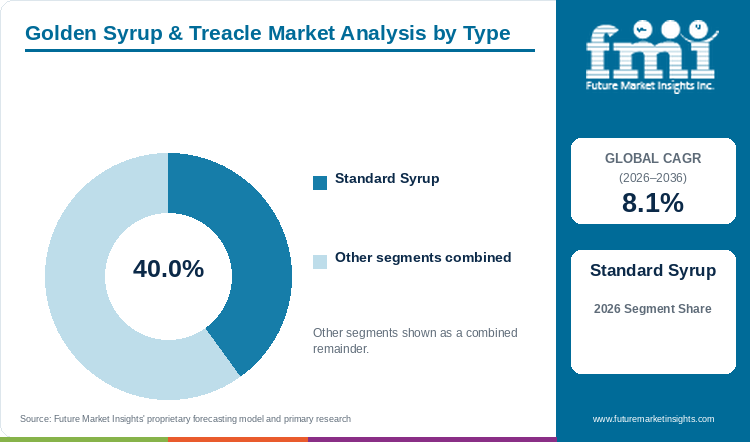
Standard Syrup is projected to capture 40.0% of type revenue in 2026 (USD 75.3 million) because established biscuit, flapjack, and dark-bread recipes rely on fixed Brix and inversion ratios.
Table 5: Type Share for the Golden Syrup & Treacle Market (percentage share), 2026
| Type | Share (2026) |
|---|---|
| Standard Syrup | 40.0% |
| Other Segments Combined | 60.0%* |
| Total | 100.0% |
*Note: Remaining type categories sum to 100.0% of 2026 commercial golden syrup & treacle revenue.
Table 6: Type Leadership and Market Growth for the Golden Syrup & Treacle Market (segment and CAGR percentage), 2026 to 2036
| Metric | Value |
|---|---|
| Global CAGR (2026 to 2036) | 8.1% |
| Leading Segment | Standard Syrup |
Large commercial bakeries favor standard 80° Brix amber golden syrup and standard culinary black treacle because quality-assurance teams can purchase against locked ICUMSA color, pH (4.8 to 5.5), and ash specifications. Meanwhile, high-DE / specialty grades (25.0%) and blended systems (21.0%) incorporating sugar substitutes allow exporters to prevent sugar bloom and lower net glycemic load in long-shelf-life cookies.
- Standard Syrup is projected to secure 40.0% of type revenue in 2026 by providing repeatable sucrose-to-invert equilibrium and authentic butterscotch or bittersweet molasses notes.
- Dough rheology research published in Food Research International in March 2025 confirmed that pairing oligosaccharides and D-allulose with traditional dough sweeteners preserves farinograph stability and yeast gas retention in reduced-sugar bakery runs [3].
How does Powder / Dry lead the Form classification?
Powder / Dry formats are estimated to command 38.0% of the form segment in 2026 (USD 71.6 million) due to premium unit realization and smooth dry-premix metering.
While bulk liquid golden syrup and treacle (35.0% revenue share) represent a larger share of raw metric tonnage, spray-dried and drum-dried golden-syrup and treacle powders command a 35% to 50% higher price per kilogram of dry solids. Co-drying viscous refiners' syrup onto starch or oat-fiber carriers eliminates trace-heated stainless pipework and 3% tote residue losses across commercial bakery products premix plants.
- Powder / Dry options are estimated to command 38.0% of the form segment in 2026 as dry cake-mix, gingerbread, and bread-improver plants automate pneumatic micro-dosing.
- Sensory evaluation published in Food Research International in January 2025 demonstrated that short-dough biscuits formulated with reduced sucrose and natural flavor-modulating sweeteners maintain dynamic consumer acceptance and crispness [4].
What supports Bread & Rolls within the Application category?
Bread & Rolls are expected to hold 37.0% of application sales in 2026 (USD 69.7 million) as dark rye, wholemeal, and artisan sourdough loaves replace synthetic caramel dyes.
In wholemeal and pumpernickel loaves or seeded burger buns, dosing 1.5% to 4.0% black treacle or dark golden syrup imparts a rich mahogany crumb hue while rounding out bitter whole-grain bran tannins. Application of culinary treacle allows industrial packaged bread brands to remove E150c and E150d ammonia caramel declarations while feeding yeast fermentation.
- Bread & Rolls are expected to hold 37.0% of application sales in 2026 because high-throughput plant bread lines consume continuous daily volumes for natural coloration and crumb softness.
- Microbiological research published in Microbiology Spectrum in March 2026 proved that balanced food-grade osmolytes and fermentable sugars protect Saccharomyces cerevisiae yeast fermentation performance under elevated dough salt stress [5].
Why does Conventional remain the largest Claim category?
Conventional grades are forecast to account for 54.0% of claim demand in 2026 (USD 101.7 million) because mainstream bread and biscuit tenders prioritize cost-effective bulk supply.
Standard cane and beet refiners' syrups already satisfy clean-label ingredient lists as 'golden syrup' or 'black treacle' without requiring expensive organic farm segregation. so conventional grades retain 54.0% share in staple bakery contracts, while dedicated clean-label (21.5%) and organic (13.0%) plus non-GMO identity-preserved cane syrups (11.5%) capture premium retail biscuit launches.
- Conventional is forecast to account for 54.0% of claim demand in 2026 as high-volume plant bakeries prioritize uninterrupted refinery tanker supply and stable ICUMSA color units.
- A September 2026 study in Nutrients on functional shortbread cookie reformulation confirmed that pairing natural botanical and syrup components with low-glycemic bulk sweeteners lowers glycemic load while preserving cookie texture [6].
Why is Direct to Industrial Bakeries the leading Sales Channel?
Direct to Industrial Bakeries is anticipated to capture 55.0% of sales channel revenue in 2026 (USD 103.6 million) through heated road tankers, 1,000-kg IBCs, and smart Bag-in-Box systems.
Large plant bakeries contract directly with cane and beet sugar refineries to secure 25-ton insulated stainless road tankers of 80° Brix golden syrup and black treacle pumped straight into heated factory holding tanks. Direct refinery relationships also cover 1,000-kilogram intermediate bulk containers and 20-kilogram Bag-in-Box formats that minimize manual handling waste.
- Direct to Industrial Bakeries is anticipated to capture 55.0% of sales channel revenue in 2026 because scheduled bakery production requires guaranteed Brix viscosity, batch certificates of analysis, and multi-quarter price hedging.
- Cereal chemistry research published in the Journal of Food Science in May 2025 showed that partially substituting traditional sugars with tagatose in toast bread modulates starch gelatinization and enhances Maillard crust browning while slowing in vitro glucose digestion [7].
What are the drivers, restraints, and opportunities in the golden syrup & treacle market?
In the golden syrup & treacle market, clean-label elimination of synthetic E150 caramel colorings and superior flapjack/biscuit humectancy drive demand, while front-of-pack Added Sugars caps and cold-weather liquid viscosity restrain unblended syrups.
- Driver: Retailer clean-label blacklists against synthetic Class III/IV ammonia caramel (E150c/d) push bakeries to use authentic black treacle and dark golden syrup for natural crumb coloration.
- Restraint: High total-sugar content (65% to 80%) triggers FDA Added Sugars declarations, UK HFSS promotional restrictions, and European Nutri-Score penalties when dosed at high levels.
- Opportunity: Co-drying golden syrup and treacle into free-flowing premix powders and blending liquid golden syrup with D-allulose, oligosaccharides, or polyols unlocks reduced-sugar pastry glazes.
Growth Analysis and Future Potential: Qualitative Demand Catalysts
Industrial bread, biscuit, and morning-goods manufacturers are replacing synthetic colourings and artificial butterscotch flavours with authentic cane golden syrup and black treacle to satisfy supermarket clean-label charters. When consumers inspect ingredient declarations on dark rye loaves and oat flapjacks, recognizable pantry terms like 'golden syrup' and 'cane treacle' build immediate quality trust compared with chemical E-numbers and synthetic caramel ingredients. Beyond visual mahogany tinting, the equilibrium invert fraction in golden syrup depresses water activity and prevents gritty sucrose recrystallization across multi-week ambient storage. In January 2026, pastry chemistry research published in the Journal of the Science of Food and Agriculture proved that polyol-modulated golden syrup matrices in Cantonese mooncakes and pastries inhibit thermal chemical hazards (including acrylamide and 5-HMF) while preserving glossy golden-brown crust sheen [8]. Bakery procurement teams across Europe, North America, and East Asia consequently lock in multi-year refinery contracts for standardized golden and treacle syrups.
Risk Assessment of the Golden Syrup & Treacle Market: Operational and Formulation Friction
Regulatory caps on free and added sugars and the high mechanical viscosity of 80° Brix syrups in unheated plants represent the primary barriers restricting volume expansion. In March 2026, updated U.S. Food and Drug Administration Nutrition Facts guidance confirmed that all invert syrups and molasses added during food manufacturing must be declared in grams and Percent Daily Value under Added Sugars [9]. When bakeries formulate sweet biscuits or breakfast pastries for children and health-conscious adults, high straight-syrup dosages risk triggering front-of-pack sugar warnings or UK HFSS promotional bans. Operationally, liquid black treacle and golden syrup thicken sharply below 25°C and leave 2% to 3% unrecoverable residue inside unheated plastic IBC totes unless plants install jacketed holding tanks and positive-displacement pumps. Smaller regional bakeries comparing heated liquid infrastructure costs against standard dry granulated sweeteners frequently delay bulk liquid conversion until co-dried powder alternatives are qualified.
Commercial Opportunity Analysis: Formulation Differentiation and Value-Add Formats
Sweetener processors and sugar refiners capture substantial margin expansion by engineering co-dried treacle powders and rare-sugar-blended golden syrups plus upcycled fermentation substrates. Co-formulation of 40% to 50% traditional amber golden syrup with D-allulose, prebiotic oligosaccharides, or chicory inulin preserves classic butterscotch aroma and Maillard browning while cutting net declared sugars by up to 45%. At the same time, spray-drying black treacle onto maltodextrin or wheat-fiber carriers allows dry-mix manufacturers to sell zero-mess spice cake and dark bread premixes to foodservice commissaries. In December 2025, bioprocess research published in PLoS One demonstrated that cane molasses and refinery by-products function as cost-effective, mineral-rich substrates for growing sourdough lactic acid bacteria [10]. Refiners that pair smart Bag-in-Box liquid packaging with co-dried premix powders and sourdough starter syrups win high-margin accounts across artisan and industrial bakery tiers.
Golden Syrup & Treacle Market by Country (2026 to 2036)
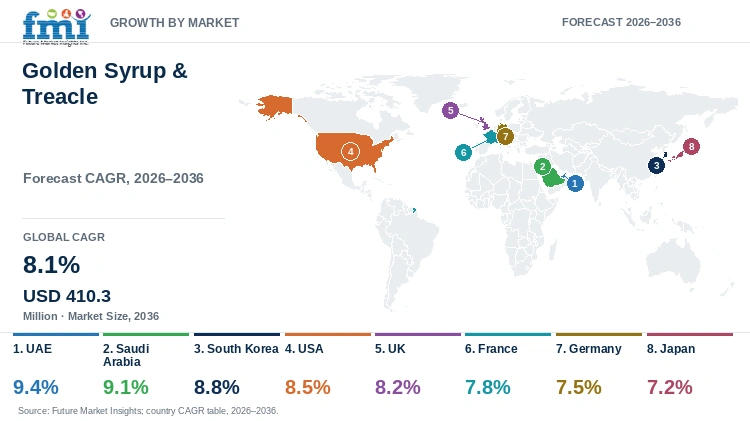
As per FMI, the UAE is projected to lead golden syrup & treacle expansion across evaluated national markets at a 9.4% CAGR through 2036, whereas Japan is forecast to progress at a 7.2% CAGR. Commercial performance across Gulf hospitality hubs and East Asian pastry plants and UK, European, or North American industrial bakeries depends on bulk refinery logistics and clean-label caramel replacement.
Table 7: Country CAGR and Primary Growth Levers for the Golden Syrup & Treacle Market (CAGR percentage and operational drivers), 2026 to 2036
| Country | CAGR (2026 to 2036) | Primary Growth Lever |
|---|---|---|
| UAE | 9.4% | 570+ local food processors, Commonwealth expatriate retail bakery, and hotel pastry commissaries |
| Saudi Arabia | 9.1% | USD 57 billion food retail market, industrial biscuit plants, and clean-label E150 caramel replacement |
| South Korea | 8.8% | KRW 111.9 trillion food processing sector, K-bakery yakgwa glazes, and allulose-blended syrups |
| USA | 8.5% | USDA sugar quota dynamics, ASR Group refinery optimization, and dark artisan bread & bar demand |
| UK | 8.2% | Heritage Lyle's and Ragus industrial base in flapjacks and ginger biscuits plus HFSS fiber blends |
| France | 7.8% | FranceAgriMer beet supply, pain d'épices & speculoos baking, and Nutri-Score blended syrups |
| Germany | 7.5% | Nordzucker/Südzucker beet-cane refining and clean-label crumb darkening in Vollkornbrot & Lebkuchen |
| Japan | 7.2% | Household confectionery demand and moisture retention in castella sponge and dorayaki pancakes |
Source: Future Market Insights analysis
UAE Golden Syrup & Treacle Market Outlook (2026 to 2036)
The UAE golden syrup & treacle market is projected to expand at a leading 9.4% CAGR from 2026 to 2036, anchored by hotel pastry commissaries and UK/Commonwealth expatriate supermarket bakeries in Dubai and Abu Dhabi. Unlike European markets with domestic beet refineries, the UAE works as an import-and-re-export processing hub where more than 570 food and beverage manufacturers source containerized IBC totes and co-dried treacle bags [11]. An August 2026 USDA Foreign Agricultural Service report noted that the UAE Food Cluster initiative and National Food Security Strategy 2051 are driving new domestic biscuit and bakery plant investments. High summer port temperatures still favor heat-stable co-dried powders and air-conditioned warehouse storage.
Key takeaway: In the UAE, hotel bakery commissaries and domestic biscuit manufacturing under the UAE Food Cluster initiative are projected to drive a 9.4% CAGR.
Saudi Arabia Golden Syrup & Treacle Market Outlook (2026 to 2036)
Whereas UK demand centers on traditional retail tins and flapjack bars, Saudi Arabia channels golden syrup and black treacle into large industrial biscuit and dark pan-bread factories across Jeddah and Riyadh. Commercial sales in Saudi Arabia are forecast to expand at a 9.1% CAGR between 2026 and 2036. In August 2026, the USDA Foreign Agricultural Service reported that food retail sales in Saudi Arabia reached USD 57 billion in 2025 while domestic food processing investment totaled USD 60 billion across 1,300 registered plants [12]. To comply with Saudi Food and Drug Authority added-sugar caps and additive scrutiny, local bakers use black treacle at low 2% dosages to replace synthetic ammonia caramel.
Key takeaway: In Saudi Arabia, clean-label replacement of synthetic E150 caramel in industrial biscuits and breads is forecast to sustain a 9.1% CAGR.
South Korea Golden Syrup & Treacle Market Outlook (2026 to 2036)
In contrast to Western rye-bread coloration, South Korea use amber golden syrup and light invert treacle to formulate high-gloss glazes on traditional yakgwa honey-ginger pastries and artisan cafe cookies. In October 2026, the USDA Foreign Agricultural Service reported that Thailand exported approximately USD 29 billion in processed food products in 2025 while importing USD 9.6 billion of processing inputs, a trade position anchoring regional biscuit manufacture [24]. so the South Korea golden syrup & treacle market will register an 8.8% CAGR from 2026 through 2036. Strict nutrition labeling on sweet baked goods across South Korea still prompts local formulators to blend golden syrup with D-allulose and oligosaccharides.
Key takeaway: In South Korea, K-bakery yakgwa pastry glazes and allulose-blended golden syrup formulations are projected to underpin an 8.8% CAGR.
USA Golden Syrup & Treacle Market Outlook (2026 to 2036)
What distinguishes the USA from the UK market is that domestic craft and plant bakeries in the USA historically relied on standard mill molasses and high-fructose corn syrup, creating white-space growth as clean-label brands upgrade to culinary golden syrup and black treacle. In June 2026, the USDA Economic Research Service Sugar and Sweeteners Outlook documented firm domestic refined cane and beet sugar pricing and active tariff-rate quota management across U.S. coastal ports [14]. Artisan sourdough pan-bread plants, ginger-snap biscuit makers, and chewy granola-bar co-packers across the USA actively order co-dried treacle powders and blended golden syrups to replace synthetic caramel colors. Commercial revenue in the USA is forecast to grow at an 8.5% CAGR through 2036.
Key takeaway: In the USA, clean-label replacement of HFCS and synthetic caramel in artisan breads and snack bars is forecast to drive an 8.5% CAGR.
UK Golden Syrup & Treacle Market Outlook (2026 to 2036)
The UK golden syrup & treacle market is estimated to expand at an 8.2% CAGR from 2026 to 2036, supported by the world's deepest per-capita consumption base in oat flapjacks and ginger nuts. What sets the UK apart from export growth markets is the presence of domestic cane refineries operated by ASR Group (Lyle's at Plaistow Wharf in London) and Ragus Sugars Manufacturing Limited in Slough. Under June 2025 UK Department of Health and Social Care guidance restricting television and online advertising for less-healthy cakes and biscuits [15], domestic bakers face strict total-sugar ceilings. so UK plant bakeries are transitioning toward fiber-blended golden syrups that preserve classic butterscotch flavor.
Key takeaway: In the UK, heritage flapjack and biscuit manufacturing paired with HFSS-compliant fiber-blended syrups are estimated to support an 8.2% CAGR.
France Golden Syrup & Treacle Market Outlook (2026 to 2036)
Whereas UK bakeries center on cane-derived Lyle's golden syrup, France integrates both cane treacle and domestic beet-derived amber invert syrups into pain d'épices spice breads and speculoos biscuits. Commercial bakery and confectionery demand across France is projected to expand at a 7.8% CAGR between 2026 and 2036. August 2026 sugar market bulletins from FranceAgriMer confirmed abundant domestic beet sucrose supply across France [16], providing local syrup blenders with a competitive feedstock advantage. Because Santé publique France's revised Nutri-Score algorithm penalizes high free-sugar density in packaged biscuits, industrial patisseries across France blend dark aromatic treacle with soluble wheat dextrins to achieve deep caramelized flavor at lower total sugar dosages.
Key takeaway: In France, pain d'épices and speculoos biscuit production combined with Nutri-Score blended syrup reformulation are projected to sustain a 7.8% CAGR.
Germany Golden Syrup & Treacle Market Outlook (2026 to 2036)
Germany diverges from Southern European pastry markets because industrial wholesale bakeries consume large bulk volumes of dark treacle and beet-cane refiners' syrup to tint Vollkornbrot, Pumpernickel, and seasonal Lebkuchen spice cakes. In January 2025, Nordzucker AG reported an easing in European Union sugar market prices following expanded beet cultivation [17], stabilizing input costs for liquid sugar and treacle processors across Germany. The Germany golden syrup & treacle market is forecast to progress at a 7.5% CAGR over the 2026 to 2036 forecast period. Retailer clean-label mandates banning E150d sulfite ammonia caramel in dark whole-grain breads continue to shift plant bakeries in Germany toward natural black treacle and co-dried molasses powders.
Key takeaway: In Germany, clean-label E150 caramel replacement in dark rye loaves and stable domestic beet-sugar refining are forecast to drive a 7.5% CAGR.
Japan Golden Syrup & Treacle Market Outlook (2026 to 2036)
Unlike Western markets that use golden syrup primarily in oat bars and ginger biscuits, Japan applies high-DE amber invert syrup and Okinawa-style dark cane treacle (kuromitsu) to retain softness in castella sponge cakes and dorayaki pancakes. In February 2026, the Statistics Bureau of Japan Family Income and Expenditure Survey documented resilient household spending on packaged cakes and traditional wagashi confections despite broader food price inflation [18]. Because convenience-store bakery buyers in Japan demand 14-day ambient shelf softness without synthetic humectants, local bakers dose precision-inverted golden syrups that prevent starch retrogradation. Commercial revenue in Japan's golden syrup & treacle market is projected to advance at a 7.2% CAGR through 2036.
Key takeaway: In Japan, ambient moisture retention in castella and dorayaki cakes and traditional kuromitsu treacle demand is projected to support a 7.2% CAGR.
Full report country CAGRs cover: North America; Latin America; Western Europe; Eastern Europe; East Asia; South Asia and Pacific; Middle East and Africa.
Who are the notable companies in the golden syrup & treacle market?
Tate & Lyle, Ingredion, Roquette, BENEO, Sudzucker, Nordzucker, ASR Group, Cargill, Ragus, and ADM are the notable companies in the market.
FMI analysis indicates that the competitive arena divides between dedicated cane golden-syrup and treacle refiners, European beet-and-cane liquid sugar groups, and multinational specialty sweetener and bakery-premix formulators. In 2010 ASR Group acquired Tate & Lyle's traditional cane sugar refining and Lyle's Golden Syrup business, whereas Tate & Lyle PLC operates independently as a global specialty sweetening and mouthfeel solutions provider.
- Dedicated Golden Syrup and Treacle Supply: ASR Group (owner of Tate & Lyle Sugars and Lyle's Golden Syrup) and Ragus Sugars Manufacturing Limited operate pure cane inversion, treacle blending, and heated bulk road-tanker fleets.
- Industrial Invert, Sugar and Liquid Logistics: Sudzucker and Nordzucker along with ADM supply bulk liquid sugars and partially inverted refiners' syrups across European and North American bakery terminals.
- Functional Bakery Sweetening and Adjacent Systems: Tate & Lyle and Ingredion along with Roquette, BENEO, and Cargill engineer co-dried syrup powders and fiber-blended bakery sweetening systems.
Competitive Benchmarking: Golden Syrup & Treacle Market
Table 8: Competitive Benchmarking for the Golden Syrup & Treacle Market (qualitative capability ratings), 2026
| Company | Golden / Treacle Evidence | Industrial Syrups & Blends | Bakery / Dry Systems | Geographic Reach |
|---|---|---|---|---|
| Tate & Lyle | Medium | Medium | High | High |
| Ingredion | Medium | Medium | High | High |
| Roquette | Medium | Medium | High | High |
| BENEO | Medium | Medium | Medium | High |
| Sudzucker | Medium | High | Medium | High |
| Nordzucker | Medium | High | Medium | Medium |
| ASR Group | High | High | Medium | High |
| Cargill | Medium | High | High | High |
| Ragus | High | High | Medium | Medium |
| ADM | Medium | High | High | High |
Scoring basis: Capability tiers evaluate direct cane golden syrup and black treacle refining capacity as well as bulk industrial liquid invert and molasses blending. Bakery / dry systems and geographic reach reflect co-dried powder, rare-sugar/fiber blending, and multi-region B2B bakery logistics.
Key Developments in the Golden Syrup & Treacle Market
- Tate & Lyle PLC published its 2026 Annual Report in June 2026 reporting GBP 1,736 million in revenue following the CP Kelco combination, expanding its sweetening and soluble fiber formulation tools for reduced-sugar bakery syrups [19].
- Südzucker Group released its Annual Report 2025/26 in May 2026 detailing EUR 2,786 million in Sugar segment sales and EUR 2,216 million in Special Products for industrial baking customers [20].
- Ingredion presented integrated sugar-reduction and bakery texture solutions at IFT FIRST in July 2025, helping commercial bakers combine traditional syrups with functional build-back hydrocolloids [21].
Key Players in the Golden Syrup & Treacle Market
Dedicated Golden Syrup and Treacle Supply
- ASR Group
- Ragus
Industrial Invert, Sugar and Liquid Logistics
- Sudzucker
- Nordzucker
- ADM
Functional Bakery Sweetening and Adjacent Systems
- Tate & Lyle
- Ingredion
- Roquette
- BENEO
- Cargill
Golden Syrup & Treacle Market - Report Scope
Table 9: Report Scope for the Golden Syrup & Treacle Market (coverage fields and definitions), 2026 to 2036
| Coverage field | Report scope |
|---|---|
| Market breakdown | Type; Form; Application; Claim; Sales Channel |
| Quantitative Units | USD Million |
| Market Definition | Includes commercial B2B revenue from partially inverted golden refiners' syrup, culinary black treacle, co-dried golden-syrup/treacle powders, and blended golden-syrup systems used in industrial and artisan baking and snack manufacturing. Category Scope Note: Excludes livestock feed molasses, ethanol fermentation molasses, and unflavored water-white medium or full invert syrups. |
| Regions Covered | North America; Latin America; Western Europe; Eastern Europe; East Asia; South Asia and Pacific; Middle East and Africa |
| Countries Covered | UAE, Saudi Arabia, South Korea, USA, UK, France, Germany, Japan, and additional countries in the full report |
| Key Companies Covered | Tate & Lyle, Ingredion, Roquette, BENEO, Sudzucker, Nordzucker, ASR Group, Cargill, Ragus, ADM |
| Forecast Period | 2026 to 2036 |
| Approach | Primary and secondary research with top-down and bottom-up market triangulation. |
Golden Syrup & Treacle Market - Research Methodology
Table 10: Research Methodology for the Golden Syrup & Treacle Market (research methods and approach), 2026 edition
| Method | Approach |
|---|---|
| Primary Research | Structured interviews with cane and beet sugar refinery technical directors, industrial bakery procurement heads, and dry-premix blenders across the UK, Europe, North America, Asia-Pacific, and the Middle East. |
| Secondary Research | Analysis of corporate annual filings (Tate & Lyle, Südzucker, Nordzucker, Ragus), PubMed cereal-chemistry studies, USDA ERS and FAS GAIN reports, and FranceAgriMer sugar bulletins. |
| Market Sizing and Forecasting | Top-down global invert sugar (USD 2,120 million in 2026) and molasses category models reconciled against bottom-up bakery dosing rates (1.5% to 12.0% flour weight) normalized to an 80° Brix or dry-solids basis. |
| Country Forecasting Model | Econometric country projections weight clean-label E150 caramel replacement, heritage flapjack/biscuit production, HFSS and Nutri-Score sugar caps, and hospitality bakery expansion. |
| Operational Benchmark Traceability | Refinery-throughput and plant spending indicators in Tables 2, 3, and 4 trace directly to USDA ERS, FranceAgriMer, and industrial bakery bulk tanker pricing. |
| Data Triangulation and Validation | Demand estimates are cross-checked against cane/beet refinery inversion capacity, IBC/tanker shipment volumes, and audited company segment disclosures. |
Golden Syrup & Treacle Market by Segments
Golden Syrup & Treacle Market segmented by Type:
- Standard Syrup
- High-DE / Specialty
- Organic
- Blended Systems
Golden Syrup & Treacle Market segmented by Form:
- Powder / Dry
- Liquid
- Paste / Semi-Solid
- Granules / Pieces
Golden Syrup & Treacle Market segmented by Application:
- Bread & Rolls
- Cakes & Muffins
- Biscuits & Cookies
- Viennoiserie & Pastry
- Other Bakery & Snacks
Golden Syrup & Treacle Market segmented by Claim:
- Conventional
- Clean Label
- Organic
- Non-GMO / Identity Preserved
Golden Syrup & Treacle Market segmented by Sales Channel:
- Direct to Industrial Bakeries
- Ingredient Distributors
- Foodservice & Artisan Supply
- Online B2B
Golden Syrup & Treacle Market by Region
- North America
- United States
- Canada
- Latin America
- Brazil
- Mexico
- Argentina
- Chile
- Western Europe
- Germany
- France
- United Kingdom
- Italy
- Spain
- Benelux
- Nordics
- Eastern Europe
- Poland
- Czech Republic
- Romania
- Hungary
- East Asia
- China
- Japan
- South Korea
- South Asia and Pacific
- India
- ASEAN
- Australia and New Zealand
- Middle East and Africa
- GCC Countries
- South Africa
- Türkiye
- Israel
Research Sources and Bibliography
- [1] Belo, I. (2025, April 10). Black treacle in baking. Ragus Sugars Manufacturing Limited.
- [2] Xiao, Z., Wu, S., Liang, H., Li, B., & Li, J. (2025, March 30). Effects of oligosaccharides, sodium carboxymethyl cellulose and d-allulose as a compound improver on the quality of sugar-reduced bread. Journal of the Science of Food and Agriculture, 105(5), 3024-3035 (PubMed PMID 39660575).
- [3] Xiao, Z., Wu, S., Liang, H., Li, B., & Li, J. (2025, March 10). Effects of oligosaccharides, sodium carboxymethyl cellulose and D-allulose on thermomechanical, rheological, fermentation properties of sugar-reduced dough. Food Research International, 208, 116163 (PubMed PMID 40263830).
- [4] Kawakami, C. A., Selani, M. M., Saldaña, E., Pimentel-Filho, N. J., & Domingues, M. A. F. (2025, January 15). Sensory dynamic profile and consumer acceptance of short-dough biscuits with reduced sucrose and thaumatin addition. Food Research International, 200, 115524 (PubMed PMID 39779152).
- [5] Sathaiah, G., Chen, P.-C., Khant, M. M., & Pillai, P. K. S. (2026, March 30). Comparative assessment of food-grade osmolytes for enhancing yeast fermentation performance under salt stress. Microbiology Spectrum, e0010226 (PubMed PMID 41910135).
- [6] Raczkowska, E., Sławińska, P., Woźniak, K., Rak, K., Gajda, R., & Lachowicz-Wiśniewska, S. (2026, September 11). Functional Reformulation of Shortbread Cookies with Urtica dioica L. Powder and Erythritol: Effects on Sensory Quality, Glycaemic Index and Glycaemic Load. Nutrients, 18(18), 2973 (PubMed PMID 42796956).
- [7] Wang, J.-Q., Liu, X.-G., Ding, Z.-R., Liu, Q.-P., Liao, A.-M., Pan, L., et al. (2025, May 10). Impact of Tagatose on Physicochemical, Nutritional, and In Vitro Digestive Properties of Toast Bread. Journal of Food Science, 90(5), e70213 (PubMed PMID 40344578).
- [8] Pang, Y., Liu, W., Wang, T., & Li, X. (2026, January 30). Polyol-mediated Maillard reaction modulation strategy for food chemical hazards inhibition and sensory quality maintenance of Cantonese bakery. Journal of the Science of Food and Agriculture, 106(2), 807-817 (PubMed PMID 40964856).
- [9] U.S. Food and Drug Administration. (2026, March 4). Added Sugars on the Nutrition Facts Label. U.S. Department of Health and Human Services.
- [10] Tchabou Tientcheu, M. L., Kaktcham, P. M., Foko Kouam, E. M., Tchamani Piame, L., Djodjeu Kamega, L. C., Aarzoo, Shekhar, A., Pratap, S. B., & Zambou Ngoufack, F. (2025, December 1). Development of a low-cost culture medium from industrial and environmental by-products for sustainable cultivation of Lactic Acid Bacteria. PLoS One, 20(12), e0337684 (PubMed PMID 41325427).
- [11] U.S. Department of Agriculture, Foreign Agricultural Service. (2026, August 4). United Arab Emirates: Food Processing Ingredients Annual. USDA GAIN Report TC2026-0009.
- [12] U.S. Department of Agriculture, Foreign Agricultural Service. (2026, August 31). Saudi Arabia: Retail Foods Annual. USDA GAIN Report SA2026-0013.
- [13] U.S. Department of Agriculture, Foreign Agricultural Service. (2026, May 27). South Korea: Food Processing Ingredients Annual. USDA GAIN Report KS2026-0013.
- [14] Abadam, V., Yeh, D. A., Weber, C., Champetier, A., & Sumner, D. (2026, June 17). Sugar and Sweeteners Outlook: June 2026. U.S. Department of Agriculture, Economic Research Service (Report SSS-M-454).
- [15] UK Department of Health and Social Care. (2025, June 4). Restricting advertising of less healthy food or drink on TV and online: products in scope. GOV.UK Official Guidance.
- [16] FranceAgriMer. (2026, August 10). Bulletin mensuel de conjoncture sucre. Établissement National des Produits de l'Agriculture et de la Mer.
- [17] Nordzucker AG. (2025, January 23). First signs point to slight easing in the EU sugar market. Nordzucker Post.
- [18] Statistics Bureau of Japan. (2026, February 6). Family Income and Expenditure Survey: Results of Two-or-more-person Households 2025 Yearly Average. Ministry of Internal Affairs and Communications.
- [19] Tate & Lyle PLC. (2026, June 1). Tate & Lyle Annual Report 2026. Tate & Lyle Investor Publications.
- [20] Südzucker AG. (2026, May 15). Annual Report 2025/26 - Südzucker Group. Südzucker Investor Relations Publications.
- [21] Ingredion Incorporated. (2025, July 22). Ingredion at IFT FIRST 2025: Connecting texture, health and innovation. Ingredion Technical Insights.
- [22] Cargill, Incorporated. (2025, November 14). Cargill APAC IngredienTracker™ 2025 assessed consumer attitudes towards 91 ingredients across four groups: Chocolate & Cocoa, Sweeteners, Texturizers, and Fats & Oils. Cargill APAC Insights.
- [23] Santé publique France. (2026, March 19). Nutri-Score. French National Public Health Agency.
- [24] U.S. Department of Agriculture, Foreign Agricultural Service. (2026, October). Thailand: Retail Foods Annual. Global Agriculture Information Networkhttps://www.fas.usda.gov/data/gain-report/2026/10/Retail%20Foods%20Annual_Bangkok_Thailand_TH2026-0033.pdf
This bibliography is provided for reader reference and is not exhaustive. The full report contains the complete reference list and detailed citations.
This Report Answers
- How large is the golden syrup & treacle market in 2026 and what is forecast for 2036?
- Which clean-label caramel-replacement and moisture-retention pressures support demand?
- Why does Standard Syrup lead the type category?
- Why does Powder / Dry lead the form category globally?
- How do growth rates differ across the UAE, Saudi Arabia, and the USA?
- Which leading companies supply cane golden syrup, black treacle, and blended bakery systems today?
- What limits adoption or supplier switching in the golden syrup & treacle market?
- What should industrial bakers evaluate before qualifying a golden syrup or treacle grade?
Frequently Asked Questions
How big is the golden syrup & treacle market in 2026, and what is forecast for 2036?
According to FMI, global golden syrup & treacle market value is estimated to reach USD 188.3 million in 2026 from USD 174.2 million in 2025. Valuation is forecast to hit USD 410.3 million by 2036 as industrial bakeries replace synthetic caramel dyes and adopt co-dried syrup powders.
What is the CAGR for the golden syrup & treacle market from 2026 to 2036?
Future Market Insights projects an 8.1% compound annual growth rate between 2026 and 2036, representing an anticipated USD 222.0 million increase in annual market value across commercial baking and snack channels.
Which type segment leads the golden syrup & treacle market?
Standard Syrup is projected to capture 40.0% of type demand in 2026 because classic 80° Brix amber golden syrup and standard culinary black treacle match established biscuit, flapjack, and dark-bread specifications.
Which form segment leads the golden syrup & treacle market?
Powder / Dry formats are estimated to secure 38.0% of the form category in 2026 because co-dried golden-syrup and treacle powders command higher unit prices per kilogram and eliminate heated pipework in dry premix plants.
Which country has a notable growth outlook during the assessment period?
The UAE is projected to lead national growth at a 9.4% CAGR through 2036, supported by more than 570 domestic food processors and hotel pastry commissaries.
Who are the key players in the market?
Tate & Lyle, Ingredion, Roquette, BENEO, Sudzucker, Nordzucker, ASR Group, Cargill, Ragus, and ADM lead commercial supply across cane/beet refining, specialty syrups, and functional bakery sweetening systems.
Preview the report firsthand - request a free sample
Get SampleGet the brochure for pricing and purchase details.
Get PDFTable of Content
- Key Takeaways
- Market Size and CAGR
- Top Growth Driver
- Fastest Growing Segment
- Leading Region
- Key Companies
- Emerging Opportunities
- Executive Summary
- Global Market Outlook
- Demand-side Trends
- Supply-side Trends
- Technology Roadmap Analysis
- Analysis and Recommendations
- Analyst Perspective (What is happening? Why now? What should investors know?)
- Key Questions Answered
- How large is the market?
- What is the CAGR?
- What are key trends?
- Which region dominates?
- Who are the leaders?
- Market Overview
- Market Coverage / Taxonomy
- Market Definition / Scope / Limitations
- Research Methodology
- Chapter Orientation
- Analytical Lens and Working Hypotheses
- Market Structure, Signals, and Trend Drivers
- Benchmarking and Cross-market Comparability
- Market Sizing, Forecasting, and Opportunity Mapping
- Research Design and Evidence Framework
- Desk Research Programme (Secondary Evidence)
- Expert Input and Fieldwork (Primary Evidence)
- Tooling, Models, and Reference Databases
- Data Engineering and Model Build
- Quality Assurance and Audit Trail
- Market Background
- Market Dynamics (Drivers, Restraints, Opportunity, Trends)
- Scenario Forecast (Optimistic, Likely, Conservative)
- Impact Analysis
- AI Impact
- Sustainability Impact
- Regulatory Impact
- Technology Impact
- Consumer / Buyer Analysis
- Purchase Drivers
- Adoption Barriers
- Buyer Journey
- Opportunity Map Analysis
- Product Life Cycle Analysis
- Supply Chain Analysis
- Investment Feasibility Matrix
- Value Chain Analysis
- PESTLE and Porter's Analysis
- Regulatory Landscape
- Regional Parent Market Outlook
- Production and Consumption Statistics
- Import and Export Statistics
- Global Market Analysis and Forecast, 2021 to 2036
- Historical Market Size Value (USD Million) Analysis, 2021 to 2025
- Current and Future Market Size Value (USD Million) Projections, 2026 to 2036
- Y-o-Y Growth Trend Analysis
- Absolute $ Opportunity Analysis
- Global Market Pricing Analysis, 2021 to 2036
- Global Market Analysis and Forecast, By Type, 2021 to 2036
- Introduction / Key Findings
- Historical Market Size Value (USD Million) Analysis By Type, 2021 to 2025
- Current and Future Market Size Value (USD Million) Analysis and Forecast By Type, 2026 to 2036
- Standard Syrup
- High-DE / Specialty
- Organic
- Blended Systems
- Y-o-Y Growth Trend Analysis By Type, 2021 to 2025
- Absolute $ Opportunity Analysis By Type, 2026 to 2036
- Global Market Analysis and Forecast, By Form, 2021 to 2036
- Introduction / Key Findings
- Historical Market Size Value (USD Million) Analysis By Form, 2021 to 2025
- Current and Future Market Size Value (USD Million) Analysis and Forecast By Form, 2026 to 2036
- Powder / Dry
- Liquid
- Paste / Semi-Solid
- Granules / Pieces
- Y-o-Y Growth Trend Analysis By Form, 2021 to 2025
- Absolute $ Opportunity Analysis By Form, 2026 to 2036
- Global Market Analysis and Forecast, By Application, 2021 to 2036
- Introduction / Key Findings
- Historical Market Size Value (USD Million) Analysis By Application, 2021 to 2025
- Current and Future Market Size Value (USD Million) Analysis and Forecast By Application, 2026 to 2036
- Bread & Rolls
- Cakes & Muffins
- Biscuits & Cookies
- Viennoiserie & Pastry
- Other Bakery & Snacks
- Y-o-Y Growth Trend Analysis By Application, 2021 to 2025
- Absolute $ Opportunity Analysis By Application, 2026 to 2036
- Global Market Analysis and Forecast, By Claim, 2021 to 2036
- Introduction / Key Findings
- Historical Market Size Value (USD Million) Analysis By Claim, 2021 to 2025
- Current and Future Market Size Value (USD Million) Analysis and Forecast By Claim, 2026 to 2036
- Conventional
- Clean Label
- Organic
- Non-GMO / Identity Preserved
- Y-o-Y Growth Trend Analysis By Claim, 2021 to 2025
- Absolute $ Opportunity Analysis By Claim, 2026 to 2036
- Global Market Analysis and Forecast, By Sales Channel, 2021 to 2036
- Introduction / Key Findings
- Historical Market Size Value (USD Million) Analysis By Sales Channel, 2021 to 2025
- Current and Future Market Size Value (USD Million) Analysis and Forecast By Sales Channel, 2026 to 2036
- Direct to Industrial Bakeries
- Ingredient Distributors
- Foodservice & Artisan Supply
- Online B2B
- Y-o-Y Growth Trend Analysis By Sales Channel, 2021 to 2025
- Absolute $ Opportunity Analysis By Sales Channel, 2026 to 2036
- Global Market Analysis and Forecast, By Region, 2021 to 2036
- Introduction
- Historical Market Size Value (USD Million) Analysis By Region, 2021 to 2025
- Current Market Size Value (USD Million) Analysis and Forecast By Region, 2026 to 2036
- North America
- Latin America
- Western Europe
- Eastern Europe
- East Asia
- South Asia and Pacific
- Middle East and Africa
- Market Attractiveness Analysis By Region
- North America Market Analysis and Forecast, By Country, 2021 to 2036
- Historical Market Size Value (USD Million) Trend Analysis By Market Taxonomy, 2021 to 2025
- Market Size Value (USD Million) Forecast By Market Taxonomy, 2026 to 2036
- By Country
- United States
- Canada
- By Type
- By Form
- By Application
- By Claim
- By Sales Channel
- By Country
- Market Attractiveness Analysis
- By Country
- By Type
- By Form
- By Application
- By Claim
- By Sales Channel
- Key Takeaways
- Latin America Market Analysis and Forecast, By Country
- Historical Market Size Value (USD Million) Trend Analysis By Market Taxonomy, 2021 to 2025
- Market Size Value (USD Million) Forecast By Market Taxonomy, 2026 to 2036
- By Country
- Brazil
- Mexico
- Argentina
- Chile
- By Type
- By Form
- By Application
- By Claim
- By Sales Channel
- By Country
- Market Attractiveness Analysis
- By Country
- By Type
- By Form
- By Application
- By Claim
- By Sales Channel
- Key Takeaways
- Western Europe Market Analysis and Forecast, By Country
- Historical Market Size Value (USD Million) Trend Analysis By Market Taxonomy, 2021 to 2025
- Market Size Value (USD Million) Forecast By Market Taxonomy, 2026 to 2036
- By Country
- Germany
- France
- United Kingdom
- Italy
- Spain
- Benelux
- Nordics
- By Type
- By Form
- By Application
- By Claim
- By Sales Channel
- By Country
- Market Attractiveness Analysis
- By Country
- By Type
- By Form
- By Application
- By Claim
- By Sales Channel
- Key Takeaways
- Eastern Europe Market Analysis and Forecast, By Country
- Historical Market Size Value (USD Million) Trend Analysis By Market Taxonomy, 2021 to 2025
- Market Size Value (USD Million) Forecast By Market Taxonomy, 2026 to 2036
- By Country
- Poland
- Czech Republic
- Romania
- Hungary
- By Type
- By Form
- By Application
- By Claim
- By Sales Channel
- By Country
- Market Attractiveness Analysis
- By Country
- By Type
- By Form
- By Application
- By Claim
- By Sales Channel
- Key Takeaways
- East Asia Market Analysis and Forecast, By Country
- Historical Market Size Value (USD Million) Trend Analysis By Market Taxonomy, 2021 to 2025
- Market Size Value (USD Million) Forecast By Market Taxonomy, 2026 to 2036
- By Country
- China
- Japan
- South Korea
- By Type
- By Form
- By Application
- By Claim
- By Sales Channel
- By Country
- Market Attractiveness Analysis
- By Country
- By Type
- By Form
- By Application
- By Claim
- By Sales Channel
- Key Takeaways
- South Asia and Pacific Market Analysis and Forecast, By Country
- Historical Market Size Value (USD Million) Trend Analysis By Market Taxonomy, 2021 to 2025
- Market Size Value (USD Million) Forecast By Market Taxonomy, 2026 to 2036
- By Country
- India
- ASEAN
- Australia and New Zealand
- By Type
- By Form
- By Application
- By Claim
- By Sales Channel
- By Country
- Market Attractiveness Analysis
- By Country
- By Type
- By Form
- By Application
- By Claim
- By Sales Channel
- Key Takeaways
- Middle East and Africa Market Analysis and Forecast, By Country
- Historical Market Size Value (USD Million) Trend Analysis By Market Taxonomy, 2021 to 2025
- Market Size Value (USD Million) Forecast By Market Taxonomy, 2026 to 2036
- By Country
- GCC Countries
- South Africa
- Türkiye
- Israel
- By Type
- By Form
- By Application
- By Claim
- By Sales Channel
- By Country
- Market Attractiveness Analysis
- By Country
- By Type
- By Form
- By Application
- By Claim
- By Sales Channel
- Key Takeaways
- Key Countries Market Analysis
- United States
- Pricing Analysis
- Market Share Analysis, 2025
- By Type
- By Form
- By Application
- By Claim
- By Sales Channel
- Canada
- Pricing Analysis
- Market Share Analysis, 2025
- By Type
- By Form
- By Application
- By Claim
- By Sales Channel
- Mexico
- Pricing Analysis
- Market Share Analysis, 2025
- By Type
- By Form
- By Application
- By Claim
- By Sales Channel
- Brazil
- Pricing Analysis
- Market Share Analysis, 2025
- By Type
- By Form
- By Application
- By Claim
- By Sales Channel
- Chile
- Pricing Analysis
- Market Share Analysis, 2025
- By Type
- By Form
- By Application
- By Claim
- By Sales Channel
- Germany
- Pricing Analysis
- Market Share Analysis, 2025
- By Type
- By Form
- By Application
- By Claim
- By Sales Channel
- United Kingdom
- Pricing Analysis
- Market Share Analysis, 2025
- By Type
- By Form
- By Application
- By Claim
- By Sales Channel
- Italy
- Pricing Analysis
- Market Share Analysis, 2025
- By Type
- By Form
- By Application
- By Claim
- By Sales Channel
- Spain
- Pricing Analysis
- Market Share Analysis, 2025
- By Type
- By Form
- By Application
- By Claim
- By Sales Channel
- France
- Pricing Analysis
- Market Share Analysis, 2025
- By Type
- By Form
- By Application
- By Claim
- By Sales Channel
- India
- Pricing Analysis
- Market Share Analysis, 2025
- By Type
- By Form
- By Application
- By Claim
- By Sales Channel
- ASEAN
- Pricing Analysis
- Market Share Analysis, 2025
- By Type
- By Form
- By Application
- By Claim
- By Sales Channel
- Australia and New Zealand
- Pricing Analysis
- Market Share Analysis, 2025
- By Type
- By Form
- By Application
- By Claim
- By Sales Channel
- China
- Pricing Analysis
- Market Share Analysis, 2025
- By Type
- By Form
- By Application
- By Claim
- By Sales Channel
- Japan
- Pricing Analysis
- Market Share Analysis, 2025
- By Type
- By Form
- By Application
- By Claim
- By Sales Channel
- South Korea
- Pricing Analysis
- Market Share Analysis, 2025
- By Type
- By Form
- By Application
- By Claim
- By Sales Channel
- Poland
- Pricing Analysis
- Market Share Analysis, 2025
- By Type
- By Form
- By Application
- By Claim
- By Sales Channel
- Hungary
- Pricing Analysis
- Market Share Analysis, 2025
- By Type
- By Form
- By Application
- By Claim
- By Sales Channel
- Türkiye
- Pricing Analysis
- Market Share Analysis, 2025
- By Type
- By Form
- By Application
- By Claim
- By Sales Channel
- South Africa
- Pricing Analysis
- Market Share Analysis, 2025
- By Type
- By Form
- By Application
- By Claim
- By Sales Channel
- UAE
- Pricing Analysis
- Market Share Analysis, 2025
- By Type
- By Form
- By Application
- By Claim
- By Sales Channel
- Saudi Arabia
- Pricing Analysis
- Market Share Analysis, 2025
- By Type
- By Form
- By Application
- By Claim
- By Sales Channel
- United States
- Market Structure Analysis
- Competition Dashboard
- Competition Benchmarking
- Market Share Analysis of Top Players
- By Regional
- By Type
- By Form
- By Application
- By Claim
- By Sales Channel
- Emerging Startups
- Innovation Benchmarking
- Competition Analysis
- Competition Deep Dive
- Tate & Lyle
- Overview
- Product Portfolio
- Profitability by Market Segments
- Sales Footprint
- Strategy Overview
- Marketing Strategy
- Product Strategy
- Channel Strategy
- Ingredion
- Roquette
- BENEO
- Sudzucker
- Nordzucker
- ASR Group
- Cargill
- Ragus
- ADM
- Tate & Lyle
- Case Studies
- Success Stories
- Recent Developments
- Competition Deep Dive
- Assumptions & Acronyms Used


