

- Market Size (2026)
- USD 0.8 Bn
- Forecast (2036)
- USD 5.0 Bn
- CAGR (2026 to 2036)
- 20.2%
How big is the Gravity Energy Storage Market in 2026?
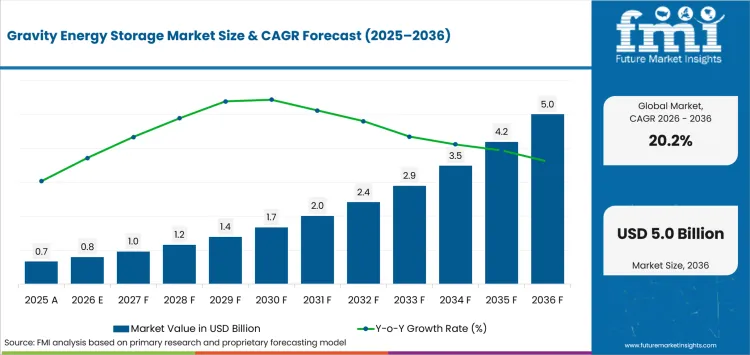
USD 0.8 billion in 2026 and USD 5.0 billion by 2036 at a 20.2% CAGR.
Sales of gravity energy storage are estimated to rise at a 20.2% CAGR through 2036, increasing valuation from USD 0.8 billion in 2026 to USD 5.0 billion by 2036. Growth is attributable to continued efforts to commercialize long-duration energy storage technologies capable of providing multi-hour grid support at lower lifecycle costs. The USA Department of Energy reaffirmed in January 2025 its target of reducing the cost of ten-hour energy storage systems by 90%, highlighting the industry's focus on improving the economic competitiveness of long-duration storage solutions.
Great Britain offers a more structured investment environment for long-duration storage projects than many USA developments. Ofgem advanced 77 long-duration electricity storage projects to the final assessment stage of its cap-and-floor support framework in September 2025, creating a pathway for revenue certainty and improved access to project financing. This regulatory support can strengthen debt availability and accelerate deployment of gravity energy storage systems and other long-duration storage technologies.
Key Takeaways of Gravity Energy Storage Market
- Utilities need long-duration capacity that shifts renewable electricity and supplies operating reserves during generation shortfalls.
- Mechanical gravity storage is projected to represent 54.0% of technology demand in 2026 owing to flexible layouts.
- Grid-scale storage is estimated to account for 46.0% of application demand in 2026 due to stable balancing.
- New installations are forecast to capture 63.0% of activity in 2026 as purpose-built sites limit compromises.
- Site geometry and civil works delay financial close until developers prove repeated-cycle performance and durable grid-service revenues.
- Energy Vault Holdings, Inc., RheEnergise Limited, Green Gravity Pty Ltd., Électricité de France S.A., ANDRITZ AG, Voith GmbH & Co. KGaA, GE Vernova Inc. and Toshiba Corporation are profiled.
Analyst Perspective
“Site depth and grid access determine whether a lifting design earns contracted revenue. Cycle evidence supports utility commitments by validating maintenance costs and lender assumptions.”
- Nikhil Kaitwade, Principal Consultant, Future Market Insights
How is the Gravity Energy Storage Market segmented?
The gravity energy storage industry is segmented by technology, application, installation type, end user, storage capacity and region.
Gravity energy storage is segmented by technology, application, installation type, end user, storage capacity and region. Technologies include mechanical, pumped-gravity, hybrid and software systems. Applications cover grid-scale storage, renewable integration, industrial backup and microgrids. Installations include new, retrofit and pilot projects. End users include utilities, renewable developers and industrial enterprises across above-100-MWh, 10-100-MWh and below-10-MWh capacities.
Why does mechanical gravity energy storage lead technology demand?
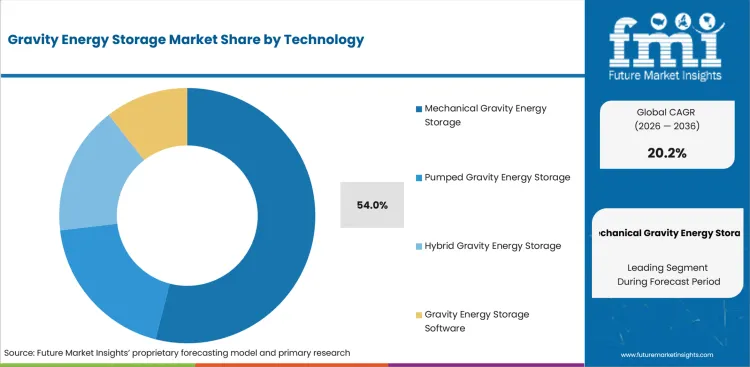
Mechanical systems lift solid masses inside shafts or purpose-built structures, allowing energy capacity to scale separately from power unlike stationary battery storage while geometry and hoist performance govern site suitability.
- In 2026, mechanical gravity energy storage is expected to lead technology demand with 54.0% share because developers can adapt lifting layouts to available depth and land.
- Mine-shaft projects reuse vertical space and nearby grid connections without constructing reservoirs, but developers require shaft surveys and cycle testing to assign construction and maintenance responsibility under long-term utility contracts.
Why does grid-scale energy storage lead application demand?
Grid-scale assets combine energy shifting with reserve services under one interconnection agreement, allowing system operators to dispatch one asset across contracted services following independent performance qualification.
- The grid-scale energy storage segment is likely to capture 46.0% share in 2026 attributable to utility needs for multi-hour balancing and congestion management.
- Transmission operators compare verified discharge duration against network constraints and capacity-payment rules during initial project screening. Service contracts support orders by assigning maintenance responsibility, availability obligations and debt repayment across operating cycles that extend beyond short market-price peaks.
Why do new installations lead installation activity?
Purpose-built sites align lifting equipment and grid interfaces with required power and duration, reducing access restrictions and geometry compromises that complicate conversion of legacy industrial locations.
- New installations are set to lead the installation type category with 63.0% share in 2026 due to coordinated civil design and equipment access.
- Developers coordinate excavation, electrical work and safety planning for hybrid sites combining gravity and battery energy storage systems. Defined permits and contractor roles reduce redesign across foundations, shaft preparation, equipment access and grid commissioning during lender review.
Why do utilities lead end-user demand?
Utilities procure storage against capacity and balancing requirements beyond emergency backup, using energy management systems that accommodate long construction periods and infrastructure-grade maintenance under contracted revenue arrangements.
- By end user, utilities are forecast to represent 44.0% in 2026 driven by system-level capacity and reserve obligations across regional networks.
- System operators compare start times and repeated-cycle availability against formal reserve requirements during project procurement. Developers secure orders once interconnection studies and maintenance coverage support contracted performance, debt repayment and scheduled overhauls across the full asset life within regulated planning cycles.
What are the drivers, restraints and opportunities in the Gravity Energy Storage Market?
Renewable balancing supports demand, but construction risk and shaft qualification govern awards.
- Driver: Utilities require multi-hour storage for renewable shifting and operating reserves.
- Restraint: Geotechnical qualification and civil works delay lender acceptance and construction awards.
- Opportunity: Qualified shafts and clearer market rules reduce development work for viable projects.
Smart grid modernization and increasing integration of variable renewable generation are strengthening demand for long-duration storage solutions, as grid operators use advanced monitoring systems to identify supply-demand imbalances and require verified storage duration for capacity market participation and ancillary-service qualification.
Project financing remains a key challenge for gravity energy storage deployment, as civil construction delays, geological uncertainty, and weak merchant revenue visibility can affect project economics, prompting lenders to closely evaluate site suitability, contractor accountability, and long-term cash flow stability.
Germany's July 2025 MiSpeL proceeding helped clarify market participation pathways for renewable energy storage projects utilizing qualified mine shafts, creating opportunities for gravity energy storage developers to repurpose existing infrastructure and expand commercial deployment.
Which country CAGRs are profiled in the Gravity Energy Storage Market?
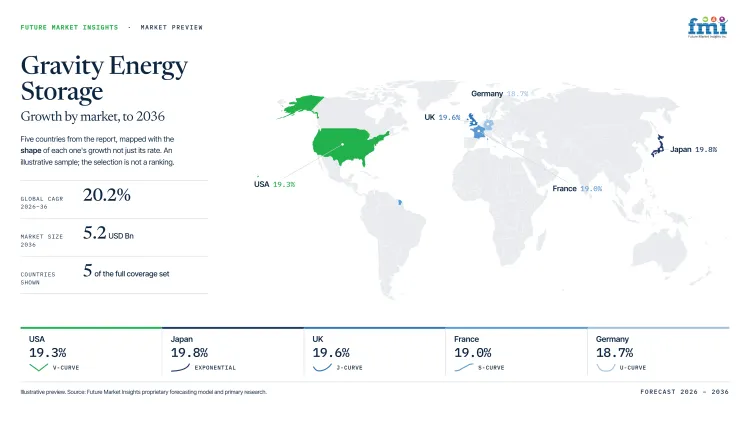
| Country | CAGR |
|---|---|
| Japan | 19.8% |
| United Kingdom | 19.6% |
| United States | 19.3% |
| France | 19.0% |
| Germany | 18.7% |
How do country-level CAGRs compare in the Gravity Energy Storage Market?
The 1.1-point spread measures forecast pace, not installed capacity. Financing routes and site constraints differ across the five countries.
- Japan combines pumped-storage experience with constrained sites and lengthy environmental review.
- United Kingdom power grid infrastructure projects receive downside protection through competitive assessment.
- United States projects face fragmented interconnection and capacity-payment rules.
- France relies on utility reservoirs and coordinated environmental permitting.
- Germany combines flexibility needs with evolving tariffs and shaft qualification.
Comparable CAGRs can produce different market entry conditions. The full report provides country-level CAGR analysis across North America, Latin America, Europe, East Asia, South Asia and Pacific, and the Middle East and Africa.
Country-wise Analysis
- Japan’s pumped-storage fleet gives utilities established turbine-service networks and operating experience across long maintenance cycles, but dense land use directs new investment toward reservoir upgrades and developed sites with proven grid access. In May 2025 the Agency for Natural Resources and Energy stated that renewables would supply 40% to 50% of the fiscal 2040 power mix as utilities prepared for broader balancing requirements nationwide. The Japan gravity energy storage sector is projected to record 19.8% CAGR during the assessment period, supported by local engineering capacity although formal environmental review and scheduled overhaul needs lengthen project qualification and service planning.
- The United Kingdom combines mine-shaft engineering knowledge with regulated downside protection, but developers must align planning consent and grid access to secure domestic construction finance across long delivery schedules and complex construction risks. Ofgem provisionally selected 16 projects across four storage technologies in June 2026 using published eligibility and delivery criteria under the national cap-and-floor scheme for qualified applicants across England and Scotland. In the United Kingdom, gravity energy storage demand is predicted to advance at 19.6% CAGR through 2036, reinforced by minimum-revenue protection although competitive assessment requires site evidence and firm delivery schedules plus lender approval for equipment orders.
- The United States combines extensive pumped-storage operating experience with regional capacity markets, but different interconnection rules require developers to tailor revenue contracts and maintenance coverage for each system operator and financing model. Adoption of gravity energy storage in the United States is estimated to expand at 19.3% CAGR through 2036, attributable to hydropower service expertise and utility familiarity with elevation-based assets across established regional networks. The USA Energy Information Administration recorded 23,156 MW of pumped-storage capacity across 18 states in 2025 while solid-mass projects require separate performance evidence and bankable revenue contracts to convert proposals into regional construction orders.
- France combines utility-owned reservoirs with established turbine-service networks, but ecological review and limited sites concentrate new investment in modernization programmes using existing grid connections across reservoir cascades tied to national transmission infrastructure. Gravity energy storage sales in France are forecast to expand at 19.0% CAGR by 2036, shaped by operating experience although equipment orders require coordinated water management and scheduled outage windows under formal environmental permits and local water-use conditions. RTE reported 8.1 TWh of pumping consumption during 2025 as national dispatch routines continued using pumped-storage assets for energy shifting, reserve services and balancing during periods of renewable output variation.
- Germany combines former mine sites with established civil and hoist engineering, but each proposal requires geotechnical validation and a revenue route suited to regional grid needs for equipment design and project financing. By 2036, Germany is projected to grow at 18.7% CAGR, influenced by clearer network treatment although developers still need contracted grid services and long-term maintenance coverage to convert shaft concepts into financed construction orders with formal lender acceptance. In May 2026 the Bundesnetzagentur proposed moderate capacity-based tariffs for new storage facilities without energy-based prices that finance the network, giving developers clearer treatment of storage as a flexibility provider.
Who are the notable companies in the Gravity Energy Storage Market?
Energy Vault Holdings, Inc., RheEnergise Limited, Green Gravity Pty Ltd., Électricité de France S.A., ANDRITZ AG, Voith GmbH & Co. KGaA, GE Vernova Inc. and Toshiba Corporation.
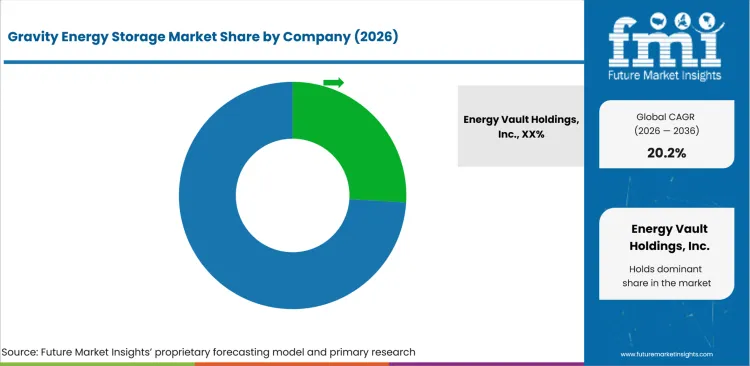
Site control and construction accountability fragment competition across developers, operators and equipment groups.
- Energy Vault, Green Gravity and RheEnergise develop specialist platforms, while EDF operates utility-owned pumped-storage assets.
- ANDRITZ, Voith, GE Vernova and Toshiba supply water turbine systems, generators, controls and commissioning support for utilities.
Competitive Benchmarking: Gravity Energy Storage Market
| Company | Project Maturity | Operating Evidence | Delivery Scope | Geographic Reach |
|---|---|---|---|---|
| Energy Vault Holdings, Inc. | Medium | Low | Medium | South Africa |
| RheEnergise Limited | Medium | Medium | Medium | United Kingdom |
| Green Gravity Pty Ltd. | Low | Low | Low | Australia |
| Électricité de France S.A. | High | High | Medium | France |
| ANDRITZ AG | Medium | Low | High | Austria |
| Voith GmbH & Co. KGaA | Medium | Low | High | Germany |
| GE Vernova Inc. | High | High | High | United States |
| Toshiba Corporation | High | High | High | Japan |
Key Developments in the Gravity Energy Storage Market
- In May 2026, Energy Vault and Eskom agreed an initial 25 MW/100 MWh project with wider development scope.
- In January 2026, RheEnergise reported full-power operation at its 500 kW Cornwood project serving Sibelco.
- In September 2025, Green Gravity signed a binding Russell Vale agreement for mine-shaft storage trials.
Key Players in the Gravity Energy Storage Market
Gravity and Pumped-Gravity Developers
- Energy Vault Holdings, Inc.
- Green Gravity Pty Ltd.
- RheEnergise Limited
Pumped-Storage Asset Operators
- Électricité de France S.A.
Pumped-Storage Equipment Providers
- ANDRITZ AG
- Voith GmbH & Co. KGaA
- GE Vernova Inc.
- Toshiba Corporation
Gravity Energy Storage Market - Report Scope
| Coverage field | Report scope |
|---|---|
| Market breakdown | By technology, application, installation type, end user, storage capacity and region. |
| Quantitative Units | Revenue in USD billion and CAGR in %. |
| Market Definition | Commercial systems storing electricity as potential energy by lifting masses or elevating water. |
| Regions Covered | North America, Latin America, Europe, East Asia, South Asia and Pacific, and Middle East and Africa. |
| Countries Covered | Japan, United Kingdom, United States, France, Germany, and 20+ countries included in the full report. |
| Key Companies Profiled | Energy Vault Holdings, Inc., RheEnergise Limited, Green Gravity Pty Ltd., Électricité de France S.A., ANDRITZ AG, Voith GmbH & Co. KGaA, GE Vernova Inc. and Toshiba Corporation. |
| Forecast Period | 2026 to 2036. |
| Approach | Primary and secondary research with market triangulation. |
Gravity Energy Storage Market - Research Methodology
| Method | Approach |
|---|---|
| Primary Research | FMI analysts gathered input from manufacturers, service providers, technology developers, distributors, end users, procurement teams, and subject-matter experts. Interviews examined purchasing decisions, product or service evaluation, adoption barriers, approval requirements, pricing considerations, and expectations for technical or commercial support. Respondents were also asked what evidence is required before a trial, pilot, or initial order develops into regular purchasing. |
| Desk Research | Desk research covered government statistics, regulatory publications, trade data, industry associations, technical literature, standards, company filings, product information, and official corporate announcements. Sources were reviewed for relevance, publication date, geographic coverage, and consistency with the defined market scope. Claims relating to performance, applications, approvals, capacity, investment, and commercial activity were retained only when supported by credible public evidence. |
| Market Sizing and Forecasting | The market model combined the baseline value with historical performance, segment structure, pricing and volume indicators, adoption levels, company participation, and country-level demand conditions. Forecast assumptions considered economic activity, investment trends, regulatory developments, technology adoption, purchasing cycles, supply availability, and barriers to wider market use. Segment and regional estimates were reconciled before the final market total was calculated. |
| Data Validation | Estimates were checked against multiple independent indicators, including public data, company activity, trade patterns, industry developments, and findings from primary interviews. Validation also tested whether products, services, applications, and company revenues fell within the defined market boundaries. Adjacent categories, unsupported claims, overlapping revenues, and activities without direct market relevance were excluded to reduce double counting and maintain consistency across segments and countries. |
Gravity Energy Storage Market by Segments
Gravity Energy Storage Market segmented by Technology:
- Mechanical Gravity Energy Storage
- Shaft-based Gravity Storage
- Tower-based Gravity Storage
- Mine Shaft Energy Storage
- Pumped Gravity Energy Storage
- Rail-based Gravity Systems
- Crane-based Gravity Systems
- Modular Block Storage
- Hybrid Gravity Energy Storage
- Gravity - Battery Systems
- Gravity - Solar Integration
- Gravity - Wind Integration
- Gravity Energy Storage Software
- Energy Management Systems
- Predictive Maintenance Software
- Remote Monitoring Platforms
Gravity Energy Storage Market segmented by Application:
- Grid-scale Energy Storage
- Peak Load Management
- Grid Frequency Regulation
- Spinning Reserve
- Renewable Energy Integration
- Solar Power Storage
- Wind Power Storage
- Hybrid Renewable Systems
- Industrial Power Backup
- Mining Operations
- Manufacturing Facilities
- Remote Industrial Sites
- Microgrids & Off-grid Systems
- Remote Communities
- Island Power Systems
- Defense Installations
Gravity Energy Storage Market segmented by Installation Type:
- New Installations
- Greenfield Utility Projects
- New Renewable Energy Plants
- New Industrial Facilities
- Retrofit Installations
- Existing Mine Shafts
- Decommissioned Industrial Sites
- Legacy Power Infrastructure
- Pilot & Demonstration Projects
- Government-funded Projects
- Research Demonstrations
- Commercial Pilot Plants
Gravity Energy Storage Market segmented by End User:
- Utilities
- Public Utilities
- Independent Power Producers
- Transmission System Operators
- Renewable Energy Developers
- Solar Farm Operators
- Wind Farm Operators
- Hybrid Energy Developers
- Industrial Enterprises
- Mining Companies
- Manufacturing Companies
- Oil & Gas Facilities
Gravity Energy Storage Market segmented by Storage Capacity:
- Above 100 MWh
- 100-500 MWh
- 500-1000 MWh
- Above 1000 MWh
- 10-100 MWh
- Utility-scale Projects
- Commercial Energy Storage
- Industrial Applications
- Below 10 MWh
- Microgrids
- Remote Power Systems
- Pilot Installations
Gravity Energy Storage Market by Region:
- North America
- United States
- Canada
- Mexico
- Latin America
- Brazil
- Chile
- Rest of Latin America
- Western Europe
- Germany
- United Kingdom
- Italy
- Spain
- France
- Nordics
- Benelux
- Rest of Western Europe
- Eastern Europe
- Russia
- Poland
- Hungary
- Balkan and Baltic States
- Rest of Eastern Europe
- East Asia
- China
- Japan
- South Korea
- South Asia and Pacific
- India
- ASEAN
- Australia and New Zealand
- Rest of South Asia and Pacific
- Middle East and Africa
- Kingdom of Saudi Arabia
- Other GCC Countries
- Türkiye
- South Africa
- Other African Union Countries
- Rest of Middle East and Africa
Research Sources and Bibliography
- USA Department of Energy. (2025, January). Long Duration Storage Shot: An Overview.
- Ofgem. (2025, September 23). Long Duration Electricity Storage (LDES) window 1 eligibility assessment outcome.
- Bundesnetzagentur. (2026, August 5). Festlegung zur Marktintegration von Speichern und Ladepunkten (MiSpeL).
- Agency for Natural Resources and Energy. (2025, February). The 7th Strategic Energy Plan.
- Ofgem. (2026, June 26). Ofgem boosts long duration storage to secure more homegrown energy for customers.
- USA Energy Information Administration. (2026, February). Where hydropower is generated.
- RTE. (2026, April 15). 2025 Electricity Review.
- Bundesnetzagentur. (2026, May 27). Bundesnetzagentur presents latest considerations on reform of electricity network tariff system.
- Energy Vault Holdings, Inc. (2026, May 13). Gravity based Storage Provider Energy Vault, Eskom Partner On 25 MW/100 MWh Project In South Africa.
- RheEnergise Limited. (2026, January 27). RheEnergise Announce the Success of their First Project.
- Green Gravity Pty Ltd. (2025, September 19). Green Gravity and Wollongong Resources finalise deal for gravity storage trials at Russell Vale mine.
This bibliography is provided for reader reference and is not exhaustive. The full report contains the complete reference list and detailed citations.
This Report Answers
- What market value is projected?
- What determines project finance?
- Why does mechanical storage lead?
- How do grid assets earn revenue?
- Why do new installations lead?
- How do CAGRs shape entry?
- Who supplies gravity storage?
- What delays financial close?
Frequently Asked Questions
How big is the Gravity Energy Storage Market in 2026?
USD 0.8 billion is the 2026 value of the gravity energy storage market across solid-mass and pumped-gravity systems. Project pipelines convert into construction contracts once suitable sites, verified performance and financeable grid revenues satisfy utility requirements and independent lender review.
What is the CAGR of the Gravity Energy Storage Market from 2026 to 2036?
The gravity energy storage market is projected to expand at 20.2% CAGR from 2026 to 2036 across international electricity systems. Long-duration balancing supports the forecast although civil construction and permitting delay financial close for site-specific projects with extended delivery schedules.
Which technology is projected to account for 54.0% of the Gravity Energy Storage Market?
Mechanical gravity energy storage is projected to account for 54.0% of the gravity energy storage market by technology in 2026. Developers can adapt shafts and lifting structures to sites but orders require verified hoists and structural performance over repeated cycles.
How much is the Gravity Energy Storage Market expected to add between 2026 and 2036?
USD 4.2 billion is expected to be added to the gravity energy storage market between 2026 and 2036. The forecast depends on projects securing sites, interconnection agreements, construction partners and durable payment arrangements that support long-term project debt service obligations.
Which companies are active in the Gravity Energy Storage Market?
Companies active in the gravity energy storage market include Energy Vault, RheEnergise, Green Gravity and EDF across several project routes. ANDRITZ, Voith, GE Vernova and Toshiba extend the field through specialist platforms, utility operation and international pumped-storage equipment delivery.
Preview the report firsthand - request a free sample
Get SampleGet the brochure for pricing and purchase details.
Get PDFTable of Content
- Key Takeaways
- Market Size and CAGR
- Top Growth Driver
- Fastest Growing Segment
- Leading Region
- Key Companies
- Emerging Opportunities
- Executive Summary
- Global Market Outlook
- Demand-side Trends
- Supply-side Trends
- Technology Roadmap Analysis
- Analysis and Recommendations
- Analyst Perspective (What is happening? Why now? What should investors know?)
- Key Questions Answered
- How large is the market?
- What is the CAGR?
- What are key trends?
- Which region dominates?
- Who are the leaders?
- Market Overview
- Market Coverage / Taxonomy
- Market Definition / Scope / Limitations
- Research Methodology
- Chapter Orientation
- Analytical Lens and Working Hypotheses
- Market Structure, Signals, and Trend Drivers
- Benchmarking and Cross-market Comparability
- Market Sizing, Forecasting, and Opportunity Mapping
- Research Design and Evidence Framework
- Desk Research Programme (Secondary Evidence)
- Expert Input and Fieldwork (Primary Evidence)
- Tooling, Models, and Reference Databases
- Data Engineering and Model Build
- Quality Assurance and Audit Trail
- Market Background
- Market Dynamics (Drivers, Restraints, Opportunity, Trends)
- Scenario Forecast (Optimistic, Likely, Conservative)
- Impact Analysis
- AI Impact
- Sustainability Impact
- Regulatory Impact
- Technology Impact
- Consumer / Buyer Analysis
- Purchase Drivers
- Adoption Barriers
- Buyer Journey
- Opportunity Map Analysis
- Product Life Cycle Analysis
- Supply Chain Analysis
- Investment Feasibility Matrix
- Value Chain Analysis
- PESTLE and Porter's Analysis
- Regulatory Landscape
- Regional Parent Market Outlook
- Production and Consumption Statistics
- Import and Export Statistics
- Global Market Analysis and Forecast, 2021 to 2036
- Historical Market Size Value (USD Billion) Analysis, 2021 to 2025
- Current and Future Market Size Value (USD Billion) Projections, 2026 to 2036
- Y-o-Y Growth Trend Analysis
- Absolute $ Opportunity Analysis
- Global Market Pricing Analysis, 2021 to 2036
- Global Market Analysis and Forecast, By Technology, 2021 to 2036
- Introduction / Key Findings
- Historical Market Size Value (USD Billion) Analysis By Technology, 2021 to 2025
- Current and Future Market Size Value (USD Billion) Analysis and Forecast By Technology, 2026 to 2036
- Mechanical Gravity Energy Storage
- Shaft-based Gravity Storage
- Tower-based Gravity Storage
- Mine Shaft Energy Storage
- Pumped Gravity Energy Storage
- Rail-based Gravity Systems
- Crane-based Gravity Systems
- Modular Block Storage
- Hybrid Gravity Energy Storage
- Gravity - Battery Systems
- Gravity - Solar Integration
- Gravity - Wind Integration
- Gravity Energy Storage Software
- Energy Management Systems
- Predictive Maintenance Software
- Remote Monitoring Platforms
- Mechanical Gravity Energy Storage
- Y-o-Y Growth Trend Analysis By Technology, 2021 to 2025
- Absolute $ Opportunity Analysis By Technology, 2026 to 2036
- Global Market Analysis and Forecast, By Application, 2021 to 2036
- Introduction / Key Findings
- Historical Market Size Value (USD Billion) Analysis By Application, 2021 to 2025
- Current and Future Market Size Value (USD Billion) Analysis and Forecast By Application, 2026 to 2036
- Grid-scale Energy Storage
- Peak Load Management
- Grid Frequency Regulation
- Spinning Reserve
- Renewable Energy Integration
- Solar Power Storage
- Wind Power Storage
- Hybrid Renewable Systems
- Industrial Power Backup
- Mining Operations
- Manufacturing Facilities
- Remote Industrial Sites
- Microgrids & Off-grid Systems
- Remote Communities
- Island Power Systems
- Defense Installations
- Grid-scale Energy Storage
- Y-o-Y Growth Trend Analysis By Application, 2021 to 2025
- Absolute $ Opportunity Analysis By Application, 2026 to 2036
- Global Market Analysis and Forecast, By Installation Type, 2021 to 2036
- Introduction / Key Findings
- Historical Market Size Value (USD Billion) Analysis By Installation Type, 2021 to 2025
- Current and Future Market Size Value (USD Billion) Analysis and Forecast By Installation Type, 2026 to 2036
- New Installations
- Greenfield Utility Projects
- New Renewable Energy Plants
- New Industrial Facilities
- Retrofit Installations
- Existing Mine Shafts
- Decommissioned Industrial Sites
- Legacy Power Infrastructure
- Pilot & Demonstration Projects
- Government-funded Projects
- Research Demonstrations
- Commercial Pilot Plants
- New Installations
- Y-o-Y Growth Trend Analysis By Installation Type, 2021 to 2025
- Absolute $ Opportunity Analysis By Installation Type, 2026 to 2036
- Global Market Analysis and Forecast, By End User, 2021 to 2036
- Introduction / Key Findings
- Historical Market Size Value (USD Billion) Analysis By End User, 2021 to 2025
- Current and Future Market Size Value (USD Billion) Analysis and Forecast By End User, 2026 to 2036
- Utilities
- Public Utilities
- Independent Power Producers
- Transmission System Operators
- Renewable Energy Developers
- Solar Farm Operators
- Wind Farm Operators
- Hybrid Energy Developers
- Industrial Enterprises
- Mining Companies
- Manufacturing Companies
- Oil & Gas Facilities
- Utilities
- Y-o-Y Growth Trend Analysis By End User, 2021 to 2025
- Absolute $ Opportunity Analysis By End User, 2026 to 2036
- Global Market Analysis and Forecast, By Storage Capacity, 2021 to 2036
- Introduction / Key Findings
- Historical Market Size Value (USD Billion) Analysis By Storage Capacity, 2021 to 2025
- Current and Future Market Size Value (USD Billion) Analysis and Forecast By Storage Capacity, 2026 to 2036
- Above 100 MWh
- 100-500 MWh
- 500-1000 MWh
- Above 1000 MWh
- 10-100 MWh
- Utility-scale Projects
- Commercial Energy Storage
- Industrial Applications
- Below 10 MWh
- Microgrids
- Remote Power Systems
- Pilot Installations
- Above 100 MWh
- Y-o-Y Growth Trend Analysis By Storage Capacity, 2021 to 2025
- Absolute $ Opportunity Analysis By Storage Capacity, 2026 to 2036
- Global Market Analysis and Forecast, By Region, 2021 to 2036
- Introduction
- Historical Market Size Value (USD Billion) Analysis By Region, 2021 to 2025
- Current Market Size Value (USD Billion) Analysis and Forecast By Region, 2026 to 2036
- North America
- Latin America
- Western Europe
- Eastern Europe
- East Asia
- South Asia and Pacific
- Middle East & Africa
- Market Attractiveness Analysis By Region
- North America Market Analysis and Forecast, By Country, 2021 to 2036
- Historical Market Size Value (USD Billion) Trend Analysis By Market Taxonomy, 2021 to 2025
- Market Size Value (USD Billion) Forecast By Market Taxonomy, 2026 to 2036
- By Country
- USA
- Canada
- By Technology
- By Application
- By Installation Type
- By End User
- By Storage Capacity
- By Country
- Market Attractiveness Analysis
- By Country
- By Technology
- By Application
- By Installation Type
- By End User
- By Storage Capacity
- Key Takeaways
- Latin America Market Analysis and Forecast, By Country
- Historical Market Size Value (USD Billion) Trend Analysis By Market Taxonomy, 2021 to 2025
- Market Size Value (USD Billion) Forecast By Market Taxonomy, 2026 to 2036
- By Country
- Brazil
- Mexico
- Chile
- Rest of Latin America
- By Technology
- By Application
- By Installation Type
- By End User
- By Storage Capacity
- By Country
- Market Attractiveness Analysis
- By Country
- By Technology
- By Application
- By Installation Type
- By End User
- By Storage Capacity
- Key Takeaways
- Western Europe Market Analysis and Forecast, By Country
- Historical Market Size Value (USD Billion) Trend Analysis By Market Taxonomy, 2021 to 2025
- Market Size Value (USD Billion) Forecast By Market Taxonomy, 2026 to 2036
- By Country
- Germany
- UK
- Italy
- Spain
- France
- Nordic
- BENELUX
- Rest of Western Europe
- By Technology
- By Application
- By Installation Type
- By End User
- By Storage Capacity
- By Country
- Market Attractiveness Analysis
- By Country
- By Technology
- By Application
- By Installation Type
- By End User
- By Storage Capacity
- Key Takeaways
- Eastern Europe Market Analysis and Forecast, By Country
- Historical Market Size Value (USD Billion) Trend Analysis By Market Taxonomy, 2021 to 2025
- Market Size Value (USD Billion) Forecast By Market Taxonomy, 2026 to 2036
- By Country
- Russia
- Poland
- Hungary
- Balkan & Baltic
- Rest of Eastern Europe
- By Technology
- By Application
- By Installation Type
- By End User
- By Storage Capacity
- By Country
- Market Attractiveness Analysis
- By Country
- By Technology
- By Application
- By Installation Type
- By End User
- By Storage Capacity
- Key Takeaways
- East Asia Market Analysis and Forecast, By Country
- Historical Market Size Value (USD Billion) Trend Analysis By Market Taxonomy, 2021 to 2025
- Market Size Value (USD Billion) Forecast By Market Taxonomy, 2026 to 2036
- By Country
- China
- Japan
- South Korea
- By Technology
- By Application
- By Installation Type
- By End User
- By Storage Capacity
- By Country
- Market Attractiveness Analysis
- By Country
- By Technology
- By Application
- By Installation Type
- By End User
- By Storage Capacity
- Key Takeaways
- South Asia and Pacific Market Analysis and Forecast, By Country
- Historical Market Size Value (USD Billion) Trend Analysis By Market Taxonomy, 2021 to 2025
- Market Size Value (USD Billion) Forecast By Market Taxonomy, 2026 to 2036
- By Country
- India
- ASEAN
- Australia & New Zealand
- Rest of South Asia and Pacific
- By Technology
- By Application
- By Installation Type
- By End User
- By Storage Capacity
- By Country
- Market Attractiveness Analysis
- By Country
- By Technology
- By Application
- By Installation Type
- By End User
- By Storage Capacity
- Key Takeaways
- Middle East & Africa Market Analysis and Forecast, By Country
- Historical Market Size Value (USD Billion) Trend Analysis By Market Taxonomy, 2021 to 2025
- Market Size Value (USD Billion) Forecast By Market Taxonomy, 2026 to 2036
- By Country
- Kingdom of Saudi Arabia
- Other GCC Countries
- Türkiye
- South Africa
- Other African Union
- Rest of Middle East & Africa
- By Technology
- By Application
- By Installation Type
- By End User
- By Storage Capacity
- By Country
- Market Attractiveness Analysis
- By Country
- By Technology
- By Application
- By Installation Type
- By End User
- By Storage Capacity
- Key Takeaways
- Key Countries Market Analysis
- USA
- Pricing Analysis
- Market Share Analysis, 2025
- By Technology
- By Application
- By Installation Type
- By End User
- By Storage Capacity
- Canada
- Pricing Analysis
- Market Share Analysis, 2025
- By Technology
- By Application
- By Installation Type
- By End User
- By Storage Capacity
- Mexico
- Pricing Analysis
- Market Share Analysis, 2025
- By Technology
- By Application
- By Installation Type
- By End User
- By Storage Capacity
- Brazil
- Pricing Analysis
- Market Share Analysis, 2025
- By Technology
- By Application
- By Installation Type
- By End User
- By Storage Capacity
- Chile
- Pricing Analysis
- Market Share Analysis, 2025
- By Technology
- By Application
- By Installation Type
- By End User
- By Storage Capacity
- Germany
- Pricing Analysis
- Market Share Analysis, 2025
- By Technology
- By Application
- By Installation Type
- By End User
- By Storage Capacity
- UK
- Pricing Analysis
- Market Share Analysis, 2025
- By Technology
- By Application
- By Installation Type
- By End User
- By Storage Capacity
- Italy
- Pricing Analysis
- Market Share Analysis, 2025
- By Technology
- By Application
- By Installation Type
- By End User
- By Storage Capacity
- Spain
- Pricing Analysis
- Market Share Analysis, 2025
- By Technology
- By Application
- By Installation Type
- By End User
- By Storage Capacity
- France
- Pricing Analysis
- Market Share Analysis, 2025
- By Technology
- By Application
- By Installation Type
- By End User
- By Storage Capacity
- India
- Pricing Analysis
- Market Share Analysis, 2025
- By Technology
- By Application
- By Installation Type
- By End User
- By Storage Capacity
- ASEAN
- Pricing Analysis
- Market Share Analysis, 2025
- By Technology
- By Application
- By Installation Type
- By End User
- By Storage Capacity
- Australia & New Zealand
- Pricing Analysis
- Market Share Analysis, 2025
- By Technology
- By Application
- By Installation Type
- By End User
- By Storage Capacity
- China
- Pricing Analysis
- Market Share Analysis, 2025
- By Technology
- By Application
- By Installation Type
- By End User
- By Storage Capacity
- Japan
- Pricing Analysis
- Market Share Analysis, 2025
- By Technology
- By Application
- By Installation Type
- By End User
- By Storage Capacity
- South Korea
- Pricing Analysis
- Market Share Analysis, 2025
- By Technology
- By Application
- By Installation Type
- By End User
- By Storage Capacity
- Russia
- Pricing Analysis
- Market Share Analysis, 2025
- By Technology
- By Application
- By Installation Type
- By End User
- By Storage Capacity
- Poland
- Pricing Analysis
- Market Share Analysis, 2025
- By Technology
- By Application
- By Installation Type
- By End User
- By Storage Capacity
- Hungary
- Pricing Analysis
- Market Share Analysis, 2025
- By Technology
- By Application
- By Installation Type
- By End User
- By Storage Capacity
- Kingdom of Saudi Arabia
- Pricing Analysis
- Market Share Analysis, 2025
- By Technology
- By Application
- By Installation Type
- By End User
- By Storage Capacity
- Türkiye
- Pricing Analysis
- Market Share Analysis, 2025
- By Technology
- By Application
- By Installation Type
- By End User
- By Storage Capacity
- South Africa
- Pricing Analysis
- Market Share Analysis, 2025
- By Technology
- By Application
- By Installation Type
- By End User
- By Storage Capacity
- USA
- Market Structure Analysis
- Competition Dashboard
- Competition Benchmarking
- Market Share Analysis of Top Players
- By Regional
- By Technology
- By Application
- By Installation Type
- By End User
- By Storage Capacity
- Emerging Startups
- Innovation Benchmarking
- Competition Analysis
- Competition Deep Dive
- Energy Vault Holdings, Inc.
- Overview
- Product Portfolio
- Profitability by Market Segments
- Sales Footprint
- Strategy Overview
- Marketing Strategy
- Product Strategy
- Channel Strategy
- Gravitricity Ltd.
- Heindl Energy GmbH
- Energy Dome S.p.A.
- ABB Ltd.
- Siemens Energy AG
- RheEnergise Limited
- Kinetic Power Ltd.
- Enel Green Power
- Hydrostor Inc.
- Energy Vault Holdings, Inc.
- Case Studies
- Success Stories
- Recent Developments
- Competition Deep Dive
- Assumptions & Acronyms Used


