

- Industry Size (2026)
- USD 78 Bn
- Forecast (2036)
- USD 124.7 Bn
- CAGR (2026 to 2036)
- 4.8%
Small Hydropower Market Forecast and Outlook 2026 to 2036
The small hydropower market expands from USD 78 billion in 2026 to USD 124.7 billion by 2036, representing a CAGR of 4.8%. Development activity remains tightly linked to permitting regimes, water rights frameworks, and environmental review procedures, which vary sharply by country and even by region. Regulatory oversight and approval timelines shape where projects proceed, often outweighing pure resource potential. Compliance cost related to ecological studies, grid connection rules, and civil works standards influences project economics and investor interest. Vendor positioning depends on the ability to navigate local certification and grid codes rather than on turbine pricing alone, which favors suppliers with strong regional engineering and approval experience.
Across the period, growth patterns differ based on policy stability and the treatment of small hydro within national renewable portfolios. Countries offering simplified licensing and priority grid access see steadier project pipelines, while others face long development cycles and sporadic investment. Site availability, hydrology data quality, and local construction capacity affect deployment speed. Financing terms and public acceptance also play a role in project sequencing. The sector expands through selective site development and refurbishment of existing assets, not through uniform buildout across all river systems or rural regions.
Quick Stats of the Small Hydropower Market
- Small Hydropower Market Value (2026): USD 78 billion
- Small Hydropower Forecast Value (2036): USD 124.7 billion
- Small Hydropower Forecast CAGR 2026 to 2036: 4.8%
- Leading Plant Configuration in Small Hydropower Market: Run-of-River Systems (39 % share)
- Leading End-Use in Small Hydropower Market: Utility Power Generation (43 % share)
- Key Growth Regions in Small Hydropower Market: India, China, Brazil, USA, UK
- Top Players in Small Hydropower Market: Andritz Hydro, GE Renewable Energy, Voith Hydro, Siemens Energy, Dongfang Electric Corporation, Toshiba Energy Systems & Solutions, Hydro Equipment (KanEnerji)
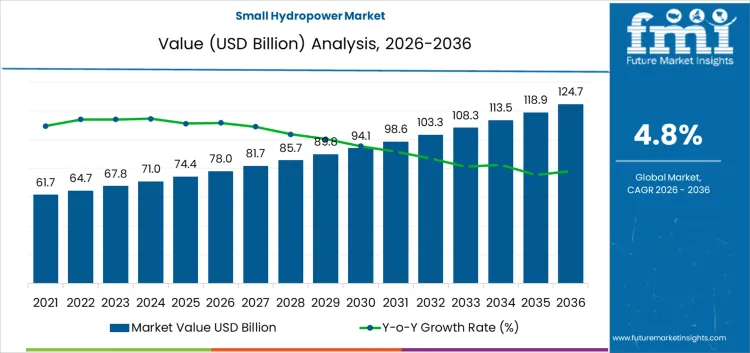
What is the Growth Forecast for Small Hydropower Market through 2036?
Between 2026 and 2031, the small hydropower market is projected to expand from USD 78 billion along a trajectory consistent with a 4.8% CAGR, shaped more by project rehabilitation and grid-integration priorities than by greenfield dam construction. Much of the activity in this phase comes from upgrading aging run-of-river and canal-based assets, improving turbine efficiency, control systems, and availability rather than adding large amounts of new capacity. Utilities and local authorities focus on projects that can be permitted and connected quickly, often by repowering existing civil works. Investment decisions emphasize reliability, seasonal flow optimization, and dispatch predictability. Growth is therefore incremental and engineering-driven, with value tied to refurbishment scope, equipment replacement cycles, and grid compliance requirements rather than to headline capacity additions.
From 2031 to 2036, the market is expected to reach USD 124.7 billion, with expansion increasingly influenced by energy security planning and decentralized generation strategies. Small hydropower is used less as a pure capacity addition tool and more as a stabilizing, long-life asset within regional energy mixes. Off-grid and community systems gain relevance in remote regions, while industrial and municipal operators use compact schemes to secure local supply. Project pipelines depend on policy continuity and financing access rather than technology breakthroughs. The business shifts toward standardized project templates and repeatable designs, which favors experienced equipment suppliers and integrators. Competitive positioning rests on lifecycle support, civil-electromechanical integration capability, and execution track record rather than on turbine performance alone.
Small Hydropower Market Key Takeaways
| Metric | Value |
|---|---|
| Market Value (2026) | USD 78 billion |
| Forecast Value (2036) | USD 124.7 billion |
| Forecast CAGR 2026 to 2036 | 4.8% |
How Is the Small Hydropower Market Supporting Decentralized Renewable Energy?
The small hydropower market is increasingly adopted to generate electricity from rivers, streams, and low-head water sources, providing decentralized, reliable, and renewable energy solutions. Historically, electricity generation relied on large-scale hydropower plants, which required significant infrastructure, environmental disruption, and high capital investment. Modern small hydropower systems employ modular turbines, compact generators, and automated controls to enable low-impact installations, scalable capacity, and integration with local grids.
Energy developers, utilities, and rural communities prioritize site adaptability, efficiency, and regulatory compliance. Early adoption focused on remote and off-grid regions, while current demand spans industrial facilities, municipal power projects, and rural electrification initiatives, driven by renewable energy targets, energy access goals, and cost-effective generation. Turbine efficiency, site suitability, and grid compatibility influence project planning and supplier selection.
Increasing renewable energy mandates, rural electrification needs, and decentralized power demand are shaping market growth. Compared with large-scale hydropower, small hydropower systems emphasize low environmental impact, modular installation, and localized energy generation. Cost structures depend on turbine technology, civil works, and grid integration, concentrating margins among suppliers capable of delivering high-efficiency, site-adaptable solutions. Utilities and developers adopt small hydropower systems to provide clean, reliable energy, reduce dependence on fossil fuels, and support sustainable energy strategies. By 2036, small hydropower is expected to become a key component of decentralized renewable energy infrastructure, supporting energy access, environmental conservation, and grid resilience globally.
What Factors Are Shaping the Demand for Small Hydropower by Plant Configuration and Power Use Case in 2026?
The small hydropower market in 2026 is segmented by system type and by end use application. By plant configuration, demand is divided into run of river, reservoir or impoundment, pumped storage small hydropower, and canal or tidal adjunct systems, each defined by different civil works requirements and operating profiles. By application, demand is organized around utility power generation, off grid rural electrification, industrial and commercial supply, and micro grid or community systems, which differ in load stability, financing structure, and grid integration needs. These segments reflect how developers and authorities balance site availability, permitting complexity, capital intensity, and long term operating responsibility across varied geographic and regulatory contexts.
Why Do Run of River Systems Represent the Largest Share of New Capacity?
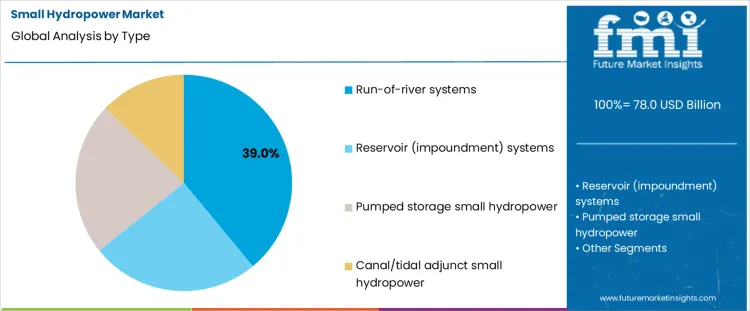
Run of river systems account for about 39% of demand in 2026, reflecting their relatively low environmental footprint and simpler approval pathways. These projects divert part of the river flow through turbines without large reservoirs, which reduces land acquisition and resettlement issues. Civil construction scopes are smaller, which shortens development timelines and lowers upfront risk. Output varies with seasonal flow, yet many grids and local users accept this variability in exchange for faster deployment. Financing institutions often prefer these schemes because cost overruns and social opposition risks are more limited. This balance between acceptable output variability and manageable project complexity keeps run of river designs as the most frequently pursued small hydropower configuration.
Reservoir based, pumped storage, and canal or tidal adjunct systems serve more specific site and grid needs. Impoundment projects provide steadier output but face higher permitting and social acceptance hurdles. Pumped storage variants focus on energy shifting rather than pure generation, which ties them to grid balancing strategies rather than to simple capacity additions. Canal and tidal adjunct projects depend on existing water infrastructure or special geographic conditions, which restricts site availability. These options are important where conditions fit, yet their development pipelines are narrower. This keeps their combined project count below that of run of river installations, which can be adapted to a wider range of river sites and regulatory environments.
Why Does Utility Power Generation Dominate End Use Demand?
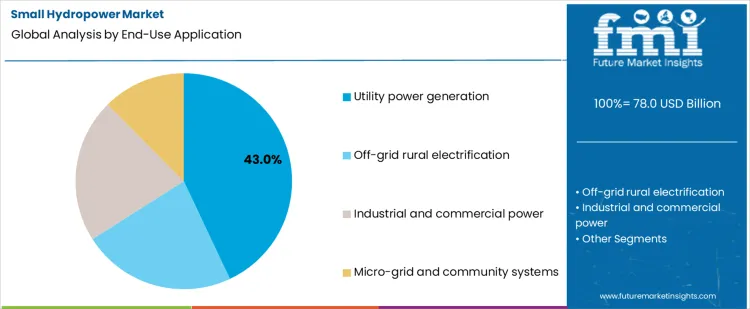
Utility power generation represents about 43% of demand in 2026 because most small hydropower projects are developed to feed public or regional grids. Utilities value these plants for their predictable operating costs and long asset life, even if output varies with hydrology. Once built, operating expenses are low and fuel cost exposure is absent, which suits long term capacity planning. Grid connection also allows surplus generation during wet seasons to be absorbed and deficits to be covered by other sources. This integration advantage concentrates a large share of projects within utility frameworks rather than in isolated systems.
Off grid, industrial, and community based applications follow different drivers. Rural electrification projects target access rather than scale and are limited by financing and local demand. Industrial and commercial users develop captive plants where water resources and load profiles align, which is not common in most locations. Micro grid and community systems depend on coordinated local governance and funding. These segments grow steadily, yet their project sizes and counts remain smaller. As a result, while they are important for energy access and resilience, they do not match the volume of capacity directed into utility connected small hydropower developments.
Why Are Grid Resilience Goals and Local Energy Economics Reviving Interest in the Small Hydropower Market through 2036?
Demand is being shaped by how utilities and communities manage reliability rather than by headline capacity targets. Small hydropower fits into existing weirs, canals, and legacy dams, turning idle hydraulic head into predictable baseload output. For remote or weak grids, this local generation reduces dependence on long transmission lines and imported fuels. Permitting risk is often lower for upgrades and run of river sites than for large dams, which shortens development timelines. Once built, operating costs are stable and output is seasonal but forecastable. These characteristics make projects attractive for municipalities and industrial sites seeking long term, low volatility power supply.
What Capital Recovery Risk, Site Specific Constraints, and Regulatory Friction Are Holding Back Faster Build Out?
Limits come from project economics and geography. Each site is unique, which raises engineering, civil works, and permitting cost relative to installed capacity. Payback depends on local tariffs, hydrology, and grid access, all of which vary widely. Environmental reviews can still be lengthy, especially where fish passage or water rights are contested. Construction risk is high because works take place in or near active waterways. Financing institutions often prefer larger, repeatable projects, which makes small schemes harder to bundle. These factors slow development pipelines and keep many technically feasible sites on hold despite favorable long term operating profiles.
How Are Retrofit Programs, Standardized Equipment, and Hybrid Energy Planning Reshaping This Category?
Change is coming from how projects are sourced and packaged. More capacity is being added through retrofits of existing dams, irrigation channels, and water infrastructure rather than through new greenfield builds. Turbine and control suppliers are offering more standardized modules to reduce engineering time and cost. In planning, small hydropower is increasingly paired with solar or storage to stabilize local grids and improve asset utilization. Public agencies also use framework programs to roll out multiple similar sites under one approval process. The category is shifting from bespoke one off projects toward programmatic, portfolio based development models.
What is the Demand for Small Hydropower by Country?
| Country | CAGR (%) |
|---|---|
| USA | 4.5% |
| UK | 4.2% |
| China | 5.2% |
| India | 5.5% |
| Brazil | 4.8% |
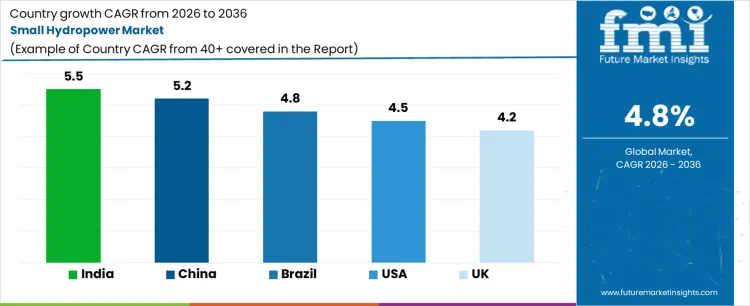
Demand for small hydropower is rising as governments and energy producers focus on renewable energy adoption, rural electrification, and sustainable power generation. India leads with a 5.5% CAGR, driven by growing electricity demand in remote areas, government incentives for small-scale renewable projects, and infrastructure development. China follows at 5.2%, supported by investment in decentralized renewable energy and adoption of mini-hydropower installations. Brazil records 4.8% growth, shaped by regional energy needs and expansion of small hydropower projects. The USA grows at 4.5%, influenced by renewable energy initiatives and deployment of micro-hydro systems. The UK shows 4.2% CAGR, reflecting steady adoption of small-scale hydropower projects and integration into renewable energy strategies.
How is the United States experiencing growth in the small hydropower market?
United States is experiencing growth at a CAGR of 4.5%, driven by initiatives to develop decentralized renewable energy and support rural electrification. Small hydropower installations, typically below 10 MW, are optimized for local grid integration, environmental compliance, and operational reliability. Demand is concentrated in regions such as the Pacific Northwest, Appalachian states, and the Mississippi Valley, where river systems and regulatory frameworks support small-scale projects. Investments focus on turbine efficiency, minimal environmental impact, and compliance with federal energy regulations. Growth reflects increasing interest in sustainable energy solutions, modernization of local grids, and incentives for renewable energy deployment.
- Decentralized renewable energy drives adoption.
- Systems optimize turbine efficiency and environmental compliance.
- River-rich regions concentrate demand.
- Regulatory adherence and operational reliability guide investment.
How is the United Kingdom witnessing growth in the small hydropower market?
United Kingdom is witnessing growth at a CAGR of 4.2%, supported by government incentives for renewable energy and the development of micro-hydro projects in Scotland, Wales, and Northern England. Small hydropower systems are optimized for river and canal integration, environmental sustainability, and grid connectivity. Demand is concentrated in rural and semi-urban regions where decentralized energy solutions complement national grid infrastructure. Investments prioritize turbine efficiency, low environmental footprint, and compliance with Ofgem and environmental regulations. Growth reflects national goals for carbon reduction, promotion of renewable energy, and modernization of small-scale energy infrastructure.
- Renewable energy policies drive adoption.
- Systems enhance turbine efficiency and sustainability.
- Rural and semi-urban regions concentrate demand.
- Regulatory compliance and low environmental impact guide investment.
How is China experiencing growth in the small hydropower market?
China is experiencing growth at a CAGR of 5.2%, fueled by government programs to expand renewable energy, particularly in western provinces such as Yunnan, Sichuan, and Guizhou. Small hydropower projects provide off-grid electricity and support rural industrial development. Systems are optimized for high energy conversion efficiency, reliability, and environmental protection. Demand is concentrated in mountainous regions with abundant water resources. Investments focus on turbine performance, ecological impact mitigation, and adherence to national energy and environmental regulations. Growth reflects government incentives, electrification of rural areas, and the push for clean energy in regional development plans.
- Rural electrification and renewable initiatives drive adoption.
- Systems optimize energy conversion and environmental protection.
- Mountainous regions concentrate demand.
- Performance and regulatory compliance guide investment.
How is India witnessing growth in the small hydropower market?
India is witnessing growth at a CAGR of 5.5%, driven by initiatives to expand renewable energy in remote areas of Himachal Pradesh, Uttarakhand, and northeastern states. Small hydropower systems are optimized for off-grid energy supply, sustainable operation, and minimal environmental impact. Demand is concentrated in rural regions, hilly terrains, and local industrial clusters. Investments prioritize turbine efficiency, ecological protection, and compliance with Central Electricity Authority and state renewable energy regulations. Growth reflects rising demand for decentralized energy, government support for clean energy projects, and development of rural infrastructure.
- Off-grid energy demand drives adoption.
- Systems enhance turbine efficiency and sustainability.
- Hilly rural regions concentrate demand.
- Compliance and ecological protection guide investment.
How is Brazil experiencing growth in the small hydropower market?
Brazil is experiencing growth at a CAGR of 4.8%, supported by expansion of renewable energy programs and small hydropower projects in Minas Gerais, Paraná, and São Paulo. Systems are optimized for river-based installations, operational efficiency, and environmental compliance. Demand is concentrated in rural areas and small industrial clusters reliant on local energy supply. Investments focus on turbine performance, low environmental footprint, and compliance with Brazilian energy regulations. Growth reflects government incentives, regional energy needs, and the push for sustainable electricity generation in decentralized locations.
- Renewable energy programs drive adoption.
- Systems optimize operational efficiency and environmental compliance.
- Rural and industrial clusters concentrate demand.
- Turbine performance and regulatory compliance guide investment.
Who Competes in the Small Hydropower Market and How Do Their Capabilities Differ?
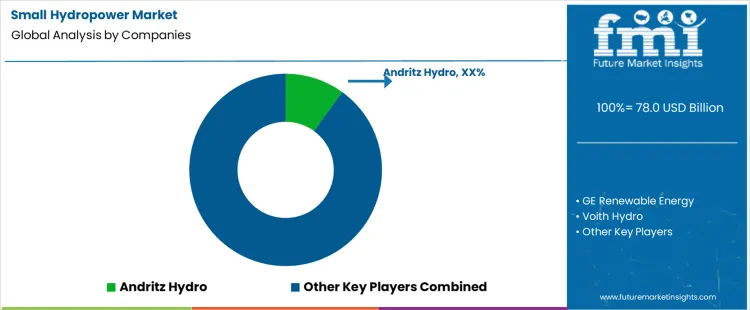
Competition in the small hydropower market is defined by turbine technology, modularity for low-head sites, and ability to integrate with local grid and water management systems. Andritz Hydro supplies small hydropower equipment and turnkey services including Kaplan, Francis, and bulb turbines tailored for river and canal installations, with expertise in retrofit and mini-grid projects. GE Renewable Energy delivers compact turbine and generator packages designed for remote and distributed generation, supported by control systems for variable flow conditions.
Voith Hydro offers modular small hydro solutions with standardized components to reduce installation time and match diverse site conditions. Siemens Energy provides electromechanical packages with digital control systems that support grid stability and remote monitoring. Dongfang Electric Corporation develops small turbine units with focus on cost effectiveness and adaptability to regional supply chains.
Toshiba Energy Systems & Solutions supplies hydro turbines and generators optimized for low to medium head applications, with service networks supporting lifecycle maintenance. Hydro-Equipment (KanEnerji) provides small hydropower components and project execution services, with emphasis on customization for local site constraints.
Other regional and specialty engineering firms support equipment supply, site assessment, and balance-of-plant integration for turnkey small hydropower projects. Competitive differentiation arises from turbine efficiency at low flows, ease of installation, operation and maintenance support, and compatibility with microgrid or isolated network solutions. Suppliers with proven project delivery, technical support infrastructure, and ability to tailor solutions to environmental and regulatory contexts maintain relevance across distributed renewable energy segments where hydropower is a stable baseload option.
Key Players in the Small Hydropower Market
- Andritz Hydro
- GE Renewable Energy
- Voith Hydro
- Siemens Energy
- Dongfang Electric Corporation
- Toshiba Energy Systems & Solutions
- Hydro-Equipment (KanEnerji)
Scope of the Report
| Items | Values |
|---|---|
| Quantitative Units (2026) | USD billion |
| Type | Run-of-River Systems, Reservoir (Impoundment) Systems, Pumped Storage Small Hydropower, Canal or Tidal Adjunct Small Hydropower |
| End-Use Application | Utility Power Generation, Off-Grid Rural Electrification, Industrial and Commercial Power, Micro-Grid and Community Systems |
| Regions Covered | Asia Pacific, Europe, North America, Latin America, Middle East & Africa |
| Countries Covered | China, Japan, South Korea, India, Australia & New Zealand, ASEAN, Germany, United Kingdom, France, Italy, Spain, Nordic, BENELUX, United States, Canada, Mexico, Brazil, Chile, Saudi Arabia, Turkey, South Africa, and other regional markets |
| Key Companies Profiled | Andritz Hydro, GE Renewable Energy, Voith Hydro, Siemens Energy, Dongfang Electric Corporation, Toshiba Energy Systems & Solutions, Hydro Equipment (KanEnerji) |
| Additional Attributes | Dollar sales by system type and end-use application, run-of-river systems forming the largest share of new projects due to lower environmental impact and simpler permitting pathways, utility power generation representing the largest end-use segment because most projects feed public grids, market growth driven by refurbishment of existing assets and selective site development rather than large greenfield dams, strong influence of permitting regimes, water rights, and environmental reviews on project economics and timelines, increasing role of retrofits of existing dams and water infrastructure, gradual shift toward standardized equipment and repeatable project templates, pairing with solar or storage in hybrid local energy systems, and competitive positioning based on lifecycle support, civil-electromechanical integration capability, and execution track record rather than turbine performance alone. |
Small Hydropower Market Segmentation
By Type:
- Run-of-river systems
- Reservoir (impoundment) systems
- Pumped storage small hydropower
- Canal/tidal adjunct small hydropower
By End-Use Application:
- Utility power generation
- Off-grid rural electrification
- Industrial and commercial power
- Micro-grid and community systems
By Region
- Asia Pacific
- China
- Japan
- South Korea
- India
- Australia & New Zealand
- ASEAN
- Rest of Asia Pacific
- Europe
- Germany
- United Kingdom
- France
- Italy
- Spain
- Nordic
- BENELUX
- Rest of Europe
- North America
- United States
- Canada
- Mexico
- Latin America
- Brazil
- Chile
- Rest of Latin America
- Middle East & Africa
- Kingdom of Saudi Arabia
- Other GCC Countries
- Turkey
- South Africa
- Other African Union
- Rest of Middle East & Africa
Bibliography
- Lyon, K. (2020). Using the hydropower sustainability tools in World Bank Group client countries: Lessons learned and recommendations. World Bank.
- U.S. Energy Information Administration. (2023, April 20). Hydropower explained. U.S. Energy Information Administration.
- International Hydropower Association. (2025). 2025 world hydropower outlook. International Hydropower Association.
Frequently Asked Questions
How big is the small hydropower market in 2026?
The global small hydropower market is estimated to be valued at USD 78.0 billion in 2026.
What will be the size of small hydropower market in 2036?
The market size for the small hydropower market is projected to reach USD 124.7 billion by 2036.
How much will be the small hydropower market growth between 2026 and 2036?
The small hydropower market is expected to grow at a 4.8% CAGR between 2026 and 2036.
What are the key product types in the small hydropower market?
The key product types in small hydropower market are run-of-river systems, reservoir (impoundment) systems, pumped storage small hydropower and canal/tidal adjunct small hydropower.
Which end-use application segment to contribute significant share in the small hydropower market in 2026?
In terms of end-use application, utility power generation segment to command 43.0% share in the small hydropower market in 2026.
Preview the report firsthand - request a free sample
Get SampleGet the brochure for pricing and purchase details.
Get PDFTable of Content
- Executive Summary
- Global Market Outlook
- Demand-side Trends
- Supply-side Trends
- Technology Roadmap Analysis
- Analysis and Recommendations
- Market Overview
- Market Coverage / Taxonomy
- Market Definition / Scope / Limitations
- Market Background
- Market Dynamics
- Drivers
- Restraints
- Opportunity
- Trends
- Scenario Forecast
- Demand in Optimistic Scenario
- Demand in Likely Scenario
- Demand in Conservative Scenario
- Opportunity Map Analysis
- Product Life Cycle Analysis
- Supply Chain Analysis
- Investment Feasibility Matrix
- Value Chain Analysis
- PESTLE and Porter’s Analysis
- Regulatory Landscape
- Regional Parent Market Outlook
- Production and Consumption Statistics
- Import and Export Statistics
- Market Dynamics
- Global Market Analysis 2021 to 2025 and Forecast, 2026 to 2036
- Historical Market Size Value (USD Million) Analysis, 2021 to 2025
- Current and Future Market Size Value (USD Million) Projections, 2026 to 2036
- Y-o-Y Growth Trend Analysis
- Absolute $ Opportunity Analysis
- Global Market Pricing Analysis 2021 to 2025 and Forecast 2026 to 2036
- Global Market Analysis 2021 to 2025 and Forecast 2026 to 2036, By Type
- Introduction / Key Findings
- Historical Market Size Value (USD Million) Analysis By Type, 2021 to 2025
- Current and Future Market Size Value (USD Million) Analysis and Forecast By Type, 2026 to 2036
- Run-of-river systems
- Reservoir (impoundment) systems
- Pumped storage small hydropower
- Canal/tidal adjunct small hydropower
- Run-of-river systems
- Y-o-Y Growth Trend Analysis By Type, 2021 to 2025
- Absolute $ Opportunity Analysis By Type, 2026 to 2036
- Global Market Analysis 2021 to 2025 and Forecast 2026 to 2036, By End-Use Application
- Introduction / Key Findings
- Historical Market Size Value (USD Million) Analysis By End-Use Application, 2021 to 2025
- Current and Future Market Size Value (USD Million) Analysis and Forecast By End-Use Application, 2026 to 2036
- Utility power generation
- Off-grid rural electrification
- Industrial and commercial power
- Micro-grid and community systems
- Utility power generation
- Y-o-Y Growth Trend Analysis By End-Use Application, 2021 to 2025
- Absolute $ Opportunity Analysis By End-Use Application, 2026 to 2036
- Global Market Analysis 2021 to 2025 and Forecast 2026 to 2036, By Region
- Introduction
- Historical Market Size Value (USD Million) Analysis By Region, 2021 to 2025
- Current Market Size Value (USD Million) Analysis and Forecast By Region, 2026 to 2036
- North America
- Latin America
- Western Europe
- Eastern Europe
- East Asia
- South Asia and Pacific
- Middle East & Africa
- Market Attractiveness Analysis By Region
- North America Market Analysis 2021 to 2025 and Forecast 2026 to 2036, By Country
- Historical Market Size Value (USD Million) Trend Analysis By Market Taxonomy, 2021 to 2025
- Market Size Value (USD Million) Forecast By Market Taxonomy, 2026 to 2036
- By Country
- USA
- Canada
- Mexico
- By Type
- By End-Use Application
- By Country
- Market Attractiveness Analysis
- By Country
- By Type
- By End-Use Application
- Key Takeaways
- Latin America Market Analysis 2021 to 2025 and Forecast 2026 to 2036, By Country
- Historical Market Size Value (USD Million) Trend Analysis By Market Taxonomy, 2021 to 2025
- Market Size Value (USD Million) Forecast By Market Taxonomy, 2026 to 2036
- By Country
- Brazil
- Chile
- Rest of Latin America
- By Type
- By End-Use Application
- By Country
- Market Attractiveness Analysis
- By Country
- By Type
- By End-Use Application
- Key Takeaways
- Western Europe Market Analysis 2021 to 2025 and Forecast 2026 to 2036, By Country
- Historical Market Size Value (USD Million) Trend Analysis By Market Taxonomy, 2021 to 2025
- Market Size Value (USD Million) Forecast By Market Taxonomy, 2026 to 2036
- By Country
- Germany
- UK
- Italy
- Spain
- France
- Nordic
- BENELUX
- Rest of Western Europe
- By Type
- By End-Use Application
- By Country
- Market Attractiveness Analysis
- By Country
- By Type
- By End-Use Application
- Key Takeaways
- Eastern Europe Market Analysis 2021 to 2025 and Forecast 2026 to 2036, By Country
- Historical Market Size Value (USD Million) Trend Analysis By Market Taxonomy, 2021 to 2025
- Market Size Value (USD Million) Forecast By Market Taxonomy, 2026 to 2036
- By Country
- Russia
- Poland
- Hungary
- Balkan & Baltic
- Rest of Eastern Europe
- By Type
- By End-Use Application
- By Country
- Market Attractiveness Analysis
- By Country
- By Type
- By End-Use Application
- Key Takeaways
- East Asia Market Analysis 2021 to 2025 and Forecast 2026 to 2036, By Country
- Historical Market Size Value (USD Million) Trend Analysis By Market Taxonomy, 2021 to 2025
- Market Size Value (USD Million) Forecast By Market Taxonomy, 2026 to 2036
- By Country
- China
- Japan
- South Korea
- By Type
- By End-Use Application
- By Country
- Market Attractiveness Analysis
- By Country
- By Type
- By End-Use Application
- Key Takeaways
- South Asia and Pacific Market Analysis 2021 to 2025 and Forecast 2026 to 2036, By Country
- Historical Market Size Value (USD Million) Trend Analysis By Market Taxonomy, 2021 to 2025
- Market Size Value (USD Million) Forecast By Market Taxonomy, 2026 to 2036
- By Country
- India
- ASEAN
- Australia & New Zealand
- Rest of South Asia and Pacific
- By Type
- By End-Use Application
- By Country
- Market Attractiveness Analysis
- By Country
- By Type
- By End-Use Application
- Key Takeaways
- Middle East & Africa Market Analysis 2021 to 2025 and Forecast 2026 to 2036, By Country
- Historical Market Size Value (USD Million) Trend Analysis By Market Taxonomy, 2021 to 2025
- Market Size Value (USD Million) Forecast By Market Taxonomy, 2026 to 2036
- By Country
- Kingdom of Saudi Arabia
- Other GCC Countries
- Turkiye
- South Africa
- Other African Union
- Rest of Middle East & Africa
- By Type
- By End-Use Application
- By Country
- Market Attractiveness Analysis
- By Country
- By Type
- By End-Use Application
- Key Takeaways
- Key Countries Market Analysis
- USA
- Pricing Analysis
- Market Share Analysis, 2025
- By Type
- By End-Use Application
- Canada
- Pricing Analysis
- Market Share Analysis, 2025
- By Type
- By End-Use Application
- Mexico
- Pricing Analysis
- Market Share Analysis, 2025
- By Type
- By End-Use Application
- Brazil
- Pricing Analysis
- Market Share Analysis, 2025
- By Type
- By End-Use Application
- Chile
- Pricing Analysis
- Market Share Analysis, 2025
- By Type
- By End-Use Application
- Germany
- Pricing Analysis
- Market Share Analysis, 2025
- By Type
- By End-Use Application
- UK
- Pricing Analysis
- Market Share Analysis, 2025
- By Type
- By End-Use Application
- Italy
- Pricing Analysis
- Market Share Analysis, 2025
- By Type
- By End-Use Application
- Spain
- Pricing Analysis
- Market Share Analysis, 2025
- By Type
- By End-Use Application
- France
- Pricing Analysis
- Market Share Analysis, 2025
- By Type
- By End-Use Application
- India
- Pricing Analysis
- Market Share Analysis, 2025
- By Type
- By End-Use Application
- ASEAN
- Pricing Analysis
- Market Share Analysis, 2025
- By Type
- By End-Use Application
- Australia & New Zealand
- Pricing Analysis
- Market Share Analysis, 2025
- By Type
- By End-Use Application
- China
- Pricing Analysis
- Market Share Analysis, 2025
- By Type
- By End-Use Application
- Japan
- Pricing Analysis
- Market Share Analysis, 2025
- By Type
- By End-Use Application
- South Korea
- Pricing Analysis
- Market Share Analysis, 2025
- By Type
- By End-Use Application
- Russia
- Pricing Analysis
- Market Share Analysis, 2025
- By Type
- By End-Use Application
- Poland
- Pricing Analysis
- Market Share Analysis, 2025
- By Type
- By End-Use Application
- Hungary
- Pricing Analysis
- Market Share Analysis, 2025
- By Type
- By End-Use Application
- Kingdom of Saudi Arabia
- Pricing Analysis
- Market Share Analysis, 2025
- By Type
- By End-Use Application
- Turkiye
- Pricing Analysis
- Market Share Analysis, 2025
- By Type
- By End-Use Application
- South Africa
- Pricing Analysis
- Market Share Analysis, 2025
- By Type
- By End-Use Application
- USA
- Market Structure Analysis
- Competition Dashboard
- Competition Benchmarking
- Market Share Analysis of Top Players
- By Regional
- By Type
- By End-Use Application
- Competition Analysis
- Competition Deep Dive
- Andritz Hydro
- Overview
- Product Portfolio
- Profitability by Market Segments (Product/Age /Sales Channel/Region)
- Sales Footprint
- Strategy Overview
- Marketing Strategy
- Product Strategy
- Channel Strategy
- GE Renewable Energy
- Voith Hydro
- Siemens Energy
- Dongfang Electric Corporation
- Toshiba Energy Systems & Solutions
- Hydro‑Equipment (KanEnerji)
- Andritz Hydro
- Competition Deep Dive
- Assumptions & Acronyms Used
- Research Methodology


