

- Industry Size (2026)
- USD 1067.72 Mn
- Forecast (2036)
- USD 2348 Mn
- CAGR (2026 to 2036)
- 8.2%
Greaves Meal Market Size, Market Forecast and Outlook By FMI
The greaves meal market was valued at USD 986.80 million in 2025, projected to reach USD 1,067.72 million in 2026, and is forecast to expand to USD 2,348.17 million by 2036 at an 8.2% CAGR. Pet food premiumization and the demand for animal-derived protein ingredients with high palatability and digestibility are driving commercial adoption of greaves meal across pet food, livestock feed, and specialty animal nutrition applications. Greaves meal, the protein-rich solid residue from rendering operations after fat extraction, provides a concentrated protein and mineral source that pet food and feed manufacturers specify for its nutritional density and organoleptic properties.
As per FMI, pork greaves hold 45.0% of source share because pork rendering generates the highest volume of greaves by-product among species-specific rendering operations, particularly in Europe and China where pork is the dominant meat category. Pet food anchors application share at 50.0% because greaves meal delivers the high protein concentration, appealing flavour profile, and amino acid balance that premium pet food formulators require. The rendering industry's investment in low-temperature processing technology is improving greaves meal digestibility and amino acid availability, expanding its acceptability in premium pet food formulations.
Summary of Greaves Meal Market
- Greaves Meal Market Definition
- Greaves meal is a rendered animal protein ingredient produced from the solid residue remaining after fat extraction from animal tissues during the rendering process. The product is dried, ground, and standardized for protein content, serving as a concentrated source of animal protein, minerals, and amino acids in pet food, livestock feed, and specialty animal nutrition formulations.
- Demand Drivers in the Market
- Pet food premiumization protein demand: Premium pet food brands specify named animal protein sources including pork greaves and beef greaves to meet consumer demand for identifiable, high-quality ingredients on pet food labels. FMI analysts note that the clean-label trend in pet food favours single-species greaves meal over generic animal protein meals, creating a premium pricing tier for species-specific greaves products.
- Rendering industry technology advancement: Based on FMI's report, low-temperature rendering and gentle drying technologies are improving the amino acid digestibility and nutritional quality of greaves meal, expanding its acceptability in premium pet food formulations that previously specified only fresh or frozen meat ingredients. These processing advances close the quality gap between greaves meal and primary meat ingredients.
- Circular economy by-product valorization: As per FMI, the rendering industry converts slaughterhouse by-products that would otherwise require disposal into valuable protein ingredients, generating revenue while reducing the environmental impact of meat processing waste. EU animal by-product regulations classify greaves meal as Category 3 material suitable for pet food and animal feed, creating a regulated commercial pathway for by-product valorization.
- Key Segments Analyzed in the FMI Report
- Pork greaves volume dominance: Pork Greaves holds 45.0% share in 2026. The global pork processing industry, concentrated in China, the European Union, and the United States, generates the highest rendering by-product volumes among species categories, making pork greaves the most available and cost-competitive greaves meal source.
- Pet food application premium: Pet Food commands 50.0% share in 2026. Premium pet food manufacturers procure greaves meal as a protein-dense ingredient that delivers high palatability scores in feeding trials, justifying the premium pricing that pet owners pay for named animal protein pet food products.
- Livestock feed protein supplementation: Livestock Feed represents a stable demand base as compound feed manufacturers use greaves meal as a cost-effective protein supplement in poultry and swine rations where animal protein digestibility advantages over plant protein sources justify the ingredient cost premium.
- Analyst Opinion at FMI
- Nandini Roy Choudhury, Principal Consultant for Food & Beverage Opinion is that the greaves meal market benefits from a convergence of pet food premiumization, rendering technology advancement, and circular economy policy support. The market growth is supply-constrained by rendering capacity and by-product availability rather than demand-constrained, meaning that every expansion of meat processing capacity creates additional greaves meal supply that the pet food and feed industries readily absorb. Rendering companies that invest in low-temperature processing technology and species-specific product segregation capture premium pricing from pet food manufacturers seeking identifiable, high-quality animal protein ingredients.
- Strategic Implications / Executive Takeaways
- Rendering companies should invest in low-temperature processing and species-specific segregation to produce premium-grade greaves meal that meets pet food manufacturer quality specifications and clean-label positioning requirements.
- Pet food formulators should evaluate species-specific greaves meal as a named protein ingredient that satisfies consumer demand for identifiable animal protein sources while maintaining cost competitiveness against primary meat ingredients.
- Animal feed compounders should specify greaves meal protein quality parameters including amino acid digestibility and ash content to ensure consistent nutritional contribution in compound feed formulations.
- Methodology
- Primary Research: FMI conducted technical interviews with procurement specialists and operations directors across 40 countries to validate adoption timelines.
- Desk Research: Analysts aggregated public regulatory documentation, industry standards, and corporate disclosure filings.
- Market-Sizing and Forecasting: Forecasting models apply hybrid methodology starting with global production metrics and projecting adoption conversion rates.
- Data Validation and Update Cycle: Segment forecasts undergo cross-validation against quarterly and annual industry production volumes.
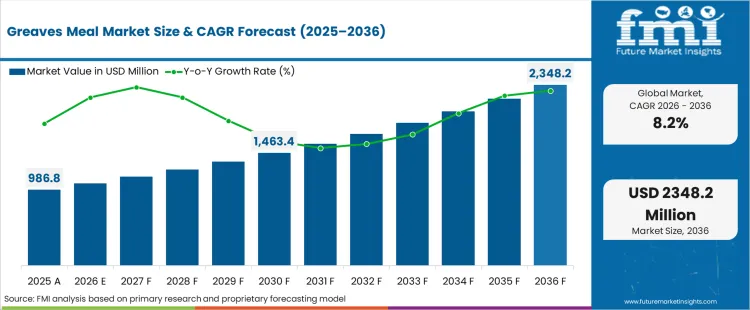
Greaves Meal Market Key Takeaways
| Metric | Details |
|---|---|
| Industry Size (2026) | USD Million 1,067.72 |
| Industry Value (2036) | USD Million 2,348.17 |
| CAGR (2026-2036) | 8.2% |
Source: Future Market Insights, 2026
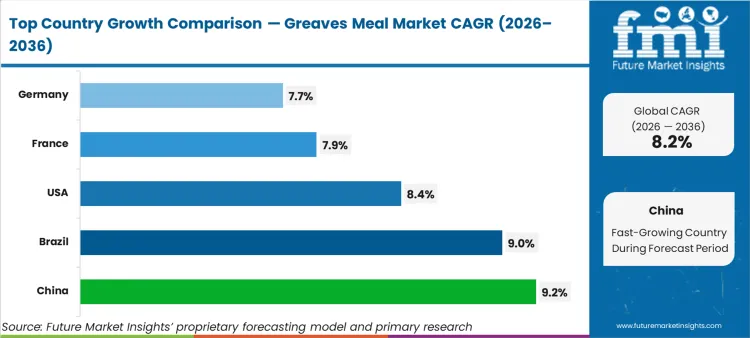
China leads with a 9.2% CAGR, driven by the world's largest pork production industry generating substantial rendering by-product volumes and the rapidly growing pet food market creating domestic demand for protein ingredients. Brazil follows at 9.0% as the beef and pork processing sectors supply rendering by-products to both domestic pet food and export animal feed markets. USA tracks at 8.4% driven by the premium pet food sector's demand for named animal protein ingredients. France registers a 7.9% pace reflecting the European rendering industry's concentration and the EU pet food market's growth. Germany tracks at 7.7% anchored by the rendering industry consolidation and the premium pet food retail channel.
Greaves Meal Market Definition
Greaves meal is a rendered animal protein ingredient produced from the solid residue remaining after fat extraction from animal tissues during the rendering process. The product is dried, ground, and standardized for protein content, serving as a concentrated source of animal protein, minerals, and amino acids in pet food, livestock feed, and specialty animal nutrition formulations.
Greaves Meal Market Inclusions
Market scope includes pork greaves meal, beef greaves meal, and mixed species greaves meal for pet food, livestock feed, and specialty animal feed applications. The report covers global and regional market sizes from 2026 to 2036, segmented by source, application, and geography.
Greaves Meal Market Exclusions
Rendered animal fats and tallow products are excluded. Meat and bone meal produced through high-temperature rendering without separate greaves extraction falls outside scope. Fresh meat by-products sold without rendering processing are excluded from the valuation.
Greaves Meal Market Research Methodology
Primary Research: Analysts engaged with procurement specialists, production managers, and supply chain directors to map purchasing cycles and supplier qualification requirements.
Desk Research: Data collection aggregated regulatory filings, industry standards, trade association publications, and public company disclosures.
Market-Sizing and Forecasting: Baseline values derive from hybrid top-down and bottom-up methodology, applying region-specific adoption curves through 2036.
Data Validation and Update Cycle: Projections tested against publicly reported production volumes, trade data, and industry benchmarks with annual recalibration.
Top Dynamics and Industry Trends Shaping the Greaves Meal Market
Higher protein retention capacity leading to Dry Rendering being the prominent production process
The production process of Greaves meal is primarily done by dry rendering. The process is conducted within controlled temperatures, between 115-145 degrees Celsius and the denaturation process is kept at a minimum to maintain the quality of protein. This method reaches protein retention of 90-95%, while wet rendering reaches 80-85%, which indicates higher commercial value.
Today's dry rendering systems are equipped with automated control systems and energy recovery systems which improve effectiveness. This process is also applied by premium pet food producers who have a need for consistent ingredients. Stronger preservation of amino acids profile, as well as lower cost of processing, have made dry rendering attractive to larger producers.
Pet Food manufacturers accounting for the majority of greaves meal sales
Pet food manufacturers constitute 45% of the global consumption of greaves meal, fueled by the global pet food industry. These suppliers buy greaves meal owing to its high protein content, which ranges between 45-60% and is usually enhanced with its natural flavoring. The long-term supply contracts, together with stringent quality requirements which are generally in line with pet food safety standards, strengthen the dominance of the segment.
Other major pet food manufacturers such as Mars Petcare and Nestlé Purina have also established suppliers of greaves meal and they have been paying premium prices in order to obtain quality harvests. This sales channel has been further consolidated by the premiumization trend of pet food formulations.
Rising pressure on companies to produce sustainable alternatives changing market dynamics
The Global Greaves Meal Industry is under pressure to move towards sustainable production as well as develop products that are less harmful to the environment. This trend is being driven by consumers, authorities and environmental organizations who expect companies to take action regarding the ecological consequences of their business activities.
Such pressure adds a different dimension as there is a focus on the sustainability side. Meeting these demands implies heavy expenditure on the R&D supply chain and non-fossil technologies. Firms that can make this transformation expect to be in a privileged position and grow in this new and promising market of eco-friendly products.
Comparison of Historical vs Future Outlook on Changing Consumer Trends for Greaves Meal Industry
Global sales increased at a CAGR of 7.5% from 2019 to 2023. For the next ten years (2024 to 2034), projections are that expenditure on the industry will rise at 8.2% forecast CAGR.
The Global Greaves meal Industry has evolved from traditional farming. With the years passing, the industry has transformed, progressing with the time and the needs of its consumers. Across cultures and geographies, greaves meal has often been used as a constituent in many animal feeds owing to its nutritional value of high protein and fats.
As we look into the future, this industry comes with its potential. As more people start to prefer sustainably, ethically sourced products, there are changes in demand that the industry must cater to. Changes in processing and applications for the products are creating new opportunities within the existing segments of the industry.
Another notable fact is that this industry also has to deal with regulatory frameworks and environmental issues while also ensuring the sustainability of the supply chain in the long run. The companies that are likely to thrive in the Global Greaves Meal Industry would be the ones who view change as a necessity and evolve, keeping in mind the importance of changing consumer dynamics.
Key Greaves Meal Market Players and Concentration
The Greaves Meal Industry is, depending on the industry area, moderate to highly concentrated. It is estimated that the top 5 players make a total of 45% of the world market share. These players are Darling Ingredients, SARIA Group and Ten Kate Vetten. The next 10 players account for another 30%, leaving about 25% for regional players.
As for Europe and North America, the concentration is high with presence of multiple MNCs. For instance, SARIA Group has more than 30% share of the European market due to its 2 holdings 'ReFood' and 'ecoMotion'. Darling Ingredients also claims to capture over 35% of the North American segment through various regional infrastructure and new acquisitions like Valley Proteins.
On the other hand, Asian and Latin American markets continue to be much more fragmented with more regionally oriented companies. These markets have a large number of average-sized processors who provide local service. The Premium Pet Food Grade products are highly concentrated and account for ~60% share. The Standard Feed Grade is moderately concentrated as the top 5 players have ~40% share and the Regional Feed Grade is fragmented with several local participants in the sector.
Integration is the strategy of the industry as the development of economical rendering plants, high entry barriers caused by the stringent regulatory environment, advantages of verticality, growing importance of global distribution and M&A activities of key players expanding to foreign markets continue to widen the gap.
Leading Companies Overview
SARIA Group established itself as a top-grade producer of greaves meal focusing mostly on species-based products in the pet food sector. This includes 'ProtiGraves' line of premium pork greaves and 'PoultryPro' line of specialized poultry greaves.
The company is pursuing growth in Eastern Europe and is expanding its sustainable technologies as well. The core direction of SARIA's future strategy is based on carbon-zero production sites and digital supply chain integration with a target of 200m euros on facility upgrade in the upcoming 3 years.
Darling Ingredients Inc has a comprehensive offering of greaves meal products sold under 'Nature Safe' and 'Dar Pro' trademarks with special formulations for pet and aquaculture as well as livestock applications. After the Valley Proteins purchase, their collection network and processing capabilities in the USA have improved considerably.
Their growth strategies are mainly to expand more in the APAC area and develop more premium products. The company expects to spend about 500 million USA dollars for a more modern facility and advanced processing technologies by the year 2026.
Ten Kate Vetten BV focuses on producing excellent greaves meal, especially cold processed variations for better-grade pet food. In their assortment include ]'Ultra-Pure' and 'PremiumPork' greaves. The company is growing its foothold in Northern Europe and upgrading its rendering technology. Plans for the future include the development of organic products and further extension of the specialty pet food ingredients range through mergers with other companies.
Analysis of Top Countries Producing, Certifying, Distributing, and Using Greaves Meal
The following table shows the estimated growth rates of the top five markets. These countries are set to exhibit high consumption, recording high CAGRs through 2036.
.webp "Top Country Growth Comparison Greaves Meal Market Cagr (2026 2036)")
| Countries | CAGR 2026 to 2036 |
|---|---|
| USA | 8.4% |
| Brazil | 9.0% |
| Germany | 7.7% |
| France | 7.9% |
| China | 9.2% |
Advanced rendering infrastructure aiding sales in USA
In terms of global greaves meal production, the United States holds the prominent position due to its more than 300 modern rendering plants. These plants contain mechanized processing lines, sophisticated quality management systems and integrated systems of transport & logistics.
Such efficient means as automatic control of the drying process and continuous quality control, remove inconsistencies among the products, thus ensuring high quality for USA greaves products. This infrastructural benefit makes sure the quality requirements are up to standards for local and international markets as well.
The industry for Greaves Meal in USA is projected to exhibit a CAGR of 8.4% during the assessment period and revenue from the sales of Greaves Meal in the country is expected to reach USD 561.6 million with a market share of 28%.
Significant meat processing industry in Germany driving sales
The German meat processing sector processes more than 8 million tons of meat every year. This is beneficial for the greaves production as there are tons of raw materials being produced. Germany has over 250+ meat processing plants that are adhering to the regulations required by the EU, hence the greaves being produced are of high quality. The German market for integrated production chains also benefits the companies that have their rendering plants next to the meat processing plants in Germany.
There is little need to store and transport raw meat because it can be procured directly and it is fresh. These trends are leading to a projected value of USD 300.9 million by 2034 with Greaves Meal demand calculated to rise at a value CAGR of 7.7% during the forecast period (2024 to 2034) with a value share of 15%.
Rising demand for protein ingredients is bolstering sales in China
China's livestock industry with 400 million pigs and 6 billion poultry birds is increasing spending for protein inputs in feed. Because the prices of traditional protein sources are very high and unstable, Chinese feed companies are gradually substituting them with more affordable and consistent quality sources that have already been processed, such as greaves meal.
As the government has been modernizing the animal feed industry and promoting increased usage of protein, the industry continues to grow. These factors are responsible for the robust projected forecast CAGR of 9.2% from 2024 to 2034, with the country achieving a global value share of 12% in 2034 with a value of USD 240.7 million.
Greaves Meal Industry Analysis by Top Investment Segments
Better fat content for applications leading to prominent pork greaves production
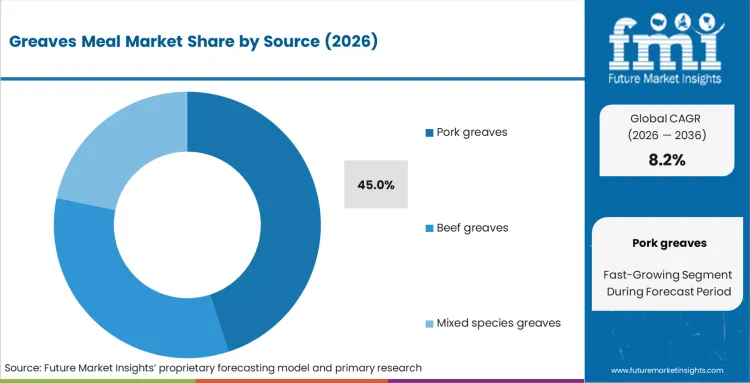
| Segment | Pork greaves |
|---|---|
| Main Segment | Source |
| Value Share (2036) | 45% |
The primary reason for pork greaves taking the lead in the industry is due to their superior functional properties and desired fat content of 10-15%. This is because increasing the fat proportions enhances the quality and energy content of animal feed. Because of its optimal protein & fat ratios, better quality can be accomplished from pork greaves than from many other sources.
Pork greaves are also a light color and have a mild odor, which makes them preferred for high-end pet food as well. The volume of pork produced, particularly in China and Europe provides good availability of raw materials for processing as well. This growth has propelled the segment's value to USD 902.6 million in 2034 with a market share of 45% and further projections suggest its growth at a CAGR of 7.4%.
Premium pricing potentials driving market interest in Pet food & treats application
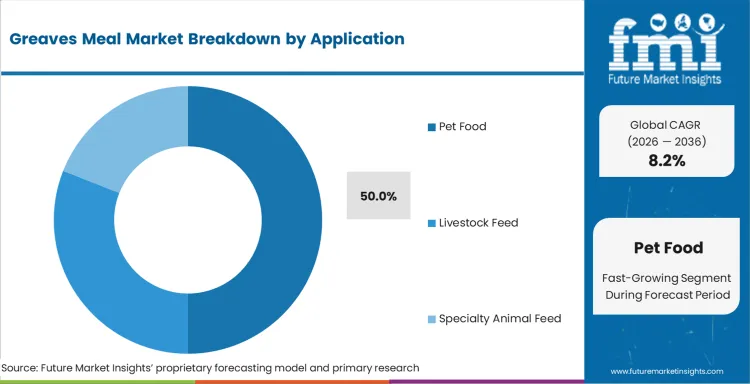
| Segment | Pet Food |
|---|---|
| Main Segment | Application |
| Value Share (2036) | 50% |
The pet food & pet food treats market segments are the most expensive out of all animal feed applications and are selling at a 30-40% premium depending on various factors. This price premium results from quality demand and processing practices, within the fast-growing pet food ecosystem. There are manufacturers in the pet food industry who go to great lengths to source greaves meal that satisfy specific nutrition and quality requirements.
The industry value of the segment continues to be supported by the continued growth of premium and super-premium categories. Specialized applications in functional pet treats and dietary supplements increase the pricing potential further. Bolstering from these trends, this segment is set to achieve a market share of 50% with a market value of USD 1,002.9 million by 2034 due to growth at a forecast CAGR of 8.4%.
Leading Suppliers of Greaves Meal
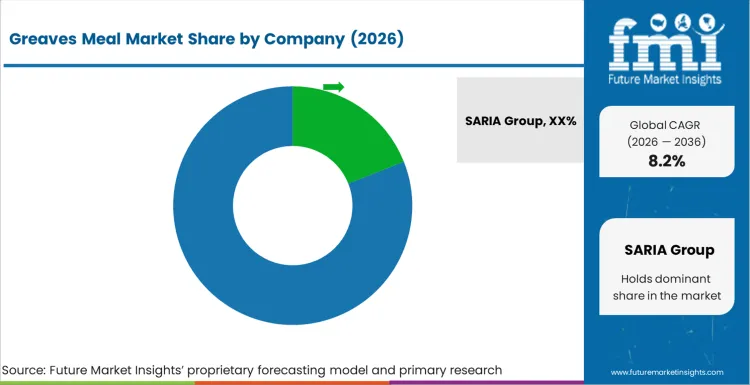
The Global Greaves Meal Industry is characterized by a moderate degree of consolidation, with most of the concentration in well-established companies from Europe and North America. The leaders of the industry are now turning their attention to vertical expansion and technology in order to remain competitive.
There is a shift in the industry with a rising focus on the production of high-end products, with an emphasis on the production of pet food, which is leading companies to develop new processing capabilities and obtain quality assurance from regulatory bodies.
Leading firms are looking to expand their presence in developing regions, mostly Asia and Latin America, through mergers and acquisitions. Enterprises are also placing a strong emphasis on sustainability as well as traceability in response to changing customer expectations.
Niche markets in specific applications and local industries are being successfully catered to by smaller regional players, while large multinational corporations are focusing their resources on achieving economies of scale and streamlining the supply chain. Also, the competitive structure is being determined by the level of digitization of the channels of distribution and the increasing popularity of value-added, niche products, which is leading companies to alter their business models.
- Darling Ingredients completed the acquisition of European Protein Solutions Group in March 2024 for €350 million and expanded its premium pet food ingredients portfolio.
- SARIA began the implementation of a carbon-neutral processing line in late 2023 and also introduced eco-friendly packaging solutions in a big shift toward sustainability.
- In 2023, Valley Proteins and Darling Ingredients came together upon completion of a USD 1.1 billion merger, with the goal of combining the primary rendering functions in the US.
Leading Greaves Meal Producers by Market Share
- SARIA Group
- Darling Ingredients Inc
- Ten Kate Vetten BV
- Scantech Group
- Boyer Valley Company
- GePro
- Mavitec Rendering
- Sonac
- ReFood UK Ltd
- American Proteins Inc
- BHJ Ingredients
- Nobless Proteins
- Valley Proteins Inc
- Kaluga Protein
- Baker Commodities Inc
- Others
Scope of the Report
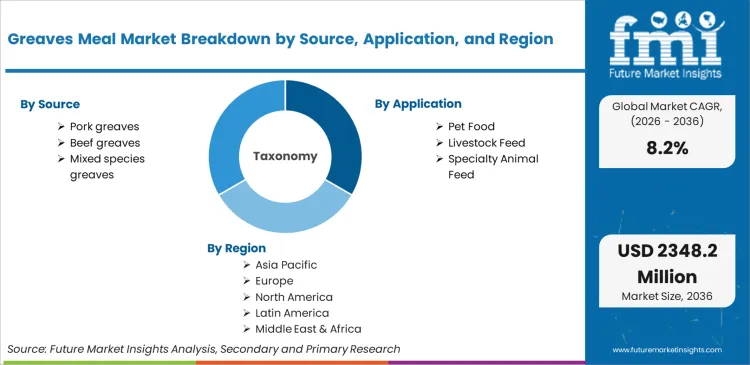
| Metric | Value |
|---|---|
| Quantitative Units | USD Million 1,067.72 to USD Million 2,348.17, at a CAGR of 8.2% |
| Market Definition | Greaves meal is a rendered animal protein ingredient produced from the solid residue remaining after fat extraction from animal tissues during the rendering process. The product is dried, ground, and standardized for protein content, serving as a concentrated source of animal protein, minerals, and amino acids in pet food, livestock feed, and specialty animal nutrition formulations. |
| Source Segmentation | Pork Greaves, Beef Greaves, Mixed Species Greaves |
| Application Segmentation | Pet Food, Livestock Feed, Specialty Animal Feed |
| Regions Covered | North America, Latin America, Europe, East Asia, South Asia, Oceania, Middle East & Africa |
| Countries Covered | China, Brazil, USA, France, Germany, and 40 plus countries |
| Key Companies Profiled | SARIA Group, Darling Ingredients Inc, Ten Kate Vetten BV, Scantech Group, Boyer Valley Company, GePro, Mavitec Rendering, Sonac, ReFood UK Ltd, American Proteins Inc, BHJ Ingredients, Nobless Proteins, Valley Proteins Inc, Kaluga Protein, Baker Commodities Inc |
| Forecast Period | 2026 to 2036 |
| Approach | Hybrid top-down and bottom-up modelling anchored by primary interviews and public data benchmarking |
Top Segments Studied in the Greaves Meal Market Report
By Source:
As per Source, the industry has been categorized into Pork greaves, Beef greaves and Mixed species greaves.
By Production Process:
As per Production Process, the industry has been categorized into Dry Rendering, Wet Rendering, Low Temperature Rendering and Others.
By Application:
As per Application, the industry has been categorized into Pet Food, Livestock Feed and Specialty Animal Feed.
By Distribution Channel:
As per Distribution Channel, the industry has been categorized into Pet Food Manufacturers, Feed Mills, Livestock Operations and Online B2B marketplaces.
By Region:
Industry analysis has been carried out in key countries of North America, Latin America, Western Europe Eastern Europe, Balkans & Baltic, Russia & Belarus, Central Asia, East Asia, South Asia & Pacific and Middle East & Africa.
Bibliography
- European Commission. (2024). Regulation (EC) No 1069/2009 laying down health rules as regards animal by-products, consolidated text. EUR-Lex.
- European Fat Processors and Renderers Association. (2024). Annual Statistics: European Rendering Industry Production Report. EFPRA.
- National Renderers Association, USA. (2024). Rendering Industry Fact Sheet: Production and Utilization Data. NRA.
- Food and Agriculture Organization of the United Nations. (2024). FAOSTAT: Livestock and Meat Production Statistics. FAO.
- FEDIAF. (2024). European Pet Food Industry: Annual Report and Nutritional Guidelines. FEDIAF.
This bibliography is provided for reader reference. The full FMI report contains the complete reference list with primary research documentation.
Frequently Asked Questions
How large is the demand for Greaves Meal in the global market in 2026?
Demand for Greaves Meal in the global market is estimated to be valued at USD Million 1,067.72 in 2026.
What will be the market size of Greaves Meal in the global market by 2036?
Market size for Greaves Meal is projected to reach USD Million 2,348.17 by 2036.
What is the expected demand growth for Greaves Meal in the global market between 2026 and 2036?
Demand for Greaves Meal is expected to grow at a CAGR of 8.2% between 2026 and 2036.
Which Source is poised to lead global sales by 2026?
Pork Greaves accounts for 45.0% share in 2026.
How significant is the role of Pet Food in Application?
Pet Food commands 50.0% of the application segment in 2026.
What is the growth outlook for China?
China is projected to grow at a CAGR of 9.2% during 2026 to 2036.
What is the growth rate for Brazil in this market?
Brazil is projected to expand at a CAGR of 9.0% during 2026 to 2036.
What is Greaves Meal and what is it mainly used for?
Greaves meal is a rendered animal protein ingredient produced from the solid residue remaining after fat extraction from animal tissues during the rendering process. The product is dried, ground, and standardized for protein content, serving as a concentrated source of animal protein, minerals, and amino acids in pet food, livestock feed, and specialty animal nutrition formulations.
What is included in the scope of this Greaves Meal report?
Market scope includes pork greaves meal, beef greaves meal, and mixed species greaves meal for pet food, livestock feed, and specialty animal feed applications. The report covers global and regional market sizes from 2026 to 2036, segmented by source, application, and geography.
What is excluded from the scope of this report?
Rendered animal fats and tallow products are excluded. Meat and bone meal produced through high-temperature rendering without separate greaves extraction falls outside scope.
What does market forecast mean on this page?
The market forecast represents a model-based projection built on defined industry and supply chain assumptions for strategic planning purposes.
How does FMI build and validate the Greaves Meal forecast?
Forecasting models apply a hybrid top-down and bottom-up methodology and cross-validate projections against publicly available industry data and primary research inputs.
What does zero reliance on speculative third-party market research mean here?
Primary interviews, verified public regulatory documentation, and official industry standards registries are used instead of unverified syndicated estimates.
Preview the report firsthand - request a free sample
Get SampleGet the brochure for pricing and purchase details.
Get PDFTable of Content
"
- Executive Summary
- Global Market Outlook
- Demand-side Trends
- Supply-side Trends
- Technology Roadmap Analysis
- Analysis and Recommendations
- Market Overview
- Market Coverage / Taxonomy
- Market Definition / Scope / Limitations
- Research Methodology
- Chapter Orientation
- Analytical Lens and Working Hypotheses
- Market Structure, Signals, and Trend Drivers
- Benchmarking and Cross-market Comparability
- Market Sizing, Forecasting, and Opportunity Mapping
- Research Design and Evidence Framework
- Desk Research Programme (Secondary Evidence)
- Company Annual and Sustainability Reports
- Peer-reviewed Journals and Academic Literature
- Corporate Websites, Product Literature, and Technical Notes
- Earnings Decks and Investor Briefings
- Statutory Filings and Regulatory Disclosures
- Technical White Papers and Standards Notes
- Trade Journals, Industry Magazines, and Analyst Briefs
- Conference Proceedings, Webinars, and Seminar Materials
- Government Statistics Portals and Public Data Releases
- Press Releases and Reputable Media Coverage
- Specialist Newsletters and Curated Briefings
- Sector Databases and Reference Repositories
- FMI Internal Proprietary Databases and Historical Market Datasets
- Subscription Datasets and Paid Sources
- Social Channels, Communities, and Digital Listening Inputs
- Additional Desk Sources
- Expert Input and Fieldwork (Primary Evidence)
- Primary Modes
- Qualitative Interviews and Expert Elicitation
- Quantitative Surveys and Structured Data Capture
- Blended Approach
- Why Primary Evidence is Used
- Field Techniques
- Interviews
- Surveys
- Focus Groups
- Observational and In-context Research
- Social and Community Interactions
- Stakeholder Universe Engaged
- C-suite Leaders
- Board Members
- Presidents and Vice Presidents
- R&D and Innovation Heads
- Technical Specialists
- Domain Subject-matter Experts
- Scientists
- Physicians and Other Healthcare Professionals
- Governance, Ethics, and Data Stewardship
- Research Ethics
- Data Integrity and Handling
- Primary Modes
- Tooling, Models, and Reference Databases
- Desk Research Programme (Secondary Evidence)
- Data Engineering and Model Build
- Data Acquisition and Ingestion
- Cleaning, Normalisation, and Verification
- Synthesis, Triangulation, and Analysis
- Quality Assurance and Audit Trail
- Market Background
- Market Dynamics
- Drivers
- Restraints
- Opportunity
- Trends
- Scenario Forecast
- Demand in Optimistic Scenario
- Demand in Likely Scenario
- Demand in Conservative Scenario
- Opportunity Map Analysis
- Product Life Cycle Analysis
- Supply Chain Analysis
- Investment Feasibility Matrix
- Value Chain Analysis
- PESTLE and Porter’s Analysis
- Regulatory Landscape
- Regional Parent Market Outlook
- Production and Consumption Statistics
- Import and Export Statistics
- Market Dynamics
- Global Market Analysis 2021 to 2025 and Forecast, 2026 to 2036
- Historical Market Size Value (USD Million) Analysis, 2021 to 2025
- Current and Future Market Size Value (USD Million) Projections, 2026 to 2036
- Y-o-Y Growth Trend Analysis
- Absolute $ Opportunity Analysis
- Global Market Pricing Analysis 2021 to 2025 and Forecast 2026 to 2036
- Global Market Analysis 2021 to 2025 and Forecast 2026 to 2036, By Source
- Introduction / Key Findings
- Historical Market Size Value (USD Million) Analysis By Source , 2021 to 2025
- Current and Future Market Size Value (USD Million) Analysis and Forecast By Source , 2026 to 2036
- Pork greaves
- Beef greaves
- Mixed species greaves
- Pork greaves
- Y-o-Y Growth Trend Analysis By Source , 2021 to 2025
- Absolute $ Opportunity Analysis By Source , 2026 to 2036
- Global Market Analysis 2021 to 2025 and Forecast 2026 to 2036, By Application
- Introduction / Key Findings
- Historical Market Size Value (USD Million) Analysis By Application, 2021 to 2025
- Current and Future Market Size Value (USD Million) Analysis and Forecast By Application, 2026 to 2036
- Pet Food
- Livestock Feed
- Specialty Animal Feed
- Pet Food
- Y-o-Y Growth Trend Analysis By Application, 2021 to 2025
- Absolute $ Opportunity Analysis By Application, 2026 to 2036
- Global Market Analysis 2021 to 2025 and Forecast 2026 to 2036, By Region
- Introduction
- Historical Market Size Value (USD Million) Analysis By Region, 2021 to 2025
- Current Market Size Value (USD Million) Analysis and Forecast By Region, 2026 to 2036
- North America
- Latin America
- Western Europe
- Eastern Europe
- East Asia
- South Asia and Pacific
- Middle East & Africa
- Market Attractiveness Analysis By Region
- North America Market Analysis 2021 to 2025 and Forecast 2026 to 2036, By Country
- Historical Market Size Value (USD Million) Trend Analysis By Market Taxonomy, 2021 to 2025
- Market Size Value (USD Million) Forecast By Market Taxonomy, 2026 to 2036
- By Country
- USA
- Canada
- Mexico
- By Source
- By Application
- By Country
- Market Attractiveness Analysis
- By Country
- By Source
- By Application
- Key Takeaways
- Latin America Market Analysis 2021 to 2025 and Forecast 2026 to 2036, By Country
- Historical Market Size Value (USD Million) Trend Analysis By Market Taxonomy, 2021 to 2025
- Market Size Value (USD Million) Forecast By Market Taxonomy, 2026 to 2036
- By Country
- Brazil
- Chile
- Rest of Latin America
- By Source
- By Application
- By Country
- Market Attractiveness Analysis
- By Country
- By Source
- By Application
- Key Takeaways
- Western Europe Market Analysis 2021 to 2025 and Forecast 2026 to 2036, By Country
- Historical Market Size Value (USD Million) Trend Analysis By Market Taxonomy, 2021 to 2025
- Market Size Value (USD Million) Forecast By Market Taxonomy, 2026 to 2036
- By Country
- Germany
- UK
- Italy
- Spain
- France
- Nordic
- BENELUX
- Rest of Western Europe
- By Source
- By Application
- By Country
- Market Attractiveness Analysis
- By Country
- By Source
- By Application
- Key Takeaways
- Eastern Europe Market Analysis 2021 to 2025 and Forecast 2026 to 2036, By Country
- Historical Market Size Value (USD Million) Trend Analysis By Market Taxonomy, 2021 to 2025
- Market Size Value (USD Million) Forecast By Market Taxonomy, 2026 to 2036
- By Country
- Russia
- Poland
- Hungary
- Balkan & Baltic
- Rest of Eastern Europe
- By Source
- By Application
- By Country
- Market Attractiveness Analysis
- By Country
- By Source
- By Application
- Key Takeaways
- East Asia Market Analysis 2021 to 2025 and Forecast 2026 to 2036, By Country
- Historical Market Size Value (USD Million) Trend Analysis By Market Taxonomy, 2021 to 2025
- Market Size Value (USD Million) Forecast By Market Taxonomy, 2026 to 2036
- By Country
- China
- Japan
- South Korea
- By Source
- By Application
- By Country
- Market Attractiveness Analysis
- By Country
- By Source
- By Application
- Key Takeaways
- South Asia and Pacific Market Analysis 2021 to 2025 and Forecast 2026 to 2036, By Country
- Historical Market Size Value (USD Million) Trend Analysis By Market Taxonomy, 2021 to 2025
- Market Size Value (USD Million) Forecast By Market Taxonomy, 2026 to 2036
- By Country
- India
- ASEAN
- Australia & New Zealand
- Rest of South Asia and Pacific
- By Source
- By Application
- By Country
- Market Attractiveness Analysis
- By Country
- By Source
- By Application
- Key Takeaways
- Middle East & Africa Market Analysis 2021 to 2025 and Forecast 2026 to 2036, By Country
- Historical Market Size Value (USD Million) Trend Analysis By Market Taxonomy, 2021 to 2025
- Market Size Value (USD Million) Forecast By Market Taxonomy, 2026 to 2036
- By Country
- Kingdom of Saudi Arabia
- Other GCC Countries
- Turkiye
- South Africa
- Other African Union
- Rest of Middle East & Africa
- By Source
- By Application
- By Country
- Market Attractiveness Analysis
- By Country
- By Source
- By Application
- Key Takeaways
- Key Countries Market Analysis
- USA
- Pricing Analysis
- Market Share Analysis, 2025
- By Source
- By Application
- Canada
- Pricing Analysis
- Market Share Analysis, 2025
- By Source
- By Application
- Mexico
- Pricing Analysis
- Market Share Analysis, 2025
- By Source
- By Application
- Brazil
- Pricing Analysis
- Market Share Analysis, 2025
- By Source
- By Application
- Chile
- Pricing Analysis
- Market Share Analysis, 2025
- By Source
- By Application
- Germany
- Pricing Analysis
- Market Share Analysis, 2025
- By Source
- By Application
- UK
- Pricing Analysis
- Market Share Analysis, 2025
- By Source
- By Application
- Italy
- Pricing Analysis
- Market Share Analysis, 2025
- By Source
- By Application
- Spain
- Pricing Analysis
- Market Share Analysis, 2025
- By Source
- By Application
- France
- Pricing Analysis
- Market Share Analysis, 2025
- By Source
- By Application
- India
- Pricing Analysis
- Market Share Analysis, 2025
- By Source
- By Application
- ASEAN
- Pricing Analysis
- Market Share Analysis, 2025
- By Source
- By Application
- Australia & New Zealand
- Pricing Analysis
- Market Share Analysis, 2025
- By Source
- By Application
- China
- Pricing Analysis
- Market Share Analysis, 2025
- By Source
- By Application
- Japan
- Pricing Analysis
- Market Share Analysis, 2025
- By Source
- By Application
- South Korea
- Pricing Analysis
- Market Share Analysis, 2025
- By Source
- By Application
- Russia
- Pricing Analysis
- Market Share Analysis, 2025
- By Source
- By Application
- Poland
- Pricing Analysis
- Market Share Analysis, 2025
- By Source
- By Application
- Hungary
- Pricing Analysis
- Market Share Analysis, 2025
- By Source
- By Application
- Kingdom of Saudi Arabia
- Pricing Analysis
- Market Share Analysis, 2025
- By Source
- By Application
- Turkiye
- Pricing Analysis
- Market Share Analysis, 2025
- By Source
- By Application
- South Africa
- Pricing Analysis
- Market Share Analysis, 2025
- By Source
- By Application
- USA
- Market Structure Analysis
- Competition Dashboard
- Competition Benchmarking
- Market Share Analysis of Top Players
- By Regional
- By Source
- By Application
- Competition Analysis
- Competition Deep Dive
- SARIA Group
- Overview
- Product Portfolio
- Profitability by Market Segments (Product/Age /Sales Channel/Region)
- Sales Footprint
- Strategy Overview
- Marketing Strategy
- Product Strategy
- Channel Strategy
- Darling Ingredients Inc
- Ten Kate Vetten BV
- Scantech Group
- Boyer Valley Company
- GePro
- Mavitec Rendering
- Sonac
- ReFood UK Ltd
- American Proteins Inc
- BHJ Ingredients
- Nobless Proteins
- Valley Proteins Inc
- Kaluga Protein
- Baker Commodities Inc
- Others
- SARIA Group
- Competition Deep Dive
- Assumptions & Acronyms Used


