

- Market Size (2026)
- USD 260.0 Mn
- Forecast (2036)
- USD 3584.0 Mn
- CAGR (2026 to 2036)
- 30.0%
How big is Ground-based Inventory Scanning Robots Market in 2026?
USD 260.0 million in 2026 and USD 3,584.0 million by 2036 at a 30.0% CAGR.
Demand for ground-based inventory scanning robots is projected to expand at 30.0% CAGR from 2026 to 2036. Market value is estimated to rise from USD 260.0 million in 2026 to USD 3,584.0 million by 2036. Warehouses lose time and margin if system records do not match stock on the floor. In February 2025, the USA Census Bureau estimated 2024 retail e-commerce sales at USD 1,192.6 billion. Sales rose 8.1% from 2023. That volume raises the cost of missed items and false stock records across the fulfillment network. Regular autonomous scans reveal errors sooner and support warehouse robotics planning across the wider network.
Warehouse adoption follows different priorities in the European Union, Eastern Europe, and the United States. Established European facilities place greater weight on safety records and reliable links with existing warehouse software. Newer Eastern European facilities often value quick installation, local training, and responsive service coverage. Large USA networks test the financial case across many buildings and require consistent reports from every location. In October 2025, Dexory reported raising USD 165 million for product development and international growth. The funding shows that investors see recurring warehouse data as a business that can scale across many sites. Companies assessing robots alongside retail warehouse management systems are likely to choose stable results and dependable service over a polished demonstration.
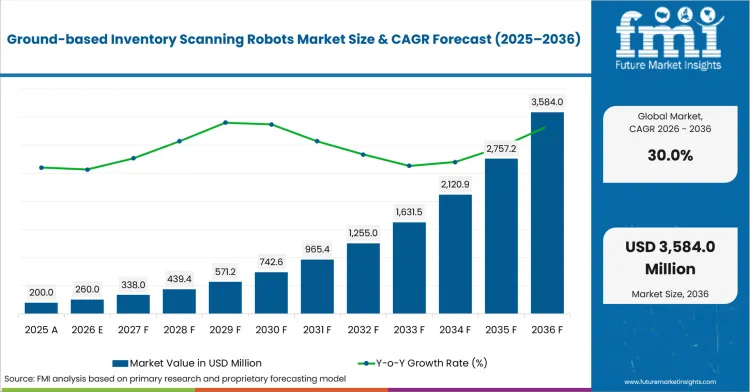
Key Takeaways of Ground-based Inventory Scanning Robots Market
- Demand for ground-based inventory scanning robots is driven by inventory accuracy becoming a direct operating issue, as missed pallets or empty shelves delay orders, create false replenishment work, and tie up working capital across warehouses and stores.
- By component, hardware is expected to lead, with the mobile base and sensors defining the system's scanning coverage across warehouse and retail environments.
- Cycle counting is the dominant application segment, supporting daily inventory control without closing aisles or delaying order work.
- Tower scanning robots are estimated to lead in warehouse settings, suited to pallet storage that requires one floor route to inspect several rack levels safely.
- Software earns growing preference as it turns raw images or tag reads into a short list of useful corrections, with successful pilots expected to reduce search time or rework rather than prove navigation alone.
- The European Union, Eastern Europe, and the United States are expected to shape regional growth differently, with mature networks focused on integration risk while newer facilities value speed and flexible contracts.
- Competition centers on Dexory, Dane Technologies, Simbe Robotics, Badger Technologies, MetraLabs, PAL Robotics, and Brain Corp, with vendors differentiating through pallet visibility, shelf availability checks, RFID counting, and managed service reach.
Analyst Perspective
"The value of mismatch detection robots is determined by how effectively they convert identified discrepancies into timely corrective actions during routine operations. End users are looking for dependable image quality, accurate location tracking, and seamless integration with existing workflows rather than high scanning speeds alone. Suppliers that combine reliable automation with responsive service, flexible deployment models, and actionable data insights are likely to build stronger long-term customer relationships."
- Nikhil Kaitwade, Principal Analyst at Future Market Insights
Source: FMI's proprietary forecasting model and primary research
How is the Ground-Based Inventory Scanning Robots Market segmented?
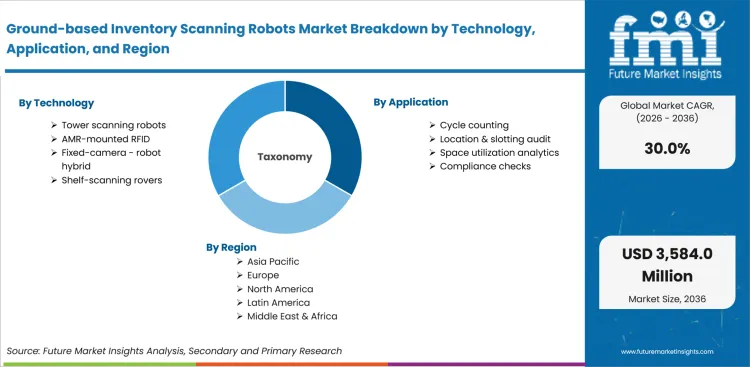
The ground-based inventory scanning robots industry is segmented by technology, application, component, end-use industry, business model, and region.
The market is segmented by technology, application, component, end-use industry, business model, and region. By technology, it is devided into tower scanning robots, AMR-mounted RFID units, fixed-camera hybrids, and shelf-scanning rovers. Application analysis covers routine cycle counting, location audits, space-use analysis, and compliance checks for active facilities. Component analysis separates hardware from software and analytics. Services cover installation and ongoing support. End-use coverage includes 3PL warehouses, retail distribution centers, e-commerce fulfillment sites, and manufacturing stockrooms. Business models include robotics as a service, direct purchase, subscriptions, and pilot programs. Regional analysis spans North America, Latin America, Europe, East Asia, South Asia, Oceania, and the Middle East and Africa.
How does tower scanning technology shape demand within the technology category?
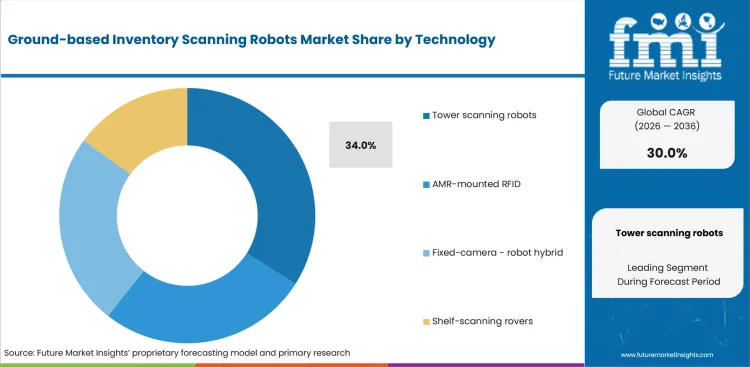
High storage racks create blind spots for cameras mounted close to the floor in busy warehouses. Tower robots raise cameras and depth sensors to inspect several rack levels in one pass. Their main benefit is the ability to inspect more pallet positions without lifts or aisle closures.
- In 2026, tower scanning robots are forecast to represent 34.0% of the technology category, as their extended vertical reach allows a single floor-level route to capture data from multiple storage tiers. In March 2025, Brain Corp and Dane Technologies introduced AiR DC for racks up to 38 feet. The system combines cameras, RFID, and barcode reading to improve coverage in routine pallet counts.
- Facilities with tall racks are expected to favor tower systems over close-range shelf robots in large storage areas. A raised sensor mast reads labels and pallet positions without lifts or aisle shutdowns during normal operations. Scan data becomes useful once a mismatch appears as an assigned correction task for warehouse staff. Piece-level tracking systems can then link the scan result to a specific item and storage location.
What supports demand for cycle counting within the application category?
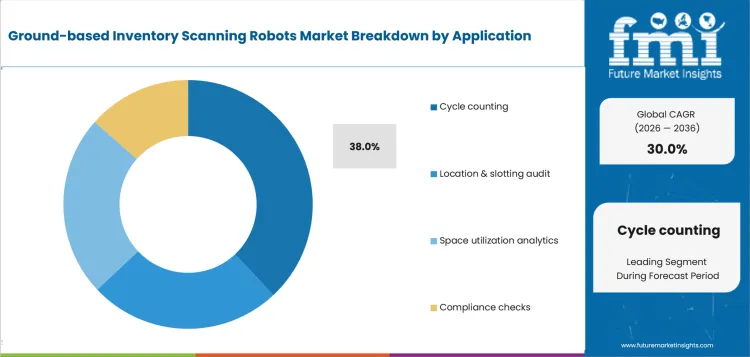
Cycle counting gives the robot a regular role in daily stock control instead of a one-time audit. It follows a planned route and compares physical stock with the warehouse or store record. The system flags mismatches for review and ignores locations that already match the record during the same route.
- By application, cycle counting is expected to lead with 38.0% share in 2026. It finds stock gaps sooner and limits order disruption during normal operations. In October 2025, Simbe Robotics reported that Harmons expanded Tally from five stores to 17 following a successful trial. The wider rollout shows that regular scans gain support once store leaders see fewer shelf gaps and less manual checking.
- Shorter review cycles expose errors sooner, so retailers and logistics groups are projected to use cycle counting more often. Cameras read visible labels, while RFID can detect tagged goods behind other products or inside closed containers.
How does hardware shape purchasing within the component category?
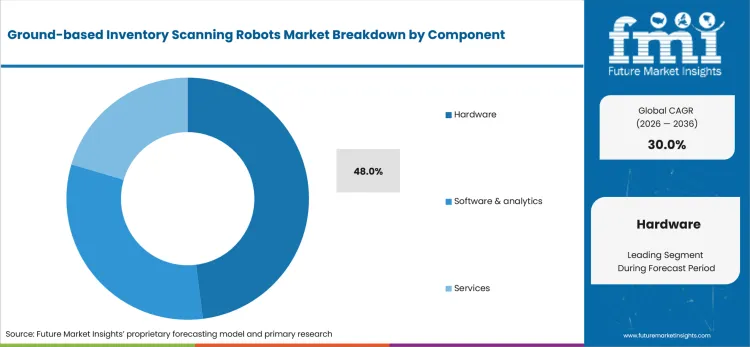
Hardware determines what the robot can detect and how long it can stay on a route. The mobile base and safety sensors control movement around people and handling equipment during normal warehouse activity. Cameras read visible labels, while RFID locates tagged goods that remain outside direct camera view. Facilities should test these limits on a full route under normal operating conditions as part of system approval. Better software cannot recover data that weak sensors or short battery life fail to capture.
- Hardware is projected to lead the component category with a 48.0% share in 2026. The mobile base and sensing equipment account for much of the total installed system cost. In January 2026, PAL Robotics reported 12 hours of autonomy and 99% reading accuracy for StockBot. These figures explain why runtime and sensor fit receive close attention in a site review.
- Large facilities often need longer battery life and more specialized sensors, which raises hardware spending. Software adds value if cameras or RFID readers collect dependable data throughout every completed route. A digital twin in logistics depends on accurate location data to reflect the warehouse correctly. Weak scans distort that picture and weaken the planning decisions based on it.
What are the drivers, restraints, and opportunities in the Ground-Based Inventory Scanning Robots Market?
Demand is projected to rise as warehouse networks seek frequent proof that physical stock matches system records. Approvals are expected to slow if sensors or software links do not fit daily inventory work. Managed services are anticipated to lower entry costs for companies that prefer recurring fees over equipment ownership.
- Driver: Repeated stock errors are expected to increase spending on autonomous scanning programs in warehouses and stores. Earlier detection prevents stock errors from slowing picking or triggering unnecessary replenishment during normal operations.
- Restraint: Approval is expected to slow if the sensor or software link does not fit the facility's daily inventory work.
- Opportunity: Managed scanning services are projected to widen access for companies that prefer recurring fees over equipment ownership.
Poor stock records create hidden costs that do not appear in a general warehouse report. A misplaced pallet delays picking and wastes staff time, while a false empty location can trigger unnecessary replenishment. In December 2025, Dexory described its system at an ODW Logistics warehouse located in Ohio. A single mission captured more than 20,000 storage locations, and the robot scanned the full facility several times a week. The case shows that autonomous scanning can reduce search time and direct staff toward the exact location that needs correction.
The significant constraint is whether scan results fit the facility's daily work. Blocked labels weaken camera performance, while RFID depends on consistent tags and reliable reader coverage. Accurate scans have little value if exceptions never reach the staff task list. Live trials should test aisle traffic and battery life under normal conditions. They should confirm that each finding enters the correct task system without manual re-entry. Poor fit delays approval and reduces the expected financial return.
Service contracts create an opening for facilities without capital or an internal robotics group. In November 2025, Brain Corp reported that 67% of surveyed retailers preferred not to own or manage an inventory-scanning robot. The study found that 60% planned a rollout by the end of 2027. Those findings support managed offers that combine equipment, maintenance, and data service under one contract. The automated material handling systems analysis shows why clear service terms can influence adoption as much as machine performance.
Which country CAGRs are profiled in the Ground-Based Inventory Scanning Robots Market?
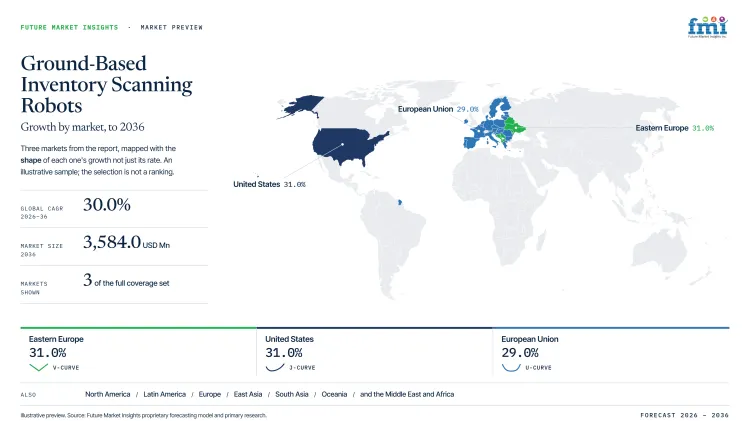
| Country | CAGR |
|---|---|
| European Union | 29.0% |
| Eastern Europe | 31.0% |
| United States | 31.0% |
Source: FMI's proprietary forecasting model and primary research
How do country-level CAGRs compare in the Ground-Based Inventory Scanning Robots Market?
The country comparison spans 2.0 percentage points and reveals a tightly grouped growth outlook across the Ground-Based Inventory Scanning Robots Market. Eastern Europe and the United States share the highest CAGR at 31.0%, indicating identical momentum in warehouse automation adoption. The European Union remains 2.0 percentage points below the leading markets, creating a closely aligned comparison with limited variation. Growth across all three regions reflects increasing demand for autonomous inventory visibility, labor efficiency and digital warehouse operations.
-
Eastern Europe shares the leading position at 31.0% CAGR as rapid warehouse modernization, expansion of third-party logistics facilities and growing investment in automation continue to support deployment of ground-based inventory scanning robots.
-
The United States also records a CAGR of 31.0%, matching Eastern Europe and reflecting strong adoption across distribution centers, retail fulfillment networks and large-scale warehouses where autonomous inventory monitoring improves stock accuracy and operational efficiency.
-
The European Union remains 2.0 percentage points below the United States and Eastern Europe. Growth reflects continued investment in warehouse digitalization, robotics integration and inventory automation, while differences in warehouse modernization and automation readiness across member states contribute to variation within the regional market.
Country-wise Analysis
-
European distribution networks need consistent scan results in countries that use different warehouse software and operating rules. The European Union market is projected to record 29.0% CAGR from 2026 to 2036. In May 2026, SPAR International reported that SPAR Austria expanded Tally from a two-store trial to six EUROSPAR and INTERSPAR stores. The wider trial links regional growth to proven reductions in inspection work and earlier restocking. Cross-border groups are likely to value consistent reports and local service in every country covered by the rollout.
- Poland shows how inventory robots can enter existing stores without requiring major layout changes or aisle closures. Ground-based inventory scanning robot demand in Eastern Europe is forecast to rise at 31.0% CAGR by 2036. In November 2025, the International Federation of Robotics reported that Decathlon used StockBot in Poland and several other countries. A robot is normally installed within one day and completes a full inventory on a daily schedule. The evidence favors systems that connect with current software and produce useful results from the first full scan. Local training and repair coverage remain uneven, so dependable regional service can decide whether trials become regular operations.
- Large USA networks can turn a successful pilot into a common operating standard for many locations. Adoption in the United States is estimated to expand at 31.0% CAGR during the forecast period. In June 2026, the USA Census Bureau placed April business inventories at USD 2,726.6 billion. The 2.7% annual increase shows how much stock businesses must track through connected sales channels. National service coverage and common software links shape the economics of every large multi-site contract.
Who are the notable companies in the Ground-Based Inventory Scanning Robots Market?
Dexory, Simbe Robotics, Badger Technologies, Brain Corp, Dane Technologies, MetraLabs, and PAL Robotics are the notable companies shaping this market.
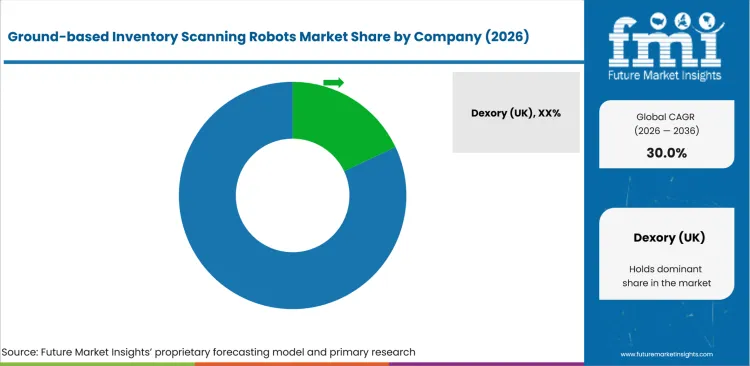
Competition is shaped by the inventory job that a robot performs in a warehouse or retail store. Dexory and Dane Technologies scan tall racks that require broad vertical coverage during normal operations. Simbe Robotics and Badger Technologies inspect retail shelves for stock gaps, pricing errors, and misplaced products. MetraLabs and PAL Robotics use RFID to locate tagged goods without a direct camera view. Brain Corp supports several settings through autonomy software, partner robots, and managed service contracts. A pilot is more likely to scale if the company offers reliable service and clean software links. The warehouse digital twin tools analysis explains why accurate location data and clear correction tasks determine the value created by each scan.
- Dexory and Dane Technologies serve high-rack warehouses that need broad vertical coverage while normal operations continue.
- Simbe Robotics and Badger Technologies focus on shelf availability and price accuracy inside working stores.
- MetraLabs and PAL Robotics serve stores and stockrooms that already use item-level RFID tags for inventory control. Their systems find tagged products that cameras cannot see directly inside crowded shelves or closed containers.
- Brain Corp supports partner-built robots through recurring service contracts for large multi-site retail projects. This model reduces equipment ownership and removes the need for a separate internal robotics group.
Competitive Benchmarking: Ground-based Inventory Scanning Robots Market
| Company | Main operating setting | Main sensing method | Proven operating fit | Geographic access |
|---|---|---|---|---|
| Dexory | High-rack warehouses | Cameras, LiDAR, and barcodes | Pallet scans across full rack height with a live 3D warehouse view | Europe and North America / Regional |
| Simbe Robotics | Retail stores | Computer vision and optional RFID | Shelf availability, pricing, product placement, and task routing | North America, Europe, and Asia / Regional |
| Badger Technologies | Retail stores | Computer vision and RFID | Shelf checks, price accuracy, planogram checks, and hazard monitoring | United States / Country-specific |
| Brain Corp | Retail and warehouse partner systems | Computer vision, RFID, and autonomy software | Managed shelf scanning and partner-built inventory robots | North America and Europe / Regional |
| Dane Technologies | Warehouses and distribution centers | Computer vision, RFID, and barcodes | Pallet and case scans across tall warehouse racks | United States / Country-specific |
| MetraLabs | Retail stores and stockrooms | RFID | Daily item counts, product location, and links to ERP systems | Global |
| PAL Robotics | Retail stores and picking warehouses | RFID | Long-duration RFID scans and product location | Europe and Asia / Regional |
Comparison basis: The table compares documented operating settings and sensing methods. It also reviews proven uses and service coverage.
Source: Future Market Insights competitive analysis, 2026. The comparison reflects documented portfolio relevance, use-case fit, and stated geographic access for every company.
Key Developments in the Ground-based Inventory Scanning Robots Market
- In February 2026, Dexory introduced an autonomous robot with a scanning range of 60 feet. The earlier model had a 40-foot range, so the new system can scan taller racks. The company also added Storage Health software to identify damaged pallets and other storage risks.
- In January 2026, Simbe Robotics introduced Tally 4.0 with up to 12 hours of runtime and wider camera coverage. Longer runtime supports more aisle scans in large stores during opening hours or overnight. More frequent coverage gives retailers a steadier view of stock gaps, price errors, and misplaced products.
- In May 2025, Badger Technologies launched the Digital Teammate platform for inventory checks and other routine store tasks. The company reported inventory accuracy above 97% at a hardware retailer and more than 1,000 deployed robots. Wider task coverage spreads the machine cost across inventory, pricing, and safety work.
- In September 2025, Brain Corp launched ShelfOptix with Driveline Retail as a managed shelf-intelligence service. Driveline has more than 15,000 field representatives who can act on robot findings. The model links automated scans with local action across large national retail networks. This approach makes nationwide coverage practical if every store follows the same scan schedule and response process.
Key Players in the Ground-based Inventory Scanning Robots Market
High-rack warehouse scanning specialists
- Dexory
- Dane Technologies
Retail shelf intelligence companies
- Simbe Robotics
- Badger Technologies
RFID inventory robotics companies
- MetraLabs
- PAL Robotics
Autonomy software and managed-service providers
- Brain Corp
Ground-based Inventory Scanning Robots Market - Report Scope
| Coverage field | Report scope |
|---|---|
| Market breakdown | Technology, application, component, end-use industry, business model, and region |
| Quantitative Units | Revenue in USD Million, CAGR in %, and segment share in % |
| Market Definition | Ground-based mobile robots that use cameras, RFID, barcodes, or related sensors to check inventory in stores and warehouses. |
| Regions Covered | North America, Latin America, Europe, East Asia, South Asia, Oceania, and the Middle East and Africa |
| Countries Covered | United States, Canada, Brazil, Mexico, Argentina, Germany, United Kingdom, France, Italy, Spain, China, Japan, South Korea, India, Thailand, Indonesia, Australia, New Zealand, GCC countries, South Africa, Turkey, and 20+ countries |
| Key Companies Profiled | Dexory, Simbe Robotics, Badger Technologies, Brain Corp, Dane Technologies, MetraLabs, and PAL Robotics |
| Forecast Period | 2026 to 2036 |
| Approach | Hybrid sizing that combines company evidence with warehouse and retail demand indicators. |
Source: Future Market Insights - analysis driven by proprietary forecasting models and primary research
Ground-based Inventory Scanning Robots Market - Research Methodology
| Method | Approach |
|---|---|
| Primary Research | Primary research draws on interviews with warehouse managers, retail operations teams, logistics companies, and system integrators in several regions. The discussions cover scan frequency, aisle traffic, and operating limits that affect results during normal use. Participants explain pilot results, service terms, and the steps used to correct an inventory mismatch. The comparison separates high-rack warehouses from retail stores, which need different sensors and support models. |
| Desk Research | Desk research reviews official product pages, company announcements from 2024 onward, and customer cases from named facilities. Government inventory and e-commerce releases provide broader scale indicators for demand in the United States. Company material supports comparisons of sensors, scan height, battery time, and available service models for commercial use. The research also checks how scan findings enter warehouse or store records so technical claims remain tied to daily use. |
| Market Sizing and Forecasting | Market sizing combines reported company activity with estimates for installed robots and recurring service contracts. Equipment prices provide a separate check on the hardware revenue estimated for each operating setting. Bottom-up results are compared with warehouse automation spending and retail demand for repeated scanning. Forecasts reflect sensor fit, contract model, warehouse maturity, and local service access in every profiled market. The final model balances equipment sales with recurring revenue from software, maintenance, and managed services. |
| Data Validation | Data validation checks company claims against installation evidence and operator interviews. High-rack systems are tested against scan height and pallet coverage on live routes. Retail systems are checked against shelf tasks and store routes. RFID claims are reviewed against tagging needs and item-location evidence. Conflicting evidence receives less weight until another official source or interview confirms it. |
Source: Future Market Insights (FMI) analysis, based on proprietary forecasting model and primary research
Ground-based Inventory Scanning Robots Market by Segments
Ground-based Inventory Scanning Robots Market segmented by Technology:
- Tower Scanning Robots
- AMR-mounted RFID
- Fixed-camera Robot Hybrids
- Shelf-scanning Rovers
Ground-based Inventory Scanning Robots Market segmented by Application:
- Cycle Counting
- Location and Slotting Audits
- Space Utilization Analytics
- Compliance Checks
Ground-based Inventory Scanning Robots Market segmented by Component:
- Hardware
- Software and Analytics
- Services
Ground-based Inventory Scanning Robots Market segmented by End-use Industry:
- 3PL and Warehousing
- Retail Distribution Centers
- E-commerce Fulfillment
- Manufacturing Stockrooms
Ground-based Inventory Scanning Robots Market segmented by Business Model:
- Robotics as a Service (RaaS)
- Direct Purchase
- Subscription
- Pilot Programs
Ground-based Inventory Scanning Robots Market by Region:
- North America
- United States
- Canada
- Latin America
- Brazil
- Mexico
- Argentina
- Europe
- Germany
- United Kingdom
- France
- Italy
- Spain
- East Asia
- China
- Japan
- South Korea
- South Asia
- India
- Thailand
- Indonesia
- Oceania
- Australia
- New Zealand
- Middle East and Africa
- GCC countries
- South Africa
- Turkey
Research Sources and Bibliography
- USA Census Bureau. (2025, February). Quarterly retail e-commerce sales: 4th quarter 2024. USA Department of Commerce.
- USA Census Bureau. (2026, June). Manufacturing and trade inventories and sales: April 2026. USA Department of Commerce.
- SPAR International. (2026, May). SPAR Austria expands inventory robot trial. SPAR International.
- International Federation of Robotics. (2025, November). Improving operations and product availability at stores globally. International Federation of Robotics.
- Dexory. (2025, October). Strong customer demand enables Dexory to secure $165M in funding, accelerating global expansion and AI-powered capabilities. Dexory.
- Dexory. (2025, December). ODW Logistics and Raymond Storage Concepts enhances warehouse performance with Dexory’s real-time data and automation. Dexory.
- Dexory. (2026, February). Dexory boosts warehouse intelligence with next-generation autonomous robot and Storage Health software feature. Dexory.
- Simbe Robotics. (2025, October). Harmons deploys Simbe’s Tally inventory robot in stores following pilot success. Simbe Robotics.
- Simbe Robotics. (2026, January). Simbe unveils Tally 4.0: The next generation of autonomous retail robot powering store intelligence via physical AI. Simbe Robotics.
- Badger Technologies. (2025, May). Badger Technologies launches Digital Teammate platform powered by next-generation multipurpose autonomous robots. Badger Technologies.
- Brain Corp. (2025, March). Dane Technologies and Brain Corp unveil Dane AiR™ DC, an autonomous inventory scanning robot for warehouses, distribution centers, and manufacturers. Brain Corp.
- Brain Corp. (2025, September). Brain Corp and Driveline launch ShelfOptix™: The first fully managed, robot-powered shelf intelligence service. Brain Corp.
- Brain Corp. (2025, November). New research from IHL Group and Brain Corp reveals two-thirds of major USA retailers face shelf issues eroding retailer-brand trust. Brain Corp.
- MetraLabs. (2026, January). TORY® RFID: The autonomous inventory robot. MetraLabs.
- PAL Robotics. (2026, January). How StockBot’s autonomous inventory management transforms retail operations. PAL Robotics.
This bibliography is provided for reader reference and uses primary government, standards-body, official trade body, and company sources.
This Report Answers
- What market value is projected for 2026 and 2036?
- What CAGR is estimated across the 2026 to 2036 forecast period?
- Which technology and application segments shape demand?
- Which operating pressures support autonomous inventory scanning?
- How do country CAGRs differ across the profiled markets?
- Which companies compete on high-rack scanning, retail shelf intelligence, and RFID inventory checks?
- How does Future Market Insights validate segment and country forecasts?
- What should purchasers address before an expansion or sourcing commitment?
- How do safety records and software links affect company selection?
Frequently Asked Questions
What is driving growth in the Ground-based Inventory Scanning Robots Market?
Growth comes from the need to match physical stock with system records as part of daily stock control. Regular autonomous scans shorten the delay between finding an error and assigning the correction to store or warehouse staff.
Who are the key players in the Ground-based Inventory Scanning Robots Market?
Dexory and Dane Technologies focus on high-rack scans that need broad vertical coverage during normal warehouse work. Simbe Robotics and Badger Technologies target shelf imaging; Brain Corp supports managed services; MetraLabs and PAL Robotics focus on RFID and software links.
What is a notable restraint in the Ground-based Inventory Scanning Robots Market?
Approval slows if cameras miss labels or RFID tags remain inconsistent across the inventory during daily use. Weak sensor fit reduces scan quality and makes the financial case harder to prove during a pilot program.
Why should executives track the Ground-based Inventory Scanning Robots Market?
Inventory errors slow orders and tie up working capital throughout stores, warehouses, and distribution networks. Executives should track this market as frequent physical checks become part of daily decisions across large retail and logistics networks.
What business problem does the Ground-based Inventory Scanning Robots Market address?
Ground-based robots find gaps between system records and the goods present at every scanned location. Earlier detection reduces search time and prevents avoidable order errors from spreading across sales channels.
What should procurement leaders evaluate before selecting suppliers?
Selection should test scan coverage and software links under normal working conditions at the intended site. Contracts should define data access, maintenance support, and service response at the start of a pilot.
What limits return on investment for purchasers?
Returns weaken if robot findings stay outside the daily task system used by store or warehouse staff. Clear routing ensures that every verified mismatch leads to a timely correction by the right employee.
How do suppliers build long-term account confidence?
Long-term confidence comes from repeatable results over several inventory cycles under normal operating conditions at the site. Clear service terms and dependable data help a proven pilot expand into a wider contract.
Preview the report firsthand - request a free sample
Get SampleGet the brochure for pricing and purchase details.
Get PDFTable of Content
- Key Takeaways
- Market Size and CAGR
- Top Growth Driver
- Fastest Growing Segment
- Leading Region
- Key Companies
- Emerging Opportunities
- Executive Summary
- Global Market Outlook
- Demand-side Trends
- Supply-side Trends
- Technology Roadmap Analysis
- Analysis and Recommendations
- Analyst Perspective (What is happening? Why now? What should investors know?)
- Key Questions Answered
- How large is the market?
- What is the CAGR?
- What are key trends?
- Which region dominates?
- Who are the leaders?
- Market Overview
- Market Coverage / Taxonomy
- Market Definition / Scope / Limitations
- Research Methodology
- Chapter Orientation
- Analytical Lens and Working Hypotheses
- Market Structure, Signals, and Trend Drivers
- Benchmarking and Cross-market Comparability
- Market Sizing, Forecasting, and Opportunity Mapping
- Research Design and Evidence Framework
- Desk Research Programme (Secondary Evidence)
- Expert Input and Fieldwork (Primary Evidence)
- Tooling, Models, and Reference Databases
- Data Engineering and Model Build
- Quality Assurance and Audit Trail
- Market Background
- Market Dynamics (Drivers, Restraints, Opportunity, Trends)
- Scenario Forecast (Optimistic, Likely, Conservative)
- Impact Analysis
- AI Impact
- Sustainability Impact
- Regulatory Impact
- Technology Impact
- Consumer / Buyer Analysis
- Purchase Drivers
- Adoption Barriers
- Buyer Journey
- Opportunity Map Analysis
- Product Life Cycle Analysis
- Supply Chain Analysis
- Investment Feasibility Matrix
- Value Chain Analysis
- PESTLE and Porter's Analysis
- Regulatory Landscape
- Regional Parent Market Outlook
- Production and Consumption Statistics
- Import and Export Statistics
- Global Market Analysis and Forecast, 2021 to 2036
- Historical Market Size Value (USD Mn) Analysis, 2021 to 2025
- Current and Future Market Size Value (USD Mn) Projections, 2026 to 2036
- Y-o-Y Growth Trend Analysis
- Absolute $ Opportunity Analysis
- Global Market Pricing Analysis, 2021 to 2036
- Global Market Analysis and Forecast, By Technology, 2021 to 2036
- Introduction / Key Findings
- Historical Market Size Value (USD Mn) Analysis By Technology, 2021 to 2025
- Current and Future Market Size Value (USD Mn) Analysis and Forecast By Technology, 2026 to 2036
- Tower scanning robots
- AMR-mounted RFID
- Fixed-camera - robot hybrid
- Shelf-scanning rovers
- Tower scanning robots
- Y-o-Y Growth Trend Analysis By Technology, 2021 to 2025
- Absolute $ Opportunity Analysis By Technology, 2026 to 2036
- Global Market Analysis and Forecast, By Application, 2021 to 2036
- Introduction / Key Findings
- Historical Market Size Value (USD Mn) Analysis By Application, 2021 to 2025
- Current and Future Market Size Value (USD Mn) Analysis and Forecast By Application, 2026 to 2036
- Cycle counting
- Location & slotting audit
- Space utilization analytics
- Compliance checks
- Cycle counting
- Y-o-Y Growth Trend Analysis By Application, 2021 to 2025
- Absolute $ Opportunity Analysis By Application, 2026 to 2036
- Global Market Analysis and Forecast, By Component, 2021 to 2036
- Introduction / Key Findings
- Historical Market Size Value (USD Mn) Analysis By Component, 2021 to 2025
- Current and Future Market Size Value (USD Mn) Analysis and Forecast By Component, 2026 to 2036
- Hardware
- Software & analytics
- Services
- Hardware
- Y-o-Y Growth Trend Analysis By Component, 2021 to 2025
- Absolute $ Opportunity Analysis By Component, 2026 to 2036
- Global Market Analysis and Forecast, By End-use Industry, 2021 to 2036
- Introduction / Key Findings
- Historical Market Size Value (USD Mn) Analysis By End-use Industry, 2021 to 2025
- Current and Future Market Size Value (USD Mn) Analysis and Forecast By End-use Industry, 2026 to 2036
- 3PL & warehousing
- Retail DC
- E-commerce
- Manufacturing stores
- 3PL & warehousing
- Y-o-Y Growth Trend Analysis By End-use Industry, 2021 to 2025
- Absolute $ Opportunity Analysis By End-use Industry, 2026 to 2036
- Global Market Analysis and Forecast, By Business Model, 2021 to 2036
- Introduction / Key Findings
- Historical Market Size Value (USD Mn) Analysis By Business Model, 2021 to 2025
- Current and Future Market Size Value (USD Mn) Analysis and Forecast By Business Model, 2026 to 2036
- RaaS
- Direct purchase
- Subscription
- Pilot programs
- RaaS
- Y-o-Y Growth Trend Analysis By Business Model, 2021 to 2025
- Absolute $ Opportunity Analysis By Business Model, 2026 to 2036
- Global Market Analysis and Forecast, By Region, 2021 to 2036
- Introduction
- Historical Market Size Value (USD Mn) Analysis By Region, 2021 to 2025
- Current Market Size Value (USD Mn) Analysis and Forecast By Region, 2026 to 2036
- North America
- Latin America
- Western Europe
- Eastern Europe
- East Asia
- South Asia and Pacific
- Middle East & Africa
- Market Attractiveness Analysis By Region
- North America Market Analysis and Forecast, By Country, 2021 to 2036
- Historical Market Size Value (USD Mn) Trend Analysis By Market Taxonomy, 2021 to 2025
- Market Size Value (USD Mn) Forecast By Market Taxonomy, 2026 to 2036
- By Country
- USA
- Canada
- By Technology
- By Application
- By Component
- By End-use Industry
- By Business Model
- By Country
- Market Attractiveness Analysis
- By Country
- By Technology
- By Application
- By Component
- By End-use Industry
- By Business Model
- Key Takeaways
- Latin America Market Analysis and Forecast, By Country
- Historical Market Size Value (USD Mn) Trend Analysis By Market Taxonomy, 2021 to 2025
- Market Size Value (USD Mn) Forecast By Market Taxonomy, 2026 to 2036
- By Country
- Brazil
- Mexico
- Chile
- Rest of Latin America
- By Technology
- By Application
- By Component
- By End-use Industry
- By Business Model
- By Country
- Market Attractiveness Analysis
- By Country
- By Technology
- By Application
- By Component
- By End-use Industry
- By Business Model
- Key Takeaways
- Western Europe Market Analysis and Forecast, By Country
- Historical Market Size Value (USD Mn) Trend Analysis By Market Taxonomy, 2021 to 2025
- Market Size Value (USD Mn) Forecast By Market Taxonomy, 2026 to 2036
- By Country
- Germany
- UK
- Italy
- Spain
- France
- Nordic
- BENELUX
- Rest of Western Europe
- By Technology
- By Application
- By Component
- By End-use Industry
- By Business Model
- By Country
- Market Attractiveness Analysis
- By Country
- By Technology
- By Application
- By Component
- By End-use Industry
- By Business Model
- Key Takeaways
- Eastern Europe Market Analysis and Forecast, By Country
- Historical Market Size Value (USD Mn) Trend Analysis By Market Taxonomy, 2021 to 2025
- Market Size Value (USD Mn) Forecast By Market Taxonomy, 2026 to 2036
- By Country
- Russia
- Poland
- Hungary
- Balkan & Baltic
- Rest of Eastern Europe
- By Technology
- By Application
- By Component
- By End-use Industry
- By Business Model
- By Country
- Market Attractiveness Analysis
- By Country
- By Technology
- By Application
- By Component
- By End-use Industry
- By Business Model
- Key Takeaways
- East Asia Market Analysis and Forecast, By Country
- Historical Market Size Value (USD Mn) Trend Analysis By Market Taxonomy, 2021 to 2025
- Market Size Value (USD Mn) Forecast By Market Taxonomy, 2026 to 2036
- By Country
- China
- Japan
- South Korea
- By Technology
- By Application
- By Component
- By End-use Industry
- By Business Model
- By Country
- Market Attractiveness Analysis
- By Country
- By Technology
- By Application
- By Component
- By End-use Industry
- By Business Model
- Key Takeaways
- South Asia and Pacific Market Analysis and Forecast, By Country
- Historical Market Size Value (USD Mn) Trend Analysis By Market Taxonomy, 2021 to 2025
- Market Size Value (USD Mn) Forecast By Market Taxonomy, 2026 to 2036
- By Country
- India
- ASEAN
- Australia & New Zealand
- Rest of South Asia and Pacific
- By Technology
- By Application
- By Component
- By End-use Industry
- By Business Model
- By Country
- Market Attractiveness Analysis
- By Country
- By Technology
- By Application
- By Component
- By End-use Industry
- By Business Model
- Key Takeaways
- Middle East & Africa Market Analysis and Forecast, By Country
- Historical Market Size Value (USD Mn) Trend Analysis By Market Taxonomy, 2021 to 2025
- Market Size Value (USD Mn) Forecast By Market Taxonomy, 2026 to 2036
- By Country
- Kingdom of Saudi Arabia
- Other GCC Countries
- Türkiye
- South Africa
- Other African Union
- Rest of Middle East & Africa
- By Technology
- By Application
- By Component
- By End-use Industry
- By Business Model
- By Country
- Market Attractiveness Analysis
- By Country
- By Technology
- By Application
- By Component
- By End-use Industry
- By Business Model
- Key Takeaways
- Key Countries Market Analysis
- USA
- Pricing Analysis
- Market Share Analysis, 2025
- By Technology
- By Application
- By Component
- By End-use Industry
- By Business Model
- Canada
- Pricing Analysis
- Market Share Analysis, 2025
- By Technology
- By Application
- By Component
- By End-use Industry
- By Business Model
- Mexico
- Pricing Analysis
- Market Share Analysis, 2025
- By Technology
- By Application
- By Component
- By End-use Industry
- By Business Model
- Brazil
- Pricing Analysis
- Market Share Analysis, 2025
- By Technology
- By Application
- By Component
- By End-use Industry
- By Business Model
- Chile
- Pricing Analysis
- Market Share Analysis, 2025
- By Technology
- By Application
- By Component
- By End-use Industry
- By Business Model
- Germany
- Pricing Analysis
- Market Share Analysis, 2025
- By Technology
- By Application
- By Component
- By End-use Industry
- By Business Model
- UK
- Pricing Analysis
- Market Share Analysis, 2025
- By Technology
- By Application
- By Component
- By End-use Industry
- By Business Model
- Italy
- Pricing Analysis
- Market Share Analysis, 2025
- By Technology
- By Application
- By Component
- By End-use Industry
- By Business Model
- Spain
- Pricing Analysis
- Market Share Analysis, 2025
- By Technology
- By Application
- By Component
- By End-use Industry
- By Business Model
- France
- Pricing Analysis
- Market Share Analysis, 2025
- By Technology
- By Application
- By Component
- By End-use Industry
- By Business Model
- India
- Pricing Analysis
- Market Share Analysis, 2025
- By Technology
- By Application
- By Component
- By End-use Industry
- By Business Model
- ASEAN
- Pricing Analysis
- Market Share Analysis, 2025
- By Technology
- By Application
- By Component
- By End-use Industry
- By Business Model
- Australia & New Zealand
- Pricing Analysis
- Market Share Analysis, 2025
- By Technology
- By Application
- By Component
- By End-use Industry
- By Business Model
- China
- Pricing Analysis
- Market Share Analysis, 2025
- By Technology
- By Application
- By Component
- By End-use Industry
- By Business Model
- Japan
- Pricing Analysis
- Market Share Analysis, 2025
- By Technology
- By Application
- By Component
- By End-use Industry
- By Business Model
- South Korea
- Pricing Analysis
- Market Share Analysis, 2025
- By Technology
- By Application
- By Component
- By End-use Industry
- By Business Model
- Russia
- Pricing Analysis
- Market Share Analysis, 2025
- By Technology
- By Application
- By Component
- By End-use Industry
- By Business Model
- Poland
- Pricing Analysis
- Market Share Analysis, 2025
- By Technology
- By Application
- By Component
- By End-use Industry
- By Business Model
- Hungary
- Pricing Analysis
- Market Share Analysis, 2025
- By Technology
- By Application
- By Component
- By End-use Industry
- By Business Model
- Kingdom of Saudi Arabia
- Pricing Analysis
- Market Share Analysis, 2025
- By Technology
- By Application
- By Component
- By End-use Industry
- By Business Model
- Türkiye
- Pricing Analysis
- Market Share Analysis, 2025
- By Technology
- By Application
- By Component
- By End-use Industry
- By Business Model
- South Africa
- Pricing Analysis
- Market Share Analysis, 2025
- By Technology
- By Application
- By Component
- By End-use Industry
- By Business Model
- USA
- Market Structure Analysis
- Competition Dashboard
- Competition Benchmarking
- Market Share Analysis of Top Players
- By Regional
- By Technology
- By Application
- By Component
- By End-use Industry
- By Business Model
- Emerging Startups
- Innovation Benchmarking
- Competition Analysis
- Competition Deep Dive
- Dexory (UK)
- Overview
- Product Portfolio
- Profitability by Market Segments
- Sales Footprint
- Strategy Overview
- Marketing Strategy
- Product Strategy
- Channel Strategy
- Simbe (US)
- Dexory (UK)
- Case Studies
- Success Stories
- Recent Developments
- Competition Deep Dive
- Assumptions & Acronyms Used


