

- Market Size (2026)
- USD 32.0 Bn
- Forecast (2036)
- USD 50.2 Bn
- CAGR (2026 to 2036)
- 4.6%
How big is High density Polyethylene (HDPE) Bottle Market in 2026?
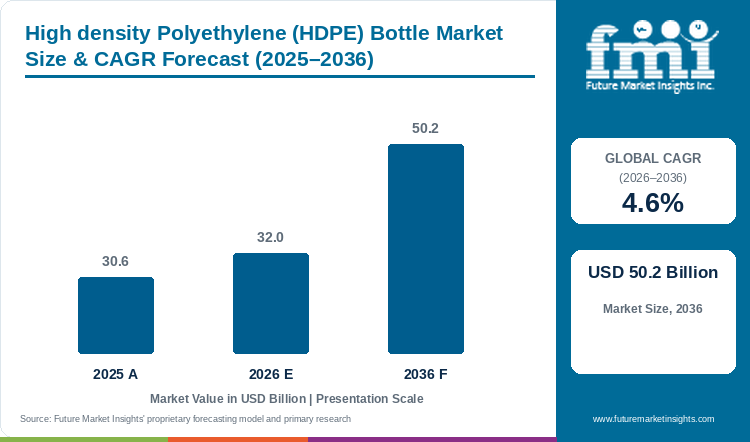
Global high density polyethylene (hdpe) bottle demand is projected to expand at a 4.6% CAGR from 2026 to 2036. Total converter revenue climbs from USD 30.6 billion in 2025 to USD 32.0 billion in 2026 and reaches USD 50.2 billion by 2036.
Increasing pressure on liquid consumer goods manufacturers to eliminate fragile glass containers and reduce outbound pallet weight has accelerated commercial adoption of blow-molded high-density polyethylene bottles. According to Future Market Insights, global high-density polyethylene bottle sales move from a 2025 base of USD 30.6 billion to USD 32.0 billion in 2026 and are projected to reach USD 50.2 billion by 2036, expanding at a 4.6% CAGR while generating USD 18.2 billion in added revenue. Rather than stemming from commodity jug volume alone, this revenue trajectory reflects liquid packers switching to co-extruded extrusion blow-molded bottles that encapsulate post-consumer recyclate between thin virgin contact skins. Virgin Blow-Molding Grade HDPE commands 38.0% of material resin / polymer demand in 2026 because dairy and oral pharmaceutical lines mandate taint-free inner contact surfaces. In October 2025, Eurostat reported that European Union residents generated 35.3 kilograms of plastic packaging waste per person while recycling 14.8 kilograms (42.1%), which has compelled liquid brands to sign multi-year recyclable polyolefin bottle contracts [1].
Key Market Trends & Insights
- By material resin / polymer: Virgin Blow-Molding Grade HDPE secures 38.0% share in 2026 because fresh dairy and pharmacopeia liquid lines require uncontaminated copolymer purity for direct product contact.
- By product format: 101 ml to 500 ml Blow-Molded Bottles represent 39.8% of 2026 format sales as personal care and over-the-counter syrup packers standardize around single-hand dispensing geometries.
- By barrier level: Co-Extruded Multilayer EVOH Barrier HDPE accounts for 50.6% of 2026 barrier demand since agrochemical and fortified beverage fillers need solvent and oxygen protection without glass weight.
- By end-use industry: Dairy, Beverages & Liquid Foods holds 36.9% of 2026 end-use revenue owing to captive rotary blow-molding integration inside regional milk and juice plants.
Regional Highlights
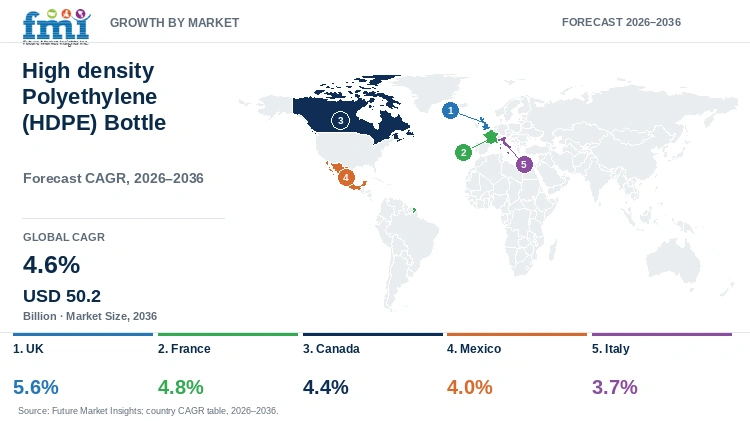
- United Kingdom blow-molding demand leads the five evaluated national markets with a 5.6% CAGR from 2026 to 2036 under the 30% Plastic Packaging Tax threshold.
- National growth reaches 4.8% in France and 4.4% in Canada ahead of Mexico at 4.0%, whereas mature Italian pharmaceutical and detergency bottle lines expand at 3.7%.
Market Size & Forecast
Table 1: Market Size and Forecast for the High density Polyethylene (HDPE) Bottle Market (USD billion and CAGR percentage), 2025 to 2036
| Metric | Value |
|---|---|
| 2025 Market Size | USD 30.6 billion |
| Estimated Market Size in 2026 | USD 32.0 billion |
| Projected Market Size by 2036 | USD 50.2 billion |
| CAGR, 2026 to 2036 | 4.6% |
| Added Revenue, 2026 to 2036 | USD 18.2 billion |
Blow-molding conversion economics vary considerably across regions because extended producer responsibility tariffs and municipal optical sorting yields govern food-grade resin availability. Converters operating across the United Kingdom and France face eco-modulated fee schedules that penalize carbon-black pigments while rewarding natural mono-material plastic bottles and containers sorted by near-infrared scanners. In July 2026, the Association of Plastic Recyclers documented in its 2024 Post-consumer Plastic Recycling Data Study that natural HDPE bale separation via optical color sortation remains the primary bottleneck governing food-grade recyclate supply across North America [2]. As a result, household chemical and dairy packers are replacing quarterly spot orders with long-term tolling agreements anchored around guaranteed PCR allocations.
Resin Throughput and Blow-Molding Capacity Sizing
Table 2: Resin Throughput and Blow-Molding Capacity Sizing for the High density Polyethylene (HDPE) Bottle Market (USD billion, million tonnes, and USD), mixed historical and forecast years from 2025 to 2036
| Metric | 2025 (Base Estimate) | 2026 (Estimated) | 2036 (Forecast) |
|---|---|---|---|
| Market size (USD billion, FMI valuation) | 30.6 | 32.0 | 50.2 |
| Blow-molded HDPE bottle resin throughput (million tonnes, modeled) | 12.8 to 13.4 | 13.3 to 14.0 | 19.8 to 21.0 |
| Commercial HDPE bottles produced (billion units, modeled) | 345.0 to 362.0 | 360.0 to 378.0 | 535.0 to 565.0 |
| Average converter realization per 1,000 bottles (USD, modeled) | 84.50 to 88.70 | 84.60 to 88.90 | 88.80 to 93.80 |
Operational traceability note: Market size reflects FMI primary and secondary triangulation while resin throughput and unit realization ranges represent FMI modeled operational estimates calibrated against Eurostat env_waspac plastic accounts and Statistics Canada resin flow data at an average bottle weight of 35 to 38 grams.
Per Capita & Packaging Line Procurement Sizing
High-density polyethylene bottles are widely specified across automated liquid filling halls due to their high stiffness-to-weight ratio and resistance to environmental stress cracking. Operating high-speed liquid packaging lines requires balancing thin-wall parison control against top-load stacking strength during palletized warehouse transit. Whereas low-density polyethylene bottles serve flexible squeeze applications, high-density copolymer grades anchor rigid dairy jugs and pharmaceutical tablet packers.
Table 3: Per Capita and Converter Spending Indicators for the High density Polyethylene (HDPE) Bottle Market (USD), mixed historical and forecast years from 2025 to 2036
| Metric | 2025 (Base Estimate) | 2026 (Estimated) | 2036 (Forecast) |
|---|---|---|---|
| World population (billion, UN demographic baseline) | 8.23 | 8.30 | 8.95 |
| Spend per capita (USD, derived ratio) | 3.72 | 3.86 | 5.61 |
| Spend per 1,000 people (USD, derived ratio) | 3,718.10 | 3,855.42 | 5,608.94 |
| Annual bottle units per capita (units, modeled range) | 42 to 44 | 43 to 46 | 60 to 63 |
Table 4: Facility & Institutional Procurement Indicators for the High density Polyethylene (HDPE) Bottle Market (USD and percentages), mixed reporting years from 2024 to 2026
| Metric | Value | Reference Basis & Traceability |
|---|---|---|
| Market size, 2026 | USD 32.0 billion | FMI 2026 report valuation |
| Active commercial liquid filling plants globally | 48,500 facilities | FMI modeled industrial packaging plant universe (2025 base) |
| Average annual HDPE bottle spend per plant | USD 659,794 | Derived ratio of 2026 valuation to modeled active filling plants |
| Dairy, beverages & liquid foods revenue, 2026 | USD 11.8 billion | Derived from 36.9% leading end-use share of USD 32.0 billion |
Analyst Perspective
"Liquid brand owners are locking in multi-year contracts for natural and co-extruded HDPE bottles that pass optical sorting and drop-impact qualification. Odor migration and environmental stress cracking in high-PCR blends still require multi-layer parison engineering before wider dairy and chemical rollout."
- Nandini Roy Choudhury, Principal Consultant, Future Market Insights.
How is the high density polyethylene (hdpe) bottle market segmented?
The high density polyethylene (hdpe) bottle market is segmented by material resin / polymer, product format, barrier level, end-use industry, and region. In 2026, Virgin Blow-Molding Grade HDPE is projected at 38.0%, 101 ml to 500 ml Blow-Molded Bottles at 39.8%, Co-Extruded Multilayer EVOH Barrier HDPE at 50.6%, and Dairy, Beverages & Liquid Foods at 36.9%.
By material resin / polymer: Virgin Blow-Molding Grade HDPE, Bimodal High-ESCR HDPE, Post-Consumer Recycled HDPE (rHDPE), and Bio-Attributed Renewable HDPE.
By product format: 101 ml to 500 ml Blow-Molded Bottles, Handled Jugs & Large-Capacity Jerrycans (Above 1 Liter), Wide-Mouth Canisters & Packer Bottles, and Squeeze & Dispensing Bottles (Up to 100 ml).
By barrier level: Co-Extruded Multilayer EVOH Barrier HDPE, Monolayer Moisture-Barrier HDPE, and Fluorinated Surface-Barrier HDPE.
By end-use industry: Dairy, Beverages & Liquid Foods, Personal Care & Homecare Liquids, Pharmaceuticals & Nutraceuticals, and Industrial & Agricultural Chemicals.
Why Does Virgin Blow-Molding Grade HDPE Lead the High density Polyethylene (HDPE) Bottle Market by Material Resin / Polymer?
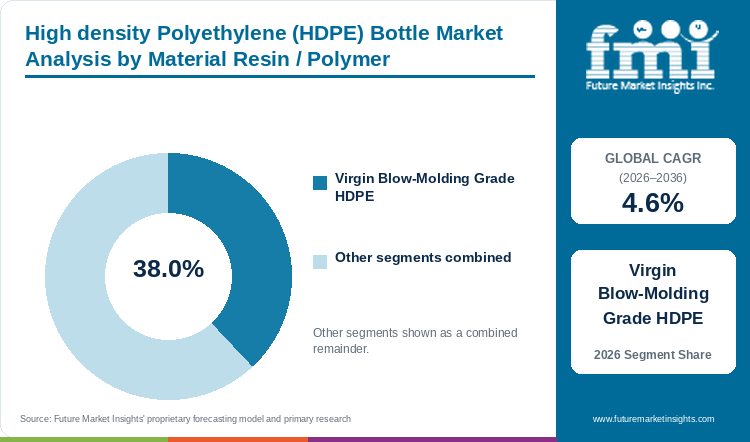
In 2026, Virgin Blow-Molding Grade HDPE holds 38.0% of material resin / polymer revenue, supported by food-contact purity.
Table 5: Material Resin / Polymer Share for the High density Polyethylene (HDPE) Bottle Market (percentage share), 2026
| Material Resin / Polymer | Share (2026) |
|---|---|
| Virgin Blow-Molding Grade HDPE | 38.0% |
| Other Segments Combined | 62.0%* |
| Total | 100.0% |
*Calculated as the balance remaining after deducting the leading segment's reported share from 100.0%.
Table 6: Material Resin / Polymer Leadership and Market Growth for the High density Polyethylene (HDPE) Bottle Market (segment and CAGR percentage), 2026 to 2036
| Metric | Value |
|---|---|
| Global CAGR (2026 to 2036) | 4.6% |
| Leading Segment | Virgin Blow-Molding Grade HDPE |
Virgin blow-molding grade resin commands the largest revenue share because pasteurized milk and oral prescription tablet lines enforce strict migration limits that mechanically recycled flakes rarely satisfy without a functional barrier. Unimodal and hexene-copolymer virgin grades deliver uniform melt strength across multi-cavity extrusion wheel machines while preventing pinch-off weld defects. In addition to this, virgin resin enables converters to encapsulate post-consumer recyclate inside a buried structural core across rigid plastic packaging designs. However, petrochemical monomer volatility and statutory recycled-content taxes are prompting converters to pair thin virgin inner skins with 30% to 50% rHDPE middle layers.
- Virgin Blow-Molding Grade HDPE captures 38.0% of material resin / polymer revenue in 2026 because food-contact and pharmacopeia specifications require odor-free inner bottle walls.
- For instance, in January 2026, ALPLA Group reported EUR 5.2 billion in 2025 annual turnover across 200 packaging and recycling plants while scaling co-extruded virgin-and-rHDPE bottle output [3].
What Makes 101 ml to 500 ml Blow-Molded Bottles Central to the Product Format Category?
By product format, 101 ml to 500 ml Blow-Molded Bottles represent 39.8% in 2026, reflecting high-speed filling line compatibility.
Mid-capacity 101 ml to 500 ml containers generate the highest format turnover because personal care shampoos and over-the-counter liquid medications standardize around ergonomic single-hand dispensing geometries. Unlike bulk 4-liter handled jugs that run on slower reciprocating presses, 250 ml and 400 ml bottles are blown on continuous-extrusion shuttle platforms exceeding 600 bottles per minute. Besides this, standard 24-410 and 28-415 neck finishes allow brand owners to pair mid-size HDPE bodies with child-resistant plastic caps and closures without retooling capping turrets. Down-gauging 300 ml bottles from 24 grams to 18 grams remains a primary qualification focus for contract liquid packers.
- 101 ml to 500 ml Blow-Molded Bottles hold 39.8% of product format demand in 2026 owing to standardized neck tooling across personal care and OTC liquid filling lines.
- In May 2025, Amcor plc unveiled its 2025 Bottles of the Year portfolio featuring lightweight mid-capacity refillable and high-PCR bottle designs for healthcare and homecare brands [4].
Why Does Co-Extruded Multilayer EVOH Barrier HDPE Anchor the Barrier Level Category?
Co-Extruded Multilayer EVOH Barrier HDPE is projected to capture 50.6% of barrier level demand in 2026, driven by oxygen protection.
Unmodified monolayer polyethylene permits gradual oxygen ingress and hydrocarbon solvent permeation, which causes vitamin loss in fortified dairy drinks and container paneling in crop-protection liquids. Integrating a 3- to 5-micron ethylene vinyl alcohol copolymer layer inside a five- or six-layer co-extruded parison cuts gas transmission by more than two orders of magnitude while preserving drop strength. Furthermore, co-extrusion is replacing post-molding fluorine gas treatment as regulators scrutinize perfluorinated substances across fluorinated jugs and packaging barrier films. Keeping EVOH content below 5% of total bottle weight allows multilayer HDPE containers to pass European and North American polyolefin recycling compatibility audits.
- Co-Extruded Multilayer EVOH Barrier HDPE secures 50.6% of barrier level revenue in 2026 due to its ability to block oxygen and organic solvents without surface fluorination.
- In December 2025, ALPLA Group secured government grant funding to establish a specialized food-grade HDPE recycling and multilayer decontamination venture [5].
What Supports Dairy, Beverages & Liquid Foods Leadership within End-Use Industry?
Dairy, Beverages & Liquid Foods commands 36.9% of end-use industry demand in 2026, underpinned by cold-chain impact durability.
Pasteurized milk and cultured probiotic drinks require moisture-tight containers that survive refrigerated distribution without shattering on supermarket dairy shelves. Natural and titanium-dioxide pigmented HDPE bottles block ultraviolet riboflavin oxidation in milk while accommodating foil induction seals and tethered pharmaceutical caps and closures or beverage screw caps that prevent cold-chain leakage. In addition to this, large dairy cooperatives operate captive blow-molding lines directly adjacent to filling cleanrooms to eliminate empty-bottle freight expenses. However, competition from aseptic cartons and clear PET bottles in chilled juices requires HDPE converters to trim gram weights and verify closed-loop milk-bottle recycling.
- Dairy, Beverages & Liquid Foods generates 36.9% of end-use industry sales in 2026 on the back of daily fresh milk and yogurt drink consumption.
- In September 2025, Amcor plc introduced lightweight tethered-closure and high-speed beverage container architectures at Drinktec in Munich to satisfy European single-use plastic directives [6].
What are the drivers, restraints, and opportunities in the high density polyethylene (hdpe) bottle market?
Mandatory recycled-content legislation and glass-to-plastic lightweighting support recurring demand in the High density Polyethylene (HDPE) Bottle Market while food-grade rHDPE bale scarcity and ethylene swings restrain margins. Non-fluorinated multilayer EVOH barrier bottles create high-margin conversion opportunities through 2036.
- Driver: Statutory recycled-content mandates and high-speed blow-molding automation are shifting dairy and household detergent brands into long-term co-extruded HDPE bottle supply agreements through 2036.
- Restraint: Shortages of food-contact approved post-consumer natural HDPE resin and volatile ethylene monomer pricing compress converter margins and delay 50%-PCR bottle rollouts through 2036.
- Opportunity: Replacing fluorinated chemical jugs and heavy glass apothecary bottles with recyclable EVOH-barrier and desiccant-lined HDPE formats is expected to unlock high-margin pharmaceutical and agrochemical contracts through 2036.
Growth Analysis and Future Potential: Qualitative Demand Catalysts
Packaging waste legislation and cold-chain freight economics are accelerating the shift toward lightweighted recyclable HDPE containers across food and household chemical filling lines. When brand owners replace glass or heavy-gauge containers with thin-wall bimodal HDPE bottles, outbound pallet weights drop by 30% to 45% while line breakage falls near zero. In January 2025, the European Union published Regulation (EU) 2025/40 on packaging and packaging waste in the Official Journal, establishing legally binding 2030 minimum post-consumer recycled content quotas across all member states [7]. Unlike clear polyethylene terephthalate bottles that lack natural opacity for light-sensitive dairy and peroxide formulas, pigmented and natural HDPE bottles provide intrinsic UV and moisture protection.
Risk Assessment of the High density Polyethylene (HDPE) Bottle Market: Operational and Supply Friction
Scarcity of FDA- and EFSA-compliant food-grade post-consumer recycled HDPE pellets and swings in petrochemical ethylene cracker margins represent the primary operational constraints facing bottle converters. While natural milk jugs are readily sorted into food-contact recycle streams, colored detergent and shampoo bottles contain diverse pigments and label adhesives that cause odor carryover and black-speck defects. In December 2025, NAPCOR reported in its 2024 PET Recycling Report that post-consumer bottle collection volumes in the United States declined by 3.9% year-over-year while imported recycled resin reached 23% of supply, highlighting tight domestic bottle bale recovery for North American reclaimers [8]. Furthermore, mismatching resin shrinkage rates between bottle necks and caps and closures during high-PCR runs can trigger thread ovality and torque failures on filling lines.
Commercial Opportunity Analysis: Differentiation and Value-Add Formats
Regulatory phase-outs of direct fluorination treatments and rising demand for high-barrier oral solid dose pharmaceutical containers are creating substantial margin expansion for technically capable blow-molders. Agrochemical and specialty solvent producers are actively qualifying six-layer co-extruded EVOH and polyamide barrier HDPE jerrycans and bottles to eliminate PFAS-linked surface fluorination. In June 2026, the Association of Plastic Recyclers recognized 15 packaging converters and brand owners as PCR Demand Champions for expanding multi-year North American post-consumer recycled resin procurement [9]. In addition to this, combining in-mold labeling with digital direct-to-shape decoration across printed rigid packaging lines eliminates paper label glue contamination during wash-plant recycling.
High density Polyethylene (HDPE) Bottle Market by Country (2026 to 2036)
Blow-molded HDPE bottle demand across the five profiled national markets spans from a 3.7% CAGR in Italy to a leading 5.6% CAGR in the United Kingdom between 2026 and 2036. National revenue trajectories depend on how rapidly domestic converters adapt to modulated extended producer responsibility fees alongside food-grade post-consumer HDPE decontamination standards.
Table 7: Country CAGR and Primary Growth Levers for the High density Polyethylene (HDPE) Bottle Market (CAGR percentage and operational drivers), 2026 to 2036
| Country | CAGR (2026 to 2036) | Primary Growth Lever |
|---|---|---|
| UK | 5.6% | Plastic Packaging Tax 30% rHDPE threshold and PackUK pEPR modulated fee compliance |
| France | 4.8% | AGEC law single-use packaging redesign and Citeo Pro commercial polyolefin recovery |
| Canada | 4.4% | Federal Plastics Registry reporting and provincial EPR dairy and detergent bottle recovery |
| Mexico | 4.0% | APR-ANIPAC bilateral bottle design harmonization and nearshored homecare filling expansion |
| Italy | 3.7% | CONAI-COREPLA eco-modulated contribution tiers and pharmaceutical blow-molding upgrades |
Source: Future Market Insights analysis
UK High density Polyethylene (HDPE) Bottle Market Outlook (2026 to 2036)
Fiscal tax penalties on virgin polyolefins combined with closed-loop dairy bottle recovery distinguish British blow-molding procurement from continental European markets. In February 2026, PackUK confirmed that Year 1 of the UK Extended Producer Responsibility scheme mobilizes GBP 1.4 billion across 2025/26 for municipal waste collection and optical sorting upgrades [10]. British converter revenues are projected to expand at a 5.6% CAGR through 2036 under the Plastic Packaging Tax on containers containing under 30% recycled plastic. While major supermarkets standardize natural milk bottles around food-grade rHDPE, smaller liquid packers face steep compliance costs and tight spot supply of natural pellets. Domestic converters respond by installing three-layer co-extrusion heads that bury jazz-colored rHDPE inside virgin skins.
Key takeaway: In the UK, the 30% Plastic Packaging Tax threshold and GBP 1.4 billion PackUK sorting upgrades anchor premium demand for natural and co-extruded rHDPE bottles through 2036.
France High density Polyethylene (HDPE) Bottle Market Outlook (2026 to 2036)
Statutory single-use plastic reduction schedules under France's Anti-Waste and Circular Economy (AGEC) law compel domestic liquid brands to redesign bottle weights and closure assemblies simultaneously. In June 2026, Citeo Pro received formal accreditation to oversee Extended Producer Responsibility across 18 million tonnes of French commercial and industrial packaging while addressing France's 26% plastic recycling rate ahead of 2030 targets [11]. Sales of blow-molded HDPE bottles in France are set to rise at a 4.8% CAGR from 2026 to 2036 as Citeo fee modulation rewards mono-material polyolefin containers. Yet commercial uptake faces friction from mandatory reuse quotas that penalize thin disposable flasks in retail aisles. French blow-molders consequently engineer thicker refillable HDPE bottles for dermo-cosmetic and detergent accounts.
Key takeaway: In France, Citeo eco-modulation bonuses and AGEC circularity mandates compel dermo-cosmetic and detergent brands to standardize around mono-material and refillable HDPE bottles.
Canada High density Polyethylene (HDPE) Bottle Market Outlook (2026 to 2036)
Extreme winter freight temperatures across vast interprovincial corridors require Canadian liquid packaging to prioritize sub-zero drop impact and environmental stress-crack resistance alongside circularity compliance. In March 2026, Statistics Canada reported in its Physical flow account for plastic material that plastic bottles represented 65.4% (184 kilotonnes) of recycled packaging resins while HDPE held the top resin share at 27.1% [12]. Canadian blow-molded HDPE bottle turnover is slated to progress at a 4.4% CAGR over the 2026 to 2036 forecast decade on the strength of producer-funded Blue Box recovery. However, long rail distances between petrochemical pelletizers and coastal fillers inflate empty-container freight expenses. Regional converters mitigate freight drag by operating near-site blow-molding lines inside dairy and detergent plants.
Key takeaway: In Canada, high domestic HDPE bottle recovery (27.1% of recycled resin) and producer-led Blue Box sorting sustain steady co-extruded bimodal bottle adoption.
Mexico High density Polyethylene (HDPE) Bottle Market Outlook (2026 to 2036)
Export-oriented personal care and household cleaner bottling plants across Nuevo Leon and Jalisco tie Mexican container specifications directly to United States retail compliance rules. In May 2026, the Association of Plastic Recyclers and Mexico's ANIPAC signed a formal agreement to harmonize Mexican bottle eco-design and post-consumer resin certification with North American APR Design Guide standards [13]. Converter shipments across Mexico are forecast to post a 4.0% CAGR between 2026 and 2036 as nearshored consumer goods filling lines scale up. Nonetheless, elevated industrial electricity tariffs and reliance on imported Gulf Coast hexene-copolymer grades compress independent converter margins. Leading Mexican blow-molders counter resin import volatility by locking in cross-border PCR tolling contracts with multinational CPG fillers.
Key takeaway: In Mexico, bilateral APR-ANIPAC recyclability harmonization and nearshored homecare bottling drive structured upgrades toward export-compliant HDPE containers.
Italy High density Polyethylene (HDPE) Bottle Market Outlook (2026 to 2036)
Dense clusters of contract pharmaceutical tableting and household detergency plants in Lombardy and Emilia-Romagna anchor Italian container demand around precision-molded small and mid-size formats. In June 2025, Italy's National Packaging Consortium (CONAI) reported that national packaging recycling reached 76.7% (10.7 million tonnes) including 1.131 million tonnes of conventional plastic recovered via COREPLA [14]. Italian HDPE bottle revenue is anticipated to register a 3.7% CAGR through 2036 under CONAI's differentiated environmental contribution fee tiers. The central commercial obstacle involves fragmented family-owned blow-molding shops that lack capital for six-layer co-extrusion retrofits. Larger Italian converters capture market share by supplying cleanroom desiccant-lined pharmaceutical packer bottles and sleeve-free mono-material detergent containers that qualify for lowest-tier CONAI eco-fees.
Key takeaway: In Italy, CONAI's differentiated environmental contribution fee tiers and 76.7% national packaging recovery incentivize fillers to specify sortable mono-material HDPE bottles.
Full report country CAGRs cover: North America; Latin America; Western Europe; Eastern Europe; East Asia; South Asia and Pacific; Middle East and Africa.
Who are the notable companies in the high density polyethylene (hdpe) bottle market?
Amcor plc, Berry Global Group, Inc., ALPLA Group, Silgan Holdings Inc., Plastipak Holdings, Inc., Graham Packaging Company, Gerresheimer AG, and Sonoco Products Company are the notable companies in the high density polyethylene (hdpe) bottle market.
Vendor qualification in the blow-molded HDPE bottle sector hinges on whether a converter controls captive post-consumer resin decontamination and operates near-site blow-molding adjacent to filler plants. Amcor plc and Berry Global Group run multi-continental extrusion and injection blow-molding networks serving global dairy and healthcare accounts. ALPLA Group and Plastipak Holdings integrate captive HDPE bottle washing and food-grade pelletizing directly with container manufacturing. Silgan Holdings and Graham Packaging specialize in custom multi-layer barrier bottles and dispensing closures, while Gerresheimer AG leads in pharmacopeia-certified oral solid dose HDPE tablet containers.
- Global Integrated Rigid Packaging Leaders: Amcor plc, Berry Global Group, Inc., and ALPLA Group operate multi-region blow-molding and captive rHDPE recycling plants.
- Custom Barrier & Dispensing Bottle Specialists: Silgan Holdings Inc., Plastipak Holdings, Inc., and Graham Packaging Company supply co-extruded multilayer and near-site dairy and homecare bottles.
- Pharmaceutical & Industrial Container Specialists: Gerresheimer AG and Sonoco Products Company manufacture cleanroom pharmaceutical packer bottles and heavy-duty industrial polyolefin containers.
Competitive Benchmarking: High density Polyethylene (HDPE) Bottle Market
Table 8: Competitive Benchmarking for the High density Polyethylene (HDPE) Bottle Market (qualitative capability ratings), 2026
| Company | Blow-Molding Portfolio Breadth | Captive rHDPE Integration | Multilayer Barrier Capability | Global Near-Site Reach |
|---|---|---|---|---|
| Amcor plc | High | High | High | High |
| Berry Global Group, Inc. | High | High | High | High |
| ALPLA Group | High | High | High | High |
| Silgan Holdings Inc. | High | Medium | High | High |
| Plastipak Holdings, Inc. | High | High | High | Medium |
| Graham Packaging Company | High | Medium | High | Medium |
| Gerresheimer AG | Medium | Medium | High | High |
| Sonoco Products Company | Medium | Medium | Medium | Medium |
Scoring basis: Blow-Molding Portfolio Breadth is rated High where a manufacturer supplies extrusion and co-extruded containers from under 30 ml to above 5 liters, and Medium where focus is concentrated in select verticals. Captive rHDPE Integration is High when the company operates proprietary bottle-to-bottle washing and pelletizing lines. Multilayer Barrier Capability reflects documented EVOH or functional-barrier co-extrusion tooling, while Global Near-Site Reach evaluates on-site hole-in-the-wall plant networks across multiple continents.
Key Developments in the High density Polyethylene (HDPE) Bottle Market
- In April 2025, Amcor plc completed its combination with Berry Global Group to unite global extrusion blow-molding and healthcare container operations across North America and Europe [15].
- In February 2026, Silgan Dispensing extended its ERA mono-material polyolefin dispensing system to airless and personal care packaging lines paired with recyclable HDPE containers [16].
- In October 2025, ALPLA Group took over Energoplast's closure production to strengthen single-source supply of lightweight HDPE bottles paired with tethered caps [17].
Key Players in the High density Polyethylene (HDPE) Bottle Market
Global Integrated Rigid Packaging Leaders
- Amcor plc
- Berry Global Group, Inc.
- ALPLA Group
Custom Barrier & Dispensing Bottle Specialists
- Silgan Holdings Inc.
- Plastipak Holdings, Inc.
- Graham Packaging Company
Pharmaceutical & Industrial Container Specialists
- Gerresheimer AG
- Sonoco Products Company
High density Polyethylene (HDPE) Bottle Market - Report Scope
Table 9: Report Scope for the High density Polyethylene (HDPE) Bottle Market (coverage fields and definitions), 2026 to 2036
| Coverage field | Report scope |
|---|---|
| Market breakdown | Material Resin / Polymer; Product Format; Barrier Level; End-Use Industry; Region |
| Quantitative Units | USD Billion |
| Market Definition | Includes commercial converter revenue from blow-molded high-density polyethylene (HDPE) bottles, jugs, packer canisters, and squeeze bottles across monolayer and co-extruded barrier designs. Category Scope Note: Market valuation reflects rigid blow-molded HDPE containers supplied to B2B liquid and solid-dose filling lines; flexible pre-formed pouches, rollstock films, BOPP/PET containers, and standalone unattached closures are excluded from this market boundary. |
| Regions Covered | North America; Latin America; Western Europe; Eastern Europe; East Asia; South Asia and Pacific; Middle East and Africa |
| Countries Covered | UK, France, Canada, Mexico, Italy, and additional countries in the full report |
| Key Companies Covered | Amcor plc, Berry Global Group, Inc., ALPLA Group, Silgan Holdings Inc., Plastipak Holdings, Inc., Graham Packaging Company, Gerresheimer AG, Sonoco Products Company |
| Forecast Period | 2026 to 2036 (Base Year: 2025) |
| Approach | Primary interviews with blow-molding plant directors and procurement heads combined with secondary trade and EPR registry triangulation. |
High density Polyethylene (HDPE) Bottle Market - Research Methodology
Table 10: Research Methodology for the High density Polyethylene (HDPE) Bottle Market (research methods and approach), 2026 edition
| Method | Approach |
|---|---|
| Primary Research | Structured interviews were conducted with extrusion and injection blow-molding plant managers, petrochemical polyolefin resin suppliers, municipal MRF reclaimers, and packaging procurement directors across dairy, personal care, pharmaceutical, and agrochemical brands. |
| Secondary Research | Desk research synthesized Eurostat packaging waste registries, PackUK EPR notices, Statistics Canada physical flow accounts, Association of Plastic Recyclers (APR) sortation studies, CONAI-COREPLA recovery data, and corporate filings from Amcor, Berry Global, ALPLA, and Silgan. |
| Market Sizing and Forecasting | Bottom-up converter resin throughput (million tonnes of blow-molding grade HDPE and rHDPE) and average realization per 1,000 bottles were reconciled against top-down end-use liquid filling line demand from 2025 to 2036. |
| Data Triangulation and Validation | Segment shares and revenue projections were cross-checked against commercial blow-molding machine installed bases, FDA/EFSA food-contact rHDPE Letters of No Objection, and national EPR fee schedules to prevent double-counting with flexible films or PET bottles. |
| Country Forecasting Model | Country-level CAGRs are projected via FMI's rigid polyolefin packaging econometric model, calibrating evaluated national growth rates against the 4.6% global baseline through verified extended producer responsibility (EPR) recycled-content mandates, curbside natural/colored HDPE optical sorting yields, and near-site blow-molding line expansions. |
| Operational Benchmark Traceability | Operational benchmarks (blow-molded HDPE resin throughput in million tonnes, unit bottle output, and converter realization per 1,000 bottles) represent modeled estimates synthesized from Eurostat env_waspac datasets, Statistics Canada plastic flow accounts, APR/NAPCOR bottle recovery studies, and commercial converter disclosures. |
High density Polyethylene (HDPE) Bottle Market by Segments
High density Polyethylene (HDPE) Bottle Market segmented by Material Resin / Polymer:
- Virgin Blow-Molding Grade HDPE
- Bimodal High-ESCR HDPE
- Post-Consumer Recycled HDPE (rHDPE)
- Bio-Attributed Renewable HDPE
High density Polyethylene (HDPE) Bottle Market segmented by Product Format:
- 101 ml to 500 ml Blow-Molded Bottles
- Handled Jugs & Large-Capacity Jerrycans (Above 1 Liter)
- Wide-Mouth Canisters & Packer Bottles
- Squeeze & Dispensing Bottles (Up to 100 ml)
High density Polyethylene (HDPE) Bottle Market segmented by Barrier Level:
- Co-Extruded Multilayer EVOH Barrier HDPE
- Monolayer Moisture-Barrier HDPE
- Fluorinated Surface-Barrier HDPE
High density Polyethylene (HDPE) Bottle Market segmented by End-Use Industry:
- Dairy, Beverages & Liquid Foods
- Personal Care & Homecare Liquids
- Pharmaceuticals & Nutraceuticals
- Industrial & Agricultural Chemicals
High density Polyethylene (HDPE) Bottle Market by Region
- North America
- United States
- Canada
- Latin America
- Brazil
- Mexico
- Argentina
- Western Europe
- Germany
- France
- United Kingdom
- Spain
- Italy
- Eastern Europe
- Poland
- Russia
- East Asia
- China
- Japan
- South Korea
- South Asia and Pacific
- India
- Australia
- New Zealand
- Middle East and Africa
- GCC Countries
- South Africa
- Israel
Research Sources and Bibliography
- [1] Eurostat. (2025, October 22). Plastic packaging waste in the EU: 35.3 kg per person. Statistical Office of the European Union.
- [2] Association of Plastic Recyclers (APR). (2026, July 22). 2024 Post-consumer Plastic Recycling Data Study. Association of Plastic Recyclers.
- [3] ALPLA Group. (2026, January 15). Stable financial year 2025: ALPLA achieves turnover of €5.2 billion. ALPLA Group Official Newsroom.
- [4] Amcor plc. (2025, May 7). Bold looks. Smarter bottles. 2025's 'Bottles of the Year' are must-see packaging designs.. Amcor Official Media Releases.
- [5] ALPLA Group. (2025, December 4). ALPLA secures grant and set up new recycling company pioneering food-grade HDPE. ALPLA Group Official Newsroom.
- [6] Amcor plc. (2025, September 2). Amcor brings caps, closures and cups to Drinktec. Amcor Official Media Releases.
- [7] European Parliament and Council of the European Union. (2025, January 22). Regulation (EU) 2025/40 of the European Parliament and of the Council of 19 December 2024 on packaging and packaging waste, amending Regulation (EU) 2019/1020 and Directive (EU) 2019/904, and repealing Directive 94/62/EC. Official Journal of the European Union.
- [8] National Association for PET Container Resources (NAPCOR). (2025, December 10). NAPCOR Releases 2024 PET Recycling Report Highlighting System Efficiency Gains and Continued Strength of PET Circularity. NAPCOR Official Newsroom.
- [9] Association of Plastic Recyclers (APR). (2026, June 10). New Champions Strengthen Long-Term Demand for North American PCR. Association of Plastic Recyclers.
- [10] PackUK. (2026, February 24). Year 1 Extended Producer Responsibility for packaging fees update. GOV.UK Official Publications.
- [11] Citeo Pro. (2026, June 5). Extended Producer Responsibility for Professional Packaging. Citeo Official EPR Portal.
- [12] Statistics Canada. (2026, March 26). The Daily — Physical flow account for plastic material, 2022. Government of Canada Official Statistics.
- [13] Association of Plastic Recyclers (APR). (2026, May 27). APR and ANIPAC Sign Agreement to Advance Recycling and the Circular Economy in Mexico. Association of Plastic Recyclers.
- [14] Consorzio Nazionale Imballaggi (CONAI). (2025, June 25). Packaging recycling: Italy reaches 76.7%. CONAI Official Press Office.
- [15] Amcor plc. (2025, April 30). Amcor completes combination with Berry Global. Amcor Official Media Releases.
- [16] Silgan Dispensing. (2026, February 5). Silgan Dispensing Extends the ERA™ Dispensing System to Airless Packaging and Expands Its Tube Offering. Silgan Dispensing Official Press Room.
- [17] ALPLA Group. (2025, October 30). Plastic packaging specialist ALPLA takes over Energoplast's closure production. ALPLA Group Official Newsroom.
- [18] Plastipak Holdings, Inc. (2025, July 1). Plastipak Sustainability: 2024 Highlights. Plastipak Official Newsroom.
- [19] Gerresheimer AG. (2026, July 23). Gerresheimer Starts Operations at New Plant in Zhenjiang Dagang, China. Gerresheimer Official Corporate News.
- [20] Graham Packaging Company. (2025, January 21). 2025 Packaging Trends: Redefining Sustainability and Consumer Appeal. Graham Packaging Official Insights.
- [21] Sonoco Products Company. (2025, November 10). Sonoco Consolidating Consumer Packaging Businesses Under Two Geographies. Sonoco Official Investor Relations.
This bibliography is provided for reader reference and is not exhaustive. The full report contains the complete reference list and detailed citations.
This Report Answers
- How large is the high density polyethylene (hdpe) bottle market in 2026 and what is forecast for 2036?
- Which regulatory and filling-line factors support demand for blow-molded HDPE bottles?
- Why does Virgin Blow-Molding Grade HDPE lead the material resin / polymer category?
- Why do 101 ml to 500 ml Blow-Molded Bottles lead the product format category globally?
- How do growth rates differ across the UK, France, Canada, Mexico, and Italy?
- Which leading companies supply blow-molded HDPE bottles and integrated closures today?
- What limits food-grade rHDPE adoption or supplier switching in the high density polyethylene (hdpe) bottle market?
- What should liquid and pharmaceutical buyers evaluate before qualifying HDPE bottle suppliers?
Frequently Asked Questions
How big is the high density polyethylene (hdpe) bottle market in 2026, and what is forecast for 2036?
The global high density polyethylene (hdpe) bottle market is estimated to reach USD 32.0 billion in 2026. Revenue is projected to expand further and reach USD 50.2 billion by 2036, generating USD 18.2 billion in added value.
What CAGR is forecast for the High density Polyethylene (HDPE) Bottle Market through 2036?
As per FMI, the high density polyethylene (hdpe) bottle market is projected to grow at a 4.6% CAGR from 2026 to 2036. Expansion is supported by glass-to-HDPE lightweighting and mandatory recycled-content rules across liquid packaging.
Which material resin / polymer holds a notable high density polyethylene (hdpe) bottle demand share in 2026?
Virgin Blow-Molding Grade HDPE is projected to hold 38.0% of material resin / polymer demand in 2026. The segment benefits from strict FDA and EFSA organoleptic purity requirements in fresh dairy, beverage, and pharmaceutical filling lines.
Which product format segment holds a notable high density polyethylene (hdpe) bottle share in 2026?
101 ml to 500 ml Blow-Molded Bottles are estimated to hold 39.8% of product format demand in 2026. Demand is supported by high-speed rotary blow-molding throughput across shampoos, OTC syrups, and single-serve dairy beverages.
Which country has a notable high density polyethylene (hdpe) bottle expansion outlook during the forecast period?
FMI finds that the UK is projected to expand at a 5.6% CAGR during the 2026 to 2036 assessment period. Growth is supported by the 30% Plastic Packaging Tax threshold and GBP 1.4 billion in PackUK municipal sorting investments.
Which companies are active in the High density Polyethylene (HDPE) Bottle Market during 2026?
Notable companies include Amcor plc, Berry Global Group, Inc., ALPLA Group, Silgan Holdings Inc., Plastipak Holdings, Inc., Graham Packaging Company, Gerresheimer AG, and Sonoco Products Company. These manufacturers focus on co-extruded multilayer rHDPE tooling, captive bottle recycling, and near-site blow-molding.
Preview the report firsthand - request a free sample
Get SampleGet the brochure for pricing and purchase details.
Get PDFTable of Content
- Key Takeaways
- Market Size and CAGR
- Top Growth Driver
- Fastest Growing Segment
- Leading Region
- Key Companies
- Emerging Opportunities
- Executive Summary
- Global Market Outlook
- Demand-side Trends
- Supply-side Trends
- Technology Roadmap Analysis
- Analysis and Recommendations
- Analyst Perspective (What is happening? Why now? What should investors know?)
- Key Questions Answered
- How large is the market?
- What is the CAGR?
- What are key trends?
- Which region dominates?
- Who are the leaders?
- Market Overview
- Market Coverage / Taxonomy
- Market Definition / Scope / Limitations
- Research Methodology
- Chapter Orientation
- Analytical Lens and Working Hypotheses
- Market Structure, Signals, and Trend Drivers
- Benchmarking and Cross-market Comparability
- Market Sizing, Forecasting, and Opportunity Mapping
- Research Design and Evidence Framework
- Desk Research Programme (Secondary Evidence)
- Expert Input and Fieldwork (Primary Evidence)
- Tooling, Models, and Reference Databases
- Data Engineering and Model Build
- Quality Assurance and Audit Trail
- Market Background
- Market Dynamics (Drivers, Restraints, Opportunity, Trends)
- Scenario Forecast (Optimistic, Likely, Conservative)
- Impact Analysis
- AI Impact
- Sustainability Impact
- Regulatory Impact
- Technology Impact
- Consumer / Buyer Analysis
- Purchase Drivers
- Adoption Barriers
- Buyer Journey
- Opportunity Map Analysis
- Product Life Cycle Analysis
- Supply Chain Analysis
- Investment Feasibility Matrix
- Value Chain Analysis
- PESTLE and Porter's Analysis
- Regulatory Landscape
- Regional Parent Market Outlook
- Production and Consumption Statistics
- Import and Export Statistics
- Global Market Analysis and Forecast, 2021 to 2036
- Historical Market Size Value (USD Billion) Analysis, 2021 to 2025
- Current and Future Market Size Value (USD Billion) Projections, 2026 to 2036
- Y-o-Y Growth Trend Analysis
- Absolute $ Opportunity Analysis
- Global Market Pricing Analysis, 2021 to 2036
- Global Market Analysis and Forecast, By Material Resin / Polymer, 2021 to 2036
- Introduction / Key Findings
- Historical Market Size Value (USD Billion) Analysis By Material Resin / Polymer, 2021 to 2025
- Current and Future Market Size Value (USD Billion) Analysis and Forecast By Material Resin / Polymer, 2026 to 2036
- Virgin Blow-Molding Grade HDPE
- Bimodal High-ESCR HDPE
- Post-Consumer Recycled HDPE (rHDPE)
- Bio-Attributed Renewable HDPE
- Y-o-Y Growth Trend Analysis By Material Resin / Polymer, 2021 to 2025
- Absolute $ Opportunity Analysis By Material Resin / Polymer, 2026 to 2036
- Global Market Analysis and Forecast, By Product Format, 2021 to 2036
- Introduction / Key Findings
- Historical Market Size Value (USD Billion) Analysis By Product Format, 2021 to 2025
- Current and Future Market Size Value (USD Billion) Analysis and Forecast By Product Format, 2026 to 2036
- 101 ml to 500 ml Blow-Molded Bottles
- Handled Jugs & Large-Capacity Jerrycans (Above 1 Liter)
- Wide-Mouth Canisters & Packer Bottles
- Squeeze & Dispensing Bottles (Up to 100 ml)
- Y-o-Y Growth Trend Analysis By Product Format, 2021 to 2025
- Absolute $ Opportunity Analysis By Product Format, 2026 to 2036
- Global Market Analysis and Forecast, By Barrier Level, 2021 to 2036
- Introduction / Key Findings
- Historical Market Size Value (USD Billion) Analysis By Barrier Level, 2021 to 2025
- Current and Future Market Size Value (USD Billion) Analysis and Forecast By Barrier Level, 2026 to 2036
- Co-Extruded Multilayer EVOH Barrier HDPE
- Monolayer Moisture-Barrier HDPE
- Fluorinated Surface-Barrier HDPE
- Y-o-Y Growth Trend Analysis By Barrier Level, 2021 to 2025
- Absolute $ Opportunity Analysis By Barrier Level, 2026 to 2036
- Global Market Analysis and Forecast, By End-Use Industry, 2021 to 2036
- Introduction / Key Findings
- Historical Market Size Value (USD Billion) Analysis By End-Use Industry, 2021 to 2025
- Current and Future Market Size Value (USD Billion) Analysis and Forecast By End-Use Industry, 2026 to 2036
- Dairy, Beverages & Liquid Foods
- Personal Care & Homecare Liquids
- Pharmaceuticals & Nutraceuticals
- Industrial & Agricultural Chemicals
- Y-o-Y Growth Trend Analysis By End-Use Industry, 2021 to 2025
- Absolute $ Opportunity Analysis By End-Use Industry, 2026 to 2036
- Global Market Analysis and Forecast, By Region, 2021 to 2036
- Introduction
- Historical Market Size Value (USD Billion) Analysis By Region, 2021 to 2025
- Current Market Size Value (USD Billion) Analysis and Forecast By Region, 2026 to 2036
- North America
- Latin America
- Western Europe
- Eastern Europe
- East Asia
- South Asia and Pacific
- Middle East and Africa
- Market Attractiveness Analysis By Region
- North America Market Analysis and Forecast, By Country, 2021 to 2036
- Historical Market Size Value (USD Billion) Trend Analysis By Market Taxonomy, 2021 to 2025
- Market Size Value (USD Billion) Forecast By Market Taxonomy, 2026 to 2036
- By Country
- United States
- Canada
- By Material Resin / Polymer
- By Product Format
- By Barrier Level
- By End-Use Industry
- By Country
- Market Attractiveness Analysis
- By Country
- By Material Resin / Polymer
- By Product Format
- By Barrier Level
- By End-Use Industry
- Key Takeaways
- Latin America Market Analysis and Forecast, By Country
- Historical Market Size Value (USD Billion) Trend Analysis By Market Taxonomy, 2021 to 2025
- Market Size Value (USD Billion) Forecast By Market Taxonomy, 2026 to 2036
- By Country
- Brazil
- Mexico
- Argentina
- By Material Resin / Polymer
- By Product Format
- By Barrier Level
- By End-Use Industry
- By Country
- Market Attractiveness Analysis
- By Country
- By Material Resin / Polymer
- By Product Format
- By Barrier Level
- By End-Use Industry
- Key Takeaways
- Western Europe Market Analysis and Forecast, By Country
- Historical Market Size Value (USD Billion) Trend Analysis By Market Taxonomy, 2021 to 2025
- Market Size Value (USD Billion) Forecast By Market Taxonomy, 2026 to 2036
- By Country
- Germany
- France
- United Kingdom
- Spain
- Italy
- By Material Resin / Polymer
- By Product Format
- By Barrier Level
- By End-Use Industry
- By Country
- Market Attractiveness Analysis
- By Country
- By Material Resin / Polymer
- By Product Format
- By Barrier Level
- By End-Use Industry
- Key Takeaways
- Eastern Europe Market Analysis and Forecast, By Country
- Historical Market Size Value (USD Billion) Trend Analysis By Market Taxonomy, 2021 to 2025
- Market Size Value (USD Billion) Forecast By Market Taxonomy, 2026 to 2036
- By Country
- Poland
- Russia
- By Material Resin / Polymer
- By Product Format
- By Barrier Level
- By End-Use Industry
- By Country
- Market Attractiveness Analysis
- By Country
- By Material Resin / Polymer
- By Product Format
- By Barrier Level
- By End-Use Industry
- Key Takeaways
- East Asia Market Analysis and Forecast, By Country
- Historical Market Size Value (USD Billion) Trend Analysis By Market Taxonomy, 2021 to 2025
- Market Size Value (USD Billion) Forecast By Market Taxonomy, 2026 to 2036
- By Country
- China
- Japan
- South Korea
- By Material Resin / Polymer
- By Product Format
- By Barrier Level
- By End-Use Industry
- By Country
- Market Attractiveness Analysis
- By Country
- By Material Resin / Polymer
- By Product Format
- By Barrier Level
- By End-Use Industry
- Key Takeaways
- South Asia and Pacific Market Analysis and Forecast, By Country
- Historical Market Size Value (USD Billion) Trend Analysis By Market Taxonomy, 2021 to 2025
- Market Size Value (USD Billion) Forecast By Market Taxonomy, 2026 to 2036
- By Country
- India
- Australia
- New Zealand
- By Material Resin / Polymer
- By Product Format
- By Barrier Level
- By End-Use Industry
- By Country
- Market Attractiveness Analysis
- By Country
- By Material Resin / Polymer
- By Product Format
- By Barrier Level
- By End-Use Industry
- Key Takeaways
- Middle East and Africa Market Analysis and Forecast, By Country
- Historical Market Size Value (USD Billion) Trend Analysis By Market Taxonomy, 2021 to 2025
- Market Size Value (USD Billion) Forecast By Market Taxonomy, 2026 to 2036
- By Country
- GCC Countries
- South Africa
- Israel
- By Material Resin / Polymer
- By Product Format
- By Barrier Level
- By End-Use Industry
- By Country
- Market Attractiveness Analysis
- By Country
- By Material Resin / Polymer
- By Product Format
- By Barrier Level
- By End-Use Industry
- Key Takeaways
- Key Countries Market Analysis
- United States
- Pricing Analysis
- Market Share Analysis, 2025
- By Material Resin / Polymer
- By Product Format
- By Barrier Level
- By End-Use Industry
- Canada
- Pricing Analysis
- Market Share Analysis, 2025
- By Material Resin / Polymer
- By Product Format
- By Barrier Level
- By End-Use Industry
- Mexico
- Pricing Analysis
- Market Share Analysis, 2025
- By Material Resin / Polymer
- By Product Format
- By Barrier Level
- By End-Use Industry
- Brazil
- Pricing Analysis
- Market Share Analysis, 2025
- By Material Resin / Polymer
- By Product Format
- By Barrier Level
- By End-Use Industry
- Germany
- Pricing Analysis
- Market Share Analysis, 2025
- By Material Resin / Polymer
- By Product Format
- By Barrier Level
- By End-Use Industry
- United Kingdom
- Pricing Analysis
- Market Share Analysis, 2025
- By Material Resin / Polymer
- By Product Format
- By Barrier Level
- By End-Use Industry
- Italy
- Pricing Analysis
- Market Share Analysis, 2025
- By Material Resin / Polymer
- By Product Format
- By Barrier Level
- By End-Use Industry
- Spain
- Pricing Analysis
- Market Share Analysis, 2025
- By Material Resin / Polymer
- By Product Format
- By Barrier Level
- By End-Use Industry
- France
- Pricing Analysis
- Market Share Analysis, 2025
- By Material Resin / Polymer
- By Product Format
- By Barrier Level
- By End-Use Industry
- India
- Pricing Analysis
- Market Share Analysis, 2025
- By Material Resin / Polymer
- By Product Format
- By Barrier Level
- By End-Use Industry
- China
- Pricing Analysis
- Market Share Analysis, 2025
- By Material Resin / Polymer
- By Product Format
- By Barrier Level
- By End-Use Industry
- Japan
- Pricing Analysis
- Market Share Analysis, 2025
- By Material Resin / Polymer
- By Product Format
- By Barrier Level
- By End-Use Industry
- South Korea
- Pricing Analysis
- Market Share Analysis, 2025
- By Material Resin / Polymer
- By Product Format
- By Barrier Level
- By End-Use Industry
- Russia
- Pricing Analysis
- Market Share Analysis, 2025
- By Material Resin / Polymer
- By Product Format
- By Barrier Level
- By End-Use Industry
- Poland
- Pricing Analysis
- Market Share Analysis, 2025
- By Material Resin / Polymer
- By Product Format
- By Barrier Level
- By End-Use Industry
- South Africa
- Pricing Analysis
- Market Share Analysis, 2025
- By Material Resin / Polymer
- By Product Format
- By Barrier Level
- By End-Use Industry
- United States
- Market Structure Analysis
- Competition Dashboard
- Competition Benchmarking
- Market Share Analysis of Top Players
- By Regional
- By Material Resin / Polymer
- By Product Format
- By Barrier Level
- By End-Use Industry
- Emerging Startups
- Innovation Benchmarking
- Competition Analysis
- Competition Deep Dive
- Amcor plc
- Overview
- Product Portfolio
- Profitability by Market Segments
- Sales Footprint
- Strategy Overview
- Marketing Strategy
- Product Strategy
- Channel Strategy
- Berry Global Group, Inc.
- ALPLA Group
- Silgan Holdings Inc.
- Plastipak Holdings, Inc.
- Graham Packaging Company
- Gerresheimer AG
- Sonoco Products Company
- Amcor plc
- Case Studies
- Success Stories
- Recent Developments
- Competition Deep Dive
- Assumptions & Acronyms Used


