

- Market Size (2026)
- USD 183.9 Bn
- Forecast (2036)
- USD 293.9 Bn
- CAGR (2026 to 2036)
- 4.8%
How big is Printed Rigid Packaging Market in 2026?
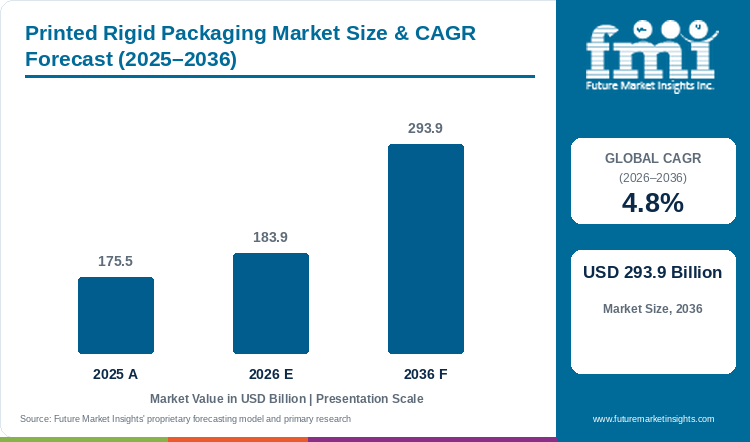
Demand for printed rigid packaging is projected to expand at 4.8% CAGR between 2026 and 2036. Industry value grows from USD 175.5 billion in 2025 to USD 183.9 billion in 2026 and is projected to reach USD 293.9 billion by 2036.
Printed rigid packaging market size is projected to reach USD 293.9 billion by 2036, at 4.8% CAGR, as per FMI. Value moves from USD 175.5 billion in 2025 to USD 183.9 billion in 2026, adding USD 110.0 billion after 2026. Paper and paperboard carries 39.1% of material revenue in 2026, as cartons and corrugated cases are used across food, beverage and household products. Regulation (EU) 2025/40 states that packaging consumes 50% of paper and 40% of plastics used in the European Union.[1] Smurfit WestRock produced 220 billion square feet of corrugated packaging and used 13.1 million tons of recovered fiber during 2025.[2] Graphic Packaging replaced about 880 million plastic packages with paperboard alternatives in the same year.[3] Product output, recovered fiber availability and replacement of selected plastic packs are expected to keep printed paperboard demand strong through 2036.
Key Market Trends & Insights
- By material, paper and paperboard represented the leading 39.1% share in 2026, supported by folding-carton and corrugated packaging applications.
- By printing technology, flexography accounted for 35.9% in 2026, as one printing route serves corrugated board, cartons and selected container surfaces.
- By packaging format, folding cartons held a 36.5% share in 2026, as pre-creased flat blanks support high-speed filling lines and efficient retail display.
- By end use, food and beverage generated 54.7% of revenue in 2026, owing to product protection, labelling and traceability requirements.
Regional Highlights
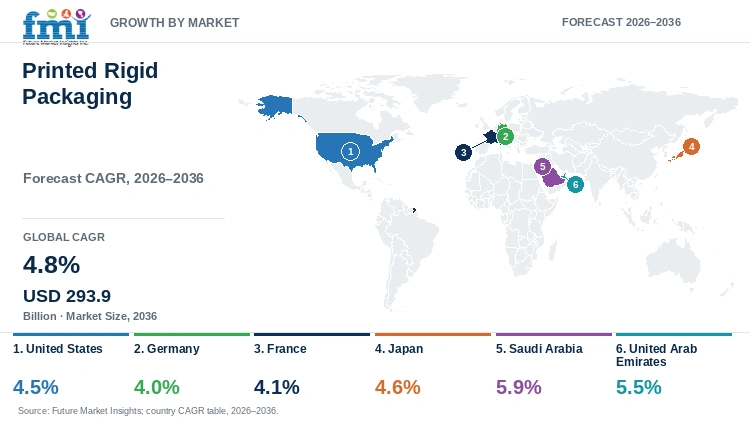
- Fastest-growing profiled country: Saudi Arabia (5.9% CAGR, 2026 to 2036).
- The United Arab Emirates (5.5%) and Japan (4.6%) follow, while Germany records the lowest profiled CAGR at 4.0%.
Market Size & Forecast
Table 1: Market Size and Forecast for the Printed Rigid Packaging Market (USD billion and percentage), 2025 to 2036
| Metric | Value |
|---|---|
| 2025 Market Size | USD 175.5 billion |
| Estimated Market Size in 2026 | USD 183.9 billion |
| Projected Market Size by 2036 | USD 293.9 billion |
| CAGR, 2026 to 2036 | 4.8% |
| Added Revenue, 2026 to 2036 | USD 110.0 billion |
| Market Expansion Multiple | 1.6x |
Demand for printed rigid packaging does not depend on package volume alone, as every format also needs converting lines and a recovery route. Germany recycled about 5.5 million tonnes of packaging collected through dual systems during 2024, with plastic packaging recycling reaching 70% compared with 42% in 2018, while composite packaging missed statutory targets.[5] Japan shipped 17.60 million tonnes of packaging materials and containers during 2025, and packaging machinery production reached 257,373 units.[6] Paperboard, metal and glass packs can move through established converting and collection systems. Mixed packs need material redesign before the same movement is possible, due to which adoption may remain slower where separation is difficult.
Converting Capacity and Recovery Readiness
Food, beverage, healthcare, household and personal care manufacturers are the main buyers of printed rigid packaging. Packaging converters print and form each carton, can, jar or container, after which product manufacturers checks graphics, protection and filling-line performance. The same package is ordered again when the brand continues production without changing its pack specification. According to FMI, converting capacity, material availability and recovery route will decide which formats receive larger repeat orders through 2036.
Table 2: Converting Capacity and Recovery Readiness for the Printed Rigid Packaging Market (tonnes, units, percentages, and output), mixed reporting years from 2024 to 2026
| Indicator | Data Point | Why It Matters | Source |
|---|---|---|---|
| EU material exposure | Packaging uses 50% of paper and 40% of plastics consumed in the EU. | Shows why recyclability and material reduction affects a large packaging material base. | [1] |
| Germany recovery activity | About 5.5 million tonnes recycled through dual systems during 2024. | Established collection supports formats which can be sorted without complex separation. | [5] |
| Germany plastic recycling | 70% in 2024, compared with 42% in 2018. | Improved recovery supports demand for rigid plastic formats designed for recycling. | [15] |
| Japan packaging shipments | 17.60 million tonnes shipped during 2025. | Large material throughput supports continuing demand for printed cartons, cans, jars and containers. | [6] |
| Japan machinery production | 257,373 packaging machinery units during 2025. | Machinery availability supports filling, converting and format changes at production sites. | [17] |
| Smurfit WestRock corrugated output | 220 billion square feet during 2025. | Shows production scale available for printed corrugated and paper-based packaging. | [2] |
| Graphic Packaging substitution | About 880 million plastic packages replaced during 2025. | Indicates commercial movement toward suitable paperboard alternatives. | [3] |
Analyst Perspective
“I expect paperboard substitution to move faster where converters can retain print quality after reducing the package weight. Shorter print runs will gain more orders as brands change graphics without carrying large packaging inventory.”
- Nandini Roy Choudhury, Principal Consultant, Future Market Insights.
How is the printed rigid packaging market segmented?
Printed rigid packaging market is segmented by four primary commercial axes and region: material, printing technology, packaging format, end use, and region. In 2026, paper and paperboard are projected at 39.1%, flexography at 35.9%, folding cartons at 36.5%, and food and beverage at 54.7%.
By material: paper and paperboard, plastics, glass, metal, and bioplastics and plant-based fibers.
By printing technology: flexography, offset, gravure, digital, and screen and other printing.
By packaging format: folding cartons, corrugated rigid packaging, rigid boxes, metal cans, and glass jars and containers.
By end use: food and beverage, pharma and healthcare, personal care and cosmetics, electronics, household and chemicals, and other end uses.
By region: North America, Latin America, Western Europe, Eastern Europe, East Asia, South Asia and Pacific, and Middle East and Africa.
Why does paper and paperboard retain a notable material share?
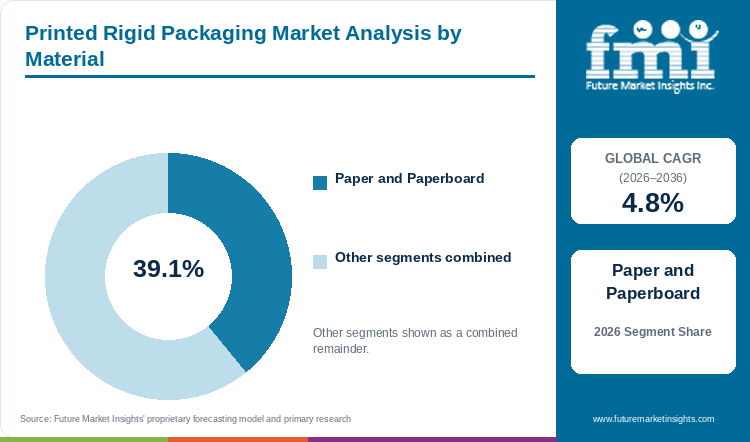
Paper and paperboard are projected to hold 39.1% of material revenue in 2026, supported by recoverable carton structures.
Table 3: Material Share for the Printed Rigid Packaging Market (percentage share), 2026
| Material | Share (2026) |
|---|---|
| Paper and Paperboard | 39.1% |
| Other Segments Combined | 60.9%* |
| Total | 100.0% |
*Calculated as the balance remaining after deducting the leading segment's reported share from 100.0%.
Table 4: Material Leadership and Market Growth for the Printed Rigid Packaging Market (material and CAGR percentage), 2026 to 2036
| Metric | Value |
|---|---|
| Global CAGR (2026 to 2036) | 4.8% |
| Leading Segment | Paper and Paperboard |
Paper and paperboard leads material with 39.1% of revenue in 2026, as food and consumer brands buy cartons in repeated volumes. The material provides a wide surface for graphics, ingredients and handling information, while flat carton supply reduces storage before filling. The American Forest & Paper Association reported that total containerboard operating rates finished 2025 above 91%, supporting consistent paper and paperboard packaging supply.[7] In the FMI report, recoverable carton structures are expected to keep paper and paperboard ahead of plastics, glass, metal and plant-based alternatives through 2036.
- Paper and paperboard account for 39.1% in 2026 because converters can combine structure, graphics, and established collection routes.
- EU rules now assess packaging through design, material use, labeling, and end-of-life performance.
What supports flexography as a preferred printing technology?
By printing technology, flexography is estimated to hold 35.9% in 2026, owing to speed on varied packaging surfaces.
Flexography holds 35.9% of printing technology revenue in 2026, as one press route can cover corrugated board, cartons and selected container surfaces. Plate-based printing supports longer food, beverage and household packaging runs where the same graphics are repeated. Smurfit WestRock received 10 WorldStar awards in January 2025, including printed corrugated and paper-based formats.[8] FMI research indicates that wider substrate use and higher press speed will support flexographic printing demand during the forecast period.
- Flexography holds 35.9% in 2026 because one printing route can serve several rigid substrates and production volumes.
- Dated packaging awards show continued development of printed paper and corrugated formats.
How are folding cartons meeting changing packaging-format needs?
In 2026, folding cartons are expected to lead packaging format with 36.5% share, driven by compact retail presentation.
Folding cartons account for 36.5% of packaging-format revenue in 2026, because brands receive the cartons flat and erect them before filling. Printable panels carry product information, graphics and different regional languages without adding a separate rigid label surface. Pro Carton reported in 2025 that European carton packaging achieved an 8% reduction in fossil carbon emissions between 2021 and 2024 through renewable energy adoption at converting mills.[9] FMI data suggests that plastic replacement and compact inbound storage will support folding cartons orders through 2036.
- Folding cartons account for 36.5% in 2026 as brands combine printable area, protection, and efficient inbound storage.
- European carton converting mills recorded an 8% reduction in fossil carbon emissions between 2021 and 2024 through renewable energy adoption.
Why does food and beverage anchor end-use demand?
Food and beverage is set to lead end use with 54.7% share in 2026, reinforced by product protection and mandatory labeling requirements.
Food and beverage is estimated to form 54.7% of end-use revenue in 2026, as each packaged product needs protection and printed information. Cartons, cans, plastic containers and glass jars carry ingredients, handling details, batch codes and shelf graphics through distribution. Eurostat reported in October 2025 that the European Union achieved an overall packaging waste recycling rate of 67.5% across food, beverage packaging, and consumer packaging sectors.[10] As noted by FMI, packaged food output and repeated filling runs will keep food and beverage as the largest end-use buyer group.
- Food and beverage represents 54.7% in 2026 because printed rigid packs join product protection with shelf and compliance information.
- Amcor listed more than 160 packaging comparisons in its 2026 sustainability assessment tool.
What are the drivers, restraints, and opportunities in the printed rigid packaging market?
In the printed rigid packaging market, food labeling drives adoption, material complexity restrains recycling, and digital decoration opens short-run opportunities.
- Driver: Food, beverage, healthcare, and household goods require protective packs with durable product and compliance information.
- Restraint: Coatings, inks, adhesives, and mixed structures can complicate recycling and raise redesign costs.
- Opportunity: Digital printing and laser marking support shorter runs, versioning, and reduced plate requirements.
Product Information Sustains Printed Demand
Printed rigid packaging carries ingredients, instructions, traceability codes and disposal information directly on the package surface. Food, beverage, healthcare and household manufacturers require this information to remain readable after filling, transport and retail handling. GS1 reported that more than 7,000 manufacturers and 5,200 retailers have initiated 2D barcode transitions under the Sunrise 2027 standard to support scannable traceability and dynamic product information on packaging.[11] Requirement for fixed product information and intelligent packaging scannable codes is expected to drive the printed rigid packaging market growth.
Mixed Structures Complicate Recovery
Printed rigid packaging can combine substrate, barrier coatings, adhesive and decorative finish in one package. These layers protect the product, but the same layers can create separation problems during recycling. The UK Department for Environment, Food and Rural Affairs reported that complex multi-material packaging formats faced higher waste compliance obligations under extended producer responsibility regulations implemented in 2025.[12] Higher redesign and separation requirements may hamper the adoption of mixed printed packaging formats.
Digital Decoration Expands Short Runs
Digital printing changes graphics without preparing a new printing plate, due to which it suits seasonal packs and smaller product batches. Brands can also use the same packaging format with different languages, codes or regional graphics. Koenig & Bauer reported in 2025 that high-speed digital inkjet press installations for corrugated and carton converting expanded by 22%, driven by short-run versioning and customized promotional packaging.[13] Wider use of shorter and repeated print orders is expected to create new avenues for digital printing in rigid packaging.
Which country CAGRs are profiled in the printed rigid packaging market?
Table 5: Country CAGR Comparison for the Printed Rigid Packaging Market (CAGR percentage), 2026 to 2036
| Country | CAGR |
|---|---|
| United States | 4.5% |
| Germany | 4.0% |
| France | 4.1% |
| Japan | 4.6% |
| Saudi Arabia | 5.9% |
| United Arab Emirates | 5.5% |
How do country-level CAGRs compare in the printed rigid packaging market?
Commercial conditions differ across the profiled countries as packaged-product output, recycling rules and local converting capacity shape market expansion. Saudi Arabia at 5.9% CAGR and the United Arab Emirates at 5.5% are expected to grow faster as both countries add local packaging activity and replace selected single-use products. Japan at 4.6% benefits from a large packaging material and machinery base. Germany at 4.0% and France at 4.1% grow more steadily, as buyers are already working inside established recovery and producer responsibility systems.
- United States demand is tied to large packaged-goods channels and investment by integrated carton, container, and paperboard suppliers.
- Germany combines high packaging recovery with tighter design pressure on composite and printed structures.
- France is extending producer responsibility to professional packaging, which broadens reporting and recovery obligations.
- Japan retains a large packaging production base with stable material shipments and growing machinery value.
- Saudi Arabia is localizing packaging capability for food and beverage manufacturing.
- United Arab Emirates demand is shifting as Dubai implements restrictions on selected single-use products.
Full report country CAGRs cover: North America; Latin America; Western Europe; Eastern Europe; East Asia; South Asia and Pacific; Middle East and Africa.
Country-wise Analysis
- The United States printed rigid packaging market is forecast to rise at 4.5% CAGR through 2036, owing to large packaged-goods and e-commerce packaging channels. Printed cartons, cans, containers and corrugated packs are used in food, beverage, healthcare and household applications. The U.S. Environmental Protection Agency reported that paper and paperboard containers and packaging reached a recycling rate of over 68% in 2025, supporting domestic recovery and converting operations.[14] Presence of large paperboard and corrugated converting capacity supports frequent changes in graphics and package sizes. Expansion of online retail and prepared food sales is expected to support the United States market growth.
- Germany is estimated to post 4.0% CAGR over the forecast period, owing to established packaging recovery and redesign of printed packs. In January 2026, the German Environment Agency reported that about 5.5 million tonnes of packaging waste collected in dual systems was recycled during 2024. Material recycling of plastic packaging reached 70% as compared to 42% in 2018. Paper, cardboard, tinplate, aluminium and plastics met statutory targets, whereas glass, beverage cartons and composite packaging missed targets.[15] Demand for printed packages which can enter established recycling streams is anticipated to support the Germany market growth.
- Printed rigid packaging demand in France is forecast to rise at 4.1% CAGR over the forecast period, influenced by producer responsibility for professional packaging. Decree No. 2025-1081 took effect on January 1, 2026 and covers manufacturers, importers, distributors, reuse operators and waste managers.[16] Printed cartons, transport packs, pails, cans and glass containers used by professional customers are included under the framework. Packaging companies require information related to substrates, inks, coatings and recovery routes for meeting reporting requirements. Use of simpler and traceable packaging structures is expected to support the France market growth.
- Adoption of printed rigid packaging in Japan is estimated to expand at 4.6% CAGR through 2036, aided by its large packaging and machinery industry. The Japan Packaging Institute reported that 17.60 million tonnes of packaging materials and containers were shipped during 2025. Packaging machinery production reached 257,373 units, whereas production value increased by 4.8%.[17] Higher machinery value alongside stable packaging volume indicates continued spending on processing and packaging lines. Demand for compact cartons, containers, metal packs and glass formats is expected to support the Japan printed rigid packaging market growth.
- By 2036, Saudi Arabia is projected to grow at 5.9% CAGR, supported by food and beverage production and localization of packaging services. In May 2025, the National Industrial Development Center and Sidel signed an agreement for assessing local packaging operations, services and technical programs. The agreement is connected with requirements of food and beverage manufacturers and transfer of packaging technology.[4][18] Local equipment service supports package trials, line changes and development of printed formats. Expansion of local manufacturing for bottles, cartons, cans and corrugated packs is anticipated to propel the Saudi Arabia market growth.
- The United Arab Emirates printed rigid packaging sector is projected to record 5.5% CAGR during the assessment period, aided by replacement of selected single-use products. Dubai started soft implementation of its single-use product rules on January 1, 2025 and moved towards full implementation on June 1, 2025.[19] Printed paperboard packs and reusable rigid containers are being considered by foodservice and retail companies for replacing restricted formats. Suppliers require alternative packs which can retain heat resistance, product protection and printed information. Use of recyclable packaging with clear disposal details is expected to create growth opportunities in the United Arab Emirates market.
Who are the notable companies in the printed rigid packaging market?
Smurfit WestRock, Amcor, Mondi, Huhtamaki, Crown Holdings, International Paper, Graphic Packaging International, and Sonoco are notable companies profiled in this market.
Printed rigid packaging market is moderately fragmented, as paperboard, corrugated, metal, glass and rigid plastic companies sells through different production systems. Smurfit WestRock, Mondi, International Paper and Graphic Packaging International are focusing on fiber-based packaging. Amcor, Huhtamaki and Sonoco offers different consumer packaging materials, while Crown Holdings is engaged in printed metal cans. Product manufacturers compare print quality, protection, filling-line performance and regional supply before selecting a packaging company. Some of the prominent players are expanding converting capacity and product portfolio in order to cater the growing demand from food, beverage and household manufacturers.
- Fiber-based packaging groups: Smurfit WestRock, Mondi, International Paper, and Graphic Packaging International.
- Multi-material consumer packaging groups: Amcor, Huhtamaki, and Sonoco.
- Metal packaging specialist: Crown Holdings.
Competitive Benchmarking: Printed Rigid Packaging Market
Table 6: Competitive Benchmarking for the Printed Rigid Packaging Market (qualitative capability ratings), 2026
| Company | Materials | Print Capability | Current Activity | Reach |
|---|---|---|---|---|
| Smurfit WestRock | High | High | High | High |
| Amcor | High | High | High | High |
| Mondi | High | High | High | High |
| Huhtamaki | High | High | Medium | High |
| Crown Holdings | Medium | High | Medium | High |
| International Paper | High | Medium | Medium | High |
| Graphic Packaging International | High | High | High | High |
| Sonoco | High | High | High | High |
High indicates evidence of broad substrate, printing, activity, or geographic coverage. Medium indicates narrower public evidence. Ratings do not indicate product quality, market share, or company rank.
Key Developments in the Printed Rigid Packaging Market
- In September 2026, Mondi prepared paper-based and flexible packaging solutions for live market discussion at PACK EXPO International.[20]
- In September 2026, Amcor showcased advanced print and tactile finishing technologies across its packaging portfolio, highlighting rigid and specialty carton containers alongside its flexible lines.[21]
- In June 2026, Graphic Packaging reported that 96% of products sold in 2025 were designed to be recyclable.[23]
- In February 2026, Sonoco reported 2025 net sales of USD 7.8 billion and simplified its operating structure around consumer and industrial packaging.[22]
Key Players in the Printed Rigid Packaging Market
Fiber and Paperboard Platforms
- Smurfit WestRock
- Mondi
- International Paper
- Graphic Packaging International
Multi-material Consumer Packaging
- Amcor
- Huhtamaki
- Sonoco
Metal Packaging
- Crown Holdings
Printed Rigid Packaging Market - Report Scope
Table 7: Report Scope for the Printed Rigid Packaging Market (coverage fields and definitions), 2026 to 2036
| Coverage field | Report scope |
|---|---|
| Market breakdown | Material; printing technology; packaging format; end use; region |
| Quantitative units | USD billion |
| Market definition | First-sale revenue from rigid packaging that carries printed, decorated, coded, or labeled commercial graphics. Unprinted transport protectors, printing equipment, inks sold separately, and flexible packaging are excluded. |
| Regions covered | North America; Latin America; Western Europe; Eastern Europe; East Asia; South Asia and Pacific; Middle East and Africa |
| Countries covered | United States; Germany; France; Japan; Saudi Arabia; United Arab Emirates |
| Key companies profiled | Smurfit WestRock, Amcor, Mondi, Huhtamaki, Crown Holdings, International Paper, Graphic Packaging International, Sonoco |
| Forecast period | 2026 to 2036 |
| Approach | Hybrid bottom-up and top-down sizing that reconciles material, format, end-use, supplier, and country indicators. |
Printed Rigid Packaging Market - Research Methodology
Table 8: Research Methodology for the Printed Rigid Packaging Market (research methods and approach), 2026 edition
| Method | Approach |
|---|---|
| Primary Research | FMI analysts gathered input from manufacturers, service providers, technology developers, distributors, end users, procurement teams, and subject-matter experts. Interviews examined purchasing decisions, product evaluation, adoption barriers, approval requirements, pricing considerations, and expectations for technical or commercial support. |
| Desk Research | Desk research covered government statistics, regulatory publications, trade data, industry associations, technical literature, standards, company filings, product information, and official corporate announcements. |
| Market Sizing and Forecasting | The market model combined the baseline value with historical performance, segment structure, pricing and volume indicators, adoption levels, company participation, and country-level demand conditions. |
| Data Validation | Estimates were checked against multiple independent indicators, including public data, company activity, trade patterns, industry developments, and findings from primary interviews. |
Printed Rigid Packaging Market by Segments
Printed Rigid Packaging Market segmented by Material:
- Paper and Paperboard
- Plastics
- Glass
- Metal
- Bioplastics and Plant-Based Fibers
Printed Rigid Packaging Market segmented by Printing Technology:
- Flexography
- Offset
- Gravure
- Digital
- Screen and Other Printing
Printed Rigid Packaging Market segmented by Packaging Format:
- Folding Cartons
- Corrugated Rigid Packaging
- Rigid Boxes
- Metal Cans
- Glass Jars and Containers
Printed Rigid Packaging Market segmented by End Use:
- Food and Beverage
- Pharma and Healthcare
- Personal Care and Cosmetics
- Electronics
- Household and Chemicals
- Other End Uses
Printed Rigid Packaging Market by Region
- North America
- United States
- Canada
- Latin America
- Brazil
- Mexico
- Argentina
- Chile
- Western Europe
- Germany
- France
- United Kingdom
- Italy
- Spain
- Benelux
- Nordics
- Eastern Europe
- Poland
- Czech Republic
- Romania
- Hungary
- East Asia
- Japan
- South Korea
- South Asia and Pacific
- ASEAN
- Australia and New Zealand
- Middle East and Africa
- GCC Countries
- South Africa
- Türkiye
- Israel
Research Sources and Bibliography
- [1] European Parliament and Council of the European Union. (2025, January 22). Regulation (EU) 2025/40 on packaging and packaging waste. https://eur-lex.europa.eu/eli/reg/2025/40/oj/eng
- [2] Smurfit WestRock. (2026). Global sustainable packaging manufacturer.
- [3] Graphic Packaging International. (2026, June 30). Graphic Packaging releases 2025 impact report.
- [4] Sidel. (2025, May 8). Saudi Arabia and Sidel sign agreement to localize advanced packaging capabilities.
- [5] German Environment Agency. (2026, January 27). Facts against myths: Packaging waste recycling in Germany is working. https://www.umweltbundesamt.de/en/press/pressinformation/facts-against-myths-packaging-waste-recycling-in
- [6] Japan Packaging Institute. (2026). Statistics on the scale of the Japanese packaging industry in 2025.
- [7] American Forest & Paper Association. (2026, January 30). AF&PA releases Q4 2025 containerboard quarterly report.
- [8] Smurfit WestRock. (2025, January 22). Smurfit WestRock showcases innovation expertise at WorldStar 2025.
- [9] Pro Carton. (2025). Carbon footprint study: European carton and cartonboard industry.
- [10] Eurostat. (2025, October 10). Packaging waste statistics.
- [11] GS1. (2025). Transition plan for 2D barcodes on packaging: Sunrise 2027.
- [12] Department for Environment, Food and Rural Affairs. (2025). Packaging waste and extended producer responsibility regulations.
- [13] Koenig & Bauer. (2025). Annual report and digital packaging solutions update.
- [14] U.S. Environmental Protection Agency. (2025, October 23). Containers and packaging: Product-specific data.
- [15] German Federal Ministry for the Environment, Nature Conservation, Nuclear Safety and Consumer Protection. (2026). Packaging Act monitoring report.
- [16] Légifrance. (2025, November 18). Decree No. 2025-1081 on packaging and packaging waste. https://www.legifrance.gouv.fr/jorf/id/JORFTEXT000052587525
- [17] Ministry of Economy, Trade and Industry of Japan. (2026). Packaging machinery and container production statistics.
- [18] National Industrial Development Center. (2025, May). Packaging localization and technical cooperation initiatives in Saudi Arabia.
- [19] Dubai Municipality. (2025). Awareness guide for regulating the use of single-use products.
- [20] Mondi. (2026, September 24). Mondi highlights sustainable packaging innovations at PACK EXPO International 2026.
- [21] Amcor. (2026, September 9). Amcor to showcase packaging solutions at PACK EXPO International 2026.
- [22] Sonoco Products Company. (2026, February 16). Sonoco reports fourth quarter and full year 2025 results.
- [23] Graphic Packaging International. (2026, June 30). Graphic Packaging 2025 sustainability and design report.
This bibliography is provided for reader reference. The full report contains the complete reference list and detailed citations.
This Report Answers
- How big is the printed rigid packaging market during 2026?
- What value is projected for the market by 2036?
- Which material holds a notable market share during 2026?
- Which printing technology holds a notable share during 2026?
- Which countries have a notable expansion outlook through 2036?
- Which companies are notable in the printed rigid packaging market?
Frequently Asked Questions
How large is the printed rigid packaging market expected in 2026?
Future Market Insights estimates that the printed rigid packaging market will reach USD 183.9 billion in 2026. Sales are projected at USD 293.9 billion by 2036 as consumer products require protective packs with printed information.
What CAGR is projected for printed rigid packaging through 2036?
As per FMI, printed rigid packaging sales are projected to rise at 4.8% CAGR from 2026 to 2036. Recyclable material use and shorter printing runs are expected to support demand during the forecast period.
Which material holds a notable share in 2026?
Paper and paperboard are projected to hold 39.1% of material revenue in 2026. Folding cartons and corrugated cases support the segment through established converting and paper recovery systems.
Which printing technology holds a notable share in 2026?
Flexography is estimated to account for 35.9% of printing technology revenue in 2026. One printing route can serve corrugated board, cartons and selected rigid container surfaces.
Which country has a notable expansion outlook through 2036?
Saudi Arabia is projected to expand at a 5.9% CAGR from 2026 to 2036. Food manufacturing and localization of packaging services are supporting package trials and local production.
Who are the key companies in printed rigid packaging?
Notable companies include Smurfit WestRock, Amcor, Mondi, Huhtamaki, Crown Holdings, International Paper, Graphic Packaging International, and Sonoco. These companies are expanding fiber, metal, rigid container and printing capabilities for consumer product manufacturers.
Preview the report firsthand - request a free sample
Get SampleGet the brochure for pricing and purchase details.
Get PDFTable of Content
- Key Takeaways
- Market Size and CAGR
- Top Growth Driver
- Fastest Growing Segment
- Leading Region
- Key Companies
- Emerging Opportunities
- Executive Summary
- Global Market Outlook
- Demand-side Trends
- Supply-side Trends
- Technology Roadmap Analysis
- Analysis and Recommendations
- Analyst Perspective (What is happening? Why now? What should investors know?)
- Key Questions Answered
- How large is the market?
- What is the CAGR?
- What are key trends?
- Which region dominates?
- Who are the leaders?
- Market Overview
- Market Coverage / Taxonomy
- Market Definition / Scope / Limitations
- Research Methodology
- Chapter Orientation
- Analytical Lens and Working Hypotheses
- Market Structure, Signals, and Trend Drivers
- Benchmarking and Cross-market Comparability
- Market Sizing, Forecasting, and Opportunity Mapping
- Research Design and Evidence Framework
- Desk Research Programme (Secondary Evidence)
- Expert Input and Fieldwork (Primary Evidence)
- Tooling, Models, and Reference Databases
- Data Engineering and Model Build
- Quality Assurance and Audit Trail
- Market Background
- Market Dynamics (Drivers, Restraints, Opportunity, Trends)
- Scenario Forecast (Optimistic, Likely, Conservative)
- Impact Analysis
- AI Impact
- Sustainability Impact
- Regulatory Impact
- Technology Impact
- Consumer / Buyer Analysis
- Purchase Drivers
- Adoption Barriers
- Buyer Journey
- Opportunity Map Analysis
- Product Life Cycle Analysis
- Supply Chain Analysis
- Investment Feasibility Matrix
- Value Chain Analysis
- PESTLE and Porter's Analysis
- Regulatory Landscape
- Regional Parent Market Outlook
- Production and Consumption Statistics
- Import and Export Statistics
- Global Market Analysis and Forecast, 2021 to 2036
- Historical Market Size Value (USD Billion) Analysis, 2021 to 2025
- Current and Future Market Size Value (USD Billion) Projections, 2026 to 2036
- Y-o-Y Growth Trend Analysis
- Absolute $ Opportunity Analysis
- Global Market Pricing Analysis, 2021 to 2036
- Global Market Analysis and Forecast, By Material, 2021 to 2036
- Introduction / Key Findings
- Historical Market Size Value (USD Billion) Analysis By Material, 2021 to 2025
- Current and Future Market Size Value (USD Billion) Analysis and Forecast By Material, 2026 to 2036
- Paper and Paperboard
- Plastics
- Glass
- Metal
- Bioplastics and Plant-Based Fibers
- Y-o-Y Growth Trend Analysis By Material, 2021 to 2025
- Absolute $ Opportunity Analysis By Material, 2026 to 2036
- Global Market Analysis and Forecast, By Printing Technology, 2021 to 2036
- Introduction / Key Findings
- Historical Market Size Value (USD Billion) Analysis By Printing Technology, 2021 to 2025
- Current and Future Market Size Value (USD Billion) Analysis and Forecast By Printing Technology, 2026 to 2036
- Flexography
- Offset
- Gravure
- Digital
- Screen and Other Printing
- Y-o-Y Growth Trend Analysis By Printing Technology, 2021 to 2025
- Absolute $ Opportunity Analysis By Printing Technology, 2026 to 2036
- Global Market Analysis and Forecast, By Packaging Format, 2021 to 2036
- Introduction / Key Findings
- Historical Market Size Value (USD Billion) Analysis By Packaging Format, 2021 to 2025
- Current and Future Market Size Value (USD Billion) Analysis and Forecast By Packaging Format, 2026 to 2036
- Folding Cartons
- Corrugated Rigid Packaging
- Rigid Boxes
- Metal Cans
- Glass Jars and Containers
- Y-o-Y Growth Trend Analysis By Packaging Format, 2021 to 2025
- Absolute $ Opportunity Analysis By Packaging Format, 2026 to 2036
- Global Market Analysis and Forecast, By End Use, 2021 to 2036
- Introduction / Key Findings
- Historical Market Size Value (USD Billion) Analysis By End Use, 2021 to 2025
- Current and Future Market Size Value (USD Billion) Analysis and Forecast By End Use, 2026 to 2036
- Food and Beverage
- Pharma and Healthcare
- Personal Care and Cosmetics
- Electronics
- Household and Chemicals
- Other End Uses
- Y-o-Y Growth Trend Analysis By End Use, 2021 to 2025
- Absolute $ Opportunity Analysis By End Use, 2026 to 2036
- Global Market Analysis and Forecast, By Region, 2021 to 2036
- Introduction
- Historical Market Size Value (USD Billion) Analysis By Region, 2021 to 2025
- Current Market Size Value (USD Billion) Analysis and Forecast By Region, 2026 to 2036
- North America
- Latin America
- Western Europe
- Eastern Europe
- East Asia
- South Asia and Pacific
- Middle East and Africa
- Market Attractiveness Analysis By Region
- North America Market Analysis and Forecast, By Country, 2021 to 2036
- Historical Market Size Value (USD Billion) Trend Analysis By Market Taxonomy, 2021 to 2025
- Market Size Value (USD Billion) Forecast By Market Taxonomy, 2026 to 2036
- By Country
- United States
- Canada
- By Material
- By Printing Technology
- By Packaging Format
- By End Use
- By Country
- Market Attractiveness Analysis
- By Country
- By Material
- By Printing Technology
- By Packaging Format
- By End Use
- Key Takeaways
- Latin America Market Analysis and Forecast, By Country
- Historical Market Size Value (USD Billion) Trend Analysis By Market Taxonomy, 2021 to 2025
- Market Size Value (USD Billion) Forecast By Market Taxonomy, 2026 to 2036
- By Country
- Brazil
- Mexico
- Argentina
- Chile
- By Material
- By Printing Technology
- By Packaging Format
- By End Use
- By Country
- Market Attractiveness Analysis
- By Country
- By Material
- By Printing Technology
- By Packaging Format
- By End Use
- Key Takeaways
- Western Europe Market Analysis and Forecast, By Country
- Historical Market Size Value (USD Billion) Trend Analysis By Market Taxonomy, 2021 to 2025
- Market Size Value (USD Billion) Forecast By Market Taxonomy, 2026 to 2036
- By Country
- Germany
- France
- United Kingdom
- Italy
- Spain
- Benelux
- Nordics
- By Material
- By Printing Technology
- By Packaging Format
- By End Use
- By Country
- Market Attractiveness Analysis
- By Country
- By Material
- By Printing Technology
- By Packaging Format
- By End Use
- Key Takeaways
- Eastern Europe Market Analysis and Forecast, By Country
- Historical Market Size Value (USD Billion) Trend Analysis By Market Taxonomy, 2021 to 2025
- Market Size Value (USD Billion) Forecast By Market Taxonomy, 2026 to 2036
- By Country
- Poland
- Czech Republic
- Romania
- Hungary
- By Material
- By Printing Technology
- By Packaging Format
- By End Use
- By Country
- Market Attractiveness Analysis
- By Country
- By Material
- By Printing Technology
- By Packaging Format
- By End Use
- Key Takeaways
- East Asia Market Analysis and Forecast, By Country
- Historical Market Size Value (USD Billion) Trend Analysis By Market Taxonomy, 2021 to 2025
- Market Size Value (USD Billion) Forecast By Market Taxonomy, 2026 to 2036
- By Country
- Japan
- South Korea
- By Material
- By Printing Technology
- By Packaging Format
- By End Use
- By Country
- Market Attractiveness Analysis
- By Country
- By Material
- By Printing Technology
- By Packaging Format
- By End Use
- Key Takeaways
- South Asia and Pacific Market Analysis and Forecast, By Country
- Historical Market Size Value (USD Billion) Trend Analysis By Market Taxonomy, 2021 to 2025
- Market Size Value (USD Billion) Forecast By Market Taxonomy, 2026 to 2036
- By Country
- ASEAN
- Australia and New Zealand
- By Material
- By Printing Technology
- By Packaging Format
- By End Use
- By Country
- Market Attractiveness Analysis
- By Country
- By Material
- By Printing Technology
- By Packaging Format
- By End Use
- Key Takeaways
- Middle East and Africa Market Analysis and Forecast, By Country
- Historical Market Size Value (USD Billion) Trend Analysis By Market Taxonomy, 2021 to 2025
- Market Size Value (USD Billion) Forecast By Market Taxonomy, 2026 to 2036
- By Country
- GCC Countries
- South Africa
- Türkiye
- Israel
- By Material
- By Printing Technology
- By Packaging Format
- By End Use
- By Country
- Market Attractiveness Analysis
- By Country
- By Material
- By Printing Technology
- By Packaging Format
- By End Use
- Key Takeaways
- Key Countries Market Analysis
- United States
- Pricing Analysis
- Market Share Analysis, 2025
- By Material
- By Printing Technology
- By Packaging Format
- By End Use
- Canada
- Pricing Analysis
- Market Share Analysis, 2025
- By Material
- By Printing Technology
- By Packaging Format
- By End Use
- Mexico
- Pricing Analysis
- Market Share Analysis, 2025
- By Material
- By Printing Technology
- By Packaging Format
- By End Use
- Brazil
- Pricing Analysis
- Market Share Analysis, 2025
- By Material
- By Printing Technology
- By Packaging Format
- By End Use
- Chile
- Pricing Analysis
- Market Share Analysis, 2025
- By Material
- By Printing Technology
- By Packaging Format
- By End Use
- Germany
- Pricing Analysis
- Market Share Analysis, 2025
- By Material
- By Printing Technology
- By Packaging Format
- By End Use
- United Kingdom
- Pricing Analysis
- Market Share Analysis, 2025
- By Material
- By Printing Technology
- By Packaging Format
- By End Use
- Italy
- Pricing Analysis
- Market Share Analysis, 2025
- By Material
- By Printing Technology
- By Packaging Format
- By End Use
- Spain
- Pricing Analysis
- Market Share Analysis, 2025
- By Material
- By Printing Technology
- By Packaging Format
- By End Use
- France
- Pricing Analysis
- Market Share Analysis, 2025
- By Material
- By Printing Technology
- By Packaging Format
- By End Use
- ASEAN
- Pricing Analysis
- Market Share Analysis, 2025
- By Material
- By Printing Technology
- By Packaging Format
- By End Use
- Australia and New Zealand
- Pricing Analysis
- Market Share Analysis, 2025
- By Material
- By Printing Technology
- By Packaging Format
- By End Use
- Japan
- Pricing Analysis
- Market Share Analysis, 2025
- By Material
- By Printing Technology
- By Packaging Format
- By End Use
- South Korea
- Pricing Analysis
- Market Share Analysis, 2025
- By Material
- By Printing Technology
- By Packaging Format
- By End Use
- Poland
- Pricing Analysis
- Market Share Analysis, 2025
- By Material
- By Printing Technology
- By Packaging Format
- By End Use
- Hungary
- Pricing Analysis
- Market Share Analysis, 2025
- By Material
- By Printing Technology
- By Packaging Format
- By End Use
- Türkiye
- Pricing Analysis
- Market Share Analysis, 2025
- By Material
- By Printing Technology
- By Packaging Format
- By End Use
- South Africa
- Pricing Analysis
- Market Share Analysis, 2025
- By Material
- By Printing Technology
- By Packaging Format
- By End Use
- Saudi Arabia
- Pricing Analysis
- Market Share Analysis, 2025
- By Material
- By Printing Technology
- By Packaging Format
- By End Use
- United Arab Emirates
- Pricing Analysis
- Market Share Analysis, 2025
- By Material
- By Printing Technology
- By Packaging Format
- By End Use
- United States
- Market Structure Analysis
- Competition Dashboard
- Competition Benchmarking
- Market Share Analysis of Top Players
- By Regional
- By Material
- By Printing Technology
- By Packaging Format
- By End Use
- Emerging Startups
- Innovation Benchmarking
- Competition Analysis
- Competition Deep Dive
- Smurfit WestRock
- Overview
- Product Portfolio
- Profitability by Market Segments
- Sales Footprint
- Strategy Overview
- Marketing Strategy
- Product Strategy
- Channel Strategy
- Amcor
- Mondi
- Huhtamaki
- Crown Holdings
- International Paper
- Graphic Packaging International
- Sonoco
- Smurfit WestRock
- Case Studies
- Success Stories
- Recent Developments
- Competition Deep Dive
- Assumptions & Acronyms Used


