
- Market Size (2026)
- USD 427.4 Mn
- Forecast (2036)
- USD 1200.0 Mn
- CAGR (2026 to 2036)
- 11.1%
How big is the Humidity-Responsive Polymers Market in 2026?
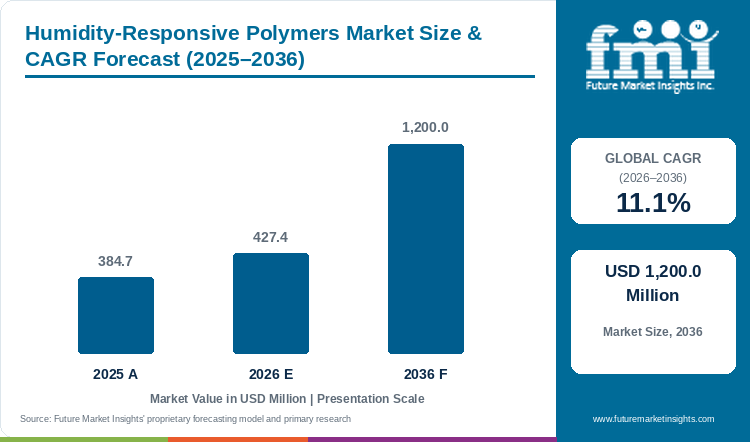
The Humidity-Responsive Polymers Market stands at USD 427.4 million in 2026. It is projected to reach USD 1.2 billion by 2036, an 11.1% CAGR from 2026 to 2036. The market was valued at USD 384.7 million in 2025. Regulation (EU) 2024/3110 on construction products entered into force on 7 January 2025 and has applied since 8 January 2026 [6]. Regulation (EU) 2025/40 on packaging has applied since 12 August 2026 [7]. The German institute DIBt issued European Technical Assessment ETA-18/1146 for pro clima's INTELLO and INTELLO PLUS on 28 November 2019 [4].
Demand follows the humidity range a material can handle, not the resin price. CertainTeed's MemBrain film has permeance of 1 perm or less by the ASTM E96 dry cup method, and more than 10 perms by the wet cup method [2]. Its pores expand when relative humidity rises above 60% [2]. pro clima gives INTELLO an sd value of significantly over 25 m in winter [3]. It describes moisture transport of more than 500 g/m2 per week in summer [3]. In packaging, a Fujian team reported in January 2026 that a film swells and releases an antimicrobial faster at 98% relative humidity than at 43% [1].
Key Market Trends & Insights
- On 8 January 2026 Regulation (EU) 2024/3110 began to apply in the European Union [6]. pro clima's INTELLO line already holds a European Technical Assessment dated 28 November 2019, issued under the earlier Regulation (EU) No 305/2011 [4].
- A Foods study published on 29 January 2026 describes a konjac glucomannan and polyvinyl alcohol packaging film. The film released 87.3% of its cinnamaldehyde over 7 days at 98% relative humidity, and release slowed significantly at 43% [1].
- Humidity-variable products are already on sale in Japan, where a Greenfield product page last updated on 1 August 2023 covers Tyvek Smart [15].
Regional Highlights
- Europe: pro clima describes its INTELLO approval by DIBt in October 2015 as the first for a humidity-variable vapour check [3], and a European Technical Assessment followed in November 2019 [4].
- North America: the International Residential Code, as summarised by the Insulation Institute, allows a responsive vapor retarder on the interior side of frame walls in any climate zone [14]. CertainTeed sells MemBrain, a 2-mil polyamide film, for heating and mixed climates [2].
- Asia Pacific: a Fujian Agriculture and Forestry University team in China published a humidity-triggered packaging film in January 2026 [1]. In Japan, a 2019 paper in the Architectural Institute of Japan's technical journal measured three humidity-variable vapour retarders in both directions [13].
Humidity-Responsive Polymers Market Size and Forecast
Table 1: Humidity-Responsive Polymers Market Size and Forecast
| Market size and forecast | Value |
|---|---|
| Market size in 2025 | USD 384.7 million |
| Market size in 2026 | USD 427.4 million |
| Projected market size by 2036 | USD 1.2 billion |
| CAGR from 2026 to 2036 | 11.1% |
Source: Future Market Insights analysis of the humidity-responsive polymers market, 2026.
Analyst Perspective
“Humidity-responsive polymers are sold on a curve, not on a single number. A membrane that is tight in a dry winter wall and open in a damp summer wall has to be proved across the humidity range it will meet. A film that releases an active ingredient only when the pack gets wet faces the same test. Buyers who ask for the dry-cup value alone will misjudge the product. Suppliers that publish tests at several humidity steps, in both directions, will win specifications first. They also need to state the climates a product is not meant for.”
- Nikhil Kaitwade, Principal Consultant, FMI
How is the Humidity-Responsive Polymers Market segmented?
- By product: Films/Coatings, Bulk Polymers/Hydrogels, Fibers and Additives / Masterbatches
- By end-use: Packaging Films, Building Materials, Textiles, Agriculture, Biomedical and Other End-uses
- By region: North America, Europe, Asia Pacific and Latin America
Why does Films/Coatings lead by Product in the Humidity-Responsive Polymers Market in 2026?
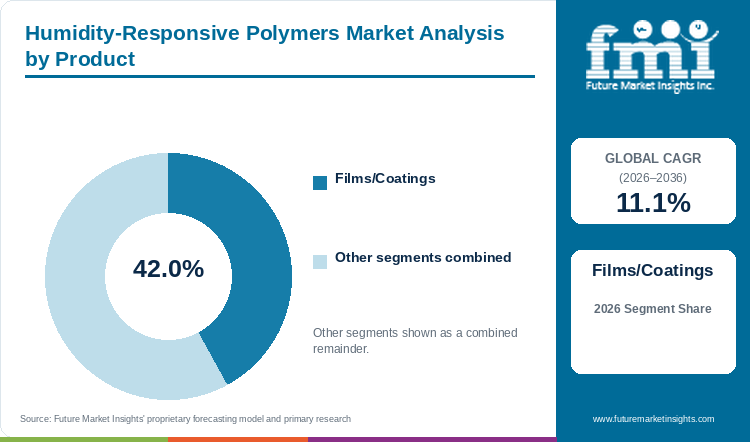
Films/Coatings accounts for 42.0% of the Humidity-Responsive Polymers Market by product in 2026. The documented humidity-variable products are mostly thin layers. CertainTeed describes MemBrain as a 2-mil polyamide film that changes permeability with ambient humidity [2]. pro clima's INTELLO is a polyethylene copolymer membrane with a polypropylene fleece and reinforcing net [5]. The British Board of Agrément assesses it for roofs, walls and suspended floors [5]. Vaisala's HUMICAP sensor places a thin polymer film between two electrodes. The film takes up water vapour as humidity rises and releases it as humidity falls [12]. Films also fit existing converting routes, and Huntsman positions its IROGRAN A 85 P 4394 HR grade as a thin film for waterproof, breathable performance apparel [8]. Covestro offers Impraperm waterborne polyurethane dispersions for water-vapour-permeable textile coatings [9]. BASF lists grades for breathable films within its Elastollan range [10]. Laminators and coaters already handle these moisture-permeable films, so the segment stays ahead of gels, fibres and additives.
Table 2: Product, 2026 Share
| Leading Share | 2026 market share |
|---|---|
| Films/Coatings | 42.0% |
| All Other Segments Combined Share | 58.0% |
Source: Future Market Insights analysis of the humidity-responsive polymers market, 2026.
Why does Packaging Films lead by End-use in the Humidity-Responsive Polymers Market in 2026?
Packaging Films accounts for 34.0% of the Humidity-Responsive Polymers Market by end-use in 2026. In a closed pack, moisture is a main lever on food quality. The authors of the January 2026 Foods study cite spoilage and foodborne illness from microbial contamination as causing the loss of about 30% of food production each year [1]. They link high humidity to moisture uptake, mould growth and microbial growth [1]. Their film swelled at 98% relative humidity and released cinnamaldehyde over 7 days, while release slowed significantly at 43% [1]. The route from laboratory to production line has been shown for humidity regulation. In 2012 Fraunhofer researchers Sven Saengerlaub and Karin Agulla described polymer films containing calcium chloride or sodium chloride [11]. The films absorb and release water vapour to prevent condensation inside closed packs, and they were tested in polypropylene, PLA, PET and polystyrene [11]. Partners then made films and thermoformed trays on production lines, and fresh mushrooms in the trials gained several days of shelf life [11]. Regulation (EU) 2025/40, which has applied since 12 August 2026, covers all packaging placed on the EU market [7]. Suppliers of responsive layers should expect questions on how the layer affects recycling.
Table 3: End-use, 2026 Share
| Leading Share | 2026 market share |
|---|---|
| Packaging Films | 34.0% |
| All Other Segments Combined Share | 66.0% |
Source: Future Market Insights analysis of the humidity-responsive polymers market, 2026.
What are the key drivers, restraints and opportunities?
Driver
Moisture control in building envelopes. A wall sealed against air still needs a way to dry. MemBrain's permeance rises from 1 perm or less in the dry cup test to more than 10 perms in the wet cup test [2]. CertainTeed says the pores expand above 60% relative humidity, so drying can occur in either direction by vapour diffusion [2]. pro clima reports INTELLO moisture transport over 500 g/m2 per week in summer [3]. Its sd value is significantly over 25 m in winter [3]. The DIBt assessment assumes a working life of at least 50 years for INTELLO and INTELLO PLUS [4]. A stated working life lets designers specify the product once.
Packaging that reacts to its own environment. Condensation and mould inside packs are visible to shoppers. The Fraunhofer team noted that customers see condensed water as non-hygienic [11]. The 2026 Foods paper shows a film whose antimicrobial release is triggered by high humidity [1]. Together the two studies describe two routes for smart packaging: films that regulate humidity in the pack, and films that react to it.
Restraint
Climate and finish limits. The same product data that promotes MemBrain also sets its limits. CertainTeed says the film is not suited to cooling climates with high outdoor humidity [2]. It is also unsuitable where indoor humidity is exceptionally high and constant, as in swimming pools. It should not be used where humidification is set above 50% relative humidity. Vinyl wallpaper and vapor-retarding paints reduce its drying benefit, and direct or reflected ultraviolet exposure is not recommended [2]. Each limit narrows the buildings in which the product can be sold.
Measurement and processing. Yoshinaga's 2019 measurements of three Japanese humidity-variable vapour retarders found very low resistance at high humidity in both directions [13]. At low humidity, resistance was high in one direction and only moderately low in the other [13]. The author concluded the desiccant dry-cup method should not be used for films with a hydrophilic layer [13]. Water also changes polymers during manufacture: University of Alberta researchers found moisture trapping increased voids in extrusion-printed shape memory polyurethane [22]. Water also plasticised the polymer and lowered its glass transition temperature [22]. A material that responds to water is harder to dry, store and certify.
Opportunity
Moisture-permeable textile laminates. Huntsman launched an IROGRAN grade on 21 June 2021 for waterproof, breathable films in performance apparel [8]. Covestro describes Impraperm coatings as giving extremely high comfort for garments and shoes [9]. BASF says its TPU films and coatings combine flexibility with water vapour permeability for textile laminates [10]. These suppliers already sell into textile laminating and coating lines. A grade whose permeability changes with humidity would fit into a catalogue already on sale.
Release and regulation films for food. The Foods study used a konjac glucomannan, polyvinyl alcohol and lithium chloride matrix [1]. Its tensile strength was 20.83 MPa [1]. The Fraunhofer work found calcium chloride and sodium chloride took up far more water than polar polymers and silica gel [11]. In 2012 the team still had to examine salt migration, sorption speed and the actual quality benefit [11]. It suggested cheese as the next test product [11]. Converters who answer those questions with shelf-life data on commercial lines gain an advantage.
Humidity-Responsive Polymers Market by Country (2026 to 2036)
Table 4: Humidity-Responsive Polymers Market Country Growth Forecast
| Country | CAGR, 2026 to 2036 |
|---|---|
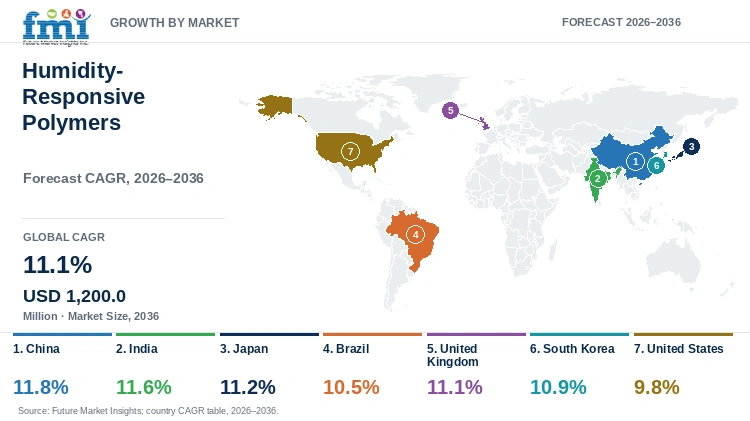
| China | 11.8% |
| India | 11.6% |
| Japan | 11.2% |
| Brazil | 10.5% |
| United Kingdom | 11.1% |
| South Korea | 10.9% |
| United States | 9.8% |
Source: Future Market Insights analysis of the humidity-responsive polymers market, 2026.
China
The Foods paper of 29 January 2026 is one dated example from China. It came from a College of Food Science team at Fujian Agriculture and Forestry University and partner institutions [1]. The film combines konjac glucomannan, polyvinyl alcohol and lithium chloride, and carries cinnamaldehyde inclusion complexes [1].
The film shows a design trade-off. At 98% relative humidity it swelled and released 87.3% of the cinnamaldehyde over 7 days, and release slowed significantly at 43% [1]. Tensile strength was 20.83 MPa, and the water contact angle was below 60 degrees [1]. A matrix hydrophilic enough to swell drives the response. Buyers should ask for release data across the humidity range their cold chain actually sees.
In construction, the Ministry of Housing and Urban-Rural Development issued mandatory national standards on building energy conservation and renewable energy use. The standards took effect on 1 April 2022 and cut design energy consumption of new residential and public buildings by 30% and 20% against the 2016 standards [21]. Lower design energy use generally points to better insulated, more airtight walls, which puts more weight on moisture control inside the wall.
India
The Indian Agricultural Research Institute in New Delhi developed Pusa Hydrogel, a granular water-absorbing product [17]. A 19 September 2014 report says it absorbs irrigation water like a sponge and releases it to plants in dry spells [17]. The institute patented it, and the Indian Council of Agricultural Research and the Ministry of Agriculture promote it [17].
Farmers mix the granules with about ten times their quantity of farm soil and a basal dose of fertiliser [17]. They add the seed and place the mixture in rows with a plough or seed drill [17]. Packs are sold in 250 g, 500 g and 1 kg sizes [17]. Small packs suit a smallholder channel and keep the cost of a first trial low.
The 2014 benefits came from the developer, not from trials. Wheat growers could save two irrigations without losing yield [17]. A paddy field irrigated every five days would need water every seven [17]. Chrysanthemum nursery plants were ready for transplanting in 18 days, against the usual 28 to 30 [17]. Buyers comparing gels should ask for crop-specific field data, since these are developer statements in a press report.
Japan
In 2019 Mika Yoshinaga of Meijo University published measurements of three humidity-variable vapour retarders [13]. The paper appeared in the Architectural Institute of Japan's technical journal [13]. Each product was tested in both directions by the cup method at eight humidity levels. Resistance was very low for all three at high humidity. At low humidity, it was high in one direction and only moderately low in the other [13].
Tyvek Smart is on sale in Japan, according to Greenfield's product page, last updated on 1 August 2023 [15]. The page describes it as an airtight product that holds moisture back like a conventional vapour barrier in winter [15]. In summer it becomes permeable, like a breathable waterproof product [15]. Asahi-DuPont Flash Spun Products sells Tyvek in Japan [16]. It says DuPont developed the material and lists a VCL Smart product among its building materials [16].
Yoshinaga concluded the desiccant dry-cup method should not be used for films with a hydrophilic layer [13]. Specifiers in Japan need humidity-step results in both directions, with the installation direction stated, before comparing products.
Brazil
Embrapa Agroindústria Tropical ran a rainfed trial with 216 plants in four blocks at Pacajus in Ceará, on the dwarf cashew clone BRS 226 [18]. The hydrogel, an acrylamide and potassium acrylate copolymer, was mixed at 2.5 g per litre of water, the manufacturer's rate [18]. Doses of 0.5 to 2.0 litres were applied at depths of 0.2 and 0.5 metres [18].
The best treatment was 1 litre of hydrated solution at the bottom of a 0.5 m planting hole [18]. It gave survival significantly above the untreated control, with no plant deaths during monitoring [18]. The report of 10 June 2024 notes that late plantings often lose more than 25% of seedlings [18]. In September 2024 EPAMIG, the agricultural research company of Minas Gerais, published Circular Técnica No. 412 [19]. It recommends hydrogel where rainfall is scarce and where water use and irrigation costs need to fall [19]. The circular says perennial crops such as coffee, fruit trees and forests accept it best [19].
EPAMIG's method hydrates the gel for 15 minutes, places it in the planting hole in direct contact with the roots, and follows with irrigation to saturate the polymer [19]. The circular lists quantities per plant for coffee, eucalyptus, citrus and native trees [19]. Sales follow the planting calendar of perennial crops and the dose per seedling, which suits distributors with nursery and orchard customers.
United Kingdom
pro clima's INTELLO and INTELLO PLUS hold British Board of Agrément Certificate 14/5155 [5]. The certificate was first issued on 22 January 2015, with a second issue dated 15 July 2019 [5]. It covers humidity-variable vapour control layers for roofs, walls and suspended floors in domestic and non-domestic buildings up to and including humidity class 4 [5].
The certificate links the product to Building Regulations 2010 [5]. It can contribute to limiting interstitial condensation under C2(c), and to conservation of fuel and power under L1(a)(1) [5]. The membranes are restricted by the external fire spread requirement B4(1) and classed E under BS EN 13501-1:2018 [5]. Specifiers must check that fire class against the roof or wall build-up.
The BBA runs a three-yearly review of certified products [5]. It tells readers to check the validity and latest issue of a certificate [5]. The version dated 15 July 2019 is the second issue, so buyers should ask for the current issue before specifying. pro clima's own timeline records BBA certification in January 2015 and a new INTELLO X version for greater UV resistance in October 2021 [3].
South Korea
The Netherlands Enterprise Agency (RVO) reported in a page checked on 27 March 2024 that Zero Energy Building certification would become mandatory in South Korea from 2025 [20]. The rule would apply to public buildings above 500 square metres, private buildings above 1,000 square metres and apartment complexes with more than 30 households [20].
Highly insulated, airtight envelopes leave moisture in wall cavities with fewer ways out. Membranes whose permeability rises in summer target this condition, as the Tyvek Smart product page describes [15].
Product choice still depends on climate and finish, and CertainTeed limits MemBrain to heating and mixed climates and to indoor humidity of no more than 50% [2]. Yoshinaga found that for some products the low-humidity resistance depends on the direction of vapour flow [13]. Korean specifiers should ask for tests in both directions and across humidity steps, not a single permeance figure.
United States
The clearest United States demand route is the building code. The Insulation Institute's summary of the International Residential Code vapor retarder table attributes it to the 2024 edition [14]. A footnote allows a responsive vapor retarder on the interior side of frame walls in any climate zone [14]. Where a Class I or II retarder is combined with foam or insulated siding as continuous insulation on frame walls, it must be a responsive vapor retarder [14]. That gives designers a named category to specify.
CertainTeed's MemBrain is the documented product, and its November 2024 product data describes a Class A fire-rated 2-mil polyamide (nylon) film [2]. Permeance is 1 perm or less by the ASTM E96 dry cup method, and more than 10 perms by the wet cup method [2]. With standard tape and sealing practices, the film also acts as an air barrier [2].
The product data also marks the edges of the sale. CertainTeed recommends the film for heating and mixed climates [2]. It advises against use in cooling climates with high outdoor humidity [2]. It also advises against use where indoor humidification is set above 50% relative humidity, or where vinyl wallpaper or vapor-retarding paints are applied [2]. Installers and designers need a climate and finish check before they choose the film. The sale depends on the wall assembly, not on the roll price.
Who are the notable companies in the Humidity-Responsive Polymers Market?
Notable companies in the Humidity-Responsive Polymers Market include Huntsman International LLC, Covestro AG, BASF SE, DuPont, CertainTeed, MOLL bauökologische Produkte (pro clima) and Vaisala.
Position in the value chain separates the companies more than any single technology. CertainTeed sells a polyamide film with stated dry-cup and wet-cup permeance [2], pro clima a membrane with a stated sd range and a European Technical Assessment [3][4], and Vaisala a polymer-film sensor [12]. Huntsman, Covestro and BASF sell polyurethane resins, dispersions and films into laminating and coating lines [8][9][10]. Their selling point is moisture-vapour permeability, not a stated humidity curve.
Test evidence and approvals decide who is specified. pro clima holds a DIBt-issued assessment dated 28 November 2019 [4]. Its British Board of Agrément certificate was first issued on 22 January 2015 [5]. CertainTeed publishes ASTM E96 values and the climates it does not recommend [2].
Geography follows building rules and climate, and Regulation (EU) 2024/3110 has applied since 8 January 2026 [6]. The International Residential Code names responsive vapor retarders for the United States [14]. Asahi-DuPont Flash Spun Products lists a VCL Smart product for Japan [16]. Suppliers with approvals in several regions reach more buyers than those with one.
Key Developments in the Humidity-Responsive Polymers Market
- On 8 January 2026, Regulation (EU) 2024/3110 on construction products began to apply, having entered into force on 7 January 2025 [6].
- On 29 January 2026 Foods published a Fujian Agriculture and Forestry University study on a humidity-triggered packaging film [1].
- On 12 August 2026, Regulation (EU) 2025/40 on packaging and packaging waste began to apply, having been in force since 11 February 2025 [7].
- In October 2021 pro clima added INTELLO X to its range for greater UV resistance [3]. On 21 June 2021 Huntsman announced a new IROGRAN grade for waterproof, breathable films in performance apparel [8].
Key Players in the Humidity-Responsive Polymers Market
- Huntsman International LLC
- Covestro AG
- BASF SE
- DuPont
- CertainTeed
- MOLL bauökologische Produkte GmbH (pro clima)
- Vaisala
Humidity-Responsive Polymers Market Report Scope
Table 5: Humidity-Responsive Polymers Market Report Scope
| Coverage field | Report scope |
|---|---|
| Market definition | Polymers and polymer-based films, coatings, gels, fibres and additives whose permeability, dimensions, electrical response or release behaviour changes reversibly with ambient moisture or relative humidity, measured by value of sales |
| Product | Films/Coatings, Bulk Polymers/Hydrogels, Fibers, Additives / Masterbatches |
| End-use | Packaging Films, Building Materials, Textiles, Agriculture, Biomedical, Other End-uses |
| Regions and profiled countries | North America, Europe, Asia Pacific and Latin America. Profiled countries: United States, United Kingdom, China, India, Japan, South Korea, Brazil |
| Companies covered | Huntsman International LLC, Covestro AG, BASF SE, DuPont, CertainTeed, MOLL bauökologische Produkte GmbH (pro clima), Vaisala |
| Forecast period | 2026 to 2036, with 2025 as the historical base year |
| Quantitative Units | USD million |
Source: Future Market Insights analysis of the humidity-responsive polymers market, 2026.
Humidity-Responsive Polymers Market by Segments
Humidity-Responsive Polymers Market segmented by Product:
- Films/Coatings
- Bulk Polymers/Hydrogels
- Fibers
- Additives / Masterbatches
Humidity-Responsive Polymers Market segmented by End-use:
- Packaging Films
- Building Materials
- Textiles
- Agriculture
- Biomedical
- Other End-uses
Humidity-Responsive Polymers Market by Region
- North America
- Europe
- Asia Pacific
- Latin America
- United States
- United Kingdom
- China
- India
- Japan
- South Korea
- Brazil
Research Sources and Bibliography
- [1] Chen, Y., Liu, H., Sun, K., Weng, Q., Yan, Y., Xiao, L., Ye, Z., Wen, C., Pang, J., & Ning, Q. (2026, January 29). A Konjac Glucomannan-Based Antibacterial Packaging Film with Humidity-Triggered Release of Cinnamaldehyde. Foods, 15(3), 464. https://doi.org/10.3390/foods15030464
- [2] CertainTeed. (2024, November). MemBrain Continuous Air Barrier & Smart Vapor Retarder, Product Data. https://www.buildsite.com/pdf/certainteed/MemBrain-Product-Data-2900178.pdf
- [3] pro clima (MOLL bauökologische Produkte GmbH). (n.d.). 20 years of INTELLO. https://proclima.com/campaigns/20-years-intello
- [4] Deutsches Institut für Bautechnik. (2019, November 28). European Technical Assessment ETA-18/1146, Humidity-dependent vapour control layers INTELLO and INTELLO PLUS. https://www.dibt.de/pdf_storage/2019/ETA-18!1146(8.06.05-42!16)e.pdf
- [5] British Board of Agrément. (2019, July 15). Agrément Certificate 14/5155, Product Sheet 1: Pro Clima Intelligent Vapour Control and Airtight Systems, INTELLO and INTELLO PLUS (second issue). https://www.roofgiant.com/resources/files/intello-plus-bba-certificate_2_10-02-2020.pdf
- [6] PU Europe. (2024, December 18). New Construction Products Regulation published in the Official Journal of the EU. https://www.pu-europe.eu/new-construction-products-regulation-published-in-the-official-journal-of-the-eu/
- [7] European Commission, Directorate-General for Environment. (n.d.). Packaging waste. https://environment.ec.europa.eu/topics/waste-and-recycling/packaging-waste_en
- [8] Huntsman Corporation. (2021, June 21). New IROGRAN TPU grade from Huntsman has improved textile properties. https://www.huntsman.com/news/media-releases/detail/487/new-irogran-tpu-grade-from-huntsman-has-improved
- [9] Covestro. (n.d.). Impraperm. https://solutions.covestro.com/es/brands/impraperm
- [10] BASF. (n.d.). Elastollan films, textiles and nonwovens. https://plastics-rubber.basf.com/emea/en/performance_polymers/products/elastollan/films-textiles-and-nonwovens
- [11] FoodNavigator. (2012, September 27). Researchers create novel humidity regulating films to stop water vapour condensation. https://www.foodnavigator.com/Article/2012/09/27/Fraunhofer-researchers-create-novel-humidity-regulating-films
- [12] Vaisala. (n.d.). HUMICAP technology. https://www.vaisala.com/en/node/38016
- [13] Yoshinaga, M. (2019, February 20). Measurement of the water vapor transmission performance of three types of humidity-variable vapor retarders and issues concerning measurement methods. Journal of Technology and Design, Architectural Institute of Japan, 25(59), 235-238. https://www.jstage.jst.go.jp/article/aijt/25/59/25_235/_article/-char/ja
- [14] Insulation Institute. (n.d.). Vapor retarders. https://insulationinstitute.org/vapor-retarders/
- [15] Greenfield Co., Ltd. (2023, August). Tyvek Smart, variable moisture-permeable airtight sheet (product listing). https://mono.ipros.com/product/detail/2000324406
- [16] Asahi-DuPont Flash Spun Products Co., Ltd. (n.d.). Tyvek building materials. https://www.tyvek.co.jp/construction/
- [17] The Water Network. (2014, September 19). Granular product raises water use efficiency. https://thewaternetwork.com/article-FfV/granular-product-raises-water-use-efficiency-_NGx9mYmua8kXuhhPAor9A
- [18] Revista Cultivar. (2024, June 10). Hidrogel aumenta a sobrevivência de mudas de cajueiro após o plantio no campo. https://revistacultivar.com.br/noticias/hidrogel-aumenta-a-sobrevivencia-de-mudas-de-cajueiro-apos-o-plantio-no-campo
- [19] Freitas, A. F. de, et al. (2024, September). Utilização do hidrogel na agricultura. EPAMIG Circular Técnica, n. 412. https://livrariaepamig.com.br/wp-content/uploads/2024/10/CT-412.pdf
- [20] Netherlands Enterprise Agency (RVO). (2024, March 27). Kansen in Zero Energy Building, Zuid-Korea. https://www.rvo.nl/onderwerpen/landen-en-gebieden/zuid-korea/zakelijke-kansen/kansen-zero-energy-building
- [21] Enviliance. (n.d.). China issues mandatory national standards for energy conservation, renewable energy use in buildings. https://enviliance.com/regions/east-asia/cn/report_4827
- [22] Garces, I. T., Aslanzadeh, S., Boluk, Y., & Ayranci, C. (2019, January 12). Effect of moisture on shape memory polyurethane polymers for extrusion-based additive manufacturing. Materials, 12(2), 244. https://pmc.ncbi.nlm.nih.gov/articles/PMC6356422
Table of Content
Table of Content
- Key Takeaways
- Market Size and CAGR
- Top Growth Driver
- Fastest Growing Segment
- Leading Region
- Key Companies
- Emerging Opportunities
- Executive Summary
- Global Market Outlook
- Demand-side Trends
- Supply-side Trends
- Technology Roadmap Analysis
- Analysis and Recommendations
- Analyst Perspective (What is happening? Why now? What should investors know?)
- Key Questions Answered
- How large is the market?
- What is the CAGR?
- What are key trends?
- Which region dominates?
- Who are the leaders?
Read More...
- Market Overview
- Market Coverage / Taxonomy
- Market Definition / Scope / Limitations
- Research Methodology
- Chapter Orientation
- Analytical Lens and Working Hypotheses
- Market Structure, Signals, and Trend Drivers
- Benchmarking and Cross-market Comparability
- Market Sizing, Forecasting, and Opportunity Mapping
- Research Design and Evidence Framework
- Desk Research Programme (Secondary Evidence)
- Expert Input and Fieldwork (Primary Evidence)
- Tooling, Models, and Reference Databases
- Data Engineering and Model Build
- Quality Assurance and Audit Trail
- Market Background
- Market Dynamics (Drivers, Restraints, Opportunity, Trends)
- Scenario Forecast (Optimistic, Likely, Conservative)
- Impact Analysis
- AI Impact
- Sustainability Impact
- Regulatory Impact
- Technology Impact
- Consumer / Buyer Analysis
- Purchase Drivers
- Adoption Barriers
- Buyer Journey
- Opportunity Map Analysis
- Product Life Cycle Analysis
- Supply Chain Analysis
- Investment Feasibility Matrix
- Value Chain Analysis
- PESTLE and Porter's Analysis
- Regulatory Landscape
- Regional Parent Market Outlook
- Production and Consumption Statistics
- Import and Export Statistics
- Global Market Analysis and Forecast, 2021 to 2036
- Historical Market Size Value (USD Million) Analysis, 2021 to 2025
- Current and Future Market Size Value (USD Million) Projections, 2026 to 2036
- Y-o-Y Growth Trend Analysis
- Absolute $ Opportunity Analysis
- Global Market Pricing Analysis, 2021 to 2036
- Global Market Analysis and Forecast, By Product, 2021 to 2036
- Introduction / Key Findings
- Historical Market Size Value (USD Million) Analysis By Product, 2021 to 2025
- Current and Future Market Size Value (USD Million) Analysis and Forecast By Product, 2026 to 2036
- Films/Coatings
- Bulk Polymers/Hydrogels
- Fibers
- Additives / Masterbatches
- Y-o-Y Growth Trend Analysis By Product, 2021 to 2025
- Absolute $ Opportunity Analysis By Product, 2026 to 2036
- Global Market Analysis and Forecast, By End-use, 2021 to 2036
- Introduction / Key Findings
- Historical Market Size Value (USD Million) Analysis By End-use, 2021 to 2025
- Current and Future Market Size Value (USD Million) Analysis and Forecast By End-use, 2026 to 2036
- Packaging Films
- Building Materials
- Textiles
- Agriculture
- Biomedical
- Other End-uses
- Y-o-Y Growth Trend Analysis By End-use, 2021 to 2025
- Absolute $ Opportunity Analysis By End-use, 2026 to 2036
- Global Market Analysis and Forecast, By Region, 2021 to 2036
- Introduction
- Historical Market Size Value (USD Million) Analysis By Region, 2021 to 2025
- Current Market Size Value (USD Million) Analysis and Forecast By Region, 2026 to 2036
- North America
- Europe
- Asia Pacific
- Latin America
- Market Attractiveness Analysis By Region
- North America Market Analysis and Forecast, By Country, 2021 to 2036
- Historical Market Size Value (USD Million) Trend Analysis By Market Taxonomy, 2021 to 2025
- Market Size Value (USD Million) Forecast By Market Taxonomy, 2026 to 2036
- By Country
- By Product
- By End-use
- Market Attractiveness Analysis
- By Country
- By Product
- By End-use
- Key Takeaways
- Europe Market Analysis and Forecast, By Country
- Historical Market Size Value (USD Million) Trend Analysis By Market Taxonomy, 2021 to 2025
- Market Size Value (USD Million) Forecast By Market Taxonomy, 2026 to 2036
- By Country
- By Product
- By End-use
- Market Attractiveness Analysis
- By Country
- By Product
- By End-use
- Key Takeaways
- Asia Pacific Market Analysis and Forecast, By Country
- Historical Market Size Value (USD Million) Trend Analysis By Market Taxonomy, 2021 to 2025
- Market Size Value (USD Million) Forecast By Market Taxonomy, 2026 to 2036
- By Country
- By Product
- By End-use
- Market Attractiveness Analysis
- By Country
- By Product
- By End-use
- Key Takeaways
- Latin America Market Analysis and Forecast, By Country
- Historical Market Size Value (USD Million) Trend Analysis By Market Taxonomy, 2021 to 2025
- Market Size Value (USD Million) Forecast By Market Taxonomy, 2026 to 2036
- By Country
- United States
- United Kingdom
- China
- India
- Japan
- South Korea
- Brazil
- By Product
- By End-use
- By Country
- Market Attractiveness Analysis
- By Country
- By Product
- By End-use
- Key Takeaways
- Key Countries Market Analysis
- United States
- Pricing Analysis
- Market Share Analysis, 2025
- By Product
- By End-use
- Brazil
- Pricing Analysis
- Market Share Analysis, 2025
- By Product
- By End-use
- United Kingdom
- Pricing Analysis
- Market Share Analysis, 2025
- By Product
- By End-use
- India
- Pricing Analysis
- Market Share Analysis, 2025
- By Product
- By End-use
- China
- Pricing Analysis
- Market Share Analysis, 2025
- By Product
- By End-use
- Japan
- Pricing Analysis
- Market Share Analysis, 2025
- By Product
- By End-use
- South Korea
- Pricing Analysis
- Market Share Analysis, 2025
- By Product
- By End-use
- United States
- Market Structure Analysis
- Competition Dashboard
- Competition Benchmarking
- Market Share Analysis of Top Players
- By Regional
- By Product
- By End-use
- Emerging Startups
- Innovation Benchmarking
- Competition Analysis
- Competition Deep Dive
- Huntsman International LLC
- Overview
- Product Portfolio
- Profitability by Market Segments
- Sales Footprint
- Strategy Overview
- Marketing Strategy
- Product Strategy
- Channel Strategy
- Covestro AG
- BASF SE
- DuPont
- CertainTeed
- MOLL bauökologische Produkte GmbH (pro clima)
- Vaisala
- Huntsman International LLC
- Case Studies
- Success Stories
- Recent Developments
- Competition Deep Dive
- Assumptions & Acronyms Used
List of Tables
- Table 1: Global Market Value (USD Million) Forecast by Region, 2021 to 2036
- Table 2: Global Market Value (USD Million) Forecast by Product, 2021 to 2036
- Table 3: Global Market Value (USD Million) Forecast by End-use, 2021 to 2036
- Table 4: North America Market Value (USD Million) Forecast by Country, 2021 to 2036
- Table 5: North America Market Value (USD Million) Forecast by Product, 2021 to 2036
- Table 6: North America Market Value (USD Million) Forecast by End-use, 2021 to 2036
- Table 7: Europe Market Value (USD Million) Forecast by Country, 2021 to 2036
- Table 8: Europe Market Value (USD Million) Forecast by Product, 2021 to 2036
- Table 9: Europe Market Value (USD Million) Forecast by End-use, 2021 to 2036
- Table 10: Asia Pacific Market Value (USD Million) Forecast by Country, 2021 to 2036
- Table 11: Asia Pacific Market Value (USD Million) Forecast by Product, 2021 to 2036
- Table 12: Asia Pacific Market Value (USD Million) Forecast by End-use, 2021 to 2036
- Table 13: Latin America Market Value (USD Million) Forecast by Country, 2021 to 2036
- Table 14: Latin America Market Value (USD Million) Forecast by Product, 2021 to 2036
- Table 15: Latin America Market Value (USD Million) Forecast by End-use, 2021 to 2036
List of Figures
- Figure 1: Global Market Pricing Analysis
- Figure 2: Global Market Value (USD Million) Forecast 2021-2036
- Figure 3: Global Market Value Share and BPS Analysis by Product, 2026 and 2036
- Figure 4: Global Market Y-o-Y Growth Comparison by Product, 2026-2036
- Figure 5: Global Market Attractiveness Analysis by Product
- Figure 6: Global Market Value Share and BPS Analysis by End-use, 2026 and 2036
- Figure 7: Global Market Y-o-Y Growth Comparison by End-use, 2026-2036
- Figure 8: Global Market Attractiveness Analysis by End-use
- Figure 9: Global Market Value (USD Million) Share and BPS Analysis by Region, 2026 and 2036
- Figure 10: Global Market Y-o-Y Growth Comparison by Region, 2026-2036
- Figure 11: Global Market Attractiveness Analysis by Region
- Figure 12: North America Market Incremental Dollar Opportunity, 2026-2036
- Figure 13: Europe Market Incremental Dollar Opportunity, 2026-2036
- Figure 14: Asia Pacific Market Incremental Dollar Opportunity, 2026-2036
- Figure 15: Latin America Market Incremental Dollar Opportunity, 2026-2036
- Figure 16: North America Market Value Share and BPS Analysis by Country, 2026 and 2036
- Figure 17: North America Market Value Share and BPS Analysis by Product, 2026 and 2036
- Figure 18: North America Market Y-o-Y Growth Comparison by Product, 2026-2036
- Figure 19: North America Market Attractiveness Analysis by Product
- Figure 20: North America Market Value Share and BPS Analysis by End-use, 2026 and 2036
- Figure 21: North America Market Y-o-Y Growth Comparison by End-use, 2026-2036
- Figure 22: North America Market Attractiveness Analysis by End-use
- Figure 23: Europe Market Value Share and BPS Analysis by Country, 2026 and 2036
- Figure 24: Europe Market Value Share and BPS Analysis by Product, 2026 and 2036
- Figure 25: Europe Market Y-o-Y Growth Comparison by Product, 2026-2036
- Figure 26: Europe Market Attractiveness Analysis by Product
- Figure 27: Europe Market Value Share and BPS Analysis by End-use, 2026 and 2036
- Figure 28: Europe Market Y-o-Y Growth Comparison by End-use, 2026-2036
- Figure 29: Europe Market Attractiveness Analysis by End-use
- Figure 30: Asia Pacific Market Value Share and BPS Analysis by Country, 2026 and 2036
- Figure 31: Asia Pacific Market Value Share and BPS Analysis by Product, 2026 and 2036
- Figure 32: Asia Pacific Market Y-o-Y Growth Comparison by Product, 2026-2036
- Figure 33: Asia Pacific Market Attractiveness Analysis by Product
- Figure 34: Asia Pacific Market Value Share and BPS Analysis by End-use, 2026 and 2036
- Figure 35: Asia Pacific Market Y-o-Y Growth Comparison by End-use, 2026-2036
- Figure 36: Asia Pacific Market Attractiveness Analysis by End-use
- Figure 37: Latin America Market Value Share and BPS Analysis by Country, 2026 and 2036
- Figure 38: Latin America Market Value Share and BPS Analysis by Product, 2026 and 2036
- Figure 39: Latin America Market Y-o-Y Growth Comparison by Product, 2026-2036
- Figure 40: Latin America Market Attractiveness Analysis by Product
- Figure 41: Latin America Market Value Share and BPS Analysis by End-use, 2026 and 2036
- Figure 42: Latin America Market Y-o-Y Growth Comparison by End-use, 2026-2036
- Figure 43: Latin America Market Attractiveness Analysis by End-use
- Figure 44: Global Market - Tier Structure Analysis
- Figure 45: Global Market - Company Share Analysis
Frequently Asked Questions
How big is the humidity-responsive polymers market in 2026?
The Humidity-Responsive Polymers Market stands at USD 427.4 million in 2026, up from USD 384.7 million in 2025. It is projected to reach USD 1.2 billion by 2036, an 11.1% CAGR from 2026 to 2036.
Which segments lead the humidity-responsive polymers market?
Films/Coatings leads by product with 42.0% of the market in 2026, and Packaging Films leads by end-use with 34.0%. Commercial products such as MemBrain, a 2-mil polyamide film, and INTELLO are thin layers [2][5]. INTELLO is a polyethylene copolymer membrane on a polypropylene fleece [5]. In packaging, a January 2026 study reported a film that released 87.3% of its cinnamaldehyde over 7 days at 98% relative humidity [1].
Which other segments matter?
By product, Bulk Polymers/Hydrogels hold 25.0%, Fibers 18.0% and Additives / Masterbatches 15.0%. By end-use, Building Materials hold 20.0%, Textiles 15.0%, Agriculture 12.0%, Biomedical 10.0% and Other End-uses 9.0%. In agriculture, EPAMIG's September 2024 circular recommends hydrogel where rainfall is scarce or irrigation costs need to fall [19].
Which profiled country is forecast to grow fastest?
China has the highest forecast CAGR of the seven profiled countries, at 11.8% from 2026 to 2036. India follows at 11.6%, then Japan at 11.2% and the United Kingdom at 11.1%. South Korea is at 10.9%, Brazil at 10.5% and the United States at 9.8%. A Fujian Agriculture and Forestry University team published a humidity-triggered packaging film in Foods on 29 January 2026 [1].
Which rules and approvals affect demand?
In the European Union, Regulation (EU) 2024/3110 on construction products entered into force on 7 January 2025 and has applied since 8 January 2026 [6]. Regulation (EU) 2025/40 on packaging has applied since 12 August 2026 [7]. In the United Kingdom, INTELLO holds British Board of Agrément Certificate 14/5155, with a second issue dated 15 July 2019 [5]. In the United States, the Insulation Institute's summary of the International Residential Code allows a responsive vapor retarder on the interior side of frame walls in any climate zone [14].
What should a buyer check when specifying a humidity-variable membrane?
Ask for permeance at several humidity steps, not a single value. CertainTeed reports 1 perm or less in the dry cup test and more than 10 perms in the wet cup test [2]. Yoshinaga advises against the dry-cup method for films with a hydrophilic layer [13]. Next, check the climate limits, since CertainTeed does not recommend MemBrain in cooling climates with high outdoor humidity [2]. It also does not recommend it where indoor humidification is above 50% relative humidity [2]. Finally, confirm the current approval, since the BBA certificate on file is a 2019 issue [5].
Preview the report firsthand - request a free sample
Get SampleGet the brochure for pricing and purchase details.
Get PDF
