

- Industry Size (2026)
- USD 15.1 Bn
- Forecast (2036)
- USD 22.5 Bn
- CAGR (2026 to 2036)
- 5.4%
Hydraulic Power Unit Market Forecast and Outlook By FMI
In 2025, the hydraulic power unit market was valued at USD 14.3 billion. Based on Future Market Insights' analysis, demand for hydraulic power units is estimated to grow to USD 15.1 billion in 2026 and USD 25.5 billion by 2036. FMI projects a CAGR of 5.4% during the forecast period.
Absolute dollar growth of USD 10.4 billion over the decade signals steady industrial capacity expansion rather than disruptive technology replacement. Growth remains tied to manufacturing automation cycles, construction equipment renewal, and mobile machinery deployment, while energy efficiency mandates and electrification trends create pressure on diesel-powered systems and drive investment in variable-speed electric units with recuperative capabilities.
As Jennifer Parmentier has frequently signaled through Parker Hannifin’s 'Win Strategy,' the modern hydraulic power unit is no longer just a component; it has evolved into a smart node within the factory network. This shift toward real-time monitoring and energy optimization provides the kind of measurable ROI that older, fixed-displacement systems cannot match."[1].
Summary of Hydraulic Power Unit Market
- Hydraulic Power Unit Market Definition
- The industry covers integrated hydraulic power generation systems combining pumps, motors, valves, and controls to deliver pressurized fluid power for industrial automation, construction equipment, and mobile machinery applications.
- Demand Drivers in the Market
- Industrial automation expansion drives demand for precision hydraulic control systems supporting high-force manufacturing processes across assembly, forming, and material handling operations.
- Construction equipment renewal cycles create replacement demand for reliable hydraulic power solutions meeting emissions standards and operational efficiency requirements.
- Energy efficiency regulations mandate adoption of variable-speed electric drives and load-sensing technologies that reduce power consumption and operating costs.
- Key Segments Analyzed in the FMI Report
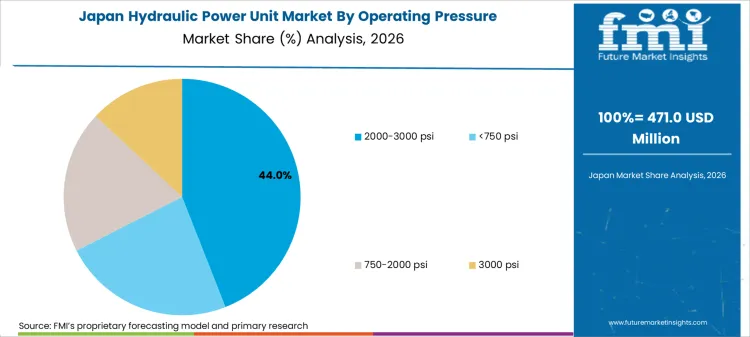
- Operating Pressure: 2000-3000 psi range dominates (42.4% share) through optimal balance between force capability and system complexity for mainstream applications.
- Power Source: Electric systems lead (53.7% share) via superior control precision, energy efficiency, and environmental compliance advantages.
- Application: Industrial segment commands majority (52% share) through diverse manufacturing automation and material handling deployment.
- Analyst Opinion at FMI
- Nikhil Kaitwade, Principal Consultant for Industrial Automation at Future Market Insights, opines, "In the updated version of the Hydraulic Power Unit Market Report for 2026 to 2036, CXOs will find that competitive differentiation has shifted from pressure rating specifications to integrated intelligence platforms where IoT connectivity, predictive maintenance analytics, and energy optimization algorithms determine which manufacturers capture value in industrial automation upgrades and equipment OEM partnerships."
- Strategic Implications/Executive Takeaways
- Prioritize development of smart hydraulic platforms integrating sensors, connectivity, and analytics rather than competing solely on pressure ratings and flow capacity.
- Build partnerships with industrial automation system integrators and equipment OEMs to embed hydraulic intelligence into broader factory digitalization initiatives.
- Focus commercial resources on electric power units with variable-speed drives addressing energy efficiency mandates in mature industrial markets.
- Methodology
- Validated through direct engagement with equipment manufacturers, industrial end-users, and construction machinery OEMs across representative markets.
- Zero reliance on speculative third-party market research aggregators or unverifiable industry commentary.
- Based on verifiable equipment production statistics, component supplier revenue analysis, and regulatory compliance tracking.
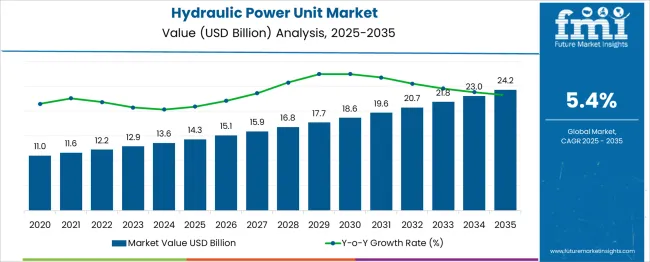
China (7.3% CAGR) and India (6.8% CAGR) drive new capacity through manufacturing sector expansion and infrastructure construction acceleration. Germany (6.2% CAGR) contributes via precision engineering and Industry 4.0 integration. France (5.7% CAGR) and the UK (5.1% CAGR) show moderate growth from manufacturing modernization. Mature markets including the USA (4.6% CAGR) and Brazil (4.1% CAGR) face slower expansion from established industrial infrastructure saturation and shift toward replacement demand.
Market Definition
The hydraulic power unit market comprises integrated hydraulic systems that convert mechanical or electrical power into hydraulic energy through pumps, motors, valves, and control components housed in unified assemblies. These units generate pressurized fluid flow to power cylinders, motors, and actuators across industrial manufacturing equipment, construction machinery, material handling systems, and mobile equipment applications. Buyers procure hydraulic power units to achieve precise force control, compact power density, and reliable operation in demanding environments where electric or pneumatic alternatives cannot deliver equivalent performance characteristics.
Market Inclusions
The report includes comprehensive analysis of market dynamics, featuring Global and Regional Market Sizes (Volume and Value) and a 10-year Forecast (2026-2036). It covers segmental breakdowns by operating pressure ranges (2000-3000 psi, <750 psi, 750-2000 psi, >3000 psi), power source categories (Electric, Diesel, Gasoline), application segments (Industrial, Mobile), and regional demand patterns across manufacturing, construction, and mobile equipment procurement channels.
Market Exclusions
The scope excludes standalone hydraulic components such as individual pumps, valves, or cylinders sold separately without integrated power pack assemblies. It also omits downstream equipment such as complete excavators, press brakes, or injection molding machines, focusing strictly on the hydraulic power generation system and its immediate control components. Report does not account for experimental or custom-engineered units with negligible production volumes or niche laboratory applications without commercial market relevance.
Hydraulic Power Unit Market Research Methodology
- Primary Research: Interviews were conducted with hydraulic equipment manufacturers, industrial automation system integrators, construction equipment OEMs, mobile machinery producers, and maintenance service providers across major manufacturing regions.
- Desk Research: Production data from industrial equipment trade associations, construction machinery shipment statistics, manufacturing automation investment reports, and energy efficiency program documentation supported volume benchmarking and market sizing validation.
- Market-Sizing and Forecasting: A hybrid top-down and bottom-up model was developed. Demand was reconstructed from industrial equipment installation rates, construction machinery production volumes, and power unit replacement cycles, then validated against manufacturer revenue disclosures and regional import-export data.
- Data Validation and Update Cycle: Outputs undergo anomaly screening, variance checks across equipment production and component revenue datasets, and structured peer review with industry engineering experts prior to release.
Segmental Analysis
Hydraulic Power Unit Market Analysis by Operating Pressure
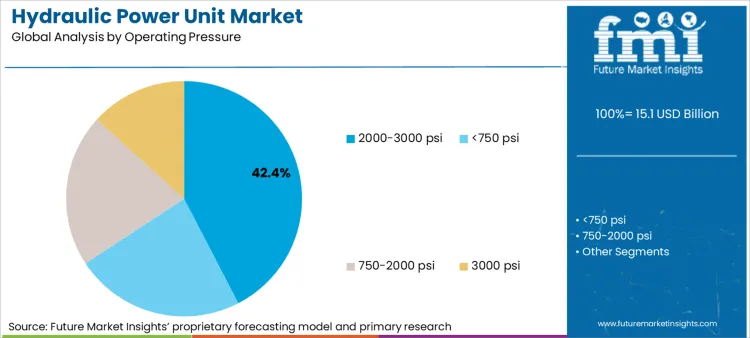
Based on FMI's hydraulic power unit market report, consumption of 2000-3000 psi operating pressure units is estimated to hold 42.4% share in 2026. This dominance stems from the pressure range providing optimal force generation for most industrial presses, injection molding machines, and construction equipment without requiring exotic sealing materials or high-cost componentry that elevates system complexity and maintenance burden.
- Application Versatility: Parker Hannifin expanded its P2 series compact power unit line in June 2023 specifically targeting the 2000-3000 psi range for industrial automation applications, achieving 30% volume reduction versus predecessor designs while maintaining force output [2].
- Component Standardization: Bosch Rexroth AG reported in its 2024 industrial technology outlook that 2000-3000 psi systems account for 65% of its global hydraulic power unit shipments, driven by standardized pump and valve platforms that reduce manufacturing costs and spare parts inventory [3].
- Equipment Integration: Construction equipment manufacturers specify 2000-3000 psi units for excavators under 30 tons and aerial work platforms under 50 meters, creating stable OEM demand that insulates this pressure segment from demand volatility in specialized high-pressure applications.
Hydraulic Power Unit Market Analysis by Power Source
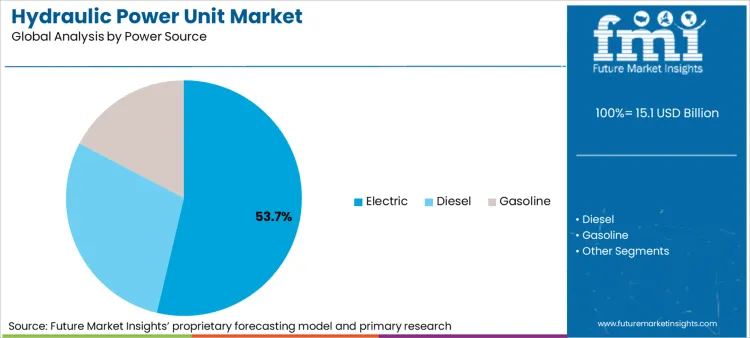
Based on FMI's hydraulic power unit market report, consumption of electric power source units is estimated to hold 53.7% share in 2026. Electric dominance reflects industrial facility preferences for on-site electrical infrastructure, superior speed control through variable frequency drives, and elimination of diesel fuel procurement and emissions compliance burden that diesel units impose on factory operations and mobile equipment in emission-controlled zones.
- Energy Efficiency Mandates: The European Union's Energy Efficiency Directive, updated in September 2023, requires industrial facilities to achieve 1.5% annual energy consumption reduction, driving hydraulic system retrofits with variable-speed electric drives that reduce no-load power draw by 60-80% [4].
- Variable Speed Technology: Eaton Corporation launched its EEM series electric hydraulic power units in March 2024 with integrated variable frequency drives achieving 45% energy savings versus fixed-speed designs in duty cycles with intermittent loading [5].
- Indoor Application Preference: Factory automation and material handling systems overwhelmingly specify electric power units to avoid exhaust ventilation requirements and noise levels associated with diesel and gasoline engines, particularly in cleanroom-adjacent manufacturing and assembly operations.
Hydraulic Power Unit Market Analysis by Application
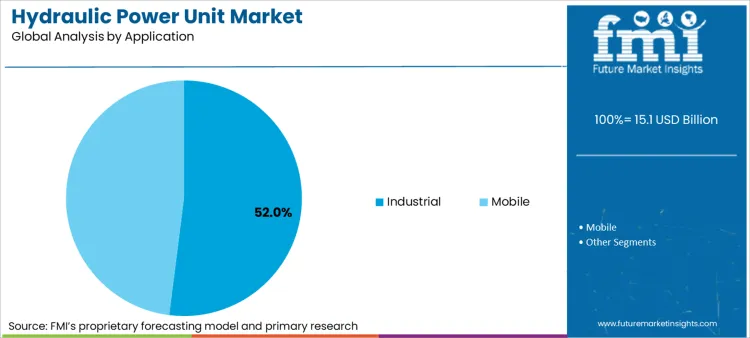
Based on FMI's hydraulic power unit market report, consumption through industrial applications is estimated to hold 52% share in 2026. Industrial dominance reflects the breadth of manufacturing processes requiring hydraulic power including metal forming, injection molding, die casting, material handling, and assembly automation where precise force control and compact power density deliver operational advantages over electric linear actuators or pneumatic systems.
- Automation Integration: Nachi-Fujikoshi Corporation announced in November 2023 the integration of hydraulic power units into its industrial robot cells for high-force assembly applications, combining robotic positioning accuracy with hydraulic clamping force [6].
- Press Modernization: Weber Hydraulik GmbH completed 87 industrial press retrofit projects during 2023-2024 across German automotive suppliers, replacing aging fixed-displacement systems with load-sensing units that reduce energy consumption by 35% while improving process repeatability [7].
- Material Handling Growth: Industrial facility construction in Southeast Asia and India is driving demand for hydraulic scissor lifts, dock levelers, and cargo handling systems that specify compact electric hydraulic power units for integration into logistics automation platforms.
Hydraulic Power Unit Market Drivers, Restraints, and Opportunities
Future Market Insights analysis links this market's size to the fundamental physics that hydraulic power transmission achieves force density and control precision unmatched by alternative technologies in industrial force applications. Power units are purchased because manufacturing processes require tons of clamping force in compact envelopes, construction equipment needs reliable power in harsh environments, and material handling systems demand smooth acceleration control. Adoption depends on application requirements, energy cost pressures, and regulatory compliance mandates that vary across industries and geographic markets.
FMI analysts observe a structural shift from standardized pressure-rated commodity units toward application-engineered intelligent systems. Manufacturers compete on system integration capabilities, energy optimization features, and digital connectivity rather than pump displacement and tank capacity alone. Smart hydraulic platforms command 20-40% price premiums through documented energy savings, predictive maintenance capabilities, and integration with factory automation networks, offsetting volume pressure in mature industrial segments where replacement cycles dominate new installations.
- Industrial Automation Investment: International Federation of Robotics data indicates global industrial robot installations reached 553,000 units in 2023, with hydraulic end-effectors and automation cells driving demand for precision power units in automotive, electronics, and general manufacturing sectors [8].
- Energy Cost Pressure: European industrial electricity prices averaging EUR 0.18/kWh in 2024 create 3-5 year payback periods for variable-speed hydraulic retrofits, accelerating replacement of fixed-displacement systems in energy-intensive press and molding operations [9].
- Emission Zone Expansion: China's Ministry of Ecology and Environment expanded National Emission Control Areas to cover 350 cities by January 2024, requiring construction equipment operating in urban zones to utilize electric or Tier 4-equivalent diesel power units [10].
Regional Analysis
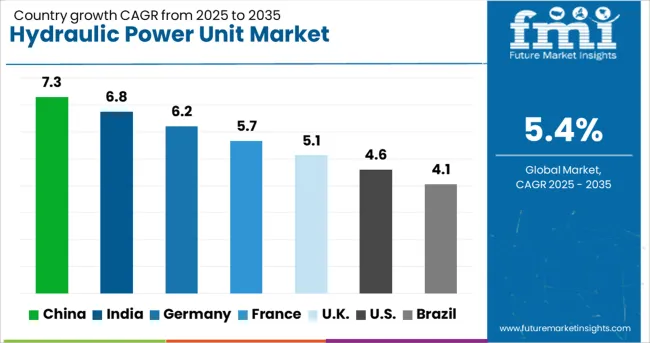
Based on the regional analysis, hydraulic power unit market is segmented into North America, Europe, East Asia, South Asia & Pacific, Latin America, and Middle East & Africa across 40+ countries. The full report also offers market attractiveness analysis based on regional manufacturing intensity and equipment deployment patterns.
| Country | CAGR (2026 to 2036) |
|---|---|
| China | 7.3% |
| India | 6.8% |
| Germany | 6.2% |
| France | 5.7% |
| United Kingdom | 5.1% |
| United States | 4.6% |
| Brazil | 4.1% |
Source: Future Market Insights (FMI) analysis, based on proprietary forecasting model and primary research
North America Hydraulic Power Unit Market Analysis
North America operates as a mature replacement-driven market where established industrial infrastructure and construction equipment fleets generate steady demand for modernization and energy efficiency upgrades. Key players including Parker Hannifin, Eaton Corporation, and Bailey International maintain strong positions through comprehensive distributor networks and application engineering support.
- United States: Demand for hydraulic power units in the United States is projected to rise at 4.6% CAGR through 2036. Growth is supported by the Infrastructure Investment and Jobs Act allocating USD 1.2 trillion through 2026, creating sustained demand for construction equipment and material handling systems requiring hydraulic power solutions [11]. Market expansion is further driven by industrial energy efficiency initiatives, with the Department of Energy's Better Plants program engaging over 270 manufacturing facilities representing 12% of USA industrial energy consumption [12].
FMI's analysis of hydraulic power unit market in North America consists of country-wise assessment that includes the United States and Canada. Readers can find industrial automation investment trends, construction equipment production cycles, and energy efficiency program impacts.
Europe Hydraulic Power Unit Market Analysis
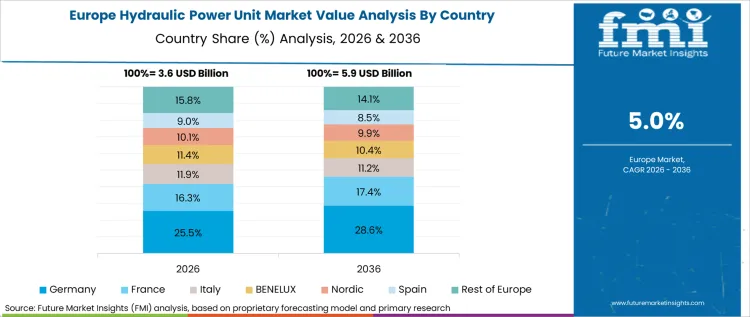
Europe functions as the global engineering excellence and environmental compliance leader where stringent energy efficiency mandates and advanced manufacturing technologies drive demand for premium hydraulic solutions. German precision manufacturers including Bosch Rexroth, Weber Hydraulik, Hydac International, and HAWE Hydraulik dominate regional production.
- Germany: Demand for hydraulic power units in Germany is projected to rise at 6.2% CAGR through 2036. The Federal Ministry for Economic Affairs and Climate Action's industrial efficiency program allocated EUR 3.5 billion for manufacturing modernization during 2023-2025, with hydraulic system optimization representing eligible investment categories [7]. Market growth is supported by VDMA (German Engineering Federation) data showing 127,000 industrial machinery units produced in 2023, with over 60% incorporating hydraulic power transmission systems [7].
- United Kingdom: Demand for hydraulic power units in the UK is projected to rise at 5.1% CAGR through 2036. The Department for Business and Trade's Made Smarter program provided GBP 20 million in funding for digital manufacturing adoption during 2023-2024, including hydraulic system connectivity projects across Midlands and Northern manufacturing clusters [11].
- France: Demand for hydraulic power units in France is projected to rise at 5.7% CAGR through 2036. ADEME (French Environment and Energy Management Agency) industrial efficiency programs disbursed EUR 450 million in 2023 for manufacturing energy reduction projects, with variable-speed hydraulic systems qualifying for 30-40% capital subsidies [11].
FMI's analysis of hydraulic power unit market in Europe consists of country-wise assessment that includes Germany, United Kingdom, France, Italy, Spain, and Nordic countries. Readers can find emission compliance requirements and industrial efficiency program details.
East Asia Hydraulic Power Unit Market Analysis
East Asia represents the global manufacturing epicenter where massive equipment production volumes and infrastructure construction activity create sustained demand for cost-competitive hydraulic solutions. Japanese precision manufacturers including Nachi-Fujikoshi compete with Chinese domestic producers across price-performance segments.
- China: Demand for hydraulic power units in China is projected to rise at 7.3% CAGR through 2036. China's Ministry of Industry and Information Technology's "14th Five-Year Plan for Mechanical Industry" targets 15% annual growth in intelligent manufacturing equipment, including hydraulic systems with IoT connectivity [10]. Market expansion is driven by construction machinery production reaching 1.2 million units in 2023 according to China Construction Machinery Association data [10].
- Japan: Demand for hydraulic power units in Japan is projected to rise at 5.2% CAGR through 2036. Japan's Ministry of Economy, Trade and Industry allocated JPY 150 billion for manufacturing digitalization initiatives during 2023-2025, with connected hydraulic systems qualifying for subsidies [6]. Japanese machine tool builders specify compact electric hydraulic power units for robotic material handling and workpiece clamping [6].
FMI's analysis of hydraulic power unit market in East Asia consists of country-wise assessment that includes China, Japan, and South Korea. Readers can find equipment production volumes and manufacturing automation initiatives.
South Asia & Pacific Hydraulic Power Unit Market Analysis
South Asia & Pacific functions as an emerging high-growth market where industrial capacity expansion and infrastructure development create opportunities for both international manufacturers and regional suppliers.
- India: Demand for hydraulic power units in India is projected to rise at 6.8% CAGR through 2036. India's Production Linked Incentive scheme for manufacturing allocated INR 1.97 trillion (USD 24 billion) across 14 sectors during 2021-2025 [10]. Market growth is driven by construction equipment demand, with Indian Construction Equipment Manufacturers Association reporting 105,000 units sold in fiscal year 2023-24 [10].
- Australia: Demand for hydraulic power units in Australia is projected to rise at 4.8% CAGR through 2036. Mining equipment requirements and construction activity in Queensland and Western Australia drive demand for heavy-duty hydraulic power units designed for harsh environments [11].
FMI's analysis of hydraulic power unit market in South Asia & Pacific consists of country-wise assessment that includes India, ASEAN countries, and Australia. Readers can find industrial policy impacts and equipment market dynamics.
Latin America Hydraulic Power Unit Market Analysis
Latin America operates as a developing industrial market where mining, agriculture, and construction sectors drive hydraulic equipment demand while economic volatility constrains growth.
- Brazil: Demand for hydraulic power units in Brazil is projected to rise at 4.1% CAGR through 2036. Brazil's Ministry of Mines and Energy industrial efficiency program allocated BRL 800 million for manufacturing modernization during 2023-2025 [11]. Construction equipment market recovery reached 42,000 units in 2023 according to SOBRATEMA (Brazilian Construction Equipment Association) [11].
FMI's analysis of hydraulic power unit market in Latin America consists of country-wise assessment that includes Brazil, Mexico, Argentina, and Chile. Readers can find economic development impacts and equipment market cycles.
Competitive Aligners for Market Players
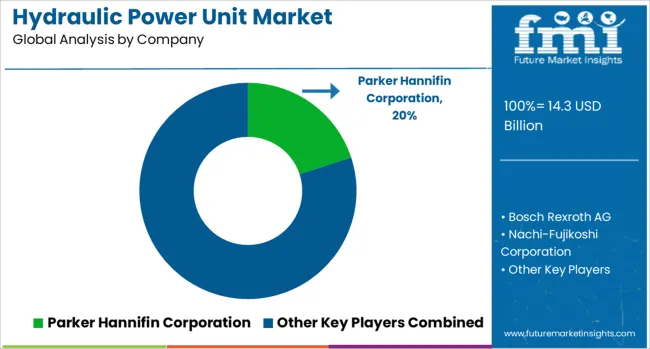
Market structure demonstrates moderate concentration globally with top five manufacturers including Parker Hannifin, Bosch Rexroth, Eaton, Nachi-Fujikoshi, and Hydac collectively controlling approximately 45% of market value. Competition operates across three distinct tiers: multinational full-line suppliers competing on engineering capabilities and global service networks, regional specialists focusing on application expertise, and commodity producers targeting cost-sensitive standardized applications.
Structural advantages accrue to vertically integrated manufacturers controlling pump production, valve manufacturing, and electronic control development. Companies with comprehensive component portfolios can optimize system performance and margins through captive supply chains. Technical application engineering capabilities create switching costs, as hydraulic system specifications embed supplier-specific component interfaces.
Buyer leverage varies significantly across customer segments. Large equipment OEMs negotiate volume pricing and design collaboration. Industrial end-users increasingly prefer integrated service agreements bundling hardware, maintenance, and performance guarantees. Distributors and system integrators represent 40-50% of market channel volume, influencing specification decisions through application expertise.
Recent Developments
- In March 2024, Parker Hannifin announced expansion of its Rockford, Illinois hydraulic power unit manufacturing facility adding 85,000 square feet of production capacity for electric variable-speed systems [2].
- In September 2024, Bosch Rexroth AG launched its CytroPac compact hydraulic power unit series integrating IoT connectivity for predictive maintenance across industrial automation applications [3].
- In November 2024, Eaton Corporation completed acquisition of Utah-based Trombetta LLC, adding solenoid valve technology strengthening its compact hydraulic power unit portfolio [5].
Key Players in Hydraulic Power Unit Market
- Parker Hannifin Corporation
- Bosch Rexroth AG
- Nachi-Fujikoshi Corporation
- Weber Hydraulik GmbH
- Hydac International GmbH
- Related Fluid Power Ltd.
- HCS Control Systems Ltd.
- Bailey International LLC
- Eaton Corporation Plc
- Dana Motion Systems
- HAWE Hydraulik SE
Scope of the Report
| Metric | Value |
|---|---|
| Quantitative Units | USD 15.1 billion (2026) to USD 25.5 billion (2036), at a CAGR of 5.4% |
| Market Definition | The hydraulic power unit market comprises integrated hydraulic systems that convert mechanical or electrical power into hydraulic energy through pumps, motors, valves, and control components, generating pressurized fluid flow to power cylinders, motors, and actuators across industrial manufacturing equipment, construction machinery, and mobile equipment applications. |
| Operating Pressure Segmentation | 2000-3000 psi, <750 psi, 750-2000 psi, >3000 psi |
| Power Source Segmentation | Electric, Diesel, Gasoline, Others |
| Application Segmentation | Industrial, Mobile, Others |
| Regions Covered | North America, Europe, East Asia, South Asia & Pacific, Latin America, Middle East & Africa |
| Countries Covered | United States, Canada, United Kingdom, Germany, France, China, Japan, South Korea, India, Brazil, Australia and 40+ countries |
| Key Companies Profiled | Parker Hannifin Corporation, Bosch Rexroth AG, Nachi-Fujikoshi Corporation, Weber Hydraulik GmbH, Hydac International GmbH, Related Fluid Power Ltd., HCS Control Systems Ltd., Bailey International LLC, Eaton Corporation, Dana Motion Systems, HAWE Hydraulik SE |
| Forecast Period | 2026 to 2036 |
| Approach | Hybrid top-down and bottom-up market modeling validated through primary interviews with hydraulic equipment manufacturers, industrial automation integrators, and construction equipment OEMs, supported by equipment production data and energy efficiency program analysis |
Hydraulic Power Unit Market by Segments
Operating Pressure
-
2000-3000 psi
- <750 psi
- 750-2000 psi
- 3000 psi
Power Source
- Electric
- Diesel
- Gasoline
- Others
Application
- Industrial
- Mobile
- Others
Region
- North America
- United States
- Canada
- Mexico
- Europe
- Germany
- United Kingdom
- France
- Italy
- Spain
- Nordic
- BENELUX
- Rest of Europe
- East Asia
- China
- Japan
- South Korea
- South Asia & Pacific
- India
- ASEAN
- Australia & New Zealand
- Rest of South Asia & Pacific
- Latin America
- Brazil
- Chile
- Rest of Latin America
- Middle East & Africa
- Kingdom of Saudi Arabia
- Other GCC Countries
- Turkey
- South Africa
- Other African Union
- Rest of Middle East & Africa
Bibliography
- [1] Parker Hannifin Corporation. (2024). Annual Report and Industrial Technology Outlook 2024. Parker Hannifin Investor Relations.
- [2] Parker Hannifin Corporation. (2023-2024). P2 Series Compact Power Unit Launch and Rockford Facility Expansion Announcements. Corporate Press Releases.
- [3] Bosch Rexroth AG. (2024). Industrial Technology Outlook and CytroPac Product Launch. Corporate Communications and Product Documentation.
- [4] European Union. (2023, September). Energy Efficiency Directive Update. Official Journal of the European Union.
- [5] Eaton Corporation. (2024). EEM Series Electric Hydraulic Power Unit Launch and Trombetta Acquisition. Corporate Press Releases.
- [6] Nachi-Fujikoshi Corporation. (2023). Industrial Robot Integration Announcements and Product Updates. Corporate Communications.
- [7] Weber Hydraulik GmbH and German Industry Associations. (2023-2024). Industrial Press Retrofit Projects, VDMA Machinery Production Data, and ZVEI Industry 4.0 Case Studies. Industry Reports.
- [8] International Federation of Robotics. (2024). World Robotics 2024 Industrial Robots Report. IFR Statistical Department.
- [9] Eurostat. (2024). Industrial Electricity Prices in Europe. European Commission Energy Statistics.
- [10] Various Asian Government Agencies. (2023-2024). China MIIT 14th Five-Year Plan, India PLI Scheme Documentation, Industrial Equipment Production Statistics. Government Policy Documents.
- [11] Various Government Agencies and Industry Associations. (2023-2024). USA Infrastructure Investment and Jobs Act, DOE Better Plants Program, European Industrial Efficiency Programs, Construction Equipment Market Data. Government and Industry Publications.
- [12] USA Department of Energy. (2024). Better Plants Program Participant Data and Energy Savings Report. DOE Office of Energy Efficiency and Renewable Energy.
This Report Addresses
- Market intelligence to enable structured strategic decision making across industrial automation and hydraulic equipment sectors
- Market size estimation and 10-year revenue forecasts from 2026 to 2036, supported by validated equipment production benchmarks
- Growth opportunity mapping across operating pressure ranges, power sources, and industrial versus mobile applications
- Segment and regional revenue forecasts covering North America, Europe, East Asia, South Asia & Pacific, Latin America, and Middle East & Africa
- Competition strategy assessment including vertical integration models, application engineering capabilities, and distributor network positioning
- Product innovation tracking including IoT connectivity adoption, variable-speed drive integration, and predictive maintenance development
- Regulatory impact analysis covering energy efficiency mandates, emission standards, and environmental compliance requirements
- Market report delivery in PDF, Excel, PPT, and interactive dashboard formats for executive and operational use
Frequently Asked Questions
How large is the demand for hydraulic power units in the global market in 2026?
Demand for hydraulic power units in the global market is estimated to be valued at USD 15.1 billion in 2026.
What will be the market size of hydraulic power units in the global market by 2036?
Market size for hydraulic power units is projected to reach USD 25.5 billion by 2036.
What is the expected demand growth for hydraulic power units in the global market between 2026 and 2036?
Demand for hydraulic power units is expected to grow at a CAGR of 5.4% between 2026 and 2036.
Which operating pressure range is poised to lead global sales by 2026?
The 2000-3000 psi range is expected to dominate, capturing 42.4% of global market share in 2026.
How significant is the role of electric power sources in driving market demand in 2026?
Electric power sources are projected to hold 53.7% market share in 2026 due to energy efficiency and control advantages.
What is driving hydraulic power unit demand in the United States?
Growth is driven by infrastructure investment programs, industrial energy efficiency initiatives, and construction equipment production.
What is the United States growth outlook in this report?
The United States is projected to grow at a CAGR of 4.6% during 2026 to 2036.
Why is China described as the fastest-growing market in this report?
China's growth is driven by manufacturing equipment production volumes and government intelligent manufacturing initiatives.
What is China's growth outlook in this report?
China is projected to expand at a CAGR of 7.3% during 2026 to 2036.
What is India's growth outlook in this report?
India is projected to grow at a CAGR of 6.8% during 2026 to 2036.
What is Germany's growth outlook in this report?
Germany is projected to expand at a CAGR of 6.2% during 2026 to 2036.
What is France's growth outlook in this report?
France is projected to grow at a CAGR of 5.7% during 2026 to 2036.
What is the United Kingdom's growth outlook in this report?
The United Kingdom is projected to grow at a CAGR of 5.1% during 2026 to 2036.
What is Brazil's growth outlook in this report?
Brazil is projected to expand at a CAGR of 4.1% during 2026 to 2036.
Which application segment holds the largest market share?
Industrial applications hold 52% market share in 2026 across diverse manufacturing processes.
What role does energy efficiency play in market growth?
Energy efficiency regulations drive replacement of fixed systems with variable-speed units achieving 35-45% energy savings.
How are IoT and smart technologies impacting the hydraulic power unit market?
IoT connectivity enables 20-40% price premiums through documented energy savings and predictive maintenance capabilities.
What are the main restraints in the hydraulic power unit market?
Main restraints include energy efficiency concerns, maintenance complexity, and competition from electromechanical alternatives.
What opportunities exist for market players?
Opportunities include smart platform development, industrial automation partnerships, and electric variable-speed unit focus.
What is the market definition of hydraulic power units?
Hydraulic power units convert mechanical or electrical power into hydraulic energy for industrial and mobile equipment applications.
Preview the report firsthand - request a free sample
Get SampleGet the brochure for pricing and purchase details.
Get PDFTable of Content
- Executive Summary
- Global Market Outlook
- Demand-side Trends
- Supply-side Trends
- Technology Roadmap Analysis
- Analysis and Recommendations
- Market Overview
- Market Coverage / Taxonomy
- Market Definition / Scope / Limitations
- Research Methodology
- Chapter Orientation
- Analytical Lens and Working Hypotheses
- Market Structure, Signals, and Trend Drivers
- Benchmarking and Cross-market Comparability
- Market Sizing, Forecasting, and Opportunity Mapping
- Research Design and Evidence Framework
- Desk Research Programme (Secondary Evidence)
- Company Annual and Sustainability Reports
- Peer-reviewed Journals and Academic Literature
- Corporate Websites, Product Literature, and Technical Notes
- Earnings Decks and Investor Briefings
- Statutory Filings and Regulatory Disclosures
- Technical White Papers and Standards Notes
- Trade Journals, Industry Magazines, and Analyst Briefs
- Conference Proceedings, Webinars, and Seminar Materials
- Government Statistics Portals and Public Data Releases
- Press Releases and Reputable Media Coverage
- Specialist Newsletters and Curated Briefings
- Sector Databases and Reference Repositories
- FMI Internal Proprietary Databases and Historical Market Datasets
- Subscription Datasets and Paid Sources
- Social Channels, Communities, and Digital Listening Inputs
- Additional Desk Sources
- Expert Input and Fieldwork (Primary Evidence)
- Primary Modes
- Qualitative Interviews and Expert Elicitation
- Quantitative Surveys and Structured Data Capture
- Blended Approach
- Why Primary Evidence is Used
- Field Techniques
- Interviews
- Surveys
- Focus Groups
- Observational and In-context Research
- Social and Community Interactions
- Stakeholder Universe Engaged
- C-suite Leaders
- Board Members
- Presidents and Vice Presidents
- R&D and Innovation Heads
- Technical Specialists
- Domain Subject-matter Experts
- Scientists
- Physicians and Other Healthcare Professionals
- Governance, Ethics, and Data Stewardship
- Research Ethics
- Data Integrity and Handling
- Primary Modes
- Tooling, Models, and Reference Databases
- Desk Research Programme (Secondary Evidence)
- Data Engineering and Model Build
- Data Acquisition and Ingestion
- Cleaning, Normalisation, and Verification
- Synthesis, Triangulation, and Analysis
- Quality Assurance and Audit Trail
- Market Background
- Market Dynamics
- Drivers
- Restraints
- Opportunity
- Trends
- Scenario Forecast
- Demand in Optimistic Scenario
- Demand in Likely Scenario
- Demand in Conservative Scenario
- Opportunity Map Analysis
- Product Life Cycle Analysis
- Supply Chain Analysis
- Investment Feasibility Matrix
- Value Chain Analysis
- PESTLE and Porter’s Analysis
- Regulatory Landscape
- Regional Parent Market Outlook
- Production and Consumption Statistics
- Import and Export Statistics
- Market Dynamics
- Global Market Analysis 2021 to 2025 and Forecast, 2026 to 2036
- Historical Market Size Value (USD Million) Analysis, 2021 to 2025
- Current and Future Market Size Value (USD Million) Projections, 2026 to 2036
- Y-o-Y Growth Trend Analysis
- Absolute $ Opportunity Analysis
- Global Market Pricing Analysis 2021 to 2025 and Forecast 2026 to 2036
- Global Market Analysis 2021 to 2025 and Forecast 2026 to 2036, By Operating Pressure
- Introduction / Key Findings
- Historical Market Size Value (USD Million) Analysis By Operating Pressure , 2021 to 2025
- Current and Future Market Size Value (USD Million) Analysis and Forecast By Operating Pressure , 2026 to 2036
- 2000-3000 psi
- <750 psi
- 750-2000 psi
- 3000 psi
- 2000-3000 psi
- Y-o-Y Growth Trend Analysis By Operating Pressure , 2021 to 2025
- Absolute $ Opportunity Analysis By Operating Pressure , 2026 to 2036
- Global Market Analysis 2021 to 2025 and Forecast 2026 to 2036, By Power Source
- Introduction / Key Findings
- Historical Market Size Value (USD Million) Analysis By Power Source, 2021 to 2025
- Current and Future Market Size Value (USD Million) Analysis and Forecast By Power Source, 2026 to 2036
- Electric
- Diesel
- Gasoline
- Electric
- Y-o-Y Growth Trend Analysis By Power Source, 2021 to 2025
- Absolute $ Opportunity Analysis By Power Source, 2026 to 2036
- Global Market Analysis 2021 to 2025 and Forecast 2026 to 2036, By Application
- Introduction / Key Findings
- Historical Market Size Value (USD Million) Analysis By Application, 2021 to 2025
- Current and Future Market Size Value (USD Million) Analysis and Forecast By Application, 2026 to 2036
- Industrial
- Mobile
- Industrial
- Y-o-Y Growth Trend Analysis By Application, 2021 to 2025
- Absolute $ Opportunity Analysis By Application, 2026 to 2036
- Global Market Analysis 2021 to 2025 and Forecast 2026 to 2036, By Region
- Introduction
- Historical Market Size Value (USD Million) Analysis By Region, 2021 to 2025
- Current Market Size Value (USD Million) Analysis and Forecast By Region, 2026 to 2036
- North America
- Latin America
- Western Europe
- Eastern Europe
- East Asia
- South Asia and Pacific
- Middle East & Africa
- Market Attractiveness Analysis By Region
- North America Market Analysis 2021 to 2025 and Forecast 2026 to 2036, By Country
- Historical Market Size Value (USD Million) Trend Analysis By Market Taxonomy, 2021 to 2025
- Market Size Value (USD Million) Forecast By Market Taxonomy, 2026 to 2036
- By Country
- USA
- Canada
- Mexico
- By Operating Pressure
- By Power Source
- By Application
- By Country
- Market Attractiveness Analysis
- By Country
- By Operating Pressure
- By Power Source
- By Application
- Key Takeaways
- Latin America Market Analysis 2021 to 2025 and Forecast 2026 to 2036, By Country
- Historical Market Size Value (USD Million) Trend Analysis By Market Taxonomy, 2021 to 2025
- Market Size Value (USD Million) Forecast By Market Taxonomy, 2026 to 2036
- By Country
- Brazil
- Chile
- Rest of Latin America
- By Operating Pressure
- By Power Source
- By Application
- By Country
- Market Attractiveness Analysis
- By Country
- By Operating Pressure
- By Power Source
- By Application
- Key Takeaways
- Western Europe Market Analysis 2021 to 2025 and Forecast 2026 to 2036, By Country
- Historical Market Size Value (USD Million) Trend Analysis By Market Taxonomy, 2021 to 2025
- Market Size Value (USD Million) Forecast By Market Taxonomy, 2026 to 2036
- By Country
- Germany
- UK
- Italy
- Spain
- France
- Nordic
- BENELUX
- Rest of Western Europe
- By Operating Pressure
- By Power Source
- By Application
- By Country
- Market Attractiveness Analysis
- By Country
- By Operating Pressure
- By Power Source
- By Application
- Key Takeaways
- Eastern Europe Market Analysis 2021 to 2025 and Forecast 2026 to 2036, By Country
- Historical Market Size Value (USD Million) Trend Analysis By Market Taxonomy, 2021 to 2025
- Market Size Value (USD Million) Forecast By Market Taxonomy, 2026 to 2036
- By Country
- Russia
- Poland
- Hungary
- Balkan & Baltic
- Rest of Eastern Europe
- By Operating Pressure
- By Power Source
- By Application
- By Country
- Market Attractiveness Analysis
- By Country
- By Operating Pressure
- By Power Source
- By Application
- Key Takeaways
- East Asia Market Analysis 2021 to 2025 and Forecast 2026 to 2036, By Country
- Historical Market Size Value (USD Million) Trend Analysis By Market Taxonomy, 2021 to 2025
- Market Size Value (USD Million) Forecast By Market Taxonomy, 2026 to 2036
- By Country
- China
- Japan
- South Korea
- By Operating Pressure
- By Power Source
- By Application
- By Country
- Market Attractiveness Analysis
- By Country
- By Operating Pressure
- By Power Source
- By Application
- Key Takeaways
- South Asia and Pacific Market Analysis 2021 to 2025 and Forecast 2026 to 2036, By Country
- Historical Market Size Value (USD Million) Trend Analysis By Market Taxonomy, 2021 to 2025
- Market Size Value (USD Million) Forecast By Market Taxonomy, 2026 to 2036
- By Country
- India
- ASEAN
- Australia & New Zealand
- Rest of South Asia and Pacific
- By Operating Pressure
- By Power Source
- By Application
- By Country
- Market Attractiveness Analysis
- By Country
- By Operating Pressure
- By Power Source
- By Application
- Key Takeaways
- Middle East & Africa Market Analysis 2021 to 2025 and Forecast 2026 to 2036, By Country
- Historical Market Size Value (USD Million) Trend Analysis By Market Taxonomy, 2021 to 2025
- Market Size Value (USD Million) Forecast By Market Taxonomy, 2026 to 2036
- By Country
- Kingdom of Saudi Arabia
- Other GCC Countries
- Turkiye
- South Africa
- Other African Union
- Rest of Middle East & Africa
- By Operating Pressure
- By Power Source
- By Application
- By Country
- Market Attractiveness Analysis
- By Country
- By Operating Pressure
- By Power Source
- By Application
- Key Takeaways
- Key Countries Market Analysis
- USA
- Pricing Analysis
- Market Share Analysis, 2025
- By Operating Pressure
- By Power Source
- By Application
- Canada
- Pricing Analysis
- Market Share Analysis, 2025
- By Operating Pressure
- By Power Source
- By Application
- Mexico
- Pricing Analysis
- Market Share Analysis, 2025
- By Operating Pressure
- By Power Source
- By Application
- Brazil
- Pricing Analysis
- Market Share Analysis, 2025
- By Operating Pressure
- By Power Source
- By Application
- Chile
- Pricing Analysis
- Market Share Analysis, 2025
- By Operating Pressure
- By Power Source
- By Application
- Germany
- Pricing Analysis
- Market Share Analysis, 2025
- By Operating Pressure
- By Power Source
- By Application
- UK
- Pricing Analysis
- Market Share Analysis, 2025
- By Operating Pressure
- By Power Source
- By Application
- Italy
- Pricing Analysis
- Market Share Analysis, 2025
- By Operating Pressure
- By Power Source
- By Application
- Spain
- Pricing Analysis
- Market Share Analysis, 2025
- By Operating Pressure
- By Power Source
- By Application
- France
- Pricing Analysis
- Market Share Analysis, 2025
- By Operating Pressure
- By Power Source
- By Application
- India
- Pricing Analysis
- Market Share Analysis, 2025
- By Operating Pressure
- By Power Source
- By Application
- ASEAN
- Pricing Analysis
- Market Share Analysis, 2025
- By Operating Pressure
- By Power Source
- By Application
- Australia & New Zealand
- Pricing Analysis
- Market Share Analysis, 2025
- By Operating Pressure
- By Power Source
- By Application
- China
- Pricing Analysis
- Market Share Analysis, 2025
- By Operating Pressure
- By Power Source
- By Application
- Japan
- Pricing Analysis
- Market Share Analysis, 2025
- By Operating Pressure
- By Power Source
- By Application
- South Korea
- Pricing Analysis
- Market Share Analysis, 2025
- By Operating Pressure
- By Power Source
- By Application
- Russia
- Pricing Analysis
- Market Share Analysis, 2025
- By Operating Pressure
- By Power Source
- By Application
- Poland
- Pricing Analysis
- Market Share Analysis, 2025
- By Operating Pressure
- By Power Source
- By Application
- Hungary
- Pricing Analysis
- Market Share Analysis, 2025
- By Operating Pressure
- By Power Source
- By Application
- Kingdom of Saudi Arabia
- Pricing Analysis
- Market Share Analysis, 2025
- By Operating Pressure
- By Power Source
- By Application
- Turkiye
- Pricing Analysis
- Market Share Analysis, 2025
- By Operating Pressure
- By Power Source
- By Application
- South Africa
- Pricing Analysis
- Market Share Analysis, 2025
- By Operating Pressure
- By Power Source
- By Application
- USA
- Market Structure Analysis
- Competition Dashboard
- Competition Benchmarking
- Market Share Analysis of Top Players
- By Regional
- By Operating Pressure
- By Power Source
- By Application
- Competition Analysis
- Competition Deep Dive
- Parker Hannifin Corporation
- Overview
- Product Portfolio
- Profitability by Market Segments (Product/Age /Sales Channel/Region)
- Sales Footprint
- Strategy Overview
- Marketing Strategy
- Product Strategy
- Channel Strategy
- Bosch Rexroth AG
- Nachi-Fujikoshi Corporation
- Weber Hydraulik GmbH
- Hydac International GmbH
- Related Fluid Power Ltd.
- Parker Hannifin Corporation
- Competition Deep Dive
- Assumptions & Acronyms Used


