

- Market Size (2026)
- USD 2340.0 Mn
- Forecast (2036)
- USD 5390.0 Mn
- CAGR (2026 to 2036)
- 8.7%
How big is Immunological Risk Assessment Transplant Market in 2026?
USD 2340.0 million in 2026 and USD 5390.0 million by 2036 at an 8.7% CAGR.
Demand for immunological risk assessment in transplantation is projected to lift the global market from USD 2,340.0 million in 2026 to USD 5,390.0 million by 2036, advancing at a CAGR of 8.7%. Every transplanted organ carries an immunological clock. From the moment a graft is placed, the recipient's immune system is reading it, probing for mismatches, and mounting responses that no drug regimen fully silences. The immunological risk assessment market exists precisely to track that conversation in real time, giving clinicians the molecular vocabulary to tell whether a patient is heading toward tolerance, subclinical rejection, or graft failure before the damage becomes irreversible. With the Global Observatory on Donation and Transplantation confirming that 173,727 organs were transplanted in 2024 alone, each procedure entering the system represents a cascade of pre-transplant compatibility checks, post-operative antibody surveillance, and longitudinal biopsy-linked monitoring, sustaining demand well beyond the day of surgery.
The market is shaped by three converging forces. Rising transplant volumes across solid organ and stem cell programs continue to expand the testable population, while growing clinical acceptance of molecular surveillance tools, particularly donor-derived cell-free DNA assays and next-generation HLA typing, is pulling diagnostics deeper into routine post-transplant care. At the same time, payer frameworks in key markets are slowly formalizing reimbursement for these assays, converting occasional use into standard-of-care protocols. Restraints remain real: reagent standardization across laboratories is uneven, skilled personnel who can integrate HLA serology with antibody history and graft-injury markers are in short supply, and the capital commitment required for high-resolution typing platforms limits adoption in lower-volume centers.
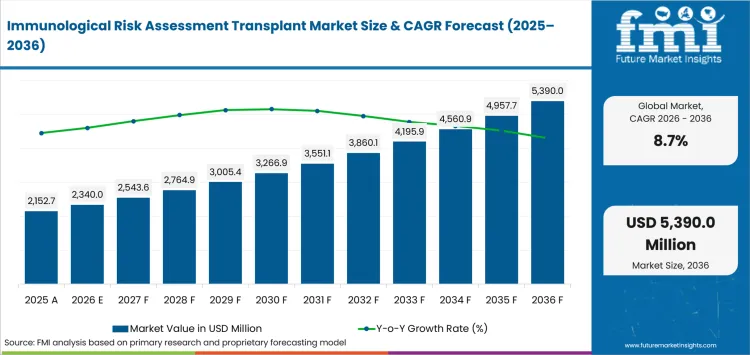
Key Takeaways of Immunological Risk Assessment Transplant Market
- Demand for immunological risk assessment in transplantation is driven by recurring testing needs across pre-transplant and post-transplant pathways, with one completed procedure supporting several distinct laboratory orders over time as transplant programs require donor compatibility results before surgery and graft-injury evidence during follow-up.
- By testing phase, pre-transplant assessment holds the leading share at 65.0% in 2026, supported by compatibility work that must be completed before an organ or stem-cell procedure advances, with laboratory standardization enabling comparable results across visits and archived findings remaining usable during later risk review.
- Reagents and assays lead the product category at 63.0% share in 2026, attributable to repeat use across donor screening and recipient follow-up episodes, reflecting a revenue base concentrated in routine laboratory consumption rather than one-time equipment purchases.
- Kidney transplantation accounts for 47.0% organ segment share in 2026, reinforced by procedure volume and long-term surveillance needs that sustain recurring testing demand across pre-transplant compatibility work and post-transplant graft-injury monitoring.
- China, India, and Japan record CAGRs of 11.2%, 10.8%, and 9.4% respectively through 2036, shaped by tertiary hospital capacity alongside formal transplant governance, procedure growth with wider access to accredited testing beyond metropolitan programs, and detailed matching requirements where donor scarcity raises the clinical value of specificity.
- Competition separates broad immunogenetics portfolios from focused graft-monitoring platforms, with Thermo Fisher Scientific and Werfen covering HLA typing and antibody assessment across integrated compatibility workflows, CareDx and Natera competing through donor-derived cell-free DNA testing for recurring surveillance decisions, and Verici Dx and Insight Molecular Diagnostics focusing on kidney transplant risk through decentralized molecular testing suited to qualified hospital laboratories.
Analyst Perspective
"The immunological risk assessment transplant market is advancing as transplant programs seek more precise approaches to donor selection and post-transplant monitoring. Clinical value depends on whether testing improves decision-making, supports timely interventions, and integrates efficiently into existing transplant workflows. Companies that combine accurate assessment capabilities with reliable interpretation, operational scalability, and specialist support will be better positioned to strengthen adoption."
- Anurag Sharma, Principal Analyst at Future Market Insights
How is the Immunological Risk Assessment Transplant Market segmented?
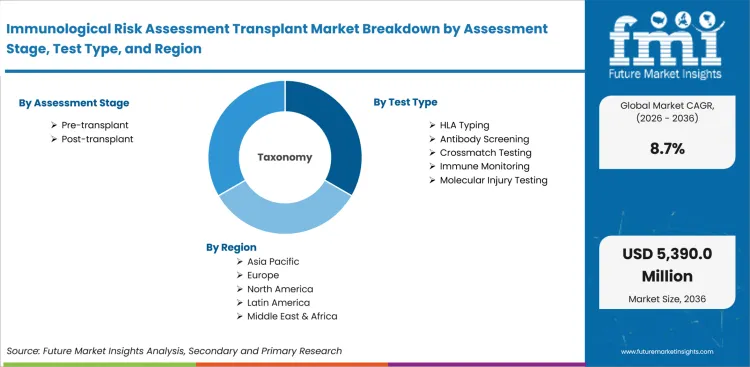
The market is assessed by Assessment Stage, Test Type, Technology, Product, Transplant Type, End User, and Region.
The segmentation separates the point of clinical use from the laboratory method and the purchased item. Assessment Stage distinguishes compatibility work from surveillance after transplantation. Test Type separates HLA typing from antibody screening and crossmatch procedures. Technology compares molecular assays with solid-phase immunoassays and cell-based methods. Product analysis divides recurring reagents from instruments plus software and services. Transplant Type shows how procedure mix changes testing demand. End User identifies whether work is completed inside a transplant center or sent to a reference laboratory. The HLA typing category provides a useful benchmark for the core immunogenetics workflow inside this market globally.
What supports demand for pre-transplant within the assessment stage category?
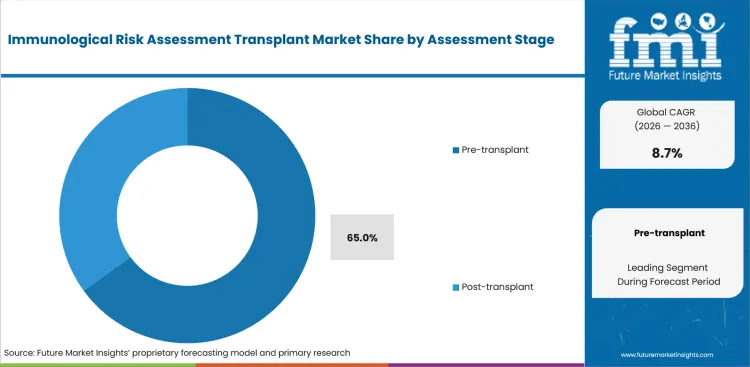
Pre-transplant assessment decides whether a donor-recipient pair can move toward surgery or stem-cell infusion during early clinical planning. NMDP explained in April 2025 that clinicians generally use eight HLA markers to assess donor options that can range from a 4/8 match to an 8/8 match. The result affects donor selection and conditioning plans. reliable DNA RNA extraction is part of the upstream laboratory process because poor sample quality can weaken typing confidence.
- In 2026, Pre-transplant is projected to account for 65.0% share, driven by compatibility testing that must be completed before a transplant proceeds. HLA typing and antibody review are repeated when donor options change or new sensitizing events occur. The segment therefore combines mandatory clinical timing with recurring laboratory demand across organ and stem-cell programs with changing donor lists and repeat crossmatch reviews.
- Transplant immunology laboratories purchase pre-transplant tests to reduce uncertainty around donor selection and antibody risk. the work supports decisions that cannot be deferred until after surgery. Purchase criteria center on resolution and turnaround plus the ability to reconcile current findings with previous samples during urgent donor allocation and later crossmatch review.
How does HLA Typing shape demand within the test type category?
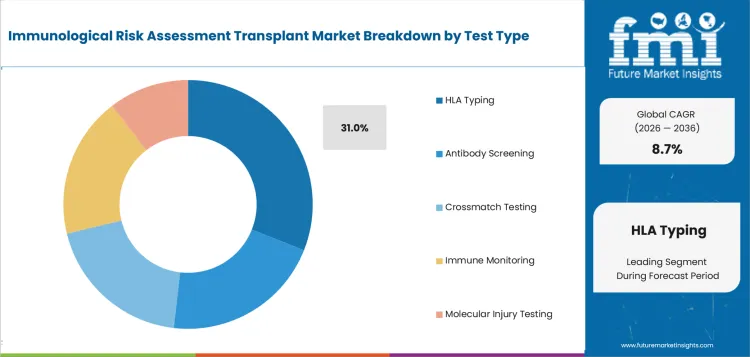
HLA typing defines the genetic compatibility information used in donor selection and risk interpretation for complex transplant cases. CareDx announced in October 2025 that AlloSeq Tx11 covers 11 HLA loci within an IVDR-certified next-generation sequencing workflow. Wider locus coverage can reduce ambiguity in complex cases, the related nucleic acid testing category shows why extraction controls and sequence analysis remain part of a complete typing service.
- By test type, HLA Typing is estimated to hold 31.0% share in 2026, attributable to its position at the start of donor matching. Molecular typing supports higher resolution than older serology workflows and creates data that can be reused during antibody interpretation. Laboratories still need software and trained review because a longer sequence output does not remove clinical ambiguity.
- Histocompatibility laboratories favor HLA typing platforms that combine readable workflows with traceable allele calls. the method must fit urgent deceased-donor work and scheduled living-donor cases. Commercial retention depends on technical support because software changes and reference-database updates can affect how results are interpreted during validation and urgent donor-allocation work locally.
How are molecular assays positioned within the technology category?
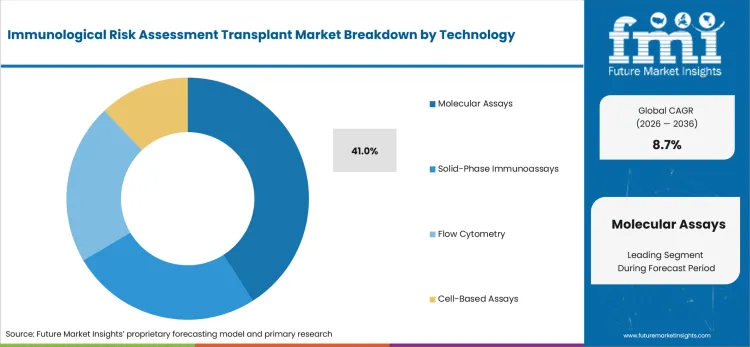
Molecular assays are used to type immune markers and detect graft-derived signals in blood during patient assessment. Natera reported in May 2025 that a heart-transplant study evaluated 808 Prospera samples from 187 patients with paired biopsies. The study showed how repeated blood testing can be compared with tissue findings. Liquid biopsy workflows are relevant because donor-derived cell-free DNA depends on controlled sampling and analytical interpretation.
- Molecular Assays are forecast to represent 41.0% share in 2026, supported by high-resolution typing and noninvasive graft surveillance. The category covers different clinical questions that should not be treated as commercially interchangeable. a typing assay establishes compatibility, whereas a donor-derived cell-free DNA result measures evidence of graft injury after transplantation.
- Hospital molecular laboratories evaluate assay reproducibility and clinical interpretation alongside instrument fit. a technically accurate result has limited value unless clinicians know what action should follow. Vendors that provide validation support and organ-specific evidence can reduce the internal work needed before routine adoption across separate organ programs and reporting pathways.
What makes reagents and assays central to the product category?
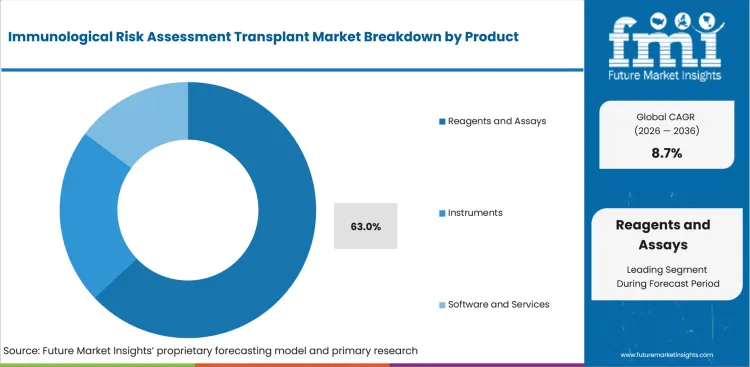
Reagents and assays create repeat revenue each time a patient sample is processed. Eurobio Scientific reported in January 2026 that GenDx generated EUR 33.5 million during 2025 and recorded 9% growth. The result links a focused HLA portfolio with recurring laboratory consumption. Instruments last for several years, whereas typing kits and antibody panels are reordered as cases enter the laboratory.
- In 2026, Reagents and Assays are projected to account for 63.0% share, reinforced by repeated use across donor screening and recipient follow-up. The product mix includes extraction materials and typing kits plus antibody panels and molecular monitoring assays. Demand is therefore tied to case flow rather than the replacement cycle for one analyzer.
- Transplant laboratories select reagents around validated performance and lot consistency plus delivery reliability. a delayed kit can interrupt a time-sensitive compatibility decision. Local inventory and technical support matter because low-volume specialist items may not be stocked through general diagnostic distribution channels with transplant-specific inventory and cold-chain requirements across regions reliably.
How does kidney shape demand within the transplant type category?
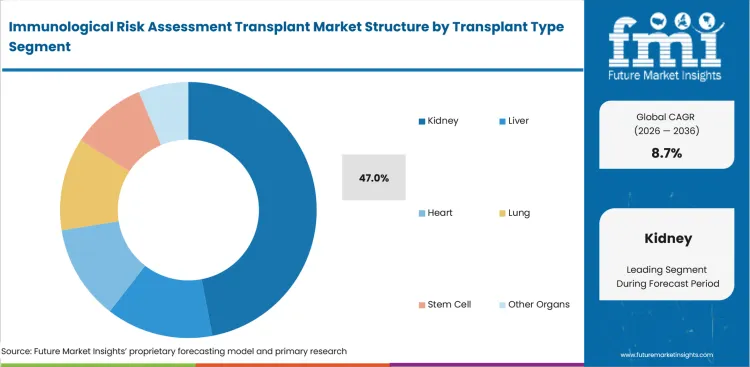
Kidney transplantation creates a broad testing pathway that begins with donor matching and continues through rejection surveillance. The Health Resources and Services Administration reported in January 2025 that 27,759 kidney transplants were performed in the United States during 2024. The reported kidney volume supports repeat antibody and molecular testing across a large recipient base. related liver transplantation activity provides a comparison for organ-specific follow-up protocols.
- Kidney is forecast to represent 47.0% share in 2026, owing to procedure volume and the need to protect long-term graft function. Living-donor and deceased-donor programs create different scheduling demands but rely on the same core compatibility evidence. Post-transplant testing adds recurring demand over time after the initial crossmatch has been completed.
- Nephrology and transplant teams use immune-risk tests to distinguish possible rejection from other causes of graft dysfunction. Procurement decisions depend on turnaround and clinical validation plus the ability to fit existing laboratory pathways. Assays gain routine use when results support a clear biopsy or treatment decision during routine outpatient follow-up visits.
How do transplant programs evaluate transplant centers within the end user category?
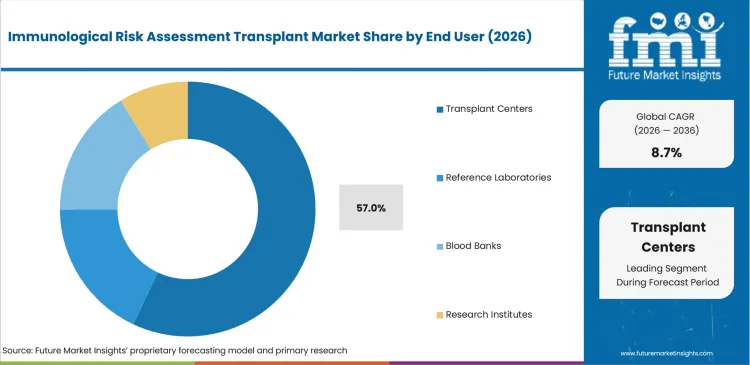
Transplant centers coordinate surgery and immunology data plus longitudinal patient management. CareDx reported in April 2025 that the SHORE registry included more than 2,700 heart-transplant patients across 67 United States centers. Multi-center evidence matters because one laboratory needs results that remain interpretable across different clinical teams. Centralized data review can support consistency across sites but may add sample-shipping dependence and reporting delays.
- Transplant Centers are estimated to capture 57.0% share during 2026, underpinned by their control over donor assessment and post-transplant care. Large programs may operate internal histocompatibility laboratories or maintain formal reference-laboratory relationships. their purchasing decisions often cover assays and software plus education and clinical implementation support across multiple organ programs.
- Hospital transplant committees evaluate whether a testing pathway can be integrated with biopsy review and treatment meetings. a lower price does not offset slow reporting or unclear interpretation. Vendors that understand organ-specific workflows can shorten validation and support broader use across the center during implementation and later method updates without disrupting clinical review.
What are the drivers, restraints, and opportunities in the Immunological Risk Assessment Transplant Market?
Procedure growth supports recurring testing. donor scarcity constrains completed-case volume. decentralized molecular assays create an opportunity for transplant-center laboratories.
- Driver: Transplant programs are using more molecular evidence to connect a blood result with rejection risk and biopsy planning.
- Restraint: Limited donor supply and uneven specialist laboratory access restrict the number of patients who complete the full testing pathway.
- Opportunity: Kitted molecular assays can move selected graft-surveillance work closer to transplant centers that already operate qualified molecular laboratories.
Market growth is expected to be driven by the expanding clinical evidence behind blood-based graft surveillance across organ programs. CareDx reported in July 2025 that an AlloSure Plus analysis covered more than 4,100 biopsies and improved detection of rejection patterns under the updated Banff framework. The commercial payoff is not the sample count by itself. larger evidence sets give transplant committees a stronger basis for deciding which results can change biopsy timing. The antibody-mediated rejection prevention category is closely linked because early immune injury can alter treatment decisions.
A factor limiting immunological risk assessment transplant adoption is the gap between patients who need organs and the number of transplants completed. NHS Blood and Transplant reported in July 2025 that 8,096 people were active on the United Kingdom waiting list at the end of March 2025. Patients who remain on the list still require some assessment, but they do not create the same post-transplant surveillance pathway as a completed procedure. market expansion therefore depends on donor availability as well as assay adoption inside laboratories.
An emerging opportunity is the transfer of selected molecular monitoring into qualified hospital laboratories with existing sequencing capacity. Insight Molecular Diagnostics reported in September 2025 that its GraftAssureDx trial had expanded from five to 10 transplant centers and enrolled its first patient. a regulated kit could reduce shipping dependence for centers with suitable staff and equipment. The commercial opening is selective rather than universal because local testing requires validation and quality controls plus enough sample volume to justify an internal workflow.
Which country CAGRs are profiled in the Immunological Risk Assessment Transplant Market?
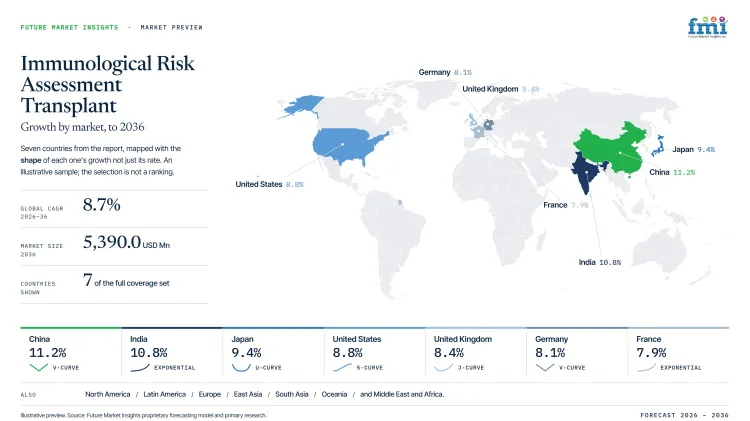
| Country | CAGR |
|---|---|
| United States | 8.8% |
| Germany | 8.1% |
| United Kingdom | 8.4% |
| France | 7.9% |
| China | 11.2% |
| Japan | 9.4% |
| India | 10.8% |
How do country-level CAGRs compare in the Immunological Risk Assessment Transplant Market?
The country comparison spans 4.5 percentage points and shows two closely spaced market groups. China, the United States and South Korea sit within a narrow range that indicates comparable momentum for autonomous line-haul operations. Germany, Canada and Japan form another compact group with moderate differences in projected expansion. The United Kingdom remains close to this second group rather than standing apart from the wider comparison. The overall pattern suggests that market development will differ through route approval and fleet integration rather than demand direction alone.
- China shows notable momentum as large freight networks are expected to support repeated autonomous operations across defined logistics corridors.
- The United States remains close to China while commercial expansion depends on aligning federal safety requirements with separate state road-access rules.
- South Korea occupies a similar position as technology-led fleet programs are anticipated to support hub-to-hub operations across concentrated industrial routes.
- Germany reflects considerable development through motorway testing and route-specific safety cases that connect vehicle approval with terminal readiness.
- Canada remains closely aligned with Germany as long intercity routes support the use case while winter validation shapes operating requirements.
- Japan shows a comparable outlook as labor constraints and expressway-focused freight models encourage relay operations with remote supervision.
- The United Kingdom sits near the second cluster as deployment is expected to progress through defined motorway corridors and approved commercial safety cases.
Markets with similar CAGRs are expected to follow different commercialization paths as road access and remote-support rules vary. These differences influence corridor selection and fleet economics as well as the timing of unattended freight operations. The full report provides country-level CAGR analysis across North America, Latin America, Europe, East Asia, South Asia, Oceania and the Middle East and Africa.
- The United States combines high procedure volume with established histocompatibility laboratories and centralized molecular testing services. During the forecast period, the country is projected to grow at 8.8% CAGR, supported by reimbursement experience and broad clinical evidence. United Network for Organ Sharing reported in January 2026 that 49,064 organ transplants were performed during 2025. The volume creates recurring demand for antibody review and graft surveillance after surgery. Large transplant hospitals can compare in-house compatibility workflows with send-out molecular services. Laboratory directors should separate analytical performance from logistics because turnaround and sample transport can change the value of an otherwise accurate result.
- German transplant testing is shaped by accredited laboratories and coordinated organ-allocation procedures. The country is forecast to advance at 8.1% CAGR by 2036, reinforced by standardized laboratory practice and specialist hospital networks. Deutsche Stiftung Organtransplantation reported in January 2026 that 3,256 organs were transplanted in 43 German centers during 2025. The concentration supports reference services and planned reagent purchasing. University hospitals and regional immunogenetics laboratories need products that fit external quality requirements and documented interpretation. Manufacturers that provide German-language support and stable lot performance are better placed to pass local evaluation without adding avoidable validation work or disrupting established reporting procedures.
- Public procurement and national clinical pathways give the United Kingdom a more centralized purchasing structure than the United States. UK demand is estimated to expand at 8.4% CAGR through 2036, attributable to repeat testing within specialist centers and a large waiting list. NHS Blood and Transplant reported in July 2025 that 4,583 patients received a transplant during the 2024/25 year. The procedure base supports compatibility work and follow-up monitoring but budget review remains strict. NHS transplant laboratories need evidence that a new assay improves a defined pathway. Suppliers must show implementation cost and reporting time plus the clinical action supported by each result.
- France operates through a national transplant framework that links allocation oversight with university-hospital care. The immunological risk assessment sector in Franceis projected to record 7.9% CAGR over the forecast period, shaped by standardized transplant activity and specialist laboratory capacity. Agence de la biomédecine reported in February 2026 that France completed 6,148 organ transplants during 2025. Recurring procedures support HLA and antibody testing plus organ-specific surveillance. Hospital groups compare assays through clinical utility and national purchasing constraints. Companies entering France need local scientific support and clear evidence because procurement committees are unlikely to replace an established method for a narrow technical improvement alone.
- China is expanding tertiary medical capacity while revised organ-donation rules increase formal oversight of transplant activity. Adoption is predicted to advance at 11.2% CAGR between 2026 and 2036, aided by hospital investment and wider molecular-laboratory access. The State Council reported in November 2024 that China had more than 38,000 hospitals during 2023. National and provincial centers do not have identical testing capability, which creates a tiered market for imported and domestic assays. Major hospitals in Beijing and Shanghai can support high-resolution workflows. Diagnostics companies need local registration and distributor coverage plus training that reaches provincial laboratory teams across major provinces.
- Japan has a limited deceased-donor pool and detailed living-donor work that places a premium on precise matching. By 2036, demand in Japan is forecast to rise at 9.4% CAGR, underpinned by specificity requirements and long recipient follow-up. Japan Organ Transplant Network recorded 16,679 registered candidates as of July 2025. Scarcity increases the cost of an uncertain donor decision and supports careful antibody interpretation. University hospitals and specialist immunogenetics laboratories favor reliable methods with local documentation. an assay manufacturer can gain trust locally through reproducible performance and direct technical support rather than frequent platform changes that require new validation and staff retraining.
- India has high-volume kidney and liver programs but specialist immunology capacity remains concentrated in metropolitan hospitals. India is estimated to post 10.8% CAGR during the forecast period, driven by procedure growth and wider laboratory investment. National Organ and Tissue Transplant Organization reported in August 2025 that India completed 18,911 organ transplants during 2024. Private hospital groups can adopt molecular tests faster than smaller public centers. Regional reference laboratories can extend access without duplicating specialist equipment in every hospital. Commercial success across India depends on affordable reagents and dependable distribution plus training for complex antibody interpretation outside established transplant hubs.
Who are the notable companies in the Immunological Risk Assessment Transplant Market?
Thermo Fisher Scientific, Werfen, CareDx, Natera, Eurobio Scientific, Verici Dx, and Insight Molecular Diagnostics are profiled for transplant compatibility or graft-risk testing across pre-transplant and post-transplant workflows.
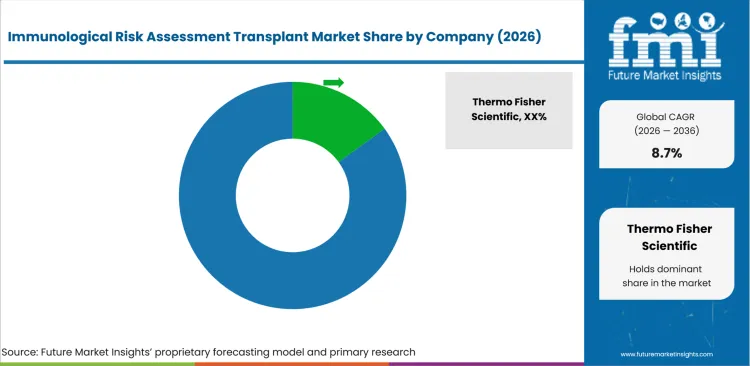
Competition is divided between broad compatibility platforms and focused post-transplant surveillance. Thermo Fisher Scientific and Werfen supply the laboratory infrastructure used before surgery. CareDx and Natera use centralized testing and clinical evidence to support repeated monitoring. Eurobio Scientific is combining HLA and laboratory products across regions. Verici Dx and Insight Molecular Diagnostics are building narrower kidney-transplant positions. The clinical oncology next-generation sequencing category offers a useful comparison because both markets require validated molecular workflows and careful interpretation rather than instrument performance alone.
- Thermo Fisher Scientific and Werfen compete for laboratory standardization decisions that can remain in place for several years. Their breadth supports typing and antibody workflows, but local service and software integration influence retention after the initial platform choice and during later software or reagent changes.
- CareDx and Natera compete through transplant-specific evidence and recurring testing services across organ programs that require longitudinal risk evidence. Their commercial position depends on clinical adoption and reimbursement plus the ability to explain how a molecular result changes biopsy or treatment decisions across different organ programs and clinical teams.
- Eurobio Scientific is extending GenDx beyond HLA typing through the CareDx laboratory products transaction across Europe and North America. The combined portfolio can offer transplant laboratories more assays through one commercial organization during customer transition. Integration quality remains important for preserving customer continuity and validated laboratory workflows throughout the transfer.
- Verici Dx and Insight Molecular Diagnostics focus on narrower molecular problems within kidney transplant programs that seek local molecular testing options. Their opportunity depends on proving clinical utility and securing regulatory or laboratory adoption without requiring centers to rebuild established compatibility workflows or imposing an unsupported interpretation burden on clinicians.
Competitive Benchmarking: Immunological Risk Assessment Transplant Market
| Company | Pre-transplant HLA | Antibody Testing | Molecular Monitoring | Clinical Evidence | Geographic Reach |
|---|---|---|---|---|---|
| Thermo Fisher Scientific | High | High | Medium | High | North America, Europe, Asia, and other regions |
| Werfen | High | High | Low | High | North America, Europe, Asia, and selected regions |
| CareDx | Medium | Medium | High | High | United States and selected international programs |
| Natera | Low | Low | High | High | United States with international evidence activity |
| Eurobio Scientific | High | High | Medium | Medium | Europe, North America, and distributor markets |
| Verici Dx | Low | Low | Medium | Medium | United States and United Kingdom base |
| Insight Molecular Diagnostics | Low | Low | Medium | Medium | United States with early international sites |
Key Developments in the Immunological Risk Assessment Transplant Market
- In March 2025, CareDx expanded AlloSure Heart testing to pediatric heart recipients younger than 15 and expanded AlloSure Kidney to simultaneous pancreas-kidney recipients. The action broadened the clinical populations covered by the company's donor-derived cell-free DNA services. It matters commercially because a validated indication can convert exception-based testing into a repeatable surveillance pathway for a defined transplant group across routine pediatric and combined-organ follow-up.
- In April 2025, Natera presented results from the DEFINE-HT study at the International Society for Heart and Lung Transplantation Annual Meeting in Boston, drawing on more than 1,100 donor-derived cell-free DNA tests in heart recipients. The company reported that elevated Prospera results correlated with adverse outcomes and predicted graft dysfunction at three times the rate of biopsy. The development strengthens the evidence base needed for transplant committees to decide how blood testing fits routine surveillance.
- In May 2026, Werfen expanded its strategic collaboration with Oxford Nanopore, building on a partnership that dates to 2020, to validate HLA typing and pre-transplant matching assays on nanopore sequencing platforms. The work targets faster sample-to-result workflows and lower implementation complexity for transplant laboratories. Commercial adoption still depends on local validation, but the collaboration could extend high-resolution typing to laboratories that need flexible sequencing capacity without replacing the existing clinical review process.
Key Players in the Immunological Risk Assessment Transplant Market
Broad Transplant Laboratory Platforms
- Thermo Fisher Scientific
- Werfen
- Eurobio Scientific
Molecular Surveillance Specialists
- CareDx
- Natera
Focused Kidney Transplant Diagnostics
- Verici Dx
- Insight Molecular Diagnostics
Immunological Risk Assessment Transplant Market - Report Scope
| Coverage field | Report scope |
|---|---|
| Market breakdown | Assessment Stage, Test Type, Technology, Product, Transplant Type, End User, and Region. |
| Market Definition | Immunological risk assessment transplant products and services evaluate donor-recipient compatibility during pre-transplant assessment or post-transplant surveillance. The scope includes HLA typing, antibody testing, crossmatch methods, and molecular graft surveillance. |
| Regions Covered | North America, Latin America, Europe, East Asia, South Asia, Oceania, and Middle East and Africa. |
| Countries Covered | United States, Germany, United Kingdom, France, China, Japan, India, and 30+ countries within the regional model. |
| Key Companies Profiled | Thermo Fisher Scientific, Werfen, CareDx, Natera, Eurobio Scientific, Verici Dx, and Insight Molecular Diagnostics. |
| Forecast Period | 2026 to 2036. |
| Approach | Hybrid bottom-up and top-down market sizing supported by primary interviews and official desk research. |
Immunological Risk Assessment Transplant Market - Research Methodology
| Method | Approach |
|---|---|
| Primary Research | FMI analysts gathered input from manufacturers, service providers, technology developers, distributors, end users, sourcing teams, and subject-matter experts. Interviews examined purchasing decisions, product or service evaluation, adoption barriers, approval requirements, pricing considerations, and expectations for technical or commercial support. Respondents were also asked what evidence is required before a trial, pilot, or initial order develops into regular purchasing. |
| Desk Research | Desk research covered government statistics, regulatory publications, trade data, industry associations, technical literature, standards, company filings, product information, and official corporate announcements. Sources were reviewed for relevance, publication date, geographic coverage, and consistency with the defined market scope. Claims relating to performance, applications, approvals, capacity, investment, and commercial activity were retained only when supported by credible public evidence. |
| Market Sizing and Forecasting | The market model combined the baseline value with historical performance, segment structure, pricing and volume indicators, adoption levels, company participation, and country-level demand conditions. Forecast assumptions considered economic activity, investment trends, regulatory developments, technology adoption, purchasing cycles, supply availability, and barriers to wider market use. Segment and regional estimates were reconciled before the final market total was calculated. |
| Data Validation | Estimates were checked against multiple independent indicators, including public data, company activity, trade patterns, industry developments, and findings from primary interviews. Validation also tested whether products, services, applications, and company revenues fell within the defined market boundaries. Adjacent categories, unsupported claims, overlapping revenues, and activities without direct market relevance were excluded to reduce double counting and maintain consistency across segments and countries. |
Immunological Risk Assessment Transplant Market by Segments
Immunological Risk Assessment Transplant Market segmented by Assessment Stage:
- Pre-transplant
- Post-transplant
Immunological Risk Assessment Transplant Market segmented by Test Type:
- HLA Typing
- Antibody Screening
- Crossmatch Testing
- Immune Monitoring
- Molecular Injury Testing
Immunological Risk Assessment Transplant Market segmented by Technology:
- Molecular Assays
- Solid-Phase Immunoassays
- Flow Cytometry
- Cell-Based Assays
Immunological Risk Assessment Transplant Market segmented by Product:
- Reagents and Assays
- Instruments
- Software and Services
Immunological Risk Assessment Transplant Market segmented by Transplant Type:
- Kidney
- Liver
- Heart
- Lung
- Stem Cell
- Other Organs
Immunological Risk Assessment Transplant Market segmented by End User:
- Transplant Centers
- Reference Laboratories
- Blood Banks
- Research Institutes
Immunological Risk Assessment Transplant Market by Region:
- North America
- United States
- Canada
- Latin America
- Mexico
- Brazil
- Chile
- Rest of Latin America
- Europe
- Germany
- United Kingdom
- France
- Italy
- Spain
- Nordic Countries
- Benelux
- Rest of Europe
- East Asia
- China
- Japan
- South Korea
- South Asia and Oceania
- India
- ASEAN
- Australia and New Zealand
- Rest of South Asia and Oceania
- Middle East and Africa
- Kingdom of Saudi Arabia
- Other GCC Countries
- Turkiye
- South Africa
- Other African Union
- Rest of Middle East and Africa
Research Sources and Bibliography
- 1. Global Observatory on Donation and Transplantation. (2026, March). Organ donation and transplantation worldwide. World Health Organization and Organización Nacional de Trasplantes.
- 2. CareDx. (2026, February 24). CareDx announces fourth quarter and full year 2025 financial results. CareDx Investor Relations.
- 3. NMDP. (2025, April 10). Donor options and making treatment decisions. NMDP.
- 4. CareDx. (2025, October 6). CareDx announces new IVD products and IVDR certification for AlloSeq Tx and QTYPE. CareDx Investor Relations.
- 5. Natera. (2025, May 7). Prospera Heart test with DQS outperforms dd-cfDNA percentage in detecting allograft rejection. Natera.
- 6. Eurobio Scientific. (2026, January 27). FY 2025 revenue. Eurobio Scientific.
- 7. Health Resources and Services Administration. (2025, January 15). Organ transplants exceeded 48,000 in 2024. USA Department of Health and Human Services.
- 8. CareDx. (2025, April 24). CareDx announces presentation of 60 abstracts including 19 oral presentations at the 2025 ISHLT meeting. CareDx Investor Relations.
- 9. CareDx. (2025, July 31). CareDx announces transplant diagnostics data at the 2025 World Transplant Congress. CareDx Investor Relations.
- 10. NHS Blood and Transplant. (2025, July 9). Organ transplant waiting list hits record high as donor and transplant numbers fall. NHS Blood and Transplant.
- 11. Insight Molecular Diagnostics. (2025, September 8). IMDX enrolls first patient in GraftAssureDx clinical trial and welcomes new hospital participants. Insight Molecular Diagnostics Investor Relations.
- 12. United Network for Organ Sharing. (2026, January 28). United States surpasses 49,000 organ transplants while deceased organ donations dip. United Network for Organ Sharing.
- 13. Deutsche Stiftung Organtransplantation. (2026, January 13). Organspende und Transplantation in Deutschland 2025. Deutsche Stiftung Organtransplantation.
- 14. Agence de la biomédecine. (2026, February 19). 6,148 organ transplants in 2025: an all-time record for France. Agence de la biomédecine.
- 15. State Council of the People’s Republic of China. (2024, November 30). China announces pilot plan for wider opening in the medical sector. The State Council of the People’s Republic of China.
- 16. Japan Organ Transplant Network. (2025, July 31). News Letter No. 29. Japan Organ Transplant Network.
- 17. National Organ and Tissue Transplant Organization. (2025, August). Annual report 2024-25. Ministry of Health and Family Welfare, Government of India.
- 18. CareDx. (2025, March 6). CareDx launches two expanded indications for AlloSure testing services. CareDx Investor Relations.
- 19. Natera. (2025, April 29). Prospective DEFINE-HT study demonstrates that Prospera Heart predicts clinical outcomes. Natera.
- 20. Werfen. (2026, May 14). Werfen and Oxford Nanopore enter strategic collaboration to support development of advanced transplant assays. Werfen.
- 21. Eurobio Scientific. (2026, April 16). Eurobio Scientific signs definitive agreement to acquire CareDx transplant lab product division. Eurobio Scientific.
- 22. Eurobio Scientific. (2026, July 1). Eurobio Scientific finalizes the acquisition of CareDx transplant lab product division. Eurobio Scientific.
- 23. Thermo Fisher Scientific. (n.d.). Transplant diagnostics products and solutions. Thermo Fisher Scientific.
- 24. Werfen. (n.d.). Transplant diagnostics assays for typing and antibody testing. Werfen.
- 25. CareDx. (n.d.). Transplant solutions. CareDx.
- 26. Natera. (n.d.). Prospera transplant assessment. Natera.
- 27. Eurobio Scientific. (n.d.). Transplantation diagnostics. Eurobio Scientific.
- 28. Verici Dx. (2026, June). Annual report and accounts for the year ended 31 December 2025. Verici Dx.
- 29. Insight Molecular Diagnostics. (2026, March 26). IMDX submits GraftAssureDx for FDA review and reports Q4 2025 results. Insight Molecular Diagnostics Investor Relations.
All sources are primary non-commercial government, regulatory, academic, trade body, or official company publications.
This Report Answers
- How does the market move from USD 2,340.0 million in 2026 to USD 5,390.0 million by 2036?
- Which clinical and laboratory factors support the 8.7% CAGR forecast from 2026 to 2036?
- Why does Pre-transplant account for 65.0% share within the Assessment Stage category during 2026?
- How do HLA typing and antibody screening differ from molecular graft-injury surveillance in purchasing and clinical use?
- Which transplant types create the most recurring demand for compatibility assessment and post-transplant immune-risk testing?
- How do public procurement and reimbursement pathways change adoption across the United States and European transplant systems?
- Why do China and India record higher country CAGRs than Germany and France during the forecast period?
- Which companies compete through broad laboratory platforms and which focus on molecular transplant surveillance services?
- What operational limits can reduce the return on investment from decentralized molecular testing inside transplant centers?
- How were procedure data and company activity plus segment structure reconciled within the market forecast?
Frequently Asked Questions
How big is the Immunological Risk Assessment Transplant Market in 2026?
The immunological risk assessment transplant market is valued at USD 2,340.0 million in 2026 and is forecast to reach USD 5,390.0 million by 2036, reflecting the recurring demand for compatibility and graft-surveillance testing across expanding global transplant programs.
What is the CAGR of the Immunological Risk Assessment Transplant Market from 2026 to 2036?
The immunological risk assessment transplant market is projected to grow at a CAGR of 8.7% between 2026 and 2036, supported by rising transplant volumes and growing clinical adoption of molecular surveillance tools including donor-derived cell-free DNA assays and next-generation HLA typing.
Which assessment stage leads the Immunological Risk Assessment Transplant Market?
Pre-transplant assessment accounts for 65.0% of the immunological risk assessment transplant market by assessment stage in 2026, driven by mandatory HLA typing and antibody screening that must be completed before any organ or stem-cell transplant procedure advances to surgery.
Which country segment is growing fastest in the Immunological Risk Assessment Transplant Market?
China is the fastest-growing country segment in the immunological risk assessment transplant market, expanding at an 11.2% CAGR through 2036, ahead of the market average of 8.7%, supported by tertiary hospital capacity expansion and wider molecular laboratory access across national and provincial transplant centers.
Who are the leading companies in the Immunological Risk Assessment Transplant Market?
Leading companies in the immunological risk assessment transplant market include Thermo Fisher Scientific, Werfen, CareDx, Natera, Eurobio Scientific, Verici Dx, and Insight Molecular Diagnostics, competing across broad transplant laboratory platforms, molecular surveillance services, and focused kidney transplant diagnostics.
Preview the report firsthand - request a free sample
Get SampleGet the brochure for pricing and purchase details.
Get PDFTable of Content
- Key Takeaways
- Market Size and CAGR
- Top Growth Driver
- Fastest Growing Segment
- Leading Region
- Key Companies
- Emerging Opportunities
- Executive Summary
- Global Market Outlook
- Demand-side Trends
- Supply-side Trends
- Technology Roadmap Analysis
- Analysis and Recommendations
- Analyst Perspective (What is happening? Why now? What should investors know?)
- Key Questions Answered
- How large is the market?
- What is the CAGR?
- What are key trends?
- Which region dominates?
- Who are the leaders?
- Market Overview
- Market Coverage / Taxonomy
- Market Definition / Scope / Limitations
- Research Methodology
- Chapter Orientation
- Analytical Lens and Working Hypotheses
- Market Structure, Signals, and Trend Drivers
- Benchmarking and Cross-market Comparability
- Market Sizing, Forecasting, and Opportunity Mapping
- Research Design and Evidence Framework
- Desk Research Programme (Secondary Evidence)
- Expert Input and Fieldwork (Primary Evidence)
- Tooling, Models, and Reference Databases
- Data Engineering and Model Build
- Quality Assurance and Audit Trail
- Market Background
- Market Dynamics (Drivers, Restraints, Opportunity, Trends)
- Scenario Forecast (Optimistic, Likely, Conservative)
- Impact Analysis
- AI Impact
- Sustainability Impact
- Regulatory Impact
- Technology Impact
- Consumer / Buyer Analysis
- Purchase Drivers
- Adoption Barriers
- Buyer Journey
- Opportunity Map Analysis
- Product Life Cycle Analysis
- Supply Chain Analysis
- Investment Feasibility Matrix
- Value Chain Analysis
- PESTLE and Porter's Analysis
- Regulatory Landscape
- Regional Parent Market Outlook
- Production and Consumption Statistics
- Import and Export Statistics
- Global Market Analysis and Forecast, 2021 to 2036
- Historical Market Size Value (USD Million) Analysis, 2021 to 2025
- Current and Future Market Size Value (USD Million) Projections, 2026 to 2036
- Y-o-Y Growth Trend Analysis
- Absolute $ Opportunity Analysis
- Global Market Pricing Analysis, 2021 to 2036
- Global Market Analysis and Forecast, By Assessment Stage, 2021 to 2036
- Introduction / Key Findings
- Historical Market Size Value (USD Million) Analysis By Assessment Stage, 2021 to 2025
- Current and Future Market Size Value (USD Million) Analysis and Forecast By Assessment Stage, 2026 to 2036
- Pre-transplant
- Post-transplant
- Pre-transplant
- Y-o-Y Growth Trend Analysis By Assessment Stage, 2021 to 2025
- Absolute $ Opportunity Analysis By Assessment Stage, 2026 to 2036
- Global Market Analysis and Forecast, By Test Type, 2021 to 2036
- Introduction / Key Findings
- Historical Market Size Value (USD Million) Analysis By Test Type, 2021 to 2025
- Current and Future Market Size Value (USD Million) Analysis and Forecast By Test Type, 2026 to 2036
- HLA Typing
- Antibody Screening
- Crossmatch Testing
- Immune Monitoring
- Molecular Injury Testing
- HLA Typing
- Y-o-Y Growth Trend Analysis By Test Type, 2021 to 2025
- Absolute $ Opportunity Analysis By Test Type, 2026 to 2036
- Global Market Analysis and Forecast, By Technology, 2021 to 2036
- Introduction / Key Findings
- Historical Market Size Value (USD Million) Analysis By Technology, 2021 to 2025
- Current and Future Market Size Value (USD Million) Analysis and Forecast By Technology, 2026 to 2036
- Molecular Assays
- Solid-Phase Immunoassays
- Flow Cytometry
- Cell-Based Assays
- Molecular Assays
- Y-o-Y Growth Trend Analysis By Technology, 2021 to 2025
- Absolute $ Opportunity Analysis By Technology, 2026 to 2036
- Global Market Analysis and Forecast, By Product, 2021 to 2036
- Introduction / Key Findings
- Historical Market Size Value (USD Million) Analysis By Product, 2021 to 2025
- Current and Future Market Size Value (USD Million) Analysis and Forecast By Product, 2026 to 2036
- Reagents and Assays
- Instruments
- Software and Services
- Reagents and Assays
- Y-o-Y Growth Trend Analysis By Product, 2021 to 2025
- Absolute $ Opportunity Analysis By Product, 2026 to 2036
- Global Market Analysis and Forecast, By Transplant Type, 2021 to 2036
- Introduction / Key Findings
- Historical Market Size Value (USD Million) Analysis By Transplant Type, 2021 to 2025
- Current and Future Market Size Value (USD Million) Analysis and Forecast By Transplant Type, 2026 to 2036
- Kidney
- Liver
- Heart
- Lung
- Stem Cell
- Other Organs
- Kidney
- Y-o-Y Growth Trend Analysis By Transplant Type, 2021 to 2025
- Absolute $ Opportunity Analysis By Transplant Type, 2026 to 2036
- Global Market Analysis and Forecast, By End User
- Introduction / Key Findings
- Historical Market Size Value (USD Million) Analysis By End User, 2021 to 2025
- Current and Future Market Size Value (USD Million) Analysis and Forecast By End User, 2026 to 2036
- Transplant Centers
- Reference Laboratories
- Blood Banks
- Research Institutes
- Transplant Centers
- Y-o-Y Growth Trend Analysis By End User, 2021 to 2025
- Absolute $ Opportunity Analysis By End User, 2026 to 2036
- Global Market Analysis and Forecast, By Region, 2021 to 2036
- Introduction
- Historical Market Size Value (USD Million) Analysis By Region, 2021 to 2025
- Current Market Size Value (USD Million) Analysis and Forecast By Region, 2026 to 2036
- North America
- Latin America
- Western Europe
- Eastern Europe
- East Asia
- South Asia and Pacific
- Middle East & Africa
- Market Attractiveness Analysis By Region
- North America Market Analysis and Forecast, By Country, 2021 to 2036
- Historical Market Size Value (USD Million) Trend Analysis By Market Taxonomy, 2021 to 2025
- Market Size Value (USD Million) Forecast By Market Taxonomy, 2026 to 2036
- By Country
- USA
- Canada
- By Assessment Stage
- By Test Type
- By Technology
- By Product
- By Transplant Type
- By End User
- By Country
- Market Attractiveness Analysis
- By Country
- By Assessment Stage
- By Test Type
- By Technology
- By Product
- By Transplant Type
- By End User
- Key Takeaways
- Latin America Market Analysis and Forecast, By Country
- Historical Market Size Value (USD Million) Trend Analysis By Market Taxonomy, 2021 to 2025
- Market Size Value (USD Million) Forecast By Market Taxonomy, 2026 to 2036
- By Country
- Brazil
- Mexico
- Chile
- Rest of Latin America
- By Assessment Stage
- By Test Type
- By Technology
- By Product
- By Transplant Type
- By End User
- By Country
- Market Attractiveness Analysis
- By Country
- By Assessment Stage
- By Test Type
- By Technology
- By Product
- By Transplant Type
- By End User
- Key Takeaways
- Western Europe Market Analysis and Forecast, By Country
- Historical Market Size Value (USD Million) Trend Analysis By Market Taxonomy, 2021 to 2025
- Market Size Value (USD Million) Forecast By Market Taxonomy, 2026 to 2036
- By Country
- Germany
- UK
- Italy
- Spain
- France
- Nordic
- BENELUX
- Rest of Western Europe
- By Assessment Stage
- By Test Type
- By Technology
- By Product
- By Transplant Type
- By End User
- By Country
- Market Attractiveness Analysis
- By Country
- By Assessment Stage
- By Test Type
- By Technology
- By Product
- By Transplant Type
- By End User
- Key Takeaways
- Eastern Europe Market Analysis and Forecast, By Country
- Historical Market Size Value (USD Million) Trend Analysis By Market Taxonomy, 2021 to 2025
- Market Size Value (USD Million) Forecast By Market Taxonomy, 2026 to 2036
- By Country
- Russia
- Poland
- Hungary
- Balkan & Baltic
- Rest of Eastern Europe
- By Assessment Stage
- By Test Type
- By Technology
- By Product
- By Transplant Type
- By End User
- By Country
- Market Attractiveness Analysis
- By Country
- By Assessment Stage
- By Test Type
- By Technology
- By Product
- By Transplant Type
- By End User
- Key Takeaways
- East Asia Market Analysis and Forecast, By Country
- Historical Market Size Value (USD Million) Trend Analysis By Market Taxonomy, 2021 to 2025
- Market Size Value (USD Million) Forecast By Market Taxonomy, 2026 to 2036
- By Country
- China
- Japan
- South Korea
- By Assessment Stage
- By Test Type
- By Technology
- By Product
- By Transplant Type
- By End User
- By Country
- Market Attractiveness Analysis
- By Country
- By Assessment Stage
- By Test Type
- By Technology
- By Product
- By Transplant Type
- By End User
- Key Takeaways
- South Asia and Pacific Market Analysis and Forecast, By Country
- Historical Market Size Value (USD Million) Trend Analysis By Market Taxonomy, 2021 to 2025
- Market Size Value (USD Million) Forecast By Market Taxonomy, 2026 to 2036
- By Country
- India
- ASEAN
- Australia & New Zealand
- Rest of South Asia and Pacific
- By Assessment Stage
- By Test Type
- By Technology
- By Product
- By Transplant Type
- By End User
- By Country
- Market Attractiveness Analysis
- By Country
- By Assessment Stage
- By Test Type
- By Technology
- By Product
- By Transplant Type
- By End User
- Key Takeaways
- Middle East & Africa Market Analysis and Forecast, By Country
- Historical Market Size Value (USD Million) Trend Analysis By Market Taxonomy, 2021 to 2025
- Market Size Value (USD Million) Forecast By Market Taxonomy, 2026 to 2036
- By Country
- Kingdom of Saudi Arabia
- Other GCC Countries
- Türkiye
- South Africa
- Other African Union
- Rest of Middle East & Africa
- By Assessment Stage
- By Test Type
- By Technology
- By Product
- By Transplant Type
- By End User
- By Country
- Market Attractiveness Analysis
- By Country
- By Assessment Stage
- By Test Type
- By Technology
- By Product
- By Transplant Type
- By End User
- Key Takeaways
- Key Countries Market Analysis
- USA
- Pricing Analysis
- Market Share Analysis, 2025
- By Assessment Stage
- By Test Type
- By Technology
- By Product
- By Transplant Type
- By End User
- Canada
- Pricing Analysis
- Market Share Analysis, 2025
- By Assessment Stage
- By Test Type
- By Technology
- By Product
- By Transplant Type
- By End User
- Mexico
- Pricing Analysis
- Market Share Analysis, 2025
- By Assessment Stage
- By Test Type
- By Technology
- By Product
- By Transplant Type
- By End User
- Brazil
- Pricing Analysis
- Market Share Analysis, 2025
- By Assessment Stage
- By Test Type
- By Technology
- By Product
- By Transplant Type
- By End User
- Chile
- Pricing Analysis
- Market Share Analysis, 2025
- By Assessment Stage
- By Test Type
- By Technology
- By Product
- By Transplant Type
- By End User
- Germany
- Pricing Analysis
- Market Share Analysis, 2025
- By Assessment Stage
- By Test Type
- By Technology
- By Product
- By Transplant Type
- By End User
- UK
- Pricing Analysis
- Market Share Analysis, 2025
- By Assessment Stage
- By Test Type
- By Technology
- By Product
- By Transplant Type
- By End User
- Italy
- Pricing Analysis
- Market Share Analysis, 2025
- By Assessment Stage
- By Test Type
- By Technology
- By Product
- By Transplant Type
- By End User
- Spain
- Pricing Analysis
- Market Share Analysis, 2025
- By Assessment Stage
- By Test Type
- By Technology
- By Product
- By Transplant Type
- By End User
- France
- Pricing Analysis
- Market Share Analysis, 2025
- By Assessment Stage
- By Test Type
- By Technology
- By Product
- By Transplant Type
- By End User
- India
- Pricing Analysis
- Market Share Analysis, 2025
- By Assessment Stage
- By Test Type
- By Technology
- By Product
- By Transplant Type
- By End User
- ASEAN
- Pricing Analysis
- Market Share Analysis, 2025
- By Assessment Stage
- By Test Type
- By Technology
- By Product
- By Transplant Type
- By End User
- Australia & New Zealand
- Pricing Analysis
- Market Share Analysis, 2025
- By Assessment Stage
- By Test Type
- By Technology
- By Product
- By Transplant Type
- By End User
- China
- Pricing Analysis
- Market Share Analysis, 2025
- By Assessment Stage
- By Test Type
- By Technology
- By Product
- By Transplant Type
- By End User
- Japan
- Pricing Analysis
- Market Share Analysis, 2025
- By Assessment Stage
- By Test Type
- By Technology
- By Product
- By Transplant Type
- By End User
- South Korea
- Pricing Analysis
- Market Share Analysis, 2025
- By Assessment Stage
- By Test Type
- By Technology
- By Product
- By Transplant Type
- By End User
- Russia
- Pricing Analysis
- Market Share Analysis, 2025
- By Assessment Stage
- By Test Type
- By Technology
- By Product
- By Transplant Type
- By End User
- Poland
- Pricing Analysis
- Market Share Analysis, 2025
- By Assessment Stage
- By Test Type
- By Technology
- By Product
- By Transplant Type
- By End User
- Hungary
- Pricing Analysis
- Market Share Analysis, 2025
- By Assessment Stage
- By Test Type
- By Technology
- By Product
- By Transplant Type
- By End User
- Kingdom of Saudi Arabia
- Pricing Analysis
- Market Share Analysis, 2025
- By Assessment Stage
- By Test Type
- By Technology
- By Product
- By Transplant Type
- By End User
- Türkiye
- Pricing Analysis
- Market Share Analysis, 2025
- By Assessment Stage
- By Test Type
- By Technology
- By Product
- By Transplant Type
- By End User
- South Africa
- Pricing Analysis
- Market Share Analysis, 2025
- By Assessment Stage
- By Test Type
- By Technology
- By Product
- By Transplant Type
- By End User
- USA
- Market Structure Analysis
- Competition Dashboard
- Competition Benchmarking
- Market Share Analysis of Top Players
- By Regional
- By Assessment Stage
- By Test Type
- By Technology
- By Product
- By Transplant Type
- By End User
- Emerging Startups
- Innovation Benchmarking
- Competition Analysis
- Competition Deep Dive
- Thermo Fisher Scientific
- Overview
- Product Portfolio
- Profitability by Market Segments
- Sales Footprint
- Strategy Overview
- Marketing Strategy
- Product Strategy
- Channel Strategy
- Werfen
- Eurobio Scientific
- CareDx
- Natera
- Verici Dx
- Insight Molecular Diagnostics
- Thermo Fisher Scientific
- Case Studies
- Success Stories
- Recent Developments
- Competition Deep Dive
- Assumptions & Acronyms Used


