

- Market Size (2026)
- USD 5.5 Bn
- Forecast (2036)
- USD 19.7 Bn
- CAGR (2026 to 2036)
- 13.5%
How big is the India construction chemicals market in 2026?
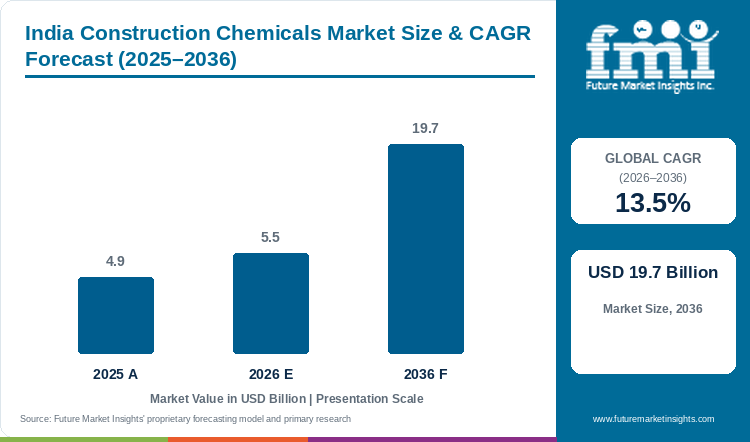
The market was estimated at USD 4.9 billion in 2025 and is expected to reach USD 5.5 billion in 2026. It is forecast to grow at a CAGR of 13.5% from 2026 to 2036 and reach USD 19.7 billion by 2036.
The India construction chemicals market was valued at USD 4.9 billion in 2025 and is estimated to reach USD 5.5 billion in 2026. The market is projected to reach USD 19.7 billion by 2036, expanding at a compound annual growth rate (CAGR) of 13.5% between 2026 and 2036. Plaster accounted for 33.9% of the product mix in 2026, while infrastructure accounted for 64.1% of total revenue by application. The demand for construction chemicals is supported by public investment in civil construction, with the 2026–27 Union Budget announcing INR 12.2 lakh crore in capital expenditure, which generates purchases of admixtures, waterproofing, repair and protection systems as projects progress. The growth in consumption is also reflected in regional manufacturing, as suppliers set up production closer to project sites. Manufacturers are also investing in production capabilities to strengthen their market position. For instance, Sika invested in its Kharagpur plant, which produces mortars, concrete admixtures and shotcrete accelerators for eastern and northeastern projects, and Fosroc inaugurated an integrated plant in Hyderabad in May 2024 to serve South and Central India.
Key Market Trends & Insights
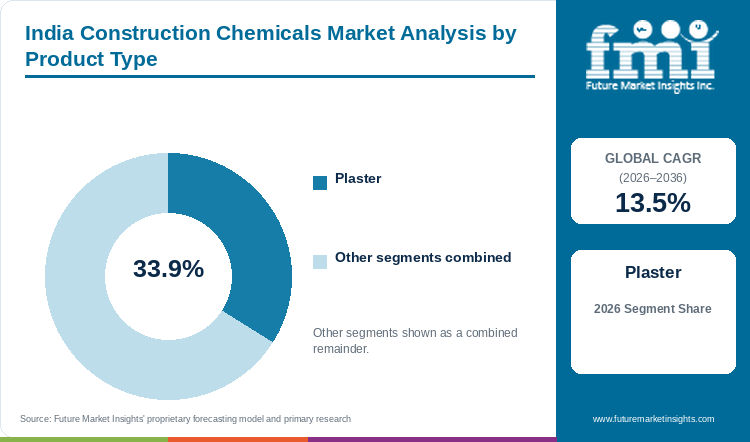
- Plaster is expected to represent an estimated 33.9% of the product mix in 2026, supported by wall preparation and finishing requirements across new construction and renovation.
- Infrastructure is expected to account for an estimated 64.1% by application in 2026, with requirements spanning concrete placement, waterproofing, protection and repair.
- Suppliers are combining regional manufacturing with application support, helping contractors connect product selection with the work sequence. [1][7]
Regional Highlights
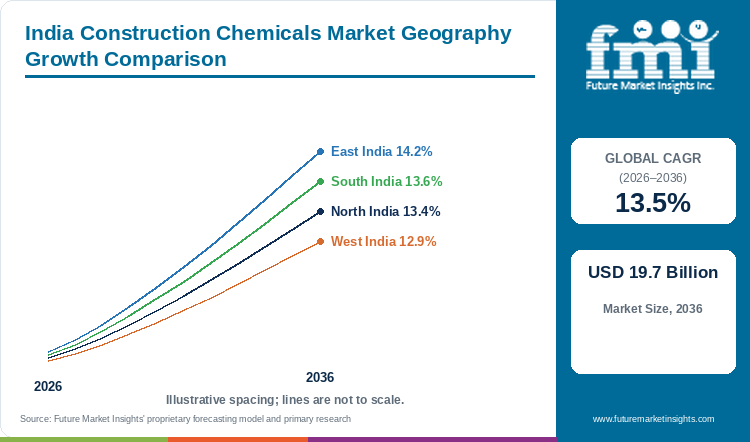
- East India is projected to lead the four profiled regions at 14.2% CAGR for 2026 to 2036; South India is forecast to follow at 13.6% over the same period.
- North India is projected at 13.4% CAGR and West India at 12.9% CAGR from 2026 to 2036.
Market Size & Forecast
Table 1: India Construction Chemicals Market Size and Forecast (USD billion), 2025 to 2036
| Market size and forecast | Value |
|---|---|
| 2025 Value | USD 4.9 billion |
| Estimated market size in 2026 | USD 5.5 billion |
| Projected market size by 2036 | USD 19.7 billion |
| CAGR (2026-2036) | 13.5% |
Construction activity reaches chemical suppliers through specifications and work packages. An infrastructure contractor may buy an admixture during concrete production and subsequently procure a repair mortar, joint sealant or protective treatment. A building contractor faces a different sequence as masonry gives way to plastering, waterproofing and tile installation. These successive decisions create opportunities for suppliers with complementary products, provided each offer fits the actual surface and exposure. They also explain why a large project does not translate into a single chemical purchase at its start. The timing of certified work, subcontractor mobilisation and the readiness of the substrate determine when materials can be used.
India's investment context supports that process. The Union Budget allocation provides a wider setting for civil construction, while the contractor's bill of quantities determines the products that enter procurement. [2] A budget announcement has its strongest commercial effect when projects progress into concrete work and other material-intensive stages. Suppliers therefore need contact with designers and execution teams as well as purchasing departments. Understanding whether a package requires concrete modification, underground waterproofing or exposed-surface protection helps them prepare the relevant technical submission and organise the delivery that follows approval.
Buildings add a broad finishing and maintenance requirement to this infrastructure base. Specialist product portfolios already connect plaster, tile fixing, waterproofing and repair: UltraTech lists Readiplast, Tilefixo, waterproofing systems, repair materials and grouts in its building-products range. [11] For the buyer, a wider portfolio can simplify coordination when adjacent materials must work together. The purchasing comparison still concerns the complete installed system. Mixing requirements, surface preparation and the next trade's starting conditions affect labour and programme costs even when they do not appear in the price of a bag or container.
The global construction chemicals market provides a wider context for formulation and supplier development, while India's commercial requirements remain shaped by its projects and distribution routes. Large civil contracts favour direct technical engagement and scheduled supply; smaller building and repair jobs need products accessible through local channels. Chembond explicitly describes both direct supply to large customers and dealer or distributor sales. [13] A manufacturer serving both routes must make its technical range understandable to different buyers. Detailed project specifications can coexist with smaller, clearly identified packs for contractors undertaking a single repair or finishing task.
Table 2: Supporting Industry Indicators
| Indicator | Data point | Why it matters | Source |
|---|---|---|---|
| Public investment context | INR 12.2 lakh crore public capital expenditure announced for FY 2026-27 | Supports the broader project environment; chemical orders follow execution stages | [2] |
| Eastern manufacturing | Kharagpur plant produces mortars, concrete admixtures and shotcrete accelerators | Regional supply for eastern and northeastern projects | [1] |
| Southern manufacturing | Fosroc inaugurated an integrated Hyderabad plant in May 2024 | Additional production serving South and Central India | [7] |
| Technical framework | NBC 2016 covers building materials, structural design and construction management | Connects specification with material use and project delivery | [3] |
| Distribution model | Chembond describes direct sales and dealer/distributor channels | Different routes serve project packages and smaller jobs | [13] |
Demand Intensity Analysis
The outlook implies about USD 14.1 billion of additional annual market value between 2026 and 2036. Demand intensity concerns how chemical systems enter each construction job. More concrete placement can support admixture orders; more finished wall area creates plastering requirements; a repair contract generates a different mix of bonding agents, mortars and coatings. The value of the order also depends on the chosen specification. A product bought for a demanding exposure can have a different formulation and installation process from one selected for a routine interior application.
The 2026 product and application share forecasts describe different aspects of this demand. The product measure identifies what contractors buy, while the application measure identifies where those purchases are used. A plaster purchase for an infrastructure building remains part of both relevant classifications. Treating the two measures as separate views of the same market helps explain why suppliers develop offers across several stages of construction. It also makes the contractor's project mix commercially important: a portfolio concentrated on concrete works will require a different sales and technical service organisation from one concentrated on interior finishing.
Installation conditions influence whether specified demand becomes a usable order. Material delivered before an area is ready must be stored and protected; material arriving late can hold up a trade whose labour is already present. Waterproofing is particularly sensitive to the condition of the surface. Asian Paints' SmartCare Damp Proof instructions address drainage, cleaning, substrate soundness and treatment of cracks before coating. [10] These tasks become part of the buyer's project planning. The supplier's opportunity extends to explaining preparation and application requirements early enough for the contractor to include them in the work package.
Table 3: Demand Intensity Metrics and Their Bases
| Demand intensity metric | Value | Basis |
|---|---|---|
| 2025 market value | USD 4.9 billion | Estimated India market value; starting value in the published assessment. |
| 2026 market size | USD 5.5 billion | Forecast value; opening year of the 2026 to 2036 outlook. |
| 2036 market size | USD 19.7 billion | Forecast endpoint; annual market value in 2036. |
| Additional annual value | About USD 14.1 billion | Projected increase in annual market value between 2026 and 2036. |
| Plaster | 33.9% | Estimated product-type share in 2026. |
| Infrastructure | 64.1% | Estimated application share in 2026. |
| Forecast period | 2026 to 2036 | India market and regional growth outlook. |
| Market growth rate | 13.5% | Projected India market CAGR for 2026 to 2036. |
Analyst Perspective
Construction chemicals suppliers in India can win technical approval yet lose an order when the specified material is unavailable as site work begins. Coordinating local supply and installation support around the chosen system's application requirements gives suppliers a practical basis for repeat business.
- Nikhil Kaitwade, Principal Analyst at Future Market Insights
How is the India construction chemicals market segmented?
The market is segmented by product type, application and region. Product categories are concrete admixtures, waterproofing chemicals, adhesives and grouts, sealants, repair and rehabilitation products, flooring compounds, protective coatings, plaster and asphalt additives. Applications comprise infrastructure, commercial and industrial, and residential construction. Geographic coverage comprises North, West, South and East India. Each product group performs a different task within the construction programme. The application identifies the project setting in which its performance, preparation and delivery requirements are assessed.
Why does plaster hold a substantial share of the product mix?
Plaster is expected to account for an estimated 33.9% of the market by product type in 2026.
Wall preparation determines the surface that later trades receive. The plastering contractor needs a formulation suitable for the masonry or concrete, the required finish and the conditions of application. Premixed products bring part of the preparation into a factory-controlled formulation. Weberwall Premium Plaster, for example, combines cement, graded sand, supplementary cementitious material and polymer additives for internal and external surfaces. [15] The commercial attraction is a more defined material input at the job site, although contractors still need to organise mixing, application and curing correctly.
Renovation adds assessment of the old surface to this purchase decision. Existing loose material, uneven areas and the interface with retained finishes affect how the next plaster layer is specified. A supplier that explains suitable substrates and preparation can help the contractor plan the handover to painting or tiling. Product consistency has value where work spans repeated deliveries and several rooms or floors. The buyer is purchasing a surface preparation result, so an apparent saving on material can disappear if an unsuitable base creates further work before the next trade can proceed.
- Premixed plaster competes through consistent material preparation and the finish required by subsequent trades.
- New construction and renovation create different substrate conditions, making application guidance part of the purchase decision.
How do admixtures and waterproofing products shape specification decisions?
Concrete admixtures and waterproofing chemicals enter projects at different stages and require different application decisions.
An admixture becomes part of the concrete production process. The relevant selection concerns the intended mix, placement requirements and setting behaviour. The Central Soil and Materials Research Station maintains a technical monograph on chemical admixtures for concrete, alongside its durability resources. [4] For the ready-mix producer or contractor, product evaluation therefore belongs with mix design and site conditions. The supplier needs to explain the formulation's intended use and support its incorporation into the actual concrete being placed.
The waterproofing admixtures market concerns products incorporated into the cementitious material, while membranes and surface coatings require their own preparation and installation sequence. Specifying these alternatives affects when the contractor must order them and which trade applies them. Water-protection details around penetrations, joints and changes in surface require attention as part of the complete system. The purchasing implication is a need to resolve the application before comparing unit prices. A material intended for integral use cannot simply take the place of a surface system where the design requires that system.
- Admixture selection is connected to concrete production and placement, so technical engagement starts before the pour.
- Waterproofing procurement depends on the chosen installation method and the stage at which the structure becomes accessible.
How do adhesives, grouts and sealants meet different installation requirements?
Adhesives, grouts and sealants address bonding, joint filling and movement-related requirements within the finishing package.
A tile installation contains several interfaces. The adhesive bonds the tile to its substrate; grout fills the joints between tiles; a specified sealant addresses joints that need a different response to movement. These functions create separate formulation choices even when the materials are purchased for the same room. Roff's Indian range includes tile and stone adhesives, joint fillers, under-tile waterproofing and associated tools. [6] Such an offer allows an installer to obtain related materials while maintaining the distinction between their purposes.
The tile adhesive market is closely connected to the surface and covering being installed, whereas the wider construction adhesives market serves additional bonding tasks. Larger or different surface materials can change handling and installation requirements, making product selection more involved than choosing a familiar bag size. For a contractor, useful technical support connects the proposed product with the real tile, backing and location. The same discipline applies to sealants: the dimensions and function of the joint, the adjoining materials and the intended exposure belong in the specification before the order is released.
- A complete tiling package retains separate specifications for adhesive, grout, waterproofing and movement joints.
- Product selection support can reduce purchasing mistakes where the surface material or substrate changes between projects.
What distinguishes the remaining specialist product categories?
Repair and rehabilitation products, flooring compounds, protective coatings and asphalt additives address specific structural, surface and pavement requirements.
A repair contractor begins with the condition of the existing structure and the purpose of the intervention. Bonding, reinstatement and protection can require several complementary materials. Flooring compounds and protective coatings also need a sound, suitably prepared base, with the intended use determining the required finish. Chembond's documented range includes repair mortars, floor hardeners, grouts and sealants, illustrating the breadth of these specialist purchases. [13] Asphalt additives form a separate product category associated with pavement materials. Across these categories, the contractor must define the task clearly enough for the supplier to recommend the relevant formulation and explain preparation, mixing and return-to-use requirements.
- Repair and protection systems are selected around the condition and intended service of the existing asset.
- Specialist categories favour a clear application specification because adjacent products perform different functions.
Why does infrastructure account for a large share of application demand?
Infrastructure is expected to represent an estimated 64.1% of application demand in 2026.
Civil works can generate chemical requirements from concrete production through to waterproofing and protection. The site team must coordinate these purchases with the construction sequence, since a material needed at a joint or below-ground interface may become difficult to install after later works cover it. Larger packages also make documentation and delivery planning important. A technical submission needs to explain the intended application, while supply arrangements must accommodate the progress of individual work fronts.
Public investment provides the wider demand setting, but procurement follows the awarded package and its execution. [2] A supplier that understands the programme can prepare successive deliveries instead of treating the project as a single sale. This creates continuing opportunities across concrete work, finishing and subsequent maintenance. It also raises the service requirement: the contractor needs access to technical personnel when conditions differ from the initial assumption and the application has to be reviewed.
- Infrastructure purchases occur across successive work packages, creating recurring requirements within the same project.
- Specification acceptance and scheduled supply both affect a supplier’s ability to serve large civil contracts.
How do commercial and industrial projects influence product selection?
Commercial and industrial applications combine building requirements with the operating demands of the completed premises.
A commercial fit-out places emphasis on finished surfaces, bonding and wet-area protection. An industrial facility can add more specific flooring or protective requirements, according to the activity planned for the area. The contractor has to coordinate these materials with access for equipment installation and other trades. Where an existing facility remains in use, the repair schedule also becomes a purchasing condition. The chosen system must fit the available preparation and application window. For suppliers, this application group rewards a clear description of intended use and the ability to coordinate related products without assuming that all areas within a facility have identical requirements.
- The intended operation of a building determines which flooring and protection systems enter its specification.
- Work in occupied premises makes access and application timing part of the material decision.
What supports construction chemical use in residential projects?
Residential construction brings together plastering, tile installation, waterproofing and repairs across the life of the home.
The purchasing unit may be a developer's project team, a small contractor or an owner arranging a specific repair. This variation changes the route to market and the amount of technical explanation required. Pidilite's Dr. Fixit range addresses locations including roofs, bathrooms and foundations, alongside professional training initiatives. [5] The homeowner's concern is often a visible symptom such as dampness, while the applicator must identify the area and work needed to address it. Clear product descriptions and accessible application guidance help connect that concern with a defined job. For new homes, planning waterproofing before finishes are installed gives the contractor greater access to the relevant surfaces.
- Residential demand includes both planned construction purchases and smaller repair or maintenance jobs.
- Retail access and applicator understanding affect the conversion of a household problem into an appropriate material order.
What are the drivers, restraints and opportunities in the India construction chemicals market?
Construction investment turns into chemical orders as contractors release work packages, while unfamiliar application methods and changes in site schedules can delay adoption or complicate stocking. Repair projects and the specification of compatible waterproofing, bonding and finishing systems create opportunities for suppliers whose technical support helps contractors choose and apply materials suited to the job.
How does construction investment become chemical procurement?
Capital spending supports demand when it progresses into work that uses the covered materials. Contractors translate project drawings and performance requirements into purchase schedules, then release orders as individual areas become ready. This process can favour suppliers involved early enough to understand the specification and establish local availability. India's announced investment programme provides an important backdrop, while the product opportunity varies with the package: concrete work, underground construction and finished buildings call for different chemical systems. The commercial task is to follow this sequence and prepare the technical and supply resources required at each stage. [2]
Why can application requirements restrain adoption?
A contractor considering a new system must allow for preparation, mixing and installation as well as its stated performance. Changing the material can require a different working method, tools or allocation of labour. If the team cannot carry out that process consistently, familiarity with the existing method can outweigh the promise of a better finish. Manufacturer instructions make these practical requirements visible. For example, Weber's premixed plaster requires a defined water-mixing process, while its product guidance distinguishes plaster from waterproof membranes. [15] Training and site demonstrations can help resolve this adoption barrier by showing the actual sequence of work.
How do project timing and material handling constrain sales?
A chemical product is useful only when it reaches a suitable work area in usable condition. Changes in the programme can leave contractors holding material before they need it, while delays can interrupt a planned application. Buyers therefore balance availability with storage and cash committed to stock. The pressure differs between a major contractor procuring against a programme and a small applicator buying for an immediate job. Suppliers need delivery arrangements suited to that difference. A nearby plant can support access, but the practical service also depends on coordination among production, local stockists and the customer’s changing schedule.
Where do repair and system specification create opportunities?
Repair work creates a need to diagnose the surface, select a compatible reinstatement material and determine how it will be protected afterwards. A supplier able to explain that sequence can participate in a more complete package of work. The same opportunity arises in new construction when waterproofing, bonding and finishing products must function together. Manufacturer portfolios such as those of Asian Paints, Roff and UltraTech give buyers several relevant product routes. [6][10][11] Growth can come from clearer specification and correct use within the existing job, alongside additional construction activity. This favours technical support that resolves a real application decision and remains available when the contractor begins work.
How do regional growth rates and supply conditions compare?
The regional outlook covers 2026 to 2036. Manufacturing locations provide a practical way to examine how suppliers serve those markets. A production point, laboratory or warehouse changes the route through which a formulation reaches the site and technical questions are addressed. The effect depends on the product and the customer's location, so commercial coverage requires both production and onward distribution. The four regional profiles combine the forecast growth rates with documented local supply developments.
Table 4: Regional Growth Outlook, 2026 to 2036
| Region | CAGR (2026-2036) |
|---|---|
| East India | 14.2% |
| South India | 13.6% |
| North India | 13.4% |
| West India | 12.9% |
How can regional manufacturing support East India's construction chemical demand?
Sika's Kharagpur facility gives East India a documented manufacturing base for mortar products, concrete admixtures and shotcrete accelerators. [1] The region is projected to have the highest growth among the four profiled markets, at a 14.2% CAGR from 2026 to 2036.
The facility was designed to serve eastern and northeastern projects, including Kolkata, with laboratories, warehousing and logistics alongside production. [1] These functions address different parts of the buying process. The laboratory supports the technical discussion, while production and storage support the physical order. For a contractor managing several work fronts, this combination can help coordinate material requirements as the project advances. The opportunity for suppliers lies in translating regional presence into a useful service for the site, including access to the appropriate formulation and support when application questions arise.
Why does the sequence of material delivery matter in South India?
Fosroc's integrated Hyderabad plant was inaugurated in May 2024 to improve service and geographic coverage across South and Central India. [7] South India's forecast is a 13.6% CAGR during 2026 to 2036.
The company's announcement describes production across its product segments and support from technical specialists, mix-design personnel and laboratories. [7] For a project buyer, that range creates scope to source materials at successive construction stages, but the delivery schedule still needs to match actual progress. The concrete package may begin well before waterproofing or flooring. A supplier that keeps those stages in view can organise supply around usable work areas and adjust when a handover changes. Technical continuity across the project can also help the contractor resolve whether the next product is suitable for the surface left by the previous operation.
How do local supply investments shape purchasing in North India?
North India's construction chemicals outlook is a 13.4% CAGR for 2026 to 2036. Mapei's investment in Kosi, Uttar Pradesh, illustrates the manufacturing rationale for reaching northern customers: its company account describes road and rail access to Mathura, Agra and New Delhi. [12]
Mapei reported the foundation ceremony for the Kosi project in December 2020, with faster northern supply among its objectives. [12] This local example shows why a supplier's commercial coverage depends on the position of its production network. A contractor buying finishing products and another selecting a concrete admixture need different technical support, yet both need a dependable route to the worksite. Northern distribution can therefore serve several purchasing groups without treating their materials as interchangeable. The buyer's comparison concerns the required formulation, the available support and the timing of delivery to the particular project.
How do technical facilities support material selection in West India?
West India's projected growth is a 12.9% CAGR from 2026 to 2036. Sika's Pune investment combines adhesive and sealant manufacturing with a technology centre, providing a local example of production supported by development facilities. [14]
Sika's announcement identifies construction alongside transportation and renewable energy among the sectors served by that investment. [14] For construction buyers, the relevant opportunity is access to application knowledge as well as material. A product used at a building joint or bonding interface must fit its adjoining surfaces and working conditions. Technical discussion can establish that fit before the contractor commits labour to installation. Suppliers serving western projects can therefore compete through the connection between formulation and use, while delivery planning remains necessary to make the accepted product available at the correct stage.
Who are the notable companies in the India construction chemicals market?
The market includes Pidilite Industries, Sika, Fosroc Chemicals India, Asian Paints, Saint-Gobain, UltraTech Cement, Mapei and Chembond Chemicals. Their documented offers cover different combinations of concrete technology, finishing, protection and installation support. Pidilite participates through Dr. Fixit waterproofing and Roff tile and stone systems. Saint-Gobain's Weber range includes adhesives, grouts, waterproofing, wall construction and flooring products. [5][6][9] These examples place supplier differentiation close to the contractor's application decision, where the required substrate, surface and work sequence determine which range is relevant.
Sika's regional investments include both concrete-related materials at Kharagpur and adhesives and sealants at Pune. Fosroc combines a broad technical product range with its Indian manufacturing and service network. [1][7][14] Saint-Gobain completed the acquisition of Fosroc in February 2025, adding that business to its construction chemicals activities. [8] The ownership change connects Fosroc's specialist offer with Saint-Gobain's wider construction portfolio. Portfolio breadth can give a buyer more purchasing options, while the actual project still needs a clear product-level specification.
Asian Paints' SmartCare Damp Proof provides a documented example of a liquid-applied waterproofing membrane, supported by preparation and application instructions. UltraTech's building-products division connects specialist plaster, waterproofing and tile fitting with repair and grout products. Mapei's Indian company account describes concrete admixtures, waterproofing, repair, flooring and installation materials. Chembond supplies both direct project customers and distribution channels. [10][11][12][13] Together, these offers show why procurement comparisons need to address the task and service route alongside the supplier's name.
Competitive Benchmarking: India Construction Chemicals Market
Table 5: Company Capabilities and Purchasing Implications
| Company | Relevant offer | Commercial capability |
|---|---|---|
| Pidilite Industries | Dr. Fixit waterproofing; Roff tile and stone fixing, joint fillers and support [5][6] | Relevant to building protection and installation packages |
| Sika | Kharagpur mortars, admixtures and accelerators; Pune adhesive/sealant production and technology centre [1][14] | Regional supply and application development for different product groups |
| Fosroc Chemicals India | Integrated Hyderabad production; technical specialists, mix-design expertise and laboratories [7] | Project supply supported by concrete and application assistance |
| Asian Paints | SmartCare liquid-applied waterproofing membrane with preparation guidance [10] | A defined surface-waterproofing process for suitable building areas |
| Saint-Gobain | Weber tiling, grouting, waterproofing, wall and floor systems; Fosroc acquisition [8][9] | Several specialist ranges within a broader corporate portfolio |
| UltraTech Cement | Readiplast, Tilefixo, waterproofing, repair materials and grouts [11] | Related building products across foundation-to-finish stages |
| Mapei | Indian range spanning admixtures, waterproofing, repair, flooring and installation products [12] | Technical systems for building and infrastructure applications |
| Chembond Chemicals | Admixtures, sealants, repair, tiling and flooring; direct and dealer channels [13] | Different pack and supply routes for projects and smaller jobs |
Key Developments in the India Construction Chemicals Market
- In June 2023, Sika announced its Kharagpur plant for mortar products, concrete admixtures and shotcrete accelerators. The regional investment added manufacturing, laboratory and logistics functions for serving eastern and northeastern projects. [1]
- On 25 May 2024, Fosroc inaugurated its integrated Hyderabad construction chemicals plant. The stated focus on South and Central India gives the expansion a clear supply-service role for projects across those areas. [7]
- On 10 February 2025, Fosroc announced completion of its acquisition by Saint-Gobain. The transaction broadened the parent group’s construction chemicals portfolio and its presence in India. [8]
- The 2026-27 Union Budget announced INR 12.2 lakh crore in public capital expenditure. This investment context supports the project environment in which concrete, protection and finishing packages proceed into procurement. [2]
Key Players in the India Construction Chemicals Market
- Pidilite Industries
- Sika
- Fosroc Chemicals India
- Asian Paints
- Saint-Gobain
- UltraTech Cement
- Mapei
- Chembond Chemicals
India Construction Chemicals Market - Report Scope
Table 6: Report Scope
| Coverage field | Report scope |
|---|---|
| Market | Construction chemicals sold in India |
| Forecast period | 2026 to 2036 |
| Quantitative unit | USD billion |
| Product types | Admixtures, waterproofing, adhesives and grouts, sealants, repair products, flooring, coatings, plaster and asphalt additives |
| Applications | Infrastructure, commercial and industrial, residential |
| Regions | North, West, South and East India |
| Market coverage | Products used to modify, protect, bond or finish construction materials |
| Assessment basis | Historical 2025 market value; 2026 segment estimates and 2026 to 2036 market and regional forecasts |
| Company coverage | Pidilite Industries, Sika, Fosroc Chemicals India, Asian Paints, Saint-Gobain, UltraTech Cement, Mapei and Chembond Chemicals |
| Approach | Published market assessment, official secondary evidence and application-based commercial analysis |
India Construction Chemicals Market - Research Methodology
Table 7: Research Method and Approach
| Method | Approach |
|---|---|
| Market coverage | India construction chemicals by product, application and the four named regions |
| Market estimates | Historical 2025 market value and 2026 segment-share forecasts for India construction chemicals. |
| Forecast presentation | India market values for 2026 and 2036, with CAGR for the 2026 to 2036 forecast period. |
| Regional presentation | Projected regional CAGRs for 2026 to 2036. |
| Secondary evidence | Government investment information, technical resources and official company disclosures |
| Commercial analysis | Examine application fit, procurement sequence, supply access and documented supplier offers |
Public budget information, company disclosures and technical resources provide context on investment, manufacturing and the use of construction materials. [1][2][3][4] Company-specific offers and developments are attributed to their official disclosures. The commercial analysis considers how these conditions affect specification, material ordering and installation. Corporate production investments and administrative expenditure retain their own bases; the market value forecast covers 2026 to 2036.
India Construction Chemicals Market by Segments
By Product Type
- Concrete admixtures
- Waterproofing chemicals
- Adhesives and grouts
- Sealants
- Repair and rehabilitation products
- Flooring compounds
- Protective coatings
- Plaster
- Asphalt additives
By Application
- Infrastructure
- Commercial and industrial
- Residential
India Construction Chemicals Market by Region
- North India
- West India
- South India
- East India
Research Sources and Bibliography
- [1] Sika. Sika Continues to Expand Production in Growth Market India. 27 June 2023.
- [2] Press Information Bureau, Government of India. Union Budget FY 2026-27: Strengthening Capital Goods Sector. 3 February 2026.
- [3] Bureau of Indian Standards. National Building Code of India 2016.
- [4] Central Soil and Materials Research Station. Monographs, including Chemical Admixtures for Concrete.
- [5] Pidilite Industries. Waterproofing: Dr. Fixit products and professional ecosystem.
- [6] Pidilite Roff. About Roff: tile and stone fixing solutions.
- [7] Fosroc. Fosroc India Inaugurates State-of-the-Art Construction Chemicals Plant in Hyderabad. 25 May 2024.
- [8] Fosroc. Saint-Gobain Completes the Acquisition of Fosroc. 10 February 2025.
- [9] Saint-Gobain Weber India. Tile adhesives, grouts, waterproofing, wall construction and flooring solutions.
- [10] Asian Paints. SmartCare Damp Proof: Product Information Sheet.
- [11] UltraTech Cement. Complete Range of Building Products.
- [12] Mapei. A New Plant and an Anniversary for Mapei India. Realtà Mapei International, No. 84, February 2021, pp. 52-54.
- [13] Chembond Construction Chemicals. About Chembond Construction Chemicals Division.
- [14] Sika. Sika Expands Production for Adhesives and Sealants in India and Opens Technology Center. 14 December 2021.
- [15] Saint-Gobain Weber India. Weberwall Premium Plaster: Product Description and Application Guidance.
This Report Answers
- How large is the market in 2026 and what value is forecast by 2036?
- Which product and application positions are expected to be notable in the 2026 mix?
- How do admixtures, waterproofing, plaster and installation products enter project procurement?
- How do the four regional growth forecasts compare for 2026 to 2036?
- Which documented company offers and developments influence supplier selection?
- What application, delivery and specification conditions affect purchasing?
Frequently Asked Questions
How large is the India construction chemicals market in 2026?
The market is estimated at USD 5.5 billion in 2026, following an estimated USD 4.9 billion in 2025.
What value is forecast for 2036?
The market is forecast to reach USD 19.7 billion by 2036 at a 13.5% CAGR from 2026 to 2036. This presents annual market value at the end of the forecast period.
Which product type is expected to hold a notable share in 2026?
Plaster is expected to account for an estimated 33.9% of product-type demand in 2026. It supports wall preparation and finishing in new construction and renovation, with the substrate and subsequent finish shaping product choice.
Which application is expected to be the largest in 2026?
Infrastructure is expected to represent an estimated 64.1% by application in 2026. Civil works require different products as concrete placement, waterproofing, protection and repair packages proceed through their construction stages.
Which region has the highest growth forecast for 2026 to 2036?
East India is projected to lead the four profiled regions at 14.2% CAGR for 2026 to 2036.
Which companies are active in the market?
The named suppliers are Pidilite Industries, Sika, Fosroc Chemicals India, Asian Paints, Saint-Gobain, UltraTech Cement, Mapei and Chembond Chemicals. Their documented offers include specialist concrete, waterproofing, plaster, installation, repair and protection products, with different technical and distribution capabilities.
Why do specification and application conditions matter when buying these products?
The contractor must match the formulation with the actual substrate and intended exposure, then allow for preparation and installation. Manufacturer instructions make those requirements part of the work package. Comparing a complete, suitable system helps the buyer assess material and labour requirements together.
How can local supply influence a project order?
Regional production and distribution provide routes for bringing the required material to the site. The order still has to match the work programme, since concrete, waterproofing and finishing products are used at different stages. Delivery planning helps the buyer coordinate stock, labour and access to the prepared area.
What period and growth rate does the India market forecast cover?
The India construction chemicals market is forecast to grow at a 13.5% CAGR from 2026 to 2036. The regional growth outlooks cover the same period.
Preview the report firsthand - request a free sample
Get SampleGet the brochure for pricing and purchase details.
Get PDFTable of Content
- Key Takeaways
- Market Size and CAGR
- Top Growth Driver
- Fastest Growing Segment
- Leading Region
- Key Companies
- Emerging Opportunities
- Executive Summary
- Global Market Outlook
- Demand-side Trends
- Supply-side Trends
- Technology Roadmap Analysis
- Analysis and Recommendations
- Analyst Perspective (What is happening? Why now? What should investors know?)
- Key Questions Answered
- How large is the market?
- What is the CAGR?
- What are key trends?
- Which region dominates?
- Who are the leaders?
- Market Overview
- Market Coverage / Taxonomy
- Market Definition / Scope / Limitations
- Research Methodology
- Chapter Orientation
- Analytical Lens and Working Hypotheses
- Market Structure, Signals, and Trend Drivers
- Benchmarking and Cross-market Comparability
- Market Sizing, Forecasting, and Opportunity Mapping
- Research Design and Evidence Framework
- Desk Research Programme (Secondary Evidence)
- Expert Input and Fieldwork (Primary Evidence)
- Tooling, Models, and Reference Databases
- Data Engineering and Model Build
- Quality Assurance and Audit Trail
- Market Background
- Market Dynamics (Drivers, Restraints, Opportunity, Trends)
- Scenario Forecast (Optimistic, Likely, Conservative)
- Impact Analysis
- AI Impact
- Sustainability Impact
- Regulatory Impact
- Technology Impact
- Consumer / Buyer Analysis
- Purchase Drivers
- Adoption Barriers
- Buyer Journey
- Opportunity Map Analysis
- Product Life Cycle Analysis
- Supply Chain Analysis
- Investment Feasibility Matrix
- Value Chain Analysis
- PESTLE and Porter's Analysis
- Regulatory Landscape
- Regional Parent Market Outlook
- Production and Consumption Statistics
- Import and Export Statistics
- Global Market Analysis and Forecast, 2021 to 2036
- Historical Market Size Value (USD Billion) Analysis, 2021 to 2025
- Current and Future Market Size Value (USD Billion) Projections, 2026 to 2036
- Y-o-Y Growth Trend Analysis
- Absolute $ Opportunity Analysis
- Global Market Pricing Analysis, 2021 to 2036
- Global Market Analysis and Forecast, By Product Type, 2021 to 2036
- Introduction / Key Findings
- Historical Market Size Value (USD Billion) Analysis By Product Type, 2021 to 2025
- Current and Future Market Size Value (USD Billion) Analysis and Forecast By Product Type, 2026 to 2036
- Concrete admixtures
- Waterproofing chemicals
- Adhesives and grouts
- Sealants
- Repair and rehabilitation products
- Flooring compounds
- Protective coatings
- Plaster
- Asphalt additives
- Y-o-Y Growth Trend Analysis By Product Type, 2021 to 2025
- Absolute $ Opportunity Analysis By Product Type, 2026 to 2036
- Global Market Analysis and Forecast, By Application, 2021 to 2036
- Introduction / Key Findings
- Historical Market Size Value (USD Billion) Analysis By Application, 2021 to 2025
- Current and Future Market Size Value (USD Billion) Analysis and Forecast By Application, 2026 to 2036
- Infrastructure
- Commercial and industrial
- Residential
- Y-o-Y Growth Trend Analysis By Application, 2021 to 2025
- Absolute $ Opportunity Analysis By Application, 2026 to 2036
- Global Market Analysis and Forecast, By Region, 2021 to 2036
- Introduction
- Historical Market Size Value (USD Billion) Analysis By Region, 2021 to 2025
- Current Market Size Value (USD Billion) Analysis and Forecast By Region, 2026 to 2036
- India
- Market Attractiveness Analysis By Region
- India Market Analysis and Forecast, By Region
- Historical Market Size Value (USD Billion) Trend Analysis By Market Taxonomy, 2021 to 2025
- Market Size Value (USD Billion) Forecast By Market Taxonomy, 2026 to 2036
- By Region
- North India
- West India
- South India
- East India
- By Product Type
- By Application
- By Region
- Market Attractiveness Analysis
- By Country
- By Product Type
- By Application
- Key Takeaways
- Key Regions Market Analysis
- East India
- Pricing Analysis
- Market Share Analysis, 2025
- By Product Type
- By Application
- South India
- Pricing Analysis
- Market Share Analysis, 2025
- By Product Type
- By Application
- North India
- Pricing Analysis
- Market Share Analysis, 2025
- By Product Type
- By Application
- West India
- Pricing Analysis
- Market Share Analysis, 2025
- By Product Type
- By Application
- East India
- Market Structure Analysis
- Competition Dashboard
- Competition Benchmarking
- Market Share Analysis of Top Players
- By Regional
- By Product Type
- By Application
- Emerging Startups
- Innovation Benchmarking
- Competition Analysis
- Competition Deep Dive
- Pidilite Industries
- Overview
- Product Portfolio
- Profitability by Market Segments
- Sales Footprint
- Strategy Overview
- Marketing Strategy
- Product Strategy
- Channel Strategy
- Sika
- Fosroc Chemicals India
- Asian Paints
- Saint-Gobain
- UltraTech Cement
- Mapei
- Chembond Chemicals
- Pidilite Industries
- Case Studies
- Success Stories
- Recent Developments
- Competition Deep Dive
- Assumptions & Acronyms Used


