

- Market Size (2026)
- USD 608.0 Mn
- Forecast (2036)
- USD 12225.0 Mn
- CAGR (2026 to 2036)
- 35.0%
How big is Inspection Quadrupeds (Robot Dogs) Market in 2026?
USD 608.0 million in 2026 and USD 12,225.0 million by 2036 at a 35.0% CAGR.
Demand for inspection quadrupeds is projected to expand at 35.0% CAGR through 2036, increasing valuation from USD 608.0 million in 2026 to USD 12,225.0 million by 2036. Inspection robots are moving from isolated demonstrations into scheduled facility rounds that collect comparable readings. The International Federation of Robotics reported in September 2025 that factories installed 542,000 industrial robots during 2024. This installed base lowers integration resistance as plant teams become more familiar with mobile automation.
China and the United States support faster fleet expansion than the European Union or India. Their industrial sites offer larger automation budgets and deeper systems integration capacity for multi-site inspection programs. Plant reliability teams compare route completion and sensor repeatability across normal shifts before approving unattended inspection rounds. The USA Energy Information Administration reported in June 2025 that operable refining capacity totaled 18.4 million barrels per calendar day on January 1, 2025. This process base supports recurring routes across complex industrial assets and large operating areas.
-market-value-analysis.webp "Inspection Quadrupeds (robot Dogs) Market Value Analysis")
Key Takeaways of Inspection Quadrupeds (Robot Dogs) Market
- Demand for inspection quadrupeds is driven by scheduled inspection rounds performing defined operational tasks, with hazardous access strengthening the safety case across hot areas and confined passages requiring added controls for human entry.
- By component, robot hardware is expected to lead with 58.0% share in 2026, as legs and batteries carry much of the first system cost.
- Autonomous plant rounds is the dominant application segment, projected to hold 34.0% share in 2026, reflecting its role in supporting repeat use across each shift.
- Thermal imaging is estimated to lead the sensor payload category with 28.0% share in 2026, driven by broad use around motors and electrical equipment.
- Direct purchase is anticipated to capture 44.0% share of business model spending in 2026, as frequent users seek full control over integration and mission timing.
- China, the United States, and the European Union are expected to form the higher-growth tier, advancing at 38.0%, 37.0%, and 34.0% CAGR respectively through 2036, supported by industrial automation capacity, active robotics service networks, and mature process assets.
- Competition centers on industrial specialists, field mobility providers, and regional platforms, with vendors differentiating through hazardous-area packages, terrain range, and local engineering access alongside global service reach.
Analyst Perspective
"Industrial users measure the value of quadruped robots by their ability to perform inspection routines consistently with minimal operator intervention. Reliable navigation, autonomous docking, and seamless integration with maintenance workflows carry more weight than expanding feature lists alone. Vendors that help customers convert inspection data into actionable maintenance decisions while ensuring dependable day-to-day operation are likely to secure wider deployment across industrial facilities."
- Nikhil Kaitwade, Principal Analyst at Future Market Insights
How is the Inspection Quadrupeds (Robot Dogs) Market segmented?
By sensor payload, application, component, end-use industry, business model, and region
Sensor payload and application define how each quadruped collects information and performs recurring inspection work. Component and end-use industry are assessed separately because technical cost differs from operating use across sites. Business models compare direct purchase with subscription or lease structures across different mission frequencies and service needs. Sensor categories cover thermal and acoustic equipment together with gas detection or mapping tools for repeated routes. Application categories separate scheduled plant rounds from hazardous access and security work across industrial facilities. Regional coverage compares North America and Europe with East Asia or South Asia across different integration conditions.
Why is thermal imaging expected to lead Sensor Payload revenue in 2026?
-market-analysis-by-sensor-payload.webp "Inspection Quadrupeds (robot Dogs) Market Analysis By Sensor Payload")
Thermal cameras give the robot a non-contact method for checking motors and panels across a repeated route. Fixed cameras can cover selected assets yet mobile systems can inspect equipment that lacks permanent sensors. Repeat distance improves comparison quality between rounds across the same monitored asset position. The payload remains sensitive to load and sunlight so plant engineers still need operating context before opening a maintenance ticket.
- With an estimated 28.0% of Sensor Payload revenue in 2026, thermal imaging is anticipated to lead because heat patterns can reveal electrical or mechanical change without touching operating equipment. Repeat viewpoints are expected to make temperature trend review easier across scheduled rounds and changing equipment loads. This consistency is likely to support faster exception review across similar assets during routine maintenance review.
- Thermal imaging is drawing demand from electrical maintenance teams owing to broad equipment coverage and clear visual evidence. The uncooled thermal imaging comparison is expected to support camera selection across mobile inspection routes. Stable calibration remains necessary for useful alarms across changing loads and different ambient temperature conditions during each route.
How are autonomous plant rounds positioned within the Application category?
-market-analysis-by-application.webp "Inspection Quadrupeds (robot Dogs) Market Analysis By Application")
A scheduled round gives the platform a defined route and a repeatable set of checks. This pattern shifts the robot from remote viewing into daily facility work. Route value rises with frequency because small equipment changes can appear between scheduled manual visits. Human oversight remains necessary for blocked paths and uncertain readings that need a maintenance decision.
- By Application, autonomous plant rounds are expected to lead with 34.0% share in 2026 since scheduled missions convert mobility into measurable work across repeated checkpoints. Completion rates are projected to provide a direct basis for expansion decisions across additional routes or facilities. A completed-round record is expected to make labor and safety comparisons more credible during later funding reviews.
- Demand for autonomous plant rounds is expected to grow among reliability engineers attributable to repeat readings and lower exposure. Links between machine condition monitoring are anticipated to turn temperature or sound changes into ranked maintenance exceptions. Clear escalation rules remain central to unattended use across blocked paths and uncertain equipment readings.
What keeps robot hardware at the center of Component spending?
-market-analysis-by-component.webp "Inspection Quadrupeds (robot Dogs) Market Analysis By Component")
Quadruped platforms need jointed legs and protected computers that react to each step across uneven surfaces. Batteries and docking equipment must support planned route length without creating unsafe stops across active work areas. Payload mounts must remain steady because motion blur can reduce inspection value across repeated visual or thermal checks. These requirements keep the physical platform ahead of software or services during initial purchase.
- Rugged locomotion and protected onboard computing mean robot hardware is forecast to hold 58.0% of Component spending in 2026. Battery capacity and actuator life are expected to influence every later mission design or sensor choice. These limits are likely to shape route length and docking needs across each facility and planned payload schedule.
- Maintenance departments are increasingly purchasing rugged platforms led by the need for stable sensor placement across stairs or grating. Connections with computerized maintenance management systems are likely to increase after the hardware proves route reliability. Fleet software cannot recover operating value from a platform that stops before reaching each planned inspection checkpoint.
Why does oil, gas & chemicals account for a larger End-use Industry share?
-market-analysis-by-end-use-industry.webp "Inspection Quadrupeds (robot Dogs) Market Analysis By End Use Industry")
Process sites combine large operating areas with heat and gas exposure around valuable rotating or electrical equipment. Inspection routes can pass through pipe racks and rotating equipment zones that require strict entry controls. A mobile robot reduces routine exposure while collecting several sensor types across one scheduled route. Hazardous-area certification and local service remain central to any decision about wider fleet scale or unattended operation.
- Oil, gas & chemicals is expected to account for 30.0% of End-use Industry revenue in 2026 since hazardous routes and high shutdown costs support frequent condition checks. Certified sensing packages are projected to carry more weight than broad mobility claims during formal site approval reviews. This requirement is expected to favor providers with documented hazardous-area experience and established local field service.
- Purchase activity for inspection quadrupeds is anticipated to rise driven by remote leak checks and thermal patrols. Process safety teams are expected to favor platforms that keep route data inside existing maintenance workflows. Ex-rated hardware can narrow the provider set and extend approval time across formal hazardous-site reviews. Local service evidence is expected to matter during final selection for unattended operation across hazardous industrial sites.
How does direct purchase compare within the Business Model category?
-market-analysis-by-business-model.webp "Inspection Quadrupeds (robot Dogs) Market Analysis By Business Model")
Ownership gives industrial operators direct control over mission schedules and system integration across their selected facilities. Frequent routes can support this model because utilization spreads the capital cost across more inspections. Subscription and lease options reduce the first commitment yet service coverage still shapes their economics across remote operating locations. Direct purchase remains attractive where internal robotics teams can maintain routes and hardware.
- Frequent mission use is projected to push direct purchase to a 44.0% share across Business Model spending in 2026. Ownership is expected to support deeper integration and fewer contract limits around schedule changes or payload access. Frequent users are likely to value direct control over mission updates and spare parts across several operating facilities.
- Direct purchase is drawing attention from multi-site operators shaped by internal service capacity and long operating schedules. Robotics managers are expected to compare spare parts and software terms across providers before choosing direct ownership. Subscription structures remain useful for pilots that need a smaller first commitment and bundled field support. Their value is likely to depend on route utilization and response terms across the full trial period.
What are the drivers, restraints, and opportunities in the Inspection Quadrupeds (Robot Dogs) Market?
Driver: recurring hazardous rounds are expected to support inspection automation. Restraint: route complexity is anticipated to raise setup and recovery costs. Opportunity: combined sensor missions are projected to widen maintenance value.
- Driver: Scheduled equipment checks are expected to support repeat missions across routes that expose people to heat or difficult access.
- Restraint: Doors and radio shadows are projected to interrupt autonomy where site conditions change between commissioning and daily use.
- Opportunity: Multi-sensor routes are anticipated to combine thermal and acoustic findings with gas detection or spatial records.
Hazardous inspection work supports recurring demand because each completed route can reduce routine exposure. Heat and confined access often add permits or protective steps to a simple equipment reading during each scheduled visit. The International Labour Organization reported in October 2024 that 395 million workers sustain non-fatal work injuries each year. That injury scale keeps worker safety inside the commercial case for recurring remote inspection routes. Fleet expansion follows where route frequency and recovery time can be measured against current practice.
Site complexity slows expansion when a robot cannot pass doors or recover from blocked walkways. Every failed round creates extra recovery labor and weakens trust in unattended operation across later mission schedules. The European Union Machinery Regulation entered into force on July 19, 2023 and applies from January 20, 2027. Its safety requirements raise documentation work for systems that operate around people. Providers compete through route testing and safer stop behavior rather than walking speed alone.
Multi-sensor missions improve route economics because one walk can serve several maintenance needs. ISO published ISO 18646-2:2024 in January 2024 with tests for navigation accuracy and obstacle avoidance. Those published measures help operators compare route behavior across platforms during structured site trials. Links between IoT-enabled equipment maintenance increase the operating value of each reading across maintenance workflows. The commercial opening is concentrated in sites that can convert inspection exceptions into planned maintenance work without manual data re-entry.
Which country CAGRs are profiled in the Inspection Quadrupeds (Robot Dogs) Market?
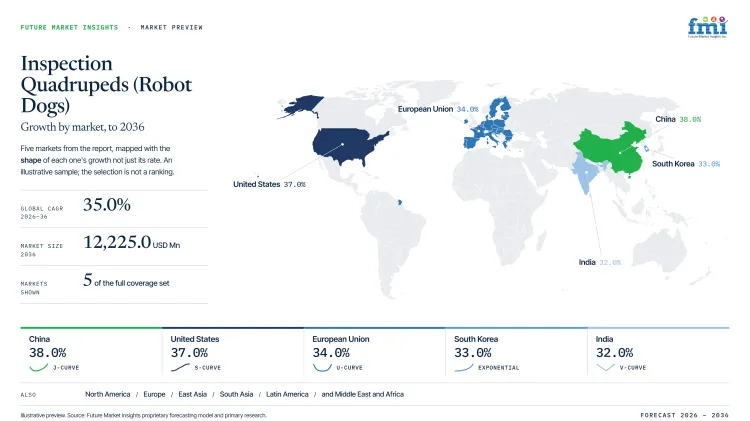
| Country | CAGR |
|---|---|
| European Union | 34.0% |
| United States | 37.0% |
| South Korea | 33.0% |
| China | 38.0% |
| India | 32.0% |
Source: Future Market Insights proprietary forecasting model and primary research
How do country-level CAGRs compare in the Inspection Quadrupeds (Robot Dogs) Market?
The country comparison spans 6.0 percentage points and reveals three clearly defined growth groups across the inspection quadrupeds (robot dogs) market. China and the United States form the upper growth tier with only 1.0 percentage point separating the two markets. The European Union and South Korea create a closely aligned middle group with a 1.0-point difference. India remains 1.0 percentage point below South Korea, creating a gradual transition across the comparison. Markets with stronger industrial automation capabilities, advanced robotics ecosystems and greater adoption of autonomous inspection technologies generally demonstrate faster market expansion.
-
China leads the comparison as industrial operators, energy companies and infrastructure owners continue expanding the use of robot dogs for autonomous inspection, hazardous site monitoring and predictive maintenance across large-scale facilities.
-
The United States remains 1.0 percentage point below China and reflects a market where utilities, defense organizations and industrial enterprises increasingly deploy inspection quadrupeds to improve worker safety and reduce manual inspection requirements.
-
The European Union begins the middle group with a 3.0-point difference from the United States, highlighting continued adoption across manufacturing plants, energy infrastructure and public utilities where operational reliability remains a priority.
-
South Korea remains 1.0 percentage point below the European Union as advanced manufacturing, semiconductor production and smart factory initiatives continue to encourage wider deployment of autonomous inspection robots.
-
India remains 1.0 percentage point below South Korea, reflecting a market where industrial digitalization, expansion of critical infrastructure and growing investment in robotics are supporting gradual adoption of inspection quadrupeds across energy, manufacturing and utility applications.
Comparable CAGRs can still produce different market entry conditions. Differences in industrial automation maturity, robotics investment, inspection requirements and workforce safety priorities influence deployment timelines and long-term adoption strategies. The full report provides country-level CAGR analysis across North America, Latin America, Europe, East Asia, South Asia, Oceania and the Middle East and Africa.
Country-wise Analysis
- United States: United States plant reliability teams evaluate route completion before approving new mobile inspection systems. Inspection quadruped demand in the United States is forecast to rise at 37.0% CAGR over the assessment period, supported by large process sites and established integration firms. The USA Bureau of Labor Statistics reported in February 2026 that manufacturing recorded 353 fatal work injuries during 2024. This record is expected to keep hazardous access reduction within plant approval cases for mobile inspection systems. Domestic projects are likely to favor rugged thermal cameras and route software that sends clear exceptions into existing maintenance systems. Service response is projected to separate national fleet providers from hardware sellers that depend on distant support.
- China: China is expected to hold a central position among industrial robot producers in East Asia through 2036. China is estimated to post 38.0% CAGR over the forecast period, reflecting large factory capacity and rapid automation investment. The National Bureau of Statistics of China reported in August 2025 that industrial robot output reached 447,121 units during January through July 2025. That production depth is expected to support local integrators and shorter hardware test cycles across industrial inspection programs. Energy and manufacturing sites are likely to compare domestic platforms with imported systems across payload quality or software access. Commercial scale is projected to depend on reliable service and route performance rather than production capacity alone.
- European Union: The European Union Machinery Regulation is projected to reshape the region’s mobile robot approval process through 2027. The European Union inspection quadruped sector is projected to record 34.0% CAGR during the assessment period, linked to worker protection and mature energy assets. Eurostat reported in January 2025 that 13.5% of European Union enterprises with at least ten employees used artificial intelligence during 2024. This adoption base is expected to support software integration yet hazardous sites still need clear safety evidence. Facility operators are likely to demand certified hardware and documented stop behavior around people during unattended inspection missions. The region’s commercial pace is anticipated to reward providers that can support long approval cycles and multi-country service.
- South Korea: South Korea’s manufacturing mix is shifting toward advanced automation at a rate that is anticipated to affect inspection purchasing. Adoption of inspection quadrupeds in South Korea is estimated to expand at 33.0% CAGR through 2036, driven by domestic engineering capacity and dense industrial sites. Invest Korea reported in May 2025 that the national plan targets deployment of one million advanced robots by 2030. That national target is expected to expand local testing skills and system integration capacity across advanced manufacturing sites. Large factories already use fixed sensors so mobile platforms must prove incremental coverage across stairs or blind areas. Commercial success is likely to depend on measured route value rather than technology novelty across sophisticated manufacturing plants.
- India: Inspection system providers in India are expected to benefit from infrastructure programs as industrial investment becomes more concentrated. Inspection quadruped demand in India is predicted to advance at 32.0% CAGR through 2036, attributable to energy and infrastructure inspection needs. The Press Information Bureau reported in August 2025 that India’s production-linked incentive program had 806 approved applications. This manufacturing activity is expected to widen the pool of sites that can test mobile inspection. Service access remains uneven across older facilities and remote energy assets outside established industrial centers. Projects linked with solar farm predictive maintenance are likely to advance where difficult terrain makes fixed coverage expensive. Local technical training is projected to decide whether early pilots become repeat missions across several operating sites.
Who are the notable companies in the Inspection Quadrupeds (Robot Dogs) Market?
Boston Dynamics, ANYbotics, Ghost Robotics, Rainbow Robotics, DEEP Robotics, and Energy Robotics are notable providers across industrial inspection and field mobility.
-market-analysis-by-company.webp "Inspection Quadrupeds (robot Dogs) Market Analysis By Company")
Competition moves from terrain demonstrations toward completed inspection work across recurring industrial routes. Platform makers need stable locomotion and payload support yet operating value depends on mission software or service response. Industrial specialists defend customer programs through hazardous-site packages and deeper plant integration across maintenance systems. Field mobility providers compete through adaptable payloads across security or remote assessment. Connections with smart camera systems increase as customers seek clearer exceptions without reviewing every image. The commercial advantage rests on repeat route performance and support depth across the operating life.
- Boston Dynamics and ANYbotics compete for enterprise facility programs through route software and broad inspection payload support. Their significance is concentrated in recurring plant missions that need fleet tools and structured data review across many assets during plant expansion.
- Ghost Robotics and DEEP Robotics compete across hazardous field routes and security work. Ghost Robotics documented refinery inspection use in September 2025 and DEEP Robotics expanded North American security inspection activity during June 2025. Both actions support clearer field relevance across refinery patrol and security inspection programs in North America.
- Rainbow Robotics and Energy Robotics compete through regional engineering access or software integration. Rainbow Robotics presented quadruped capability at Automate 2026 and Energy Robotics expanded its infrastructure inspection platform during October 2025. Their positions depend on regional customer access or integration depth across local partner networks and service channels.
Competitive Benchmarking: Inspection Quadrupeds (Robot Dogs) Market
| Company | Industrial Inspection Depth | Hazardous-Site Evidence | Data Integration Depth | Service Reach |
|---|---|---|---|---|
| Boston Dynamics | High | Medium | High | Global |
| ANYbotics | High | High | High | Global |
| Ghost Robotics | Medium | Medium | Medium | Global; North America focus |
| Rainbow Robotics | Medium | Low | Medium | Regional; Asia and North America |
| DEEP Robotics | Medium | Medium | Medium | Regional; Asia and North America |
| Energy Robotics | High | Medium | High | Regional; Europe and partner markets |
Scoring basis: High indicates repeated official evidence across several projects or official releases within the benchmark area. Medium indicates credible evidence that covers fewer projects or narrower operating conditions within this comparison. Low indicates limited official evidence for the assessed inspection use across current public materials and dated company releases.
Source: Future Market Insights
Key Developments in the Inspection Quadrupeds (Robot Dogs) Market
- In January 2026, Boston Dynamics introduced Spot and Orbit 5.1 to support more structured facility inspection workflows. Spot Cam 2 added 4K pan-tilt-zoom video with radiometric thermal and acoustic options that widen one-route inspection coverage.
- In February 2025, ANYbotics launched Data Navigator to organize condition records from repeated industrial inspection missions. The platform organizes thermal and acoustic findings with visual or gas data so maintenance teams can review asset condition across repeated missions.
- In June 2025, DEEP Robotics announced a North American partnership with Kandi Technologies for security inspection quadrupeds. The arrangement increases local sales support and system assembly for patrol or infrastructure work.
- In October 2025, Energy Robotics, secured USD 13.5 million in Series A funding for energy infrastructure inspection. The investment supports international expansion and software that combines robot fleets with artificial intelligence.
Key Players in the Inspection Quadrupeds (Robot Dogs) Market
Integrated Facility Inspection Platforms
- Boston Dynamics
- ANYbotics
- Energy Robotics
Hazardous Route and Field Mobility Providers
- Ghost Robotics
- DEEP Robotics
Regional Quadruped Platform Developers
- Rainbow Robotics
Inspection Quadrupeds (Robot Dogs) Market - Report Scope
-market-breakdown-by-sensor-payload,-application,-and-region.webp "Inspection Quadrupeds (robot Dogs) Market Breakdown By Sensor Payload, Application, And Region")
| Report Attribute | Coverage |
|---|---|
| Market Breakdown | Sensor Payload, Application, Component, End-use Industry, Business Model, and Region |
| Quantitative Units | USD million and percentage share |
| Market Definition | Four-legged mobile robots used for repeat inspection and remote assessment across industrial or infrastructure sites |
| Regions Covered | North America, Europe, East Asia, South Asia, Latin America, and Middle East and Africa |
| Countries Covered | United States, European Union, China, South Korea, India, and 20+ countries |
| Companies Profiled | Boston Dynamics, ANYbotics, Ghost Robotics, Rainbow Robotics, DEEP Robotics, and Energy Robotics |
| Approach | A hybrid bottom-up and top-down approach was applied, combining demand-side inspection requirements with supplier capabilities and country readiness factors across the forecast model. |
Inspection Quadrupeds (Robot Dogs) Market - Research Methodology
| Method | Application |
|---|---|
| Primary Research | FMI analysts gathered input from manufacturers, service providers, technology developers, distributors, end users, procurement teams, and subject-matter experts. Interviews examined purchasing decisions, product or service evaluation, adoption barriers, approval requirements, pricing considerations, and expectations for technical or commercial support. Respondents were also asked what evidence is required before a trial, pilot, or initial order develops into regular purchasing. |
| Desk Research | Desk research covered government statistics, regulatory publications, trade data, industry associations, technical literature, standards, company filings, product information, and official corporate announcements. Sources were reviewed for relevance, publication date, geographic coverage, and consistency with the defined market scope. Claims relating to performance, applications, approvals, capacity, investment, and commercial activity were retained only when supported by credible public evidence. |
| Market Sizing and Forecasting | The market model combined the baseline value with historical performance, segment structure, pricing and volume indicators, adoption levels, company participation, and country-level demand conditions. Forecast assumptions considered economic activity, investment trends, regulatory developments, technology adoption, purchasing cycles, supply availability, and barriers to wider market use. Segment and regional estimates were reconciled before the final market total was calculated. |
| Data Validation | Estimates were checked against multiple independent indicators, including public data, company activity, trade patterns, industry developments, and findings from primary interviews. Validation also tested whether products, services, applications, and company revenues fell within the defined market boundaries. Adjacent categories, unsupported claims, overlapping revenues, and activities without direct market relevance were excluded to reduce double counting and maintain consistency across segments and countries. |
Inspection Quadrupeds (Robot Dogs) Market by Segments
By Sensor Payload
- Thermal imaging
- Acoustic and ultrasonic sensing
- Gas and leak detection
- LiDAR and visual mapping
- Manipulator-equipped sensing
By Application
- Autonomous plant rounds
- Confined and hazardous inspection
- Security patrol
- Digital-twin data capture
- Emergency response
By Component
- Robot hardware
- Autonomy software
- Sensor payloads
- Docking and charging equipment
- Services and integration
By End-use Industry
- Oil, gas and chemicals
- Power and utilities
- Manufacturing
- Construction and mining
- Public safety and other uses
By Business Model
- Direct purchase
- Robotics as a Service subscription
- Lease arrangements
- Pilot programs
Inspection Quadrupeds (Robot Dogs) Market by Region:
- North America
- United States
- Canada
- Europe
- European Union
- United Kingdom
- Other Europe
- East Asia
- China
- South Korea
- Japan
- South Asia and Pacific
- India
- Southeast Asia
- Australia and New Zealand
- Latin America
- Brazil
- Mexico
- Other Latin America
- Middle East and Africa
- Gulf Cooperation Council countries
- South Africa
- Other Middle East and Africa
Research Sources and Bibliography
- ANYbotics. (2025, February 27). ANYbotics launches Data Navigator.
- Boston Dynamics. (2026, January 16). A new perspective for facilities inspection.
- Bureau of Labor Statistics. (2026, February 19). Number and rate of fatal work injuries by industry.
- DEEP Robotics. (2025, June 13). DEEP Robotics and Kandi partner for North American security inspection quadrupeds.
- Energy Robotics. (2025, October 7). Energy Robotics secures Series A funding to scale critical infrastructure inspections with AI robotics.
- Energy Information Administration. (2025, June 30). USA refining capacity largely unchanged as of January 2025.
- Eurostat. (2025, January 23). Use of artificial intelligence in enterprises reached 13.5% in 2024.
- European Union. (2023, June 29). Regulation (EU) 2023/1230 on machinery.
- Ghost Robotics. (2025, September 23). Autonomous robots for industrial inspection in hazardous zones.
- International Federation of Robotics. (2025, September 25). Global robot demand in factories doubles over ten years.
- International Labour Organization. (2024, October 18). EU-ILO partnership for safe and healthy workplaces for all.
- International Organization for Standardization. (2024, January). ISO 18646-2:2024 robotics performance criteria and related test methods for service robots.
- Invest Korea. (2025, May 9). Korea plans expanded advanced robot investment and deployment through 2030.
- National Bureau of Statistics of China. (2025, August 15). Industrial production above designated size in July 2025.
- Press Information Bureau. (2025, August 24). Production linked incentive schemes support manufacturing investment and approved applications.
- Rainbow Robotics. (2026, June 4). Rainbow Robotics at Automate 2026.
This Report Answers
- How large is the Inspection Quadrupeds (Robot Dogs) Market during 2025 and 2026?
- What valuation is forecast for 2036 and what CAGR supports that outlook?
- Why is thermal imaging expected to lead Sensor Payload revenue during 2026?
- How do autonomous plant rounds create recurring value across industrial sites?
- Why is robot hardware estimated to hold most Component spending during 2026?
- Which operating conditions support oil, gas and chemicals demand?
- What evidence should plant engineers review before expanding a pilot?
- Which competitive capabilities separate the profiled inspection quadruped providers?
Frequently Asked Questions
What is driving growth in the Inspection Quadrupeds (Robot Dogs) Market?
Recurring hazardous routes support demand as plants seek more frequent readings without routine human entry. Better mission software turns repeat walks into usable maintenance records across existing plant workflows.
Who are the key players in the Inspection Quadrupeds (Robot Dogs) Market?
Boston Dynamics and ANYbotics serve industrial facility programs through mobile platforms and structured mission software across repeat routes. Ghost Robotics and DEEP Robotics address field routes while Rainbow Robotics and Energy Robotics add regional or integration depth.
What is a notable restraint in the Inspection Quadrupeds (Robot Dogs) Market?
Doors and radio shadows can interrupt a route after a successful pilot enters normal facility operating conditions. Recovery work reduces operating value when the robot cannot dock or resume the planned mission.
Why should executives track the Inspection Quadrupeds (Robot Dogs) Market?
The category connects safety spending with maintenance productivity across difficult industrial routes that need recurring inspection coverage. Fleet expansion can change service needs and software budgets once successful pilots become scheduled work across several routes.
What business problem does the Inspection Quadrupeds (Robot Dogs) Market address?
The platform carries inspection sensors through areas that are repetitive or unsafe for people during routine facility rounds. It creates comparable route records that can support earlier review of equipment change across each monitored asset.
What should procurement leaders evaluate before selecting suppliers?
Procurement leaders should test route completion and blocked-path recovery under normal site conditions across representative operating shifts. They should review payload support and docking reliability together with local repair access across each planned facility.
What limits return on investment for purchasers?
Low mission frequency can leave the platform underused after commissioning costs are paid across the first operating period. Repeated interventions can reduce returns by adding labor to routes that were selected for automation.
How do suppliers build long-term account confidence?
Providers build confidence through repeat mission completion and clear exception records across changing site conditions. Fast field support protects inspection coverage after route or equipment layouts change across an active industrial facility.
Preview the report firsthand - request a free sample
Get SampleGet the brochure for pricing and purchase details.
Get PDFTable of Content
- Key Takeaways
- Market Size and CAGR
- Top Growth Driver
- Fastest Growing Segment
- Leading Region
- Key Companies
- Emerging Opportunities
- Executive Summary
- Global Market Outlook
- Demand-side Trends
- Supply-side Trends
- Technology Roadmap Analysis
- Analysis and Recommendations
- Analyst Perspective (What is happening? Why now? What should investors know?)
- Key Questions Answered
- How large is the market?
- What is the CAGR?
- What are key trends?
- Which region dominates?
- Who are the leaders?
- Market Overview
- Market Coverage / Taxonomy
- Market Definition / Scope / Limitations
- Research Methodology
- Chapter Orientation
- Analytical Lens and Working Hypotheses
- Market Structure, Signals, and Trend Drivers
- Benchmarking and Cross-market Comparability
- Market Sizing, Forecasting, and Opportunity Mapping
- Research Design and Evidence Framework
- Desk Research Programme (Secondary Evidence)
- Expert Input and Fieldwork (Primary Evidence)
- Tooling, Models, and Reference Databases
- Data Engineering and Model Build
- Quality Assurance and Audit Trail
- Market Background
- Market Dynamics (Drivers, Restraints, Opportunity, Trends)
- Scenario Forecast (Optimistic, Likely, Conservative)
- Impact Analysis
- AI Impact
- Sustainability Impact
- Regulatory Impact
- Technology Impact
- Consumer / Buyer Analysis
- Purchase Drivers
- Adoption Barriers
- Buyer Journey
- Opportunity Map Analysis
- Product Life Cycle Analysis
- Supply Chain Analysis
- Investment Feasibility Matrix
- Value Chain Analysis
- PESTLE and Porter's Analysis
- Regulatory Landscape
- Regional Parent Market Outlook
- Production and Consumption Statistics
- Import and Export Statistics
- Global Market Analysis and Forecast, 2021 to 2036
- Historical Market Size Value (USD Mn) Analysis, 2021 to 2025
- Current and Future Market Size Value (USD Mn) Projections, 2026 to 2036
- Y-o-Y Growth Trend Analysis
- Absolute $ Opportunity Analysis
- Global Market Pricing Analysis, 2021 to 2036
- Global Market Analysis and Forecast, By Sensor Payload, 2021 to 2036
- Introduction / Key Findings
- Historical Market Size Value (USD Mn) Analysis By Sensor Payload, 2021 to 2025
- Current and Future Market Size Value (USD Mn) Analysis and Forecast By Sensor Payload, 2026 to 2036
- Thermal imaging
- Acoustic - ultrasonic
- Gas & leak detection
- LiDAR - visual mapping
- Manipulator-equipped
- Thermal imaging
- Y-o-Y Growth Trend Analysis By Sensor Payload, 2021 to 2025
- Absolute $ Opportunity Analysis By Sensor Payload, 2026 to 2036
- Global Market Analysis and Forecast, By Application, 2021 to 2036
- Introduction / Key Findings
- Historical Market Size Value (USD Mn) Analysis By Application, 2021 to 2025
- Current and Future Market Size Value (USD Mn) Analysis and Forecast By Application, 2026 to 2036
- Autonomous plant rounds
- Confined - hazardous inspection
- Security patrol
- Digital-twin data capture
- Emergency response
- Autonomous plant rounds
- Y-o-Y Growth Trend Analysis By Application, 2021 to 2025
- Absolute $ Opportunity Analysis By Application, 2026 to 2036
- Global Market Analysis and Forecast, By Component, 2021 to 2036
- Introduction / Key Findings
- Historical Market Size Value (USD Mn) Analysis By Component, 2021 to 2025
- Current and Future Market Size Value (USD Mn) Analysis and Forecast By Component, 2026 to 2036
- Robot hardware
- Autonomy software
- Services - RaaS
- Robot hardware
- Y-o-Y Growth Trend Analysis By Component, 2021 to 2025
- Absolute $ Opportunity Analysis By Component, 2026 to 2036
- Global Market Analysis and Forecast, By End-use Industry, 2021 to 2036
- Introduction / Key Findings
- Historical Market Size Value (USD Mn) Analysis By End-use Industry, 2021 to 2025
- Current and Future Market Size Value (USD Mn) Analysis and Forecast By End-use Industry, 2026 to 2036
- Oil, gas & chemicals
- Power & utilities
- Manufacturing plants
- Construction & mining
- Public safety & others
- Oil, gas & chemicals
- Y-o-Y Growth Trend Analysis By End-use Industry, 2021 to 2025
- Absolute $ Opportunity Analysis By End-use Industry, 2026 to 2036
- Global Market Analysis and Forecast, By Business Model, 2021 to 2036
- Introduction / Key Findings
- Historical Market Size Value (USD Mn) Analysis By Business Model, 2021 to 2025
- Current and Future Market Size Value (USD Mn) Analysis and Forecast By Business Model, 2026 to 2036
- Direct purchase
- RaaS - subscription
- Lease
- Pilot programs
- Direct purchase
- Y-o-Y Growth Trend Analysis By Business Model, 2021 to 2025
- Absolute $ Opportunity Analysis By Business Model, 2026 to 2036
- Global Market Analysis and Forecast, By Region, 2021 to 2036
- Introduction
- Historical Market Size Value (USD Mn) Analysis By Region, 2021 to 2025
- Current Market Size Value (USD Mn) Analysis and Forecast By Region, 2026 to 2036
- North America
- Latin America
- Western Europe
- Eastern Europe
- East Asia
- South Asia and Pacific
- Middle East & Africa
- Market Attractiveness Analysis By Region
- North America Market Analysis and Forecast, By Country, 2021 to 2036
- Historical Market Size Value (USD Mn) Trend Analysis By Market Taxonomy, 2021 to 2025
- Market Size Value (USD Mn) Forecast By Market Taxonomy, 2026 to 2036
- By Country
- USA
- Canada
- By Sensor Payload
- By Application
- By Component
- By End-use Industry
- By Business Model
- By Country
- Market Attractiveness Analysis
- By Country
- By Sensor Payload
- By Application
- By Component
- By End-use Industry
- By Business Model
- Key Takeaways
- Latin America Market Analysis and Forecast, By Country
- Historical Market Size Value (USD Mn) Trend Analysis By Market Taxonomy, 2021 to 2025
- Market Size Value (USD Mn) Forecast By Market Taxonomy, 2026 to 2036
- By Country
- Brazil
- Mexico
- Chile
- Rest of Latin America
- By Sensor Payload
- By Application
- By Component
- By End-use Industry
- By Business Model
- By Country
- Market Attractiveness Analysis
- By Country
- By Sensor Payload
- By Application
- By Component
- By End-use Industry
- By Business Model
- Key Takeaways
- Western Europe Market Analysis and Forecast, By Country
- Historical Market Size Value (USD Mn) Trend Analysis By Market Taxonomy, 2021 to 2025
- Market Size Value (USD Mn) Forecast By Market Taxonomy, 2026 to 2036
- By Country
- Germany
- UK
- Italy
- Spain
- France
- Nordic
- BENELUX
- Rest of Western Europe
- By Sensor Payload
- By Application
- By Component
- By End-use Industry
- By Business Model
- By Country
- Market Attractiveness Analysis
- By Country
- By Sensor Payload
- By Application
- By Component
- By End-use Industry
- By Business Model
- Key Takeaways
- Eastern Europe Market Analysis and Forecast, By Country
- Historical Market Size Value (USD Mn) Trend Analysis By Market Taxonomy, 2021 to 2025
- Market Size Value (USD Mn) Forecast By Market Taxonomy, 2026 to 2036
- By Country
- Russia
- Poland
- Hungary
- Balkan & Baltic
- Rest of Eastern Europe
- By Sensor Payload
- By Application
- By Component
- By End-use Industry
- By Business Model
- By Country
- Market Attractiveness Analysis
- By Country
- By Sensor Payload
- By Application
- By Component
- By End-use Industry
- By Business Model
- Key Takeaways
- East Asia Market Analysis and Forecast, By Country
- Historical Market Size Value (USD Mn) Trend Analysis By Market Taxonomy, 2021 to 2025
- Market Size Value (USD Mn) Forecast By Market Taxonomy, 2026 to 2036
- By Country
- China
- Japan
- South Korea
- By Sensor Payload
- By Application
- By Component
- By End-use Industry
- By Business Model
- By Country
- Market Attractiveness Analysis
- By Country
- By Sensor Payload
- By Application
- By Component
- By End-use Industry
- By Business Model
- Key Takeaways
- South Asia and Pacific Market Analysis and Forecast, By Country
- Historical Market Size Value (USD Mn) Trend Analysis By Market Taxonomy, 2021 to 2025
- Market Size Value (USD Mn) Forecast By Market Taxonomy, 2026 to 2036
- By Country
- India
- ASEAN
- Australia & New Zealand
- Rest of South Asia and Pacific
- By Sensor Payload
- By Application
- By Component
- By End-use Industry
- By Business Model
- By Country
- Market Attractiveness Analysis
- By Country
- By Sensor Payload
- By Application
- By Component
- By End-use Industry
- By Business Model
- Key Takeaways
- Middle East & Africa Market Analysis and Forecast, By Country
- Historical Market Size Value (USD Mn) Trend Analysis By Market Taxonomy, 2021 to 2025
- Market Size Value (USD Mn) Forecast By Market Taxonomy, 2026 to 2036
- By Country
- Kingdom of Saudi Arabia
- Other GCC Countries
- Türkiye
- South Africa
- Other African Union
- Rest of Middle East & Africa
- By Sensor Payload
- By Application
- By Component
- By End-use Industry
- By Business Model
- By Country
- Market Attractiveness Analysis
- By Country
- By Sensor Payload
- By Application
- By Component
- By End-use Industry
- By Business Model
- Key Takeaways
- Key Countries Market Analysis
- USA
- Pricing Analysis
- Market Share Analysis, 2025
- By Sensor Payload
- By Application
- By Component
- By End-use Industry
- By Business Model
- Canada
- Pricing Analysis
- Market Share Analysis, 2025
- By Sensor Payload
- By Application
- By Component
- By End-use Industry
- By Business Model
- Mexico
- Pricing Analysis
- Market Share Analysis, 2025
- By Sensor Payload
- By Application
- By Component
- By End-use Industry
- By Business Model
- Brazil
- Pricing Analysis
- Market Share Analysis, 2025
- By Sensor Payload
- By Application
- By Component
- By End-use Industry
- By Business Model
- Chile
- Pricing Analysis
- Market Share Analysis, 2025
- By Sensor Payload
- By Application
- By Component
- By End-use Industry
- By Business Model
- Germany
- Pricing Analysis
- Market Share Analysis, 2025
- By Sensor Payload
- By Application
- By Component
- By End-use Industry
- By Business Model
- UK
- Pricing Analysis
- Market Share Analysis, 2025
- By Sensor Payload
- By Application
- By Component
- By End-use Industry
- By Business Model
- Italy
- Pricing Analysis
- Market Share Analysis, 2025
- By Sensor Payload
- By Application
- By Component
- By End-use Industry
- By Business Model
- Spain
- Pricing Analysis
- Market Share Analysis, 2025
- By Sensor Payload
- By Application
- By Component
- By End-use Industry
- By Business Model
- France
- Pricing Analysis
- Market Share Analysis, 2025
- By Sensor Payload
- By Application
- By Component
- By End-use Industry
- By Business Model
- India
- Pricing Analysis
- Market Share Analysis, 2025
- By Sensor Payload
- By Application
- By Component
- By End-use Industry
- By Business Model
- ASEAN
- Pricing Analysis
- Market Share Analysis, 2025
- By Sensor Payload
- By Application
- By Component
- By End-use Industry
- By Business Model
- Australia & New Zealand
- Pricing Analysis
- Market Share Analysis, 2025
- By Sensor Payload
- By Application
- By Component
- By End-use Industry
- By Business Model
- China
- Pricing Analysis
- Market Share Analysis, 2025
- By Sensor Payload
- By Application
- By Component
- By End-use Industry
- By Business Model
- Japan
- Pricing Analysis
- Market Share Analysis, 2025
- By Sensor Payload
- By Application
- By Component
- By End-use Industry
- By Business Model
- South Korea
- Pricing Analysis
- Market Share Analysis, 2025
- By Sensor Payload
- By Application
- By Component
- By End-use Industry
- By Business Model
- Russia
- Pricing Analysis
- Market Share Analysis, 2025
- By Sensor Payload
- By Application
- By Component
- By End-use Industry
- By Business Model
- Poland
- Pricing Analysis
- Market Share Analysis, 2025
- By Sensor Payload
- By Application
- By Component
- By End-use Industry
- By Business Model
- Hungary
- Pricing Analysis
- Market Share Analysis, 2025
- By Sensor Payload
- By Application
- By Component
- By End-use Industry
- By Business Model
- Kingdom of Saudi Arabia
- Pricing Analysis
- Market Share Analysis, 2025
- By Sensor Payload
- By Application
- By Component
- By End-use Industry
- By Business Model
- Türkiye
- Pricing Analysis
- Market Share Analysis, 2025
- By Sensor Payload
- By Application
- By Component
- By End-use Industry
- By Business Model
- South Africa
- Pricing Analysis
- Market Share Analysis, 2025
- By Sensor Payload
- By Application
- By Component
- By End-use Industry
- By Business Model
- USA
- Market Structure Analysis
- Competition Dashboard
- Competition Benchmarking
- Market Share Analysis of Top Players
- By Regional
- By Sensor Payload
- By Application
- By Component
- By End-use Industry
- By Business Model
- Emerging Startups
- Innovation Benchmarking
- Competition Analysis
- Competition Deep Dive
- Boston Dynamics Spot (US)
- Overview
- Product Portfolio
- Profitability by Market Segments
- Sales Footprint
- Strategy Overview
- Marketing Strategy
- Product Strategy
- Channel Strategy
- ANYbotics (CH)
- Ghost Robotics (US)
- Rainbow Robotics (KR)
- Boston Dynamics Spot (US)
- Case Studies
- Success Stories
- Recent Developments
- Competition Deep Dive
- Assumptions & Acronyms Used


