

- Market Size (2026)
- USD 15.8 Bn
- Forecast (2036)
- USD 42.1 Bn
- CAGR (2026 to 2036)
- 10.3%
How big is Integration Platform as a Service Market in 2026?
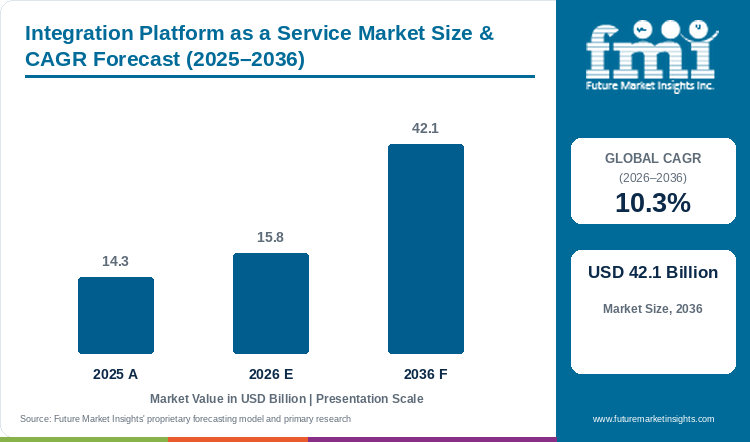
Valued at USD 14.3 billion during 2025, worldwide integration platform as a service sales are estimated at USD 15.8 billion for 2026 and are projected to hit USD 42.1 billion by the close of 2036 at an expected 10.3% CAGR.
Global integration platform as a service revenue totaled USD 14.3 billion during 2025 and is estimated at USD 15.8 billion for 2026, with Future Market Insights projecting demand to reach USD 42.1 billion by 2036 at a 10.3% CAGR expected to generate USD 26.3 billion in added annual software sales. When compared with brittle custom point-to-point integration scripts, cloud-hosted integration platforms unify pre-built protocol adapters and canonical schema mediation in one runtime that reduces developer maintenance overhead. As a result, enterprises across banking and healthcare alongside retail and manufacturing are standardizing on managed middleware, corroborated by the June 2025 European Commission State of the Digital Decade report confirming EUR 288.6 billion in national digital transformation roadmaps accelerating enterprise cloud and artificial intelligence software integration [1]. In addition to this, the application integration segment is anticipated to hold 43.3% of integration type demand in 2026 as corporations connect cloud services with core ERP databases. However, asynchronous webhook latency and unannounced breaking upstream API schema alterations remain major restraining factors hindering adoption across legacy mainframe environments.
Key Market Trends & Insights
- By integration type: Application integration is projected to secure 43.3% of 2026 category spending because managed connector libraries link customer relationship and enterprise resource databases without custom code.
- By deployment: Public cloud is expected to command 40.3% of 2026 deployment outlays as serverless execution pods scale automatically during seasonal transaction bursts.
- By enterprise size: Large enterprises are anticipated to generate 41.0% of 2026 customer billings due to multi-subsidiary governance audits across acquired software estates.
- By end use: BFSI is forecast to capture 45.1% of 2026 vertical expenditure as commercial banks connect legacy core ledgers to real-time open banking gateways.
Regional Highlights
- Leading national growth rate: Australia is projected to pace international middleware adoption with a projected 11.4% compound annual rate between 2026 and 2036 on the back of Consumer Data Right obligations across banking and energy alongside phased non-bank lending rollouts and separate My Health Record clinical exchange programs.
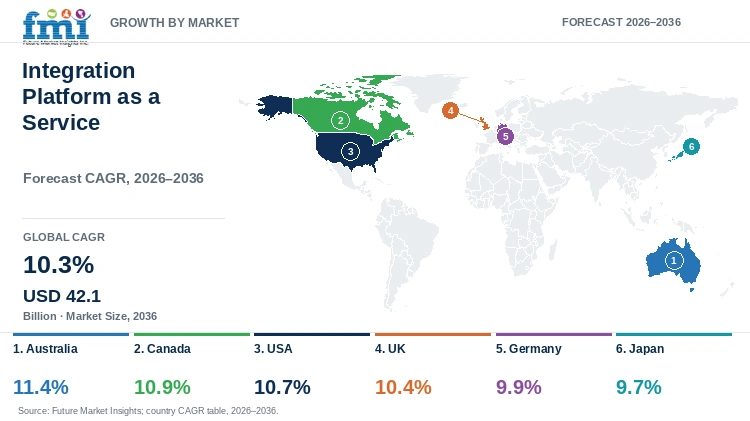
- Comparative country outlook: Canadian cloud integration spending is expected to climb by 10.9% annually while United States subscriptions are anticipated to grow at 10.7%, outpacing British demand (10.4%) and German deployments (9.9%) whereas Japanese accounts are forecast to expand at 9.7%.
Market Size & Forecast
Table 1: Market Size and Forecast for the Integration Platform as a Service Market (USD billion and CAGR percentage), 2025 to 2036
| Metric | Value |
|---|---|
| 2025 Market Size | USD 14.3 billion |
| Estimated Market Size in 2026 | USD 15.8 billion |
| Projected Market Size by 2036 | USD 42.1 billion |
| CAGR, 2026 to 2036 | 10.3% |
| Added Revenue, 2026 to 2036 | USD 26.3 billion |
Rapid deployment of departmental cloud applications across commercial corporations has created severe endpoint fragmentation and identity federation complexity. When cross-application API calls lack standardized cryptographic assertions, distributed business units face authentication failures and synchronous payload bottlenecks. August 2025 NIST Special Publication 800-63-4 guidelines defined updated cryptographic requirements for federated identity assertions across networked enterprise systems [2]. Consequently, software architects are pairing zero-trust federation brokers with cloud computing middleware to govern multi-tenant API traffic, even as high mainframe adapter licensing fees slow migration among conservative institutions.
Enterprise Endpoint Connectivity and API Transaction Throughput Sizing
Table 2: Endpoint Connectivity and API Transaction Throughput Indicators for the Integration Platform as a Service Market (USD billion and operational ranges), mixed historical and forecast years from 2025 to 2036
| Metric | 2025 | 2026 | 2036 |
|---|---|---|---|
| Market size (USD billion) | 14.3 | 15.8 | 42.1 |
| Active enterprise SaaS endpoints per organization (count) | 110 to 160 | 125 to 185 | 280 to 450 |
| Monthly processed API transactions per enterprise tenant (billion) | 1.8 to 4.5 | 2.2 to 5.8 | 8.5 to 24.0 |
| Average synchronous REST API latency overhead (milliseconds) | 85 to 140 | 75 to 120 | 25 to 45 |
Operational note: Metrics reflect managed production environments across enterprise subscribers operating multi-tenant cloud middleware. Endpoint counts represent unique authenticated software systems communicating through managed platform connectors, while monthly API transactions capture total ingress and egress payload volume.
Enterprise Platform Deployment & Subscription Procurement Sizing
Cloud integration runtimes translate incompatible SOAP and REST payloads into canonical data structures so that business transactions clear without transformation delays. Chief information officers evaluate middleware vendors on certified connector depth and sub-second webhook delivery guarantees across sovereign cloud jurisdictions. In addition to this, technology departments modernize private cloud services by routing distributed microservices through managed integration planes rather than provisioning dedicated on-premises gateway servers. This architecture lowers hardware maintenance overhead while accelerating cross-departmental workflow rollouts.
Table 3: Enterprise Platform & Subscription Procurement Indicators for the Integration Platform as a Service Market (USD and tenant counts), mixed historical and forecast years from 2025 to 2036
| Metric | 2025 | 2026 | 2036 |
|---|---|---|---|
| Qualified global enterprise tenant accounts (thousand) | 48.5 | 52.8 | 114.5 |
| Average annual iPaaS platform subscription spend per enterprise (USD) | 294,845 | 299,242 | 367,685 |
| Standard core connector subscription price band (USD/month) | 1,200 to 2,800 | 1,150 to 2,700 | 850 to 1,950 |
| Premium high-throughput financial connector price band (USD/month) | 3,800 to 7,500 | 3,650 to 7,200 | 2,400 to 5,100 |
Table 4: End-Use Sector Revenue Indicators for the Integration Platform as a Service Market (USD billion and percentages), 2026
| Metric | Value | Basis |
|---|---|---|
| Market size, 2026 | USD 15.8 billion | Report value |
| BFSI sector revenue, 2026 | USD 7.1 billion | 45.1% share |
| Application integration revenue, 2026 | USD 6.8 billion | 43.3% share |
| Public cloud deployment revenue, 2026 | USD 6.4 billion | 40.3% share |
Analyst Perspective
"Enterprise technology leaders no longer treat integration middleware as an auxiliary plumbing utility for internal IT scripts. Modern engineering teams require event-driven connectivity fabrics that mediate API schema drift while enforcing zero-trust governance across distributed microservices."
- Sudip Saha, Co-founder, FMI
How is the integration platform as a service market segmented?
The integration platform as a service market is segmented by integration type, deployment, enterprise size, and end use. In 2026, application integration is projected at 43.3%, public cloud at 40.3%, large enterprises at 41.0%, and BFSI at 45.1%.
By integration type: application integration, data integration, API management, and B2B integration.
By deployment: public cloud, private cloud, hybrid cloud, and multi-cloud.
By enterprise size: large enterprises, mid-market, small enterprises, and digital-native startups.
By end use: BFSI, retail and e-commerce, healthcare, and manufacturing.
Why does application integration lead the integration type category?
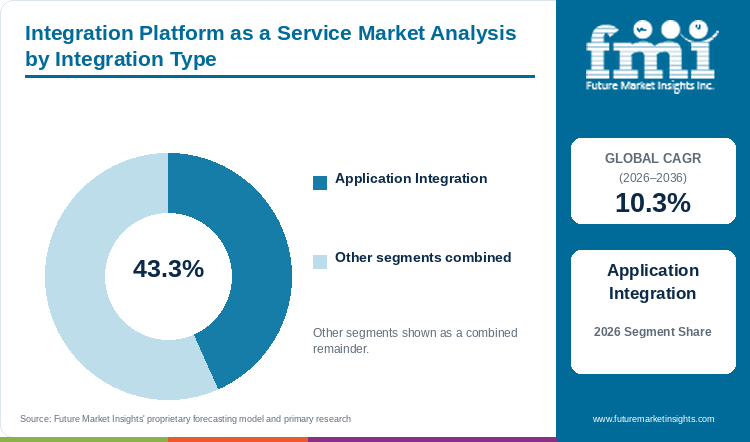
Pre-built SaaS connector libraries are projected to place application integration at 43.3% of 2026 integration type demand, supported by automated schema mediation.
Table 5: Integration Type Share for the Integration Platform as a Service Market (percentage share), 2026
| Integration Type | Share (2026) |
|---|---|
| Application Integration | 43.3% |
| Other Segments Combined | 56.7%* |
| Total | 100.0% |
*Note: Balance across remaining integration type classifications sums to 100.0% of 2026 iPaaS software turnover.
Table 6: Integration Type Leadership and Market Growth for the Integration Platform as a Service Market (segment and CAGR percentage), 2026 to 2036
| Metric | Value |
|---|---|
| Global CAGR (2026 to 2036) | 10.3% |
| Leading Segment | Application Integration |
Decoupling monolithic enterprise resource planning databases from cloud customer portals requires bidirectional protocol translation that only managed application connectors can sustain at scale. In FMI's assessment, engineering leaders prioritize application integration budgets to retire fragile point-to-point scripts across sales and billing systems. Managed REST and Model Context Protocol connectors equipped with vendor-specific schema-mediation tools map routine additive field updates and supported version increments without custom code, although unannounced breaking JSON structure changes still require manual remapping. This operational reliability is expected to keep application integration at the center of corporate middleware procurement through 2036.
- Replacing custom point-to-point scripts with managed connectors is expected to give application integration 43.3% of 2026 integration type revenue.
- Salesforce launched MuleSoft Agent Fabric in September 2025 to orchestrate and govern AI agents alongside MCP servers and API application workflows across enterprise ecosystems [3].
What drives public cloud to the forefront of the deployment segment?
Elastic serverless execution engines are expected to give public cloud 40.3% of 2026 deployment revenue, driven by multi-tenant container autoscaling.
Multi-tenant compute elasticity allows serverless integration runtimes to absorb sudden seasonal transaction spikes without over-provisioning idle on-premises hardware. Corporate technology teams adopt public cloud middleware to orchestrate distributed microservices while trimming physical data center footprints. Platform architects pair each hybrid integration platform control plane with elastic cloud queues to harmonize warehouse pipelines without managing dedicated physical clusters. Consumption-based billing is also anticipated to let mid-sized and large enterprises align middleware expenditure directly with monthly payload execution volume.
- Autoscaling multi-tenant runtimes and low infrastructure maintenance are projected to lift public cloud to 40.3% of 2026 deployment spending.
- Microsoft redesigned the Azure Logic Apps Standard workflow designer in November 2025 with 10-second auto-save draft mode and unified run-history timeline debugging [4].
How do large enterprises maintain their 41.0% share in the enterprise size segment?
Centralized multi-subsidiary governance budgets are anticipated to lift large enterprises to 41.0% of 2026 enterprise size turnover, reinforced by hybrid ERP modernization.
Multinational corporations operate hundreds of independent software applications accumulated through regional expansions and corporate acquisitions. Central IT governance teams deploy robotic process automation alongside integration runtimes to enforce endpoint rate limits and protect regulated cross-border data flows. Manual orchestration across multi-tier subsidiary environments generates severe technical debt and exposes corporate groups to statutory audit penalties. Centralized control planes allow enterprise architects to monitor transaction latency across global divisions, which is forecast to sustain large enterprise budget leadership.
- Complex hybrid software estates and mandatory cross-border compliance audits are estimated to keep large enterprises at 41.0% of 2026 enterprise size demand.
- Boomi introduced Boomi Meta Hub and the Boomi for SAP Data Connector with real-time change data capture alongside a European sovereign cloud instance in March 2026 across more than 30,000 customers [5].
What positions BFSI as the leading end use category in 2026?
Mandatory instant payment clearing rails are forecast to push BFSI to 45.1% of 2026 end use spending, enabled by open banking gateways.
Commercial banks and insurance carriers face statutory mandates to expose real-time account interfaces while preserving mainframe ledger integrity. Financial institutions combine digital commerce platform checkout rails with high-throughput middleware connectors to accelerate loan underwriting and instant clearing verifications. Certified financial adapters bridge legacy COBOL core banking databases with open API gateways under strict encryption protocols. Continuous transaction availability during peak settlement windows is predicted to compel banking CIOs to prioritize enterprise-grade integration subscriptions over custom middleware.
- Open banking compliance rules and real-time core ledger modernization are forecast to generate 45.1% of 2026 end use revenue for BFSI.
- Workato launched its Workato ONE WoW Release in August 2025 featuring Decision Models for automated Know Your Customer compliance and financial approvals built on more than 850 billion workflow actions [6].
What are the drivers, restraints, and opportunities in the integration platform as a service market?
Enterprise SaaS sprawl and real-time API clearing mandates are projected to accelerate integration platform as a service adoption through 2036, even as cross-agency governance friction creates interoperability hurdles and autonomous AI mapping copilots open new subscription tiers.
- Driver: Proliferation of containerized cloud-native workloads compels engineering leaders to deploy centralized integration platforms that replace brittle point-to-point scripts.
- Restraint: Cross-agency digital governance silos and unannounced breaking schema alterations trigger pipeline friction that inflates developer maintenance costs.
- Opportunity: Generative AI mapping assistants and Model Context Protocol servers allow non-technical business operators to assemble secure cross-app workflows.
Growth Analysis and Future Potential: Cloud Sprawl Consolidation and Event-Driven Microservices
Corporate technology departments are retiring custom point-to-point integration scripts to prevent architectural fragmentation across expanding software footprints. Uncoordinated departmental SaaS purchasing creates isolated data silos when sales and finance units deploy incompatible cloud tools. Future Market Insights analysts note that enterprise migration toward AI platform infrastructures is expected to accelerate procurement of event-driven middleware connectors. In January 2026, the Cloud Native Computing Foundation reported in its annual survey that 82.0% of container users run Kubernetes in production as the foundational operating layer for cloud-native and AI workloads [7]. Standardized integration runtimes eliminate manual batch uploads while preserving transactional consistency across distributed corporate databases.
Risk Assessment and Operational Hurdles: Interoperability Silos and Breaking Schema Alterations
Fragmented data governance rules and unannounced breaking payload schema alterations represent persistent operational hurdles for enterprise and public-sector integration teams. Legacy application databases enforce rigid field structures that cause cascading synchronization errors whenever connected portals overhaul metadata formats. In June 2026, the Organisation for Economic Co-operation and Development published its Digital Government Outlook 2026 highlighting single digital gateway interoperability and cross-organization data-sharing governance barriers [8]. Platform engineers encounter severe latency bottlenecks when linking high-frequency project management software pipelines to legacy on-premises databases. While managed connectors absorb minor additive field updates, unannounced breaking JSON schema alterations or endpoint deprecations outside supported adapter versions still halt downstream recipes and require manual developer remediation.
Commercial Opportunity Analysis: Autonomous AI Connectors and Pre-Built Domain Recipes
Middleware software vendors are capturing incremental recurring revenue by embedding generative artificial intelligence copilots that synthesize data transformation mappings automatically. Natural language recipe builders convert plain-text business rules into production integration flows so line-of-business analysts can deploy secure automations without writing code. During October 2025, Informatica announced its Fall 2025 Intelligent Data Management Cloud release featuring autonomous CLAIRE Agents alongside no-code AI Agent Engineering and Informatica MCP Servers [9]. Software providers also bundle pre-configured vertical software integration templates tailored for healthcare claims adjudication and retail order routing. Delivering vertical-specific connector packs is projected to allow vendors to command premium subscription pricing while reducing professional services implementation timelines.
Integration Platform as a Service Market by Country (2026 to 2036)
Consumer Data Right API obligations across financial and energy sectors alongside separate digital health interoperability programs are projected to push Australia to an 11.4% CAGR through 2036, followed by Canadian hybrid cloud rollouts (expected at 10.9%) and American FedNow clearing integrations (anticipated at 10.7%) alongside British (10.4%) and German (9.9%) deployments while Japanese mainframe modernizations are forecast to expand at 9.7%. Sovereign data residency statutes and real-time banking interoperability requirements govern vendor qualification across all major regional markets.
Table 7: Country CAGR and Primary Growth Levers for the Integration Platform as a Service Market (CAGR percentage and operational drivers), 2026 to 2036
| Country | CAGR (2026 to 2036) | Primary Growth Lever |
|---|---|---|
| Australia | 11.4% | ACCC Consumer Data Right rollouts in banking, energy, and non-bank lending plus separate My Health Record FHIR programs |
| Canada | 10.9% | Pan-Canadian hybrid financial API networks and federal bilingual public cloud mandates |
| USA | 10.7% | FedNow instant payments integration and multi-cloud SaaS sprawl consolidation across enterprises |
| UK | 10.4% | Open Banking standard compliance and fintech middleware orchestration across financial hubs |
| Germany | 9.9% | Industrie 4.0 shop-floor ERP connectivity and Gaia-X sovereign cloud integration standards |
| Japan | 9.7% | METI digital governance mandates and legacy mainframe modernisation across manufacturing groups |
Source: Future Market Insights analysis
Australia Integration Platform as a Service Market Outlook (2026 to 2036)
Unlike the broader global market where corporate SaaS consolidation drives voluntary middleware adoption, Australia enforces sector-specific Consumer Data Right API sharing across banking and energy alongside separate federal healthcare interoperability programs. Australian banks and energy retailers are extending accredited Consumer Data Right endpoints as product data sharing obligations commenced for non-bank lenders in July 2026 ahead of consumer data sharing in November 2026 under Australian Competition and Consumer Commission rules [10]. Simultaneously, diagnostic laboratories deploy FHIR connectors under the Modernising My Health Record Sharing by Default Act 2025. Australian integration platform as a service revenue is projected to expand at an 11.4% annual pace to 2036, as Privacy Act residency audits favor Sydney and Melbourne cloud pods.
Key takeaway: In Australia, sector-specific Consumer Data Right obligations in finance and energy alongside separate My Health Record sharing-by-default rules drive sovereign API middleware adoption.
Canada Integration Platform as a Service Market Outlook (2026 to 2036)
Canadian integration platform as a service spending is expected to advance at a 10.9% yearly rate through 2036 while federal digital-government procurement and pan-Canadian open banking networks scale. Domestic middleware architecture in Canada differs from single-language international cloud deployments through its mandatory combination of bilingual French-English payload schemas and provincial privacy impact assessment rules under Quebec Law 25. The January 2025 CCCS National Cyber Threat Assessment 2025-2026 flagged critical infrastructure exposure across third-party cloud service integrations and digital supply chains [11]. Dual-language metadata governance and interprovincial privacy audits create compliance friction for smaller foreign suppliers, favoring middleware vendors that operate localized Toronto and Montreal availability zones.
Key takeaway: In Canada, public sector cloud procurement rules and provincial privacy governance sustain demand for localized bilingual integration platforms.
USA Integration Platform as a Service Market Outlook (2026 to 2036)
In January 2026, Federal Reserve Financial Services published its FedNow Service 2025 recap documenting rapid instant payment routing expansion across participating depository institutions [12]. Whereas international middleware buyers typically connect a single core ERP to regional banking rails, United States corporations must orchestrate hundreds of best-of-breed departmental SaaS apps alongside dual FedNow and RTP instant clearing networks. This extreme multi-cloud endpoint density is anticipated to propel United States integration platform as a service billings at a 10.7% yearly pace to 2036. Frequent unannounced third-party SaaS API deprecations still disrupt production pipelines across American enterprises, leading software engineering teams to deploy automated schema validation proxies and self-healing connectors.
Key takeaway: In the USA, FedNow instant payment rails and multi-cloud software consolidation drive high-throughput enterprise middleware contracts.
UK Integration Platform as a Service Market Outlook (2026 to 2036)
High commercial uptake of cloud backup synchronization and regulated fintech APIs across London financial hubs differentiates the United Kingdom from continental European middleware markets that remain centered on batch legacy transfers. British retail banks and merchant enterprises rely on sub-second API orchestration to synchronize cloud databases and supplier networks without settlement bottlenecks. Consequently, British integration platform as a service expenditure is predicted to grow at a 10.4% CAGR from 2026 to 2036. In June 2025, the UK Cyber Security Breaches Survey 2025 reported that 71.0% of UK businesses back up data securely via cloud services while 45.0% of large firms review immediate supplier digital integration risks [13]. Post-Brexit regulatory divergence and Financial Conduct Authority operational resilience audits still lengthen procurement cycles.
Key takeaway: In the UK, cloud data synchronization maturity and supplier governance rules prioritize high-throughput API gateway subscriptions.
Germany Integration Platform as a Service Market Outlook (2026 to 2036)
Germany diverges from service-sector cloud middleware markets because domestic demand is anchored in linking shop-floor programmable logic controllers with SAP ERP instances across Mittelstand automotive and machinery plants. European Commission analysts noted in the September 2025 Germany Digital Decade Country Report that Berlin committed EUR 102.1 billion across 50 digital transformation measures and 652 edge nodes [14]. Bridging factory OPC UA machine protocols with sovereign cloud databases is forecast to lift German integration platform as a service turnover by a 9.9% compound annual rate to 2036. Strict European General Data Protection Regulation audits and works-council rules against external cloud telemetry still slow public cloud adoption, prompting German manufacturers to install Gaia-X compatible hybrid runtime agents.
Key takeaway: In Germany, Industrie 4.0 shop-floor connectivity and strict data sovereignty audits compel manufacturers to install hybrid integration runtimes.
Japan Integration Platform as a Service Market Outlook (2026 to 2036)
Decades-old bespoke COBOL mainframes and acute domestic IT workforce shortages make Japan structurally distinct from Western markets where packaged SaaS applications predominate. Japanese banking and manufacturing conglomerates must wrap customized legacy core systems in non-intrusive REST APIs rather than executing risky rip-and-replace database migrations. Supported by government digital-cliff modernization incentives, Japanese integration platform as a service sales are estimated to rise at a 9.7% annual rate over the decade. Japan's METI Legacy Systems Modernization Committee issued a comprehensive May 2025 report urging domestic corporations to standardize APIs and eliminate legacy mainframe debt [15]. Deep reliance on domestic systems integrators still slows direct vendor sales, prompting middleware providers to co-develop Japanese-language mainframe adapters with Tokyo SI partners.
Key takeaway: In Japan, legacy mainframe modernization policies and engineering talent shortages accelerate enterprise adoption of low-code integration platforms.
Full report country CAGRs cover: North America; Latin America; Western Europe; Eastern Europe; East Asia; South Asia and Pacific; Middle East and Africa.
Who are the notable companies in the integration platform as a service market?
MuleSoft (Salesforce, Inc.), Workato, Inc., Boomi, LP, Informatica Inc., SnapLogic, Inc., Celigo, Inc., Jitterbit, Inc., and Microsoft Corporation (Azure Logic Apps) are the notable companies in the integration platform as a service market.
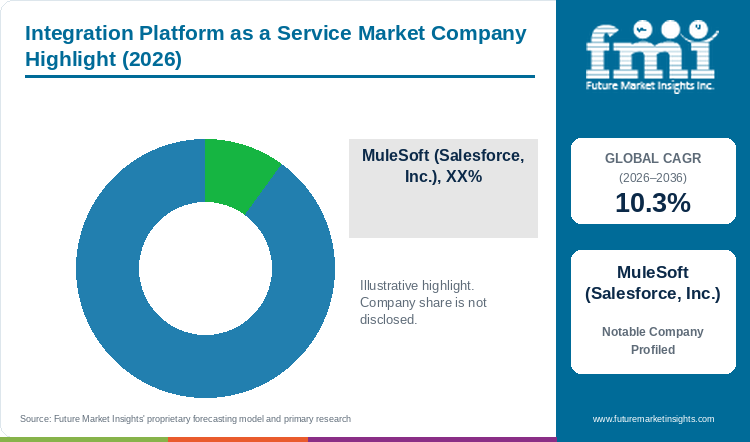
Vendor evaluations by Future Market Insights show that competition splits between hyperscale enterprise software ecosystems and agile pure-play cloud middleware specialists. Pure-play vendors modernize industrial automation and enterprise software connectivity by supplying low-code recipe builders and autonomous schema mappers that decouple monolithic legacy databases. Conversely, global enterprise platform providers bundle full-lifecycle API governance with distributed master data synchronization across multinational cloud estates. Chief information officers select suppliers based on certified ERP connector depth and sub-second execution latency alongside automated dead-letter queue recovery.
- Enterprise API & Ecosystem Orchestration Leaders: MuleSoft (Salesforce) and Boomi alongside Microsoft Corporation (Azure Logic Apps) deliver enterprise connectivity suites with certified ERP adapters and multi-cloud governance planes.
- Autonomous Workflow & Modern iPaaS Innovators: Workato and SnapLogic together with Celigo supply low-code automation studios and generative AI recipe builders for rapid cross-departmental deployment.
- Hybrid Data Management & Mid-Market Integration Platforms: Informatica and Jitterbit specialize in high-volume master data synchronization and hybrid cloud gateways for mid-market and large enterprise accounts.
Competitive Benchmarking: Integration Platform as a Service Market
Table 8: Competitive Benchmarking for the Integration Platform as a Service Market (qualitative capability ratings), 2026
| Company | Hybrid Multi-Cloud Connectivity | API Lifecycle & Governance Depth | Enterprise ERP & CRM Pre-Built Connectors | Geographic Reach |
|---|---|---|---|---|
| MuleSoft (Salesforce, Inc.) | High | High | High | High |
| Workato, Inc. | High | High | High | High |
| Boomi, LP | High | High | High | High |
| Informatica Inc. | High | High | High | High |
| SnapLogic, Inc. | High | Medium | High | High |
| Celigo, Inc. | Medium | Medium | High | High |
| Jitterbit, Inc. | Medium | Medium | High | Medium |
| Microsoft Corporation (Azure Logic Apps) | High | High | High | High |
Scoring basis: Hybrid multi-cloud connectivity earns a High rating when public platform documentation confirms native runtime execution across AWS and Azure alongside private data centers. API lifecycle and governance depth is rated High when the software includes automated rate limiting and microservices traffic routing. Enterprise ERP and CRM pre-built connectors receives a High mark where the vendor maintains certified bidirectional adapters for SAP and Salesforce, while Geographic Reach reflects regional data residency pods across continents.
Key Developments in the Integration Platform as a Service Market
- In January 2026, Salesforce expanded MuleSoft Agent Fabric with automated Agent Scanners that catalog AI agents and MCP servers across Agentforce alongside Amazon Bedrock and Google Cloud Vertex AI [16].
- In May 2026, Boomi unveiled Boomi Connect featuring more than 1,000 managed MCP-enabled integration tools alongside Boomi AI Gateway and Distributed Agent Runtime [17].
- In May 2026, Workato detailed more than 1,000 annual platform enhancements on Workato ONE spanning Enterprise MCP Gateway and Agent Studio alongside Managed File Transfer and Workato EDI [18].
Key Players in the Integration Platform as a Service Market
Enterprise API & Ecosystem Orchestration Leaders
- MuleSoft (Salesforce, Inc.)
- Boomi, LP
- Microsoft Corporation (Azure Logic Apps)
Autonomous Workflow & Modern iPaaS Innovators
- Workato, Inc.
- SnapLogic, Inc.
- Celigo, Inc.
Hybrid Data Management & Mid-Market Integration Platforms
- Informatica Inc.
- Jitterbit, Inc.
Integration Platform as a Service Market - Report Scope
Table 9: Report Scope for the Integration Platform as a Service Market (coverage fields and definitions), 2026 to 2036
| Coverage field | Report scope |
|---|---|
| Market breakdown | Integration Type; Deployment; Enterprise Size; End Use; Region |
| Quantitative Units | USD Billion |
| Market Definition | Includes B2B enterprise software subscription and consumption revenue from cloud-hosted integration platforms providing application integration, data integration, API management, and B2B EDI workflows. Category Scope Note: The valuation strictly captures managed multi-tenant and hybrid cloud iPaaS control-plane subscriptions, excluding unmanaged open-source integration libraries, standalone on-premises enterprise service bus (ESB) hardware appliances, and third-party IT systems integration consulting fees. |
| Regions Covered | North America; Latin America; Western Europe; Eastern Europe; East Asia; South Asia and Pacific; Middle East and Africa |
| Countries Covered | Australia, Canada, USA, UK, Germany, Japan, and additional countries in the full report |
| Key Companies Covered | MuleSoft (Salesforce, Inc.), Workato, Inc., Boomi, LP, Informatica Inc., SnapLogic, Inc., Celigo, Inc., Jitterbit, Inc., Microsoft Corporation (Azure Logic Apps) |
| Forecast Period | 2026 to 2036 |
| Approach | Primary and secondary research with top-down and bottom-up market triangulation. |
Integration Platform as a Service Market - Research Methodology
Table 10: Research Methodology for the Integration Platform as a Service Market (research methods and approach), 2026 edition
| Method | Approach |
|---|---|
| Primary Research | Primary interviews were conducted with enterprise chief information officers, cloud integration architects, API platform directors, and middleware procurement leads to validate connector utilization and subscription pricing tiers. |
| Secondary Research | Secondary research included vendor financial filings, European Commission Digital Decade reports, NIST SP 800-63-4 digital identity guidelines, Cloud Native Computing Foundation surveys, OECD Digital Government Outlook publications, ACCC Consumer Data Right documentation, and national digital economy statistics. |
| Market Sizing and Forecasting | Market sizing and forecasting for the 2026 to 2036 period were developed using top-down and bottom-up econometric models reconciling active enterprise tenant counts, average annual subscription spend, and API transaction volumes. |
| Data Triangulation and Validation | Revenue estimates were triangulated against corporate SaaS adoption registries and public cloud infrastructure expenditure while strictly excluding standalone IT consulting and custom systems integration labor. |
| Country Forecasting Model | Country-level CAGRs were modeled against the 10.3% global baseline by weighting sector-specific open-banking and Consumer Data Right API mandates, sovereign cloud residency rules, instant payment clearing volumes, and enterprise hybrid cloud migration rates. |
| Operational Benchmark Traceability | Operational indicators in Tables 2, 3, and 4 (active SaaS endpoints per tenant, monthly API transaction volumes, REST latency overhead, and connector price bands) are synthesized from European Commission, NIST, CNCF, OECD, and vendor telemetry disclosures. |
Integration Platform as a Service Market by Segments
Integration Platform as a Service Market segmented by Integration Type:
- Application Integration
- Data Integration
- API Management
- B2B Integration
Integration Platform as a Service Market segmented by Deployment:
- Public Cloud
- Private Cloud
- Hybrid Cloud
- Multi-Cloud
Integration Platform as a Service Market segmented by Enterprise Size:
- Large Enterprises
- Mid-Market
- Small Enterprises
- Digital-Native Startups
Integration Platform as a Service Market segmented by End Use:
- BFSI
- Retail and E-commerce
- Healthcare
- Manufacturing
Integration Platform as a Service Market by Region
- North America
- USA
- Canada
- Latin America
- Brazil
- Mexico
- Western Europe
- Germany
- UK
- France
- Italy
- Spain
- Eastern Europe
- Poland
- Czech Republic
- East Asia:
- Japan
- South Korea
- China
- South Asia and Pacific
- Australia
- India
- Singapore
- Middle East and Africa
- GCC Countries
- South Africa
Research Sources and Bibliography
- [1] European Commission. (2025, June 16). State of the Digital Decade 2025 report. Directorate-General for Communications Networks, Content and Technology.
- [2] National Institute of Standards and Technology (NIST). (2025, August 1). NIST SP 800-63-4: Digital Identity Guidelines. U.S. Department of Commerce.
- [3] Salesforce, Inc. (2025, September 25). Salesforce Launches MuleSoft Agent Fabric to Orchestrate and Govern Any AI Agent Across the Agentic Enterprise. Salesforce News & Insights.
- [4] Microsoft Corporation. (2025, November 18). Moving the Logic Apps Designer Forward. Microsoft Community Hub.
- [5] Boomi, LP. (2026, March 9). Boomi Activates Data for the Enterprise. Boomi Newsroom.
- [6] Workato, Inc. (2025, August 19). Workato ONE : The WoW Release. Workato Blog.
- [7] Cloud Native Computing Foundation (CNCF). (2026, January 20). The CNCF Annual Cloud Native Survey: The Infrastructure of AI's Future. The Linux Foundation.
- [8] Organisation for Economic Co-operation and Development (OECD). (2026, June 15). Digital Government Outlook 2026. OECD Publishing.
- [9] Informatica Inc. (2025, October 29). Informatica Announces Fall 2025 Release with Latest Innovations to Intelligent Data Management Cloud. Informatica News Releases.
- [10] Australian Competition and Consumer Commission (ACCC). (2026, July 13). The Consumer Data Right. Commonwealth of Australia.
- [11] Canadian Centre for Cyber Security (CCCS). (2025, January 28). National Cyber Threat Assessment 2025-2026. Government of Canada.
- [12] Federal Reserve Financial Services. (2026, January 15). Infographic: FedNow Service 2025 recap. Federal Reserve Banks.
- [13] Department for Science, Innovation and Technology (DSIT) & Home Office. (2025, June 19). Cyber security breaches survey 2025. GOV.UK Official Statistics.
- [14] European Commission. (2025, September 2). Germany 2025 Digital Decade Country Report. Shaping Europe's digital future.
- [15] Ministry of Economy, Trade and Industry (METI). (2025, May 28). Comprehensive Report Compiled by the Legacy Systems Modernization Committee to Eliminate Legacy Systems. Government of Japan.
- [16] Salesforce, Inc. (2026, January 22). Salesforce Expands MuleSoft Agent Fabric with Automated Discovery for Any AI Agent or Tool. Salesforce News & Insights.
- [17] Boomi, LP. (2026, May 13). Boomi Unveils Innovations That Power the Agentic Enterprise. Boomi Newsroom.
- [18] Workato, Inc. (2026, May 27). Workato Named Gartner Magic Quadrant iPaaS Leader in 2026. Workato Blog.
- [19] SnapLogic, Inc. (2026, August 13). The August 2026 Product Release: Bringing Agentic Integration Into Production. SnapLogic Blog.
- [20] Celigo, Inc. (2026, May 27). Celigo May 2026 Release. Celigo Builder's Hub.
- [21] Informatica Inc. (2025, May 14). Informatica Unveils Agentic AI Offerings on Its AI-Powered Cloud Data Management Platform. Informatica News Releases.
This bibliography is provided for reader reference and is not exhaustive. The full report contains the complete reference list and detailed citations.
This Report Answers
- How large is the integration platform as a service market in 2026 and what is forecast for 2036?
- Which cloud application sprawl factors support demand for integration platform as a service?
- Why does application integration lead the integration type category?
- Why do large enterprises lead the enterprise size category globally?
- How do middleware growth rates differ across Australia, Canada, the USA, the UK, Germany, and Japan?
- Which leading companies supply pre-built connectors, event streams, and automation recipes today?
- What limits adoption or vendor switching in the integration platform as a service market?
- What should IT leaders evaluate before purchasing an integration platform as a service subscription?
Frequently Asked Questions
How big is the integration platform as a service market in 2026, and what is forecast for 2036?
Global integration platform as a service subscriptions are estimated at USD 15.8 billion in 2026 (up from USD 14.3 billion during 2025) and are projected to reach USD 42.1 billion by 2036 as enterprises consolidate SaaS sprawl onto managed connector runtimes.
What is the CAGR for the integration platform as a service market from 2026 to 2036?
Future Market Insights projects a 10.3% compound annual growth rate between 2026 and 2036, which is expected to deliver an increase in annual market revenue of USD 26.3 billion between 2026 and 2036 as event-driven microservices replace custom point-to-point scripts.
Which integration type segment leads the integration platform as a service market?
Application integration is anticipated to capture 43.3% of 2026 integration type demand because pre-built SaaS adapters automate bidirectional schema mediation for supported CRM and ERP version updates while reducing custom connector maintenance.
Which deployment segment leads the integration platform as a service market?
Public cloud is expected to command 40.3% of 2026 deployment spending as serverless multi-tenant execution planes autoscale during peak payload windows while eliminating on-premises gateway hardware.
Which country has a notable growth outlook during the assessment period?
As per FMI, Australia is forecast to lead national expansion with an 11.4% CAGR from 2026 to 2036, supported by Consumer Data Right API obligations in banking, energy, and non-bank lending alongside separate My Health Record clinical exchange programs.
Who are the key players in the market?
Active vendors include MuleSoft (Salesforce, Inc.), Workato, Inc., Boomi, LP, Informatica Inc., SnapLogic, Inc., Celigo, Inc., Jitterbit, Inc., and Microsoft Corporation (Azure Logic Apps), supplying pre-built ERP connectors and generative AI mapping tools.
Preview the report firsthand - request a free sample
Get SampleGet the brochure for pricing and purchase details.
Get PDFTable of Content
- Key Takeaways
- Market Size and CAGR
- Top Growth Driver
- Fastest Growing Segment
- Leading Region
- Key Companies
- Emerging Opportunities
- Executive Summary
- Global Market Outlook
- Demand-side Trends
- Supply-side Trends
- Technology Roadmap Analysis
- Analysis and Recommendations
- Analyst Perspective (What is happening? Why now? What should investors know?)
- Key Questions Answered
- How large is the market?
- What is the CAGR?
- What are key trends?
- Which region dominates?
- Who are the leaders?
- Market Overview
- Market Coverage / Taxonomy
- Market Definition / Scope / Limitations
- Research Methodology
- Chapter Orientation
- Analytical Lens and Working Hypotheses
- Market Structure, Signals, and Trend Drivers
- Benchmarking and Cross-market Comparability
- Market Sizing, Forecasting, and Opportunity Mapping
- Research Design and Evidence Framework
- Desk Research Programme (Secondary Evidence)
- Expert Input and Fieldwork (Primary Evidence)
- Tooling, Models, and Reference Databases
- Data Engineering and Model Build
- Quality Assurance and Audit Trail
- Market Background
- Market Dynamics (Drivers, Restraints, Opportunity, Trends)
- Scenario Forecast (Optimistic, Likely, Conservative)
- Impact Analysis
- AI Impact
- Sustainability Impact
- Regulatory Impact
- Technology Impact
- Consumer / Buyer Analysis
- Purchase Drivers
- Adoption Barriers
- Buyer Journey
- Opportunity Map Analysis
- Product Life Cycle Analysis
- Supply Chain Analysis
- Investment Feasibility Matrix
- Value Chain Analysis
- PESTLE and Porter's Analysis
- Regulatory Landscape
- Regional Parent Market Outlook
- Production and Consumption Statistics
- Import and Export Statistics
- Global Market Analysis and Forecast, 2021 to 2036
- Historical Market Size Value (USD Billion) Analysis, 2021 to 2025
- Current and Future Market Size Value (USD Billion) Projections, 2026 to 2036
- Y-o-Y Growth Trend Analysis
- Absolute $ Opportunity Analysis
- Global Market Pricing Analysis, 2021 to 2036
- Global Market Analysis and Forecast, By Integration Type, 2021 to 2036
- Introduction / Key Findings
- Historical Market Size Value (USD Billion) Analysis By Integration Type, 2021 to 2025
- Current and Future Market Size Value (USD Billion) Analysis and Forecast By Integration Type, 2026 to 2036
- Application Integration
- Data Integration
- API Management
- B2B Integration
- Y-o-Y Growth Trend Analysis By Integration Type, 2021 to 2025
- Absolute $ Opportunity Analysis By Integration Type, 2026 to 2036
- Global Market Analysis and Forecast, By Deployment, 2021 to 2036
- Introduction / Key Findings
- Historical Market Size Value (USD Billion) Analysis By Deployment, 2021 to 2025
- Current and Future Market Size Value (USD Billion) Analysis and Forecast By Deployment, 2026 to 2036
- Public Cloud
- Private Cloud
- Hybrid Cloud
- Multi-Cloud
- Y-o-Y Growth Trend Analysis By Deployment, 2021 to 2025
- Absolute $ Opportunity Analysis By Deployment, 2026 to 2036
- Global Market Analysis and Forecast, By Enterprise Size, 2021 to 2036
- Introduction / Key Findings
- Historical Market Size Value (USD Billion) Analysis By Enterprise Size, 2021 to 2025
- Current and Future Market Size Value (USD Billion) Analysis and Forecast By Enterprise Size, 2026 to 2036
- Large Enterprises
- Mid-Market
- Small Enterprises
- Digital-Native Startups
- Y-o-Y Growth Trend Analysis By Enterprise Size, 2021 to 2025
- Absolute $ Opportunity Analysis By Enterprise Size, 2026 to 2036
- Global Market Analysis and Forecast, By End Use, 2021 to 2036
- Introduction / Key Findings
- Historical Market Size Value (USD Billion) Analysis By End Use, 2021 to 2025
- Current and Future Market Size Value (USD Billion) Analysis and Forecast By End Use, 2026 to 2036
- BFSI
- Retail and E-commerce
- Healthcare
- Manufacturing
- Y-o-Y Growth Trend Analysis By End Use, 2021 to 2025
- Absolute $ Opportunity Analysis By End Use, 2026 to 2036
- Global Market Analysis and Forecast, By Region, 2021 to 2036
- Introduction
- Historical Market Size Value (USD Billion) Analysis By Region, 2021 to 2025
- Current Market Size Value (USD Billion) Analysis and Forecast By Region, 2026 to 2036
- North America
- Latin America
- Western Europe
- Eastern Europe
- South Asia and Pacific
- Middle East and Africa
- Market Attractiveness Analysis By Region
- North America Market Analysis and Forecast, By Country, 2021 to 2036
- Historical Market Size Value (USD Billion) Trend Analysis By Market Taxonomy, 2021 to 2025
- Market Size Value (USD Billion) Forecast By Market Taxonomy, 2026 to 2036
- By Country
- USA
- Canada
- By Integration Type
- By Deployment
- By Enterprise Size
- By End Use
- By Country
- Market Attractiveness Analysis
- By Country
- By Integration Type
- By Deployment
- By Enterprise Size
- By End Use
- Key Takeaways
- Latin America Market Analysis and Forecast, By Country
- Historical Market Size Value (USD Billion) Trend Analysis By Market Taxonomy, 2021 to 2025
- Market Size Value (USD Billion) Forecast By Market Taxonomy, 2026 to 2036
- By Country
- Brazil
- Mexico
- By Integration Type
- By Deployment
- By Enterprise Size
- By End Use
- By Country
- Market Attractiveness Analysis
- By Country
- By Integration Type
- By Deployment
- By Enterprise Size
- By End Use
- Key Takeaways
- Western Europe Market Analysis and Forecast, By Country
- Historical Market Size Value (USD Billion) Trend Analysis By Market Taxonomy, 2021 to 2025
- Market Size Value (USD Billion) Forecast By Market Taxonomy, 2026 to 2036
- By Country
- Germany
- UK
- France
- Italy
- Spain
- By Integration Type
- By Deployment
- By Enterprise Size
- By End Use
- By Country
- Market Attractiveness Analysis
- By Country
- By Integration Type
- By Deployment
- By Enterprise Size
- By End Use
- Key Takeaways
- Eastern Europe Market Analysis and Forecast, By Country
- Historical Market Size Value (USD Billion) Trend Analysis By Market Taxonomy, 2021 to 2025
- Market Size Value (USD Billion) Forecast By Market Taxonomy, 2026 to 2036
- By Country
- Poland
- Czech Republic
- East Asia:
- Japan
- South Korea
- China
- By Integration Type
- By Deployment
- By Enterprise Size
- By End Use
- By Country
- Market Attractiveness Analysis
- By Country
- By Integration Type
- By Deployment
- By Enterprise Size
- By End Use
- Key Takeaways
- South Asia and Pacific Market Analysis and Forecast, By Country
- Historical Market Size Value (USD Billion) Trend Analysis By Market Taxonomy, 2021 to 2025
- Market Size Value (USD Billion) Forecast By Market Taxonomy, 2026 to 2036
- By Country
- Australia
- India
- Singapore
- By Integration Type
- By Deployment
- By Enterprise Size
- By End Use
- By Country
- Market Attractiveness Analysis
- By Country
- By Integration Type
- By Deployment
- By Enterprise Size
- By End Use
- Key Takeaways
- Middle East and Africa Market Analysis and Forecast, By Country
- Historical Market Size Value (USD Billion) Trend Analysis By Market Taxonomy, 2021 to 2025
- Market Size Value (USD Billion) Forecast By Market Taxonomy, 2026 to 2036
- By Country
- GCC Countries
- South Africa
- By Integration Type
- By Deployment
- By Enterprise Size
- By End Use
- By Country
- Market Attractiveness Analysis
- By Country
- By Integration Type
- By Deployment
- By Enterprise Size
- By End Use
- Key Takeaways
- Key Countries Market Analysis
- USA
- Pricing Analysis
- Market Share Analysis, 2025
- By Integration Type
- By Deployment
- By Enterprise Size
- By End Use
- Canada
- Pricing Analysis
- Market Share Analysis, 2025
- By Integration Type
- By Deployment
- By Enterprise Size
- By End Use
- Mexico
- Pricing Analysis
- Market Share Analysis, 2025
- By Integration Type
- By Deployment
- By Enterprise Size
- By End Use
- Brazil
- Pricing Analysis
- Market Share Analysis, 2025
- By Integration Type
- By Deployment
- By Enterprise Size
- By End Use
- Germany
- Pricing Analysis
- Market Share Analysis, 2025
- By Integration Type
- By Deployment
- By Enterprise Size
- By End Use
- UK
- Pricing Analysis
- Market Share Analysis, 2025
- By Integration Type
- By Deployment
- By Enterprise Size
- By End Use
- Italy
- Pricing Analysis
- Market Share Analysis, 2025
- By Integration Type
- By Deployment
- By Enterprise Size
- By End Use
- Spain
- Pricing Analysis
- Market Share Analysis, 2025
- By Integration Type
- By Deployment
- By Enterprise Size
- By End Use
- France
- Pricing Analysis
- Market Share Analysis, 2025
- By Integration Type
- By Deployment
- By Enterprise Size
- By End Use
- India
- Pricing Analysis
- Market Share Analysis, 2025
- By Integration Type
- By Deployment
- By Enterprise Size
- By End Use
- China
- Pricing Analysis
- Market Share Analysis, 2025
- By Integration Type
- By Deployment
- By Enterprise Size
- By End Use
- Japan
- Pricing Analysis
- Market Share Analysis, 2025
- By Integration Type
- By Deployment
- By Enterprise Size
- By End Use
- South Korea
- Pricing Analysis
- Market Share Analysis, 2025
- By Integration Type
- By Deployment
- By Enterprise Size
- By End Use
- Poland
- Pricing Analysis
- Market Share Analysis, 2025
- By Integration Type
- By Deployment
- By Enterprise Size
- By End Use
- South Africa
- Pricing Analysis
- Market Share Analysis, 2025
- By Integration Type
- By Deployment
- By Enterprise Size
- By End Use
- Australia
- Pricing Analysis
- Market Share Analysis, 2025
- By Integration Type
- By Deployment
- By Enterprise Size
- By End Use
- USA
- Market Structure Analysis
- Competition Dashboard
- Competition Benchmarking
- Market Share Analysis of Top Players
- By Regional
- By Integration Type
- By Deployment
- By Enterprise Size
- By End Use
- Emerging Startups
- Innovation Benchmarking
- Competition Analysis
- Competition Deep Dive
- MuleSoft (Salesforce, Inc.)
- Overview
- Product Portfolio
- Profitability by Market Segments
- Sales Footprint
- Strategy Overview
- Marketing Strategy
- Product Strategy
- Channel Strategy
- Workato, Inc.
- Boomi, LP
- Informatica Inc.
- SnapLogic, Inc.
- Celigo, Inc.
- Jitterbit, Inc.
- Microsoft Corporation (Azure Logic Apps)
- MuleSoft (Salesforce, Inc.)
- Case Studies
- Success Stories
- Recent Developments
- Competition Deep Dive
- Assumptions & Acronyms Used


