
- Market Size (2026)
- USD 3.2 Bn
- Forecast (2036)
- USD 5.0 Bn
- CAGR (2026 to 2036)
- 4.5%
How big is the Irish Whiskey Market in 2026?
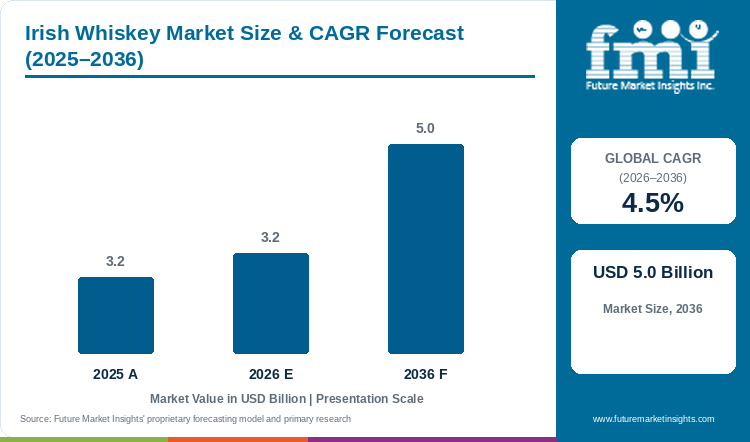
The market was valued at USD 3.20 billion in 2025. FMI estimates revenue of USD 3.25 billion in 2026 and projects the market to reach USD 5.04 billion by 2036, expanding at a CAGR of 4.5% over the forecast period.
Demand for Irish whiskey is rising due to growing whiskey consumption in India, Nigeria, China and Eastern Europe, where rising incomes are moving drinkers toward international spirit brands and where the category's smooth style helps it recruit new consumers. Premium releases are also contributing to demand, as distillers with large stocks of maturing whiskey bring out older and single-distillery expressions that earn more per liter than a standard blend. However, dependence on the United States can create challenges for growth, since the country accounts for about one in every three bottles sold and changes in tariffs or distributor ordering affect the whole category. Distillers also hold more maturing stock than near-term demand requires, which adds holding costs and weakens pricing. Ownership is consolidating after a decade in which the number of distilleries in Ireland rose from about five to about 50, and several independents changed hands in 2026. Distillery tourism and aged releases offer the clearest opportunity, and FMI projects single pot still and single malt revenue to grow at 6.5% a year each, against 4.5% for the market. By product type, blended Irish whiskey accounts for 68.0% of 2026 revenue, while standard bottles hold 45.0% by price tier and off-trade retail accounts for 58.0% of sales. Key companies include Pernod Ricard, William Grant & Sons, Proximo Spirits, Diageo and Brown-Forman.
Irish Whiskey Market Size and Forecast
Table 1: Irish Whiskey Market Size and Forecast
| Market size and forecast | Value |
|---|---|
| Market size in 2025 | USD 3.20 billion |
| Estimated market size in 2026 | USD 3.25 billion |
| Projected market size by 2036 | USD 5.04 billion |
| CAGR from 2026 to 2036 | 4.5% |
| Dominant product type (2026) | Blended Irish whiskey, 68.0% of revenue |
| High-growth country markets | South Africa (6.4% CAGR), Poland (5.9%), Australia (4.9%) |
| Leading Tier-1 companies | Pernod Ricard, William Grant & Sons, Proximo Spirits, Diageo, Brown-Forman, Suntory Global Spirits |
Source: Future Market Insights analysis of the Irish whiskey market, 2026.
Key Market Trends & Insights
- Demand is moving away from its traditional base. Irish whiskey built its scale in the United States, but brand owners are now putting more effort into markets where whiskey drinking is growing fastest. Revenue from outside the ten largest country markets is projected to rise from 23.3% of the global total in 2026 to 27.9% by 2036. Sales in Japan and India rose by 124% and 120% over three years, and exports to Canada grew by about 25% in 2025.
- Higher price tiers are expected to outgrow standard bottles. Distillers with large stocks of maturing whiskey can release older and single-distillery expressions that earn more per litre than a standard blend. FMI projects super premium revenue at 6.5% a year and prestige and ultra premium at 7.5%, against 3.0% for standard bottles, which lifts average revenue per litre from about USD 23 to about USD 28.
- Ownership is consolidating after a decade of new distilleries. Many independent distilleries were financed on the expectation of steady US growth and now face slower sales and high stock-holding costs. Several have changed hands in 2026, including Waterford, Powerscourt and Teeling, and further sales and production pauses are likely as the industry adjusts.
Regional Highlights
- North America is expected to remain the largest region, but its weight is likely to fall. The United States is projected to drop from 38.0% of global revenue in 2026 to 34.2% by 2036, even as it adds USD 491.9 million. The US tariff on Irish whiskey was cut from 15% to 10% in July 2026, and its removal was announced in September 2026.
- Europe is likely to grow steadily from a large base. Germany, the United Kingdom, Ireland and France together hold 23.5% of 2026 revenue, while Poland is projected to grow fastest among the European markets at 5.9% a year. Ten of the category's 20 largest markets are EU member states.
- Africa and Asia are expected to deliver the fastest gains. South Africa is projected to grow at 6.4% a year, and markets outside the ten largest are likely to add USD 651.7 million, more than the United States adds over the same period.
Analyst Perspective
"Irish whiskey has moved from a volume story to a margin story. The distillers that win the next decade will be the ones that turn maturing stock into premium releases and build demand in India, Africa and Eastern Europe, instead of waiting for the United States to return to its earlier growth."
- Nandini Roy Choudhury, Principal Consultant, FMI
How is the Irish Whiskey Market segmented?
The Irish Whiskey Market is segmented by product type, price tier, distribution channel and region. Product type covers blended Irish whiskey, single pot still, single malt, single grain, and flavoured and cask-finished whiskey. Price tier runs from standard through premium and super premium to prestige and ultra premium. Distribution channel covers off-trade retail, on-trade bars and restaurants, travel retail and online retail.
Why does the Blended Irish Whiskey segment lead by Product Type?
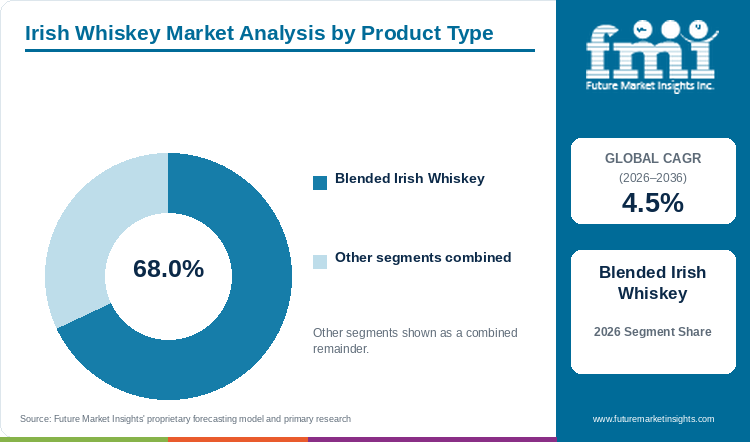
Blended Irish whiskey is expected to lead the market by product type, with 68.0% of revenue in 2026.
Blends lead because they are how most drinkers first meet the category. A blend combines grain whiskey, made efficiently in large column stills, with pot still or malt whiskey for flavour. That lets a producer sell a smooth and consistent whiskey at a price that suits everyday drinking and mixing. This cost structure supports heavy brand investment, and the global blended brands carry the category into bars and shops in markets where Irish whiskey is still new. As a result, the blended segment sets the price reference against which single pot still and single malt whiskeys are judged, and it absorbs most of the swings in mass-market demand across the wider whiskey market.
The pattern is clearest in emerging markets. Jameson, a blended Irish whiskey, is now the leading imported premium spirit brand in India and grew by double digits there in fiscal 2026.
Why does the Standard segment lead by Price Tier?
Standard bottles hold 45.0% of 2026 revenue by price tier.
The tier leads because Irish whiskey's growth was built on accessible prices. Most drinkers buy a standard blend for home consumption, for mixing or as a recognized pour in bars, and retailers use these bottles to drive traffic through promotions. Standard bottles also hold up best when household budgets are tight, because drinkers who trade down from higher tiers move into this range and not out of the category. The tier's share is still expected to fall to 38.8% by 2036, as maturing stocks allow distillers to shift volume into premium releases, in line with the trend across the premium alcoholic beverage market.
Pricing pressure in 2025 and 2026 shows the tier's role. Pernod Ricard reported negative price and mix in a soft pricing environment in fiscal 2026, and smaller distillers have repositioned their US prices to rebuild sales.
Why does the Off-trade Retail segment lead by Distribution Channel?
Off-trade retail accounts for 58.0% of 2026 sales by distribution channel.
Off-trade leads because most Irish whiskey is drunk at home. Supermarkets, liquor stores and specialist shops carry the full range from standard blends to aged expressions, and gift buying at holiday periods concentrates sales in these outlets. The channel also responds quickly to price changes, which matters when brand owners are adjusting prices and pack sizes to protect volume. Bars and restaurants hold 30.0% of sales and remain important for recruiting new drinkers, while online retail is projected to grow fastest at 7.8% a year as buyers order limited releases direct.
Recent trading shows how closely producers watch retail stock. Bord Bia noted in January 2026 that improving US sell-out rates were lowering inventories, and Pernod Ricard pointed to strong demand for small formats in the United States.
What are the key drivers, restraints and opportunities?
New whiskey markets and premium releases are expected to drive the category, while US trade policy and surplus stock are likely to hold back growth in the near term. Distillery tourism and aged expressions give producers ways to earn more from each litre.
Driver
Diversification into fast-growing whiskey markets is expected to drive demand. India is the world's largest whiskey market, and much of Africa and Eastern Europe is shifting toward international spirit brands as incomes rise. Irish whiskey enters these markets with a smoother, more approachable style than many Scotch whiskies, which helps it recruit new drinkers. Trade agreements matter here, because high import duties hold back imported spirits in several of these markets. The early results are visible. Sales in India rose by 120% over three years, and the industry has made an EU-India trade agreement a priority for 2026.
Restraint
US trade policy and surplus stock are likely to restrain growth. The United States takes about a third of all Irish whiskey, so any change in tariffs or distributor ordering moves the whole category. Distillers also laid down stock for a faster growth path than the market has followed, which adds holding costs and weakens pricing. Recent events show both effects. Irish whiskey exports fell 5.0% to €930 million in 2025, and Brown-Forman paused production at its Slane distillery in May 2026 while keeping supply from maturing stock.
Opportunity
Distillery tourism and premium releases offer the clearest opportunity. A distillery visit builds brand loyalty and earns high margins, and visitors often buy limited releases that are not sold elsewhere. Older stock can also be released as single pot still, single malt or cask-finished expressions, which sell at higher prices than standard blends. FMI projects single pot still and single malt revenue to grow at 6.5% a year each. Distilleries welcomed more than one million visitors in the year to June 2025, with an average onsite spend of €41.24, and Irish distillers bought €80 million of US whiskey casks in 2025, a link to the wider wine barrel market.
Irish Whiskey Market by Country (2026 to 2036)
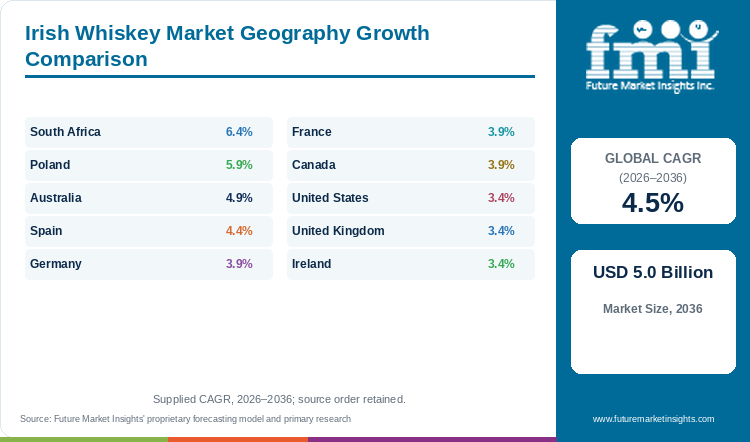
The United States is expected to stay the largest market by a wide margin, while the fastest growth is projected in South Africa, Poland and markets outside the ten largest. FMI projects the ten countries below to hold 72.1% of global revenue in 2036, against 76.7% in 2026.
Table 2: Irish Whiskey Market CAGR by Country, 2026 to 2036
| Country | CAGR, 2026 to 2036 |
|---|---|
| South Africa | 6.4% |
| Poland | 5.9% |
| Australia | 4.9% |
| Spain | 4.4% |
| Germany | 3.9% |
| France | 3.9% |
| Canada | 3.9% |
| United States | 3.4% |
| United Kingdom | 3.4% |
| Ireland | 3.4% |
Source: Future Market Insights analysis of the Irish whiskey market, 2026.
United States
The United States is expected to remain the largest Irish whiskey market, with revenue projected to rise from USD 1.23 billion in 2026 to USD 1.73 billion by 2036. The country is likely to add USD 491.9 million, about 27.4% of the market's total increase, although its share of global revenue is projected to fall from 38.0% to 34.2%.
The US market runs through a three-tier system of importers, distributors and retailers, so changes in distributor stock move shipments well before they show up in consumer demand. That structure amplified the 2025 slowdown, when tariffs, weaker spending and inventory cuts all hit at once. Demand itself has held up better than shipments, and Irish whiskey keeps a strong position in bars, where it is often the default whiskey for shots and simple mixed drinks. Lower tariffs and leaner distributor stocks are expected to support a gradual recovery from 2027, led by the main blended brands. Small formats and ready-to-drink products are also likely to bring younger drinkers into the category. Irish whiskey competes with tequila and ready-to-drink cocktails for US drinkers' spending across the wider spirits market.
Recent figures show both the scale and the strain. Irish whiskey exports to the United States were worth €450 million in 2025, and the tariff on them was cut to 10% in July 2026 before its removal was announced in September.7 8 Pernod Ricard's US sales fell 14.0% in fiscal 2026, partly because of stock reductions in the trade.
Germany
Germany is expected to remain the largest Irish whiskey market in Europe, with revenue projected to rise from USD 227.4 million in 2026 to USD 333.7 million by 2036. The country is likely to add USD 106.3 million, the second-largest increase among the ten countries, while its share of global revenue edges down from 7.0% to 6.6%.
German whiskey buyers are price-conscious and buy mainly through supermarkets and discount chains, where promotions drive a large share of volume. Irish whiskey competes there against Scotch blends and private-label whisky, so brand owners rely on smooth, approachable blends at accessible prices. Growth is expected to come from drinkers trading up from entry blends to premium and cask-finished expressions, which specialist shops and online retailers carry in greater depth. The supermarket channel is likely to keep volume steady, while specialist and online channels lift value. Online retail is also widening the choice available to German buyers, including limited releases from independent Irish distilleries that lack supermarket listings. As a result, the number of Irish whiskey brands on sale in Germany is likely to keep rising even as total volume grows slowly.
Volume data confirm Germany's weight in Europe. The country bought 715,000 cases of Irish whiskey in 2024, among the five largest markets worldwide, although the wider German spirits market softened in fiscal 2026.
United Kingdom
The United Kingdom is projected to grow at 3.4% a year, from USD 194.9 million in 2026 to USD 272.6 million by 2036. The country is likely to add USD 77.7 million, while its share of global revenue moves from 6.0% to 5.4%.
The UK is a mature whisky market dominated by Scotch, so Irish whiskey competes for a defined share of an established category instead of building a new habit. Its advantage lies in the on-trade, where Irish whiskey brands are well known, and in a growing range of single pot still and single malt releases that appeal to whisky enthusiasts. Northern Ireland adds a domestic production base inside the UK, which gave some distillers a tariff advantage in the United States after Washington lifted tariffs on UK whiskey in 2026.8 Growth is therefore expected to come from premium releases more than from volume. Independent Irish distilleries are likely to use the UK as an early export market because of its proximity and shared language, which keeps the range on offer wide and supports specialist retail.
The market has remained steady through recent disruption. The UK bought 698,000 cases in 2024, and Pernod Ricard reported growth for Jameson there in fiscal 2026 despite a modest decline in its total UK sales.4 1 Irish whiskey is therefore likely to hold its place in UK whisky sales while premium releases lift value.
Ireland
Ireland is projected to grow at 3.4% a year, from USD 178.6 million in 2026 to USD 249.8 million by 2036. The country is likely to add USD 71.2 million, and its share of global revenue is expected to ease from 5.5% to 5.0%.
The home market is small in volume but high in value, because a large share of sales comes from tourists and from premium bottles bought as gifts. Distillery visitor centres act as both a sales channel and a marketing platform, and many release bottlings available only on site. Domestic demand is also shaped by regulation. Ireland has had minimum unit pricing since January 2022 and restricts alcohol promotion, which limits volume growth but protects pricing.9 Tourism is therefore likely to drive most of the domestic market's value growth. Exports remain the main business for almost every Irish distiller, so the home market matters most as a shop window for the category. Visitors who taste a brand at a distillery often look for it at home, which links Irish tourism to export sales in the United States, the UK, Germany and France.
Recent data show the scale of both channels. Ireland was the fourth-largest market by volume in 2024, at 707,000 cases, and Irish whiskey distilleries welcomed 1,010,261 visitors in the year to June 2025.4 6 Mandatory health warning labels have been deferred to 3 September 2028.
France
France is projected to grow at 3.9% a year, from USD 162.4 million in 2026 to USD 238.3 million by 2036. The country is likely to add USD 75.9 million, while its share of global revenue moves from 5.0% to 4.7%.
France is one of Europe's largest whisky markets, and buyers there know many whisky styles. Hypermarkets and supermarkets sell most of the volume, so Irish whiskey competes on shelf price and promotion against Scotch blends that have long dominated the category. Irish whiskey's smooth style gives it a role as an accessible alternative, and its growth rate is expected to match Germany's as premium releases widen the range on shelf. The specialist and online channels are likely to carry most of the premium growth, as in other mature European markets. Cask-finished whiskeys, particularly those finished in wine casks, are likely to appeal to French buyers who know wine well. Distillers that offer wine-cask finishes are therefore expected to gain space in specialist shops. Travel retail at French airports and ferry ports also gives Irish brands regular contact with buyers from across Europe, and France's large café and bar sector adds a further route through cocktails and mixed drinks.
Recent trading has been mixed. Pernod Ricard reported a decline in France in fiscal 2026, while France remains one of the five core visitor markets for Irish whiskey distilleries.
A full deep-dive analysis of 40+ countries is available in the full report.
Who are the notable companies in the Irish Whiskey Market?
Notable companies in the Irish Whiskey Market include Pernod Ricard, William Grant & Sons, Proximo Spirits, Diageo, Brown-Forman, Suntory Global Spirits, Bacardi, Walsh Whiskey, Glendalough Distillery, Dingle Distillery, West Cork Distillers and Great Northern Distillery.
Ownership of Irish whiskey is concentrated at the top and fragmented below. A few international spirits groups own the largest distilleries and the leading blended brands, and they control most of the category's volume through global distribution networks. These groups can absorb a downturn by drawing on maturing stock and slowing production, as several did in 2025 and 2026. Beneath them sit dozens of independent distilleries that opened during the last decade. Most of them sell single pot still, single malt and cask-finished whiskeys at higher prices, depend on a few export markets and carry the cost of laying down stock for years before it can be sold. That gap in financial depth explains why the recent slowdown has led to receiverships and sales among independents, while the large groups have adjusted output and pricing.
The past year shows both sides of this structure. Bacardi took full ownership of Teeling in June 2026, after first investing in the company in 2017, while Powerscourt's assets were sold and Waterford's agreed for sale to US buyers out of receivership.
Key Developments in the Irish Whiskey Market
- In January 2026, Altiva Management acquired most of the assets of Powerscourt Distillery in County Wicklow, maker of the Fercullen brand, from its receivers.
- In March 2026, Tennessee Distilling Group agreed to acquire the core assets of Waterford Distillery, including the distillery and its intellectual property, from its receivers.
- On 23 June 2026, Bacardi completed a transaction that made it the sole owner of the Teeling Whiskey Company and the Teeling brand.
Key Players in the Irish Whiskey Market
- Pernod Ricard
- William Grant & Sons
- Proximo Spirits
- Diageo
- Brown-Forman
- Suntory Global Spirits
- Bacardi
- Walsh Whiskey
- Glendalough Distillery
- Dingle Distillery
- West Cork Distillers
- Great Northern Distillery
Irish Whiskey Market Report Scope
Table 3: Irish Whiskey Market Report Scope
| Coverage field | Report scope |
|---|---|
| Market definition | Whiskey distilled and matured on the island of Ireland under the Irish whiskey geographical indication. |
| Product types | Blended Irish whiskey, single pot still, single malt, single grain, and flavoured and cask-finished whiskey. |
| Price tiers | Standard, premium, super premium, and prestige and ultra premium. |
| Age statements | No age statement, up to 10 years, 11 to 18 years and over 18 years. |
| Distribution channels | Off-trade retail, on-trade bars and restaurants, travel retail and online retail. |
| Production base | Distilleries in the Republic of Ireland and Northern Ireland producing to the Irish whiskey technical file. |
| Exclusions | Irish cream liqueurs, poitín, Irish gin, whiskey made outside the island of Ireland, and bulk whiskey traded between producers. |
| Quantitative units | USD billion for value, million litres for volume. |
| Value basis | Supplier selling prices across all channels, counted in the country where the whiskey is consumed. |
| Volume basis | Litres of bottled whiskey sold to the trade. |
| Regions covered | North America, Latin America, Europe, East Asia, South Asia and Pacific, and Middle East and Africa. |
| National coverage | United States, Germany, United Kingdom, Ireland, France, Canada, Poland, South Africa, Australia and Spain. |
| Companies covered | Pernod Ricard, William Grant & Sons, Proximo Spirits, Diageo, Brown-Forman, Suntory Global Spirits, Bacardi, Walsh Whiskey, Glendalough Distillery, Dingle Distillery, West Cork Distillers and Great Northern Distillery. |
Source: Future Market Insights analysis of the Irish whiskey market, 2026.
Irish Whiskey Market Research Methodology
FMI sizes the market from the volume of Irish whiskey sold and the price paid by the trade, and checks the result against industry case sales and export values. Country revenue is counted where the whiskey is consumed, and segment and country figures sum to the market total in every year. Price tier and age statement splits reflect each tier's share of bottles sold and its price relative to standard blends. Forecasts reflect expected changes in demand, trade policy, pricing and product mix, and they are estimates subject to a margin of error.
Irish Whiskey Market by Segments
Irish Whiskey Market segmented by Product Type:
- Blended Irish Whiskey
- Single Pot Still
- Single Malt
- Single Grain
- Flavoured and Cask-finished Whiskey
Irish Whiskey Market segmented by Price Tier:
- Standard
- Premium
- Super Premium
- Prestige and Ultra Premium
Irish Whiskey Market segmented by Distribution Channel:
- Off-trade Retail
- On-trade (Bars and Restaurants)
- Travel Retail
- Online Retail
Irish Whiskey Market by Region
- North America
- Latin America
- Europe
- East Asia
- South Asia and Pacific
- Middle East and Africa
Research Sources and Bibliography
- Agriland. (2026, January 7). Market challenges see Irish whiskey exports drop 5% in 2025. https://www.agriland.ie/farming-news/market-challenges-see-irish-whiskey-exports-drop-5-in-2025/
- Arthur Cox. (2025, October 23). Alcohol labelling in Ireland: timeline for compliance deferred. https://www.arthurcox.com/knowledge/alcohol-labelling-in-ireland-timeline-for-compliance-deferred/
- Associated Press. (2026, September 13). Trump says he plans to remove a 10% tariff on Irish whiskey. apnews.com
- Bacardi Limited. (2026, June 23). Bacardi takes full ownership of TEELING Irish whiskey. www.bacardilimited.com
- Irish Examiner. (2025, December 9). US continues to dominate Irish whiskey exports. https://www.irishexaminer.com/business/economy/arid-41757011.html
- Irish Whiskey Association. (2025, November 13). Irish Whiskey distilleries welcome more than 1 million visitors. https://www.ibec.ie/drinksireland/news-insights-and-events/news/2025/11/13/irish-whiskey-distilleries-welcome-more-than-1-million-visitors
- Irish Whiskey Association. (2026, September 14). Statement on announcement of removal of tariffs on Irish Whiskey in the USA. www.ibec.ie
- Pernod Ricard. (2026, August 27). FY26 Full-year Sales and Results. www.pernod-ricard.com
- Robb Report. (2026, May 29). Brown-Forman is halting production at its Irish whiskey distillery. https://robbreport.com/food-drink/spirits/brown-forman-pausing-production-slane-irish-whiskey-1238217541/
- The Irish Times. (2026, September 14). Removal of whiskey tariff a step in the right direction for hard-hit sector. https://www.irishtimes.com/business/2026/09/14/removal-of-whiskey-tariff-step-in-the-right-direction-for-hard-hit-sector/
- The Spirits Business. (2026, March 24). US whiskey maker takes over Waterford Distillery. https://www.thespiritsbusiness.com/2026/03/us-whiskey-maker-takes-over-waterford-distillery/
Table of Content
- Key Takeaways
- Market Size and CAGR
- Top Growth Driver
- Fastest Growing Segment
- Leading Region
- Key Companies
- Emerging Opportunities
- Executive Summary
- Global Market Outlook
- Demand-side Trends
- Supply-side Trends
- Technology Roadmap Analysis
- Analysis and Recommendations
- Analyst Perspective (What is happening? Why now? What should investors know?)
- Key Questions Answered
- How large is the market?
- What is the CAGR?
- What are key trends?
- Which region dominates?
- Who are the leaders?
Read More...
- Market Overview
- Market Coverage / Taxonomy
- Market Definition / Scope / Limitations
- Research Methodology
- Chapter Orientation
- Analytical Lens and Working Hypotheses
- Market Structure, Signals, and Trend Drivers
- Benchmarking and Cross-market Comparability
- Market Sizing, Forecasting, and Opportunity Mapping
- Research Design and Evidence Framework
- Desk Research Programme (Secondary Evidence)
- Expert Input and Fieldwork (Primary Evidence)
- Tooling, Models, and Reference Databases
- Data Engineering and Model Build
- Quality Assurance and Audit Trail
- Market Background
- Market Dynamics (Drivers, Restraints, Opportunity, Trends)
- Scenario Forecast (Optimistic, Likely, Conservative)
- Impact Analysis
- AI Impact
- Sustainability Impact
- Regulatory Impact
- Technology Impact
- Consumer / Buyer Analysis
- Purchase Drivers
- Adoption Barriers
- Buyer Journey
- Opportunity Map Analysis
- Product Life Cycle Analysis
- Supply Chain Analysis
- Investment Feasibility Matrix
- Value Chain Analysis
- PESTLE and Porter's Analysis
- Regulatory Landscape
- Regional Parent Market Outlook
- Production and Consumption Statistics
- Import and Export Statistics
- Global Market Analysis and Forecast, 2021 to 2036
- Historical Market Size Value (USD Billion) Analysis, 2021 to 2025
- Current and Future Market Size Value (USD Billion) Projections, 2026 to 2036
- Y-o-Y Growth Trend Analysis
- Absolute $ Opportunity Analysis
- Global Market Pricing Analysis, 2021 to 2036
- Global Market Analysis and Forecast, By Product Type, 2021 to 2036
- Introduction / Key Findings
- Historical Market Size Value (USD Billion) Analysis By Product Type, 2021 to 2025
- Current and Future Market Size Value (USD Billion) Analysis and Forecast By Product Type, 2026 to 2036
- Blended Irish Whiskey
- Single Pot Still
- Single Malt
- Single Grain
- Flavoured and Cask-finished Whiskey
- Y-o-Y Growth Trend Analysis By Product Type, 2021 to 2025
- Absolute $ Opportunity Analysis By Product Type, 2026 to 2036
- Global Market Analysis and Forecast, By Price Tier, 2021 to 2036
- Introduction / Key Findings
- Historical Market Size Value (USD Billion) Analysis By Price Tier, 2021 to 2025
- Current and Future Market Size Value (USD Billion) Analysis and Forecast By Price Tier, 2026 to 2036
- Standard
- Premium
- Super Premium
- Prestige and Ultra Premium
- Y-o-Y Growth Trend Analysis By Price Tier, 2021 to 2025
- Absolute $ Opportunity Analysis By Price Tier, 2026 to 2036
- Global Market Analysis and Forecast, By Distribution Channel, 2021 to 2036
- Introduction / Key Findings
- Historical Market Size Value (USD Billion) Analysis By Distribution Channel, 2021 to 2025
- Current and Future Market Size Value (USD Billion) Analysis and Forecast By Distribution Channel, 2026 to 2036
- Off-trade Retail
- On-trade (Bars and Restaurants)
- Travel Retail
- Online Retail
- Y-o-Y Growth Trend Analysis By Distribution Channel, 2021 to 2025
- Absolute $ Opportunity Analysis By Distribution Channel, 2026 to 2036
- Global Market Analysis and Forecast, By Region, 2021 to 2036
- Introduction
- Historical Market Size Value (USD Billion) Analysis By Region, 2021 to 2025
- Current Market Size Value (USD Billion) Analysis and Forecast By Region, 2026 to 2036
- North America
- Latin America
- Europe
- East Asia
- South Asia and Pacific
- Middle East and Africa
- Market Attractiveness Analysis By Region
- North America Market Analysis and Forecast, By Country, 2021 to 2036
- Historical Market Size Value (USD Billion) Trend Analysis By Market Taxonomy, 2021 to 2025
- Market Size Value (USD Billion) Forecast By Market Taxonomy, 2026 to 2036
- By Country
- By Product Type
- By Price Tier
- By Distribution Channel
- Market Attractiveness Analysis
- By Country
- By Product Type
- By Price Tier
- By Distribution Channel
- Key Takeaways
- Latin America Market Analysis and Forecast, By Country
- Historical Market Size Value (USD Billion) Trend Analysis By Market Taxonomy, 2021 to 2025
- Market Size Value (USD Billion) Forecast By Market Taxonomy, 2026 to 2036
- By Country
- By Product Type
- By Price Tier
- By Distribution Channel
- Market Attractiveness Analysis
- By Country
- By Product Type
- By Price Tier
- By Distribution Channel
- Key Takeaways
- Europe Market Analysis and Forecast, By Country
- Historical Market Size Value (USD Billion) Trend Analysis By Market Taxonomy, 2021 to 2025
- Market Size Value (USD Billion) Forecast By Market Taxonomy, 2026 to 2036
- By Country
- By Product Type
- By Price Tier
- By Distribution Channel
- Market Attractiveness Analysis
- By Country
- By Product Type
- By Price Tier
- By Distribution Channel
- Key Takeaways
- East Asia Market Analysis and Forecast, By Country
- Historical Market Size Value (USD Billion) Trend Analysis By Market Taxonomy, 2021 to 2025
- Market Size Value (USD Billion) Forecast By Market Taxonomy, 2026 to 2036
- By Country
- By Product Type
- By Price Tier
- By Distribution Channel
- Market Attractiveness Analysis
- By Country
- By Product Type
- By Price Tier
- By Distribution Channel
- Key Takeaways
- South Asia and Pacific Market Analysis and Forecast, By Country
- Historical Market Size Value (USD Billion) Trend Analysis By Market Taxonomy, 2021 to 2025
- Market Size Value (USD Billion) Forecast By Market Taxonomy, 2026 to 2036
- By Country
- By Product Type
- By Price Tier
- By Distribution Channel
- Market Attractiveness Analysis
- By Country
- By Product Type
- By Price Tier
- By Distribution Channel
- Key Takeaways
- Middle East and Africa Market Analysis and Forecast, By Country
- Historical Market Size Value (USD Billion) Trend Analysis By Market Taxonomy, 2021 to 2025
- Market Size Value (USD Billion) Forecast By Market Taxonomy, 2026 to 2036
- By Country
- By Product Type
- By Price Tier
- By Distribution Channel
- Market Attractiveness Analysis
- By Country
- By Product Type
- By Price Tier
- By Distribution Channel
- Key Takeaways
- Key Countries Market Analysis
- South Africa
- Pricing Analysis
- Market Share Analysis, 2025
- By Product Type
- By Price Tier
- By Distribution Channel
- Poland
- Pricing Analysis
- Market Share Analysis, 2025
- By Product Type
- By Price Tier
- By Distribution Channel
- Australia
- Pricing Analysis
- Market Share Analysis, 2025
- By Product Type
- By Price Tier
- By Distribution Channel
- Spain
- Pricing Analysis
- Market Share Analysis, 2025
- By Product Type
- By Price Tier
- By Distribution Channel
- Germany
- Pricing Analysis
- Market Share Analysis, 2025
- By Product Type
- By Price Tier
- By Distribution Channel
- France
- Pricing Analysis
- Market Share Analysis, 2025
- By Product Type
- By Price Tier
- By Distribution Channel
- Canada
- Pricing Analysis
- Market Share Analysis, 2025
- By Product Type
- By Price Tier
- By Distribution Channel
- United States
- Pricing Analysis
- Market Share Analysis, 2025
- By Product Type
- By Price Tier
- By Distribution Channel
- United Kingdom
- Pricing Analysis
- Market Share Analysis, 2025
- By Product Type
- By Price Tier
- By Distribution Channel
- Ireland
- Pricing Analysis
- Market Share Analysis, 2025
- By Product Type
- By Price Tier
- By Distribution Channel
- South Africa
- Market Structure Analysis
- Competition Dashboard
- Competition Benchmarking
- Market Share Analysis of Top Players
- By Regional
- By Product Type
- By Price Tier
- By Distribution Channel
- Emerging Startups
- Innovation Benchmarking
- Competition Analysis
- Competition Deep Dive
- Pernod Ricard
- Overview
- Product Portfolio
- Profitability by Market Segments
- Sales Footprint
- Strategy Overview
- Marketing Strategy
- Product Strategy
- Channel Strategy
- Bacardi
- Brown-Forman
- Dingle Distillery
- William Grant & Sons
- Proximo Spirits
- Diageo
- Suntory Global Spirits
- Walsh Whiskey
- Glendalough Distillery
- West Cork Distillers
- Great Northern Distillery
- Pernod Ricard
- Case Studies
- Success Stories
- Recent Developments
- Competition Deep Dive
- Assumptions & Acronyms Used
List of Tables
- Table 1: Global Market Value (USD Billion) Forecast by Region, 2021 to 2036
- Table 2: Global Market Value (USD Billion) Forecast by Product Type, 2021 to 2036
- Table 3: Global Market Value (USD Billion) Forecast by Price Tier, 2021 to 2036
- Table 4: Global Market Value (USD Billion) Forecast by Distribution Channel, 2021 to 2036
- Table 5: North America Market Value (USD Billion) Forecast by Country, 2021 to 2036
- Table 6: North America Market Value (USD Billion) Forecast by Product Type, 2021 to 2036
- Table 7: North America Market Value (USD Billion) Forecast by Price Tier, 2021 to 2036
- Table 8: North America Market Value (USD Billion) Forecast by Distribution Channel, 2021 to 2036
- Table 9: Latin America Market Value (USD Billion) Forecast by Country, 2021 to 2036
- Table 10: Latin America Market Value (USD Billion) Forecast by Product Type, 2021 to 2036
- Table 11: Latin America Market Value (USD Billion) Forecast by Price Tier, 2021 to 2036
- Table 12: Latin America Market Value (USD Billion) Forecast by Distribution Channel, 2021 to 2036
- Table 13: Europe Market Value (USD Billion) Forecast by Country, 2021 to 2036
- Table 14: Europe Market Value (USD Billion) Forecast by Product Type, 2021 to 2036
- Table 15: Europe Market Value (USD Billion) Forecast by Price Tier, 2021 to 2036
- Table 16: Europe Market Value (USD Billion) Forecast by Distribution Channel, 2021 to 2036
- Table 17: East Asia Market Value (USD Billion) Forecast by Country, 2021 to 2036
- Table 18: East Asia Market Value (USD Billion) Forecast by Product Type, 2021 to 2036
- Table 19: East Asia Market Value (USD Billion) Forecast by Price Tier, 2021 to 2036
- Table 20: East Asia Market Value (USD Billion) Forecast by Distribution Channel, 2021 to 2036
- Table 21: South Asia and Pacific Market Value (USD Billion) Forecast by Country, 2021 to 2036
- Table 22: South Asia and Pacific Market Value (USD Billion) Forecast by Product Type, 2021 to 2036
- Table 23: South Asia and Pacific Market Value (USD Billion) Forecast by Price Tier, 2021 to 2036
- Table 24: South Asia and Pacific Market Value (USD Billion) Forecast by Distribution Channel, 2021 to 2036
- Table 25: Middle East and Africa Market Value (USD Billion) Forecast by Country, 2021 to 2036
- Table 26: Middle East and Africa Market Value (USD Billion) Forecast by Product Type, 2021 to 2036
- Table 27: Middle East and Africa Market Value (USD Billion) Forecast by Price Tier, 2021 to 2036
- Table 28: Middle East and Africa Market Value (USD Billion) Forecast by Distribution Channel, 2021 to 2036
List of Figures
- Figure 1: Global Market Pricing Analysis
- Figure 2: Global Market Value (USD Billion) Forecast 2021-2036
- Figure 3: Global Market Value Share and BPS Analysis by Product Type, 2026 and 2036
- Figure 4: Global Market Y-o-Y Growth Comparison by Product Type, 2026-2036
- Figure 5: Global Market Attractiveness Analysis by Product Type
- Figure 6: Global Market Value Share and BPS Analysis by Price Tier, 2026 and 2036
- Figure 7: Global Market Y-o-Y Growth Comparison by Price Tier, 2026-2036
- Figure 8: Global Market Attractiveness Analysis by Price Tier
- Figure 9: Global Market Value Share and BPS Analysis by Distribution Channel, 2026 and 2036
- Figure 10: Global Market Y-o-Y Growth Comparison by Distribution Channel, 2026-2036
- Figure 11: Global Market Attractiveness Analysis by Distribution Channel
- Figure 12: Global Market Value (USD Billion) Share and BPS Analysis by Region, 2026 and 2036
- Figure 13: Global Market Y-o-Y Growth Comparison by Region, 2026-2036
- Figure 14: Global Market Attractiveness Analysis by Region
- Figure 15: North America Market Incremental Dollar Opportunity, 2026-2036
- Figure 16: Latin America Market Incremental Dollar Opportunity, 2026-2036
- Figure 17: Europe Market Incremental Dollar Opportunity, 2026-2036
- Figure 18: East Asia Market Incremental Dollar Opportunity, 2026-2036
- Figure 19: South Asia and Pacific Market Incremental Dollar Opportunity, 2026-2036
- Figure 20: Middle East and Africa Market Incremental Dollar Opportunity, 2026-2036
- Figure 21: North America Market Value Share and BPS Analysis by Country, 2026 and 2036
- Figure 22: North America Market Value Share and BPS Analysis by Product Type, 2026 and 2036
- Figure 23: North America Market Y-o-Y Growth Comparison by Product Type, 2026-2036
- Figure 24: North America Market Attractiveness Analysis by Product Type
- Figure 25: North America Market Value Share and BPS Analysis by Price Tier, 2026 and 2036
- Figure 26: North America Market Y-o-Y Growth Comparison by Price Tier, 2026-2036
- Figure 27: North America Market Attractiveness Analysis by Price Tier
- Figure 28: North America Market Value Share and BPS Analysis by Distribution Channel, 2026 and 2036
- Figure 29: North America Market Y-o-Y Growth Comparison by Distribution Channel, 2026-2036
- Figure 30: North America Market Attractiveness Analysis by Distribution Channel
- Figure 31: Latin America Market Value Share and BPS Analysis by Country, 2026 and 2036
- Figure 32: Latin America Market Value Share and BPS Analysis by Product Type, 2026 and 2036
- Figure 33: Latin America Market Y-o-Y Growth Comparison by Product Type, 2026-2036
- Figure 34: Latin America Market Attractiveness Analysis by Product Type
- Figure 35: Latin America Market Value Share and BPS Analysis by Price Tier, 2026 and 2036
- Figure 36: Latin America Market Y-o-Y Growth Comparison by Price Tier, 2026-2036
- Figure 37: Latin America Market Attractiveness Analysis by Price Tier
- Figure 38: Latin America Market Value Share and BPS Analysis by Distribution Channel, 2026 and 2036
- Figure 39: Latin America Market Y-o-Y Growth Comparison by Distribution Channel, 2026-2036
- Figure 40: Latin America Market Attractiveness Analysis by Distribution Channel
- Figure 41: Europe Market Value Share and BPS Analysis by Country, 2026 and 2036
- Figure 42: Europe Market Value Share and BPS Analysis by Product Type, 2026 and 2036
- Figure 43: Europe Market Y-o-Y Growth Comparison by Product Type, 2026-2036
- Figure 44: Europe Market Attractiveness Analysis by Product Type
- Figure 45: Europe Market Value Share and BPS Analysis by Price Tier, 2026 and 2036
- Figure 46: Europe Market Y-o-Y Growth Comparison by Price Tier, 2026-2036
- Figure 47: Europe Market Attractiveness Analysis by Price Tier
- Figure 48: Europe Market Value Share and BPS Analysis by Distribution Channel, 2026 and 2036
- Figure 49: Europe Market Y-o-Y Growth Comparison by Distribution Channel, 2026-2036
- Figure 50: Europe Market Attractiveness Analysis by Distribution Channel
- Figure 51: East Asia Market Value Share and BPS Analysis by Country, 2026 and 2036
- Figure 52: East Asia Market Value Share and BPS Analysis by Product Type, 2026 and 2036
- Figure 53: East Asia Market Y-o-Y Growth Comparison by Product Type, 2026-2036
- Figure 54: East Asia Market Attractiveness Analysis by Product Type
- Figure 55: East Asia Market Value Share and BPS Analysis by Price Tier, 2026 and 2036
- Figure 56: East Asia Market Y-o-Y Growth Comparison by Price Tier, 2026-2036
- Figure 57: East Asia Market Attractiveness Analysis by Price Tier
- Figure 58: East Asia Market Value Share and BPS Analysis by Distribution Channel, 2026 and 2036
- Figure 59: East Asia Market Y-o-Y Growth Comparison by Distribution Channel, 2026-2036
- Figure 60: East Asia Market Attractiveness Analysis by Distribution Channel
- Figure 61: South Asia and Pacific Market Value Share and BPS Analysis by Country, 2026 and 2036
- Figure 62: South Asia and Pacific Market Value Share and BPS Analysis by Product Type, 2026 and 2036
- Figure 63: South Asia and Pacific Market Y-o-Y Growth Comparison by Product Type, 2026-2036
- Figure 64: South Asia and Pacific Market Attractiveness Analysis by Product Type
- Figure 65: South Asia and Pacific Market Value Share and BPS Analysis by Price Tier, 2026 and 2036
- Figure 66: South Asia and Pacific Market Y-o-Y Growth Comparison by Price Tier, 2026-2036
- Figure 67: South Asia and Pacific Market Attractiveness Analysis by Price Tier
- Figure 68: South Asia and Pacific Market Value Share and BPS Analysis by Distribution Channel, 2026 and 2036
- Figure 69: South Asia and Pacific Market Y-o-Y Growth Comparison by Distribution Channel, 2026-2036
- Figure 70: South Asia and Pacific Market Attractiveness Analysis by Distribution Channel
- Figure 71: Middle East and Africa Market Value Share and BPS Analysis by Country, 2026 and 2036
- Figure 72: Middle East and Africa Market Value Share and BPS Analysis by Product Type, 2026 and 2036
- Figure 73: Middle East and Africa Market Y-o-Y Growth Comparison by Product Type, 2026-2036
- Figure 74: Middle East and Africa Market Attractiveness Analysis by Product Type
- Figure 75: Middle East and Africa Market Value Share and BPS Analysis by Price Tier, 2026 and 2036
- Figure 76: Middle East and Africa Market Y-o-Y Growth Comparison by Price Tier, 2026-2036
- Figure 77: Middle East and Africa Market Attractiveness Analysis by Price Tier
- Figure 78: Middle East and Africa Market Value Share and BPS Analysis by Distribution Channel, 2026 and 2036
- Figure 79: Middle East and Africa Market Y-o-Y Growth Comparison by Distribution Channel, 2026-2036
- Figure 80: Middle East and Africa Market Attractiveness Analysis by Distribution Channel
- Figure 81: Global Market - Tier Structure Analysis
- Figure 82: Global Market - Company Share Analysis
Frequently Asked Questions
How big is the Irish whiskey market in 2026?
FMI estimates the Irish whiskey market at USD 3.25 billion in 2026, up from USD 3.20 billion in 2025.
What is the forecast for the Irish whiskey market?
The market is projected to reach USD 5.04 billion by 2036, growing at a CAGR of 4.5% from 2026.
Which product type leads the Irish whiskey market?
Blended Irish whiskey leads with 68.0% of 2026 revenue. Single pot still and single malt are expected to grow fastest, at 6.5% a year each.
Which price tier is growing fastest?
Prestige and ultra premium whiskey is projected to grow fastest, at 7.5% a year, while standard bottles keep the largest share at 45.0% in 2026.
Which country is the largest Irish whiskey market?
The United States is the largest market, with 38.0% of global revenue in 2026. Germany and the United Kingdom follow at 7.0% and 6.0%.
Which countries are expected to grow fastest?
South Africa and Poland are projected to grow fastest among the ten largest markets, at 6.4% and 5.9% a year.
How do US tariffs affect the Irish whiskey market?
The US tariff on Irish whiskey was cut from 15% to 10% in July 2026, and its removal was announced in September 2026. Lower tariffs are expected to support a gradual recovery in the category's largest market.
Preview the report firsthand - request a free sample
Get SampleGet the brochure for pricing and purchase details.
Get PDF
