

- Industry Size (2026)
- USD 15.89 Bn
- Forecast (2036)
- USD 52.53 Bn
- CAGR (2026 to 2036)
- 12.7%
Demand for Whiskey in USA Market Size, Market Forecast and Outlook By FMI

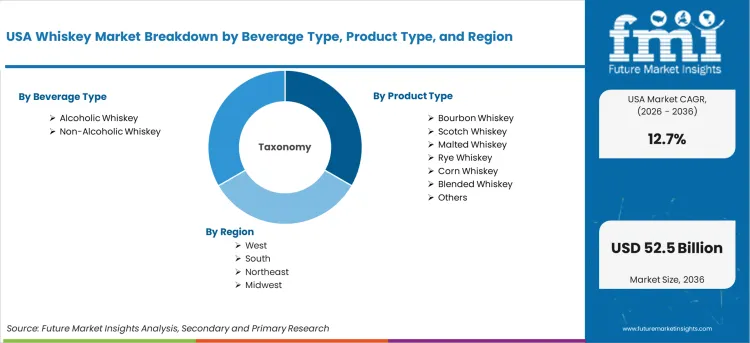
The demand for whiskey in usa market was valued at USD 14.10 billion in 2025, projected to reach USD 15.89 billion in 2026, and is forecast to expand to USD 52.53 billion by 2036 at a 12.7% CAGR. Demand for whiskey in the USA is expanding across both premium alcoholic and emerging non-alcoholic segments as consumer preferences shift toward craft production, aged expressions, and flavor experimentation.
Bourbon whiskey anchors the largest product share at 28.5%, supported by domestic production heritage appeal and international export demand growth. The unflavored segment commands 72.0% market share as traditional whiskey consumers prioritize barrel-aged character over added flavoring, while the flavored segment is capturing younger demographic trial with honey, cinnamon, and fruit-infused variants. Distillery capacity expansion across Kentucky, Tennessee, and emerging craft production states is responding to the sustained premiumization trend driving average selling price increases.
Summary of Demand for Whiskey in USA Market
- Market Overview
- The market is valued at USD 14.10 billion in 2025 and is projected to reach USD 52.53 billion by 2036.
- The industry is expected to grow at a 12.7% CAGR from 2026 to 2036, creating an incremental opportunity of USD 36.64 billion.
- The market is a premiumization-driven spirits category where barrel aging inventory depth, production heritage credibility, craft identity differentiation, and non-alcoholic segment expansion define competitive positioning across the United States.
- Demand and Growth Drivers
- Consumers are trading up from standard expressions to aged, single barrel, and cask strength whiskey variants, driving average selling price growth that outpaces volume growth by three to one and creating margin expansion opportunities for distillers who invest in barrel inventory aging programs.
- The sustained increase in federal distilled spirits plant registrations is creating a fragmented competitive landscape where regional production identities and local provenance narratives compete for shelf space and consumer attention alongside established heritage bourbon and scotch brands.
- The non-alcoholic whiskey segment is expanding the total addressable market by attracting sober-curious consumers and moderation-focused buyers who represent incremental category entrants rather than substitution defectors from traditional alcoholic whiskey consumption.
- Among key regions, West at 14.9%, South at 13.5%, Northeast at 12.0%, Midwest at 10.4%.
- Product and Segment View
- The market includes products segmented by Beverage Type, Product Type, Flavor, covering Alcoholic Whiskey, Non-Alcoholic Whiskey under Beverage Type and Bourbon Whiskey, Scotch Whiskey, Malted Whiskey, Rye Whiskey, Corn Whiskey, Blended Whiskey, Others under Product Type.
- Alcoholic Whiskey leads Beverage Type segmentation with 91.2% share in 2026.
- Bourbon Whiskey leads Product Type segmentation with 28.5% share in 2026.
- Geography and Competitive Outlook
- West is the fastest-growing area at 14.9% CAGR.
- Competition is shaped by product quality, supply reliability, and distribution reach, with key players including Diageo, Chivas Brothers, William Grant & Sons, Bacardi, La Martiniquaise.
- Analyst Opinion at FMI
- Nandini Roy Choudhury, Principal Consultant at FMI, opines: 'In my analysis, I have observed that the USA whiskey market growth trajectory is defined by value accretion rather than volume expansion. Distillers who commit capital to multi-year barrel aging inventory programs will capture the pricing premium that consumers assign to age-stated and single barrel expressions. Producers relying solely on young whiskey or flavored variants risk positioning their brands in segments where margin compression from craft competition and private label programs is most acute.'
- Strategic Implications / Executive Takeaways
- Distillers must commit to multi-year barrel inventory aging programs to compete in the premium segment where consumer willingness to pay for age statements and single barrel selections drives the highest margin growth in the category.
- Portfolio managers should allocate resources to non-alcoholic whiskey product development to capture incremental category entrants from the sober-curious consumer segment without cannibalizing existing alcoholic whiskey sales volumes.
- Distribution strategists must balance three-tier wholesale channel maintenance with direct-to-consumer tasting room and e-commerce investment to capture margin that traditional distribution intermediaries currently absorb.
Demand for Whiskey in USA Market Key Takeaways
| Metric | Details |
|---|---|
| Industry Size (2026) | USD 15.89 Billion |
| Industry Value (2036) | USD 52.53 Billion |
| CAGR (2026-2036) | 12.7% |
Source: Future Market Insights, 2026
FMI is of the opinion that the whiskey market in the USA is undergoing a structural premiumization cycle where volume growth in standard expressions is decelerating while value growth in aged, single barrel, and limited release categories is accelerating. Craft distillery proliferation has expanded consumer choice and introduced regional whiskey identities outside the traditional Kentucky and Tennessee production corridors. The non-alcoholic whiskey segment, while representing only 8.8% of the total market, is growing at a rate that exceeds the overall category average as sober-curious consumers and moderation-focused buyers seek flavor-authentic alternatives. As per FMI, distribution channel dynamics are shifting as direct-to-consumer sales from distillery tasting rooms and online platforms capture margin that previously flowed through traditional three-tier distribution networks.
Regional demand trajectories reflect distinct structural conditions within the United States. West USA leads with a 14.9% CAGR, driven by the concentration of craft cocktail culture in California, Oregon, and Washington and a consumer demographic that prioritizes artisanal production credentials. South USA registers 13.5% growth, anchored by the domestic bourbon production heartland in Kentucky and Tennessee and expanding craft distillery licensing across Texas and Georgia. Northeast USA maintains a 12.0% expansion trajectory supported by premium spirits retail density in major metropolitan markets. Midwest USA records 10.4% growth as craft distillery establishment in states like Indiana, Illinois, and Wisconsin broadens the regional production base.
Demand for Whiskey in USA Market Definition
Whiskey is a distilled alcoholic spirit produced from fermented grain mash, aged in wooden barrels, and bottled at specified proof levels. Product categories in the USA market include bourbon whiskey, scotch whiskey, malted whiskey, rye whiskey, corn whiskey, blended whiskey, and other regional or specialty variants. The market also encompasses non-alcoholic whiskey products formulated to replicate the flavor profile of traditional whiskey without ethanol content. Flavor segmentation distinguishes between unflavored whiskey, which retains barrel-aged character without added flavoring, and flavored whiskey infused with honey, cinnamon, fruit, or other taste additives.
Demand for Whiskey in USA Market Inclusions
Market scope includes all whiskey products sold through licensed retail and food service channels in the USA, encompassing alcoholic whiskey across all proof levels and non-alcoholic whiskey alternatives. Product type coverage spans bourbon, scotch, malted, rye, corn, blended, and other whiskey categories. Flavor segmentation covers unflavored and flavored variants. Regional coverage spans West, South, Northeast, and Midwest USA with forecast projections from 2026 to 2036.
Demand for Whiskey in USA Market Exclusions
Other distilled spirits including vodka, gin, rum, tequila, and brandy are excluded. Beer, wine, and ready-to-drink cocktail products containing whiskey as a minor ingredient are outside the scope. Distillery equipment, barrel manufacturing, and grain agricultural commodities used as whiskey production inputs are excluded from the valuation.
Demand for Whiskey in USA Market Research Methodology
- Primary Research: Analysts conducted structured interviews with supply chain managers, product procurement leads, and distribution network operators to map decision triggers that shape purchasing volumes and vendor selection criteria.
- Desk Research: Data collection phases aggregated regulatory filings, trade body publications, national consumption surveys, and public procurement records from government statistical agencies.
- Market-Sizing and Forecasting: Baseline values derive from a bottom-up aggregation of category-level consumption volumes, applying region-specific penetration curves and pricing benchmarks to project future demand trajectories.
- Data Validation and Update Cycle: Projections are cross-checked against publicly reported trade statistics, manufacturer shipment disclosures, and import-export databases maintained by customs authorities.
Demand for Whiskey in USA Market Drivers, Restraints, and Opportunities
Future Market Insights analysis indicates the USA whiskey market has entered a sustained premiumization phase that is structurally distinct from previous spirits industry cycles. The growth trajectory is not driven by volume expansion in standard-priced expressions but by average selling price inflation in aged, single barrel, cask strength, and limited release categories that command retail pricing of two to five times the standard product equivalent. Consumer willingness to pay premium prices for provenance storytelling, barrel selection specifics, and age statement guarantees is creating a value growth curve that outpaces volume growth by a ratio exceeding three to one.
The craft distillery segment is reshaping competitive dynamics by fragmenting consumer attention across hundreds of regional production identities. FMI analysts note that the Alcohol and Tobacco Tax and Trade Bureau has processed a sustained increase in distilled spirits plant registrations over the past decade, creating a competitive environment where shelf space allocation is increasingly contested between established heritage brands and emerging craft producers. The non-alcoholic whiskey segment represents a structural category expansion rather than a substitution threat: sober-curious consumers purchasing non-alcoholic whiskey are incremental category entrants, not defectors from alcoholic whiskey consumption. This dynamic expands the total addressable market beyond traditional alcohol consumer demographics.
- Premiumization and Age Statement Demand: Consumers are trading up from standard expressions to aged, single barrel, and cask strength whiskey variants, driving average selling price growth that outpaces volume growth by three to one and creating margin expansion opportunities for distillers who invest in barrel inventory aging programs.
- Craft Distillery Proliferation: The sustained increase in federal distilled spirits plant registrations is creating a fragmented competitive landscape where regional production identities and local provenance narratives compete for shelf space and consumer attention alongside established heritage bourbon and scotch brands.
- Non-Alcoholic Whiskey Category Creation: The non-alcoholic whiskey segment is expanding the total addressable market by attracting sober-curious consumers and moderation-focused buyers who represent incremental category entrants rather than substitution defectors from traditional alcoholic whiskey consumption.
Why is the Demand for Whiskey in the USA Growing?
Demand for whiskey in the USA is increasing because consumers show strong interest in premium spirits, small batch varieties and craft products that offer distinctive flavor profiles. Growth in cocktail culture encourages use of bourbon, rye and other whiskey styles in bars, restaurants and home settings. Younger adults explore new brands and limited releases, which supports higher value segments within the category. The rise of tasting events, distillery tourism and online specialty retail expands access to diverse whiskey options and encourages trial purchases.
Domestic producers invest in new expressions and barrel ageing methods that appeal to consumers seeking variety. Constraints to growth include price sensitivity among value focused buyers, competition from other spirits and ready to drink options and shifts in overall alcohol consumption patterns in some regions. Production costs and long ageing cycles can limit rapid supply expansion for certain premium categories.
Which Beverage Type, Product Type, and Flavor Segments Lead Demand for Whiskey in the USA?
Demand for whiskey in the United States reflects consumer preference for traditional alcoholic varieties, established product categories, and growing interest in flavoured extensions. Industry distribution across beverage type, product type, and flavour categories illustrates the influence of heritage production styles, regional consumption habits, and evolving taste profiles shaped by experimentation in both premium and mainstream segments.
By Beverage Type, Alcoholic Whiskey Accounts for the Largest Share of Demand
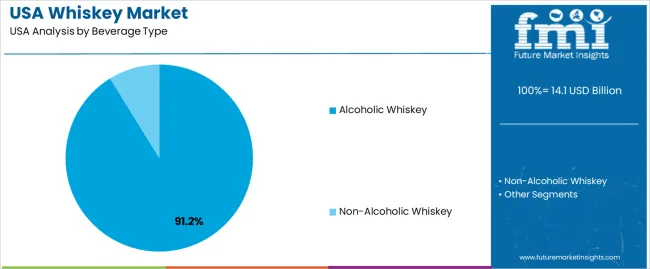
Alcoholic whiskey holds 91.2% of USA demand and remains the dominant category. Consumption patterns reflect longstanding preference for full-strength whiskey across bourbon, scotch, malt, rye, and blended segments. Alcoholic variants maintain high penetration across retail, on-premise establishments, and specialty stores due to established usage in cocktails, neat consumption, and premium tasting formats. Non-alcoholic whiskey holds 8.8%, serving a niche but expanding industry segment driven by interest in alcohol-free alternatives that retain aroma and flavour cues of traditional whiskey. Growth in this category aligns with moderation trends and increasing availability of distilled or flavour-reconstructed formulations.
Key drivers and attributes:
- Alcoholic whiskey dominates traditional and premium consumption occasions.
- Broad distribution supports high availability across retail channels.
- Non-alcoholic variants target moderation and sobriety-focused consumers.
- Choice reflects consumption context and flavour expectations.
By Product Type, Bourbon Whiskey Represents the Largest Share of Demand
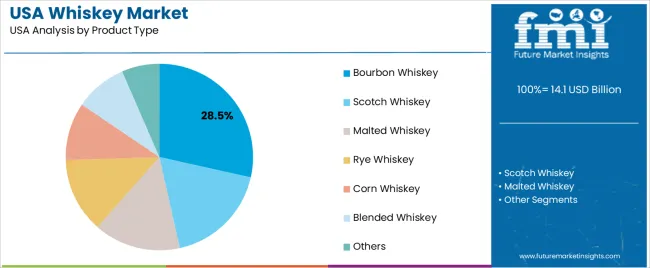
Bourbon whiskey accounts for 28.5% of USA demand, making it the leading product type. Its prominence reflects strong domestic production, flavour familiarity, and wide availability across price ranges. Scotch whiskey holds 18.0%, driven by steady interest in imported varieties and aged expressions. Malted whiskey represents 15.0%, supported by craft distilling and specialty offerings. Rye whiskey holds 13.0%, reflecting renewed interest in spicier profiles used in classic cocktails. Corn whiskey accounts for 10.0%, serving regional and traditional consumption segments. Blended whiskey holds 9.0%, supported by affordability and consistent flavour. The remaining 6.5% covers niche and specialty formats.
Key drivers and attributes:
- Bourbon benefits from strong domestic production and established flavour appeal.
- Scotch maintains premium and imported consumption patterns.
- Rye and malted varieties support craft and cocktail-focused demand.
- Product choice reflects flavour preferences and price range.
By Flavor, Unflavored Whiskey Accounts for the Largest Share of Demand

Unflavored whiskey holds an estimated 72.0% share of USA demand. Traditional flavour profiles, ranging from caramel and oak to smoke and spice, remain central to consumer expectations. Unflavored expressions are preferred for sipping, aging, and cocktail use, supporting their continued dominance in both the premium and mainstream categories. Flavored whiskey accounts for 28.0%, serving segments interested in honey, cinnamon, fruit, and dessert-inspired variations. These products attract younger drinkers, casual consumers, and those preferring sweeter or lower-proof options. Adoption of flavored varieties increases during seasonal promotions and on-premise consumption.
Key drivers and attributes:
- Unflavored variants support traditional consumption and mixology use.
- Flavored options attract newer and flavour-driven consumer groups.
- Seasonal releases strengthen flavored category visibility.
- Flavor selection aligns with consumer experience level and use case.
What are the Drivers, Restraints, and Key Trends of the Demand for Whiskey in the USA?
Growing consumer interest in premium spirits, craft and small-batch production, and elevated cocktail culture are driving demand.
In the United States, whiskey demand is supported by the increasing appeal of aged, premium and super-premium products as consumers trade up their spirit selections. Craft distilleries and independent bottlings are gaining traction with offerings that emphasise heritage, unique mash bills, and limited releases. Whiskey is also benefiting from the surge in at-home consumption and direct-to-consumer sales channels, which became more prominent during recent years. Mixology trends across bars and restaurants emphasise whiskey as a base for classic and modern cocktails, widening its appeal beyond traditional consumers.
Price sensitivity, changing consumer demographics and headwinds in standard-tier volumes are restraining growth.
Despite premium segment strength, volume declines in the standard and value tier whiskey industry cast a shadow over overall demand. Inflation-driven cost pressures reduce consumer discretionary spending on higher-priced spirits, while younger generations show evolving preferences, including greater interest in ready-to-drink (RTD) formats and alternative categories, which may reduce whiskey consumption. Some reports indicate USA American whiskey volumes fell by roughly 1-2% in recent periods. Industry growth is also affected by regulatory tax burdens on spirits and the lead-time required for aging high-end whiskey, which slows product refresh and renewal.
Greater premiumisation, expansion of whiskey tourism and experiential marketing, and increased online and direct-sales distribution are shaping industry trends.
Premiumisation remains a key trend, with more consumers selecting higher aged, limited-edition and single-barrel whiskies that justify higher price points and differentiate brands. Distilleries are leveraging tourism (tasting rooms, trail tours) and experiential events to deepen brand loyalty and attract younger consumers. Digital commerce is growing rapidly in the whiskey channel, enabling brands to engage consumers through subscriptions, special releases and direct shipping (where permitted). Innovation is appearing in barrel-finishing techniques, flavour variants (e.g., rye, craft malt blends) and collaborations that appeal to aficionados and collectors.
Analysis of the Demand for Whiskey in the United States by Region
.webp "Top Country Growth Comparison Usa Whiskey Market Cagr (2026 2036)")
| Region | CAGR (2026-2036) |
|---|---|
| West | 14.9% |
| South | 13.5% |
| Northeast | 12.0% |
| Midwest | 10.4% |
Source: FMI analysis based on primary research and proprietary forecasting model

Demand for whiskey in the United States is rising through 2036, supported by expanding premium-spirit consumption, growth in craft-distillery production, and increasing interest in regional whiskey varieties. Consumer demand is shaped by shifting beverage-alcohol preferences, tourism linked to distillery trails, and broad retail distribution across national chains. Whiskey maintains strong penetration in both on-premise and off-premise channels, reinforced by consistent demand for bourbon, rye, single malt, and blended styles. Growth reflects demographic changes, evolving flavor preferences, and the continuing expansion of small-batch and specialty releases. The West leads with a 14.9% CAGR, followed by the South (13.5%), the Northeast (12.0%), and the Midwest (10.4%).
How is the West driving demand for whiskey?
The West grows at 14.9% CAGR, supported by strong craft-distilling activity, large urban consumer industries, and consistent retail demand across California, Washington, Oregon, and Colorado. Regional distilleries produce single-malt, grain-based, and experimental expressions that reinforce local brand engagement. Consumers show high interest in premium and small-batch whiskey varieties, with steady sales through specialty retailers and restaurant-bar networks. Tourism activity across major cities supports tasting-room purchases and limited-release sales. Distribution networks in the West enable broad placement of domestic and imported whiskey brands across retail shelves. Expanding suburban industries and high disposable income reinforce continued category growth.
- Strong craft-distillery presence across Western states
- High premium-whiskey consumption in urban and suburban industries
- Broad availability across major retail and on-premise channels
- Solid growth supported by tourism and tasting-room activity
How is the South advancing demand for whiskey?
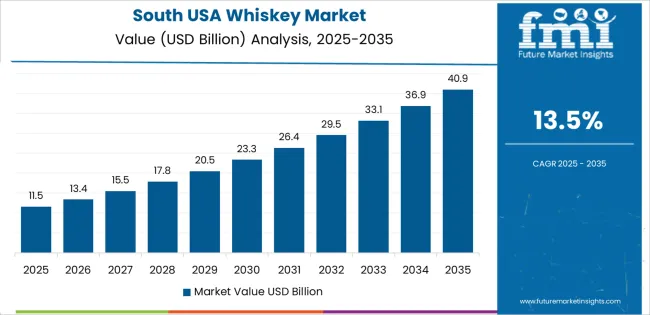
The South grows at 13.5% CAGR, supported by its long-established spirits industry, broad consumer base, and the presence of major whiskey-producing states. Kentucky, Tennessee, Texas, and Georgia maintain strong whiskey consumption across retail and restaurant channels. Distilleries in the region contribute to steady interest in bourbon and Tennessee whiskey, while craft producers expand offerings in specialty expressions. Population growth across Southern metropolitan areas increases demand in retail chains and hospitality venues. Whiskey tourism, including distillery tours and regional trails, reinforces steady sales of premium and heritage products.
- Broad consumption across retail and on-premise sectors
- Strong influence of major whiskey-producing states
- Growth supported by craft distilleries and regional tourism
- Increasing demand tied to expanding metropolitan populations
How is the Northeast shaping demand for whiskey?
The Northeast grows at 12.0% CAGR, supported by dense urban populations, established cocktail culture, and high off-premise sales through major retail chains. New York, Massachusetts, New Jersey, and Pennsylvania show strong demand for premium and imported whiskey varieties, including single malts and high-aged blends. Regional craft distilleries continue to expand distribution across local industries, contributing to rising interest in unique grain profiles and small-batch releases. Bars and restaurants maintain steady whiskey sales due to consistent demand for classic and contemporary cocktail programs.
- Strong premium-whiskey consumption in major metropolitan areas
- Steady presence of craft distilling across the region
- High on-premise sales from cocktail-driven venues
- Stable growth supported by large retail distribution networks
How is the Midwest influencing demand for whiskey?
The Midwest grows at 10.4% CAGR, supported by established whiskey-drinking culture, regional craft-distillery expansion, and consistent demand across suburban and rural communities. States such as Illinois, Michigan, Ohio, and Wisconsin maintain strong retail sales of bourbon, rye, and blended whiskey. Local distillers produce grain-forward expressions that reinforce interest in regional styles. Restaurants and bars maintain steady whiskey sales driven by traditional consumption patterns and renewed interest in American whiskey categories. Although growth is slower than coastal regions, distribution stability and strong loyalty to domestic whiskey support reliable long-term demand.
- Consistent whiskey consumption across urban, suburban, and rural areas
- Growing craft-distillery presence producing regional styles
- Reliable retail performance for bourbon, rye, and blended products
- Moderate but steady growth tied to established consumer preferences
Competitive Aligners for Market Players

The competitive structure of the whiskey market in the USA is concentrated at the premium tier and fragmented at the craft tier. Diageo, Chivas Brothers, William Grant & Sons, Bacardi, and La Martiniquaise compete through portfolio breadth spanning multiple whiskey categories, global distribution infrastructure, and the financial capacity to maintain multi-year barrel aging inventory programs. Competitive differentiation at the premium level is driven by age statement credibility, production heritage narratives, barrel selection expertise, and the ability to sustain limited release marketing programs that generate consumer excitement and retail shelf velocity.
The structural advantage held by heritage distillers derives primarily from their barrel inventory depth: aging whiskey for 8 to 25 years requires capital commitment and warehouse capacity that craft distillers cannot replicate in their early operational years. This creates a natural competitive moat in the aged whiskey segment that favors incumbents, while the unaged and young whiskey segments remain accessible to new entrants with lower capital requirements. Distribution leverage in the US three-tier system further advantages established producers who maintain longstanding relationships with major distributors and national retail chain buyers.
Craft distillery entrants compete through local provenance appeal, tasting room direct-to-consumer sales, and innovative production techniques including alternative grain mashing, experimental barrel finishing, and rapid aging technologies. The direct-to-consumer channel provides craft producers with margin advantages over three-tier distribution but limits geographic reach. Private label whiskey programs operated by major retailers are emerging as a competitive factor in the value tier, though consumer perception of whiskey as a craft-driven category limits private label penetration compared to other spirits categories.
Key Players in Demand for Whiskey in USA Market
- Diageo
- Chivas Brothers
- William Grant & Sons
- Bacardi
- La Martiniquaise
Scope of the Report
| Metric | Value |
|---|---|
| Quantitative Units | USD 15.89 Billion to USD 52.53 Billion, at a CAGR of 12.7% |
| Market Definition | Whiskey is a distilled alcoholic spirit produced from fermented grain mash, aged in wooden barrels, and bottled at specified proof levels. Product categories in the USA market include bourbon whiskey, scotch whiskey, malted whiskey, rye whiskey, corn whiskey, blended whiskey, and other regional or specialty variants. |
| Beverage Type Segmentation | Alcoholic Whiskey, Non-Alcoholic Whiskey |
| Product Type Segmentation | Bourbon Whiskey, Scotch Whiskey, Malted Whiskey, Rye Whiskey, Corn Whiskey, Blended Whiskey, Others |
| Flavor Segmentation | Unflavored, Flavored |
| Regions Covered | West, South, Northeast, Midwest |
| Key Companies Profiled | Diageo, Chivas Brothers, William Grant & Sons, Bacardi, La Martiniquaise |
| Forecast Period | 2026 to 2036 |
| Approach | Bottom-up methodology starting with category-level consumption data and applying regional penetration assumptions. |
Demand for Whiskey in USA Market Analysis by Segments
By Beverage Type:
Alcoholic Whiskey, Non-Alcoholic Whiskey
By Product Type:
Bourbon Whiskey, Scotch Whiskey, Malted Whiskey, Rye Whiskey, Corn Whiskey, Blended Whiskey, Others
By Flavor:
Unflavored, Flavored
By Region:
West, South, Northeast, Midwest
Bibliography
- 1. Alcohol and Tobacco Tax and Trade Bureau. (2024). Distilled Spirits Plant Registration and Production Statistics. TTB.
- 2. National Institute on Alcohol Abuse and Alcoholism. (2024). Alcohol Epidemiologic Data System: Beverage Consumption Trends. NIAAA.
- 3. United States Department of Agriculture. (2024). Economic Research Service: Grain Utilization in Distilled Spirits Production. USDA ERS.
- 4. Distilled Spirits Council of the United States. (2024). Annual Economic Briefing: Spirits Industry Revenue and Volume Data. DISCUS.
- 5. International Trade Administration. (2024). Spirits Export and Import Trade Data: Whiskey Category Analysis. ITA.
This bibliography is provided for reader reference. The full Future Market Insights report contains the complete reference list with primary research documentation.
Frequently Asked Questions
How large is the Demand for Whiskey in USA Market in 2026?
The Demand for Whiskey in USA market is estimated to be valued at USD 15.89 billion in 2026.
What will be the market size of Demand for Whiskey in USA by 2036?
The Demand for Whiskey in USA market is projected to reach USD 52.53 billion by 2036.
What is the expected CAGR for Demand for Whiskey in USA between 2026 and 2036?
The Demand for Whiskey in USA market is expected to grow at a CAGR of 12.7% between 2026 and 2036.
Which Beverage Type is poised to lead in 2026?
Alcoholic Whiskey accounts for 91.2% share in 2026, maintaining its position as the leading beverage type segment.
Which region is projected to grow the fastest?
West is projected to grow at a CAGR of 14.9% during 2026 to 2036, the fastest among all covered regions.
What does Demand for Whiskey in USA mean in this report?
Whiskey is a distilled alcoholic spirit produced from fermented grain mash, aged in wooden barrels, and bottled at specified proof levels. Product categories in the USA market include bourbon whiskey, scotch whiskey, malted whiskey, rye whiskey, corn whiskey, blended whiskey, and other regional or specialty variants.
What is included in the scope of this report?
Market scope includes all whiskey products sold through licensed retail and food service channels in the USA, encompassing alcoholic whiskey across all proof levels and non-alcoholic whiskey alternatives. Product type coverage spans bourbon, scotch, malted, rye, corn, blended, and other whiskey categories.
How does FMI build and validate the Demand for Whiskey in USA forecast?
Forecasting models apply a bottom-up methodology starting with category-level consumption data and cross-validate projections against trade statistics, manufacturer shipment disclosures, and regulatory filings.
Preview the report firsthand - request a free sample
Get SampleGet the brochure for pricing and purchase details.
Get PDFTable of Content
- Executive Summary
- USA Market Outlook
- Demand-side Trends
- Supply-side Trends
- Technology Roadmap Analysis
- Analysis and Recommendations
- Market Overview
- Market Coverage / Taxonomy
- Market Definition / Scope / Limitations
- Research Methodology
- Chapter Orientation
- Analytical Lens and Working Hypotheses
- Market Structure, Signals, and Trend Drivers
- Earnings Decks and Investor Briefings
- Statutory Filings and Regulatory Disclosures
- Technical White Papers and Standards Notes
- Trade Journals, Industry Magazines, and Analyst Briefs
- Conference Proceedings, Webinars, and Seminar Materials
- Government Statistics Portals and Public Data Releases
- Press Releases and Reputable Media Coverage
- Specialist Newsletters and Curated Briefings
- Sector Databases and Reference Repositories
- FMI Internal Proprietary Databases and Historical Market Datasets
- Subscription Datasets and Paid Sources
- Social Channels, Communities, and Digital Listening Inputs
- Additional Desk Sources
- Expert Input and Fieldwork (Primary Evidence)
- Primary Modes
- Qualitative Interviews and Expert Elicitation
- Quantitative Surveys and Structured Data Capture
- Blended Approach
- Why Primary Evidence is Used
- Field Techniques
- Interviews
- Surveys
- Focus Groups
- Observational and In-context Research
- Social and Community Interactions
- Stakeholder Universe Engaged
- C-suite Leaders
- Board Members
- Presidents and Vice Presidents
- R&D and Innovation Heads
- Technical Specialists
- Domain Subject-matter Experts
- Scientists
- Physicians and Other Healthcare Professionals
- Governance, Ethics, and Data Stewardship
- Research Ethics
- Data Integrity and Handling
- Primary Modes
- Tooling, Models, and Reference Databases
- Data Engineering and Model Build
- Data Acquisition and Ingestion
- Cleaning, Normalisation, and Verification
- Synthesis, Triangulation, and Analysis
- Quality Assurance and Audit Trail
- Market Background
- Market Dynamics
- Drivers
- Restraints
- Opportunity
- Trends
- Scenario Forecast
- Demand in Optimistic Scenario
- Demand in Likely Scenario
- Demand in Conservative Scenario
- Opportunity Map Analysis
- Product Life Cycle Analysis
- Supply Chain Analysis
- Investment Feasibility Matrix
- Value Chain Analysis
- PESTLE and Porter’s Analysis
- Regulatory Landscape
- Regional Parent Market Outlook
- Production and Consumption Statistics
- Import and Export Statistics
- Market Dynamics
- USA Market Analysis 2021 to 2025 and Forecast, 2026 to 2036
- Historical Market Size Value (USD Million) Analysis, 2021 to 2025
- Current and Future Market Size Value (USD Million) Projections, 2026 to 2036
- Y-o-Y Growth Trend Analysis
- Absolute $ Opportunity Analysis
- USA Market Pricing Analysis 2021 to 2025 and Forecast 2026 to 2036
- USA Market Analysis 2021 to 2025 and Forecast 2026 to 2036, By Beverage Type
- Introduction / Key Findings
- Historical Market Size Value (USD Million) Analysis By Beverage Type , 2021 to 2025
- Current and Future Market Size Value (USD Million) Analysis and Forecast By Beverage Type , 2026 to 2036
- Alcoholic Whiskey
- Non-Alcoholic Whiskey
- Alcoholic Whiskey
- Y-o-Y Growth Trend Analysis By Beverage Type , 2021 to 2025
- Absolute $ Opportunity Analysis By Beverage Type , 2026 to 2036
- USA Market Analysis 2021 to 2025 and Forecast 2026 to 2036, By Product Type
- Introduction / Key Findings
- Historical Market Size Value (USD Million) Analysis By Product Type, 2021 to 2025
- Current and Future Market Size Value (USD Million) Analysis and Forecast By Product Type, 2026 to 2036
- Bourbon Whiskey
- Scotch Whiskey
- Malted Whiskey
- Rye Whiskey
- Corn Whiskey
- Blended Whiskey
- Others
- Bourbon Whiskey
- Y-o-Y Growth Trend Analysis By Product Type, 2021 to 2025
- Absolute $ Opportunity Analysis By Product Type, 2026 to 2036
- USA Market Analysis 2021 to 2025 and Forecast 2026 to 2036, By Flavor
- Introduction / Key Findings
- Historical Market Size Value (USD Million) Analysis By Flavor, 2021 to 2025
- Current and Future Market Size Value (USD Million) Analysis and Forecast By Flavor, 2026 to 2036
- Unflavored
- Flavored
- Unflavored
- Y-o-Y Growth Trend Analysis By Flavor, 2021 to 2025
- Absolute $ Opportunity Analysis By Flavor, 2026 to 2036
- USA Market Analysis 2021 to 2025 and Forecast 2026 to 2036, By Region
- Introduction
- Historical Market Size Value (USD Million) Analysis By Region, 2021 to 2025
- Current Market Size Value (USD Million) Analysis and Forecast By Region, 2026 to 2036
- West
- South
- Northeast
- Midwest
- Market Attractiveness Analysis By Region
- West Market Analysis 2021 to 2025 and Forecast 2026 to 2036, By Country
- Historical Market Size Value (USD Million) Trend Analysis By Market Taxonomy, 2021 to 2025
- Market Size Value (USD Million) Forecast By Market Taxonomy, 2026 to 2036
- By Country
- By Beverage Type
- By Product Type
- By Flavor
- By Country
- Market Attractiveness Analysis
- By Country
- By Beverage Type
- By Product Type
- By Flavor
- Key Takeaways
- South Market Analysis 2021 to 2025 and Forecast 2026 to 2036, By Country
- Historical Market Size Value (USD Million) Trend Analysis By Market Taxonomy, 2021 to 2025
- Market Size Value (USD Million) Forecast By Market Taxonomy, 2026 to 2036
- By Country
- By Beverage Type
- By Product Type
- By Flavor
- By Country
- Market Attractiveness Analysis
- By Country
- By Beverage Type
- By Product Type
- By Flavor
- Key Takeaways
- Northeast Market Analysis 2021 to 2025 and Forecast 2026 to 2036, By Country
- Historical Market Size Value (USD Million) Trend Analysis By Market Taxonomy, 2021 to 2025
- Market Size Value (USD Million) Forecast By Market Taxonomy, 2026 to 2036
- By Country
- By Beverage Type
- By Product Type
- By Flavor
- By Country
- Market Attractiveness Analysis
- By Country
- By Beverage Type
- By Product Type
- By Flavor
- Key Takeaways
- Midwest Market Analysis 2021 to 2025 and Forecast 2026 to 2036, By Country
- Historical Market Size Value (USD Million) Trend Analysis By Market Taxonomy, 2021 to 2025
- Market Size Value (USD Million) Forecast By Market Taxonomy, 2026 to 2036
- By Country
- By Beverage Type
- By Product Type
- By Flavor
- By Country
- Market Attractiveness Analysis
- By Country
- By Beverage Type
- By Product Type
- By Flavor
- Key Takeaways
- Key Countries Market Analysis
- USA
- Pricing Analysis
- Market Share Analysis, 2025
- By Beverage Type
- By Product Type
- By Flavor
- Canada
- Pricing Analysis
- Market Share Analysis, 2025
- By Beverage Type
- By Product Type
- By Flavor
- Mexico
- Pricing Analysis
- Market Share Analysis, 2025
- By Beverage Type
- By Product Type
- By Flavor
- Brazil
- Pricing Analysis
- Market Share Analysis, 2025
- By Beverage Type
- By Product Type
- By Flavor
- Chile
- Pricing Analysis
- Market Share Analysis, 2025
- By Beverage Type
- By Product Type
- By Flavor
- Germany
- Pricing Analysis
- Market Share Analysis, 2025
- By Beverage Type
- By Product Type
- By Flavor
- UK
- Pricing Analysis
- Market Share Analysis, 2025
- By Beverage Type
- By Product Type
- By Flavor
- Italy
- Pricing Analysis
- Market Share Analysis, 2025
- By Beverage Type
- By Product Type
- By Flavor
- Spain
- Pricing Analysis
- Market Share Analysis, 2025
- By Beverage Type
- By Product Type
- By Flavor
- France
- Pricing Analysis
- Market Share Analysis, 2025
- By Beverage Type
- By Product Type
- By Flavor
- India
- Pricing Analysis
- Market Share Analysis, 2025
- By Beverage Type
- By Product Type
- By Flavor
- ASEAN
- Pricing Analysis
- Market Share Analysis, 2025
- By Beverage Type
- By Product Type
- By Flavor
- Australia & New Zealand
- Pricing Analysis
- Market Share Analysis, 2025
- By Beverage Type
- By Product Type
- By Flavor
- China
- Pricing Analysis
- Market Share Analysis, 2025
- By Beverage Type
- By Product Type
- By Flavor
- Japan
- Pricing Analysis
- Market Share Analysis, 2025
- By Beverage Type
- By Product Type
- By Flavor
- South Korea
- Pricing Analysis
- Market Share Analysis, 2025
- By Beverage Type
- By Product Type
- By Flavor
- Russia
- Pricing Analysis
- Market Share Analysis, 2025
- By Beverage Type
- By Product Type
- By Flavor
- Poland
- Pricing Analysis
- Market Share Analysis, 2025
- By Beverage Type
- By Product Type
- By Flavor
- Hungary
- Pricing Analysis
- Market Share Analysis, 2025
- By Beverage Type
- By Product Type
- By Flavor
- Kingdom of Saudi Arabia
- Pricing Analysis
- Market Share Analysis, 2025
- By Beverage Type
- By Product Type
- By Flavor
- Turkiye
- Pricing Analysis
- Market Share Analysis, 2025
- By Beverage Type
- By Product Type
- By Flavor
- South Africa
- Pricing Analysis
- Market Share Analysis, 2025
- By Beverage Type
- By Product Type
- By Flavor
- USA
- Market Structure Analysis
- Competition Dashboard
- Competition Benchmarking
- Market Share Analysis of Top Players
- By Regional
- By Beverage Type
- By Product Type
- By Flavor
- Competition Analysis
- Competition Deep Dive
- Diageo
- Overview
- Product Portfolio
- Profitability by Market Segments (Product/Age /Sales Channel/Region)
- Sales Footprint
- Strategy Overview
- Marketing Strategy
- Product Strategy
- Channel Strategy
- Chivas Brothers
- William Grant & Sons
- Bacardi
- La Martiniquaise
- Diageo
- Competition Deep Dive
- Assumptions & Acronyms Used


