

- Industry Size (2025)
- USD 1.7 Bn
- Forecast (2035)
- USD 3.0 Bn
- CAGR (2025 to 2035)
- 5.7%
Demand for LegalTech in Japan Forecast and Outlook 2025 to 2035
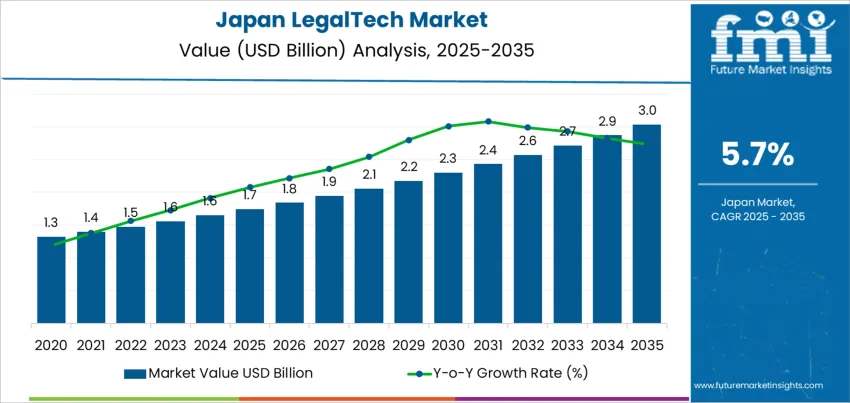
In 2025, legal technology spending in Japan stands at USD 1.7 billion and is projected to reach USD 3.0 billion by 2035 at a CAGR of 5.7%. The early phase from 2025 to 2029 reflects gradual adoption, with demand moving from USD 1.7 billion toward roughly USD 2.1 billion. During this period, usage remains concentrated in contract management, e-discovery, and compliance tracking within large law firms and corporate legal departments. Resistance to full digital migration, reliance on paper-based workflows, and conservative procurement cycles keep growth measured. This stage forms the pre-inflection buildup, where product familiarity increases but large-scale deployment remains limited.
The inflection point becomes visible between 2029 and 2031 as spending accelerates from near USD 2.1 billion to over USD 2.4 billion. This shift is tied to mounting regulatory reporting pressure, labor constraints in legal services, and wider acceptance of cloud based document automation. After this transition, the curve remains steeper through 2035 as demand advances toward USD 3.0 billion. Post inflection growth reflects broader deployment across mid-sized enterprises, local government bodies, and compliance driven industries. Vendor strategies shift toward workflow integration, Japanese language optimization, and direct partnerships with domestic IT service firms to capture this structurally higher demand phase.
Quick Stats of the Demand for LegalTech in Japan
- Demand for LegalTech in Japan Value (2025): USD 1.7 billion
- Demand for LegalTech in Japan Forecast Value (2035): USD 3.0 billion
- Demand for LegalTech in Japan Forecast CAGR (2025-2035): 5.7%
- Leading Solution in LegalTech Japan: Deployment Based (62%)
- Leading Type in LegalTech Japan: Contract Lifecycle Management (24%)
- Key Growth Regions for LegalTech in Japan: Kyushu & Okinawa, Kanto, Kinki, Chubu, Tohoku, Rest of Japan
- Top Players in LegalTech Industry in Japan: Thomson Reuters, LexisNexis, Clio, Relativity, DocuSign
What is the Growth Forecast for LegalTech in Japan through 2035?
Under the half-decade weighted growth lens, the 2020–2025 block carries a relatively lighter weight in total value creation. Demand rises from USD 1.3 billion in 2020 to USD 1.7 billion in 2025, adding USD 0.4 billion over five years. This block reflects early institutional adoption led by large law firms and corporate legal departments experimenting with contract management, e-discovery, and compliance automation. Annual additions remain narrow at about USD 0.1 billion, which keeps the weighted contribution of this block limited despite its strategic importance. Growth during this phase is capability-led rather than volume-led, forming the base layer of the long-term value curve.
The 2025–2030 block carries a heavier growth weight as demand expands from USD 1.7 billion to USD 2.3 billion, adding USD 0.6 billion. This half-decade marks the acceleration zone where LegalTech platforms move beyond pilot usage into standardized procurement across mid-size enterprises and regulated industries. From 2030-2035, the weighted contribution becomes strongest, with demand rising from USD 2.3 billion to USD 3.0 billion, adding USD 0.7 billion. This final block dominates total value creation, driven by litigation workflow automation, AI-driven document review, and regulatory reporting digitization. The weighted structure shows that most absolute value is back-loaded into the final five-year window rather than evenly distributed.
LegalTech Industry in Japan Key Takeaways
| Metric | Value |
|---|---|
| Industry Value (2025) | USD 1.7 billion |
| Forecast Value (2035) | USD 3.0 billion |
| Forecast CAGR (2025–2035) | 5.7% |
What Is Driving the Demand for LegalTech in Japan?
Demand for LegalTech in Japan developed slowly at first due to conservative legal workflows, paper based documentation, and strict professional boundaries within law firms and corporate legal teams. Historically, adoption was driven by large corporations managing growing volumes of contracts, compliance files, and internal governance records. Rising cross border trade created pressure for bilingual contract handling and faster review cycles. At the same time, Japan faced a widening gap between legal workload and available legal staff, which made manual review difficult to sustain. Courts and regulators also began accepting digital filings and electronic records, which reduced dependence on physical documentation. These structural shifts pushed early adoption in contract management, document storage, and basic compliance tracking systems.
Future demand for LegalTech in Japan will be shaped by deeper operational needs rather than simple digitisation. Legal departments increasingly require tools for real time contract risk monitoring, automated clause analysis, litigation data management, and regulatory reporting under stricter corporate governance rules. Workforce constraints will intensify as the legal profession ages, increasing reliance on automation for routine review and documentation. Data security, audit trails, and internal control systems will become core buying criteria. Growth will also come from small and mid-sized enterprises that previously relied on manual outsourcing. Rather than replacing lawyers, LegalTech adoption will centre on controlling cost, reducing turnaround time, and managing risk in complex commercial environments.
What Factors Are Affecting the Demand for LegalTech in Japan in Terms of Solution and Type?
The demand for LegalTech in Japan is shaped by solution format and functional type. Deployment based solutions account for 62% of total demand, while services address implementation, customization, and support needs. By type, contract lifecycle management holds a 24% share, followed by case management, document management, billing and accounting, lead management, and other software categories. Adoption is guided by regulatory compliance requirements, law firm digitization levels, corporate legal department workloads, and data security standards. These segments reflect how workflow automation priorities and software delivery preferences influence procurement across private law practices, in house legal teams, and compliance driven enterprises nationwide.
What Drives the Leading Demand for Deployment Based LegalTech Solutions in Japan?
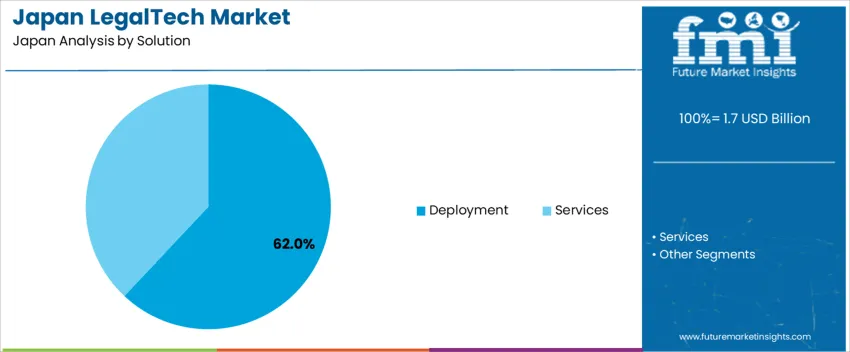
Deployment based LegalTech solutions account for 62% of total demand in Japan, reflecting the preference for direct software ownership and system control. Law firms and corporate legal departments rely on deployment models to manage sensitive client data within secure internal infrastructures. This approach supports compliance with strict data privacy and cybersecurity standards applied across financial, healthcare, and corporate governance sectors. Deployment solutions allow full customization of access controls, workflow routing, and document permission structures based on internal operational policies.
Long term cost stability also supports deployment preference. One time licensing and predictable maintenance spending offer budget visibility for firms managing multiyear digital transformation programs. Integration with existing enterprise resource planning and document storage systems can be executed without dependency on external service uptime. These operational and regulatory advantages reinforce deployment as the dominant LegalTech solution format across large law firms and regulated corporate legal departments in Japan.
What Drives the Leading Demand for Contract Lifecycle Management in Japan LegalTech Adoption?
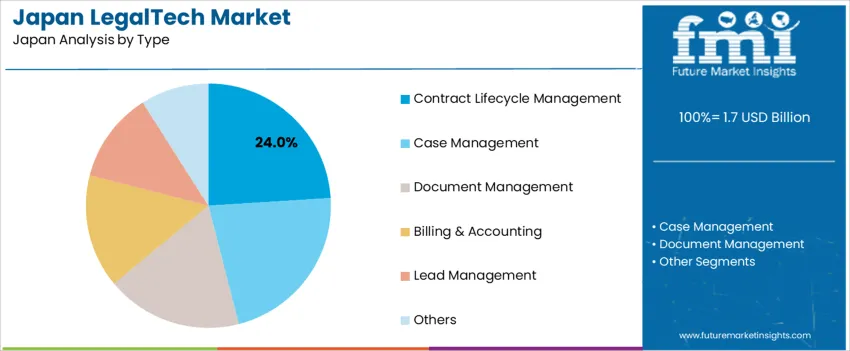
Contract lifecycle management accounts for 24% of total LegalTech demand in Japan, making it the leading software type. This position reflects rising transaction volumes across corporate procurement, supply chain contracting, and compliance reporting. Automated contract drafting, approval routing, version tracking, and renewal alerts reduce administrative burdens across legal teams handling high document flow. Contract management systems also support audit readiness through centralized recordkeeping and timestamped revision histories.
Cross departmental reliance on contracts further drives adoption. Procurement, finance, and operations teams require real time visibility into contractual obligations, payment milestones, and risk exposures. Integration with billing, accounting, and enterprise databases strengthens data consistency across business units. Regulatory scrutiny in sectors such as manufacturing, pharmaceuticals, and financial services raises expectations for contract traceability. These compliance and efficiency pressures continue to position contract lifecycle management as the primary functional anchor of LegalTech deployment in Japan.
What Forces Are Driving the Adoption of LegalTech in Japan?
LegalTech demand in Japan is driven by internal operational strain rather than headline digital ambition. Corporate legal departments face rising contract volumes tied to supplier networks, data-privacy compliance, and cross-border transactions. At the same time, the supply of junior legal staff is tightening, which forces firms to automate routine review and documentation work. Remote work practices introduced in recent years remain embedded in many firms, making cloud-based legal platforms more practical than physical document handling. Pressure from finance teams for faster compliance reporting also accelerates LegalTech use across manufacturing, finance, and export-driven businesses.
What Structural and Cultural Factors Continue to Restrain LegalTech Growth in Japan?
LegalTech expansion in Japan remains restrained by conservative risk culture and sensitivity around legal judgment automation. Many senior lawyers continue to rely on paper-based verification and manual review for litigation, regulatory filings, and arbitration work. Client confidentiality expectations create resistance to third-party cloud platforms, especially in regulated sectors such as finance and pharmaceuticals. Procurement cycles in law firms are slow and consensus-driven, which delays technology approval. Smaller firms often lack internal IT teams capable of vendor evaluation and system integration. These structural and cultural limits slow LegalTech diffusion despite visible efficiency gains.
How Are LegalTech Use Cases and System Design Evolving in the Japanese Market?
LegalTech adoption in Japan is shifting steadily from basic document storage toward full workflow control. Contract lifecycle management now anchors many platforms, followed by compliance tracking and internal approval automation. AI-assisted review tools are used mainly for preliminary screening rather than final legal judgment. Systems increasingly integrate with accounting and procurement platforms to support audit readiness and cost attribution. Bilingual contract tools support growing overseas exposure among mid-sized Japanese firms. Product design emphasizes security, long-term data retention, and regulatory traceability rather than rapid feature upgrades. This evolution reflects Japans preference for layered, enterprise-grade digital infrastructure.
What is the Demand for LegalTech in Japan by Region?
| Region | Assumed CAGR (%)* |
|---|---|
| Kyushu & Okinawa | 7.1 |
| Kanto | 6.6 |
| Kinki | 5.8 |
| Chubu | 5.1 |
| Tohoku | 4.4 |
| Rest of Japan | 4.2 |
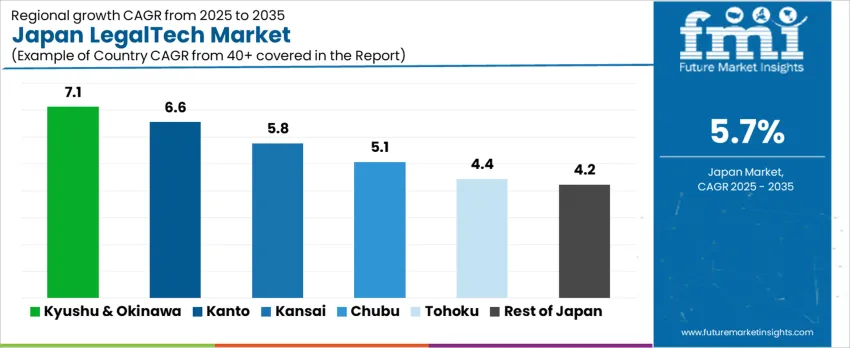
The demand for LegalTech in Japan is rising across regions, with the strongest growth in Kyushu & Okinawa at around 7.1 %. This likely reflects increasing adoption of digital legal solutions and demand for contract-management, legal research, and compliance tools even outside major urban centers. In the Kanto region the 6.6 % rate builds on a dense concentration of corporations, law firms, and regulatory-driven demand for legal efficiencies. Kinki, Chubu and other industrially active regions showing 5.8 %, 5.1 %, and 4.4 % respectively are gradually integrating LegalTech for corporate and commercial legal needs. The lower 4.2 % in Rest of Japan may reflect slower uptake due to limited access, smaller legal markets and lower digital infrastructure penetration. Overall this regional distribution suggests LegalTech growth correlates with corporate density, regulatory complexity, and regional economic activity.
What is Driving LegalTech Adoption in Kyushu and Okinawa Regions of Japan?
Expansion across Kyushu and Okinawa reflects a CAGR of 7.1% through 2035 for LegalTech demand, supported by rising digital adoption among regional law firms, corporate legal departments, and local government offices. Small and mid sized enterprises increasingly rely on contract management and compliance automation to reduce administrative burden. Tourism, logistics, and cross border trade activity strengthen demand for digital documentation platforms. Cloud based legal software gains share due to limited in house IT staffing. Growth remains structured around workflow digitization rather than advanced analytics, supporting steady subscription based platform deployment across regional professional service networks.
- SME adoption supports steady subscription demand
- Contract management tools lead platform usage
- Cross border trade increases digital documentation needs
- Cloud delivery suits limited internal IT resources
How is Kanto Shaping the National LegalTech Landscape in Japan?
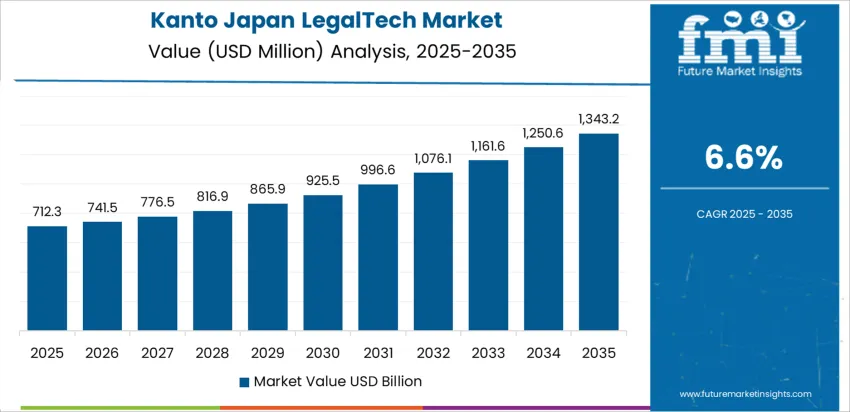
Kanto advances at a CAGR of 6.6% through 2035 for LegalTech demand, driven by Japans largest concentration of law firms, financial institutions, and multinational corporate legal teams. Tokyo based enterprises prioritize e discovery, compliance automation, and regulatory monitoring platforms. Venture funding and software development activity reinforce local platform availability. Large scale litigation management and data security requirements sustain enterprise level deployments. High regulatory workload across finance, real estate, and technology sectors drives continuous platform expansion. Demand reflects enterprise productivity optimization rather than small firm digitization alone within the metropolitan legal services ecosystem.
- Corporate legal teams anchor enterprise platform demand
- Regulatory monitoring tools see high deployment
- Venture backed software development accelerates supply
- Data security requirements sustain platform upgrades
Why is LegalTech Demand Rising Steadily in Kinki Region of Japan?
Kinki records a CAGR of 5.8% through 2035 for LegalTech demand, supported by strong manufacturing, commercial services, and regional headquarters activity in Osaka. Contract lifecycle management, document automation, and internal compliance tools remain core applications. Export oriented manufacturers adopt legal software to manage supplier agreements and regulatory filings. Local law firms expand digital client intake and case management systems. Adoption growth remains methodical due to conservative procurement cycles, yet steady corporate usage sustains reliable revenue flow for domestic LegalTech software providers serving Kansai based professional service markets.
- Manufacturing contracts drive document automation usage
- Export compliance strengthens regulatory software demand
- Law firm case management systems support adoption
- Conservative procurement sustains predictable growth pace
What is Supporting LegalTech Expansion in Chubu Region of Japan?
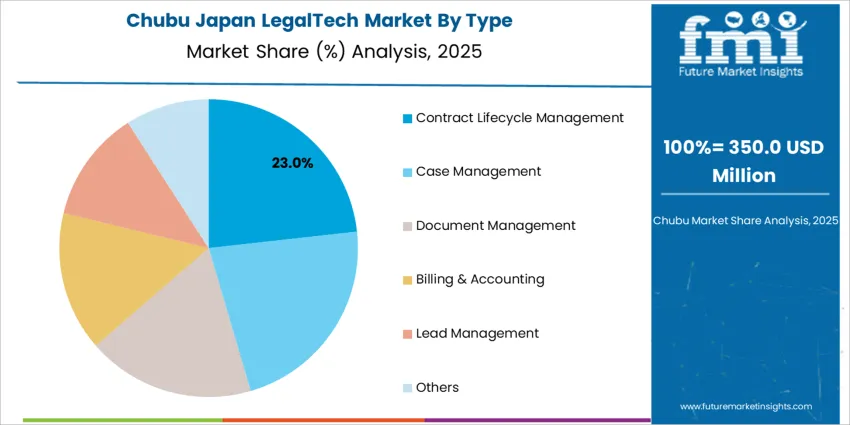
Chubu expands at a CAGR of 5.1% through 2035 for LegalTech demand, shaped by automotive manufacturing, supplier contracting, and regional commercial litigation activity. Legal departments within industrial firms increasingly use digital tools for contract standardization and dispute tracking. Supplier onboarding and compliance audits drive software integration into procurement workflows. Regional law practices adopt cloud based document review systems to manage rising transaction volumes. Platform adoption focuses on operational efficiency rather than litigation scale analytics, aligning demand with steady industrial legal workloads concentrated around manufacturing driven business activity.
- Supplier contract standardization supports platform usage
- Compliance audits increase software integration needs
- Cloud document review tools gain regional adoption
- Industrial legal workloads anchor steady demand
How is LegalTech Adoption Developing in Tohoku Region of Japan?
Tohoku shows a CAGR of 4.4% through 2035 for LegalTech demand, supported by gradual digitization of municipal legal services, agricultural cooperatives, and regional businesses. Contract documentation, land ownership records, and regulatory reporting remain primary use cases. Smaller law firms adopt digital case filing to manage resource constraints. Adoption remains slower than metropolitan regions due to lower transaction density. Growth is driven by administrative efficiency rather than litigation complexity. Demand remains focused on basic document automation and records management solutions rather than full scale enterprise legal platforms.
- Municipal digitization supports baseline platform use
- Agricultural cooperatives adopt contract documentation tools
- Small law firms use software for workload efficiency
- Basic records management dominates application demand
What is Sustaining LegalTech Demand in the Rest of Japan?
The rest of Japan reflects a CAGR of 4.2% through 2035 for LegalTech demand, supported by scattered SME legal operations, municipal governance digitization, and routine compliance management. Demand concentrates on affordable SaaS platforms offering document storage, digital signatures, and basic legal workflow automation. Limited access to specialized legal IT vendors shapes conservative adoption behavior. Growth depends on regulatory reporting obligations and public sector digitization programs rather than private litigation volume. Platform selection favors cost control, data localization, and vendor stability across secondary cities and rural prefectures.
- SME compliance tools drive most platform subscriptions
- Digital signature platforms support routine workflows
- Public sector digitization guides baseline demand
- Cost control governs software selection decisions
What Is Driving the Demand for LegalTech in Japan and Who Are the Key Players Shaping the Industry?
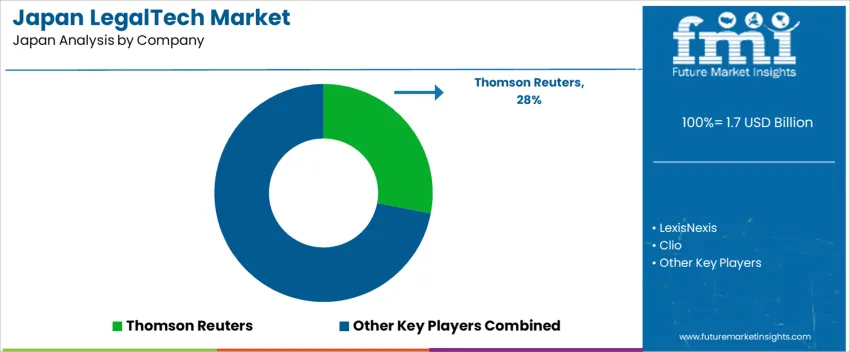
The market for legal technology in Japan is expanding as law firms, corporate legal departments, and in house counsel face growing workloads, a tight supply of legal professionals, and increasing demand for efficiency. Automation of legal research, contract review, compliance monitoring, and document management helps address manpower constraints and rising complexity of regulation. Digital transformation in the broader services sector is encouraging adoption of cloud based tools and AI powered software that streamline workflows. The shift toward e contracting, remote work, and cross border legal operations increases need for scalable, reliable legal software. For 2024, the legal tech market in Japan is estimated at USD 1,016.7 million and is projected to reach USD 1,998.8 million by 2030, corresponding to a growth rate of 12.4% per annum.
Leading providers such as Thomson Reuters, LexisNexis, Clio, Relativity, and DocuSign play central roles in shaping adoption and standards in Japan. Thomson Reuters holds one of the largest global shares of legal tech revenue, offering comprehensive legal research, document automation, and contract management tools. LexisNexis delivers legal research and compliance solutions widely used by law firms and corporate legal teams. Clio supplies practice management and case management software aimed at small to mid sized firms seeking streamlined operations. Relativity provides e discovery and document review platforms suited for litigation and regulatory work. DocuSign offers e signature and contract lifecycle management systems that support the growing e contract and remote work environment. These firms influence the market by establishing standards for legal workflows, enabling cloud deployment, and fostering digital workflows across legal and corporate sectors.
Key Players in LegalTech Industry in Japan
- Thomson Reuters
- LexisNexis
- Clio
- Relativity
- DocuSign
Scope of the report
| Items | Values |
|---|---|
| Quantitative Units (2025) | USD billion |
| Solution | Deployment, Services |
| Type | Contract Lifecycle Management, Case Management, Document Management, Billing & Accounting, Lead Management, Others |
| End-user | Law Firms, Corporate Legal Departments |
| Region | Kyushu & Okinawa, Kanto, Kinki, Chubu, Tohoku, Rest of Japan |
| Countries Covered | Japan |
| Key Companies Profiled | Thomson Reuters, LexisNexis, Clio, Relativity, DocuSign |
| Additional Attributes | Dollar by sales by solution type and functional category; regional CAGR and adoption rate; deployment vs service solution penetration; leading software type (contract lifecycle management) adoption; SME vs large enterprise uptake; law firm vs corporate legal department usage patterns; cloud vs on-premises adoption; AI-assisted document review and e-discovery integration; regulatory and compliance-driven purchasing trends; subscription vs license model adoption; platform integration with ERP, procurement, and accounting systems; bilingual/legal language support adoption; workflow automation trends and digital transformation impact across regional legal ecosystems. |
LegalTech Industry in Japan Segmentation
Solution:
- Deployment
- Services
Type:
- Contract Lifecycle Management
- Case Management
- Document Management
- Billing & Accounting
- Lead Management
- Others
End-user:
- Law Firms
- Corporate Legal Departments
Region:
- Kyushu & Okinawa
- Kanto
- Kinki
- Chubu
- Tohoku
- Rest of Japan
Frequently Asked Questions
How big is the demand for legaltech in Japan in 2025?
The demand for legaltech in Japan is estimated to be valued at USD 1.7 billion in 2025.
What will be the size of legaltech in Japan in 2035?
The market size for the legaltech in Japan is projected to reach USD 3.0 billion by 2035.
How much will be the demand for legaltech in Japan growth between 2025 and 2035?
The demand for legaltech in Japan is expected to grow at a 5.7% CAGR between 2025 and 2035.
What are the key product types in the legaltech in Japan?
The key product types in legaltech in Japan are deployment and services.
Which type segment is expected to contribute significant share in the legaltech in Japan in 2025?
In terms of type, contract lifecycle management segment is expected to command 24.0% share in the legaltech in Japan in 2025.
Preview the report firsthand - request a free sample
Get SampleGet the brochure for pricing and purchase details.
Get PDFTable of Content
- Executive Summary
- Japan Market Outlook
- Demand-side Trends
- Supply-side Trends
- Technology Roadmap Analysis
- Analysis and Recommendations
- Market Overview
- Market Coverage / Taxonomy
- Market Definition / Scope / Limitations
- Market Background
- Market Dynamics
- Drivers
- Restraints
- Opportunity
- Trends
- Scenario Forecast
- Demand in Optimistic Scenario
- Demand in Likely Scenario
- Demand in Conservative Scenario
- Opportunity Map Analysis
- Product Life Cycle Analysis
- Supply Chain Analysis
- Investment Feasibility Matrix
- Value Chain Analysis
- PESTLE and Porter’s Analysis
- Regulatory Landscape
- Regional Parent Market Outlook
- Production and Consumption Statistics
- Import and Export Statistics
- Market Dynamics
- Japan Market Analysis 2020 to 2024 and Forecast, 2025 to 2035
- Historical Market Size Value (USD Million) Analysis, 2020 to 2024
- Current and Future Market Size Value (USD Million) Projections, 2025 to 2035
- Y-o-Y Growth Trend Analysis
- Absolute $ Opportunity Analysis
- Japan Market Pricing Analysis 2020 to 2024 and Forecast 2025 to 2035
- Japan Market Analysis 2020 to 2024 and Forecast 2025 to 2035, By Solution
- Introduction / Key Findings
- Historical Market Size Value (USD Million) Analysis By Solution , 2020 to 2024
- Current and Future Market Size Value (USD Million) Analysis and Forecast By Solution , 2025 to 2035
- Deployment
- Services
- Y-o-Y Growth Trend Analysis By Solution , 2020 to 2024
- Absolute $ Opportunity Analysis By Solution , 2025 to 2035
- Japan Market Analysis 2020 to 2024 and Forecast 2025 to 2035, By Type
- Introduction / Key Findings
- Historical Market Size Value (USD Million) Analysis By Type, 2020 to 2024
- Current and Future Market Size Value (USD Million) Analysis and Forecast By Type, 2025 to 2035
- Contract Lifecycle Management
- Case Management
- Document Management
- Billing & Accounting
- Lead Management
- Others
- Y-o-Y Growth Trend Analysis By Type, 2020 to 2024
- Absolute $ Opportunity Analysis By Type, 2025 to 2035
- Japan Market Analysis 2020 to 2024 and Forecast 2025 to 2035, By End-user
- Introduction / Key Findings
- Historical Market Size Value (USD Million) Analysis By End-user, 2020 to 2024
- Current and Future Market Size Value (USD Million) Analysis and Forecast By End-user, 2025 to 2035
- Law Firms
- Corporate Legal Departments
- Y-o-Y Growth Trend Analysis By End-user, 2020 to 2024
- Absolute $ Opportunity Analysis By End-user, 2025 to 2035
- Market Structure Analysis
- Competition Dashboard
- Competition Benchmarking
- Market Share Analysis of Top Players
- By Regional
- By Solution
- By Type
- By End-user
- Competition Analysis
- Competition Deep Dive
- Thomson Reuters
- Overview
- Product Portfolio
- Profitability by Market Segments (Product/Age /Sales Channel/Region)
- Sales Footprint
- Strategy Overview
- Marketing Strategy
- Product Strategy
- Channel Strategy
- LexisNexis
- Clio
- Relativity
- DocuSign
- Thomson Reuters
- Competition Deep Dive
- Assumptions & Acronyms Used
- Research Methodology


