

- Industry Size (2026)
- Forecast (2036)
- CAGR
- (2026 to 2036)
Demand for Weatherization Service in Japan 2026 to 2036
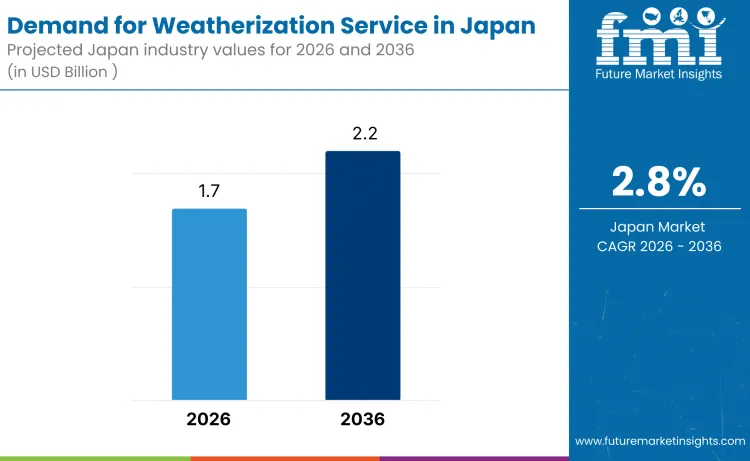
Demand for weatherization service in Japan is valued at USD 1.7 billion in 2026 and is forecasted to reach USD 2.2 billion by 2036, reflecting a CAGR of 2.8%. Demand grows through steady residential renovation activity, aging housing stock upgrades, and national emphasis on energy efficiency and indoor comfort. Climate variability and rising utility costs reinforce adoption of building envelope improvements across urban and regional housing.
Insulation upgrades lead service-type usage because enhanced thermal barriers reduce heat loss, improve indoor temperature stability, and lower energy consumption year-round. Property owners prioritize wall, roof, and floor insulation retrofits compatible with existing structures and seismic standards. Advances in high-performance materials and installation methods support efficiency gains without extensive structural modification.
Quick Stats for Market for Weatherization Service in Japan
- Japan Weatherization Service Sales Value (2026): USD 1.7 billion
- Japan Weatherization Service Forecast Value (2036): USD 2.2 billion
- Japan Weatherization Service Forecast CAGR (2026 to 2036): 2.8%
- Leading Service Type in Japan Market: Insulation Upgrades
- Key Growth Regions in Japan Market: Kyushu & Okinawa, Kanto, Kansai, Chubu, Tohoku
- Top Players in Japan Market: Sekisui House Renovation & Support Co., Ltd., Daiken Corporation, LIXIL Corporation, Nisshinbo Holdings Inc., Panasonic Homes Co., Ltd.
Kyushu & Okinawa, Kanto, Kansai, Chubu, and Tohoku represent key growth regions driven by population density, renovation cycles, and regional climate needs. Sekisui House Renovation & Support Co., Ltd., Daiken Corporation, LIXIL Corporation, Nisshinbo Holdings Inc., and Panasonic Homes Co., Ltd. anchor competitive activity through integrated renovation services, material innovation, and nationwide contractor networks aligned with Japan’s energy-efficiency standards and housing performance requirements.
Japan Weatherization Service Key Takeaways
| Metric | Value |
|---|---|
| Japan Weatherization Service Sales Value (2026) | USD 1.7 billion |
| Japan Weatherization Service Forecast Value (2036) | USD 2.2 billion |
| Japan Weatherization Service Forecast CAGR (2026 to 2036) | 2.8% |
How Are the Segments Classified in the Demand for Weatherization Service in Japan?
Demand for weatherization services in Japan is shaped by energy-efficiency standards, aging building stock, and climate-driven thermal performance requirements. Property owners and public authorities assess insulation effectiveness, air-tightness improvement, and compliance with national energy conservation guidelines. Adoption patterns reflect emphasis on residential upgrades, supported by material selection and service combinations suited to compact building designs and seasonal heating and cooling needs across Japan.
By Service Type, Do Insulation Upgrades Account for the Largest Share of Demand in Japan?
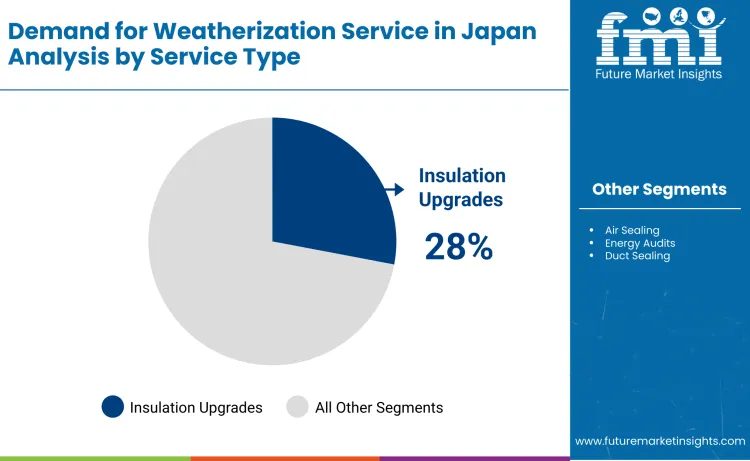
Insulation upgrades hold 28.0%, making them the leading service-type segment in Japan. These services directly improve thermal resistance in walls, roofs, and floors, reducing energy loss during winter and summer periods. Air sealing supports insulation performance by limiting uncontrolled airflow in tightly designed structures. Energy audits guide targeted interventions by identifying efficiency gaps. Window and door weatherization enhances envelope performance in older buildings. Duct sealing improves HVAC efficiency in applicable systems. Service-type distribution reflects priority given to insulation as the most impactful efficiency measure under Japan’s building conditions.
Key Points:
- Insulation upgrades lead due to direct thermal performance impact.
- Air sealing complements compact building envelope designs.
- Audits support targeted efficiency improvements.
By Material, Does Spray Foam Represent the Largest Share of Demand in Japan?
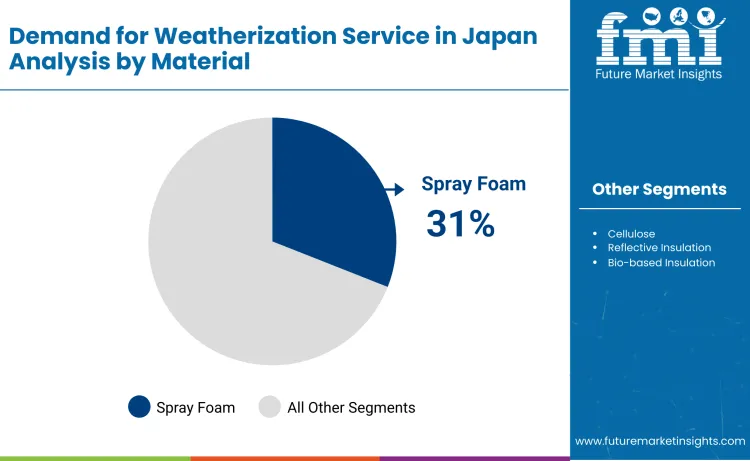
Spray foam holds 31.0%, making it the leading material segment in Japan. Spray foam provides high insulation value and effective air sealing within limited wall cavities common in Japanese buildings. Its adaptability supports retrofit projects with space constraints. Cellulose insulation offers cost-effective thermal improvement and recycled content usage. Reflective insulation supports radiant heat control in specific applications. Bio-based insulation materials serve sustainability-focused projects. Material distribution reflects preference for spray foam due to space efficiency, performance reliability, and suitability for Japan’s dense construction environment.
Key Points:
- Spray foam dominates due to high performance in limited spaces.
- Combined insulation and sealing improves energy efficiency.
- Alternative materials address cost and sustainability needs.
By End-User, Does Residential Usage Account for the Largest Share of Demand in Japan?
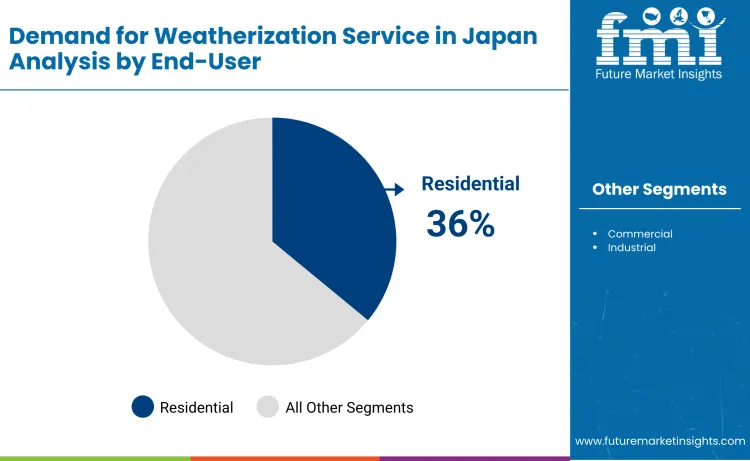
Residential end users hold 36.0%, making them the leading end-user segment in Japan. Demand is driven by owner-occupied housing, aging homes, and government-supported efficiency programs. Commercial buildings adopt weatherization to manage energy costs and meet efficiency benchmarks. Industrial facilities apply services selectively in offices and controlled environments. Government and public buildings implement weatherization to meet policy-driven conservation targets. End-user distribution reflects concentration of upgrade activity within residential housing across Japan.
Key Points:
- Residential buildings lead due to aging housing stock.
- Efficiency programs support household-level upgrades.
- Public buildings follow structured conservation mandates.
What are the Key Dynamics in the Weatherization Service Industry in Japan?
Demand increases as Japan addresses energy efficiency in residential and small commercial buildings under long-term carbon reduction and energy security objectives. Weatherization services focus on insulation upgrades, airtightness improvement, and thermal performance enhancement in aging housing stock. Adoption aligns with cold-climate regions, rising household energy costs, and national efficiency standards. Government programs, housing renovation trends, and disaster-resilient building practices shape service uptake across urban and rural prefectures.
How do energy efficiency policy goals and aging housing stock drive demand in Japan?
Japan’s housing stock includes a high proportion of older detached homes built before modern insulation standards. National energy conservation policies encourage retrofits that reduce heating and cooling losses. Cold regions such as Hokkaido and Tohoku show higher demand due to winter heating requirements. Homeowners adopt insulation upgrades, window sealing, and draft reduction to improve indoor comfort and reduce energy bills. Local governments provide subsidies for renovation projects that meet efficiency benchmarks. Earthquake-resilient retrofits often integrate weatherization measures, increasing service scope. Rising awareness of indoor thermal comfort and health outcomes supports continued demand among owner-occupied households.
How do workforce limitations, building structure constraints, and cost sensitivity influence demand stability?
Japan faces shortages of skilled retrofit contractors, limiting service capacity and extending project timelines. Traditional wooden housing structures require customized weatherization approaches, increasing labor intensity. High upfront renovation costs discourage adoption among elderly homeowners and rental property owners. Rental market dynamics reduce incentive for landlords to invest in efficiency upgrades. Regional variation in subsidy availability affects participation rates. Strict building codes and inspection requirements add administrative steps. Seasonal demand fluctuations challenge workforce planning. Demand remains steady in supported renovation segments, while broader expansion depends on labor availability, cost reduction strategies, and continued public funding alignment within Japan.
How Is Demand for Weatherization Service in Japan Evolving by Region?
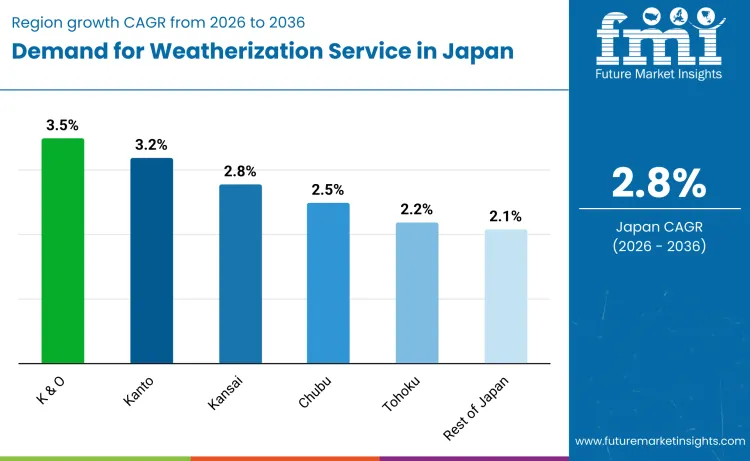
Demand for weatherization services in Japan is increasing due to rising household energy costs, aging residential stock, and national efficiency targets. Kyushu and Okinawa lead with a 3.5% CAGR, supported by climate exposure and housing retrofit programs. Kanto follows at 3.2%, driven by urban housing upgrades and energy-efficiency compliance. Kansai records a 2.8% CAGR, shaped by renovation activity and cost-control measures. Chubu posts 2.5%, reflecting owner-occupied housing improvements. Tohoku shows 2.2%, supported by cold-climate insulation needs. Rest of Japan records 2.1%, reflecting stable replacement demand. Regional variation reflects climate conditions, housing age, and retrofit intensity across Japan.
| Region | CAGR (2026 to 2036) |
|---|---|
| Kyushu & Okinawa | 3.5% |
| Kanto | 3.2% |
| Kansai | 2.8% |
| Chubu | 2.5% |
| Tohoku | 2.2% |
| Rest of Japan | 2.1% |
How is Kyushu and Okinawa driving demand for Weatherization Services in Japan?
Kyushu and Okinawa drive demand due to exposure to heat, humidity, typhoons, and coastal weather conditions. Region’s CAGR of 3.5% reflects increased use of weatherization services for roof insulation, wall sealing, moisture control, and window upgrades. Residential properties require protection against heat ingress and humidity-related deterioration. Local governments promote retrofit programs to reduce cooling energy consumption and improve indoor comfort. Contractors focus on ventilation optimization and envelope reinforcement suited to warm climates. Demand remains project-driven, supported by public subsidies and disaster-resilience planning rather than discretionary home improvement alone.
- Heat and humidity mitigation requirements
- Roof, wall, and window insulation upgrades
- Public retrofit and resilience programs
- Focus on moisture control and ventilation
How is Kanto driving demand for Weatherization Services in Japan?
Kanto demand is shaped by dense urban housing, aging apartment buildings, and energy-efficiency compliance requirements. Region’s CAGR of 3.2% reflects steady adoption of weatherization services in condominiums, rental housing, and mixed-use residential structures. Building owners prioritize air sealing, insulation retrofits, and window performance upgrades to reduce energy bills and meet efficiency standards. Space constraints favor minimally invasive solutions. Municipal programs and utility incentives support structured retrofit activity. Demand growth aligns with urban renewal and compliance-driven upgrades rather than new residential construction.
- Urban apartment and rental housing retrofits
- Energy-efficiency compliance-driven upgrades
- Space-efficient weatherization solutions
- Utility and municipal incentive support
How is Kansai driving demand for Weatherization Services in Japan?
Kansai demand reflects renovation-focused housing improvement and cost-management priorities. Region’s CAGR of 2.8% is supported by weatherization services applied during home renovations and building refurbishments. Property owners invest in insulation enhancement, air leakage reduction, and heating efficiency improvements to manage seasonal energy costs. Climatic variability encourages balanced solutions addressing both summer cooling and winter heating. Contractors emphasize standardized retrofit packages suitable for older housing stock. Demand remains steady, linked to renovation cycles rather than large-scale policy mandates.
- Renovation-linked weatherization projects
- Balanced cooling and heating efficiency needs
- Older housing stock upgrades
- Standardized retrofit service offerings
How is Chubu driving demand for Weatherization Services in Japan?
Chubu demand is anchored in owner-occupied housing improvements and regional climate conditions. Region’s CAGR of 2.5% reflects use of weatherization services for insulation upgrades, draft reduction, and heating efficiency improvements. Households prioritize comfort enhancement and gradual reduction in utility expenses. Industrial employment stability supports moderate investment in residential upgrades. Contractors focus on cost-effective measures with measurable performance outcomes. Growth remains moderate, aligned with household renovation budgets and replacement cycles.
- Owner-occupied residential upgrades
- Insulation and draft reduction services
- Cost-effective efficiency improvements
- Replacement-driven retrofit activity
How is Tohoku driving demand for Weatherization Services in Japan?
Tohoku demand is influenced by cold winters, older housing stock, and energy conservation needs. Region’s CAGR of 2.2% reflects adoption of weatherization services focused on thermal insulation, air sealing, and heating loss reduction. Residential buildings require upgrades to improve indoor comfort during extended cold seasons. Public-sector programs support efficiency improvements in rural and regional housing. Contractors emphasize durability and long-term performance. Demand growth remains cautious and necessity-driven rather than discretionary.
- Cold-climate insulation requirements
- Heating efficiency and air sealing focus
- Rural and regional housing upgrades
- Public-sector supported programs
How is Rest of Japan driving demand for Weatherization Services in Japan?
Rest of Japan shows stable demand driven by routine housing maintenance and incremental efficiency upgrades. Region’s CAGR of 2.1% reflects use of weatherization services during scheduled renovations and maintenance cycles. Homeowners prioritize basic insulation improvements and window sealing to manage energy costs. Demand remains cost-sensitive and focused on proven measures. Growth aligns with replacement needs rather than proactive retrofit adoption.
- Routine residential maintenance upgrades
- Basic insulation and sealing services
- Cost-sensitive homeowner demand
- Replacement-driven consumption patterns
What is the competitive landscape of demand for weatherization service in Japan?
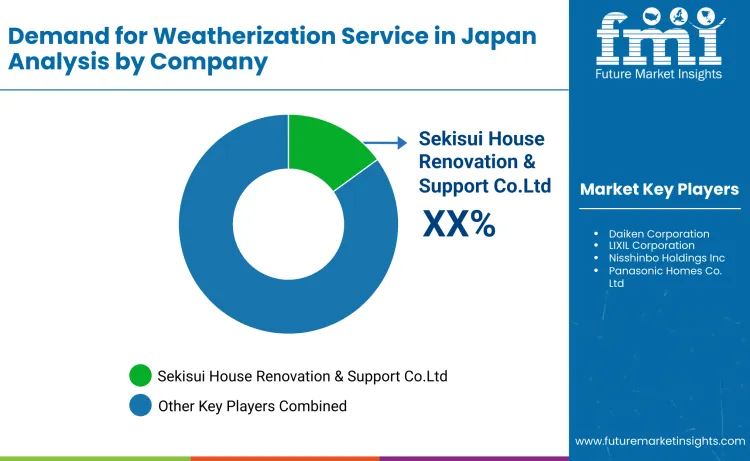
Demand for weatherization service in Japan is shaped by energy efficiency goals, seismic retrofit considerations, and national initiatives to reduce residential and commercial energy consumption. Weatherization encompasses insulation upgrades, air sealing, draft control, and moisture management tailored to Japan’s varied climate zones and building practices. Buyers evaluate contractor certification, thermal performance measurement, material suitability for high-humidity environments, and compliance with stringent building codes. Procurement teams prioritize firms with local service networks, expertise in seismic resistance integration, and familiarity with Japan’s energy-saving standards. Trend in the Japan market reflects sustained interest in energy savings amid rising fuel costs, aging building stock, and government incentives supporting retrofit programs.
Sekisui House Renovation & Support Co., Ltd. operates weatherization and retrofit services across Japan, delivering insulation improvements and airtightness enhancements for housing and residential complexes. Daiken Corporation participates with comprehensive thermal comfort solutions, including insulation materials and associated retrofit service expertise. LIXIL Corporation maintains visibility through building envelope solutions and energy performance services applied within both residential and commercial sectors. Nisshinbo Holdings Inc. contributes through advanced insulation materials and integrated service offerings for energy-efficient building upgrades. Panasonic Homes Co., Ltd. supports demand through retrofit planning, energy auditing, and implementation of weatherization measures aligned with national energy-saving guidelines. Competitive positioning in Japan reflects localized service delivery, integration of thermal performance solutions, compliance with seismic and energy standards, and deep understanding of domestic building practices.
Key Players in Japan Weatherization Service Demand
- Sekisui House Renovation & Support Co., Ltd.
- Daiken Corporation
- LIXIL Corporation
- Nisshinbo Holdings Inc.
- Panasonic Homes Co., Ltd.
Scope of the Report
| Items | Values |
|---|---|
| Quantitative Units | USD billion |
| Service Type | Insulation Upgrades; Air Sealing; Energy Audits; Window & Door Weatherization; Duct Sealing |
| Material | Spray Foam; Cellulose; Reflective Insulation; Bio-based Insulation |
| End-User | Residential; Commercial; Industrial; Government & Public Buildings |
| Regions Covered | Kyushu & Okinawa; Kanto; Kansai; Chubu; Tohoku; Rest of Japan |
| Key Companies Profiled | Sekisui House Renovation & Support Co., Ltd.; Daiken Corporation; LIXIL Corporation; Nisshinbo Holdings Inc.; Panasonic Homes Co., Ltd. |
| Additional Attributes | Dollar sales by service type, material, and end-user; regional CAGR trends across residential retrofitting and public building efficiency programs; demand patterns linked to energy conservation policies and aging housing stock; adoption trends for bio-based and high-performance insulation materials; regulatory influence of Japan energy-efficiency standards and carbon reduction targets. |
Japan Weatherization Service Demand by Segments
By Service Type:
- Insulation Upgrades
- Air Sealing
- Energy Audits
- Window & Door Weatherization
- Duct Sealing
By Material:
- Spray Foam
- Cellulose
- Reflective Insulation
- Bio-based Insulation.
By End-User:
- Residential
- Commercial
- Industrial
- Government & Public Buildings
Region:
- Kyushu & Okinawa
- Kanto
- Kansai
- Chubu
- Tohoku
- Rest of Japan
Frequently Asked Questions
How big is the demand for weatherization service in Japan in 2026?
The demand for weatherization service in Japan is estimated to be valued at USD 1.7 billion in 2026.
What will be the size of weatherization service demand in Japan in 2036?
The demand size for weatherization service in Japan is projected to reach USD 2.2 billion by 2036.
How much will the demand for weatherization service in Japan grow between 2026 and 2036?
The demand for weatherization service in Japan is expected to grow at a 2.8% CAGR between 2026 and 2036.
What are the key service types in the weatherization service demand in Japan?
The key service types in weatherization service demand in Japan include insulation upgrades, air sealing, window retrofits, and thermal performance improvements.
Which material segment is expected to contribute a significant share in the weatherization service demand in Japan in 2026?
In terms of material, spray foam insulation is expected to command 31.0% share in the weatherization service demand in Japan in 2026.
Preview the report firsthand - request a free sample
Get SampleGet the brochure for pricing and purchase details.
Get PDFTable of Content
- Executive Summary
- Japan Market Outlook
- Demand Side Trends
- Supply Side Trends
- Policy, Housing, and Climate Context
- Analysis and Recommendations
- Market Overview
- Market Coverage and Taxonomy
- Market Definition Scope and Limitations
- Market Background
- Market Dynamics
- Drivers
- Restraints
- Opportunities
- Trends
- Scenario Forecast
- Demand in Optimistic Scenario
- Demand in Likely Scenario
- Demand in Conservative Scenario
- Opportunity Map Analysis
- Service Life Cycle Analysis
- Housing Renovation and Retrofit Value Chain Analysis
- Investment Feasibility Matrix
- PESTLE and Porter Analysis
- Building Codes and Energy Efficiency Compliance Framework
- Regional Parent Market Outlook
- Japan Weatherization Service Demand Analysis 2020 to 2024 and Forecast 2025 to 2035
- Historical Demand Value USD Billion Analysis 2020 to 2024
- Current and Future Demand Value USD Billion Projections 2025 to 2035
- Year on Year Growth Trend Analysis
- Absolute Dollar Opportunity Analysis
- Japan Weatherization Service Pricing Analysis 2020 to 2024 and Forecast 2025 to 2035
- Japan Weatherization Service Demand Analysis 2020 to 2024 and Forecast 2025 to 2035 By Service Type
- Introduction and Key Findings
- Historical Demand Value USD Billion Analysis by Service Type 2020 to 2024
- Current and Future Demand Value USD Billion Analysis and Forecast by Service Type 2025 to 2035
- Insulation Upgrades
- Air Sealing
- Energy Audits
- Window and Door Weatherization
- Duct Sealing
- Year on Year Growth Trend Analysis by Service Type
- Absolute Dollar Opportunity Analysis by Service Type
- Japan Weatherization Service Demand Analysis 2020 to 2024 and Forecast 2025 to 2035 By Material
- Introduction and Key Findings
- Historical Demand Value USD Billion Analysis by Material 2020 to 2024
- Current and Future Demand Value USD Billion Analysis and Forecast by Material 2025 to 2035
- Spray Foam
- Cellulose
- Reflective Insulation
- Bio-based Insulation
- Year on Year Growth Trend Analysis by Material
- Absolute Dollar Opportunity Analysis by Material
- Japan Weatherization Service Demand Analysis 2020 to 2024 and Forecast 2025 to 2035 By End User
- Residential
- Commercial
- Industrial
- Government and Public Buildings
- Japan Weatherization Service Demand Analysis 2020 to 2024 and Forecast 2025 to 2035 By Region
- Kyushu and Okinawa
- Kanto
- Kansai
- Chubu
- Tohoku
- Rest of Japan
- Market Structure Analysis
- Competition Dashboard
- Competition Benchmarking
- Market Share Analysis of Key Players
- By Service Type
- By Material
- By Region
- Competition Analysis
- Competition Deep Dive
- Sekisui House Renovation and Support
- Daiken Corporation
- LIXIL Corporation
- Nisshinbo Holdings
- Panasonic Homes
- Assumptions and Acronyms Used
- Research Methodology


