

- Industry Size (2026)
- USD 12.8 Bn
- Forecast (2036)
- USD 18.1 Bn
- CAGR (2026 to 2036)
- 3.5%
Demand for Weatherization Service in USA 2026 to 2036
Demand for Weatherization Service in USA is valued at USD 12.8 billion in 2026 and is projected to reach USD 18.1 billion by 2036, reflecting a CAGR of 3.5%. Demand expands as residential and commercial property owners seek to reduce energy consumption, lower utility costs, and improve building thermal performance. Federal and state efficiency programs, aging housing stock, and rising energy prices continue to support steady adoption of weatherization services across income segments.
Insulation upgrades lead service-type usage because improved wall, attic, and floor insulation delivers immediate energy savings and long-term thermal stability. Contractors focus on high-performance insulation materials that reduce air leakage, control moisture intrusion, and enhance indoor comfort. Integration with air sealing, duct optimization, and ventilation improvements strengthens overall building efficiency outcomes.
West USA, South USA, Northeast USA, and Midwest USA represent key growth regions due to diverse climate conditions, strong public funding support, and large inventories of older buildings requiring efficiency retrofits. Ameresco, ICF, CLEAResult, Franklin Energy, and AECOM anchor competitive activity through program management expertise, large-scale retrofit execution, and data-driven energy efficiency solutions aligned with utility-led and government-backed weatherization initiatives across the United States.
Quick Stats for Demand for Weatherization Service in USA
- USA Weatherization Service Sales Value (2026): USD 12.8 billion
- USA Weatherization Service Forecast Value (2036): USD 18.1 billion
- USA Weatherization Service Forecast CAGR (2026-2036): 3.5%
- Leading Service Type in USA Demand: Insulation upgrades
- Key Growth Regions in USA Demand: West USA, South USA, Northeast USA, Midwest USA
- Top Players in USA Demand: Ameresco, ICF, CLEAResult, Franklin Energy, AECOM
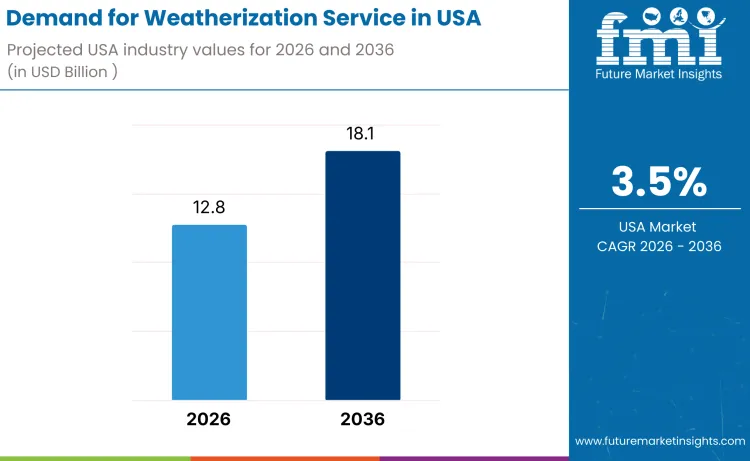
USA Weatherization Service Key Takeaways
| Metric | Value |
|---|---|
| USA Weatherization Service Sales Value (2026) | USD 12.8 billion |
| USA Weatherization Service Forecast Value (2036) | USD 18.1 billion |
| USA Weatherization Service Forecast CAGR (2026-2036) | 3.5% |
How Are the Segments Classified in the Demand for Weatherization Service in the USA?
Demand for weatherization services in the USA is shaped by energy-efficiency mandates, rising utility costs, and programs targeting reduced heat loss in existing buildings. Property owners and public agencies evaluate thermal performance improvement, air leakage reduction, and compliance with efficiency standards. Adoption patterns reflect strong activity in residential retrofits, supported by audits, insulation upgrades, and sealing services designed to lower energy consumption and improve indoor comfort across varied U.S. climate zones.
Which Service Type Accounts for the Largest Share of Demand in the USA?
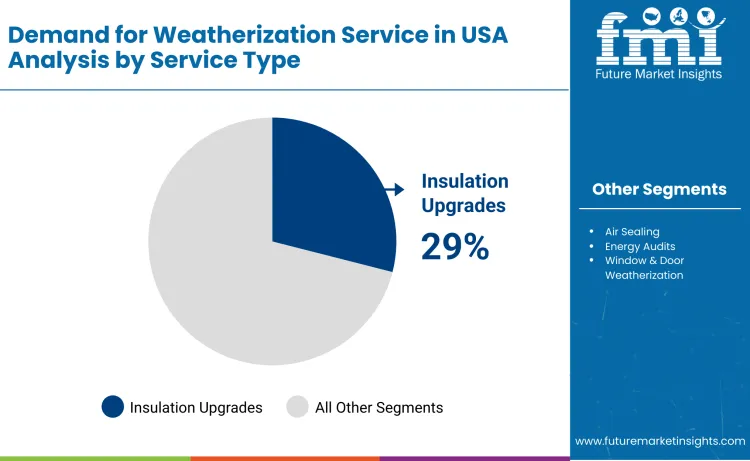
Insulation upgrades hold 29.0%, making them the leading service-type segment in the USA. Insulation improvements directly reduce heat transfer through walls, roofs, and floors, delivering measurable energy savings. Air sealing services support insulation performance by limiting uncontrolled airflow through building envelopes. Energy audits identify inefficiencies and guide prioritization of weatherization measures. Window and door weatherization improves thermal resistance and reduces drafts. Duct sealing enhances HVAC efficiency by minimizing conditioned air losses. Service-type distribution reflects priority given to insulation as the most impactful weatherization intervention.
Key Points:
- Insulation upgrades provide direct and measurable energy reduction.
- Air sealing complements insulation effectiveness.
- Audits guide targeted weatherization investments.
Which Material Accounts for the Largest Share of Demand in the USA?
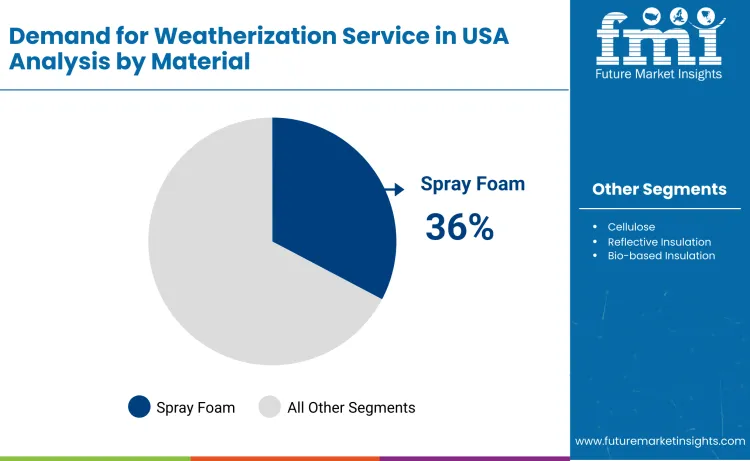
Spray foam holds 36.0%, making it the leading material segment in the USA. Spray foam delivers high R-values and effective air sealing in a single application, supporting energy-efficiency goals. Cellulose insulation offers cost-effective thermal improvement using recycled content. Reflective insulation supports radiant heat control in specific climate conditions. Bio-based insulation materials address sustainability-focused projects and regulatory preferences. Material distribution reflects preference for spray foam due to performance efficiency and adaptability across residential and light commercial structures.
Key Points:
- Spray foam combines insulation and air sealing functions.
- High thermal performance supports retrofit applications.
- Alternative materials serve cost or sustainability priorities.
Which End-User Segment Accounts for the Largest Share of Demand in the USA?
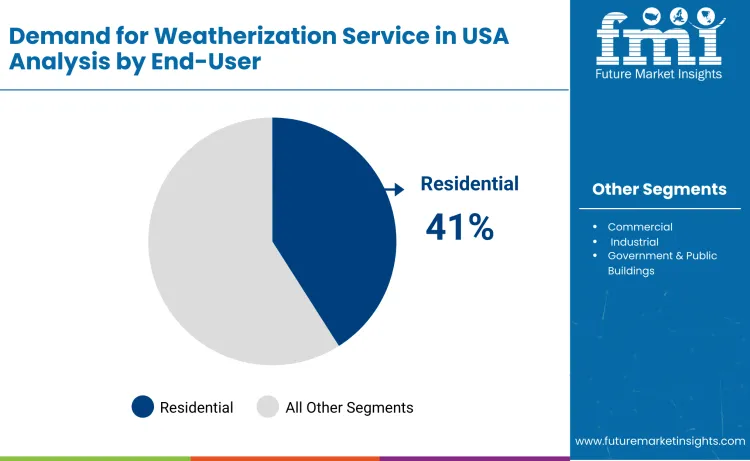
Residential end users hold 41.0%, making them the leading end-user segment in the USA. Single-family and multi-family housing drives demand due to aging building stock and efficiency upgrade incentives. Commercial buildings adopt weatherization services to manage operating costs and meet energy benchmarks. Industrial facilities apply services selectively in offices and controlled environments. Government and public buildings use weatherization to meet policy-driven efficiency targets. End-user distribution reflects concentration of programs and incentives within residential housing.
Key Points:
- Residential buildings lead due to retrofit incentives.
- Housing stock age increases weatherization needs.
- Public buildings represent structured, policy-driven demand.
What are the Key Dynamics in the Weatherization Service Industry in USA?
Demand increases as residential energy efficiency upgrades expand across low-income housing, aging building stock, and climate-exposed regions in USA. Weatherization services address insulation gaps, air leakage, and inefficient heating systems that drive high energy consumption. Federal and state programs support service delivery through grants and utility partnerships. Adoption concentrates in colder regions and older homes where efficiency improvements reduce energy burden and improve indoor comfort.
How do federal funding programs and residential energy efficiency needs drive demand in USA?
USA weatherization activity is driven by federally supported programs that target low-income households for insulation, air sealing, duct repair, and HVAC efficiency upgrades. State energy offices and community action agencies administer funds to reduce heating and cooling costs. Older housing stock built before modern energy codes presents high retrofit potential. Cold-climate states show strong service uptake due to heating cost pressure. Utilities partner with service providers to meet demand-side management goals. Rising energy prices increase household interest in efficiency improvements. Workforce programs support trained installers, reinforcing service availability across urban and rural regions.
How do labor constraints, housing eligibility rules, and program complexity affect demand stability?
Skilled labor shortages limit service throughput in several states, extending project timelines. Eligibility criteria restrict participation to income-qualified households, narrowing addressable scope. Administrative requirements increase overhead for service providers managing audits, documentation, and inspections. Older homes often require additional repairs before weatherization, raising per-unit cost. Rental properties face participation barriers due to split incentives between owners and tenants. Regional climate variability influences seasonal demand cycles. Funding availability depends on annual budget allocations and grant timing. Demand remains steady within program-supported segments, while expansion faces constraints from workforce capacity, administrative burden, and housing condition variability across USA industries.
How Is Demand for Weatherization Service in USA Evolving by Region?
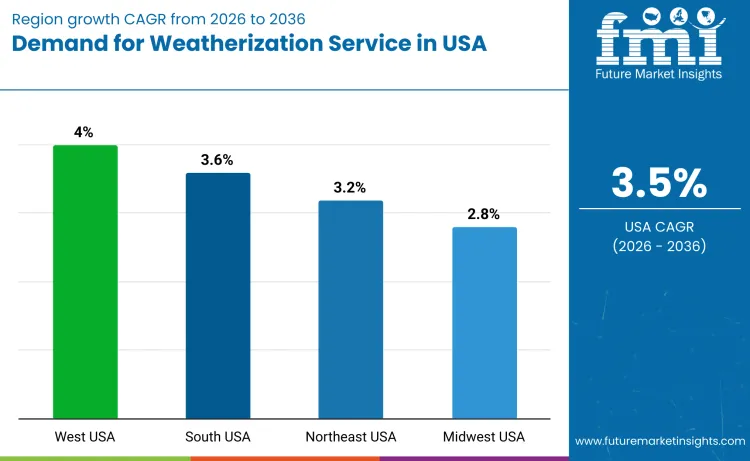
Demand for weatherization services in the USA is increasing due to rising energy costs, building-efficiency standards, and public funding for residential energy upgrades. West USA leads with a 4.0% CAGR, supported by utility efficiency programs, electrification initiatives, and retrofit activity in older housing stock. South USA follows at 3.6%, driven by cooling-load reduction, low-income housing upgrades, and utility-sponsored conservation efforts. Northeast USA records a 3.2% CAGR, shaped by cold-climate efficiency needs, aging buildings, and compliance with state energy codes. Midwest USA posts a 2.8% CAGR, reflecting steady demand from residential retrofits and publicly funded weatherization programs. Regional variation reflects climate intensity, housing age, and funding availability across the USA.
| Region | CAGR (2026-2036) |
|---|---|
| West USA | 4.0% |
| South USA | 3.6% |
| Northeast USA | 3.2% |
| Midwest USA | 2.8% |
How is West USA driving demand for Weatherization Services?
West USA demand is influenced by high energy prices, climate variability, and strong policy support for efficiency upgrades. The region’s CAGR of 4.0% reflects extensive use of weatherization services in single-family homes, multi-family buildings, and public housing. Programs emphasize insulation upgrades, air sealing, window retrofits, and duct optimization to reduce heating and cooling losses. Utilities partner with service providers to deliver incentive-backed retrofits aligned with electrification goals. Wildfire resilience and indoor air quality considerations also influence project scope. Demand favors comprehensive audits, data-driven retrofit planning, and certified contractors.
- Utility-sponsored residential efficiency programs
- Insulation, air sealing, and envelope upgrades
- Electrification-aligned retrofit activity
- Emphasis on certified audits and contractors
How is South USA driving demand for Weatherization Services?
South USA demand is shaped by cooling-dominated climates, housing affordability concerns, and public assistance programs. The region’s CAGR of 3.6% reflects rising adoption of weatherization services to reduce air-conditioning loads and manage peak electricity demand. Services focus on attic insulation, duct sealing, reflective roofing support, and moisture control. State and federal programs target low-income households to improve comfort and reduce utility bills. Contractors prioritize scalable solutions suitable for large housing volumes. Demand remains steady due to year-round energy usage and recurring retrofit needs.
- Cooling-load reduction through envelope improvements
- Low-income housing weatherization initiatives
- Duct sealing and attic insulation focus
- Scalable service models for high housing volumes
How is Northeast USA driving demand for Weatherization Services?
Northeast USA demand reflects cold-climate efficiency requirements, older building stock, and regulatory-driven energy targets. The region’s CAGR of 3.2% is supported by weatherization of pre-1980 housing, multi-family buildings, and municipal housing units. Services emphasize wall insulation, air leakage reduction, window performance upgrades, and heating system optimization. State energy codes and carbon-reduction goals support continued retrofit activity. Demand favors detailed energy audits, compliance documentation, and integration with heating system upgrades.
- Cold-climate insulation and air sealing needs
- Retrofit activity in older residential buildings
- Alignment with state energy and emissions targets
- Demand for audit-driven service delivery
How is Midwest USA driving demand for Weatherization Services?
Midwest USA demand is stable and program-driven, reflecting seasonal heating demand and public funding structures. The region’s CAGR of 2.8% reflects use of weatherization services in single-family homes, rural housing, and community housing programs. Services focus on insulation, air sealing, and heating efficiency improvements to manage winter energy consumption. Budget constraints influence adoption, favoring cost-effective measures with measurable savings. Demand growth remains moderate, supported by replacement cycles and ongoing participation in federally funded weatherization programs.
- Seasonal heating-efficiency upgrades
- Rural and community housing weatherization
- Cost-effective retrofit measures
- Stable demand linked to public funding programs
What is the competitive landscape of demand for weatherization service in the USA?
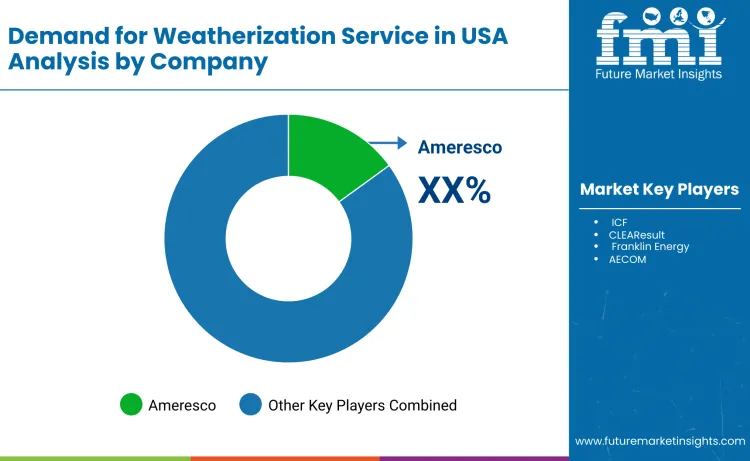
Demand for weatherization service in the USA is driven by energy efficiency goals, utility conservation programs, and household cost reduction initiatives. Programs address air sealing, insulation upgrades, duct improvements, and appliance efficiency within residential and small multifamily buildings. Buyers evaluate contractor certification, program compliance capability, workforce scale, and measurement and verification accuracy. Procurement teams emphasize safety protocols, building science expertise, and alignment with federal, state, and utility program requirements. Trend in the USA market reflects sustained funding for low-income efficiency upgrades, utility-administered demand-side management, and climate resilience initiatives.
Ameresco operates nationwide delivering energy efficiency services, audits, and retrofit execution for residential and community programs. ICF supports large-scale weatherization delivery through program administration, contractor management, and data-driven verification services. CLEAResult maintains extensive utility program operations providing weatherization measures, outreach, and quality assurance across multiple states. Franklin Energy participates through field services, workforce training, and incentive program delivery supporting residential efficiency upgrades. AECOM contributes engineering, program design, and implementation support for state and municipal weatherization initiatives. Competitive positioning in the USA reflects regulatory compliance, workforce availability, geographic coverage, data integrity, and ability to coordinate multi-stakeholder programs at scale.
Key Players in USA Weatherization Service Demand
- Ameresco
- ICF
- CLEAResult
- Franklin Energy
- AECOM
Scope of the Report
| Items | Values |
|---|---|
| Quantitative Units | USD billion |
| Service Type | Insulation Upgrades; Air Sealing; Energy Audits; Window & Door Weatherization; Duct Sealing |
| Material | Spray Foam; Cellulose; Reflective Insulation; Bio-based Insulation |
| End-User | Residential; Commercial; Industrial; Government & Public Buildings |
| Regions Covered | West USA; South USA; Northeast USA; Midwest USA |
| Key Companies Profiled | Ameresco; ICF; CLEAResult; Franklin Energy; AECOM |
| Additional Attributes | Dollar sales by service type and end-user; adoption patterns tied to federal and state energy-efficiency programs; retrofit demand across aging building stock; contractor-led implementation models; material preference trends influenced by insulation performance, installation speed, and compliance with U.S. building energy codes. |
USA Weatherization Service Demand by Segments
Service Type:
- Insulation Upgrades
- Air Sealing
- Energy Audits
- Window & Door Weatherization
- Duct Sealing
Material:
- Spray Foam
- Cellulose
- Reflective Insulation
- Bio-based Insulation
End-User:
- Residential
- Commercial
- Industrial
- Government & Public Buildings
Region:
- West USA
- South USA
- Northeast USA
- Midwest USA
Bibliography
- USA Department of Energy. (2023). Weatherization Assistance Program guidelines and energy efficiency measures. DOE Technical and Program Guidance.
- American Society of Heating, Refrigerating and Air-Conditioning Engineers. (2023). Standards for building energy performance and weatherization techniques. ASHRAE Standards Publications.
- National Renewable Energy Laboratory. (2023). Research on building envelope improvements and cost effectiveness of weatherization services. NREL Technical Reports.
- Building Performance Institute. (2023). Best practices and competency frameworks for residential and commercial weatherization services. BPI Technical Publications.
Frequently Asked Questions
How big is the demand for weatherization service in USA in 2026?
The demand for weatherization service in USA is estimated to be valued at USD 12.8 billion in 2026.
What will be the size of weatherization service demand in USA in 2036?
The demand size for weatherization service in USA is projected to reach USD 18.1 billion by 2036.
How much will the demand for weatherization service in USA grow between 2026 and 2036?
The demand for weatherization service in USA is expected to grow at a 3.5% CAGR between 2026 and 2036.
What are the key service types in the weatherization service demand in USA?
The key service types in weatherization service demand in USA include insulation upgrades, air sealing, window and door improvements, and HVAC efficiency enhancements.
Which material segment is expected to contribute a significant share in the weatherization service demand in USA in 2026?
In terms of material, spray foam insulation is expected to command 36.0% share in the weatherization service demand in USA in 2026.
Preview the report firsthand - request a free sample
Get SampleGet the brochure for pricing and purchase details.
Get PDFTable of Content
- Executive Summary
- USA Market Outlook
- Demand Side Trends
- Supply Side Trends
- Federal and State Weatherization Programs
- Analysis and Recommendations
- Market Overview
- Market Coverage and Taxonomy
- Market Definition Scope and Limitations
- Market Background
- Market Dynamics
- Drivers
- Restraints
- Opportunities
- Trends
- Scenario Forecast
- Demand in Optimistic Scenario
- Demand in Likely Scenario
- Demand in Conservative Scenario
- Opportunity Map Analysis
- Product Life Cycle Analysis
- Supply Chain Analysis
- Investment Feasibility Matrix
- Value Chain Analysis
- PESTLE and Porter Analysis
- Energy Efficiency and Building Code Framework
- Regional Parent Market Outlook
- Service Delivery and Workforce Analysis
- USA Weatherization Service Demand Analysis 2020 to 2024 and Forecast 2025 to 2035
- Historical Demand Value USD Billion Analysis 2020 to 2024
- Current and Future Demand Value USD Billion Projections 2025 to 2035
- Year on Year Growth Trend Analysis
- Absolute Dollar Opportunity Analysis
- USA Weatherization Service Pricing Analysis 2020 to 2024 and Forecast 2025 to 2035
- USA Weatherization Service Demand Analysis 2020 to 2024 and Forecast 2025 to 2035 By Service Type
- Introduction and Key Findings
- Historical Demand Value USD Billion Analysis by Service Type 2020 to 2024
- Current and Future Demand Value USD Billion Analysis and Forecast by Service Type 2025 to 2035
- Insulation Upgrades
- Air Sealing
- Energy Audits
- Window and Door Weatherization
- Duct Sealing
- Year on Year Growth Trend Analysis by Service Type
- Absolute Dollar Opportunity Analysis by Service Type
- USA Weatherization Service Demand Analysis 2020 to 2024 and Forecast 2025 to 2035 By Material
- Introduction and Key Findings
- Historical Demand Value USD Billion Analysis by Material 2020 to 2024
- Current and Future Demand Value USD Billion Analysis and Forecast by Material 2025 to 2035
- Spray Foam
- Cellulose
- Reflective Insulation
- Bio-based Insulation
- Year on Year Growth Trend Analysis by Material
- Absolute Dollar Opportunity Analysis by Material
- USA Weatherization Service Demand Analysis 2020 to 2024 and Forecast 2025 to 2035 By End User
- Residential
- Commercial
- Industrial
- Government and Public Buildings
- USA Weatherization Service Demand Analysis 2020 to 2024 and Forecast 2025 to 2035 By Region
- West USA
- South USA
- Northeast USA
- Midwest USA
- Market Structure Analysis
- Competition Dashboard
- Competition Benchmarking
- Market Share Analysis of Key Players
- By Service Type
- By Material
- By End User
- By Region
- Competition Analysis
- Competition Deep Dive
- Ameresco
- ICF
- CLEAResult
- Franklin Energy
- AECOM
- Assumptions and Acronyms Used
- Research Methodology


