

- Market Size (2026)
- USD 360.4 Mn
- Forecast (2036)
- USD 627.4 Mn
- CAGR (2026 to 2036)
- 5.7%
How big is the Kids & Baby Sunscreen Market in 2026?
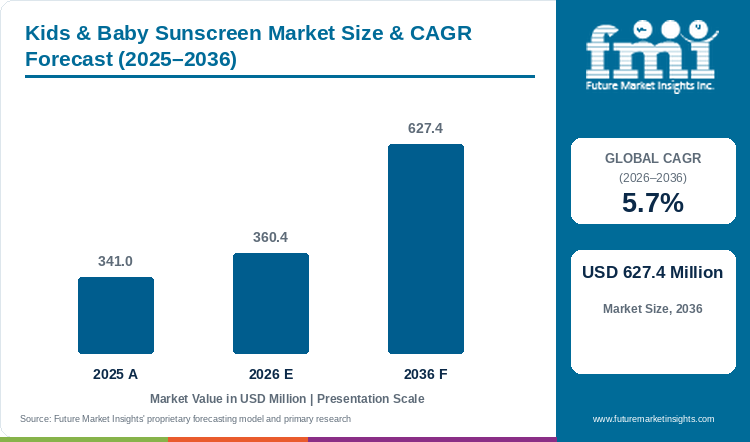
Demand for kids & baby sunscreen is projected to expand at 5.7% CAGR between 2026 and 2036. Industry value grows from USD 341.0 million in 2025 to USD 360.4 million in 2026 and is projected to reach USD 627.4 million by 2036.
Demand is projected to expand at 5.7% CAGR between 2026 and 2036. As per FMI, market value is estimated at USD 341.0 million in 2025 and USD 360.4 million in 2026. It is projected to reach USD 627.4 million by 2036. WHO states that children and adolescents are particularly vulnerable to ultraviolet radiation and that childhood sunburn raises later skin-cancer risk [1]. These challenges support products that combine broad-spectrum protection with tolerable skin feel. School and sports create recurring use occasions while travel and water play add more. The category also sits within the wider sun care products market, but pediatric use adds age guidance and tolerability requirements.
Brazil is projected at 7.3% CAGR through 2036 and requires children's sunscreen registration. Australia follows at 7.0% under a therapeutic-goods model that puts unusual weight on SPF substantiation. Japan combines established sun-care use with demand for mild textures suited to parent-supervised application. The USA added a new permitted sunscreen active ingredient in June 2026 for adults and children aged six months or older. Across these markets a product still has to clear local efficacy rules and feel acceptable on a child's skin.
Key Takeaways
- Childhood UV-risk awareness is translating into repeat household purchases for outdoor routines, which is expected to support the kids and baby sunscreen market growth.
- Based on product type, chemical filters is projected to account for 32.0% in 2026 owing to formulation flexibility that pairs high protection with low-residue, easy-to-spread textures.
- By nature, conventional is estimated to hold 47.0% in 2026 because mainstream portfolios remain the most broadly available across mass and pharmacy channels.
- In 2026, cream & balm is expected to lead format with 31.0% share owing to the dose visibility it gives caregivers applying product to a child's face and body.
- Testing credibility and sensitive-skin tolerability raise the qualification threshold for pediatric products, and a challenged SPF claim can remove a product from sale entirely.
- Profiled companies include Beiersdorf and L'Oreal alongside Amorepacific and Kao Corporation. Shiseido and Unilever are also covered with Coty and e.l.f. Beauty. Procter & Gamble and Estee Lauder Companies complete the profiled set.
Analyst Perspective
“Protection earns repeat purchase only when families can use it correctly week after week. Products must avoid sting and visible residue while remaining easy to reapply. In my experience these factors decide whether seasonal trial becomes a trusted household routine.”
- Rahul Pandita, Principal Consultant, Future Market Insights.
How is the kids & baby sunscreen market segmented?
Kids & baby sunscreen market is segmented by five primary commercial axes and region: product type, nature, format, price positioning, and sales channel. Chemical filters is projected at 32.0%, conventional at 47.0%, and cream & balm at 31.0% in 2026.
- By product type: Chemical Filters, Mineral Filters, Hybrid Filters, and Tinted Formats.
- By nature: Conventional, Vegan & Cruelty-Free, Natural & Organic, Dermocosmetic / Clinical, and Fragrance-Free & Sensitive.
- By format: Cream & Balm, Liquid & Serum, Stick & Solid, Spray & Mist, Sheet & Patch, and Powder.
- By price positioning: Mass, Masstige, Premium, and Professional.
- By sales channel: E-commerce & DTC, Specialty Beauty Retail, Pharmacies & Drugstores, Supermarkets & Hypermarkets, and Salons & Spas.
- By region: North America, Latin America, Western Europe, Eastern Europe, East Asia, South Asia and Pacific, and Middle East and Africa.
Why do Chemical Filters lead demand within the Product Type category?
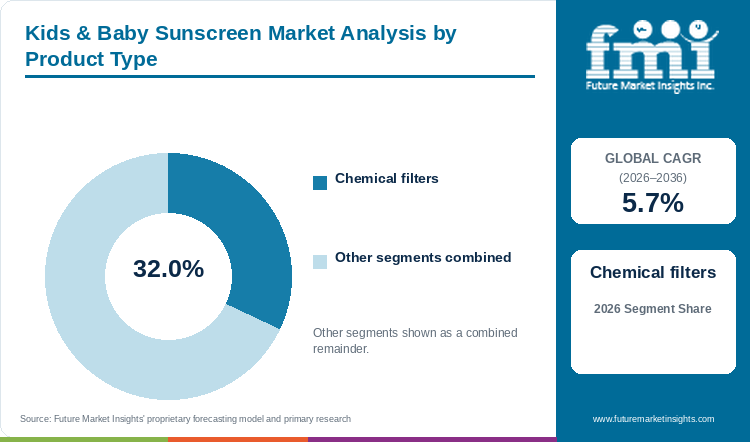
Chemical filters are projected to account for 32.0% of product type demand in 2026. Formulation flexibility supports high protection with low-residue textures.
Chemical-filter systems remain central because formulators can combine broad-spectrum protection with transparent finishes that spread easily over an active child. Caregivers judge a sunscreen by SPF and by whether a child tolerates repeated face and body application. Organic filters also support fluid textures with high protection and lower visible residue. La Roche-Posay updated its kids and babies sunscreen guidance in August 2026. It positioned Anthelios Dermo-Pediatrics Baby Lotion SPF50+ for babies six months and older. The mineral sunscreen market remains important when ingredient preference or sensitive-skin positioning drives the purchase. Hybrid systems give brands another route between those two needs.
- Chemical filters are projected to account for 32.0% of product type demand in 2026 because their formulation flexibility supports high protection with cosmetically acceptable textures.
- That range gives brands room to serve both an active, high-exposure child and a caregiver who simply wants a formula that disappears quickly on skin.
Why does Conventional lead demand within the Nature category?
By nature, conventional is estimated to hold 47.0% in 2026, owing to familiar brand architecture and broad retail availability.
Conventional products lead because family sunscreen purchasing still favors familiar brands and broad retail availability. Parents move toward natural or vegan options when ingredient preference matters more. Clinical and fragrance-free products are more relevant when a child has a specific sensitivity. These claims can support premium pricing but they narrow the addressable pool as price rises. Beiersdorf reported that its reformulated NIVEA SUN Protect & Moisture range reached more than 50 markets during 2025. This scale shows the distribution advantage available to mainstream sun-care platforms. A similar trust dynamic appears in the baby skincare market where caregivers often prioritize tolerability and familiar brands.
- Conventional products are projected to account for 47.0% of nature demand in 2026 because familiar sunscreen architectures and broad retail availability support everyday purchase.
- Claims-led positioning keeps expanding around it, but it competes for a smaller, more deliberate share of the buying decision.
Why does Cream & Balm lead demand within the Format category?
In 2026, cream & balm is expected to lead format with 31.0% share, supported by dose visibility during caregiver-controlled application.
Cream and balm formats support controlled primary application because caregivers can see where product has been placed. They can work the formula into small facial areas without airborne overspray. This matters when a young child depends on an adult for complete coverage. AEMPS advised in July 2024 that adults should apply sunscreen to young children before exposure and supervise its use [4]. Liquids and sticks can reduce friction during reapplication. Sprays and mists suit travel or quick-use occasions. Cream and balm remain useful as the dependable first layer.
- Cream & balm is projected to account for 31.0% of format demand in 2026 because dose visibility gives caregivers control during primary application.
- Suppliers can extend the same routine by pairing that controlled first layer with a simpler format built just for reapplication.
Why does Mass lead demand within the Price Positioning category?
Mass is projected to account for 34.0% of price positioning demand in 2026. Repeat purchasing supports its lead.
Mass positioning leads because children's sunscreen is a repeat-use household purchase with seasonal peaks. Caregivers may keep separate units at home and in school bags before travel or sports adds more replacement needs. That pattern favors accessible price points once efficacy and tolerability are credible. Kao launched Bioré UV Kids Pure Milk in Singapore in September 2021 through Watsons and Guardian as well as NTUC FairPrice. The launch shows that a pediatric-specific product can sit comfortably in high-frequency mass and drugstore channels. Premium brands can justify higher prices through sensitive-skin testing or advanced filter systems. Mass retains an advantage through affordability and clear age guidance.
- Mass is projected to account for 34.0% of price positioning demand in 2026 because repeat purchase and multi-unit household use reward accessible price points.
- Professional positioning stays more selective, since routine sunscreen purchasing usually happens outside a clinical consultation altogether.
Why does E-commerce & DTC lead demand within the Sales Channel category?
E-commerce & DTC is forecast to lead sales channel with 32.0% share in 2026, supported by comparison and convenient replenishment.
E-commerce and DTC lead because parents can compare ingredient systems with age guidance before the first purchase. Texture claims and caregiver reviews also matter when a product will be used repeatedly on a child's skin. Digital channels simplify replenishment once a child tolerates a formula. They also support bundles that place sunscreen in several routine locations or pair a primary format with a portable option. La Roche-Posay updated its online kids and babies sunscreen guide in August 2026 with separate baby and child choices. The same comparison-led buying pattern is visible across the baby personal care products market. Offline pharmacy and specialty channels still matter when professional advice carries more weight than online reviews.
- E-commerce & DTC is projected to account for 32.0% of sales channel demand in 2026 because detailed comparison and convenient replenishment support repeat purchase.
- The channel's advantage is therefore strongest after that first successful trial, when switching risk has already dropped.
What are the drivers, restraints and opportunities in the kids & baby sunscreen market?
Childhood UV-risk awareness supports repeat protection purchases, while efficacy and tolerability requirements slow conversion and easier reapplication creates room for product and channel innovation.
- Driver: Caregivers seek reliable broad-spectrum protection for recurring outdoor exposure.
- Restraint: Testing credibility and sensitive-skin tolerability raise the qualification threshold for pediatric products.
- Opportunity: Low-friction textures, portable reapplication formats, and digital replenishment can improve adherence and repeat purchase.
A Clear Health Consequence Sustains Repeat Purchase
Caregivers buy more consistently when sun protection is linked to a clear health consequence rather than cosmetic prevention alone. WHO states that excessive sun exposure in children and adolescents contributes to skin cancer later in life and recommends broad-spectrum sunscreen on skin that clothing cannot cover [1]. For this market the commercial mechanism is recurring exposure during school and sports. Holidays and water activities add more occasions. Brands capture that demand when correct application fits the family routine instead of becoming another chore.
Substantiation Failures Can Remove a Product from Sale Entirely
Protection claims must be trusted before parents will use a product repeatedly. Australia's TGA reported on March 31 2026 that 19 sunscreens using the same base formulation were cancelled from the national register and recalled after lower-than-claimed SPF results [3]. For pediatric suppliers weak substantiation can remove a product from sale. Poor skin feel can also suppress repeat use even when the protection claim is sound. The result is a higher development and quality threshold rather than lower underlying demand.
Adherence After the First Purchase Is the Real Growth Lever
The clearest opportunity is to improve adherence after the first purchase. La Roche-Posay updated its child and baby sunscreen guidance in August 2026 around dedicated high-protection formulas for sensitive skin. Suppliers can extend that approach with easy-spread primary products and portable reapplication formats. Replenishment programs can also reduce the chance of a family running out mid-season. Strong products combine defensible efficacy with a sensory profile that children accept repeatedly.
Which country CAGRs are profiled in the kids & baby sunscreen market?
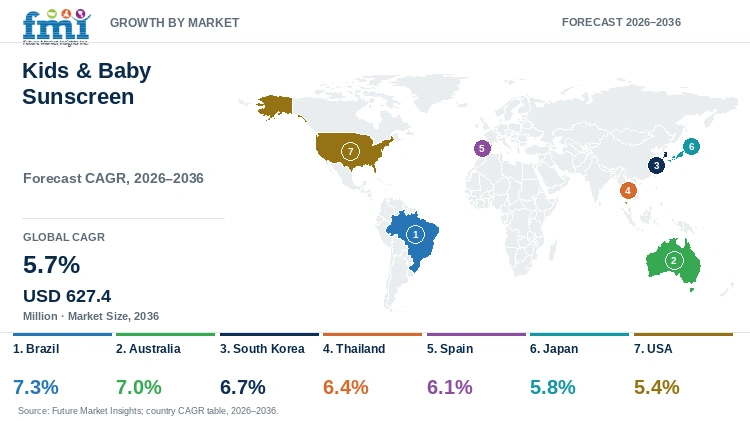
| Country | CAGR |
|---|---|
| Brazil | 7.3% |
| Australia | 7.0% |
| South Korea | 6.7% |
| Thailand | 6.4% |
| Spain | 6.1% |
| Japan | 5.8% |
| USA | 5.4% |
Country-wise Analysis
- The FDA’s addition of bemotrizinol as a permitted sunscreen active ingredient on June 9, 2026 gives brands another formulation option in the USA. The agency recognized it as generally safe and effective for adults and children aged six months or older [2]. Over-the-counter drug rules continue to govern eligible actives and Drug Facts labeling, which caregivers consult for application directions. FMI forecasts a 5.4% CAGR from 2026 to 2036. Within these requirements, textures that children tolerate can help families maintain regular use and support repeat purchases.
- Established sunscreen routines in Japan give mild, child-suitable formulations a place in everyday family skincare. Shiseido’s February 2024 launch of ANESSA Mineral UV Mild Gel illustrates this positioning: its non-chemical formula was intended for sensitive skin and children, including babies other than newborns. Acceptance still depends partly on comfort and visible white cast, while easy removal makes parent-supervised use more manageable. Japan’s market is projected to grow at a 5.8% CAGR from 2026 to 2036, with retail and online age guidance helping parents choose suitable products.
- South Korea’s projected 6.7% CAGR from 2026 to 2036 comes with close scrutiny of UV-protection claims, which fall under functional cosmetics regulation. In August 2026, MFDS proposed stronger requirements for submitted supporting data while allowing certain in-vitro efficacy evidence. The proposal puts reproducible testing at the center of claim development. Brands positioning children’s sunscreens for sensitive skin will need transparent evidence that satisfies regulatory review and supports the claims parents encounter when shopping.
- Concerns over SPF substantiation carry particular weight in Australia, where primary sunscreens are regulated as therapeutic goods. On March 31, 2026, the TGA reported that 19 sunscreens sharing a base formulation had been cancelled from the Australian Register of Therapeutic Goods and recalled following SPF concerns [3]. Robust testing and conservative claims are therefore central to supplying this market, which FMI projects to expand at a 7.0% CAGR from 2026 to 2036. Water-resistant family formats also fit the needs of this highly sun-aware market.
- Brazil is forecast to record the fastest growth among the seven profiled markets, at a 7.3% CAGR from 2026 to 2036. Manufacturers pursuing that demand must keep production aligned with registered formulas. Children’s sunscreens require registration, and Anvisa’s April 2026 prohibition of specified products followed findings that their formulations differed from those authorized by the agency. Control over manufacturing changes is consequently a commercial requirement as well as a compliance concern. Reliable distribution supports product authenticity, while Portuguese-language instructions help caregivers use products correctly.
- Spain’s AEMPS placed supervised application at the center of its July 2024 child sun-protection campaign. Its recommendations covered high or very high UVA and UVB protection, child-specific formulas, and water or sweat resistance where relevant [4]. Easy-spread textures and clear reapplication directions make that guidance more practical for families. With market growth projected at a 6.1% CAGR from 2026 to 2036, seasonal retail availability around travel and outdoor activities remains an important part of reaching buyers.
- Heat and water activities make repeated application a practical consideration for families in Thailand. In March 2024, the Thai FDA advised consumers to choose sunscreen suited to their outdoor activities, use water-resistant products for water exposure, and reapply every two hours. It also advised against sunscreen use in children younger than six months. These directions favor formats that are quick to apply and clearly labeled for age-appropriate use. Thailand’s market is projected to grow at a 6.4% CAGR from 2026 to 2036; pharmacy and digital education can help families follow application guidance during school holidays and travel periods.
Who are the notable companies in the kids & baby sunscreen market?
Notable companies include Beiersdorf and L'Oreal alongside Amorepacific and Kao Corporation. Shiseido and Unilever are also profiled with Coty and e.l.f. Beauty. Procter & Gamble and Estee Lauder Companies complete the set.
Competition spans dedicated pediatric sunscreen brands and broader beauty platforms. L'Oreal and Kao Corporation compete with direct child-focused products. Shiseido and Coty also field pediatric sunscreen propositions built around age suitability and high protection. Beiersdorf and Amorepacific compete through wider sun-care science and testing capability. Estee Lauder Companies sits closer to prestige and dermatologist-oriented sun care. Unilever and e.l.f. Beauty compete through consumer reach while Procter & Gamble brings broad household distribution. Pediatric specificity matters more here than corporate size alone.
- Dedicated pediatric sun-care platforms: L'Oreal and Kao Corporation compete alongside Shiseido and Coty through child-focused formulas and age-specific use cases.
- Broad sunscreen and skin-health platforms: Beiersdorf and Amorepacific compete through UV science and sensitive-skin capability. Estee Lauder Companies adds a wider prestige skincare ecosystem.
- Adjacent mass and digital beauty platforms: Unilever and e.l.f. Beauty bring established consumer access. Procter & Gamble adds broad household reach.
Competitive Benchmarking: Kids & Baby Sunscreen Market
| Company | Pediatric-Specific SPF Evidence | Sensitive-Skin Formula Depth | Reapplication Format Evidence | Geographic Reach |
|---|---|---|---|---|
| Beiersdorf | Low | Medium | Medium | Broad international sunscreen distribution; recent NIVEA SUN relaunch reached 50+ markets |
| L'Oreal | High | High | Medium | Europe and broader international dermatological beauty reach; dedicated child and baby products in the UK |
| Amorepacific | Low | Medium | Low | South Korea-centered sun-care R&D with internationally oriented testing and brand platforms |
| Kao Corporation | High | High | Low | Japan and selected Asia-Pacific markets; dedicated kids mineral sunscreen products in Singapore and Japan |
| Shiseido | High | High | Medium | Japan and wider Asia; ANESSA mild products include child and baby-oriented use cases |
| Unilever | Low | Low | Low | Broad consumer distribution through personal-care channels |
| Coty | High | High | High | Lancaster sun-care distribution across Europe and selected international markets with a dedicated kids spray |
| e.l.f. Beauty | Low | Low | Low | Broad digital and mass beauty reach |
| Procter & Gamble | Low | Low | Low | Broad mass retail and household distribution |
| Estee Lauder Companies | Low | Low | Low | Prestige beauty distribution across major markets |
Scoring basis: Pediatric-Specific SPF Evidence measures the strength of child-focused product positioning. Sensitive-Skin Formula Depth measures mild or fragrance-free architecture and sensitive-skin positioning within sun care. Reapplication Format Evidence measures formats that reduce friction during repeat use. High indicates broad capability. Medium indicates narrower capability. Low indicates limited capability within the criterion.
Key Developments in the Kids & Baby Sunscreen Market
- In January 2024 Shiseido announced a February launch of ANESSA Mineral UV Mild Gel and other updated ANESSA products. The mineral gel was described as the company's first non-chemical sunscreen gel formula. It was designed for sensitive skin and children including babies other than newborns. The launch addresses a pediatric trade-off between filter preference and comfortable application.
- In March 2025, Amorepacific and BASF announced the joint development of UV-R Pro antioxidant UV protection technology after signing an agreement in Seoul. The work targets free-radical formation associated with UV exposure and strengthens Amorepacific's technical options for future sun-care formulas where protection credibility and differentiated skin benefits influence premium positioning.
- In March 2026, Amorepacific announced international certification of its sunscreen efficacy evaluation capability under ISO 24443 and the establishment of an ISO 23675 testing framework. For the market, stronger internal testing capability can shorten evidence loops and support claims in jurisdictions where sunscreen performance is increasingly examined.
- In March 2026 Beiersdorf reported that its NIVEA SUN Protect & Moisture relaunch had reached more than 50 markets during 2025. The reformulation combined UVA and UVB protection with antioxidant support and a faster-absorbing texture. The development shows how a large sun-care platform can use sensory improvement and international scale to support regular use.
Key Players in the Kids & Baby Sunscreen Market
Dedicated Pediatric Sun Care Platforms
- L'Oreal
- Kao Corporation
- Shiseido
- Coty
Broad Sunscreen and Skin-Health Platforms
- Beiersdorf
- Amorepacific
- Estee Lauder Companies
Adjacent Mass and Digital Beauty Platforms
- Unilever
- e.l.f. Beauty
- Procter & Gamble
Kids & Baby Sunscreen Market - Report Scope
| Coverage field | Report scope |
|---|---|
| Market breakdown | Product Type; Nature; Format; Price Positioning; Sales Channel; Region |
| Quantitative Units | USD Million |
| Market Definition | Market revenue includes standalone sunscreen products explicitly positioned for babies and/or children and sold through the listed channel universe. Adjacent baby skin care, adult-only sunscreen, after-sun products, tanning products, UV apparel, shade products, oral supplements, insect repellents, and non-sunscreen bundle revenue are excluded. |
| Regions Covered | North America; Latin America; Western Europe; Eastern Europe; East Asia; South Asia and Pacific; Middle East and Africa |
| Countries Covered | USA, Japan, South Korea, Australia, Brazil, Spain, Thailand, and more than twenty-five additional countries in the full report |
| Key Companies Profiled | Beiersdorf, L'Oreal, Amorepacific, Kao Corporation, Shiseido, Unilever, Coty, e.l.f. Beauty, Procter & Gamble, Estee Lauder Companies |
| Forecast Period | 2026 to 2036 |
| Approach | Hybrid bottom-up and top-down market sizing with reconciliation across product, channel, country, and company evidence; adjacent-category revenue is excluded to prevent double counting. |
Kids & Baby Sunscreen Market - Research Methodology
| Method | Approach |
|---|---|
| Primary Research | Primary research covers sunscreen manufacturers and brand owners alongside distributors and retailers. It also includes pharmacy stakeholders plus dermatology and skin-care specialists. Questions focus on product scope and channel mix. They also cover price positioning and repeat-use patterns as well as claim requirements and country-specific purchase friction. |
| Desk Research | Desk research reviews regulator guidance and sunscreen rules. It also covers public company filings and official product documentation. Government health guidance and standards-related announcements provide additional context. Sources support product eligibility and operating conditions as well as company actions and country-specific adoption mechanisms. |
| Market Sizing and Forecasting | Market sizing combines product-level and channel-level evidence with company participation and country demand conditions. Forecast assumptions consider child sun-protection awareness and outdoor-use occasions. They also cover regulatory requirements and formulation innovation. Price architecture and channel migration are included alongside the ability to convert trial into repeat sunscreen purchases. |
| Data Validation | Validation cross-checks values and narratives across independent source types. It removes duplicate revenue and unsupported claims while keeping adjacent categories outside the market boundary. Company actions support company-specific facts rather than industry-wide leadership. Country evidence is applied only to the market where it occurs. |
Kids & Baby Sunscreen Market by Segments
Kids & Baby Sunscreen Market segmented by Product Type:
- Chemical filters
- Mineral filters
- Hybrid filters
- Tinted formats
Kids & Baby Sunscreen Market segmented by Nature:
- Conventional
- Vegan & cruelty-free
- Natural & organic
- Dermocosmetic / clinical
- Fragrance-free & sensitive
Kids & Baby Sunscreen Market segmented by Format:
- Cream & balm
- Liquid & serum
- Stick & solid
- Spray & mist
- Sheet & patch
- Powder
Kids & Baby Sunscreen Market segmented by Price Positioning:
- Mass
- Masstige
- Premium
- Professional
Kids & Baby Sunscreen Market segmented by Sales Channel:
- E-commerce & DTC
- Specialty beauty retail
- Pharmacies & drugstores
- Supermarkets & hypermarkets
- Salons & spas
Kids & Baby Sunscreen Market by Region:
- North America
- United States
- Canada
- Latin America
- Brazil
- Mexico
- Argentina
- Chile
- Western Europe
- Germany
- France
- United Kingdom
- Italy
- Spain
- Benelux
- Nordics
- Eastern Europe
- Poland
- Czech Republic
- Romania
- Hungary
- East Asia
- China
- Japan
- South Korea
- South Asia and Pacific
- India
- ASEAN
- Australia and New Zealand
- Middle East and Africa
- GCC Countries
- South Africa
- Türkiye
- Israel
Research Sources and Bibliography
- [1] World Health Organization. (2022, June 21). Ultraviolet radiation. https://www.who.int/news-room/fact-sheets/detail/ultraviolet-radiation
- [2] U.S. Food and Drug Administration. (2026, June 9). FDA Expands Sunscreen Options for the First Time in 20 Years. https://www.fda.gov/news-events/press-announcements/fda-expands-sunscreen-options-first-time-20-years
- [3] Therapeutic Goods Administration, Australia. (2026, March 31). Listed Medicine Compliance Reports - March 2026 Update. https://www.tga.gov.au/news/news-articles/listed-medicine-compliance-reports-march-2026-update
- [4] Agencia Española de Medicamentos y Productos Sanitarios. (2024, July 2). Consejos para una adecuada protección solar en niños. https://www.aemps.gob.es/informa/campanas-institucionales/consejos-para-una-adecuada-proteccion-solar-en-ninos/
This bibliography lists four external references used in the public article. The full report contains the complete reference list and detailed citations.
This Report Answers
- What is the Kids & Baby Sunscreen Market size in 2026 and what value is forecast by 2036?
- Which childhood UV-exposure and family-use pressures support demand for kids & baby sunscreen?
- Why do Chemical filters hold the leading position in Product Type?
- How does Conventional positioning influence access across mainstream family purchase channels?
- Why does Cream & balm remain the leading Format for caregiver-controlled application?
- How do forecast CAGRs differ across the seven profiled countries?
- Which profiled companies offer dedicated pediatric sunscreen propositions and which participate through broader sun-care platforms?
- How do efficacy substantiation and sensitive-skin tolerability limit product adoption or repeat purchase?
- What should brand, retail, and portfolio decision-makers evaluate before entering or expanding in the market?
Frequently Asked Questions
What is driving growth in the Kids & Baby Sunscreen Market?
Growth is driven by caregiver awareness of childhood UV risk and repeated exposure in school or sports settings. Travel and water activities add further occasions. Demand strengthens when high-protection formulas are easy to spread and comfortable on sensitive skin. Simple reapplication supports repeat household purchase.
Who are the key players in the Kids & Baby Sunscreen Market?
The profiled company universe includes Beiersdorf and L'Oreal alongside Amorepacific and Kao Corporation. Shiseido and Unilever are also covered with Coty and e.l.f. Beauty. Procter & Gamble and Estee Lauder Companies complete the set. Their roles range from direct pediatric sunscreen portfolios to broader sun-care and beauty platforms.
What notable restraint affects the Kids & Baby Sunscreen Market?
The main restraint is the combined burden of credible efficacy substantiation and child-appropriate tolerability. A product can lose momentum if SPF evidence is challenged, and families may not repurchase when a formula stings or leaves residue and visible cast, or when reapplication is difficult.
Why should executives track the Kids & Baby Sunscreen Market?
The market sits at the intersection of preventive health behavior, regulated sunscreen claims, and repeat family purchasing. Executives can use it to assess where formulation science and age guidance need stronger channel design or trust-building to produce durable replenishment rather than one-time seasonal trial.
What business problem does the Kids & Baby Sunscreen Market address?
The market addresses the need to protect children from ultraviolet exposure during routine outdoor activity while fitting real family behavior. Products must deliver credible UVA and UVB protection in forms that adults can apply correctly and children will tolerate repeatedly.
What should brand and portfolio decision-makers evaluate in the Kids & Baby Sunscreen Market?
Decision-makers should evaluate local ingredient rules and efficacy testing alongside age guidance, sensitive-skin evidence, and water resistance. Texture and reapplication format should also be tested against price and channel placement to support repeat household purchase after the first successful use.
What limits return on investment in the Kids & Baby Sunscreen Market?
Return can be reduced by testing and registration costs plus reformulation or seasonal inventory risk. Acquisition spending also underperforms when the product is technically compliant but unpleasant to apply or poorly matched to the local channel.
What supports long-term commercial confidence in the Kids & Baby Sunscreen Market?
Long-term confidence rests on a durable prevention need because children remain vulnerable to ultraviolet exposure. Commercial resilience improves when suppliers combine defensible testing with age-appropriate instructions and acceptable sensory performance, since convenient replenishment through trusted channels supports repeat use.
Preview the report firsthand - request a free sample
Get SampleGet the brochure for pricing and purchase details.
Get PDFTable of Content
- Key Takeaways
- Market Size and CAGR
- Top Growth Driver
- Fastest Growing Segment
- Leading Region
- Key Companies
- Emerging Opportunities
- Executive Summary
- Global Market Outlook
- Demand-side Trends
- Supply-side Trends
- Technology Roadmap Analysis
- Analysis and Recommendations
- Analyst Perspective (What is happening? Why now? What should investors know?)
- Key Questions Answered
- How large is the market?
- What is the CAGR?
- What are key trends?
- Which region dominates?
- Who are the leaders?
- Market Overview
- Market Coverage / Taxonomy
- Market Definition / Scope / Limitations
- Research Methodology
- Chapter Orientation
- Analytical Lens and Working Hypotheses
- Market Structure, Signals, and Trend Drivers
- Benchmarking and Cross-market Comparability
- Market Sizing, Forecasting, and Opportunity Mapping
- Research Design and Evidence Framework
- Desk Research Programme (Secondary Evidence)
- Expert Input and Fieldwork (Primary Evidence)
- Tooling, Models, and Reference Databases
- Data Engineering and Model Build
- Quality Assurance and Audit Trail
- Market Background
- Market Dynamics (Drivers, Restraints, Opportunity, Trends)
- Scenario Forecast (Optimistic, Likely, Conservative)
- Impact Analysis
- AI Impact
- Sustainability Impact
- Regulatory Impact
- Technology Impact
- Consumer / Buyer Analysis
- Purchase Drivers
- Adoption Barriers
- Buyer Journey
- Opportunity Map Analysis
- Product Life Cycle Analysis
- Supply Chain Analysis
- Investment Feasibility Matrix
- Value Chain Analysis
- PESTLE and Porter's Analysis
- Regulatory Landscape
- Regional Parent Market Outlook
- Production and Consumption Statistics
- Import and Export Statistics
- Global Market Analysis and Forecast, 2021 to 2036
- Historical Market Size Value (USD Million) Analysis, 2021 to 2025
- Current and Future Market Size Value (USD Million) Projections, 2026 to 2036
- Y-o-Y Growth Trend Analysis
- Absolute $ Opportunity Analysis
- Global Market Pricing Analysis, 2021 to 2036
- Global Market Analysis and Forecast, By Product Type, 2021 to 2036
- Introduction / Key Findings
- Historical Market Size Value (USD Million) Analysis By Product Type, 2021 to 2025
- Current and Future Market Size Value (USD Million) Analysis and Forecast By Product Type, 2026 to 2036
- Chemical filters
- Mineral filters
- Hybrid filters
- Tinted formats
- Y-o-Y Growth Trend Analysis By Product Type, 2021 to 2025
- Absolute $ Opportunity Analysis By Product Type, 2026 to 2036
- Global Market Analysis and Forecast, By Nature, 2021 to 2036
- Introduction / Key Findings
- Historical Market Size Value (USD Million) Analysis By Nature, 2021 to 2025
- Current and Future Market Size Value (USD Million) Analysis and Forecast By Nature, 2026 to 2036
- Conventional
- Vegan & cruelty-free
- Natural & organic
- Dermocosmetic / clinical
- Fragrance-free & sensitive
- Y-o-Y Growth Trend Analysis By Nature, 2021 to 2025
- Absolute $ Opportunity Analysis By Nature, 2026 to 2036
- Global Market Analysis and Forecast, By Format, 2021 to 2036
- Introduction / Key Findings
- Historical Market Size Value (USD Million) Analysis By Format, 2021 to 2025
- Current and Future Market Size Value (USD Million) Analysis and Forecast By Format, 2026 to 2036
- Cream & balm
- Liquid & serum
- Stick & solid
- Spray & mist
- Sheet & patch
- Powder
- Y-o-Y Growth Trend Analysis By Format, 2021 to 2025
- Absolute $ Opportunity Analysis By Format, 2026 to 2036
- Global Market Analysis and Forecast, By Price Positioning, 2021 to 2036
- Introduction / Key Findings
- Historical Market Size Value (USD Million) Analysis By Price Positioning, 2021 to 2025
- Current and Future Market Size Value (USD Million) Analysis and Forecast By Price Positioning, 2026 to 2036
- Mass
- Masstige
- Premium
- Professional
- Y-o-Y Growth Trend Analysis By Price Positioning, 2021 to 2025
- Absolute $ Opportunity Analysis By Price Positioning, 2026 to 2036
- Global Market Analysis and Forecast, By Sales Channel, 2021 to 2036
- Introduction / Key Findings
- Historical Market Size Value (USD Million) Analysis By Sales Channel, 2021 to 2025
- Current and Future Market Size Value (USD Million) Analysis and Forecast By Sales Channel, 2026 to 2036
- E-commerce & DTC
- Specialty beauty retail
- Pharmacies & drugstores
- Supermarkets & hypermarkets
- Salons & spas
- Y-o-Y Growth Trend Analysis By Sales Channel, 2021 to 2025
- Absolute $ Opportunity Analysis By Sales Channel, 2026 to 2036
- Global Market Analysis and Forecast, By Region, 2021 to 2036
- Introduction
- Historical Market Size Value (USD Million) Analysis By Region, 2021 to 2025
- Current Market Size Value (USD Million) Analysis and Forecast By Region, 2026 to 2036
- North America
- Latin America
- Western Europe
- Eastern Europe
- East Asia
- South Asia and Pacific
- Middle East and Africa
- Market Attractiveness Analysis By Region
- North America Market Analysis and Forecast, By Country, 2021 to 2036
- Historical Market Size Value (USD Million) Trend Analysis By Market Taxonomy, 2021 to 2025
- Market Size Value (USD Million) Forecast By Market Taxonomy, 2026 to 2036
- By Country
- United States
- Canada
- By Product Type
- By Nature
- By Format
- By Price Positioning
- By Sales Channel
- By Country
- Market Attractiveness Analysis
- By Country
- By Product Type
- By Nature
- By Format
- By Price Positioning
- By Sales Channel
- Key Takeaways
- Latin America Market Analysis and Forecast, By Country
- Historical Market Size Value (USD Million) Trend Analysis By Market Taxonomy, 2021 to 2025
- Market Size Value (USD Million) Forecast By Market Taxonomy, 2026 to 2036
- By Country
- Brazil
- Mexico
- Argentina
- Chile
- By Product Type
- By Nature
- By Format
- By Price Positioning
- By Sales Channel
- By Country
- Market Attractiveness Analysis
- By Country
- By Product Type
- By Nature
- By Format
- By Price Positioning
- By Sales Channel
- Key Takeaways
- Western Europe Market Analysis and Forecast, By Country
- Historical Market Size Value (USD Million) Trend Analysis By Market Taxonomy, 2021 to 2025
- Market Size Value (USD Million) Forecast By Market Taxonomy, 2026 to 2036
- By Country
- Germany
- France
- United Kingdom
- Italy
- Spain
- Benelux
- Nordics
- By Product Type
- By Nature
- By Format
- By Price Positioning
- By Sales Channel
- By Country
- Market Attractiveness Analysis
- By Country
- By Product Type
- By Nature
- By Format
- By Price Positioning
- By Sales Channel
- Key Takeaways
- Eastern Europe Market Analysis and Forecast, By Country
- Historical Market Size Value (USD Million) Trend Analysis By Market Taxonomy, 2021 to 2025
- Market Size Value (USD Million) Forecast By Market Taxonomy, 2026 to 2036
- By Country
- Poland
- Czech Republic
- Romania
- Hungary
- By Product Type
- By Nature
- By Format
- By Price Positioning
- By Sales Channel
- By Country
- Market Attractiveness Analysis
- By Country
- By Product Type
- By Nature
- By Format
- By Price Positioning
- By Sales Channel
- Key Takeaways
- East Asia Market Analysis and Forecast, By Country
- Historical Market Size Value (USD Million) Trend Analysis By Market Taxonomy, 2021 to 2025
- Market Size Value (USD Million) Forecast By Market Taxonomy, 2026 to 2036
- By Country
- China
- Japan
- South Korea
- By Product Type
- By Nature
- By Format
- By Price Positioning
- By Sales Channel
- By Country
- Market Attractiveness Analysis
- By Country
- By Product Type
- By Nature
- By Format
- By Price Positioning
- By Sales Channel
- Key Takeaways
- South Asia and Pacific Market Analysis and Forecast, By Country
- Historical Market Size Value (USD Million) Trend Analysis By Market Taxonomy, 2021 to 2025
- Market Size Value (USD Million) Forecast By Market Taxonomy, 2026 to 2036
- By Country
- India
- ASEAN
- Australia and New Zealand
- By Product Type
- By Nature
- By Format
- By Price Positioning
- By Sales Channel
- By Country
- Market Attractiveness Analysis
- By Country
- By Product Type
- By Nature
- By Format
- By Price Positioning
- By Sales Channel
- Key Takeaways
- Middle East and Africa Market Analysis and Forecast, By Country
- Historical Market Size Value (USD Million) Trend Analysis By Market Taxonomy, 2021 to 2025
- Market Size Value (USD Million) Forecast By Market Taxonomy, 2026 to 2036
- By Country
- GCC Countries
- South Africa
- Türkiye
- Israel
- By Product Type
- By Nature
- By Format
- By Price Positioning
- By Sales Channel
- By Country
- Market Attractiveness Analysis
- By Country
- By Product Type
- By Nature
- By Format
- By Price Positioning
- By Sales Channel
- Key Takeaways
- Key Countries Market Analysis
- United States
- Pricing Analysis
- Market Share Analysis, 2025
- By Product Type
- By Nature
- By Format
- By Price Positioning
- By Sales Channel
- Canada
- Pricing Analysis
- Market Share Analysis, 2025
- By Product Type
- By Nature
- By Format
- By Price Positioning
- By Sales Channel
- Mexico
- Pricing Analysis
- Market Share Analysis, 2025
- By Product Type
- By Nature
- By Format
- By Price Positioning
- By Sales Channel
- Brazil
- Pricing Analysis
- Market Share Analysis, 2025
- By Product Type
- By Nature
- By Format
- By Price Positioning
- By Sales Channel
- Chile
- Pricing Analysis
- Market Share Analysis, 2025
- By Product Type
- By Nature
- By Format
- By Price Positioning
- By Sales Channel
- Germany
- Pricing Analysis
- Market Share Analysis, 2025
- By Product Type
- By Nature
- By Format
- By Price Positioning
- By Sales Channel
- United Kingdom
- Pricing Analysis
- Market Share Analysis, 2025
- By Product Type
- By Nature
- By Format
- By Price Positioning
- By Sales Channel
- Italy
- Pricing Analysis
- Market Share Analysis, 2025
- By Product Type
- By Nature
- By Format
- By Price Positioning
- By Sales Channel
- Spain
- Pricing Analysis
- Market Share Analysis, 2025
- By Product Type
- By Nature
- By Format
- By Price Positioning
- By Sales Channel
- France
- Pricing Analysis
- Market Share Analysis, 2025
- By Product Type
- By Nature
- By Format
- By Price Positioning
- By Sales Channel
- India
- Pricing Analysis
- Market Share Analysis, 2025
- By Product Type
- By Nature
- By Format
- By Price Positioning
- By Sales Channel
- ASEAN
- Pricing Analysis
- Market Share Analysis, 2025
- By Product Type
- By Nature
- By Format
- By Price Positioning
- By Sales Channel
- Australia and New Zealand
- Pricing Analysis
- Market Share Analysis, 2025
- By Product Type
- By Nature
- By Format
- By Price Positioning
- By Sales Channel
- China
- Pricing Analysis
- Market Share Analysis, 2025
- By Product Type
- By Nature
- By Format
- By Price Positioning
- By Sales Channel
- Japan
- Pricing Analysis
- Market Share Analysis, 2025
- By Product Type
- By Nature
- By Format
- By Price Positioning
- By Sales Channel
- South Korea
- Pricing Analysis
- Market Share Analysis, 2025
- By Product Type
- By Nature
- By Format
- By Price Positioning
- By Sales Channel
- Poland
- Pricing Analysis
- Market Share Analysis, 2025
- By Product Type
- By Nature
- By Format
- By Price Positioning
- By Sales Channel
- Hungary
- Pricing Analysis
- Market Share Analysis, 2025
- By Product Type
- By Nature
- By Format
- By Price Positioning
- By Sales Channel
- Türkiye
- Pricing Analysis
- Market Share Analysis, 2025
- By Product Type
- By Nature
- By Format
- By Price Positioning
- By Sales Channel
- South Africa
- Pricing Analysis
- Market Share Analysis, 2025
- By Product Type
- By Nature
- By Format
- By Price Positioning
- By Sales Channel
- Australia
- Pricing Analysis
- Market Share Analysis, 2025
- By Product Type
- By Nature
- By Format
- By Price Positioning
- By Sales Channel
- Thailand
- Pricing Analysis
- Market Share Analysis, 2025
- By Product Type
- By Nature
- By Format
- By Price Positioning
- By Sales Channel
- United States
- Market Structure Analysis
- Competition Dashboard
- Competition Benchmarking
- Market Share Analysis of Top Players
- By Regional
- By Product Type
- By Nature
- By Format
- By Price Positioning
- By Sales Channel
- Emerging Startups
- Innovation Benchmarking
- Competition Analysis
- Competition Deep Dive
- Beiersdorf
- Overview
- Product Portfolio
- Profitability by Market Segments
- Sales Footprint
- Strategy Overview
- Marketing Strategy
- Product Strategy
- Channel Strategy
- L'Oreal
- Amorepacific
- Kao Corporation
- Shiseido
- Unilever
- Coty
- e.l.f. Beauty
- Procter & Gamble
- Estee Lauder Companies
- Beiersdorf
- Case Studies
- Success Stories
- Recent Developments
- Competition Deep Dive
- Assumptions & Acronyms Used


