

- Market Size (2026)
- USD 427.3 Mn
- Forecast (2036)
- USD 723.0 Mn
- CAGR (2026 to 2036)
- 5.4%
How big is Kids Bath & Body Products Market in 2026?
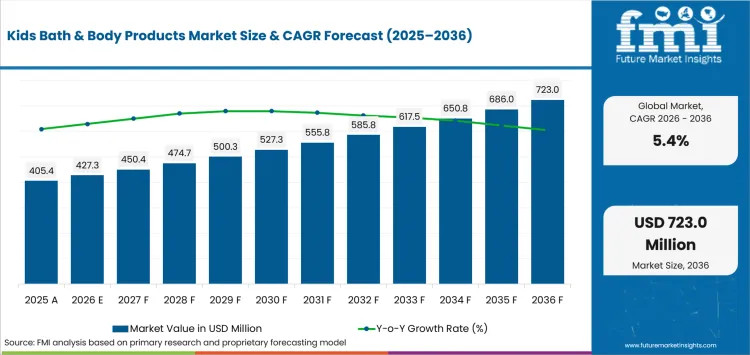
USD 427.3 million in 2026 and USD 723.0 million by 2036 at a 5.4% CAGR.
Demand for kids bath & body products is projected to grow at a 5.4% CAGR between 2026 and 2036 as valuation rises from USD 427.3 million to USD 723.0 million. Caregivers reorder cleansers and moisturizers because bathing and post-bath hydration recur within ordinary child-care routines. The American Academy of Pediatrics stated in May 2025 that daily moisturizer use is part of skin-directed care for children with atopic dermatitis, strengthening the case for mild routine products.
National cosmetic rules influence the documentation and product-listing work needed before new formulations can reach consumers. FDA data published in September 2026 counted about 1.3 million active cosmetic product listings under MoCRA as of June 30, 2026. That volume highlights the scale of compliance activity facing cosmetics manufacturers and can make documentation management a launch-capacity consideration for brands handling multiple formulations and retail destinations. Multicountry rollouts therefore require local files and claims preparation before retailer onboarding rather than after shelf placement.
Key Takeaways
- Routine child cleansing and moisturization support repeat purchasing because caregivers can fit these products into an existing bath-time habit without adding specialist steps.
- Based on product type, core - classic lines are projected to account for 43.0% in 2026 due to routine cleansing and moisturization needs.
- By nature, conventional formulations are estimated to hold 55.0% in 2026 owing to familiar production controls and accessible household pricing.
- In 2026, cream & balm is expected to lead format with 33.0% share because post-bath moisturization is simple to apply.
- Age-specific exposure and labeling requirements can delay commercialization because formulas and claims must remain suitable for foreseeable child use in each destination.
- Some of the key players in this market include The Estée Lauder Companies, L'Oréal Groupe, Kao Corporation, Shiseido, Amorepacific, Coty, Beiersdorf, Procter & Gamble, Unilever, and e.l.f. Beauty.
Analyst Perspective
"Kids bath and body products earn repeat orders when a gentle formula works within the routine families already use. Brands that prove child suitability without overloading the regimen can protect both retailer confidence and household replenishment."
- Rahul Pandita, Principal Consultant, Future Market Insights
How is the kids bath & body products market segmented?
The market is segmented by product type, nature, format, price positioning and sales channel.
Product type covers core - classic lines, targeted treatment lines, sensitive & gentle lines, premium & clinical lines, and kits & sets. Nature covers conventional, vegan & cruelty-free, natural & organic, dermocosmetic - clinical, and fragrance-free & sensitive formulation options. Format covers cream & balm, liquid & serum, stick & solid, spray & mist, sheet & patch, and powder. Price positioning covers mass, masstige, premium, and professional tiers for household and specialist purchasing. Sales channel covers specialty beauty retail, e-commerce & DTC, pharmacies & drugstores, supermarkets & hypermarkets, and salons & spas.
Why do core - classic lines lead the product type category?
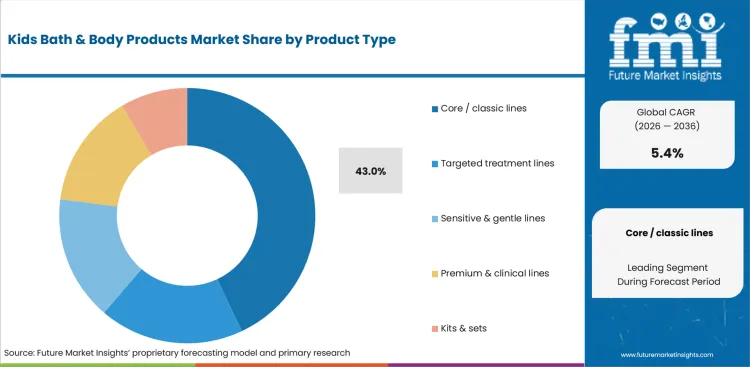
Caregivers first buy routine washes and moisturizers before adding treatment-led steps for a child. Core - classic lines overlap with baby toiletries because familiar formats reduce comparison work during repeated household replenishment.
- By product type, core - classic lines are estimated to hold 43.0% in 2026 owing to frequent use in routine cleansing and moisturization.
- The American Academy of Dermatology advised tweens in October 2025 to start with a gentle cleanser and fragrance-free moisturizer in a simple age-appropriate routine.
Why does conventional lead the nature category?
Manufacturers can adjust conventional preservative and sensory systems for mild child use without rebuilding the production route. Those systems also overlap with baby personal care where stable texture and predictable shelf performance matter during repeat use.
- Conventional is forecast to represent 55.0% of nature demand in 2026 driven by familiar formulation controls and accessible routine pricing.
- The European Commission's SCCS concluded in May 2025 that child exposure required lower butylparaben limits for several common cosmetic product uses.
How does cream & balm lead the format category?
Leave-on creams and balms treat visible dryness immediately after washing during routine child care. The same use pattern appears in baby skincare where comfort can be judged without adding another cleansing step.
- In 2026, cream & balm is expected to lead format with 33.0% share because post-bath moisturization is direct and easy to repeat.
- The American Academy of Dermatology issued pediatric atopic dermatitis guidelines in April 2026 that strongly recommend moisturizer use and conditionally recommend bathing followed by moisturizer.
What supports mass leadership in the price positioning category?
Family body care competes with other replenishment purchases so pack price and routine usefulness shape reorder behavior. Mass skincare products spread formulation and channel costs over broader volumes without requiring specialist service at purchase.
- Mass is set to lead price positioning with 40.0% share in 2026 due to frequent replacement and high-traffic retail access.
- e.l.f. Beauty's 2026 proxy statement listed average skin-care prices of about USD 11 for e.l.f. SKIN and USD 17 for Naturium versus USD 48 for prestige skin care.
What supports specialty beauty retail in the sales channel category?
Specialty beauty stores let caregivers compare sensitive-skin and fragrance-free claims beside broader body-care options. The format also gives organic personal care propositions space for ingredient explanation before repeat purchasing shifts toward online reorder convenience.
- Specialty beauty retail is projected to hold 27.0% share in 2026 owing to curated discovery and staff-supported product comparison.
- Amorepacific launched AESTURA with Sephora across 17 European countries in March 2026 and entered about 680 stores plus Sephora's European online mall.
What are the drivers, restraints and opportunities in the Kids Bath & Body Products Market?
Simple child-oriented routines support repeat purchases while age-specific ingredient limits can slow commercialization and barrier-care evidence gives brands a credible route to differentiation.
- Driver: Caregivers favor simple cleansing and moisturization that address daily hygiene without importing complex adult skin-care routines into children's use.
- Restraint: Child exposure changes the safety case for some cosmetic ingredients and can force lower concentrations or narrower format choices before launch.
- Opportunity: Brands can extend barrier-care offers with gentle cleansers and moisturizers that fit ordinary bathing while giving families clearer evidence for sensitive-skin use.
Simple child-care routines convert youth skin-care interest into repeat cleansing and moisturization purchases without adding treatment steps. The June 2025 Pediatrics study found an average of six products in each observed routine. That complexity leaves a clearer role for baby bath products and older-child cleansers built around simple wash-and-moisturize steps.
Child-exposure rules narrow ingredient and format choices by raising safety and documentation requirements for child-oriented cosmetic launches. The European Commission's SCCS set age- and product-specific conditions for children's salicylic acid exposure in its May 2025 opinion. Formulators therefore need exposure checks before extending adult acne or exfoliation systems into child-oriented products with different foreseeable use.
Barrier-care evidence supports clearer child-oriented propositions when brands keep moisturization claims within documented cosmetic safety boundaries. Brands can widen barrier-care offers by keeping cleansing and hydration inside one routine instead of adding treatment steps. Procter & Gamble launched Native's reformulated Moisturizing Body Wash in June 2026 with gentle cleansing and 24-hour moisturization. The same functional pairing gives foaming cleansers and body washes a credible adjacent route when child suitability is established separately.
Which country CAGRs are profiled in the Kids Bath & Body Products Market?
| Country | CAGR |
|---|---|
| UAE | 6.7% |
| Saudi Arabia | 6.4% |
| South Korea | 6.1% |
| USA | 5.8% |
| Germany | 5.4% |
| UK | 5.1% |
| France | 4.8% |
| Japan | 4.5% |
How do country-level CAGRs compare in the Kids Bath & Body Products Market?
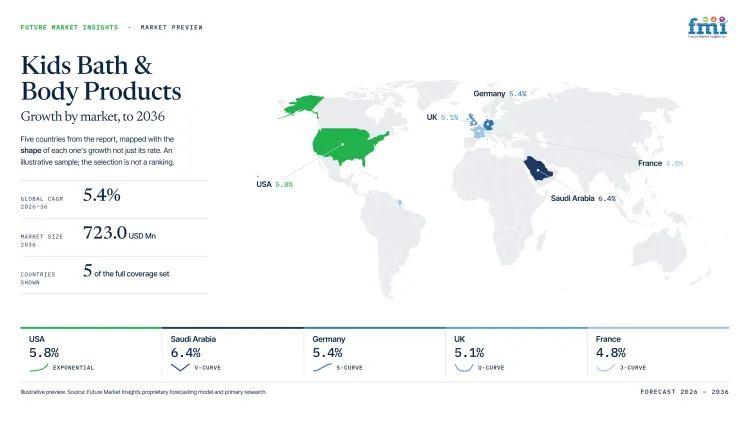
Three forecast groups shape rollout priorities because UAE and Saudi Arabia form a faster Gulf cluster while South Korea also stays above 6.0% CAGR. USA and Western Europe track near the 5.4% global pace while Japan records 4.5% CAGR within a mature daily-care channel with slower category expansion.
- UAE retail assortments turn quickly so multilingual packs can broaden child-care reach among expatriate households.
- Saudi Arabia's large pharmacy and beauty chains can give imported family-care lines concentrated national reach after products clear entry requirements.
- South Korean specialty stores shorten product discovery by placing sensitive-skin textures beside established barrier-care routines.
- USA mass retail and e-commerce give child body-care brands several replenishment routes without specialist-store dependence.
- German drugstores keep family skin-care replenishment inside ordinary household shopping and support routine product comparison.
- Great Britain's pharmacy and general retail mix gives routine child-care products several replenishment routes after compliant listings reach the shelf.
- French pharmacy and beauty channels support dermocosmetic positioning but still require defensible mildness claims before distribution.
- Japanese drugstores reward clear daily-use benefits within a mature category that limits speculative child-specific extensions.
The spread changes launch timing because every country still requires child-suitable claims and repeatable retail access. The comparison covers North America, Latin America, Western Europe, Eastern Europe, East Asia, South Asia and Pacific, and the Middle East and Africa under the report taxonomy.
Country-wise Analysis
- UAE market entry depends on national conformity documentation before regulated consumer products can circulate through retail channels. Kids bath & body products demand in UAE is forecast to rise at 6.7% CAGR through 2036 because fast assortment turnover still depends on completed technical files. MoIAT's national conformity service requires a valid trade license and an accredited-laboratory test report for regulated products entering the country. Multilingual merchandising can widen discovery after approval but incomplete conformity records can delay stocking for imported child-care assortments.
- Saudi cosmetic launches depend on an accountable local entity and complete notification records before products enter national distribution. Kids bath & body products are projected to record 6.4% CAGR during the assessment period as formal listing supports a structured import route. SFDA's March 2025 listed-products service publishes active cosmetics with product numbers plus brand and responsible-company details. Retailers can broaden child-care assortments only after the responsible company aligns formula records and Arabic-facing product information with the notified item.
- South Korea applies national safety oversight to infant and children's cosmetics before retail visibility converts into routine sales. Kids bath & body products demand is predicted to advance at 6.1% CAGR through 2036 as barrier-care interest meets tightly managed younger-user safety requirements. MFDS published a national infant and children's cosmetics safety-management investigation in February 2026 with a stated plan to reduce product hazards. K-beauty products channels can accelerate discovery after brands finish local safety records and pack information for younger users.
- US cosmetic commercialization now carries a recurring federal registration cycle that affects manufacturers serving broad retail channels. Kids bath & body products demand is forecast to expand at 5.8% CAGR from 2026 to 2036 because routine family care has several national replenishment routes. FDA updated Cosmetics Direct in February 2026 for biennial facility-registration renewal and added registration-status plus renewal-date fields. Companies selling USA baby personal care beside older-child lines still need accurate facility records and age-suitable claims before national retailer expansion.
- Germany's national monitoring program tests child-relevant cosmetic safety points before products move through mature family-care channels. Germany is projected to grow at 5.4% CAGR over the forecast period as frequent household replenishment meets formal safety scrutiny. The 2025 national monitoring plan assigned 140 tests to sunscreen and child sunscreen products for octocrylene and benzophenone. Sunscreen is an immediate-family category here because the test program concerns younger-user cosmetic exposure rather than bath products themselves.
- Great Britain requires a UK Responsible Person and an English product information file before cosmetics are placed on its market. Kids bath & body products are expected to maintain 5.1% CAGR through 2036 because repeat household use still depends on complete safety and notification records. OPSS guidance updated in June 2026 requires product notification and current safety documentation before cosmetics enter the GB market. Brands can separate routine replenishment planning from the regulatory work needed before a child-focused formula reaches national shelves.
- France's national cosmetics controls put product information files and defensible claims ahead of post-launch retail expansion. Kids bath & body products are anticipated to record 4.8% CAGR over the assessment period as mature retail demand meets detailed compliance review. DGCCRF documented in February 2026 that inspectors reviewed 147 cosmetics establishments and more than 200 product-information files. French-language labels and child-oriented claims must match the safety assessment before accepted listings translate into dependable replenishment.
- Japan tightened national guidance on highlighting individual cosmetic ingredients by requiring a stated purpose and objective substantiation for permitted claims. Kids bath & body product sales are forecast to expand at 4.5% CAGR by 2036 because routine-care positioning must fit disciplined claims practice. MHLW's March 2025 notice warns that special ingredient presentation can mislead consumers by implying an active effect without proper context. Brands entering adjacent skincare categories need concise daily-use benefits that do not overstate what a child-oriented cosmetic can claim.
Who are the notable companies in the Kids Bath & Body Products Market?
The Estée Lauder Companies, L'Oréal Groupe, Kao Corporation, Shiseido, Amorepacific, Coty, Beiersdorf, Procter & Gamble, Unilever, and e.l.f. Beauty are active in direct or adjacent skin and body-care routes relevant to this category.
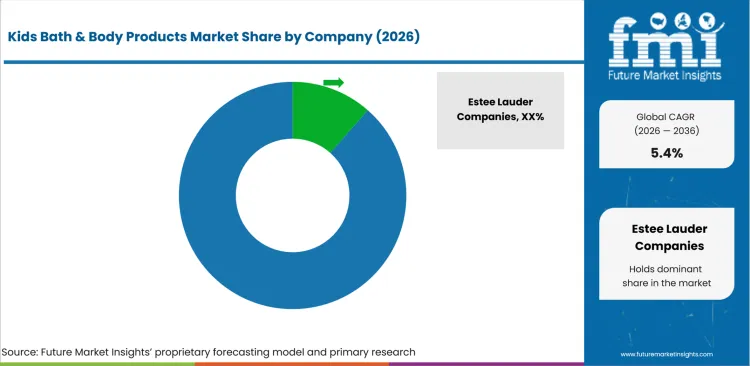
Competition spans direct family care and adjacent skin-care platforms with different levels of child-specific evidence. Kao Corporation and Amorepacific provide sensitive-skin routes while several global groups participate mainly through broader body-care channels.
- The Estée Lauder Companies and L'Oréal Groupe require child-specific qualification before extending prestige or dermatological platforms into direct child care.
- Kao Corporation, Shiseido and Amorepacific contribute sensitive-skin research or barrier-care platforms with direct younger-user relevance.
- Coty and Beiersdorf participate through body-care routes, while Procter & Gamble and Unilever add mass reach alongside e.l.f. Beauty.
Competitive Benchmarking: Kids Bath & Body Products Market
| Company | Child-Focused Care Evidence | Sensitive-Skin Depth | Body-Care Channel Activation | Geographic Reach |
|---|---|---|---|---|
| The Estée Lauder Companies | Low | Medium | Medium | North America, Western Europe, East Asia |
| L'Oréal Groupe | High | High | High | Global |
| Kao Corporation | High | High | High | East Asia, Western Europe |
| Shiseido | Low | High | Medium | East Asia, global prestige markets |
| Amorepacific | High | High | High | East Asia, North America, Western Europe |
| Coty | Low | Low | Medium | North America, Western Europe |
| Beiersdorf | High | High | High | Global |
| Procter & Gamble | Low | Medium | High | North America, Western Europe |
| Unilever | Medium | High | High | Global |
| e.l.f. Beauty | Low | Medium | High | North America, Western Europe, GCC |
High ratings require direct current evidence within the named criterion while Medium denotes a credible adjacent route. Low identifies narrower participation that still fits the defined market boundary and does not represent missing evidence.
Key Developments in the Kids Bath & Body Products Market
- In August 2026, Kao Corporation announced Curél's Nordic expansion through KICKS and Matas with retail sales scheduled to begin in September.
- In June 2026, Procter & Gamble launched reformulated Native body washes with gentler cleansing claims and distribution through major USA retailers.
- In May 2026, Shiseido announced a new Clé de Peau Beauté Synactif body cream for a July launch in Japan.
Key Players in the Kids Bath & Body Products Market
Prestige and Dermatological Skin-Care Platforms
- The Estée Lauder Companies
- L'Oréal Groupe
- Kao Corporation
- Shiseido
Sensitive-Skin and Body-Care Platforms
- Amorepacific
- Coty
- Beiersdorf
Mass and Specialty-Retail Platforms
- Procter & Gamble
- Unilever
- e.l.f. Beauty
Kids Bath & Body Products Market - Report Scope
| Coverage field | Report scope |
|---|---|
| Market breakdown | By product type, nature, format, price positioning, sales channel and region. |
| Quantitative Units | USD million. |
| Market Definition | Packaged bath and body cosmetic products formulated or marketed for children including cleansers, moisturizers, body washes, creams, balms and related daily-care formats. |
| Regions Covered | North America, Latin America, Western Europe, Eastern Europe, East Asia, South Asia and Pacific and Middle East and Africa. |
| Countries Covered | UAE, Saudi Arabia, South Korea, USA, Germany, UK, France, Japan and 20+ additional countries included in the full report. |
| Key Companies Profiled | The Estée Lauder Companies, L'Oréal Groupe, Kao Corporation, Shiseido, Amorepacific, Coty, Beiersdorf, Procter & Gamble, Unilever, and e.l.f. Beauty. |
| Forecast Period | 2026 to 2036. |
| Approach | Primary and secondary research with market triangulation. |
Kids Bath & Body Products Market - Research Methodology
| Method | Approach |
|---|---|
| Primary Research | FMI analysts gathered input from manufacturers, service providers, technology developers, distributors, end users, procurement teams, and subject-matter experts. Interviews examined purchasing decisions, product or service evaluation, adoption barriers, approval requirements, pricing considerations, and expectations for technical or commercial support. Respondents were also asked what evidence is required before a trial, pilot, or initial order develops into regular purchasing. |
| Desk Research | Desk research covered government statistics, regulatory publications, trade data, industry associations, technical literature, standards, company filings, product information, and official corporate announcements. Sources were reviewed for relevance, publication date, geographic coverage, and consistency with the defined market scope. Claims relating to performance, applications, approvals, capacity, investment, and commercial activity were retained only when supported by credible public evidence. |
| Market Sizing and Forecasting | The market model combined the baseline value with historical performance, segment structure, pricing and volume indicators, adoption levels, company participation, and country-level demand conditions. Forecast assumptions considered economic activity, investment trends, regulatory developments, technology adoption, purchasing cycles, supply availability, and barriers to wider market use. Segment and regional estimates were reconciled before the final market total was calculated. |
| Data Validation | Estimates were checked against multiple independent indicators, including public data, company activity, trade patterns, industry developments, and findings from primary interviews. Validation also tested whether products, services, applications, and company revenues fell within the defined market boundaries. Adjacent categories, unsupported claims, overlapping revenues, and activities without direct market relevance were excluded to reduce double counting and maintain consistency across segments and countries. |
Kids Bath & Body Products Market by Segments
Kids Bath & Body Products Market segmented by Product Type:
- Core - classic lines
- Targeted treatment lines
- Sensitive & gentle lines
- Premium & clinical lines
- Kits & sets
Kids Bath & Body Products Market segmented by Nature:
- Conventional
- Vegan & cruelty-free
- Natural & organic
- Dermocosmetic - clinical
- Fragrance-free & sensitive
Kids Bath & Body Products Market segmented by Format:
- Cream & balm
- Liquid & serum
- Stick & solid
- Spray & mist
- Sheet & patch
- Powder
Kids Bath & Body Products Market segmented by Price Positioning:
- Mass
- Masstige
- Premium
- Professional
Kids Bath & Body Products Market segmented by Sales Channel:
- Specialty beauty retail
- E-commerce & DTC
- Pharmacies & drugstores
- Supermarkets & hypermarkets
- Salons & spas
Kids Bath & Body Products Market by Region:
- North America
- United States
- Canada
- Latin America
- Brazil
- Mexico
- Argentina
- Chile
- Western Europe
- Germany
- France
- United Kingdom
- Italy
- Spain
- Benelux
- Nordics
- Eastern Europe
- Poland
- Czech Republic
- Romania
- Hungary
- East Asia
- China
- Japan
- South Korea
- South Asia and Pacific
- India
- ASEAN
- Australia and New Zealand
- Middle East and Africa
- GCC Countries
- South Africa
- Türkiye
- Israel
Research Sources and Bibliography
- Hales, M., Rigali, S., Paller, A., Liszewski, W., & Lagu, T. (2025, June 9). Pediatric Skin Care Regimens on TikTok.
- USA Food and Drug Administration. (2026, September 9). Registration & Listing of Cosmetic Product Facilities and Products.
- American Academy of Dermatology. (2025, October 28). A dermatologist's guide to skincare from growing up to glowing up.
- European Commission, Scientific Committee on Consumer Safety. (2025, May 2). SCCS Opinion on Butylparaben (CAS No. 94-26-8, EC No. 202-318-7) - Children's exposure.
- American Academy of Pediatrics. (2025, May 19). Atopic Dermatitis: Update on Skin-Directed Management: Clinical Report.
- e.l.f. Beauty, Inc. (2026, July 8). 2026 Proxy Statement.
- Procter & Gamble. (2026, June 24). Native Launches Reformulated Moisturizing Body Wash Designed to Gently Cleanse and Hydrate Skin.
- Office for Product Safety and Standards. (2026, June 29). Regulation 1223/2009 and the Cosmetic Products Enforcement Regulations 2013: Great Britain.
- European Commission, Scientific Committee on Consumer Safety. (2025, May 2). SCCS Opinion on Salicylic Acid (CAS No. 69-72-7, EC No. 200-712-3) - Children's exposure.
- American Academy of Dermatology. (2026, April 7). American Academy of Dermatology issues first-ever pediatric atopic dermatitis guidelines.
- USA Food and Drug Administration. (2026, February 11). FDA Updates Web Portal and Informational Materials to Help Cosmetic Facilities Prepare for Biennial Registration Renewal.
- Federal Office of Consumer Protection and Food Safety. (2025). Handbuch Monitoring 2025.
- Direction générale de la concurrence, de la consommation et de la répression des fraudes. (2026, February 2). Cosmétiques : des TPE nouvelles dans le secteur qui méconnaissent trop souvent la réglementation.
- UAE Ministry of Industry and Advanced Technology. (n.d.). Issue UAE Certificates of Conformity for Products Subject to Technical Regulations.
- Saudi Food and Drug Authority. (2025, March 5). List of Notification of Marketing for Cosmetic Products (Listed Products).
- Ministry of Health, Labour and Welfare, Japan. (2025, March 10). 化粧品における特定成分の特記表示について.
- Procter & Gamble. (2026, June 25). Native Launches Reformulated Deodorant and Body Washes with Enhanced Performance and Improved Formulations.
- Ministry of Food and Drug Safety, Republic of Korea. (2026, February 27). 영유아, 어린이 사용 화장품 안전관리를 위한 조사 보고서.
- Shiseido. (2026, August 17). 角層バリアを守り続ける「先進保湿ケア」敏感肌のためのダブル膜設計 dプログラム新スキンリペアクリーム.
- e.l.f. Beauty. (2026, April 30). rhode Continues Its Global Retail Expansion Into Sephora Europe.
- Amorepacific. (2026, May 8). Mamonde to Exclusively Launch in Amazon Premium Beauty.
- Procter & Gamble. (2026, June 26). Native Shakes Up the Body Care Category with New Detoxifying Body Scrub Collection.
- Beiersdorf. (2026, August 3). Half-year results 2026: Derma outperformance continues, NIVEA enters next phase of rebalancing with 18-month turnaround plan.
- Kao Corporation. (2026, June 2). Kao Accelerates Skin Care Growth in EMEA with Launch of Dry and Sensitive Skin Care Brand Curél in the Netherlands.
- L'Oréal Groupe. (2026, July 29). 2026 Half-Year Results.
- Amorepacific. (2026, March 9). AESTURA Announces Official Launch at Sephora Across 17 European Countries.
- L'Oréal Groupe. (2026, June 18). L’Oréal to acquire a majority stake in Innovist, a leading digital-first Indian personal care house of brands.
- Beiersdorf. (2026, January 5). Iconic blue tin now available in two versions: Beiersdorf launches NIVEA Creme Natural Touch in Germany.
- Procter & Gamble. (2026, August 27). Olay Launches 'Barrier Bootcamp' With New Repair Serum Body Wash Collection - Your Shower-Powered Workout for Skin Barrier Repair.
- Unilever. (2026, May 28). $270M investment in Connecticut Global Innovation Center.
- Amorepacific. (2026, March 11). AP BEAUTY Enters Amazon Luxury Stores USA.
- Kao Corporation. (2026, August 25). Kao Steps Up EMEA Skincare Growth with Curél Launch in the Nordics.
- Coty. (2026, May 5). Coty Announces Third Quarter Fiscal Year 2026 Results.
- The Estée Lauder Companies. (2026, April 29). The Estée Lauder Companies Announces Minority Investment in Luxury Clinical Skin Care Brand 111SKIN.
- e.l.f. Beauty. (2026, May 27). Naturium Launches “Glow Better Together” Campaign Celebrating the Community Behind Its Bestselling Glow Getter Collection.
- Shiseido. (2026, May 20). クレ・ド・ポー ボーテ シナクティフより新ボディクリーム登場.
This Report Answers
- What value will the market reach?
- Which needs support repeat purchasing?
- Why do core - classic lines lead product type?
- Why do conventional formulations lead nature?
- Why does cream & balm lead format?
- How do country CAGRs differ?
- Which requirements can delay launches?
- How do company roles differ?
Frequently Asked Questions
How big is the kids bath & body products market in 2026?
The kids bath & body products market is valued at USD 427.3 million in 2026 and is projected to reach USD 723.0 million by 2036. Repeated cleansing and moisturization keep routine child care on a regular household replenishment cycle.
What is the CAGR of the kids bath & body products market from 2026 to 2036?
The kids bath & body products market is projected to grow at a 5.4% CAGR between 2026 and 2036. Growth depends on age-appropriate routines plus compliant formulas that retailers can replenish without repeated claim or safety corrections.
Which product type leads the kids bath & body products market?
Core - classic lines are expected to hold 43.0% of product-type demand during 2026 household purchasing. Routine washes and moisturizers reduce comparison work for caregivers because the products fit familiar cleansing and post-bath care.
How much absolute opportunity will the kids bath & body products market add by 2036?
The kids bath & body products market is projected to add USD 295.7 million between 2026 and 2036. The gain equals the difference between the USD 427.3 million base value and USD 723.0 million 2036 forecast.
Which companies are active in the kids bath & body products market?
Key companies in the kids bath & body products market include The Estée Lauder Companies, L'Oréal Groupe, Kao Corporation, Shiseido, Amorepacific, Coty, Beiersdorf, Procter & Gamble, Unilever, and e.l.f. Beauty. Their roles differ between direct family care and adjacent skin or body-care platforms serving wider retail channels.
Preview the report firsthand - request a free sample
Get SampleGet the brochure for pricing and purchase details.
Get PDFTable of Content
- Key Takeaways
- Market Size and CAGR
- Top Growth Driver
- Fastest Growing Segment
- Leading Region
- Key Companies
- Emerging Opportunities
- Executive Summary
- Global Market Outlook
- Demand-side Trends
- Supply-side Trends
- Technology Roadmap Analysis
- Analysis and Recommendations
- Analyst Perspective (What is happening? Why now? What should investors know?)
- Key Questions Answered
- How large is the market?
- What is the CAGR?
- What are key trends?
- Which region dominates?
- Who are the leaders?
- Market Overview
- Market Coverage / Taxonomy
- Market Definition / Scope / Limitations
- Research Methodology
- Chapter Orientation
- Analytical Lens and Working Hypotheses
- Market Structure, Signals, and Trend Drivers
- Benchmarking and Cross-market Comparability
- Market Sizing, Forecasting, and Opportunity Mapping
- Research Design and Evidence Framework
- Desk Research Programme (Secondary Evidence)
- Expert Input and Fieldwork (Primary Evidence)
- Tooling, Models, and Reference Databases
- Data Engineering and Model Build
- Quality Assurance and Audit Trail
- Market Background
- Market Dynamics (Drivers, Restraints, Opportunity, Trends)
- Scenario Forecast (Optimistic, Likely, Conservative)
- Impact Analysis
- AI Impact
- Sustainability Impact
- Regulatory Impact
- Technology Impact
- Consumer / Buyer Analysis
- Purchase Drivers
- Adoption Barriers
- Buyer Journey
- Opportunity Map Analysis
- Product Life Cycle Analysis
- Supply Chain Analysis
- Investment Feasibility Matrix
- Value Chain Analysis
- PESTLE and Porter's Analysis
- Regulatory Landscape
- Regional Parent Market Outlook
- Production and Consumption Statistics
- Import and Export Statistics
- Global Market Analysis and Forecast, 2021 to 2036
- Historical Market Size Value (USD Million) Analysis, 2021 to 2025
- Current and Future Market Size Value (USD Million) Projections, 2026 to 2036
- Y-o-Y Growth Trend Analysis
- Absolute $ Opportunity Analysis
- Global Market Pricing Analysis, 2021 to 2036
- Global Market Analysis and Forecast, By Product Type, 2021 to 2036
- Introduction / Key Findings
- Historical Market Size Value (USD Million) Analysis By Product Type, 2021 to 2025
- Current and Future Market Size Value (USD Million) Analysis and Forecast By Product Type, 2026 to 2036
- Core / classic lines
- Targeted treatment lines
- Sensitive & gentle lines
- Premium & clinical lines
- Kits & sets
- Core / classic lines
- Y-o-Y Growth Trend Analysis By Product Type, 2021 to 2025
- Absolute $ Opportunity Analysis By Product Type, 2026 to 2036
- Global Market Analysis and Forecast, By Nature, 2021 to 2036
- Introduction / Key Findings
- Historical Market Size Value (USD Million) Analysis By Nature, 2021 to 2025
- Current and Future Market Size Value (USD Million) Analysis and Forecast By Nature, 2026 to 2036
- Conventional
- Vegan & cruelty-free
- Natural & organic
- Dermocosmetic / clinical
- Fragrance-free & sensitive
- Conventional
- Y-o-Y Growth Trend Analysis By Nature, 2021 to 2025
- Absolute $ Opportunity Analysis By Nature, 2026 to 2036
- Global Market Analysis and Forecast, By Format, 2021 to 2036
- Introduction / Key Findings
- Historical Market Size Value (USD Million) Analysis By Format, 2021 to 2025
- Current and Future Market Size Value (USD Million) Analysis and Forecast By Format, 2026 to 2036
- Cream & balm
- Liquid & serum
- Stick & solid
- Spray & mist
- Sheet & patch
- Powder
- Cream & balm
- Y-o-Y Growth Trend Analysis By Format, 2021 to 2025
- Absolute $ Opportunity Analysis By Format, 2026 to 2036
- Global Market Analysis and Forecast, By Price Positioning, 2021 to 2036
- Introduction / Key Findings
- Historical Market Size Value (USD Million) Analysis By Price Positioning, 2021 to 2025
- Current and Future Market Size Value (USD Million) Analysis and Forecast By Price Positioning, 2026 to 2036
- Mass
- Masstige
- Premium
- Professional
- Mass
- Y-o-Y Growth Trend Analysis By Price Positioning, 2021 to 2025
- Absolute $ Opportunity Analysis By Price Positioning, 2026 to 2036
- Global Market Analysis and Forecast, By Sales Channel, 2021 to 2036
- Introduction / Key Findings
- Historical Market Size Value (USD Million) Analysis By Sales Channel, 2021 to 2025
- Current and Future Market Size Value (USD Million) Analysis and Forecast By Sales Channel, 2026 to 2036
- Specialty beauty retail
- E-commerce & DTC
- Pharmacies & drugstores
- Supermarkets & hypermarkets
- Salons & spas
- Specialty beauty retail
- Y-o-Y Growth Trend Analysis By Sales Channel, 2021 to 2025
- Absolute $ Opportunity Analysis By Sales Channel, 2026 to 2036
- Global Market Analysis and Forecast, By Region, 2021 to 2036
- Introduction
- Historical Market Size Value (USD Million) Analysis By Region, 2021 to 2025
- Current Market Size Value (USD Million) Analysis and Forecast By Region, 2026 to 2036
- North America
- Latin America
- Western Europe
- Eastern Europe
- East Asia
- South Asia and Pacific
- Middle East & Africa
- Market Attractiveness Analysis By Region
- North America Market Analysis and Forecast, By Country, 2021 to 2036
- Historical Market Size Value (USD Million) Trend Analysis By Market Taxonomy, 2021 to 2025
- Market Size Value (USD Million) Forecast By Market Taxonomy, 2026 to 2036
- By Country
- USA
- Canada
- By Product Type
- By Nature
- By Format
- By Price Positioning
- By Sales Channel
- By Country
- Market Attractiveness Analysis
- By Country
- By Product Type
- By Nature
- By Format
- By Price Positioning
- By Sales Channel
- Key Takeaways
- Latin America Market Analysis and Forecast, By Country
- Historical Market Size Value (USD Million) Trend Analysis By Market Taxonomy, 2021 to 2025
- Market Size Value (USD Million) Forecast By Market Taxonomy, 2026 to 2036
- By Country
- Brazil
- Mexico
- Chile
- Rest of Latin America
- By Product Type
- By Nature
- By Format
- By Price Positioning
- By Sales Channel
- By Country
- Market Attractiveness Analysis
- By Country
- By Product Type
- By Nature
- By Format
- By Price Positioning
- By Sales Channel
- Key Takeaways
- Western Europe Market Analysis and Forecast, By Country
- Historical Market Size Value (USD Million) Trend Analysis By Market Taxonomy, 2021 to 2025
- Market Size Value (USD Million) Forecast By Market Taxonomy, 2026 to 2036
- By Country
- Germany
- UK
- Italy
- Spain
- France
- Nordic
- BENELUX
- Rest of Western Europe
- By Product Type
- By Nature
- By Format
- By Price Positioning
- By Sales Channel
- By Country
- Market Attractiveness Analysis
- By Country
- By Product Type
- By Nature
- By Format
- By Price Positioning
- By Sales Channel
- Key Takeaways
- Eastern Europe Market Analysis and Forecast, By Country
- Historical Market Size Value (USD Million) Trend Analysis By Market Taxonomy, 2021 to 2025
- Market Size Value (USD Million) Forecast By Market Taxonomy, 2026 to 2036
- By Country
- Russia
- Poland
- Hungary
- Balkan & Baltic
- Rest of Eastern Europe
- By Product Type
- By Nature
- By Format
- By Price Positioning
- By Sales Channel
- By Country
- Market Attractiveness Analysis
- By Country
- By Product Type
- By Nature
- By Format
- By Price Positioning
- By Sales Channel
- Key Takeaways
- East Asia Market Analysis and Forecast, By Country
- Historical Market Size Value (USD Million) Trend Analysis By Market Taxonomy, 2021 to 2025
- Market Size Value (USD Million) Forecast By Market Taxonomy, 2026 to 2036
- By Country
- China
- Japan
- South Korea
- By Product Type
- By Nature
- By Format
- By Price Positioning
- By Sales Channel
- By Country
- Market Attractiveness Analysis
- By Country
- By Product Type
- By Nature
- By Format
- By Price Positioning
- By Sales Channel
- Key Takeaways
- South Asia and Pacific Market Analysis and Forecast, By Country
- Historical Market Size Value (USD Million) Trend Analysis By Market Taxonomy, 2021 to 2025
- Market Size Value (USD Million) Forecast By Market Taxonomy, 2026 to 2036
- By Country
- India
- ASEAN
- Australia & New Zealand
- Rest of South Asia and Pacific
- By Product Type
- By Nature
- By Format
- By Price Positioning
- By Sales Channel
- By Country
- Market Attractiveness Analysis
- By Country
- By Product Type
- By Nature
- By Format
- By Price Positioning
- By Sales Channel
- Key Takeaways
- Middle East & Africa Market Analysis and Forecast, By Country
- Historical Market Size Value (USD Million) Trend Analysis By Market Taxonomy, 2021 to 2025
- Market Size Value (USD Million) Forecast By Market Taxonomy, 2026 to 2036
- By Country
- Kingdom of Saudi Arabia
- Other GCC Countries
- Türkiye
- South Africa
- Other African Union
- Rest of Middle East & Africa
- By Product Type
- By Nature
- By Format
- By Price Positioning
- By Sales Channel
- By Country
- Market Attractiveness Analysis
- By Country
- By Product Type
- By Nature
- By Format
- By Price Positioning
- By Sales Channel
- Key Takeaways
- Key Countries Market Analysis
- USA
- Pricing Analysis
- Market Share Analysis, 2025
- By Product Type
- By Nature
- By Format
- By Price Positioning
- By Sales Channel
- Canada
- Pricing Analysis
- Market Share Analysis, 2025
- By Product Type
- By Nature
- By Format
- By Price Positioning
- By Sales Channel
- Mexico
- Pricing Analysis
- Market Share Analysis, 2025
- By Product Type
- By Nature
- By Format
- By Price Positioning
- By Sales Channel
- Brazil
- Pricing Analysis
- Market Share Analysis, 2025
- By Product Type
- By Nature
- By Format
- By Price Positioning
- By Sales Channel
- Chile
- Pricing Analysis
- Market Share Analysis, 2025
- By Product Type
- By Nature
- By Format
- By Price Positioning
- By Sales Channel
- Germany
- Pricing Analysis
- Market Share Analysis, 2025
- By Product Type
- By Nature
- By Format
- By Price Positioning
- By Sales Channel
- UK
- Pricing Analysis
- Market Share Analysis, 2025
- By Product Type
- By Nature
- By Format
- By Price Positioning
- By Sales Channel
- Italy
- Pricing Analysis
- Market Share Analysis, 2025
- By Product Type
- By Nature
- By Format
- By Price Positioning
- By Sales Channel
- Spain
- Pricing Analysis
- Market Share Analysis, 2025
- By Product Type
- By Nature
- By Format
- By Price Positioning
- By Sales Channel
- France
- Pricing Analysis
- Market Share Analysis, 2025
- By Product Type
- By Nature
- By Format
- By Price Positioning
- By Sales Channel
- India
- Pricing Analysis
- Market Share Analysis, 2025
- By Product Type
- By Nature
- By Format
- By Price Positioning
- By Sales Channel
- ASEAN
- Pricing Analysis
- Market Share Analysis, 2025
- By Product Type
- By Nature
- By Format
- By Price Positioning
- By Sales Channel
- Australia & New Zealand
- Pricing Analysis
- Market Share Analysis, 2025
- By Product Type
- By Nature
- By Format
- By Price Positioning
- By Sales Channel
- China
- Pricing Analysis
- Market Share Analysis, 2025
- By Product Type
- By Nature
- By Format
- By Price Positioning
- By Sales Channel
- Japan
- Pricing Analysis
- Market Share Analysis, 2025
- By Product Type
- By Nature
- By Format
- By Price Positioning
- By Sales Channel
- South Korea
- Pricing Analysis
- Market Share Analysis, 2025
- By Product Type
- By Nature
- By Format
- By Price Positioning
- By Sales Channel
- Russia
- Pricing Analysis
- Market Share Analysis, 2025
- By Product Type
- By Nature
- By Format
- By Price Positioning
- By Sales Channel
- Poland
- Pricing Analysis
- Market Share Analysis, 2025
- By Product Type
- By Nature
- By Format
- By Price Positioning
- By Sales Channel
- Hungary
- Pricing Analysis
- Market Share Analysis, 2025
- By Product Type
- By Nature
- By Format
- By Price Positioning
- By Sales Channel
- Kingdom of Saudi Arabia
- Pricing Analysis
- Market Share Analysis, 2025
- By Product Type
- By Nature
- By Format
- By Price Positioning
- By Sales Channel
- Türkiye
- Pricing Analysis
- Market Share Analysis, 2025
- By Product Type
- By Nature
- By Format
- By Price Positioning
- By Sales Channel
- South Africa
- Pricing Analysis
- Market Share Analysis, 2025
- By Product Type
- By Nature
- By Format
- By Price Positioning
- By Sales Channel
- USA
- Market Structure Analysis
- Competition Dashboard
- Competition Benchmarking
- Market Share Analysis of Top Players
- By Regional
- By Product Type
- By Nature
- By Format
- By Price Positioning
- By Sales Channel
- Emerging Startups
- Innovation Benchmarking
- Competition Analysis
- Competition Deep Dive
- Estee Lauder Companies
- Overview
- Product Portfolio
- Profitability by Market Segments
- Sales Footprint
- Strategy Overview
- Marketing Strategy
- Product Strategy
- Channel Strategy
- L'Oreal
- Kao Corporation
- Shiseido
- Amorepacific
- Coty
- Beiersdorf
- Procter & Gamble
- Unilever
- e.l.f. Beauty
- Estee Lauder Companies
- Case Studies
- Success Stories
- Recent Developments
- Competition Deep Dive
- Assumptions & Acronyms Used


