

- Market Size (2026)
- USD 643.4 Mn
- Forecast (2036)
- USD 1163.1 Mn
- CAGR (2026 to 2036)
- 6.1%
How big is Baby Skincare Market in 2026?
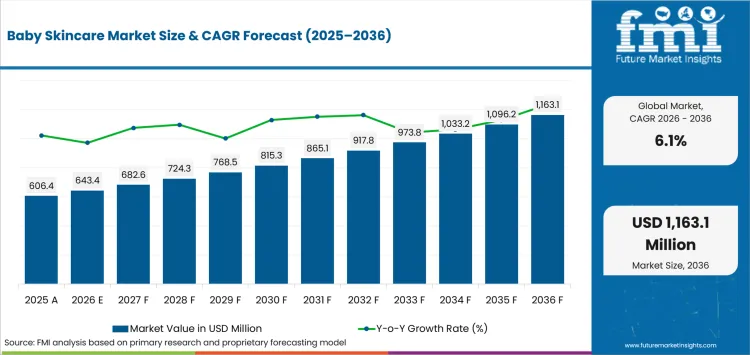
USD 643.4 million in 2026 and USD 1,163.1 million by 2036 at a 6.1% CAGR.
Demand for baby skincare is projected to expand at a 6.1% CAGR between 2026 and 2036, increasing from USD 643.4 million to USD 1,163.1 million. The American Academy of Pediatrics stated in May 2025 that atopic dermatitis affects 20% to 25% of children and recommends frequent gentle cleansing followed by moisturizer. These care practices support recurring purchases of mild cleansers, moisturizers and barrier creams without treating the clinical prevalence figure as direct demand.
Mature birth bases do not translate directly into equal spending or replenishment patterns across countries. The USA is forecast to expand at a 6.5% CAGR compared with 5.5% for Germany. CDC provisional data released in April 2026 recorded 3,606,400 USA births in 2025, a 1% decline from 2024. The USA outlook therefore depends more on repeat-care routines and spending per child than on growth in the birth cohort alone.
Key Takeaways of Baby Skincare Market
- Routine cleansing, moisturization and barrier protection sustain repeat demand once tolerated products become part of everyday infant-care schedules.
- By product type, core - classic lines are estimated to hold 38.0% in 2026 owing to broad use in cleansing and moisturization routines.
- In 2026, conventional is expected to lead nature with 55.0% share because familiar formulations remain widely available in mass retail.
- The format category is forecast to be led by cream & balm at 29.0% share in 2026 due to controlled application on dry or irritation-prone skin.
- Irritation risk and cosmetic documentation requirements can interrupt repeat purchase or delay launches despite strong caregiver interest in gentle formulations.
- Some of the key players in this market include Kenvue Inc., Pigeon Corporation, Beiersdorf AG, Amorepacific Corporation, The Honest Company, Inc., Laboratoires Expanscience, PZ Cussons plc, and Galderma Group AG.
Analyst Perspective
"Baby skincare repurchase depends on a tolerated formula fitting ordinary bathing, moisturizing and diaper-area routines without adding uncertainty for caregivers. Stronger propositions pair infant-skin evidence with a texture and retail route that make the same product easy to repurchase."
- Rahul Pandita, Principal Consultant, Future Market Insights
How is the Baby Skincare Market segmented?
The baby skincare market is segmented by product type, nature, format, price positioning and sales channel.
Product type covers core - classic lines, targeted treatment lines, sensitive & gentle lines, premium & clinical lines and kits & sets. Nature includes conventional, vegan & cruelty-free, natural & organic, dermocosmetic / clinical and fragrance-free & sensitive. Format includes cream & balm, liquid & serum, stick & solid, spray & mist, sheet & patch and powder. Price positioning includes mass, masstige, premium and professional. Sales channel covers e-commerce & DTC, specialty beauty retail, pharmacies & drugstores, supermarkets & hypermarkets and salons & spas.
Why do Core - classic lines lead the Product type category?
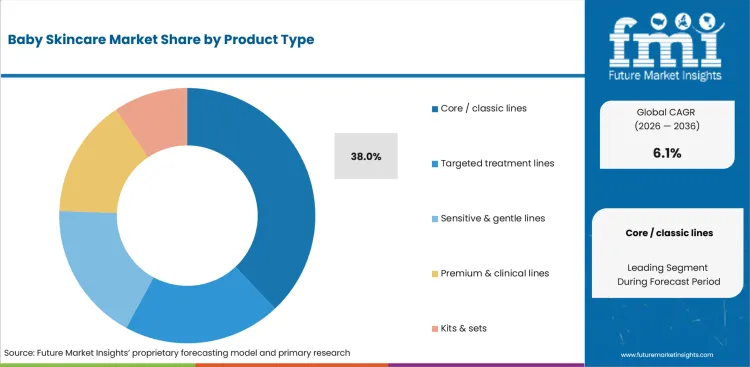
Core ranges address the routines households repeat most often, including bathing and daily moisturization within the baby personal care category. Their breadth reduces the need to identify a narrow skin concern before each purchase.
Frequent wash use also links core ranges to baby bath products that households purchase beside everyday moisturizers.
- By product type, core - classic lines are estimated to hold 38.0% in 2026 owing to familiar everyday use and wide replenishment needs.
- The Cussons Baby restage in February 2026 matters here less as a one-off launch and more as evidence that classic baby-care franchises are being refreshed around everyday use occasions such as washing, calming and moisturization.
Why does Conventional hold the leading position in Nature?
Conventional formulations retain a wide household base in mainstream retail, letting families compare mildness and price beside organic personal care ranges in mainstream retail. Natural claims can influence selection, yet they do not replace the need for repeatable tolerance and shelf access.
Organic baby shampoo gives retailers another direct ingredient and price reference beside conventional infant cleansing formats.
- Conventional is set to lead the nature category with 55.0% share in 2026 due to familiar formula choices in mainstream retail.
- For conventional and dermocosmetic ranges, Expanscience’s October 2025 ISO 22716 certification adds a different kind of support: it signals that manufacturing controls and cosmetic-GMP discipline remain part of the trust equation before products reach pharmacy or retail shelves.
How do Cream & Balm formats lead the Format category?
Creams and balms let caregivers place product directly on dry patches or diaper-area skin with controlled coverage. Caregivers compare that localized coverage with lighter baby oil formats during everyday moisturization.
Baby powder gives retailers a separate dryness-control reference where households prefer a dry application format during warmer-weather or diaper-area care.
- The cream & balm segment is likely to capture 29.0% share in 2026 attributable to controlled application and sustained barrier coverage on dry skin.
- Creams and balms also benefit from how claims are experienced at home. Amorepacific’s third-generation ILLIYOON Ceramide Ato line shows how barrier-care positioning becomes more persuasive when it is tied to textures caregivers can apply repeatedly on dry or sensitive skin.
Why does E-commerce & DTC lead the Sales channel category?
Digital shelves give caregivers time to compare ingredients, use instructions and variant availability before ordering a tolerated product again. This purchase path is particularly useful for baby toiletries that households replenish once a routine becomes established.
Skincare products with clear ingredient information also benefit from digital comparison during repeat ordering at home.
- By sales channel, e-commerce & DTC is forecast to represent 30.0% in 2026 driven by product comparison and simplified repeat ordering.
- Amorepacific’s July 2026 Prime Day result points to the channel dynamic rather than the product alone: online marketplaces can turn visibility, reviews and saved purchasing habits into faster repeat orders once a caregiver has already settled on a trusted skincare routine.
What are the drivers, restraints and opportunities in the Baby Skincare Market?
Repeated barrier-care routines increase replenishment. Irritation risk and cosmetic documentation slow conversion. Infant-specific skin research gives sensitive-care brands a stronger basis for formula decisions.
- Driver: Daily cleansing and moisturization turn tolerated baby skincare into repeated household purchases between episodes of visible irritation.
- Restraint: Product irritation or incomplete cosmetic records can stop repurchase and extend launch preparation ahead of broad retail distribution.
- Opportunity: Infant-specific skin research can sharpen formula selection and give retailers a clearer basis for separating sensitive-care propositions from routine ranges.
Infant bathing and moisturization continue between episodes of visible irritation, which gives tolerated formulas repeated purchase occasions. In March 2025, Kenvue presented clinical data showing an Aveeno Baby wash-and-moisturizer regimen improved infant hydration and skin-barrier integrity. A two-step care routine therefore gives brands more replenishment occasions than products reserved for visible flare-ups.
Regulatory documentation raises launch costs during the period between formula completion and national retail entry for cosmetic brands. FDA June 2026 records counted 1,298,361 active cosmetic product listings under MoCRA in the United States. Completed listing work still cannot protect repurchase after launch if irritation or unclear instructions weaken household trust.
Warm-market formulas need texture and tolerance evidence under local climate conditions during launch qualification. Beiersdorf’s Mumbai center covered NIVEA Baby and completed more than 50 studies with about 1,800 participants during 2025. Local testing gives developers a firmer basis for adjusting texture and use claims ahead of release in hot and humid markets.
Which country CAGRs are profiled in the Baby Skincare Market?
| Country | CAGR |
|---|---|
| Saudi Arabia | 7.5% |
| UAE | 7.1% |
| South Korea | 6.8% |
| USA | 6.5% |
| UK | 6.2% |
| France | 5.8% |
| Germany | 5.5% |
| Japan | 5.2% |
How do country-level CAGRs compare in the Baby Skincare Market?
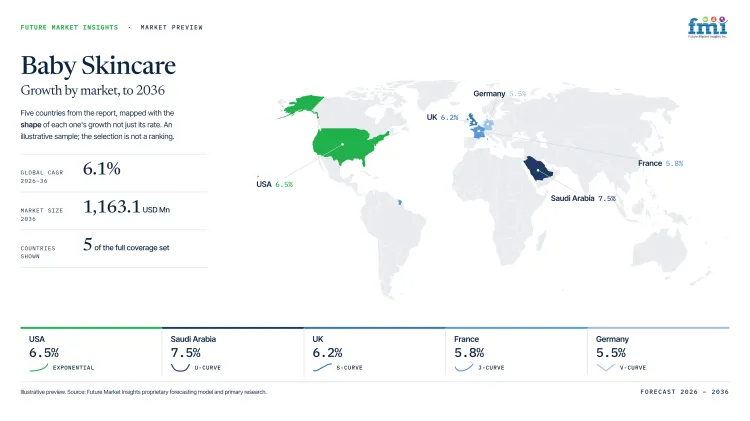
Eight profiled markets span 5.2% to 7.5% CAGR and create a 2.3-point forecast spread between Japan and Saudi Arabia. Saudi Arabia and the UAE move ahead of South Korea because regulated distribution and rapid urban retail turnover improve launch execution. USA and UK occupy the middle while France and Germany grow more slowly under tighter demographic and household-spending conditions. Japan records the lowest rate because continuing child-population decline limits growth from new-parent acquisition alone.
- Saudi Arabia combines faster growth with a larger regulated cosmetics handling base for repeat distribution.
- UAE launch speed depends on product registration and efficient import handling through Dubai trade routes.
- South Korea rewards fast product iteration because digital discovery compresses infant-care comparison cycles and raises pressure on brands to refresh propositions quickly.
- USA repeat-care depth offsets slower population growth because broad pharmacy and mass retail access keeps tolerated products easy to replenish nationwide.
- UK pack economics remain important because the birth base is shrinking while omnichannel access stays broad.
- France relies more on pharmacy trust and household retention as annual births continue to decline.
- Germany places greater weight on price discipline because drugstore competition keeps routine-care pricing visible during household comparison and repeat purchase.
- Japan depends most heavily on repeat spend per child because the under-15 population continues to contract.
Country priorities therefore depend on household retention and launch execution. The full report provides country-level CAGR analysis across North America, Latin America, Europe, East Asia, South Asia, Oceania and the Middle East and Africa.
Country-wise Analysis
- Saudi Arabia's faster forecast reflects expanding regulated cosmetics capacity and a retail system that can replenish imported infant-care ranges after approval. Saudi baby skincare demand is projected to grow at 7.5% CAGR through 2036 as licensed cosmetics handling expands. SFDA reported in January 2026 that 2025 included 43 licensed cosmetics factories and 831 licensed cosmetics warehouses. The regulated base gives brands more local routes for stockholding and repeat distribution after product files clear. Caregiver trust still depends on tolerability and clear labeling because additional warehouse capacity does not guarantee repeat use.
- UAE baby skincare sales move quickly through specialist beauty retail once product registration and import checks are complete. The market is forecast to expand at 7.1% CAGR by 2036 owing to dense urban retail and frequent international assortment turnover. Dubai Municipality stated in October 2025 that it manages nearly 40,000 product shipments each year and monitors more than half a million imported products. That oversight scale makes documentation timing a direct part of launch execution for infant-care ranges entering Dubai through regulated import routes. Brands still need mild formulas that earn repurchase after trial because faster import handling cannot compensate for poor tolerability.
- South Korean caregivers use mobile beauty platforms to compare ingredients quickly and reorder tolerated baby skincare without relying on store visits. The South Korean baby skincare sector is projected to record 6.8% CAGR during the assessment period, propelled by rapid digital discovery and barrier-care interest. Statistics Korea recorded 238,300 births in 2024 following a 3.6% annual increase and placed the total fertility rate at 0.75. The infant base therefore stays small despite the rebound in births and stronger year-on-year momentum. Population growth cannot carry the forecast by itself, so companies entering South Korea need products that earn repeat spend per child in a market where beauty launches move quickly.
- USA households can compare baby skincare through mass retailers, pharmacies and national online platforms then decide whether a tolerated product merits repeat use. Census Bureau data released in August 2026 put e-commerce at 17.1% of adjusted USA retail sales in the second quarter. The wider USA baby care category therefore operates within a substantial digital buying route. Baby skincare demand in USA is forecast to rise at 6.5% CAGR over the forecast period, aided by deep distribution and frequent routine use. MoCRA documentation raises launch discipline, so clear labeling and reliable replenishment become practical advantages once the first purchase is tolerated.
- UK households compare baby skincare through supermarkets and online retailers, and pharmacy chains remain influential for sensitive-care choices. ONS counted 585,396 live births in England and Wales during 2025 and reported a 1.6% annual decline. The UK baby skincare outlook is anticipated to advance at 6.2% CAGR over the assessment period, helped by omnichannel access and repeated care. Household budget pressure limits easy premiumization even as pharmacy credibility improves confidence in tolerability. A shrinking birth base leaves less room for weak first-purchase conversion or poorly differentiated premium offers. Brands therefore need everyday value and tolerability to protect repeat purchase after the first household trial.
- French pharmacies give baby skincare brands a familiar setting for explaining tolerability beside mainstream personal-care offers. Adoption of baby skincare in France is estimated to expand at 5.8% CAGR through 2036, tied to repeated moisturization and professional-channel trust. Insee recorded 643,905 births in 2025 and a 2.3% annual decline in July 2026. The long demographic contraction raises the value of retention and basket expansion inside existing households. Pharmacy staff can reinforce tolerability claims during consultations whereas mass retailers keep routine prices visible to caregivers. Future growth increasingly depends on extending trusted moisturization routines into targeted sensitive-care formats without losing everyday affordability.
- German drugstores place mainstream baby skincare beside pharmacy alternatives, which keeps price comparison visible and gives mass brands broad household reach. Destatis recorded 654,241 births in 2025 and a total fertility rate of 1.32. Germany is estimated to post 5.5% CAGR over the forecast period, attributable to routine use despite weak demographic expansion. Frequent drugstore promotion preserves trial volume though it also keeps routine pricing under visible pressure. Weak birth volumes limit how quickly baby skincare brands can expand through frequent new-parent acquisition in Germany. Daily propositions therefore need to earn more value from existing households during each purchase cycle.
- Japan's shrinking child population makes repeat spending per household more important than new-parent volume for baby skincare brands. Baby skincare sales in Japan are estimated to grow at 5.2% CAGR over the assessment period despite continued demographic contraction. The Statistics Bureau reported in May 2026 that Japan had 13.29 million children under 15 and the total fell for a forty-fifth consecutive year. That population trend favors brands that extend trusted routines through moisturizers and barrier products instead of relying on household formation. Premium pricing remains harder to sustain unless the product provides clear tolerability evidence or a specific functional benefit caregivers can recognize.
Who are the notable companies in the Baby Skincare Market?
Kenvue Inc., Pigeon Corporation, Beiersdorf AG, Amorepacific Corporation, The Honest Company, Inc., Laboratoires Expanscience, PZ Cussons plc and Galderma Group AG are the notable companies serving this market.
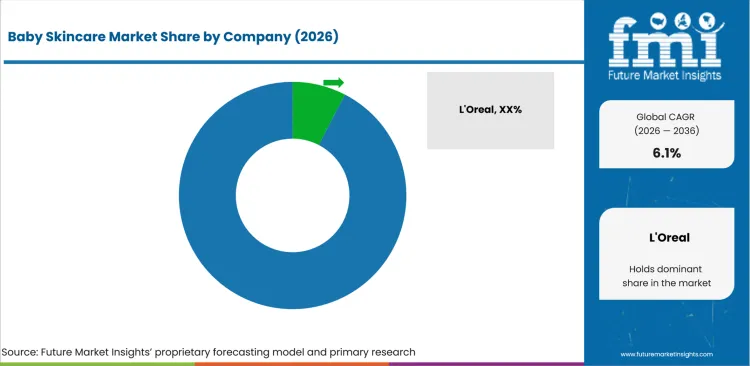
Competition is fragmented between infant-care specialists, scaled skincare groups and baby-focused personal-care platforms. Entry depends on documented infant suitability plus the ability to keep a trusted proposition available through baby personal care products channels once household trial begins.
- Kenvue Inc., Pigeon Corporation and Beiersdorf AG pair broad consumer-care distribution with dedicated baby or infant-skin propositions.
- Amorepacific Corporation, The Honest Company, Inc. and Laboratoires Expanscience compete more directly on barrier care, tolerability and family skincare credibility.
- PZ Cussons plc and Galderma Group AG bring baby-focused personal care or dermatology platforms with substantial regional distribution reach.
Competitive Benchmarking: Baby Skincare Market
| Company | Baby Topical Breadth | Infant Skin Evidence | Channel Breadth | Geographic Reach |
|---|---|---|---|---|
| Kenvue Inc. | High | High | High | Global |
| Pigeon Corporation | High | High | High | Asia and selected global markets |
| Beiersdorf AG | Medium | High | High | Europe, Asia and international markets |
| Amorepacific Corporation | Medium | High | High | South Korea, UK and USA |
| The Honest Company, Inc. | High | High | High | United States |
| Laboratoires Expanscience | High | High | High | Nearly 100 countries |
| PZ Cussons plc | High | Medium | High | UK, Australia, Nigeria and Indonesia |
| Galderma Group AG | Medium | Medium | High | Global |
Scoring basis: High baby-topical breadth requires three or more verified topical formats, Medium requires two and Low identifies one. High infant-skin evidence requires direct infant research or clinical substantiation, Medium reflects one documented testing route and Low identifies limited infant-specific evidence. High channel breadth requires at least three major routes, Medium requires two and Low identifies one documented route. These ratings reflect verified market scope rather than overall corporate size or reputation.
Key Developments in the Baby Skincare Market
- In June 2026, Kenvue Inc. launched a chamomile-scent Johnson’s Baby bar soap in Latin America using its Sustainable Innovation Profiler during formulation development.
- In July 2025, Pigeon Corporation announced its Biomimetic Vernix skincare series at CBME China as part of its infant-skin research commercialization program.
- In March 2026, The Honest Company, Inc. introduced Sensitive Rich Cream for all ages including babies with fragrance-free positioning and a 48-hour moisture claim.
Key Players in the Baby Skincare Market
Broad Baby-Care Platforms
- Kenvue Inc.
- Pigeon Corporation
Sensitive-Skin and Dermocosmetic Platforms
- Beiersdorf AG
- Amorepacific Corporation
Gentle Personal-Care Specialists
- The Honest Company, Inc.
- Laboratoires Expanscience
Additional Baby and Dermatology Platforms
- PZ Cussons plc
- Galderma Group AG
Baby Skincare Market - Report Scope
| Coverage field | Report scope |
|---|---|
| Market breakdown | By product type, nature, format, price positioning, sales channel and region. |
| Quantitative Units | USD Million. |
| Market Definition | Commercial leave-on and skin-cleansing topical products positioned primarily for babies or infants, including moisturizers, barrier creams, cleansers, oils, powders, sunscreen and targeted non-prescription skin-care formats. |
| Regions Covered | North America, Latin America, Europe, East Asia, South Asia and Pacific, and Middle East and Africa. |
| Countries Covered | Saudi Arabia, UAE, South Korea, USA, UK, France, Germany, Japan, and 20+ countries included in the full report. |
| Key Companies Profiled | Kenvue Inc., Pigeon Corporation, Beiersdorf AG, Amorepacific Corporation, The Honest Company, Inc., Laboratoires Expanscience, PZ Cussons plc, Galderma Group AG. |
| Forecast Period | 2026 to 2036. |
| Approach | Primary and secondary research with market triangulation. |
Baby Skincare Market - Research Methodology
| Method | Approach |
|---|---|
| Primary Research | FMI analysts gathered input from manufacturers, service providers, technology developers, distributors, end users, procurement teams, and subject-matter experts. Interviews examined purchasing decisions, product or service evaluation, adoption barriers, approval requirements, pricing considerations, and expectations for technical or commercial support. Respondents were also asked what evidence is required before a trial, pilot, or initial order develops into regular purchasing. |
| Desk Research | Desk research covered government statistics, regulatory publications, trade data, industry associations, technical literature, standards, company filings, product information, and official corporate announcements. Sources were reviewed for relevance, publication date, geographic coverage, and consistency with the defined market scope. Claims relating to performance, applications, approvals, capacity, investment, and commercial activity were retained only when supported by credible public evidence. |
| Market Sizing and Forecasting | The market model combined the baseline value with historical performance, segment structure, pricing and volume indicators, adoption levels, company participation, and country-level demand conditions. Forecast assumptions considered economic activity, investment trends, regulatory developments, technology adoption, purchasing cycles, supply availability, and barriers to wider market use. Segment and regional estimates were reconciled before the final market total was calculated. |
| Data Validation | Estimates were checked against multiple independent indicators, including public data, company activity, trade patterns, industry developments, and findings from primary interviews. Validation also tested whether products, services, applications, and company revenues fell within the defined market boundaries. Adjacent categories, unsupported claims, overlapping revenues, and activities without direct market relevance were excluded to reduce double counting and maintain consistency across segments and countries. |
Baby Skincare Market by Segments
Baby Skincare Market segmented by Product Type:
- Core - classic lines
- Targeted treatment lines
- Sensitive & gentle lines
- Premium & clinical lines
- Kits & sets
Baby Skincare Market segmented by Nature:
- Conventional
- Vegan & cruelty-free
- Natural & organic
- Dermocosmetic / clinical
- Fragrance-free & sensitive
Baby Skincare Market segmented by Format:
- Cream & balm
- Liquid & serum
- Stick & solid
- Spray & mist
- Sheet & patch
- Powder
Baby Skincare Market segmented by Price Positioning:
- Mass
- Masstige
- Premium
- Professional
Baby Skincare Market segmented by Sales Channel:
- E-commerce & DTC
- Specialty beauty retail
- Pharmacies & drugstores
- Supermarkets & hypermarkets
- Salons & spas
Baby Skincare Market by Region:
- North America
- United States
- Canada
- Latin America
- Brazil
- Mexico
- Chile
- Rest of Latin America
- Western Europe
- Germany
- United Kingdom
- Italy
- Spain
- France
- Nordics
- Benelux
- Rest of Western Europe
- Eastern Europe
- Russia
- Poland
- Hungary
- Balkan and Baltic States
- Rest of Eastern Europe
- East Asia
- China
- Japan
- South Korea
- South Asia and Pacific
- India
- ASEAN
- Australia and New Zealand
- Rest of South Asia and Pacific
- Middle East and Africa
- Kingdom of Saudi Arabia
- Other GCC Countries
- Türkiye
- South Africa
- Other African Union Countries
- Rest of Middle East and Africa
Research Sources and Bibliography
- American Academy of Pediatrics. (2025, May 19). Treating Eczema (Atopic Dermatitis): AAP Updates Recommendations.
- Centers for Disease Control and Prevention. (2026, April 9). USA Births down 1% in 2025.
- USA Census Bureau. (2026, August 18). Quarterly Retail E-Commerce Sales.
- PZ Cussons plc. (2026, February 11). Interim Results for the Half Year to 29 November 2025.
- Laboratoires Expanscience. (2025, October). A story made in France.
- Amorepacific Corporation. (2025, February 5). 일리윤, 세라마이드 아토 라인 3세대 출시.
- Amorepacific Corporation. (2026, July 6). Amorepacific Group Achieves Highest-Ever Revenue on Amazon Prime Day.
- Kenvue Inc. (2025, March 7). Kenvue to Showcase New Clinical Data on Skin Longevity, Hydration and Sun Protection at American Academy of Dermatology Association Meeting.
- USA Food and Drug Administration. (2026, February 11). Registration & Listing of Cosmetic Product Facilities and Products.
- Beiersdorf AG. (2026, March 3). Research and Development - Beiersdorf Annual Report 2025.
- Statistics Korea. (2025, February 26). Preliminary Results of Birth and Death Statistics in 2024.
- Office for National Statistics. (2026, May 27). Births in England and Wales: 2025.
- Insee. (2026, July 6). Births in 2025: A Continuing Decrease in the Number of Births.
- Federal Statistical Office of Germany. (2026, July 1). Total fertility rate drops to 1.32 children per woman in 2025.
- Kenvue Inc. (2026, June 11). Gentle care, smarter science: Inside Johnson’s Baby new chamomile-scent baby bar soap.
- Pigeon Corporation. (2026, April 27). Skincare Product Development Using 3D Infant Skin model (China).
- The Honest Company, Inc. (2026, March 2). The Honest Company Introduces Sensitive Rich Cream, Delivering Gentle Care for All Ages.
- Kenvue Inc. (2025, March 10). Johnson’s Baby hosts ONEder Labs: Over 2000 mums experience science behind Babycare.
- PZ Cussons plc. (2025, September 17). FY25 Preliminary Results Presentation.
- Galderma Group AG. (2026, July 23). Galderma reports record first half 2026 net sales of 3.134 billion USD and 24.6% year-on-year growth at constant currency, raises net sales guidance for the full year.
- The Honest Company, Inc. (2025, September 9). The Honest Company Collaborates with Disney on Bathtime Collection.
- Amorepacific Corporation. (2025, November 3). Mamonde, Primera, and ILLIYOON Announce Official Debut at Boots in the United Kingdom.
- Pigeon Corporation. (2026, February 13). Review of the FY Dec. 2025 Results.
- Beiersdorf AG. (2026, August 3). Half-year results 2026: Derma outperformance continues, NIVEA enters next phase of rebalancing with 18-month turnaround plan.
- Laboratoires Expanscience. (2026, February 12). Expanscience renews its B Corp certification and confirms the strength of its impact model.
- Pigeon Corporation. (2026). Quality and Safety Initiatives.
- Saudi Food and Drug Authority. (2026, January 26). SFDA Reports 18% Growth in Licensed Factories and Warehouses During 2025.
- Dubai Municipality. (2025, October 27). Product safety at Beautyworld Middle East 2025.
- Statistics Bureau of Japan. (2026, May 28). News Bulletin May 28, 2026.
This bibliography is provided for reader reference and is not exhaustive. The full report contains the complete reference list and detailed citations.
This Report Answers
- What is the baby skincare market size in 2026 and forecast value for 2036?
- Which repeated infant-care routines support baby skincare demand?
- Why do core - classic lines lead product type in 2026?
- How does conventional positioning shape nature demand?
- Why do cream & balm formats lead their category?
- How do country CAGRs differ among the eight profiled markets?
- Which companies have verified infant-skin activity?
- Which frictions can slow trial-to-repurchase conversion?
Frequently Asked Questions
How big is the baby skincare market in 2026?
The baby skincare market is valued at USD 643.4 million in 2026 and is projected to reach USD 1,163.1 million by 2036. Repeated cleansing and moisturization routines keep tolerated formulas in household replenishment cycles after the first successful trial.
What is the CAGR of the baby skincare market from 2026 to 2036?
The baby skincare market is projected to grow at a CAGR of 6.1% between 2026 and 2036. Expansion depends on repeat daily care and wider physical plus digital access.
Which product type leads the baby skincare market?
The core - classic lines segment is expected to hold 38.0% of the baby skincare market in 2026, driven by broad cleansing and moisturization use. Familiar daily routines give core ranges a broad replenishment base among households seeking simple infant-care products.
Which countries are projected to record the highest growth in the baby skincare market?
Saudi Arabia is projected to grow at 7.5% CAGR, followed by the UAE at 7.1% and South Korea at 6.8% through 2036. Faster Gulf growth reflects regulated cosmetics distribution and dense urban retail while South Korea relies more on rapid digital product discovery.
Which companies are active in the baby skincare market?
Key companies operating in the baby skincare market include Kenvue Inc., Pigeon Corporation, Beiersdorf AG, Amorepacific Corporation, The Honest Company, Inc., Laboratoires Expanscience, PZ Cussons plc, and Galderma Group AG. Their positions differ by infant-skin evidence, baby-focused product breadth and the retail routes available for repeat household purchase.
Preview the report firsthand - request a free sample
Get SampleGet the brochure for pricing and purchase details.
Get PDFTable of Content
- Key Takeaways
- Market Size and CAGR
- Top Growth Driver
- Fastest Growing Segment
- Leading Region
- Key Companies
- Emerging Opportunities
- Executive Summary
- Global Market Outlook
- Demand-side Trends
- Supply-side Trends
- Technology Roadmap Analysis
- Analysis and Recommendations
- Analyst Perspective (What is happening? Why now? What should investors know?)
- Key Questions Answered
- How large is the market?
- What is the CAGR?
- What are key trends?
- Which region dominates?
- Who are the leaders?
- Market Overview
- Market Coverage / Taxonomy
- Market Definition / Scope / Limitations
- Research Methodology
- Chapter Orientation
- Analytical Lens and Working Hypotheses
- Market Structure, Signals, and Trend Drivers
- Benchmarking and Cross-market Comparability
- Market Sizing, Forecasting, and Opportunity Mapping
- Research Design and Evidence Framework
- Desk Research Programme (Secondary Evidence)
- Expert Input and Fieldwork (Primary Evidence)
- Tooling, Models, and Reference Databases
- Data Engineering and Model Build
- Quality Assurance and Audit Trail
- Market Background
- Market Dynamics (Drivers, Restraints, Opportunity, Trends)
- Scenario Forecast (Optimistic, Likely, Conservative)
- Impact Analysis
- AI Impact
- Sustainability Impact
- Regulatory Impact
- Technology Impact
- Consumer / Buyer Analysis
- Purchase Drivers
- Adoption Barriers
- Buyer Journey
- Opportunity Map Analysis
- Product Life Cycle Analysis
- Supply Chain Analysis
- Investment Feasibility Matrix
- Value Chain Analysis
- PESTLE and Porter's Analysis
- Regulatory Landscape
- Regional Parent Market Outlook
- Production and Consumption Statistics
- Import and Export Statistics
- Global Market Analysis and Forecast, 2021 to 2036
- Historical Market Size Value (USD Million) Analysis, 2021 to 2025
- Current and Future Market Size Value (USD Million) Projections, 2026 to 2036
- Y-o-Y Growth Trend Analysis
- Absolute $ Opportunity Analysis
- Global Market Pricing Analysis, 2021 to 2036
- Global Market Analysis and Forecast, By Product Type, 2021 to 2036
- Introduction / Key Findings
- Historical Market Size Value (USD Million) Analysis By Product Type, 2021 to 2025
- Current and Future Market Size Value (USD Million) Analysis and Forecast By Product Type, 2026 to 2036
- Core / classic lines
- Targeted treatment lines
- Sensitive & gentle lines
- Premium & clinical lines
- Kits & sets
- Core / classic lines
- Y-o-Y Growth Trend Analysis By Product Type, 2021 to 2025
- Absolute $ Opportunity Analysis By Product Type, 2026 to 2036
- Global Market Analysis and Forecast, By Nature, 2021 to 2036
- Introduction / Key Findings
- Historical Market Size Value (USD Million) Analysis By Nature, 2021 to 2025
- Current and Future Market Size Value (USD Million) Analysis and Forecast By Nature, 2026 to 2036
- Conventional
- Vegan & cruelty-free
- Natural & organic
- Dermocosmetic / clinical
- Fragrance-free & sensitive
- Conventional
- Y-o-Y Growth Trend Analysis By Nature, 2021 to 2025
- Absolute $ Opportunity Analysis By Nature, 2026 to 2036
- Global Market Analysis and Forecast, By Format, 2021 to 2036
- Introduction / Key Findings
- Historical Market Size Value (USD Million) Analysis By Format, 2021 to 2025
- Current and Future Market Size Value (USD Million) Analysis and Forecast By Format, 2026 to 2036
- Cream & balm
- Liquid & serum
- Stick & solid
- Spray & mist
- Sheet & patch
- Powder
- Cream & balm
- Y-o-Y Growth Trend Analysis By Format, 2021 to 2025
- Absolute $ Opportunity Analysis By Format, 2026 to 2036
- Global Market Analysis and Forecast, By Price Positioning, 2021 to 2036
- Introduction / Key Findings
- Historical Market Size Value (USD Million) Analysis By Price Positioning, 2021 to 2025
- Current and Future Market Size Value (USD Million) Analysis and Forecast By Price Positioning, 2026 to 2036
- Mass
- Masstige
- Premium
- Professional
- Mass
- Y-o-Y Growth Trend Analysis By Price Positioning, 2021 to 2025
- Absolute $ Opportunity Analysis By Price Positioning, 2026 to 2036
- Global Market Analysis and Forecast, By Sales Channel, 2021 to 2036
- Introduction / Key Findings
- Historical Market Size Value (USD Million) Analysis By Sales Channel, 2021 to 2025
- Current and Future Market Size Value (USD Million) Analysis and Forecast By Sales Channel, 2026 to 2036
- E-commerce & DTC
- Specialty beauty retail
- Pharmacies & drugstores
- Supermarkets & hypermarkets
- Salons & spas
- E-commerce & DTC
- Y-o-Y Growth Trend Analysis By Sales Channel, 2021 to 2025
- Absolute $ Opportunity Analysis By Sales Channel, 2026 to 2036
- Global Market Analysis and Forecast, By Region, 2021 to 2036
- Introduction
- Historical Market Size Value (USD Million) Analysis By Region, 2021 to 2025
- Current Market Size Value (USD Million) Analysis and Forecast By Region, 2026 to 2036
- North America
- Latin America
- Western Europe
- Eastern Europe
- East Asia
- South Asia and Pacific
- Middle East & Africa
- Market Attractiveness Analysis By Region
- North America Market Analysis and Forecast, By Country, 2021 to 2036
- Historical Market Size Value (USD Million) Trend Analysis By Market Taxonomy, 2021 to 2025
- Market Size Value (USD Million) Forecast By Market Taxonomy, 2026 to 2036
- By Country
- USA
- Canada
- By Product Type
- By Nature
- By Format
- By Price Positioning
- By Sales Channel
- By Country
- Market Attractiveness Analysis
- By Country
- By Product Type
- By Nature
- By Format
- By Price Positioning
- By Sales Channel
- Key Takeaways
- Latin America Market Analysis and Forecast, By Country
- Historical Market Size Value (USD Million) Trend Analysis By Market Taxonomy, 2021 to 2025
- Market Size Value (USD Million) Forecast By Market Taxonomy, 2026 to 2036
- By Country
- Brazil
- Mexico
- Chile
- Rest of Latin America
- By Product Type
- By Nature
- By Format
- By Price Positioning
- By Sales Channel
- By Country
- Market Attractiveness Analysis
- By Country
- By Product Type
- By Nature
- By Format
- By Price Positioning
- By Sales Channel
- Key Takeaways
- Western Europe Market Analysis and Forecast, By Country
- Historical Market Size Value (USD Million) Trend Analysis By Market Taxonomy, 2021 to 2025
- Market Size Value (USD Million) Forecast By Market Taxonomy, 2026 to 2036
- By Country
- Germany
- UK
- Italy
- Spain
- France
- Nordic
- BENELUX
- Rest of Western Europe
- By Product Type
- By Nature
- By Format
- By Price Positioning
- By Sales Channel
- By Country
- Market Attractiveness Analysis
- By Country
- By Product Type
- By Nature
- By Format
- By Price Positioning
- By Sales Channel
- Key Takeaways
- Eastern Europe Market Analysis and Forecast, By Country
- Historical Market Size Value (USD Million) Trend Analysis By Market Taxonomy, 2021 to 2025
- Market Size Value (USD Million) Forecast By Market Taxonomy, 2026 to 2036
- By Country
- Russia
- Poland
- Hungary
- Balkan & Baltic
- Rest of Eastern Europe
- By Product Type
- By Nature
- By Format
- By Price Positioning
- By Sales Channel
- By Country
- Market Attractiveness Analysis
- By Country
- By Product Type
- By Nature
- By Format
- By Price Positioning
- By Sales Channel
- Key Takeaways
- East Asia Market Analysis and Forecast, By Country
- Historical Market Size Value (USD Million) Trend Analysis By Market Taxonomy, 2021 to 2025
- Market Size Value (USD Million) Forecast By Market Taxonomy, 2026 to 2036
- By Country
- China
- Japan
- South Korea
- By Product Type
- By Nature
- By Format
- By Price Positioning
- By Sales Channel
- By Country
- Market Attractiveness Analysis
- By Country
- By Product Type
- By Nature
- By Format
- By Price Positioning
- By Sales Channel
- Key Takeaways
- South Asia and Pacific Market Analysis and Forecast, By Country
- Historical Market Size Value (USD Million) Trend Analysis By Market Taxonomy, 2021 to 2025
- Market Size Value (USD Million) Forecast By Market Taxonomy, 2026 to 2036
- By Country
- India
- ASEAN
- Australia & New Zealand
- Rest of South Asia and Pacific
- By Product Type
- By Nature
- By Format
- By Price Positioning
- By Sales Channel
- By Country
- Market Attractiveness Analysis
- By Country
- By Product Type
- By Nature
- By Format
- By Price Positioning
- By Sales Channel
- Key Takeaways
- Middle East & Africa Market Analysis and Forecast, By Country
- Historical Market Size Value (USD Million) Trend Analysis By Market Taxonomy, 2021 to 2025
- Market Size Value (USD Million) Forecast By Market Taxonomy, 2026 to 2036
- By Country
- Kingdom of Saudi Arabia
- Other GCC Countries
- Türkiye
- South Africa
- Other African Union
- Rest of Middle East & Africa
- By Product Type
- By Nature
- By Format
- By Price Positioning
- By Sales Channel
- By Country
- Market Attractiveness Analysis
- By Country
- By Product Type
- By Nature
- By Format
- By Price Positioning
- By Sales Channel
- Key Takeaways
- Key Countries Market Analysis
- USA
- Pricing Analysis
- Market Share Analysis, 2025
- By Product Type
- By Nature
- By Format
- By Price Positioning
- By Sales Channel
- Canada
- Pricing Analysis
- Market Share Analysis, 2025
- By Product Type
- By Nature
- By Format
- By Price Positioning
- By Sales Channel
- Mexico
- Pricing Analysis
- Market Share Analysis, 2025
- By Product Type
- By Nature
- By Format
- By Price Positioning
- By Sales Channel
- Brazil
- Pricing Analysis
- Market Share Analysis, 2025
- By Product Type
- By Nature
- By Format
- By Price Positioning
- By Sales Channel
- Chile
- Pricing Analysis
- Market Share Analysis, 2025
- By Product Type
- By Nature
- By Format
- By Price Positioning
- By Sales Channel
- Germany
- Pricing Analysis
- Market Share Analysis, 2025
- By Product Type
- By Nature
- By Format
- By Price Positioning
- By Sales Channel
- UK
- Pricing Analysis
- Market Share Analysis, 2025
- By Product Type
- By Nature
- By Format
- By Price Positioning
- By Sales Channel
- Italy
- Pricing Analysis
- Market Share Analysis, 2025
- By Product Type
- By Nature
- By Format
- By Price Positioning
- By Sales Channel
- Spain
- Pricing Analysis
- Market Share Analysis, 2025
- By Product Type
- By Nature
- By Format
- By Price Positioning
- By Sales Channel
- France
- Pricing Analysis
- Market Share Analysis, 2025
- By Product Type
- By Nature
- By Format
- By Price Positioning
- By Sales Channel
- India
- Pricing Analysis
- Market Share Analysis, 2025
- By Product Type
- By Nature
- By Format
- By Price Positioning
- By Sales Channel
- ASEAN
- Pricing Analysis
- Market Share Analysis, 2025
- By Product Type
- By Nature
- By Format
- By Price Positioning
- By Sales Channel
- Australia & New Zealand
- Pricing Analysis
- Market Share Analysis, 2025
- By Product Type
- By Nature
- By Format
- By Price Positioning
- By Sales Channel
- China
- Pricing Analysis
- Market Share Analysis, 2025
- By Product Type
- By Nature
- By Format
- By Price Positioning
- By Sales Channel
- Japan
- Pricing Analysis
- Market Share Analysis, 2025
- By Product Type
- By Nature
- By Format
- By Price Positioning
- By Sales Channel
- South Korea
- Pricing Analysis
- Market Share Analysis, 2025
- By Product Type
- By Nature
- By Format
- By Price Positioning
- By Sales Channel
- Russia
- Pricing Analysis
- Market Share Analysis, 2025
- By Product Type
- By Nature
- By Format
- By Price Positioning
- By Sales Channel
- Poland
- Pricing Analysis
- Market Share Analysis, 2025
- By Product Type
- By Nature
- By Format
- By Price Positioning
- By Sales Channel
- Hungary
- Pricing Analysis
- Market Share Analysis, 2025
- By Product Type
- By Nature
- By Format
- By Price Positioning
- By Sales Channel
- Kingdom of Saudi Arabia
- Pricing Analysis
- Market Share Analysis, 2025
- By Product Type
- By Nature
- By Format
- By Price Positioning
- By Sales Channel
- Türkiye
- Pricing Analysis
- Market Share Analysis, 2025
- By Product Type
- By Nature
- By Format
- By Price Positioning
- By Sales Channel
- South Africa
- Pricing Analysis
- Market Share Analysis, 2025
- By Product Type
- By Nature
- By Format
- By Price Positioning
- By Sales Channel
- USA
- Market Structure Analysis
- Competition Dashboard
- Competition Benchmarking
- Market Share Analysis of Top Players
- By Regional
- By Product Type
- By Nature
- By Format
- By Price Positioning
- By Sales Channel
- Emerging Startups
- Innovation Benchmarking
- Competition Analysis
- Competition Deep Dive
- L'Oreal
- Overview
- Product Portfolio
- Profitability by Market Segments
- Sales Footprint
- Strategy Overview
- Marketing Strategy
- Product Strategy
- Channel Strategy
- Unilever
- e.l.f. Beauty
- Shiseido
- Beiersdorf
- Procter & Gamble
- Kao Corporation
- Amorepacific
- Coty
- Estee Lauder Companies
- L'Oreal
- Case Studies
- Success Stories
- Recent Developments
- Competition Deep Dive
- Assumptions & Acronyms Used


