

- Market Size (2026)
- USD 1.5 Bn
- Forecast (2036)
- USD 2.4 Bn
- CAGR (2026 to 2036)
- 4.9%
How big is Kiln Tyres Market in 2026?
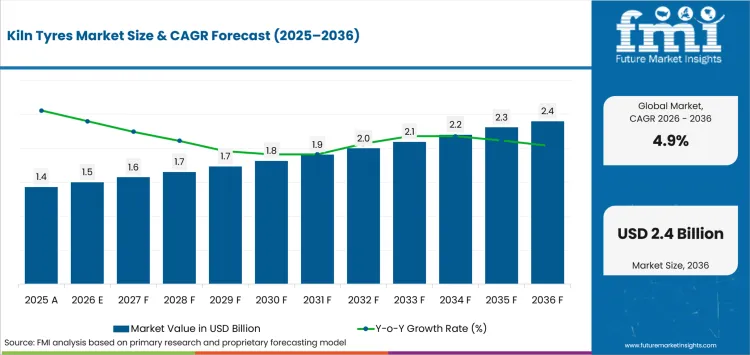
USD 1.5 billion in 2026 and USD 2.4 billion by 2036 at a 4.9% CAGR.
Demand for kiln tyres is projected to expand at 4.9% CAGR between 2026 and 2036, lifting valuation from USD 1.5 billion in 2026 to USD 2.4 billion by 2036. New kiln projects specify tyre geometry beside the industrial gearbox and support layout as roller positions determine the ring dimensions. Pengfei Group reported in July 2026 that more than 350 nickel rotary kilns had been delivered by end-2025, sustaining a direct route for original-equipment tyre orders.
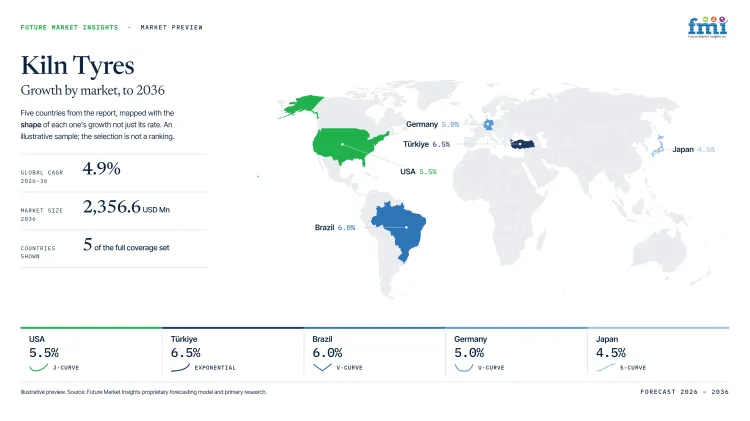
Kiln maintenance requirements vary across countries according to investment priorities and fleet age instead of the basic rotary-kiln process itself. Türkiye is forecast to expand at a 4.8% CAGR through 2036 as fuel-transition projects continue to extend the operating life of existing kiln assets. TÜRKÇİMENTO reported in June 2026 that alternative fuels supplied 13.2% of thermal energy during 2025. Greater use of alternative fuels often requires ongoing inspection and mechanical upgrades on retained kiln lines. Japan is forecast at 3.5% CAGR as its mature fleet places more weight on machine condition monitoring and dimensional checks before full replacement.
Key Takeaways of Kiln Tyres Market
- Kiln uptime converts ring wear and alignment risk into planned replacement or re-machining spending across long-life rotary assets.
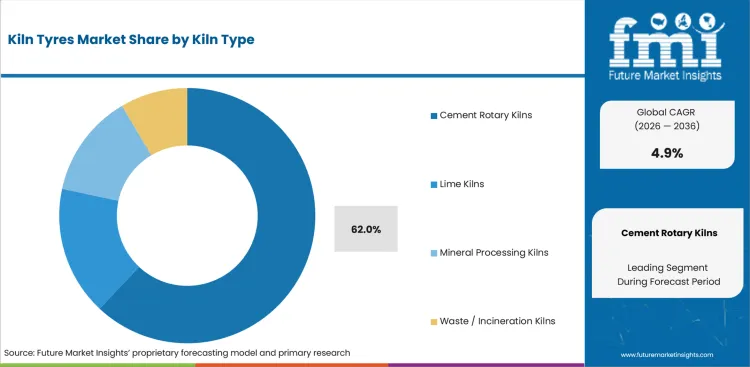
- Based on kiln type, cement rotary kilns are projected to account for 62.0% in 2026 due to continuous clinker production duties.
- In 2026, cast steel is expected to lead material with 42.0% share because large custom rings require controlled casting and machining.
- The end use category is forecast to be led by cement plants at 64.0% share in 2026 due to continuous clinker output and costly unplanned downtime.
- Custom geometry and heavy transport extend replacement lead times as plant shutdown windows leave little tolerance for dimensional errors.
- Fuller Technologies, KHD Humboldt Wedag, thyssenkrupp Polysius, CITIC Heavy Industries, Pengfei Group, Fives, Hofmann Engineering and Özek Makina are the eight profiled companies.
Analyst Perspective
"Plant engineers should compare kiln tyre offers by measurement quality and metallurgical records before they compare quoted ring price. A lower component price loses its advantage if dimensional mismatch extends lifting work or forces corrective machining during a planned shutdown."
- Nikhil Kaitwade, Principal Consultant, Future Market Insights
How is the Kiln Tyres Market segmented?
The kiln tyres market is segmented by kiln type, diameter, material, sales type and end use.
Kiln type covers cement rotary kilns, lime kilns, mineral processing kilns and waste / incineration kilns. Diameter groups are <4 m, 4-5.5 m and >5.5 m, while material includes cast steel, forged steel and alloy steel. Sales type covers replacement tyres, new kiln supply and repair / re-machining services. End use covers cement plants, lime producers, metallurgy / minerals and waste processing. Within the diameter category, 4-5.5 m is estimated to account for 48.0% in 2026 because this range fits widely used cement rotary kiln configurations.
What makes cement rotary kilns central to the kiln type category?
Cement rotary kilns operate continuously, so their riding rings transfer shell loads into support rollers throughout production campaigns. KHD reported in March 2026 that Batisöke started a Pyrorotor project on an operating cement kiln in Türkiye.
- Cement rotary kilns are projected to hold 62.0% share in 2026 owing to their large installed base and high uptime exposure.
- Plant engineers assess tyre work beside refractory and drive maintenance during shutdowns that can cover several kiln interventions. That purchasing route links ring replacement with broader predictive maintenance planning and reduces repeated heavy-lift preparation for maintenance teams.
How do plant engineers evaluate cast steel within the material category?
Cast steel suits large closed rings that need section strength and controlled heat treatment after casting. Foundries produce the full ring geometry before machining, which avoids joining ring sections during manufacture.
- By material, cast steel is estimated to hold 42.0% in 2026 owing to custom ring geometry that large machining platforms can finish accurately.
- Kiln engineers require chemistry records and nondestructive inspection for each metal casting before a ring reaches the plant. CITIC Limited reported in its 2025 annual report that CITIC Heavy Industries maintained high-end casting and forging operations for large engineered components.
Why do replacement tyres lead demand within the sales type category?
Replacement tyres restore riding-ring function on operating kilns once wear, cracking or dimensional change exceeds the acceptable service condition. Plant teams align the work with planned shutdowns because lifting and alignment must match the installed shell and support system.
- By sales type, replacement tyres are estimated to hold 49.0% in 2026 because installed rotary-kiln fleets require lifecycle renewal as operating conditions affect ring condition.
- Replacement planning links tyre procurement with shell measurement, roller adjustment and machining checks. This route limits the risk that an installed kiln remains unavailable after a scheduled maintenance window.
Why do cement plants lead demand within the end use category?
Cement plants lose upstream clinker output during an unplanned rotary-kiln stop, so reliability teams inspect riding rings beside refractory and drive work during planned mechanical shutdowns.
- Cement plants are set to lead the end use category with 64.0% share in 2026 due to continuous production economics and large kiln populations.
- Maintenance teams inspect tyres with rollers and shell alignment to detect local wear that redistributes support loading across a blended cement line. India’s Press Information Bureau reported in February 2026 that cement production reached about 453 million tonnes in FY25.
What are the drivers, restraints and opportunities in the Kiln Tyres Market?
Kiln uptime and modernization sustain demand, while custom geometry and outage logistics constrain replacement and regional service improves response for mature plants.
- Driver: New kiln projects and modernization programs convert support-system condition into planned component spending across operating rotary assets.
- Restraint: Reverse measurement and heavy logistics can delay replacement because the ring must match existing shell and roller geometry.
- Opportunity: Regional technical service can shorten inspection and outage response for mature plants with repairable or replaceable ring damage.
Installed Kiln Fleets Convert Reliability Risk into Planned Spending
Operating cement plants coordinate support-component work with broader kiln modernization so one shutdown can cover several mechanical interventions. KHD reported in March 2026 that Conch Group commissioned a Pyrorotor on an existing 5,000-tpd kiln line at Baoshan. That retrofit kept the shell in service, reinforcing planned inspection of the industrial furnace support train before major mechanical work starts.
Custom Geometry and Shutdown Windows Slow Replacement
Replacement timing depends on accurate reverse measurement as installed shells can carry wear or historical changes that old drawings miss. thyssenkrupp Polysius documented an August 2025 Górażdże modernization to solve problems with third-party rotary kilns at the operating plant. Long lead times for iron and steel casting raise the cost of dimensional errors, so field measurement must settle the repair scope before manufacturing begins.
Regional Field Service Expands Repair-versus-Replace Options
Regional service matters for mature plants that need inspection close to a planned outage and cannot absorb repeated specialist travel. Fives opened Fives FCB USA Inc. in Alabama during May 2025 to provide local support for cement and minerals operations. The same service proximity can shorten diagnostic response for mineral-processing kilns operating beside surface mining equipment without changing the ring’s technical qualification requirements.
Which country CAGRs are profiled in the Kiln Tyres Market?
| Country | CAGR |
|---|---|
| Türkiye | 4.8% |
| Brazil | 4.6% |
| United States | 4.0% |
| Germany | 3.7% |
| Japan | 3.5% |
How do country-level CAGRs compare in the Kiln Tyres Market?
The 1.3-point range forms a narrow upper pair and a mature lower cluster. Türkiye and Brazil retain more project and production momentum, while the United States acts as a transition market. Germany and Japan depend more heavily on installed-base service for mature production lines. The spacing reflects maintenance economics and investment timing rather than current market size.
- Türkiye’s clinker base keeps retrofit work active on retained kiln lines.
- Brazil’s inland freight costs favor regional inspection before heavy replacement.
- United States geography raises service value around scheduled mechanical outages.
- German sales weakness raises replacement thresholds inside clinker-line investment programs.
- Japan’s compact plant network favors precise lifecycle work over greenfield supply.
Similar CAGRs therefore produce different entry conditions for service and manufacturing firms. The full report provides country-level CAGR analysis across North America, Latin America, Europe, East Asia, South Asia, Oceania and the Middle East and Africa.
Country-wise Analysis
- Türkiye’s cement plants operate large clinker lines that also serve export markets, so shutdown planning must cover domestic production and port-linked delivery schedules across coastal terminals. TurkCimento data reported by S&P Global Commodity Insights in March 2026 showed Turkish cement production reached a record 93.7 million tonnes in 2025, up 10.5% year over year, while clinker exports rose 43% to 7.49 million tonnes. Kiln tyre demand in Türkiye is forecast to rise at 4.8% CAGR over the forecast period, aided by regional machining access for GCC cement plants. Currency exposure and heavy-component freight remain material frictions that favor service firms completing measurement and machining near the plant with fewer transport handoffs before scheduled outage work begins on site.
- Brazilian cement producers operate across long inland corridors, making transport economics part of every large-ring replacement decision outside the main industrial centers and ports. Brazil is estimated to post 4.6% CAGR over the forecast period, aided by regional inspection that can extend service on structurally sound rings. Financing costs can delay full replacement even when wear is visible, so plant engineers need clear condition evidence before approving a new ring. SNIC reported in June 2026 that first-half cement sales reached 32.9 million tonnes and June sales rose 7.7% year over year, supporting planned mechanical work across a busier production base.
- United States cement plants operate across a wide geography, and the USA Geological Survey reported that 97 plants in 34 states and Puerto Rico produced cement during 2025. Heavy-component freight and specialist travel can dominate scheduled tyre work for plants outside the main equipment-service corridors across multiple states and remote inland sites. Domestic field service reduces diagnostic travel, but narrow outage windows still require dimensional confirmation before a replacement is released for manufacture. Kiln tyre sales in the United States are forecast to expand at 4.0% CAGR by 2036, supported by the installed plant base and recurring lifecycle work orders.
- German cement plants screen mechanical spending closely as weak domestic sales coincide with expensive decarbonization work on clinker lines that owners intend to retain. The German kiln tyres sector is projected to record 3.7% CAGR during the assessment period, shaped by precise engineering and local service for retained assets. VDZ reported in May 2026 that German cement sales had fallen by around one third during the previous five years, which raises the condition threshold for replacement. Inspection-led proposals therefore need measured wear and alignment data that separates necessary ring work from maintenance that can safely wait during scheduled outage approval.
- Japan’s cement sector concentrates production in a small number of large plants, so dimensional accuracy and predictable outage execution matter more than rapid greenfield delivery. Adoption of kiln tyres in Japan is estimated to expand at 3.5% CAGR through 2036, supported by established inspection and repair skills. Limited new-line activity makes plant engineers compare re-machining with like-for-like replacement inside planned maintenance cycles. Service firms gain an advantage by fitting work into established outages without changing proven shell interfaces. The Japan Cement Association reported that, as of April 2024, the industry comprised 28 plants owned by 16 companies with clinker production capacity of approximately 50 million tonnes.
Who are the notable companies in the Kiln Tyres Market?
Fuller Technologies, KHD Humboldt Wedag, thyssenkrupp Polysius, CITIC Heavy Industries, Pengfei Group, Fives, Hofmann Engineering and Özek Makina are the notable companies serving this market.
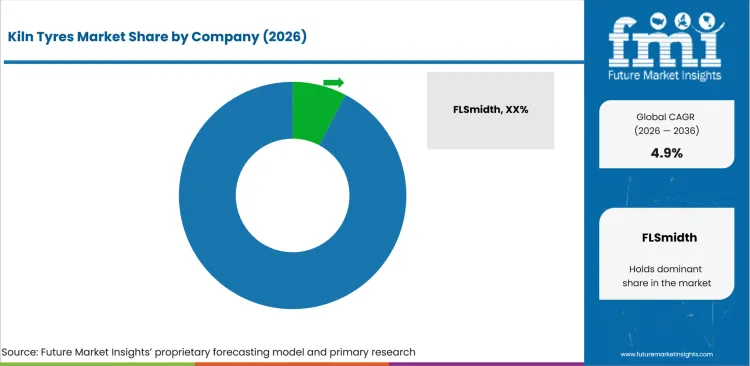
The kiln tyres market divides among full-line kiln engineers, heavy-equipment manufacturers and field reconditioning specialists. Entry requires large-section machining plus reliable control of ring geometry and metallurgy. Installed-base service adds another barrier because plant teams expect measurement and outage support on decades-old equipment.
- Fuller Technologies, KHD Humboldt Wedag, thyssenkrupp Polysius and Fives compete in full-line kiln engineering plus modernization work.
- CITIC Heavy Industries and Pengfei Group combine rotary-kiln projects with heavy manufacturing for large engineered equipment and support components.
- Hofmann Engineering and Özek Makina concentrate on field inspection plus tyre and roller reconditioning for installed rotary equipment.
Competitive Benchmarking: Kiln Tyres Market
| Company | Kiln System Integration | Heavy-Section Manufacturing | Tyre Lifecycle Service | Geographic Reach |
|---|---|---|---|---|
| Fuller Technologies | High | Medium | Medium | Global cement and related industrial operations |
| KHD Humboldt Wedag | High | Medium | Medium | Europe with global cement-project activity |
| thyssenkrupp Polysius | High | Medium | Medium | Europe, Americas and international service projects |
| CITIC Heavy Industries | High | High | Medium | China with international heavy-equipment project activity |
| Pengfei Group | High | High | Medium | China with international rotary-kiln projects |
| Fives | High | Medium | Medium | Europe and North America with international cement activity |
| Hofmann Engineering | Medium | Medium | High | Australia with international field-service coverage |
| Özek Makina | Medium | Medium | High | Türkiye with international kiln-service activity |
Key Developments in the Kiln Tyres Market
- In March 2026, KHD Humboldt Wedag detailed a Borg El Arab pyroprocess upgrade with Amreyah Cement covering a Pyrorotor reactor plus preheater and calciner modernization around the existing kiln.
- In November 2025, Fuller Technologies became the new name for FLSmidth Cement after Pacific Avenue Capital Partners completed its acquisition.
- In October 2025, Fives expanded Fives FCB USA Inc. with three experienced professionals to strengthen cement and minerals equipment support across North America.
Key Players in the Kiln Tyres Market
Kiln-System and Lifecycle Service Platforms
- Fuller Technologies
- KHD Humboldt Wedag
- thyssenkrupp Polysius
- Fives
Heavy-Equipment and Manufacturing Platforms
- CITIC Heavy Industries
- Pengfei Group
Field Reconditioning Specialists
- Hofmann Engineering
- Özek Makina
Kiln Tyres Market - Report Scope
| Coverage field | Report scope |
|---|---|
| Market breakdown | By kiln type, diameter, material, sales type, end use and region. |
| Quantitative Units | Revenue in USD billion and CAGR in %. |
| Market Definition | Revenue from kiln tyres or riding rings supplied with new rotary kilns or sold as replacement components plus repair and re-machining services directly tied to kiln tyres. |
| Regions Covered | North America, Latin America, Europe, East Asia, South Asia and Pacific, and Middle East and Africa. |
| Countries Covered | Türkiye, Brazil, United States, Germany, Japan, and 20+ countries included in the full report. |
| Key Companies Profiled | Fuller Technologies, KHD Humboldt Wedag, thyssenkrupp Polysius, CITIC Heavy Industries, Pengfei Group, Fives, Hofmann Engineering and Özek Makina. |
| Forecast Period | 2026 to 2036. |
| Approach | Primary and secondary research with market triangulation. |
Kiln Tyres Market - Research Methodology
| Method | Approach |
|---|---|
| Primary Research | FMI analysts gathered input from manufacturers, service providers, technology developers, distributors, end users, procurement teams, and subject-matter experts. Interviews examined purchasing decisions, product or service evaluation, adoption barriers, approval requirements, pricing considerations, and expectations for technical or commercial support. Respondents were also asked what evidence is required before a trial, pilot, or initial order develops into regular purchasing. |
| Desk Research | Desk research covered government statistics, regulatory publications, trade data, industry associations, technical literature, standards, company filings, product information, and official corporate announcements. Sources were reviewed for relevance, publication date, geographic coverage, and consistency with the defined market scope. Claims relating to performance, applications, approvals, capacity, investment, and commercial activity were retained only when supported by credible public evidence. |
| Market Sizing and Forecasting | The market model combined the baseline value with historical performance, segment structure, pricing and volume indicators, adoption levels, company participation, and country-level demand conditions. Forecast assumptions considered economic activity, investment trends, regulatory developments, technology adoption, purchasing cycles, supply availability, and barriers to wider market use. Segment and regional estimates were reconciled before the final market total was calculated. |
| Data Validation | Estimates were checked against multiple independent indicators, including public data, company activity, trade patterns, industry developments, and findings from primary interviews. Validation also tested whether products, services, applications, and company revenues fell within the defined market boundaries. Adjacent categories, unsupported claims, overlapping revenues, and activities without direct market relevance were excluded to reduce double counting and maintain consistency across segments and countries. |
Kiln Tyres Market by Segments
Kiln Tyres Market segmented by Kiln Type:
- Cement Rotary Kilns
- Lime Kilns
- Mineral Processing Kilns
- Waste / Incineration Kilns
Kiln Tyres Market segmented by Diameter:
- <4 m
- 4-5.5 m
- >5.5 m
Kiln Tyres Market segmented by Material:
- Cast Steel
- Forged Steel
- Alloy Steel
Kiln Tyres Market segmented by Sales Type:
- New Kiln Supply
- Replacement Tyres
- Repair / Re-machining Services
Kiln Tyres Market segmented by End Use:
- Cement Plants
- Lime Producers
- Metallurgy / Minerals
- Waste Processing
Kiln Tyres Market by Region:
- North America
- United States
- Canada
- Latin America
- Brazil
- Mexico
- Chile
- Rest of Latin America
- Western Europe
- Germany
- United Kingdom
- Italy
- Spain
- France
- Nordics
- Benelux
- Rest of Western Europe
- Eastern Europe
- Russia
- Poland
- Hungary
- Balkan and Baltic States
- Rest of Eastern Europe
- East Asia
- China
- Japan
- South Korea
- South Asia and Pacific
- India
- ASEAN
- Australia and New Zealand
- Rest of South Asia and Pacific
- Middle East and Africa
- Kingdom of Saudi Arabia
- Other GCC Countries
- Türkiye
- South Africa
- Other African Union Countries
- Rest of Middle East and Africa
Research Sources and Bibliography
- Pengfei Group. (2026, July 7). 点“石”成“镍” | 鹏飞全球镍矿版图.
- TÜRKÇİMENTO. (2026, June 5). TÜRKÇİMENTO Calls for Triple Transformation on World Environment Day.
- KHD Humboldt Wedag. (2026, March 11). KHD expands Pyrorotor® footprint in Türkiye with Batisöke order.
- CITIC Limited. (2026, April 21). CITIC Heavy Industries - Advanced Intelligent Manufacturing - CITIC Limited Annual Report 2025.
- Pengfei Group. (2026, June 25). 鹏飞集团总承包建设的土耳其KYS年产80万吨水泥EP项目投产.
- Press Information Bureau, Government of India. (2026, February 12). Union Budget FY 2026-27: Manufacturing Sector Driving India’s Next Growth Phase.
- KHD Humboldt Wedag. (2026, March 18). KHD commissions second Pyrorotor® alternative fuel system in China.
- thyssenkrupp Polysius. (2025, August 11). The Górażdże modernization project - a remarkable project in many respects.
- Fives. (2025, May 5). Fives opens a new subsidiary in the United States.
- TÜRKÇİMENTO. (2026, June 5). ADİL SANİ KONUKOĞLU ELECTED CHAIRMAN OF TOBB CEMENT AND CEMENT PRODUCTS COUNCIL.
- Sindicato Nacional da Indústria do Cimento. (2026, June). Resultados Preliminares Junho 2026.
- USA Geological Survey. (2026, February 6). Mineral commodity summaries 2026.
- Verein Deutscher Zementwerke. (2026, May 5). Dr Dirk Spenner elected as new VDZ president.
- Japan Cement Association. (2025, July). Statistics.
- Fuller Technologies. (2025, November 3). Pacific Avenue’s Acquisition of FLSmidth Cement Closes; New Company Name and Brand Announced.
- Özek Makina. (2026, March 4). On Site Machining & Grinding Services for Tyre, Roller and Thrust Roller at up to 3,5 rpm.
- Hofmann Engineering Pty. Ltd. (n.d.). Mills & Kilns.
- KHD Humboldt Wedag. (2026, March 24). Amreyah Cement and KHD: A partnership for sustainable pyroprocess innovation.
- Fives. (2025, October 13). Fives FCB USA Inc. expands with a dedicated expert team.
This bibliography is provided for reader reference and is not exhaustive. The full report contains the complete reference list and detailed citations
This Report Answers
- How large is the kiln tyres market in 2026 and 2036?
- Which operating conditions convert kiln wear into replacement or re-machining spending?
- Why do cement rotary kilns account for 62.0% of kiln type demand in 2026?
- How does cast steel support large riding-ring manufacturing and qualification?
- Why does new kiln supply remain a distinct sales route alongside replacement demand?
- How do country growth rates differ across the five profiled markets?
- Which companies combine kiln engineering, heavy manufacturing and tyre lifecycle service?
- What execution constraints can delay kiln tyre replacement during planned outages?
- How should plants compare replacement with on-site re-machining?
Frequently Asked Questions
How big is the Kiln Tyres Market in 2026?
The Kiln Tyres Market is valued at USD 1.5 billion in 2026 and is projected to reach USD 2.4 billion by 2036. Replacement demand and kiln-service work sustain spending across operating rotary-kiln fleets.
What is the CAGR of the Kiln Tyres Market from 2026 to 2036?
The Kiln Tyres Market is projected to grow at a CAGR of 4.9% between 2026 and 2036. New kiln projects and lifecycle replacement work support demand across cement and mineral-processing installations.
Which kiln type leads the Kiln Tyres Market?
Cement rotary kilns are projected to account for 62.0% of the Kiln Tyres Market in 2026. Their large installed base and continuous operating duty make riding-ring condition a recurrent maintenance priority.
How much value will the Kiln Tyres Market add between 2026 and 2036?
The Kiln Tyres Market is expected to add USD 0.9 billion in value between 2026 and 2036. Project supply plus replacement and re-machining services support the forecast expansion.
Which companies are active in the Kiln Tyres Market?
Key companies include Fuller Technologies, KHD Humboldt Wedag, thyssenkrupp Polysius, CITIC Heavy Industries, Pengfei Group, Fives, Hofmann Engineering and Özek Makina. They compete through kiln engineering, heavy-component manufacturing and field reconditioning services.
Preview the report firsthand - request a free sample
Get SampleGet the brochure for pricing and purchase details.
Get PDFTable of Content
- Key Takeaways
- Market Size and CAGR
- Top Growth Driver
- Fastest Growing Segment
- Leading Region
- Key Companies
- Emerging Opportunities
- Executive Summary
- Global Market Outlook
- Demand-side Trends
- Supply-side Trends
- Technology Roadmap Analysis
- Analysis and Recommendations
- Analyst Perspective (What is happening? Why now? What should investors know?)
- Key Questions Answered
- How large is the market?
- What is the CAGR?
- What are key trends?
- Which region dominates?
- Who are the leaders?
- Market Overview
- Market Coverage / Taxonomy
- Market Definition / Scope / Limitations
- Research Methodology
- Chapter Orientation
- Analytical Lens and Working Hypotheses
- Market Structure, Signals, and Trend Drivers
- Benchmarking and Cross-market Comparability
- Market Sizing, Forecasting, and Opportunity Mapping
- Research Design and Evidence Framework
- Desk Research Programme (Secondary Evidence)
- Expert Input and Fieldwork (Primary Evidence)
- Tooling, Models, and Reference Databases
- Data Engineering and Model Build
- Quality Assurance and Audit Trail
- Market Background
- Market Dynamics (Drivers, Restraints, Opportunity, Trends)
- Scenario Forecast (Optimistic, Likely, Conservative)
- Impact Analysis
- AI Impact
- Sustainability Impact
- Regulatory Impact
- Technology Impact
- Consumer / Buyer Analysis
- Purchase Drivers
- Adoption Barriers
- Buyer Journey
- Opportunity Map Analysis
- Product Life Cycle Analysis
- Supply Chain Analysis
- Investment Feasibility Matrix
- Value Chain Analysis
- PESTLE and Porter's Analysis
- Regulatory Landscape
- Regional Parent Market Outlook
- Production and Consumption Statistics
- Import and Export Statistics
- Global Market Analysis and Forecast, 2021 to 2036
- Historical Market Size Value (USD Million) Analysis, 2021 to 2025
- Current and Future Market Size Value (USD Million) Projections, 2026 to 2036
- Y-o-Y Growth Trend Analysis
- Absolute $ Opportunity Analysis
- Global Market Pricing Analysis, 2021 to 2036
- Global Market Analysis and Forecast, By Kiln Type, 2021 to 2036
- Introduction / Key Findings
- Historical Market Size Value (USD Million) Analysis By Kiln Type, 2021 to 2025
- Current and Future Market Size Value (USD Million) Analysis and Forecast By Kiln Type, 2026 to 2036
- Cement Rotary Kilns
- Lime Kilns
- Mineral Processing Kilns
- Waste / Incineration Kilns
- Cement Rotary Kilns
- Y-o-Y Growth Trend Analysis By Kiln Type, 2021 to 2025
- Absolute $ Opportunity Analysis By Kiln Type, 2026 to 2036
- Global Market Analysis and Forecast, By Diameter, 2021 to 2036
- Introduction / Key Findings
- Historical Market Size Value (USD Million) Analysis By Diameter, 2021 to 2025
- Current and Future Market Size Value (USD Million) Analysis and Forecast By Diameter, 2026 to 2036
- 4-5.5 m
- <4 m
- >5.5 m
- 4-5.5 m
- Y-o-Y Growth Trend Analysis By Diameter, 2021 to 2025
- Absolute $ Opportunity Analysis By Diameter, 2026 to 2036
- Global Market Analysis and Forecast, By Material, 2021 to 2036
- Introduction / Key Findings
- Historical Market Size Value (USD Million) Analysis By Material, 2021 to 2025
- Current and Future Market Size Value (USD Million) Analysis and Forecast By Material, 2026 to 2036
- Cast Steel
- Forged Steel
- Alloy Steel
- Cast Steel
- Y-o-Y Growth Trend Analysis By Material, 2021 to 2025
- Absolute $ Opportunity Analysis By Material, 2026 to 2036
- Global Market Analysis and Forecast, By Sales Type, 2021 to 2036
- Introduction / Key Findings
- Historical Market Size Value (USD Million) Analysis By Sales Type, 2021 to 2025
- Current and Future Market Size Value (USD Million) Analysis and Forecast By Sales Type, 2026 to 2036
- Replacement Tyres
- New Kiln Supply
- Repair / Re-machining Services
- Replacement Tyres
- Y-o-Y Growth Trend Analysis By Sales Type, 2021 to 2025
- Absolute $ Opportunity Analysis By Sales Type, 2026 to 2036
- Global Market Analysis and Forecast, By End Use, 2021 to 2036
- Introduction / Key Findings
- Historical Market Size Value (USD Million) Analysis By End Use, 2021 to 2025
- Current and Future Market Size Value (USD Million) Analysis and Forecast By End Use, 2026 to 2036
- Cement Plants
- Lime Producers
- Metallurgy / Minerals
- Waste Processing
- Cement Plants
- Y-o-Y Growth Trend Analysis By End Use, 2021 to 2025
- Absolute $ Opportunity Analysis By End Use, 2026 to 2036
- Global Market Analysis and Forecast, By Region, 2021 to 2036
- Introduction
- Historical Market Size Value (USD Million) Analysis By Region, 2021 to 2025
- Current Market Size Value (USD Million) Analysis and Forecast By Region, 2026 to 2036
- North America
- Latin America
- Western Europe
- Eastern Europe
- East Asia
- South Asia and Pacific
- Middle East & Africa
- Market Attractiveness Analysis By Region
- North America Market Analysis and Forecast, By Country, 2021 to 2036
- Historical Market Size Value (USD Million) Trend Analysis By Market Taxonomy, 2021 to 2025
- Market Size Value (USD Million) Forecast By Market Taxonomy, 2026 to 2036
- By Country
- USA
- Canada
- By Kiln Type
- By Diameter
- By Material
- By Sales Type
- By End Use
- By Country
- Market Attractiveness Analysis
- By Country
- By Kiln Type
- By Diameter
- By Material
- By Sales Type
- By End Use
- Key Takeaways
- Latin America Market Analysis and Forecast, By Country
- Historical Market Size Value (USD Million) Trend Analysis By Market Taxonomy, 2021 to 2025
- Market Size Value (USD Million) Forecast By Market Taxonomy, 2026 to 2036
- By Country
- Brazil
- Mexico
- Chile
- Rest of Latin America
- By Kiln Type
- By Diameter
- By Material
- By Sales Type
- By End Use
- By Country
- Market Attractiveness Analysis
- By Country
- By Kiln Type
- By Diameter
- By Material
- By Sales Type
- By End Use
- Key Takeaways
- Western Europe Market Analysis and Forecast, By Country
- Historical Market Size Value (USD Million) Trend Analysis By Market Taxonomy, 2021 to 2025
- Market Size Value (USD Million) Forecast By Market Taxonomy, 2026 to 2036
- By Country
- Germany
- UK
- Italy
- Spain
- France
- Nordic
- BENELUX
- Rest of Western Europe
- By Kiln Type
- By Diameter
- By Material
- By Sales Type
- By End Use
- By Country
- Market Attractiveness Analysis
- By Country
- By Kiln Type
- By Diameter
- By Material
- By Sales Type
- By End Use
- Key Takeaways
- Eastern Europe Market Analysis and Forecast, By Country
- Historical Market Size Value (USD Million) Trend Analysis By Market Taxonomy, 2021 to 2025
- Market Size Value (USD Million) Forecast By Market Taxonomy, 2026 to 2036
- By Country
- Russia
- Poland
- Hungary
- Balkan & Baltic
- Rest of Eastern Europe
- By Kiln Type
- By Diameter
- By Material
- By Sales Type
- By End Use
- By Country
- Market Attractiveness Analysis
- By Country
- By Kiln Type
- By Diameter
- By Material
- By Sales Type
- By End Use
- Key Takeaways
- East Asia Market Analysis and Forecast, By Country
- Historical Market Size Value (USD Million) Trend Analysis By Market Taxonomy, 2021 to 2025
- Market Size Value (USD Million) Forecast By Market Taxonomy, 2026 to 2036
- By Country
- China
- Japan
- South Korea
- By Kiln Type
- By Diameter
- By Material
- By Sales Type
- By End Use
- By Country
- Market Attractiveness Analysis
- By Country
- By Kiln Type
- By Diameter
- By Material
- By Sales Type
- By End Use
- Key Takeaways
- South Asia and Pacific Market Analysis and Forecast, By Country
- Historical Market Size Value (USD Million) Trend Analysis By Market Taxonomy, 2021 to 2025
- Market Size Value (USD Million) Forecast By Market Taxonomy, 2026 to 2036
- By Country
- India
- ASEAN
- Australia & New Zealand
- Rest of South Asia and Pacific
- By Kiln Type
- By Diameter
- By Material
- By Sales Type
- By End Use
- By Country
- Market Attractiveness Analysis
- By Country
- By Kiln Type
- By Diameter
- By Material
- By Sales Type
- By End Use
- Key Takeaways
- Middle East & Africa Market Analysis and Forecast, By Country
- Historical Market Size Value (USD Million) Trend Analysis By Market Taxonomy, 2021 to 2025
- Market Size Value (USD Million) Forecast By Market Taxonomy, 2026 to 2036
- By Country
- Kingdom of Saudi Arabia
- Other GCC Countries
- Türkiye
- South Africa
- Other African Union
- Rest of Middle East & Africa
- By Kiln Type
- By Diameter
- By Material
- By Sales Type
- By End Use
- By Country
- Market Attractiveness Analysis
- By Country
- By Kiln Type
- By Diameter
- By Material
- By Sales Type
- By End Use
- Key Takeaways
- Key Countries Market Analysis
- USA
- Pricing Analysis
- Market Share Analysis, 2025
- By Kiln Type
- By Diameter
- By Material
- By Sales Type
- By End Use
- Canada
- Pricing Analysis
- Market Share Analysis, 2025
- By Kiln Type
- By Diameter
- By Material
- By Sales Type
- By End Use
- Mexico
- Pricing Analysis
- Market Share Analysis, 2025
- By Kiln Type
- By Diameter
- By Material
- By Sales Type
- By End Use
- Brazil
- Pricing Analysis
- Market Share Analysis, 2025
- By Kiln Type
- By Diameter
- By Material
- By Sales Type
- By End Use
- Chile
- Pricing Analysis
- Market Share Analysis, 2025
- By Kiln Type
- By Diameter
- By Material
- By Sales Type
- By End Use
- Germany
- Pricing Analysis
- Market Share Analysis, 2025
- By Kiln Type
- By Diameter
- By Material
- By Sales Type
- By End Use
- UK
- Pricing Analysis
- Market Share Analysis, 2025
- By Kiln Type
- By Diameter
- By Material
- By Sales Type
- By End Use
- Italy
- Pricing Analysis
- Market Share Analysis, 2025
- By Kiln Type
- By Diameter
- By Material
- By Sales Type
- By End Use
- Spain
- Pricing Analysis
- Market Share Analysis, 2025
- By Kiln Type
- By Diameter
- By Material
- By Sales Type
- By End Use
- France
- Pricing Analysis
- Market Share Analysis, 2025
- By Kiln Type
- By Diameter
- By Material
- By Sales Type
- By End Use
- India
- Pricing Analysis
- Market Share Analysis, 2025
- By Kiln Type
- By Diameter
- By Material
- By Sales Type
- By End Use
- ASEAN
- Pricing Analysis
- Market Share Analysis, 2025
- By Kiln Type
- By Diameter
- By Material
- By Sales Type
- By End Use
- Australia & New Zealand
- Pricing Analysis
- Market Share Analysis, 2025
- By Kiln Type
- By Diameter
- By Material
- By Sales Type
- By End Use
- China
- Pricing Analysis
- Market Share Analysis, 2025
- By Kiln Type
- By Diameter
- By Material
- By Sales Type
- By End Use
- Japan
- Pricing Analysis
- Market Share Analysis, 2025
- By Kiln Type
- By Diameter
- By Material
- By Sales Type
- By End Use
- South Korea
- Pricing Analysis
- Market Share Analysis, 2025
- By Kiln Type
- By Diameter
- By Material
- By Sales Type
- By End Use
- Russia
- Pricing Analysis
- Market Share Analysis, 2025
- By Kiln Type
- By Diameter
- By Material
- By Sales Type
- By End Use
- Poland
- Pricing Analysis
- Market Share Analysis, 2025
- By Kiln Type
- By Diameter
- By Material
- By Sales Type
- By End Use
- Hungary
- Pricing Analysis
- Market Share Analysis, 2025
- By Kiln Type
- By Diameter
- By Material
- By Sales Type
- By End Use
- Kingdom of Saudi Arabia
- Pricing Analysis
- Market Share Analysis, 2025
- By Kiln Type
- By Diameter
- By Material
- By Sales Type
- By End Use
- Türkiye
- Pricing Analysis
- Market Share Analysis, 2025
- By Kiln Type
- By Diameter
- By Material
- By Sales Type
- By End Use
- South Africa
- Pricing Analysis
- Market Share Analysis, 2025
- By Kiln Type
- By Diameter
- By Material
- By Sales Type
- By End Use
- USA
- Market Structure Analysis
- Competition Dashboard
- Competition Benchmarking
- Market Share Analysis of Top Players
- By Regional
- By Kiln Type
- By Diameter
- By Material
- By Sales Type
- By End Use
- Emerging Startups
- Innovation Benchmarking
- Competition Analysis
- Competition Deep Dive
- FLSmidth
- Overview
- Product Portfolio
- Profitability by Market Segments
- Sales Footprint
- Strategy Overview
- Marketing Strategy
- Product Strategy
- Channel Strategy
- KHD Humboldt Wedag
- thyssenkrupp Polysius
- CITIC Heavy Industries
- CHAENG
- Pengfei Group
- Luoyang Zhongtai
- Uralmash
- NHI Group
- Hofmann Engineering
- FLSmidth
- Case Studies
- Success Stories
- Recent Developments
- Competition Deep Dive
- Assumptions & Acronyms Used


