

- Industry Size (2026)
- USD 3260.0 Mn
- Forecast (2036)
- USD 5160.4 Mn
- CAGR (2026 to 2036)
- 4.7%
Noise Cancelling Tyres Market Forecast and Outlook 2026 to 2036
The noise cancelling tyres market is likely to be valued at USD 3,260.0 million in 2026 and reach USD 5,160.4 million by 2036, at a CAGR of 4.7%. Value behavior reflects how tyre-road interaction noise has shifted from a secondary comfort issue to a measurable refinement parameter, particularly as powertrain noise declines. Noise cancelling tyres address cavity resonance and tread-induced vibration through internal foam liners and tuned structural design rather than changes to vehicle architecture.
Specification is concentrated in passenger cars and electric vehicles where interior quietness directly influences perceived quality. Cost formation remains linked to added material processes and integration within standard tyre manufacturing lines, limiting deployment to segments where acoustic benefit justifies incremental pricing. Adoption depends on compatibility with rolling resistance targets, wear life expectations, and high-speed durability requirements, constraining indiscriminate use across all vehicle classes.
Quick Stats for Noise Cancelling Tyres Market
- Noise Cancelling Tyres Market Value (2026): USD 3,260.0 million
- Noise Cancelling Tyres Market Forecast Value (2036): USD 5,160.4 million
- Noise Cancelling Tyres Market Forecast CAGR 2026 to 2036: 4.7%
- Leading Vehicle Type by Demand Share: Passenger Cars
- Fastest-Growing Countries: India, China, Mexico, Thailand, Indonesia
- Top Players in Global Demand: Michelin, Bridgestone, Continental, Goodyear, Pirelli
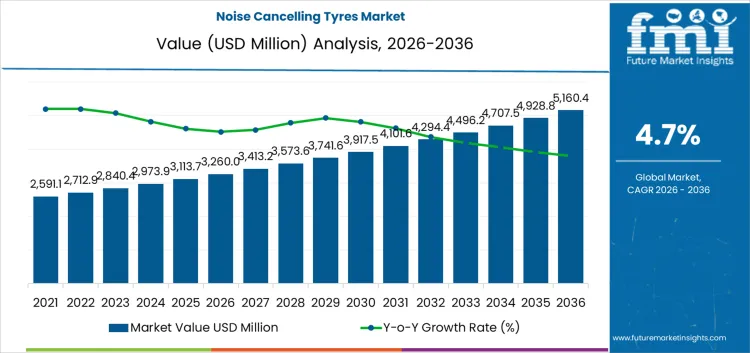
Electrification alters the acoustic balance of vehicles, exposing tyre noise that was previously masked by engine output. Urban driving conditions, coarse road surfaces, and congestion amplify this effect, increasing sensitivity to low-frequency resonance inside cabins. Constraints persist around foam durability under heat and centrifugal stress, repair complexity during puncture servicing, and limited interchangeability across rim sizes. Replacement cycles moderate value realization, as benefits are fully captured only when OEM fitment aligns with vehicle tuning.
Supplier advantage centers on validated decibel reduction under standardized test cycles and consistency over tyre life. Distribution remains dominated by OEM programs, with aftermarket penetration following slowly due to price sensitivity and service limitations. Expansion remains governed by refinement benchmarks, EV platform strategies, and durability trade-offs rather than regulatory mandates on interior noise levels.
Noise Cancelling Tyres Market Key Takeaways
| Metric | Value |
|---|---|
| Market Value (2026) | USD 3,260.0 million |
| Market Forecast Value (2036) | USD 5,160.4 million |
| Forecast CAGR 2026 to 2036 | 4.7% |
Why is the Demand for Noise Cancelling Tyres Growing?
Demand for noise cancelling tyres is increasing as vehicle manufacturers and fleet operators seek tyre technologies that reduce interior and exterior sound levels associated with road texture, tread impact, and tyre-related vibration. Typical tyre tread patterns and carcass resonances generate broadband noise that can compromise passenger comfort, increase in-cab fatigue on long journeys, and contribute to overall urban noise pollution. Noise cancelling tyres incorporate engineered tread designs, internal acoustic foam inserts, and optimized sidewall constructions that disrupt and absorb specific frequency ranges linked to tyre-road interaction noise. Engineers and procurement teams specify these tyres for passenger cars, electric vehicles, and commercial fleets because improved acoustics enhances perceived ride quality without compromising grip, tread wear performance, or fuel efficiency. Noise control becomes especially relevant where low tyre noise complements advanced powertrain quietness, as in electric and hybrid vehicle segments where reduced mechanical noise exposes tyre noise more prominently.
Growth in urbanization, stringent regulations on environmental noise, and elevated consumer expectations for refined ride quality reinforce uptake of noise cancelling tyres across diverse vehicle classes. Road authorities and urban planners are emphasizing quieter streetscapes as part of quality-of-life initiatives, which encourages adoption of low noise tyre solutions in densely populated regions. Tyre manufacturers are responding with compound and tread pattern innovations that balance noise reduction with traction performance under wet and dry conditions. The original equipment fitment programs for premium and near-premium vehicles include noise cancelling tyres to differentiate products on ride comfort metrics. These application-specific performance requirements and regulatory drivers are contributing to sustained demand growth in the noise cancelling tyres market.
How Are the Segments Classified in the Noise Cancelling Tyres Market?
Demand for noise cancelling tyres is shaped by cabin comfort expectations, vehicle refinement standards, and regulatory focus on road noise reduction. Automotive manufacturers integrate noise mitigation solutions to improve perceived ride quality and reduce interior sound pressure levels. Adoption aligns with growth of electric vehicles, premium passenger models, and urban driving conditions. Product selection prioritizes acoustic effectiveness, durability, and compatibility with standard tyre construction. Segment classification reflects differentiation by vehicle category, noise reduction technology, and sales channel influencing integration timing, performance consistency, and replacement patterns.
By Vehicle Type, Passenger Cars Hold the Largest Share
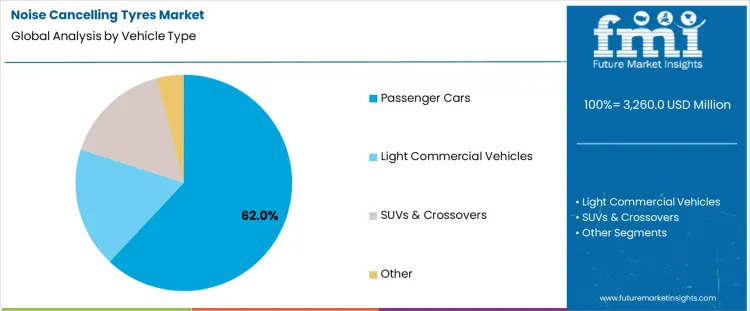
Passenger cars hold 62.0%, representing the largest share due to high production volumes and comfort-focused design priorities. Cabin noise reduction remains a key refinement parameter in mass-market and premium passenger vehicles. Urban driving environments amplify tyre-road noise, increasing reliance on acoustic solutions. Integration aligns with consumer expectations for quieter interiors, particularly in electric and hybrid models. Light commercial vehicles adopt noise reduction selectively with durability emphasis. SUVs and crossovers balance noise control with varied road conditions. Vehicle segmentation reflects concentration where ride comfort, volume scale, and regulatory attention drive consistent adoption.
Key Points
- Passenger cars prioritize cabin comfort and refinement.
- Urban usage increases sensitivity to tyre noise.
- Other vehicle types apply solutions selectively.
By Technology, Foam Liner Systems Represent the Leading Share
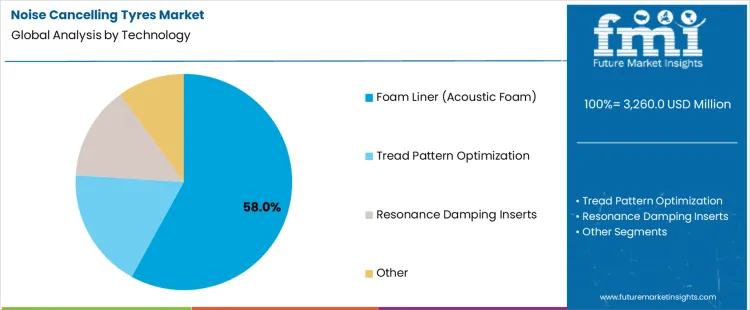
Foam liner technology holds 58.0%, representing the largest share due to proven acoustic performance. Polyurethane foam bonded inside the tyre cavity absorbs resonance generated by air compression during rotation. This approach reduces interior noise without altering tread design or external appearance. Compatibility with existing manufacturing processes supports broad adoption. Tread pattern optimization provides incremental noise reduction with design trade-offs. Resonance damping inserts offer targeted control with added complexity. Technology segmentation reflects preference for internal acoustic treatments delivering predictable noise attenuation with minimal impact on tyre performance characteristics.
Key Points
- Foam liners absorb cavity resonance effectively.
- Internal placement avoids external design changes.
- Other technologies offer incremental or targeted benefits.
By Sales Channel, OEM Fitment Accounts for the Highest Share
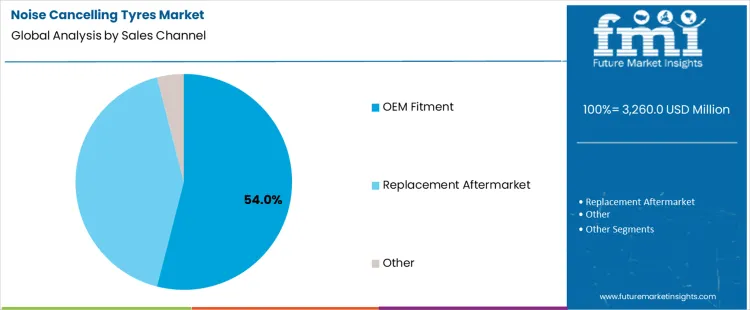
OEM fitment holds 54.0%, representing the largest share due to early-stage integration. Manufacturers specify noise cancelling tyres during vehicle development to meet refinement targets. Factory fitment ensures consistency across vehicle platforms and trim levels. Integration supports warranty coverage and performance validation. Replacement aftermarket demand follows as vehicles require tyre changes over service life. Consumer awareness influences aftermarket adoption. Sales channel segmentation reflects dominance of factory installation where design integration, validation, and volume deployment establish baseline demand.
Key Points
- OEM integration ensures consistent noise performance.
- Early specification supports refinement targets.
- Aftermarket demand follows vehicle parc expansion.
What are the Key Dynamics in the Noise Cancelling Tyres Market?
Demand for noise cancelling tyres reflects requirement to reduce cabin noise generated by tire-road interaction without altering vehicle structure. Adoption concentrates in passenger vehicles, electric vehicles, and premium segments where acoustic comfort affects perceived quality. Global scope aligns with stricter interior noise targets and refinement expectations. Usage centers on tyres incorporating internal polyurethane foam or resonator structures bonded to the inner liner to attenuate cavity resonance.
How do cabin noise reduction requirements and vehicle electrification shape adoption?
Tire cavity resonance contributes significantly to low-frequency cabin noise, particularly between 200 and 250 Hz. Demand increases as electric vehicles eliminate engine masking noise, making tire-generated sound more perceptible. Noise cancelling tyres damp internal air vibrations, lowering transmitted sound pressure into the cabin. Premium vehicles adopt such tyres to meet interior sound level targets without adding mass to body insulation. OEM tuning integrates tyre acoustic behavior with suspension and chassis characteristics. Urban driving with coarse asphalt surfaces amplifies benefit perception. Adoption reflects need to achieve measurable noise reduction through component-level solutions rather than structural redesign.
How do durability exposure, replacement cost, and service constraints influence market scalability?
Acoustic foam liners face degradation from heat, moisture, and centrifugal forces over extended mileage. Demand sensitivity rises where foam detachment affects balance or serviceability. Tyre repair becomes more complex due to foam interference with puncture sealing and inspection. Unit cost remains higher than standard tyres, limiting uptake in cost-driven segments. Benefits vary with road surface quality, affecting user perception consistency. Limited compatibility across tyre sizes restricts standardization. Aftermarket availability remains constrained by OEM fitment specifications. Scalability depends on balancing acoustic benefit against durability, repair practicality, and price acceptance.
How Is Demand for Noise Cancelling Tyres Evolving Globally?
Demand for noise cancelling tyres is expanding globally due to cabin comfort expectations, urban driving exposure, and regulatory focus on pass-by noise. Adoption aligns with passenger vehicles, premium segments, and electric vehicles where drivetrain silence elevates tyre noise prominence. OEM fitment and replacement cycles shape volumes, while tread design and foam inserts drive performance differentiation. Urban congestion and longer ownership periods reinforce demand for quieter operation. Growth rates in India at 5.6%, China at 5.3%, Mexico at 4.9%, Thailand at 4.7%, and Indonesia at 4.5% indicate steady expansion driven by comfort-led specifications and OEM adoption rather than rapid increases in vehicle ownership.
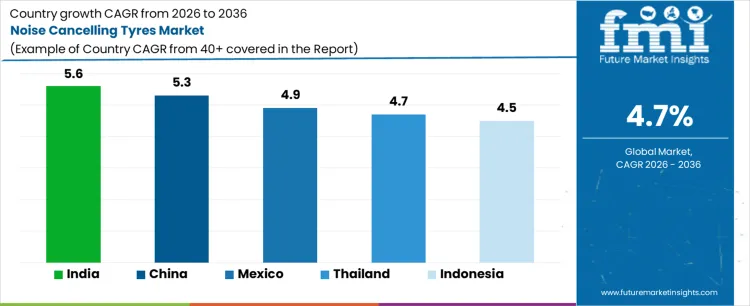
| Country | CAGR (%) |
|---|---|
| India | 5.6% |
| China | 5.3% |
| Mexico | 4.9% |
| Thailand | 4.7% |
| Indonesia | 4.5% |
What Is Driving Growth of Noise Cancelling Tyre Demand in India?
Demand for noise cancelling tyres in India is growing at a CAGR of 5.6%, supported by urban congestion and rising expectations for cabin comfort. Road surface variability and stop-and-go traffic elevate tyre noise contribution. Premium compact and mid-size vehicles increasingly specify quieter tyres as standard equipment. Replacement demand grows as owners prioritize comfort during upgrades. EV adoption highlights tyre noise in low-speed urban driving. Growth reflects comfort-led purchasing and OEM specification shifts rather than regulatory mandates on interior noise.
- Urban congestion elevating tyre noise exposure
- OEM fitment in premium compact segments
- EV adoption amplifying low-speed noise perception
- Comfort-focused replacement upgrades
Why Is China Sustaining Expansion in Noise Cancelling Tyre Adoption?
Noise cancelling tyre demand in China is expanding at a CAGR of 5.3%, driven by EV penetration and urban mobility patterns. Quiet powertrains increase sensitivity to road noise, raising specification of foam-lined tyres. Dense city driving emphasizes interior comfort differentiation. Domestic manufacturers scale production of noise-reducing designs. OEM integration across new models supports volume growth. Expansion reflects EV-led specification changes and urban comfort expectations rather than aftermarket-only adoption.
- High EV penetration increasing cabin noise sensitivity
- Dense urban driving emphasizing comfort differentiation
- Scaled domestic production of foam-lined tyres
- OEM integration across new vehicle platforms
How Are Noise Cancelling Tyre Sales Developing in Mexico?
Sales of noise cancelling tyres in Mexico are growing at a CAGR of 4.9%, shaped by OEM manufacturing presence and replacement demand. Vehicles produced for export adopt quieter tyre specifications aligned with destination standards. Urban road conditions increase awareness of tyre noise during ownership. Service centers promote noise-reducing options during tyre replacement. Platform commonality supports standardized fitment. Growth reflects OEM alignment and service-channel influence rather than rapid premium vehicle penetration.
- OEM export specifications influencing fitment
- Urban road conditions elevating noise awareness
- Service-led promotion during replacements
- Platform commonality enabling standardization
What Factors Are Supporting Noise Cancelling Tyre Demand in Thailand?
Noise cancelling tyre demand in Thailand is expanding at a CAGR of 4.7%, supported by passenger vehicle assembly and urban usage. OEMs specify quieter tyres to improve perceived vehicle quality. Metropolitan traffic conditions heighten cabin noise exposure. Replacement demand follows normal wear cycles with comfort as a selection criterion. Domestic tyre manufacturing supports availability. Growth reflects OEM-driven quality positioning and urban comfort needs rather than regulatory pressure.
- Passenger vehicle assembly specifying quieter tyres
- Metropolitan traffic increasing cabin noise exposure
- Comfort-led replacement selection
- Domestic manufacturing availability
Why Is Indonesia Experiencing Measured Growth in Noise Cancelling Tyres?
Demand for noise cancelling tyres in Indonesia is growing at a CAGR of 4.5%, driven by urbanization and gradual comfort upgrades. Road surface conditions contribute to tyre noise prominence. Mid-range vehicle owners increasingly prioritize reduced cabin noise. Aftermarket awareness grows through dealer recommendations. Cost sensitivity moderates adoption speed. Growth remains measured, reflecting selective comfort-driven purchases and OEM fitment expansion rather than widespread premium segment growth.
- Urban road surfaces elevating tyre noise
- Mid-range vehicle comfort prioritization
- Dealer-led aftermarket awareness
- Cost sensitivity moderating adoption pace
What is the competitive landscape of demand for the noise cancelling tyres market globally?
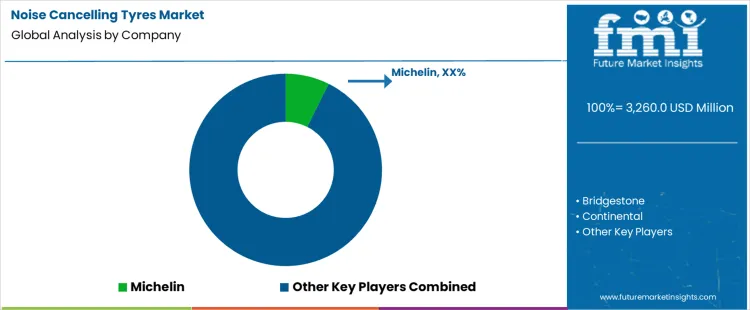
Demand for noise cancelling tyres is driven by cabin noise reduction targets in electric vehicles and premium passenger cars. Buyers evaluate foam liner effectiveness, rolling resistance impact, durability under high temperatures, and compatibility with high-speed tyre construction. OEMs assess acoustic attenuation across specific frequency ranges linked to road surface excitation and drivetrain noise. Procurement behavior prioritizes suppliers demonstrating validated interior noise reduction results under standardized test cycles. Purchasing decisions emphasize tyre lifecycle performance, manufacturing consistency, and integration with vehicle NVH tuning strategies. Trend in the noise cancelling tyres market reflects rising OEM adoption as powertrain noise declines and road noise becomes a dominant cabin comfort constraint.
Michelin leads competitive positioning through proprietary acoustic foam technologies integrated across electric and premium vehicle platforms. Bridgestone competes with noise absorption tyre designs optimized for low rolling resistance and long tread life. Continental supports demand with ContiSilent solutions aligned with European OEM noise regulations and EV platforms. Goodyear maintains relevance through sound comfort tyre variants balancing acoustic damping with all-season performance requirements. Pirelli participates by supplying PNCS-equipped tyres tailored for luxury and high-performance vehicles. Competitive differentiation centers on measured decibel reduction, durability of internal foam structures, vehicle-specific tuning capability, and OEM co-development depth.
Key Players in the Noise Cancelling Tyres Market
- Michelin
- Bridgestone
- Continental
- Goodyear
- Pirelli
- Hankook
- Yokohama Rubber
- Sumitomo Rubber Industries
- Toyo Tires
- Kumho Tire
Scope of the Report
| Items | Values |
|---|---|
| Quantitative Units | USD million |
| Vehicle Type | Passenger Cars; Light Commercial Vehicles; SUVs & Crossovers; Other |
| Technology | Foam Liner (Acoustic Foam); Tread Pattern Optimization; Resonance Damping Inserts; Other |
| Sales Channel | OEM Fitment; Replacement Aftermarket; Other |
| Rim Size | 17-19 inch; Up to 16 inch; 20 inch and above; Other |
| Regions Covered | Asia Pacific, Europe, North America, Latin America, Middle East & Africa |
| Countries Covered | India, China, Mexico, Thailand, Indonesia, and 40+ countries |
| Key Companies Profiled | Michelin; Bridgestone; Continental; Goodyear; Pirelli; Hankook; Yokohama Rubber; Sumitomo Rubber Industries; Toyo Tires; Kumho Tire |
| Additional Attributes | Dollar sales by vehicle type, technology, rim size, and sales channel; interior noise reduction performance linked to acoustic foam liners, tread pattern optimization, and resonance damping inserts; impact on rolling resistance and ride comfort; durability of noise-cancelling features over tire life cycles; OEM adoption in passenger cars and SUVs; aftermarket replacement demand shaped by rim size preferences and vehicle parc composition. |
Noise Cancelling Tyres Market by Segment
Vehicle Type:
- Passenger Cars
- Light Commercial Vehicles
- SUVs & Crossovers
- Other
Technology:
- Foam Liner (Acoustic Foam)
- Tread Pattern Optimization
- Resonance Damping Inserts
- Other
Sales Channel:
- OEM Fitment
- Replacement Aftermarket
- Other
Rim Size:
- 17-19 inch
- Up to 16 inch
- 20 inch and above
- Other
Region:
- Asia Pacific
- China
- Japan
- South Korea
- India
- Australia & New Zealand
- ASEAN
- Rest of Asia Pacific
- Europe
- Germany
- United Kingdom
- France
- Italy
- Spain
- Nordic
- BENELUX
- Rest of Europe
- North America
- United States
- Canada
- Mexico
- Latin America
- Brazil
- Chile
- Rest of Latin America
- Middle East & Africa
- Kingdom of Saudi Arabia
- Other GCC Countries
- Turkey
- South Africa
- Other African Union
- Rest of Middle East & Africa
Bibliography
- International Organization for Standardization. (2024). Acoustics — Measurement of noise emitted by road vehicles — Engineering method (ISO 362-1:2024). ISO.
- United Nations Economic Commission for Europe. (2024). Uniform provisions concerning the approval of tyres with regard to rolling sound emissions (UNECE Regulation No. 117, Rev. 5). UNECE.
- National Highway Traffic Safety Administration. (2024). Tire performance, durability, and noise characteristics in passenger vehicles (DOT/NHTSA Technical Report 2024). U.S. Department of Transportation.
Frequently Asked Questions
How big is the noise cancelling tyres market in 2026?
The global noise cancelling tyres market is estimated to be valued at USD 3,260.0 million in 2026.
What will be the size of noise cancelling tyres market in 2036?
The market size for the noise cancelling tyres market is projected to reach USD 5,160.4 million by 2036.
How much will be the noise cancelling tyres market growth between 2026 and 2036?
The noise cancelling tyres market is expected to grow at a 4.7% CAGR between 2026 and 2036.
What are the key product types in the noise cancelling tyres market?
The key product types in noise cancelling tyres market are passenger cars, light commercial vehicles, suvs & crossovers and other.
Which technology segment to contribute significant share in the noise cancelling tyres market in 2026?
In terms of technology, foam liner (acoustic foam) segment to command 58.0% share in the noise cancelling tyres market in 2026.
Preview the report firsthand - request a free sample
Get SampleGet the brochure for pricing and purchase details.
Get PDFTable of Content
- Executive Summary
- Global Market Outlook
- Demand-side Trends
- Supply-side Trends
- Technology Roadmap Analysis
- Analysis and Recommendations
- Market Overview
- Market Coverage / Taxonomy
- Market Definition / Scope / Limitations
- Market Background
- Market Dynamics
- Drivers
- Restraints
- Opportunity
- Trends
- Scenario Forecast
- Demand in Optimistic Scenario
- Demand in Likely Scenario
- Demand in Conservative Scenario
- Opportunity Map Analysis
- Product Life Cycle Analysis
- Supply Chain Analysis
- Investment Feasibility Matrix
- Value Chain Analysis
- PESTLE and Porter’s Analysis
- Regulatory Landscape
- Regional Parent Market Outlook
- Production and Consumption Statistics
- Import and Export Statistics
- Market Dynamics
- Global Market Analysis 2021 to 2025 and Forecast, 2026 to 2036
- Historical Market Size Value (USD Million) Analysis, 2021 to 2025
- Current and Future Market Size Value (USD Million) Projections, 2026 to 2036
- Y-o-Y Growth Trend Analysis
- Absolute $ Opportunity Analysis
- Global Market Pricing Analysis 2021 to 2025 and Forecast 2026 to 2036
- Global Market Analysis 2021 to 2025 and Forecast 2026 to 2036, By Vehicle Type
- Introduction / Key Findings
- Historical Market Size Value (USD Million) Analysis By Vehicle Type , 2021 to 2025
- Current and Future Market Size Value (USD Million) Analysis and Forecast By Vehicle Type , 2026 to 2036
- Passenger Cars
- Light Commercial Vehicles
- SUVs & Crossovers
- Other
- Passenger Cars
- Y-o-Y Growth Trend Analysis By Vehicle Type , 2021 to 2025
- Absolute $ Opportunity Analysis By Vehicle Type , 2026 to 2036
- Global Market Analysis 2021 to 2025 and Forecast 2026 to 2036, By Technology
- Introduction / Key Findings
- Historical Market Size Value (USD Million) Analysis By Technology, 2021 to 2025
- Current and Future Market Size Value (USD Million) Analysis and Forecast By Technology, 2026 to 2036
- Foam Liner (Acoustic Foam)
- Tread Pattern Optimization
- Resonance Damping Inserts
- Other
- Foam Liner (Acoustic Foam)
- Y-o-Y Growth Trend Analysis By Technology, 2021 to 2025
- Absolute $ Opportunity Analysis By Technology, 2026 to 2036
- Global Market Analysis 2021 to 2025 and Forecast 2026 to 2036, By Sales Channel
- Introduction / Key Findings
- Historical Market Size Value (USD Million) Analysis By Sales Channel, 2021 to 2025
- Current and Future Market Size Value (USD Million) Analysis and Forecast By Sales Channel, 2026 to 2036
- OEM Fitment
- Replacement Aftermarket
- Other
- OEM Fitment
- Y-o-Y Growth Trend Analysis By Sales Channel, 2021 to 2025
- Absolute $ Opportunity Analysis By Sales Channel, 2026 to 2036
- Global Market Analysis 2021 to 2025 and Forecast 2026 to 2036, By Rim Size
- Introduction / Key Findings
- Historical Market Size Value (USD Million) Analysis By Rim Size, 2021 to 2025
- Current and Future Market Size Value (USD Million) Analysis and Forecast By Rim Size, 2026 to 2036
- 17-19 inch
- Up to 16 inch
- 20 inch and above
- Other
- 17-19 inch
- Y-o-Y Growth Trend Analysis By Rim Size, 2021 to 2025
- Absolute $ Opportunity Analysis By Rim Size, 2026 to 2036
- Global Market Analysis 2021 to 2025 and Forecast 2026 to 2036, By Region
- Introduction
- Historical Market Size Value (USD Million) Analysis By Region, 2021 to 2025
- Current Market Size Value (USD Million) Analysis and Forecast By Region, 2026 to 2036
- North America
- Latin America
- Western Europe
- Eastern Europe
- East Asia
- South Asia and Pacific
- Middle East & Africa
- Market Attractiveness Analysis By Region
- North America Market Analysis 2021 to 2025 and Forecast 2026 to 2036, By Country
- Historical Market Size Value (USD Million) Trend Analysis By Market Taxonomy, 2021 to 2025
- Market Size Value (USD Million) Forecast By Market Taxonomy, 2026 to 2036
- By Country
- USA
- Canada
- Mexico
- By Vehicle Type
- By Technology
- By Sales Channel
- By Rim Size
- By Country
- Market Attractiveness Analysis
- By Country
- By Vehicle Type
- By Technology
- By Sales Channel
- By Rim Size
- Key Takeaways
- Latin America Market Analysis 2021 to 2025 and Forecast 2026 to 2036, By Country
- Historical Market Size Value (USD Million) Trend Analysis By Market Taxonomy, 2021 to 2025
- Market Size Value (USD Million) Forecast By Market Taxonomy, 2026 to 2036
- By Country
- Brazil
- Chile
- Rest of Latin America
- By Vehicle Type
- By Technology
- By Sales Channel
- By Rim Size
- By Country
- Market Attractiveness Analysis
- By Country
- By Vehicle Type
- By Technology
- By Sales Channel
- By Rim Size
- Key Takeaways
- Western Europe Market Analysis 2021 to 2025 and Forecast 2026 to 2036, By Country
- Historical Market Size Value (USD Million) Trend Analysis By Market Taxonomy, 2021 to 2025
- Market Size Value (USD Million) Forecast By Market Taxonomy, 2026 to 2036
- By Country
- Germany
- UK
- Italy
- Spain
- France
- Nordic
- BENELUX
- Rest of Western Europe
- By Vehicle Type
- By Technology
- By Sales Channel
- By Rim Size
- By Country
- Market Attractiveness Analysis
- By Country
- By Vehicle Type
- By Technology
- By Sales Channel
- By Rim Size
- Key Takeaways
- Eastern Europe Market Analysis 2021 to 2025 and Forecast 2026 to 2036, By Country
- Historical Market Size Value (USD Million) Trend Analysis By Market Taxonomy, 2021 to 2025
- Market Size Value (USD Million) Forecast By Market Taxonomy, 2026 to 2036
- By Country
- Russia
- Poland
- Hungary
- Balkan & Baltic
- Rest of Eastern Europe
- By Vehicle Type
- By Technology
- By Sales Channel
- By Rim Size
- By Country
- Market Attractiveness Analysis
- By Country
- By Vehicle Type
- By Technology
- By Sales Channel
- By Rim Size
- Key Takeaways
- East Asia Market Analysis 2021 to 2025 and Forecast 2026 to 2036, By Country
- Historical Market Size Value (USD Million) Trend Analysis By Market Taxonomy, 2021 to 2025
- Market Size Value (USD Million) Forecast By Market Taxonomy, 2026 to 2036
- By Country
- China
- Japan
- South Korea
- By Vehicle Type
- By Technology
- By Sales Channel
- By Rim Size
- By Country
- Market Attractiveness Analysis
- By Country
- By Vehicle Type
- By Technology
- By Sales Channel
- By Rim Size
- Key Takeaways
- South Asia and Pacific Market Analysis 2021 to 2025 and Forecast 2026 to 2036, By Country
- Historical Market Size Value (USD Million) Trend Analysis By Market Taxonomy, 2021 to 2025
- Market Size Value (USD Million) Forecast By Market Taxonomy, 2026 to 2036
- By Country
- India
- ASEAN
- Australia & New Zealand
- Rest of South Asia and Pacific
- By Vehicle Type
- By Technology
- By Sales Channel
- By Rim Size
- By Country
- Market Attractiveness Analysis
- By Country
- By Vehicle Type
- By Technology
- By Sales Channel
- By Rim Size
- Key Takeaways
- Middle East & Africa Market Analysis 2021 to 2025 and Forecast 2026 to 2036, By Country
- Historical Market Size Value (USD Million) Trend Analysis By Market Taxonomy, 2021 to 2025
- Market Size Value (USD Million) Forecast By Market Taxonomy, 2026 to 2036
- By Country
- Kingdom of Saudi Arabia
- Other GCC Countries
- Turkiye
- South Africa
- Other African Union
- Rest of Middle East & Africa
- By Vehicle Type
- By Technology
- By Sales Channel
- By Rim Size
- By Country
- Market Attractiveness Analysis
- By Country
- By Vehicle Type
- By Technology
- By Sales Channel
- By Rim Size
- Key Takeaways
- Key Countries Market Analysis
- USA
- Pricing Analysis
- Market Share Analysis, 2025
- By Vehicle Type
- By Technology
- By Sales Channel
- By Rim Size
- Canada
- Pricing Analysis
- Market Share Analysis, 2025
- By Vehicle Type
- By Technology
- By Sales Channel
- By Rim Size
- Mexico
- Pricing Analysis
- Market Share Analysis, 2025
- By Vehicle Type
- By Technology
- By Sales Channel
- By Rim Size
- Brazil
- Pricing Analysis
- Market Share Analysis, 2025
- By Vehicle Type
- By Technology
- By Sales Channel
- By Rim Size
- Chile
- Pricing Analysis
- Market Share Analysis, 2025
- By Vehicle Type
- By Technology
- By Sales Channel
- By Rim Size
- Germany
- Pricing Analysis
- Market Share Analysis, 2025
- By Vehicle Type
- By Technology
- By Sales Channel
- By Rim Size
- UK
- Pricing Analysis
- Market Share Analysis, 2025
- By Vehicle Type
- By Technology
- By Sales Channel
- By Rim Size
- Italy
- Pricing Analysis
- Market Share Analysis, 2025
- By Vehicle Type
- By Technology
- By Sales Channel
- By Rim Size
- Spain
- Pricing Analysis
- Market Share Analysis, 2025
- By Vehicle Type
- By Technology
- By Sales Channel
- By Rim Size
- France
- Pricing Analysis
- Market Share Analysis, 2025
- By Vehicle Type
- By Technology
- By Sales Channel
- By Rim Size
- India
- Pricing Analysis
- Market Share Analysis, 2025
- By Vehicle Type
- By Technology
- By Sales Channel
- By Rim Size
- ASEAN
- Pricing Analysis
- Market Share Analysis, 2025
- By Vehicle Type
- By Technology
- By Sales Channel
- By Rim Size
- Australia & New Zealand
- Pricing Analysis
- Market Share Analysis, 2025
- By Vehicle Type
- By Technology
- By Sales Channel
- By Rim Size
- China
- Pricing Analysis
- Market Share Analysis, 2025
- By Vehicle Type
- By Technology
- By Sales Channel
- By Rim Size
- Japan
- Pricing Analysis
- Market Share Analysis, 2025
- By Vehicle Type
- By Technology
- By Sales Channel
- By Rim Size
- South Korea
- Pricing Analysis
- Market Share Analysis, 2025
- By Vehicle Type
- By Technology
- By Sales Channel
- By Rim Size
- Russia
- Pricing Analysis
- Market Share Analysis, 2025
- By Vehicle Type
- By Technology
- By Sales Channel
- By Rim Size
- Poland
- Pricing Analysis
- Market Share Analysis, 2025
- By Vehicle Type
- By Technology
- By Sales Channel
- By Rim Size
- Hungary
- Pricing Analysis
- Market Share Analysis, 2025
- By Vehicle Type
- By Technology
- By Sales Channel
- By Rim Size
- Kingdom of Saudi Arabia
- Pricing Analysis
- Market Share Analysis, 2025
- By Vehicle Type
- By Technology
- By Sales Channel
- By Rim Size
- Turkiye
- Pricing Analysis
- Market Share Analysis, 2025
- By Vehicle Type
- By Technology
- By Sales Channel
- By Rim Size
- South Africa
- Pricing Analysis
- Market Share Analysis, 2025
- By Vehicle Type
- By Technology
- By Sales Channel
- By Rim Size
- USA
- Market Structure Analysis
- Competition Dashboard
- Competition Benchmarking
- Market Share Analysis of Top Players
- By Regional
- By Vehicle Type
- By Technology
- By Sales Channel
- By Rim Size
- Competition Analysis
- Competition Deep Dive
- Michelin
- Overview
- Product Portfolio
- Profitability by Market Segments (Product/Age /Sales Channel/Region)
- Sales Footprint
- Strategy Overview
- Marketing Strategy
- Product Strategy
- Channel Strategy
- Bridgestone
- Continental
- Goodyear
- Pirelli
- Hankook
- Yokohama Rubber
- Sumitomo Rubber Industries
- Toyo Tires
- Kumho Tire
- Michelin
- Competition Deep Dive
- Assumptions & Acronyms Used
- Research Methodology


