

- Industry Size (2026)
- USD 0.9 Bn
- Forecast (2036)
- USD 2.3 Bn
- CAGR (2026 to 2036)
- 9.8%
Low Noise Laser Diode Driver Market Forecast and Outlook 2026 to 2036
The low noise laser diode driver market expands from USD 0.9 billion in 2026 to USD 2.3 billion by 2036, representing a CAGR of 9.8%. Demand is concentrated in regions with strong photonics, precision measurement, and optical communications industries, notably East Asia, North America, and Western Europe. Adoption remains uneven because many countries lack the laboratory infrastructure and system integration capability required for low noise optical systems. Geographic cost advantages favor locations with established analog IC design, wafer fabrication access, and test and calibration ecosystems. As a result, most volume is specified, designed, and qualified close to a limited number of advanced research and manufacturing clusters.
System architects and equipment manufacturers, rather than component distributors, control most purchasing decisions in this segment. Once a driver design is validated within a laser module or instrument platform, it is reused across entire product families to avoid requalification risk. Smaller users typically buy through integrators because noise performance depends on board layout, grounding, and thermal control. Regions with strong metrology, semiconductor inspection, and telecom equipment industries adopt first. Market growth therefore follows the scaling of high precision optical systems, not the broad spread of generic laser applications.
Quick Stats for Low Noise Laser Diode Driver Market
- Low Noise Laser Diode Driver Market Value (2026): USD 0.9 billion
- Low Noise Laser Diode Driver Market Forecast Value (2036): USD 2.3 billion
- Low Noise Laser Diode Driver Market Forecast CAGR 2026 to 2036: 9.8%
- Leading Type in Low Noise Laser Diode Driver Market: Analog laser diode drivers
- Key Growth Regions in Low Noise Laser Diode Driver Market: Asia Pacific, North America, Europe
- Top Players in Low Noise Laser Diode Driver Market: Analog Devices, Texas Instruments, Maxim Integrated, Microchip Technology, ON Semiconductor, Broadcom, STMicroelectronics
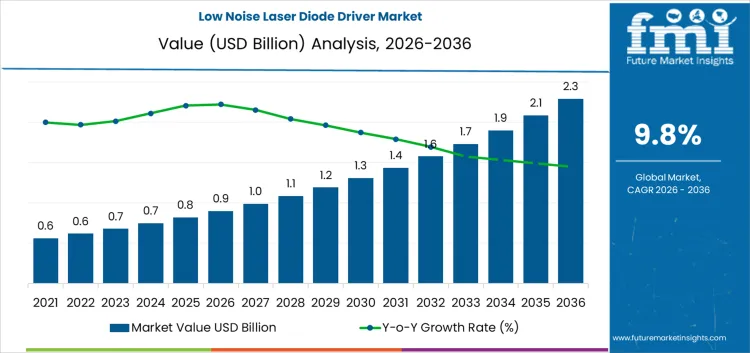
What is the Growth Forecast for Low Noise Laser Diode Driver Market through 2036?
The expansion of the low noise laser diode driver market is being driven by the migration of photonics from laboratory environments into production-scale systems. As optical sensing, spectroscopy, LiDAR, coherent communications, and precision metrology move into continuous-duty industrial and infrastructure roles, electrical noise stops being a performance nuance and becomes a system-level constraint. In these applications, the driver is no longer a supporting component but a determinant of signal integrity, measurement stability, and system certification. Platform designers increasingly freeze driver architectures early in the development cycle, which locks in specific noise, stability, and thermal characteristics across entire product families. Growth is therefore tied to platform adoption and replication rather than to spot demand for individual instruments. Once designed in, volumes scale with the equipment ecosystem.
The path of the market toward USD 2.3 billion by 2036 is shaped by the spread of these stabilized photonics platforms into secondary industrial, medical, and infrastructure deployments. After core applications validate performance and reliability, the same driver architectures propagate into lower-tier systems, regional manufacturing lines, and cost-optimized variants without fundamental redesign. This creates a compounding effect where each new platform family carries multiple driver instances across multiple configurations. Value growth comes from system density and deployment breadth rather than from pricing. Competitive advantage rests on ultra-stable current control, thermal drift management, and long-term availability, since equipment makers prioritize repeatability, qualification continuity, and signal purity over incremental feature differentiation.
Low Noise Laser Diode Driver Market Key Takeaways
| Metric | Value |
|---|---|
| Market Value (2026) | USD 0.9 billion |
| Forecast Value (2036) | USD 2.3 billion |
| Forecast CAGR 2026 to 2036 | 9.8% |
How Are Low-Noise Laser Diode Drivers Balancing Cost Predictability and Volatility?
Low-noise laser diode drivers are increasingly adopted to ensure precise current control, stability, and performance in optical communication, medical devices, and industrial laser systems. Historically, laser diode operation relied on basic drivers, which often produced noise, thermal instability, and variable output, increasing maintenance costs and operational unpredictability. Modern low-noise drivers integrate precision current regulation, temperature compensation, and filtering techniques to maintain stable operation, extend diode life, and improve system reliability.
Electronics manufacturers, medical device producers, and photonics integrators prioritize driver stability, compatibility with diode specifications, and regulatory compliance. Early adoption focused on high-precision instrumentation, while current demand spans fiber-optic communications, sensing, and industrial laser applications, driven by performance requirements, reliability expectations, and cost management. Noise performance, thermal stability, and integration flexibility influence supplier selection.
Cost predictability and volatility are key considerations in the low-noise laser diode driver market. Compared with conventional drivers, modern solutions emphasize long-term stability, reduced component degradation, and predictable maintenance schedules, which help control operational expenditure. Cost structures depend on component quality, precision manufacturing, and thermal management systems, concentrating margins among suppliers capable of delivering reliable, consistent products. Manufacturers adopt these drivers to minimize unexpected operational costs, ensure stable laser performance, and reduce maintenance interventions. By 2036, low-noise laser diode drivers are expected to become standard in high-precision photonics, industrial, and medical applications, supporting consistent performance, predictable operational costs, and reduced system downtime.
How Is the Trade Off Between Cost Predictability and Cost Volatility Shaping Demand for Laser Diode Drivers by Control Architecture and End Use in 2026?
The laser diode driver market in 2026 is segmented by driver type and by application. By control architecture, demand is divided into analog, digital, hybrid analog digital, and programmable drivers, each offering different balances between stability, flexibility, and bill of materials exposure. By application, demand is organized around optical communication, lidar and sensing systems, medical and diagnostic equipment, and industrial laser systems, which differ in volume stability, certification burden, and tolerance for design change. These segments reflect how system builders choose between predictable, locked configurations and more adaptable platforms that may carry higher short term cost variability.
Why Do Analog Laser Diode Drivers Dominate Where Cost Predictability Matters?
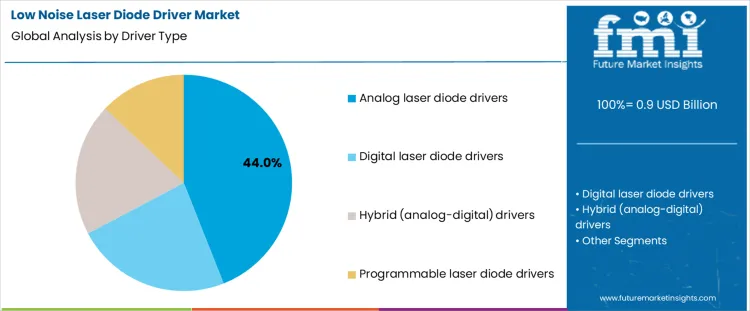
Analog laser diode drivers account for about 44% of demand in 2026, largely because they offer stable performance with simple and well understood component structures. In many designs, once an analog driver is tuned and validated, the circuit remains unchanged for long production runs. This reduces exposure to firmware updates, software validation, and changing digital components. For procurement teams, this stability translates into more predictable sourcing and pricing over time. Analog drivers also rely on mature component ecosystems with multiple second source options, which reduces supply risk. In sectors where unit volumes are high and margins are controlled tightly, this predictability matters more than feature flexibility, which keeps analog architectures as the default choice in many designs.
Digital, hybrid, and programmable drivers serve environments where adaptability is valued over strict cost stability. Digital control allows fine tuning, monitoring, and communication, yet it introduces dependence on specific controllers and software stacks. Hybrid designs try to balance both worlds, while programmable drivers are chosen where one hardware platform must serve many product variants. These options improve system flexibility, but they also expose designs to component lifecycle changes and software maintenance. Their adoption grows in technically demanding systems, yet they do not displace analog solutions in applications where long production runs and stable cost structures remain the primary decision drivers.
Why Does Optical Communication Anchor Volume Demand Despite Cost Sensitivity?
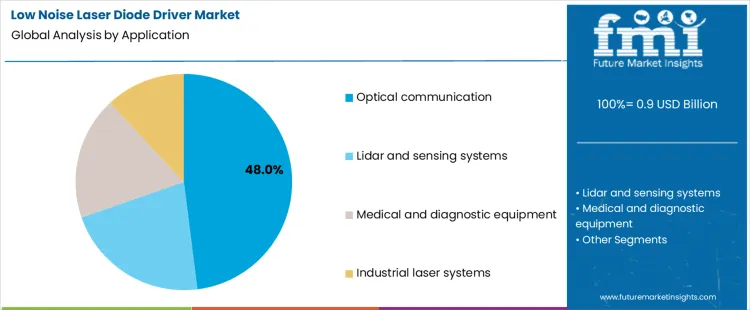
Optical communication represents about 48% of demand in 2026 because it combines very high shipment volumes with tightly standardized system architectures. Data centers, telecom networks, and access infrastructure deploy laser modules in large, repeatable quantities. Once a transceiver or module design is qualified, it is produced for long periods with minimal change. This environment favors driver solutions that can be sourced consistently and integrated into fixed reference designs. Even small cost variations matter at these volumes, which reinforces the preference for stable, predictable driver platforms. This scale effect explains why optical communication remains the largest application segment despite strong pressure on component pricing.
Lidar, medical, and industrial laser systems follow different economics. Lidar and sensing platforms evolve quickly, which pushes designers toward more flexible and programmable driver architectures. Medical equipment faces long approval cycles but smaller volumes, which shifts focus toward control precision and monitoring rather than pure unit cost. Industrial laser systems often require configurable power profiles and integration with machine controls. These segments accept more cost variability in exchange for performance and adaptability. As a result, while they drive technology development, they do not match the sheer volume pull of optical communication, which keeps it as the dominant application base.
Why Are Measurement Integrity, Integration Barriers, and System Level Standardization Redefining the Low Noise Laser Diode Driver Market through 2036?
The category is shaped by how precision systems are built and governed. Demand comes from applications where signal quality sets the limit of performance, making electrical noise a system risk rather than a component detail. Adoption speed is moderated by conservative qualification practices and the cost of revalidating complete optical chains. At the same time, more equipment builders are standardizing platforms and subsystems to scale production and support globally. This shifts purchasing from one off engineering choices to program level sourcing. As a result, growth, resistance, and direction are determined less by component novelty and more by operating models, validation economics, and the move toward repeatable, system based architectures.
Why Are Signal Integrity Requirements and Performance Ceilings Driving the Low Noise Laser Diode Driver Market through 2036?
Demand is anchored in the physics of measurement and communication rather than in component refresh cycles. In spectroscopy, interferometry, metrology, quantum research, and high speed optical links, electrical noise directly translates into amplitude, phase, or frequency instability. As systems push for finer resolution and higher data quality, the driver becomes part of the performance ceiling, not a background utility. Once a platform is tuned around a specific noise profile, the driver is locked into the architecture for long periods. Equipment builders therefore treat low noise drivers as enabling infrastructure. Volume follows deployment of high precision instruments and replication of validated system designs rather than short term purchasing cycles.
What Qualification Cost, Integration Risk, and Organizational Conservatism Are Slowing Wider Adoption?
The main restraint is system risk, not component price. Changing a laser driver alters thermal behavior, modulation response, and noise coupling, which forces revalidation of the entire optical chain. In regulated, scientific, or mission critical environments, this means months of testing and documentation. Many organizations rely on long established reference designs that are deeply embedded in procedures and training. Even when better drivers exist, the perceived risk of destabilizing a working system outweighs performance gains. Procurement and engineering incentives are often misaligned, further slowing decisions. These factors stretch replacement cycles and confine adoption to new platforms rather than retrofits.
How Are Platform Engineering and Subsystem Standardization Changing the Structure of This Category?
The category is moving from component selection to subsystem governance. Equipment makers increasingly define standard laser modules where the diode, driver, thermal control, and control interface are treated as one qualified block. This allows faster replication across product lines and sites. Low noise drivers that become part of these blocks benefit from volume pull across multiple programs without being reselected each time. Documentation, lifecycle stability, and long term supply commitments are becoming as important as raw noise performance. Over time, competition shifts toward being designed into reference platforms, and demand becomes tied to multiyear system roadmaps rather than to isolated engineering experiments.
What is the Demand for Low Noise Laser Diode Drivers by Country?

| Country | CAGR (%) |
|---|---|
| USA | 10.0% |
| UK | 9.5% |
| China | 11.5% |
| India | 12.5% |
| Brazil | 10.2% |
Demand for low noise laser diode drivers is rising as manufacturers adopt precise and reliable drivers for applications in telecommunications, medical devices, and industrial equipment. India leads with a 12.5% CAGR, driven by growing adoption in medical diagnostics, optical communications, and industrial laser systems. China follows at 11.5%, supported by expansion in telecommunications infrastructure, industrial applications, and high-volume electronics production. Brazil records 10.2% growth, shaped by demand in industrial, medical, and defense sectors. The USA grows at 10.0%, influenced by adoption in precision instrumentation and advanced optical systems. The UK shows 9.5% CAGR, reflecting steady demand for low noise laser drivers in scientific and industrial applications.
How is the United States experiencing growth in the low noise laser diode driver market?
United States is experiencing growth at a CAGR of 10%, supported by a large installed base of telecommunications, medical, and industrial laser systems with predictable replacement cycles. Labor cost structure is relatively high, increasing pressure to adopt reliable, low-noise drivers that minimize downtime and maintenance interventions. Industry concentration around optical component manufacturers and research institutions in California, Massachusetts, and Texas anchors demand for precision drivers. Local production is strong, though certain high-frequency components remain imported, influencing cost sensitivity and price ceilings. Capital intensity in laser systems drives careful payback expectations, with preference for durable drivers that integrate easily into existing platforms.
- Telecommunications and medical devices drive adoption.
- Drivers optimize reliability and low-noise performance.
- Optical manufacturing hubs concentrate demand.
- Capital-intensive systems favor proven, long-life solutions.
How is the United Kingdom witnessing growth in the low noise laser diode driver market?
United Kingdom is witnessing growth at a CAGR of 9.5%, fueled by aerospace, defense, and research applications in London, Manchester, and Edinburgh. Installed base size and replacement cycles in experimental and commercial laser systems create steady demand. Moderate labor cost structure combined with productivity pressures drives adoption of low-noise drivers that reduce operational downtime. Industry concentration among high-tech electronics and defense suppliers anchors the market. Import dependence exists for specialized high-frequency components, influencing cost sensitivity and pricing. Capital intensity in laser platforms encourages buyers to prioritize drivers with predictable payback periods and proven reliability.
- Aerospace and defense sectors drive adoption.
- Drivers enhance signal stability and reduce noise.
- High-tech hubs concentrate demand.
- Payback expectations emphasize reliability and lifecycle value.
How is China experiencing growth in the low noise laser diode driver market?
China is experiencing growth at a CAGR of 11.5%, driven by expansion of industrial laser systems, telecommunications, and scientific research in Shanghai, Shenzhen, and Beijing. Installed base size is growing rapidly with replacement cycles shortening in high-volume manufacturing sectors. Lower labor costs reduce immediate productivity pressure, but high-volume production emphasizes driver reliability and low-noise performance. Industry concentration in technology and electronics clusters anchors demand, and local production of drivers is increasing, though some precision components remain imported. Capital-intensive systems with competitive pricing requirements shape cost sensitivity and payback expectations.
- Industrial and telecom applications drive adoption.
- Drivers optimize noise reduction and operational reliability.
- Electronics and tech clusters concentrate demand.
- Local production and cost control influence payback.
How is India witnessing growth in the low noise laser diode driver market?
India is witnessing growth at a CAGR of 12.5%, supported by expanding medical imaging, research laboratories, and industrial laser installations in Bengaluru, Pune, and Delhi. Installed base size is moderate but increasing, with frequent replacements in growing industrial and R&D facilities. Labor cost structure is comparatively low, but productivity pressures in electronics and precision manufacturing drive the adoption of reliable, low-noise drivers. Industry concentration in industrial and research hubs anchors demand. Import dependence on specialized driver components influences cost sensitivity and price ceilings. Capital-intensive equipment encourages buyers to favor solutions with predictable lifecycle performance and return on investment.
- Medical imaging and industrial lasers drive adoption.
- Drivers enhance reliability and minimize noise.
- Industrial and research hubs concentrate demand.
- Payback and cost sensitivity influence purchasing decisions.
How is Brazil experiencing growth in the low noise laser diode driver market?
Brazil is experiencing growth at a CAGR of 10.2%, influenced by moderate industrial and research laser installations in São Paulo, Rio de Janeiro, and Paraná. Installed base size is smaller with longer replacement cycles compared to other regions. Mixed labor cost structure and moderate productivity pressures lead firms to prefer durable, low-noise drivers for maintenance efficiency. Industry concentration exists around electronics and manufacturing clusters, but local production is limited, creating import dependence that heightens cost sensitivity. Capital intensity encourages buyers to select drivers offering long-term reliability and predictable payback.
- Industrial and research applications drive adoption.
- Drivers optimize durability and noise reduction.
- Electronics clusters concentrate demand.
- Import reliance and cost management guide investment.
Who Competes in the Low Noise Laser Diode Driver Market and How Do They Differ?
Competition in the low noise laser diode driver market is shaped by output stability, noise performance, and integration with photonic and optical systems. Analog Devices supplies laser diode drivers engineered for precision current control, low electrical noise, and compatibility with fiber optic communication and sensing systems. Texas Instruments provides driver ICs with adjustable bias and modulation capabilities designed to support a wide range of laser diodes used in industrial, instrumentation, and telecom applications. Maxim Integrated delivers low noise drivers with integrated control features and protection mechanisms for compact optical modules. Microchip Technology offers solutions with emphasis on programmability and system integration for portable and embedded optical systems. ON Semiconductor supplies driver components designed for reliability and low jitter in industrial and automotive photonics.
Broadcom provides laser diode drivers with high signal integrity and support for data-centric optical networks, focusing on stable current delivery and thermal management. STMicroelectronics supplies low noise driver ICs tailored for optical communication, sensing, and consumer imaging applications with balanced performance and power efficiency. Other regional and specialist semiconductor firms offer targeted driver solutions for specific end uses such as LIDAR, medical imaging, or optical metrology where low noise and precise control are critical. Market differentiation arises from electrical noise floor, control interfaces, integration with optical transceivers, and robustness across temperature and environmental conditions. Suppliers with extensive design support, documentation, and ecosystem compatibility tend to attract system designers who require reliable performance in high-precision optical systems. Adoption reflects demand in telecommunications, industrial sensing, scientific instrumentation, and emerging photonic applications that rely on stable, low noise current sources for laser diodes.
Key Players in the Low Noise Laser Diode Driver Market
- Analog Devices
- Texas Instruments
- Maxim Integrated
- Microchip Technology
- ON Semiconductor
- Broadcom
- STMicroelectronics
Scope of the Report
| Items | Values |
|---|---|
| Quantitative Units (2026) | USD billion |
| Driver Type | Analog Laser Diode Drivers, Digital Laser Diode Drivers, Hybrid (Analog-Digital) Drivers, Programmable Laser Diode Drivers |
| Application | Optical Communication, Lidar and Sensing Systems, Medical and Diagnostic Equipment, Industrial Laser Systems |
| Regions Covered | Asia Pacific, Europe, North America, Latin America, Middle East & Africa |
| Countries Covered | China, Japan, South Korea, India, Australia & New Zealand, ASEAN, Germany, United Kingdom, France, Italy, Spain, Nordic, BENELUX, United States, Canada, Mexico, Brazil, Chile, Saudi Arabia, Turkey, South Africa, and other regional markets |
| Key Companies Profiled | Analog Devices, Texas Instruments, Maxim Integrated, Microchip Technology, ON Semiconductor, Broadcom, STMicroelectronics |
| Additional Attributes | Dollar sales by driver type and application; analog drivers as the largest segment; optical communication as the leading application; demand driven by precision photonics platforms and system replication; procurement shaped by qualification cycles, noise performance, and long-term availability; adoption constrained by revalidation cost, integration risk, and conservative platform governance. |
Low Noise Laser Diode Driver Market Segmentation
Driver Type:
- Analog laser diode drivers
- Digital laser diode drivers
- Hybrid (analog-digital) drivers
- Programmable laser diode drivers
Application:
- Optical communication
- Lidar and sensing systems
- Medical and diagnostic equipment
- Industrial laser systems
Region:
- Asia Pacific
- China
- Japan
- South Korea
- India
- Australia & New Zealand
- ASEAN
- Rest of Asia Pacific
- Europe
- Germany
- United Kingdom
- France
- Italy
- Spain
- Nordic
- BENELUX
- Rest of Europe
- North America
- United States
- Canada
- Mexico
- Latin America
- Brazil
- Chile
- Rest of Latin America
- Middle East & Africa
- Kingdom of Saudi Arabia
- Other GCC Countries
- Turkey
- South Africa
- Other African Union
- Rest of Middle East & Africa
Bibliography
- United States Department of Commerce, National Institute of Standards and Technology. (2024). Good measurement practice for low-noise electronic and photonic systems (Special Publication 1245). NIST.
- United States Food and Drug Administration. (2024). Laser products and laser systems — Performance standards for light-based equipment (Final Rule 21 CFR 1040, updated 2024). U.S. Department of Health and Human Services.
- Organisation for Economic Co-operation and Development. (2024). Advanced photonics and precision electronics in industrial and communication infrastructure: Policy and technology outlook. OECD Publishing.
- International Organization for Standardization. (2024). ISO 13694: Lasers and laser-related equipment — Test methods for radiation emitted by laser products. ISO.
Frequently Asked Questions
How big is the low noise laser diode driver market in 2026?
The global low noise laser diode driver market is estimated to be valued at USD 0.9 billion in 2026.
What will be the size of low noise laser diode driver market in 2036?
The market size for the low noise laser diode driver market is projected to reach USD 2.3 billion by 2036.
How much will be the low noise laser diode driver market growth between 2026 and 2036?
The low noise laser diode driver market is expected to grow at a 9.8% CAGR between 2026 and 2036.
What are the key product types in the low noise laser diode driver market?
The key product types in low noise laser diode driver market are analog laser diode drivers , digital laser diode drivers, hybrid (analog‑digital) drivers and programmable laser diode drivers.
Which application segment to contribute significant share in the low noise laser diode driver market in 2026?
In terms of application, optical communication segment to command 48.0% share in the low noise laser diode driver market in 2026.
Preview the report firsthand - request a free sample
Get SampleGet the brochure for pricing and purchase details.
Get PDFTable of Content
- Executive Summary
- Global Market Outlook
- Demand-side Trends
- Supply-side Trends
- Technology Roadmap Analysis
- Analysis and Recommendations
- Market Overview
- Market Coverage / Taxonomy
- Market Definition / Scope / Limitations
- Market Background
- Market Dynamics
- Drivers
- Restraints
- Opportunity
- Trends
- Scenario Forecast
- Demand in Optimistic Scenario
- Demand in Likely Scenario
- Demand in Conservative Scenario
- Opportunity Map Analysis
- Product Life Cycle Analysis
- Supply Chain Analysis
- Investment Feasibility Matrix
- Value Chain Analysis
- PESTLE and Porter’s Analysis
- Regulatory Landscape
- Regional Parent Market Outlook
- Production and Consumption Statistics
- Import and Export Statistics
- Market Dynamics
- Global Market Analysis 2021 to 2025 and Forecast, 2026 to 2036
- Historical Market Size Value (USD Million) Analysis, 2021 to 2025
- Current and Future Market Size Value (USD Million) Projections, 2026 to 2036
- Y-o-Y Growth Trend Analysis
- Absolute $ Opportunity Analysis
- Global Market Pricing Analysis 2021 to 2025 and Forecast 2026 to 2036
- Global Market Analysis 2021 to 2025 and Forecast 2026 to 2036, By Driver Type
- Introduction / Key Findings
- Historical Market Size Value (USD Million) Analysis By Driver Type, 2021 to 2025
- Current and Future Market Size Value (USD Million) Analysis and Forecast By Driver Type, 2026 to 2036
- Analog laser diode drivers
- Digital laser diode drivers
- Hybrid (analog‑digital) drivers
- Programmable laser diode drivers
- Analog laser diode drivers
- Y-o-Y Growth Trend Analysis By Driver Type, 2021 to 2025
- Absolute $ Opportunity Analysis By Driver Type, 2026 to 2036
- Global Market Analysis 2021 to 2025 and Forecast 2026 to 2036, By Application
- Introduction / Key Findings
- Historical Market Size Value (USD Million) Analysis By Application, 2021 to 2025
- Current and Future Market Size Value (USD Million) Analysis and Forecast By Application, 2026 to 2036
- Optical communication
- Lidar and sensing systems
- Medical and diagnostic equipment
- Industrial laser systems
- Optical communication
- Y-o-Y Growth Trend Analysis By Application, 2021 to 2025
- Absolute $ Opportunity Analysis By Application, 2026 to 2036
- Global Market Analysis 2021 to 2025 and Forecast 2026 to 2036, By Region
- Introduction
- Historical Market Size Value (USD Million) Analysis By Region, 2021 to 2025
- Current Market Size Value (USD Million) Analysis and Forecast By Region, 2026 to 2036
- North America
- Latin America
- Western Europe
- Eastern Europe
- East Asia
- South Asia and Pacific
- Middle East & Africa
- Market Attractiveness Analysis By Region
- North America Market Analysis 2021 to 2025 and Forecast 2026 to 2036, By Country
- Historical Market Size Value (USD Million) Trend Analysis By Market Taxonomy, 2021 to 2025
- Market Size Value (USD Million) Forecast By Market Taxonomy, 2026 to 2036
- By Country
- USA
- Canada
- Mexico
- By Driver Type
- By Application
- By Country
- Market Attractiveness Analysis
- By Country
- By Driver Type
- By Application
- Key Takeaways
- Latin America Market Analysis 2021 to 2025 and Forecast 2026 to 2036, By Country
- Historical Market Size Value (USD Million) Trend Analysis By Market Taxonomy, 2021 to 2025
- Market Size Value (USD Million) Forecast By Market Taxonomy, 2026 to 2036
- By Country
- Brazil
- Chile
- Rest of Latin America
- By Driver Type
- By Application
- By Country
- Market Attractiveness Analysis
- By Country
- By Driver Type
- By Application
- Key Takeaways
- Western Europe Market Analysis 2021 to 2025 and Forecast 2026 to 2036, By Country
- Historical Market Size Value (USD Million) Trend Analysis By Market Taxonomy, 2021 to 2025
- Market Size Value (USD Million) Forecast By Market Taxonomy, 2026 to 2036
- By Country
- Germany
- UK
- Italy
- Spain
- France
- Nordic
- BENELUX
- Rest of Western Europe
- By Driver Type
- By Application
- By Country
- Market Attractiveness Analysis
- By Country
- By Driver Type
- By Application
- Key Takeaways
- Eastern Europe Market Analysis 2021 to 2025 and Forecast 2026 to 2036, By Country
- Historical Market Size Value (USD Million) Trend Analysis By Market Taxonomy, 2021 to 2025
- Market Size Value (USD Million) Forecast By Market Taxonomy, 2026 to 2036
- By Country
- Russia
- Poland
- Hungary
- Balkan & Baltic
- Rest of Eastern Europe
- By Driver Type
- By Application
- By Country
- Market Attractiveness Analysis
- By Country
- By Driver Type
- By Application
- Key Takeaways
- East Asia Market Analysis 2021 to 2025 and Forecast 2026 to 2036, By Country
- Historical Market Size Value (USD Million) Trend Analysis By Market Taxonomy, 2021 to 2025
- Market Size Value (USD Million) Forecast By Market Taxonomy, 2026 to 2036
- By Country
- China
- Japan
- South Korea
- By Driver Type
- By Application
- By Country
- Market Attractiveness Analysis
- By Country
- By Driver Type
- By Application
- Key Takeaways
- South Asia and Pacific Market Analysis 2021 to 2025 and Forecast 2026 to 2036, By Country
- Historical Market Size Value (USD Million) Trend Analysis By Market Taxonomy, 2021 to 2025
- Market Size Value (USD Million) Forecast By Market Taxonomy, 2026 to 2036
- By Country
- India
- ASEAN
- Australia & New Zealand
- Rest of South Asia and Pacific
- By Driver Type
- By Application
- By Country
- Market Attractiveness Analysis
- By Country
- By Driver Type
- By Application
- Key Takeaways
- Middle East & Africa Market Analysis 2021 to 2025 and Forecast 2026 to 2036, By Country
- Historical Market Size Value (USD Million) Trend Analysis By Market Taxonomy, 2021 to 2025
- Market Size Value (USD Million) Forecast By Market Taxonomy, 2026 to 2036
- By Country
- Kingdom of Saudi Arabia
- Other GCC Countries
- Turkiye
- South Africa
- Other African Union
- Rest of Middle East & Africa
- By Driver Type
- By Application
- By Country
- Market Attractiveness Analysis
- By Country
- By Driver Type
- By Application
- Key Takeaways
- Key Countries Market Analysis
- USA
- Pricing Analysis
- Market Share Analysis, 2025
- By Driver Type
- By Application
- Canada
- Pricing Analysis
- Market Share Analysis, 2025
- By Driver Type
- By Application
- Mexico
- Pricing Analysis
- Market Share Analysis, 2025
- By Driver Type
- By Application
- Brazil
- Pricing Analysis
- Market Share Analysis, 2025
- By Driver Type
- By Application
- Chile
- Pricing Analysis
- Market Share Analysis, 2025
- By Driver Type
- By Application
- Germany
- Pricing Analysis
- Market Share Analysis, 2025
- By Driver Type
- By Application
- UK
- Pricing Analysis
- Market Share Analysis, 2025
- By Driver Type
- By Application
- Italy
- Pricing Analysis
- Market Share Analysis, 2025
- By Driver Type
- By Application
- Spain
- Pricing Analysis
- Market Share Analysis, 2025
- By Driver Type
- By Application
- France
- Pricing Analysis
- Market Share Analysis, 2025
- By Driver Type
- By Application
- India
- Pricing Analysis
- Market Share Analysis, 2025
- By Driver Type
- By Application
- ASEAN
- Pricing Analysis
- Market Share Analysis, 2025
- By Driver Type
- By Application
- Australia & New Zealand
- Pricing Analysis
- Market Share Analysis, 2025
- By Driver Type
- By Application
- China
- Pricing Analysis
- Market Share Analysis, 2025
- By Driver Type
- By Application
- Japan
- Pricing Analysis
- Market Share Analysis, 2025
- By Driver Type
- By Application
- South Korea
- Pricing Analysis
- Market Share Analysis, 2025
- By Driver Type
- By Application
- Russia
- Pricing Analysis
- Market Share Analysis, 2025
- By Driver Type
- By Application
- Poland
- Pricing Analysis
- Market Share Analysis, 2025
- By Driver Type
- By Application
- Hungary
- Pricing Analysis
- Market Share Analysis, 2025
- By Driver Type
- By Application
- Kingdom of Saudi Arabia
- Pricing Analysis
- Market Share Analysis, 2025
- By Driver Type
- By Application
- Turkiye
- Pricing Analysis
- Market Share Analysis, 2025
- By Driver Type
- By Application
- South Africa
- Pricing Analysis
- Market Share Analysis, 2025
- By Driver Type
- By Application
- USA
- Market Structure Analysis
- Competition Dashboard
- Competition Benchmarking
- Market Share Analysis of Top Players
- By Regional
- By Driver Type
- By Application
- Competition Analysis
- Competition Deep Dive
- Competition Deep Dive
- Assumptions & Acronyms Used
- Research Methodology


