

- Market Size (2026)
- USD 280.0 Mn
- Forecast (2036)
- USD 1152.6 Mn
- CAGR (2026 to 2036)
- 15.2%
Koji Meat Alternative Market Size, Market Forecast and Outlook By FMI
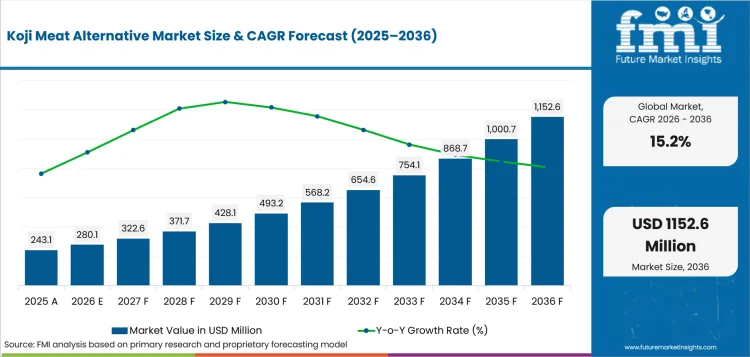
The koji meat alternative industry value is predicted to grow from USD 243.1 million in 2025 to USD 1,152.6 million by 2036 at 15.2% CAGR as foodservice buyers and specialty retailers test fungi-based meat analogues for deli and breakfast occasions. Biomass fermentation is anticipated to represent 57.2% share in 2026, led by repeatable fungal biomass production and B2B ingredient use. Koji and mycelium cultures are expected to secure 46.9% share in 2026, reflected by fibrous texture and savory fermentation notes.
Key Takeaways, Market Size, and Forecast
- 2026 Market Size: USD 280.0 million
- 2036 Market Size: USD 1,152.6 million
- Forecast CAGR: 15.2% from 2026 to 2036
- Leading Production Method: Biomass Fermentation
- Biomass Fermentation Share in 2026: 57.2%
- Leading Fungi Base: Koji and Mycelium Cultures
- Koji and Mycelium Cultures Share in 2026: 46.9%
- Fastest-growing Country: Saudi Arabia
- Saudi Arabia CAGR: 18.8% by 2036
Summary of Koji Meat Alternative Market
- Demand and Growth Drivers
- Deli and sandwich operators are testing koji meats to add sliced animal-free proteins with cleaner bite and stronger counter use.
- Fermentation suppliers are using edible fungal biomass to reduce dependence on isolated pea and soy inputs in meat-style foods.
- Pizza and breakfast applications are creating repeat use cases for pepperoni and savory fungi-based toppings.
- Product and Segment View
- Biomass fermentation is forecast to represent 57.2% share in 2026, driven by batch repeatability and standardized fungal biomass supply.
- Koji and mycelium cultures are projected to hold 46.9% share in 2026, influenced by fibrous texture and savory fermentation character.
- Foodservice operators are expected to secure 41.6% share in 2026, reflected by deli counters and chef-led menu trials.
- Geography and Competitive Outlook
- Saudi Arabia is projected to record 18.8% CAGR by 2036, backed by hotel dining and food diversification programs.
- GCC excluding Saudi Arabia is expected to expand at 17.6% CAGR by 2036 due to UAE-led specialty retail and hospitality distribution.
- Prime Roots and MyForest Foods compete based on finished koji and mycelium meat formats for deli and pizza applications.
- The Better Meat Co., ENOUGH Foods, Infinite Roots, and Kynda focus on fungal biomass and B2B formulation support.
- Analyst Opinion
- Nandini Roy Choudhury, Principal Consultant for Food and Beverage at FMI, observes, “Koji meat alternatives need proof at counter level before scale follows. Chefs and deli buyers compare slice behavior and ingredient lists before repeat orders. Suppliers combining approved fungal strains and foodservice-ready pack formats are likely to gain stronger placement in premium meat alternative accounts.”
- Koji Meat Alternative Market Value Analysis
- Market value is supported by finished koji and mycelium meat analogue revenue before restaurant preparation margins add incremental sales.
- B2B fungal biomass revenue is included only when ingredient sales support meat alternative formulation.
- Revenue improves as pizza and breakfast formats move fungal protein from trial products into repeat menu use.
- Buyer confidence increases as product labels and ingredient documentation make fungal protein easier to review before listing.
Formulators need meat alternatives tasting familiar and staying practical for foodservice use. Cargill’s February 2024 ENOUGH partnership release shows stronger supply planning for the fermented mycoprotein market, with ENOUGH’s 160,000.0-square-foot Sas van Gent facility and a target to produce more than 1.0 million tons of ABUNDA cumulatively by 2033. It helps food manufacturers assess whether fermented mycoprotein can support repeat production. Meati’s November 2025 revival update adds another commercial signal, stating that Meati steaks and cutlets are 95.0% mycelium. This gives retailers a clearer whole-cut proposition based on fungal protein along with the plant-based protein blends.
Why is the Koji Meat Alternative Market Growing?
- Restaurant kitchens are using fungi-based meat formats in controlled menu trials before wider product rollouts.
- Fungal biomass is gaining attention as brands look for protein and texture beyond soy and pea isolate systems.
- Retail and foodservice teams are giving more weight to products explaining nutrition clearly and fit normal kitchen workflows.
Koji meat alternatives are gaining commercial room since buyers need products that are easy to test and easy to explain. IFIC’s 2025 Food & Health Survey found, 23.0% of Americans followed a high-protein diet and 38.0% selected a good source of protein as a defining trait of healthy food. It supports clearer positioning for fungi-based meat substitutes with protein-forward claims. A 2025 Journal of Food Science review reported, 4 edible mushroom species had 11.0% to 30.0% protein content, supporting the use of mycelium and fungal biomass in plant-based protein development. Infinite Roots stated in April 2025, its first MushRoots product was scheduled to debut in Germany’s foodservice sector during Q2 2025 with select restaurant partners. This gives fermented mycoprotein suppliers a practical route to validate texture and kitchen performance before broader retail placement.
Market Segmentation Analysis
- Biomass fermentation is projected to secure 57.2% share in 2026, led by repeatable ingredient batches supporting deli slices and blended meat analogue development across commercial kitchens.
- Koji and mycelium cultures are anticipated to hold 46.9% share in 2026, shaped by natural fiber formation and savory notes helping replace isolate-only texture systems.
- Foodservice operators are forecast to account for 41.6% share in 2026, supported by sandwich shops and chef-led accounts testing smaller volumes before retail expansion.
- Deli slices are expected to capture 34.8% share in 2026, influenced by cold-cut use cases and fresh-sliced counters needing clean cuts and flexible thickness.
- Sandwich and deli applications are projected to represent 39.7% share in 2026, guided by lunch occasions and established prepared-food programs using sliced turkey and pepperoni alternatives.
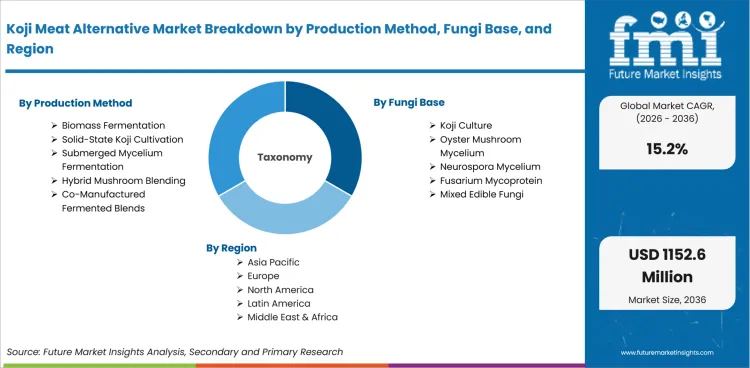
The koji meat alternative industry is segmented by product format, production method, fungi base, sales channel, end-use application, and region. Product format covers deli slices, bacon strips, whole-cut filets, grounds and mince, pepperoni and charcuterie. Production method covers biomass fermentation, solid-state koji cultivation, submerged mycelium fermentation, hybrid mushroom blending, and co-manufactured fermented blends. Fungi base includes koji culture, oyster mushroom mycelium, Neurospora mycelium, Fusarium mycoprotein, and mixed edible fungi. Sales channel includes foodservice operators, specialty retail, natural grocery chains, direct-to-consumer, and B2B ingredient supply. End-use application covers sandwiches and deli, pizza and toppings, breakfast meats, ready meals, and institutional foodservice.
Insights into Koji Meat Alternative Market by Production Method
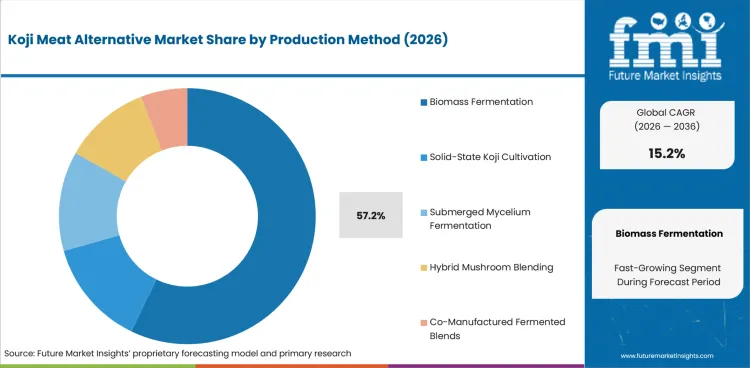
- Biomass fermentation is projected to account for 57.2% share in 2026, influenced by tank-based repeatability and supplier ability to sell standardized fungal biomass into meat analogue manufacturers.
- Solid-state koji cultivation gains use in flavor-rich formats, especially deli slices and charcuterie products requiring savory aroma and softer bite.
Insights into Koji Meat Alternative Market by Fungi Base
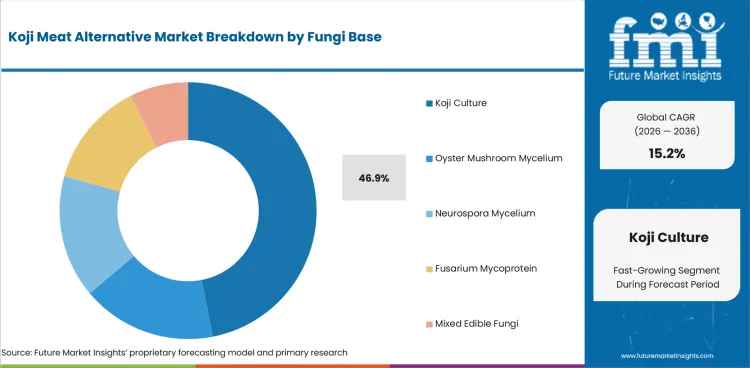
- Koji and mycelium cultures are anticipated to hold 46.9% share in 2026, reflected by culinary familiarity in Asian fermentation and texture formation in meat-style foods.
- Fusarium mycoprotein retains established use in frozen meat-free foods, while newer koji brands are moving into chilled deli and bacon formats.
Insights into Koji Meat Alternative Market by Sales Channel
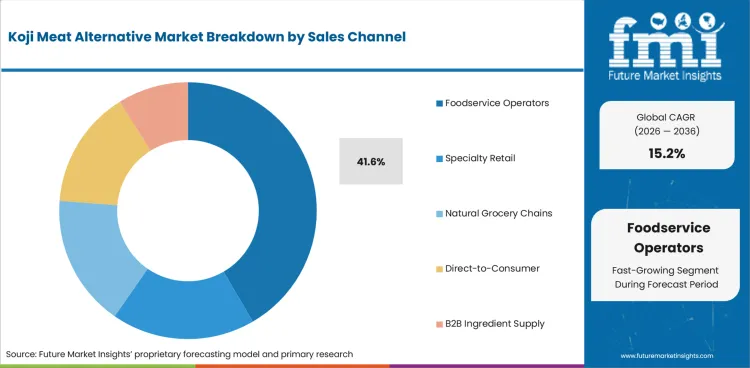
- Foodservice operators are forecast to secure 41.6% share in 2026, led by restaurants and deli counters introducing fungi-based meats through prepared meals before packaged retail listing.
- Specialty retail gains value among premium mycelium products as buyers compare labels and cooking behavior before repeat purchase.
Insights into Koji Meat Alternative Market by Product Format
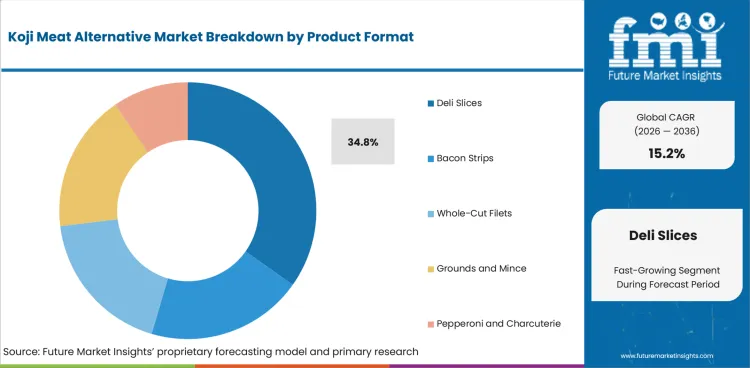
- Deli slices are projected to represent 34.8% share in 2026, guided by cold-cut replacement demand and operator need for products slicing cleanly across sandwich programs.
- Bacon strips add menu pull in breakfast and burger toppings, especially as mycelium formats support chew and browning without soy-heavy recipes.
Insights into Koji Meat Alternative Market by End-use Application
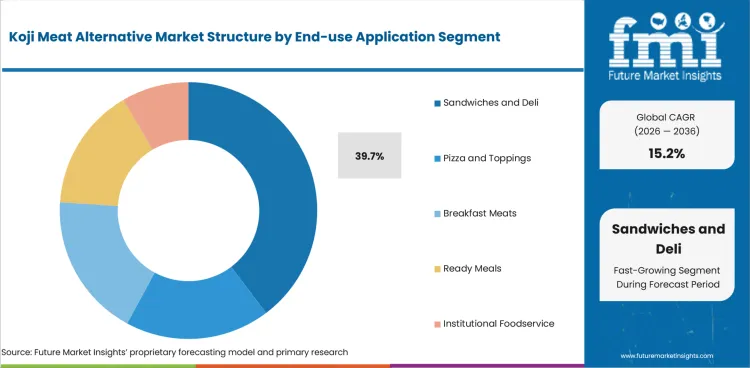
- Sandwich and deli applications are expected to capture 39.7% share in 2026, shaped by specialized prepared foods and quick-service lunch formats needing sliced proteins.
- Pizza and topping applications grow from pepperoni and sausage-style launches using fermentation flavor to replace cured-meat notes.
Market Drivers, Restraints and Opportunities
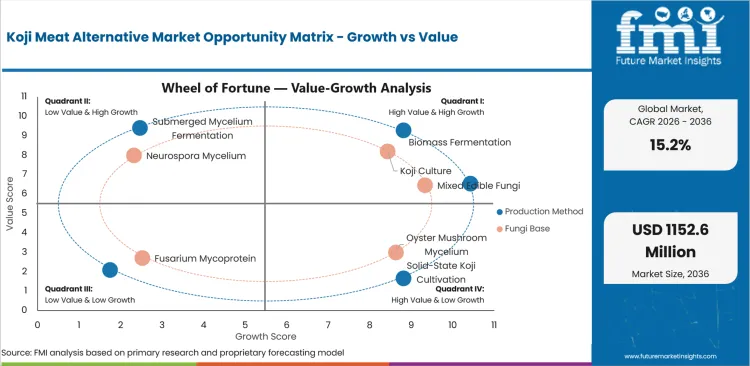
- Foodservice testing is bringing koji meats into familiar eating occasions through sandwiches and breakfast plates.
- Plant-based meat retail softness keeps pressure on price and cooking behavior for new fungal formats.
- Ingredient approval and B2B fungal biomass supply are creating new formulation routes for meat-style foods.
Foodservice Trials Support Commercial Entry
Koji meat alternatives are moving through restaurant channels where operators can test texture and portion control before retail expansion. National Restaurant Association stated in April 2025, nearly 75.0% of restaurant traffic happens off-premises, while off-premises now accounts for a larger share of sales for 58.0% of limited-service and 41.0% of full-service operators compared with 2019. This supports fungi-based formats suited for delivery and prepared meals, where products must hold quality beyond the dining room. Suppliers serving the food service industry can use these channels to prove cooking performance before wider distribution.
Retail Weakness Keeps Reformulation Pressure High
Plant-based meat suppliers are under pressure to improve product fit as category softness affects both retail and foodservice. Beyond Meat stated in May 2025, first-quarter net revenues decreased 9.1% to USD 68.7 million, while U.S. retail volume fell 23.2% and U.S. foodservice volume fell 22.0%. Such declines make reformulation more important for koji and mycelium products, since buyers need better texture and stronger cooking performance before adding new items. This keeps fungi-based product development closely tied to the plant-based ingredients market.
Regulatory Screening Shapes B2B Openings
Regulatory classification is becoming a practical filter for fungal protein suppliers entering finished meat alternative formulations. European Commission stated in its novel food consultation list that mycoprotein derived from Fusarium venenatum A 3/5 was classified as not novel food on 6 August 2024, while mycoprotein from Fusarium venenatum strain NRRL 26228 was classified as novel food on 19 December 2024. This distinction matters for manufacturers since similar fungal ingredients can follow different review routes depending on strain and history of use. Suppliers in the fermented protein market need stronger strain documentation before B2B adoption.
Retail Price and Pack-price Architecture Analysis
Koji meat alternatives are expected to move toward clearer pack-price ladders as retailers use private-label plant-based ranges to lower trial barriers. Lidl GB’s September 2025 plant-based update gives a useful benchmark, with own-label meat-free and alternative milk sales rising 694.0% against a 400.0% target, more than 20.0 new Vemondo Plant! products launched, and meat-free items such as mince and burgers priced from GBP 1.49. For koji and mycelium formats, this supports a stronger split between entry packs for first-time shoppers and established whole-cut or deli SKUs where texture and protein claims justify higher pricing. Suppliers linked to the plant-based food market will need sharper pack sizes and price points to reduce first-purchase hesitation while keeping established formats profitable.
Consumer Segmentation and Purchase Behavior Analysis
Koji meat alternatives are expected to gain stronger traction among flexitarian and reducetarian consumers who still eat animal protein but are open to regular swaps. ProVeg International’s October 2025 Veggie Challenge analysis found, 75.77% of subscribers identified as omnivores, while 44.64% already ate meat only one to four times a week. Its engagement data also placed the core age group at 25 to 34 with 28.0% of reach and showed women accounting for 81.0% of reach in key markets. This supports positioning built around taste and easy cooking rather than strict vegan identity. For suppliers in the alternative protein market, repeat demand will depend on making koji mince and mycelium-style meals familiar enough for mixed-diet households.
Analysis of Koji Meat Alternative Market by Key Countries
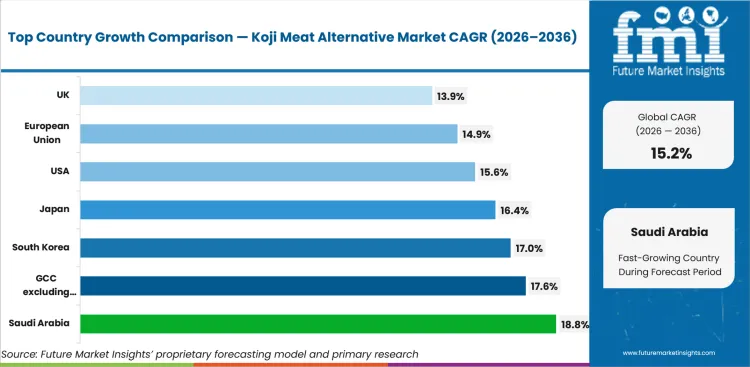
.webp "Top Country Growth Comparison Koji Meat Alternative Market Cagr (2026 2036)")
| Country / Geography | CAGR |
|---|---|
| Saudi Arabia | 18.8% |
| GCC excluding Saudi Arabia | 17.6% |
| South Korea | 17.0% |
| Japan | 16.4% |
| United States | 15.6% |
| European Union | 14.9% |
| United Kingdom | 13.9% |
| Canada | 12.8% |
| Australia | 12.1% |
Source: Future Market Insights, 2026.
Koji Meat Alternative Market CAGR Analysis by Country
- Saudi Arabia is projected to record 18.8% CAGR by 2036, driven by hotel dining and premium imported food access.
- GCC excluding Saudi Arabia is expected to expand at 17.6% CAGR from 2026 to 2036 due to UAE-led distribution and hospitality demand.
- South Korea is projected to grow at 17.0% CAGR by 2036, reflected by prepared meals and convenience retail product testing.
- Japan is expected to advance at 16.4% CAGR by 2036, since koji familiarity and foodservice quality requirements support trial.
- United States is projected to rise at 15.6% CAGR by 2036, influenced by mycelium bacon and koji deli meat launches.
- European Union is forecast at 14.9% CAGR by 2036 as fermentation scale-up and retailer reformulation support B2B demand.
- United Kingdom is expected to post 13.9% CAGR by 2036, led by mycoprotein familiarity and chilled meat-free retail access.
- Canada is forecast at 12.8% CAGR by 2036, aided by alternative protein funding and ingredient pilots.
- Australia is expected to grow at 12.1% CAGR by 2036, guided by clean-label trials and premium grocery access.
Sales Outlook for Koji Meat Alternative Market in Saudi Arabia
Foodservice and hotel menu testing center · 2026 to 2036
Country Market Snapshot Table
| Parameter | Value |
|---|---|
| Market Size in 2025 (Value) | USD 8.0 million |
| Market Size in 2026 (Value) | USD 9.5 million |
| Market Forecast in 2036 (Value) | USD 53.2 million |
| CAGR (2026 to 2036) | 18.8% |
| Years Considered | 2021 to 2036 |
| Base Year | 2025 |
| Forecast Period | 2026 to 2036 |
| Units Considered | Value (USD million) |
| Leading Sub-Region | Riyadh and Jeddah hospitality corridors |
Saudi Arabia Koji Meat Alternative Market Outlook
Saudi Arabia koji meat alternative market is driven by hotel dining, imported premium foods, and national food diversification planning. Demand in Saudi Arabia is projected to record 18.8% CAGR by 2036, influenced by premium restaurant menus and hospitality kitchen trials.
Foodservice buyers are expected to test service-pack deli slices and pizza toppings before wider retail listing. Suppliers with Halal documentation and stable cold-chain support should gain stronger access among premium accounts.
Key Growth Drivers
- Hotel kitchens can introduce koji meats through controlled menus, supported by Ministry of Tourism data showing 30.0 million international tourist arrivals in 2024.
- Food diversification supports alternative protein testing, shown by GASTAT reporting poultry self-sufficiency increased by 1.4% in 2024.
- Premium supermarkets in Riyadh and Jeddah can list chilled fungi-based meat alternatives as imported specialty items.
- Cloud kitchens can test small packs of pepperoni and bacon alternatives before committing to larger foodservice volumes.
Key Restraints
- Imported chilled products face high landed costs from cold-chain handling and retailer margin requirements.
- Consumer familiarity with koji meat remains limited outside established dining and chef-led channels.
- Saudi retail price pressure can restrict trial frequency, as USDA FAS stated food retail sales exceeded USD 50.0 billion in 2024 while prices stayed sensitive.
What makes Saudi Arabia unique
Saudi Arabia offers a hospitality-first route for fungi-based meat alternatives. Menu testing inside hotels and premium restaurants can build credibility before frozen or chilled retail expansion.
Key Companies
- Switch Foods
- Thryve
- Prime Roots import partners
- LuLu Saudi Arabia
- Tamimi Markets specialty teams
Sales & Marketing Channels
- Hotel and resort kitchens
- Cloud kitchens
- Premium supermarkets
- Foodservice distributors
- Specialty health retailers
- Direct importer networks
Country Segment Breakdown Table
| Segment | Sub-Segments |
|---|---|
| By Product Format | Deli Slices · Bacon Strips · Whole-Cut Filets · Grounds and Mince · Pepperoni and Charcuterie |
| By Production Method | Biomass Fermentation · Solid-State Koji Cultivation · Submerged Mycelium Fermentation · Hybrid Mushroom Blending · Co-Manufactured Fermented Blends |
| By Fungi Base | Koji Culture · Oyster Mushroom Mycelium · Neurospora Mycelium · Fusarium Mycoprotein |
| By Sales Channel | Foodservice Operators · Specialty Retail · Natural Grocery Chains · Direct-to-Consumer · B2B Ingredient Supply |
| By End-use Application | Sandwiches and Deli · Pizza and Toppings · Breakfast Meats · Ready Meals · Institutional Foodservice |
| Key Sub-Regions Covered, Launch and Distribution Areas | Riyadh · Jeddah · Makkah · Dammam · Red Sea tourism zones |
Frequently Asked Questions
How fast is Saudi Arabia koji meat alternative market growing?
Saudi Arabia koji meat alternative market is projected to record 18.8% CAGR from 2026 to 2036, led by hotel dining and food diversification programs.
Who leads Saudi Arabia koji meat alternative market?
Importer-distributor networks and regional plant-based suppliers lead early product access.
What is driving adoption in Saudi Arabia koji meat alternative market?
Hotel dining and food diversification programs are supporting early adoption.
Demand Outlook for Koji Meat Alternative Market in GCC excluding Saudi Arabia
Premium retail and hospitality distribution base · 2026 to 2036
Country Market Snapshot Table
| Parameter | Value |
|---|---|
| Market Size in 2025 (Value) | USD 10.2 million |
| Market Size in 2026 (Value) | USD 12.0 million |
| Market Forecast in 2036 (Value) | USD 60.7 million |
| CAGR (2026 to 2036) | 17.6% |
| Years Considered | 2021 to 2036 |
| Base Year | 2025 |
| Forecast Period | 2026 to 2036 |
| Units Considered | Value (USD million) |
| Leading Sub-Region | United Arab Emirates |
GCC excluding Saudi Arabia Koji Meat Alternative Market Outlook
GCC excluding Saudi Arabia koji meat alternative market is shaped by UAE specialty retail access and hotel foodservice distribution. Demand in GCC excluding Saudi Arabia is expected to expand at 17.6% CAGR by 2036, guided by imported chilled meat alternatives and restaurant-led menu testing.
UAE food import channels allow smaller brands to test multi-country Gulf availability before committing local production. Distribution companies with cold-chain coverage and chef training should gain stronger placement than suppliers selling only packaged retail units.
Key Growth Drivers
- Dubai hotels support foodservice experimentation, backed by DET data showing 18.7 million international overnight visitors in 2024.
- UAE trade routes support imported food testing, as USDA FAS stated nearly 40.0 countries imported wheat and wheat products from the UAE in MY 2024 to 2025.
- Qatar and Kuwait hotel kitchens can add fungi-based proteins for international diners and catered events.
- Specialty retailers in Dubai and Abu Dhabi can place koji meat alternatives near dairy-free and vegan chilled foods.
Key Restraints
- Shelf price remains high for imported chilled meat alternatives due to limited batch sizes and cold-chain cost.
- Halal documentation and ingredient file review can slow listing across multiple Gulf countries.
- UAE food security exposure keeps import planning sensitive, as the US-UAE Business Council stated food crop access could save up to 25.0% on import spending.
What makes GCC excluding Saudi Arabia unique
GCC excluding Saudi Arabia allows brands to test across hotel kitchens and airline catering through fewer distribution gateways. UAE remains the main launch point before Qatar and Oman expansion.
Key Companies
- Switch Foods
- Thryve
- IFFCO plant-based teams
- Kibsons specialty retail
- Spinneys UAE
Sales & Marketing Channels
- Importer-distributor networks
- Hotel foodservice
- Premium supermarkets
- Online grocery
- Restaurant groups
- Airline catering
Country Segment Breakdown Table
| Segment | Sub-Segments |
|---|---|
| By Product Format | Deli Slices · Bacon Strips · Whole-Cut Filets · Grounds and Mince · Pepperoni and Charcuterie |
| By Production Method | Biomass Fermentation · Solid-State Koji Cultivation · Submerged Mycelium Fermentation · Hybrid Mushroom Blending · Co-Manufactured Fermented Blends |
| By Fungi Base | Koji Culture · Oyster Mushroom Mycelium · Neurospora Mycelium · Fusarium Mycoprotein |
| By Sales Channel | Foodservice Operators · Specialty Retail · Natural Grocery Chains · Direct-to-Consumer · B2B Ingredient Supply |
| By End-use Application | Sandwiches and Deli · Pizza and Toppings · Breakfast Meats · Ready Meals · Institutional Foodservice |
| Key Sub-Regions Covered, Launch and Distribution Areas | United Arab Emirates · Qatar · Kuwait · Bahrain · Oman |
Frequently Asked Questions
How fast is GCC excluding Saudi Arabia koji meat alternative market growing?
GCC excluding Saudi Arabia koji meat alternative market is expected to expand at 17.6% CAGR from 2026 to 2036, reflected by UAE-led distribution and premium retail imports.
Who leads GCC excluding Saudi Arabia koji meat alternative market?
Importer-distributor networks and premium supermarkets support early product access.
What is driving adoption in GCC excluding Saudi Arabia koji meat alternative market?
UAE retail distribution, and imported specialty foods promote adoption.
Growth Outlook for Koji Meat Alternative Market in South Korea
Prepared-meal and convenience retail trial base · 2026 to 2036
Country Market Snapshot Table
| Parameter | Value |
|---|---|
| Market Size in 2025 (Value) | USD 15.8 million |
| Market Size in 2026 (Value) | USD 18.5 million |
| Market Forecast in 2036 (Value) | USD 88.9 million |
| CAGR (2026 to 2036) | 17.0% |
| Years Considered | 2021 to 2036 |
| Base Year | 2025 |
| Forecast Period | 2026 to 2036 |
| Units Considered | Value (USD million) |
| Leading Sub-Region | Seoul Capital Area |
South Korea Koji Meat Alternative Market Outlook
South Korea koji meat alternative market is influenced by convenience retail, meal-kit culture, and prepared-food product testing. Demand in South Korea is forecast to grow at 17.0% CAGR by 2036, reflected by small-pack retail trials and local alternative protein activity.
Korean shoppers are familiar with fermented flavors, yet meat analogue acceptance still relies on texture and price parity. Suppliers should focus on ready-meal inclusions and retail packs that match local cooking styles.
Key Growth Drivers
- Convenience stores can trial koji mince and pepperoni formats, supported by Korea.net reporting 504,657.0 Korean food industry businesses in 2024.
- Online grocery supports small-pack testing, as South Korea online shopping transactions reached KRW 21.2 trillion in April 2026.
- Fermentation familiarity gives koji-based meats an entry point in rice bowls and prepared meals.
- Local food manufacturers can test mycelium ingredients through limited product batches before mass retail listing.
Key Restraints
- Imported fungal biomass can face price pressure against local soy and wheat-based meat alternatives.
- Retailers require clear allergen and cooking instructions before listing chilled meat substitutes.
- Foodservice budgets remain cautious, as USDA FAS stated Republic of Korea foodservice sales declined 1.2% in 2024.
What makes South Korea unique
South Korea offers prepared-meal and convenience-store routes testisg koji meat alternatives in smaller packs than Western retail. Format localization matters more than full product range.
Key Companies
- Pulmuone
- CJ CheilJedang alternative protein teams
- Shinsegae Food
- Infinite Roots Korea partner programs
- Lotte Food plant-based teams
Sales & Marketing Channels
- Omnichannel retail tests
- Convenience stores
- Hypermarkets
- Foodservice distributors
- Meal-kit platforms
- Specialty vegan outlets
Country Segment Breakdown Table
| Segment | Sub-Segments |
|---|---|
| By Product Format | Deli Slices · Bacon Strips · Whole-Cut Filets · Grounds and Mince · Pepperoni and Charcuterie |
| By Production Method | Biomass Fermentation · Solid-State Koji Cultivation · Submerged Mycelium Fermentation · Hybrid Mushroom Blending · Co-Manufactured Fermented Blends |
| By Fungi Base | Koji Culture · Oyster Mushroom Mycelium · Neurospora Mycelium · Fusarium Mycoprotein |
| By Sales Channel | Foodservice Operators · Specialty Retail · Natural Grocery Chains · Direct-to-Consumer · B2B Ingredient Supply |
| By End-use Application | Sandwiches and Deli · Pizza and Toppings · Breakfast Meats · Ready Meals · Institutional Foodservice |
| Key Sub-Regions Covered, Launch and Distribution Areas | Seoul Capital Area · Busan · Daegu · Daejeon · Jeju |
Frequently Asked Questions
How fast is South Korea koji meat alternative market growing?
South Korea koji meat alternative market is forecast to grow at 17.0% CAGR from 2026 to 2036, driven by convenience retail trials and local alternative protein activity.
Who leads South Korea koji meat alternative market?
Local food manufacturers and convenience retail operators are likely to lead early availability.
What is driving adoption in South Korea koji meat alternative market?
Fermentation familiarity and small-pack retail testing influence market adoption.
Industry Outlook for Koji Meat Alternative Market in Japan
Foodservice quality and koji familiarity center · 2026 to 2036
Country Market Snapshot Table
| Parameter | Value |
|---|---|
| Market Size in 2025 (Value) | USD 19.8 million |
| Market Size in 2026 (Value) | USD 23.0 million |
| Market Forecast in 2036 (Value) | USD 105.0 million |
| CAGR (2026 to 2036) | 16.4% |
| Years Considered | 2021 to 2036 |
| Base Year | 2025 |
| Forecast Period | 2026 to 2036 |
| Units Considered | Value (USD million) |
| Leading Sub-Region | Kanto and Kansai foodservice corridors |
Japan Koji Meat Alternative Market Outlook
Japan koji meat alternative market is guided by culinary familiarity with koji fermentation and strict foodservice quality requirements. Sector in Japan is expected to scale at 16.4% CAGR by 2036, led by premium retail testing and chef-led menu adoption.
Domestic food companies already use fermentation messaging in sauces and seasoning systems. Suppliers delivering clean slices and neutral aroma should gain placement in sandwich and izakaya-style applications.
Key Growth Drivers
- Koji culture familiarity helps chefs explain fungi-based meats through existing culinary language.
- Tourism dining supports menu trials, as Japan recorded 36.9 million international visitor arrivals in 2024.
- Bento and convenience food channels can use small portions of meat alternatives in controlled recipes.
- E-commerce supports specialty food discovery, as METI stated Japan’s domestic B2C e-commerce market reached JPY 26.1 trillion in 2024.
Key Restraints
- Chilled deli meat alternatives face strict quality expectations and short shelf-life requirements.
- Domestic buyers often require strong sensory proof before replacing familiar soy-based vegetarian products.
- Food price pressure can limit premium trial frequency, as Japan’s Statistics Bureau stated food prices rose 6.8% in 2025.
What makes Japan unique
Japan can position koji meat alternatives through native fermentation knowledge. Product success should rely on refinement and foodservice credibility.
Key Companies
- Marukome plant-based programs
- Kagome plant-based programs
- Next Meats
- DAIZ
- Mizkan fermentation-linked teams
Sales & Marketing Channels
- Convenience stores
- Restaurant chains
- Department store food halls
- Natural supermarkets
- B2B ingredient distributors
- Online specialty shops
Country Segment Breakdown Table
| Segment | Sub-Segments |
|---|---|
| By Product Format | Deli Slices · Bacon Strips · Whole-Cut Filets · Grounds and Mince · Pepperoni and Charcuterie |
| By Production Method | Biomass Fermentation · Solid-State Koji Cultivation · Submerged Mycelium Fermentation · Hybrid Mushroom Blending · Co-Manufactured Fermented Blends |
| By Fungi Base | Koji Culture · Oyster Mushroom Mycelium · Neurospora Mycelium · Fusarium Mycoprotein |
| By Sales Channel | Foodservice Operators · Specialty Retail · Natural Grocery Chains · Direct-to-Consumer · B2B Ingredient Supply |
| By End-use Application | Sandwiches and Deli · Pizza and Toppings · Breakfast Meats · Ready Meals · Institutional Foodservice |
| Key Sub-Regions Covered, Launch and Distribution Areas | Kanto · Kansai · Chubu · Kyushu · Hokkaido |
Frequently Asked Questions
How fast is Japan koji meat alternative market growing?
Japan koji meat alternative market is expected to advance at 16.4% CAGR from 2026 to 2036, aided by koji familiarity and quality-focused foodservice demand.
Who leads Japan koji meat alternative market?
Fermentation-linked food manufacturers and foodservice channels lead early product positioning.
What is driving adoption in Japan koji meat alternative market?
Tourism dining and premium retail trials promotes sector adoption.
Sales Outlook for Koji Meat Alternative Market in the United States
Commercial launch and deli-foodservice center · 2026 to 2036
Country Market Snapshot Table
| Parameter | Value |
|---|---|
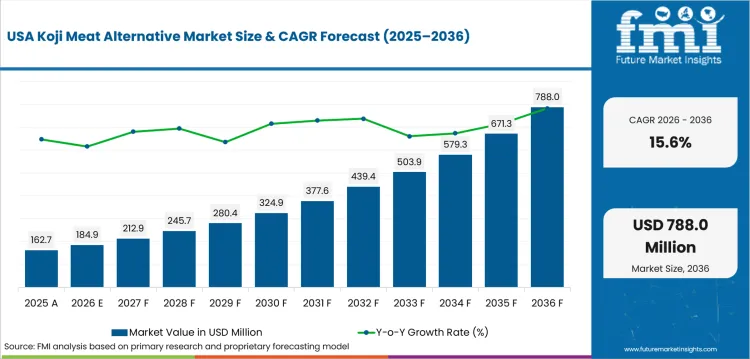
| Market Size in 2025 (Value) | USD 76.1 million |
| Market Size in 2026 (Value) | USD 88.0 million |
| Market Forecast in 2036 (Value) | USD 375.0 million |
| CAGR (2026 to 2036) | 15.6% |
| Years Considered | 2021 to 2036 |
| Base Year | 2025 |
| Forecast Period | 2026 to 2036 |
| Units Considered | Value (USD million) |
| Leading Sub-Region | West Coast and Northeast retail corridors |
United States Koji Meat Alternative Market Outlook
United States koji meat alternative sales are influenced by commercial launches and foodservice proof rather than mass retail substitution. Demand in the United States is projected to rise at 15.6% CAGR by 2036, backed by mycelium bacon and koji deli meat availability.
FDA GRAS activity supports ingredient documentation, while weak plant-based meat retail performance keeps reformulation pressure high. Producers with deli counters and chef channels are better placed than brands relying only on frozen burger shelves.
Key Growth Drivers
- FDA ingredient clearance improves manufacturer confidence, with GRN 1117 allowing mycelial biomass use up to 90.0% in specified meat and alternative formats.
- Online grocery and specialty retail aid product discovery, as U.S. Census Bureau stated Q1 2026 retail e-commerce sales reached USD 326.7 billion.
- Mycelium bacon and koji deli meats suit foodservice preparation in sandwich and breakfast menus.
- Deli operators can trial sliced fungi-based meats in limited regions before national retail expansion.
Key Restraints
- Grocery buyers remain cautious after plant-based meat unit declines in recent retail cycles.
- Chilled mycelium products require narrow launch geography and strict cold-chain control.
- Foodservice inflation can slow menu tests, as U.S. Bureau of Labor Statistics stated food away from home prices rose 3.8% over the 12 months to May 2026.
What makes the United States unique
United States has the deepest brand launch base for koji deli meat and mycelium bacon. Commercial success should depend on foodservice proof and tighter retail SKU discipline.
Key Companies
- Prime Roots
- MyForest Foods
- Meati Holdings
- The Better Meat Co.
- MycoTechnology
- Ecovative food platform
Sales & Marketing Channels
- Foodservice direct sales
- Natural grocery chains
- Direct-to-consumer
- Specialty distributors
- Pizza and deli operators
- B2B ingredient supply
Country Segment Breakdown Table
| Segment | Sub-Segments |
|---|---|
| By Product Format | Deli Slices · Bacon Strips · Whole-Cut Filets · Grounds and Mince · Pepperoni and Charcuterie |
| By Production Method | Biomass Fermentation · Solid-State Koji Cultivation · Submerged Mycelium Fermentation · Hybrid Mushroom Blending · Co-Manufactured Fermented Blends |
| By Fungi Base | Koji Culture · Oyster Mushroom Mycelium · Neurospora Mycelium · Fusarium Mycoprotein |
| By Sales Channel | Foodservice Operators · Specialty Retail · Natural Grocery Chains · Direct-to-Consumer · B2B Ingredient Supply |
| By End-use Application | Sandwiches and Deli · Pizza and Toppings · Breakfast Meats · Ready Meals · Institutional Foodservice |
| Key Sub-Regions Covered, Launch and Distribution Areas | California · Colorado · New York · Midwest · Pacific Northwest |
Frequently Asked Questions
How fast is United States koji meat alternative market growing?
United States koji meat alternative market is projected to rise at 15.6% CAGR from 2026 to 2036, guided by FDA ingredient records and foodservice trial routes.
Who leads United States koji meat alternative market?
Prime Roots, MyForest Foods, Meati Holdings, and The Better Meat Co. support early market formation.
What is driving adoption in United States koji meat alternative market?
Foodservice launches and improved meat analogue texture propel market adoption.
Growth Outlook for Koji Meat Alternative Market in European Union
Ingredient scale-up and retailer testing base · 2026 to 2036
Country Market Snapshot Table
| Parameter | Value |
|---|---|
| Market Size in 2025 (Value) | USD 46.6 million |
| Market Size in 2026 (Value) | USD 53.5 million |
| Market Forecast in 2036 (Value) | USD 214.6 million |
| CAGR (2026 to 2036) | 14.9% |
| Years Considered | 2021 to 2036 |
| Base Year | 2025 |
| Forecast Period | 2026 to 2036 |
| Units Considered | Value (USD million) |
| Leading Sub-Region | Germany and Netherlands fermentation corridors |
European Union Koji Meat Alternative Market Outlook
European Union koji meat alternative growth is aided by ingredient scale-up, retailer testing, and novel food review. Sector in European Union is forecast at 14.9% CAGR by 2036, reflected by fermentation capacity and retail reformulation.
Germany, Netherlands, France, and Spain provide better launch routes due to plant-based shelf presence and ingredient manufacturing clusters. Suppliers with documentation packages for strain and process controls should gain better customer approval.
Key Growth Drivers
- Biomanufacturing policy supports fermentation supply in Europe, as the European Commission’s March 2024 biotechnology and biomanufacturing plan listed 8.0 follow-up actions and noted that Cohesion Policy had funded about 3,700.0 close-to-market biotech research and innovation projects since the past 10 years.
- Plant-based retail depth supports reformulation, as GFI Europe stated Germany plant-based food sales across six categories reached EUR 1.7 billion in 2025.
- Retailers can test fungal meats under chilled private-label and premium meat-free ranges.
- Ingredient suppliers in Germany and Netherlands can support co-manufacturers with documented fungal biomass.
Key Restraints
- Novel food assessment can lengthen commercialization timelines for new fungal biomass ingredients.
- Retailers remain cautious after slow movement in older meat-free SKUs.
- Food affordability can restrict premium pricing, as Eurostat stated 2024 food and non-alcoholic beverage prices were 24.0% above the EU average in Luxembourg.
What makes European Union unique
European Union has the strongest ingredient-scale pathway for fungal biomass. Regulatory review can slow product rollout, so B2B suppliers with process documentation should outpace small consumer brands.
Key Companies
- Infinite Roots
- ENOUGH Foods
- Kynda
- NAPLASOL
- Quorn Europe
- Libre Foods assets under Planetary
Sales & Marketing Channels
- Retail private label
- Ingredient distributors
- Foodservice distributors
- Co-manufacturers
- Specialty supermarkets
- Restaurant chains
Country Segment Breakdown Table
| Segment | Sub-Segments |
|---|---|
| By Product Format | Deli Slices · Bacon Strips · Whole-Cut Filets · Grounds and Mince · Pepperoni and Charcuterie |
| By Production Method | Biomass Fermentation · Solid-State Koji Cultivation · Submerged Mycelium Fermentation · Hybrid Mushroom Blending · Co-Manufactured Fermented Blends |
| By Fungi Base | Koji Culture · Oyster Mushroom Mycelium · Neurospora Mycelium · Fusarium Mycoprotein |
| By Sales Channel | Foodservice Operators · Specialty Retail · Natural Grocery Chains · Direct-to-Consumer · B2B Ingredient Supply |
| By End-use Application | Sandwiches and Deli · Pizza and Toppings · Breakfast Meats · Ready Meals · Institutional Foodservice |
| Key Sub-Regions Covered, Launch and Distribution Areas | Germany · Netherlands · France · Spain · Italy · Nordics |
Frequently Asked Questions
How fast is European Union koji meat alternative market growing?
European Union koji meat alternative market is forecast at 14.9% CAGR from 2026 to 2036, influenced by fermentation scale-up, B2B ingredient supply, and retailer reformulation.
Who leads European Union koji meat alternative market?
Infinite Roots, ENOUGH Foods, Kynda, and Quorn-linked supply channels support early development.
What is driving adoption in European Union koji meat alternative market?
Fermentation capacity along with retailer reformulation and B2B ingredient supply support adoption.
Industry Outlook for Koji Meat Alternative Market in the United Kingdom
Mycoprotein familiarity and chilled retail base · 2026 to 2036
Country Market Snapshot Table
| Parameter | Value |
|---|---|
| Market Size in 2025 (Value) | USD 21.9 million |
| Market Size in 2026 (Value) | USD 25.0 million |
| Market Forecast in 2036 (Value) | USD 91.9 million |
| CAGR (2026 to 2036) | 13.9% |
| Years Considered | 2021 to 2036 |
| Base Year | 2025 |
| Forecast Period | 2026 to 2036 |
| Units Considered | Value (USD million) |
| Leading Sub-Region | England retail and foodservice corridors |
United Kingdom Koji Meat Alternative Market Outlook
United Kingdom koji meat alternative market is driven by long-running mycoprotein familiarity and supermarket own-label capability. The market in the United Kingdom is projected to post 13.9% CAGR by 2036, backed by chilled meat-free shelves and foodservice sandwich use.
Retailers remain disciplined after plant-based SKU rationalization, so koji and mycelium products need clear taste proof and price justification. Suppliers should focus on sandwich and deli applications already understood by meat-free shoppers.
Key Growth Drivers
- Mycoprotein familiarity reduces education needs, supported by GFI Europe reporting UK plant-based annual sales across 6 categories at GBP 898.0 million in the year to January 2025.
- Online grocery supports chilled discovery, as Office for National Statistics recorded internet sales at 27.3% of total retail sales in April 2026.
- Sandwich chains and foodservice wholesalers can test sliced koji meats in prepared meals and lunch programs.
- Retailer own-label expertise supports controlled reformulation in sliced and chilled formats.
Key Restraints
- Retail buyers remain cautious on premium chilled meat alternatives after SKU rotation in meat-free aisles.
- Consumer price sensitivity limits higher-ticket mycelium bacon and deli packs.
- Food inflation still limits trial frequency, as House of Commons Library stated UK food inflation reached 4.2% in November 2025.
What makes the United Kingdom unique
United Kingdom can use mycoprotein familiarity to reduce consumer education barriers. Retailer own-label control also supports recipe testing in sliced and chilled formats.
Key Companies
- Quorn Foods
- ENOUGH Foods
- THIS plant-based teams
- Meatless Farm brand assets
- Plant-based private label suppliers
Sales & Marketing Channels
- Supermarket own label
- Foodservice wholesalers
- Sandwich chains
- Pizza operators
- Natural grocery
- Online grocery
Country Segment Breakdown Table
| Segment | Sub-Segments |
|---|---|
| By Product Format | Deli Slices · Bacon Strips · Whole-Cut Filets · Grounds and Mince · Pepperoni and Charcuterie |
| By Production Method | Biomass Fermentation · Solid-State Koji Cultivation · Submerged Mycelium Fermentation · Hybrid Mushroom Blending · Co-Manufactured Fermented Blends |
| By Fungi Base | Koji Culture · Oyster Mushroom Mycelium · Neurospora Mycelium · Fusarium Mycoprotein |
| By Sales Channel | Foodservice Operators · Specialty Retail · Natural Grocery Chains · Direct-to-Consumer · B2B Ingredient Supply |
| By End-use Application | Sandwiches and Deli · Pizza and Toppings · Breakfast Meats · Ready Meals · Institutional Foodservice |
| Key Sub-Regions Covered, Launch and Distribution Areas | England · Scotland · Wales · Northern Ireland |
Frequently Asked Questions
How fast is United Kingdom koji meat alternative market growing?
United Kingdom koji meat alternative market is projected to post 13.9% CAGR from 2026 to 2036, led by mycoprotein familiarity and sandwich foodservice demand.
Who leads United Kingdom koji meat alternative market?
Quorn Foods, ENOUGH Foods, and retailer private-label suppliers are central to early commercialization.
What is driving adoption in United Kingdom koji meat alternative market?
Mycoprotein familiarity and private-label testing influence adoption for the industry
Industry Outlook for Koji Meat Alternative Market in Canada
Protein ingredient and foodservice trial base · 2026 to 2036
Country Market Snapshot Table
| Parameter | Value |
|---|---|
| Market Size in 2025 (Value) | USD 14.2 million |
| Market Size in 2026 (Value) | USD 16.0 million |
| Market Forecast in 2036 (Value) | USD 53.4 million |
| CAGR (2026 to 2036) | 12.8% |
| Years Considered | 2021 to 2036 |
| Base Year | 2025 |
| Forecast Period | 2026 to 2036 |
| Units Considered | Value (USD million) |
| Leading Sub-Region | Ontario and British Columbia |
Canada Koji Meat Alternative Market Outlook
Canada koji meat alternative sector is influenced by ingredient partnerships and alternative protein funding. Sales in Canada are forecast at 12.8% CAGR by 2036, aided by B2B pilots and foodservice testing.
Domestic companies are active in fungi and plant-based foods, yet national retail scale remains smaller than United States levels. Producers should prioritize B2B pilots and regional foodservice accounts before wide retail listing.
Key Growth Drivers
- Ingredient innovation supports fungal biomass trials, as Protein Industries Canada stated its second technology program received CAD 150.0 million in federal funding.
- Public cluster support aids food manufacturing partnerships, as ISED stated Canada’s Global Innovation Clusters had 676.0 announced projects, 3,500.0 project partners, and more than CAD 3.39 billion co-invested with industry as of December 2025.
- Foodservice buyers can test mycelium formats through limited-time menus and institutional dining programs.
- Regional natural grocery chains can trial fungi-based meats in Ontario and British Columbia before national expansion.
Key Restraints
- Retail scale is smaller than United States levels, which can slow chilled mycelium product rollout.
- Cold-chain distribution across provinces raises costs for small batch producers.
- Grocery price pressure affects trial spending, as Statistics Canada stated grocery prices increased 3.5% in 2025.
What makes Canada unique
Canada offers ingredient research and regional pilot routes rather than immediate mass retail scale. Companies with B2B formulation support should find better entry than consumer-only brands.
Key Companies
- Maia Farms
- Smallfood
- Big Mountain Foods
- Konscious Foods
- Protein Industries Canada partners
Sales & Marketing Channels
- Foodservice distributors
- Natural grocery
- Club stores
- Meal kits
- Ingredient pilots
- University dining
Country Segment Breakdown Table
| Segment | Sub-Segments |
|---|---|
| By Product Format | Deli Slices · Bacon Strips · Whole-Cut Filets · Grounds and Mince · Pepperoni and Charcuterie |
| By Production Method | Biomass Fermentation · Solid-State Koji Cultivation · Submerged Mycelium Fermentation · Hybrid Mushroom Blending · Co-Manufactured Fermented Blends |
| By Fungi Base | Koji Culture · Oyster Mushroom Mycelium · Neurospora Mycelium · Fusarium Mycoprotein |
| By Sales Channel | Foodservice Operators · Specialty Retail · Natural Grocery Chains · Direct-to-Consumer · B2B Ingredient Supply |
| By End-use Application | Sandwiches and Deli · Pizza and Toppings · Breakfast Meats · Ready Meals · Institutional Foodservice |
| Key Sub-Regions Covered, Launch and Distribution Areas | Ontario · British Columbia · Quebec · Alberta · Prairies |
Frequently Asked Questions
How fast is Canada koji meat alternative market growing?
Canada koji meat alternative market is forecast at 12.8% CAGR from 2026 to 2036, guided by alternative protein funding and regional foodservice testing.
Who leads Canada koji meat alternative market?
Maia Farms, Smallfood, and alternative protein ingredient programs support early activity.
What is driving adoption in Canada koji meat alternative market?
Foodservice pilots and regional retail tests add to the market adoption for the country.
Sales Outlook for Koji Meat Alternative Market in Australia
Clean-label plant meat trial base · 2026 to 2036
Country Market Snapshot Table
| Parameter | Value |
|---|---|
| Market Size in 2025 (Value) | USD 12.0 million |
| Market Size in 2026 (Value) | USD 13.4 million |
| Market Forecast in 2036 (Value) | USD 42.0 million |
| CAGR (2026 to 2036) | 12.1% |
| Years Considered | 2021 to 2036 |
| Base Year | 2025 |
| Forecast Period | 2026 to 2036 |
| Units Considered | Value (USD million) |
| Leading Sub-Region | New South Wales and Victoria |
Australia Koji Meat Alternative Market Outlook
Australia koji meat alternative market is shaped by clean-label product testing, chef-led use, and premium grocery ranges. Industry in Australia is expected to grow at 12.1% CAGR by 2036, supported by mycelium-style formats and foodservice trials.
Retailers remain selective after mixed plant-based meat performance, which makes texture and ingredient simplicity more important. Suppliers should focus on whole-cut and mushroom-linked formats that match existing consumer familiarity with fungi-based foods.
Key Growth Drivers
- Premium grocery and cafe channels can test mycelium-style proteins, supported by Food Frontier reporting plant-based meat sales rose 47.0% from 2020 to 2023.
- Foodservice supports menu tests, as Restaurant & Catering Australia cited ABS data showing cafes and takeaway turnover reached AUD 66.3 billion in the year to June 2025.
- Local mushroom familiarity helps hybrid mycelium products communicate texture and flavor with lower education burden.
- Meal-kit and cafe operators can position fungi-based meat alternatives through controlled recipes and limited menus.
Key Restraints
- Plant-based meat repeat purchase remains pressured by taste and price concerns.
- Geographic distance raises imported ingredient cost and chilled distribution complexity.
- Food price pressure affects trial frequency, as Australian Bureau of Statistics stated food and non-alcoholic beverages rose 3.4% in the 12 months to December 2025.
What makes Australia unique
Australia can link koji and mycelium alternatives to mushroom-forward food culture and premium cafe menus. Whole-cut and hybrid mushroom formats should gain stronger acceptance than highly processed meat analogues.
Key Companies
- Fable Food Co
- v2food adjacent plant-meat programs
- Made With Plants
- Harvest B
- Food Frontier supplier network
Sales & Marketing Channels
- Supermarket chilled aisles
- Foodservice distributors
- Cafes
- Online grocery
- Health retailers
- Meal kits
Country Segment Breakdown Table
| Segment | Sub-Segments |
|---|---|
| By Product Format | Deli Slices · Bacon Strips · Whole-Cut Filets · Grounds and Mince · Pepperoni and Charcuterie |
| By Production Method | Biomass Fermentation · Solid-State Koji Cultivation · Submerged Mycelium Fermentation · Hybrid Mushroom Blending · Co-Manufactured Fermented Blends |
| By Fungi Base | Koji Culture · Oyster Mushroom Mycelium · Neurospora Mycelium · Fusarium Mycoprotein |
| By Sales Channel | Foodservice Operators · Specialty Retail · Natural Grocery Chains · Direct-to-Consumer · B2B Ingredient Supply |
| By End-use Application | Sandwiches and Deli · Pizza and Toppings · Breakfast Meats · Ready Meals · Institutional Foodservice |
| Key Sub-Regions Covered, Launch and Distribution Areas | New South Wales · Victoria · Queensland · Western Australia · South Australia |
Frequently Asked Questions
How fast is Australia koji meat alternative market growing?
Australia koji meat alternative market is expected to grow at 12.1% CAGR from 2026 to 2036, guided by clean-label trials and cafe menu testing.
Who leads Australia koji meat alternative market?
Fable Food Co, Harvest B, and premium retail suppliers support early activity.
What is driving adoption in Australia koji meat alternative market?
Mushroom familiarity and premium grocery access support adoption in the country.
Competitive Landscape and Strategic Positioning
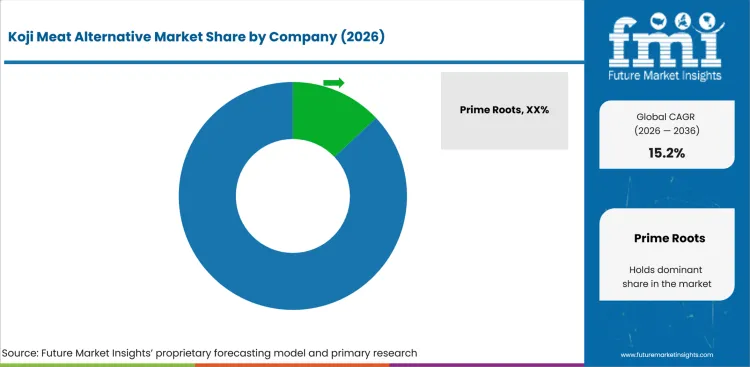
- Finished koji meat brands hold an advantage in deli and pepperoni formats due to application-specific product design.
- Fungal biomass ingredient suppliers compete through strain documentation and co-manufacturer support.
- Mycelium bacon producers gain shelf access by proving repeat purchase in chilled natural grocery channels.
- Entry barriers remain high as buyers require food safety files and stable cold-chain delivery.
Competition in koji meat alternatives centers on product performance and channel access. Buyers compare fungi-based meats against soy wheat and mushroom-forward products before approving repeat orders. Supplier selection therefore depends on sensory proof and reliable production.
Manufacturing depth separates finished food brands from ingredient-platform companies. Prime Roots and MyForest Foods compete led by finished koji and mycelium meat products for deli and pizza applications. The Better Meat Co., ENOUGH Foods, Infinite Roots, and Kynda compete based on fungal biomass and fermentation supply for B2B customers.
Smaller and regional suppliers can gain placement through local menu testing and controlled retail distribution. Meati Holdings remains important due to mycelium whole-cut products, although its 2025 asset transfer makes its near-term position more cautious. Nature’s Fynd is excluded because its current product scope is less directly tied to koji or mycelium meat analogues. Companies best placed to gain share are those combining foodservice-ready formats and repeatable fungal biomass supply.
Key Companies in the Koji Meat Alternative Market
Competition differs across finished koji meat brands, mycelium bacon producers, fungal biomass ingredient suppliers, and established mycoprotein companies. Regional foodservice distributors add channel reach in smaller buyer accounts.
- Finished Koji and Mycelium Meat Brands: Prime Roots and MyForest Foods compete based on deli meats and foodservice-ready products. Meati Holdings adds mycelium-based whole-cut products, although its restart after 2025 ownership transfer reduces near-term certainty.
- Fungal Biomass and Ingredient Suppliers: The Better Meat Co., ENOUGH Foods, Infinite Roots, Kynda, and MycoTechnology compete led by strain documentation and formulation support.
- Established Mycoprotein Suppliers: Quorn Foods / Marlow Foods and NAPLASOL support market education and fungal protein commercialization through established mycoprotein knowledge.
Competitive Benchmarking: Koji Meat Alternative Market
| Company | Match to Market Title | Koji / Mycelium Portfolio Depth | Fermentation Capability | Regulatory / Documentation Support | Channel Reach | Geographic Footprint |
|---|---|---|---|---|---|---|
| Prime Roots | Very High | Very Strong | Strong | Strong | Strong | United States |
| MyForest Foods | Very High | Very Strong | Very Strong | Moderate | Strong | North America |
| The Better Meat Co. | Very High | Strong | Very Strong | Very Strong | Moderate | United States |
| ENOUGH Foods | High | Strong | Very Strong | Strong | Moderate | Europe / UK |
| Infinite Roots | High | Strong | Very Strong | Strong | Moderate | European Union / Asia |
| Kynda | High | Strong | Strong | Moderate | Moderate | European Union |
| Quorn Foods / Marlow Foods | Moderate to High | Strong | Very Strong | Very Strong | Very Strong | UK / Europe / Global |
| Meati Holdings | Moderate to High | Strong | Strong | Moderate | Moderate | United States |
| MycoTechnology | Moderate | Moderate | Strong | Strong | Moderate | United States |
| NAPLASOL | Moderate | Moderate | Strong | Strong | Moderate | European Union |
Source: Future Market Insights competitive analysis, 2026.
Key Developments in Koji Meat Alternative Market
- In February 2025, Kynda raised EUR 3.0 million in seed funding and planned to ramp up production at its new Jelmstorf plant from Q2 2025.
- In March 2025, Prime Roots launched Koji Pepperoni for pizza applications and positioned the product for high-temperature foodservice use.
- In March 2025, MyForest Foods expanded MyBacon to more than 1,200.0 grocery retailers across 45.0 states and territories in North America.
Key Players in the Koji Meat Alternative Market
- Prime Roots
- MyForest Foods
- The Better Meat Co.
- ENOUGH Foods
- Infinite Roots
- Kynda
- Quorn Foods / Marlow Foods
- Meati Holdings
- MycoTechnology
- NAPLASOL
Koji Meat Alternative Market - Report Scope
| Parameter | Details |
|---|---|
| Market size by 2036 | USD 1,152.6 million |
| Growth rate | 15.2% CAGR from 2026 to 2036 |
| Forecast period | 2026 to 2036 |
| Base year value, 2025 | USD 243.1 million |
| By product format | Deli slices, bacon strips, whole-cut filets, grounds and mince, pepperoni and charcuterie |
| By production method | Biomass fermentation, solid-state koji cultivation, submerged mycelium fermentation, hybrid mushroom blending, co-manufactured fermented blends |
| By fungi base | Koji culture, oyster mushroom mycelium, Neurospora mycelium, Fusarium mycoprotein, mixed edible fungi |
| By sales channel | Foodservice operators, specialty retail, natural grocery chains, direct-to-consumer, B2B ingredient supply |
| By end-use application | Sandwiches and deli, pizza and toppings, breakfast meats, ready meals, institutional foodservice |
| Regions covered | North America, Europe, East Asia, South Asia and Pacific, Middle East and Africa |
| Countries covered | United States, Canada, European Union, United Kingdom, GCC excluding Saudi Arabia, Saudi Arabia, South Korea, Japan, Australia |
| Key companies profiled | Prime Roots, MyForest Foods, The Better Meat Co., ENOUGH Foods, Infinite Roots, Kynda, Quorn Foods, Meati Holdings, MycoTechnology, NAPLASOL |
| Approach | Bottom-up product-boundary approach using eligible SKU revenue, channel presence, retail pricing, product positioning, and country-level adoption |
Source: Future Market Insights, 2026.
Koji Meat Alternative Market Breakdown by Product Format, Production Method, Fungi Base, Sales Channel, End-use Application, and Region
By Product Format:
- Deli Slices
- Bacon Strips
- Whole-Cut Filets
- Grounds and Mince
- Pepperoni and Charcuterie
By Production Method:
- Biomass Fermentation
- Solid-State Koji Cultivation
- Submerged Mycelium Fermentation
- Hybrid Mushroom Blending
- Co-Manufactured Fermented Blends
By Fungi Base:
- Koji Culture
- Oyster Mushroom Mycelium
- Neurospora Mycelium
- Fusarium Mycoprotein
- Mixed Edible Fungi
By Sales Channel:
- Foodservice Operators
- Specialty Retail
- Natural Grocery Chains
- Direct-to-Consumer
- B2B Ingredient Supply
By End-use Application:
- Sandwiches and Deli
- Pizza and Toppings
- Breakfast Meats
- Ready Meals
- Institutional Foodservice
By Region:
- North America
- Europe
- East Asia
- South Asia and Pacific
- Middle East and Africa
This Report Answers
- What is the 2026 value and 2036 forecast for koji meat alternative market?
- Which production method is projected to hold the leading share during the forecast period?
- What fungi base is expected to account for the leading 2026 share?
- How do foodservice trials and fungal ingredient approvals affect demand?
- What companies compete in koji and mycelium meat alternatives?
Research Sources and Bibliography
- Australian Bureau of Statistics. (2026, January 28). Consumer Price Index, Australia, December 2025. Australian Bureau of Statistics.
- Beyond Meat, Inc. (2025, May 7). Beyond Meat reports first quarter 2025 financial results. Beyond Meat, Inc.
- Cargill. (2024, February 15). Cargill and ENOUGH expand partnership to provide consumers with innovative, sustainable protein options. Cargill.
- Dubai Department of Economy and Tourism. (2025, February 9). Dubai welcomes 18.72 million international overnight visitors in 2024. Dubai Department of Economy and Tourism.
- European Commission. (2024, March 20). Building the future with nature: Boosting biotechnology and biomanufacturing in the EU: COM(2024) 137 final. EUR-Lex.
- European Commission. (2024, August 6). Article 4 request: Mycoprotein derived from the microorganism Fusarium venenatum A 3/5. European Commission.
- European Commission. (2024, December 19). Application for determination of novel food status: Mycoprotein obtained from mycelium of Fusarium venenatum strain NRRL 26228. European Commission.
- Eurostat. (2025, June). Comparative price levels for food, beverages and tobacco. Eurostat.
- Food Frontier. (2024, May 2). Latest State of the Industry report shows plant-based meat charts its own course in Australia. Food Frontier.
- General Authority for Statistics. (2025, December 11). GASTAT publishes Food Security Statistics 2024 results. General Authority for Statistics.
- Good Food Institute. (2026, April). State of the Industry: Plant-based meat, seafood, eggs, dairy, and ingredients. Good Food Institute.
- Good Food Institute. (2026, April). State of the Industry: Fermentation for meat, seafood, eggs, dairy, and ingredients. Good Food Institute.
- Good Food Institute Europe. (2025, June). UK plant-based food retail market insights 2022 to 2024. Good Food Institute Europe.
- Hamburg Business. (2025, February 19). Kynda raises EUR 3 million in seed round for mycoproteins. Hamburg Business.
- Innovation, Science and Economic Development Canada. (2026, March 19). Global Innovation Clusters. Government of Canada.
- Infinite Roots. (2025, April 8). Infinite Roots launches first mushroom-based product in German foodservice. Infinite Roots.
- International Food Information Council. (2026, January 13). 2025 IFIC Food & Health Survey: The full report. International Food Information Council.
- Japan Ministry of Economy, Trade and Industry. (2025, August 26). Results of FY2024 E-Commerce Market Survey compiled. Ministry of Economy, Trade and Industry.
- Japan National Tourism Organization. (2025, January). Visitor arrivals to Japan in 2024. Japan National Tourism Organization.
- Japan Statistics Bureau. (2026, January 23). Consumer Price Index, Japan 2025. Statistics Bureau of Japan.
- Korea.net. (2025, July 31). The result of the survey on the Korean food industry. Korea.net.
- Lidl Great Britain. (2025, September 1). Beet-ing expectations: Lidl GB shoots past plant-based target, achieving nearly 700% sales uptake. Lidl Great Britain.
- Maseko, K. H., Regnier, T., Bartels, P., & Meiring, B. (2025). Mushroom mycelia as sustainable alternative proteins for the production of hybrid cell-cultured meat: A review. Journal of Food Science, 90(2), e70060.
- Meati Foods. (2025, November 11). Meati Holdings announces strategic revival and market expansion. Meati Foods.
- Ministry of Data and Statistics Korea. (2026, June 1). Online shopping in April 2026. Ministry of Data and Statistics Korea.
- Ministry of Tourism Saudi Arabia. (2025, January). Saudi tourism performance 2024. Ministry of Tourism Saudi Arabia.
- MyForest Foods. (2025, March 27). Ecovative secures over $11 million as its mycelium products gain momentum in food, materials, and wellness. MyForest Foods.
- National Restaurant Association. (2025, April 16). From trend to transformation: Off-premises dining now essential for restaurant consumers, operators. National Restaurant Association.
- Office for National Statistics. (2026, May 22). Internet sales as a percentage of total retail sales. Office for National Statistics.
- Prime Roots Foods. (2025, March 11). Parlors punt pepperoni for Prime Roots at Pizza Expo. Prime Roots Foods.
- Protein Industries Canada. (2025, May 29). Technology leadership. Protein Industries Canada.
- ProVeg International. (2025, October 20). The new flexitarian consumer: Insights from ProVeg’s Veggie Challenge. ProVeg International.
- Restaurant & Catering Australia. (2025, August 3). Australians still dining out. Restaurant & Catering Australia.
- Statistics Canada. (2026, January 19). Consumer Price Index: Annual review, 2025. Statistics Canada.
- U.S. Bureau of Labor Statistics. (2026, June 11). Consumer Price Index summary. U.S. Bureau of Labor Statistics.
- U.S. Census Bureau. (2026, May 18). Quarterly retail e-commerce sales, first quarter 2026. U.S. Census Bureau.
- U.S. Department of Agriculture Foreign Agricultural Service. (2025, September 24). Retail Foods Annual: Saudi Arabia. U.S. Department of Agriculture Foreign Agricultural Service.
- U.S. Department of Agriculture Foreign Agricultural Service. (2025, December 30). Food Service - Hotel Restaurant Institutional Annual: Republic of Korea. U.S. Department of Agriculture Foreign Agricultural Service.
- U.S. Department of Agriculture Foreign Agricultural Service. (2026, April 17). Grain and Feed Annual: United Arab Emirates. U.S. Department of Agriculture Foreign Agricultural Service.
- U.S. Food and Drug Administration. (2024, July 9). GRAS Notice No. GRN 1117. U.S. Food and Drug Administration.
- US-UAE Business Council. (2024, November). The UAE’s Food Security Vision: Innovation, Investment, and Integration. US-UAE Business Council.
This bibliography is provided for reader reference and is not exhaustive. The full report contains the complete reference list and detailed citations.
Koji Meat Alternative Market - Scope & Definition
| Attribute | Detail |
|---|---|
| Market Definition | Meat-style foods and B2B ingredients made from koji cultures, edible mycelium, or fungal biomass. |
| Functions Covered | Slicing, frying, grilling, topping, sandwich filling, breakfast meat replacement, and meat analogue formulation. |
| Applications Covered | Deli meats, bacon strips, pepperoni, whole-cut filets, mince, ready meals, and institutional foodservice. |
| End-use Industries | Retail, foodservice, co-manufacturing, ingredient distribution, prepared foods, and specialty grocery. |
| Grades Covered | Finished foods, foodservice packs, B2B biomass ingredients, and co-manufactured fermented blends. |
| Inclusions | Koji deli meats, mycelium bacon, fungal biomass meat analogue ingredients, koji pepperoni, and whole-cut mycelium products. |
| Exclusions | Conventional soy burgers, pea-protein patties, tofu, tempeh, whole mushrooms, and animal meat products. |
Koji Meat Alternative Market - Research Methodology
| Method | Description |
|---|---|
| Primary Research | FMI analysts reviewed supplier disclosures, foodservice product claims, retail availability, and B2B ingredient approval evidence for koji and mycelium meat analogues. |
| Desk Research | Desk research reviewed FDA GRAS records, supplier product pages, official statistics, retail sales data, and foodservice market evidence. |
| Market Sizing & Forecasting | Market size was estimated using a bottom-up product-boundary approach. Eligible SKU revenue, channel presence, retail pricing, product positioning, and country-level adoption were used to construct the 2026 market estimate. |
| Data Validation | Forecasts were cross-checked against product launch records, ingredient approval evidence, plant-based meat performance, and fermentation investment data. |
Frequently Asked Questions
What is the koji meat alternative market size in 2026?
The koji meat alternative market size is anticipated to cross USD 280.0 million in 2026.
What is the koji meat alternative market forecast for 2036?
The koji meat alternative industry revenue is projected to reach USD 1,152.6 million by 2036.
What is the koji meat alternative market CAGR?
The koji meat alternative market is likely to expand at 15.2% CAGR from 2026 to 2036.
What segment leads the koji meat alternative market?
Biomass fermentation is projected to hold 57.2% share in 2026, reflected by repeatable fungal biomass production.
What fungi base leads the koji meat alternative market?
Koji and mycelium cultures are expected to capture 46.9% share in 2026, guided by texture and savory fermentation notes.
What country grows fastest in the koji meat alternative market?
Saudi Arabia is projected to record 18.8% CAGR by 2036, influenced by hospitality menus and imported premium foods.
Which companies operate in the koji meat alternative market?
Prime Roots, MyForest Foods, The Better Meat Co., ENOUGH Foods, Infinite Roots, Kynda, Quorn Foods, Meati Holdings, MycoTechnology, and NAPLASOL operate across finished foods and fungal ingredient supply.
How are koji meat alternatives different from conventional plant-based meats?
Koji meat alternatives use edible fungal biomass or koji culture to create meat-style structure. Conventional plant-based meats usually depend on soy or other plant isolates.
Preview the report firsthand - request a free sample
Get SampleGet the brochure for pricing and purchase details.
Get PDFTable of Content
- Executive Summary
- Global Market Outlook
- Demand to side Trends
- Supply to side Trends
- Technology Roadmap Analysis
- Analysis and Recommendations
- Market Overview
- Market Coverage / Taxonomy
- Market Definition / Scope / Limitations
- Research Methodology
- Chapter Orientation
- Analytical Lens and Working Hypotheses
- Market Structure, Signals, and Trend Drivers
- Benchmarking and Cross-market Comparability
- Market Sizing, Forecasting, and Opportunity Mapping
- Research Design and Evidence Framework
- Desk Research Programme (Secondary Evidence)
- Company Annual and Sustainability Reports
- Peer-reviewed Journals and Academic Literature
- Corporate Websites, Product Literature, and Technical Notes
- Earnings Decks and Investor Briefings
- Statutory Filings and Regulatory Disclosures
- Technical White Papers and Standards Notes
- Trade Journals, Industry Magazines, and Analyst Briefs
- Conference Proceedings, Webinars, and Seminar Materials
- Government Statistics Portals and Public Data Releases
- Press Releases and Reputable Media Coverage
- Specialist Newsletters and Curated Briefings
- Sector Databases and Reference Repositories
- FMI Internal Proprietary Databases and Historical Market Datasets
- Subscription Datasets and Paid Sources
- Social Channels, Communities, and Digital Listening Inputs
- Additional Desk Sources
- Expert Input and Fieldwork (Primary Evidence)
- Primary Modes
- Qualitative Interviews and Expert Elicitation
- Quantitative Surveys and Structured Data Capture
- Blended Approach
- Why Primary Evidence is Used
- Field Techniques
- Interviews
- Surveys
- Focus Groups
- Observational and In-context Research
- Social and Community Interactions
- Stakeholder Universe Engaged
- C-suite Leaders
- Board Members
- Presidents and Vice Presidents
- R&D and Innovation Heads
- Technical Specialists
- Domain Subject-matter Experts
- Scientists
- Physicians and Other Healthcare Professionals
- Governance, Ethics, and Data Stewardship
- Research Ethics
- Data Integrity and Handling
- Primary Modes
- Tooling, Models, and Reference Databases
- Desk Research Programme (Secondary Evidence)
- Data Engineering and Model Build
- Data Acquisition and Ingestion
- Cleaning, Normalisation, and Verification
- Synthesis, Triangulation, and Analysis
- Quality Assurance and Audit Trail
- Market Background
- Market Dynamics
- Drivers
- Restraints
- Opportunity
- Trends
- Scenario Forecast
- Demand in Optimistic Scenario
- Demand in Likely Scenario
- Demand in Conservative Scenario
- Opportunity Map Analysis
- Product Life Cycle Analysis
- Supply Chain Analysis
- Investment Feasibility Matrix
- Value Chain Analysis
- PESTLE and Porter’s Analysis
- Regulatory Landscape
- Regional Parent Market Outlook
- Production and Consumption Statistics
- Import and Export Statistics
- Market Dynamics
- Global Market Analysis 2021 to 2025 and Forecast, 2026 to 2036
- Historical Market Size Value (USD Million) Analysis, 2021 to 2025
- Current and Future Market Size Value (USD Million) Projections, 2026 to 2036
- Y to o to Y Growth Trend Analysis
- Absolute $ Opportunity Analysis
- Global Market Pricing Analysis 2021 to 2025 and Forecast 2026 to 2036
- Global Market Analysis 2021 to 2025 and Forecast 2026 to 2036, By Production Method
- Introduction / Key Findings
- Historical Market Size Value (USD Million) Analysis By Production Method , 2021 to 2025
- Current and Future Market Size Value (USD Million) Analysis and Forecast By Production Method , 2026 to 2036
- Biomass Fermentation
- Solid-State Koji Cultivation
- Submerged Mycelium Fermentation
- Hybrid Mushroom Blending
- Co-Manufactured Fermented Blends
- Biomass Fermentation
- Y to o to Y Growth Trend Analysis By Production Method , 2021 to 2025
- Absolute $ Opportunity Analysis By Production Method , 2026 to 2036
- Global Market Analysis 2021 to 2025 and Forecast 2026 to 2036, By Fungi Base
- Introduction / Key Findings
- Historical Market Size Value (USD Million) Analysis By Fungi Base, 2021 to 2025
- Current and Future Market Size Value (USD Million) Analysis and Forecast By Fungi Base, 2026 to 2036
- Koji Culture
- Oyster Mushroom Mycelium
- Neurospora Mycelium
- Fusarium Mycoprotein
- Mixed Edible Fungi
- Koji Culture
- Y to o to Y Growth Trend Analysis By Fungi Base, 2021 to 2025
- Absolute $ Opportunity Analysis By Fungi Base, 2026 to 2036
- Global Market Analysis 2021 to 2025 and Forecast 2026 to 2036, By Sales Channel
- Introduction / Key Findings
- Historical Market Size Value (USD Million) Analysis By Sales Channel, 2021 to 2025
- Current and Future Market Size Value (USD Million) Analysis and Forecast By Sales Channel, 2026 to 2036
- Foodservice Operators
- Specialty Retail
- Natural Grocery Chains
- Direct-to-Consumer
- B2B Ingredient Supply
- Foodservice Operators
- Y to o to Y Growth Trend Analysis By Sales Channel, 2021 to 2025
- Absolute $ Opportunity Analysis By Sales Channel, 2026 to 2036
- Global Market Analysis 2021 to 2025 and Forecast 2026 to 2036, By Product Format
- Introduction / Key Findings
- Historical Market Size Value (USD Million) Analysis By Product Format, 2021 to 2025
- Current and Future Market Size Value (USD Million) Analysis and Forecast By Product Format, 2026 to 2036
- Deli Slices
- Bacon Strips
- Whole-Cut Filets
- Grounds and Mince
- Pepperoni and Charcuterie
- Deli Slices
- Y to o to Y Growth Trend Analysis By Product Format, 2021 to 2025
- Absolute $ Opportunity Analysis By Product Format, 2026 to 2036
- Global Market Analysis 2021 to 2025 and Forecast 2026 to 2036, By End-use Application
- Introduction / Key Findings
- Historical Market Size Value (USD Million) Analysis By End-use Application, 2021 to 2025
- Current and Future Market Size Value (USD Million) Analysis and Forecast By End-use Application, 2026 to 2036
- Sandwiches and Deli
- Pizza and Toppings
- Breakfast Meats
- Ready Meals
- Institutional Foodservice
- Sandwiches and Deli
- Y to o to Y Growth Trend Analysis By End-use Application, 2021 to 2025
- Absolute $ Opportunity Analysis By End-use Application, 2026 to 2036
- Global Market Analysis 2021 to 2025 and Forecast 2026 to 2036, By Region
- Introduction
- Historical Market Size Value (USD Million) Analysis By Region, 2021 to 2025
- Current Market Size Value (USD Million) Analysis and Forecast By Region, 2026 to 2036
- North America
- Latin America
- Western Europe
- Eastern Europe
- East Asia
- South Asia and Pacific
- Middle East & Africa
- Market Attractiveness Analysis By Region
- North America Market Analysis 2021 to 2025 and Forecast 2026 to 2036, By Country
- Historical Market Size Value (USD Million) Trend Analysis By Market Taxonomy, 2021 to 2025
- Market Size Value (USD Million) Forecast By Market Taxonomy, 2026 to 2036
- By Country
- USA
- Canada
- Mexico
- By Production Method
- By Fungi Base
- By Sales Channel
- By Product Format
- By End-use Application
- By Country
- Market Attractiveness Analysis
- By Country
- By Production Method
- By Fungi Base
- By Sales Channel
- By Product Format
- By End-use Application
- Key Takeaways
- Latin America Market Analysis 2021 to 2025 and Forecast 2026 to 2036, By Country
- Historical Market Size Value (USD Million) Trend Analysis By Market Taxonomy, 2021 to 2025
- Market Size Value (USD Million) Forecast By Market Taxonomy, 2026 to 2036
- By Country
- Brazil
- Chile
- Rest of Latin America
- By Production Method
- By Fungi Base
- By Sales Channel
- By Product Format
- By End-use Application
- By Country
- Market Attractiveness Analysis
- By Country
- By Production Method
- By Fungi Base
- By Sales Channel
- By Product Format
- By End-use Application
- Key Takeaways
- Western Europe Market Analysis 2021 to 2025 and Forecast 2026 to 2036, By Country
- Historical Market Size Value (USD Million) Trend Analysis By Market Taxonomy, 2021 to 2025
- Market Size Value (USD Million) Forecast By Market Taxonomy, 2026 to 2036
- By Country
- Germany
- UK
- Italy
- Spain
- France
- Nordic
- BENELUX
- Rest of Western Europe
- By Production Method
- By Fungi Base
- By Sales Channel
- By Product Format
- By End-use Application
- By Country
- Market Attractiveness Analysis
- By Country
- By Production Method
- By Fungi Base
- By Sales Channel
- By Product Format
- By End-use Application
- Key Takeaways
- Eastern Europe Market Analysis 2021 to 2025 and Forecast 2026 to 2036, By Country
- Historical Market Size Value (USD Million) Trend Analysis By Market Taxonomy, 2021 to 2025
- Market Size Value (USD Million) Forecast By Market Taxonomy, 2026 to 2036
- By Country
- Russia
- Poland
- Hungary
- Balkan & Baltic
- Rest of Eastern Europe
- By Production Method
- By Fungi Base
- By Sales Channel
- By Product Format
- By End-use Application
- By Country
- Market Attractiveness Analysis
- By Country
- By Production Method
- By Fungi Base
- By Sales Channel
- By Product Format
- By End-use Application
- Key Takeaways
- East Asia Market Analysis 2021 to 2025 and Forecast 2026 to 2036, By Country
- Historical Market Size Value (USD Million) Trend Analysis By Market Taxonomy, 2021 to 2025
- Market Size Value (USD Million) Forecast By Market Taxonomy, 2026 to 2036
- By Country
- China
- Japan
- South Korea
- By Production Method
- By Fungi Base
- By Sales Channel
- By Product Format
- By End-use Application
- By Country
- Market Attractiveness Analysis
- By Country
- By Production Method
- By Fungi Base
- By Sales Channel
- By Product Format
- By End-use Application
- Key Takeaways
- South Asia and Pacific Market Analysis 2021 to 2025 and Forecast 2026 to 2036, By Country
- Historical Market Size Value (USD Million) Trend Analysis By Market Taxonomy, 2021 to 2025
- Market Size Value (USD Million) Forecast By Market Taxonomy, 2026 to 2036
- By Country
- India
- ASEAN
- Australia & New Zealand
- Rest of South Asia and Pacific
- By Production Method
- By Fungi Base
- By Sales Channel
- By Product Format
- By End-use Application
- By Country
- Market Attractiveness Analysis
- By Country
- By Production Method
- By Fungi Base
- By Sales Channel
- By Product Format
- By End-use Application
- Key Takeaways
- Middle East & Africa Market Analysis 2021 to 2025 and Forecast 2026 to 2036, By Country
- Historical Market Size Value (USD Million) Trend Analysis By Market Taxonomy, 2021 to 2025
- Market Size Value (USD Million) Forecast By Market Taxonomy, 2026 to 2036
- By Country
- Kingdom of Saudi Arabia
- Other GCC Countries
- Turkiye
- South Africa
- Other African Union
- Rest of Middle East & Africa
- By Production Method
- By Fungi Base
- By Sales Channel
- By Product Format
- By End-use Application
- By Country
- Market Attractiveness Analysis
- By Country
- By Production Method
- By Fungi Base
- By Sales Channel
- By Product Format
- By End-use Application
- Key Takeaways
- Key Countries Market Analysis
- USA
- Pricing Analysis
- Market Share Analysis, 2025
- By Production Method
- By Fungi Base
- By Sales Channel
- By Product Format
- By End-use Application
- Canada
- Pricing Analysis
- Market Share Analysis, 2025
- By Production Method
- By Fungi Base
- By Sales Channel
- By Product Format
- By End-use Application
- Mexico
- Pricing Analysis
- Market Share Analysis, 2025
- By Production Method
- By Fungi Base
- By Sales Channel
- By Product Format
- By End-use Application
- Brazil
- Pricing Analysis
- Market Share Analysis, 2025
- By Production Method
- By Fungi Base
- By Sales Channel
- By Product Format
- By End-use Application
- Chile
- Pricing Analysis
- Market Share Analysis, 2025
- By Production Method
- By Fungi Base
- By Sales Channel
- By Product Format
- By End-use Application
- Germany
- Pricing Analysis
- Market Share Analysis, 2025
- By Production Method
- By Fungi Base
- By Sales Channel
- By Product Format
- By End-use Application
- UK
- Pricing Analysis
- Market Share Analysis, 2025
- By Production Method
- By Fungi Base
- By Sales Channel
- By Product Format
- By End-use Application
- Italy
- Pricing Analysis
- Market Share Analysis, 2025
- By Production Method
- By Fungi Base
- By Sales Channel
- By Product Format
- By End-use Application
- Spain
- Pricing Analysis
- Market Share Analysis, 2025
- By Production Method
- By Fungi Base
- By Sales Channel
- By Product Format
- By End-use Application
- France
- Pricing Analysis
- Market Share Analysis, 2025
- By Production Method
- By Fungi Base
- By Sales Channel
- By Product Format
- By End-use Application
- India
- Pricing Analysis
- Market Share Analysis, 2025
- By Production Method
- By Fungi Base
- By Sales Channel
- By Product Format
- By End-use Application
- ASEAN
- Pricing Analysis
- Market Share Analysis, 2025
- By Production Method
- By Fungi Base
- By Sales Channel
- By Product Format
- By End-use Application
- Australia & New Zealand
- Pricing Analysis
- Market Share Analysis, 2025
- By Production Method
- By Fungi Base
- By Sales Channel
- By Product Format
- By End-use Application
- China
- Pricing Analysis
- Market Share Analysis, 2025
- By Production Method
- By Fungi Base
- By Sales Channel
- By Product Format
- By End-use Application
- Japan
- Pricing Analysis
- Market Share Analysis, 2025
- By Production Method
- By Fungi Base
- By Sales Channel
- By Product Format
- By End-use Application
- South Korea
- Pricing Analysis
- Market Share Analysis, 2025
- By Production Method
- By Fungi Base
- By Sales Channel
- By Product Format
- By End-use Application
- Russia
- Pricing Analysis
- Market Share Analysis, 2025
- By Production Method
- By Fungi Base
- By Sales Channel
- By Product Format
- By End-use Application
- Poland
- Pricing Analysis
- Market Share Analysis, 2025
- By Production Method
- By Fungi Base
- By Sales Channel
- By Product Format
- By End-use Application
- Hungary
- Pricing Analysis
- Market Share Analysis, 2025
- By Production Method
- By Fungi Base
- By Sales Channel
- By Product Format
- By End-use Application
- Kingdom of Saudi Arabia
- Pricing Analysis
- Market Share Analysis, 2025
- By Production Method
- By Fungi Base
- By Sales Channel
- By Product Format
- By End-use Application
- Turkiye
- Pricing Analysis
- Market Share Analysis, 2025
- By Production Method
- By Fungi Base
- By Sales Channel
- By Product Format
- By End-use Application
- South Africa
- Pricing Analysis
- Market Share Analysis, 2025
- By Production Method
- By Fungi Base
- By Sales Channel
- By Product Format
- By End-use Application
- USA
- Market Structure Analysis
- Competition Dashboard
- Competition Benchmarking
- Market Share Analysis of Top Players
- By Regional
- By Production Method
- By Fungi Base
- By Sales Channel
- By Product Format
- By End-use Application
- Competition Analysis
- Competition Deep Dive
- Prime Roots
- Overview
- Product Portfolio
- Profitability by Market Segments (Product/Age /Sales Channel/Region)
- Sales Footprint
- Strategy Overview
- Marketing Strategy
- Product Strategy
- Channel Strategy
- MyForest Foods
- The Better Meat Co.
- ENOUGH Foods
- Infinite Roots
- Kynda
- Quorn Foods / Marlow Foods
- Meati Holdings
- MycoTechnology
- NAPLASOL
- Prime Roots
- Competition Deep Dive
- Assumptions & Acronyms Used


