

- Market Size (2026)
- USD 151.2 Mn
- Forecast (2036)
- USD 246.3 Mn
- CAGR (2026 to 2036)
- 5.0%
How big is Konjac Sponges Market in 2026?
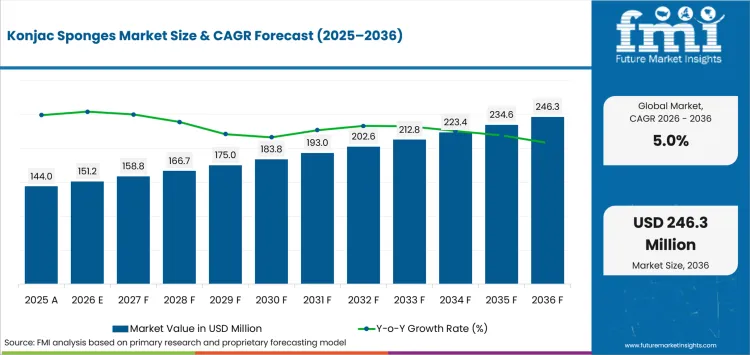
USD 151.2 million in 2026 and USD 246.3 million by 2036 at a 5.0% CAGR.
Demand for konjac sponges is projected to expand at 5.0% CAGR between 2026 and 2036, increasing valuation from USD 151.2 million to USD 246.3 million. Repeated complexion application keeps replacement relevant after consumers settle on a familiar tool for base makeup. Korea's Ministry of Food and Drug Safety reported in January 2026 that 2025 color-cosmetics exports reached USD 1.51 billion and increased 12.0%. That activity gives applicator suppliers a large adjacent purchase route tied directly to foundation and complexion routines rather than a generic accessories trade code.
Retail access is widening at the same time across physical and digital beauty channels. Target announced in August 2026 that Target Beauty Studio would launch on September 10 in more than 600 USA stores and online with 90 beauty brands. The expansion gives shoppers more places to discover makeup formats before reordering familiar tools through Target.com. Sponge suppliers therefore need a clear application purpose and dependable replenishment because larger omnichannel assortments make weakly differentiated formats easier to replace.
Key Takeaways
- Digital discovery supports recurring sponge demand by making a familiar applicator easier to replace after routine use.
- Blending sponges are estimated at 47.0% of product type in 2026, attributable to broad full-face coverage.
- Standard products are projected at 43.0% of nature in 2026, driven by familiar feel and simple replacement.
- Single tools are anticipated at 46.0% of offering in 2026, supported by lower trial commitment and replacement.
- Cleaning and complete drying remain adoption frictions because poor care can reduce confidence before replacement.
- Some of the key players in this market include Beautyblender, Real Techniques, e.l.f. Beauty, and Morphe.
Analyst Perspective
"Konjac sponge offers earn repeat revenue when shape function and care guidance make replacement decisions easy to understand. Retailers should compare application consistency with replenishment logic because low price cannot offset weak differentiation or confusing maintenance."
- Rahul Pandita , Principal Consultant, Future Market Insights
How is the konjac sponges market segmented?
The konjac sponges market is segmented by product type, nature, offering, price tier, sales channel, and region.
Product type covers blending sponges, mini and precision formats, silicone applicators, and sets across different application needs. Nature and offering separate standard, eco and reusable, premium, single-tool, kit, and replacement formats for comparison. Price tier and sales channel distinguish economy, mid-range, premium, e-commerce and DTC, specialty beauty retail, mass retail, and salons.
What makes blending sponges central to the product type category?
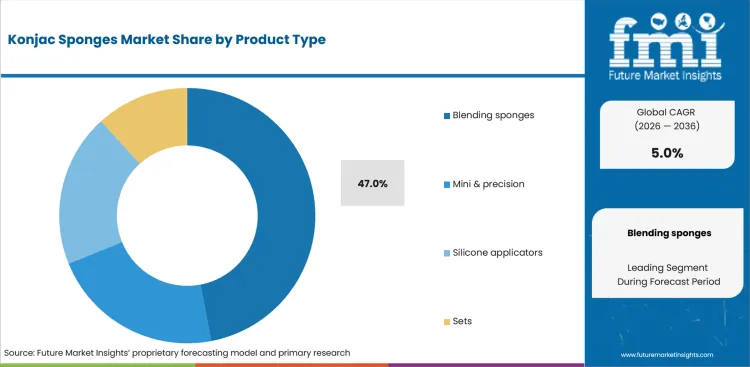
Blending sponges cover broad complexion work without requiring separate tools for every base step. Rounded surfaces handle larger areas while pointed edges improve control near the eyes and nose. Shoppers can compare conventional foam with silicone applicator formats without changing the decision around coverage and finish.
- Blending sponges are estimated to hold 47.0% of product type in 2026 owing to full-face utility and a familiar wet-use application method.
- MOB & KO introduced its Spuffy sponge-and-puff hybrid in August 2026 after developing one tool for both base blending and powder touch-ups. The launch shows how brands can extend the core blending use case by combining adjacent application tasks without requiring a separate purchase.
Why does standard hold the central position in the nature category?
Standard formats are easy to evaluate because users can judge softness and coverage without interpreting a specialized material claim. Eco-oriented tools change expectations inside sponge applicator demand by placing material and hygiene claims beside the familiar technique.
- Standard is forecast to represent 43.0% of nature in 2026 driven by familiar performance during trial and routine replacement purchases.
- Clue announced in April 2026 that the &be makeup sponge series passed antibacterial testing after cumulative series shipments exceeded 4.11 million units. The quality action makes hygiene performance a commercial differentiator for reusable sponge formats without relying on a broad sustainability claim.
How do single tools shape the offering category?
Staining and wear make one-for-one replacement practical, letting shoppers test one shape before paying for a broader kit. The same purchase pattern supports replenishment within color cosmetics routines after a preferred format becomes familiar.
- Single tools account for 46.0% of offering in 2026 attributable to lower trial commitment and straightforward replacement of one frequently used applicator.
- SHIRORU announced in June 2026 that it would launch a dedicated Spot Puff on September 22 after consumers requested a smaller application tool. The decision demonstrates how single-tool launches can address a specific complexion task without forcing shoppers into a broader kit.
What supports mid-range products in the price tier category?
Mid-range sponges sit between inexpensive replacements and premium tools, making repeat-purchase value easier to judge over time. Wider beauty and wellness spending can widen trial when retailers keep recognizable performance within an accessible price band.
- Mid-range is estimated to hold 44.0% of price tier in 2026 supported by recognizable performance without premium specialist pricing.
- e.l.f. Beauty reported in August 2026 that first-quarter fiscal 2027 net sales rose 36% to USD 479.4 million with retailer and e-commerce channels contributing. The result keeps accessible beauty formats commercially visible across both store and digital routes where mid-range applicators compete for repeat purchases.
What drives e-commerce and DTC within the sales channel category?
Small beauty tools suit online retail because merchants can explain shape and cleaning guidance without much shelf space. Once shoppers know the preferred sponge, reordering requires little comparison. Digital discovery also places applicators beside related beauty and personal care purchases in the same checkout journey.
- E-commerce and DTC are projected to account for 35.0% of sales channel in 2026 driven by visual comparison and convenient replenishment.
- Sephora announced in September 2026 that its USA TikTok Shop pilot would begin with monthly curated drops and shoppable LIVE events. That channel development gives small beauty tools another discovery and purchase route without requiring permanent physical shelf expansion.
What are the drivers, restraints and opportunities in the Konjac Sponges Market?
Digital beauty retail supports discovery and replacement, product-care requirements create friction, and differentiated lower-waste materials provide room for new sponge propositions.
- Driver: Omnichannel beauty launches shorten the path from discovery to repeat purchase after consumers understand a preferred sponge format.
- Restraint: Product-safety and hygiene expectations raise the information burden because reusable beauty tools must be sold with credible care and compliance guidance.
- Opportunity: Cross-brand launches can create new trial occasions when a complexion tool reaches buyers through an established partner audience and retail route.
Omnichannel beauty launches strengthen discovery and repeat purchasing
Beauty consumers move between physical stores, brand websitesand digital marketplaces when discovering and repurchasing skincare accessories. In August 2026, Sephora announced that 19 Korean beauty brands curated by OLIVE YOUNG would launch in more than 500 USA stores and on Sephora.com. Although the rollout does not specifically include konjac sponges, it demonstrates how coordinated physical and digital distribution can expand consumer access to emerging beauty categories. Konjac sponge suppliers can apply a similar strategy by placing their products alongside complementary cleansers and skincare products and enabling convenient online replenishment after consumers adopt the product.
Hygiene and maintenance requirements can limit adoption of reusable konjac sponges
Consumer acceptance of reusable beauty tools depends not only on product performance but also on the ease of cleaning and replacement. Because konjac sponges are intended for repeated skin contact, unclear care or replacement instructions may reduce consumer confidence. Brands can address this restraint by providing concise cleaning guidance, recommended replacement intervals and traceability details.
Cross-brand collaborations can expand trial and retail access
Partnerships between skincare and beauty-accessory brands can introduce application tools to consumers who may not actively search for them as standalone products. Konjac sponge suppliers can follow a similar approach through co-branded cleansing routines, skincare starter kits or limited-edition collaborations that demonstrate a clear use case and position the sponge as part of a complete skincare regimen.
Which country CAGRs are covered in the Konjac Sponges Market?
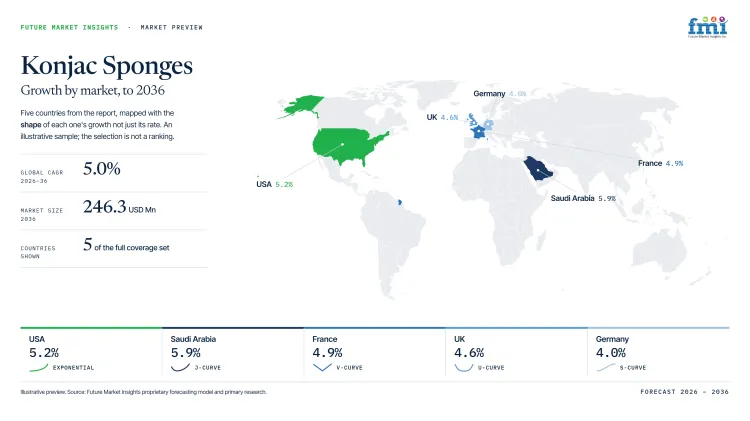
| Country | CAGR |
|---|---|
| UAE | 6.2% |
| Saudi Arabia | 5.9% |
| South Korea | 5.6% |
| USA | 5.2% |
| France | 4.9% |
| UK | 4.6% |
| Japan | 4.3% |
| Germany | 4.0% |
How do country-level CAGRs compare in the Konjac Sponges Market?
The covered countries span 4.0% to 6.2% CAGR with a 2.2 percentage-point gap between Germany and the UAE. The difference is better explained by current beauty-channel conditions than by a broad customs code. Mobile purchasing is especially important in the Gulf, while mature European and Japanese channels put more pressure on differentiation and product information. USA and South Korean evidence points to strong beauty activity across digital and physical routes.
- UAE growth is supported by premium beauty demand and strong mobile purchasing within an e-commerce environment that already includes major cosmetics specialists.
- Saudi Arabia combines high online-purchase participation with substantial cosmetics purchasing, which gives beauty tools a practical mobile route beyond mall discovery.
- South Korea pairs record cosmetics output with strong color-cosmetics exports, increasing launch velocity and competitive pressure around complexion routines.
- USA beauty sales are expanding across stores and digital channels, so established sponge formats compete on replenishment convenience rather than basic availability.
- France retains a substantial international cosmetics position, giving applicator brands access to sophisticated channels while increasing comparison among established alternatives.
- UK beauty channels remain import-intensive, which broadens assortment but also exposes low-differentiation tools to international price and brand competition.
- Japan's pharmaceuticals and cosmetics retail category contributed strongly to 2025 retail growth, supporting active distribution through established drugstore and specialty routes.
- German beauty-care sales and exports grew during the first half of 2026, keeping retail competition active across a mature national beauty market.
Forecast pace therefore reflects how channel access converts into repeat purchase because mature beauty markets can increase competition as readily as they support replacement volume.
Country-wise Analysis
- UAE beauty retail combines premium demand with a mobile-led purchase environment that exposes imported cosmetics and tools before many store visits. Konjac sponge demand in the UAE is projected to grow at 6.2% CAGR through 2036. JETRO reported in March 2026 that the country combines strong mobile purchasing with major cosmetics e-commerce operators and defined import rules. Brands therefore need mobile-ready product information and dependable local fulfillment to convert discovery into repeat orders.
- Saudi beauty purchasing has a strong digital component that extends specialist assortment beyond major physical retail clusters. Demand for konjac sponges in Saudi Arabia is forecast to rise at 5.9% CAGR over the assessment period. GASTAT reported in January 2026 that 80.2% of Saudi individuals purchased goods or services online and cosmetics accounted for 40.2% of online purchases. Trusted retail partners and local inventory remain important because digital access does not guarantee authenticity or dependable delivery.
- South Korean beauty consumers move quickly between health-and-beauty stores and mobile platforms that compress selling windows for new tools. Konjac sponge demand is predicted to advance at 5.6% CAGR through 2036. Korea's Ministry of Food and Drug Safety reported in May 2026 that 2025 cosmetics exports reached USD 11.4 billion and color cosmetics accounted for USD 1.51 billion. That scale keeps K-beauty product demand active while weakly differentiated applicators face rapid substitution.
- USA shoppers can test beauty tools in mass and specialty stores before reordering familiar formats through digital channels. The USA is expected to post 5.2% CAGR through 2036. Target reported in August 2026 that second-quarter beauty sales grew at a high-single-digit rate while digital comparable sales increased 8.7%. That combination gives cosmetics and applicators a strong omnichannel purchase route while increasing pressure on tools without a visible functional difference.
- French beauty shoppers operate inside a mature cosmetics economy with strong international brand and manufacturing depth. France is anticipated to advance at 4.9% CAGR over the assessment period. France Diplomatie reported in February 2026 that perfumes and cosmetics generated a EUR 17 billion trade surplus in 2025. That national strength expands assortment depth and raises the importance of clear use and care information within make-up products packaging and adjacent beauty merchandising.
- UK beauty-tool purchasing sits inside a market with broad international sourcing and mature online retail. Konjac sponge adoption in the UK is forecast to expand at 4.6% CAGR through 2036. CTPA reported in 2026 that UK cosmetics imports had increased 61% versus 2021 and that 65% of imports originated in the EU. That channel depth helps replacement access but also exposes low-differentiation tools to rapid comparison across beauty and personal care packaging and related assortments.
- Japanese shoppers expect compact presentation and dependable performance from established beauty retailers and drugstores. Konjac sponge sales in Japan are forecast to expand at 4.3% CAGR by 2036. METI reported in April 2026 that pharmaceuticals and cosmetics retail made the largest positive contribution to Japan's 2025 retail growth. Brands therefore need precise application roles that earn space beside personalized beauty devices and other small tools in mature assortments.
- German consumers compare beauty tools across established drugstores and online channels where product information is easy to compare. The German konjac sponges sector is projected to record 4.0% CAGR during the assessment period. IKW reported in September 2026 that first-half beauty-care sales increased 1.8% domestically and beauty-care exports increased 4.5%. Retailers therefore reward clear value and dependable replenishment across beauty and personal care packaging categories in a well-supplied market.
Who are the notable companies in the Konjac Sponges Market?
Beautyblender, Real Techniques, e.l.f. Beauty, and Morphe are notable companies with current direct makeup-sponge participation.
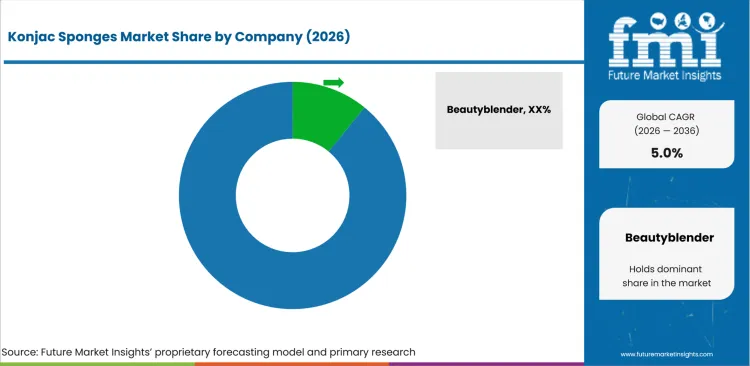
The direct company set contains four brands with current 2026 makeup-sponge or closely matched applicator activity: Beautyblender, Real Techniques, e.l.f. Beauty, and Morphe. Parent ownership is stated only where it affects a current operating brand or distribution route.
- Beautyblender tied a new reusable sponge-format launch to Sephora activation, while Real Techniques continues inside Future Beauty Brands' global beauty-tool platform.
- e.l.f. Beauty launched the Briny Blender across several national retail routes, while Morphe supported its Buttery Blends tool launch with a dedicated January campaign.
- Across the four-brand set, launch cadence and route-to-market breadth determine how quickly a new applicator can move from discovery into routine replacement.
Competitive Benchmarking: Konjac Sponges Market
| Company | Exact-market action | Retail route breadth | Access model | Geographic reach |
|---|---|---|---|---|
| Beautyblender | High | Medium | Medium | United States through Sephora and DTC |
| Real Techniques | Medium | High | High | 70+ markets through Future Beauty Brands |
| e.l.f. Beauty | High | High | High | USA, UK and Germany |
| Morphe | High | Medium | High | United States and UK direct retail |
Ratings compare dated 2026 company actions and verified distribution routes across the defined sponge and applicator scope. High exact-market action requires a launch or activation centered on a sponge or closely matched applicator, while medium reflects an immediate-family beauty-tool action linked to the same buyer route. Retail-route and access scores reflect documented store plus digital availability. Geographic reach remains descriptive rather than a reputation ranking.
Key Developments in the Konjac Sponges Market
- In July 2026, Beautyblender paired the Sephora launch of The Resetter with a Citi Bike activation across New York, linking a new reusable sponge-format release to physical discovery.
- In August 2026, e.l.f. Beauty launched the Briny Blender through elfcosmetics.com, Ulta.com and TikTok Shop before physical rollouts at Ulta Beauty, Boots and dm.
- In January 2026, Morphe ran an official launch giveaway for its new Buttery Blends Brush Collection, whose launch included a sponge-and-puff Tool Duo within the applicator assortment.
Key Players in the Konjac Sponges Market
Direct Sponge and Complexion Applicator Brands
- Beautyblender
- Real Techniques
- e.l.f. Beauty
- Morphe
Konjac Sponges Market - Report Scope
| Coverage field | Report scope |
|---|---|
| Market breakdown | By product type, nature, offering, price tier, sales channel, and region. |
| Quantitative Units | USD million. |
| Market Definition | Revenue includes consumer and professional sales of konjac sponges and the sponge or applicator formats classified within the stated segmentation universe when sold as standalone tools, sets, or replacement items. Downstream finished-product revenue and unrelated substitute products are excluded. |
| Regions Covered | North America, Latin America, Western Europe, Eastern Europe, East Asia, South Asia and Pacific, and Middle East and Africa. |
| Countries Covered | UAE, Saudi Arabia, South Korea, USA, France, UK, Japan, Germany, and more than twenty-five additional countries in the full report. |
| Key Companies Covered | Beautyblender, Real Techniques, e.l.f. Beauty, Morphe. |
| Forecast Period | 2026 to 2036. |
| Approach | Hybrid bottom-up and top-down sizing reconciles sponge-format revenue signals with channel availability, replacement behavior, company participation, country conditions, and the authorized forecast model before final estimates are applied. |
Konjac Sponges Market - Research Methodology
| Method | Approach |
|---|---|
| Primary Research | FMI analysts gathered input from beauty-tool manufacturers, distributors, specialty retailers, mass retailers, professional users, and category buyers. Interviews examined sponge replacement behavior, launch evaluation, retail selection, price thresholds, care requirements, and the conditions that move a trial purchase into routine replenishment. |
| Desk Research | Desk research prioritized national government statistics, regulator publications, recognized industry associations, official company newsrooms, investor-relations releases, and dated corporate announcements. Product catalog descriptions and undated commercial listings were excluded as evidence for market developments. |
| Market Sizing and Forecasting | The market model combines the authorized baseline with historical performance, segment structure, replacement indicators, channel access, company participation, and country demand conditions. Segment and regional estimates are reconciled before the final 2026 to 2036 forecast is calculated. |
| Data Validation | Estimates are checked against independent national beauty indicators, dated company actions, verified launch routes, and findings from primary interviews. Broad proxy trade codes, unsupported claims, overlapping revenues, and products outside the defined sponge and applicator boundary are excluded. |
Konjac Sponges Market by Segments
Konjac Sponges Market segmented by Product Type:
- Blending sponges
- Mini & precision
- Silicone applicators
- Sets
Konjac Sponges Market segmented by Nature:
- Standard
- Eco & reusable
- Premium & pro-grade
Konjac Sponges Market segmented by Offering:
- Single tools
- Sets & kits
- Refills & replacements
Konjac Sponges Market segmented by Price Tier:
- Mid-range
- Economy
- Premium
Konjac Sponges Market segmented by Sales Channel:
- E-commerce & DTC
- Specialty beauty retail
- Mass retail
- Salons
Konjac Sponges Market by Region:
- North America
- United States
- Canada
- Latin America
- Brazil
- Mexico
- Argentina
- Chile
- Western Europe
- Germany
- France
- United Kingdom
- Italy
- Spain
- Benelux
- Nordics
- Eastern Europe
- Poland
- Czech Republic
- Romania
- Hungary
- East Asia
- China
- Japan
- South Korea
- South Asia and Pacific
- India
- ASEAN
- Australia and New Zealand
- Middle East and Africa
- GCC Countries
- South Africa
- Türkiye
- Israel
Research Sources and Bibliography
- Korea.net. (2026, January 13). Year of beauty: cosmetics exports hit record USD 11.4B in 2025. Source
- Target Corporation. (2026, August 26). Target Launches Target Beauty Studio, Its Destination for What's New, Now and Next in Beauty. Source
- MOB & KO. (2026, August 26). Meet the Spuffy: Why We Created a Sponge and Puff Hybrid. Source
- Clue Co., Ltd. / &be. (2026, April 15). Makeup sponge series passes antibacterial testing after cumulative shipments exceed 4.11 million units. Source
- SHIRORU Co., Ltd. (2026, June 30). SHIRORU announces Spot Puff launch for September 22, 2026. Source
- e.l.f. Beauty. (2026, August 5). e.l.f. Beauty Announces First Quarter Fiscal 2027 Results. Source
- Sephora. (2026, September 2). Sephora launches on TikTok Shop, bringing a new beauty shopping experience to USA customers with its Sephora Drop Shop. Source
- Sephora. (2026, August 4). SEPHORA Introduces OLIVE YOUNG-Curated K-Beauty to USA Consumers Beginning August 20. Source
- Office for Product Safety and Standards. (2026, August 27). Product Safety Database report 2025 to 2026. Source
- e.l.f. Beauty. (2026, August 3). e.l.f. and Bubble Launch Limited-Edition Hybrid Holy Grails in Skincare-Makeup Collaboration. Source
- Japan External Trade Organization. (2026, March 31). Overview of e-commerce and the cosmetics market in the United Arab Emirates, March 2026. Source
- General Authority for Statistics. (2026, January 5). ICT Access and Usage Statistics by Households and Individuals 2025. Source
- Korea.net. (2026, May 26). Cosmetics surplus breaks USD 10B, exports ranked 2nd worldwide. Source
- Target Corporation. (2026, August 19). Target Corporation Reports Second Quarter Earnings. Source
- France Diplomatie. (2026, February 6). Commerce extérieur 2025 : une amélioration confirmée et un cap clair pour 2026. Source
- Cosmetic, Toiletry and Perfumery Association. (2026). CTPA's Global View. Source
- Ministry of Economy, Trade and Industry. (2026, April 14). 2025 retail sales review: retail sales increased for a fifth consecutive year. Source
- Industrieverband Körperpflege- und Waschmittel. (2026, September 1). Export wieder im Plus. Source
- Beautyblender. (2026, July 21). Beautyblender at Citi Bike Giveaway Terms and Conditions. Source
- Beautyblender. (2026). Company updates covering The Resetter Sephora launch and the Glow Recipe collaboration. Source
- Morphe. (2026, January 20). Sweepstakes Terms: Buttery Blends Giveaway. Source
- Yellow Wood Partners. (2026, July 22). Future Beauty Brands Appoints Heather Wallace as Chief Executive Officer. Source
- European Commission. (2026, March 9). Increased action against dangerous products in the EU in 2025. Source
- e.l.f. Beauty. (2026, August 19). e.l.f. Cosmetics Answers Community Demand with the Return of Pickle-Inspired Glow Reviver Melting Lip Balms. Source
- e.l.f. Beauty. (2026, August 26). e.l.f. Brands Will Surprise and Delight as the Only Beauty Brand at the Minnesota State Fair. Source
This bibliography is provided for reader reference and is not exhaustive. The full report contains the complete reference list and detailed citations.
This Report Answers
- What is the market-size forecast?
- Which product type leads?
- Which nature segment leads?
- Which offering leads?
- Why does e-commerce matter?
- How do country CAGRs compare?
- What are the main driver, restraint, and opportunity?
- Which direct makeup-sponge companies are active?
Frequently Asked Questions
How big is the Konjac Sponges Market in 2026?
The konjac sponges market is valued at USD 151.2 million in 2026 and is projected to reach USD 246.3 million by 2036. Recurring complexion-tool use and easier digital replenishment give consumers a practical reason to replace familiar sponge formats.
What is the CAGR of the Konjac Sponges Market from 2026 to 2036?
The konjac sponges market is projected to grow at a CAGR of 5.0% between 2026 and 2036. Digital beauty retail and replacement of frequently used sponge applicators support repeat purchases through familiar channels.
Which product type leads the Konjac Sponges Market?
The blending sponges segment is expected to hold 47.0% of the konjac sponges market by product type in 2026, attributable to broad coverage and familiar wet-use application. One familiar shape can cover several complexion steps without requiring a separate tool for each application.
Which nature segment holds the stated share in the Konjac Sponges Market?
The standard segment is projected to represent 43.0% of the konjac sponges market by nature in 2026, driven by familiar feel and straightforward replacement. Eco-oriented alternatives compete by changing material claims while preserving the familiar blending technique consumers already understand.
Which companies are active in the Konjac Sponges Market?
The active company set includes Beautyblender and Real Techniques alongside e.l.f. Beauty and Morphe. Each has current direct evidence for makeup sponges or closely matched complexion-applicator formats sold through identifiable retail routes.
Preview the report firsthand - request a free sample
Get SampleGet the brochure for pricing and purchase details.
Get PDFTable of Content
- Key Takeaways
- Market Size and CAGR
- Top Growth Driver
- Fastest Growing Segment
- Leading Region
- Key Companies
- Emerging Opportunities
- Executive Summary
- Global Market Outlook
- Demand-side Trends
- Supply-side Trends
- Technology Roadmap Analysis
- Analysis and Recommendations
- Analyst Perspective (What is happening? Why now? What should investors know?)
- Key Questions Answered
- How large is the market?
- What is the CAGR?
- What are key trends?
- Which region dominates?
- Who are the leaders?
- Market Overview
- Market Coverage / Taxonomy
- Market Definition / Scope / Limitations
- Research Methodology
- Chapter Orientation
- Analytical Lens and Working Hypotheses
- Market Structure, Signals, and Trend Drivers
- Benchmarking and Cross-market Comparability
- Market Sizing, Forecasting, and Opportunity Mapping
- Research Design and Evidence Framework
- Desk Research Programme (Secondary Evidence)
- Expert Input and Fieldwork (Primary Evidence)
- Tooling, Models, and Reference Databases
- Data Engineering and Model Build
- Quality Assurance and Audit Trail
- Market Background
- Market Dynamics (Drivers, Restraints, Opportunity, Trends)
- Scenario Forecast (Optimistic, Likely, Conservative)
- Impact Analysis
- AI Impact
- Sustainability Impact
- Regulatory Impact
- Technology Impact
- Consumer / Buyer Analysis
- Purchase Drivers
- Adoption Barriers
- Buyer Journey
- Opportunity Map Analysis
- Product Life Cycle Analysis
- Supply Chain Analysis
- Investment Feasibility Matrix
- Value Chain Analysis
- PESTLE and Porter's Analysis
- Regulatory Landscape
- Regional Parent Market Outlook
- Production and Consumption Statistics
- Import and Export Statistics
- Global Market Analysis and Forecast, 2021 to 2036
- Historical Market Size Value (USD Million) Analysis, 2021 to 2025
- Current and Future Market Size Value (USD Million) Projections, 2026 to 2036
- Y-o-Y Growth Trend Analysis
- Absolute $ Opportunity Analysis
- Global Market Pricing Analysis, 2021 to 2036
- Global Market Analysis and Forecast, By Product Type, 2021 to 2036
- Introduction / Key Findings
- Historical Market Size Value (USD Million) Analysis By Product Type, 2021 to 2025
- Current and Future Market Size Value (USD Million) Analysis and Forecast By Product Type, 2026 to 2036
- Blending sponges
- Mini & precision
- Silicone applicators
- Sets
- Blending sponges
- Y-o-Y Growth Trend Analysis By Product Type, 2021 to 2025
- Absolute $ Opportunity Analysis By Product Type, 2026 to 2036
- Global Market Analysis and Forecast, By Nature, 2021 to 2036
- Introduction / Key Findings
- Historical Market Size Value (USD Million) Analysis By Nature, 2021 to 2025
- Current and Future Market Size Value (USD Million) Analysis and Forecast By Nature, 2026 to 2036
- Standard
- Eco & reusable
- Premium & pro-grade
- Standard
- Y-o-Y Growth Trend Analysis By Nature, 2021 to 2025
- Absolute $ Opportunity Analysis By Nature, 2026 to 2036
- Global Market Analysis and Forecast, By Offering, 2021 to 2036
- Introduction / Key Findings
- Historical Market Size Value (USD Million) Analysis By Offering, 2021 to 2025
- Current and Future Market Size Value (USD Million) Analysis and Forecast By Offering, 2026 to 2036
- Single tools
- Sets & kits
- Refills & replacements
- Single tools
- Y-o-Y Growth Trend Analysis By Offering, 2021 to 2025
- Absolute $ Opportunity Analysis By Offering, 2026 to 2036
- Global Market Analysis and Forecast, By Price Tier, 2021 to 2036
- Introduction / Key Findings
- Historical Market Size Value (USD Million) Analysis By Price Tier, 2021 to 2025
- Current and Future Market Size Value (USD Million) Analysis and Forecast By Price Tier, 2026 to 2036
- Mid-range
- Economy
- Premium
- Mid-range
- Y-o-Y Growth Trend Analysis By Price Tier, 2021 to 2025
- Absolute $ Opportunity Analysis By Price Tier, 2026 to 2036
- Global Market Analysis and Forecast, By Sales Channel, 2021 to 2036
- Introduction / Key Findings
- Historical Market Size Value (USD Million) Analysis By Sales Channel, 2021 to 2025
- Current and Future Market Size Value (USD Million) Analysis and Forecast By Sales Channel, 2026 to 2036
- E-commerce & DTC
- Specialty beauty retail
- Mass retail
- Salons
- E-commerce & DTC
- Y-o-Y Growth Trend Analysis By Sales Channel, 2021 to 2025
- Absolute $ Opportunity Analysis By Sales Channel, 2026 to 2036
- Global Market Analysis and Forecast, By Region, 2021 to 2036
- Introduction
- Historical Market Size Value (USD Million) Analysis By Region, 2021 to 2025
- Current Market Size Value (USD Million) Analysis and Forecast By Region, 2026 to 2036
- North America
- Latin America
- Western Europe
- Eastern Europe
- East Asia
- South Asia and Pacific
- Middle East & Africa
- Market Attractiveness Analysis By Region
- North America Market Analysis and Forecast, By Country, 2021 to 2036
- Historical Market Size Value (USD Million) Trend Analysis By Market Taxonomy, 2021 to 2025
- Market Size Value (USD Million) Forecast By Market Taxonomy, 2026 to 2036
- By Country
- USA
- Canada
- By Product Type
- By Nature
- By Offering
- By Price Tier
- By Sales Channel
- By Country
- Market Attractiveness Analysis
- By Country
- By Product Type
- By Nature
- By Offering
- By Price Tier
- By Sales Channel
- Key Takeaways
- Latin America Market Analysis and Forecast, By Country
- Historical Market Size Value (USD Million) Trend Analysis By Market Taxonomy, 2021 to 2025
- Market Size Value (USD Million) Forecast By Market Taxonomy, 2026 to 2036
- By Country
- Brazil
- Mexico
- Chile
- Rest of Latin America
- By Product Type
- By Nature
- By Offering
- By Price Tier
- By Sales Channel
- By Country
- Market Attractiveness Analysis
- By Country
- By Product Type
- By Nature
- By Offering
- By Price Tier
- By Sales Channel
- Key Takeaways
- Western Europe Market Analysis and Forecast, By Country
- Historical Market Size Value (USD Million) Trend Analysis By Market Taxonomy, 2021 to 2025
- Market Size Value (USD Million) Forecast By Market Taxonomy, 2026 to 2036
- By Country
- Germany
- UK
- Italy
- Spain
- France
- Nordic
- BENELUX
- Rest of Western Europe
- By Product Type
- By Nature
- By Offering
- By Price Tier
- By Sales Channel
- By Country
- Market Attractiveness Analysis
- By Country
- By Product Type
- By Nature
- By Offering
- By Price Tier
- By Sales Channel
- Key Takeaways
- Eastern Europe Market Analysis and Forecast, By Country
- Historical Market Size Value (USD Million) Trend Analysis By Market Taxonomy, 2021 to 2025
- Market Size Value (USD Million) Forecast By Market Taxonomy, 2026 to 2036
- By Country
- Russia
- Poland
- Hungary
- Balkan & Baltic
- Rest of Eastern Europe
- By Product Type
- By Nature
- By Offering
- By Price Tier
- By Sales Channel
- By Country
- Market Attractiveness Analysis
- By Country
- By Product Type
- By Nature
- By Offering
- By Price Tier
- By Sales Channel
- Key Takeaways
- East Asia Market Analysis and Forecast, By Country
- Historical Market Size Value (USD Million) Trend Analysis By Market Taxonomy, 2021 to 2025
- Market Size Value (USD Million) Forecast By Market Taxonomy, 2026 to 2036
- By Country
- China
- Japan
- South Korea
- By Product Type
- By Nature
- By Offering
- By Price Tier
- By Sales Channel
- By Country
- Market Attractiveness Analysis
- By Country
- By Product Type
- By Nature
- By Offering
- By Price Tier
- By Sales Channel
- Key Takeaways
- South Asia and Pacific Market Analysis and Forecast, By Country
- Historical Market Size Value (USD Million) Trend Analysis By Market Taxonomy, 2021 to 2025
- Market Size Value (USD Million) Forecast By Market Taxonomy, 2026 to 2036
- By Country
- India
- ASEAN
- Australia & New Zealand
- Rest of South Asia and Pacific
- By Product Type
- By Nature
- By Offering
- By Price Tier
- By Sales Channel
- By Country
- Market Attractiveness Analysis
- By Country
- By Product Type
- By Nature
- By Offering
- By Price Tier
- By Sales Channel
- Key Takeaways
- Middle East & Africa Market Analysis and Forecast, By Country
- Historical Market Size Value (USD Million) Trend Analysis By Market Taxonomy, 2021 to 2025
- Market Size Value (USD Million) Forecast By Market Taxonomy, 2026 to 2036
- By Country
- Kingdom of Saudi Arabia
- Other GCC Countries
- Türkiye
- South Africa
- Other African Union
- Rest of Middle East & Africa
- By Product Type
- By Nature
- By Offering
- By Price Tier
- By Sales Channel
- By Country
- Market Attractiveness Analysis
- By Country
- By Product Type
- By Nature
- By Offering
- By Price Tier
- By Sales Channel
- Key Takeaways
- Key Countries Market Analysis
- USA
- Pricing Analysis
- Market Share Analysis, 2025
- By Product Type
- By Nature
- By Offering
- By Price Tier
- By Sales Channel
- Canada
- Pricing Analysis
- Market Share Analysis, 2025
- By Product Type
- By Nature
- By Offering
- By Price Tier
- By Sales Channel
- Mexico
- Pricing Analysis
- Market Share Analysis, 2025
- By Product Type
- By Nature
- By Offering
- By Price Tier
- By Sales Channel
- Brazil
- Pricing Analysis
- Market Share Analysis, 2025
- By Product Type
- By Nature
- By Offering
- By Price Tier
- By Sales Channel
- Chile
- Pricing Analysis
- Market Share Analysis, 2025
- By Product Type
- By Nature
- By Offering
- By Price Tier
- By Sales Channel
- Germany
- Pricing Analysis
- Market Share Analysis, 2025
- By Product Type
- By Nature
- By Offering
- By Price Tier
- By Sales Channel
- UK
- Pricing Analysis
- Market Share Analysis, 2025
- By Product Type
- By Nature
- By Offering
- By Price Tier
- By Sales Channel
- Italy
- Pricing Analysis
- Market Share Analysis, 2025
- By Product Type
- By Nature
- By Offering
- By Price Tier
- By Sales Channel
- Spain
- Pricing Analysis
- Market Share Analysis, 2025
- By Product Type
- By Nature
- By Offering
- By Price Tier
- By Sales Channel
- France
- Pricing Analysis
- Market Share Analysis, 2025
- By Product Type
- By Nature
- By Offering
- By Price Tier
- By Sales Channel
- India
- Pricing Analysis
- Market Share Analysis, 2025
- By Product Type
- By Nature
- By Offering
- By Price Tier
- By Sales Channel
- ASEAN
- Pricing Analysis
- Market Share Analysis, 2025
- By Product Type
- By Nature
- By Offering
- By Price Tier
- By Sales Channel
- Australia & New Zealand
- Pricing Analysis
- Market Share Analysis, 2025
- By Product Type
- By Nature
- By Offering
- By Price Tier
- By Sales Channel
- China
- Pricing Analysis
- Market Share Analysis, 2025
- By Product Type
- By Nature
- By Offering
- By Price Tier
- By Sales Channel
- Japan
- Pricing Analysis
- Market Share Analysis, 2025
- By Product Type
- By Nature
- By Offering
- By Price Tier
- By Sales Channel
- South Korea
- Pricing Analysis
- Market Share Analysis, 2025
- By Product Type
- By Nature
- By Offering
- By Price Tier
- By Sales Channel
- Russia
- Pricing Analysis
- Market Share Analysis, 2025
- By Product Type
- By Nature
- By Offering
- By Price Tier
- By Sales Channel
- Poland
- Pricing Analysis
- Market Share Analysis, 2025
- By Product Type
- By Nature
- By Offering
- By Price Tier
- By Sales Channel
- Hungary
- Pricing Analysis
- Market Share Analysis, 2025
- By Product Type
- By Nature
- By Offering
- By Price Tier
- By Sales Channel
- Kingdom of Saudi Arabia
- Pricing Analysis
- Market Share Analysis, 2025
- By Product Type
- By Nature
- By Offering
- By Price Tier
- By Sales Channel
- Türkiye
- Pricing Analysis
- Market Share Analysis, 2025
- By Product Type
- By Nature
- By Offering
- By Price Tier
- By Sales Channel
- South Africa
- Pricing Analysis
- Market Share Analysis, 2025
- By Product Type
- By Nature
- By Offering
- By Price Tier
- By Sales Channel
- USA
- Market Structure Analysis
- Competition Dashboard
- Competition Benchmarking
- Market Share Analysis of Top Players
- By Regional
- By Product Type
- By Nature
- By Offering
- By Price Tier
- By Sales Channel
- Emerging Startups
- Innovation Benchmarking
- Competition Analysis
- Competition Deep Dive
- Beautyblender
- Overview
- Product Portfolio
- Profitability by Market Segments
- Sales Footprint
- Strategy Overview
- Marketing Strategy
- Product Strategy
- Channel Strategy
- EcoTools
- Slip
- Paris Presents
- Kiss Products
- e.l.f. Beauty
- Conair
- Tangle Teezer
- Sigma Beauty
- Kitsch
- Beautyblender
- Case Studies
- Success Stories
- Recent Developments
- Competition Deep Dive
- Assumptions & Acronyms Used


