

- Market Size (2026)
- USD 1134.7 Mn
- Forecast (2036)
- USD 1994.0 Mn
- CAGR (2026 to 2036)
- 5.8%
How big is LNG Containment Resins Market in 2026?
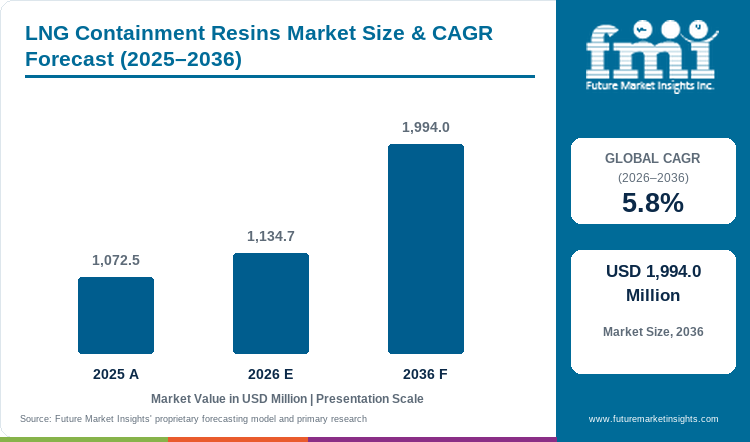
USD 1,134.7 million in 2026 and USD 1,994.0 million by 2036, expanding at 5.8% CAGR.
Sales of LNG containment resins are estimated to rise at 5.8% CAGR through 2036, increasing valuation from USD 1,072.5 million in 2025 to USD 1,134.7 million in 2026, and reaching USD 1,994.0 million by 2036. Tank designers test each resin in extreme cold before approval. In January 2026 the International Maritime Organization put new IGC Code material rules into force. The rules keep cold-test proof at the center of carrier design. Project teams need clear data before they approve a resin for use.
Finland is projected to grow at 7.0% CAGR through 2036 compared with 4.9% for Japan. Finland has a small terminal system, so clear booking windows can bring resin orders into the same work period. In July 2026 Gasgrid offered 21 Inkoo FSRU slots of 950 GWh each for 2027. Japan has a mature LNG import base with long test records. Nordic projects can group resin orders around terminal work. Japanese programs rely more on proven resins, repeat tests, and local expert help.
Key Takeaways
- Cold-service tests and project timing decide when LNG work becomes an approved resin order.
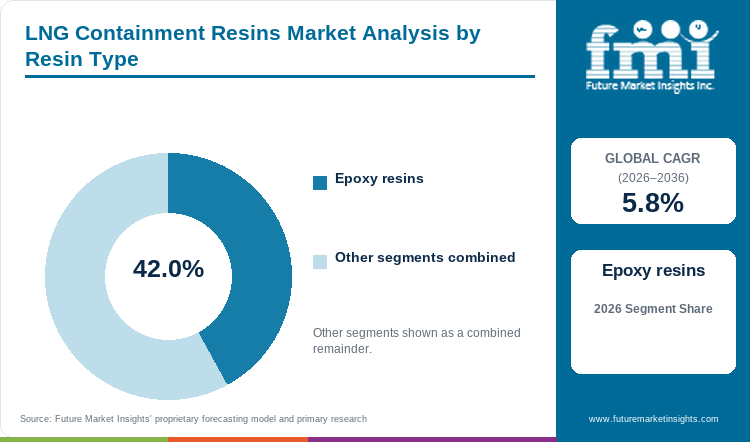
- By resin type, epoxy resins are estimated to hold 42.0% in 2026, owing to bond control during factory work and repairs.
- In 2026, secondary barriers are expected to lead application with 31.0% share, supported by large bonded safety areas that need approved resins.
- In 2026, LNG carriers are expected to lead end use with 34.0% share, attributed to vessel programs that need approved resin packages.
- Long approval cycles limit switching because a resin change can reopen cold, leak, fire, and process tests.
- Key players include Huntsman, Westlake Epoxy, Olin Epoxy, Sika, and Syensqo. The list also includes Gurit, Hexion, Mitsubishi Chemical Group, Swancor, and Sicomin.
Analyst Perspective
"Resin suppliers win project access by proving their resins work in extreme cold. They keep that access through steady support because late resin changes can delay vessel or tank work."
- Nikhil Kaitwade, Principal Consultant, Future Market Insights
How is the LNG containment resins market segmented?
The LNG containment resins market is segmented by Resin Type, Application, End Use, Form, Sales Channel, and Region.
The market uses six main ways to group demand. They are resin type, application, end use, form, sales channel, and region. Resin type includes epoxy, polyurethane, and vinyl ester resins. It also includes phenolic and specialty cryogenic resins. Application includes secondary barriers, composite supports, and insulation bonding. It also includes membrane supports and repair laminates. End use includes LNG carriers, onshore tanks, and floating LNG. It also includes small-scale LNG tanks and cryogenic containers. Form includes liquid systems, film adhesives, prepregs, and filled compounds. Sales channels include tank system suppliers, composite fabricators, EPC projects, and specialty distributors.
What makes epoxy resins central to the resin type category?
Engineers use epoxy in structural adhesive work to set cure speed and bond thickness. Formulators change the mix for factory jobs or repairs. In May 2026 Westlake gained ISCC PLUS certification for liquid epoxy, solid epoxy, and epoxy blends. Buyers can use that record during resin checks.
- Epoxy resins are set to lead the resin type category with 42.0% share in 2026, supported by factory bonding and repair needs.
- General epoxy data cannot replace cold tests for the exact job. Suppliers need thermal-cycle and leak results before approval.
How do secondary barriers shape demand within the application category?
Secondary barriers catch LNG if the first barrier leaks. Their bonds must stay strong through many cooling cycles. Resin choice affects cold insulation and the layers that strengthen the barrier. IMO rules that took effect in January 2026 cover cold-service products under the IGC and IGF Codes. Project teams need clear test records before approval.
- By application, secondary barriers are forecast to represent 31.0% in 2026, tied to large bonded areas and strict record checks.
- Repair teams need resins that keep a strong bond through cold shrinkage without forcing the full system through new tests.
What role do LNG carriers play within the end use category?
LNG carriers bring many approved bonds into one vessel. Resin packages cover barrier joints while marine composites support repair work. In July 2026 GTT ordered Mark III Flex designs for four 175,000-cubic-meter carriers. One approved resin set can serve several ships in the same program. That reuse can reduce repeat testing once the project accepts the resin.
- In 2026, LNG carriers are expected to lead end use with 34.0% share, driven by approved resin packages for vessels and repairs.
- Dry-dock repairs create another order cycle because cure time and resin match affect how soon a vessel returns to service.
What supports liquid resin systems within the form category?
Liquid systems work for infusion, potting, wet lamination, and field bonding. They also support prepreg materials during gap filling and repair work. In February 2026 Sicomin said it would show CMR-free epoxy systems at JEC World. The company is focusing on safer handling while keeping the resin ready for project checks. Crews can meter liquid systems on uneven shapes and small repair areas.
- By form, liquid resin systems are forecast to represent 46.0% in 2026, supported by easy use on uneven parts and repairs.
- Crews must control mix ratio, heat, moisture, and cure records during factory work or field repairs.
Why do tank system suppliers lead the sales channel category?
Tank system suppliers shape resin approval before shipyards or fabricators buy resin. Project plans connect membranes, insulation, industrial adhesives, and reinforcement in one design. In July 2026 GTT received an order for eight Mark III Flex tanks on the first US FLNG unit. The tanks hold 180,000 cubic meters in total. Project teams can lock the design years before resin orders start. Suppliers need approval records early so the chosen resin stays in the plan.
- Tank system suppliers are set to lead the sales channel category with 36.0% share in 2026, tied to design and approval records.
- Clear work steps and batch records help resin suppliers gain project access before fabricators place orders.
What are the drivers, restraints and opportunities in the LNG Containment Resins Market?
New containment projects expand qualified resin packages, long approval cycles restrict substitution, and safer composite chemistry offers a route to differentiated supply.
- Driver: New carriers, tanks, and floating LNG units add bonded parts that need approved resin systems for construction and repair work.
- Restraint: Cold-service tests and change rules can delay a new resin once project teams lock the material choice.
- Opportunity: Suppliers can win new work with safer resins that keep the cold performance each project needs.
New project awards turn design work into approved resin packages
New LNG vessels and floating units need barrier bonds and support parts that use approved resin systems. In July 2026 GTT received an order for Delfin FLNG 1 with eight Mark III Flex tanks. That order fixes the tank design before the main resin purchases start. Resin suppliers are competing for a place during design and testing. Cryogenic tank systems need clear cold-service records because one late resin change can affect several joined layers. A project award alone does not create resin sales. Sales start when the chosen resin enters the approved resin list and plants can supply the same grade in every batch. Early expert work helps a resin stay inside the project schedule.
Low-temperature approval makes resin changes harder after specifications close
A resin change can alter bond strength and shrinkage at one joint. It can also change leak resistance or fire response under a new cure plan. IMO rules that took effect in 2026 keep cold-service resin performance inside the gas-carrier safety system. The rules do not approve a resin brand or replace project tests. They require strong test proof for cargo systems that work in extreme cold. Epoxy resin systems need test data for the exact job before a licensor or class body accepts them. Testing uses engineering time and can miss a project window. An approved system keeps an advantage when a new resin cannot prove equal performance before design freeze.
Safer resin chemistry can reduce handling risks without changing the buying test
Formulators are removing hazardous ingredients from advanced resin systems while keeping the same work performance. At JEC World 2026 Syensqo presented high-performance composite materials with lower-impact design choices. Those products are not direct LNG containment products. They matter here because composite resins use many of the same factory and test steps. A safer resin can enter a project once cold tests confirm the same bond performance. Project teams can then reduce handling risks without changing the design rules. Repair work gives teams a controlled place to test new resin. A good entry point is a repair or approval program with planned testing, local support on site, and clear test limits.
Which country CAGRs are profiled in the LNG Containment Resins Market?
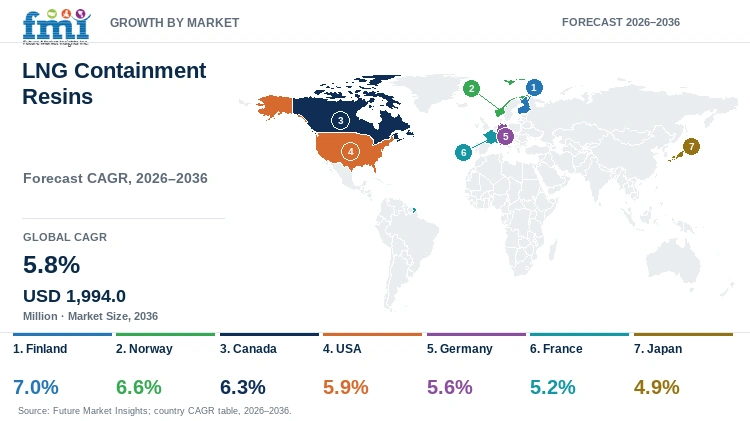
| Country | CAGR |
|---|---|
| Finland | 7.0% |
| Norway | 6.6% |
| Canada | 6.3% |
| USA | 5.9% |
| Germany | 5.6% |
| France | 5.2% |
| Japan | 4.9% |
How do country-level CAGRs compare in the LNG Containment Resins Market?
Finland and Norway form the upper growth band because planned terminal work can move a small project base quickly. Canada follows as LNG exports move from construction into operation. The USA and Germany grow at slower rates as large projects work through fixed review steps. France and Japan follow because mature assets spread resin orders across longer repair and service cycles.
- Finland can group resin orders around clear terminal bookings and planned repair windows for marine work.
- Norway's Arctic and offshore work raises the need for proven cold-weather strength and quick repair support.
- Canada is moving resin orders from LNG construction toward export work and regular repair needs.
- US EPC schedules can lock resin choices before a terminal reaches the main stage for buying materials.
- German terminal work favors resins that match old systems and meet current EU chemical rules.
- French gas-network limits can change repair timing and move work between the country's main entry points.
- Japanese buyers favor proven resins and local technical help during careful reviews and repeat tests.
Similar CAGRs can create different order patterns because each country has its own test, repair, and maintenance needs.
The full report gives country-level CAGR trends for North America and Latin America. It also covers Western Europe, Eastern Europe, East Asia, and South Asia and Pacific. The final region is the Middle East and Africa.
Country-wise Analysis
- Finland runs LNG demand through a small national terminal network with clear booking windows. By 2036, Finland is projected to grow at 7.0% CAGR, supported by planned terminal and marine work. Gasgrid opened long-term capacity booking in September 2026 for the Inkoo FSRU from 2028 to 2032. A small customer base can make resin orders uneven during a strong project year. Suppliers need Nordic stock and field teams for repair work. Crews also need clear batch records and simple work steps. Approved resin must reach the job on time because a late delivery can extend maintenance and delay the next terminal slot.
- Norway uses resins in cold offshore and Arctic sites that have short shutdown windows. LNG containment resin demand in Norway is forecast to rise at 6.6% CAGR through 2036, shaped by harsh service conditions. The Norwegian Offshore Directorate says Snøhvit gas moves to Melkøya before storage in dedicated LNG tanks. Remote work makes errors and missing records more costly. Vinyl ester systems can serve some composite jobs but need the same careful checks. Suppliers need clear batch records and repair steps that crews can follow on site. Cold weather leaves less room for avoidable rework. Fast expert help matters because a missed shutdown window can delay work and raise service costs.
- Canada is moving resin demand from LNG build work into exports and new coastal projects. Canada is estimated to post 6.3% CAGR through 2036, linked to new export capacity and approved projects. Canada's energy regulator said LNG Canada exported 0.295 Bcf/d in 2025. The first LNG shipments began in June 2025. Long shipping routes can separate resin approval from final delivery. Local and Indigenous participation rules can shape which service firms join the work. Suppliers need stock and trained teams in British Columbia. They also need the same batch quality through long project plans. Early resin approval can cut repeat tests and work delays.
- US project teams set resin choices in EPC and licensor plans before terminals place the main resin orders. In the USA, LNG containment resin demand is predicted to advance at 5.9% CAGR through 2036, influenced by new export approvals. In February 2026 the Department of Energy approved a 12% export increase for Corpus Christi. The approval raised total authorization to 4.45 Bcf/d. Large projects can create strong resin volumes once resins pass testing. Their size makes late changes harder because contractors follow fixed plans. Suppliers need to join tests before design freeze. Early approval can support tank, vessel, and repair work without repeat tests or buying delays.
- German LNG work combines import terminals with retrofit jobs and detailed chemical records. LNG containment resin sales in Germany are forecast to expand at 5.6% CAGR by 2036, tied to terminal use and upgrade work. Bundesnetzagentur reported 106 TWh through German LNG terminals in 2025, equal to 10.3% of national gas imports. Gas flows can change each year, so resin orders do not rise in a straight line with terminal capacity. Repair crews need resins that match old layers and approved work steps. Suppliers can help with smaller orders and complete compliance files. Faster review can help crews start work without changing the approved system.
- French demand comes from LNG terminals and gas-network work that changes repair timing. France's LNG containment resins outlook is anticipated to advance at 5.2% CAGR through 2036, reinforced by terminal and network investment. CRE said in July 2026 that France has LNG terminals linked to a large national gas system. CRE decisions have addressed flow limits between southern and northern networks. Polyurethane resin systems can support insulation or bonding jobs when they match the approved design. Short cure times can help crews finish planned repairs within the work window. Suppliers also need complete EU compliance files and local contractor help. Good service can keep repair work on schedule.
- Japanese LNG users favor proven resins and local help because safety reviews take time. Adoption of LNG containment resins in Japan is estimated to expand at 4.9% CAGR through 2036, supported by LNG's role in energy security. Japan's energy agency says the Seventh Strategic Energy Plan keeps LNG in the energy mix. The plan also leaves room for lower-carbon options. Japan's mature LNG base shifts resin demand toward repair and approved replacement work. Suppliers need local test files and the same batch quality over time. Long programs reward strong local support. Repeat orders depend on keeping approval records intact during carrier and terminal repair work.
Who are the notable companies in the LNG Containment Resins Market?
Huntsman, Westlake Epoxy, Olin Epoxy, Sika, Syensqo, Gurit, Hexion, Mitsubishi Chemical Group, Swancor, and Sicomin are active in the defined LNG containment resins supply boundary.
The field has four main supplier groups. Large epoxy producers form one group while composite specialists and bonding suppliers form two more. Regional resin formulators make up the fourth group. New entrants need cold-service test data before project teams approve their materials.
- Huntsman and Westlake Epoxy supply resin and bonding products in several regions. Olin Epoxy and Sika also serve those needs through their own product lines.
- Syensqo and Gurit supply composite resins and prepregs. Mitsubishi Chemical Group also supplies composite materials. Sicomin supplies resin systems for similar work.
- Hexion and Swancor serve smaller thermoset roles. Their work centers on resin chemistry and technical help. Regional supply is also part of their role.
Competitive Benchmarking: LNG Containment Resins Market
| Company | Thermoset Chemistry Evidence | Composite Format Evidence | Technical Support Evidence | Geographic Reach |
|---|---|---|---|---|
| Huntsman | High | Medium | High | Global |
| Westlake Epoxy | High | Medium | High | North America, Europe and Asia |
| Olin Epoxy | High | Low | Medium | Global |
| Sika | Medium | Medium | High | Global |
| Syensqo | Medium | High | High | Global |
| Gurit | Medium | High | High | Europe, North America and Asia-Pacific |
| Hexion | Medium | Low | Medium | North America and Europe |
| Mitsubishi Chemical Group | High | High | High | Asia, Europe and North America |
| Swancor | Medium | High | Medium | East Asia and international marine markets |
| Sicomin | Medium | High | High | Europe with distributor-led international reach |
Scoring basis: High shows broad proof, Medium shows solid but narrower support, and Low shows a limited role. Geographic reach remains descriptive.
Key Developments in the LNG Containment Resins Market
- In July 2026 Mitsubishi Chemical Corporation added two Xlink Tech carbon-fiber prepreg series. The company used new resin designs in those products. The resins aim to make composite parts tougher during impact.
- In May 2026 Westlake Epoxy gained ISCC PLUS certification at Deer Park. The certificate covers liquid and solid epoxy resins. It also covers liquid epoxy blends.
- In February 2026 Sicomin presented new CMR-free epoxy systems. The company also expanded its GreenPoxy range. The products serve industrial and marine composite jobs.
Key Players in the LNG Containment Resins Market
Integrated epoxy and bonding platforms
- Huntsman
- Westlake Epoxy
- Olin Epoxy
- Sika
Composite resin and prepreg specialists
- Syensqo
- Gurit
- Mitsubishi Chemical Group
- Sicomin
Specialty thermoset suppliers
- Hexion
- Swancor
LNG Containment Resins Market - Report Scope
| Coverage field | Report scope |
|---|---|
| Market breakdown | By resin type, application, end use, form, sales channel and region. |
| Quantitative Units | USD million. |
| Market Definition | Revenue from formulated thermoset resin systems sold for LNG containment and cryogenic tank applications. Finished tanks, vessels, membranes, insulation panels, dry reinforcement fabrics and unrelated general-purpose coatings are excluded. |
| Regions Covered | North America, Latin America, Western Europe, Eastern Europe, East Asia, South Asia and Pacific, and Middle East and Africa. |
| Countries Covered | Finland, Norway, Canada, USA, Germany, France, Japan, and 20+ countries included in the full report. |
| Key Companies Profiled | Huntsman, Westlake Epoxy, Olin Epoxy, Sika, Syensqo, Gurit, Hexion, Mitsubishi Chemical Group, Swancor, and Sicomin. |
| Forecast Period | 2026 to 2036. |
| Approach | Primary and secondary research with market triangulation. |
LNG Containment Resins Market - Research Methodology
| Method | Approach |
|---|---|
| Primary Research | FMI analysts gathered input from manufacturers, service providers, technology developers, distributors, end users, procurement teams, and subject-matter experts. Interviews examined purchasing decisions, product or service evaluation, adoption barriers, approval requirements, pricing considerations, and expectations for technical or commercial support. Respondents were also asked what evidence is required before a trial, pilot, or initial order develops into regular purchasing. |
| Desk Research | Desk research covered government statistics, regulatory publications, trade data, industry associations, technical literature, standards, company filings, product information, and official corporate announcements. Sources were reviewed for relevance, publication date, geographic coverage, and consistency with the defined market scope. Claims relating to performance, applications, approvals, capacity, investment, and commercial activity were retained only when supported by credible public evidence. |
| Market Sizing and Forecasting | The market model combined the baseline value with historical performance, segment structure, pricing and volume indicators, adoption levels, company participation, and country-level demand conditions. Forecast assumptions considered economic activity, investment trends, regulatory developments, technology adoption, purchasing cycles, supply availability, and barriers to wider market use. Segment and regional estimates were reconciled before the final market total was calculated. |
| Data Validation | Estimates were checked against multiple independent indicators, including public data, company activity, trade patterns, industry developments, and findings from primary interviews. Validation also tested whether products, services, applications, and company revenues fell within the defined market boundaries. Adjacent categories, unsupported claims, overlapping revenues, and activities without direct market relevance were excluded to reduce double counting and maintain consistency across segments and countries. |
LNG Containment Resins Market by Segments
LNG Containment Resins Market segmented by Resin Type:
- Epoxy resins
- Polyurethane resins
- Vinyl ester resins
- Phenolic resins
- Specialty cryogenic resins
LNG Containment Resins Market segmented by Application:
- Secondary barriers
- Composite supports
- Insulation bonding
- Membrane support systems
- Repair laminates
LNG Containment Resins Market segmented by End Use:
- LNG carriers
- Onshore tanks
- Floating LNG
- Small-scale LNG tanks
- Cryogenic containers
LNG Containment Resins Market segmented by Form:
- Liquid resin systems
- Film adhesives
- Prepreg resin systems
- Filled compounds
LNG Containment Resins Market segmented by Sales Channel:
- Tank system suppliers
- Composite fabricators
- EPC projects
- Specialty distributors
LNG Containment Resins Market by Region:
- North America
- United States
- Canada
- Latin America
- Brazil
- Mexico
- Chile
- Rest of Latin America
- Western Europe
- Germany
- United Kingdom
- Italy
- Spain
- France
- Nordics
- Benelux
- Rest of Western Europe
- Eastern Europe
- Russia
- Poland
- Hungary
- Balkan and Baltic States
- Rest of Eastern Europe
- East Asia
- China
- Japan
- South Korea
- South Asia and Pacific
- India
- ASEAN
- Australia and New Zealand
- Rest of South Asia and Pacific
- Middle East and Africa
- Kingdom of Saudi Arabia
- Other GCC Countries
- Türkiye
- South Africa
- Other African Union Countries
- Rest of Middle East and Africa
Research Sources and Bibliography
- International Maritime Organization. (2026, January 9). Raft of shipping rules in force from 1 January 2026.
- Gasgrid Finland. (2026, July 13). Invitation for requesting FSRU capacity for 2027 (1st of January - 31st of December 2027).
- Westlake Corporation. (2026, May 4). Westlake Epoxy's Deer Park, Texas, Site Achieves ISCC PLUS Certification, Expanding EpoVIVE Mass Balance Offering Across Europe and the U.S..
- GTT. (2026, July 7). GTT receives an order from Jiangnan shipyard for the tank design of four new LNG Carriers.
- Sicomin. (2026, February 3). JEC World 2026: Sicomin showcases GreenPoxy and its CMR-free technology.
- GTT. (2026, July 9). GTT receives an order from Samsung Heavy Industries for the tank design of the first U.S. FLNG unit, the world's largest by production capacity.
- International Maritime Organization. (2026). Amendments to IMO instruments: upcoming and recent entry into force/effective dates.
- Syensqo. (2026, March 2). Syensqo to showcase high-performance sustainable composites at JEC World 2026.
- Gasgrid Finland. (2026, September 15). Invitation for requesting FSRU Long-term Capacity for 2028 - 2032.
- Norwegian Offshore Directorate. (2026, April 24). Onshore facilities.
- Canada Energy Regulator. (2026). Market Snapshot: Overview of 2025 Canada-U.S. Energy Trade.
- U.S. Department of Energy. (2026, February 26). Energy Department Approves Export Expansion at Corpus Christi LNG.
- Bundesnetzagentur. (2026, January 12). Bundesnetzagentur publishes gas supply figures for 2025.
- Commission de régulation de l’énergie. (2026, July 1). Avenir des infrastructures gazières à 2050 : la CRE évalue les coûts des infrastructures nécessaires en 2050 et l’impact sur le tarif de réseau.
- Agency for Natural Resources and Energy, Japan. (2025, April 30). A Detailed Outline of the Latest Strategic Energy Plan.
- Mitsubishi Chemical Group Corporation. (2026, July 23). Mitsubishi Chemical Corporation Develops New Series of Xlink Tech Carbon Fiber Prepreg.
- Huntsman Corporation. (2026, September 11). OLIN and HUNTSMAN Announce Expiration of Hart-Scott-Rodino Waiting Period for Proposed Merger.
- Sika. (2026, September 3). Sika closes acquisition of Akkim - Accelerating global expansion in adhesives and sealants.
- Sika. (2026, February 13). Sika to acquire Akkim: Marking a major step in accelerating global expansion in adhesives and sealants.
- Syensqo. (2026, June 30). Syensqo and Bucci Composites partner to accelerate high-volume automotive composites manufacturing.
- Gurit. (2026, July 31). Gurit expands strategic partnership with leading western wind OEM through new supply contract for specialized formulated products.
- Westlake Corporation. (2026, February 17). Westlake Epoxy Expands Distribution Relationship with Brenntag to India.
- Westlake Corporation. (2026, August 4). Westlake Corporation Reports Second Quarter 2026 Results.
- Olin Corporation and Huntsman Corporation. (2026, August 25). OLIN and HUNTSMAN Shareholders Approve Transformative Merger of Equals.
- Olin Corporation and Huntsman Corporation. (2026, June 16). OLIN and HUNTSMAN Announce Transformative Merger of Equals to Create a $12+ Billion Integrated North American Chemicals Leader.
- Gurit. (2026, February 5). Gurit expands U.S. operations to support growing subsea demand.
- Mitsubishi Chemical Group Corporation. (2026, May 27). Discontinuance of Production and Sales of Some Grades of Epoxy Resins at the Tokai Plant Kawajiri Site.
- Sicomin. (2026, February 26). ZAG UBAC 95 Prototype Features Highest Ever Bio-Based Content Resin with Sicomin SR GreenPoxy 80.
This bibliography is provided for reader reference and is not exhaustive. The full report contains the complete reference list and detailed citations.
This Report Answers
- What are the 2026 and 2036 LNG containment resin values?
- What converts LNG projects into qualified resin orders?
- Why do epoxy resins lead resin type revenue?
- How do secondary barriers shape resin qualification?
- Why do LNG carriers lead end-use revenue?
- How do the seven profiled countries differ in growth?
- What limits substitution after resin approval?
- Which companies supply resin and composite platforms?
- How do liquid systems and tank-system channels differ?
Frequently Asked Questions
How big is the LNG containment resins market in 2026?
The market is worth USD 1,134.7 million in 2026 and is projected to reach USD 1,994.0 million by 2036. New approved projects and repair work create repeat resin orders.
What is the CAGR of the LNG containment resins market from 2026 to 2036?
The LNG containment resins market is projected to grow at 5.8% CAGR between 2026 and 2036. New projects and regular repair work support this growth path.
Which resin type leads the LNG containment resins market?
Epoxy resins are expected to hold 42.0% of resin type revenue in 2026 because formulators can adjust bond strength and cure time. Cold-service tests still decide whether a project approves the resin for use.
Which application leads the LNG containment resins market?
Secondary barriers are projected to hold 31.0% of application revenue in 2026 because they contain large bonded safety areas. The resin must keep a strong bond through repeated cooling cycles.
Which companies are active in the LNG containment resins market?
Key companies include Huntsman, Westlake Epoxy, Olin Epoxy, Sika, Syensqo, Gurit, Hexion, Mitsubishi Chemical Group, Swancor, and Sicomin. They compete through resin chemistry, product forms, expert help, and supply reach.
Preview the report firsthand - request a free sample
Get SampleGet the brochure for pricing and purchase details.
Get PDFTable of Content
- Key Takeaways
- Market Size and CAGR
- Top Growth Driver
- Fastest Growing Segment
- Leading Region
- Key Companies
- Emerging Opportunities
- Executive Summary
- Global Market Outlook
- Demand-side Trends
- Supply-side Trends
- Technology Roadmap Analysis
- Analysis and Recommendations
- Analyst Perspective (What is happening? Why now? What should investors know?)
- Key Questions Answered
- How large is the market?
- What is the CAGR?
- What are key trends?
- Which region dominates?
- Who are the leaders?
- Market Overview
- Market Coverage / Taxonomy
- Market Definition / Scope / Limitations
- Research Methodology
- Chapter Orientation
- Analytical Lens and Working Hypotheses
- Market Structure, Signals, and Trend Drivers
- Benchmarking and Cross-market Comparability
- Market Sizing, Forecasting, and Opportunity Mapping
- Research Design and Evidence Framework
- Desk Research Programme (Secondary Evidence)
- Expert Input and Fieldwork (Primary Evidence)
- Tooling, Models, and Reference Databases
- Data Engineering and Model Build
- Quality Assurance and Audit Trail
- Market Background
- Market Dynamics (Drivers, Restraints, Opportunity, Trends)
- Scenario Forecast (Optimistic, Likely, Conservative)
- Impact Analysis
- AI Impact
- Sustainability Impact
- Regulatory Impact
- Technology Impact
- Consumer / Buyer Analysis
- Purchase Drivers
- Adoption Barriers
- Buyer Journey
- Opportunity Map Analysis
- Product Life Cycle Analysis
- Supply Chain Analysis
- Investment Feasibility Matrix
- Value Chain Analysis
- PESTLE and Porter's Analysis
- Regulatory Landscape
- Regional Parent Market Outlook
- Production and Consumption Statistics
- Import and Export Statistics
- Global Market Analysis and Forecast, 2021 to 2036
- Historical Market Size Value (USD Million) Analysis, 2021 to 2025
- Current and Future Market Size Value (USD Million) Projections, 2026 to 2036
- Y-o-Y Growth Trend Analysis
- Absolute $ Opportunity Analysis
- Global Market Pricing Analysis, 2021 to 2036
- Global Market Analysis and Forecast, By Resin Type, 2021 to 2036
- Introduction / Key Findings
- Historical Market Size Value (USD Million) Analysis By Resin Type, 2021 to 2025
- Current and Future Market Size Value (USD Million) Analysis and Forecast By Resin Type, 2026 to 2036
- Epoxy resins
- Polyurethane resins
- Vinyl ester resins
- Phenolic resins
- Specialty cryogenic resins
- Y-o-Y Growth Trend Analysis By Resin Type, 2021 to 2025
- Absolute $ Opportunity Analysis By Resin Type, 2026 to 2036
- Global Market Analysis and Forecast, By Application, 2021 to 2036
- Introduction / Key Findings
- Historical Market Size Value (USD Million) Analysis By Application, 2021 to 2025
- Current and Future Market Size Value (USD Million) Analysis and Forecast By Application, 2026 to 2036
- Secondary barriers
- Composite supports
- Insulation bonding
- Membrane support systems
- Repair laminates
- Y-o-Y Growth Trend Analysis By Application, 2021 to 2025
- Absolute $ Opportunity Analysis By Application, 2026 to 2036
- Global Market Analysis and Forecast, By End Use, 2021 to 2036
- Introduction / Key Findings
- Historical Market Size Value (USD Million) Analysis By End Use, 2021 to 2025
- Current and Future Market Size Value (USD Million) Analysis and Forecast By End Use, 2026 to 2036
- LNG carriers
- Onshore tanks
- Floating LNG
- Small-scale LNG tanks
- Cryogenic containers
- Y-o-Y Growth Trend Analysis By End Use, 2021 to 2025
- Absolute $ Opportunity Analysis By End Use, 2026 to 2036
- Global Market Analysis and Forecast, By Form, 2021 to 2036
- Introduction / Key Findings
- Historical Market Size Value (USD Million) Analysis By Form, 2021 to 2025
- Current and Future Market Size Value (USD Million) Analysis and Forecast By Form, 2026 to 2036
- Liquid resin systems
- Film adhesives
- Prepreg resin systems
- Filled compounds
- Y-o-Y Growth Trend Analysis By Form, 2021 to 2025
- Absolute $ Opportunity Analysis By Form, 2026 to 2036
- Global Market Analysis and Forecast, By Sales Channel, 2021 to 2036
- Introduction / Key Findings
- Historical Market Size Value (USD Million) Analysis By Sales Channel, 2021 to 2025
- Current and Future Market Size Value (USD Million) Analysis and Forecast By Sales Channel, 2026 to 2036
- Tank system suppliers
- Composite fabricators
- EPC projects
- Specialty distributors
- Y-o-Y Growth Trend Analysis By Sales Channel, 2021 to 2025
- Absolute $ Opportunity Analysis By Sales Channel, 2026 to 2036
- Global Market Analysis and Forecast, By Region, 2021 to 2036
- Introduction
- Historical Market Size Value (USD Million) Analysis By Region, 2021 to 2025
- Current Market Size Value (USD Million) Analysis and Forecast By Region, 2026 to 2036
- North America
- Latin America
- Western Europe
- Eastern Europe
- East Asia
- South Asia and Pacific
- Middle East and Africa
- Market Attractiveness Analysis By Region
- North America Market Analysis and Forecast, By Country, 2021 to 2036
- Historical Market Size Value (USD Million) Trend Analysis By Market Taxonomy, 2021 to 2025
- Market Size Value (USD Million) Forecast By Market Taxonomy, 2026 to 2036
- By Country
- United States
- Canada
- By Resin Type
- By Application
- By End Use
- By Form
- By Sales Channel
- By Country
- Market Attractiveness Analysis
- By Country
- By Resin Type
- By Application
- By End Use
- By Form
- By Sales Channel
- Key Takeaways
- Latin America Market Analysis and Forecast, By Country
- Historical Market Size Value (USD Million) Trend Analysis By Market Taxonomy, 2021 to 2025
- Market Size Value (USD Million) Forecast By Market Taxonomy, 2026 to 2036
- By Country
- Brazil
- Mexico
- Chile
- Rest of Latin America
- By Resin Type
- By Application
- By End Use
- By Form
- By Sales Channel
- By Country
- Market Attractiveness Analysis
- By Country
- By Resin Type
- By Application
- By End Use
- By Form
- By Sales Channel
- Key Takeaways
- Western Europe Market Analysis and Forecast, By Country
- Historical Market Size Value (USD Million) Trend Analysis By Market Taxonomy, 2021 to 2025
- Market Size Value (USD Million) Forecast By Market Taxonomy, 2026 to 2036
- By Country
- Germany
- United Kingdom
- Italy
- Spain
- France
- Nordics
- Benelux
- Rest of Western Europe
- By Resin Type
- By Application
- By End Use
- By Form
- By Sales Channel
- By Country
- Market Attractiveness Analysis
- By Country
- By Resin Type
- By Application
- By End Use
- By Form
- By Sales Channel
- Key Takeaways
- Eastern Europe Market Analysis and Forecast, By Country
- Historical Market Size Value (USD Million) Trend Analysis By Market Taxonomy, 2021 to 2025
- Market Size Value (USD Million) Forecast By Market Taxonomy, 2026 to 2036
- By Country
- Russia
- Poland
- Hungary
- Balkan and Baltic States
- Rest of Eastern Europe
- By Resin Type
- By Application
- By End Use
- By Form
- By Sales Channel
- By Country
- Market Attractiveness Analysis
- By Country
- By Resin Type
- By Application
- By End Use
- By Form
- By Sales Channel
- Key Takeaways
- East Asia Market Analysis and Forecast, By Country
- Historical Market Size Value (USD Million) Trend Analysis By Market Taxonomy, 2021 to 2025
- Market Size Value (USD Million) Forecast By Market Taxonomy, 2026 to 2036
- By Country
- China
- Japan
- South Korea
- By Resin Type
- By Application
- By End Use
- By Form
- By Sales Channel
- By Country
- Market Attractiveness Analysis
- By Country
- By Resin Type
- By Application
- By End Use
- By Form
- By Sales Channel
- Key Takeaways
- South Asia and Pacific Market Analysis and Forecast, By Country
- Historical Market Size Value (USD Million) Trend Analysis By Market Taxonomy, 2021 to 2025
- Market Size Value (USD Million) Forecast By Market Taxonomy, 2026 to 2036
- By Country
- India
- ASEAN
- Australia and New Zealand
- Rest of South Asia and Pacific
- By Resin Type
- By Application
- By End Use
- By Form
- By Sales Channel
- By Country
- Market Attractiveness Analysis
- By Country
- By Resin Type
- By Application
- By End Use
- By Form
- By Sales Channel
- Key Takeaways
- Middle East and Africa Market Analysis and Forecast, By Country
- Historical Market Size Value (USD Million) Trend Analysis By Market Taxonomy, 2021 to 2025
- Market Size Value (USD Million) Forecast By Market Taxonomy, 2026 to 2036
- By Country
- Kingdom of Saudi Arabia
- Other GCC Countries
- Türkiye
- South Africa
- Other African Union Countries
- Rest of Middle East and Africa
- By Resin Type
- By Application
- By End Use
- By Form
- By Sales Channel
- By Country
- Market Attractiveness Analysis
- By Country
- By Resin Type
- By Application
- By End Use
- By Form
- By Sales Channel
- Key Takeaways
- Key Countries Market Analysis
- United States
- Pricing Analysis
- Market Share Analysis, 2025
- By Resin Type
- By Application
- By End Use
- By Form
- By Sales Channel
- Canada
- Pricing Analysis
- Market Share Analysis, 2025
- By Resin Type
- By Application
- By End Use
- By Form
- By Sales Channel
- Mexico
- Pricing Analysis
- Market Share Analysis, 2025
- By Resin Type
- By Application
- By End Use
- By Form
- By Sales Channel
- Brazil
- Pricing Analysis
- Market Share Analysis, 2025
- By Resin Type
- By Application
- By End Use
- By Form
- By Sales Channel
- Chile
- Pricing Analysis
- Market Share Analysis, 2025
- By Resin Type
- By Application
- By End Use
- By Form
- By Sales Channel
- Germany
- Pricing Analysis
- Market Share Analysis, 2025
- By Resin Type
- By Application
- By End Use
- By Form
- By Sales Channel
- United Kingdom
- Pricing Analysis
- Market Share Analysis, 2025
- By Resin Type
- By Application
- By End Use
- By Form
- By Sales Channel
- Italy
- Pricing Analysis
- Market Share Analysis, 2025
- By Resin Type
- By Application
- By End Use
- By Form
- By Sales Channel
- Spain
- Pricing Analysis
- Market Share Analysis, 2025
- By Resin Type
- By Application
- By End Use
- By Form
- By Sales Channel
- France
- Pricing Analysis
- Market Share Analysis, 2025
- By Resin Type
- By Application
- By End Use
- By Form
- By Sales Channel
- India
- Pricing Analysis
- Market Share Analysis, 2025
- By Resin Type
- By Application
- By End Use
- By Form
- By Sales Channel
- ASEAN
- Pricing Analysis
- Market Share Analysis, 2025
- By Resin Type
- By Application
- By End Use
- By Form
- By Sales Channel
- Australia and New Zealand
- Pricing Analysis
- Market Share Analysis, 2025
- By Resin Type
- By Application
- By End Use
- By Form
- By Sales Channel
- China
- Pricing Analysis
- Market Share Analysis, 2025
- By Resin Type
- By Application
- By End Use
- By Form
- By Sales Channel
- Japan
- Pricing Analysis
- Market Share Analysis, 2025
- By Resin Type
- By Application
- By End Use
- By Form
- By Sales Channel
- South Korea
- Pricing Analysis
- Market Share Analysis, 2025
- By Resin Type
- By Application
- By End Use
- By Form
- By Sales Channel
- Russia
- Pricing Analysis
- Market Share Analysis, 2025
- By Resin Type
- By Application
- By End Use
- By Form
- By Sales Channel
- Poland
- Pricing Analysis
- Market Share Analysis, 2025
- By Resin Type
- By Application
- By End Use
- By Form
- By Sales Channel
- Hungary
- Pricing Analysis
- Market Share Analysis, 2025
- By Resin Type
- By Application
- By End Use
- By Form
- By Sales Channel
- Kingdom of Saudi Arabia
- Pricing Analysis
- Market Share Analysis, 2025
- By Resin Type
- By Application
- By End Use
- By Form
- By Sales Channel
- Türkiye
- Pricing Analysis
- Market Share Analysis, 2025
- By Resin Type
- By Application
- By End Use
- By Form
- By Sales Channel
- South Africa
- Pricing Analysis
- Market Share Analysis, 2025
- By Resin Type
- By Application
- By End Use
- By Form
- By Sales Channel
- Finland
- Pricing Analysis
- Market Share Analysis, 2025
- By Resin Type
- By Application
- By End Use
- By Form
- By Sales Channel
- Norway
- Pricing Analysis
- Market Share Analysis, 2025
- By Resin Type
- By Application
- By End Use
- By Form
- By Sales Channel
- United States
- Market Structure Analysis
- Competition Dashboard
- Competition Benchmarking
- Market Share Analysis of Top Players
- By Regional
- By Resin Type
- By Application
- By End Use
- By Form
- By Sales Channel
- Emerging Startups
- Innovation Benchmarking
- Competition Analysis
- Competition Deep Dive
- Huntsman
- Overview
- Product Portfolio
- Profitability by Market Segments
- Sales Footprint
- Strategy Overview
- Marketing Strategy
- Product Strategy
- Channel Strategy
- Westlake Epoxy
- Olin Epoxy
- Sika
- Syensqo
- Gurit
- Hexion
- Mitsubishi Chemical Group
- Swancor
- Sicomin
- Huntsman
- Case Studies
- Success Stories
- Recent Developments
- Competition Deep Dive
- Assumptions & Acronyms Used


