

- Market Size (2026)
- USD 759.4 Mn
- Forecast (2036)
- USD 1797.8 Mn
- CAGR (2026 to 2036)
- 9.0%
How big is Maamoul Market in 2026?
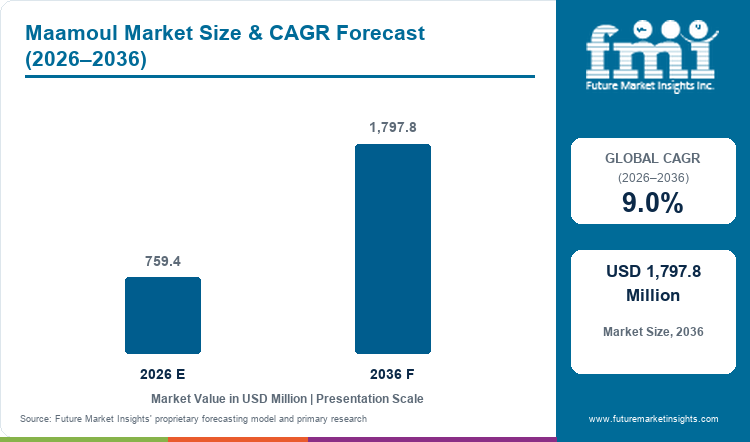
USD 759.4 million in 2026 and USD 1,797.8 million by 2036 at a 9.0% CAGR.
Demand for maamoul is projected to expand from USD 759.4 million in 2026 to USD 1,797.8 million by 2036 at a 9.0% CAGR. Recurring family visits and religious celebrations generate repeated purchase windows for a pastry that buyers already recognize as suitable for sharing. A WGBH report updated in April 2024 documented maamoul as a customary Easter and Eid pastry in the Levant. That direct link to recurring celebrations supports repeat buying because suppliers do not have to introduce an unfamiliar pastry before competing on quality or presentation.
Manufacturers and retailers convert those occasions into regular revenue by matching shelf life and presentation to the intended selling route. Fresh assortments work where bakeries can replenish quickly and packaged formats support grocery or cross-border fulfillment over longer periods. The 2026 Codex adoption of a regional maamoul standard gives producers a clearer reference for product requirements across Near East trade. Repeat orders still depend on texture and pack integrity because damaged products lose much of their value as gifts or shared pastries.
Key Takeaways
- Recurring celebration and hospitality purchases provide the core demand base and packaged formats can extend sales into routine snacking occasions.
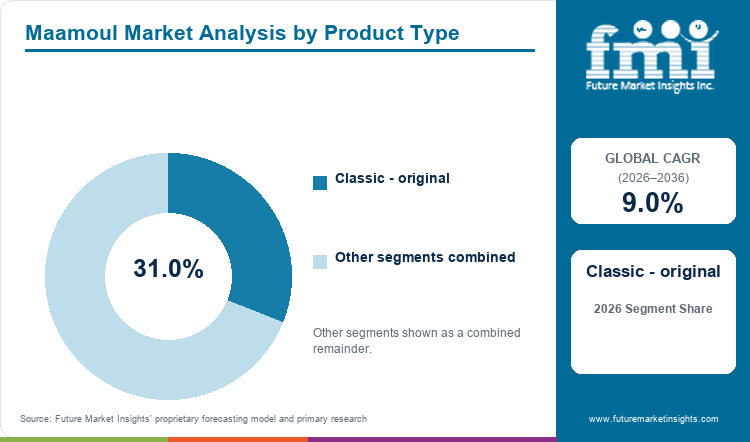
- Classic - original is projected to account for 31.0% of product type demand in 2026 as familiar fillings reduce trial risk for household and gift buyers.
- Conventional is expected to hold 46.0% by claim - nature and fresh is projected to represent 36.0% by format in 2026.
- Multipack is likely to capture 35.0% by packaging format and supermarkets & hypermarkets are expected to hold 29.0% by sales channel in 2026.
- Standardized product requirements can support wider trade but shelf life and breakage still limit longer distribution routes.
- Packaged manufacturers compete through production scale and retail replenishment, while specialty networks compete through freshness, direct ordering and gift presentation.
Analyst Perspective
"Maamoul earns steadier revenue when suppliers plan inventory and sales channels around predictable seasonal peaks rather than treating each celebration as a separate rush. Buyers value familiar fillings and gift-ready presentation but repeat orders depend on texture and reliable replenishment after major celebrations."
- Nandini Roy Choudhury, Principal Consultant, Future Market Insights
How is the maamoul market segmented?
The maamoul market is segmented by product type, claim - nature, format, packaging format, sales channel and region.
The segmentation separates product type and claim - nature from format and packaging format before identifying the sales channel and region. Product type distinguishes familiar recipes from reformulated or premium offers that serve different price points and eating occasions. Claim - nature separates conventional products from clean label and specialist formulations that require different ingredient controls. Format reflects freshness and storage needs while packaging and sales channel show how buyers receive or replenish the product.
Why does classic - original lead demand within the product type category?
Classic date and nut fillings make the purchase easier for buyers who already associate maamoul with celebration and hospitality. Retailers can place familiar maamoul beside other bakery products without changing the shopper's reason for buying it for sharing or gifting. A WGBH report updated in April 2024 described date, walnut and pistachio maamoul as customary Easter and Eid pastries in the Levant. That familiarity lets the same recipe work across bakery counters and standardized retail packs.
- Classic - original is estimated to account for 31.0% of product type demand in 2026 as familiar fillings support broad household and gifting acceptance.
- Familiar date and nut fillings reduce trial risk across household, gifting and retail-pack purchases without relying on an undated company portfolio claim.
Why does conventional lead demand within the claim - nature category?
Conventional recipes give manufacturers more flexibility to balance dough texture and filling stability at mainstream price points. Established production knowledge from biscuits and crackers can support consistent mixing and baking for packaged products. Specialist claims require extra ingredient controls and production separation which can narrow the supplier base. Demand for gluten-free food follows a separate formulation and production path rather than directly replacing conventional maamoul.
- Conventional is expected to hold 46.0% of claim - nature demand in 2026 as familiar formulations support broad production and retail availability.
- Mainstream conventional recipes give retailers a broad-access option while specialist claims require additional ingredient controls and production separation.
Why does fresh lead demand within the format category?
Fresh maamoul lets buyers judge aroma and crumb close to the purchase point where these qualities signal freshness and authenticity. Specialty bakeries can schedule production around holiday orders and shorten the time between baking and consumption. Bakeries must replenish carefully because short selling windows can leave waste after a celebration. The commercial advantage is therefore direct and local: freshness can support premium positioning, but it also limits delivery distance and inventory duration.
- Fresh is projected to represent 36.0% of format demand in 2026 as sensory quality and occasion timing support specialty bakery purchases.
- Direct ordering can widen access beyond walk-in bakery traffic, but suppliers still need protective packing and short delivery windows to preserve the sensory advantage of fresh maamoul.
Why does multipack lead demand within the packaging format category?
Multipacks fit the way maamoul is shared because one purchase can serve a household or several gift recipients. Assortment boxes give buyers several fillings in one purchase and reduce the chance that one flavor limits group appeal. Effective food packaging must protect molded surfaces and separate pieces during handling without adding unnecessary pack cost. Different box sizes can serve gifting and larger sharing occasions, but pack design must remain directly tied to breakage protection and portion needs.
- Multipack is likely to capture 35.0% of packaging format demand in 2026 as sharing and assortment variety converge in one purchase.
- Multipacks support assortment and portioning in one purchase, while sealed internal trays or dividers help protect molded surfaces during retail handling and delivery.
Why do supermarkets & hypermarkets lead demand within the sales channel category?
Supermarkets & hypermarkets combine holiday stock-up with routine grocery traffic and let shoppers compare brands or pack sizes during one visit. The same packaged products can move through online grocery channels when retailers maintain consistent stock and delivery standards. This route is directly relevant to maamoul because standardized packs can remain visible before and after holiday peaks. Retailers benefit from suppliers that can plan promotional inventory without leaving excessive stock after a seasonal peak.
- Supermarkets & hypermarkets are expected to hold 29.0% of sales channel demand in 2026 as assortment visibility supports planned and routine purchases.
- National grocery and online-grocery operations extend access beyond specialty bakery counters, provided suppliers can maintain consistent pack integrity, labeling and replenishment.
What are the drivers, restraints and opportunities in the Maamoul Market?
Recurring celebration purchases support demand as distribution quality and allergen control raise execution costs while standardized packaged formats widen commercial reach.
- Driver: Repeated religious celebrations and household hospitality give the same familiar product several purchase occasions across the year.
- Restraint: Texture loss and pack damage can weaken repeat buying and allergen labeling adds extra work for suppliers in regulated packaged-food channels.
- Opportunity: Standardized product requirements and shelf-stable packs can help suppliers extend maamoul beyond short holiday windows and local bakery reach.
Recurring Occasions Support Repeat Ordering
Households do not need a new eating occasion before purchasing maamoul because established celebrations already provide recurring demand. A WGBH report updated in April 2024 described maamoul as a customary Easter and Eid pastry in the Levant. Suppliers can improve annual revenue by keeping familiar fillings available between major peaks instead of rebuilding stock and distribution for each event. Regular availability turns repeated cultural use into a more predictable production and replenishment cycle.
Distribution Conditions Raise Qualification Costs
Maamoul loses commercial value when transport dries the shell or breaks molded pieces before the buyer opens the pack. USA packaged-food sales add another requirement because sesame is a major allergen under federal labeling requirements for relevant recipes. Suppliers serving allergen-free food demand also need stricter ingredient separation than conventional producers. These requirements favor suppliers that can protect product quality and keep allergen declarations accurate across repeated shipments.
Standardized Packs Can Extend Selling Windows
The July 2026 Codex adoption of a regional maamoul standard gives Near East producers a shared reference for a product that already crosses national borders. The Saudi Food and Drug Authority said the standard is intended to harmonize technical requirements and support regional or international market access. Suppliers can combine that common standard with ambient multipacks that remain suitable for longer delivery windows. Wider distribution works only when shelf life and ingredient information remain reliable after the seasonal gift peak.
Which country CAGRs are included in the Maamoul Market?
| Country | CAGR |
|---|---|
| Saudi Arabia | 9.8% |
| UAE | 9.1% |
| Kuwait | 8.8% |
| Egypt | 9.4% |
| Jordan | 10.8% |
| Lebanon | 10.4% |
| Qatar | 8.5% |
| USA | 10.1% |
How do country-level CAGRs compare in the Maamoul Market?
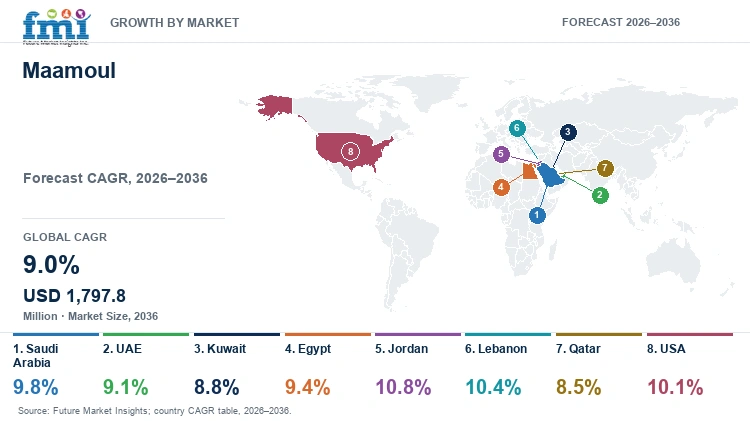
The country forecasts span 2.3 percentage points from Jordan at 10.8% to Qatar at 8.5%. Jordan and Lebanon exceed 10.0% and the United States follows at 10.1% through a more shipping-led model. Saudi Arabia and Egypt remain above the global 9.0% forecast with strong domestic retail demand supporting repeat orders. UAE, Kuwait and Qatar are closer to the global rate even though their buyer bases and retail scale differ.
- Jordan benefits from a strong maamoul heritage and gifting culture, allowing specialty producers to expand their customer reach across domestic and regional markets.
- Lebanon’s established reputation for premium maamoul supports growth through specialty production, exports, and cross-border gifting demand.
- The USA combines growing ethnic-food demand with wide geographic distribution, creating opportunities for packaged maamoul brands that can meet shipping and labeling requirements.
- Saudi Arabia’s large consumer base and well-developed retail channels support consistent replenishment and repeat purchases throughout the year.
- Egypt’s sizable domestic market and expanding packaged-food sector continue to strengthen demand for commercially produced maamoul products.
- The UAE benefits from modern grocery retail, a multicultural consumer base, and strong demand for premium packaged bakery products.
- Kuwait relies on established supermarket networks and a preference for branded packaged foods to support category expansion.
- Qatar’s smaller consumer base places greater emphasis on premium positioning, inventory discipline, and demand linked to seasonal and festive occasions.
CAGR is useful for timing investment only after suppliers compare the revenue they can reach with the cost of serving each country. Similar rates can produce different returns when local production and channel concentration change inventory or delivery costs.
Country-wise Analysis
- Saudi Arabia is forecast to expand at 9.8% CAGR from 2026 to 2036 as domestic production and celebration-led consumption support both seasonal and year-round demand. The Saudi Food and Drug Authority reported in July 2026 that Codex adopted a regional maamoul standard after Saudi Arabia led the drafting process. The shared standard can reduce uncertainty around product requirements for suppliers targeting regional distribution channels. Seasonal gifting remains important and routine grocery purchases also support demand outside major holiday periods.
- UAE maamoul demand is anticipated to grow at 9.1% CAGR through 2036, supported by modern grocery retail and premium gifting channels. Shoppers can compare packaged products through mainstream retail formats rather than relying solely on specialty stores. The combination of everyday retail sales and holiday demand creates multiple routes to market for suppliers. Consistent packaging and reliable replenishment remain important when imported and local sweets compete for shelf space during peak seasons.
- Industry in Kuwait is expected to record 8.8% CAGR during the forecast period as supermarkets continue to support both family sharing and everyday consumption. Retailers can offer conventional and premium maamoul within standard grocery assortments without changing shopping habits. The established retail structure gives suppliers broad product visibility throughout the year. The relatively smaller consumer base places greater emphasis on inventory discipline during periods between major seasonal peaks.
- Egypt is projected to advance at 9.4% CAGR from 2026 to 2036 as packaged maamoul becomes more accessible through mainstream grocery channels. Wider retail distribution allows suppliers to reach consumers beyond traditional bakery purchases. Grocery formats also make it easier for shoppers to compare products during routine food purchases. Product quality remains important, although competitive pricing continues to influence purchasing decisions in a market with many familiar pastry options.
- Jordan is set to register 10.8% CAGR through 2036 as specialist producers combine heritage positioning with direct-to-consumer sales channels. Online ordering extends access beyond walk-in bakery traffic and creates additional opportunities for gifting purchases. The model allows producers to serve both household and seasonal demand through the same distribution network. Flexible production planning helps businesses respond to changing order volumes while preserving product freshness.
- Lebanon is forecast to expand at 10.4% CAGR from 2026 to 2036, supported by a well-established base of specialty sweet producers and gifting demand. A June 2025 Made in Lebanon profile identified Sea Sweet as a Lebanese producer of maamoul and other Arabic sweets with multiple branches. Established producers provide local market coverage while also supporting gifting and export-oriented sales. Maintaining freshness and presentation remains important in premium product categories where appearance influences consumer perception.
- Qatar is projected to advance at 8.5% CAGR during the forecast period as organized grocery retail supports both resident and hospitality demand. Standardized assortments allow shoppers to compare products easily within routine retail visits. The channel structure gives packaged maamoul a wider reach than specialty bakery distribution alone. Inventory planning is needed because premium product demand can vary outside major festive periods.
- USA maamoul demand is anticipated to grow at 10.1% CAGR through 2036 as specialty bakeries and online distribution extend access beyond local ethnic-food markets. Federal allergen requirements make ingredient disclosure an important part of packaged-product compliance. Sellers must manage sesame declarations and other relevant allergen labeling where applicable. Shelf stability and protective packaging become significant when products are shipped long distances for gifting and direct-to-consumer orders.
Who are the notable companies in the Maamoul Market?
Halwani Bros. Co., Deemah (United Food Industries Corporation), Zalatimo Brothers for Sweets, Mahroum Sweets of Nazareth, Saadeddin Pastry, Al Baba Sweets, Rafaat Hallab 1881, Sea Sweet, Bateel International and AlBohsali Sweets are notable companies serving this market.
Competition differs by selling route rather than following one ranking across every buyer and occasion. Packaged manufacturers compete on consistent formats and broad retail access that can handle large seasonal volumes. Bakery networks compete on freshness and direct customer access where frequent replenishment protects product quality. Gifting specialists compete on presentation and assortment design because those features affect willingness to pay during high-value occasions.
- Scaled packaged manufacturers include Halwani Bros. Co. and Deemah (United Food Industries Corporation).
- Regional bakery and pastry networks include Saadeddin Pastry, Al Baba Sweets, Rafaat Hallab 1881 and Sea Sweet.
- Premium heritage and gifting specialists include Zalatimo Brothers for Sweets, Mahroum Sweets of Nazareth, Bateel International and AlBohsali Sweets.
Competitive Benchmarking: Maamoul Market
| Company | Retail-Pack Format Breadth | Gifting & Premium Presentation | Multi-Market Channel Reach | Geographic Reach |
|---|---|---|---|---|
| Halwani Bros. Co. | High | Medium | High | Saudi Arabia, Egypt and export markets |
| Deemah (United Food Industries Corporation) | Medium | Low | High | Saudi Arabia and 50+ countries |
| Zalatimo Brothers for Sweets | Medium | High | Medium | Jordan and international online sales |
| Mahroum Sweets of Nazareth | Medium | Medium | High | Israel, Palestinian territories and export routes |
| Saadeddin Pastry | High | Medium | Medium | Saudi Arabia and selected international channels |
| Al Baba Sweets | Medium | High | Medium | Lebanon and UAE |
| Rafaat Hallab 1881 | High | High | Medium | Lebanon and selected regional or online channels |
| Sea Sweet | Medium | High | Medium | Lebanon and selected international channels |
| Bateel International | Medium | High | High | GCC, Europe, Asia and North America |
| AlBohsali Sweets | Medium | Medium | Low | Lebanon with limited directly documented wider reach |
Scoring basis: High retail-pack breadth requires at least four current maamoul formats or pack types. Medium requires two to three and Low indicates one documented format. High gifting presentation requires several dedicated maamoul gift or premium options. Medium requires at least one documented gifting route and Low indicates basic product availability. High channel reach requires at least three verified country or channel routes. Medium requires two and Low reflects one documented channel or country base.
Key Developments in the Maamoul Market
- In February 2026, Halwani Bros. Co. announced a one-year renewable Sharia-compliant SAR 100 million banking facilities agreement with Emirates NBD Bank. The official Saudi Exchange disclosure states that the facility is intended to finance working capital, making the development directly relevant to the company's operating capacity.
- In February 2025, Deemah reported its participation at Gulfood 2025 through its official news section. The company said the event focused on customer discussions, food-industry innovation, tailored solutions and collaboration, providing a dated and directly relevant channel-development update.
Key Players in the Maamoul Market
Scaled Packaged Manufacturers
- Halwani Bros. Co.
- Deemah (United Food Industries Corporation)
Regional Bakery and Pastry Networks
- Saadeddin Pastry
- Al Baba Sweets
- Rafaat Hallab 1881
- Sea Sweet
Premium Heritage and Gifting Specialists
- Zalatimo Brothers for Sweets
- Mahroum Sweets of Nazareth
- Bateel International
- AlBohsali Sweets
Maamoul Market - Report Scope
| Coverage field | Report scope |
|---|---|
| Market breakdown | By product type, claim - nature, format, packaging format, sales channel and region. |
| Quantitative Units | USD million. |
| Market Definition | Revenue from maamoul sold as a distinct finished baked pastry or cookie across the stated product, claim, format, packaging and channel categories. The scope excludes raw ingredients, baking equipment, baklava, kahk, kleicha, generic filled cookies, cafe services and mixed-dessert revenue when maamoul value cannot be separated. |
| Regions Covered | North America, Latin America, Western Europe, Eastern Europe, East Asia, South Asia and Pacific and Middle East and Africa. |
| Countries Covered | Saudi Arabia, UAE, Kuwait, Egypt, Jordan, Lebanon, Qatar, USA and more than twenty-five additional countries in the full report. |
| Key Companies Included | Halwani Bros. Co., Deemah (United Food Industries Corporation), Zalatimo Brothers for Sweets, Mahroum Sweets of Nazareth, Saadeddin Pastry, Al Baba Sweets, Rafaat Hallab 1881, Sea Sweet, Bateel International and AlBohsali Sweets. |
| Forecast Period | 2026 to 2036. |
| Approach | Primary and secondary research with market triangulation. |
Maamoul Market - Research Methodology
| Method | Approach |
|---|---|
| Primary Research | FMI analysts gathered input from manufacturers, specialty bakeries, distributors, category buyers, packaging suppliers, foodservice operators and subject-matter experts. Interviews examined price points, seasonality, channel mix, fill rates, product quality and the conditions that turn trial orders into repeat purchases. |
| Desk Research | Desk research covered official statistics, food regulations, standards, company filings, dated company announcements and documented channel evidence. Product or retailer listings were not used as development evidence unless a dated official company launch or announcement established direct relevance. |
| Market Sizing and Forecasting | The market model combined the authorized baseline with segment structure, price and volume indicators, packaged-format penetration, country demand conditions and seasonal purchase cycles. Forecast assumptions considered channel expansion, reformulation, input costs, compliance and fulfillment constraints before regional estimates were reconciled. |
| Data Validation | Estimates were checked against company activity, retailer assortment, country evidence and findings from primary research. Validation excluded raw ingredients, bakery equipment, adjacent sweets and mixed assortments when maamoul revenue cannot be separated with reasonable confidence. |
Maamoul Market by Segments
Maamoul Market segmented by Product Type:
- Classic - original
- Whole grain & seeded
- Flavored & filled
- Mini & snacking formats
- Premium - artisan
Maamoul Market segmented by Claim - Nature:
- Conventional
- Clean label
- Organic
- Gluten-free
- High-protein - fortified
Maamoul Market segmented by Format:
- Fresh
- Frozen
- Ambient packaged
- Chilled
- Par-baked - thaw-and-serve
Maamoul Market segmented by Packaging Format:
- Multipack
- Single-serve
- Family - loaf pack
- Bulk foodservice
Maamoul Market segmented by Sales Channel:
- Supermarkets & hypermarkets
- Artisan & specialty bakeries
- Convenience & forecourt
- Online & DTC
- Foodservice distributors
Maamoul Market by Region:
- North America
- United States
- Canada
- Latin America
- Brazil
- Mexico
- Argentina
- Chile
- Western Europe
- Germany
- France
- United Kingdom
- Italy
- Spain
- Benelux
- Nordics
- Eastern Europe
- Poland
- Czech Republic
- Romania
- Hungary
- East Asia
- China
- Japan
- South Korea
- South Asia and Pacific
- India
- ASEAN
- Australia and New Zealand
- Middle East and Africa
- GCC Countries
- South Africa
- Türkiye
- Israel
Research Sources and Bibliography
- GBH. (2017, April 11; updated 2024, April 29). Maamoul: An Ancient Cookie That Ushers In Easter And Eid In The Middle East.
- Saudi Food and Drug Authority. (2026, July 7). Saudi Arabia’s New International Achievement for Traditional Foods: Codex Alimentarius Commission Adopts Maamoul Standard.
- USA Food and Drug Administration. (2024, April 12). The FASTER Act: Sesame Is the Ninth Major Food Allergen.
- Saudi Exchange. (2026, February 4). Halwani Bros. Co. Announces the Signing of a Sharia-Compliant Banking Facilities Agreement with Emirates NBD Bank.
- Deemah. (2025, February 27). Gulfoods 2025.
- Riman, T. (2025, June 5). Sea Sweet | Made in Lebanon.
This bibliography is provided for reader reference and is not exhaustive. The full report contains the complete reference list and detailed citations.
This Report Answers
- What is the Maamoul Market size in 2026 and what value is forecast for 2036?
- Which celebration and hospitality purchase cycles support recurring demand for maamoul?
- Why does classic - original hold the largest position within product type?
- How does conventional influence production economics and mainstream retail availability?
- Why does fresh hold the largest position within format?
- How do maamoul growth rates differ across Saudi Arabia, UAE, Kuwait, Egypt, Jordan, Lebanon, Qatar and USA?
- Which companies compete through packaged manufacturing, bakery networks or premium gifting?
- How do freshness, breakage, allergen compliance and seasonality limit wider distribution?
- What should bakery and retail category managers evaluate before purchasing maamoul from a supplier?
Frequently Asked Questions
How big is the Maamoul Market in 2026?
The global maamoul market is valued at USD 759.4 million in 2026 and is forecast to reach USD 1,797.8 million by 2036. This represents a 9.0% CAGR as suppliers extend recurring celebration demand through packaged retail and direct ordering.
What is driving growth in the Maamoul Market?
Growth comes from recurring celebration and hospitality purchases that already give maamoul a familiar role in households and gifting. Packaged formats and online ordering can extend those purchases beyond the short period surrounding one holiday.
Which product type leads the Maamoul Market?
Classic - original is estimated to account for 31.0% of product type demand in 2026. Familiar date and nut fillings reduce uncertainty for buyers and let retailers serve both gifting and household purchases with a recognizable product.
Who are the key players in the Maamoul Market?
Notable companies include Halwani Bros. Co. and Deemah alongside Saadeddin Pastry and Rafaat Hallab 1881. Zalatimo Brothers for Sweets and Bateel International serve specialty or premium channels while other regional producers broaden local assortment.
What is a notable restraint in the Maamoul Market?
Freshness loss and breakage can reduce repeat purchases when maamoul travels long distances or remains stocked after seasonal peaks. Packaged suppliers also need accurate allergen declarations and controlled production practices for regulated retail channels.
What business problem does the Maamoul Market address?
Maamoul gives households and professional buyers a culturally familiar pastry that already fits sharing and gifting occasions. Suppliers meet different buying needs by offering the appropriate freshness and shelf life for each route to market.
What should category managers evaluate before purchasing maamoul from a supplier?
Category managers should compare filling consistency and breakage alongside shelf life and allergen declarations. They should also test whether replenishment plans can absorb holiday spikes without leaving excess inventory after the event.
Preview the report firsthand - request a free sample
Get SampleGet the brochure for pricing and purchase details.
Get PDFTable of Content
- Key Takeaways
- Market Size and CAGR
- Top Growth Driver
- Fastest Growing Segment
- Leading Region
- Key Companies
- Emerging Opportunities
- Executive Summary
- Global Market Outlook
- Demand-side Trends
- Supply-side Trends
- Technology Roadmap Analysis
- Analysis and Recommendations
- Analyst Perspective (What is happening? Why now? What should investors know?)
- Key Questions Answered
- How large is the market?
- What is the CAGR?
- What are key trends?
- Which region dominates?
- Who are the leaders?
- Market Overview
- Market Coverage / Taxonomy
- Market Definition / Scope / Limitations
- Research Methodology
- Chapter Orientation
- Analytical Lens and Working Hypotheses
- Market Structure, Signals, and Trend Drivers
- Benchmarking and Cross-market Comparability
- Market Sizing, Forecasting, and Opportunity Mapping
- Research Design and Evidence Framework
- Desk Research Programme (Secondary Evidence)
- Expert Input and Fieldwork (Primary Evidence)
- Tooling, Models, and Reference Databases
- Data Engineering and Model Build
- Quality Assurance and Audit Trail
- Market Background
- Market Dynamics (Drivers, Restraints, Opportunity, Trends)
- Scenario Forecast (Optimistic, Likely, Conservative)
- Impact Analysis
- AI Impact
- Sustainability Impact
- Regulatory Impact
- Technology Impact
- Consumer / Buyer Analysis
- Purchase Drivers
- Adoption Barriers
- Buyer Journey
- Opportunity Map Analysis
- Product Life Cycle Analysis
- Supply Chain Analysis
- Investment Feasibility Matrix
- Value Chain Analysis
- PESTLE and Porter's Analysis
- Regulatory Landscape
- Regional Parent Market Outlook
- Production and Consumption Statistics
- Import and Export Statistics
- Global Market Analysis and Forecast, 2021 to 2036
- Historical Market Size Value (USD Million) Analysis, 2021 to 2025
- Current and Future Market Size Value (USD Million) Projections, 2026 to 2036
- Y-o-Y Growth Trend Analysis
- Absolute $ Opportunity Analysis
- Global Market Pricing Analysis, 2021 to 2036
- Global Market Analysis and Forecast, By Product Type, 2021 to 2036
- Introduction / Key Findings
- Historical Market Size Value (USD Million) Analysis By Product Type, 2021 to 2025
- Current and Future Market Size Value (USD Million) Analysis and Forecast By Product Type, 2026 to 2036
- Classic - original
- Whole grain & seeded
- Flavored & filled
- Mini & snacking formats
- Premium - artisan
- Y-o-Y Growth Trend Analysis By Product Type, 2021 to 2025
- Absolute $ Opportunity Analysis By Product Type, 2026 to 2036
- Global Market Analysis and Forecast, By Claim - Nature, 2021 to 2036
- Introduction / Key Findings
- Historical Market Size Value (USD Million) Analysis By Claim - Nature, 2021 to 2025
- Current and Future Market Size Value (USD Million) Analysis and Forecast By Claim - Nature, 2026 to 2036
- Conventional
- Clean label
- Organic
- Gluten-free
- High-protein - fortified
- Y-o-Y Growth Trend Analysis By Claim - Nature, 2021 to 2025
- Absolute $ Opportunity Analysis By Claim - Nature, 2026 to 2036
- Global Market Analysis and Forecast, By Format, 2021 to 2036
- Introduction / Key Findings
- Historical Market Size Value (USD Million) Analysis By Format, 2021 to 2025
- Current and Future Market Size Value (USD Million) Analysis and Forecast By Format, 2026 to 2036
- Fresh
- Frozen
- Ambient packaged
- Chilled
- Par-baked - thaw-and-serve
- Y-o-Y Growth Trend Analysis By Format, 2021 to 2025
- Absolute $ Opportunity Analysis By Format, 2026 to 2036
- Global Market Analysis and Forecast, By Packaging Format, 2021 to 2036
- Introduction / Key Findings
- Historical Market Size Value (USD Million) Analysis By Packaging Format, 2021 to 2025
- Current and Future Market Size Value (USD Million) Analysis and Forecast By Packaging Format, 2026 to 2036
- Multipack
- Single-serve
- Family - loaf pack
- Bulk foodservice
- Y-o-Y Growth Trend Analysis By Packaging Format, 2021 to 2025
- Absolute $ Opportunity Analysis By Packaging Format, 2026 to 2036
- Global Market Analysis and Forecast, By Sales Channel, 2021 to 2036
- Introduction / Key Findings
- Historical Market Size Value (USD Million) Analysis By Sales Channel, 2021 to 2025
- Current and Future Market Size Value (USD Million) Analysis and Forecast By Sales Channel, 2026 to 2036
- Supermarkets & hypermarkets
- Artisan & specialty bakeries
- Convenience & forecourt
- Online & DTC
- Foodservice distributors
- Y-o-Y Growth Trend Analysis By Sales Channel, 2021 to 2025
- Absolute $ Opportunity Analysis By Sales Channel, 2026 to 2036
- Global Market Analysis and Forecast, By Region, 2021 to 2036
- Introduction
- Historical Market Size Value (USD Million) Analysis By Region, 2021 to 2025
- Current Market Size Value (USD Million) Analysis and Forecast By Region, 2026 to 2036
- North America
- Latin America
- Western Europe
- Eastern Europe
- East Asia
- South Asia and Pacific
- Middle East and Africa
- Market Attractiveness Analysis By Region
- North America Market Analysis and Forecast, By Country, 2021 to 2036
- Historical Market Size Value (USD Million) Trend Analysis By Market Taxonomy, 2021 to 2025
- Market Size Value (USD Million) Forecast By Market Taxonomy, 2026 to 2036
- By Country
- United States
- Canada
- By Product Type
- By Claim - Nature
- By Format
- By Packaging Format
- By Sales Channel
- By Country
- Market Attractiveness Analysis
- By Country
- By Product Type
- By Claim - Nature
- By Format
- By Packaging Format
- By Sales Channel
- Key Takeaways
- Latin America Market Analysis and Forecast, By Country
- Historical Market Size Value (USD Million) Trend Analysis By Market Taxonomy, 2021 to 2025
- Market Size Value (USD Million) Forecast By Market Taxonomy, 2026 to 2036
- By Country
- Brazil
- Mexico
- Argentina
- Chile
- By Product Type
- By Claim - Nature
- By Format
- By Packaging Format
- By Sales Channel
- By Country
- Market Attractiveness Analysis
- By Country
- By Product Type
- By Claim - Nature
- By Format
- By Packaging Format
- By Sales Channel
- Key Takeaways
- Western Europe Market Analysis and Forecast, By Country
- Historical Market Size Value (USD Million) Trend Analysis By Market Taxonomy, 2021 to 2025
- Market Size Value (USD Million) Forecast By Market Taxonomy, 2026 to 2036
- By Country
- Germany
- France
- United Kingdom
- Italy
- Spain
- Benelux
- Nordics
- By Product Type
- By Claim - Nature
- By Format
- By Packaging Format
- By Sales Channel
- By Country
- Market Attractiveness Analysis
- By Country
- By Product Type
- By Claim - Nature
- By Format
- By Packaging Format
- By Sales Channel
- Key Takeaways
- Eastern Europe Market Analysis and Forecast, By Country
- Historical Market Size Value (USD Million) Trend Analysis By Market Taxonomy, 2021 to 2025
- Market Size Value (USD Million) Forecast By Market Taxonomy, 2026 to 2036
- By Country
- Poland
- Czech Republic
- Romania
- Hungary
- By Product Type
- By Claim - Nature
- By Format
- By Packaging Format
- By Sales Channel
- By Country
- Market Attractiveness Analysis
- By Country
- By Product Type
- By Claim - Nature
- By Format
- By Packaging Format
- By Sales Channel
- Key Takeaways
- East Asia Market Analysis and Forecast, By Country
- Historical Market Size Value (USD Million) Trend Analysis By Market Taxonomy, 2021 to 2025
- Market Size Value (USD Million) Forecast By Market Taxonomy, 2026 to 2036
- By Country
- China
- Japan
- South Korea
- By Product Type
- By Claim - Nature
- By Format
- By Packaging Format
- By Sales Channel
- By Country
- Market Attractiveness Analysis
- By Country
- By Product Type
- By Claim - Nature
- By Format
- By Packaging Format
- By Sales Channel
- Key Takeaways
- South Asia and Pacific Market Analysis and Forecast, By Country
- Historical Market Size Value (USD Million) Trend Analysis By Market Taxonomy, 2021 to 2025
- Market Size Value (USD Million) Forecast By Market Taxonomy, 2026 to 2036
- By Country
- India
- ASEAN
- Australia and New Zealand
- By Product Type
- By Claim - Nature
- By Format
- By Packaging Format
- By Sales Channel
- By Country
- Market Attractiveness Analysis
- By Country
- By Product Type
- By Claim - Nature
- By Format
- By Packaging Format
- By Sales Channel
- Key Takeaways
- Middle East and Africa Market Analysis and Forecast, By Country
- Historical Market Size Value (USD Million) Trend Analysis By Market Taxonomy, 2021 to 2025
- Market Size Value (USD Million) Forecast By Market Taxonomy, 2026 to 2036
- By Country
- GCC Countries
- South Africa
- Türkiye
- Israel
- By Product Type
- By Claim - Nature
- By Format
- By Packaging Format
- By Sales Channel
- By Country
- Market Attractiveness Analysis
- By Country
- By Product Type
- By Claim - Nature
- By Format
- By Packaging Format
- By Sales Channel
- Key Takeaways
- Key Countries Market Analysis
- United States
- Pricing Analysis
- Market Share Analysis, 2025
- By Product Type
- By Claim - Nature
- By Format
- By Packaging Format
- By Sales Channel
- Canada
- Pricing Analysis
- Market Share Analysis, 2025
- By Product Type
- By Claim - Nature
- By Format
- By Packaging Format
- By Sales Channel
- Mexico
- Pricing Analysis
- Market Share Analysis, 2025
- By Product Type
- By Claim - Nature
- By Format
- By Packaging Format
- By Sales Channel
- Brazil
- Pricing Analysis
- Market Share Analysis, 2025
- By Product Type
- By Claim - Nature
- By Format
- By Packaging Format
- By Sales Channel
- Chile
- Pricing Analysis
- Market Share Analysis, 2025
- By Product Type
- By Claim - Nature
- By Format
- By Packaging Format
- By Sales Channel
- Germany
- Pricing Analysis
- Market Share Analysis, 2025
- By Product Type
- By Claim - Nature
- By Format
- By Packaging Format
- By Sales Channel
- United Kingdom
- Pricing Analysis
- Market Share Analysis, 2025
- By Product Type
- By Claim - Nature
- By Format
- By Packaging Format
- By Sales Channel
- Italy
- Pricing Analysis
- Market Share Analysis, 2025
- By Product Type
- By Claim - Nature
- By Format
- By Packaging Format
- By Sales Channel
- Spain
- Pricing Analysis
- Market Share Analysis, 2025
- By Product Type
- By Claim - Nature
- By Format
- By Packaging Format
- By Sales Channel
- France
- Pricing Analysis
- Market Share Analysis, 2025
- By Product Type
- By Claim - Nature
- By Format
- By Packaging Format
- By Sales Channel
- India
- Pricing Analysis
- Market Share Analysis, 2025
- By Product Type
- By Claim - Nature
- By Format
- By Packaging Format
- By Sales Channel
- ASEAN
- Pricing Analysis
- Market Share Analysis, 2025
- By Product Type
- By Claim - Nature
- By Format
- By Packaging Format
- By Sales Channel
- Australia and New Zealand
- Pricing Analysis
- Market Share Analysis, 2025
- By Product Type
- By Claim - Nature
- By Format
- By Packaging Format
- By Sales Channel
- China
- Pricing Analysis
- Market Share Analysis, 2025
- By Product Type
- By Claim - Nature
- By Format
- By Packaging Format
- By Sales Channel
- Japan
- Pricing Analysis
- Market Share Analysis, 2025
- By Product Type
- By Claim - Nature
- By Format
- By Packaging Format
- By Sales Channel
- South Korea
- Pricing Analysis
- Market Share Analysis, 2025
- By Product Type
- By Claim - Nature
- By Format
- By Packaging Format
- By Sales Channel
- Poland
- Pricing Analysis
- Market Share Analysis, 2025
- By Product Type
- By Claim - Nature
- By Format
- By Packaging Format
- By Sales Channel
- Hungary
- Pricing Analysis
- Market Share Analysis, 2025
- By Product Type
- By Claim - Nature
- By Format
- By Packaging Format
- By Sales Channel
- Türkiye
- Pricing Analysis
- Market Share Analysis, 2025
- By Product Type
- By Claim - Nature
- By Format
- By Packaging Format
- By Sales Channel
- South Africa
- Pricing Analysis
- Market Share Analysis, 2025
- By Product Type
- By Claim - Nature
- By Format
- By Packaging Format
- By Sales Channel
- Saudi Arabia
- Pricing Analysis
- Market Share Analysis, 2025
- By Product Type
- By Claim - Nature
- By Format
- By Packaging Format
- By Sales Channel
- UAE
- Pricing Analysis
- Market Share Analysis, 2025
- By Product Type
- By Claim - Nature
- By Format
- By Packaging Format
- By Sales Channel
- Kuwait
- Pricing Analysis
- Market Share Analysis, 2025
- By Product Type
- By Claim - Nature
- By Format
- By Packaging Format
- By Sales Channel
- Egypt
- Pricing Analysis
- Market Share Analysis, 2025
- By Product Type
- By Claim - Nature
- By Format
- By Packaging Format
- By Sales Channel
- Jordan
- Pricing Analysis
- Market Share Analysis, 2025
- By Product Type
- By Claim - Nature
- By Format
- By Packaging Format
- By Sales Channel
- Lebanon
- Pricing Analysis
- Market Share Analysis, 2025
- By Product Type
- By Claim - Nature
- By Format
- By Packaging Format
- By Sales Channel
- Qatar
- Pricing Analysis
- Market Share Analysis, 2025
- By Product Type
- By Claim - Nature
- By Format
- By Packaging Format
- By Sales Channel
- United States
- Market Structure Analysis
- Competition Dashboard
- Competition Benchmarking
- Market Share Analysis of Top Players
- By Regional
- By Product Type
- By Claim - Nature
- By Format
- By Packaging Format
- By Sales Channel
- Emerging Startups
- Innovation Benchmarking
- Competition Analysis
- Competition Deep Dive
- Halwani Bros. Co.
- Overview
- Product Portfolio
- Profitability by Market Segments
- Sales Footprint
- Strategy Overview
- Marketing Strategy
- Product Strategy
- Channel Strategy
- Deemah (United Food Industries Corporation)
- Zalatimo Brothers for Sweets
- Mahroum Sweets of Nazareth
- Saadeddin Pastry
- Al Baba Sweets
- Rafaat Hallab 1881
- Sea Sweet
- Bateel International
- AlBohsali Sweets
- Halwani Bros. Co.
- Case Studies
- Success Stories
- Recent Developments
- Competition Deep Dive
- Assumptions & Acronyms Used


